




Abstract
This article explores the challenges faced by women with disabilities in combining the roles of ‘mother’ and ‘worker’ in Lithuania and reflects on the strategies mothers employed to overcome these. Semi-structured interviews were undertaken with twenty women with a variety of (dis)abling conditions and diverse life experiences between 2014 and 2018. In-depth thematic analysis by qualitative research teams revealed a constant tension in women’s aspirations to have a family and work. This revealed women’s enormous personal resources which facilitated them to overcome challenges they faced in motherhood as well as seemingly insurmountable obstacles to employment. However, within the vicious circle of social and economic challenges, they fought their battles with silent compliance, which hid their experiences and potentially denied them opportunities for support. This research reveals a policy response in Lithuania that categorises disability as an individual issue to be overcome rather than a socially constructed experience. The findings indicate the need for reframing understanding at macro, as well as micro-level policy interventions. At the micro-level, sensitive forms of professional support would help mothers with disabilities to choose more pronounced strategies of coping while also maintaining their dignity and privacy. These findings provide insights into the specific situation of women in Lithuania but are also relevant to many other contexts.
Introduction
Disability rights movements pursue that people with disabilities should be given opportunities to live as independently as possible (DeJong, 1984; Oliver, 2013). Some of these opportunities, like the right to health care, social services or education are now provided without question, whereas others, such as sexual and reproductive rights, and the services or supports that come with these rights, are rather perceived as dilemmatic and obscured in the shadows of public discourse. Silence on these issues is evident in Lithuanian society, which, despite the Convention on the Rights of Persons with Disabilities, ratified in 2010, is still fighting disability stigma inherited from the Soviet past, in which persons with disabilities were hidden in specialized institutions (Pranckūnienė and Ruškus, 2016; Rasell and Iarskaia-Smirnova, 2013; Šumskienė et al., 2015, 2021). 1 This article reflects on how women with disabilities (re) act at the intersection of maternity and employment.
Worldwide, women with disabilities face both objective challenges, including health-related issues and limitations, and subjective challenges including negative societal attitudes and stigma (Corrigan, 2007). Research shows that the sphere of maternity is still driven by stereotypes and women with disabilities can be perceived as ‘unsuitable’ for maternity (Wolfe and Blanchet, 2000). They are seldom offered opportunities to expand their knowledge of disability-specific reproductive health care and are rarely supported after childbirth and beyond. Professionals doubt their parenting skills, and often take a paternalistic and controlling role (McCarthy, 1998).
The family-work dilemma in the context of disability and the strategies that women use to cope with it, are insufficiently investigated, both in Lithuania and internationally. Disability scholars mostly focus either on the family component (Clarke and McKay, 2008; Wade et al., 2007) or employment-related issues (Stull, 2014), independently. Specific research about working mothers who have a disability is extremely limited. Thus, in this paper, we include a review of all relevant and available literature. We start by examining the literature on mothering with a disability, we then review the research on working with a disability and finally we discuss the limited research that explores the intersection of mothering and working with a disability.
Mothering with disability
According to Giddens (1991), certain competencies are expected from a person in the postmodern society: to be able to control one’s ‘life project’, to take risks, and to rely on knowledge from expert systems to do this. These expectations are also transferred to the realm of motherhood. Pregnant women with disabilities experience scrutiny from service providers and from the public (Frederick, 2017). The literature paints a stark picture of life for mothers with disability. Baum and Burns (2007) describe how women with disabilities are more likely have their children taken into care. Goldacre et al. (2015) highlight that women with intellectual disabilities are more likely than the majority population to give birth at a young age, more likely to be unmarried (42% compared with 9% of women without disabilities) and more likely to have smoked in the pregnancy (54% compared with 23%).
Rather than receiving support, mothers with intellectual disabilities feel they are being monitored (Starke, 2010). Aware that their actions are put under a ‘lens’ of scrutiny, women conceal their disability while also developing strategies to handle socially intrusive situations (Molden, 2014: 141). However, after the birth of a child, mothers report feeling abandoned; they are expected to be independent carers of their children and their own needs are often overlooked. This is further compounded by fear of social judgement and loss of independence (Parton et al., 2017). Mothers with disabilities are thus trapped in the ‘visibility paradox’: the invisibility of their childbearing needs due to their disability on the one hand, and unwanted public visibility in terms of constant judgement, on the other hand (Molden, 2014: 145). Moreover, due to long lasting prejudices, mothers with disabilities are not only ‘selectively’ visible but even ‘silenced’ (Lourens, 2018) in research, policy and practice. This can lead to families not getting the services they require and lead to the poorer outcomes which propagate the stereotypes in the first place (Lightfoot et al., 2020; Lindblad et al., 2013).
Motherhood for women with disabilities requires reconceptualization of mothering where autonomy and independence replace dependence (Vaidya, 2015) or, using Giddens’ (1991) frame, encompasses her power to control her own life. Against a common assumption that motherhood will be an unbearable burden, it may, paradoxically, create the conditions for empowerment and help to gain a higher status in society (Vaidya, 2015).
Internationally, research highlights that to comply with societal expectations, mothers with disabilities are inventive in overcoming obstacles and ensuring a ‘good childhood’ for their children (Molden, 2014; Parton et al., 2017; Vaidya, 2015). This challenge, however, can culminate in ‘self-sacrifice’ (Parish et al., 2008; Parton et al., 2017), which manifests in prioritising family needs at the neglect of the mother’s own needs.
Working with disability
‘Participation in the labour market is one of the prerequisites of social and economic well-being, and a general satisfaction with one’s life, both in the majority population (Robertson and Cooper, 2011) and among people with disabilities (Brown and Maloney, 2009; Vaidya, 2015). Most research reveals family and work as conflicting areas of life for women (Bellavia and Frone, 2005; Duxbury and Higgins, 2001; Eby et al., 2005 and many more) that can generate stress (Joshi and Bogen, 2007). Buckingham et al. (2020) analyse the impact of the intersectionality of various inequalities including education and (dis)ability for women in work across the EU and highlight the impact of the disproportionate amount of time that women spend on caregiving roles and domestic work, on their ability to thrive in work. In addition, stereotypes and discrimination still colour women’s and in particular, mother’s, experiences of the labour market (Bobbitt-Zeher, 2011). This is compounded for women with disabilities (Molden, 2014). Their chances of accessing employment are lower (Blank, 2007) and women with disabilities encounter more barriers at work (Coffey et al., 2014). In the literature, persons with disabilities are often viewed as one homogenous group with gender distinctions and other diversity not examined (Folguera, 2014; Hashim and Wok, 2014; Lindsay et al., 2019; Vick and Lightman, 2010). Demographic data about the family situation of persons with disabilities is usually limited to the data on marital status or, in other cases, where focused on motherhood, the occupational situation is omitted (e.g. Goldacre et al., 2015).
Molden (2014) describes how mothers with disabilities perceive their work as an opportunity to gain confidence and model autonomy, and that they see it as a key aspect of their role as a mother. For others, working is a possibility for retaining a sense of self (Parton et al., 2017). The intersection of disability and employment is a challenge in the wider context of female employment. Women are expected to fulfil two competing roles, to be a good worker and a good mother (Turner and Norwood, 2013). Not surprisingly, working mothers with disabilities report financial pressures, lack of time, energy and social support, which often leads to total exhaustion (Parton et al., 2017) and to a perceived failure to play the modern role of ‘super mom’ (Vaidya, 2015). These circumstances necessitate that working mothers with disabilities must adapt in the face of their daily struggles.
Balancing work and child-rearing
It is widely accepted that efforts to combine work and family life often require certain coping strategies – ways to cope with role demands and stresses (Folkman and Lazarus, 1988; Hall, 1972; Rout et al., 1997; Sharma, 1999). Hall (1972) classified coping strategies into three types: 1. Structural role redefinition to cope with structurally imposed demands (for instance, adjusting one’s working hours); 2. Personal role redefinition (changing one’s role expectations as opposed to changing expectations of themselves); and 3. Reactive role behaviour (assuming that one’s role is un-changeable and one has to meet the demands). Folkman and Lazarus (1988) identified problem-focused and emotion-focused coping. There were many attempts to apply these two models, but the prevalent research focuses on women without disabilities (Lo et al., 2003; Rout et al., 1997; Sharma, 1999). Rout et al. (1997) found that while both working and non-working mothers tended to focus on the positive, reduce tension and seek social support, non-working mothers used wishful thinking, self-blame and ‘keep to self’ more often. Lo et al. (2003) revealed that few working mothers engaged with organizations to change work conditions, and mostly adjusted their expectations or enlisted the help of others to cope. Both studies found evidence of reactive role behaviour and emotion focussed coping.
Research on the strategies that working mothers with disabilities adopt in a workplace is scarce. The few studies that focused on this problem, found that coping strategies can also be influenced by one’s perception of one’s disability (Souza, 2010). Some women resist the very idea of a ‘disability’: for example, in the culture of the Deaf community, there is a rejection of deafness as deficit and as the sole identity, and rather, emphasis on other dimensions of identity, such as, being lifetime educators or self-advocates (Riach and Loretto, 2009; Souza, 2010). Strategies for these women include advocating for their and their children’s needs, accessing support from social services and their extended families, relying on their religious beliefs and, in many cases, extreme self-sacrifice (Parish et al., 2008). The family-work dilemma that mothers with disabilities face and the strategies they use is scarcely researched in international research and a new subject in Lithuania.
The context in Lithuania
Lithuania was occupied by the Soviet Union until late 1980s. On 11 March 1990, a year before the formal dissolution of the Soviet Union, Lithuania passed the Act of the Re-Establishment of the State of Lithuania, becoming the first Soviet republic to proclaim its independence. Lithuania passed the Law on the Social Integration of the Disabled in 1991 which aimed to grant equal rights to persons with disabilities in all aspects of life and included a commitment to also gather statistics on various aspects of life for people with disabilities. Lithuania joined the United Nations (UN) in 1991 and the European Union (EU) in 2004 and subsequently adopted the Universal Declaration of Human Rights (UDHR), the Salamanca Statement and later the Convention on the Rights of Persons with Disabilities (CRPD) (Van Kessel et al., 2020).
During the Soviet period, people with disabilities, were hidden from society in large institutions where they suffered neglect of their autonomy, privacy and pro-creational rights (Gevorgianienė and Šumskienė, 2017; Rasell and Iarskai͡a-Smirnova, 2013; Šumskienė et al., 2021; Tobis, 2000; Vann and SiSka, 2006). In the case of mild disabilities, women, usually the residents of boarding schools, were prepared for employment as cook assistants, seamstresses, dishwashers (Lithuanian Society of Persons with Disabilities, 2018). Since independence, the rights of persons with disabilities have progressed. The most recent development is the right to personal assistance which was introduced by the (Lithuanian Ministry of Social Security and Labour 2021). This means, that a person with a disability can now access personal support for up to four hours a day, seven days a week, to enable him or her to be self-sufficient and to ensure basic needs are met.
Research focussed on the situation of working mothers with disabilities is sparse in Lithuania, which contributes to their political and discursive invisibility (national research in this field is mostly focused on the mothers who have children with disabilities) (Lithuanian Ministry of Social Security and Labour, 2018). In its Concluding Observations on the initial report of Lithuania, the Committee on the Rights of Persons with Disabilities (2016:11) highlights an ongoing lack of disaggregated and reliable data regarding persons with disabilities across all sectors. The Committee calls upon the State to ‘systematise the collection, analysis and dissemination of data’ for people with disabilities and to provide adequate support services to ensure that families with parents and/or children with disabilities have the right to a family and a home. In 2018, Lithuanian Society of Persons with Disabilities conducted research on the situation of women with disabilities in Lithuania. According to this report, 43% of women with disabilities have no work experience. Those who have worked, claim that their choice of workplace is limited, and that disability is the main obstacle to being employed. In 2018, the Ministry of Social Security and Labour of Lithuania also undertook research. 2 This showed that a third of respondents – women with disabilities – still experience discrimination in many areas of their life, including their right to have children. The intersection of work and child-rearing was not discussed in this research.
The Yearly Review of Poverty and Social Exclusion (2020) identified the poverty of persons with disabilities in Lithuania as one of the highest in the EU. However, the gender differences are not illuminated in this report. The lack of research reveals the persistence of the perspective of disability as a personal issue rather than a socially constructed phenomenon both in the field research, as well as, in the social policies of the country.
Methodology
Thirty-seven in-depth qualitative semi-structured interviews with working mothers who have disabilities were undertaken by five Lithuanian native-speaking interviewers in the period of 2014 and 2018. Two of the interviewers also had a disability themselves. Interviewees were recruited through disability NGOs, social care institutions and professional contacts of the researchers. Inclusion criteria included having a diagnosed disability; the experience of employment; and having minor or adult children (including situations of losing the custody of a child); understanding of the research and the ability to give informed consent. The exclusion criteria were not having children (never being pregnant and giving birth), the absence of work experience, or insufficient capacity to describe their experiences and thoughts verbally or not being in a position to give informed consent. Women who met at least one of the above-mentioned criteria were not included from the research.
Information about the research was provided in accessible plain language, both verbally and in written format. Time was spent with the participants to ensure that the purpose of the research was understood, and that consent was informed and voluntary. This also created the space to develop a positive relationship and to ensure participant’s comfort and to create the conditions for their full participation. Anonymity and confidentiality of the interviewees were ensured, and data protected at all stages. Ethical approval for this research was obtained from the Ethics Committee of the Department of Social Work and Social Welfare at Vilnius University.
Socio-demographic profile of the research participants.
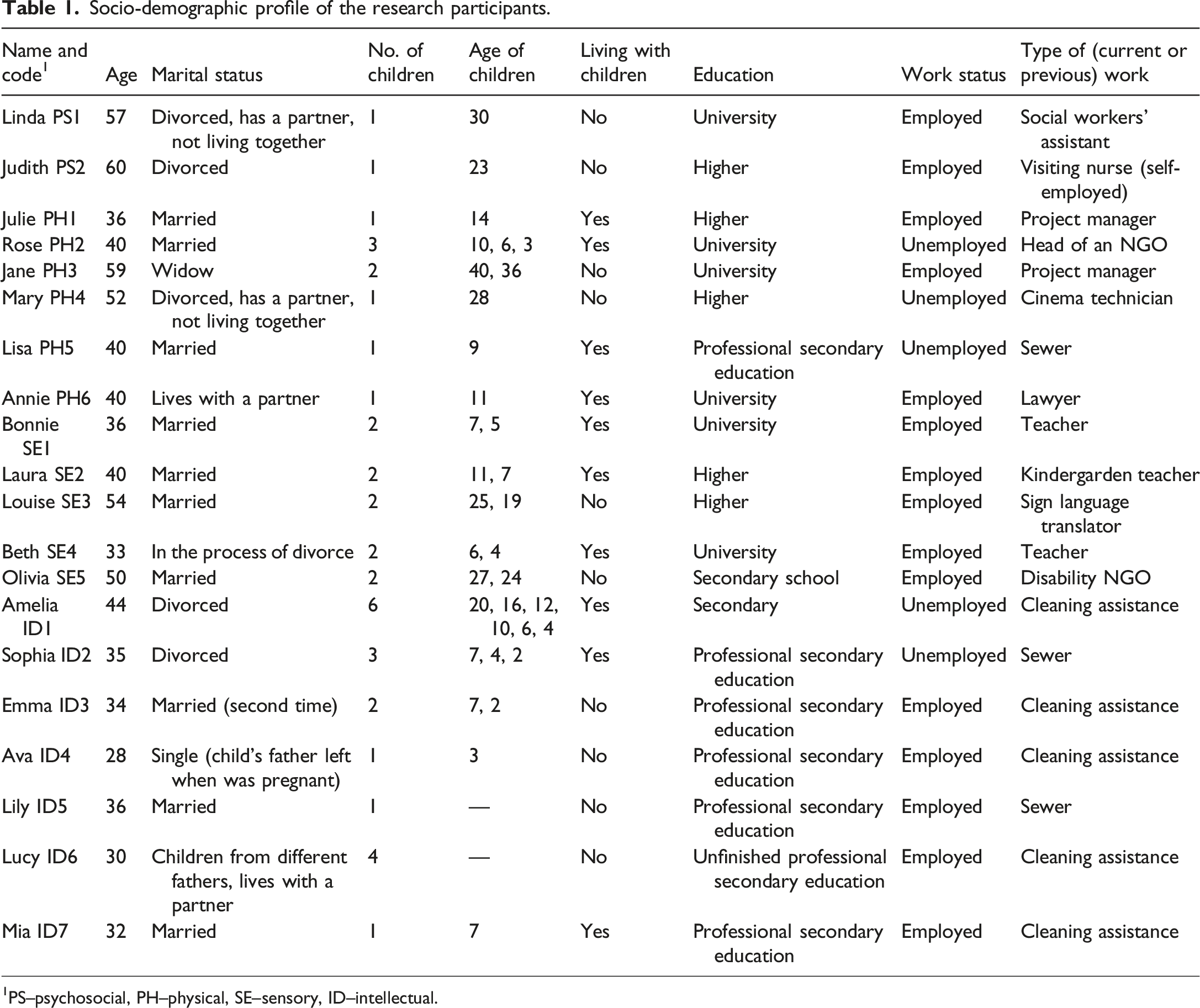
PS–psychosocial, PH–physical, SE–sensory, ID–intellectual.
The interview protocol was informed by the literature and the researchers’ previous academic and social work in the field. Interview questions included demographic data, such as age, type of disability, family and employment situation, number, and age of children and childcare; and covered the breath of the employment and disability experience, including a focus on the intersectional areas such as care. Consideration of the needs of interviewees was paramount to the process. Questions were designed to be easily understood. In addition, interviews took place in locations decided by the interviewees for their comfort. These measures supported the active participation of participants. Reflecting on this process now, in future research we would develop this engagement further, by inviting representatives of women with disabilities to join a research advisory group which would have input on the research design and approach overall.
Interviews lasted between 30 and 90 minutes. The interviews were audio recorded. With their permission, interviews with women who had hearing impairments were assisted by sign language translators. A constant dialogue between the researcher, the participant and the sign language interpreter helped to clarify and deepen the conversation and check the researcher’s understanding of responses. Researchers also took extensive notes.
After several interviews with working mothers having different disabilities, saturation was reached and no new themes were emerging. However, in the interviews of mothers who have intellectual disabilities the loss of custody of a child emerged as a theme which was not identified in interviews of mothers with other types of disabilities. For this reason, we interviewed larger numbers from this group to reach saturation on this topic.
Interviews were transcribed verbatim. All interviewees were assigned an individual code, which refers to the type of disability and facilitates attributing a statement to a particular interviewee. Twenty interviews that corresponded to the inclusion criteria were selected from the large pool for analysis.
Analysis
The interviews were analysed using thematic analysis (Meuser and Nagel, 2009) with particular attention paid to the intersectionality of the issues surrounding disability and employment. The interviews were first manually coded independently by each researcher. Following this, in-depth discussion between the researchers facilitated a collaborative analysis across the interviews. The interviews were conducted in Lithuanian; for the purposes of the analysis in the international team, large parts of the selected interviews were translated into English. The derived themes were identified, collected and discussed among the researchers until consensus was reached about the overarching themes. During the process of analysis, the authors worked closely together, constantly exchanging ideas, checking their visions and discussing the ambiguous parts.
Findings
The findings reveal significant challenges for working mothers with disability in combining work and motherhood and describe the strategies they use to cope. We will discuss these in relation to four themes which have emerged from the analysis: ambition and resignation at work; fight and surrender in motherhood; a child at the intersection of mother’s work and care; and the importance of social networks.
Employment: between ambition and resignation
Mothers in this study named employment as a significant part of their lives. For them, it fostered self-esteem, allowed them to provide financial resources for their family, as well as affording them status in society. The type of disability predisposed the character of work: irrespective of the age or number of children, women with physical disabilities pursued qualified labour in the free labour market; women with intellectual disabilities most often worked in unskilled jobs in the free market; whereas women with sensory disabilities in this study were employed in qualified labour in disability NGOs.
Ambition: proving one’s capability to the extent of self-sacrifice
Women described that having a child motivated them to do everything they could to secure their quality of life. This often-meant commitment to heavy workloads and a personal struggle for the very right to have a job. I worked with seven projects at a time, I was employed at the newspaper, and along with that – my direct work. Even in good health, someone would find this challenging, but I was fighting as a real mother for my children (Jane, PH3).
Four mothers with physical disabilities in this study, were, or had been, employed in places which required specific qualifications, such as a lawyer, a cinema technician, a school and university teacher. In these jobs, they faced multi-layered challenges that lead them to have to fight for their rights, integrity, financial survival and self-esteem. The challenges were addressed mostly on an individual level, with women fighting invisible battles and achieving personal victories. This was especially evident in the case of Mary, which demonstrates her motivation to work, with silent reconciliation in a situation of utmost injustice. I couldn’t climb into the bus, so I walked a few blocks. There was mud everywhere, so I fell and I struggled to get up. My condition makes it difficult for me to stand up without help. People passing by said things like ‘YOU, stop using drugs (…)’… I did not want to lose my job. I wanted to keep it, so I did everything I could get to work that day (Mary, PH4).
Annie, PH6, also went to extraordinary effort to prove she could work under surveillance: ‘they’d throw you like a little fly into the soup and watch whether you swim or sink. And they’d observe you with a magnifying glass, whether you manage, or not’ (PH6). Annie worked to achieve flexible working hours, environmental adjustment and the respect of her colleagues. Even though her wage was below minimum, the sense of self-fulfilment and social recognition, for her, outweighed a higher salary, professional mobility, or other rights.
Resignation: ‘providing for my children’
In this study, all the participants with intellectual disabilities had a lower level of education. Their employment experience corresponded to the expectations they felt were placed upon them by society – to be silent, invisible and diligent. They worked as cleaning assistants (five women) and in sewing (two women). Their attitude towards work and employment was instrumental. Their ambition was less focussed on employment progression and more to provide for their family: ‘I get a salary, I can save’ (Ava, ID4); ‘I want to work so that I can earn and provide for my kids’ (Emma, ID3). The work was perceived as an escape from daily problems, rather than as a means for self-realization: ‘It is more interesting [to work] than just sit at home’ (Amelia, ID1); ‘It was easy because I know how to sew’ (Sophia, ID2); ‘I am busy thinking of work and I can forget my problems’ (Ava, ID4). For some mothers with an intellectual disability, the psychological atmosphere at their work was a positive contrast compared to the challenges they faced rearing their children or the problematic relations with partners or their mothers. Four mothers with intellectual disabilities had lost a child’s custody (or were at risk of this), their employment was often seen as a means to bring back their children or to keep them: ‘I want to work to have my children back’ (Emma, ID3).
The attitude of interviewees with intellectual disabilities towards themselves in the workplace, and communication with co-workers reflected the deeply entrenched social expectation to be obedient, to conform, not to object, not to argue. Such social expectation combined with low self-esteem led to a passive acceptance of professionals’ intervention in their families. The strategy they used to perform both the role of a mother and an employee contained a paradox-they attempted to make their efforts visible but kept their problems to themselves.
In all cases, participant’s chance to work was limited not only by the physical or mental health issues, but also by the structural hindrances: women with intellectual disabilities experience exclusion from the open labour market due to the negative attitudes of employers and lack of support.3
Disability as a preconceived maternal ‘disqualification’
For the majority of women with disabilities in this study, the choice to have a child led to a real ‘fight’ with professionals: ‘When I said I was pregnant, the doctor’s eyes popped out. “Abortion. Immediately”’. (Lisa, PH5). Doctors sometimes warned of potential negative consequences to a mother and a risk that a child could inherit a disability. Mothers were rarely aware of their right to bear children and their right to request professional help. However, most professionals provided support after encountering their strong determination to give birth: ‘…when I said [to a doctor] that I will not do anything to the child, she said “well, let’s try”’ (Rose, PH2).
The loss of child custody was especially evident in the cases of mental illness or intellectual disability (one out of two interviewees with psycho-social and four out of seven women with intellectual disability had lost custody of their children). One participant recalls ‘I was hospitalized and no one told me where my child was, for two weeks, no one. I had no idea why the doctor hadn’t told me, although she knew it’ (Judith, PS2). Another participant reports lack of choice ‘I remember giving my children but I did not want to’ (Emma, ID3).
In many of the cases, the reasons for loss of custody was not the disability itself, but a lack of support. The participants clearly identified this. ‘It is terribly, terribly, terribly difficult for a single mother to raise a child. I’d say it’s impossible if you do not have relatives and their support’ (Judith, PS2). In some cases professionals provided non-evidence informed arguments that perpetuate stigma. One mother recalls: ‘they were afraid that if my child starts crying, I will get angry and I will throw him out of the window’ (Lily, ID5). Losing custody of a child takes place in the context of accumulated oppression over the life course. The experiences of the women in this study reveal the challenges for mothers with disabilities in engaging with professionals, as well as, how the societal view of disability still prevalent in Lithuania impacts this.
The reality of parenting with a disability
Interviewees reported that their disability also created challenges for their children, who were everyday witnesses of their mothers’ struggles. Many of the mothers in this study described the burden of support borne by their children: ‘While my son was not studying, he was our carer… he used to come, he helped me to go out, and to come back’ (Annie, PH6). ‘Children do everything – washing, drilling, laundry’ (Rose, PH2). ‘My daughters help me, very much: to translate, to call, to do housework’ (Olivia, SE5). ‘My child has walked along with me all that way – from the beginning of disability to a better condition now’ (Judith, PS2).
Interviewees expressed their worries about bullying, and also the often sparse financial and physical possibilities, which limited children’s lives and opportunities: ‘in summer [the child is] more or less busy, but summer quickly passes and when winter comes… oh my God, there’s no way we can get out anywhere’ (Lisa, PH5). They also expressed worry that they would be unable to provide proper support for the start of their children’s adult lives: ‘he needs that kick-off, and no-one is there to give it to him’ (Mary, PH4).
Family and social support
The support of extended family members, friends and neighbours in combining child-rearing and work was often an essential part of mothering for women with disabilities. Support in the immediate environment sometimes resulted in less need for external institutional help. The search for work or kindergarten was often determined by the proximity of family members who could provide assistance – this was especially important for women with physical disabilities. In other cases, when relatives lived far away, the most essential support was received from neighbours or co-workers (again revealing the centrality of work). The situation of mothers with disabilities invokes the saying that it takes a village to raise a child. It was also reported by interviewees that the loss of a child was caused by an absence of support in the extended family, as well as the experience of intersecting inequalities such as poor living conditions or addiction: ‘There was no bathroom, no toilet at my parents’ place…. They both, my mother and father, had alcohol problems’ (Lucy, ID6); ‘My mother-in-law would help me with the child. When sober, she was ok. We started arguing when she was drunk… It was her who called “child protection”’ (Emma, ID3). Many families were trapped in a cycle of inter-generational poverty. As noted above, some mothers in this study grew up in childcare institutions which were the standard place of care in Lithuania at that time, and they themselves had had challenging childhoods.
Theoretical implications: invisible struggles instead of an open ‘fire’
This exploratory study confirms the impact of disability on access to and participation in work by mothers with a disability and illuminates how structural inequalities exacerbate that experience (Buckingham et al., 2020). The findings describe the challenges that mothers with all types of disabilities face in the realm of employment and charts how mothers negotiate these experiences with emotion focussed coping strategies (Folkman and Lazarus, 1988) and self-adaptation (Rout et al., 1997) rather than challenging the system, revealing the internalised oppression (Freire, 1978) and self-sacrifice.
Mothers with intellectual and psychosocial disabilities form the most silent group. Similar to the findings of Ababneh and Al Shaik (2020), they tend to be wary of social interactions, especially with professionals, and choose to be invisible rather than be exposed to scrutiny. Women with physical and sensory disabilities tend to be more vocal and more visible. They make high demands on themselves. In fact, strategies employed by these working mothers balance on the edge of ‘self-sacrifice’ (Parish et al., 2008; Parton et al., 2017, 2019). However, like their counterparts, this facilitates their silent surrender to often unfavourable working conditions. This research highlights how (in)visibility is consciously managed by mothers with disabilities as the main precondition for their highly-valued social safety and privacy, even at the cost of social services and other types of outside support (this somewhat explains their ‘market invisibility’) (Frederick, 2017). This further reveals the stark impact of intersectional inequalities on the lives and work of women with disabilities and their families (Buckingham et al., 2020).
Jost and Banaji (1994) classify such chosen invisibility as the phenomenon of system justification – the tendency to defend and justify the societal status quo, even where one suffers under this system, common where persons with disabilities have suffered historically (Pranckūnienė and Ruškus, 2016; Šumskienė et al., 2021). These findings resonate with both Molden’ research (2014) which revealed the self-silencing of mothers with disabilities in the face of difficulties; and external silencing of women in adverse situations where there is lack of support, inaccessibility of services, etc., described by Lourens (2018). There are also parallels with the experience and reactions of mothers who are perceived as deviant in other social settings, for other reasons (Bradley and Millar, 2020). The motivation for invisibility is a need to reduce uncertainty, threat and social discord in their lives. This research also confirms the analysis of Heidi Lourens (2018) who explained this ‘voicelessness’ through internalization of a largely uninhabitable world. However, in our research, the working mothers with disabilities ‘inhabited’ a ‘parallel’ world which they used all their energy to create. In some sense, their life is like a still river – calm on the surface, but with a lot of deep underwater struggles and obstacles to overcome.
This study is small in its scope and limited within one country. Yet, how disability is socially constructed makes the findings relevant to other jurisdictions. In particular it will have resonance with new states or post authoritarian regimes, which face social and political changes and are beginning to review the concept of disability, and approaches to this in legal and social policy and practice.
Practical implications
The silence of working mothers with disabilities somewhat explains the lack of initiatives for systemic, structural changes in the Lithuanian disability policy. Marsden describes how social change can occur ‘through the focused action of a relatively small group of determined individuals with access to a power elite’ (2012, : 180). Aunos et al. (2003) argue that mothers with disabilities rarely engage in networks and thus lack access to the power elite and have less chance at advocating for change. Challenging the social structures and institutions can publicly highlight the challenges women face and further exacerbate women’s vulnerability and risk of custody loss. Without doubt, there is a discrepancy between the power in the social policy system and the personal resources of mothers with disabilities where social services are perceived as a constant threat, services that are based on doubting parenting abilities and possess the mandate to take the child into custody (Lintott and Sander-Staudt, 2012).
Change is needed. Advocacy for the right to be a mother, a wife, an employee, a co-worker is needed. The politics of shutting up (Lourens, 2018: 574), embedded in physical and social structure, has to be challenged. This study also highlights the gaps in professional support received by women and the need for development in this area with an approach underpinned by rights. Further research into what forms of professional support would help mothers with disabilities is essential. Any intervention should be sensitive and in partnership with women, creating the conditions for women to take up their own power, time to reflect on unspoken experiences and to reclaim opportunities at their own pace.
Trends of the Lithuanian disability policy mirror the general trends in other post-socialist countries (Šumskienė et al., 2021); therefore, this research could contribute to the change in the disability discourse and multidisciplinary professional practices throughout the region. This has the potential for meaningful practical implications for the lives of working mothers with disabilities.
Conclusions
Through this research, mothers with disabilities challenge the widespread belief about their limited capacities in maternity and employment. Their life choices and achieved victories confront attempts to squeeze them into a limited life path informed by prejudices and stereotypes. With persistent efforts to combine child-care with a job, mothers create a strong and persuasive narrative – a narrative of determined, loving mothers, able to work with disability and sculpt their lives from opportunities they often silently struggle for.
Particular socio-cultural and economic circumstances create a context, which limits opportunities for women with disabilities. But mothers with disabilities find short- and long-term strategies to combine maternity and employment and ‘write’ into this context their own story – a narrative that challenges social prejudices. They do this in their everyday lives in a unique and startling manner discovering ways to self-fulfilment both in their personal life and at work. But still waters run deep – beneath the surface of their lives there are many invisible challenges which they overcome silently, setting aside rightful complaints and demands, often in order (and in need!) to preserve personal energy for their small yet admirable victories. Paraphrasing the words of Heidi Lourens (2018: 571), their silence is the currency in which they try to secure and protect this essential resource.
This research reveals a policy response in Lithuania that still categorises disability as an individual issue to be overcome rather than a socially constructed experience. The findings suggest the need for reframing understanding at the macro as well as well as micro-level policy interventions. At the micro-level, sensitive forms of professional support would help mothers with disabilities to choose more pronounced strategies of coping while also maintaining their dignity and privacy.
This small explorative study provides a glimpse on a rarely researched topic, expanding on previously identified difficulties faced by women with disabilities in fulfilling their family obligations and employment and paves the way for a more detailed exploration of this subject. To better understand the strategies mothers with disabilities use at the intersection of work and care, it would be helpful to study cohorts with different disabilities separately. Future analysis could also help to explore the structural relationship between the institutional context, family situation, employment and the impact of the type of disability.
Footnotes
Declaration of conflicting interests
The author(s) declared no potential conflicts of interest with respect to the research, authorship, and/or publication of this article.
Funding
The author(s) disclosed receipt of the following financial support for the research, authorship, and/or publication of this article: This work was supported by the European Union’s Horizon 2020 research and innovation programme under grant agreement No 952366.
