




Abstract
Across Europe, the labour market participation of persons with disabilities remains lower than that of persons without a disability. Our research examines this disability employment gap, looking specifically at its variation by country and gender. Additionally, we test the influence of labour market policies – testing both the social investment perspective and the welfare scepticism perspective – on the size of the gap, in an effort to determine whether a more generous welfare state raises or lowers the employment rate of people with disabilities. Using the European Union Statistics on Income and Living Conditions (EU-SILC), we show that Southern European countries have the smallest disability employment gap. Whereas stricter employment protection legislation is found to be beneficial for people with disabilities on the labour market, other labour market policies specifically intended to benefit this group do not strongly affect their chances on the labour market. These findings support the social investment perspective and show that social policies can have a positive effect on the employment of people with disabilities.
Introduction
According to the UN Convention on the Rights of Persons with Disabilities (CRPD), people with disabilities should enjoy equality with others in society, including on the labour market. However, the employment rate of people with disabilities is consistently lower than that of people without a disability (Geiger et al., 2017; Jones, 2008; OECD, 2010; Waddington and Priestley, 2018). Social barriers as well as impairments may result in difficulties finding a job – because of prejudice among employers, the accessibility of workplaces or the inability to work full-time. Hence, finding and keeping a job is more difficult for disabled people than for non-disabled people. A higher employment rate among disabled people is, however, not only a requirement of the CRPD; it also has economic benefits for society. It can help in diminishing labour supply shortages; it also increases economic activity and reduces dependency on social benefits. Moreover, employment is known to improve individuals’ wellbeing (Dean et al., 2018) and is often considered to be key to social inclusion (Barnes and Mercer, 2005; Cregan et al., 2017).
Therefore, this study seeks to explain differences in the employment rates of disabled and non-disabled residents of European countries. Since the CRPD emphasises equality on the labour market, we concentrate on the difference in employment rates (in percentage points) between people with and without disabilities – the disability employment gap (DEG) – rather than on the employment rates of disabled people per se. This gives more insight into relative inequality than absolute employment rates, which can be high for people with disabilities in countries where there is nevertheless a large DEG. The DEG could be measured either in percentage points (i.e. as a percentage of the total working-age population) or in percentages (relative to the total employed labour force). Measuring the DEG in percentage points, it can be interpreted as the percentage of the total working-age population with disabilities that should additionally be employed in order to close the employment gap with people without disabilities. In our view, this best captures the intention of the CRPD to provide equal opportunities on the labour market for all people with disabilities. Previous studies have already established that disability rates and the DEG vary among European countries (Geiger et al., 2017; Heggebø and Dahl, 2015; Jones, 2008, 2016; Kuznetsova and Yalcin, 2017; McAllister et al., 2015; Reeves et al., 2014). Although previous studies have examined the employment of people with disabilities, very few have homed in on the DEG and its explanations. Adding to existing research, this study tests the impact on the DEG of labour market policies that can be expected to be relevant specifically to people with disabilities. The main question we seek to answer is:
To what extent can labour market policies explain differences in the size of the disability employment gap in Europe?
Variation in DEG size among countries is most likely due to country-level or institutional factors, rather than demographic factors or differences in health (Börsch-Supan, 2007). Institutional factors can, for instance, include laws intended to prevent discrimination against people with disabilities (Nardodkar et al., 2016). However, the implementation of such anti-discrimination laws seems to have little impact on the labour market situation of disabled people (Clayton et al., 2012; Jones, 2008; Kuznetsova and Yalcin, 2017). Other studies have focused on variations among welfare regimes (Bambra, 2011; Bratsberg et al., 2010; Tschanz and Staub, 2017; Van der Wel et al., 2011). One might expect that a generous welfare state would ensure better access to the labour market for marginalised groups and a safety net for those who cannot participate (Esping-Andersen, 1990; Korpi, 2010; Van der Wel et al., 2011). The Nordic countries, which combine a generous welfare state with a high overall employment rate, might be expected to perform well regarding the employment of people with disabilities. Indeed, some studies show that in Scandinavian welfare regimes absolute employment rates among chronically ill people are higher than in other European countries (Burström et al., 2000; Holland et al., 2011a; Van der Wel et al., 2012; Whitehead et al., 2009). However, studies also show that these countries have higher rates of benefit recipients and that the gap in employment rates between those with and without disabilities is relatively large (Bratsberg et al., 2010; O’Brien, 2015). In this study we build on the existing literature, but we move beyond this rather broad welfare state perspective by focusing on specific labour market policies that may be relevant to disabled people and studying how these affect the DEG in European countries. To examine differences in the DEG across Europe, we use the European Union Statistics on Income and Living Conditions (EU-SILC) for 23 countries between 2004 and 2017.
The concept of disability
In our study, those who indicated that they are limited or strongly limited in activities because of long-standing health problems are identified as people with a disability. This is one of many ways to identify people with a disability and is a common approach when using large-scale surveys (Jones, 2008; Molden and Tøssebro, 2010). It is, for instance, also used by the Academic Network of European Disability Experts (ANED) to report on disability employment rates, among others as input for the European Semester (ANED, 2018; Waddington and Priestley, 2018). There are some limitations to this approach. It is possible that the country-specific context influences the definition and reporting of disability, which makes it more difficult to compare across countries (Kapteyn et al., 2007; O’Brien, 2015). Moreover, people living in institutions are often excluded from large-scale surveys, which may exclude those with the most severe disabilities. These are, however, issues that are not easily resolved due to the complexity of the concept of disability (Baumberg et al., 2015; Molden and Tøssebro, 2010). Research based on register data, for instance, may result in apparent differences between countries that reflect little more than different institutional definitions of disability. Moreover, register data may also include people who do not see themselves as disabled. Therefore, we choose to rely on self-reports, including only those who perceive themselves to be limited by long-standing health problems.
Theoretical framework
Social investment perspective
Ideas differ on the impact of social policies on labour market participation. According to one perspective, a more generous welfare state increases the labour market participation of disadvantaged individuals (Midgley, 1999; Morel et al., 2012; Van der Wel et al., 2011). This idea is based on the social investment perspective, which holds that government social policies may benefit economic growth if they provide people with the resources, such as training, needed to find a job and offer workers protection against firing in case of illness. For instance, more generous benefits may give people the time to invest in human capital, which can eventually result in a higher employment rate (Holland et al., 2011b; Van der Wel et al., 2011). This perspective applies to the population in general, but also to specific disadvantaged groups including people with disabilities. Based on this perspective, we can formulate expectations about the influence of several labour market policies on the employment rates of people with disabilities.
The first policy characteristic under study concerns countries’ active labour market policies (ALMP). These are policies aimed at increasing disadvantaged groups’ access to the labour market by increasing work incentives and removing barriers to work (Bonoli, 2011). In contrast to earlier studies, however, we concentrate only on those ALMP relevant for people with disabilities (e.g. Holland et al., 2011a; McAllister et al., 2015; Van der Wel et al., 2011): sheltered and supported employment, and vocational rehabilitation and training (Waddington and Bell, 2016; Waddington and Priestley, 2018). Sheltered employment includes jobs that are created for people with disabilities – usually outside of the regular labour market – and vocational rehabilitation and training aims to improve skills relevant in the labour market (Waddington and Bell, 2016). Last, subsidised employment provides financial support to employers who hire a person with a disability. Employers may be hesitant to hire a person with a disability due to fear of frequent absenteeism or of the costs associated with adapting the workplace, or simply due to prejudice about the likely productivity of the disabled employee (Brouwers, 2016; Nelissen, 2018; Sundar et al., 2018). If governments (partly) cover the costs of employing disabled people, this can act as an incentive for employers to hire them (Holland et al., 2011a). Hence, these are social policies aimed at removing barriers and enhancing human capital; by investing in such policies, the employment rate of people with disabilities could increase (Waddington and Priestley, 2018). The first hypothesis we formulate is:
The more countries spend on active labour market policies aimed at supporting people with disabilities, the more likely that disabled people are employed and the smaller the disability employment gap (H1).
Although not specifically aimed at the labour market participation of people with disabilities, ‘flexicurity’ policies could also affect their chances of employment (Waddington and Priestley, 2018). Countries with a higher level of flexicurity are characterised by flexible rules concerning the hiring and firing of workers and higher shares of temporary contracts (Backhans et al., 2016; Holland et al., 2011a; McAllister et al., 2015). Flexible contracts are particularly common for low-pay, low-quality jobs (Green et al., 2010). In regulated labour markets (those with less flexicurity), governments invest more in disadvantaged groups and also offer better protection for workers who become ill (Burström et al., 2000; McAllister et al., 2015). Moreover, less flexicurity provides an incentive for employers to invest in their employees and in life-long learning (De Deken, 2017).
1
The employment situation for people with disabilities is therefore likely to be better in countries with fewer flexible contracts and more protection against dismissals. We formulate the following hypotheses:
The lower the share of flexible jobs, the more likely that people with disabilities are employed and the smaller the disability employment gap (H2a).
The stricter the employment protection legislation, the more likely that people with disabilities are employed and the smaller the disability employment gap (H2b).
Welfare scepticism perspective
In contrast to the social investment perspective, the welfare scepticism view argues that a more generous welfare state has harmful effects on the disadvantaged in society (Midgley, 1999; Van den Noord et al., 2006; Van der Wel et al., 2011). The more a country spends on social programmes, the less incentive those disadvantaged in the labour market have to find paid employment, as they have an alternative source of income (Holland et al., 2011b; Prinz and Tompson, 2009). Although such social policies may improve the general wellbeing of people with disabilities, the policies may hinder their labour market participation.
According to the social investment perspective, lower shares of flexible jobs and stricter employment protection legislation (EPL) could result in higher employment rates among people with disabilities. However, a contrasting expectation can be formulated based on the welfare scepticism perspective. Countries with a higher level of flexicurity may provide more employment opportunities for people with disabilities (Burström et al., 2000). Additionally, from an employer’s perspective, hiring a disabled person is less risky if it is easier to dismiss an employee or to hire a person on a temporary contract. If the disabled employee calls in sick often, or is less productive than expected, the employer can end the contract without much ado. It could thus be expected that a higher level of flexicurity is related to higher employment rates of disabled people. We therefore propose a contrasting hypothesis:
The higher the share of flexible jobs, the more likely that people with disabilities are employed and the smaller the disability employment gap (H2c).
The more flexible the employment protection legislation, the more likely that people with disabilities are employed and the smaller the disability employment gap (H2d).
Additionally, specific social policies for people with disabilities may hamper the employment opportunities for this group. Disability benefits, for instance, can create the impression that the recipient does not need to work. If the benefits are high enough, the recipients may not be motivated to find employment, even if they could work (part-time). It can be seen as compensation rather than as a social investment (De Deken, 2017). Based on the welfare scepticism perspective, we expect that in countries that spend less on disability benefits, the incentive to find paid work is higher and therefore the employment rates of people with disabilities will be higher. Bonoli (2011) refers to this as incentive reinforcement: policies that increase the incentive to find employment for those in a weak position on the labour market.
The less countries spend on disability benefits, the more likely that disabled people are employed and the smaller the disability employment gap (H3).
Existing studies show that in many European countries the male breadwinner model is still dominant and that employment rates vary along gender lines (Trappe et al., 2015; Warren, 2007). Moreover, men and women tend to be employed in different kinds of jobs (Cregan et al., 2017). Therefore, women with disabilities may face double the hurdles that their male counterparts face, and it is possible that this results in a different DEG for each gender (Cregan et al., 2017; O’Hara, 2004; Waddington and Priestley, 2018; Werth, 2015). That is why we test all hypotheses separately for men and for women.
Data and methods
For the analysis, we used the European Union Statistics on Income and Living Conditions (EU-SILC). We used waves from 2004 to 2017. EU-SILC is a cross-sectional dataset with a focus on income, poverty, social exclusion and living conditions, and it includes more than 30 countries in Europe. EU-SILC has been carried out every year since 2004 among people 16 years of age or older. People living in collective households and institutions are usually excluded (more information about the data and data collection can be found on the website of Eurostat). 2 Data from all the waves of the EU-SILC were pooled. From this dataset, we selected the working age population (18–65). We only included countries for which country-level policy characteristics were available. After this selection, the dataset included a total of 3,575,967 respondents in 23 countries. 3
Disability status
Respondents were asked whether they are limited in activities because of health problems. Respondents could choose between yes, strongly limited; yes, limited; and no, not limited. The respondents who reported themselves to be strongly limited and limited in their activities due to health problems are combined, due to the relatively small number of respondents who reported being strongly limited. Hence, we distinguish between respondents limited in their activities because of health problems (1) and respondents that are not limited (0). The 94,453 respondents (2.6%) with a missing value on this item were excluded from the analysis, leaving a total of 3,481,514 respondents. In total, about 19% of the respondents reported themselves to be limited in daily activities due to health problems. 4
Dependent variable
The dependent variable is whether respondents are employed. The item basic activity status is recoded: the unemployed, those in retirement, and other inactive people are combined in the no paid work category (0) and working people in the paid work category (1). 5
Individual-level control variables
We included age as a continuous variable, ranging from 18 to 65 years old. We also considered education level using the International Standard Classification of Education (ISCED). Education level included the following three categories: pre-primary, primary, lower secondary (1); upper secondary (reference category); and post-secondary non-tertiary, tertiary education (3). Last, household type was included, since there may be a difference between single and married people and between those with and without dependent children. Household type is measured using five categories: one-person household (0); two-adult household, no dependent children (1); single-parent household, one or more dependent children (2); two adults, one or more dependent children (reference category); other households (4). 6 Last, year of survey was included as a control variable.
Missing values
From the 3,481,514 respondents we excluded 45,749 (1.3%) due to missing values. In total, our dataset included 3,435,765 respondents, of which 1,650,714 were men and 1,785,051 women.
Country-level characteristics
Our first policy characteristic is ALMP, derived from the OECD dataset on public expenditure and participants in labour market programmes (OECD, 2019a). We used public expenditure as a percentage of GDP on sheltered and supported employment and rehabilitation from 2004 to 2017. Sheltered and supported employment programmes are subsidies for the employment of people with disabilities. Rehabilitation is vocational rehabilitation for people with a reduced working capacity; this is intended to prepare these workers to move on to work or regular training. There is no data for the year 2017. Moreover, information about ALMP is missing for the UK from 2012 to 2016, Spain in 2016, Italy in 2016, and France in 2016. For country-year combinations with missing values, the closest known values were used. Since the public expenditure on sheltered and supported employment and rehabilitation is relatively stable over the years for most countries, we do not expect that this has introduced significant errors.
To measure flexicurity, three indicators were used. The first indicator was the share of flexible jobs in a country, measured with Eurostat data on the share of temporary contracts (Eurostat, 2019c). We included the share of temporary contracts for men and for women separately for all years. From the OECD we derived a measure of employment protection legislation (EPL) strictness, focusing on two areas: protection of workers on regular contracts against individual dismissal (the second indicator of flexicurity) and regulation of temporary forms of employment (the third indicator for flexicurity; OECD, 2019b). The measurement of EPL strictness consists of 14 items which are converted into a scale ranging from 0 to 6. A higher score on this scale indicates stricter regulations. For most countries, 2013 is the latest year for which information is available. For Lithuania, there is no information from 2004 to 2014. For Estonia, Luxembourg and Slovenia, data is missing from 2004 to 2007. No information is available for Latvia between 2004 and 2011. Again, the closest data available were used for the years that data are missing.
The third policy characteristic was the percentage of GDP spent on disability benefits. These data were derived from Eurostat and cover benefits that provide an income to people of working age who cannot work due to a disability (Eurostat, 2019b). It also concerns rehabilitation services specifically for people with disabilities and goods and services (other than medical care) for disabled people.
Country-level control variables
Additionally, several country-level characteristics were included as control variables. With these control variables, we take into account the macro-economic context in a country because this may partly explain variation in employment outcomes. The overall employment rate of each country was available for men and women separately (Eurostat, 2019a). We also controlled for the share of part-time work as a percentage of total employment for men and women. Moreover, we considered countries’ GDP per capita. The descriptive statistics for both individual- and country-level variables can be found in Supplemental Appendix A.
Methodology
The analysis consists of two parts. First, we used logistic regression analysis with robust standard errors to study the DEG. We included dummies for each country and to account for the nesting of individuals within countries, we used country-year robust standard errors (Figures 1 and 2). Second, because one-step multilevel regression analysis may not be reliable when there are too few countries at the second level, we use two-step multilevel models to examine the influence of the policy characteristics on employment status (Angel and Heitzmann, 2015; Bryan and Jenkins, 2016; Huber et al., 2005). 7 The first step is an estimation of the individual-level effects for each country separately. The logit coefficients of the effect of being disabled and the standard errors are stored and used as the dependent variable in the second step (Figure C1 in the Supplemental Appendices shows the effects of disability on employment for each country). Hence, we ran a logistic regression estimating the likelihood to be employed while taking into account disability status, age, educational level, household type and year. Thereafter, the logit coefficients of the effect of being disabled are regressed on the policy characteristics using the edvreg procedure for Stata to account for possible heteroscedasticity (Lewis and Linzer, 2005). The edvreg procedure uses a weighted least-squares estimation with robust standard errors.
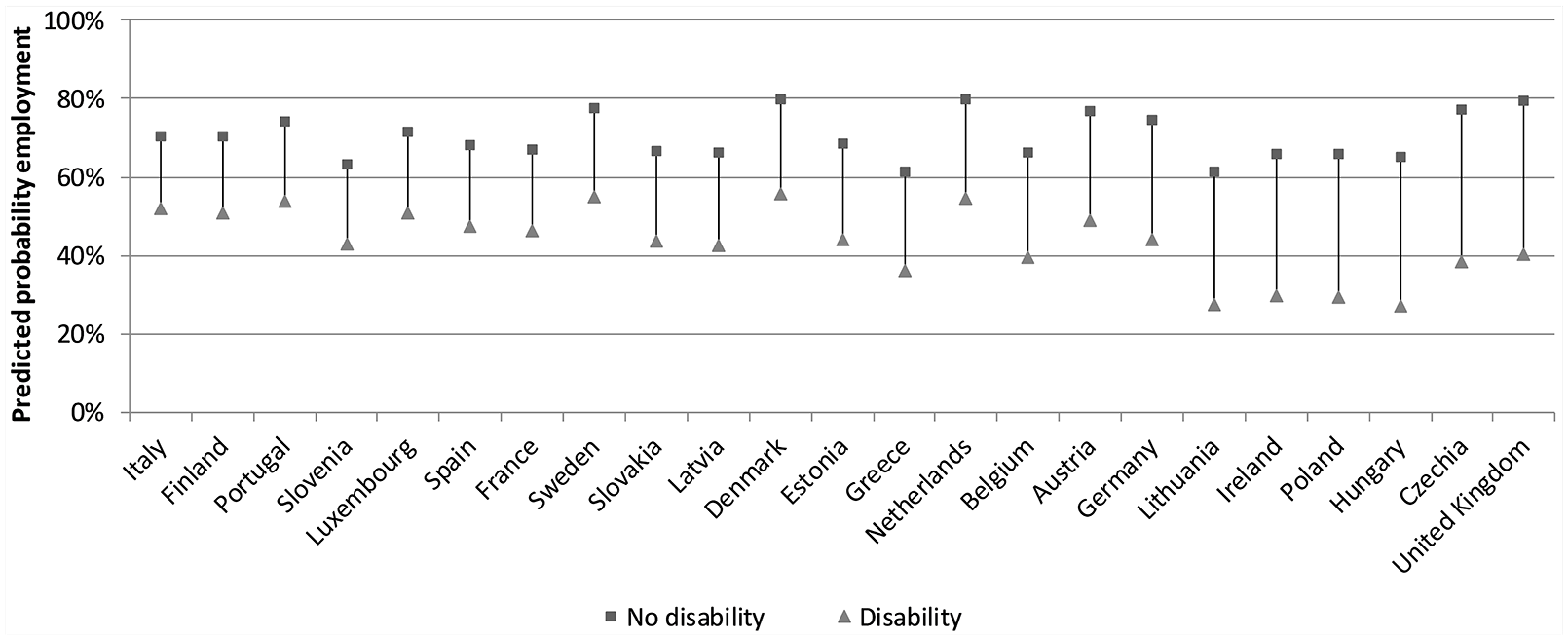
Predicted probabilities of employment for men.
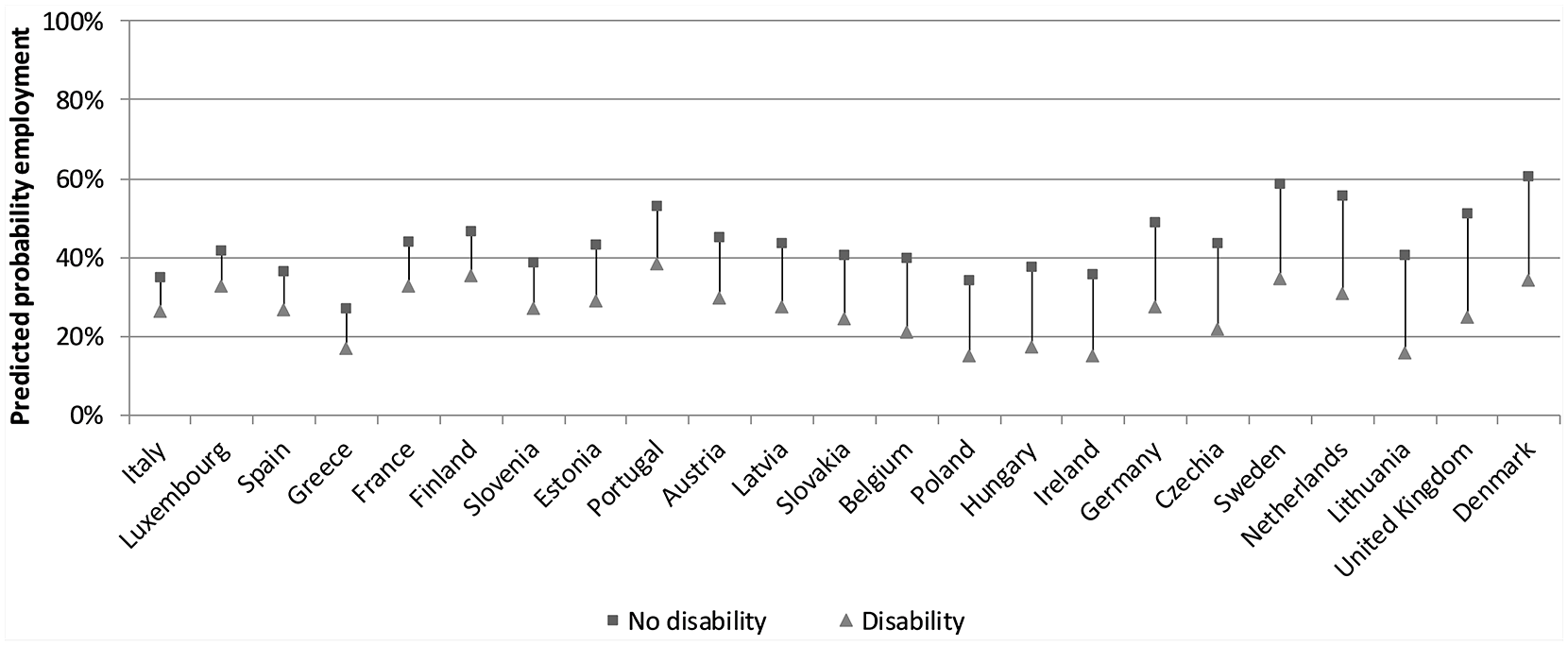
Predicted probabilities of employment for women.
Results
First, we estimated a model that included each country (separately, as a dummy) and the interactions between disability status and country of residence. This enabled us to calculate the DEG while taking into account sociodemographic characteristics. From this model, we calculated predicted probabilities to ease interpretation, which are shown in Figures 1 and 2 (Model 1 can be found in Supplemental Appendix C). The figures show that the DEG exists in all countries and, moreover, demonstrate the variation in predicted probabilities of employment between disabled and non-disabled men and women. Based on these analyses, we see that the gap varies between 10 to 42 percentage points and that in countries where people with disabilities have a relatively high probability to be employed, the gap can still be large, such as in Denmark, the Netherlands and Austria for women and Sweden, the Netherlands and Denmark for men. This indicates that in countries where the macro-economic situation is relatively favourable and the general employment rate is high, the relative employment situation for people with a disability is not necessarily better in the sense that the DEG is smaller. The gap is the smallest for men in Italy, Finland, Portugal and Slovenia; it is largest for men in the UK, Czechia, Hungary and Poland. For women, the gap is largest in Denmark, the UK, Lithuania and the Netherlands. It is smallest in Italy, Luxembourg, Spain and Greece. 8
Figure 3 shows the association between the policy characteristics and the logits of the effect of being disabled on employment status, taking into account individual level control variables. A higher coefficient indicates a higher likelihood to be employed, and, thus, a smaller DEG. First, Figure 3 shows a negative association between the share of GDP spent on ALMP and the employment status of disabled women. Second, it shows a positive association, and therefore a smaller DEG, for women in countries with a higher share of temporary contracts, whereas the effect for men appears to be very small. The figures, furthermore, show a positive association between EPL for regular and temporary contracts and employment status, which indicates that stricter EPL results in a smaller DEG for both men and women. Lastly, there is a positive association between the share of the GDP spent on disability benefits and the employment rates of people with disabilities.
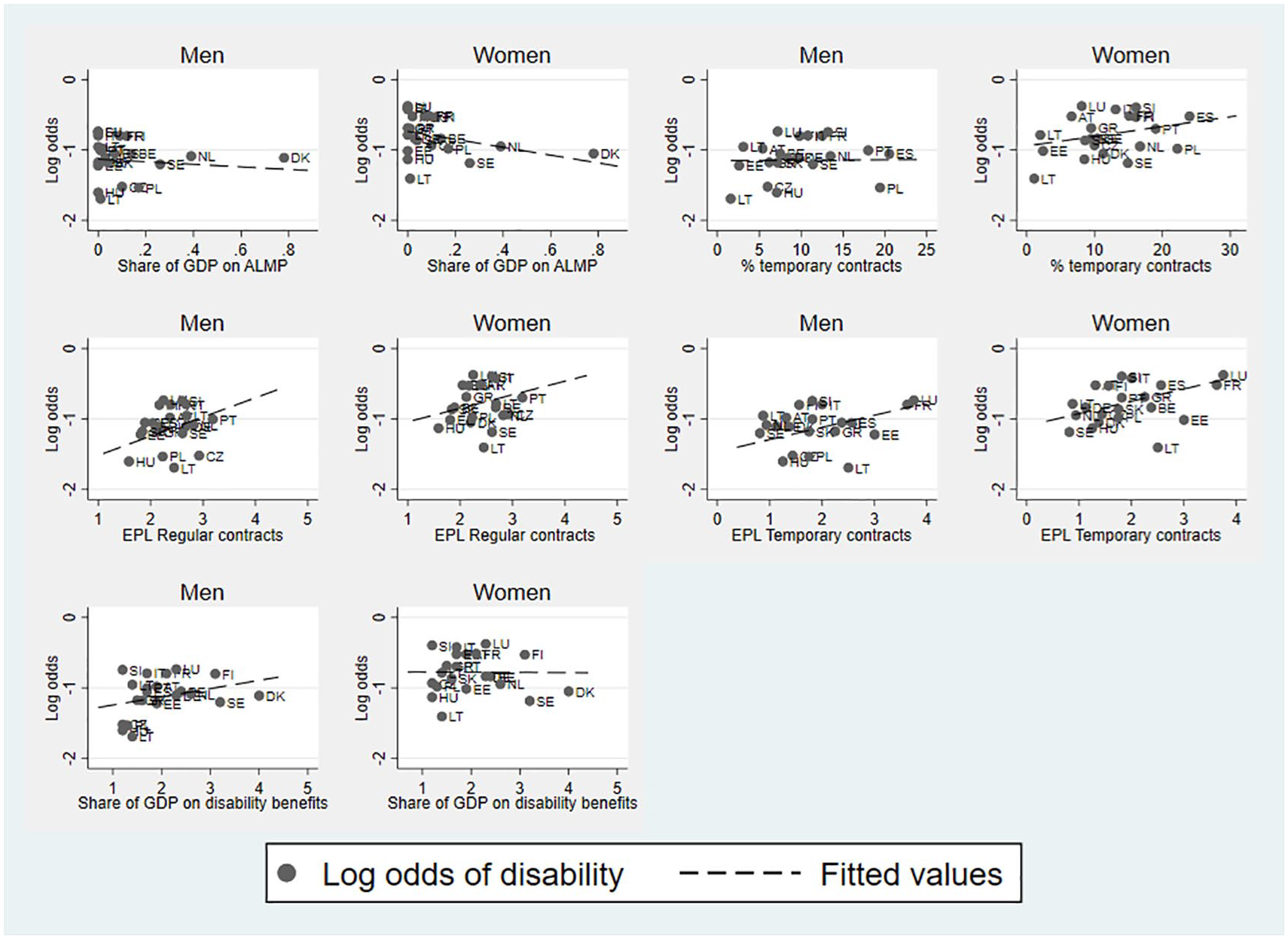
Associations of logits of the effect of being disabled on employment status and policy characteristics by country.
We examine the associations from Figure 3 in more detail using two-step multilevel models. The effects of the policy characteristics on the disability effect on employment are presented in Table 1. Recall that our first hypothesis (in accord with the social investment perspective) was that more spending on ALMP would increase the employment rates of people with disabilities and result in a smaller DEG. In Table 1, the coefficients shown are the effect of a change in the country-level variables on the effect of being disabled on the odds of being employed (compared to people without disabilities). Model 1 shows no significant effect for men, but a negative significant effect for women, indicating that the likelihood of being employed for women with disabilities compared to women without disabilities is smaller in countries spending a higher share of GDP on ALMP. Hence, we do not find support for the first hypothesis. This effect might mean that ALMP for women with disabilities has a lock-in effect which hinders them from entering employment.
Effect of policy characteristics on the disability effect on employment; second step of two-step multilevel logistic regression models.

Robust standard errors in parentheses.
p < 0.1. **p < 0.05. ***p < 0.01.
The second hypothesis concerned several components of flexibility and EPL. The first aspect is the share of flexible jobs. Model 2 shows a positive and significant association between the share of temporary jobs in a country and the employment of people with disabilities. However, the effect for men is not significant in Model 5, controlling for EPL. Given this finding – along with the finding that the effect of the share of temporary jobs on the likelihood that disabled men are employed was already weak – there is support for hypotheses 2c rather than for 2a, but mainly for women with disabilities.
Two other flexicurity indicators are EPL for people with regular and with temporary contracts, respectively. A higher value means stricter EPL, which we interpret as an indicator of less flexicurity. In Models 3–5, we find a significant and positive effect of the strictness of EPL on the likelihood of having paid work for men and women with disabilities, even if we take into account the share of temporary contracts. These findings indicate that the stricter EPL (and thus the less flexicurity), the more likely it is that people with disabilities are employed compared to people without disabilities. This supports hypothesis 2b and suggests that employment protection of workers by the government can be beneficial for people with disabilities and result in a smaller DEG.
Based on the welfare scepticism view, we expected that the less a country spends on disability benefits, the more likely that disabled people in that country are employed. The effect of the share of GDP spent on disability benefits is only significant for men (Model 6). We do not find support for hypothesis 3; the findings indicate that a higher share of GDP spent on disability benefits is beneficial for the employment of men. This may be explained by reversed causality: in countries with a high employment rate of people with disabilities, a larger share of the disabled working-age population may be entitled to a disability benefit and, consequently, total spending on disability benefits may be higher.
Conclusion and discussion
The main goal of the current study was to determine to what extent labour market policies could explain variation in the DEG in Europe. We first assessed the DEG; as earlier studies have found, the DEG varies (between 10 and 42 points) among the countries of Europe. Most Scandinavian countries have a rather mediocre score despite their generous welfare states and despite relatively high employment rates for people with disabilities. Among the countries with the smallest DEG are several Southern European countries: Italy, Spain and France seem to have smaller gaps for both men and women. The countries that perform the worst include the UK, Ireland and Hungary. Another interesting finding is that although there are differences in the DEG between men and women, they are not exceptionally large.
This study has, once more, shown that labour market policies specifically relevant to those with a disability cannot fully account for the gap. A noteworthy exception was that when EPL is stricter, the probability that people with disabilities are employed is larger. An explanation for this effect may be that workers who become disabled are more likely to stay employed in countries with stricter EPL, which offers them protection from dismissal. Furthermore, the results showed that in countries that spend a higher share of GDP on disability benefits, men with a disability are more likely to be employed. Although we did not find that disability benefits spending had strong effects on the DEG, these findings and those on the EPL are in line with the theoretical perspective that government social investments are beneficial for people in a disadvantaged position in the labour market. The findings thus do not support the welfare scepticism perspective. Further research on the influence of disability benefits, but also on ALMP, is strongly recommended, since spending on policies related to people with disabilities may also depend on the macro-economic situation in a country. Moreover, spending figures do not give insight into the exact measures and conditions of these policies.
Labour market policies are often considered an explanation for the variation in DEGs. Nevertheless, whether a very broad approach is used (i.e. welfare state types) or a very specific approach (i.e. ALMP specifically relevant for disabled people), the results remain mixed. This raises questions about the type of policies – not related to the labour market – countries should implement in order to reduce the DEG. Future studies might also explore the influence of employers on the DEG. Although this has been studied in specific countries or companies, cross-national studies on the role of employers would be a fruitful area for further work.
The analysis focused on Southern, Northern and Eastern European countries, and therefore gives an overview of the differences among European countries. Nevertheless, this study is subject to certain limitations. Although the EU-SILC is a longstanding, well-established survey, countries are free to choose their own method of data collection. Moreover, the questionnaires are not harmonised. This may affect the rate at which people indicate that they have a disability. It is therefore possible that differences between countries in the share of people reporting to have a disability, may partly explain variation in the DEG. Another source of weakness of these data, and of most large-scale surveys, is that people living in collective households and institutions are excluded. In research on people with disabilities, this is likely to result in a sample in which those with more severe disabilities are not included. Further work is needed to investigate possible solutions to these problems.
To conclude, we have shown that the DEG differs among European countries. Whereas one might expect that Nordic countries would perform well in the employment of people with disabilities, we find the smallest gaps in Southern European countries. Most European countries have labour market policies intended to support the employment of people with disabilities. We did not find strong evidence that such policies have a positive impact. In the light of the CRPD, governments should try to focus on other types of policies that may have more impact.
Supplemental Material
sj-pdf-1-esp-10.1177_09589287211002435 – Supplemental material for The disability employment gap in European countries: What is the role of labour market policy?
Supplemental material, sj-pdf-1-esp-10.1177_09589287211002435 for The disability employment gap in European countries: What is the role of labour market policy? by Roos van der Zwan and Paul de Beer in Journal of European Social Policy
Footnotes
Acknowledgements
We would like to thank Mies Westerveld, the participants of the AIAS-HSI seminar and the ISOL seminar for their comments on previous versions of this article.
Author’s note
Roos van der Zwan is now affiliated with Netherlands Interdisciplinary Demographic Institute, The Hague, The Netherlands.
Funding
The author(s) disclosed receipt of the following financial support for the research, authorship and/or publication of this article: this work was supported by Instituut GAK.
Supplemental material
Supplemental material for this article is available online.
Notes
References
Supplementary Material
Please find the following supplemental material available below.
For Open Access articles published under a Creative Commons License, all supplemental material carries the same license as the article it is associated with.
For non-Open Access articles published, all supplemental material carries a non-exclusive license, and permission requests for re-use of supplemental material or any part of supplemental material shall be sent directly to the copyright owner as specified in the copyright notice associated with the article.
