




Abstract
In this paper I seek to delineate how the relationship between social work and sociology has been regarded in more recent years as represented by textbooks. In the light of such writing, I review the nature, themes and extent of sociological interest in social work in the past and the present. I set out a partial and provisional agenda for interlacing disciplinary and professional work.
Through 130 years the relationship between sociology and social work has been troublesome, equivocal, disparate and occasionally turbulent, yet one with rich undertones. The aim of this paper is to map the various ways, actual, possible and perhaps desirable, that the relationship between social work and sociology has been or may be understood. I will do this primarily through taking a historical perspective, largely because much social work discussion of this and consequential questions has been beset by a tendency to confuse normative and analytic categories.
While the focus is on social work and sociology, similar questions arise when we think of the relationship of sociology and (e.g.) social policy, law or education. Morris (2019), for example, counters the argument that sociology and social policy are distinct disciplines that rest on different kinds of knowledge. She suggests that the theoretical and the practical do not divide sociology and social policy but should be seen as extreme ends of a continuum that includes a productive area of overlap across the two disciplines, rather than a clear boundary between them. I resist tendencies to essentialising either sociology or social work. I will refer to this at several points in the article, but perhaps most specifically in discussions of the idea of the ‘case’, and when reflecting on some recent work by Nordic social work scholars. I regard both social work and sociology as disciplined fields, rather than intrinsic disciplines.
If we were walking over the whole territory our map scale might be 1:25000. However, our concern lies in sketching the outline contours, with a scale more like 1: 250000, showing greater area but with little worked detail. There is some new material in this paper, but my main intention is to bring together various existing strands and rough out how the general picture may look when they are brought into conjunction, and to link arguments and material that I and others have explored in more detail elsewhere.
I will not seek to do justice to ways that areas of sociology greatly inform the University social work curricula and academic social work research. There is good work being done by – to name only a few – German, Nordic, Italian, Portuguese, UK, American and French scholars, as well as in pockets of significant work across Asia. The European Social Work Research Association also acts as a fruitful host for sociologically interested work. In a number of countries social work practice and thinking has been shaped in part by feminist sociology, sociology of social change (e.g. labour market restructuring; the ‘risk' society; theories of late modernity; individualisation and changes in family relations), sociology of social inequality (e.g. Bourdieu theories of cultural and social capital); sociology of social problems (e.g. poverty, health inequalities); sociology of family life; sociology of everyday life; and sociology of childhood and youth. To set out this work would need a textbook.
In the first part of the paper I will delineate how the relationship between social work and sociology has been regarded in more recent years as represented by existing textbooks. I then will review the nature and extent of sociological interest in social work in the past and the present. There is an intentional one-sidedness to the historical approach taken here, of viewing social work through sociologists’ eyes. An influential line of argument has been to the effect that sociologists were – possibly are – almost wholly disregarding of social work. The groundwork for this argument has been brought together recently by Levin et al. (2016) and Selzer and Haldar (2016). We will return to this below. In the later part I will consider a partial and provisional agenda for interlacing disciplinary and professional work. The approach throughout is illustrative rather than systematic, suggesting characters and plot lines that are part of a subterranean narrative. I draw on archival research in the University of Chicago Special Collections and an analysis of early social work and sociological literature primarily from the USA.
It is possible that the first occasion when the phrase ‘social worker’ was used with a meaning similar to its later sense of a professional or occupational role was in a paper on the settlement and friendly visiting in 1889 by Mary Richmond where she referred to a ‘modern city’s…general scheme of social work’. 1 Yet dating the beginnings of social work or sociology is contentious, depending to a significant degree on where one stands in relation to assumptions and beliefs about the nature of each field. The National Association of Social Workers in the USA has an interesting site portraying the ‘pioneers’ of social work. 2 It is noteworthy that very few of these ‘pioneers’ are known in Europe. Ask a social worker in Japan, for example, the same question and they may mention Ishii Jyuji, Toyohiko Kagawa or Dorothy Dessau.
There are, of course, elements of claims-making. American social work academics, for example, may have loyalties to Chicago, New York or Boston when referring to conceptions and birth pangs. But pangs there certainly were, and ones that directly spill over to how the relationships between the simultaneously emerging and intertwined fields of what subsequently became understood as ‘social work’ and ‘sociology’ were and are viewed. Among these early USA sites for social work education, within a decade there were unresolved tensions over gender and the role of women (Boston), the relative framing influence of universities or agencies (Chicago and New York), whether target problems for social work lay in society or the individual (New York), the institutional and disciplinary relationship between social work and sociology (Chicago), and the relative weight that should be given to skills and academic knowledge (Boston and New York). 3
The past in the present
A scan of the titles of books in the English language that take up the sociology/social work relationship is illuminating. We have Sociology in Social Work (Day, 1987; Leonard, 1966), Sociology and Social Work (Heraud, 1970; Price and Simpson, 2007; Cunningham and Cunningham, 2014), The Sociology of Social Work (Davies, 1991; Sibeon, 1991), and Sociology for Social Work (Dominelli, 1997; Cree, 2010; Ingleby, 2017; Yuill and Gibson, 2010). There is one outlier in Sociological Social Work (Dunk-West and Verity, 2013).
Several significant observations immediately are apparent. First, we have a range of prepositions linking the two – ‘and’, ‘in’, ‘for’ and ‘of.’ There may be a trend, in that ‘for’ appears, with the exception of Dominelli, only in books published from 2010. The compound term – sociological social work - is an expression first used apparently by Dominelli, although she did not reflect on it.
Second, the sequencing seems significant in that ‘sociology’ always comes before ‘social work.’ ‘Sociology’ and ‘social work’ have almost always been seen in the direction ‘sociology’ to ‘social work.’ Social work may benefit from sociology through an act of application, rather than the reverse. Sociology is seen as interrogating social work. Social work is not seen as interrogating sociology.
Third, these books are largely written by social work writers not sociologists. The preface to Yuill and Gibson’s book, however, says ‘Each chapter applies theory to practice and is uniquely co-written by a sociologist, social worker and service user’. Sociologists – at least those who write textbooks - rarely show interest in social work, and many appear not to think that social work is academically interesting. 4
Fourth, most, though not all, of these titles stem from the UK, although there are edited books published in Nordic countries, e.g. Hansen (2013), Jacobsen and Pringle (2008) and Jacobson et al. (2014). 5 Interest in the question is almost wholly absent in USA textbooks, at least among the social work community. A moment’s thought shows how striking is this silence. This should not be interpreted to mean that there is no interest in sociology in the American social work academic community. There was an interesting argument in the USA in the 1950s suggesting that a rapprochement was taking place in the post-war years between social science and social work ( Greenwood, 1955, 1957), and at the present The University of Michigan, for example, has a joint doctoral program in the social sciences and social work and some very strong joint students in sociology and social work. Furthermore, there has been an active social work grouping within the major annual sociology-led Congress of Qualitative Inquiry at The University of Illinois.
Finally, with the exception of Dunk-West and Verity it is assumed that social work and sociology are two distinct fields that need work to find connectors. While there is a large field of medical sociology/sociology of health and illness, and also educational sociology, there is no ‘social work sociology’ 6 – indeed the expression feels odd.
How and why have we arrived here?
Part of the problem lies in how we see history. Cooper, in an incisive analysis of colonialism, complains, in terms analogous to social work and sociology, of ‘four modes of looking at history ahistorically.’ He labels these ‘story plucking, leapfrogging legacies, doing history backward, and the epochal fallacy’ all of which ‘purport to address the relationship of past to present but do so without interrogating the way processes unfold over time’ (Cooper, 2005: 17). Each of these hazards can be encountered in social work literature. The collection by Levin et al. (2016), while helpful in some regards, bears several of these four marks. Rightly placing centre-stage the work of people at the University of Chicago a hundred years ago, they unduly generalise from the writing of Robert Park and, in the case of Selzer and Haldar (2016), are too-heavily influenced by a small number of critiques, in particular those by Linda Gordon and Mary Jo Deegan. 7 While Park’s rather dramatically expressed negativity towards social work is well-known, such ‘story-plucking’ leads to an overly homogenous drift in their argument, that gives no attention to the ways in which a significant number of the men in sociology deeply integrated ‘social work’ in their agenda. These included Ernest Burgess, Clifford Shaw (though he was not strictly within the department) Erle Young, Walter Reckless and Frederick Thrasher.
‘Leap-frogging’ is also present in parts of their analysis. To say, for example, that when the university opened its social work programme in 1920 ‘all the women studying in the sociology department left their studies there to begin at the social work department’ (Levin et al., 2016: 2), and that the creation in the Sociology Department of a ‘near-total male bastion’ (p. 2) was associated with how ‘many’ left and turned to the Hull-House settlement, makes a leap from the creation of the Sociology Department in 1892 to the establishment of the Graduate School of Social Service Administration 8 almost thirty years later without acknowledging that the key women never were employed in the Sociology Department but pursued social work training through the Chicago School of Civics and Philanthropy. They wholeheartedly welcomed the establishment of the graduate school, and do not seem to have developed their critique in gender terms (e.g. Abbott, 1931). One problem is that writers such as Selzer and Haldar (2016) do not seem to have had access to the key archival materials in the Special Collections at the University of Chicago. Harriet Bartlett, later an important figure in the development of social work thinking, looked back on her decision to register in the Sociology Department at Chicago rather than the Graduate School of Social Service Administration. She recalled ‘We were social workers who came out of case work but ourselves through our interest had an urge…to see things more broadly, to see people not just (as) personalities but people who were working and living and growing up in a social environment’ (Department of Sociology. Interviews with Graduate Students. Special Collections). Cooper’s caution in another context is well made. ‘Good historical practice should be sensitive to the disjunctures between the frameworks of past actors and present interpreters.’ (Cooper, 2005: 19).
Part of the problem is a tendency towards essentialism. Levin, Haldar and Picot commence their work with the remark that ‘Once upon a time, social work and sociology were one discipline’ (Levin et al., 2016: 1). ‘Once upon a time’ is wording we associate with children’s tales. It is doubtful it can be said they were once one discipline. To see matters through this lens also converts the historical question into one of why what was once a whole later experienced a ‘division into two’ – a way of problematising which is too simple and in some respects wrongheaded. It becomes a story of explaining loss – e.g. explaining ‘a possibility of losing some of their most important characteristics to individualising trends, the disappearance of “the social” and the pressure towards solely evidence-based knowledge’ (p. 1). It also presents a social work essentialism, such that the original oneness is tacitly assumed to be of the nature of things and so is something less likely to be questioned. 9
Over forty years ago Diana Leat remarked ‘There are histories of social work but there has as yet been little attempt to provide a sociological analysis of the historical construction of social work activity’ (Leat, 1975: 21). The rise of historical interest in social work in the last decade is a welcome vehicle for a more thoughtful stance. Some of this has emerged at the initiative of sociologists, as in the overview of the historical pictures in the USA (e.g. Lengerman and Niebrugge, 2007) and the UK (e.g. Shaw, 2014). 10
The interlacing of the two fields has not been wholly unventured, although when tried has not always been found straightforward. This is partly a consequence of the problems of historical analysis referred to above. But there are more pragmatic implementation problems flowing from the divergent traditions. To note but one example, Peter Leonard introduced an edited collection of the sociology of community action in the UK in the 1970s by saying it was his intention to explore community action ‘from a standpoint which was primarily sociological’ (Leonard, 1975: 5). It had not proved easy partly down to ‘the reluctance of practitioners to write about and reflect upon their practice, and of theoreticians to concentrate attention on some of the central issues of this type of social action’, leading to ‘considerable struggle and delay’ (p. 6) in the production of the book.
But there are grounds to be hopeful. First, I will mention several sociologists – past and present – who did or do find social work of sociological interest. Second, I will suggest some questions that are of mutual social work and sociological interest.
Sociological attention to social work
The early and mid-twentieth century
From the years of the early and mid-twentieth century, I will touch on Chicago School sociology and social work, the thinking of Robert MacIver, and the linked contributions of Ernest Greenwood and F. Stuart Chapin. 11
Chicago school sociology and social work
The significance for social work of much research undertaken through what subsequently became known as the Chicago School of Sociology has until recently been unnoticed. Ernest Burgess, Clifford Shaw, Walter Reckless and Frederick Thrasher are all remembered and categorised as early sociologists, but their borderland engagements mean that they should be better understood, at least in the formative years up to about 1930, as conceptually, empirically and in terms of purpose, sociologists of social intervention.
A naive reading of Clifford Shaw’s The Jack-Roller, for example, leaves the reader with a sense of having been inducted into a mélange of what we now know as ‘sociology’ and ‘social work’, but which to Shaw seemed a coherent stance (Shaw, 2009). Burgess in particular made a sustained and relatively extensive effort to reason through the implications of what he saw as the interdependent relationship between sociology and social work.
12
He pleaded for ‘a new technique of treatment’ (in his discussion of The Jack-Roller in Shaw, 1966, p. 194) consisting of:
Empathy not sympathy, which he defines as ‘entering into the experience of another person by the human and democratic method of sharing experiences’ (pp. 194-195). Telling one’s life story. This ‘is itself part of the treatment’ (p. 195), not simply to be understood as therapeutic catharsis but as making the subject ‘perspective upon his life.’ Hence ‘Mr Shaw does not use the methods of the psychoanalyst, he is not dealing with the materials of the unconscious, but with the memories, wishes and ambitions of the conscious mind’ (p. 195). ‘Pay attention to the powerful factors of group and neighbourhood influence’ (p. 195).
In the 1920s Thrasher’s work, and that of Reckless, included a welfare and interventionist mission (Reckless, 1928, 1929; Thrasher, 1927, 1928a, 1928b). Thrasher’s famous study, The Gang, is representative of his work in this regard (Thrasher, 1927; c.f. Shaw, 2011b), although Reckless’ analysis is perhaps more directly transferable. The work of these people should not be interpreted as a temporary distortion in the distinct histories of sociology and social work.
Robert MacIver
Robert MacIver (1882–1970) was born in the Scottish Hebridean islands and became Professor of Political Philosophy and Sociology at Columbia University. A major sociologist, he found the borders of the fields intrinsically interesting and challenging. His relationship with sociology appeared ambivalent. ‘Sociology has always been for me a kind of beloved mistress with whom I seemed unable to get on really comfortable terms.’ 13 Perhaps because of this he took seriously the questions posed to sociology by social work (MacIver, 1931).
Science, he insisted, ‘can never answer the essential preliminary question, should this objective itself be sought?’ (MacIver, 1931: 3) ‘Science is no ready reckoner. It never offers immediate solutions to the problems of living. It never responds to our last-minute appeals’ (p.13). Yet social science for the social worker ‘helps us to clear our eyes, to see things steadily and whole, to interpret situations as though we lacked the emotions which make us want to interpret them’ (p. 4). Sociology enables social workers to ‘advocate further goals while still doing the day’s work’ and gives ‘a background of intellectual convictions’ (p. 7). (p. 7). Exploring the reciprocity of relationship between the fields, he set out two ways in which the sociologist may co-operate with the social worker, viz. to ‘gain an orientation to his task, a greater comprehension…a broader knowledge…and this some safeguard against illusive hopes and immature enthusiasms’ (p. 10) and to gather ‘specific aid from the studies made in the field of his own interest’ (p. 11).
Thinking in the opposite direction, he identified three ways in which social work can cooperate with sociology. First, ‘the social worker can help to classify the types of social situation’ (p. 81). It is the social worker’s ‘direct contact with many concrete situations’ that helps in this, but it is not mere taxonomy but ‘demands high powers of observation and…an appropriate descriptive vocabulary’ (p. 87). Second, s/he ‘can help us to study the processes of group life.’ ‘[S]ociologists…lack the opportunity to do so which the social worker possesses. Large-scale investigations do not bring us close to it. Statistical information cannot yield this knowledge… It is only those who are in a position to use the case method…who can open out for us its possibilities. 14 (p. 82f). Finally, ‘the social worker can throw light on social causation’. In social work ‘Every step on the road is an experiment’(p. 83). But all of these actions, so he insisted, ‘need…to be pursued for the sake of social work itself’ (p. 84).
The value of MacIver’s approach, whether or not we agree with the details, lies in how he saw the relationship as genuinely mutual and reciprocal, and as one that demands skills on both sides.
Ernest Greenwood, Stuart Chapin and experimental sociology 15
From the 1920s through to the early 1950s a strand of experimental sociology was developed and pursued especially by Stuart Chapin and Ernest Greenwood (consolidated in Chapin, 1955 and Greenwood, 1945). The disappearance of this tradition illustrates how one area of potentially fruitful exchange between sociology and social work was lost.
Stuart Chapin (1888-1974) was the leading figure in the development of experimental research designs that were, he argued, especially relevant to sociology. His work, and that of Ernest Greenwood, has almost entirely disappeared from international sociology. His studies typically took place in normal community situations, not in the laboratory or special settings such as classrooms. He gave particular attention to ex post facto designs in which some present effect is traced backwards to an assumed prior causal complex. Greenwood went further and argued that an experiment always flows out of empirical insight as to suspected causal relations and relevant variables; the experiment succeeds if it is based on good insight, and it fails if it is based upon false insight. He questioned the application of J S Mills’ canons of agreement and difference, which seem to imply that such arduous preliminary work has been done and was apt to convey an incorrect impression of the difficulties of pursuing a successful experimental inquiry (Greenwood, 1945: 74–75).
This general position, albeit not without difficulties, is important because it illuminates central issues for fields within the social sciences where the outcomes of policy, political and social programme interventions demand understanding and explanation. It also offers epistemological and methodological frameworks for quasi-experimental intervention designs that provide a form of intellectual brokerage in continuing debates between who hold disparate positions regarding such matters, sometimes associated with opposing ways of valuing qualitative and quantitative methods of inquiry.
The randomised control trial tradition in social work remains deeply individualist and psychological in orientation. Chapin and Greenwood both open the possibility of bridge- building. Greenwood in particular was sensitive to such opportunities (Greenwood, 1955, 1957). Many of the challenges that social work faces can only be addressed by some form of ex post facto design. They both were scholars wholly committed to experimental designs yet from largely within a diverse school that forms a central part of the emergence of hermeneutic epistemology and qualitative methodology (see Shaw, 2019a).
The intellectual cross-over is visible when we scan the names that occur in Greenwood. We find acknowledgements of McIver, William S Robinson (of analytic induction fame), Paul Lazarsfeld, Robert Lynd, Florian Znaniecki, and Stuart Chapin. Within the text we find also Weber, W. I. Thomas, Margaret Mead, Dorothy Thomas, Pitrim Sorokin, Albion Small, Vivian Palmer, Robert Park and Frederick Thrasher. The reference to writers who normally are treated as occupying oppositional positions was a constant mark of Greenwood’s thinking.
Contemporary sociologists
It is a matter of judgement as to who one considers relevant, but Andrew Abbott, Michael J Bloor, Stephen Turner and Jay Gubrium will serve as illustrative examples.
Andrew Abbott is atypical as a sociologist who early in his career ‘began to find social work knowledge and psychological knowledge … interesting’ and ‘just as interesting as psychiatric knowledge’ (Abbott, 1995: 548). 16 He argues that in the various sub-areas like probation and family work ‘boundaries began to emerge between different kinds of people doing the same kinds of work, or between different styles of work with roughly similar clients, or between one kind of workplace and another… They were not boundaries of anything but, rather, simple locations of difference’. ‘Thus, I come to the notion that social entities actually emerge from boundaries’ (p. 557, 558). This set of connections is ‘the great problem of social work history. Why was it that certain task areas became part of social work and other parts did not?’ (Abbott, 1995: 546).
The British sociologist, Michael Bloor, is of interest for how he repeatedly prods at the ways sociologists, especially through their methodological practices, ought to be of social work value. He remarks how ‘the real opportunities for sociological influence lie closer to the coalface than they do to head office and ‘in relations with practitioners, not with the managers of practice’ (Bloor, 1997: 234). Bloor and McKeganey listed seven practices which seemed to them to promote therapy in their original settings (Bloor and McKeganey, 1989), and which they discussed with the practitioners in the therapeutic communities. There are two ways, Bloor suggests, in which ethnography might speak to the practitioner:
it may ‘model’ a service delivery that can be transferred to service providers. For example, ‘ethnographic fieldwork, in its protracted and regular contacts with research subjects, has much in common with services outreach work’ (Bloor, 1997: 234). ethnographers may, where appropriate, draw practitioners’ attention to practices they think worth dissemination and further consideration.
In so doing, when ‘citizens themselves commend the work of practitioners, then it is not the place of sociologists to murmur of false consciousness and demand resistance to pastoral care’ (p. 235. C.f. Bloor, 2010).
Stephen Turner’s interest takes us full circle to early Chicago social programmes and sociology. Reflecting on a famous early 20th Century series of studies - the Pittsburgh Survey - he locates it in ‘a history of expertise’ (Turner, 1996). Turner’s analysis revisits historical movements that have been forgotten or dismissed, to find them interesting in the context of a wider issue that has, and will be, a perennial concern for social work – the nature of the claims to expertise that ought to and plausibly may be made.
Jay Gubrium’s work has had some recognition within social work. 17 His collaboration with Holstein has yielded some excellent work on methodology. But more directly he has persistently followed his interest in – as he expresses it – the social organization of care and treatment in human service institutions. His work extends from the 1970s on the everyday practice of caregiving in nursing homes through to an edited book on Reimagining the Human Service Relationship (Gubrium et al., 2016). This book explores how the move toward greater efficiency and accountability in the human services has weakened the bond between users and providers, and rethinks traditional networks of exchange so that professionals can find new ways to foster trust and collaboration within modern management strategies.
We can summarise past and present sociologists’ thematic engagements with social work as in Figure 1. These engagements may not have been part of sociologists’ intent or awareness.
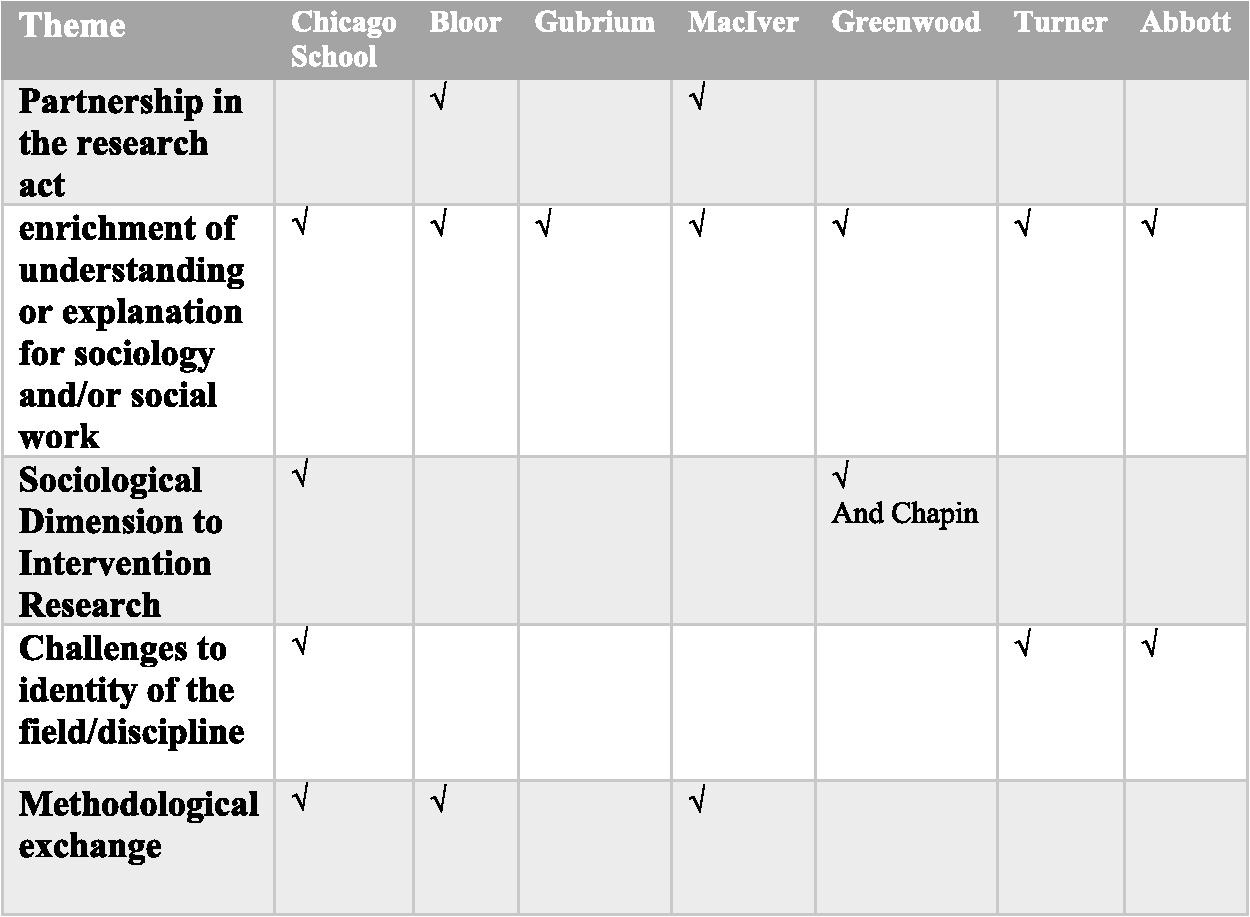
Sociologists’ engagement with social work.
While the catalogue is not intended to be comprehensive, it is immediately obvious that these are all men and from the West, 18 though it would have been entirely possible to illustrate from the work of women social scientists on the borders of sociology, as in the field of social and cultural geography, where some direct social work and social care contextualizing has been central. 19 Social work also has been profoundly influenced by feminist sociology, even when the original work may have had no direct social work focus. There also has been a small amount of directly collaborative work. We noted above the book by Yuill and Gibson where chapters were co-written by a social worker, service user and sociologist. 20 A more recent and interesting example has been carried out in Singapore (Ng et al., 2019). This originally conceived account of housing relocation and settlement in Singapore consists of a sequence of linked sets each comprising an interview with a resident, a reflection from a volunteer associated with a community action settlement team, and an academic essay. This is a book that ‘delves deeply…into the very local in order to find universal meaning and value’, and where a small estate is ‘not the perimeter, but an aperture: a space through which the world could be seen.’ 21
A partial agenda
The central part of this article has looked from sociology towards social word. Taking stock on this basis suggests a provisional agenda of questions. These include asking how we arrived at present day conventions about the boundary between sociology and social work, and with other disciplines? What constitutes a ‘case’? How did we come to see research strategies as we do? How have cultural, social, political, economic, and other regimes given form to both social work and sociology? in what ways is research labour in both sociology and social work gendered? How does sociological work illuminate social work ‘interventions’?
Boundary conventions
While we should eschew the essentialism of some analysis, how we arrived at present day conventions about the boundary between sociology and social work (and, of course, other disciplines) seems a fundamental discipline-identity question. While psychiatry and social work have received attention (as have psychiatry and sociology – e.g. Manning, 2005), a study of the rise of clinical sociology at Chicago through Louis Wirth and others would well repay social work study. There are aspects of early sociological work in Chicago that had what later would be seen as social work qualities, as we have touched on above. This raises the question of how institutional relationships between sociology and social work developed, especially in universities. In the USA for example, social work usually appears as autonomous academic institutional units within higher education, whereas in, for instance, the UK social work exists in cohabitation with fields such as social policy, sociology, or various health fields. The reasons for this, and the consequences for how each field is seen within government, agencies and higher education has received almost zero attention in social work.
A ‘case’
A central idea in both sociology and social work has been what constitutes a ‘case.’ Case study, as a research method, emerged in Chicago in the first two decades of the last century. It is common ground to say that case study research, and the closely connected development of life histories, was a central part of Chicago School sociology. Sociologists accessed urban life in some ways through social work agency records. Thus, the term ‘case’ as developed and strongly owned by sociologists was a direct ‘loan word’ from social workers. In addition, although there is a tendency to interpret this as a transient feature of disciplinary infancies, it is generally acknowledged that there was tension between the preoccupations of social workers and sociologists over issues such as social reform.
Harriet Bartlett, who we encountered earlier, valued the sociological stance on the idea of the case. ‘I’m glad I came at the time that the case study was regarded as a professional and possibly scientific instrument. There were ways of evaluating this material; it could be other than just used for helping people, trying to understand’ (Department of Sociology. Interviews with Graduate Students. Special Collections). I have summarized the question elsewhere in the following way: ‘Mainstream sociological accounts of the period treat the simultaneous social work and sociology uses of ‘case’ language in the first part of the last century as a linguistic moment in the period when sociologists and social workers were still coming to understand their distinct fields and practices. In this view of things, sociologists used ‘case’ as a loan word from a social work language in a period before clarity had emerged on their proper and separate spheres of knowledge. But it was not inherently so that sociological knowledge should conceive of ‘cases’ as socially constituted understandings of ‘the multiple layers of spatial and temporal contexts for social facts’ (Abbott, 1999: 207), while social workers should conceive of them primarily as individuals and families who are the beneficiaries and/or targets of professional intervention. If understandings of the ‘case’ were central to the identities of both ‘social work’ and ‘sociology’, then it suggests a way in to the question of how we understand scholarly relationships between the two now rather different fields today.’ (Shaw, 2016a: 67)
Research orientations
Closely linked to questions of the ‘case’ and ‘case work’ is the matter of how we have come to see ‘best’ and ‘correct’ research strategies as we do – why, more generally, orientations and framings of social work research are seen differently from country to country. This is a multi-layered question. The Special Collections archives at The University of Chicago have considerable light to shed on this in the case of social work research in parts of the West (e.g. Shaw, 2015b). The work in this area of the sociologist, Raymond Lee, is of significance and value (Lee, 2004, 2018).
We have mentioned the contribution of ‘experimental sociology’ in the first half of the last century, and its fluctuating disciplinary ‘home.’ Why did it emerge and why disappear? A case can be made that the tendency for explanations of social work intervention outcomes to be seen wholly in terms of the logic of one strand of nineteenth century philosophy of science would be lessened had there been an ongoing pursuit of the pluralistic behaviourism of Chapin and Greenwood in both social work and sociology. 22
Regimes
Several of these problems run in concatenation. Following from the questions of ‘case’ and research method, a further question relates to how cultural, social, political, economic, and other regimes have given form to both social work and sociology. This has complex and not easily disentangled elements. The relevance of this to the wider question of nurturing fruitful relationships between sociology and social work is that most social work discourse around such issues frames the debate in terms of several key concepts, in particular modernity and postmodernity, identity and globalization. In each case social work – and much of sociology – tend to treat each as a single package which ‘substitutes for analysis of debates, actions, trajectories, and processes as they took place in history’ (Cooper, 2005: 134).
In order to defamiliarize Western ways of thinking about such issues, it pays to reflect on how sociology and social work are associated with ideas of nation-building in large parts of the world. It is plausible to suggest that research in countries that regard themselves as in the early years of social work’s development (or re-development) may foster a more pragmatically-oriented agenda. Leung, Luk and Xiang, for example, suggest that ‘As social work was recognized as legitimate for tackling the host of social problems in socialist China, social work research in the Chinese context has largely been focused on practice issues.’ (Leung et al., 2020: 210). A similar factor may be at play in Taiwan, from Ku’s report of a survey of social work dissertations marked by ‘an indigenization of social work in Taiwan that focused on serving and meeting community needs in the national context’ (Ku, 2020: 176). Fahrudin observes a comparable feature of social work research in Indonesia, saying that ‘research is still limited to describing social problems’ (Fahrudin, 2020: 195). In this connection it perhaps is not surprising that sociology has been seen as closer to social work’s applied interests. Inasmuch as this is the case, it is understandable that social work should be cast in the role of nation-building, notwithstanding the ambiguities of that role in nations ruled through authoritarian, weak democratic and state socialist governments. Setting the idea of nation states in the context of colonialism, Cooper warns against ‘falling into the teleology of nation-building’ (Cooper, 2005: 12). He quotes Aihwa Ong saying ‘non-western societies themselves make modernities after their own fashion, in the remaking of … rationality, capitalism and the nation in ways that borrow from but also transform western universalizing forms’ (p. 127).
Gendered research labour
In what ways is research labour in both sociology and social work gendered? Has it always been this way? Can we understand why these patterns are so? How is it related to the institutional development and domicile of social work within higher education? In a recent study 60% of qualitative articles were first authored by women. Of those first authored by men, 60% were quantitative (Jobling et al., 2017). In another study, while the association of methods and gender was not examined, it is noteworthy that 69% of all articles in the present journal had been first authored by women (Shaw and Ramatowski, 2013: 741). Morris recently found ‘this trend had continued to increase with 82% of the 295 sampled articles having women first-authors’ in the subsequent period (Morris, 2019: 749).
The scale of these differences is considerable, but their meaning and consequences are less simple. While there have been claims, sometimes from feminist science, suggesting that quantitative positions represent masculinist methodology (c.f. Westmarland, 2001), this is a difficult argument to sustain. Almost two in five quantitative articles in Jobling’s study, for example, were first-authored by women. Speaking of her career Oakley says at one point ‘I discovered that in our excitement to dismantle patriarchy I and other feminist social scientists had mistakenly thrown at least part of the baby out with the bathwater. Women and other minority groups, above all, need “quantitative” research, because without this it is difficult to distinguish between personal experience and collective expression. Only large-scale comparative research can determine to what extent the situations of men and women are structurally differentiated’ (Oakley, 1999: 251).
Intervention and sociological social work
How have commitments to particular forms of social work intervention shaped in turn how we think of the nature of social work and its relation to wider social science? For example, an apparently plausible case can be made for believing there to be an association between the development of varying forms of community-based intervention and the work of research inquiry.
This was fairly explicit in the early Settlement movements, which poses the further question of the relationship between science and reform. Clement Attlee believed in a close link between reform and science. He said: ‘There are numbers of social workers who find in the work of research and investigation the best outlet for their desire for social service… the scientific motive takes its place as one of the incentives that lead men to devote themselves to social service’ (Attlee, 1920: 14–18). ‘Each group of social workers, each Settlement, has been a laboratory of social science in which new theories are tested’ (p. 230). Hence ‘Theory and practice must work together. It is no good to leave theory to the universities and practice to the social workers’ (p. 233).
There have been social workers whose practice - and writing about practice – has manifested a form we can understand as sociological social work. What might doing sociological social work look like? We should not treat this question as an exact mirror image of the enduring tensions as to whether social work should focus on the individual or society, or whether social work is about social change. Nor is it the same as asking how far social workers have founded their practice on structural explanations or have undertaken community-based intervention. Rather there is a more grounded question whether there have been social workers who consciously worked within a self-identity that was sociological and who gave a sociological ‘shape’ to social work practice.
In this connection there were several interesting figures from the first half of the last century in the USA. In order of birth these include Ada Sheffield (1869-1943), Erle Fisk Young, (1888-1953), Stuart Queen, (1890-1987), Pauline Young, (1896-1977) and Harriett Bartlett, (1897-1987). Taken together, if not as a consciously collective enterprise, they pursued a sociological social work in three central ways:
Through their understanding of social environments. In the meaning they gave to the ‘case’ In the direct practice of social work intervention (c.f. Shaw, 2015a).
Finally, in my own work and that of writers such as Walter Reckless, Gerhard Riemann and Pauline Young, 23 a case has been set out for how it is possible and fruitful to develop intervention practices founded on a ‘translated’ set of parallels between social work practice and qualitative research methods. Bloor’s remarks, noted earlier, regarding how ethnography may ‘model’ a service delivery that can be transferred to service providers are of this kind.
I have sought in this paper to delineate how the relationship between social work and sociology has been regarded in more recent years as represented by textbooks. In the light of such recent writing, I have reviewed the nature, themes and extent of sociological interest in social work in the past and the present. I have set out a partial and provisional agenda for interlacing disciplinary and professional work.
Archives
University of Chicago. Burgess, Ernest. Papers Special Collections Research Center, University of Chicago Library
University of Chicago. Office of the President. Records, Special Collections Research Center, University of Chicago Library.
University of Chicago. Department of Sociology. Interviews with Graduate Students of the 1920s and 1930s. Special Collections Research Center, University of Chicago Library.
Footnotes
Declaration of conflicting interests
The author(s) declared no potential conflicts of interest with respect to the research, authorship, and/or publication of this article.
Funding
The author(s) received no financial support for the research, authorship, and/or publication of this article.
