




Abstract
For centuries understood as a micro-level caring profession, recently social work is dramatically changing its goals due to structural changes in societies, climate change, migration and political instability. The article employs cross-cultural comparisons that aim to reveal the invariant structure of the social work field, which is realized through the unique manifestations of social work practices in different cultural contexts in Lithuania, Japan, and the United States. The research identifies four social work practices in the professional fields and presents them based on the concepts of field, habitus, and capital, highlighting the similarities and differences between countries in the application of rules of the social field.
Introduction
When one of the first books on the professions appeared in 1933, the authors proposed a strict classification of the professions by function. Professions were thought to be very static, ‘every profession lives in a world of its own’ (Carr-Saunders and Wilson, 1933). Modern sociology of professions claims that professional boundaries are changing and vanishing. One famous sociologist, Pierre Bourdieu, suggested the shift from the traditional approach of analyzing professions to analyzing the professional field instead.
The article attempts to employ the theory of Bourdieu in two areas. First, to analyze the field of social work and identify the main oppositions or tensions that constitute the core structure of this field; second, to evaluate the role of habitus in the discussions about the professional identity of social workers. The article employs a cross-cultural comparison that aims to reveal the invariant structure of the social work field, which is realized through the unique manifestations of social work practices in different cultural contexts, in Lithuania, Japan, and the United States. The choice of countries is based on several factors. On the one hand, they were specified in the project that funded the study. On the other hand, the researchers aimed to reveal the typicality of the different social contexts expressed uniquely in each country. Therefore, the existing stereotypes, which the reflexive analysis of the subsequent research partially deconstructed, influence the initial selection of the countries. The United States was chosen as the mecca of Western culture and values and the birthplace of the social work profession. Japan reflects a different Eastern cultural context and the multifaceted history of social work. Lithuania is a post-Soviet country in search of an identity for social work.
It is difficult to identify the precise date of social work’s birth as a field. The first recorded social worker employment was the hiring of Mary Stewart in 1895 at the Royal Free Hospital in London (Healy and Thomas, 2021). As early as 1893, an International Conference of Charities, Correction, and Philanthropy was held in Chicago. Since then, the factors that constructed social work as a profession have begun to take shape. Usually, social work was attributed to the micro-level helping profession and rarely seen as an important actor in macro discourse, which operate ‘with individualistic theories’ and often complex social problems were ‘beyond the scope of their professional practice’ (Abbott and Meerabeau, 2003). The purpose of the profession was generally attributed to three approaches: (1) helping hand, helping to solve some personal social problems; (2) as a technician of society, trying to ‘correct’ some of the members of society; (3) the third perception states that the purpose of social work is to build society (Blom and Morén, 2012). The dominant discourse was attributed to the first two approaches for a century. Thus, recently social work has been dramatically changing its goals due to structural changes in societies (Berzin, 2012; Berzin et al., 2015; Flynn, 2017; Kavaliauskiene, 2005), environmental changes, increased migration, growth in populism and its threats to human rights (Healy and Thomas, 2021), and the emerging innovations. The focus of social work on the root causes of the problems and trying to predict the consequences could be a success factor for creating social innovation (Berzin and Pitt-Catsouphes, 2014). Social work knowledge could contribute significantly to establishing new systemic and theoretical approaches needed in uncertain times (Berzin, 2012; Nandan et al., 2020; Rønning and Knutagard, 2015).
For the following reasons, this article aims to discuss the changing professional field of social work, its new functions, and future developments. It presents four newly identified social work practices that manifest differently in different countries. We analyze the development of social work as a professional field, both in terms of changes in professional practices and social work’s impact on society.
Social work field in Pierre Bourdieu’s sociology
In many cases, the analysis of the field of social work is closely related to the concepts of the profession and professionalization. According to Wiegmann, ‘Bourdieu’s contention that fields occur in hierarchies directly applies to the field of social work, particularly its history of fighting for status as a respected profession’ (Wiegmann, 2017: 100). Nevertheless, it is important to remember that Bourdieu has criticized the application in sociology of the occupational taxonomies of bureaucratic origin that social sciences inherited from the bureaucratic field. Despite his sympathies toward critical analysis of the professions elaborated by Magali Sarfatti Larson or Elliot Freidson, Bourdieu was convinced that the concept of the profession should be replaced. ‘We must go beyond this critic, however radical, and try, as I do, to replace this concept with that of the field’ (Bourdieu and Wacquant, 1992).
According to Bourdieu, when analyzing a field, it is important to consider its relationship with the field of power, the interrelations among agents, and the agents’ habitus.
To discuss the struggle of sociologists with the other specialists involved in symbolic production, Bourdieu has identified three indicators of the heteronomy of sociology. The simplest one is the propensity to convert social problems into sociological problems; the second includes the tendency to bring into scientific discourse concepts or antinomies taken from everyday discourse; and the third is the inclination to take as the principle of the hierarchy of scientific objects the social hierarchy (Bourdieu, 1991).
How could this analysis be applied to the study of social work? In his masterpiece The Weight of the World: Social Suffering in Contemporary Society (Bourdieu et al., 1999 [1993]), Bourdieu, to analyze the social policy and its shifts toward a workfare regime and neoliberalism, has employed the concept of the state’s right and left hands. Wacquant, in his book Punishing the Poor: The Neoliberal Government of Social Insecurity (Wacquant, 2009), elaborates on the dichotomy between the right and the left of the state and applies it to the analysis of the governance of marginalized areas and focuses on how changes in social policy have contributed to the formation of the so-called ‘underclass’.
The Left hand, the feminine side of Leviathan, is materialized by the ‘spendthrift’ ministries in charge of ‘social functions’ – public education, health, housing, welfare, and labor law – which offer protection and succor to the social categories shorn of economic and cultural capital. The right hand, the masculine side, is charged with enforcing the new economic discipline via budget cuts, fiscal incentives, and economic deregulation. (Wacquant, 2009)
The social scientists who applied the theory of Bourdieu to analyze social work, associate social work with functions of the left hand of the state. According to Başcıllar (2020), ‘the “left hand” represents the areas [that] include social work and education’. Earlier, Garrett (2007) maintained that Bourdieu claimed that social workers (along with, for example, youth leaders and secondary and primary school teachers) constitute the left hand of the state.
Whereas the ‘left hand’ refers to those government departments and government-sponsored social service agencies that offer social protection and support (e.g. public education, health, housing, and employment), the ‘right hand’ consists of institutional actors assigned with the task of disciplining subjects to the economic rigors of the neoliberal market. (Woolford and Curran, 2012)
In the face of intense global change and the role of social work in it, we need to re-examine the left-hand and right-hand dichotomy critically (Wolniak and Houston, 2023).
Another critical aspect of Bourdieu’s field theory is the concept of habitus. Habitus, as the internalized structure of the social field, shapes social agents’ practices and influences how those practices are interpreted. The habitus structure depends on one’s position in the field and intertwines the social agent’s background, learning and upbringing experiences, and previous choices. The habitus of the social agent depends on social, cultural, and financial capital, one type of which becomes symbolic depending on the mode of power that dominates the social field. It is useful to begin the analysis of the habitus with the critique of Bourdieu which is derived mostly from rational choice theory and positivistic materialism. In his dialogue with Wacquant, Bourdieu defines two functions of the concept of habitus. Bourdieu encourages social workers to gain awareness about their habitus and position in the social field (Garrett, 2007).
Employing previously presented debates around the theory of Bourdieu for the analysis of the social work field, we constructed a toolkit to analyze the field of social work in Lithuania, Japan, and the United States. Aware of the limitations of this toolkit, we acknowledge that a wider variety of methods should be applied to the analysis of the field. We do not pretend to provide an objective analysis of the field, but we have made a reflexive attempt to convey our observations to stimulate a discussion on the depth and trends of change in the social work field.
Research methodology
The sampling of participants
A qualitative research approach implemented through expert interviews was chosen for the study. Thirty social work experts participated in the survey: 9 from Japan, 11 from Lithuania, and 10 from the United States. Purposive sampling was used to select the research subjects (Bitinas et al., 2008). The main criteria were social work education or knowledge, at least 5 years of experience in social work or the social work academic field, methodological or research activity, and the organization represented. In total, five respondents represented the field of social policy, either at the parliamentary level or at the level of the department responsible; four experts represented national social work associations and the International Federation of Social Work and the Commission on Global Social Work Education; seven experts were from the field of social work education and research, including authors of international social work books. The remaining respondents represented social work practice (private, non-governmental organization [NGO], public) and various networks of social work practitioners. All informants are coded using the same principle – country code and expert number, for example, LT1, JP5, US2.
Implementation of research
Data were collected in individual, dyadic, and triadic interviews (Gaižauskaitė and Valavičienė, 2016). The advantage of this method is that it provides more detailed and substantive answers to the questions than a standardized questionnaire (Rupšienė, 2007). The data collection was organized in two phases. The first phase consisted of remote interviews, which could not be conducted in person due to the limitations of the COVID-19 pandemic. In total, nine interviews were conducted with Japanese experts, ten with US experts and eleven with Lithuanian experts. Due to temporary changes during the COVID pandemic, the second phase was organized with face-to-face meetings with experts in Chicago and/or Vilnius, Kaunas. The total duration of the interviews was 29 hours and 50 minutes. in total. The remote online interviews were conducted on the Zoom platform and recorded. Interviews with Lithuanian experts were conducted in Lithuanian, with US experts in English, and with Japanese experts in Japanese with the help of a translator (the translator was a research team member). The recorded interviews were transcribed and analyzed using Maxqda software.
For the data analysis, we distinguished the following topics: (1) the purpose of the profession, which is determined by the position of agents in the field, and the extent to which professionals are recognized; (2) sets of competencies depend not only on different understandings of the objectives of the profession but also on how other institutions, such as education, perceive the profession; (3) the field of operation shows the breadth of the professional field, in the case of social work, and shows the available volume of capital; (4) professional self-awareness and perspectives of professional fields seek to understand the different habitus in the field, the beliefs, attitudes and behaviors, the prevailing power relations.
Research findings
The case of Lithuania
The purpose of the profession
The profession of social work began to develop in Lithuania in the early 1980s after Lithuania regained its independence. In just 30 years, social work has gone through various stages of development: from Jane Adams’ helpers and professional caregivers to macro-level actors and social innovators and advocates. The purpose of the profession has evolved too. The development of social work in the country has been strongly influenced by various foreign initiatives, mostly from Anglo-Saxon countries and Scandinavia.
The experts acknowledge that despite the rapid professionalization and expansion of the social services network, much associate social work with nursing, visiting care, and control (LT11, LT2). The profession’s purpose is still liquid and perceived quite differently due to regional diversity. The big cities have a growing ecosystem of social innovation, while social workers perform helping hand functions in the regions. ‘The profile of social work is not well defined because of the poorly developed network of social services, which are more care-oriented’ (LT9). The municipal diversity leads to uneven services and, thus, different perceptions and funding of the profession’s purpose and functions (LT9, LT3, LT6).
For a long time, a clear social work identity has not been formed by the state institutions, the media, and the profession’s self-regulatory structures, nor have the objectives of the professional field been shaped (LT3, LT1). Although Lithuania has a pendulum electoral tradition (right-wing and left-wing parties form the majority), social policy has been shaped by the left hand, so the prevailing narrative of the purpose of the social work profession is not deconstructed in practice yet. At the same time, however, the diversity of agents in the professional field is increasing. New players in the field are bringing new approaches of the right hand to the profession’s goals (LT5, LT8, LT7).
Sets of competencies
The development of social work competencies in Lithuania is high-speed and radical. The prevailing view that ‘social work does not require a lot of knowledge and skills, maybe a lot of life experience is enough’ (LT2) is changing. Professional competence development agencies are increasing, and the state funds various capacity-building projects.
According to experts, competencies can be divided into traditional competencies, that is, traditionally attributed to social work, such as empathy, sensitivity, flexibility, compassion (LT1, LT3), ‘reading between the lines’ (LT10), and the new ‘visionary’ competences, such as ‘interdisciplinarity, adaptability to different environments, being oriented to achieving results’ (LT6), ‘flexibility of thinking and adaptability to change, creativity, curiosity, social responsibility’ (LT5), ‘Systematic and collaborative approach to science’ (LT4). In other words, the experts recognize the emergence of a new social worker profile whose habitus and capital differ significantly.
It should be noted that the experts placed less emphasis on specific professional competencies, emphasizing the importance of generic competencies for the future professional field. In other words, particular competencies remain important. Still, it is crucial to focus on developing new generic competencies for developing the professional field in a context of uncertainty. The focus was on competencies linked to innovation and technology (artificial intelligence, big data, etc.) and digital literacy (LT3, LT4, LT7). Experts emphasized technology as a tool to ‘give us the freedom to return more to the relationship with the human being’ (LT5).
The fields of operation
Traditionally, social work in Lithuania has been classified as a micro-level public sector profession. The main areas of operation were the elderly, childcare, and areas of disability. This is due to the relatively poorly funded NGO sector or the lack of recognition of its strengths, the low interest of the private sector in creating social impact, and the dominant role of local government in providing social services. However, the situation has been changing rapidly in the last 5 years. Reform of childcare and family services involves the NGO sector and an increasing number of creative agents capable of fundraising in the field (LT9). Good practices from foreign countries are bringing social entrepreneurship trends to Lithuania. The informants acknowledge that the social work field and its agents’ diversity vis-à-vis the public sector are changing. The field of social work is moving toward greater diversity: the influence of non-state, private practices is growing, and this is changing the levels of the social workers’ operation. More and more social work is making its presence felt in human rights advocacy and social policy. ‘We need to develop leaders who speak up and are not afraid to represent themselves in politics’ (LT7). Thus, at the macro level of social policy processes, social work in Lithuania is taking its first tentative steps, and it is doing so with the help of NGOs. This direction and the attempt to achieve more autonomy in the field are essential for the profession’s future: ‘If we work independently, there would be more autonomy, and social work would seem more independent’ (LT5).
Professional self-awareness and perspectives
‘I feel that social workers are becoming increasingly aware of what they do’ (LT4). ‘An unreflective social worker is the death of social work’ (LT9).
Professional self-awareness is increasing, thanks to many factors: improving training for social workers, international exchange opportunities, European Union funding, and a growing civil society. In the view of experts, the increasing popularity and attractiveness of the NGO sector is a significant contributor to these developments (LT8, LT7). ‘Where does innovation come from? It comes from NGOs because they are more interested in survival’ (LT4).
At the same time, the habitus of the disregarded social worker still prevails in the field. In relation to other professions, social work remains in an unequal power relationship, ‘there is a shrugging of the shoulders, and workers have to be reminded to straighten up because we are equal’ (LT10). Social workers are learning to operate in a system where their power is limited. Although there is better cooperation with other professionals, psychologists, health professionals, nurses, and employment service professionals, there is still a lot of confrontation between organizations (LT1, LT2, LT6). The profession’s self-regulatory structures could take over the empowering role. Strengthening professional regulation to empower the profession can be a condition for revitalizing the professional habitus, as ‘defeatism stifles innovation and many affected social workers lose hope of saving the world’ (LT8). In light of complex modern problems, ‘the role of social work is strengthened when the capacity of other professions to solve problems reaches its limits’ (LT7).
The case of Japan
While charity work and social welfare have deeper historical roots in Japan (JP5), the present-day concept and practices of social work have formed after WW2 and have been influenced by the American tradition (JP3). It is marked ‘a new era’ (JP3) of modern systemic social work in Japan. What started as medical social work in the hospital setting has radically expanded since then, developing rapidly in the second half of the 20th century (JP1). After the creation of the national social work qualification (shakai fukushi shi 社会福祉士) in the late 1980s (JP1), Japan experienced a boom of professional training programs at the university level, and the number of social workers significantly increased (JP2). The 1990s saw the formation of the present-day social work profession in Japan (JP3), together with culturally specific forms of practices and habitus that continue to evolve to this very day.
The purpose of the profession
The field of social work in Japan does not have fully defined autonomous boundaries but is principally described by the experts as interdisciplinary managerial work together with other professionals (JP5). The most prominent role of the social worker is that of a facilitator (JP9), consultant (JP7), coordinator (JP2), and mediator (JP5) between the people in need and those who provide the necessary specific services. The other important roles of social workers are engagement with the local communities (JP7), organizing prevention programs (JP2) and public communication, including the articulation of social ills (JP8). Together these shape the core habitus of social work in Japan and act as the defining characteristics of its practice.
Recently, social work has shifted from working with individuals to working with groups – families and local communities (JP4). This new approach is also used to overcome the fragmentation of social work, where social services are provided to each family member separately and by a different social worker, according to the needs of the individual (JP3). Other pertinent social problems that the Japanese experts emphasized include violence against children (JP3), physical and mental disabilities (JP9), and poverty (JP2).
The set of competencies
The core skills and abilities named by the experts mirror the aforementioned role of social work and further reveal the Japanese social work habitus. It should be based on empathy toward the client (JP5) and a strong sense of professional ethics (JP2). This ‘sensitivity towards the other person should go hand in hand with the objective decision making’ (JP5). Thus, communication skills (JP4) and specific social work knowledge (JP2) become paramount in professional practice. In addition, the knowledge of macro-level systems (JP2) and macro-level social policies (JP1) are becoming more relevant as the focus shifts to social work within the local communities. Finally, the experts have stressed the importance of teamwork and collaboration skills, which could signify culturally specific elements of the habitus. ‘We barely work alone; you have to be a team player to be able to work together with others’ (JP8).
The fields of operation
Three main avenues of social work emerged during our interviews. The first of these was public administration at the prefectural or municipal level, where professional civil servants are assigned to oversee social services (JP5). This type of bureaucratic management is separated from the front-line social work by the experts but recognized as part of the overall social work system providing background support (JP1). Second were professional social workers in public hospitals, other care facilities, community centers, and private sectors. These workers, described above, form a relatively autonomous background for the professional practice of social work. The others are volunteers (JP7), social activists (JP3), and people in other professions (JP3) who contribute to social work through their activities but are considered to be outside of the field.
A large part of present-day social work is carried out in the municipal community service centers (chiiki hōkatsu shien sentā 地域包括支援センター) that act as central hubs in the neighborhoods for the multitude of social services (JP6), alongside other specific institutions like hospitals, child protection agencies, or centers for people with disabilities. These community centers have been established in recent decades to respond to a rapidly aging society (JP3). The aging population and the rise of the nuclear family forced the state to look for ways to ensure the availability of elderly care (JP2) and the community-involving social work approach (JP3) was chosen to tackle this issue as a possible sustainable long-term solution that does not overburden the state financially (JP5).
Professional self-awareness and perspectives
The field of social work in Japan is formed from a blend of autonomous (the habitus of the professional practice) and heteronomous influences, the latter being the aforementioned political power of the state and the imperative of efficiency from the economic sphere (JP3). The professional identity, in this case, is primarily anchored to the specific roles of the social worker and numerous state-provided professional qualifications (JP6), although neither of them can provide a final verdict on who the social worker is, as the practice of social work takes a multitude of forms, some of them without any formal qualifications (JP4). Individual career choices (JP3) and the accumulation of professional and cultural capital through work experience (JP7) can and does solidify one’s identity as a social worker, equal to other professions in the neighboring fields (JP8).
According to the experts, the future of social work in Japan is likely to remain an interdisciplinary affair through deeper multiple specializations within the field itself (JP8), the blend of several different qualifications (JP1), and social work as a bridging profession (JP5). The social services are likely to become more targeted toward specific groups (JP7), yet concentrated in one place (JP9).
The case of the United States
The purpose of the profession
Social work in the United States was well established more than 100 years ago, but with such a great range of diversity, it is difficult to summarize the profession’s activities. Generally, social work in the United States has two main paths: clinical social work or behavior therapy and community engagement focusing on social justice and human rights advocacy (US2, US4). The role of government in providing social services is still contested (Healy and Thomas, 2021), and the United States is attributed to the right-hand state. More than anywhere else, social work in the United States focuses on macro-level advocacy. Recently, ‘there is a strong focus on social justice now [. . .] the shift in language’ (US1). The purpose of the profession is understood through long-term social changes by participating in social policy debates (US2, US3), with created ‘interprofessional interventions for social movements’ (US1).
Another distinctive feature that sets the United States apart is the breadth and depth of the profession’s purpose. Experts stated that social work has a strong focus on bridging sources and collaboration (US6): ‘No other professions could go that deep into a client’s social system’ (US7). The purpose could be understood as activating the client’s entire social system.
And finally, although social work is a profession with a long tradition in the United States, ‘we deal with people who are unprivileged, we are also associated with them’ (US2).
The set of competencies
Concerning perceptions of the profession’s purpose, the distribution of social work competencies could be divided into person-centered and systemic competencies. In the case of the first group, more emphasis is paid to adaptivity skills (US1), integration and holistic (US4), and understanding diversity, equality, and inclusion (US10). However, the narrative in expert interviews was more focused on system-level competencies. ‘Cultural sensitivity, community capacity building’ (US1), innovative practices, and ‘macro skills to understand the context’ (US2) were highlighted. The ambition for social work to be a visible and bright star in policymaking and international orbit is strongly expressed in the United States.
Other sets of competencies are linked to global technological transformation. Experts underlined the ability to provide online social work and create a safe virtual environment (US7, US8). After the COVID-19 pandemic, it became apparent that some customers will never return to live contact (US5): ‘The profession changed significantly towards virtual practices. Maybe there will be a license for virtual work in the future’ (US6).
Besides, ‘technologies will connect people from different regions and cultures. Holograms are used for customer counseling, artificial intelligence for data analysis, and we will be able to see the whole situation of the client in a second’ (US2).
The fields of operation
The five most critical social work themes are operating in the field: casework, group work, administration, community organizing, and social policy (US1). One of the dominant domains is clinical behavior therapy, and here we observe a significant difference in the field of social work in the United States. Individual therapeutic practice is a right-hand practice that provides social workers with autonomy, especially economically (‘it is all because of money’ [US7]) but is also criticized in terms of the value of the profession: ‘We take money from those who are in need’ (US5).
Another feature of the US medical social work in primary care institutions is that organizations provide all the integrated help in one place. This reform has increased the availability of services, especially for those clients who would not be willing to consult a social worker on their own (US5, US8). It is important to note that social work in the United States is also influenced by a deep tradition of human rights advocacy and lobbying, which has led to a number of discussions about the boundaries of the profession also in the international arena.
Professional self-awareness and perspectives
In general, self-awareness is a well-developed and essential skill. Reflectiveness is part of the United States’ social work identity. Self-determination helps represent the client’s interests, especially under pressure from other professions (US4). Strong self-confidence helps to form an appropriate habitus that brings the professional back to their goals and values. ‘We stopped apologizing for not fixing the world and ending poverty’ (US5). ‘We know that we do the cleaning job of capitalism’ (US10). Of the countries studied, this form of habitus is the strongest in the United States and is linked to the cultural and sociocultural capital of the field. However, social work in the United States faces challenges, too, in being treated as a ‘feminine and unpaid’ (US3, US9) profession.
Four types of practice in the field of social work
In the following, based on an analysis of country-specific attributions, we present a synthesis of social work practices that can be found in social work. However, they manifest themselves differently in diverse cultural contexts. In Figure 1, we have sought to map how specific social work practices are distributed in the field by volume of economic and social capital.
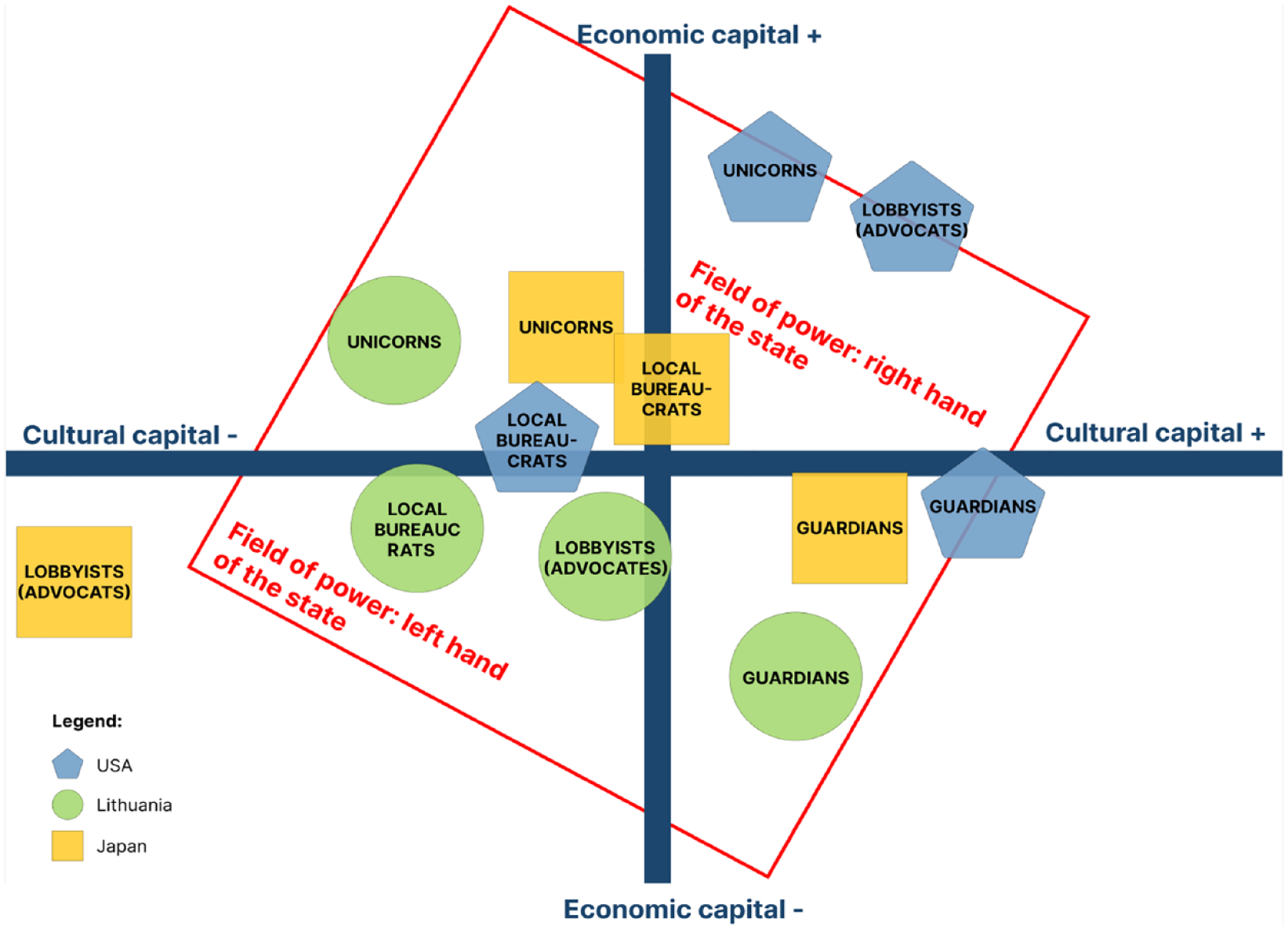
Distribution of social work practices in the field.
Unicorn practice – social work as innovations booster
This practice is manifested in a right-handed state more usually, where social policymaking is liberal and agents in the field of social work act with a high degree of autonomy, the field is subject to less regulation, and processes of self-regulation come into play. Under these conditions of independence, the Unicorn social work begins to emerge. They involve innovative actors who defy traditional postulates and dogmas and can attract economic capital. Unicorn practices include social business organizations and other social innovation initiatives or new models, and methods of social work, more frequently observed in non-state organizations. Unicorns also have symbolic and cultural capital in traditional right-hand states, like the United States. In Lithuania, the status is not clear yet; the hybrid identity of innovators vs social workers is present. In Japan, our study did not detect the growth of Unicorn practices, but we acknowledge the limitations of our research.
The Unicorn practice is attractive to young people who enter the labor market looking for opportunities to apply their skills creatively. Such organizations offer freedom and have fostered a spirit of creativity and innovation. A superior level of personal engagement, self-motivation, innovation, and digital literacy characterizes unicorns. As a rule, they associate solving social problems with sustainability and eco-friendly behavior and extensively use entrepreneurial and fundraising competencies. Thus, this practice might be seen as a threat to social work identity, as unicorns are less focused on formal requirements. For a profession that has fought for its own identity and recognition for 100 years, this may be less attractive and could shy away from recognizing the unicorn as a part of the social work profession.
Advocates’ practice – fighting for social justice
The research revealed that this practice, due to cultural and historical aspects, is particularly characteristic of the United States but is gaining strength in Lithuania too. The United States is still struggling with the social stratification of society. It determines social exclusion and polarization. The high level of diversity encourages social workers to look for ways to ensure human rights, and social and environmental justice, which has been a fundamental value of social work in the United States since the time of Jane Adams. Similar phenomena due to global migration are becoming common in the European Union (including Lithuania), where the community is encouraging the strengthening of social advocacy.
In this practice, social work is characterized by acting at the macro level, participating in important debates and decision-making, which is not traditionally characteristic of right-handed social work. The Japanese situation, with a strong hierarchy based on tradition, is different; our research did not gather sufficient data on the practice of advocacy in Japan. Obviously, some forms of advocacy are performed more by guardians or bureaucrats.
Regarding capital, advocates have relatively high sociocultural capital (especially in the United States), have competencies that are important for lobbyists, and can make important connections that help them to be at the right place at the right time. In societies with deep traditions of philanthropy and patronage, lobbying and social advocacy attract more economic capital but also lead to entrapment by interest groups. In countries such as Lithuania, where lobbying is more associated with the representation of narrow business interests, the field of social work is rarely identified as advocacy.
Guardians practice – dam from poverty and social inclusion
Guardianship is dominant in left-hand states, where the state assumes an essential role in protecting the population from poverty and dominates as a provider of social services (e.g. Lithuania). Guardians act like the Hoover Dam (United States): they dam the river, reduce the flow, and redistribute the energy according to demand. Traditionally, this has been the identity of social work: to protect the most vulnerable groups and integrate them into the existing social order. Unlike advocates or unicorns, guardians do not seek to change the current social order; guardians’ social work practice operates autonomously in local communities with local individual needs. Both state and non-state organizations can be found, whose primary function is to be where other professions do not want to be. Guardians’ practice operates at an individual level in a specific social context, for example, street social work and social workers in local rural communities. Guardians are characterized by a particular social sensitivity and empathy, a sense of personal involvement, even devotion, and competence in self-motivation.
Guardian practice is often identified in the countries surveyed with ‘real’ social work. Their habitus thus has been aptly described as ‘disregarded professionals’ (Švedaitė et al., 2014). Due to the limited financial possibilities, guardians are constantly confronted with human resource shortages and the risk of professional burnout. Unless the important role of this practice in society is recognized, it will have little appeal to young professionals in the future.
Bureaucrats practice – social policy inspectors
Bureaucratic social work is quite dominant in the studied countries due to social work’s highly regulated functions and purpose. Bureaucratic practices have little autonomy with clearly defined and delegated functions from authorities. The development of this practice is driven by new trends in public management and the desire to transfer managerial practices to the field of social work. In all the countries studied, the number of bureaucratic functions is increasing, but they are treated and distributed differently in the field of power. In Japan and, to some extent, in Lithuania, administrative social work is associated with better pay, prestige, and recognition, among other professions. In the United States, bureaucracy is separated from social work practice as a function of public administration.
In general, bureaucrats have no cultural solid or symbolic capital, except in the case of Japan. Because of the social guarantees the state provides, even if they are not autonomous, they possess economic capital. They are skilled with managerial and planning competencies and digital literacy skills, as they have to use various public registers and databases. However, bureaucrats must also have well-developed critical thinking skills, as they must allocate state resources by a clear risk assessment.
Conclusion
In the shade of intense global change, we need to critically re-examine the left-hand/right-hand social work dichotomy by questioning the purpose and the methods of the professional field of social work. Bourdieu criticized the concept of profession due to its bureaucratic origin and was convinced that the concept of the field should replace the concept of the profession. As usual, the social scientists, who apply the theory of Bourdieu for the analysis of the field of social work, associate genuine social work with functions of the left hand of the state. Although with this study, we want to highlight the heterogeneity of the social work field and stimulate a debate on the deconstruction of the field in the new social reality. We undertake this professional field research to observe the expression and movement of different field practices that could not be noticed by looking through the lens of invariant evaluation.
The proposed framework of social work typology we used broadly reflects the particular sociocultural social work patterns captured during our interviews. On the other hand, this framework can also serve as an analytical tool or a point of departure for further research on social work practice in virtually any cultural context. We believe that additional empirical data from various countries could test, refine, and even challenge the model proposed in this article.
The social work practices we have identified can be seen as strategies by which the field adapts to changes. Some are more attributed to invariant social work; others might seem too scattered and liquid. For a profession that for many years has not been considered a real profession or field of science, such volatility may not seem like an attractive development path. Thus, the ambition of social work to be a visible and bright star in policymaking and the international orbit is strongly expressed in the United States and followed by countries like Lithuania.
The role of social work in decision-making on a global scale is not new. The first attempt to involve social work in macro-level decision-making was in 1945, with the establishment of the United Nations (UN), which provided ‘a permanent international platform for social workers from across the globe to contribute to humanitarian efforts’ (Healy and Thomas, 2021). The research revealed that social work would stand in the first lines again in fighting the threats of global migration and political instability. Will we manage to recruit technologies and employ innovation to help the profession meet these challenges? And also will there be a leaders instead of disregarding professionals to come along?
Footnotes
Declaration of conflicting interests
The authors declared no potential conflicts of interest with respect to the research, authorship, and/or publication of this article.
Funding
The authors disclosed receipt of the following financial support for the research, authorship, and/or publication of this article: This research received funding from the European Social Fund (project No 09.3.3-LMT-K-712-19-0197) under a grant agreement with the Research Council of Lithuania (LMTLT).

Data availability statement
The authors confirm that the data supporting the findings of this study are available within the article [and/or] its supplementary materials. Raw data that supported the findings of this study are available from the corresponding author Ieva Adomaityte-Subaciene, upon reasonable request.