




Abstract
In an era marked by the construction of an increasingly digital and technological justice for children, the use of electronic monitoring within child justice systems is a controversial issue. This article examines the projected (non)futures of electronic monitoring in Portugal by exploring the perspectives of relevant stakeholders involved in the child justice system. Our data show that both opposing and supportive perspectives are anchored on four key axes – education, control, environments and conditions, and stigma – that underpin stakeholders’ perceptions of the different challenges, principles and goals that underpin the child justice.
Keywords
Introduction
The United Nations Committee on the Rights of the Child (UNCRC, 2021), in its General Comment No. 25 on children’s rights in relation to the digital environment, has highlighted the importance for States to ensure that surveillance and monitoring mechanisms within child justice systems 1 are not used in an unfair manner. That is, in a way that does not violate the rights to privacy, dignity and freedom of association of children in conflict with the law. Within these monitoring mechanisms, one controversial issue that has largely flown under the radar of policy, media and academic scrutiny is the (potential) use of electronic monitoring in child justice systems (Arnett, 2018).
In a 2014 recommendation on electronic monitoring, the Council of Europe (2014), defines it as a ‘a general term referring to forms of surveillance with which to monitor the location, movement and specific behaviour of persons in the framework of the criminal justice process’ (p. 3). Although its use varies considerably from one jurisdiction to another – that is, in terms of the technologies used, the groups targeted and the stage of involvement in the criminal justice system (Beyens, 2017; Daems, 2019; Granja and Gomes, 2024; McNeill and Beyens, 2013; Nellis, 2021; Nellis et al., 2013) – there is the possibility, which has been mobilized in some countries, of using electronic monitoring in the child justice system (Van Biervliet, 2023). Despite its very concrete implications in terms of breadth and depth for the lives of children in conflict with the law, this is a largely under-researched topic (Arnett, 2018). With the aim of contributing to the expansion of the academic literature and opening up a much-needed discussion on the topic, in this article we explore the projected (non)futures of electronic monitoring in the child justice system in Portugal, based on the perspectives of professional actors involved in this system.
Our data reveal a clear dichotomy among the respondents regarding the possible implementation of electronic monitoring in the child justice system in Portugal. While some respondents are enthusiastically supportive, others are opposed to its introduction. However, rather than simply categorizing these perspectives into opposing camps, which would only provide a rather descriptive and simplistic approach, we delve deeper into the nuances by exploring four key axes that underpin stakeholders’ perceptions of the potential use of electronic monitoring in the Portuguese child justice system, namely education, control, environments and conditions, and stigma. In an era marked by the construction of an increasingly digital and technological justice for children (Davidson et al., 2023), by exploring the projected (non)futures of electronic monitoring, this article therefore offers an original contribution to the debate on the various challenges, principles and goals that underpin child justice.
Electronic Monitoring for Children in Conflict with the Law
A global culture of control (Garland, 2013), based on a drift towards security, is increasingly present in children’s lives (Case and Haines, 2021). Zero tolerance guidelines in the definition of public justice and security policies underpin collective expectations of the child justice system, characterized by an ever-increasing demand for control and regulation of children’s behaviour (Carvalho, 2015; Case and Bateman, 2020; Kilkelly and Pleysier, 2023). Despite strong geographical disparities and social inequalities worldwide, children are among the most vulnerable social groups with a higher risk of experiencing some degree of deprivation of liberty (Nowak, 2019). Electronic monitoring of children in conflict with the law can be understood as a measure that involves varying degrees of deprivation of liberty, making its discussion increasingly relevant.
As in the adult criminal justice system (Campello, 2021; Daems, 2019; Gacek, 2022; Kilgore, 2022), electronic monitoring in the child justice system is presented as a cost-effective alternative to institutional detention that allows individuals in conflict with the law to (allegedly) maintain social ties (education, social peers, family, etc.), thereby enabling rehabilitative and deterrent goals (Arnett, 2018; Crump, 2019; Weisburd, 2015). However, most of such proclaimed aims of electronic monitoring are difficult to sustain when analysing the empirical evidence (Granja and Gomes, 2024). According to Chaz Arnett (2018), the transfer of electronic monitoring from the criminal justice system to the child justice system leads to a ‘manifestation of adultification, where juvenile courts adopt a ‘one size fits all’ approach and implement tools and practices from the adult criminal justice system, despite having great discretion to explore alternatives’ (p. 399). Furthermore, some authors suggest that, similar to what has been suggested in relation to the criminal justice system (Berry, 1985; Council of Europe, 2014), electronic monitoring could contribute significantly to ‘net widening’ (Cohen, 1979). That is, electronic monitoring could contribute to expanding and diversifying forms of control over children in conflict with the law who would otherwise have received no or less burdensome measures (Crump, 2019).
Despite some relevant literature mapping and describing known electronic monitoring programmes for young people in the United States of America (Berry-Cohen, 2023; Crump, 2019; Vaughn, 1989; Weisburd, 2015) and in European countries such as Wales, England, the Netherlands, Hungary and Sweden (Párkányi and Hucklesby, 2021a, 2021b, 2021c; Van Biervliet, 2023), there is a dearth of empirical evidence analysing the effectiveness of electronic monitoring in the child justice system (Anderson et al., 2021; Párkányi and Hucklesby, 2021a; Weisburd, 2015), exploring the lived experiences of children on electronic monitoring programmes (Arnett, 2018), or describing the perspectives and experiences of relevant stakeholders (Harig, 2001; Párkányi and Hucklesby, 2021a, 2021b, 2021c; Van Biervliet, 2023).
Existing research is highly variable, diverse and sometimes contradictory – as is the case with the use of electronic monitoring in the criminal justice system (Granja and Gomes, 2024). Nevertheless, it is useful to outline some of these studies as they provide insightful information and perspectives. Charles (1989a, 1989b) developed a study focusing on a pilot electronic monitoring project between October 1987 and June 1988 in Indiana, USA. Based on quantitative and qualitative data, the author shows that young people can successfully complete electronic monitoring programmes in the community, provided that the equipment is appropriately chosen, participants are carefully selected, the programme is adequately explained and regular visits are maintained. In addition, the author shows that concerns about the social and psychological impact of stigma on young people on electronic monitoring are not supported by empirical data (Charles, 1989a, 1989b).
Also based in Indiana, Roy (1997) developed a comparative study of adults and juveniles sentenced to the Electronically Monitored Home Detention Programme over a 5-year period (1990–1994). The data show that while the number of previous offences and previous institutional detentions are associated with non-compliance for adults, they are not considered significant for young people. For young people, the most significant factors are the offence, the number of previous offences and the most recent previous offence.
In Scotland, Deuchar (2011) conducted a study that aimed to explore electronic monitoring curfews for young people whose involvement in crime stemmed from a previous association with gang culture. The findings suggest that, on one hand, curfews provided a minority of young participants with an opportunity to distance themselves from their involvement in crime with groups of delinquent peers. In some cases, compliance occurred as a result of new social routines. On the other hand, for a significant number of participants in this study, the curfew experience was clearly associated with negative family and individual consequences. For many, the curfew led to increased dependence on alcohol and drugs, as well as tensions, friction and alienated family relationships within the home, resulting in anger due to loss of freedom. Issues of stigma associated with supervision were also significant.
More recently, Balasubramanyam and Antoine (2019) analysed an electronic monitoring programme in New York City for young people aged 16–18 years, which tested the use of smartphones-based monitoring. Overall, the authors found that smartphone-based monitoring still presents several challenges and provides little benefit compared with other traditional monitoring methods. Most of the problems were related to the battery life of the devices, as young people used mobile phones to play games, watch videos and listen to music. However, other problems were also identified: excessive alerts; the fact that many schools in New York do not allow students to use phones during class; and the size of the bracelet, which, although smaller than the traditional bracelet, limited the clothing options available to young participants.
There is also some literature that explores other perspectives. In this regard, we outline Párkányi and Hucklesby’s (2021a) report on the use of electronic monitoring in the youth justice system in England and Wales. In 2019–2020, the authors conducted interviews with relevant institutional stakeholders and three children who were/are in custody, as well as focus group interviews with 28 secondary school children. Overall, the findings show that participants perceive electronic monitoring as a punitive measure that should be reserved for cases of serious and/or persistent offending. Nonetheless, the potential for child protection is also highlighted, as electronic monitoring can keep children away from people and places associated with their offending.
On a similar note, Van Biervliet (2023), inspired by a 2019 law in Flanders concerning the use of electronic monitoring by children in conflict with the law, interrogates what lessons can be learned from Western European countries that already apply electronic monitoring in the child justice system (namely, England and Wales, the Netherlands, Scotland and Sweden). Based upon interviews with strategic experts from such countries, Van Biervliet suggests that electronic monitoring of juveniles should ensure that children can understand the technology, using it for a limited time, potentially integrating global GPS and linking it to therapeutic treatments. In addition, it is important to obtain consent from the child and other relevant parties, include incentive plans, have individualized procedures for violations, incorporate restorative options and conduct regular evaluations.
The Portuguese Case
The Portuguese State ratified the Convention on the Rights of the Child (CRC) in 1990, following its adoption by the United Nations in 1989. This ratification prompted a thorough assessment and revision of the welfare model that had shaped Portugal’s child justice system since 1911. Through this review, it became evident that the existing model was insufficient for addressing the changing needs and rights of children and young people, including those who were victims and those (also) involved in offending behaviour. Especially because, during that period, there was no distinction between children’s trajectories. There was a lack of specialized programmes, services and resources to address the needs of children and youth, and, particularly, to target the prevention of some of the social factors more related to offending, such as, social exclusion, school dropout, family instability, abuse, neglect or maltreatment. The child justice system’s decisions regarding children were based on addressing their social needs, even if there was no concrete evidence of offending behaviour. The measures taken by the courts were not sufficiently focused on education or rehabilitation, and the system relied heavily on institutionalization rather than on community-based interventions. In parallel, there was a significant rise of violent juvenile delinquency registered in the second half of the 1990s. Although Portugal had ratified a set of international standards on child protection and child justice since the 1980s, those norms had not been, at the end of the 20th century, yet transposed to the legal framework (Carvalho, 2014).
The conclusions of this evaluation process following the ratification of the Convention on the Rights of the Child (CRC), therefore, led to a major reform. On 1 January 2001, a new child justice law came into force: the so-called Educational Guardianship Law. This law applies to children between the ages of 12 and 16 years who have committed a fact qualified by the penal law as crime. In this age group, a transfer to adult courts is absolutely inadmissible, whatever the nature of the offence committed, and the Family and Minors Court can only impose educational measures. Such measures include admonition, restriction of the right to drive or obtain a motorcycle licence, reparation to the victim, economic compensation or work for the benefit of the community, imposition of rules of conduct, imposition of obligations, participation in training programmes, educational supervision and detention in educational centres. 2 Since 2015, this last measure may include a period of intensive supervision in the community (Rodrigues and Fonseca, 2010).
One of the fundamental changes brought by this reform is the recognition of children as rightsholders with specific needs, vulnerabilities and capacities that need to be addressed in the justice system. Portugal has introduced the principle of the best interests of the child throughout the judicial process, which aims to provide tailored interventions that focus on the child’s individual circumstances and developmental needs. This means that children in conflict with the law are considered responsible for their actions, but not in a penal way. Portugal’s child justice system places greater emphasis on educating the child about the core values of the community that the offence has offended, rather than on the offence itself. The Portuguese child justice system can thus be seen as a third perspective between the punitive or penal and the welfare models (Bailleau and De Fraene, 2009; Carvalho, 2015). The Educational Guardianship Law drawn on a process known as ‘education in the law’, which ‘does not represent moral correction, but is rather – in respect for the freedom of conscience that pertains to all citizens – to educate the minor to pursue a social life that complies with essential legal norms’ (Rodrigues and Fonseca, 2010: 1035). The criteria on the basis of which an educational guardianship measure is determined by the court are based on the needs of the children, as assessed prior to sentencing by social and psychological or psychiatric assessments, in relation to the seriousness of the offences committed (established in comparison with what is defined in the Penal Code). It is only by confirming the above assumptions – proving the facts and demonstrating the child’s need for ‘education in law’ – that the court can decide to apply an educational measure. Since 2001, the child justice in Portugal has, therefore, shown what Bailleau and De Fraene (2009) have early identified as a ‘tendency towards bifurcation – a soft approach in most cases and tougher actions against a limited number of adolescents undergoing a custodianship order’ (p. 6). In fact, as statistics made available by the Public Prosecution Service show, each year, an average of 82–87 per cent of cases are dismissed at the stage of investigation by the prosecutor. This means that the judicial intervention in relation to the offence at the origin of the complaint ends and no further action is taken. In cases where an educational measure was applied, according to Justice Statistics, non-institutional educational measures accounted for around 70 per cent of cases each year between 2001 and 2010, while between 2011 and 2020 this figure rose to around 85–90 per cent, indicating a clear trend towards non-custodial approaches.
However, despite all the progress influenced by the UNCRC in Portugal, the minimum age of criminal responsibility in Portugal is 16, although the civil age of majority is set at 18 (Article 122 of the Civil Code). The Portuguese system currently combines three different types of intervention for children and young people in conflict with the law: (1) children under the age of 12 are subject to the child protection system; (2) young people between the ages of 12 and 16 are subject to the Educational Guardianship Act; and (3) young adults between the ages of 16 and 21 are subject to the Penal Code. This means that after the age of 16, the criminal law applies, and young people are tried in criminal courts (Article 19 of the Criminal Code). To alleviate this situation, a person aged between 16 and 21 may be subject to the Regime Penal Especial para Jovens Delinquentes (Special Criminal Law Regime for Young Adults, Decree-Law No. 401/82 of 23 September), which establishes different procedures and lower sentencing guidelines that can be applied to young adults, depending on the judge’s assessment (Carvalho et al., 2021; Rodrigues and Fonseca, 2010).
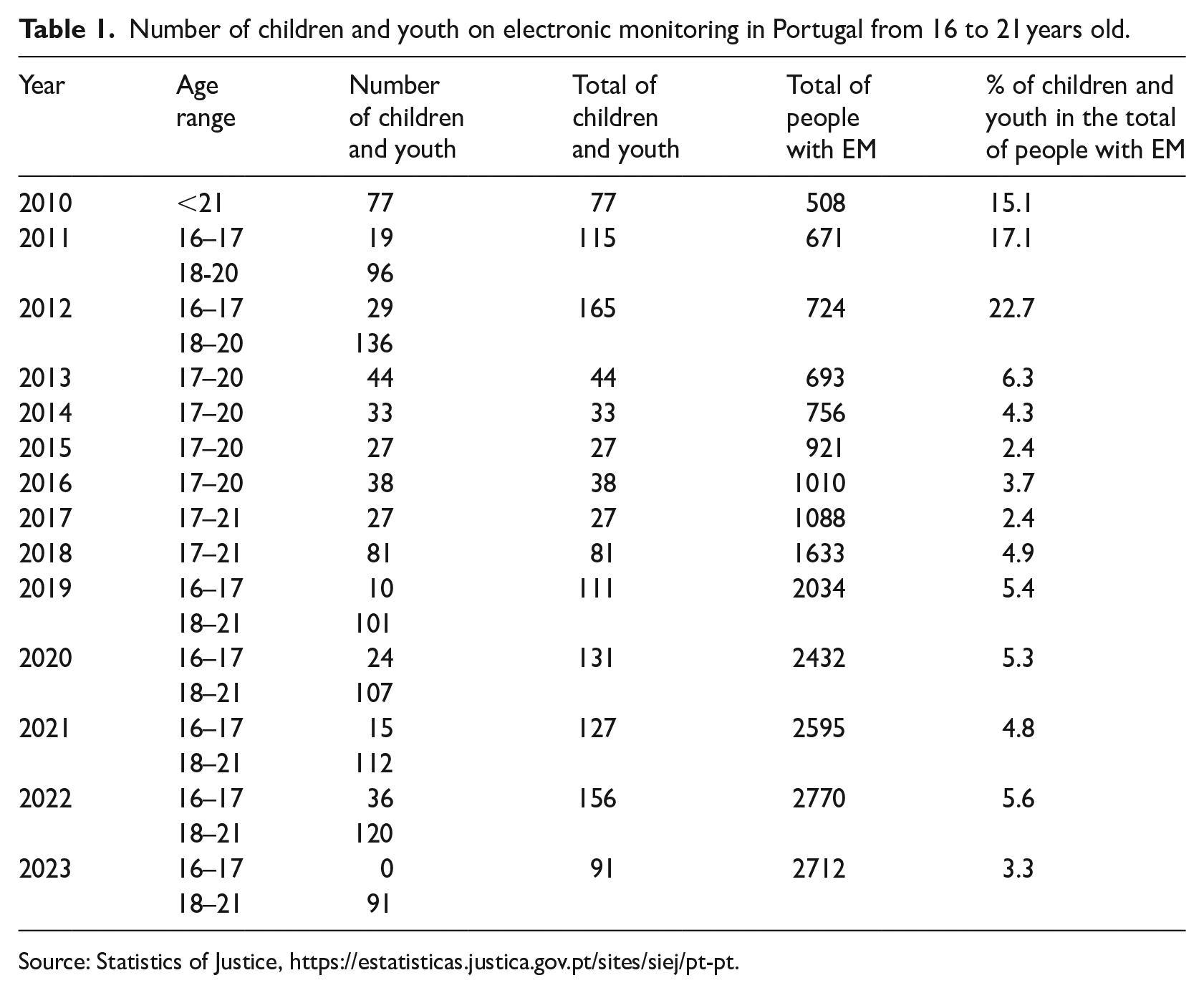
This regime clearly recognizes that young adults are different from adults in that they are more susceptible to peer pressure, more likely to engage in risk-taking behaviour, more likely to seek social recognition and less likely to consider the immediate and future consequences of their actions. Recognizing the potentially high criminogenic effect of imprisonment and the social and personal vulnerabilities that affect the transition from youth to adulthood, the focus is on the implementation of alternatives to imprisonment that could more effectively promote the social rehabilitation of young adults and prevent reoffending (Carvalho et al., 2021). In concrete terms, this means that young people between the ages of 16 and 21 in Portugal are currently subject to electronic monitoring measures and sanctions, as shown in Table 1. However, as the table clearly shows, it is very difficult to have a clear view on this issue as the statistics vary considerably from year to year, as the age range and the percentage of children and young people in the total number of persons under electronic monitoring explicitly show. Since 2010, this percentage has fluctuated between a maximum of 22.7 per cent in 2012 and a minimum of 2.4 per cent in 2015 and has remained between 2.4 and 5.6 per cent in recent years. Such fluctuations are extremely difficult to explain as they don’t reflect clear trends in legislation or crime rates. Further research is therefore needed. Nevertheless, the figures are highly relevant.
Number of children and youth on electronic monitoring in Portugal from 16 to 21 years old.
Source: Statistics of Justice, https://estatisticas.justica.gov.pt/sites/siej/pt-pt.
Electronic monitoring in Portugal mobilizes two types of technology: radiofrequency, which monitors presence at a specific location (e.g. home), and GPS, which is used only to control the prohibition of contact between (alleged) perpetrators and victims of domestic violence and stalking, which accounts for more than 60 per cent of the measures and sanctions enforced (Direção-Geral de Reinserção e Serviços Prisionais (DGRSP), 2024; Granja and Gomes, 2024). When people are under radiofrequency, they are ordered to stay at home 24 hours a day, except for those who have permission to leave for work, school or other exceptional leave. This makes Portugal one of the more restrictive countries in Europe, as in most contexts, supervision is usually limited to a certain number of hours per day (Hucklesby et al., 2021).
In 2010, the possible extension of electronic monitoring for children in conflict with the law (i.e. between 12 and 16 years old) was debated and equated as part of the work of the Committee for the Review of the Educational Guardianship Law. Leonor Furtado, the then Director General of Social Reinsertion, stated that the Commission ‘approves and proposes the application of electronic monitoring to juveniles in certain circumstances, namely in the context of intensive supervision and possibly as a precautionary measure’ (Lusa, 2010). This proposal flew under the radar of public, political and media attention and was ultimately not adopted in the revision of the Educational Guardianship Law that took place in 2015 (Law no. 4/2015, of 15th of January, first amendment to the Law no. 166/99, of 14th of September).
In this article, we argue that the use of electronic monitoring for children in conflict with the law is a crucial and controversial issue that is seriously underdiscussed and under-researched. First, because it is already being used on children between the ages of 16 and 18 without any kind of debate or discussion (see Table 1). Second, because the Committee for the Review of the Educational Guardianship Law’s proposal to use electronic monitoring for children between the ages of 12 and 16, despite not being approved, is a meaningful indicator of the adultification of the child justice system (Arnett, 2018), without any kind of public or academic debate. Third, the programme of the current government (which took office in April 2024) outlines a focus on the expansion of specific interventions in the field of juvenile delinquency and the strengthening of electronic monitoring teams (República Portuguesa, 2024: 86). Fourth, all this contrasts with a severe lack of research on the impact of electronic monitoring in the Portuguese context, which makes it difficult to assess the impact of such measures on offenders, particularly among the so-called young adults, victims and society in general (Granja, 2021; Granja and Gomes, 2024).
Methodology
This article draws and puts into conversation two research projects currently ongoing in Portugal supported by the Fundação para a Ciência e a Tecnologia. More particularly, the E-Monitoring project (Ref.a 2023.00030.RESTART), coordinated by Rafaela Granja, intends to explore the ‘projected futures’ (Nellis, 2021) and lived experiences of electronic monitoring in the criminal justice system. The Cyber-delinquency@Child-Justice research project (Ref.a 2021.00384.CEECIND/CP1657/CT0022), coordinated by Maria João Leote de Carvalho, is dedicated to studying the legal child-justice responses to online offending. Within the second project, the topic of electronic monitoring emerged as relevant during data collection.
For the purposes of this article, the interaction between the two projects offers a valuable analysis of the empirical data obtained from 22 individual in-depth semi-structured interviews within the Cyber-delinquency@Child-Justice research project, conducted between 2021 and 2022. Our aim is to explore how different stakeholders from different sectors of the Portuguese child justice system perceive both the challenges framing the child justice system and the projected (non)-futures of electronic monitoring.
Seeking the breadth of expertise and professionals’ views held by those working in the field of child justice system in Portugal, a non-probabilistic sampling was used to select the participants for this study. Specific criteria for defining the sample considered the need to include (1) judicial and non-judicial intervenients with recognized experience in the field of child offending and related law enforcement; (2) representatives from different entities and justice departments; and (3) diverse geographical locations. The first step was mapping the key stakeholders who could be involved (Knott et al., 2022). The second step was obtained authorization from the Portuguese authorities to access some of the professionals, that is, the Higher Superior Council of Judges, the Public Prosecution Service, the Ombudsman, the Directorate-General of Reinsertion and Prison Services and the Director of the National Security Police. The third step was to engage in snowball sampling, as the first individuals indicated other professionals, which resulted in a list of contacts that evolved during the data collection.
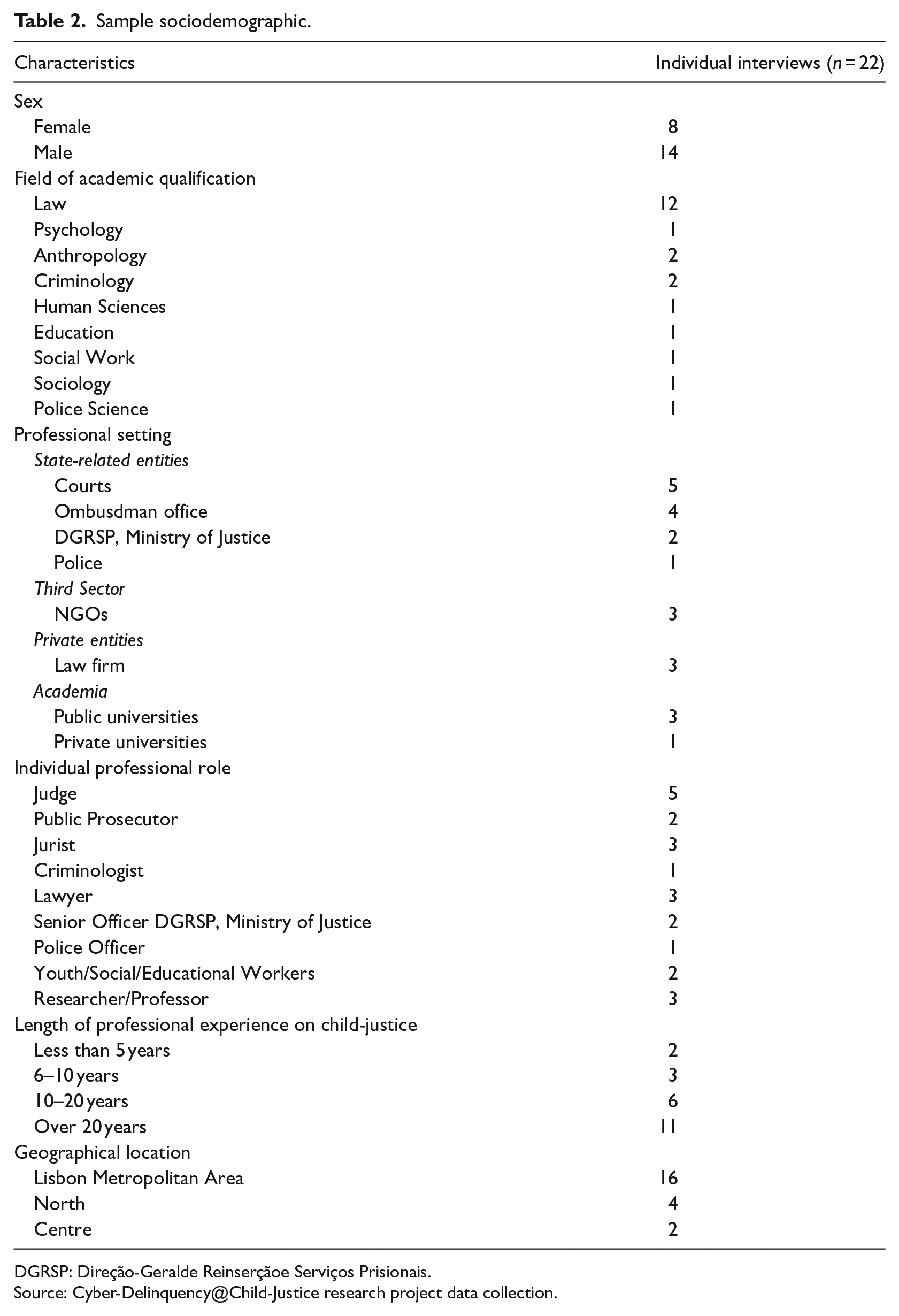
The sociodemographic characterization is summarized in Table 2. Overall, participants are diverse in terms of their background, professional roles and length of work experience in child-justice. Half of the participants have been working on this field for over 20 years. Law is the domain most represented in terms of academic qualifications.
Sample sociodemographic.
DGRSP: Direção-Geralde Reinserçãoe Serviços Prisionais.
Source: Cyber-Delinquency@Child-Justice research project data collection.
The data collection followed a strict ethical protocol that articulated the rights of the participants (e.g. voluntary participation, anonymity and confidentiality, possibility to withdraw at any time, data storage and use, complaints procedure) and the responsibilities of the researcher. Prior to the interviews, all respondents signed a written informed consent form and agreed to be audio-recorded. The time and place of the interview was at the participant’s convenience, and the interviews ranged in length from 40 to 97 minutes.
The resulting audio files were transcribed verbatim and uploaded into MAXQDA v20 to aid the data analysis process. All personal information was omitted and pseudonyms were used during transcription. Transcripts were read several times to gain an overview of the content, and an initial set of themes were labelled (Creswell, 2014). Through an inductive process, thematic analysis was then carried out using open coding for emerging themes in an exploratory descriptive analysis (Saldaña, 2013). For the purposes of this article, we selected only responses to questions that focused directly on electronic monitoring and analysed those responses that were considered by all authors to be illustrative of each thematic category that emerged from the content analysis.
Indecision and lack of reflection on the use of electronic monitoring in the child justice system characterized the position of five of the interviewees: a judge, a member of the Ministry of Justice, a public prosecutor, a social worker and a researcher. They stated that they had no knowledge or reflection on the subject, and they had no idea what could be done in Portugal in this area. The remaining 17 interviewees explored their views on the issue along four key axes that we explore below: (1) education, (2) control, (3) environments and conditions and (4) stigma. There were no differences identified in the opinions towards electronic monitoring related to the sample’s sociodemographic characteristics mentioned in Table 2. This might derive from the fact the use of electronic monitoring in the child justice system is a highly underdiscussed topic and, in some cases, participants were reflecting on it for the first time.
Results and Discussion
Education
In Portugal, the educational objectives of the child justice system are considered to be its main pillar. Drawing on the UNCRC principles, there is a prevailing legal belief that when dealing with children in conflict with the law, the focus should be on educating them about legal norms, rather than adopting a punitive and retributive framework (Carvalho, 2015; Rodrigues and Fonseca, 2010). However, some of the interviewed stakeholders argue that electronic monitoring stands in stark contrast to this ethos, as it is seen as a technology that mainly emphasizes surveillance and control. As a result, there’s resistance to its use among some respondents who see it as contrary to the basic principles of child justice in Portugal, as outlined by the following quotations: Electronic monitoring, in my opinion, is exactly contrary to the principle of the Educational Guardianship Law, which is education, accountability, motivation for young people to feel that there is a desire for change. (Judge 1) If the focus of the Education Guardianship Law is precisely education, then the issue of electronic monitoring (at least as it is applied to adults or as it is understood) does not, in my view, add value from an educational point of view. (Jurist 1)
In this context, many respondents draw direct comparisons between the child justice system and the adult criminal justice system. Within the latter, a prominent argument in favour of electronic monitoring is its potential to maintain social ties and thus prevent the enforced separation of individuals from their families and communities – a possibility facilitated by electronic monitoring, especially when contrasted with the prison system (Beyens, 2017; Daems, 2019; Granja and Gomes, 2024; McNeill and Beyens, 2013; Nellis, 2021; Nellis et al., 2013). However, when considering the child justice system, some stakeholders argue that there’s a real need to temporarily remove the child from their immediate environment: If, in the case of adults, it is a question of seeking uprooting and achieving the objectives of rehabilitation without creating this uprooting, in the case of admission to an educational centre, there is an effective need, at least from a conceptual point of view (. . .), to restrict the freedom of this young person and to remove him/her from the context in which he/she lives so that he/she can acquire a set of skills in a more appropriate environment. (Jurist 1)
A similar positioning is presented by another interviewee, a legal expert, that considers that the implementation of electronic monitoring in the child justice system would imply to purge the requirement of education from Educational Guardianship Law. This position argues that the emphasis on surveillance and control through electronic means may overshadow the educational components programmes directed to children in conflict with the law: (. . .) the only thing that will be identical [in the application of electronic monitoring between young people and adults] is the bracelet and the control function. That’s why I have a lot of doubts and it’s difficult for me to imagine, in the field of juveniles, in the field of educational protection, it’s difficult for me to imagine measures of this kind, because in the end we would end up, in an undeclared way, removing the need for education from educational protection. (Jurist 2)
However, there are also respondents who, while explaining that the law requires the child to be ‘educated for the law’ (Rodrigues and Fonseca, 2010), see electronic monitoring as an attractive option. According to one interviewee, electronic monitoring has the potential to promote self-control, especially when compared with other measures that restrict freedom of movement. According to this interviewee, by removing concrete physical barriers, electronic monitoring holds potential to enhance children’s feeling of being in control and responsible for their own actions: There is an electronic control, I would say self-control, because it’s one thing to be behind bars, I may want to break out, I may want to escape, but I’ve got bars and, that’s it, I can’t. What’s the advantage? None, so how do I educate myself, how do I fix my impulse, the fence is there, I hit my head, I headbutt, I don’t pass. (Lawyer 1)
Other respondents also see electronic monitoring as particularly useful for older children under the Educational Guardianship Law, for instance, when subject to a liberty-depriving measure: From the outset, I have no objection to this. Even today we have young people who are detained up to 21 years [within the Educational Guardship Law]. So, it makes perfect sense for this possibility to exist, at least for older children, I think it makes perfect sense, I think it can be included, I think so. I don’t have anything against it, I don’t see anything against it, especially for older children who are subject to a measure. (Public Prosecutor 1)
As we have shown before (please see Table 1), electronic monitoring is already used for people aged between 16 and 21 in criminal justice in Portugal, something not mentioned by any of the interviewees.
Control
Prevent reoffending through behavioural control is a common practice of child justice systems worldwide (Case and Bateman, 2020; Nowak, 2019). However, there are different and sometimes conflicting ways of exercising control, which creates a significant divide in how different stakeholders perceive the potential of electronic monitoring in the child justice system. For some, it is seen essentially as an economic measure that saves money: It is an electronic bracelet for control purposes only. That is, the State is not investing in real rehabilitation measures! (Public Prosecutor 1)
Other respondents perceive electronic monitoring as an instance of ‘isolated control’, divorced from complementary educational and rehabilitative measures: It seems to me that we can only achieve this with another type of measure that is not strictly an isolated control of their behavior (Judge 1) It’s a question of having means of surveillance, being there to see where the signal is, it’s strictly a control measure, it has nothing to do with restorative justice. (Jurist 2) Because of the nature of the law, I also think that it is not the best option from the point of view of the philosophy of the law of guardianship itself, which is specifically aimed at purposes other than mere control. (Judge 2)
Respondents who hold this position argue that relying solely on electronic monitoring neglects the underlying factors that contribute to offending, such as being a victim of abuse, neglect of violence, peer influence, school dropout, community factors, substance abuse, socio-economic deprivation, gender inequalities and family dynamics (Carvalho et al., 2021; Farrington et al., 2016; Nowak, 2019). One psychologist, for example, argues that most of these individuals already spend too much time alone and that the introduction of electronic monitoring would only serve to exacerbate this problem (see also Deuchar, 2011): I don’t know if it makes sense to me because it’s an isolated measure and it’s based on the assumption that they have this ability to control themselves in the family and what I feel here is that these children are left alone for too long. A lot of the behaviour that ends up happening is because they’ve been left alone for too long and if they haven’t had that ability to control themselves and adapt, I don’t know how much they’re going to have that ability with the bracelet. (Psychologist 1)
Some respondents go even further, equating the message the system would be sending with the implementation of a mechanism that is perceived by such stakeholders as a mere tool to increase control. Considering that children involved with the justice system are highly vulnerable and have faced multiple trust issues from relatives and institutions that have somehow failed them (Arnett, 2018; Carvalho, 2015; Case and Bateman, 2020; Kilkelly and Pleysier, 2023), the implementation of a monitoring tool would have the potential to further exacerbate such problems and only provide a ‘false sense of security’ to mainstream society: Most of these young people have never had anybody who believed in them, not at school, not with their parents, nobody they trusted, and then we’re going to have the system itself not believing and just watching? It seems to me that this is in fact a contradiction in terms of the philosophy itself and the model of educational guardianship. I don’t think it’s really compatible, and it would undoubtedly be a false sense of security. (Judge 1)
Such perspective encounters a lot of echoes in the specialized literature that reflects upon how electronic monitoring fosters the ‘adultification’ of the child justice system (Arnett, 2018; Devresse, 2022), in the absence of critical reflection and evaluation of potential harms for minors.
However, a contrasting view is held by a group of respondents who support the use of electronic monitoring in the child justice system, namely as support to the enforcement of other educational measures. They argue that electronic monitoring, by potentially facilitating location tracking through GPS, could be invaluable in preventing young people from going to certain places or contacting certain people: It may no longer be justified for educational supervision, but it could now be an important tool for other measures, such as banning people from certain places. (Judge 3)
On the contrary, one judge goes even further, suggesting that electronic monitoring by itself could technologically replicate parental authority, which tends to be problematic for young people with deviant behaviour: For example, not to go to certain places or not to talk to certain people. I think that electronic monitoring in itself [would be useful] as an autonomous measure, with components linked to obligations, for example not to visit certain places, without deprivation of liberty, but with some restrictions, but only on movement, such as prohibiting contact with certain people (. . .) Basically, it was a kind of parental authority, but exercised in a robotic way. (Judge 4)
Environments and conditions
Another aspect that shapes stakeholders’ perspectives on the potential role of electronic monitoring in the child justice system concerns the settings and conditions in which measures are implemented. It is in this context that several respondents who support the use of electronic monitoring in the criminal justice system anchor their main argument. They claim that electronic monitoring allows for children to remain a part of the community and continue education in the same settings, which is far less stigmatizing and harmful than being subjected to a custody measure (Crump, 2019; Weisburd, 2015) at an educational centre: If we think about it, what could be more punitive for young people: going to school with an electronic bracelet or going to an educational centre? Well, maybe, in the young man’s place, I would prefer to go to school with an electronic bracelet and continue with my daily life. Go on with your social life, have self-control. The educational centre is very punitive for the children who have to integrate the system, these will be the most serious cases. I think that because the goal is always future socialisation, it will always be easier to achieve this goal with the electronic bracelet than to remove the young person from his environment, place him in the educational centre and then have to do the whole thing in reverse and go back at the end. That’s something to think about. (Police Deputy Superintendent)
Another option for the implementation of electronic monitoring in the child justice system, also mentioned by the stakeholders interviewed, is its adaptation to different settings, ranging from the family home to institutional settings. The chameleon nature of the technology, already demonstrated by its use in the adult criminal justice system (Granja and Gomes, 2024), is thus highlighted as a point in its favour: It makes perfect sense! Electronic monitoring, [when] compared to a closed confinement measure in an educational centre, electronic monitoring can be similar to a closed regime in a place that is more . . . more personal or even institutional. Attention, because electronic monitoring can be used, for example, in a youth centre or in a special boarding school, it can be used in any context and does not have to be limited to the young person’s home. (Lawyer 1)
However, this position is directly contradicted by stakeholders who oppose the use of electronic monitoring in the child justice system. Such respondents argue that educational centres are effective precisely because they don’t focus solely on control. They claim that the strength of these centres lies in their multidisciplinary approach, where professionals work together to help children and young people acquire essential skills (Carvalho, 2015), something that electronic monitoring, by its very nature, would never be able to do: The educational centre is able to do something because it has technicians who work with them every day, and I emphasise, every day. This is why this makes all the difference compared to other measures. (. . .) With a bracelet they can even spend the whole day locked up at home watching television with nothing else to do or dealing drugs. (Judge 1)
Stigma
Finally, an issue that is also strongly mobilized by respondents with opposing views is that of stigma. On one hand, those who don’t agree with the potential use of electronic monitoring in the child justice system point to the potential visibility of the monitoring device and its potential harmful effects on children and young people: The effect of electronic monitoring on a young person is very different from the effect on an adult. There is the stigmatising effect, which can be worse than a more restrictive measure of freedom, it can be more offensive than others; I don’t see it as a positive alternative. (Judge 5) I can’t find anything that overcomes the risks of greater stigmatisation of young people. (Jurist 1) It’s easier to reinforce his behaviour, to show people ‘here I am’. (Youth worker)
On the other hand, respondents in favour of implementing electronic monitoring in the child justice system outline how such a technology is far less stigmatizing than other measures involving placing children in custody at educational centres: Electronic monitoring in itself is not stigmatising, or is as stigmatising or less stigmatising than other educational safeguards such as [detention in] closed regimes. (Lawyer 1)
Such a view tends to be anchored in the idea that the mechanisms of electronic monitoring could be adapted to be less visible and more discreet (Balasubramanyam and Antoine, 2019): Bearing in mind that technically it would have to have this protection, it would have to be something discreet, because technically there are already more discreet mechanisms, smaller, very small, because obviously if we had to see a 14- or 15-year-old young man going to school with a bracelet on his arm or something, that would make everything much more complicated. (Judge 3)
Discussion
Participants’ perspectives on the potential (non)futures of electronic monitoring within child justice systems reveal a complex spectrum of views shaped largely by their perceptions of the technology’s purpose and impact. On one end, some participants perceive electronic monitoring as a technical tool that enhances the operational capacity of the justice system, providing structure and monitoring capabilities that can, in theory, support children and the youth. On the other end, several participants view electronic monitoring as a restrictive surveillance mechanism that lacks necessary rehabilitative interventions, failing to address the unique developmental and psychological needs of young individuals.
This spectrum of perspectives resonates with the broader dichotomy within Portugal’s child justice system, which has been positioned as a third path – between the punitive or penal model and the welfare model (Bailleau and De Fraene, 2009; Carvalho, 2015). We argue that this hybrid positioning directly informs how participants view electronic monitoring; their perspectives appear to mirror the broader ideological spectrum of child justice, with some participants emphasizing punitive applications of electronic monitoring and others aligning it with welfare-centred ideals.
Among participants who perceive electronic monitoring as a supportive tool consistent with the goals of the Educational Guardianship Law, there is a focus on the practical benefits of electronic monitoring in controlling specific risk factors. These respondents highlight electronic monitoring’s capacity to restrict children and youth from visiting high-risk locations or interacting with certain individuals, potentially reducing exposure to negative influences (Deuchar, 2011; Párkányi and Hucklesby, 2021a). In addition, they note that electronic monitoring allows children and youth to remain within their communities and continue their education, which may foster a sense of normalcy and reduce stigma by keeping them in familiar environments rather than isolating them through detention (Charles, 1989a, 1989b). Such perspectives underscore electronic monitoring’s potential to support community-based rehabilitation, aligning with welfare-oriented aims.
Conversely, those who view electronic monitoring primarily as a vehicle for control and surveillance express concerns over its punitive nature. From this perspective, electronic monitoring is seen as emphasizing monitoring and restriction, often at the expense of complementary educational or rehabilitative measures that would address the specific developmental needs of children (Párkányi and Hucklesby, 2021a). These participants caution that a reliance on electronic monitoring without additional supportive measures risks reinforcing punitive approaches, potentially undermining efforts to rehabilitate and reintegrate young people in meaningful ways.
Final Remarks
In an era marked by the construction of an increasingly digital and technological justice for children (Davidson et al., 2023), the use of electronic monitoring within child justice systems is a controversial issue. This article examines the projected (non)futures of electronic monitoring in Portugal by exploring the perspectives of relevant stakeholders involved in the child justice system.
Overall, our data reveal a clear dichotomy among respondents regarding the possible implementation of electronic monitoring in the child justice system in Portugal. While some respondents are enthusiastically supportive, others are opposed to its introduction. Despite their different positions, it is interesting to note that all the arguments are based on the same four axes. The first is the proclaimed need to enforce education as a core aim of the Educational Guardianship Law. While for some the introduction of electronic monitoring would interfere with this aim, for others it is seen as a way of teaching children self-control. The second cross-cutting issue raised relates to the question of control. Some respondents felt that electronic monitoring is only a control mechanism with no other functions, while others see it as a potentially useful technology to complement other measures and actions. The issue of environments and contexts also emerges as particularly relevant, as it opens the discussion of what kind of contextual settings (family, institutional or others) are more appropriate for dealing with children in conflict with the law. Finally, stigma is also seen as a fundamental vector. While for some respondents electronic monitoring is seen as much less stigmatizing than detention in educational centres, for others its visible component is seen as potentially more stigmatizing.
Regardless of such insights, our results also show that the discussion on electronic monitoring suffers from a serious underdevelopment, since the respondents have little knowledge of what happens in other countries where electronic monitoring is already applied, including European countries (Párkányi and Hucklesby, 2021a, 2021b, 2021c; Van Biervliet, 2023) and how the system works in the Portuguese criminal justice (Granja and Gomes, 2024) – namely, what kind of equipment, intensity, intrusiveness, mechanisms for non-compliance and breach (Hucklesby et al., 2021) are currently applied or could be applied in the near future. But, even more importantly most respondents don’t bring to the debate any information on the use of electronic monitoring with individuals between the ages of 16 and 21, as is already established (please check Table 1).
This invisibility leads to a second consideration, which relates to the way in which the interviewees’ perspectives outline a purely functional, utilitarian and managerial view of electronic monitoring. Overall, the focus of the discussion is on how the child justice system could deal with electronic monitoring and link it to its already existing legal framework, based on the principles of the Educational Guardianship Law. In other words, the focus is not on the child itself, nor on the child’s rights, which were not even explicitly mentioned by the interviewees. Such a discussion is mostly absent, as electronic monitoring is seen only as a functional tool, which may or may not fulfil or complement certain functions of the Educational Guardianship Law. The positioning of the interviewees, perhaps stemming from the relative stability of the Portuguese system, is limited to considering the perspective from the system’s point of view, and few put the child’s point of view, and particularly the child’s rights, at the centre of the discussion.
In sum, the findings underscore a pressing need for sustained reflection and informed discussion in Portugal regarding electronic monitoring’s potential future within the child justice system. Without this foundational knowledge, it remains challenging to debate whether electronic monitoring is a suitable tool for child justice and, if so, to determine how it should be applied. To address these gaps, it is crucial for stakeholders to engage in dialogue that addresses fundamental questions: how does electronic monitoring might fit the Portuguese child justice system, and, in particular, the principles of the Educational Guardianship Law? What types of technology may be best suited for this context (Balasubramanyam and Antoine, 2019)? For which categories of cases could electronic monitoring be beneficial (Párkányi and Hucklesby, 2021a)? Under what specific conditions should electronic monitoring be applied to balance control with rehabilitative support (Van Biervliet, 2023)? Only through a well-informed, critical discourse can the child justice system identify approaches to electronic monitoring that prioritize children and young people’s developmental needs and foster positive outcomes aligned with both welfare and educational objectives.
Footnotes
Acknowledgements
The authors are grateful for the permission to conduct interviews granted by the Portuguese High Council of Judges, the Public Prosecutor’s Office, the Ombudsman, the Directorate General of Reintegration and Prisons and the Director of the National Security Police. They are also grateful to those who accepted the invitation to be interviewed and gave their time and expertise.
Funding
The author(s) disclosed receipt of the following financial support for the research, authorship and/or publication of this article: This work has been funded by Fundação para a Ciência e Tecnologia (FCT – Portuguese Foundation for Science and Technology) under the Programme Scientific Employment Stimulus – Institutional Call attributed to Rafaela Granja (https://doi.org/10.54499/CEECINST/00157/2018/CP1643/CT0003), as well as under the Restart Programme for the research project ‘Electronic monitoring in the criminal justice system: Projected futures and lived experiences’ (2023.00030.RESTART), coordinated by Rafaela Granja. Additionally, this publication is supported by FCT under the projects UIDB/00736/2020 (base funding) and UIDP/00736/2020 (programmatic funding). Finally, FCT also funded this publication under the Programme Scientific Employment Stimulus – Individual Call, financed by national funds, attributed to Maria João Leote de Carvalho ( ).
).