




Abstract
The ‘Child First’ guiding principle for practice in the Youth Justice System of England and Wales has a growing international evidence-base and is fully embedded in policy/strategy, yet remains underdeveloped in consistent, coherent practice across local agencies and areas. This raises the potential for a policy–strategy practice implementation gap. Focus-group consultations (n = 11) with professional stakeholder groups (community, custody, strategy, inspectorate, and research) explored perceptions of the practice challenges to understanding, implementing and supporting Child First. Qualitative analysis identified child-centrism, professional relationships and cognisance as pivotal features of the effective realisation of Child First in practice.
Keywords
Introduction
The philosophy for youth justice must be to treat all young offenders as children first’ (Haines and Drakeford, 1998: 89)
It took nearly 20 years for Haines and Drakeford’s vision to be seriously considered, but eventually the 2016 ‘Youth Justice Review’ recommended improving the Youth Justice System (YJS) of England and Wales by creating ‘a new system in which young people are treated as children first and offenders second’ (Taylor, 2016: 48). The Youth Justice Board for England and Wales (YJB, 2021a, 2021b) subsequently reformulated this recommendation into ‘Child First’, now the ‘strategic approach and central guiding principle’ for youth justice practice (p. 10), wherein ‘children can and should be given every opportunity to make positive changes’ (p. 7). However, Child First is in stark contrast to the then prevailing risk-focussed, deficit-led approach to addressing the YJB’s overarching aim of prevention of offending and reoffending by children (Case and Hampson, 2019). Not only is the evidence-base for this risk-focus questionable, but its effects have been found to be extremely damaging to children in the grip of the YJS (McAra and McVie, 2010). The resulting tensions from two opposing, possibly contradictory, approaches have stalled progress towards full adoption of Child First in several areas. The Strategy Implementation Project (SIP) was a strategy consultation exercise undertaken to establish which areas have seen stalled progress. The SIP sought to investigate the realities of Child First through the eyes of a wide range of stakeholders to identify challenges still needing to be overcome, thereby generating impact through recommendations for improved realisation of Child First in practice. It utilised 11 workshop-style focus groups and two interviews, with participants selected using purposive sampling to ensure a wide range of different agency involvement from senior management down to frontline practitioners. Data were then analysed thematically to identify where the issues lay for these professionals in translating the strategy of Child First into the reality of Child First.
This article will explore tensions arising at all levels from the development of Child First as a philosophy of youth justice replacing the previous risk-focus, by identifying their source, effect and potentially how they could be mitigated. To facilitate this, we first explore Child First justice (as recognised by the YJB), its emerging evidence base and the challenges this brings to a previously risk-focussed approach, especially caused by incongruence between the two approaches. To evidence this and develop the theory into practice, we then discuss the SIP, Our findings from this are categorised into the three main features of child-centrism, cognisance and professional relationships, leading to a distilled and focussed analysis of how the challenges within these areas can be addressed.
Child First Justice
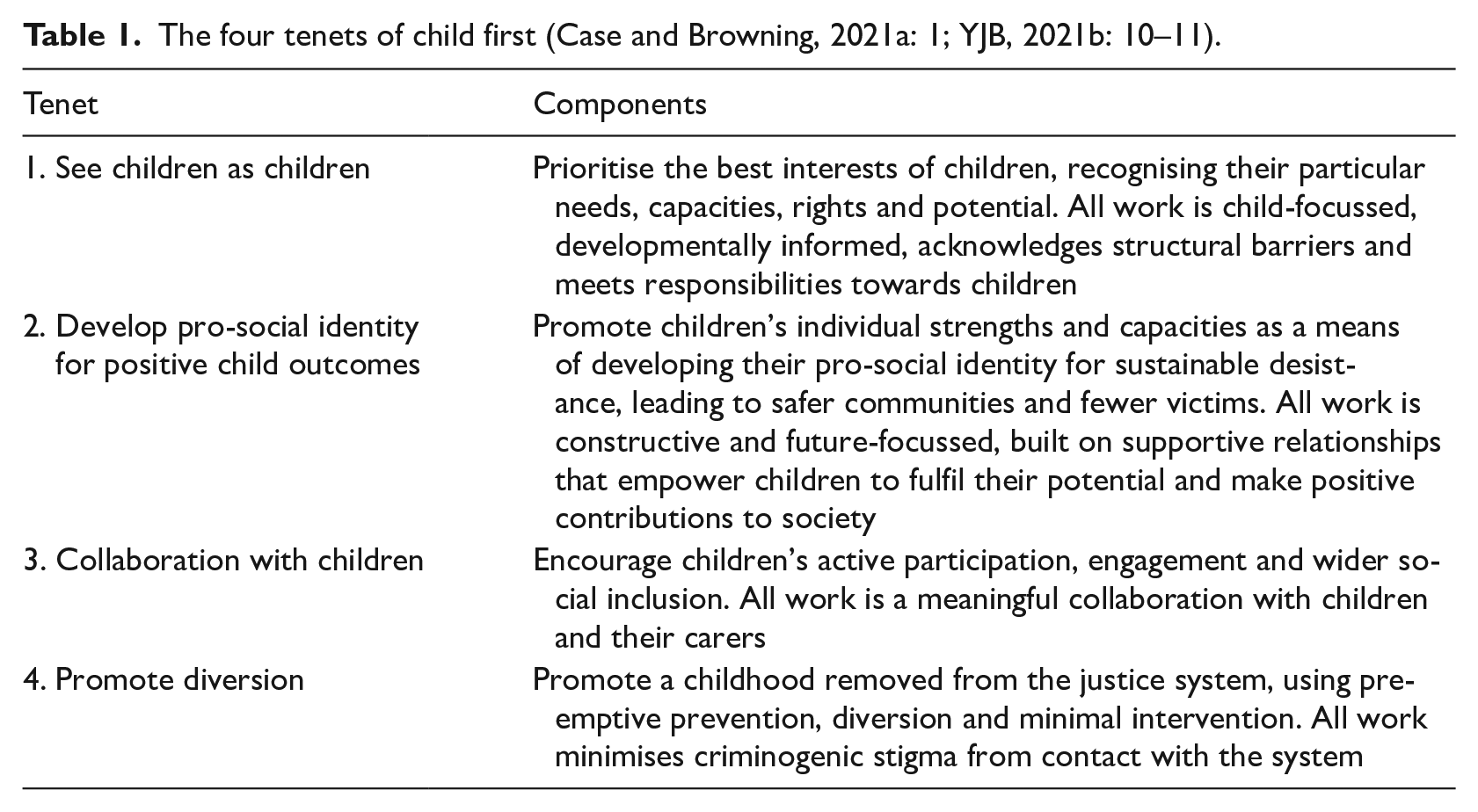
The YJB’s Strategic Plan operationalises Child First into four inter-related tenets that combine the central features of ‘Positive Youth Justice’ (child-friendly, diversionary, promotional, legitimate, engaging, responsibilising adults; Haines and Case, 2015) with ‘Constructive Resettlement’ (constructive, co-created, customised, consistent, co-ordinated; Hazel and Bateman, 2021), as shown in Table 1.
The four tenets of child first (Case and Browning, 2021a: 1; YJB, 2021b: 10–11).
Child First: An evidence-based challenge to risk management
Formalising Child First represents a significant policy and strategy shift for youth justice in England and Wales. The Child First tenets (see Table 1) clearly outline an approach based on positive strengths-based working, privileging collaboration with children and working towards positive outcomes. This is a deliberate stepping away from the hegemonic risk management model, which has been criticised as inappropriate, criminalising and iatrogenic due to its focus on preventing negative behaviours/outcomes, neglect of children’s meaningful participation, prioritisation of adult-centric understanding/practices and tendency towards ‘interventionism’ (see Case and Haines, 2021). Comprehensive critiques of risk management practice models and mechanisms (e.g. risk assessment) are long-standing and evidence-based – focussed on theoretical, conceptual, methodological, practical and ethical weaknesses/limitations (cf. Case, 2021; Case and Haines, 2009). System research, from the multi-method ‘Edinburgh Study’ (McAra and McVie, 2010) and survey-based ‘Swansea Bureau’ evaluation (Haines et al., 2013), identified system contact and risk-based youth justice as criminogenic. Practice research, utilising interviews and observations with practitioners, identified risk assessment as marginalising children’s voices (Drake et al., 2014) and criminalising them (Creaney, 2020). Process analyses of the risk-based ‘Scaled Approach’ framework have shown it to have been significantly outperformed by Child First models (Haines and Case, 2012). Critical reviews, exemplified by an evaluation of 39 meta-analyses/systematic reviews (Prins and Reich, 2021), concluded that risk assessment claims to predictive accuracy are undermined by inappropriate statistics and inconsistent, overstated conclusions.
Consequently, risk management critique should not be diminished or caricatured as mere ‘theoretical debates’ (Baker, 2014) or ‘fashiona’, 1 since dismissive, defensive rebuttals could be misleading, reductionist, caricatured or even agenda-driven in evidential terms.
The emergence of Child First
Long-term critical reflection by the YJB alongside academics and practitioners, on the appropriateness and utility of risk management philosophies, strategies and practices dates back (at least) to the circa 2013 re-evaluation and ultimate abolition of the ‘Scaled Approach’ assessment–intervention framework (see Drew, in Case, 2021). The subsequent emergence and strategic formalisation of Child First has been driven by a series of developments, including developing evidence, debates of principle, socio-economic change, political dynamism and strategic developments in other policy areas, which we now discuss.
Academic and empirical insights regarding successful youth justice strategies and practice have been evolving, as demonstrated within the growing international evidence-base (cf. Case and Browning, 2021a). Alongside evidence-based critiques of previous models (e.g. risk management; see earlier), this has expanded knowledge and understanding of effective youth justice practice. The YJB acknowledged that this ‘has challenged our previous thinking . . . We are still learning and building our understanding of the evidence and what this might mean for policy and practice’ (YJB, 2021a: 8). ‘Child-friendly’ and ‘principled’ models have been arguing for youth justice to address socio-economic inequalities, prioritise diversion from the formal YJS and promote child-appropriate justice – viewing children who offend as ‘vulnerable becomings in need of protection, help, guidance and support’ (Goldson and Muncie, 2015: vii), in that, they are still developing so have not yet become.
Recent times have been characterised by wholesale socio-economic change, with a combination of credit-crunch crises and right-wing neoliberal politics/economics bringing sweeping austerity. This has precipitated the enforced downsizing of children’s support services across the board (Ridge, 2013), catalysing key stakeholders to explore and innovate new, more efficient and cost-effective understandings of/responses to children’s offending behaviour. The consequential governmental instability and insecurity (also threatened by Brexit and growing internal devolution) has caused constant personnel turnover (epitomised by four different Prime Ministers over the last 4 years), drowning out the visibility and priority of youth justice as a political issue. For example, the ‘Youth Justice Review’ (Taylor, 2016) was motivated by pragmatic and economic concerns to reduce reoffending rates in the YJS, rather than a genuine will to address shortcomings arising from developing evidence. This is starkly illustrated by the express ban on that review even considering the minimum age of criminal responsibility – long shown by evidence from wide-ranging evidence and United Nations edicts to be pitiably low in England and Wales (United Nations, 2019). However, other policy areas do appear to be reflecting real change, for example, the ‘Child Centred Policing’ national strategy states that ‘It is crucial that in all encounters with the police those below the age of 18 should be treated as children first’ (National Police Chiefs’ Council, 2015: 9). Similarly, the ‘Sentencing Children and Young People’ guidelines and principles state that ‘the approach to sentencing should be individualistic and focused on the child or young person, as opposed to offence focused’ (Sentencing Council, 2017: 4).
In this context of a developing commitment to, and movement towards, Child First from other agencies, the ‘Standards for children in the justice system’ (MoJ/YJB, 2019) provide a ‘framework for youth justice practice’ to ensure that positive outcomes for children align with the Child First guiding principle for youth justice practice (MoJ/YJB, 2019: 4). These revised ‘National Standards’ for practitioners are ‘indicative of a clear distinction between the philosophy now espoused by the YJB [Child First] and that which informed the previous itertion of the standards [risk management]’ (Bateman, 2020: 4). The standards are consolidated in ‘Case Management Guidance’ for practitioners, which outline how practitioners/managers can work effectively with children at different stages of the YJS; this guidance has just been updated, as stated: ‘the Child First guiding principle runs throughout it’ (YJB, 2022b). Together, these documents offer a ‘guide to strategic and operational services’, and at last constitute a significant improvement on the previous 2019 case management revisions, as they now detail such Child First priorities as relationship-building and involving children in their own planning (YJB, 2022b).
Incongruence: A barrier to implementing Child First in practice
There have been encouraging Child First-aligned developments in youth justice practice standards and guidance, including normalisation of the term ‘children’ (rather than ‘young people’), the general rejection of references to ‘risk factors’, and the change in terminology from ‘Youth Offending Team’ to ‘Youth Justice Service’. However, there remains an overriding incongruence (caused by incompatibility, contradiction and confusion) in information provided to youth justice staff to direct their work. This incongruence is most evident in the simultaneous pursuit of Child First objectives alongside risk management objectives that continue to dominate much practice guidance provided by youth justice governance organisations, like the inspectorate (explored later).
Although the YJB’s new case management guidance is much more focussed on the Child First tenets, it still relies on ‘AssetPlus’ as an assessment–intervention framework, which has its feet firmly within a risk-focus (Hampson, 2018). The rationale for AssetPlus asserts that ‘theoretical debates . . . [and] perceptions and experiences of practitioners’ (Baker, 2014: 4) regarding risk management/assessment have influenced moves away from the risk-based Scaled Approach framework by providing ‘new ideas’. The document outlines purportedly more holistic, ‘whole child’, integrated and collaborative processes for understanding and responding to children who offend – championing new mechanisms designed to increase practitioner discretion, foster children’s meaningful participation and tackle interactions between a wide range of criminogenic influences, not just stand-alone (risk) ‘factors’. However, despite these anti-risk sentiments, the rationale maintains that ‘assessment will involve identifying risk and protective factors’ (Baker, 2014: 4–5), illustrated by the focus on practitioner judgements on risk (impact and likelihood of reoffending) and intervention emphasis on the reduction and management of risk (Baker, 2014: 3–4). The inclusion of an automatically computed ‘YOGRs’ (Youth Offender Group Reconviction Scale) number to predict risk of reoffending shows how little AssetPlus has moved away from actuarial risk-based youth justice (despite evidential difficulties with the basal research on which prediction of offending is based (Prins and Reich, 2021). Ultimately, comprehensive training/guidance regarding implementing the AssetPlus framework/instrument is persistently absent, bringing inevitable regression to risk-informed practices of old (Creaney, 2020; Hampson, 2018) antithetical to Child First (Case and Browning, 2021a).
Youth Offending Teams (YOTs) are inspected by His Majesty’s Inspectorate of Probation (HMIP), but inspection criteria exacerbate the climate of incongruence with an incompatible mix amalgamating support for Child First tenets amid risk management principles. For example, key elements of inspecting/evaluating ‘Organisational delivery’ (HMIP, 2022) encourage YOT management boards to promote evidence-based, multi-agency partnership working in child-friendly delivery environments (Child First), while targeting ‘desistance factors’, risk profiles, criminogenic needs and risks posed (i.e. retaining a largely risk management-led approach). Confusingly, HMIP (2022) promotes desistance as ‘a primary goal for YOTs’ (p. 4), despite the primary aim of the YJS remaining the ‘prevention’ of offending – a fundamental mismatch of function. The ‘Case assessment rules and guidance’ (HMIP, 2022) guide practitioners to employ assessment to support desistance by addressing strengths, structural barriers, diversity and developmental sensitivity (Child First) alongside attitudes/motivations for offending, personal, family and social ‘context’ (risk factors/management). Incongruence persists in ‘Supporting the desistance of children subject to court orders’ (HMIP, 2022), which promotes children’s strengths, positive identity development, positive outcomes, constructive relationships and collaboration (Child First) alongside often negative-focussed ‘desistance’ factors (risk/protective factors) identified using the (HMIP-endorsed) ‘Risk-Need-Responsivity’ 2 model (risk management). HMIP inspection criteria, guidance and evidence-bases consistently privilege risk management–relegating Child First to the status of one of several possible ‘models and frameworks’ 3 for practice (HMIP, 2022: 8). This model confusion is typified by the ‘blended approach’ that explicitly draws strengths- and risk-based approaches together into one (Kemshall, 2021) – surely the ultimate in incongruence.
Notwithstanding these sources of incongruence, formal strategic and operational support for animating and applying Child First in practice continues to grow, building on the revised YJB National Standards and Case Management Guidance. The centrality of Child First has been reasserted in the ‘YJB Business Plan 2022-23’, which draws a ‘new sense of purpose’ from ‘looking at everything through the lens of maximising impact in service of the YJB (2022a) Child First vision’ (p. 4) . Accordingly, Child First is now embedded in strategy rhetoric and formal publications, alongside exerting a more tangible influence on practice guidance and, to at least some degree, on inspection criteria. However, persistent incongruence between practice guidance and most inspection criteria perpetuates barriers to consistent, faithful and successful implementation of Child First in youth justice practice (cf. Day, 2022). Indeed, the underwhelming development of Child First in practice is indicative of a potential policy–strategy–practice ‘implementation gap’ (cf. Gunn, 1978), whereby Child First progresses little beyond policy rhetoric or strategy guidance into observable, measurable practice realities that transform youth justice structures, frameworks, practices and the experiences and outcomes of children in trouble (Bateman, 2020).
The Child First ‘SIP’
Western governments are increasingly interested in how policy implementation can be ‘strengthened and supported in order to ensure the policy intentions are turned into practice results’ (Hudson et al., 2019: 2), rather than privileging policy formation processes. There is a growing political and academic emphasis on policy implementation, understood as multi-faceted, complex and inherently unpredictable and non-linear (Braithwaite et al., 2018). Failure to acknowledge this contributes significantly to policy implementation failure, often exacerbated by stakeholder misunderstandings or disagreements regarding implementation objectives and evidence-base deficits. These issues, combined with conflicting guidance from governance organisations, indicate the need for more focussed consultation (particularly including frontline staff), regarding the implementation of Child First in practice to avoid a policy–strategy–practice implementation gap. Meaningful consultation with practice should be prioritised because youth justice practice is created by practitioners mediating and moderating national policy/strategy through locally specific relations, discretion, decisions and adaptations (see Goldson and Briggs, 2021). Frontline practitioners (nicknamed ‘street-level bureaucrats’; Lipsky, 1980) are typically closer to, with a better understanding of, realities of implementing policy in the real-world than centralised governance and policy-makers (Hudson et al., 2019). Therefore, it is crucial to examine how practitioners’ understandings, ideas, relationships and activities around Child First shape and drive its implementation. It remains, of course, crucial to simultaneously consult with multiple levels of stakeholders (e.g. policy-makers, strategy makers, managers) to explore the ‘messy engagement of multiple players with diverse sources of knowledge’ (Davies et al., 2008: 188) in policy/strategy implementation.
The Child First SIP was designed as a whole sector consultation (from practitioner to policymaker) to examine perceptions of how Child First is being operationalised, implemented and supported in practice, and how these processes could be improved. Funded by Loughborough University Enterprise Project Group (EPG), the SIP embodies the real value of academic enterprise, which lies in making a difference and the potential for improving lives – in this case, the lives of YJS-involved children. Aligned with the EPG aims of accelerating the creation of social, cultural and economic impact through knowledge exchange, the SIP sought to generate impact through recommendations for improved realisation of Child First in practice.
Methodology
The central research question of ‘What are the challenges to implementing Child First in youth justice practice?’ was explored through stakeholder consultation within a workshop format each consisting of a short presentation to contextualise the introduction of Child First and explain the purpose of the consultation, followed by a focus group/interview. This methodology enabled participants to engage in natural, within-group discussion, sharing and debating examples, experiences, thoughts and insights, all with the potential to reveal themes that may not emerge through other forms of data collection (Palys, 2008). Workshop recordings were transcribed verbatim and identifying details that could compromise participant anonymity removed.
Sampling and procedure
Purposive sampling was employed to selectively and strategically access views and experiences of professionals ‘involved in designing, giving . . . or administering’ relevant services (Palys, 2008: 697), thus possessing specialist knowledge of the field and potential to contribute appropriate content and depth of data (Oliver, 2006).
Seventy-three participants were recruited across a range of YJS stakeholder groups, including YJB England and Wales, YJB Cymru, HMIP, Association of YOT Managers (AYM – through which frontline practitioners as well as managers were also recruited), YOT Managers Cymru and the Welsh Centre for Crime and Social Justice (see Table 2). Qualitative data were drawn from 11 online consultation workshops and two interviews (September–December 2020). These included six groups facilitated via youth justice organisations. YJB England and YJB Cymru each identified a strategy-role based group (n = 12); a government policy unit facilitated a policymaker group (n = 3); HMIP facilitated an inspectorate group (n = 4). The YJB Liaison Group identified a mixed group of practice and management stakeholders from across the wider YJS and partnership organisations (Youth Custody Service, Healthcare, Children’s Services, Policy-makers, (n = 15), while the Hwb Doeth Developing Practice Fora included both academics and practitioners (n = 12)). Four groups were made up of 15 YOT staff who responded to a call for participants distributed via AYM; they were organised into groups based on role-type (Heads of Service, Operations/Team Managers, and Practitioners). The final group was recruited via direct contact with a Resettlement Consortium, both from management roles). In addition, two participants (HMIP, academic researcher/practitioner) were unable to join scheduled workshops and were therefore interviewed individually.
Composition of stakeholder groups.
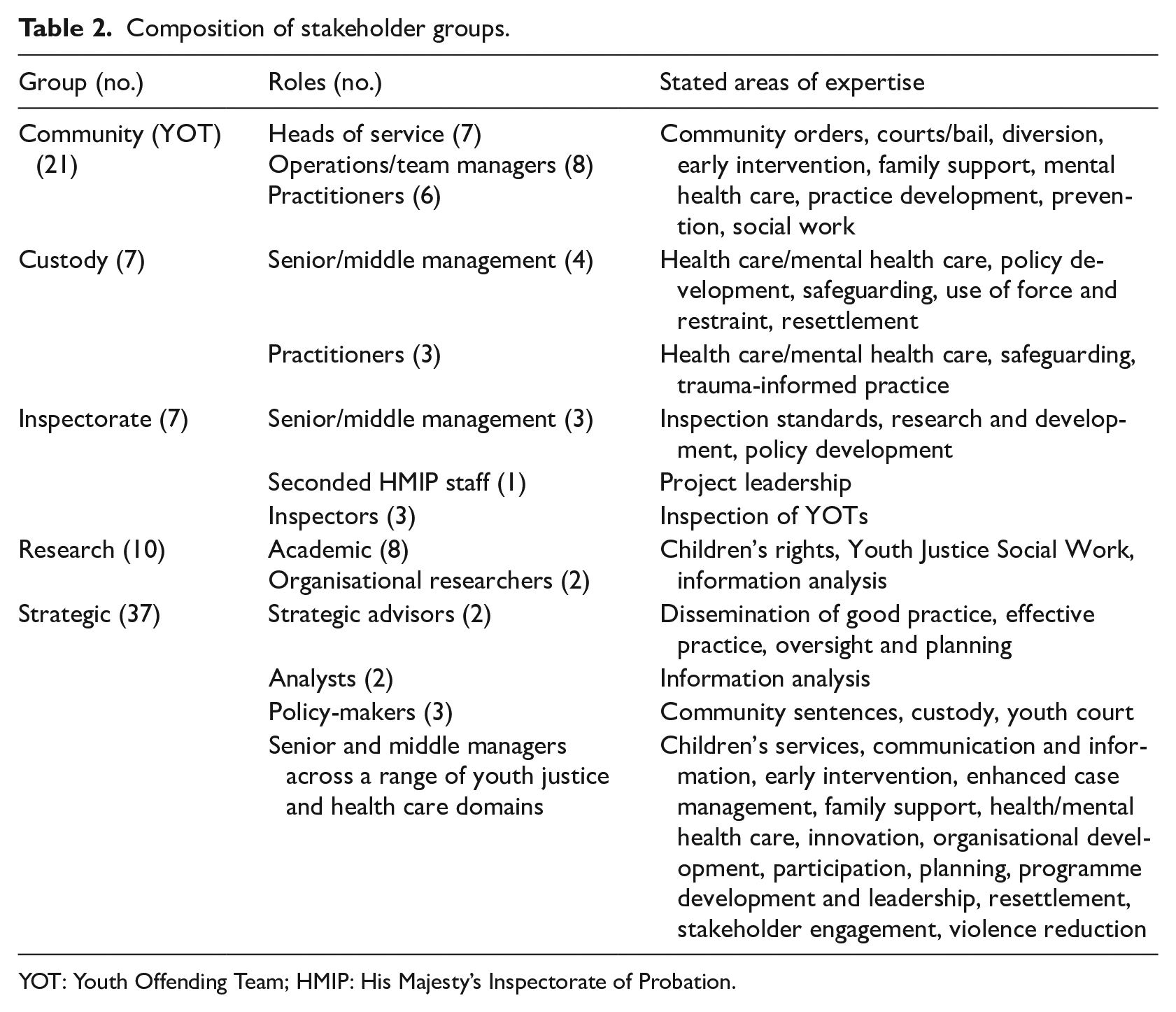
YOT: Youth Offending Team; HMIP: His Majesty’s Inspectorate of Probation.
Ensuring project integrity
As an enterprise project, the SIP took the form of a stakeholder consultation and engagement exercise rather than a research study and as such, formal ethical approval was not required. Nevertheless, equally robust measures were put in place to ensure the ethical integrity of the consultation process. Information about the consultation was provided prior to participation (covering such areas as project purpose, confidentiality, data management and security and the right to withdraw at any time), thus enabling participants to arrive at an informed decision regarding their involvement. Informed consent for participation was sought verbally upon commencement of each workshop. In accordance with General Data Protection Regulation (GDPR) data protection legislation, all consultation data were considered confidential and stored safely, securely and separately from participant names and contact details. All participant data are therefore anonymised within this article.
A workshop–focus-group data collection method was employed to achieve several different aims. It enabled access to a large number of participants with shared interests in youth justice policy and practice. A less structured approach to data collection (compared with surveys or interviewing) allowed participants to engage in natural, within-group conversation with guidance from a mediator. Participants were therefore able to share and debate examples, experiences thoughts and insights related to youth justice policy and practice, with discussions having the potential to reveal themes that may not have emerged through other forms of data collection.
This workshop approach was piloted involving stakeholders engaged in strategic, managerial and research roles to test its suitability for generating appropriate, good quality, detailed data. This same approach was subsequently employed across the remaining nine workshops. The workshop recordings were transcribed verbatim and any identifying details that could compromise participant anonymity were removed.
Analysis
The workshop transcripts were thematically analysed (Braun and Clarke, 2006) using ‘NVivo’. 4 This analysis method offers a flexible approach to unpacking large qualitative data sets, facilitating analysis that is both deductive (examining anticipated existing themes; e.g. varying levels of understanding of Child First, predicted support needs) and inductive (allowing new unanticipated theme generation from the data). Our approach to thematic analysis involved detailed, systematic coding, identifying and labelling text excerpts relevant to the central consultation question: ‘How can the Child First guiding principle be operationalised in practice across the Youth Justice System of England and Wales?’
The excerpts (codes) were further examined for commonalities and reduced repeatedly, through systematic grouping and categorising into a range of distinct categories (sub-themes). Further analysis enabled the sub-themes to be collated into more general themes that were, in turn, grouped into three key features. Hence, each feature was defined by a variety of themes and sub-themes.
However, while analysing/generalising findings across all participants offers valuable insight into stakeholder perceptions of Child First in practice, it explains little about how practice elements of Child First, for example, understanding, may be perceived differently by specific stakeholder groups (see Table 2 for detailing of these groups). Therefore, between-group analyses were conducted using NVivo cross-tabulation, which enabled commonalities and differences between the different stakeholder group responses to be identified.
SIP findings
The three key features identified through the analyses outlined above were child-centrism, cognisance, professional relationships. Child-centrism (a commonly identified feature of Child First stakeholder understandings for all groups), incorporates child-friendly and child-focussed strategies for working with children. It often seemed to be considered synonymous with developmental sensitivity (understanding the developing nature of childhood) and alongside realising rights/entitlements, with its sub-theme of realising rights to childhood. Also related to this feature was engagement and the vital importance of building good relationships with children. Cognisance focusses on knowledge, understanding and information regarding Child First. This feature was pivotal, particularly the development of understanding of Child First. Conversely, incongruence seems to distort understandings of Child First, where deficit/risk-focussed practices operate alongside positive and rights-based approaches. Professional relationships include components and practices of inter- and multi-agency working relationships. This feature highlighted philosophical and cultural differences influencing disparate interpretations between community and inspectorate groups.
These three features, with their themes/subthemes, will now be discussed in more detail, within a framework of the different stages needed for true child first implementation – understanding (how much this feature and its themes/subthemes is truly understood), implementation (how this can be made practice reality) and for the latter two features, support requirements (what is needed to ease transition into normal consistent practice). Each discussion is illustrated by quotes from stakeholders (note that quotes include the stakeholder group category in brackets afterwards) and begins with a table (Tables 3 to 5) defining each feature’s identified themes/subthemes distilled from participant consultations.
Child-centrism – Feature and theme definitions.
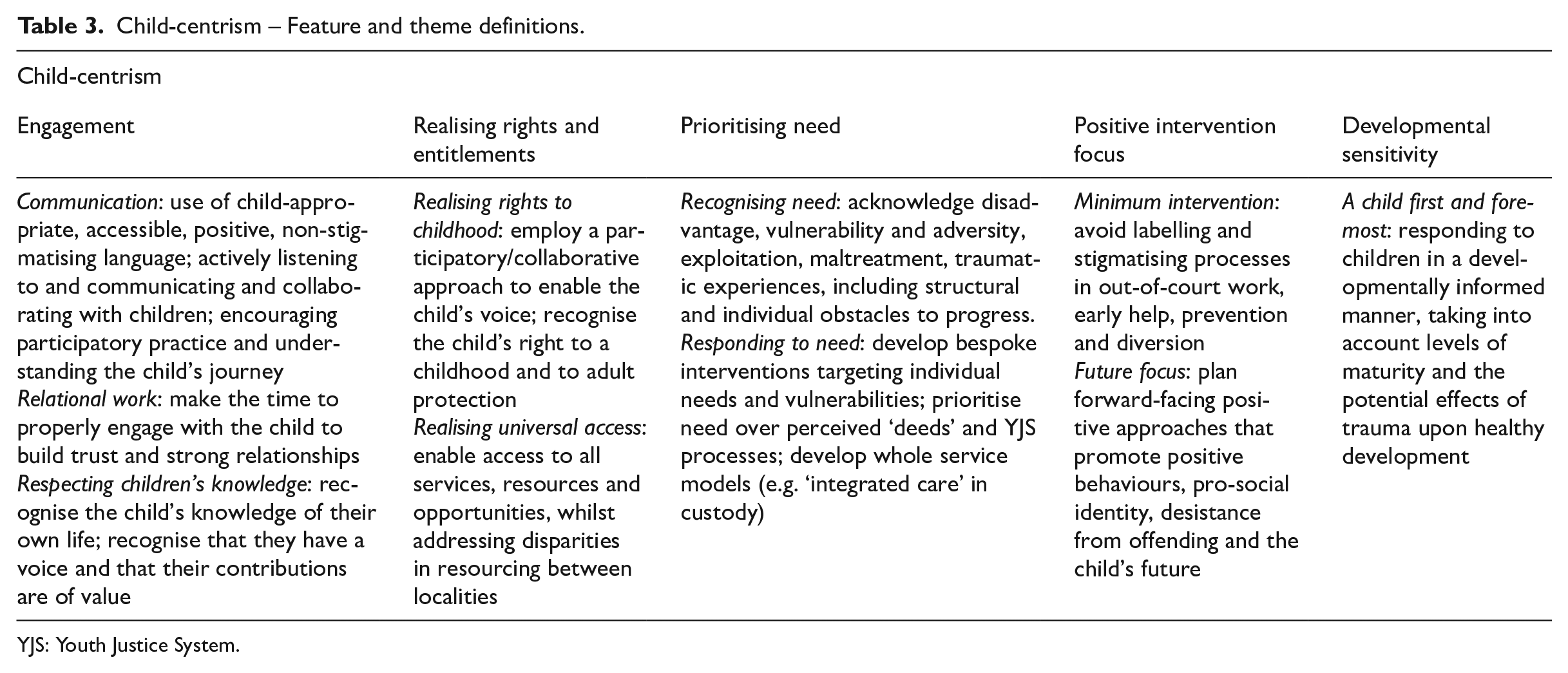
YJS: Youth Justice System.
Cognisance – Feature and theme definitions.
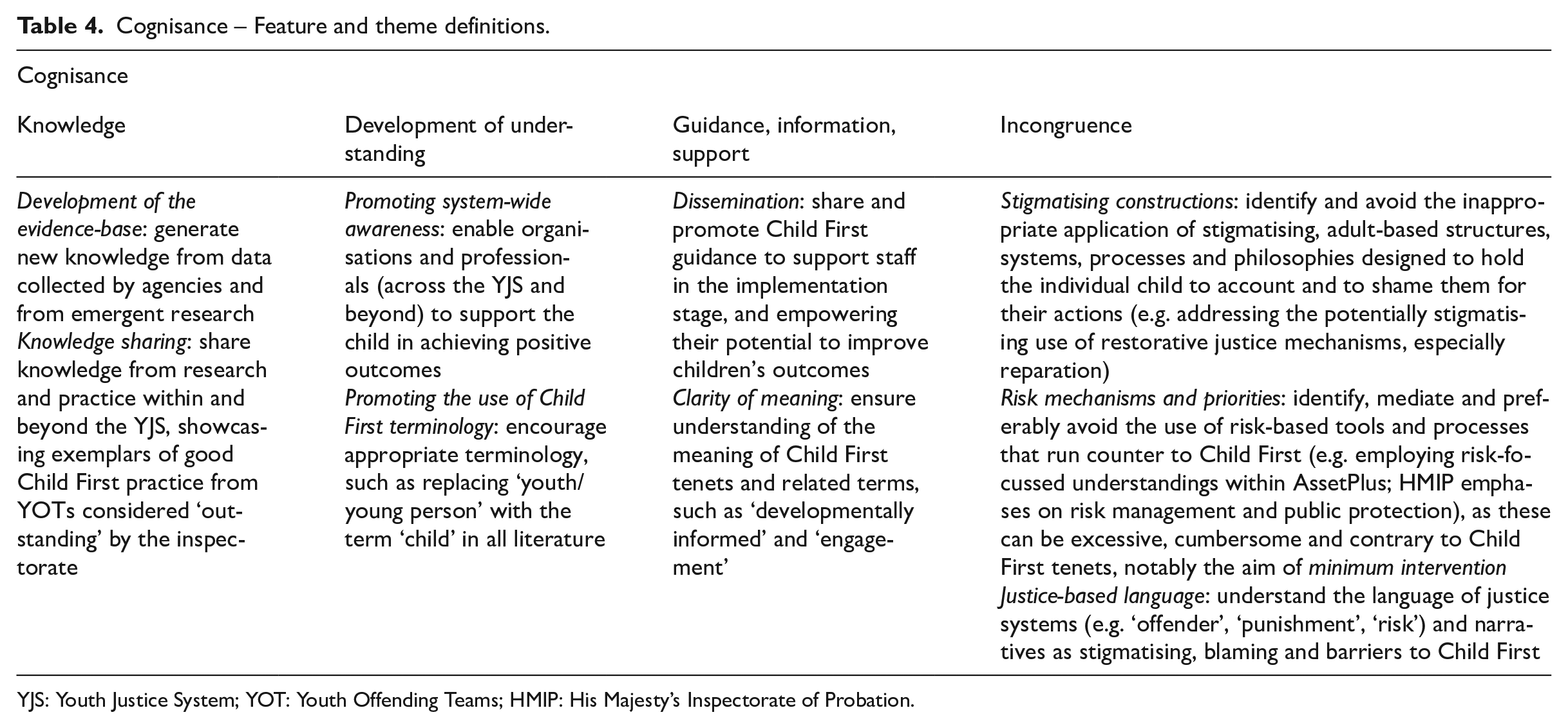
YJS: Youth Justice System; YOT: Youth Offending Teams; HMIP: His Majesty’s Inspectorate of Probation.
Professional relationships – Feature and theme definitions.
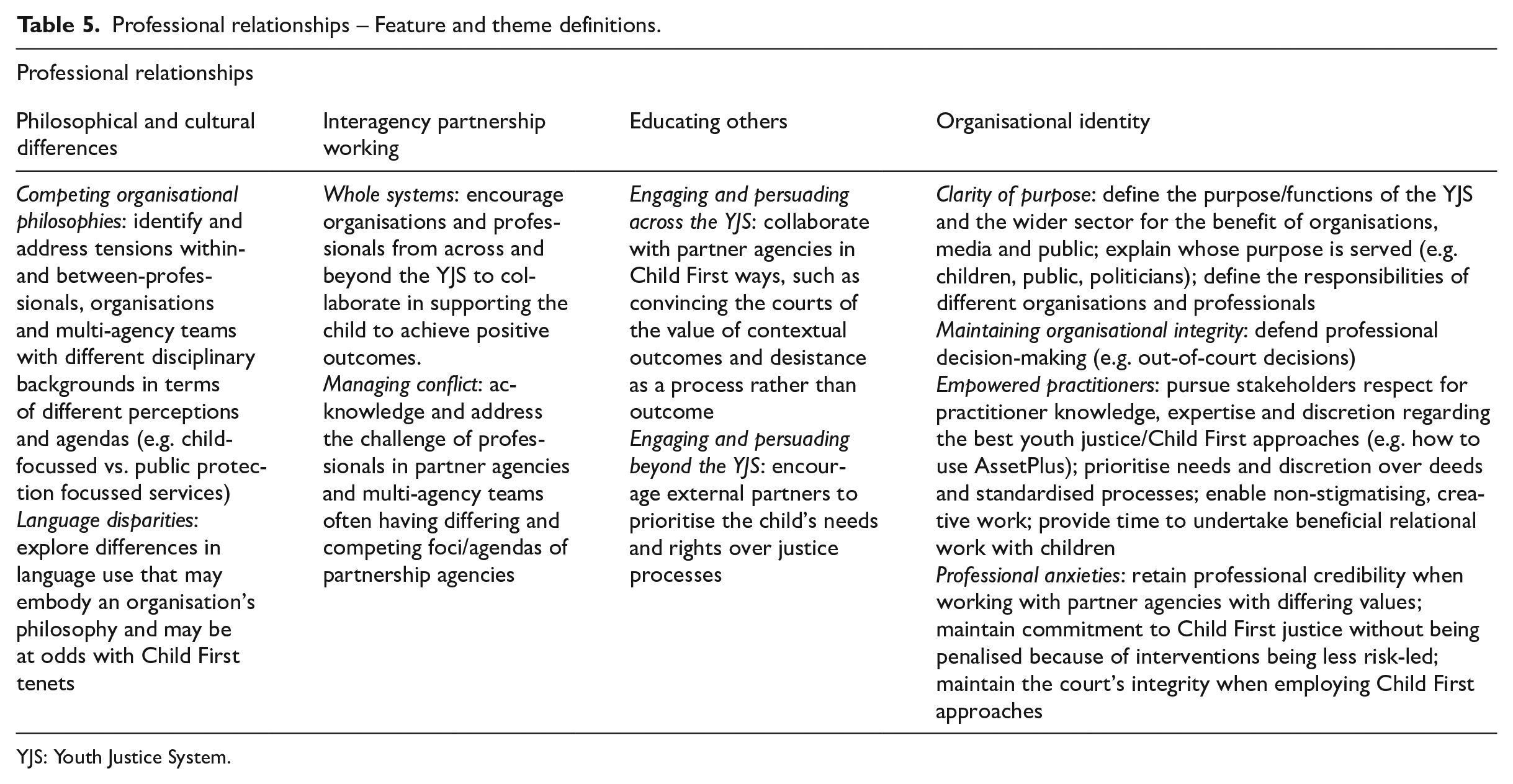
YJS: Youth Justice System.
Feature 1–Child-centrism
Understanding
Child-centric understanding of Child First was common across all groups; for example, it was defined as being: . . . what children need in order to thrive, for me that should be the centre of where Children First comes from and what Children First should mean (Strategy: Academic Researcher) . . . child-centred design, so where policy is being developed specifically about children . . . hearing from children and understanding their particular needs, designing that into both policy development and implementation . . . Also, a Child First approach needs to be compliant with children’s rights . . . in line with the UNCRC and any additional general comments linked to that (Strategy: Policymaker)
Consultation responses around child-centric understandings of Child First most commonly focussed on engagement, effective communicating/collaborating with children, respecting children’s knowledge and building trusting relationships. This was emphasised by the community, research and strategy groups in terms of valuing children’s voices, particularly empathetic/active listening to the child to better understand their life, situation and wishes. This ensures that children are heard and listened to by all agencies within and beyond the YJS: . . . we need to listen to the child, not just hear what they’re saying but hear the context in which they’re speaking and understand, almost from within the child, what their needs are (Strategy: Academic Research)
One YOT Manager described staff frequently expressing the desire to build trusting relationships with children and spoke of having developed a fully participatory model in which ‘relationships, trusting relationships, underpin everything we do’ (YOT Team Manager). While acknowledging the significant time investment that good relational work requires, custody/health care stakeholders reported the positive aspects of Child First, stating that staff: have had more time to build relationships with the children, and the benefits that that’s brought about . . . for integrated care . . . understanding the child’s story [and] developing those relationships . . . they’re doing something different, they can see it’s making a difference and they believe in it (Custody: Healthcare Manager)
Child-centrism also required developmental sensitivity – seeing the child as a child first and foremost and acknowledging that children are in a process of development, which also differs from child to child. The inspectorate group in particular emphasised this as central to their understandings of Child First, while also highlighting the need for greater clarity regarding the meaning of ‘developmentally informed’: Is that developmentally in terms of age? . . . I don’t think necessarily there’s a common understanding of what that actually means in practice (Inspectorate)
The child-centric theme of realising rights/entitlements, especially realising rights to childhood, was noted by all participant groups as relevant to understandings of Child First, with the notable exception of the inspectorate. Those stakeholders understood the realisation of rights and entitlements as a child’s right to participation/collaboration and enabling and valuing the child’s voice.
For example, regarding aspects of the AssetPlus assessment–intervention tool, YOT staff said: . . . [we] developed a way of using the ‘pathways and planning’ intervention, so that it’s truly co-designed and written in the child’s voice . . . the child sets their own targets and we fill in the gaps (YOT Manager/Practitioner) Rather than a pathway and planning module . . . we do something called ‘me and my plan’. We talk to the young people, we talk to the people who’ve been bought into the young people’s lives (YOT Practitioner)
However, responding stakeholders were clear that the Child First strategy, needs to more explicitly attend to realising rights/entitlements if it is to be understood as truly Child First, asking: Where is the role of children in defining Child First and how are they going to contribute to evaluator frameworks, inspections . . . if we actually believe in Child First, they are partners in our process, they’re not just the clients of the system (Academic Researcher)
Implementation
Child-centrism was a commonly identified enabler for operationalising/implementing Child First in practice for all participant groups. This was notably through engagement with children, realising rights/entitlements, positive intervention focus and prioritising need. Stakeholders seem to strongly associate child-centrism with engagement and in particular communicating/collaborating with children and building trusting relationships.
Engagement was referenced in terms of communication and collaboration (with children) by YOT staff in particular. This participant group emphasised the promotion of child-appropriate, accessible language and prioritising the child’s voice in all areas of practice: We developed a participatory youth practice framework . . . co-designed principles for working with children in the YJS (Community: YOT Manager/Practitioner) We’re reviewing all our front-facing literature to make it much more child-friendly, and particularly with children with maybe specific speech, language and communication needs, in order to reach children in a more meaningful way (Community: YOT Head of Service)
Realising rights/entitlements were viewed by some respondents as requiring universal access to services across localities, with prioritising need necessitating recognising and responding to (real, welfare) need (not criminogenic need) through individualised intervention: Child First means we, perhaps controversially, say actually this isn’t about criminal justice per se, this is about a much broader community justice approach. I think that’s a positive opportunity, if we can optimise educational opportunities, youth work, community development – all of that is youth justice . . . and children shouldn’t be asking for these support services – adults should be providing them (Strategy: Academic Researcher)
Consultation groups generally understood that children need provision, which is bespoke for them, understandable and developmentally informed – child centric. They highlighted the importance of building relationships for any work with children to be meaningful, while raising questions around whether Child First in its current form effectively facilitates children to be able to access their rights. The need for a more universal approach to justice-involved children (that it is not just about criminality, but also about the whole child) chimes well with a general bolstering of children’s access to good outcomes. However, when this is not acknowledged across (or even within) agencies, Child First is more likely to be compromised, leading us into the area of professional relationships.
Feature 2 – Cognisance
Understanding
Cognisance underpins understandings of Child First, with stakeholders reporting a responsibility to promote system-wide awareness of Child First and to promote the use of Child First terminology. It was apparent across the whole sample that many stakeholders experience difficulty articulating the meaning of Child First – indeed, some were more able to define what Child First is not: It’s almost like saying Child First is everything it hasn’t been so far. [But people still] talk a lot about the deficit model . . . risk management . . . offender management. Elements of AssetPlus are positive and Child First, like the positive desistance elements, but it’s still got a lot of risk management wrapped up in it (Researcher/Strategy: Project Lead)
Other attempts to articulate its meaning were vague: Moving the identity away from an offender narrative to one that recognises the needs of children and recognising them as children, and I guess the limitations that they would have, some form of lack of agency around their decision-making comparative to what an adult may have (Community: Head of Service)
While others explained Child First in terms of healing children for public protection: The vast majority of children in custody have experienced abuse, loss, trauma, a life which has caused damage. A Child First YJS heals that harm as a means of protecting the public . . . for me it’s about understanding that even our big lads, seventeen-year-old boys in our YOIs, are developmentally, physiologically and legally children (Custody: Safeguarding Manager)
The associated theme of incongruence shapes and distorts understandings of Child First, notably through the confusion that exists where deficit- and risk-focussed mechanisms and priorities operate alongside those that are positive and rights-based (e.g. when using AssetPlus): Child First doesn’t just mean everything is driven by the child and we ignore the risks that they may present to other people, it’s about keeping the child first and centre. Though that includes making sure that they don’t harm other people, because it’s not in their interests either. So that’s the sort of, the complex bit (Community: YOT Head of Service)
Overall, stakeholder understandings are limited by the absence of a previous practice model or guidance upon which to base their explanations.
Implementation
Cognisance seems to enable Child First practice, particularly through the development of understanding and promoting system-wide awareness, whereas incongruence (particularly adult-based stigmatising processes applied to children) was frequently reported as a barrier. Adult-centric stigmatising constructions of children who offend, continued support for risk mechanisms and priorities and use of justice-based language, were particularly problematic barriers to operationalising Child First: . . . the [police] custody side . . . still thinks of children as adults. I hear so many people saying, ‘well they’re six foot four, they’re eighteen stone’, and they’re this and that. And you know, physically they may be that big, but mentally, where are they at? (Inspectorate)
Support requirements
Addressing cognisance, notably the development and sharing of new knowledge within and between agencies, was highly relevant to stakeholder practice support requirements. The provision of guidance, information and support to promote of system-wide awareness was considered essential to aid development of understanding of Child First. Conversely, negotiating incongruence between Child First strategy and expectations of risk management was identified as a key support requirement.
Cognisance was the most commonly reported feature of practice support requirements for the operation of Child First, with the themes of development of understanding, guidance, information, support, knowledge and incongruence all reported as highly relevant: We work closely with schools, but it’s work in progress . . .we’re not in a place where we’re speaking the same language or have the same approach (Community: Prevention/Diversion Service Team Manager)
Support for the development of understanding involved educating other agencies about Child First to promote system-wide awareness. Stakeholders identified the need for dissemination of formal guidance, information and support to clarify what Child First actually is: [When] trying to find a placement, we’ll need children’s social care to understand Child First principles . . . or, if we want specific accommodation with particular needs met, we’re going to need housing associations to understand what Child First means (Community: YOT Head of Service)
Knowledge requirements focussed on the development and sharing of new research, including the importance of establishing a robust evidence-base for Child First and knowledge sharing processes within and between agencies: Everything has to be evidence-based before you can achieve change. If we can embed Child First and demonstrate benefits, especially around the longer-term benefits . . . a way of working that reduces reoffending, then automatically you can start to use that (Strategy: Engagement Lead)
There was an enthusiasm across the community, inspectorate and strategy participant groups for agencies to have the opportunity to learn what effective Child First practice ‘looks like’ through the provision of exemplars and facilitation of discussion between professionals: New knowledge would be beneficial to all . . . some things could be a joined-up learning, and that would be encouraged, get people together from different YOTs in different areas to really get their minds together and learn together . . . that would add value to our service (Community: YOT Practitioner, Bail)
Cognisance of Child First is clearly vital for effective system development, but there are gaps, causing incongruence through attempts to blend it with risk (not seeing them as incompatible) and misunderstanding due to the fact that the evidence-base for effectiveness is currently a work in progress.
Feature 3 – Professional relationships
Understanding
Professional relationships influence understandings of Child First, notably philosophical and cultural differences and associated language reflect differing organisational views of children who offend. These differences were highlighted as a potential obstacle to understandings of other agencies. The YJB’s decision to call the guiding principle ‘Child First’ rather than ‘Children First, Offender Second’ provoked discussion revealing subtle differences in interpretation of the meaning and significance of language between professions, for example: By losing ‘Offender Second’, you’re almost losing what ‘Child First, Offender Second’ was all about, reminding people these are children, there are reasons why they offend. They’re not just an offender . . . ‘Child First, Offender Second’ tells you they’re not just about risk (Inspectorate)
Other stakeholders, however, approved of the modified terminology, asserting that ‘Offender Second’ had purpose in a ‘hostile climate’ of negative, risk-focussed policy and practice, explaining: It conceded that children break the law, but also challenged the master status of ‘offender’ by reasserting the ‘child’ status. Language is important (Researcher)
Implementation
Professional relationships significantly influence the operation/implementation of Child First in practice. This is especially so when agencies work together (or in parallel) through interagency partnership working to enable a whole systems approach. Educating others, addressing philosophical and cultural differences and accommodating organisational identity were deemed important if professional relationships are to be positive. Resettlement services work extensively with wider services, with one custody-based resettlement worker stressing the importance of educating others: We’ve worked around challenges . . .we brought Immigration in and talk [to staff], we’ve developed links so that learning is shared. It’s all about partnership working’ (Custody: Resettlement Manager)
Notably, perceived strategic disparities between YOTs (Child First) and the inspectorate (risk-led) also influence implementation: They said the [out-of-court] assessment didn’t cover risk. Our argument was that the theory and research around diversion is to not bring them into a criminal system, to push them out within the community (YOT Team Manager)
Philosophical and cultural differences influence the operationalisation of Child First. One practitioner explained that: With our out-of-court decision-making panel, we have discrepancies about what the police think should happen and what whoever’s chairing it thinks should happen . . . even though we’ve got youth justice-specific police (Community: Diversion practitioner)
Support requirements
Professional relationships were central to support requirements, with educating others about Child First crucial to the negotiation of philosophical and cultural differences. This was a key support theme for all participant groups except custody. Organisational identity support requirements include clarifying purpose, empowering practitioners, easing professional anxieties and retaining professional, organisational integrity in multi-agency work, especially overcoming existing tensions and incongruence between agencies with opposing perceptions and agendas.
Support requirements were strongly associated with clarity of agency purpose, empowerment of practitioners and alleviation of professional anxieties regarding inspection outcomes. In particular, there were concerns regarding long-term, ongoing tensions between YOTs and the inspectorate: The inspectorate needs to really understand what Child First means and should move away from the risk-focused work that they’re so comfortable with. YOTs are nervous because they are judged by the inspectorate. . . one of the biggest supports would be training the inspectorate far more. . . they have moved a bit, but they need to move an awful lot further (Strategy: Academic Researcher)
Maintaining organisational integrity by defending professional decision-making and respecting practitioner knowledge was reported as a crucial means of negotiating philosophical and cultural differences: How do we make sure that all of our magistrates, crown court judges and district judges understand what Child First means and don’t just think it’s letting them [children] off? I don’t want to get into frequent arguments with the courts about why we’ve decided to do this or that (Community: YOT Head of Service)
Maintaining professional relationships by educating others across and beyond the YJS was central to stakeholder support requirements. It was argued that the perspectives of others are: . . .different from ours. . . such as the police, the general public or the courts. There are still people out there that want to see their pound of flesh. . . where is punishment going to leave anybody? (Prevention/Diversion Team Manager)
The fact that there are so many different agencies involved with children in youth justice (e.g. YOTs, courts, police, probation, inspectorate, custodial institutions) almost inevitably creates space for differing understandings and agency cultures to intervene in how Child First is received and understood, and from there how (if) it is incorporated into practice. As the concerned Head of YOT Service suggested, there is a much wider training need than those directly influenced by the YJB, a lack of which highlights the dangers of poor cognisance.
In summary, Child-centrism was considered central to understanding and implementing Child First by all participant groups, particularly its component themes of engagement, realising rights/entitlements, developmental sensitivity and prioritising need (although less relevant to custody and the inspectorate). Cognisance was crucial to implementing and supporting Child First, particularly through attention to knowledge, guidance, information and development of understanding. Negotiating incongruence was seen as the key barrier to implementation and support requirement by all participant groups. Professional relationships were acknowledged as pivotal to understanding, implementing and supporting Child First. All participant groups perceived them as a barrier to implementation and a support requirement, particularly focusing on philosophical and cultural differences, educating others and organisational identity (of most significance to community and strategy groups). The discussion will now consider how these consultation findings can be applied to fully embed Child First into the YJS in its widest possible multi-agency sense.
Realising Child First in Practice
The SIP offers a detailed, contextualised investigation into a wide range of stakeholder understandings, perceptions and experiences of Child First–notably the conceptual, relational and practical issues and challenges shaping its implementation. Project findings clearly demonstrate that the strategic implementation of youth justice policy (mobilised through strategy) in real-world practice is a multi-faceted process subject to adaptation at the discretion of key stakeholders working in different local and organisational contexts (cf. Braithwaite et al., 2018). Furthermore, consultation findings identified and initiated the process of addressing specific facilitators and threats to successful implementation of Child First in practice contexts.
There is significant complexity in the challenge of policy transfer and implementation/delivery in practice, redolent within stakeholder perspectives. Implementation complexity should not be underestimated when implementing Child First, particularly as such underestimation is an evidenced contributor to policy failure (Hudson et al., 2019). Instead, it should be addressed through bespoke support and guidance mechanisms, designed and administered in meaningful collaboration with different stakeholder groups to meet organisational needs, while remaining true to Child First principles.
There is a lack of consensus and understanding through shared mis/understandings and the perceived feasibility of aligning different views of, and approaches to, operationalising and applying Child First in practice. This all presents potential barriers to policy implementation (Hudson et al., 2019). These conclusions both confront and validate the central SIP objective and subsequent recommendations to pursue the ‘messy engagement of multiple players with diverse sources of knowledge’ (Davies et al., 2008: 188) to identify and tackle the potential Child First policy–strategy–practice implementation gap.
There is a pressing need to generate a more comprehensive evidence-base to consolidate the SIP findings and support the implementation of Child First in practice, particularly as insufficient evidence-bases can precipitate policy failure (Hudson et al., 2019). This evidence-base is best pursued through partnership/collaboration between stakeholders to examine and elucidate their professional understandings of the Child First guiding principles, perceived implementation challenges and resultant practice support needs. Importantly, evidence-generation processes have already been instigated by the SIP and foundational Child First evidence-base document (Case and Browning, 2021a), which should now be consolidated and extrapolated through more formalised stakeholder collaboration exercises.
Child First bringing systemic and organisational r/evolution
The formalisation and implementation of Child First has significant potential to catalyse the evolution of youth justice practice, possibly on an equivalent scale to the radical changes heralded by the ‘new youth justice’ (Goldson, 2000) of the Crime and Disorder Act 1998. This r/evolution is likely to precipitate changes in occupational cultures, organisational identities, multi-agency working practices and relationships with service delivery (cf. Souhami, 2007). The incremental and ground-breaking nature of (potential) Child First changes is already discernible in stakeholder perspectives of implementation challenges. These coalesce around the extent and nature of their child-centrism, their cognisance of the Child First guiding principles and the dynamic, ever-changing nature of the professional relationships required to implement the strategy successfully. It is highly likely that exponential growth of Child First across the youth justice sector will require the YJS to reconfigure its services and structures and stakeholders to transcend their accustomed roles, professional identities and ways of working to pursue new and shared approaches to strategic delivery. This necessary r/evolution and reconstruction of traditional (post-1998) youth justice, therefore, introduces fundamental challenges and changes liable to incite systemic and professional disruption, anxiety and uncertainty, particularly in the absence of clear, consistent guidance for making sense of and operationalising Child First. Moreover, conceptual and professional uncertainties/anxieties in the absence of consensus regarding what Child First actually is could exacerbate existing occupational tensions and conflicts played out in professional relationships, if the sector is denied concrete guidance on how to make sense of the reforms inherent to implementing Child First. 5
Child First addressing local universality through multi-level stakeholder collaboration
Findings support conclusions that policy implementation is highly dependent on local context (Braithwaite et al., 2018) and that centralised youth justice policy and strategy is ‘made’ real on a local level (Goldson and Briggs, 2021). The SIP data conceptualise ‘local contexts and practices’ as primarily located within local organisations rather than as (exclusively) geographically contingent, which enables comparison/contrast of national contexts and practices (e.g. YOTs–YJB/HMIP), as well as analyses within- and between- local organisations. Most importantly, the analyses illuminate the centrality of holistic collaboration to prevent policy failure. The debilitating influence of ‘inadequate collaborative policy-making’ (Hudson et al., 2019) on the policy–strategy–practice implementation gap strongly recommends the SIP-led prioritisation of stakeholder collaboration at multiple levels (e.g. politicians, policy-making, management), including frontline practitioners. The SIP findings, therefore, support the need for Child First implementation that ‘connects actors vertically and horizontally in the process of collaboration and joint deliberation’ (Ansell et al., 2017). This collaborative emphasis can help manage differences within and between organisations and should facilitate sufficient common ground for implementation of [Child First] policy/strategy to begin, rather than seeking (unrealistic) unanimous consent and privileging policy legitimacy and organisational missions/agendas (Ansell et al., 2017).
A key SIP conclusion, therefore, is that collaborative mechanisms are essential to implementing Child First. Actioning such collaboration could necessitate ‘reforming the structural framework which profoundly influences the way children in trouble are treated’ (Bateman, 2020: 7), or in other words, considering ‘what the evidence suggests appropriate system reform might look like’ (YJB, 2021a: 8). Child First implementation has been facilitated by the revision of centralised guidance frameworks, such as YJB National Standards and YOT Case Management Guidance into much more Child First-compliant instruments; but this has not been so clear within recent HMIP inspection criteria developments. Greater collaboration should work towards preventing such frameworks from developing in silos, to avoid ‘implementation in dispersed governance’ (Hudson et al., 2019) and the exclusion of meaningful strategic and operational input from key stakeholder groups and partners. Crucially, collaboration should extend beyond the YJS (‘youth justice is not an island’ – Bateman, 2020: 9) in the pursuit of localised whole-system responses for children in trouble that incorporate a range of professional bodies, systems and knowledge-bases to enable them to have positive outcomes.
Child First facilitated by youth justice governance organisations
The consultation evidence suggests the YJB could have a key role as an implementation broker for Child First, well positioned to offer expert, evidence-led support tailored to local contexts while being sensitive to ‘bottom-up’ discretion and dilemmas. Such implementation support should focus on capacity building – developing practitioner understanding, skills and competencies through training, peer learning, information, guidance and project management skills. It should also undertake ongoing problem-solving – collaborating to define and address problems/issues in practice, providing technical support, troubleshooting arising issues, brokering areas of dispute and encouraging the utilisation of research and evidence (cf. Hudson et al., 2019). Strategic support focussed on capacity-building and problem-solving enables local stakeholders to develop a sustainable knowledge-base and skills relevant to implementing Child First in their youth justice practice.
The YJB has made massive steps forward in becoming this implementation broker, by foregrounding their Child First focus within recent strategic plans, firmly basing revised National Standards and case management guidance on Child First principles, and developing YOT training (both in-house, provided by the YJB to establish child first ‘champions’, and external, with a Child First ‘module’ provided by Unitas, the YJB’s preferred training provider; Goddard, 2022). However, these developments, while showing a promising trajectory, are somewhat uneven, potentially adding to aspects confounding understanding, like incongruence. For example, while Unitas training is now available to plug knowledge gaps, it was slow to appear and not entirely congruent with other youth justice training they provide, which seems rather more risk-based (Hampson, 2023). In addition, while the new National Standards are clearly based, for the most part, on the model of Child First as exemplified by the four ‘tenets’, there is some conflation between earlier model understandings of ‘child first, offender second’ and current Child First justice, with both terms being used apparently synonymously (MoJ/YJB, 2019). The current guidance does not fully address stakeholder concerns regarding child-centrism, largely because ‘There is no explicit indication that rights [realising rights/entitlements], best interests [prioritising need] or minimising levels of intervention [positive intervention focus] should contribute to the decision-making process, as might be expected in guidance intended to direct Child First practice’ (Bateman, 2020: 5). It is recommended therefore, that the YJB revisit their guidance documents to address incongruencies and incorporate emerging areas of practice significance, such as trauma-informed practice, adverse childhood experiences and communication issues (see Case and Browning, 2021a). In critically reflecting on whether practice guidance sufficiently incorporates the tenets/components of their Child First principle (YJB, 2021b; see also Case and Browning, 2021a, 2021b) and addresses the SIP findings and conclusions, the YJB should ensure to fully collaborate with stakeholder partners (including children). For example, the YJB should re-evaluate and appropriately revise their National Standards guidance to practitioners regarding out-of-court processes.
Given that the new case management guidance goes a long way towards truly embedding Child First throughout youth justice practice, HMIP are strongly encouraged to critically reflect upon the project evidence and previous evidence-base (Case and Browning, 2021a), to ensure congruence between all governance and guidance. This would allow them to fulfil their stated intention ‘to follow the evidence as it evolves . . . [to] determine where the academic research leads us to refine and amend our approach to inspection’. An inspection culture shift towards consistently, explicitly rewarding Child First practice would complement existing HMIP (2022) guidance to YOTs to ‘protect against the dangers of responsibilising children for their ability to move away from offending’ and for ‘actively supporting . . . children through future-focussed work to develop strengths and opportunities’.
Conclusion
Notwithstanding the inevitable and worthwhile requirement for constant reflective improvement, it can be tentatively concluded, through the contributions of stakeholders and Child First developments in YJB guidance documents, that the Child First principle is being increasingly mobilised and realised in the YJS. Practice is moving away from being prescriptive and process-driven towards becoming more discretionary and outcomes-focussed. Indeed, the support offered to the current consultation exercise by all participant stakeholder groups strongly indicates both the desire and capacity for cultural change and continued critical reflection, offering encouragement that this could be conducted in collaborative, child-focussed ways. As Child First is now the established guiding principle for youth justice practice in England and Wales, it is ever more crucial to be able to measure, demonstrate and evaluate (e.g. inspect) its development and success (or otherwise) in practice to support investment, capacity building and resource allocation. Currently, however, it is ‘difficult to identify any concrete outcomes that could be used as measures of Child First practice’ and practitioners have ‘no yardstick against which their activities – or absence thereof – can be objectively assessed’ (Bateman, 2020: 5). Therefore, the issue of what constitutes Child First practice outcomes, notably the pivotal positive outcomes for children and the pro-social identity that allegedly drives these outcomes as their theory of change (Hazel and Bateman, 2021), remains a conceptual, strategic and operational void in the evidence-led implementation, development and evaluation of the Child First principle. Consequently, governance organisations (most notably the YJB) must collaborate with stakeholder groups (including academic researchers) to identify suitable concepts, procedures and standards for better understanding, measurement and scrutiny of ‘evidence-based’ Child First performance (Case and Browning, 2021a), which can then be inspected with congruence to the model.
The SIP highlights that Child First as a guiding principle for youth justice practice in England and Wales is being embraced by stakeholders across the sector. Stakeholder perspectives, particularly their continued emphasis of (and commitment to) child-centrism and the need to address incongruence in conceptual and operational understandings of Child First, provide strong support that Child First is currently functioning as the principle that guides youth justice practice in a contemporary, progressive and evidence-based way, subsuming previously dominant but now outdated risk management approaches. Taken together, the open-minded, collaborative and positive professional mindsets of the participants engaged in this consultation and the insightful, progressive findings that emerged move the sector forward significantly in terms of its understanding of Child First and how this guiding principle could and should operate in practice. To conclude, the emerging emphases on constructive collaboration across and beyond the YJS consolidates the ambition of youth justice stakeholders for realising Child First in practice, articulated by the YJB with commendable openness: Child First is a journey for the YJB . . . We are not alone on this journey . . . We realise that the change we want will be years in the making. Meanwhile, we are committed to exploring with others how the evidence base might be applied . . . Working with practitioners, policy makers and academics alike in doing so’ (YJB, 2021a: 8).
Footnotes
Funding
The author(s) disclosed receipt of the following financial support for the research, authorship, and/or publication of this article: Funded by Loughborough University Enterprise Project Fund.
