




Abstract
This article analyses the qualitative findings of doctoral research on a sample of 210 young offenders who were transferred to Adult Court in 1999, 2000 and 2001. The results give an insight into the impact of juvenile transfer on a specific subgroup of participants, now aged between 30 and 40 years, allowing a critical evaluation of their pathways into adulthood. Drawing on the life stories of 17 young adults from a cohort of transferred juveniles who were still in prison at the time, we focus on their lived experiences of the decision to transfer them from the juvenile justice system and its impact on their lives. The findings support the idea that transfer, and its experienced ‘collateral’ effects, contributes to an escalating trajectory of judicial contacts; a view echoed by the transferred participants themselves. We present and discuss three main findings that offer important insights to extend the understandings of patterns of reoffending and involvement in the criminal justice system: (1) the impact of the first detention in an adult prison (as a consequence of the juvenile transfer), (2) a fatalistic attitude towards the future and (3) the unanticipated impact of family on views on re-offending.
Introduction
Juvenile transfer was introduced to the Belgian juvenile justice system in 1965 with the federal Youth Protection Act. It stipulated that young offenders between the age of 16 and 18 years can be transferred out of the juvenile justice system if the judge believed that interventions available within the juvenile justice system were no longer adequate (anymore) to rehabilitate them. Since its introduction, juvenile transfer has been a controversial and much contested mechanism, and while the application rate has always been fairly low, 1 the mechanism remains an important and symbolic issue in political debates (Christiaens and Nuytiens, 2009).
Over time, several changes have been made to the juvenile transfer procedure, with the most significant alterations introduced in 2006. 2 Prior to 2006, all transferred young offenders appeared in an Adult Court, either the Correctionele Rechtbank (similar to the Magistrates’ Court) or the Hof van Assisen (similar to the Crown Court). In 2006, a specialized Youth Court, the Extended Youth Court was put in place for transferred offenders. Since then, most transferred offenders appear in this specialized Youth Court with three judges, with only the most serious cases being tried in the Hof van Assisen. Before 2006, no offence-related criteria for juvenile transfer were legally foreseen, thereafter it was stipulated that young offenders could only be transferred if they committed a serious offence or when the Youth Court had previously imposed a youth measure. The maximum sentence for transferred offenders was reduced from life imprisonment to 30 years. However, a later change to the criminal law saw the maximum sentence for transferred offenders rise to 40 years imprisonment (Put, 2019). In addition, while transferred offenders receiving a custodial sentence in 2006 were sent to adult prisons, thereafter they were held in specialized detention centres for transferred offenders until they reached 23 years of age. As a result, most transferred offenders are now detained separately from other adult prisoners in these youth detention centres.
The debate on juvenile transfer re-emerged when the Belgian Youth Protection System was defederalized in 2011. This meant that the four communities in Belgium would be responsible for developing their own juvenile justice system: the Flemish community (Flanders), the French-speaking community (Wallonia), the German-speaking community and the community of Brussels. Consequently, the Federal Youth Protection Act enacted in 1965 and revised on several occasions, was replaced by four different juvenile justice systems in 2019. While several neighbouring countries have introduced adolescent justice systems (e.g. The Netherlands) or ‘gradual’ youth justice systems with separate regulations for different age categories, including young adults (e.g. Germany) (Zeijlmans et al., 2019), none of the communities in Belgium have followed this trend. As a result, a rigid boundary between juvenile justice and criminal justice still exists across the country, with the 18th birthday as a border between both systems. None of the communities in Belgium have introduced an adolescent justice system for young adults. 3 The exception to this only persists on the other side of the border; young offenders committing an offence from the age of 16 years onwards can be the subject of juvenile transfer. 4 This means that they will be tried according to the rules of criminal law, and be sanctioned with pre-ordained punishments. The juvenile transfer was kept after the sixth state reform, not just in Flanders but also in the other communities (Goedseels and Ravier, 2020). Now that it seems like Flemish, Brussels, and Walloon politicians are in total agreement after all, it calls to question whether a transfer of authority in this area was actually necessary.
In Flanders, the region focussed on here, the Youth Offending Decree was passed on 15 February 2019 and went into effect from September 2019. 5 Flemish lawmakers did not make many changes to the juvenile transfer mechanism, aside from ensuring that transfers from then on were only possible ‘when’ the young offender had committed a serious offence and (instead of ‘or’ in the previous legislation) had already been sanctioned with a residential measure in a closed setting. An exception to this cumulative rule is only foreseen in the event of serious violations of international humanitarian law and acts of terrorism (Put, 2019).
That Flanders retained the option to transfer juveniles is remarkable in a number of regards. First, long-term sanctions hitherto unavailable in the former juvenile justice system were consequently legitimated in the Flemish youth justice. Therefore, the earlier often-used argument that juvenile transfer was needed as a ‘last resort’, c.q. a harsh(er) reaction to youth crime, could be considered overruled. Now, young people committing an offence between 16 and 18 years (the target group of juvenile transfer), can be detained for up to 7 years, and in some cases this period can be followed by being placed for up to 10 years at the disposal of the Sentence Implementation Court. Second, Flemish lawmakers claimed that they would opt for an evidence-based youth justice system, and much time and effort was spent gathering available data and input from professionals, young people and parents involved in the juvenile justice system. However, in the Decree, the unanimous advice from academics, nongovernmental organizations, lawyers specialized in juvenile justice and the Committee for the Rights of the Child was for the abolition of juvenile transfer, and the introduction of an inclusive juvenile justice system. These calls were systematically ignored (Pleysier, 2019). The advice they gave was not only based on the Conventions on the Rights of the Child, but also on ample research findings. Both national and international studies have consistently reported that juvenile transfer does not deter young peoples from committing further crimes and might even facilitate recidivism. While some research, such as the meta-analysis from Zane et al. (2016) shows that juvenile transfer has a small but statistically non-significant increase on recidivism, other studies consistently reveal negative effects of transfer. Young people who have been transferred out of the Youth Court to be tried and sentenced as adults, are found to have re-offended more often, committed more serious crimes, and have done so at a faster rate than young people who have been retained within juvenile justice (see, e.g. Bishop et al., 1996; Fagan, 1996; Fagan and Piquero, 2007; Fagan et al., 2007; Jensen and Metsger, 1994; Jordan, 2014; Lanza-Kaduce et al., 2005; Loughran et al., 2010; Myers, 2003; Steiner et al., 2006). Overall, it can be stated that there is overwhelming evidence to suggest that neither general deterrence nor overall reductions in recidivism have been achieved by transferring young people to adult court (Jordan and Meyers, 2011; Sharlein, 2018).
Specifically striking were the findings in a recent doctoral study on the long-term trajectories of transferred juveniles in Belgium. Jaspers (2018) demonstrated that transferring young people out of Youth Court had long-term detrimental effects on their pathways into (young) adulthood (Jaspers, 2018). 6 The quantitative element to this research revealed how a large number of the researched transferees were still involved within the judicial system at the time of the research, either by being in prison, having been recently released, or serving new convictions (Jaspers et al., 2017). The latest conviction on their criminal records correlated with the types of offence for which they were originally transferred: commonly property crimes (often with aggravated assault). The analysis of their detention files demonstrated a high frequency of imprisonment, and by 2015 most had been imprisoned between three and six times with an average of five prison stays. Almost the entire population had been imprisoned multiple times in their lives; only 7.8 per cent had never been imprisoned since the offence for which they had been transferred. One-third were serving prison time, and 40 per cent had been imprisoned recently (i.e. released from prison during the past 3 years). 7 This very bleak picture called into question whether this was the result of (1) an accurate prediction by rather omniscient youth judges who successfully identified these ‘super offenders’ at a young age, or (2) a negative spiral caused by the collateral and iatrogenic damage of juvenile transfer, which we identified elsewhere as a ‘self-fulfilling trajectory’ (Jaspers et al., 2017: 13).
A qualitative element of that doctoral study was designed to amplify the voice of the transferred young people, in which it is explored how juvenile transferees experience the juvenile transfer, and what they perceived to be the impact on their further lives. In this contribution, we will present and discuss the results of this qualitative aspect of the doctoral research (Jaspers, 2018), based on the lived experiences of 17 young adults who were transferred as juveniles in 1999, 2000 or 2001. This contribution focuses on the way young adults experienced the juvenile transfer decision, specifically by those who were still imprisoned as adults at the time the research was conducted. The findings from the respondents’ testimonies support the existing literature, strongly suggesting that the transfer and the subsequent ‘switch’ in their judicial track contributed to an escalating trajectory with recurrent judicial contacts.
Research Methods
Ethical reflections
The sample of participating young adults (N = 17) was selected from an existing cohort population of 210 young offenders transferred in 1999, 2000 and 2001, which was selected in the study of (Nuytiens et al., 2005, 2006) 8 The choice was made to select only those participants who were, at the moment of our research, still in prison or serving an additional custodial sentence. This decision was based on ethical and pragmatical considerations on which we will elaborate.
From an ethical point of view, we deliberated extensively with the question of who, how and where we could, or should, approach participants whose judicial files had been researched in this previous research. The research that selected the cohort transferred juveniles was undertaken from 2003 to 2005 by Nuytiens et al. (2005, 2006) (Nuytiens & Chrisitaens are also authors of this contribution). That research started in 2003 with an analysis of transferred juveniles’ Youth Court files as well as their subsequent criminal records. Consequently, a doctoral study (Jaspers, 2018) under the supervision of two of the three original researchers (Nuytiens & Christiaens) was conducted that was specifically designed as a follow-up to Nuytiens et al.’s (2005, 2006) study. This research design allowed us to reconstruct juvenile transferee’s judicial pathways over a period of 15 years. On the basis that gaining access to court files, criminal records and detention records is relatively easy by obtaining the approval of General Prosecutor for youth cases, the researched transferred juveniles would have been unaware of their inclusion. This is standard procedure for this type of research and not uncommon. Moreover, at the time young people had no right of access to their own files. While from a legal point of view, the researcher could tick all the boxes, this research practice can be questioned from an ethical point of view. Indeed, for the doctoral qualitative study (Jaspers, 2018), interviewing members from the Nuytiens et al. (2005) cohort raised important ethical question concerning if, and if so the way how to contact and approach participants concerning research undertaken about them of which they had no prior knowledge.
Existing research whose respondents were contacted directly, in their home environment, via social media, via mobile or any other registered phone numbers (e.g. Sharpe, 2017; Van der Geest et al., 2013) provided food for thought. However, we considered that contacting the participants directly in their homes could risk exposing their judicial past and insensitive enquiry might be considered invasive and could have harmful, albeit unintended, effects. Thus, we decided to approach only those juvenile transferees who were in prison at the time the doctoral study was conducted. From a practical point of view, this meant they were easy to locate, and only required gaining access to several Belgian prisons. 9 It also meant that we had ample opportunity to explain what past research had already been conducted to possible participants, and why the doctoral study and its qualitative approach made it of importance to interview them now. This created the possibility of a qualitative dialogue of informed consent, giving them ample opportunity to consider or reject participation, as well as giving them the option of excluding their files from the research altogether (also in the case file analysis). We would argue that this approach provided the ethical rigour necessary for undertaking sensitive research.
Consequently we focussed our approach on retrieving participants from Nuytiens et al’.s (2005) sample of 210 young offenders imprisoned. As a result of missing values in the original data set, only 204 of them could be traced in the official detention database (Sidis-Suite), which showed that 60 (29.4%) and 55 (27%) of them were imprisoned in 2013 and 2015, respectively. We approached the prisons where the latter were residing, and were granted access to multiple, but not all, prisons. This meant that of the 55 imprisoned transferees, 35 were approached for interviews and 17 agreed to do so. In Belgium, researchers undertaking studies involving prisoners need authorization from the penitentiary administration and the prison governor(s) to proceed. Administrative demands require that the research is conducted according to the prevailing ethical rules and that any recordings made for research purposes are destroyed when the research has been completed. In fulfilment of this requirement, 16 out of the 17 interviews which were audio recorded were destroyed after they had been transcribed verbatim. While today all granted research projects are screened by the ECHS (the university’s Ethical Committee of Human Sciences), there was no ECHS instated yet at the university when this research took place (started in March 2013). Nonetheless, as mentioned above, the research was extensively explained and discussed face to face with potential participants. Those who agreed to participate signed and received a copy of the informed consent form with the researcher’s contact details, which formalized confidentiality, voluntariness and recordings. Some participants were reluctant to sign documents, therefore informed consent was also given orally and recorded if opted for. For the sake of confidentiality, the interviews took place in the lawyers’ room or in an empty office in the prison.
While juvenile offenders often have vulnerable backgrounds (Nuytiens et al., 2005, 2006), emergent discourses challenge ethics rules which may assume that all people in distressing situations are vulnerable and unable to consent or participate in research. Van den Hoonaard (2018) argues that we should challenge the centrality of vulnerability as an ethical concept because it is a concept that does not always match with the lived experiences of people labelled as vulnerable by ethics committees. The question should be whether people would become more vulnerable by taking part in the research. In this study, this was not the case. While we did not reduce participants to ‘vulnerable subjects’, we did, however, create a space appropriate for amplifying their voice as experts of their own experience (Nuytiens and Jehaes, 2022).
The sample
Of the 35 young adults 10 we contacted in prison, 17 agreed to participate, and were interviewed between September 2016 and May 2016. Since they were transferred in 1999, 2000 or 2001, their juvenile transfer happened over 15 years ago at the time of the research. The participants were aged between 31 and 38 years, with an average age of 34 years. The reasons for non-response were diverse. Some participants agreed to participate but later withdrew, or were released/transferred before the date the interviewed was planned. Another interview was cancelled on the spot by the prison warden who deemed the inmate ‘too dangerous’ to be interviewed by the researcher (who was a 28-year-old female, 6 months pregnant). In one prison, the warden had approached all selected young adults before allowing the researcher to explain the research. The non-response rate in this instance was higher than in prisons where the researcher had the chance to explain the research herself, we reasonably assume that this may have affected the response rate. One indicated that his memories of being transferred were too painful, and he was not ready to talk about this ‘devastating chapter’ of his life, while others simply did not want to spend their time on it; preferring to spend time at work or in the yard.
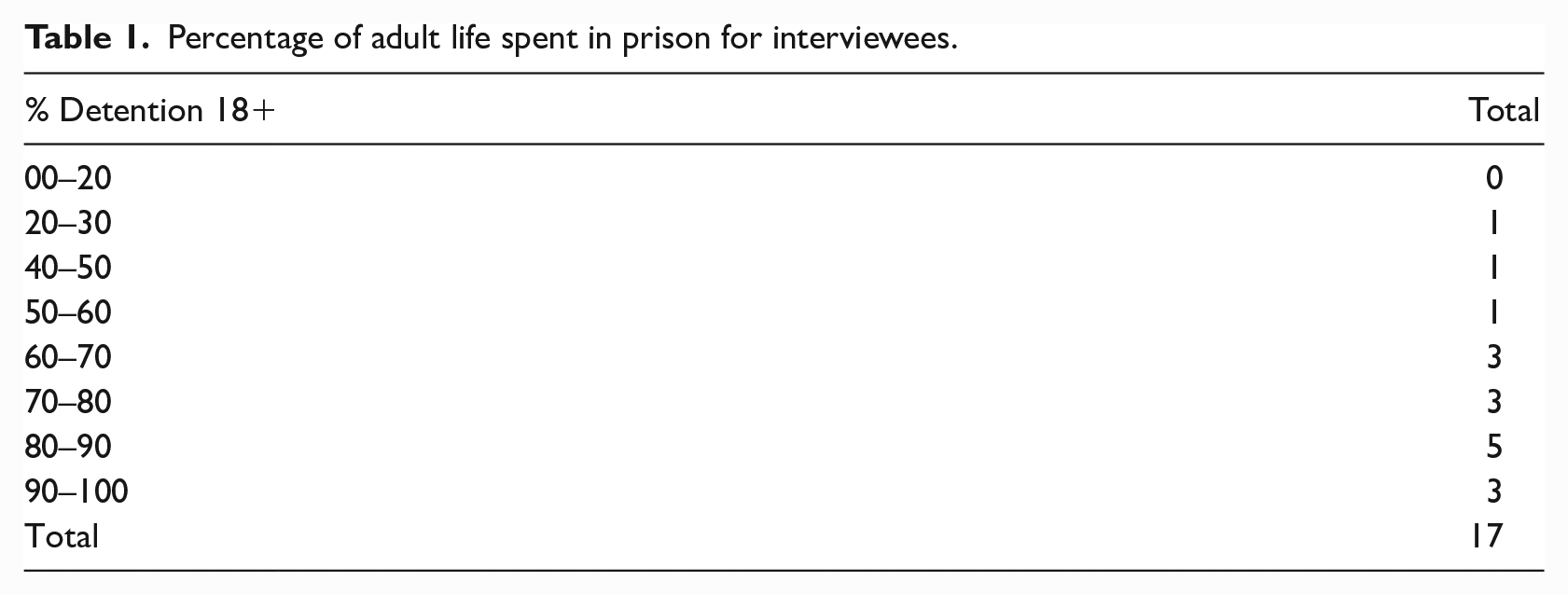
Most of the 17 participants (14) had spent more than 60 per cent of their adult lives being imprisoned with only 2 of the 17 spending less than half their adult lives in prison (Table 1). The time spent in prison in adulthood was, of course, not always consecutive. For most of them, however, it came down to spending long sentences in prison, with short stays out between imprisonments. However, three participants had been imprisoned throughout their entire adult life (100%).
Percentage of adult life spent in prison for interviewees.
The interviews
The interviews explored how these participants reflected back at their judicial careers, and what they regarded as pivotal moments or influencing factors in the judicial trajectories they had followed. As the interviews would mark the first time the participants would be informed and questioned directly, we considered this to be a very important and sensitive moment. However, none of the participants expressed disapproval or dismay upon being informed of the prior study by Nuytiens et al. (2005, 2006) in which they were unknowingly involved.
We used an open topic list and an overview of all life stages to scaffold the interviews, leaving enough space for respondents to share as much as they wanted to about their life stories, and not reflect solely on the transfer. The interviews took place in 11 different Belgian prisons, 11 usually in rooms where prisoners could meet their lawyers. The interviews fluctuated in length between 40 and 150 minutes and were conducted in Dutch (5) and in French (12).
Data analysis
The data analysis was performed using a technique close to reflexive interpretative phenomenology (RPA). This method presumes that participants will try to understand their own world, and researchers try to make sense of how the participants try to understand the world (Smith and Osborn, 2007). RPA is commonly used with small cohorts, which we regarded as a perfect fit for our sample of 17. As Smith and Osborn argue: The detailed case-by-case analysis of individual transcripts takes a long time, and the aim of the study is to say something in detail about the perceptions and understandings of this particular group rather than prematurely make more general claims. (Smith and Osborn, 2007: 55)
Since we wanted to explore the lived experience of the transfer, this method aligned with our research goal.
Drawing inspiration from RPA the analysis was undertaken over four stages. First, the material was read and reread repeatedly, so researchers were able to get fully acquainted with the material as a whole. In the second stage, the transcripts were read and divided into content units. Third, the units were grouped into clusters, where the meaning of the units was questioned at a more abstract level. In the final stage, connections and links were made between the clusters to distil and reveal the structure of the problem. This last phase required constant reflection on the different clusters by the entire research team (researcher and supervisors), in what is also referred to as a hermeneutic cycle of data analysis, with a dynamic and repeated movement between the entire body of data and their divided units of meaning (Van Der Meide, 2014: 70). The data were repeatedly exposed to this process to detect and form the most prominent findings. The collection of material and the analysis were to some extent conducted simultaneously, in a cyclical manner, allowing the researcher to repeatedly shift between conducting interviews, transcribing and reviewing interviews, analysing them and reflecting upon them. This created an analytical context whereby the researcher was immersed in the data on different levels and different timescales.
Findings
The fact that the judicial reconstruction of the trajectories (Jaspers et al., 2017) indicated that most of our samples were involved in the criminal justice system throughout adulthood could suggest sharply opposing conclusions. We noted above how these findings may suggest that the juvenile justice system was successful in identifying the so-called ‘incorrigibles/irredeemables’, individuals for whom juvenile transfer was implemented at the time (Lox, 1966). Consequently, the juvenile justice system would be regarded as having ‘correctly’ removed these youths from the system since they continued on a criminal path into adulthood as was suspected. How far can such a conclusion be sustained? With respect to the core claim, it has become increasingly accepted that predicting delinquent paths based solely on (risk) indicators from childhood is not only extremely difficult, but also ineffective (see, e.g. Bersani et al., 2009; Laub and Sampson, 2003; Nieuwbeerta and Blokland, 2006). Few, if any, studies show any meaningful causation between juvenile transfer and decreased recidivism. In this sense, if the juvenile transfer did not have a deterrent effect, it leaves us to unpick what sort of effect it did have on young people, which draws our analysis back to the lived experiences and impact of the juvenile transfer on participants themselves and their lives well into adulthood.
How do those who were transferred as minors recall this event? How did they experience going through it, and where (and how) did they perceive the transfer as having impacted their lives afterwards? It is important here to take into account what voices are heard here. They consist of the experiences of this specific group, and they are not implied to represent the experiences of transferred young people as a whole. Nonetheless, however these are important voices of the so-called persistent delinquents and ought to be considered as significant to the debates concerning juvenile transfer more broadly. Below, we present and discuss our three main insights that we argue broaden the understanding of our participants narratives on their offending trajectory and involvement in the criminal justice system: (1) the impact of their first ‘adult’ detention, (2) their dominant feelings of fatalism and their perspectives on the future and (3) the desire for independence and feelings of shame towards family.
Never a second chance at a first detention
Interestingly, the narratives revealed that the transfer decision was first experienced as emblematic rather than an overwhelming lifechanging event. However, it soon became clear that the meaning of being transferred had a far greater impact. At such a young age, being deemed ‘irredeemable’ or ‘incorrigable’ by the judge, and by extension by the juvenile justice system, cemented the feeling that they were denied any chances in life, let alone second chances. The outcome of the transfer meant that participants were sentenced as if they were adults, despite not yet reaching the age of majority, and as a result of this juvenile transfer all of them ended up in an adult prison at a very young age. In this sense the transfer had a significant ‘steering’ impact, setting in motion a whole host of other things.
It emerged from the interviews, that as juveniles, it was not the transfer decision as such, that was most disturbing, but rather being imprisoned in an adult prison for the first time as a consequence of being transferred that was a crucial and pivotal experience.
That first time when I was 15, almost 16 I think, I was so afraid, I was so scared. I remember they said to me: ‘two weeks in prison’, I arrived, and I was scared, I was so scared (Saïd). I remember one night, I broke, I started crying, I’ve served 5 years after that, but those first two weeks in prison, I tell you, those were the worst. I was among the big guys, the real criminals. I felt so out of place. (Reda)
Being amongst the ‘real offenders’, the grown-ups, signified, on one hand, fear, loneliness and angst about being there, yet on the other, for some it served as validation of their authenticity as a ‘criminal’, their so-called ‘thug’ status. By going to prison they would be taken seriously among other delinquent peers.
I was transferred, and I had to serve 8 months, and when I got out, I was laughing because my friends looked at me like woah, I don’t know it was something really impressive because in my crew nobody had gone to prison before, not to actual prison like, so I was the first one. (Malik)
Imprisonment at a young age has a significant impact on possible future trajectories. Being incarcerated in the adult prison system as a transferred juvenile had large detrimental effects on our participants’ further development and trajectories. The interviewees described several disruptive effects of being imprisoned: their schooling came to an abrupt halt, and they acquired a criminal record which made finding a job, home or further education infinitely harder. For them, the incarceration symbolized the end of what they viewed as an ‘optimal but temporary window of committing crime’. It was interesting to hear almost every interviewee expressing their intent to stop committing crime at the age of 18 years. They described the plan to get as much monetary benefit from criminal activities while being underage. This because if arrested they would have been subjected to the juvenile justice system, that was perceived as quite lenient, and such juvenile ‘convictions’ would be erased from their records when they reached the age of 18 years. Almost all participants indicated that they had every intent to stop their criminal activities when reaching the adult age. From that moment on, they were subjected to the criminal justice system. In that sense, committing crime until majority was part of a ‘calculated risk’. Being transferred out of juvenile court and into adult court before reaching the legal age negated that calculation, and was described as stripping them from their ultimate second chance: the chance to start ‘fresh’ with a clean criminal record and an expunged youth file: Of course, it might be crass to say it like that but I used to think: now that I’m still a minor, this is my chance to commit robberies and deal some drugs, get a lot of money and then when I’m 18 I’ll stop altogether and use the money to do something with my life, open a business, or I don’t know. (Marwan)
It was equally striking that the life stories told, showed little diversification; there were substantive similarities in the self-narratives of the 17 interviewees. Jaspers (2018) described these similarities as an overarching storyline, whose characteristics were discernible in almost all narratives. Their life trajectory narratives were built around detention which can be understood as the driver of their life histories. In that sense, the impact of that first detention was overwhelming clear and fundamentally negative.
According to the interviewees, the juvenile transfer was experienced as the starting point of their negative pathway, because it set them on the road to their first detention at such a young age.
You know, my life would have been totally different if I never was transferred, if this never happened to me. Now look at me! What have I got? Nothing but bad experiences, my whole life long, ever since being transferred, nothing but one bad thing after another. (Emir)
The impact of (long-term) detention on the construction of their life stories was major, characterized by influences from other (older) inmates and the constant lack of autonomy inherent to the prison system. Entering prison at such a young age has the effect of enabling them to make contacts with other offenders and to gain increased knowledge about crime. Especially during adolescence, the participants indicated how they were very interested in all the information about crime. They learnt about weapons, how to break into different kinds of cars and who were the ‘right’ people to contact in which city. Coming into contact with older and more experienced offenders taught them ‘new criminal’ skills that they immediately applied upon release. This could allow us to explain the persistent judicial influence (new convictions) on their transition into adulthood.
We really wanted to get to know the older guys, the big shots, and then we get bad ideas from them. We’ll say, it’s as if, look, when I was caught, I was caught for a theft, a burglary, and then in the end, by being around prisons and being with older people, with the big shots and everything, I hear what they’re talking about and everything and then, that’s it, that gives us ideas and then, from time to time, they say: Yes, it would be good if you did it like that and so on and so forth. From one day to the next you find yourself with, um, weapons in your hands and you find yourself, um, in the most dangerous business. (Saïd)
The overwhelming experience of first time detention for our participants was that they had landed in a ‘university of crime’, with lectures and tutorials on how to commit ‘better crimes’ on tap.
Fatalism: a coping strategy or bitter reality?
What really stood out in the self-narratives were the signs of fatalism. A fatalistic discourse was most strongly evident when speaking about future trajectories and prospects. Participants were in their 30s at the time of the interview. However, their voices sounded much older. They spoke as if they were in the ‘final stages’ of their lifetime. This description of being ‘old at thirty’ was intertwined with a bleak and negative view on their futures where fatalism was embedded in their sense of self as having ‘no future’.
I don’t really know, maybe before when you would have asked me during another time (previous detention), I would have said: ‘oh yes I want to get married, I want to have kids’, but now, you know. I still hope so, I hope so but I want to say, I don’t know. I don’t think it can happen anymore, I don’t think it is possible. (Yassin)
Juvenile transfer embodies the idea in the Youth Justice system that (some) young people are fully responsible for their own life path. Hence they are responsible for bearing the judicial consequences of their actions as if they were adults, even if that falls before they have reached the legal age of criminal (and civil) liability. Transferred participants were (and are) left to their own devices after being sentenced to prison. The participants we interviewed seemed to have absorbed and internalized this fatalistic judicial perspective into their own. They appeared to have accepted the idea that no other path was possible and expressed the perception that the likelihood of remaining within the judicial and prison system was not only high, but almost inescapable. A feeling expressed by Abdulla: I talk a little bit with my family to make them understand that, even though they are ready to help me with my plans for the future, sometimes I say it’s still a, too little too late. Hey, for me to. . . you know what I mean? I’d like to go out, I wish I had one last chance, but sometimes it’s already too late. (Abdulla)
This fatalistic view can arguably be connected to the more widely criminological phenomenon of the loss of autonomy (Sykes, 1958), which is one element of the significant harm caused by detention. Their self-narratives show how the loss of autonomy and learned helplessness (Seligman, 1972), during their years in detention, caused a permanent sense of a loss of autonomy, at precisely the same time when they would be expected to develop their identities as young adults. Fifteen years after their transfer, they were barely able to actively achieve an independent lifestyle (Van der Helm et al., 2013), and the harm caused by detention has had lasting damage on various aspects of their lives outside prison.
I feel safe here in prison, crazy right? But you know, I already told my psychologist, these walls they actually have like a protecting vibe, you know when I have to go out, you know when you get out you have responsibilities, like commitment, it gets serious at that point. Here, after a while, prison it doesn’t bother you anymore, it is only your family that suffers. (Reda)
The absorption of fatalist thinking might well be a strategy to survive detention honed over many years. Interestingly, the purpose of juvenile transfer was claimed to be about holding young people accountable and responsible, it is, however, a cruel irony that the opposite is the case. Paradoxically, many of those interviewed have found it essential throughout their lives to place the burden of responsibility for their situations outside of themselves (Jaspers, 2018). To ensure that long prison stays remain bearable, they voice their experienced journey as something that happened to them. It is the justice system, the lack of opportunities in their youth and the persistent lack of second chances throughout their lives that have determined and steered their life path. Taking away one’s own agency and responsibility appears to be an important survival strategy to make detention bearable. Of course, this is at odds with the hegemonic purpose of the juvenile justice system and its transfer mechanism, which is designed precisely to make juvenile delinquents bear the full responsibility for their actions (Jaspers, 2018).
The period as young adults following the juvenile transfer, the so-called ‘emerging adulthood’ (Arnett, 2000), was also discussed in the interviews. This period of young adulthood has been described by Arnett (2000) as one where, many different directions remain possible, when little about the future has been decided for certain, when the scope of independent exploration of life’s possibilities is greater for most people than it will be at any other period of the life course. (p. 469)
All (Western) young adults deal and struggle with this transition. In the collected life histories in this research we also explored this period of emerging adulthood of participants. It is a transition in life known for challenges of uncertainty, instability, self-doubt and exploration. All young adults struggle with doubts, identity crisis and the feelings of being in-between. However, being transferred out of youth court can been seen as a ‘fast track’ towards adulthood (MacDonald, 2011). The members of our cohort were pushed into adulthood as rapidly as possible by being transferred as juveniles, in contrast to the concept ‘emerging adulthood’, where there is room to gradually evolve into the position of an adult, a ‘slow track’ to maturity as it were (MacDonald, 2011). As early as the age of 16, these participants were forced ‘manu militari’ into maturity and all of the obligations (especially judicial ones) that entail. The interviews with participants illustrated that no room was provided for them to ‘undergo’ this tumultuous period of emerging adulthood, as described by Arnett (2000, 2007), like other young adults, but rather were pushed into rapid adulthood. Their absorption of negative discourse and fatalistic outlook on the future of the participants in this research could be seen as the result of ‘skipping’ this period of ‘emerging adulthood’ and being forced on a fast track towards adulthood.
Independence and shame
A further surprising aspect in the narratives that impacted upon continual involvement in crime was the support of the participants families – more specifically, living with them after being released from prison. In the desistance literature, having a social network to rely on when released from prison is usually described as having a positive impact on recidivism (La Vigne et al., 2005; Laub et al., 1998; Sampson and Laub, 1993), in our study the contrary was the case. Dependence on family in periods of release and freedom was not described as a push towards desistance but rather as a push towards recidivism. Several participants described how moving in with their parents or siblings after release created strong feelings of shame and guilt. Having to rely on the care and resources of the family evoked feelings of uselessness and inadequacy.
Because even when I get out, I always go with my family, and in the beginning, you are super excited, and they are also happy to see you and so on. But after some time, then you know, they also have their lives, hey, they also need their rest. Then I want to do something, but you don’t get everyone to go along, then one wants to do something, but the others don’t, and I have to respect their peace, too. So yes, . . . that’s just the way it goes. You need money, you don’t want to ask your family anymore. so, you call your homies, and you meet with them. And you know how it goes, in the beginning it was car theft, and then robberies and so on, that’s how it goes, every time. (Bashir)
Escaping into crime was referred to by the interviewed participants as a way to get rid of uncomfortable, shameful feelings towards their families, and to regain a sense of financial independence as well as adequacy. Because they lacked proof of good conduct and morals, and had (often substantial) criminal records, participants struggled to obtain a job, find housing, faced hardship and thus found themselves dependent on family support. When this feeling of dependency became too hard to bear, it led to intense feelings of shame and incompetence. It is at these moments, according to some respondents, that they turn to what they know.
The need for independence and self-sufficiency, to pursue self-reliance and earn their own money, emerged in multiple narratives as a key push-factor towards recidivism. They indicated a dread of once more becoming dependent on their family upon release, which was inextricably linked to the perceived need to recommit crime upon possible release from prison. As noted above, emotional and/or financial support from the family, but also the provision of shelter and transport has, according to La Vigne et al. (2005) had an important influence on the chances of success after release. Interestingly, this is at odds with how our participants perceived their reliance on family support, which may well be pertinent to their specific experiences.
Discussion and Conclusion
This research into the Belgian transfer practice has revealed a number of impacts that it had on the judicial trajectories of young people. Significant to this, was to unpick what happened to the transferred participants afterwards by creating opportunities for them to give an account of their lived experiences, and how they perceived this change of track in their lives, and its consequences. This study focussed on a specific group of transferred participants with a track record of offending and a judicial trajectory of detention. Nevertheless, the results and insights of our research are relevant not only as a reference for future research, but also pertinent for studies looking to unpick the experiences of other ‘after transfer’ groups, especially those referred to as young ‘desisters’. As we considered at length above, any future investigations will need to resolve the ethical issues and dilemmas inherent to this kind of research, nonetheless, future studies informed by our findings, could analyse and unravel how similarly transferred young adults, and their judicial trajectories, have played out.
We conclude by stressing the relevant insights concerning persistent judicial trajectories. The transfer decision by the Youth Court represented, and will continue to represent, an adulteration of the juvenile judicial path. In the first instance, this is indicated by the act of making the young offender bear formal penally responsibility for their actions. Second, and as a consequence, because the Court decision changes the track of a juvenile onto a specifically ‘adult’ judicial path, where minors are treated as if they were adults. As we have shown, this judicial response has a significant (and one could say malign) influence on their transition into adulthood and their future.
In regard to Arnett’s (2000, 2007) notion of emerging adulthood, and in particular, the question of identity construction, this change of track relocates young people on a ‘fast lane’ transition into adulthood. Our research shows a very visible and lasting impact of detention on this process, even within the constraints and restrictions of the penitentiary system. Prison is a context in which there is little room for exploratory routes towards adulthood (Jaspers, 2018).
The juvenile transfer is, as Macdonald describes it, a ‘fast track’ to adulthood (MacDonald, 2011). In contrast to ‘emerging adulthood’, where there is room to slowly grow into the role of an adult, a ‘slow track’ to adulthood as it were (MacDonald, 2011), the members of our cohort became catapulted into adulthood as quickly as possible by being transferred as juveniles. Penological research has shown that ‘young people in custody have troubled histories and complex unmet needs’ (Liebling, 2012: 65). In this research, similar findings were presented. By entering an adult prison while still a minor (as a consequence of the juvenile transfer), the interviewees explained they were catapulted into adulthood: their sentence and punishment were performed as if they were adults; they entered prison as if they were adults; and significantly, they were processed and handled in prison as if they were adults. This first detention period was described by participants as terrifying and impactful. It occurred with little to no specific modifications to their regime, or conditions of confinement, that might have been expected to take their young age into account. Concepts such as emerging adulthood, in which young adults are granted an extended period to discover who they are, were and are totally absent in the prison system. Contrary to the idea of a ‘long adolescence’, which emerging adulthood describes, our participants experienced something that is more adequately described as ‘instant adulthood’ or a ‘fast track’ into adulthood. Their necessary emotional space to grow and develop was hampered, or at the very least paused, by the prison system. Participants who are tried and sentenced as adults have to ‘go with the flow’ of the prison system as adults.
One of the deeply problematic effects of this detention experience is that these very young adults are stripped of all responsibility and autonomy. The pains of imprisonment, as described by Sykes (1958), have an enduring effect on these participants, as they become adults. The long-term loss of autonomy (Sykes, 1958), and the practical lack of decision-making freedoms within detention, results in the ‘learned helplessness’ (Seligman, 1972) described in the participants’ accounts, which severely limited their chances to learn and develop autonomy. By the time they leave prison, they lack the skills and abilities they need to successfully re-integrate in society. Imprisonment does not fix, heal or significantly improve the general well-being of those who are subjected to it. On the contrary, numerous studies have sufficiently demonstrated the detrimental, adverse and harmful effects of detention, especially on young people (Holman and Ziedenberg, 2006; Paterson-Young et al., 2019). An important consequence of this experienced lack of autonomy is an embedded fatalism whereby participants perceived little that was positive about their future. It appeared they felt as if their lives were not necessarily something they had actively led, but more something that had happened to them.
The experiences of the participants in the persistent judicial trajectory clearly reveal the negative effect of the transfer mechanism, and its consequences on becoming a (desisting) adult. Furthermore, the otherwise classic protective factor of family support was experienced by our participants as a pushing factor towards recommitting crime. The dependence on family and their accompanying shame made it more likely that they would turn towards offending, as the only perceived way to reclaim a sense of independence.
For our participants, the experienced (enduring) consequences of the juvenile transfer policy were broad and deep. Their moment of ‘becoming adult’ was clearly at stake, and the self-fulfilling persistent delinquent identity became a grim but accepted perspective on the future. As noted above, it remains to be seen how juvenile transfer played out for other participants who desisted, and if their experiences of this fast lane into adulthood were as detrimental as they were for our participants.
Limitations
The findings of this study must be seen in light of some limitations. The first limitation that needs to be considered is that we aimed to amplify voices of people who experienced juvenile transfer; however, the number of participants interviewed (N = 17) is rather limited. Moreover, all the participants were incarcerated at the time of the interview. As a result of the rigorous ethical considerations made, it was decided not to approach those in the juvenile transfer cohort who were not imprisoned at the time of the research. This is not to risk accidentally exposing their judicial past to possible bystanders. Therefore, the data are biased in nature. This does not imply this contribution does not provide important insight into the lived experienced of juvenile transfer because the voices that were heard and amplified shed important light on the experienced impact of juvenile transfer. Nevertheless, they only account for those who stayed incarcerated during their adulthood and ensnared within the judicial system.
In addition, because the research is retrospective in nature, the recollection bias or misclassification bias can be considered when interpreting the findings. However, rather than concentrating on gathering ‘facts’, it was decided to emphasize the amplification of the participants’ actual experiences. Participants’ memories of their experiences affect how they perceive the impact of those experiences in their present lives, and the opposite is also true. In a similar vein, the findings only provide information regarding juvenile transferees based on their subjective perceptions of being imprisoned at the time, which in certain instances could differ dramatically from the accounts of individuals who are no longer involved in the legal system.
Our intention was not to set up a large-scale generalizable study on juvenile transfer at large, but rather to understand very concretely what happened to this specific cohort that was transferred as juveniles in 1999, 2000 and 2001, research their pathway into adulthood and illuminate how they experienced these trajectories into adulthood. In that regard, including the experiences of the non-incarcerated research subjects would have been meaningful.
In addition, it would have been intriguing to offer a reference group of individuals who had been kept in the legal system to examine how their transitions into adulthood varied (or not). It was impossible to locate the juvenile justice system files of young persons from 1999, 2000 and 2001 who were indicted by the public offender to be transferred as juveniles but kept by the youth judge due to the lack of stringent registration of indictments.
Finally, the dearth of qualitative research papers on the subject left us with limited background knowledge and framework to draw from. In that regard, the findings of this study provide a foundation for further investigation.
Footnotes
Funding
The author(s) disclosed receipt of the following financial support for the research, authorship and/or publication of this article: The authors are grateful to the Fonds voor Wetenschappelijk Onderzoek (Research Foundation Flanders) for funding their research (grant number G098713 N).
