




Abstract
This paper introduces a framework of critical institutional hybridity as a theoretical lens for understanding urban planning in postcolonial contexts, where statutory and customary governance systems actively compete, overlap, and reshape urban landscapes. While mainstream planning typically seeks to harmonize these tensions, I argue that hybridity is not a dysfunction to be resolved but a structural condition planners must directly engage. Drawing insights from agonistic planning theory, I analyze the failed Kwabenya landfill project in Ghana to demonstrate how contestation, boundary negotiation, and institutional maneuvering fundamentally reshape planning outcomes. Instead of eliminating these hybrid dynamics, planners should focus on institutional designs that explicitly structure its contestation, thereby enhancing public accountability and enabling more adaptive governance.
Keywords
Introduction
Since the early 1990s, many African countries have witnessed a resurgence of traditional chieftaincy institutions in local governance, a trend often described as “retraditionalization” (Buur and Kyed, 2007). This resurgence is driven by several factors, including global discourses on cultural diversity, pluralism, and decentralized participation (Hagberg, 2007), as well as the strategic efforts of political actors to leverage the socio-cultural legitimacy of chiefs for electoral gain and state formation (Baldwin, 2015; Kleist, 2011). However, this reassertion of customary authorities has not merely supplemented existing governance systems. It has, instead, deepened governance tensions, particularly in land use and planning. Across much of sub-Saharan Africa (SSA), statutory land administration frameworks inherited from colonial rule continue to intersect – and at times compete – with customary tenure systems (Peters, 2009; Ubink, 2008; Ubink and Amanor, 2008). The result is a condition of institutional hybridity, where statutory and customary institutions co-exist, overlap, and contest authority in complex and often contradictory ways (Akaateba et al., 2018).
Indeed, nowhere are these tensions more visible than urban planning, where statutory mandates – grounded in imported, often modernist planning models – collide with resilient customary land practices (Mabogunje, 1990; Njoh, 2009). While formal colonial rule ended decades ago, its legal-bureaucratic structures have persisted, operating in uneasy tandem with local norms, social obligations, and ancestral claims (Peters, 2009; Ubink, 2008). Consequently, urban planning in many African cities is rarely a technocratic exercise. Instead, it is a profoundly political process, shaped by overlapping jurisdictions, divergent conceptions of land, and competing claims to legitimacy (Amponsah et al., 2022; Ayambire et al., 2019).
Ghana offers a particularly instructive site for interrogating these dynamics. With one of Africa’s most constitutionally entrenched chieftaincy systems (customary authorities control approximately 80% of land (Boamah and Amoako, 2020; Ibrahim et al., 2025)), Ghana’s planning landscape is defined by the friction between rapid urbanization and deeply rooted customary power (Boamah and Amoako, 2020; Ibrahim et al., 2025). Recent planning reforms, including the Land Use and Spatial Planning Act of 2016, have attempted to bridge the statutory–customary divide. Yet, these efforts frequently remain superficial, hence failing to address the structural conditions of hybridity that fragment political authority, fuel contestation, and contribute to the hollowing out of the public interest (Akaateba et al., 2021; Akaateba et al., 2018; Yeboah and Shaw, 2013). For planners, understanding how these hybrid governance systems operate in practice is vital to forging more equitable, culturally responsive, and politically transformative approaches in postcolonial contexts.
Crucially, institutional hybridity is not a benign “bridge” between competing governance systems. Rather, it often amplifies struggles over land, authority, and legitimacy. Planning decisions regarding land use, zoning regulations, and major infrastructure projects often become flashpoints of conflict, as statutory and customary institutions assert competing claims over jurisdiction and decision-making (Akaateba et al., 2018; Boamah and Amoako, 2020). These disagreements reflect what Watson (2006, 2009a) describes as deep differences in the very ontologies of space, property, and governance. Where statutory planning frames land as a commodity governed through zoning and regulation, customary authorities view land as a collective trust, bound by lineage, spirituality, and social obligation (Ubink and Amanor, 2008; Ubink and Quan, 2008). In such settings, there is no shared agreement on whose rules apply – or even on what land represents.
Mainstream planning models that seek to “harmonize”, or “reconcile” these competing logics through consensus-oriented planning models – such as communicative planning – often fall short. Communicative planning (Healey, 1997), for instance, presumes that rational dialogue can produce shared understandings. However, in hybrid governance contexts, where statutory actors and customary authorities may not recognize each other’s legitimacy, these shared deliberative frameworks break down. Here, an agonistic perspective (Mouffe, 1999) proves promising, as it reminds us that conflict is neither pathologic nor avoidable but can be acknowledged and channeled. Rather than assuming that conflicts can or should be resolved, agonistic planning recognizes that tensions are inherent to governance and can, under the right conditions, be a productive force for institutional transformation.
In this paper, I position institutional hybridity as the core analytical lens through which post-colonial planning dilemmas can be understood and navigated. I then rely on agonism as a complementary theoretical lens to guide the design of planning institutions that confronts the political realities of hybrid governance. The failed Kwabenya landfill case in Accra, which I explore later in this paper, illustrates this interplay. The case reveals how institutional hybridity generates prolonged contestation while simultaneously enabling strategic boundary-making, shifting alliances, and institutional maneuvering that blend statutory and customary tools. It also demonstrates that while conflict can destabilize planning processes, it does not necessarily lead to governance transformation. Instead, contestation often reinforces existing governance asymmetries, particularly when institutional mechanisms for structuring conflict are absent.
The remainder of the paper is structured as follows. First, I outline the theoretical underpinnings of critical institutional hybridity, explaining how it differs from simpler “dual” governance models and how it resonates with postcolonial debates on conflicting rationalities (Watson, 2003). Next, I turn to agonistic planning theory, which reimagines conflict as a driver of institutional adaptation rather than an anomaly to be managed. I then present the Kwabenya landfill case, which show how overlapping statutory–customary mandates manifest in practice and how resistance movements tactically navigate these hybrid landscapes. Finally, I conclude by reflecting on the broader implications for planning theory and practice, arguing that institutional hybridity – when approached through an agonistic lens – offers new pathways for designing inclusive, adaptive, and culturally grounded urban governance in postcolonial contexts.
Situating institutional hybridity in planning theory
Urban planning in the global South operates within highly plural and contested institutional landscapes shaped by the legacies of colonial governance, indigenous land ownership and land use practices, and contemporary global political-economic forces (De Satgé and Watson, 2018; Miraftab, 2009). These layered histories have generated governance environments marked by legal pluralism and competing normative orders where no single institutional logic holds uncontested authority. This reality has led to calls for alternative planning frameworks and approaches that engage more meaningfully with the specific political, cultural, and social contexts of postcolonial cities (Bhan, 2019; De Satgé and Watson, 2018; Watson, 2009b).
These calls intersect with broader currents in institutional theory that challenge the rationalist assumptions underlying much of mainstream planning thought (Sorensen, 2015, 2017). Rather than viewing institutions as stable structures designed for optimal decision-making, a historical institutionalist perspective foregrounds the path-dependent, politically mediated processes through which institutions evolve. From this view, colonialism represents a critical juncture, a moment of disruption that dislocated indigenous or customary governance systems and imposed new bureaucratic structures (Mahoney, 2000), that continue to shape contemporary urban planning. However, the postcolonial period did not simply replace one system with another. It generated a new form of governance, where colonial frameworks coexist in tension with customary institutions (Njoh, 2009; Ubink, 2008; Ubink and Quan, 2008).
This institutional hybridity contributes to deep epistemological and ontological differences in how land, property, and authority are conceptualized. Statutory institutions may view land as a commodity to be regulated through zoning and formal ownership, while customary authorities treat land as a communal trust embedded in kinship, spirituality, and stewardship obligations. Additionally, whereas statutory institutions see clear differences between land ownership and the authority to decide on land use, customary authorities see land ownership and use as inseparable (Amponsah et al., 2022; Cobbinah et al., 2020; Winkler, 2021). These divergent logics create not just parallel systems but contested fields of authority, which is particularly acute in peri-urban areas undergoing rapid social and spatial transformation (Rakodi, 2006; Ubink, 2008).
In response to these complexities, planning theorists have long sought answers from mainstream planning theories, which has further exposed significant limitations confronting planning in these contexts. Communicative planning approaches, for example, emphasize dialogue and consensus-building (Healey, 1997), yet critics argue that these frameworks often fail in contexts where historical power asymmetries and conflicting rationalities preclude shared deliberative frameworks (Akaateba et al., 2018; Miraftab, 2009; Watson, 2009b). Recognizing these limitations, southern planning scholars have advanced insurgent planning approaches that center subaltern resistance to dominant state planning and seek to unsettle entrenched hierarchies of power (Miraftab, 2009; Watson, 2006). These insurgent planning perspectives move us closer to ‘seeing’ the productive aspects of conflict and activity confronting planning’s “dark side” (Yiftachel, 1998, 2009) – its tendency to delegitimize subaltern voices (in this case, customary land governance practices) while entrenching structural inequalities and colonial power relations.
Yet, while insurgent planning perspectives foreground the agency of marginalized groups, it often leaves unresolved the equally pressing question of institutional design: How might planning systems be structured to productively mediate conflicts within hybrid governance contexts? Put differently, how do we move from opposing dominant structures to transforming the institutions themselves to accommodate multiple ways of knowing, being, and doing, central planning in hybrid institutional contexts?
In response to this gap, I propose critical institutional hybridity as a conceptual lens that moves beyond rigid binaries – formal vs. informal or state vs. customary – and instead attends to the dynamic boundary-making practices through which actors navigate, contest, and strategically reconfigure hybrid governance arrangements in pursuit of planning goals. The critical dimension of this framework lies in recognizing that hybridity is not just a passive or descriptive condition (as is often presumed by analysts) but an active site of negotiation, contestation, and institutional bricolage (Cleaver, 2001). Actors within hybrid systems continually engage in what Lund (2006a) calls the “negotiation of public authority”. Through this process, they redraw the boundaries of legitimacy and jurisdiction as they pursue shifting interests and adapt to evolving power relations.
By centering this dynamism, critical institutional hybridity serves not only as an analytical category but as a theoretical intervention which seeks to position hybridity as both a reflection of entrenched power asymmetries and a potential locus of institutional transformation within the context of planning and urban governance in post-colonial cities. It invites us to reimagine planning in postcolonial cities not as the search for harmonized governance or stable institutional configurations but as an ongoing political project of managing deep difference, structuring contestation, and designing adaptive, accountable, and pluralistic governance arrangements. The next section elaborates this framework, emphasizing how planners might actively engage hybrid governance to transform urban planning theory and practice.
Critical institutional hybridity as a framework for post-colonial planning
Critical institutional hybridity describes governance contexts in which statutory and customary institutions continuously reshape one another through processes of negotiation, contestation, and mutual adaptation. It is not the static coexistence of dual governance systems but the dynamic and strategic ways in which actors – state officials, customary authorities, community members – deliberately navigate and reconfigure institutional boundaries to advance competing claims over land, authority, and decision-making. In other words, critical institutional hybridity moves beyond describing the presence of multiple governance systems to interrogating how these systems actively interact, compete, and transform over time, often producing new, unpredictable institutional configurations and consequential planning outcomes.
Unlike institutional bricolage (Cleaver, 2001), which emphasizes pragmatic adaptation to plural governance contexts, critical institutional hybridity foregrounds the deliberate, strategic creation and manipulation of governance boundaries as arenas of political contestation. This perspective moves beyond describing hybridity as an inevitable byproduct of plural governance systems. Instead, it examines how actors strategically redraw governance jurisdictions, selectively invoke legal orders, and maneuver institutional contradictions to maintain or contest authority. These practices of boundary-making are central mechanisms through which power is negotiated in hybrid governance settings.
The dynamics of planning in hybrid institutional contexts typically involve four interrelated processes: (1)
These parameters are deeply interwoven. For example, the potential for transformation or exploitation (the fourth parameter) directly emerges from the ways in which authority is contested, boundaries are negotiated, and institutions compete. As such, institutional hybridity must be understood not as a stable or balanced cohabitation of governance systems, but as a dynamic field of political struggle, where power circulates, shifts, and is continuously renegotiated through everyday practices of planning, resistance, and adaptation.
This framing challenges reductive “dual system” models that treat postcolonial governance as a structural standoff between discrete statutory and customary systems locked in perpetual tension (Boamah and Amoako, 2020; Ibrahim et al., 2025; Owusu-Ansah and Braimah, 2013). Such duality perspectives risk flattening the complex (often contradictory interactions between institutions) and overlooks the fluidity with which actors traverse, contest, and redefine governance boundaries to advance particular interests (Simelane and Sihlongonyane, 2021).
In contrast, critical institutional hybridity foregrounds the agency of planners, chiefs, community members, and activists who actively negotiate and repurpose institutional rules to serve vrious planning objectives. In practice, this means that hybrid governance spaces are sites of strategic maneuvering, where actors selectively invoke statutory laws or customary norms depending on what is most advantageous. For urban planners, this creates a volatile regulatory context in which they must broker competing claims to legitimacy, mediate overlapping jurisdictions, and navigate shifting alliances between statutory authorities and customary leaders. The focus thus also moves from high-level policy frameworks to the everyday enactment of governance, where power, legitimacy, and spatial control are contested in real time (Bhan, 2019; Cleaver, 2001; Lund, 2006b).
To theorize hybridity and to design planning interventions, then, is not merely to acknowledge the presence of multiple governance orders, but to examine how these relationships are actively produced, managed, and reshaped through deliberate institutional design. Here, Homi Bhabha’s postcolonial notion of hybridity as a “third space” (Bhabha, 1994) becomes particularly instructive. While originally applied to cultural identities, the third space provides a generative lens for understanding how institutional arrangements might intentionally engage with zones of intersection and contestation. These interstitial spaces are institutional arenas where competing rationalities collide and co-produce hybrid governance arrangements that are at once tense and transformative. This extension recognizes that institutions, much like cultures, are sites of ongoing boundary work, where competing logics and power relations shape how rules are applied, contested, or reconfigured. In other words, the third space can be an organizational or procedural arena where actors negotiate multiple rationalities – colonial-modernist, Indigenous, or otherwise – resulting in hybrid governance arrangements that retain both tension and transformative potential.
However, as Papastergiadis cautions, the concept of hybridity itself carries risks. If treated as an inevitable or ontological condition, hybridity can be co-opted by hegemonic powers, serving as a veneer of inclusion that masks deepening inequalities (Papastergiadis, 1997). In planning, this danger emerges when hybrid institutional designs (such as incorporating chiefs into planning boards or formalizing informal land rights) are celebrated as inclusive innovations, while in practice they entrench elite capture, facilitate land dispossession, or hollow out public accountability (Akaateba et al., 2021; Akaateba et al., 2018; Boamah and Amoako, 2020).
This underscores the need for vigilance in how hybrid governance structures are designed and operationalized. Within these interstitial spaces of hybridity lie both opportunities and dangers (Figure 1). They can foster innovative, pluralistic governance arrangements, but they can just as easily enable the privatization of public authority, the marginalization of subaltern voices, and the consolidation of power among predatory elites. Conceptual diagram of hybrid institutional realms.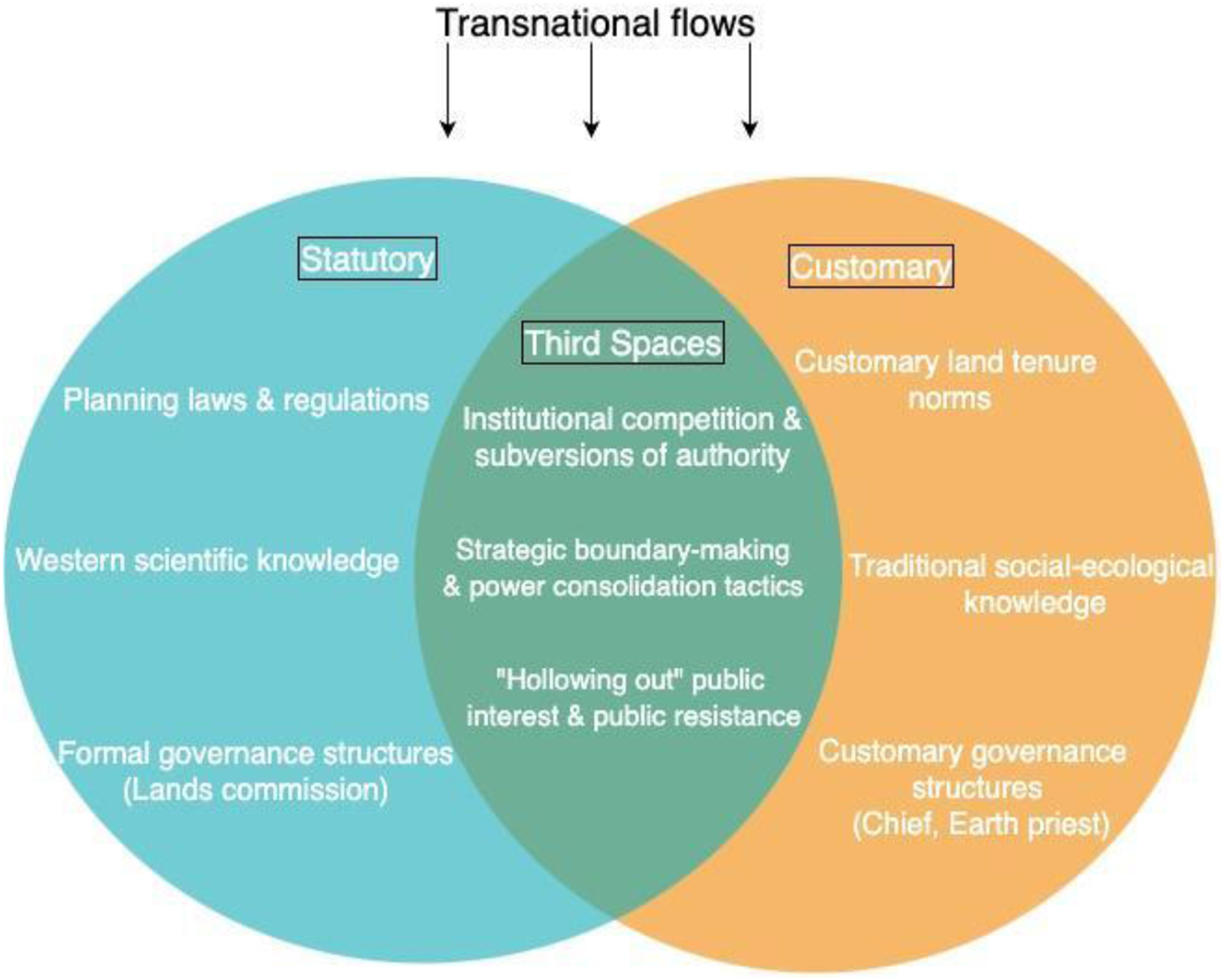
In this context, Mouffe’s agonistic framework (Mouffe, 1999, 2008, 2011) offers guidance on how institutions might be designed to harness the opportunities embedded in hybrid systems while reducing the threats. Agonistic planning rejects the assumption that planning should seek consensus and instead advocates for institutional designs that structure contestation in ways that remain accountable to the public interest. Applying this lens to the design of planning institutions, the third space can be understood as an agonistic institutional space, where conflict is not a failure of governance but a necessary condition for negotiating legitimacy and inclusion. It is also a space where a diversity of institutions, norms, and knowledge systems are respected and structured. This requires mechanisms that prevent elite capture, ensure ongoing participation, and create institutional safeguards that make institutions accountable to the public interest.
Indeed, as illustrated in Figure 1, hybrid governance spaces can become sites of institutional creativity and inclusion, but without robust protective mechanisms, they are equally susceptible to the hollowing out of the public interest. When excluded communities find themselves denied meaningful voice and subjected to coercive dispossession (whether through state-backed projects or customary elite capture), they may turn to insurgent forms of resistance that operate outside formal governance channels (Benjamin, 2008). From an agonistic perspective, the challenge for institutional design is these contexts is thus threefold. First, to create structures that harness the transformative potential of hybridity through inclusive, pluralistic governance practices. Second, to build in safeguards against elite exploitation to ensure that hybrid arrangements do not simply reproduce existing hierarchies of power. And third, to guarantee channels for community voice and resistance, particularly when formal mechanisms fail. This ensures that governance remains accountable, adaptive, and responsive to those most affected by planning decisions.
“It is too late to talk now”: the contested kwabenya landfill project and the illusion of consensus
The failed Kwabenya landfill project provides an empirical illustration of how, when left unstructured, institutional hybridity can lead to overlapping authority claims, institutional competition, the hollowing out of public accountability, and ultimately governance paralysis. At the same time, it highlights the potential for agonistic institutional designs that hold statutory and customary governance systems in productive tension while ensuring accountability to the public interest.
Conceived in the late 1990s as part of Accra’s broader waste management strategy, the project aimed to establish an engineered landfill in Kwabenya – a peri-urban area experiencing rapid urbanization and land commodification. The Accra Metropolitan Assembly (AMA), the city’s primary statutory planning authority, sought to enforce state planning laws to secure and develop the site (Figure 2). However, from the outset, the project encountered entrenched opposition from local chiefs, customary landowners, and residents (Jafaru, 2014). After nearly two decades of deadlock, protests, and legal challenges, the landfill was formally abandoned in 2014 (GhanaWeb, 2014; Modern Ghana, 2014). Site map of the failed Kwabenya engineered landfill. Source: World Bank Inspection Panel (2011).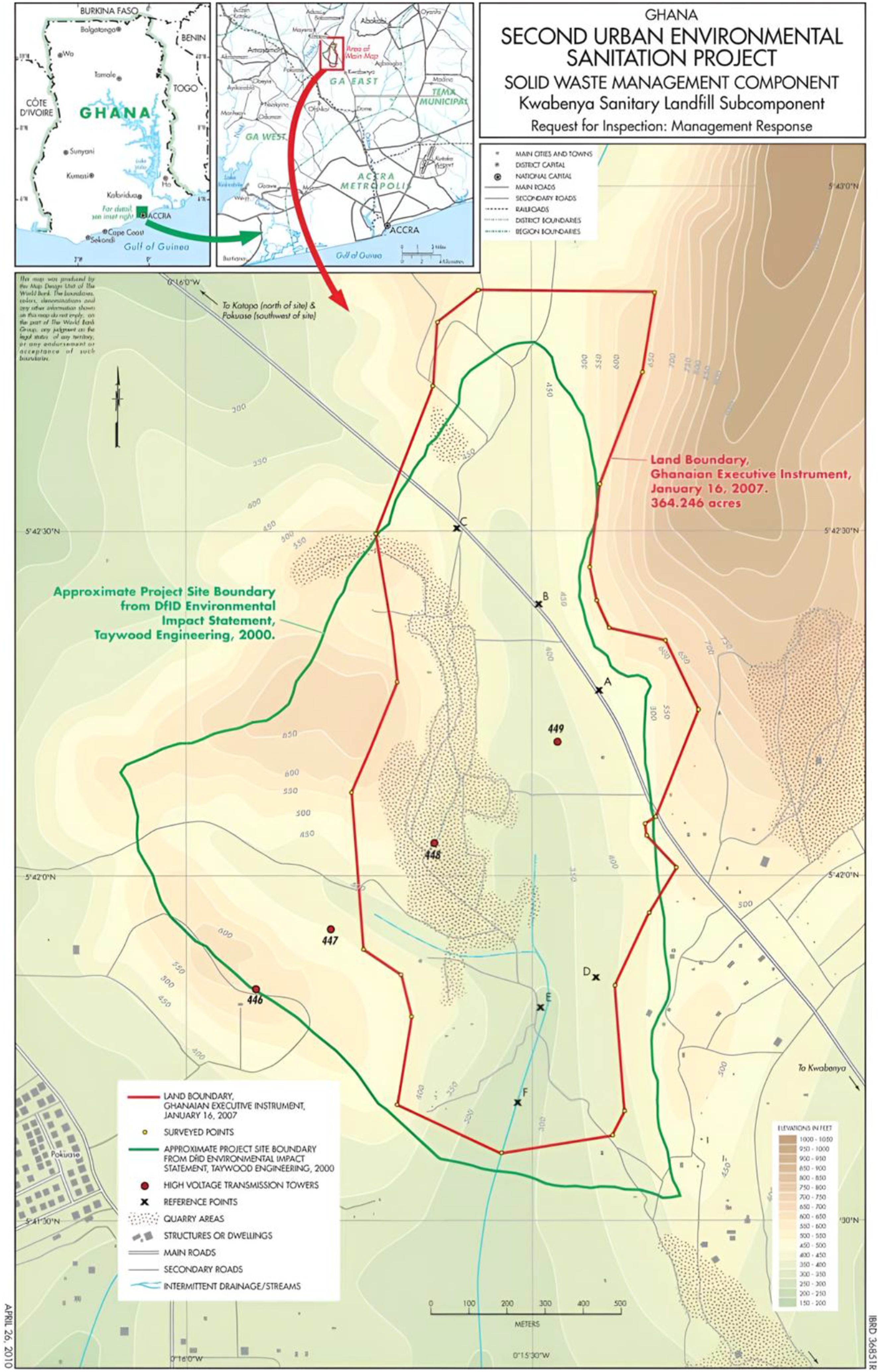
At the heart of the conflict lay overlapping and competing claims of authority between statutory planning bodies and customary governance institutions. Under Ghana’s Local Government Act (Act 936), the statutory authorities held the legal mandate to zone land for waste management and public infrastructure. However, the designated landfill site sat on land under customary tenure, controlled by a constellation of local chiefs and family landowners (Oteng-Ababio, 2011) who, despite constitutional recognition, operated largely outside formal statutory planning frameworks. The governance tensions in Kwabenya were structurally embedded in Ghana’s hybrid land governance system. Without clearly defined mechanisms for resolving competing claims, hybridity became a site of escalating contestation rather than negotiation.
In response to growing opposition, the government established a 20-member Technical Advisory Committee (TAC) in 2004 to review agreements and resolve stakeholder concerns (Modern Ghana, 2004a). The TAC was tasked with harmonizing the varied interests at play and providing recommendations on the project’s feasibility. However, rather than resolving competing governance claims, the TAC ultimately endorsed the landfill project and recommended that the government proceed (World Bank Inspection Panel, 2009). This decision solidified the state’s commitment to the project while doing very little to diffuse the tensions.
Following the TAC’s recommendation, the government issued an Executive Instrument (EI) in 2007, which legally transferred ownership of the land to the state (Modern Ghana, 2014). The use of an EI to compulsorily acquire land reflected the state’s assumption that legal instruments alone conferred legitimacy. However, in hybrid governance settings, statutory legality does not always translate into recognized authority.
The local chiefs and community members rejected the legitimacy of the EI, arguing that no meaningful consultation had taken place, and the state had no authority to forcefully implement a landfill on their land (GhanaWeb, 2004). Indeed, the first time many residents heard of the project was through media reports in 2001 (Oteng-Ababio, 2011). The TAC’s procedural legitimacy did little to change the community’s fundamental rejection of state authority over land allocation and use.
From the vantage point of agonism, the failure of the TAC exemplifies the limitations of the prevailing planning approach (which is arguably communicative) in contexts of pronounced institutional hybridity. The TAC entered negotiations with the assumption that stakeholders accepted the state’s authority over the land and that the main barrier to landfill construction was resolving competing interests through compensation payments. This assumption was flawed from the outset. The TAC’s role was not to assess whether the landfill was legitimate but to identify compensation claimants and facilitate the project’s implementation.
For the affected community, the dispute was not about compensation. It was about whether the state had the legitimate authority to forcibly develop an obnoxious waste facility on their land. The TAC viewed its role as “harmonizing” interests under a unified legal framework. But in reality, no such common framework existed. The state approached the landfill as a technical planning issue, to be resolved through statutory enforcement and compensation, while the community saw it as an existential struggle over land rights and governance authority. The land use rationalities, and the respective institutional structures that underpin them, were at odds. This reflects what Watson (2003) suggests as the failure of communicative planning in contexts of “conflicting rationalities.”
Communicative approaches assume that, given the right deliberative structures, actors will eventually reach mutual understanding. But in this example, mutual understanding was structurally impossible because the very foundation of the planning process – the state’s authority over the land use – was not recognized by the community and their customary members. For the state, the landfill was framed as an essential urban planning intervention – a technical necessity for managing Accra’s growing waste problem. The community, however, saw it as something far more profound: a direct existential threat to their land, their livelihoods, and their future.
As Ms. Irene Gyau, spokesperson for the Women of Agyemankata (a protest group against the project) emphasized, “we will resist the construction of the project, and the consequences will be death. If a landfill is a legacy to bequeath to future generations, then what about our homes?” (Modern Ghana, 2004b). This statement is revealing, not just for its defiance, but for what it tells us about the impossibility of compromise. Communicative planning assumes that all parties ultimately seek common ground and that even when conflicts emerge, stakeholders will negotiate practical solutions. But in this case, there was no middle ground. One side demanded the landfill as non-negotiable urban planning necessity, the other was willing to die to prevent it. This lack of shared common ground made negotiation futile.
Additionally, the shifting of positions between customary authorities and the state as they negotiate compensation claims isolated communities who felt their interest had essentially been ‘hollowed out’. The government initially positioned the TAC as a mechanism for participatory resolution but later abandoned this approach in favor of statutory enforcement through the EI. Meanwhile, customary authorities negotiated privately with the state while publicly opposing the project, creating deep divisions within the community. These shifting governance positions illustrate what Boamah and Amoako (2020) describe as “double-dipping,” where actors in hybrid governance strategically invoke statutory or customary authority depending on what best serves their interests.
The broader community, feeling increasingly marginalized, escalated their opposition. With no formal role in governance negotiations, residents turned to direct action – protests, physical site blockades, and appeals to international bodies like the World Bank. As Ms. Gyau further emphasized, “it is rather too late for the Government to come in now [to dialogue with the community].” (Modern Ghana, 2004b). This rejection of dialogue exposes one of the core weaknesses of communicative planning in hybrid contexts: it does not account for conflicts that have already hardened and have become irreconcilable. Agonistic planning, by contrast, anticipates that certain governance disputes are not just “problems to be solved” but power struggles that must be structured into the planning process from the outset. In other words, the TAC assumed that negotiations could begin at any stage, but agonism recognizes that by the time institutional interventions happen, contestation has often already escalated to resistance.
Imagining institutional designs for planning in hybrid institutional contexts
The case illustrates how institutional hybridity generates governance tensions that cannot be resolved through consensus-driven approaches alone. It shows that conventional planning frameworks fail not merely due to poor implementation of consensus, but because they rest on the flawed assumption that conflicts between statutory and customary authorities can be harmonized through rational deliberation. Yet, as agonistic planning suggests (Mäntysalo et al., 2023; Mouffe, 1999), the differences at stake in hybrid governance are often irreconcilable, grounded in fundamentally distinct worldviews about land, authority, and legitimacy. Additionally, the features of institutional hybridity, as demonstrated in the case, are not temporary anomalies to be overcome, but persistent structural conditions. The shifting boundaries between state and customary authority, the hollowing out of the public interest through elite negotiations, and the failure to structure contestation in a way that was accountable to affected communities made conflict unavoidable. The challenge, then, is not to eliminate conflict but to design governance arrangements capable of managing and structuring it as an ongoing feature of political life.
Responding to this reality requires an agonistic approach to institutional design that embraces conflict as a necessary and generative force within hybrid institutional contexts. In Kwabenya, the state treated negotiation as a technical exercise, focusing on procedural mechanisms such as the Technical Advisory Committee (TAC), financial compensation to select customary leaders, and post-hoc public engagement. These efforts were not structural interventions to hold competing institutional logics in tension; instead, they were reactive measures that ultimately failed because they arrived too late, at a moment when governance legitimacy had already been fractured. Designing institutions for agonistic planning requires structuring contestation, not as a one-time participatory moment, but as a continuous, multi-level process embedded across scales of governance.
In practice, this means creating durable spaces that structure statutory-customary tensions into institutional mechanisms that ensure contestation remains accountable, rather than reinforcing elite dominance. Some models of institutional design that attempt to structure hybridity include India’s public interest litigation (PIL) system and South Africa’s Traditional Leadership and Governance Framework Act (TLGFA). The PIL provides formal channels for marginalized communities to challenge state and private development decisions (Holladay, 2012). It avoids forcing communities into extra-legal resistance by channeling contestation through public courts. However, PIL have at times prioritized middle-class interests over the urban poor; thus, without complementary governance reforms, PIL may not serve urban justice and equity goals (Bhan, 2009). A different trajectory is seen in South Africa’s TLGFA, which clearly illustrates the risks of poorly structured hybridity. While it was designed to integrate customary authorities into municipal governance with defined jurisdictional limits (Ntsebeza, 2005), in practice, it has enabled traditional elites to consolidate control over land allocation, often undermining democratic accountability and excluding local communities from decision-making (Claassens and Matlala, 2014). A key lesson from these cases is that hybridity cannot be left as an informal process. It must be procedurally defined, institutionally safeguarded, and actively regulated to prevent elite capture and governance circumvention (Cleaver, 2001; Lund, 2006b; Meagher, 2012). This requires binding statutory frameworks, enforceable accountability measures, and accessible grievance mechanisms to ensure that hybrid governance remains a tool for inclusion rather than exclusion.
To effectively implement such institutional designs, planners must rethink thier roles in hybrid governance contexts. In conventional participatory models, planners are positioned as neutral facilitators, helping diverse stakeholders reach consensus (Healey, 1997; Innes and Booher, 2010). This model assumes that planners mediate between competing interests within a shared legal and institutional framework. But in hybrid governance contexts, no such shared framework exists (Miraftab, 2009; Watson, 2003). The Kwabenya case demonstrates why planners cannot operate as neutral facilitators of consensus. The AMA and TAC assumed it could harmonize interests by compensating the “right” stakeholders. But as we saw, the legitimacy of these stakeholders was contested.
Consequently, instead of functioning as consensus brokers, planners in hybrid contexts must take on the role of agonistic mediators. This requires planners to actively engage with and apply multiple knowledge systems simultaneously (i.e., customary and statutory), developing the ability to assess when and how to invoke distinct legal, procedural, and governance mandates in hybrid contexts, and developing the skills to negotiate power asymmetries, mediate governance disputes, and maintain planning processes even in the face of deep institutional contradictions. Thus, they must resist rigid legal frameworks that assume authority is stable. This involves refusing the temptation to reduce planning to a purely technical exercise divorced from its political realities. Instead, they must engage in the political work of amplifying subaltern voices, safeguarding the public interest, and designing governance structures that not only accommodate contestation but actively sustain spaces for negotiation and adaptation.
At the same time, hybrid governance institutions must be designed to accommodate fluidity and change. Too often, planning failures in postcolonial cities stem from efforts to impose rigid legal frameworks onto contested, dynamic governance landscapes. In such contexts, adaptation is not optional but essential. However, as the case shows, adaptation alone is insufficient. Actors in hybrid governance settings strategically navigate overlapping institutions to consolidate authority and assert legitimacy. This means that governance flexibility can become a mechanism for elite consolidation – an act of double dipping (Boamah and Amoako, 2020) – rather than democratic responsiveness. In Kwabenya, the state used the EI to assert exclusive statutory authority over the land. But when resistance continued, it shifted strategies – engaging in backroom compensation deals with chiefs and selectively recognizing customary authority where it served state interests. The case, thus, reveals the dangers of adaptive governance unmoored from accountability: when power is left unchecked, adaptation becomes a cover for opportunism, corruption, and the concentration of authority.
For this reason, adaptive governance must be coupled with strong (internal and external) counterbalance mechanisms, including independent oversight bodies that ensure governance adaptation does not become a tool for elite consolidation and transparent grievance processes that allow communities to challenge governance decisions. For example, the case demonstrates the critical need for communities to have access to formal avenues through which to contest decisions, challenge abuses of power, and hold both customary and statutory authorities to account. In this regard, the PIL model, as seen in India and South Africa (Budlender et al., 2014; Holladay, 2012), offers models of how legal infrastructure can function as a site of structured contestation. Far from being peripheral to planning, these mechanisms are essential tools for ensuring that governance remains responsive to those most affected by its outcomes. Without these safeguards, institutional hybridity risks becoming a system of governance fluidity that only benefits those with the power to navigate it.
The challenge, then, is not to eliminate conflict from hybrid governance, but to institutionalize it in ways that are equitable, transparent, and productive. This requires moving beyond the search for consensus and embracing hybridity as a structural condition that demands institutional creativity, political courage, and continuous negotiation. The Kwabenya case makes clear that statutory planning must operate within, rather than outside, these realities. If planning in postcolonial cities is to serve the public interest, it must be reimagined as an ongoing political project: one that is adaptive, accountable, and fundamentally designed to hold deep differences in tension without allowing them to calcify into paralysis or reproduce cycles of exclusion.
Conclusions
This paper advances planning theory by reframing institutional hybridity as a fundamental governance condition (rather than an anomaly) that planners must confront directly. In doing so, it critiques mainstream planning theory for its failure to confront the realities of hybrid institutional contexts – particularly by prioritizing rational deliberation in ways that obscure or suppress deep institutional differences (Watson, 2002, 2003). Instead, drawing on agonistic planning principles, I argue for an alternative approach: one that calls for planning institutions to embrace hybridity, design structures to harness its productive potential, and implement safeguards to ensure public accountability.
By shifting the focus from resolving governance tensions to structuring them, this paper highlights how current planning frameworks fail not because of weak implementation but because they lack institutional mechanisms to anticipate and hold governance struggles in productive tension (Porter, 2010). Planning institutions often assume that hybridity is a barrier to effective practice, leading them to seek procedural inclusion of customary systems within statutory frameworks. However, customary authorities do not necessarily seek absorption into state planning institutions, nor do they readily accept it; rather, they assert their autonomy, contesting statutory authority while maintaining parallel governance structures. Additionally, as I have demonstrated, governance actors do not simply negotiate within fixed institutional boundaries but actively maneuver across governance structures, leveraging plural legal contexts to consolidate power (Boamah and Amoako, 2020). Without institutional safeguards, hybridity risks becoming a vehicle for elite capture.
This argument has significant implications for the role of planners in hybrid governance contexts. Far from acting as neutral facilitators operating within stable institutional frameworks, planners must be equipped to navigate contested governance spaces where authority is fluid and governance claims are actively negotiated. This requires developing legal and procedural ‘(multi)bilingualism’ – the ability to navigate, interpret, and apply statutory and customary governance frameworks in ways that acknowledge their distinct logics and power dynamics. Planners must assess legitimacy claims across statutory and customary systems, navigate shifting jurisdictional authority, and design participatory structures that sustain, rather than suppress, contestation (Porter, 2010). These competencies require a rethinking of planning education and professional practice. Training in agonistic mediation, jurisdictional interpretation, and adaptive governance should be central to planning pedagogy. This will ensure that planners are not merely policy implementers but institutional innovators capable of structuring governance contestation in ways that uphold democratic accountability and prevent elite capture.
While this analysis is grounded in the Ghanaian context, the core dynamics of institutional hybridity it explores resonate across other postcolonial settings where customary or indigenous and statutory authorities systems co-exist in tension. In South Africa, tensions between municipal governments and traditional authorities over land allocation and local governance have produced enduring conflicts, particularly in peri-urban areas (Ntsebeza, 2005). Similar patterns of overlapping jurisdiction and boundary negotiation are visible across African cities grappling with rapid urbanization on customary land (Boone, 2014; Ubink, 2008). Beyond Africa, settler-colonial contexts such as Canada, Australia, New Zealand, and the United States reveal comparable tensions between Indigenous governance systems and formal state authorities. In these contexts, disputes over land rights, resource management, and urban development frequently invoke both Indigenous legal traditions and statutory frameworks (Barry and Porter, 2012; Porter, 2010). In doing so, the framework of critical institutional hybridity offers planning theory a grounded, globally relevant lens for structuring deep differences, protecting public interest, and advancing inclusive urban governance.
Footnotes
Acknowledgements
I would like to express my sincere gratitude to Dr. Sarah Cooper and Dr. Abraham Nunbogu for their invaluable feedback and insights on an earlier draft of this paper. Their constructive comments and suggestions have greatly contributed to refining the arguments and improving the overall quality of the manuscript.
Declaration of conflicting interests
The author declared no potential conflicts of interest with respect to the research, authorship, and/or publication of this article.
Funding
The author disclosed receipt of the following financial support for the research, authorship, and/or publication of this article: Faculty Start-up Grant; 57854.
