




Abstract
There has been considerable debate about Habermasian-inspired communicative planning theory and Mouffe’s-inspired agonistic planning theory. This study investigates the possibility of the communicative and agonistic approaches for collaborative planning in the Chinese context. It examines three common theoretical dimensions, regarding the political concept, the public sphere and the power relation. The recent political development in China is related to authoritarian deliberation, in which governments allow some space for deliberation and participation but with limited empowerment. The multiple tensions between governments and society lead to the fragmentation of public spheres and various forms of power relations in collaborative practices. This study concludes that a dichotomous perspective is not helpful to understand China’s collaborative planning, which reflects features of both communicative and agonistic approaches.
Introduction
There are two theories about planning and democracy in Western contexts, namely, of communicative planning theory and agonistic planning theory (Bond, 2011). Grounded in Habermasian communicative rationality, communicative or collaborative planning theory has been advocated since the 1980s, with an emphasis on inclusiveness, equality, power neutralization, and dialogue (Healey, 1997; Innes and Booher, 2015, 2018; Sager, 2017). It refers to the political theory of deliberative democracy, that is, political decisions are reached through a process of rational argumentation among equal citizens (Gualini, 2015). Therefore, this approach emphasizes the interactive process, through which different views and claims are presented and brought together in search of consensus (Innes and Booher, 1999; Bond, 2011). However, communicative planning theory has been strongly criticized for ignoring power differences and conflicting rationalities in the context of social differences (Huxley and Yiftachel, 2000; Watson, 2003; Fainstein, 2016; Agger and Sørensen, 2018). In the past two decades, many Western countries have encountered increasing social heterogeneity, polarization and inequality. This has led to frequent conflicts within planning, such as citizen activism in urban redevelopment or neoliberal projects (Gualini, 2015). Thus, some scholars argue a paradigm shift in urban planning—from communicative planning to agonistic planning (Bäcklund and Mäntysalo, 2010; Pløger, 2018; Kühn, 2021). However, other scholars argue that the agonistic approach is an alternative to collaborative planning (Brand and Gaffikin, 2007; Bond, 2011; Mouat et al., 2013; Innes and Booher, 2015). The agonistic approach is based on the political concept of agonistic pluralism that emphasizes agonistic forms of conflicts, where the opponents are not viewed as enemies but adversaries (Mouffe, 2013). An agonistic approach to urban planning seeks to validate the implications of the plurality by endorsing multiple forms of expression and communication (Brand and Gaffikin, 2007). But it has received a lot of criticisms as well, because it lacks specific procedures for the transformation from antagonism to agonism and the role of planners remains unclear (Kühn, 2021). Although there has been much debate over the dichotomy of planning theories, few studies have been conducted to understand the differences between these two approaches, for example, the distinct roles of citizens (Bäcklund and Mäntysalo, 2010), and the divergent ways of dealing with conflict (Kühn, 2021). Besides, too strict dichotomies are counterproductive and sometimes could not reflect reality, especially in the authoritarian context (Özdemir, 2021).
The current debate is mainly attuned to the democratic context of Western countries, while planning theories have traveled around the world and adapted to specific local contexts. China is an interesting case to reflect this adaption, since its institutional context is very different from the democratic context that gave birth to the two theories and it has experienced rapid development and planning transitions in the past few decades. As Healey (2013) indicates, specific experiences have a strong potential to challenge the universal policy and planning ideas, because they are likely to be “a world away” from the contexts in which the ideas were developed. Since the late 1990s, Chinese scholars have introduced collaborative or communicative planning ideas to China, translating the works of Healey and Innes and publishing them in Chinese planning journals (Cao et al., 2021). Although the research of Chinese scholars is rooted in the communicative approach with an emphasis of consensus building, dialogue and institutional design, but it is subject to their own interests and sometimes restrictions, such as lacking an in-depth discussion of radical institutional reforms giving the sensitivity to criticize governance approaches in China (Cao et al., 2021). Since many Chinese planning scholars have been involved in planning practices, it is not surprising that communicative planning ideas have been quickly translated into practices and policies. Collaborative planning practices have emerged to address fragmentation, conflicts of interest, and complex problems in urban regeneration, environmental management, regional governance and other domains (Hu et al., 2013; Wang and Chen, 2020; Yuan et al., 2021). They are also related to the deliberative turn in Chinese political development. He and Warren (2011) argue that authoritarian rules are now permeated by deliberative and participatory practices at the local levels to deal with increasing complexity, diversity and pluralism under market-led economic development. This institutional change has facilitated the implementation of collaborative practices in the Chinese context. Besides, recent studies show that the Internet and social media have become influential platforms for collaborative planning in China. Local governments have used digital tools to support citizen participation and governmental management (Lin, 2022), while citizens and civil society have used social media and online forums to challenge existing power relations and enable critical debates, which may affect decision-making processes (Cheng, 2013; Deng et al., 2015; Zhao et al., 2018). These bottom-up approaches reflect some features of agonistic practices, while scholars often apply the communicative approach to evaluate the case studies. Besides, most of the existing studies are based on a specific case study, with limited theoretical understanding. It remains unclear the extent to which collaborative planning in China reflects communicative and agonistic planning theories.
Therefore, this study fills the mentioned gaps. It explores the relevance of the communicative and agonistic planning theories to Chinese collaborative planning. A critical literature review was conducted to understand the differences between communicative and agonistic approaches. It showed that both approaches adopted different political concepts and distinct views of power, with an emphasis of rational communication or confrontation. The review of these dimensions in the Chinese contexts led to identify the relevance of the two approaches to collaborative planning in China. Some collaborative practices were also used to elaborate the dimensions. The contribution of this study includes several aspects. It enriches the debate on the communicative and agonistic approaches by extending the discussions to the authoritarian context of China. Until now, the debates over the dichotomy of these planning theories have mainly attuned to democratic contexts. Nevertheless, a dichotomous perspective may not reflect planning realities in an authoritarian context, because rationality may mix with passions (Özdemir, 2021). Furthermore, it contributes to the theoretical understanding of collaborative planning in the Chinese context. Moreover, it develops an analytical framework to examine the communicative and agonistic approaches and Chinese collaborative planning from three common dimensions, namely, political concepts, public spheres and power relations. First, two different political theories (deliberative democracy and agonistic pluralism), respectively, influence the communicative and agonistic approaches, while “authoritarian deliberation” (He and Warren, 2011) is a new political development in China, affecting governance and planning processes in recent years. Second, although public spheres are crucial for rational communication or confrontation, the existing studies tell little about the differences of public spheres in the two approaches. There has also been little attention to the recent influence of digital platforms on the forms and quality of public spheres. It is reflective to compare them with Chinese public spheres, which have recently emerged for communication and contestation with the impact of new media. Third, power is crucial to the debate over contemporary planning theories. The communicative approach has received a lot of criticism regarding ignoring power relations, while the agonistic approach emphasizes power struggles. It is interesting to reflect on these different views of power in the Chinese context due to the challenging nature of power relations. These three dimensions are interacting with each other. In particular, the political aspect influences the forms and quality of public spheres and the types of power relations. The comparison of these three dimensions is helpful to understand the differences of these two approaches as well as their references to the Chinese context.
The remaining sections are structured as following. First, it examines the communicative and agonistic approaches from the mentioned three dimensions. Second, it discusses authoritarian deliberation, fragmented public spheres and various forms of power relations in the Chinese context. Third, it identifies several characteristics and trends of collaborative planning in China. Finally, some conclusion remarks are given.
The debate on the communicative and agonistic approaches
The communicative approach: Deliberative democracy, Habermasian public sphere, and communication power
The communicative approach to collaborative planning has been advocated by a number of Western scholars (e.g., Forester, 1989, 1999; Healey, 1997, 1999; Innes and Booher, 1999, 2015, 2018; Sager, 2017). It largely draws on the communicative rationality of Habermas (1984). The assumption of this approach is that there is a model of deliberative democracy, in which political decisions should be reached through a process of deliberation among free and equal citizens, endowed with the rationality of argumentation (Gualini, 2015). It takes Habermasian principles to make planning practice more democratic and socially just, with the premise of rationally and legitimately acting in the public sphere (Healey, 1997; Bond, 2011). Habermasian public sphere is a space, which is separated from the economy and the state, and in which citizens gather together to debate issues of public concern (Habermas, 1989). It emphasizes the ideals of openness, egalitarianism, and rational communication. Habermas also elaborates the discursive aspects of this public sphere, arguing for a procedural model of deliberative democracy. Politics is viewed as a public conversation governed by legitimating procedures and reason to encourage public participation and strengthen democracy (Kappor, 2002). Therefore, reason prevails over power, and power inequality is expected to be minimized by legitimating rules with communicative rationality (Kappor, 2002). The exercise of deliberative democracy in planning is then translated into “communicatively generated power” through “free public reasoning among equals” (Cohen, 1988: 186). Dialogue and debate in the public sphere are important for ensuring democracy and creating the conditions for the legitimate exercise of power as a representation of citizens’ values and interests (Innes and Booher, 2018). The communicative approach thus concentrates on consensus building, that is, selected representative stakeholders engage in face-to-face, long-term dialogue to address controversial issues by collectively defining problems, negotiating interest differentials, and finding solutions (Innes and Booher, 1999). Drawn from successful collaborative planning practices, Innes and Booher (2018) argue that three conditions are critical to determine whether a collaborative process is collaboratively rational. First, the collaboratively rational process should include not only agents who have power but also those who have needed information or could be affected by outcomes of the process. Second, agents must depend to a significant degree on other agents in a reciprocal way. Third, authentic dialogue requires that the agents engage with each other on a shared task in a deliberation and that their claims are legitimate, accurate, comprehensible, and sincere.
The communicative approach emphasizes the interaction between various stakeholders, for example, from the three spheres (state, economy, and civil society) (Healey, 1997), or the representatives of all relevant interests (Innes and Booher, 1999). It underlines the importance of citizen participation and empowerment for a more inclusive and fair process. Westin (2022) indicates that Forester, Healey and Innes criticize the dominating power, and their approaches are to empower disadvantaged communities by including them in the planning process, where “power over” can be transformed into “power with.” Communicative planning theorists consider that communication is able to mediate power relations (Sager, 2017). Based on Castells’ (2007) communication power, Innes and Booher (2015) argue that “the power relationship works through communication, which builds shared meanings of power—of who and what is powerful” (p.203). In such a view, norms and meanings can be developed through communication networks, and in turns shape the perceptions and actions of agencies regarding power relations. Communicative planners thus execute power through the ways they influence communication by shaping attention and questioning the information, statements, and arguments (Innes and Booher, 2015; Sager, 2017). Their roles are organizers, facilitators, mediators, and negotiators (e.g., Healey, 1997; Innes and Booher, 2018). From a more critical perspective, Forester (1989) argues that planners should listen sensitively and critically, speak cogently and persuasively, and develop “mediated” negotiation strategies to assure the interests of the major parties and support collective actions to challenge power structures. They acknowledge the need of some protest groups and social movements outside the formal planning framework, so they meet and discuss with those actors in invented spaces external to the formal framework in order to achieve a more equal and inclusive dialogue (Sager, 2017).
However, the communicative approach has received a lot of criticisms on the limited attention to institutional contexts, power differentials, conflicting rationalities, and planning outcomes (e.g., Huxley and Yiftachel, 2000; Watson, 2003; Agger and Sørensen, 2018; Van Dijk, 2021). It fails to take into account the reality of structural inequality and hierarchies of power, and the emphasis of processes make it not promise just outcomes (Fainstein, 2016). It is not an inclusive process as the claim of communicative planning theorists, since it favors some “stakeholders” (e.g., business groups) and ignores the interests of marginalized groups in neoliberal projects (Purcell, 2009). Instead of challenging the existing power relations, it provides an attractive way for neoliberals to maintain hegemony and ensure political stability (Purcell, 2009). Besides, complex urban conflicts may require creative leaps and strong leadership (rather than equal power) in coordinated actions (Van Dijk, 2021). The role of planners has been criticized for its neutral position in a nexus of power, knowledge and rationality (McGuirk, 2001), isolating from political-economic contexts and different institutional logics that enable or constraint their actions (Agger and Sørensen, 2018). Consensus-oriented conflict resolution strategies may be accused of facilitating neoliberal projects (Gualini and Bianchi, 2015), in which developers reap the benefits while leaving local communities with environmental burdens (Boonstra and Boelens, 2011). The framing of “power with” downplays the potential darker sides of consensus that may work to stabilize illegitimate power relations through de-politization and token participation (Westin, 2022). There are tensions in managing collaborative processes in the institutional context of a public bureaucracy (Agger and Sørensen, 2018). This critique is especially significant in the Global South, where the premises of the communicative planning theory, such as deliberative democracy and a matured civil society, may not exist (Calderon and Westin, 2021).
The agonistic approach: Agonistic pluralism, Mouffe’s public sphere, and discursive hegemony
Some scholars propose an agonistic approach as an alternative or addition to collaborative planning (Brand and Gaffikin, 2007; Bond, 2011; Mouat et al., 2013; Innes and Booher, 2015), while others argue there is a shift of planning paradigm to agonistic planning (Bäcklund and Mäntysalo, 2010; Pløger, 2018; Kühn, 2021). The agonistic approach is based on the political concept of “agonistic pluralism.” Conflict is viewed as inherent in pluralist societies and the acceptance and legitimacy of conflict characterizes pluralist democracies (Mouffe, 2013). A central task of democratic politics is to transform antagonism to agonism, and to provide the institutions which permit conflicts to take an agonistic form, where the opponents are not enemies but adversaries (Mouffe, 2013). The agonistic approach recognizes the role of emotion and passion in power struggle and contestation. Thus, agonistic public sphere is the public space “where conflicting points of view are confronted without any possibility of a final reconciliation” (Mouffe, 2013: 92). It is a domain for dissent and resistance, and a condition of pluralism that challenges the legitimacy of the liberal order (Gualini, 2015). Mouffe (2013) argues that “consensus is needed on the institutions that are constitutive of liberal democracy and on the ethico-political values that should inform political association. But there will always be disagreement concerning the meaning of those values and the way they should be implemented. This consensus will therefore always be a ‘conflictual consensus’” (p. 8).
The agonistic approach to planning has recently become popular in many Western countries as a response to increasing social heterogeneity, polarization, and inequality (Kühn, 2021). There is an increasing income gap between poor and rich, and a growing super diversity of the population due to migration (Kühn, 2021). Conflict within and from planning is increasing, such as the active civic engagement of citizens in public protest regarding housing shortages and the implementation of large-scale projects (Kühn, 2021). The impact of neoliberal projects and the unprecedented level of local and trans-local mediatization of urban struggles add to this complexity (Gualini, 2015). In a neo-liberalizing world, counter-hegemonic planning practice are required to achieve the transformation of existing power relations (Purcell, 2009). There have emerged networked social movements: people firstly connect with each other and establish networks through the Internet, and then move towards collective actions in urban spaces (Castells, 2012). The potential of social movements to develop agonistic forms depends on the way it contributes to repoliticize urban governance and the establishment of reflexive interfaces with planning practices (Gualini, 2015). The agonistic approach recognizes multiple identities and irreconcilable conflicts among competing views, values, and interests (Brand and Gaffikin, 2007; Innes and Booher, 2015), and it accepts dissent, make them visible, and cultivate strife (Kühn, 2021).
Mouffe’s agonistic pluralism plays an important role in the opening up of existing power structures and the articulation of pro-authoritarian arguments to more pluralistic and hitherto views, values and experiences (Yamamoto, 2020). Power is the achievement of discursive hegemony with the aim of political supremacy over opponents, and with the marginalization of lesser interests in the power struggle (Kühn, 2021). Discursive hegemony refers to not only language but also actions in practice (Mouffe, 2013). For instance, citizens use social media to create new meanings, organize collective actions, mount political pressure, and achieve a discursive counter-hegemony (e.g., Bäcklund and Mäntysalo, 2010; Kühn, 2021). The inclusion of citizens and civil society in an arena of agonistic negotiation in formal and informal participation processes is essential for the transformation from antagonistic to agonistic conflict (Kühn, 2021). However, the role of planners remains unclear. Brand and Gaffikin (2007) argue that planners not only play a role in facilitation and arbitration for proactive engagement, but also have skilled in semiotics and hermeneutics for analysis. But this point of view does not distinguish the role of planners from that in the communicative approach. Kühn (2021) argue that “the role of planners would be to establish a ‘culture of debate’, to offer public arenas for open-ended disputes, to discuss alternative solutions and to use the increasing protests of citizens and social movements to change the fields of power” (p.154). Nevertheless, this poses new challenges for planners, regarding their capacity to create the arenas for disputes and to mobilize actions. Since “deep divisions based on race, gender, culture, and ideology” are very difficult to overcome, the question is then “how to move forward in the face of agonism, assuring we do not tamp down meaningful differences or lose the multiplicity of voices and creativity that emerge around such conflict” (Innes and Booher, 2015: 203). The statement of consensus as a “solution for now” indicates that planning is seen as an unfinished process and that decisions are temporary (Pløger, 2021). This raises the question how to translate the agonistic approach into planning practice. The application of agonistic pluralism to urban planning is difficult especially under the conditions of neoliberalism, because it may threaten to weaken institutional power and foster inequality in undemocratic processes (McAuliffe and Rogers, 2020). The existing studies also do not discuss tools or procedures for dealing with conflict, and they do not show ways for realizing in practice (Kühn, 2021). Agonistic pluralism emphasizes democratic ethos (the substantive concepts of democracy, equality, and liberty as the three master signifiers), which provides inclusive spaces for different styles of speech, argumentation, reasoning and social learning that are similar to communicative planning (Bond, 2011). This suggests that it is hard to separate procedure and substance in the agonistic approach.
Authoritarian deliberation, fragmented public spheres, and power relations in China
Collaborative practices have emerged in China in several domains, such as the regional plan for green space, water governance, urban regeneration projects, and heritage protection (Ma and Lu, 2006; Hu et al., 2013; Deng et al., 2015; Wang and Chen, 2020; Yuan et al., 2021). However, the political, social and technological contexts are much different from that of Western countries, shaping the unique characteristics of collaborative practices in China.
Authoritarian deliberation
The collaborative planning turn in China is related to the development of deliberation in China. In recent years, scholars in the political science argued that deliberation in the authoritarian context of China (led by one party) is not only theoretically possible but also empirically existent (He and Warren, 2011; Tong and He, 2018). Deliberation is a mode of communication in which participants offer and respond to the substance of claims, reasons and diverse perspectives in ways that generate persuasion-based influence (He and Warren, 2011). The concept of “authoritarian deliberation” has been proposed to describe Chinese political development, that is, authoritarian rules are now permeated by a wide variety of deliberative and participatory practices (He and Warren, 2011). There have emerged norms and procedures of public hearings, citizen participation, and deliberative forums that promote deliberative virtue, impact decision-making, and ensure equality and fairness in villages and cities. There has also been online deliberation that refers to political expression, discourse and everyday talk among Chinese internet users, despite the boundary of deliberation is actively shaped by the state (Jiang, 2010). The emergence of authoritarian deliberation reflects the failure of command authoritaritarianism under the conditions of complexity and pluralism by market-oriented development (He and Warren, 2011). The rapid economic development has increased the size of the middle class, pluralized values, generated social inequalities, induced severe environmental problems, and produced rural-urban migration (Hu et al., 2013; Yuan et al., 2021). Local governments have faced an increase of petitions and social conflicts due to land appropriation, building demolition, and residential displacement in the urbanization process. Urban governance becomes complex in terms of multiple actors, plural values, and competing interests, with the involvement of private sectors and the rise of civil society. This give elites incentives to rely on popular inputs and deliberation in order to make legitimate decision. However, it should be noted that authoritarian deliberation is different from democratic deliberation in terms of the power distribution of the decision resulting from deliberation: the former is more concentrated and hierarchical, and the latter is more dispersed and egalitarian (Stockmann et al., 2020). Governance-level participation in China has developed in the absence of regime-level democratization, combining a high degree of experimentalism with consultation, deliberation, and limited empowerment (He and Warren, 2011). But experiences of consultative and deliberative engagement may change citizen expectations and deliberation tends towards institutionalized decision-making procedures (He and Warren, 2011).
In the planning domain, public participation was legalized through the Measure for Formulating City Planning (2006) and the Law of the PRC on Urban and Rural Planning (2008). Participatory and deliberative practices have been varied in terms of levels, scales, design, and frequency. At the local level, cities have developed a variety of policies and methods to support different levels of citizen participation and deliberation. Big cities such as Beijing, Shanghai and Shenzhen have adopted public hearings, workshops, community meetings, deliberative forums, and other citizen participation platforms in order to communicate with the public in planning processes (Du et al., 2014; Zhang et al., 2019). Public deliberations are usually more local than national, and favor issues related to municipal governance and economic performance by empowering some domain-limited and scope-limited forms of voices (He and Warren, 2017). The different degrees of deliberative democracy can be measured by participants, agenda setting, procedures, deliberation themes, and the use of results (Tong and He, 2018). Thus, deliberation is not a universal approach to all planning practices, and their adoptions and degrees are largely depend on the specific problems and the different local institutional contexts. It has also been influenced by Chinese culture. He and Wagenaar (2018: 624) argue that “deliberation in China operates under a different, Confucian, moral code that includes concepts such as people-centric (min ben), humanness (ren), ritual (li), harmony (hexie), and gentleman (junzi).” They point out that these concepts reflect a political order in which the rule of gentlemen prevailed, the notion of duty was central, moral concerns override political bargaining processes, and harmony wins over conflict. This is different from deliberative democracy, with the assumptions of individual freedom, autonomy and equality. Rather than individualism, the individual in the Chinese culture is also considered as part of household and part of wider forms of collectivism (Hu et al., 2013). These differences should be carefully examined in collaborative practices for collective problem solving in the Chinese context. They may influence the forms of power relations (e.g., the decisive and coordinative role of governments), consensus building processes, and the principles of collaborative planning (e.g., harmony as a principle rather than freedom and equality). Additionally, He and Warren (2011) call our attention to the differences between deliberation and communications that are purely instrumental and strategic. Not all communications in the planning process are deliberative practices. Much research should be done to understand the different forms of deliberations and their effects on collaborative planning.
Fragmented public spheres
Since the 1990s, there has been increasing debate on the existence and concepts of public spheres in the Chinese context, especially in the fields of media and communication studies. The public sphere in China has been conceptualized as fora for public expression and discourse, communication, social interaction, collective identity building, civic association, and popular protest (Yang, 2003; Rauchfleisch and Schäfer, 2015; Sun et al., 2018). It has been facilitated by the rise of the internet and social media in recent years. The development of information and communication technologies has led to mass self-communication: “self-generated in content, self-directed in emission, and self-selected in reception by many that communicate with many” (Castells, 2007: 248). This enriches a plurality of publics—distinct groups organize around affinity and interest (Gitlin, 1998). A series of public sphericules and micro-publics coexist, intersect and overlap in multiple forms (Bruns and Highfield, 2016). In the Chinese context, online public spaces are more complex and dynamic, due to censorship and regulations. China limits the influx of non-domestic social media communication and runs its own social media (e.g., Weibo, WeChat). The censorship is regulated by the central government and mainly implemented by tech companies, but it fails to shut down all critical debates due to the large number of netizens and the difficulties to identify all problems (Rauchfleisch and Schäfer, 2015). Shao and Wang (2017) argue that there is a need to focus on the fragmented structure of public spheres due to the multiple tensions between participatory democracy, journalism transformation and governmental authority. On the one hand, modern public issues involve various citizens, resulting in divergent public interests among different social groups. On the other hand, the public conversation changes when agenda and issues change. Citizens, government and journalism interact with each other not only for cooperation but also for conflicts and contestation. The dynamic and fragmented features make the formation of a typology of public spheres possible. Rauchfleisch and Schäfer (2015) present various types of online public spheres (e.g., local public spheres, thematic public spheres, and shot-term public spheres) that exist on Weibo, in which open and critical debates can occur under specific circumstances. They argue that online debates (that do not challenge regime stability) are tolerated by the central government, who uses them as feedback loops to keep local government officials in check and to improve its legitimacy by solving local problems. Several studies reflect the rise of a green public sphere, in which citizens become the main actors to produce green discourse, expressing their complaints and anger about environmental degradation and ineffective policies (Yang and Calhoun, 2007; Sun et al., 2018). However, opinion leaders may occupy more important positions in online discourse (Shao and Wang, 2017). Some scholars find the dominance of communal and less confrontational forms of discourses in everyday online (non-political) talk, which are characterized by a certain amount of reasoned claims and a high degree of reciprocity (Sun et al., 2020). Other scholars present more contesting public spheres, in which various actors compete to shape public spheres and promote political change (Lei and Zhou, 2015), or in which grassroots express their emotions such as anger and form counter-hegemony discourse to challenge the powerful actors (Tong, 2015; Luqiu, 2018). These public spheres show some characteristics of Mouffe’s agonistic public sphere, which enables the prominence of emotions, contesting discourses, and collective actions to against dominant groups.
In the planning field, Cheng (2013) argues that the internet provides the grassroots a new channel for expressing their voices resulting in more open and communicative planning processes. Based on the PX event in Xiamen city and the nail household event in Chongqing city, she indicates that grassroots participants have been successfully to change the decision-making process and power relations through online discourse and offline actions. In the Xiamen case, a professor firstly posted a message that a mega-project—a PX (p-Xylene) producing plant would bring severe environmental problems. This message was rapidly distributed in the Internet and led heated debates around citizens, who then had a silent “walk” collectively on urban streets to express their anger. The interaction between online discourse and offline actions pushed local government to initiate citizen participation mechanisms and cancel the project at the end. In the nail household event, the households framed developers as the “opponents” of the households to gain the support of millions of netizens and to put pressures on both developers and local government. However, Cheng (2013) argues that the interactive processes were far away from consensus building as described by the communitive planning theorists, because there were bias, opinion polarization and insufficient management from professionals. Zhang et al. (2019) take the Bell-Brum Towers controversy in Beijing as an example to study the built-heritage stewardship movement in urban redevelopment. They indicate that preservationists mobilized the general public online to shape public debates, mobilized high-level governments to employ political pressure, and directly disempowered local decision-makers online. Based on the study on the regeneration of Enning Road in Guangzhou, Cao and Wang (2019) argue that newspapers with online and offline editions play a crucial role in the planning process, reporting the problems of the project and questioning local government for non-transparency and social injustice. Government is no longer the only dominant player in urban planning, since non-governmental actors and mass media have actively participated in the public sphere through public topics (Yao et al., 2021). Societal actors do not resist against government, but they also jointly construct planning practice along with government (Yao et al., 2021).
Various forms of power relations
In the past few decades, there have been changes in power relations between state, market and society in China. “Society” is often used by scholars to explain the sphere beyond the state and the market in the Chinese context, including the third sectors (in which state and social groups collide), formal and informal organizations, and individual households (Lin et al., 2015). In the socialist period, there was no free market and the power of the state was significantly greater than that of society (Hu et al., 2013). Since the economic reform, the private sector has been allowed to participate in urban development, but enterprises and local governments have often formed a regime-like growth coalition or state entrepreneurialism (Wu, 2018). With the rise of civil society, the power coalition between government and enterprises has been challenged by social groups. However, scholars argue the lack of a robust civil society (as a liberal notion that pits society against state) in China (Hu et al., 2013), since non-governmental organizations (NGOs) may develop relations and build trust with governments to survive, hindering their impact on policies and practices (Hsu and Hasmath, 2017). Yao et al. (2021) argue that there are still asymmetric power structures, particularly the influence of the uneven distribution of resources between state and society. Hu et al. (2013) point out that the traditional Chinese culture (e.g., Confucianism) and institutional structures influence the power relations and make them different from that of the communicative approach with an emphasis of citizens’ self-organization and equal power. They argue that governments take a decisive and coordinative role rather than a facilitating role, and that citizens may consider planning as a task of governments and lack the incentives to influence decision-making. Thus, it is not surprising that collaborative practices have adopted a government-led participation approach, in which lower-level government creates a platform for negotiations between various actors and planners facilitate community’s participation and control the process (Hu et al., 2013). Considering the asymmetric power structures, some scholars argue that the third sector—that is comprised of representatives from government, local communities, media, enterprises and other sectors—is crucial for consensus building, since it is a platform for multi-stakeholders to express their opinions and enable reciprocal communication (Yuan et al., 2021). Either the government-led or the third sector led approach reflects the influence of “authoritarian deliberation” on urban planning. Local residents can express their claims and opinions through participatory and deliberative mechanisms, while the process is still highly regulated and controlled by government and professionals, who decide how the process is organized, who can participate, and to which extent the opinions of local resident are adopted in the final decision.
Nevertheless, new forms of power relations can be regenerated through the Internet and social media. According to Castells (2007), power relations in the contemporary social and technological contexts largely depend on the process of mass self-communication, which increases the ability of online participants to produce their own messages and potentially challenge existing power structures. There are four different forms of power in the network society: networking power, network power, networked power, and network-making power (Castells, 2011). Counter power is exercised by fighting to change the programs of specific networks and by the effort to disrupt the switches that reflect dominant interests (Castells, 2011). The interactions between virtual communities and offline activities such as gathering in public spaces lead to the so-called networked social movements (Castells, 2012). Although some communicative planning theorists (e.g., Innes and Booher, 2015) are aware of communication power, they pay little attention to diverse forms of power that may raise in the Internet and social media. Some recent studies in China show that citizens, civil society, professionals, and journalism use social media to establish large-scale social networks that facilitate information flows in planning processes (Deng et al., 2015; Zhao et al., 2018). Social media create more open and flexible networks, in which any netizen can be a node of the network. As such, they have the potential to empower those groups, who are otherwise not able to gain information and express their voices. However, this doesn’t necessarily lead to equal power, since elites may become the power center and play a major influential role, resulting in networked power which is a form of power exercised by certain nodes over other nodes within a network (Zhao et al., 2018). Although these studies explore the role of social media in creating new forms of power, it remains unclear about the switches and interactions between online and offline networks as well as their impacts on power relations. With the rapid development of smart cities in recent years, many online participatory tools such as crowdsourcing platforms and planning support systems have also been used by government and experts in supporting citizen participation and communication. More research is called to understand to which extent these digital tools empower citizens and other actors.
Rethinking the communicative and agonistic approaches for the Chinese context
The communicative and agonistic approaches and collaborative planning in China.
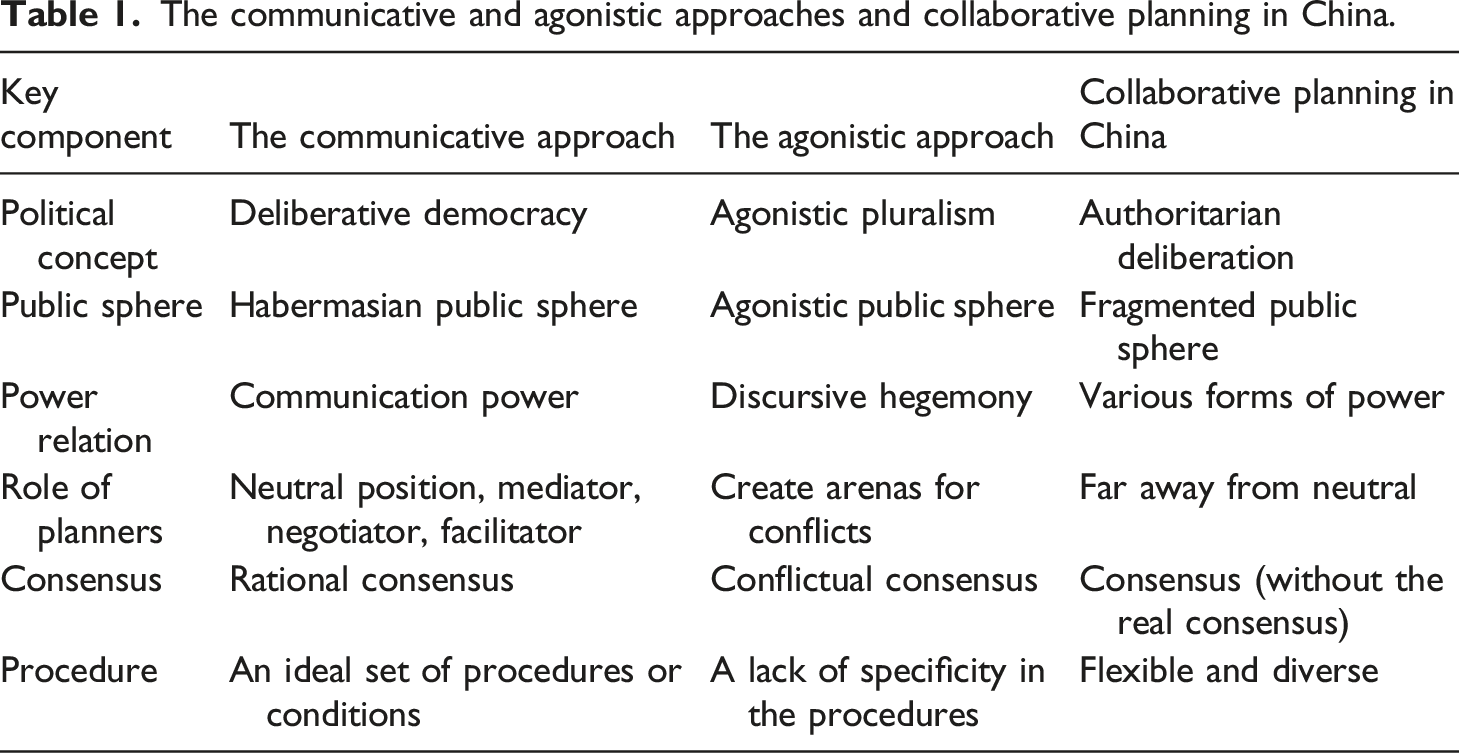
Both of the communicative and agonistic approaches aim to improve democracy and equity by engaging grassroots participants or the powerless in planning processes, but they have several different dimensions. The communicative approach has the assumption of deliberative democracy that emphasizes free speeches among equal individuals. The discussions in the public sphere should be sincere, accurate and comprehensive, meeting Habermas’ ideal speech conditions, resulting in consensus and agreement (Innes and Booher, 2015, 2018). There is also an assumption that power inequality can be minimized by legitimating rules with communication rationality (Kappor, 2002). Although recent studies adopt Castells’ approach of network power and communication power (Innes and Booher, 2015), the premise is still that communication can lead to more equal power. The Internet and social media indeed provide new platforms for the powerless to challenge existing power structures, but new forms of unequal power can also be generated within networks. The advantage of this approach is that it sets up a number of clear procedures, criteria or conditions for institutional design (Healey, 1998), consensus building (Innes and Booher, 1999), and collaborative rationality (Innes and Booher, 2018), and defines the roles of planners such as mediators, facilitators and negotiators (Forester, 1989; Sager, 2017). In contrast, the agonistic approach has the premise of agonistic pluralism. The public sphere is a space for dissent, resistance, and confrontation of conflicting points of view, enabling the expression of emotions and passions, but without any possibility of a final reconciliation (Mouffe, 2013). It emphasizes discourse hegemony, in which the combination of discourse and actions carries out power, challenging hegemony projects and existing power structures. The consensus is thus a conflictual consensus, which is politically conceived as an ongoing dispute over the conditions for agreement (Mouffe, 2013). However, the role of planners remains vague, and there is a lack of specific procedures to guide the implementation or evaluation of planning practices.
Under authoritarian deliberation, there is no clear boundary between the communicative and agonistic approaches. On the one hand, there are spaces for reasoned deliberation, such as arguments, claims, opinions and persuasion in formal deliberative forums, public hearings, and citizen evaluation forums (He and Warren, 2011). But public reason is constrained by political techniques, such as informal meetings before formal deliberation (He and Wagenaar, 2018). On the other hand, there are rooms for popular protests, mass mobilization, petitions, and participation strikes (He and Warren, 2011; He and Wagenaar, 2018). Participation strikes have forced local authorities to make public deliberation a partially empowered process, which help to solve increasingly local complex problems and effectively implement policies and plans (He and Wagenaar, 2018). The deliberative practices reflect some features of Habermasian reasoning, but also some characteristics of the agonistic approach regarding power struggling and contestation. A collaborative process may show some features of the communicative approach in certain stages and some characteristics of the agonistic approach in other stages. Therefore, it should carefully examine different stages of an interactive process. There are some tendencies of collaborative planning in the Chinese context: • Authoritarian deliberation shapes collaborative planning. Public participation and deliberation are used as a means to solve complex problems by getting information from citizens, and allowing space for citizens to discuss issues and directly impact decisions (Tong and He, 2018). Grassroots participants and civil society may let their voices to be heard by bounded petitions, protests, new media, and deliberative forums (He and Warren, 2011). But the space of deliberation is shaped by the state, and the expression of interests and rights are often related to local governance issues, which don’t threaten the regime stability. The empowerment of citizens can be partial and diverse, depending on the domains and scopes of issues. • Collaborative planning generates new institutional capital. Government-led experimentations of collaborative practices change the expectations of citizens and become a new culture, while bottom-up agonistic practices stimulate the creation of innovative participation mechanisms for collectively problem solving in the short term. Local governance are adaptive and adjusted to external challenges such as social contestation, financial pressure and the influence from higher political levels (Yao et al., 2021). Therefore, these practices may lead to institutional and policy changes in the long term, through the actions of governmental and non-governmental actors. • Collaborative planning emerges for specific governance contexts and issues. Collaborative practices occur in specific contexts such as urban regeneration, environmental management and regional governance, where there are complex governance problems. These governance issues include economic interests of local residents, cultural identities, political rights (e.g., openness of information and transparency), and environmental sustainability. Local governments may find it difficult to deal with the issues themselves or face the protests from local residents and civil society. Collaborative planning thus helps to collectively solve the problems, but it may also be strategically used by governments to shift the burdens to various actors. • The procedures and forms of collaborative planning are flexible and diverse. The forms of state-society interactions can be flexible in different phases of governance processes, with different driving forces (bottom-up or top-down) and the diverse mixture between formality and informality (Yao et al., 2021). Thus, the procedures of collaborative planning can be flexible and diverse, since a government-led approach may be necessary to address some issues, while a bottom-up approach may take place in other contexts. Besides, the rapid changes of institutions and policies can lead to different interactions between various actors in various stages of a planning process. This suggests a heterogeneous nature of collaborative practices. • Public spheres are fragmented, with the impact of new media. Offline public spheres is often controlled and regulated by governments in authoritarian contexts. The internet and social media create new public spaces, where open and critical debates may take place for specific topics and contexts. But the multiple tensions between governments and society lead to the fragmentation of online public spheres, where there are divergent public interests and dynamic discourse (Shao and Wang, 2017). Some forms of reasoned deliberation may exist, but it is not necessary to form Habermasian public sphere. Agonistic and other forms of public spheres may be created for expressing emotions and mobilizing actions in specific contexts. • Power relations are various and dynamic. There are asymmetric power relations between local governments and societal actors, since the core decision-making may be exclusive to non-governmental actors (Yao et al., 2021). There may be more equal power through the mediation of the third sector, but a formal planning process is often highly regulated by governments and planners (Yuan et al., 2021). Through social networking and online discourse (properly with actions in physical spaces), counter power may be formed to challenge existing power structure and turn down hegemony projects with little social and environmental concerns. Power relations can be dynamic in different stages of a planning process. • The roles of planners are far away from neutral. Some planners work with governments and developers to establish the planning procedure, engage local residents, and mediate the interests of various stakeholders. But they may became the agents of governments and private sectors who consigned the projects to them, and have the danger to work for profit-making rather than public interest (Cao and Wang, 2019). Some planners work for their professional values and create agonistic arenas (through new media and other platforms) to mobilize citizens and civil society to protect culture heritage and environment, but they may pay little attention to the interests of local residents who are more careful about their living environment and economic interests (Zhang et al., 2019). • Consensus is needed but may be a different one. The deliberation spaces allow for the formation of opinions and sometimes enable consensus for collective problem solving (He and Warren, 2011). But public officials can play a central in deliberative democracy and an administrative power tends to manipulate deliberation to achieve “consensus” without any real consensus among all affected (He and Wagenaar, 2018). Consensus building can seldom be achieved without the driving forces of government steering and conflict resolution, within asymmetric power structures (Yao et al., 2021). The consensus should be differentiated from Habermasian consensus with the assumptions of individual freedom and equal power. Online public spheres provide a new platform for grassroots participants to debate and may form partial consensus which is conflictual or have some degrees of reasoning. • The values for evaluation include harmony, stability and sustainability. The institutionalization of deliberation is a response to increasing complexity under market-led economic development, with the aim to foster harmony society and regime stability (He and Warren, 2011; He and Wagenaar, 2018). Rather than a normative perspective that focuses on democracy, equality and inclusion in planning processes, collaborative planning in China looks like more a practical solution to deal with complex problems and challenges of sustainability.
Conclusion
This study is an attempt to understand to which extent the communicative and agonistic approaches are related to collaborative planning in China. Although the communicative and agonistic approaches emphasize different dimensions, they share some common features such as the striving for democracy, equality, and consensus, the creation of public spheres, and the use of language in power struggling or balance (Healey, 1997; Bond, 2011; Innes and Booher, 2015, 2018; Kühn, 2021). Some scholars consider the agonistic approach is an alternative to collaborative planning, while others views that there is a paradigm shift to the agonistic approach. However, I argue that a dichotomous perspective is not helpful to understand collaborative planning in the Chinese context. Rather than deliberative democracy and agonistic pluralism, authoritarian deliberation is a key political concept to understand collaborative practices in the Chinese context. The voices of the public can be heard through public hearings, deliberative forums, formal participatory channels, petitions, and protests, while the boundary of deliberation is shaped by the state and there is often limited empowerment (He and Warren, 2011). These deliberative practices show some features of reasoning and agonism. Therefore, it is possible that a collaborative practice in China reflects a mixture of both approaches and even different approaches in various planning stages. With the support of the internet, grassroots participants may take a more radical approach leading to discursive counter-hegemony. But the preconditions are that these practices do not challenge the regime stability. Instead, they can help the government to know the problems and improve its legitimacy by conflict resolution. The scopes of agonistic practices are thus still bounded by governments, who have strong technical means, financial resources and organizational capacities. The protests from citizens may push local governments to create formal channels or experimentations for participation and communication in order to solve complex problems. Experimentations and practices may lead to the change of culture, and even become institutionalized decision-making procedures. This reflects resilient governance, with adaptive purposes, flexible patterns, and responsive mechanisms, which doesn’t simply entail the reaction of the state in the face of current challenges, but also involves future designs for controlling potential social actions (Yao et al., 2021). More research needed to be done to understand the interactions between institutions and collaborative planning in China.
Based on this study, I have three thoughts for future research on collaborative planning. First, much attention should be given to how specific institutional settings and political systems shape collaborative planning. The non-democratic experiences should also be better integrated into the discussion of planning theories. This study shows that three types of planning are influenced by three distinct political ideas. Although formal and informal institutions may be changed and adapted due to new urban dynamics and the actions of agencies, they shape the types of power relations and the forms of public spheres. Second, the key task of planning is to solve problems, which are specific to different local situations. Although it is helpful to have a critical debate over planning theories, it is important to link theories with practices. Empirical research can reflect the theories and even lead to the improvement and reconceptualization of the theories. Third, the impact of digital tools on collaborative planning has increased in the past decade, especially since the pandemic. The recent research of Lin (2022) shows that social media has created new types of participation, networks and power relations, and enabled new forms of communication affecting the forms and qualities of public spheres. New digital participatory platforms have also been widely developed to support participatory and collaborative processes. More research should be done to understand the recent influence of digital platforms on the forms of participation, communication, and contestation in urban planning.
Footnotes
Funding
The author(s) disclosed receipt of the following financial support for the research, authorship, and/or publication of this article: This research has received funding from the European Research Council (ERC) under the European Union’s Horizon 2020 research and innovation programme (grant agreement No 947879).
