




Abstract
Among the values conceptualising and measuring planning processes and outcomes, two play a prominent role in liberal democracies: legal and economic. Current conceptions and practices framing these values face substantial challenges: civil law systems do not account for the variety of land use situations, increases in wealth inequalities, and human activities which threaten planetary boundaries. A way to tackle these challenges is to analyse the current theoretical discourse and legal norms framing values in planning, study alternative conceptions, and outline new responses. The present article investigates how a paradigm shift in planning theory may open new avenues for conceptualising legal and economic values. To do so, it first compares the episteme of land ownership defined by two theories applied to planning: law-and-economics and land master theory. Second, drawing upon the comparison, the article discusses how the strengths of each theory may contribute to filling the gaps of the others. Identified gaps are: the integration of political aspects into the analysis, the conceptualization of collective and use-specific forms of ownership, and methodological issues. These gaps mirror the western legal conception of land ownership, defined as individual and absolute. Fourth, based on collective and use-specific land management practices that develop within the western legal framework, and theoretical inputs from land master theory, the article puts forward a transduction of legal norms that foster a more sustainable conception of land ownership, known as land stewardship.
Keywords
Fructus can be understood not in the sense of making a profit, but in the sense of restoring, making habitable for others, enabling others to use this space and maintain its habitability. Felwine Sarr (2021)
Introduction
In western civil law regimes, accounting for the variety of land use situations, in particular, forms of common and collective land ownership and management, has become a challenge to the dominance of private ownership in the legal discourse (Marella, 2017). 1 In research practice, tackling such challenges emerges from the study of different types of institutions framing land ownership and management. Scholars have studied, for example, the interactions between competing conceptions of ownership in a colonial context (Porter and Barry, 2016), the extent to which ownership may be conceived as a temporally and spatially contingent relationship (Piedalue and Rishi, 2017), and how indigenous knowledge may provide alternative valuations of land ownership (Moreton-Robinson, 2015). Studies on the commons (Netting, 1981; Ostrom, 1990; Haller et al., 2019), on community land trusts (Kelly, 2009; Moore and McKee, 2012), and other mixed property regimes (Lehavi, 2008), have also contributed to the expansion of our current conception of land ownership. Nevertheless, “institutional mismatches”, i.e., an increasing inadequacy of available legal tools to provide efficient and sustainable responses to secure intended uses, management, and ownership on land, persist.
Institutional mismatches spawn in several fields of planning, such as: housing supply (Rolnik, 2013; Dawkins, 2020), densification of urban areas (Perez, 2020; Debrunner et al., 2024), agricultural land management (Kassis, 2023; Léger-Bosch, 2023), water governance (Ostrom, 1990; Bolognesi and Nahrath, 2020), or environmental and climate-related policies (Slaev and Daskalova, 2020; Bazzan and Righettini, 2023), to name examples. These mismatches are also reflected in contemporary critiques of planning theories. One critique is the tendency of planning theories to neglect the limitations of their applicability to planning practice, as they tend to become ‘a set repertoire of narratives’ deemed universally applicable (Barry et al., 2018). To address this critique, challenging the theories’ underlying the epistemologies to foster ‘intellectual unsettlement’ may constitute a valid path (Barry et al., 2018).
Another critique addresses a theoretical assumption put forward by new institutional economic theories, such as law-and-economics, which may be formulated as follows: if property rights are well assigned and transaction costs are zero, then social welfare is maximized (see Lai, 2007). Barry et al. (2018) question the assumed clarity of property rights and the definition of exchange value as surrogate for use value. In fact, clear or well assigned property rights subsume incidents on excludability, shared knowledge on entitlements, liabilities over externalities, transferability, fungibility, and mechanisms of enforcement. These economic incidents are rooted in the legal incidents of ownership described by Honoré (1961), and subject to debates on their interpretations and content (e.g., Decker, 2023; Wilson, 2023).
The present article addresses these two critiques by initiating an epistemological comparison between two theories: the well-established law-and-economics theory applied to planning (Webster, 2005; Webster and Lai, 2003), and its core branch new institutional economics, and a little-known theory from legal anthropology with elements from legal pluralism and new institutionalism: land master theory 2 (Le Roy, 2011). The choice of these two theories relies on their joint consideration of the legal system as a corollary of planning. In western societies, the consideration of the legal system is central to understanding planning processes and outcomes, as it greatly contributes to the clarification and security of property rights (Hodgson, 2015). Both theories put forward the importance of ‘rights’ as a key aspect of planning and the enforcement of land use decisions. Other characteristics of the two theories highlight the differences between them, and thus emphasize the relevance of their comparison: theoretical versus empirical roots, diverging epistemological standpoints, respective fit within the western legal system, and partly distinct fields of observation – the west in comparison with Africa, Oceania, and Europe.
Section two of the paper provides an epistemological comparison of the two theories – law-and-economics and land master theory – and an analysis of their epistemological roots. The comparison shows how these theories enrich our thinking of legal and economic values in planning as well as their shortcomings in the provision of an encompassing understanding of land ownership. In section three, the paper first reflects upon the definition of western legal norms of land ownership and their mismatches with a variety of land use practices. Second, the identified legal gaps and the theoretical insights provided by the epistemological comparison allow for transduction of obtained results into legal norms of land ownership which may better fit the purposes they aim to achieve. We conclude the article by emphasizing the main lessons drawn from the epistemological comparison and the transduction.
Episteme of land ownership according to law-and-economics and land master theory
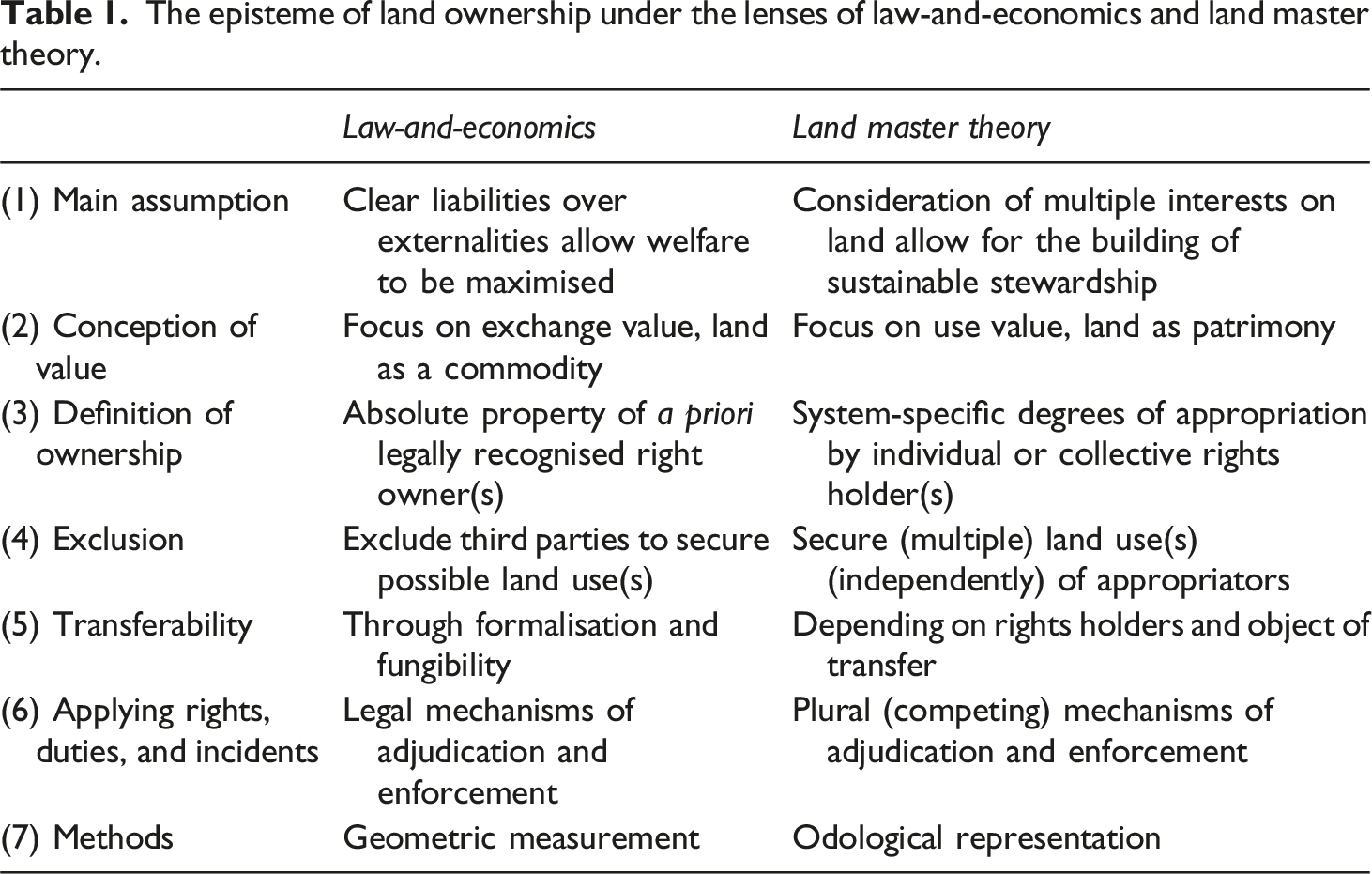
The episteme of land ownership under the lenses of law-and-economics and land master theory.
Main theoretical assumptions and conception of value
Law-and-economics analyses interactions between market forces and government policy: it aims to understand a) how these two institutions allocate property rights over scarce land and land-related resources, and b) the (re-)distributive implications for the involved parties. A theoretical assumption central to law-and-economics is that clear liabilities over externalities allow for a maximisation of welfare (Hanley, Shogren, and White, 2019). Welfare is maximised when existing rights to the considered commodity are allocated to the most productive uses. To allow for such maximisation, it is key to define clear liabilities over externalities (e.g., traffic, nuisance, pollution, etc.). Defining and enforcing liabilities over externalities induces transaction costs (Marshall, 2013; Bolognesi and Nahrath, 2020). These costs may be carried by different actors: involved parties such as landowners, as well as third parties, or planning authorities. In line with Coase’s theorem (1960), which addresses the difficulties for authorities to regulate externalities, the theory considers the intervention of planning authorities as efficient, as long as it contributes to reduced transaction costs and clarification of liabilities (Cooter, 1998). Therefore, the minimization of transaction costs allows for a reduction of uncertainty over time and ensures an elevation of the value of exchange for the considered commodity. Such a conception of value does not impair law-and-economics, and new institutional economics in general, from considering the role of moral aspects and justice, as these are key aspects which explain institutional change over the long term (North, 1986; Roland, 2004; Gagliardi, 2017).
A central doctrine of new institutional economics is methodological individualism, which holds that social phenomena can be explained by individual motivations and behaviour (Basu, 2018). As utility-maximising agents, individuals are deemed boundedly rational and adapt their subjective preferences among others to prices and income. Despite the recognitions of the influences of social relations and institutions on individual behaviour (Veblen, 1899; North, 1990), the notion of methodological individualism remains often implicit (Hodgson, 2007).
Land master theory analyses the conception and evolution of legal and social rules within and across human groups: it aims to understand a) how humans appropriate land and the distribution of its fruits, and b) how the related appropriation rules evolve in time and space. A central theoretical assumption of land master theory is that the conciliation of past, present, and future location-specific rights on land and its fruits secures sustainable land stewardship (Le Roy, 2011, 387). Sustainable stewardship requires to distinguish relationships between humans and land from those between humans and other humans. While humans may hold rights on land, i.e., rights attached to a specific plot of land, humans may also hold spatial rights within an area that may not be directly attached to a given plot of land (Bohannan, 1963). In such cases, and in contrast to Western land-tenure, the ‘tenure’ lacks a fixed spatial location, and its attribution does not depend on a contract between two individuals. Rather, it can be a right to farming or a right to housing that one person or a group of persons may obtain based on genealogy, kinship, temporary residence, or other criteria judged suitable by the community allocating those rights. The allocated rights may also be revoked on specific conditions (e.g., death, relocation, change of occupation, etc.). Further, land master theory considers the temporal dimension of use rights in the allocation of land uses as an ability of future generations to modify or reverse established uses. In other words, sustainable land stewardship aims to secure the environmental regeneration capacity and enable an intergenerational transmission of land as patrimony.
Land master theory relies on a Maussian conception of social phenomena. It considers land ownership as involving “the totality of society and its institutions […]. [Social phenomena such as land ownership] are at the same time juridical, economic, religious, and even aesthetic and morphological, etc. They are juridical because they concern private and public law, and a morality that is organized and diffused throughout society […].” (Mauss, 2002, 100). Land master theory assumes that a globally shared conception of ownership does not exist, because humans do not share a common legal culture that trusts an exterior, superior entity such as the western state (Le Roy, 2011, 328). However, it aims to bring together different conceptions of ownership within a single theory, which must therefore embrace different conceptions of ownership, including individual, communitarian, and collective forms.
Definition of ownership
When thematising (land) ownership, new institutional economics generally refers to the concept of property rights. A first group of scholars define property rights as “socially recognized rights of action” (Alchian and Demsetz, 1973: 17) or as the “ability to directly consume the services of the asset, or to consume it indirectly through exchange” (Barzel, 1994: 394). A second group, such as Coase (1959) or Hodgson (2013, 2015), emphasize the importance of the legal system to use the word ‘rights’, i.e., legal entitlements that can be enforced by the state, or used by their owners as collateral. Hence, Heinsohn and Steiger (1996) and Hodgson (2015) argue that the first group of scholars neglect the concept of rightful ownership, denoting possession rather than property. Further, Hodgson (2015) distinguishes among different types of property rights included in ownership (e.g., sale, lease, use), as well as types of owners (e.g., private individual, corporation, cooperative, public).
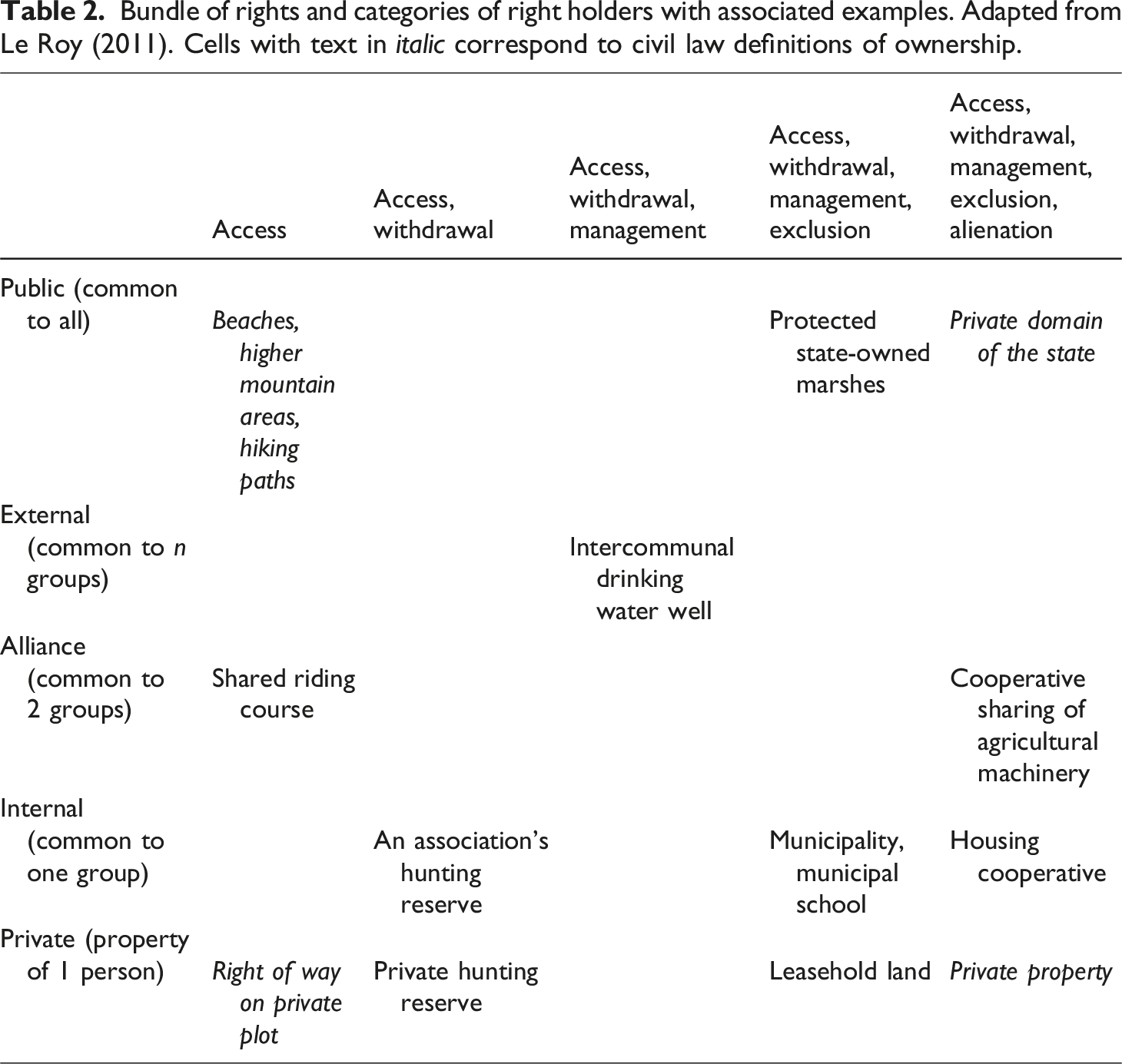
Bundle of rights and categories of right holders with associated examples. Adapted from Le Roy (2011). Cells with text in italic correspond to civil law definitions of ownership.
Exclusion of non-holders
Both law-and-economics and land master theory emphasize the importance of exclusion but differ in the comprehensiveness of its conceptualization. Law-and-economics defines exclusion as the “right to participate in the determination of who has right of access or withdrawal or management” (McGinnis, 2011). Some authors consider exclusion an uncompromising key attribute of ownership (Orsi, 2014), which entails that ‘all benefits and costs from use of a resource accrue to the owner’ (Hanley, Shogren, and White 2019, 14). Others insist on a clear definition of rights and duties between the involved parties to minimise mutual occlusion (Coase, 1960; Alchian and Demsetz, 1973; Webster, 2005).
Land master theory differentiates categories of users with specific more or less encompassing and exclusionary rights such as access, withdrawal, or management (Le Roy, 2011). However, keeping in mind that legal systems can be ‘folk systems’, land master theory accounts for two additional elements which are relevant when considering exclusionary aspects relating to land ownership. First, it takes (groups of) users into consideration, i.e., the plurality of individuals and/or groups that may possess a right relating to land and its use (e.g., family, clan, community, inhabitants). In contrast to the modern definition of ownership, which is essentially individualistic (Honoré, 1961), land master theory includes communitarian forms of ownership in the analysis. An additional theoretical embrace of land master theory is related to time-limited exclusionary rights.
Transferability of rights
New institutional economics emphasize the importance for the owner to be able to consume their asset, either directly or through exchange (Barzel, 1994). According to de Soto (2000) and in line with Coase (1959), such capacity of exchange is tightly linked to a formalised property system, where property is registered, standardized, legally protected, and fungible, i.e., capable of being divided, combined, or converted into a financial asset to suit any transaction. Consequently, owners become part of a greater network of ‘individually identifiable and accountable business agents’ who may sell or acquire property as they see fit (De Soto, 2000).
In the view of land master theory, multiple conceptions of transferability are possible, depending on the object of transfer, and on the actors involved in the transaction (Le Roy, 2011). The object of transfer may not be subsumed under the generic category of good or asset. Rather, the nature of the object considered – a construction, the grounded land, a tenure, a usufruct, an inheritance, etc. – and the type of owner – individual, community, etc. – determines the possibilities of transferability. For example, in certain societies, while a farm-tenure may be sold or leased, the right of allocating the farm-tenure may be solely returned to the local land community and may not be sold. The ability to transfer rights on specific objects is also tightly linked to whom the right may be transferred to. While the example of the farm-tenure may be sold or leased to another member of the community, it may not, for example, be transferred to non-members.
Applying rights, duties, and incidents
Securing the application of related rights and duties involves their protection by higher authorities and/or integration within broader legal systems (Coase, 1959). Their integration within legal systems operates through their inscription into written norms such as laws and contracts. These institutions are sanctioned by an authority or result from the execution of a legally defined procedure. While some authors consider such authority implicitly (Alchian and Demsetz, 1973; Barzel, 1994), others (Hodgson, 2013; Decker, 2023) define them as essential in the establishment and recognition of land ownership. In fact, authorities legitimise the content of rights by providing ‘legal mechanisms of adjudication and enforcement’ (Hodgson, 2015, 684), such as land surveys, a land register, courts, etc. These mechanisms allow contractual uncertainties to be overcome, as they are inherent to the contractual assignments of property rights (Deakin et al., 2017; Webster, 2005).
Land master theory postulates that the sole analysis of written norms and related adjudication mechanisms limits our ability to analyse and explain the (non-) enforcement of rights and their land-use consequences, as legal institutions are conceived of as bodies of autonomous, abstract and neutral norms that order behaviours within society (Le Roy, 2009). In fact, land master theory postulates that other non-written norms, such as modes of conduct and behaviour, customs, rituals, and traditions, play key roles in explaining land-use outcomes. While sanctions from written laws and contracts assert the autonomy of individuals and the anonymity of the parties, these other institutions may be more oral, rely on interpersonal relationships, and are thus embedded into social relations. In line with the Northian perspective, land master theory endogenizes these social and political rules into the analysis and lends greater attention to the bargaining power of actors (Ensminger, 1992).
Further, land master theory assumes that public authorities may legitimise rights attached to written norms and contracts, and that they are not the only ‘third party’ or ‘authority’, nor do they act as ‘neutral arbitrator’. Land master theory refers to a broader category of ‘third person’ that includes mediators, negotiators, counsellors, and other actors that are external to the formal legislative or judicial system. These actors, through social connections with the parties, or any other kind of recognition that the transacting parties accept, may also sanction the allocation of land uses and the distribution of its benefits, and thus contribute to the securing of rights. A contemporary example may be a farmer assisting a land assessor: the farmer’s expertise and professional background legitimises sanctions issued by a land assessor whose duty it is to define the exchange value of a land plot. According to land master theory, difficulties may emerge in settling conflicts between the legal and non-legal types of institutions if they do not both pursue the same overarching goal. We further develop this point in section 3.
Methods
Land surveys and cartography are technologies essential to the Western conception of land management (Bohannan, 1963). The creation of an imaginary grid allows for the geometric measurement of the entire land surface, and its division into a set of parcels. The measurement of a parcel in accordance with mathematical criteria (surface, distance, time, pedologic) allows for its valuation in terms of use and exchange, and its registration into a land register. It also generates empirically informed sets of data to model the potential effects of new land-uses. Further, the doctrine of methodological individualism employed in new institutional economics imparts another significant advantage: the ability to model actors’ behaviours and thus calculate expected costs and benefits from land-use decisions (e.g., Huber et al., 2018; Wossen and Berger, 2015). Hence, econometric analysis and game theoretical experiments may be used to conduct observations.
Among the representations of spaces used by land master theory, odology refers to the study of pathways (Le Roy, 2011, 54). Pathways include routes and paths taken by (groups of) users informed by practice, habits, traditions, etc. to reach a spatially defined goal. A traditional practice informing odology is nomadic pastoralism. An odological representation of space focusses on the metrically approximate but semiotically precise mapping of paths used to reach a specific point or area. Such mapping includes restricted and alternative routes, areas authorised for resource extraction (e.g., pastures, water access points), political borders generating specific constraints, as well as topographic elements, such as mountains and rivers. Odological representation is a communitarian-based perception of space and related resources in a more or less limited time frame. Data collection for odological analysis primarily relies on ethnographic fieldwork, participant observation, interviews, and document analysis.
Main epistemological differences between law-and-economics and land master theory
Table 1 subsumes the chosen points of comparison between the two theories detailed in the previous paragraphs. Law-and-economics analyses the impact of norms and institutions on the creation of societal welfare. The creation of welfare depends on the capacity of individuals to exchange rights on land and land-related resources. Exchange may be facilitated when ownership rights have clear liabilities over related duties and externalities, when they exclude non-owners, are fungible with other assets, and fully transferable to interested buyers. To secure the duties and liabilities of transacting parties, legal mechanisms involving the state define land survey and registry procedures, resolve conflicts, and enforce rights. In contrast, land master theory analyses the impacts of norms and institutions on the appropriation of land and resulting uses. Resulting land uses depend on the ability of appropriators to consider past, present, and future interests on land. According to land master theory, land stewardship may be secured when system-specific degrees of appropriation consider both the object of use and the (groups of) possible user(s), and when frictions between potentially competing mechanisms of adjudication and enforcement are minimized. To account for the plurality of uses and users, both legal and non-legal norms and related mechanisms of conflict resolution must be considered.
As mentioned at the beginning of the section, the theories’ conception of value has an overarching impact on its secondary assumptions (see Table 1). Law-and-economics puts forward the value of exchange, which, to be facilitated, requires a very clear definition of ownership. Such definition is challenged by any actor-specific form of appropriation, particularly if it is not formally registered. Consequently, the possibility to conceive of permeable (temporal) uses on land and integrate them into the analysis is limited. In contrast, land master theory focusses on the use value of land, which is defined by (groups of) rights holders and users with often diverging interests and power positions. Further, facilitating exchange through the lens of law-and-economics requires land to be transferred from one owner to another at low costs. On the contrary, the patrimonial conception of land held by land master theory requires consideration of the different right holders’ interests and beliefs. Finally, depending on the theory considered, mechanisms to settle disagreements fulfil different goals: while law-and-economics takes the stance of a single supreme and welfare-maximizing court decision, land master theory emphasizes the different venues, rules, resources etc. that involved actors may use to achieve their goals.
Explanatory gaps: Power relations and substitutability of uses
The subsection appraises two main gaps of the planning literature mobilising law-and-economics: power relations among a plurality of actors, and the question of substitutability of uses. By reducing the number of actors beyond observations in research practice, planning research using law-and-economics tends to dismiss the consideration of their interests and power positions in the planning process. Further, the assumption of the substitutability of uses leads to a focus on the price variable.
New institutional economic theory explicitly accounts for the role of norms, traditions and how they embed lower levels of norms, such as institutional environment, governance structures, and resource allocation (Williamson, 2000). However, depending on the level of analysis considered, ‘higher’ levels of norms are considered exogenous. Law-and-economics studies in the field of planning tend to elude the embedment of norms, in particular the political dimension of planning processes and the distribution of power among actors (Moulaert, 2005). As outlined in the previous section, the role of state as ‘third party’ tends to be neglected, despite its key role in regulating the ‘residual character of ownership’, such as the structure of secured transactions and bailments, and the protection of creditor interests in debt enforcement actions (see also Goode, 2004; Heinsohn and Steiger, 1996, 2013). In addition, it is unlikely that most planning processes can be subsumed by a bargaining process involving two parties. Rather, planning practice involves developers, multiple landowners, several authorities from various branches and levels of government, as well as environmental and social NGOs. These actors are all rightful stakeholders of planning processes with varying degrees of decisional and/or reputational power. They may intervene to defend their interests at various stages, as shown by urban governance and urban regime analysis (Pierre, 2014; Stone and Stoker, 2015).
A second point is on the concept of substitutability, which primarily belongs to micro-economic analysis – “agency” according to Williamson (2000). Studies applying law-and-economics to planning often assume a quantitative comparability in terms of welfare between two outcomes deemed substitutable, such as compensation for nuisance vs. cost internalisation, or human-made vs. nature-made capital (Daly, Jacobs, and Skolimowski, 1995; Wu, 2013). For example, Webster and Lai (2003) describe the key concepts of law-and-economics, using schematic examples such as hypothetical planning situations and land-use anecdotes to exemplify their arguments. Using the concepts and methods of the authors, one can measure ‘optimal’ outcomes of land-use change projects (e.g., financial gains, amount of housing units produced). However, legal, social, aesthetic, environmental or moral outcomes corollary to the planning situation are subsumed under the price variable. Therefore, considerations of past, current, or intended uses are not considered relevant if they do not impact price.
The plurality of actors involved and the intended uses are two aspects that play a marginal role in most planning publications referring to law-and-economics (Fischel, 2015; Gurran, Searle, and Phibbs, 2018; Lawrence W. C. Lai, Lorne, and Davies 2020; Lawrence Wai Chung Lai 1997, 199; Slaev and Collier, 2018; Wang and Baddeley, 2016; Webster and Wu, 2001). Ignoring these social and political struggles underlying most, if not all, planning processes, lead to ‘theories divorced from their planning context’ (Alexander, 2022). In such cases, theory tends to prescribe still valid remedies notwithstanding the socio-political context, rather than gaining insights from empirical observations. Our present argument may be fruitful to look beyond the micro-economic and bi-partite blinders and use available concepts and methods to inform empirical studies and their broader complexities (e.g., Clinch, O’Neill, and Russell, 2008; Shahab and Viallon, 2021; Slaev, 2022).
Figure 1 (below) provides a visual synthesis of the argument. While the vertical axis distinguishes a theoretical and an empirical level, the horizontal axis displays the explanatory range of law-and-economics and land master theory. As argued above, we contend that land master theory expands the range of explanation by granting an increased weight to power relations among a plurality of actors and the socio-political context of observed phenomena. Range of observed empirical phenomena explained by theory.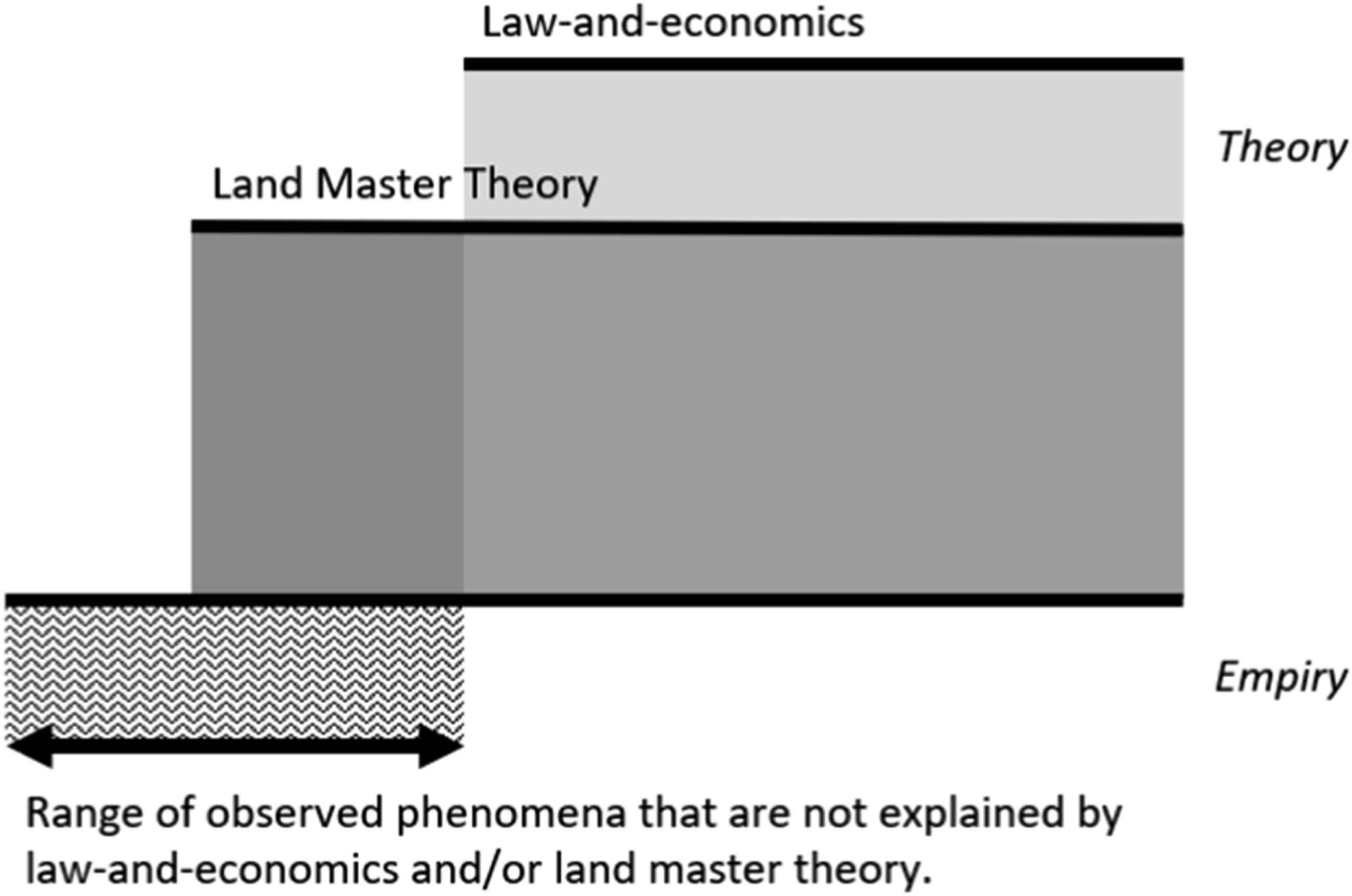
From land ownership to land stewardship
Having shed light on the differences between law-and-economics and land master theory in terms of ‘explanatory range’, we turn to their interactions with legal institutions. The main argument is that both theories hold the conceptual tools to consider individual and collective forms of ownership. However, civil law legislation, as defined in most western countries, provides limited recognition of collective forms of ownership. To demonstrate this, the current section first recalls the legal definition of western ownership and its main characteristics, i.e., absolute and individual. Despite the monological definition of ownership in civil and common law, the second part of this section exemplifies how, in certain legislations and in their socio-political implementation, some degree of legal pluralism persists or has re-emerged. Building upon these examples, the third part of the section presents how land master theory responds to current and conceptual and legal shortcomings by introducing the land master matrix. Building on the bundle of rights approach, the land master matrix distinguishes different types of rights associated with different types of right holders. In the fourth part of the section, informed by the conceptualisation of land ownership in land master theory, we suggest a transductive scenario of norms that may foster patrimonial conceptions of ownership within the existing framework of civil law.
A partial legal definition of ownership
In western societies, legal value in planning and real estate is framed by the modern conception of land ownership and its three underlying components (Herman, 1984): usus, fructus, and abusus. Whereas the usus essentially defines the use(s) of a property, including the definition of who may (not) use the thing, the fructus primarily reflects the potential income that can be gained from a property. The abusus may be defined as the sale, waste, or destruction of property. These three components compose the core definitions of ownership in western legal institutions and are subsumed under the term of dominium, which refers to the exclusive, absolute and perpetual character of ownership (Herman, 1981). In civil law, these characteristics reflect the owner’s ability to freely dispose of an object they see fit within the limits of the law, without time restriction (see article 641 in the Swiss Civil Code as an example 3 ). Ownership includes its constituent parts, such as buildings, water sources, and periodic produce and revenues. Ownership of land extends to the air and the ground to the extent determined by the owner’s legitimate interest Common law since the UK Law of Property Act of 1925 sets forth a comparable definition of ownership, the “estate in fee simple absolute in possession”, which defines a perpetual and immediate appropriation of land by an individual (Law and Martin, 2014).
Enlarging our conception of ownership based on the insights of land master theory requires an integration of common and patrimonial conceptions of appropriation within the analysis, as well as within planning and legal practice (Le Roy, 2011). According to Galey (2007), in light of case law and legislative provisions on administrative restrictions in English land ownership law, the concept of custody or superintendence may substitute that of ownership as the basis for interpreting positive law in this area. In fact, the notion of “stewardship” in English law may be reused to legally redevelop and practically recognize common and patrimonial forms of ownership. In civil law systems, stewardship is not a straightforward concept. Here, the principles of exclusion, alienability, and full individual ownership form a sole, uncompromising legal concept (Herman, 1984).
Transformative norms with patrimonial focus
The following show that the reality of land appropriation is often more complex than the definition of ownership civil law may recognize, as subsidiary legal systems persist, or are reinstated, and develop transformative norms (Savini, 2019). Among non-absolute forms of ownership, cantonal implementation laws of the Swiss Civil Code have several legal and practical examples to offer. Well known since the pioneering work of Elinor Ostrom (1990) in Törbel, several Swiss cantons still maintain and utilize pre-civil legal institutions, i.e., laws and regulations that pre-date the introduction of the respective cantonal federal civil codes. These institutions may be subsumed under the term of ‘commons’. They consist of codified rules regulating the collective use and management, as well as ownership, of land (Gerber et al., 2008; Viallon, 2021), housing (Balmer and Gerber, 2018), water (Schweizer, 2015), forests and pastures (Haller et al., 2021), or cynegetic resources (Nahrath et al., 2012). While most housing commons have emerged during the past century, the existence of natural resource commons can be traced back to the Middle Ages. Since their creation, these institutions have managed land and natural resources through collective governance structures and, in some cases, proven more effective in the sustainable management of a resource than state or private forms of governance and ownership (Gerber et al., 2008).
Another well-known example of a non-absolute form of ownership are the Dutch waterschappen (Havekes, 2008). Waterschappen are public governing bodies in charge of integrated water management. Defined as decentralized administration, waterschappen execute functional tasks in the field of water governance, such as management of water defense, water quantity and quality, as well as navigable waterways. Their governing boards consist of interested and elected representatives of landowners, residents, and businesses who collectively decide upon water-related issues within the boundary of the waterschappen. To finance their activities, waterschappen receive public subsidies and charge taxes on wastewater treatment. The constitutional anchorage of waterschappen and their financial autonomy represents their long-lasting position in Dutch water policy and their democratic organization.
In 2015 in France, the legislation introduced a legal equivalent to the Anglo-Saxon community land trust, called bail réel et solidaire (lit., real supportive lease; Le Rouzic (2015, 2021)). The French community land trust unbundles ownership on land from ownership on buildings. To do so, the landowner registers as a non-profit organization with the aim of managing land according to a set of legally defined criteria regarding land acquisition, household selection, land leasing, and contractual surveillance in cases of resale. To ‘circumvent’ the prohibition of undetermined leases written in French law, a lease signed by a home buyer renews tacitly on expiry or on the resale of the home. Another legal specificity concerns resale price, which is subject to a contractual clause framing home prices upon resale. Since the introduction of this clause, dozens of non-profit organizations aiming to establish such leases have emerged from community- and city-led initiatives.
Further, in Italy, the Rodotà Commission legal proceedings and the practical mobilization of people for the institution of common goods have led to the creation of goods “that are functional to the exercise of fundamental rights and to a free development of the human being” (Bailey and Mattei, 2013, 994). The focus here is not on the creation of a third type of ownership between public and private, but on the disentanglement of rights from the ownership bundle, e.g., land ownership and land use. Such disentanglement consists of the re-allocation of use rights on land to those users whose fundamental rights are at stake. In other words, the social and legal institutions of commons arise from their functional capacity to satisfy the fundamental rights of individuals, notwithstanding their public or private ownership (Marella, 2017).
In a recent article, Kassis (2023) identifies institutional mismatches between the traditional farmland management model and citizen demand for local food provision, showing innovative solutions developed by actors to overcome existing incongruities. In particular, the author suggests a misalignment between farmland allocation criteria, (which focuses on the economic viability of the farm), and surface-oriented agricultural subsidies on the one hand, and demand for local food provision on the other. The study shows how farmers, landowners, municipalities, and private citizens pool use rights (such as grazing paths, harvesting rights), control rights (e.g., definition of land leases, distribution of rent), and authoritative rights (acquisition) to secure farmers’ access to land for local food production. In other words, the involved actors define new and project-specific degrees of excludability on land rights among different stakeholders to achieve the desired land uses and their resulting outcomes. They unbundle the ownership rights contained in ‘private property’ and distribute them across different groups of right holders, with each holding specific rights.
The examples outlined above show appropriation norms and practices that go beyond the strict definition of ownership in civil law. These examples show how multiple actors may unbundle land ownership rights for specific uses. Although unremarkable in common law, such unbundling is highly uncommon in civil law. In fact, the prohibition of unbundling property rights, for example, in the form of a perpetual lease, was a core element underlying the introduction of the French Civil Code (Galey and Booth, 2007). Figure 2 sums up the argument. While the vertical axis distinguishes a theoretical, a legal and an empirical level, the horizontal axis displays the explanatory range of law-and-economics and land master theory, and the range of land use practices regulated (or not) by civil law. The figure shows that the two theories compared may inform future developments of civil law towards land stewardship. Range of empirical phenomena regulated by legality (civil law) and/or explained by theory.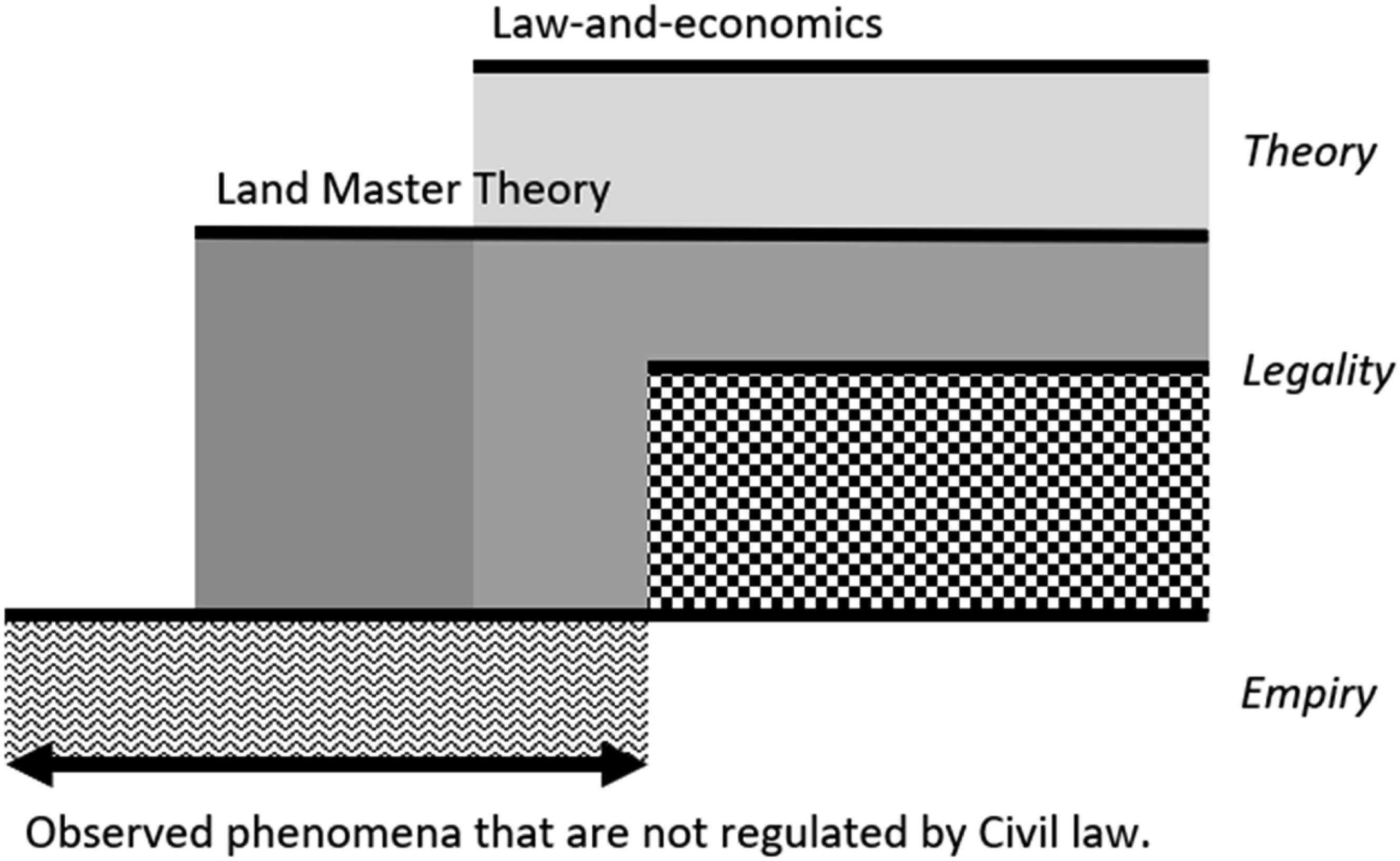
Introducing the land master matrix
Among the theoretical insights of new institutional economics (North, 1990; Ostrom, 1990) and land master theory is the consideration of alternative ‘folk systems’, i.e., definitions and practices of land ownership, as defined in social theory, that are not regulated by civil law. To account for as many land appropriation situations and actors as possible, land master theory defines a typology of appropriation rights that goes beyond the bundles of rights approach developed by Schlager and Ostrom (1992). Table 2 shows the typology of appropriation rights developed by Le Roy, known as ‘land master matrix’. This typology brings together the known types of rights on the resource (in column) from the bundle of rights with possible (group[s]) of right holders (in line). Each cell corresponds to a possible land appropriation scenario.
The cells with text in italic in the corner of the table correspond to the classic definitions of ownership in civil law. The precise composition of these four cells may slightly vary depending on a country’s legal system – as an example, we associate the cells with the corresponding articles from the Swiss Civil Code (SCC). However, the four cells and their respective ownership categories remain: the cell in the top left corner includes land resources for open access lands, such as beaches, lakes, or higher mountains (art. 664 SCC). The top right corner includes land resources which are part of the state’s private domain (art. 641 SCC); the bottom left corner includes easements (art. 730 SCC).
The cells with regular text correspond to situations of land appropriation that may be observed in practice, but which have no legal equivalent in civil legislation. For example, leasehold land is time-limited and does not unbundle the right to alienate land from the other rights. Therefore, this form of appropriation is placed into the second column from the right. Another example are intercommunal water wells, which often derive access, withdrawal, and management rights from aquifers, which may belong to the domain of the state. Further, hunting reserves may access and withdraw cynegetic resources from the state domain, or from private property. These examples and the others shown in the land master matrix demonstrate a large variety of land appropriation situations. However, these situations do not fit into the four legal categories of ownership as defined by civil law. Rather, they represent nuances of land appropriation elaborated in practice, located between the four definitions of civil law.
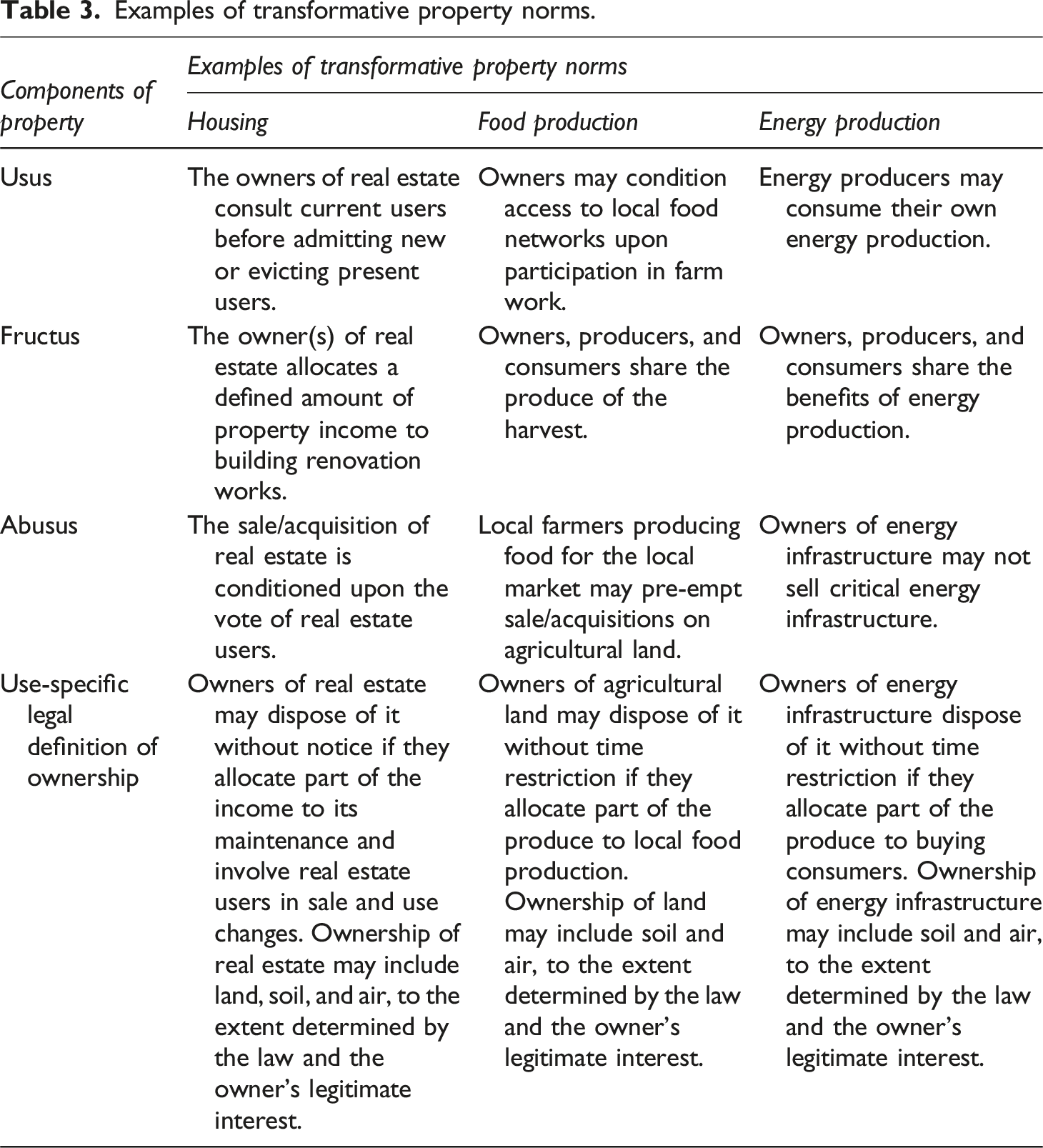
Filling the land ownership definition gap
Examples of transformative property norms.
Summary and Conclusion
Legal and economic values play a prominent role in the conceptualisation and measurement of planning processes and outcomes. While legal value shapes rights and obligations applying to specific areas and land plots, economic value results from the protection, sale, rental, or mortgage of legal value. Civil law systems framing these values have neglected a large variety of land use situations, contributed to increased wealth inequalities, and threatened planetary boundaries. Through a comparison of the epistemology of two theories putting forward the importance of ‘rights’ as a key aspect of planning, this paper aims to identify their respective strengths and weaknesses, and outline the ways they may contribute to modifying current conceptions of legal and economic values.
The comparison of law-and-economics with land master theory was structured around seven points drawn from the literature: main theoretical assumption, underlying conception of value, conceptions of ownership, exclusion, and transferability, application of rights, duties and incidents, and finally, the methods. While law-and-economics assumes that the allocation of rights to the most productive uses maximises welfare and refers to methodological individualism in modelling change, land master theory assumes that the conciliation of past, present, and future rights on land allow for its sustainable stewardship to be secured. It defines land ownership as a total social fact which embraces juridical, economic, religious, and aesthetic dimensions.
Both theories struggle to provide a clear definition of ownership. While law-and-economics tends to neglect its residual character, land master theory includes non-legal aspects in a definition that is specific to each 'folk system'. Both theories identify exclusion as a key aspect of ownership. While law-and-economics essentially acknowledges individual ownership, land master theory considers (groups of) owners. Regarding transferability, law-and-economics considers it a key attribute of ownership, while land master theory acknowledges different transfer options, depending on the rights and the object of the ownership considered (e.g., use of farmland, or management of housing rights). The comparison of the application of rights, duties, and incidents shows that law-and-economics refers to a third-party arbitrator to overcome contractual uncertainties, while land master theory considers non-written norms and the political load of every arbitrator. In terms of methods, the strict assumptions of law-and-economics allow for econometric analysis and game-theoretical experiments. Land master theory relies on ethnographic fieldwork, participant observation, and document analysis.
The comparison of the two theories reveals the chiasmic nature of their respective analytical strengths and gaps, i.e., the strengths of one theory correspond with the gap in the other. First, law-and-economics tends to analyse social and political aspects through the lens of overcoming contractual uncertainties. In the view of land master theory, allocation of property rights is an ongoing social negotiation process whose analysis requires careful attention to the power positions of all actors involved in the allocation process of property rights. The negotiation outcomes are susceptible to change, which leads to a reduction of the rights’ apparent clarity.
Second, law-and-economics adopts an individualistic standpoint on land ownership, which adheres to the modern western legal definition of ownership; land master theory additionally accounts for collective ownership through one or several groups of individuals. As the examples of transformative norms and practices in civil law systems show, existing forms of land appropriation go beyond the accepted definitions of law-and-economics and legal ownership in civil law. A prime argument of these examples is the consideration of collective forms of land appropriation. This point provides a case in alignment with Barry et al.’s critique on the tendency of planning theories to explain spatial injustice ‘through a set repertoire of narratives’ deemed universally applicable. In fact, if theory and legal institutions ignore non-individual forms of land appropriation, they may provide explanations and solutions divorced from any context, and unable to address practical problems (Alexander, 2022).
Third, the current theoretical conception of ownership in law-and-economics does not distinguish past, present, and intended uses of ownership; nor does the legal definition of ownership in the civil code. The examples of existing transformative norms provided show how subsidiary legal norms coexist with the current civil law definition of ownership and may contribute to a patrimonial shift of land ownership. However, a more decisive shift towards patrimony may require the conceptualization of destination-specific forms of land ownership, and their translation into corresponding legal norms, as shown in Table 3.
Fourth, through the parcellation of land and its geometric measurement, law-and-economics provides quantitative analyses and modelling possibilities, i.e., a range of methods that the application of land master theory precludes, as actors’ representations play a central explanatory role. These representations may vary across individuals and/or groups, and therefore hinder the aggregation of actor preferences required for quantitative comparison. Nonetheless, developing secondary assumptions and models on involved actors and their representations may enhance the variety of methodological tools applied to land master theory and increase possibilities of generalization. In addition, collecting empirical data in western urban environments would inform land master theory with an institutional environment of highly codified property rights and new land use situations.
If theory aims to reconnect to the variety of observed practices and formulate general principles that inform empirical research and practice (Forsyth, 2021), the consideration of all folk systems, including those (re-)developing within western legal institutions, is necessary (Decker, 2023). Including the transformative examples into an overarching theory would require the release of the ‘individual constraint’ and the ‘generic-definition-of-ownership constraint’, as they currently exist in specific theoretical and legal conceptions. Such a release would not imply a dismissal of existing bodies of theory. On the contrary, law-and-economics could provide useful tools for the comparison of a broadened variety of land appropriation and land use practices. Such a comparison may, for example, focus on coordination costs to secure exclusion, a central object of study within new institutional economics (North, 1986), or the provision of specific uses (e.g., Slaev, 2022).
Footnotes
Declaration of Conflicting Interests
The author(s) declared no potential conflicts of interest with respect to the research, authorship, and/or publication of this article.
Funding
The author(s) received no financial support for the research, authorship, and/or publication of this article.
