




Abstract
Attention to the multiple temporalities of planning has gained recent and further traction in the planning literature, and time is clearly implicated in how power and resources are combined in the governance of the built and natural environment. Time, and specifically the management of clock time, shapes planning practice. Moreover successive reform agendas in England have drawn heavily on temporal framings of ‘speed’, ‘efficiency’ and ‘delay’ as part of a neoliberal ‘timescaping’ deployed to promote growth. We discuss time theory in application to planning to contrast the opposing uchronic or perfect timescapes, balanced between neoliberal ideology and normative principles underpinning proper time for planning.
Introduction: Theorising the temporalities of planning practice
Whilst much has been written about the spatial / scalar dimensions of planning reform, few have focussed on the temporal dimensions of reform. Despite this political justification for successive rounds of planning reforms in England typically involve and feature alterations to the timings of planning when presenting policy changes as appropriate and necessary fixes. There is an implicit search involved for ideal(ised) timings for planning activity, where the use of temporal-infused language, often centring around ‘speed’, ‘efficiency’ and ‘delay’, form temporal markers for neoliberal reforms (Dobson and Parker, 2024). If ideal places are deemed utopian, an important part of such endpoints involve uchronias – perfect times. We critique the ‘silver bullet’ approach implied in such a political / ideological imaginary and policy formulations in arguing that there cannot be any abstract perfect scale, space or time for planning. Instead we juxtapose this concern with the timings of planning in reform agendas with a relational view of proper time derived from Helga Nowotny’s work and in light of explaining the relationship between time and practice by drawing on Pierre Bourdieu’s social theory and Barbara Adam’s work on time and capital(ism).
We characterise the temporal governance of planning in England as a series of political-rhetorical devices often aimed at stripping back the complexity of the planning process, and offering a reductionism that seems at odds with the number of issues involved and limitations faced in practice by planners and other stakeholders engaged with the system. The messy business of contending with complexity and uncertainty becomes a source of frustration for some and the narrative of a faster, more efficient planning system as the solution becomes appealing when creating political and policy narratives for reform. The problematisation of planning time has become a recurrent feature and is portrayed as a barrier to neoliberal growth objectives. Within such discourses the concept of uchronia serves a particular purpose as an heuristic device to highlight the disconnect from the reality that planning requires time, particularly if it is to be done well, and that disparate actors will perceive their own different proper times for planning. Nowotny (1994, p.139) highlights the appeal of promises about better futures, ‘Uchronias, like utopias before them, have a central social function to fulfil: they contain proposed solutions to particular unsolved problems in society’. Whilst we may think ourselves beyond such naïve ideas and idealisations, appeals to time form an important part of political agendas and their justifications. Moreover, control over what or whose time is considered legitimate reflect power relations within planning (timescapes) (cf. Adam, 2004).
Central to the debates over the speed and efficiency of planning is how the ‘performance’ of planning is measured by governments in accordance with whether an application is determined within statutory deadlines for decision-making. If the majority of local authority decisions are made within this time frame it is recorded in national statistics as good planning performance, if not, it is viewed as ‘delay’ and therefore poor / under performance that falls below the set threshold and carries the risk of sanctions (i.e. ‘designation' or special measures). We see the measurement of planning performance in reference only to quantitative targets geared to speed as a ‘straw man’ argument that sets up an intentionally misrepresented proposition that planning is a burden, without considering the possible (legitimate) reasons for time taken, the growing complexities of practice or qualitative measures related to outcomes. The (ideological) basis for this (partial) view rests on the very conflation of speed and growth (i.e., the belief that deciding / doing things quickly is the best way to support development). In contrast to the neoliberal speed-growth paradigm (cf. Rydin, 2013), we argue that good planning requires a recognition of the proper time(s) of multiple actors. We see the use of the idea of proper time as a counter-point to neoliberal reform narratives (such as ‘project speed’) which allows time-space for considering and embedding normative goals of planning, not least to facilitate inclusion and deliberation. Instead what we seem to have is a temporal ‘muddling through’ that neither suits the interests of planners, politicians, developers or the public well. In such an environment, few seem to be amenable to the existing timings of planning process and practice, leaving the profession susceptible to sustained critique and calls for further reform.
Political leaders need to project a vision for future to be seen as having a credible plan for governing and asserting legitimacy (cf. Lazar, 2019). Under neoliberal-informed governments such futures are oriented towards increasing economic efficiency and growth. These political narratives present an unsatisfactory present in contrast with a desired or idealised future state – where control over the defined problems and solutions in the present is de facto control over the future. We see such narratives being consistently mobilised to problematise the timings of planning and to justify reforms, certainly in England and most likely elsewhere. We contend that dominant political imperatives have adopted a range of chrono-technologies to (re)shape the practices of planning, and as such the growing interest in the temporalities of planning should consider power enacted through time.
In addressing this question, we draw on a set of theorist’s ideas, notably Pierre Bourdieu’s (1977; 1998; 2000) theorisation of practice and the interrelationships with time found in his work. We then reflect on Barbara Adam’s work (1995, 2004, 2008) which has drawn attention to the control and colonisation of time in capitalist societies and the concept ‘timescapes’. We draw on these insights from social theory to consider ‘proper time’ as presented in Helga Nowotny’s work (Nowotny, 1994). In order to deepen this aspect of the study of temporal governance in planning, we discuss how attempts to shape the planning timescape result in the creation of ‘political time’ that serves to preference some actors and goals over others. This perspective requires recognition of both the multiple temporalities of planning and the possibilities for ‘good’ planning that are often squeezed to suit competing visions for achieving an ideal planning time through reform.
The contribution of the paper is firstly to review afresh the significance of social theories of time for planning theory to help assess and understand how time orders planning practice and, as Bastian argues, to help address the relative lack of attention paid to ‘the role of time in attaining political and /or social goals’ (Bastian, 2014, p.154). The second is to highlight where ‘timescaping’ (Adam, 2008) has been deployed in planning, using the English planning system as an illustrative case in point. Lastly, to indicate the implications of the neoliberalisation of the timescape for planning and how this may be challenged through the assertion of ‘proper’ timings. The import for planning theory, research and practice across these points are discussed at the end of the paper.
A central argument presented here is that successive reforms of planning systems impact upon process and on outcomes which favour some actors over others; they produce particular (politicised and idealised) futures. Often a combination of rhetoric and changes to planning made with reference to time measures feature overtly in reform agendas. We argue that how time is figured and deployed in planning, and for those affected by planning, should form an important concern for planning scholars and practitioners. Timescaping performs who and how planning is practised, as well as what futures are considered and brought into being.
The focus on the English situation acts as a ‘canary in the mine’, emphasising serial attempts to debase good planning, with chrono-strategy used as an important pillar of that project, and to prompt curiosity about the forms, degrees and impacts of chrono- technologies worldwide. We conclude by reflecting on the idea of ‘proper times’ or eigenzeit (Nowotny, 1994), where relationality and flexibility is stressed and defined by difference, rather than fixity and standardisation. This view has marked implications for how planning process is organised and towards particular ends.
On planning and time
Planning practice and associated plan and decision-making processes reflect multiple and shifting combinations of issues, resources, skills and knowledges which are combined, calculated and applied to generate options for the future. Whether explicitly or not, such arrangements reflect and shape power and knowledge distribution and its deployment in planning. To explain and map approaches to planning, various applications of power theory have been applied using numerous theoretical lens to unmask the operation of power. For example, some have deployed assemblage theory (cf. Simandan, 2018) to unpack the relations between actors, others have considered the institutional repertoires that may enable temporal calibration or ‘modulation’ (such as the slowing-down or speeding-up of process cf. Stirling, 2008; Parker and Street, 2015), as well as those which have applied new institutionalist theory (e.g. Lowndes, 2005; Salet, 2018) to help explain change and how actors gather power and move toward goal realisation in time. Notably, time has not taken a prominent place in such assessments of power and practice in planning but, in contradistinction, time does feature prominently in governmental discourses about planning and specifically when formulating justifications for proposed reform agendas. It appears therefore as somewhat of a lacuna that may be explained by dominant ontological and epistemological orientations and emphases of planning theory (i.e. what one is looking for, and how one is looking at planning).
The more specific consideration here is how greater attention to time and temporal strategies can aid understanding of planning and attempts to shape planning practice. We firstly draw attention to the idea of ‘political time’ (Howlett and Goetz, 2014; Strassheim, 2016) as a means to open up the discussion on the political value / capital of time for shaping the future. This is followed by a review from within the planning literature, and more expansively a distillation of key theoretical contributions drawn largely from the work of Bourdieu, Adam and Nowotny, in relation to how time shapes practice and acts as an important means of exerting control (see also Dobson and Parker, 2024; Raco et al., 2018). This is followed by a review of the English planning system to demonstrate how timescaping is present in practice through chrono-technologies that reflect the use of power through time.
Critical to our exploration of reform agendas and the temporalities of planning is the idea of ‘political time’. Howlett and Goetz (2014, p.477) summarise the concept of ‘political time’ as the specific historical-temporal location in which a phenomenon, such as a policy, exists. This highlights the significance of effects such as policy legacies, sequencing and trajectories on current political actors. Political time may be broadly understood as an institution, a resource and a constraint on actors in decision-making. Linz (1998, p.34) argued that ‘time and timing…are the essence of the democratic process’, and Goetz and Meyer-Sahling (2009) identify a politics and a policy dimension of political time. The former is concerned with rules relating to timing, sequencing, speed and duration in decision-making. The latter, the policy dimension, is largely about temporal policy features, such as the distribution of costs and benefits of major policies in time. Part of a political strategy by government administrations involves the deployment of time as chrono-technology. Political time therefore refers to the diverse range of rules, norms, conventions and understandings that serve as a resource and constraint for political institutions and actors. Many aspects of political and policy-making behaviour, such as the timing of decision-making and the processes involved in making public policy (Howlett and Goetz, 2014), reflect exercises of political time.
Strassheim (2016) discusses how a main mode of political action is temporal manipulation, and how the introduction of urgency and ‘burning flags’ are used to progress debates and move reforms in a desired direction. Such work brings into focus how institutions ‘define repertoires of more or less acceptable courses of action that will leave considerable scope for the strategic and tactical choices of purposeful actors’ (Scharpf, 1997, p.42). Strassheim (2016) also argues that the analysis of political time reveals how both policy by time and in time influence ‘spaces of experience’, or what we consider relevant, and our ‘horizons of expectation’, i.e. what we think is possible or desirable. This is significant as the exercise of power over time can delimit the scope and ambition of planning by performing actors in practice.
Much attention has been paid in the planning literature to power and relations between actors, but specifically the emphasis on time has received much less investigation. Given the relationship of time to power, the Foucauldian treatment of power therefore lends itself here, and when one compares Bourdieu’s framework of ideas with governmentality and technologies of control through time, and other means of disciplining, they are clearly congruent. Accepted techniques of disciplining society, and workers, to maximise ‘efficiency’ include using time more intensely. This reflects one aspect of self-regulation and the imagination of what is acceptable, or the ‘normal’ use of time for particular things, as part of doxic relations (Loyal, 2017). Relevant here is the disciplining of behaviour (qua practice) and the use of power and time to govern conduct. Time becomes a means to help achieve particular outcomes in a field, such as collaboration, efficiency, de-risking and achievement of set objectives. Its orchestration forms an element of technologies of performance where behaviour can be measured and governed ‘from above’ (Rose and Miller, 1992), as well as the inculcation of self-disciplining in which clock time plays an important part.
Some calls to address this deficit in the study of planning have been aired recently (e.g., Lennon and Tubridy, 2022; Laurian and Inch, 2019; Raco et al, 2018; Madanipour, 2017; Abram, 2014), who in various ways have highlighted the role and importance of time in planning. Recently there have been calls that research ‘...need(s) to explicitly explore what it means to collectively and inclusively muddle through the various temporalities involved in plan making and urban change’ (Laurian and Inch, 2019: p.278). Indeed, the theorisation of time and its use appears particularly significant in planning, not least as Abram (2014, p.129) notes, because ‘planning is, by definition, a temporal field, one that is concerned with transformation through time… close attention to planning practices indicates that such temporalities are doubted, contested, and mediated’. Lennon and Tubridy (2022, p.10) argue that more heed be paid to time in planning and highlight that 'time operates as a mechanic process that organises a particular constellation of relations between objects, ideas, people and actions to mould realities grounded in ontological and epistemological standpoints’. This view highlights an important relationship between planning and the role of time as formative and influential on system design, scope and of anticipations of the future.
Raco et al. (2018) see how ‘the temporalities of planning lie at the heart of broader debates over contemporary forms of urban governance, democratic engagement and policy outcomes…temporalities are not just about time but about the socially and politically situated experiences of time embedded in specific power relations and conjunctions…’ (Raco et al., 2018, p.1190-91). Whilst Laurian and Inch (2019, p.278) argue that powerful interests can be challenged using time as a lens: …“slow planning” can be a selective tactic for accommodating multiple temporalities and concerns, tempering the negative impacts of urban development processes dominated by financial rates of returns or the preferred pacing of dominant actors…Selective deceleration tactics could aim to set aside time to stimulate thinking about the now and the future by making time slow down or stand still.
The pace of planning is particularly salient here, as Madanipour (2017, p.6) highlights, ‘processes of reification, quantification and commodification have paved the way for an instrumental treatment of temporality, turning it increasingly into the subject of market pressures for speed, productivity and profit maximisation’. Indeed Raco et al. (2018) call attention to development as a key manifestation where manipulation of time is present, given that ‘time is a resource within the development process and that like other resources it represents a source of both power and control’ (2018, p.1190). In a similar vein, Laurian and Inch (2019, p.269) also emphasise that ‘[time] is a scarce resource and an unescapable constraint’ and that ‘knowledge of time is power’ which can be used to control agendas or to promote interests. There is clear linkage to arguments that Adam has made about clock time and the control of time, and in Bourdieu’s work concerning time and practice, to which we now turn.
Beyond explicit discussion of political time, a vast amount has been written about time across the social sciences. Whilst much of this interdisciplinary literature remains untapped and potentially fruitful for planning theory and practice, we focus here specifically on Bourdieu’s work on practice and time and Adam’s theorisations of time and control. This work is useful to first highlight time and practice entanglements and the idea of timescapes, before turning to the idea of uchronia and how to align or reconcile the ‘proper times’ (Nowotny, 1994) of different interests in planning.
In Bourdieu’s conceptualisation of time and practice, he argues that ‘time derives its efficacy from the state of the structure of relations within which it comes into play’ (Bourdieu, 1977, p.143); and where strategies of giving or with-holding, as well as compartmentalising time, with associated limits and deadlines, reflect the use of power. Indeed, Bourdieu goes further in asserting that ‘practice [is] temporalization’ (Bourdieu, 2000, p.206), meaning that practice organises or ‘makes’ time. Bourdieu perceives a structuring relationship between time and practice where practice makes time and recursively time makes practice. This places the consideration of time as a critical factor, given that time is both constituted in practice and that practice does not take place in time but that (as above) practices make time. This critical point is deliberately repeated here to bring into view the question of how time is used as a tool in exerting power (e.g., political time and associated reform agendas) and how this in turn performs practice.
Shin (2013) has argued that Bourdieu’s work on practice and time can ‘help planners strategically participate in urban planning and politics…By identifying the stakeholders who have alternative logics of practice (habitus) and interests (capitals) across diverse social sectors’ (Shin, 2013, p.268). The scrutiny of how practices are organised to deliver on particular priorities and accepted aims can be revealing when attention is paid to how time is variously understood, squeezed, sequenced, paced and suspended. In Bourdieu’s work there are at least four elements of temporal experience that recognisably speak to time and practice, namely; time consciousness, field rhythm, schedules, and lastly time squeezes.
Firstly, through temporal strategies and practices, the temporal structure of prevailing consciousness acts to shape how past, present and future possibilities can be reckoned. Atkinson (2019) identifies a clear linkage to planning in highlighting time consciousness, where attitudes towards the future are something to be colonised and which is ‘...characteristic of the spirit of capitalism: the projection or forecasting of possibilities, the actual positing of the future [is]... something to be considered and mastered' (ibid., 2019, p.953). In this way plans create the future or at least orient future decisions and provide some certainty, while delay or lack of programming of the future is typically deemed unsatisfactory.
The second aspect of Bourdieu’s theory of practice and relation to time is ‘field rhythm’, which involves the question of timings in and of fields, or their flow and tempo; a consideration which is conditioned by the relative position of a group or individual. The way that the field is subject to change and consolidation creates tension between new and pre-existing actors, and new stipulations, or guidance from beyond the field is absorbed or resisted. A further aspect is that of established markers in time and their role in shaping change e.g., meeting cycles, elections and associated speeding-up and slowing-down of activity. This draws attention to how such devices may be used to frustrate change or be altered to accommodate or enable action.
Linked to the above, there is the question of schedules and their use and imposition. This aspect of time management and impact on practice is typified by timings imposed from beyond the practice field - and the grandest example is clock time itself. More specifically this idea revolves around how interventions are accepted and act to alter the temporal organisation of a field; for example, where new schedules, deadlines or other stipulations apply. All of the above factors impact on established actors (i.e., professional planners) and those who are not established in the planning field. This has clear import considering the array of actors and interests in planning, their relative position in the field and the ability to shape policy and inform decisions.
The fourth aspect of Bourdieu’s work relevant here, links to the question of how time is ‘squeezed’, alternatively labelled ‘time binds’. This aspect of time and its use brings into question how the quantum of tasks and limits placed on a timeframe alter behaviour and practice. This idea has been identified by others, notably Southerton (2003) and Hochschild (2005) and it is discernible in Barbara Adam’s work. Time squeezes or binds have received significant scrutiny, not least because of work intensification and technological change, which have tended to encourage such squeezes. Southerton (2003) explains that experiences of time squeeze raise consciousness of a need to manage time, which can easily fall foul of the contexts in which people are operating, and affects whether or not practices are able to be performed in rigid temporal routines. In this context people develop temporal strategies to cope with the various calls on their time. Bourdieu’s view that practice makes time becomes clearer here, in that how people operate speeds-up, slows down or folds time, such that the culture in a field will encourage coping strategies or tactics as outlined by Hochschild (2005) i.e. by absorbing, delegating, enduring, deferring or resisting attempts to control their actions in time.
Barbara Adam’s work delves more deeply into how time has been organised and deployed to effect control, with such squeezes or ‘time binds’ forming only one element of the control of time. Adam (2008) deploys the term ‘timescape’ to embrace a number of constituent factors that form the assembly of time-related measures that influence individual or institutional behaviour (or practice). These include time-frames, temporality, timing, tempo, duration, sequence and temporal modalities (i.e., past, present, future). A timescape includes both time-related rules and temporal regularities, and the effect is to variously reify and sustain economic, political, bureaucratic and social practices with the purposes of control over others. This shows how time and its use is linked to power, and is fundamental in helping to explain why time is managed, manipulated, calculated and ‘transacted’. We see the need to unpack the construction of (planning) ‘timescapes’ where ‘timeframes and timing, temporality and tempo, time point, duration and succession have all become subject to control’ (Adam, 2004, p.145).
A discernible or accepted timescape may be identifiable in a number of related professions (e.g., law, medicine, etc.), yet sustained governmental attention to the timings of planning and development have been particularly marked. We view the planning ‘timescape’ as the locally-situated and spatial-temporal context that frames the relations between actors; and this is reconciled with Hochschild’s scheme of temporal strategies, as driven by different interests and their power, knowledge and resources within a planning system. The planning timescape and the multiple temporalities involved in planning bring into view the potential tensions and conflict between economic (market) time, political (ideological) time, democratic (deliberative) time and procedural (bureaucratic) time that may be more or less aligned to different actors and interests. This can be seen in how time elements, actors and resources are aligned in the planning timescape to shape process and outcomes.
In exploring the appropriation of time, Adam isolated five elements; which she termed the ‘5C’s’ of industrial time, these are: time creation (clock-time), commodification of time, time compression, the colonisation of time and time control; where ‘the quest for control is to a large extent about obtaining dominion over time for economic gain and social advantage’ (Adam, 2004, p.123-4). This range of tools and techniques that involve all five C’s mean that together the device of ‘clock time is used to regulate and rationalise the pace and seasonality of organisms and beings, social activities and institutions’ (Adam, 2004, p.145) to effect significant (rather than total) control. Thus, linking back to Bourdieu’s work, the conditions and timescape of participants in the field are shaped critically by behaviour. The way that actors endorse or challenge political time hold clear implications for social practice generally and planning practices specifically.
When considering time in any given context, as we explore below, the effect on time and how perceptions of time influence behaviour in time are brought into view (Friedman, 1990; Adam, 1995). Southerton and Tomlinson (2005) indicate how a move beyond one-dimensional interpretations of time, and feelings of lack of time (or ‘time squeeze’), can help account for the relationship between social practices and their conduct within the temporalities of daily and professional life. This brings us to a point where the timescape, discussed here to assist in assessing planning practice, will be experienced differently and responded to variously by actors. How each actor chooses where time can facilitate their interests, and what approach they take is reflected in the temporal strategy adopted, and their idea of proper timing. As we argue below, how governments attempt to orient the timescape reflects ambitions to oversee timings for planning to suit the agenda proposed. This highlights how political time is influenced by ideational power (Carstensen and Schmidt, 2016; Parker et al., 2022). The search for a perfect planning fix involves a search for a timescape that delivers against the asserted measures of success. Moreover, this maps onto the ideational parameters of the promoter and involves a particular temporal choreography (Felt, 2016) of technologies, resources and institutional design.
One way to challenge political time that seeks to colonise the future in that way is to reflect and assert ‘proper time’ or eigenzeit (Nowotny, 1994) and the closely related idea of kairos as ‘right time and due measure’ (Czarniawska, 2004). For Nowotny this is crafted for actors and context: ‘proper time is made possible only through the time of others. Only when a common time is created as a frame of reference, which neither belongs completely to the one or completely to the other…can the constraint of time at least be loosened, even if it cannot be totally removed…this presupposes a process of constant development, of negotiation and argument by means of their continued temporal strategies…the interval of time is the basic element for structuring interhuman relations’ (Nowotny, 1994, p.144-5).
Moreover, in recognising the multiple temporalities of planning and proper times of actors, Nowotny asserts that ‘time represents a central dimension of power which manifests itself in the systems of time that dictate priorities and speeds, beginning and end, content and form of the activities to be performed in time’ (1994, p.105). A relational view of time, as highlighted by Madanipour (2017, p.171), chimes with such readings of time and power and recognises the linkage to social institutions that embed behaviours and practices: If time and space are envisaged as relationships, they become subject to the stabilizing effects of social institutions. Temporality is managed through the development of social institutions, the recurrent beliefs and modes of conduct that would generate continuity and predictability, helping to manage change and control events within a stable social framework.
This social and relational perspective emphasises the multiple times of different actors and their practices. As we discuss below, there will be attempts made to impose a particular temporal governance regime or political time driven by particular agendas and priorities. This will have an (unknown) effect on the very practice of planning. The inculcation of priorities via chrono-technologies and timescaping highlights tensions across actors, processes, tasks and resources. This is typically observable where time apportionment clashes with previously accepted bounds of normalised practice, which can ‘squeeze’ action and impinge on others’ ‘proper time’ (what we refer to later as producing exclusionary potential of time in planning).
Neoliberal reforms to planning involve attempts to (re)shape time and orient the planning timescapes to align with a political agenda (such as ‘project speed’ discussed below), and such associated time squeezes and justifications for ‘reducing delay’ become proxies for asserting control over the practices of planning. In practice, however, this will be a political compromise, and we can see that attempts to reorientate the planning field are experimental and incomplete when assessed against abstract ideological scenarios.
Any existing timescape arrangement, including other resources and delimitations, is the product of inter alia negotiation and has been shaped by the contours of power, feedback / challenge, the results of strategisation and embedded institutions. As we discuss, in order to stabilise and progress political time, a set of frequently adjusted technologies (of performance) are required to variously set deadlines, provide temporal cues and coordinate processes. Taken together the wider institutional frame, along with specific technologies and individual temporal strategies, shape the planning timescape and may be linked to factors of time consciousness, markers, schedules and squeezes.
Neoliberalisation and the timescaping of English planning
In order to indicate the type and degree of timescaping involved in planning systems, elements of the English planning system (as at 2023) are used as to indicate and explore the temporal governance of planning. The array of temporal features presented here reflect only part of the way that time is deployed in planning, and indeed multiple ‘waves’ of reform of the English system have been observed in recent decades (Lord and Tewdwr-Jones, 2014; 2018). Alongside the more pronounced clear shifts in planning policy and structures, there have been almost continual minor iterations, adjustments and other tweaks that tend to be left relatively unremarked in the academic literature, with alterations to wording of policy, or process specifications and other apparently mundane revisions applied (see also, UK Parliament, 2023. Yet, as Rose et al. (2006, p.101) argue, attention should be drawn to: ‘the role of the grey sciences, the minor professions, the accountants and insurers, the managers and psychologists, in the mundane business of governing everyday economic and social life, in the shaping of governable domains and governable persons, in the new forms of power, authority, and subjectivity being formed within these mundane practices’.
Some such changes are not neutral and have bearing on the temporalities of planning, but many remain obscure. Authors such as Thousand et al. (2006) noted that varying perceptions of time shape the trajectory of relationships and influence of (planning) practice, while Davoudi and Madanipour (2013) have highlighted how technologies of performance play a significant role in governing in terms of organising and aligning behaviours / practice to particular goals. Calls to focus on practice have been growing (cf. Hoch, 2011), and in the English context (Clifford, 2016) an agenda to discipline theory with practice and vice versa has grown.
Clifford and Tewdwr-Jones (2013), in examining practice and considering the impacts of change, identified new requirements and ways of working set in the context of forms of neo-liberal institutionalism. The temporal problematisation of planning as slow, burdensome and unresponsive in England forms the basis of many policy narratives that involve state (de)regulation internationally, and in accompanying tropes which prioritise speed and growth. In the context of late capitalism and neoliberalism, this is typified by discontent with planning as a ‘barrier’ or which adds ‘delay’ to economic growth. Recent work on planning and time in a neoliberal context has recognised the now wearisome refrain that planning takes ‘too long’ and conversely has presented ‘the argument that social acceleration undermines thoughtful democratic governance’ and the need for renewed calls to ‘explore the possibilities and consequences of taking the time to plan’ (Laurian and Inch, 2019, p.278).
Without expounding at length on the coverage of neoliberalisation and neoliberal planning (see, for example, Zanotto, 2020; Davoudi, 2017; Sager, 2011; Purcell, 2009), we necessarily explain below why and how time and political time, as deployed in the English planning system, carries predominant characteristics of neoliberal thinking. Firstly there is a distinction to draw between neoliberalism as an economic idea or ideal, in contrast to neoliberalisation as a process or set of changes and that ‘neoliberalization acts on and through…institutional landscapes’ (Peck, 2013, p.146) and is not static. It is also revealed, across the expanse of outputs discussing neoliberalisation and governance, that not only is it a disparate or variegated phenomenon, but a composite set of logics crowned by that of growth which act to justify shaping the institutional environment towards one that is ‘business friendly’ and oriented to markets, deregulation and competition. In this mix, time is already recognised as one element implicated in the project to shape such neoliberalised environments: Conceptual understandings of time and temporality can be employed to critique the political economy of global capitalism. Conversely, the insights of critical political economy reveal how dominant regimes of time and temporality are materially constructed (Hope, 2009, p.63).
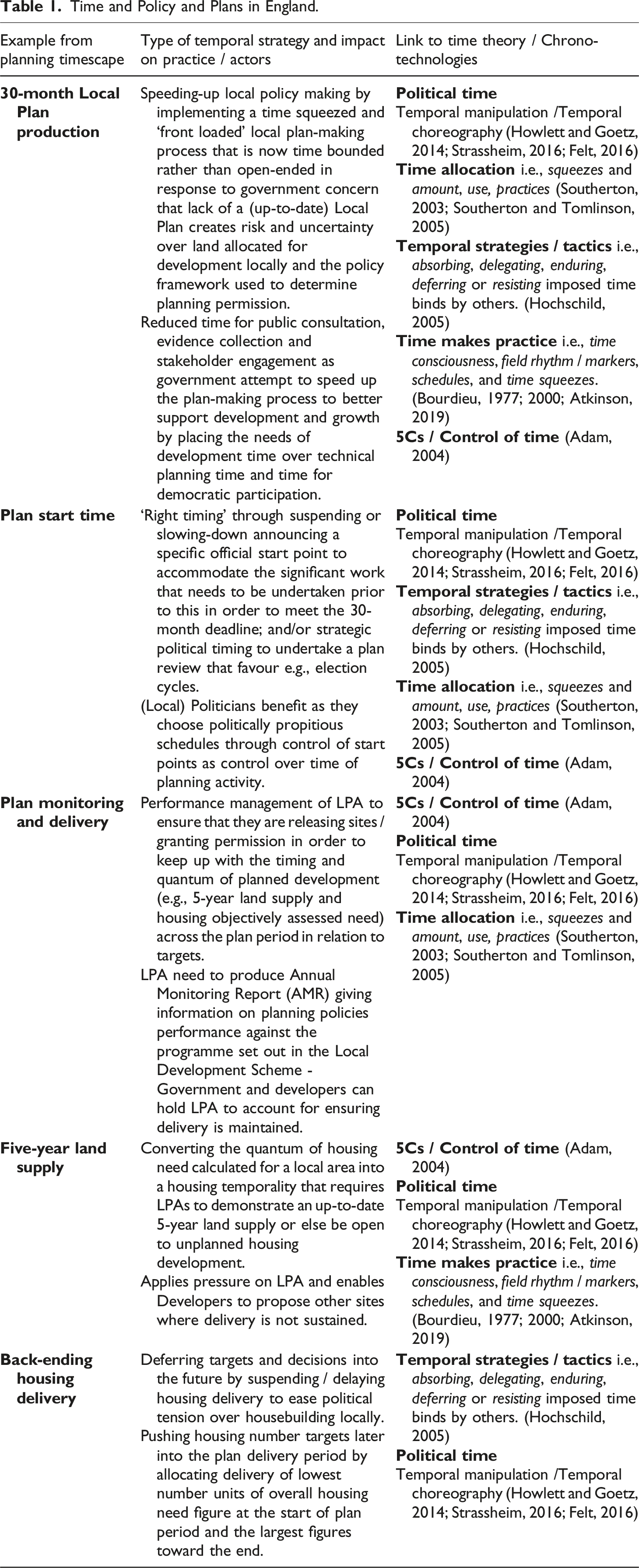
Time and Policy and Plans in England.
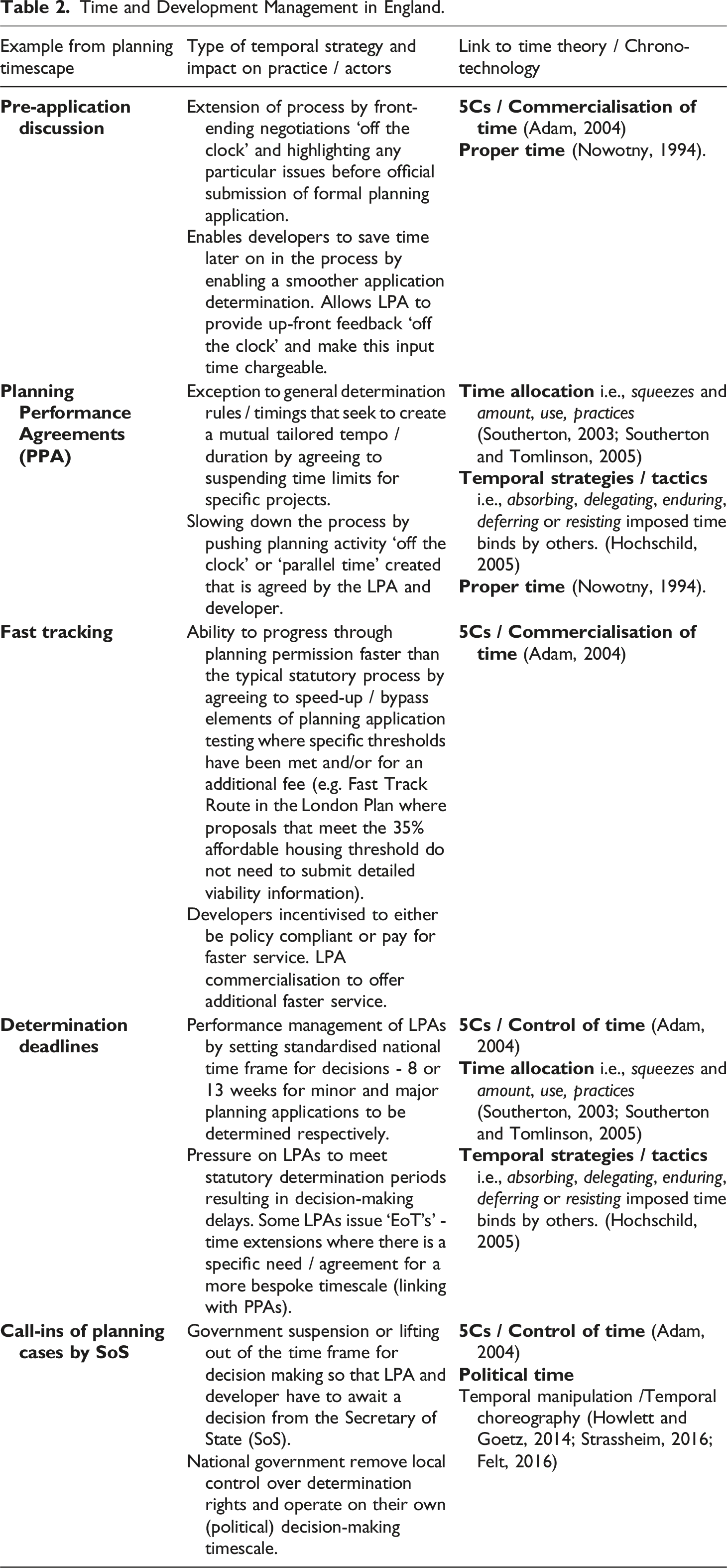
Time and Development Management in England.
Successive UK government administrations have taken the view that planning needs to be speeded-up and simplified, and tropes citing delay and slowness have acted as a legitimation tool for a political-economic agenda which we label ‘project speed’ (to borrow from a term used by recent UK government administrations and see Dobson and Parker, 2024). This focus on time (and growth) has been carried forward in numerous policy iterations, actions and amendments and has embraced a set of measures and exhortations that have been propelling planning activity to happen more quickly.
The aspiration to position planning as problematic and justify reform of planning is exemplified in the following excerpts. Firstly, the ‘project speed’ agenda was reinforced with temporal cues by the then UK Prime Minister Boris Johnson, who argued for a planning system that ‘...is simpler, clearer and quicker to navigate, delivering results in weeks and months rather than years and decades’ (Ministry of Housing, Communities and Local Government [MHCLG], 2020, p.6). A few weeks earlier Johnson had proposed that: ‘Time is money and the newt-counting delays in our system are a massive drag on the prosperity of this country. And so we will build better, build greener and we will also build faster. That is why the chancellor and I have set up Project Speed to scythe through red tape and get things done’. (Boris Johnson, 30th June 2020, no pagination).
The political use of speed, delay and time, as linked devices to legitimise reform, became ever more apparent during the launch and publication of the 2020 planning reform proposals for England. Robert Jenrick, the then Secretary of State at the Ministry for Housing Communities and Local Government (MHCLG) and person responsible for planning, claimed he wanted to make planning ‘more efficient, effective and equitable’ and bring about ‘a significantly simpler, faster and more predictable system’ (MHCLG, 2020, p.8). In 2011 Eric Pickles when Secretary of State, had argued that: ‘planning delays cost the economy £3bn a year…In a global economy, where skills and capital are more mobile than ever, our planning system is a deterrent to international investment, and a barrier to the expansion of home-grown enterprise. When planning acts as a brake on growth, and on the much needed new jobs and new businesses, reform is imperative’ (Eric Pickles, 2011, no pagination).
Moving on from political rhetoric that has used time to justify reforms, we indicate in Table 1 below a set of timescaping examples associated with plan-making and policy formulation in England (see also MHCLG, 2015 for an overview).
It is notable that these local policy-making examples from the planning timescape are predominately focused on housing and land release as a key use of political time being deployed to support development over other substantive goals of plan-making, as well as the strategies used by actors to resist or subvert attempts to control the timings of their practice.
The way that decision-making in planning is organised and ‘kept to schedule’ is also apparent in attempts to control outcomes in the system, as Table 2 depicts and summarises below. This indicates how ‘clock time’ dominates the shaping development management practice in England as a means to maintain control over planning ‘performance’.
These instances of decision-making across the planning timescape highlight that time allocation and temporal strategies are deployed to create alternative slower or faster planning determination timings, and which are linked to the commercialisation of bespoke activity.
Overall, the use of such chrono-technologies, as shown in Tables 1 and 2, orient planning towards speed and respond to accusations of delay, ‘red-tape’ and burdening business. In reference to related drives to ‘efficiency’, Inch (2018) argues that ‘the hegemonic depth and weight of the discourse of efficiency therefore continues to function as a powerful problematisation of planning ideas and practices, not just disciplining prevailing practices but also generating pressure for further cycles of neoliberalising reform’ (p.1090). Indeed some of the examples presented also indicate where time squeezing and suspensions of deadlines appear if the actor and their interest is deemed in service of neoliberalist policy goals.
We now reflect on what this means for practice and in particular questions of where proper planning and time appears important in defending good or ‘just’ planning (Campbell, 2006; Fainstein, 2010; Moroni, 2020).
Conclusion: the temporal governance of planning and practice
This paper has sought to draw attention to the role of time in planning governance and asserting time as a key consideration alongside space and scale when examining the power relations and politics that underpin planning practice and associated reform agendas. This orientation positions time and its control as one of the key resources and mechanisms used to exert power and perform actors in planning. Our assessment indicates how planning practice in England is hemmed-in by a whole range of time related means and assumptions (as depicted in the selected examples shown in Tables 1 and 2). These practice measures, and the underpinning political / ideological priorities, set up a timescape for planning action that rewards and withholds time. The overt interventions discussed here are overlain with existing behaviours and practices that serve to normalise particular conceptualisations and organisations of (clock) time (e.g., contracted working hours, office cultures) as well as time squeezes and other accommodations. These arrangements hold multiple implications for planning legitimacy, inclusion, agency and shaping the future.
We have drawn together contributions from social theories of time to help assess and understand the orientation of the timescape of planning practice. This has served to highlight that ‘time shapes practice’ (Bourdieu, 2000) and as part of this a range of ‘timescaping’ (Adam, 2008) measures which have been deployed in the English system. The overtly temporal technologies deployed in the English planning system reflect a timescape that performs as political time and are illustrative of how key elements of timescaping in planning relate to the wider literature on social time.
We link neoliberal views of efficiency, speed and growth as the dominant political time tropes achieved by temporal strategy applied to planning practice and shaped by an ongoing process of major and minor reform. UK administrations have perceived an overlap between their political interest in economic growth and performance measures, and what they hear from developers about the planning system introducing delay and holding back the delivery. For developers the main interest is unlikely to be time taken per se, but rather the predictability of planning outcomes and stages for development to progress (i.e., control over shorter-term futures that impact on their interests). These political and economic interests coalesce around time through temporally-infused language and appeals to reform. Time and its control become analogous with establishing certainty over practice. Yet, given the relational nature of social time and multiple temporalities involved in planning, we see a clear risk that such a situation undermines ‘good’ planning where this is measured in terms of speed alone; particularly if we accept that planning should intrinsically involve inclusive and deliberative activity and ensure that sustainable development is wrought by the operation of a planning system.
We raised the notional concept of uchronia to critique the idea that any timing for planning can be created that satisfies abstract ideological ideal scenarios, such as the neoliberal credentials of project speed. If underpinning ideological logics were pursued fully and the logical consequence considered, then it becomes apparent why aspirations to regularise and codify planning in England have been argued for in recent years. Those approaches proceed towards instantaneity in decisions, to standardised policy and to shortened, set times to produce local plans. The ideal (or near ideal) time for planning in the imagination of neoliberal policymakers is being gradually realised, with speed and the targeting of supposed delay used as a substitute for (development) certainty by government. This approach forms an important element in exerting control over the processes and outcomes of planning to fit this political agenda and holds far-reaching consequences.
Beyond ideological spatial and temporal imaginaries for planning, there are calculations and compromises over time-resource deployed in the system and this serves particular interests and aims. Time is then not neutral but part of the power relations between actor groups. Attempts to reconcile actor interests in time through political time, acts to sustain legitimacy as well as progress a governmental agenda. Given that different actors will respond variously to changes in the planning timescape, some successfully, others less so, it is of significant research interest to explore how actors react to timescaping. Moreover, how measures are absorbed and what temporal strategies are provoked. Furthermore, whether prevailing timescapes address or deliver what any of the individual key actors would consider proper time for them.
Much as other studies on power highlight uneven social relations, what is apparent is that standardised times and chrono-technologies of the types delineated here carry exclusionary potentials, both for some people but also some planning goals. Felt (2016, p.183) argues that ‘what is regarded as an adequate duration and temporal structure of participatory events obviously impacts the ways in which matters of concern take form and are debated. This perception shapes what types of scenarios are elaborated and tested and whether and how the right to take time for deliberation can be exercised’. While there is no automatic assumption that speed and deadlines are intrinsically positive or negative, it is the case that highlighting how time is structured and responded to presents an important research agenda - noting how different interests are likely to be affected and respond (for instance when considering planning reforms). Indeed. Shin (2013, p.269) points out that monolithic planning theory and its implementation can ‘essentially exclude ordinary citizens from the planning process, and therefore produces plans that do not reflect citizens’ values and cultures’.
For many, planning is an intrinsically deliberative act where time, alongside other resources, is mobilised in service of inclusion, deliberation, public interest and sustainable development goals, rather than the speed and efficiency agenda that supposedly underpins growth. The relevance of time in planning theory and practice is that time benefits actors differently and secondly that it shapes practice. Iteratively, practice shapes time too, as Bourdieu argues, in that the way individuals act and respond to the combination of resources, exercises of power and pre-existing temporalities which influence how timings are organised (i.e. tempo, sequencing etc.) and what time is deemed affordable in planning processes.
If we conclude that control of the present is a means to exert control over the future, the political work enacted through appeals to a desired future are often used to justify extreme or radical action in the present, but these can hide power relations and goals that support the status quo or which assert particular interests. The role of power enacted through time is brought into sharper focus when considering the increasing role of finance and economic viability in shaping planning and development outcomes. We reflect that temporal strategies aimed at fostering a more just planning process, through allowing proper time for different actors and interests, must be alive to the challenge that the ‘uchronia which only demands more time does not escape the quantitative logic of money and its accumulation. Money and time remain substitutable, but the general money preference will predominate even when more time is demanded’ (Nowotny, 1994, p.139). This may also help explain why governments have been resistant to ‘proper time’ considerations.
Rather than what is clearly a quixotic search and experimentation with neoliberal temporal governance arrangements (i.e. an implicit search for a planning uchronia), there is a need to craft and reflect ‘proper times’ that are understood and reconciled through the timescape, rather than timescaping that acts to preference one interest over another for the sake of ‘growth’. Such a reset can, in a hopeful concluding sentiment, account for a range of normative goals, with inclusivity of process as one and the effective, equitable management of sustainable development in outcome terms counted as another. The view presented here extends the potential range and scope of engagement for planning scholars to reflect on and apply theories of time to the study of planning practice. Consideration of the way that time and its organisation and control impacts on all interests in planning is clearly needed, so that time in planning ‘works’ for all and ‘proper timing’ is understood as a precondition for good, just planning.
Footnotes
Declaration of conflicting interests
The author(s) declared no potential conflicts of interest with respect to the research, authorship, and/or publication of this article.
Funding
The author(s) received no financial support for the research, authorship, and/or publication of this article.
