




Abstract
This article introduces the concept of territorial healing as a strategy for holistic intervention with communities affected by violence-related trauma. Violence exerted in places generates affective and territorial ruptures contained in socio-emotional wounds and disruptions in the social and institutional fabric that weakens collective life. Building on post/in-conflict cities studies, peacebuilding studies, and a decolonial approach, we argue that territorial healing agglutinates myriad interventions aimed at a collective restorative reparation of geo-traumas (Pain, 2021) and promotes the construction of collective subjects for decision-making in territorial processes. The article highlights the need to go beyond the local/spatial turn of peacebuilding and reparative planning by providing a more robust understanding of how to frame the political project of reparative justice in urban spaces and across different scales. Territorial healing processes go beyond institutionalized frameworks to involve decentralized and autonomous processes that expand the spatiality of the symbolic, corporeal and emotions of collective urban life. This article suggests that a territorial healing trajectory requires weaving the mapping of body-territory-earth (Cabnal, 2019), collective memory, and spatial imagination as a strategy to manage existing conflicts through therapeutic dialogue and the shaping of reparative infrastructures.
Keywords
Introduction
“If we were to make a minute of silence for each of the victims of the armed conflict, the country would have to be silent for seventeen years… We urge to heal the physical and symbolic, pluricultural, and pluri-ethnic body that we form as citizens of this nation” (2022) Rv. Francisco de Roux, President of Colombia’s Truth Commission
We live in a broken world. Rv. de Roux illustrates one example of the magnitude of the collective damage left by conflict in Colombia. But the collective damage is planetary. This time has been called a civilisational crisis, a transition, a portal, a no-return point. In response to the climate emergency, war, the rise of the far right, the pandemic, and the reckoning with racial violence, concepts such as repair, care and healing have recently gained traction in urban planning and urban studies (Thrift, 2005; Graham and Thrift, 2007; Mattern, 2018; Bahn, 2019). For instance, therapeutic planning (Sandercock & Attili, 2014; Erfan, 2017), reparative planning (Williams, 2020), repair and healing in planning (Knapp et al., 2022), post-traumatic design (Lahoud, 2010; Helou, 2020), communal trauma in planning (Poe, 2022) and trauma-informed planning (Lanphier, 2022) are some of the articulations to reorient the transformative potentials of the field. These articulations are pivotal for advancing our understanding not only of the complicit work of planning in the reproduction of violence and the racialization of space but also, they show the imperative for a reparative praxis. Yet, they remain North American-centric, the theoretical underpinnings around the spatiality of healing is not fully explored neglecting its political, material and spiritual dimensions.
This article aims to contribute to the emerging debates around the nexus between healing and urban planning by proposing the concept of territorial healing. Urban space affects the likelihood and practices of violence because places are suffused with political meaning, transforming the built environment into a geopolitical stage (Markowitz, 2020). In turn, violence exerted in places generates affective and territorial ruptures contained in socio-emotional wounds and disruptions in the social and institutional fabric that weakens collective life. Learning from our experience in territorial planning processes in Colombia and building on post/in-conflict cities studies, peacebuilding studies, and a decolonial approach, we argue that territorial healing agglutinates myriad strategies of holistic intervention aimed at a collective restorative reparation of geo-traumas (Pain, 2021) and promotes the construction of collective subjects for decision-making in territorial processes.
We illustrate the strategies of territorial healing as a collective intervention with communities affected by chronic violence. We explore the power of territory, especially urban space, in healing, and psychosocial recovery. Our starting point is to consider that urban spaces have agency in generating the conditions to overcome collective geo-traumas. The article highlights the need to frame territorial healing beyond the local turn and institutionalized peacebuilding frameworks to involve decentralized and autonomous processes to expand the spatiality of the symbolic, corporeal and emotions of collective urban life. In this way, we frame territorial healing as a process and horizon for urban planning that operates on the processing of existing conflicts anchored in specific territories. Thus, territorial healing also becomes a political strategy of spatial intervention that requires the articulation of various actors in a multiscale fashion and engaging with the spiritual dimension of collective life.
The article is structured in four parts. The first delves into the bodies of literature that allow us to understand the spatiality of violence and the nexus between space and trauma. The second illustrates the approaches to place-based trauma healing approaches, drawing from peacebuilding studies, emerging trauma-informed planning, and decolonial healing explorations. The third offers a conceptual framing of territorial healing developing four premises that underpin the different facets of the concept. The fifth explores the concomitant strategies that prompt territorial healing using the metaphor of a spiral. It suggests that a territorial healing trajectory requires weaving the mapping of body-territory-earth, collective memory, and spatial imagination as a strategy to manage existing conflicts through therapeutic dialogue and the shaping of reparative infrastructures. The last one proposes the implications of the conceptualization for the field.
Territorial wounds: Trauma and space
Territorial wounds are collective, spatial, and embodied. The contemporary urban experience for the ‘urban majority’ (Simone, 2013) is shaped by prolonged experiences of harm derived from colonial, structural, symbolic, and lethal violence. The repertoires of urban violence vary in degree and kind, from urbicide, genocide, forced displacement, and non-state armed actors’ territorial control. Urban settings are weaved not only by the visible wounds of the ruins but also by the urban fears inscribed in the invisible borders, imposed rules of coexistence, the everyday life of a guarded territory or the elimination of community spaces of gathering. The cumulative experience of inhabiting these places generates mistrust and imposed rules of silence on the sharing of memories and pains. This multidimensional violence generates different types of traumas that inscribe in space and people’s spatial practices because of the occurrence of an event or accumulation of many events of great emotional magnitude beyond the subject's and collective control.
The territory is the clear expression of the visibility of violence beyond the opposition between physical or symbolic, lethal, or non-lethal violence (Markowitz, 2020). Territory is understood “as a form of social disputes along intersecting power relations rather than as their result allowed the disclosure of the unpredictable, contradictory, and conflictive processes of territorialisation provoked by (state-led) territorial peacebuilding in the city” (Stienen, 2020: 300). Cities hold the traces of human rights violations such as racism, gender-based violence, war, or conflict through the silent separations of neighborhoods, the segregation of communities, the differentiated access to infrastructures and other public goods, etc. The structure that has prevailed is the occurrence of an event of great emotional magnitude beyond the subject's control.
To unravel the nexus between trauma and space is paramount to advancing our collective search for healing and reconciliation. Trauma comprises material and embodied experiences of harm from an accumulation of events (Visser, 2015). Recently nursing studies have identified the factors that comprise collective trauma: “(a) collective neurophysiological, psychobiological, psychosocial, sociocultural, and economic perspectives; (b) extent of impact: communities, societies, cultures, intergroup or indigenous, national, transgenerational or intergenerational, and globally as a whole; and (c) temporality: collectively unforgettable, irreversible, and lasting impact” (Cypress, 2021: 400). In a different line, postcolonial trauma theory identifies that the roots of many collective traumas lie in the violence of colonialism, racism, and capitalism (Pain, 2021). Such societal impacts on social bonds, sense of community and continuity are reflected in low levels of trust, ruptured social fabric, and posttraumatic stress symptoms (Maya-Jariego et al., 2019), forming collective trauma and a collective, intergenerational memory of trauma (Hirschberger, 2018). A longstanding principle of feminist trauma theory is that healing interventions must be survivor-centred and strengths-based (Pain, 2021). This encompassing approach to collective trauma also calls for an encompassing approach to healing.
Critical urban geography and urban planning have also framed the nexus between collective trauma and space. One strand argues that urban spaces are much more than backdrops of traumatic events but are constitutive dimensions of violence perpetuation and physical destruction, and as a result, also crucial for processes of grieving and meaning making. To illustrate this strand, notions like ‘wounded cities' (Till, 2012), ‘traumascapes’ (Tumarkin, 2019) or ‘traumatized cities’ (Yacobi, 2021) have been proposed. The other strand focuses on the spatiotemporal nature of trauma. While the concept of ‘chronic urban trauma’ (Pain, 2019) proposes a shift in examining trauma; from individual to collective trauma, from trauma as a one-off incident to long-term violence, from trauma as an exterior assault to an assault through the city's own exclusionary structures; ‘communal trauma’ (Poe, 2022) is articulated as a spatial, psycho-socio process caused by the disruption of time and place, identity challenges due to destruction of place, and/or threats to collective well-being. Similarly, the notion of ‘geotrauma’ (Pain, 2021) helps to underpin layered violence and “describes… the relational clasping of place with the experience and impacts of trauma… it is both rooted in place yet defies geospatial logics… (974- 979) and manifests “in diverse spatialities to survivorhood” (982). Geotrauma brings the multiple temporalities and geographies of memorial places, retraumatizing places, layered places, hardwired places, mobile places, places of repossession and healing places (Pain, 2021). This approach expands the multiplicity of spatial scales that can be involved in territorial healing processes.
Place-based trauma healing approaches
In this section, we summarize three approaches to place-based trauma healing approaches. The first links to therapeutic and reparative planning to address the impacts of settler colonial and racial violence. The second presents how peacebuilding studies deal with the role of local space in processes of reconciliation and healing derived from armed conflict. The third illustrates decolonial healing approaches. We contend that while these strands provide important foundations to our understanding of healing, a more capacious conceptualization of healing in ‘southern’ urban settings requires weaving the lessons from the three of them and disentangling the spatialities of healing and their possibilities for socio-spatial transformation.
Reparative and trauma-informed planning
Urban planning can play a fundamental role in the “larger societal project of healing and reconciliation” (Sandercock & Attili, 2014: 19). The literature in the field have addressed in tandem the imperatives to question the entanglement with white supremacy (Williams, 2020) and the spatial technologies of ongoing colonisation processes and culture (Porter, 2010). Reece (2020) has reminded planners that trauma-informed practices have long been embraced in fields such as public health, social work, and education and we need to learn from them. Sandercock (2003) has outlined a Therapeutic Planning approach “as the process of bringing people together not only to share their experiences and work in solidarity but also to work through their differences” (159) and to signal the creation of “a dialogic space… for the unspeakable, for talk of fear and loathing as well as of hope and transformation” (159). In an indigenous–settler context, Sandercock & Attili (2014) have argued that this approach provides “a new space of recognition in which historic injustices are acknowledged, as a necessary prelude to addressing contemporary conflicts” (19). Along the same line, Erfan (2017) has expanded that therapeutic planning can contribute to grappling with collective traumas through collective forums as spaces that have the intention to heal and that provide opportunities for people to grieve and reconnect with each other. In sum, the main assumption of therapeutic planning is that collective trauma healing may lead to reconciliation.
‘Reparative Planning’ (Williams, 2020) has been proposed as a notion that articulates the nexus between transformative planning and reparative and transitional justice debates. Building on this view, Knapp et al. (2022) have proposed as guiding principles for a reparative planning practice: “radical honesty, confronting whiteness, and radical imagination” (2). With a focus on racialised communities, reparative planning is considered “as a process of transitional justice, seeks to not only redress past harms, but redistribute resources, undermine dominant power structures, and honor community agency. In short, a reparative planning framework disrupts distributions for white advantage while paying for past racial injustices” (Poe, 2022: 70). This approach proposes a contextual use of a trauma-informed lens and a post-traumatic growth model for planning (Poe, 2022). Similarly, Lanphier (2022) suggests that a Healing Centered Engagement can advance a collective view of healing as it is grounded on an assets-based practice. She argues that “when people are involved in advocating for policies and opportunities that address causes of trauma, the act of advocacy and direct action contribute to a sense of purpose, power and control of their environment” (Lanphier, 2022: 26). The main assumption of reparative planning is that beyond the ‘talk’ and economic reparations, acknowledgement, atonement, and the enforcement of non-repetition are needed to heal. Nonetheless, the spatial conditions for healing are overlooked.
Local and spatial turns of peacebuilding
Trauma healing and reconciliation are central to peacebuilding efforts. Healing is necessary for post-conflict communities to build ‘peace’ (Parent, 2011). Parent (2011) argues that while healing and reconciliation are inextricably linked, conflating the two is problematic. Both require “the need for security or peace; the search or need for the truth; the building of new relationships; expressions of regard towards the other, mercy or forgiveness; and some form of justice” (Parent, 2011: 381). However, reconciliation is anchored in an institutional socio-political process whereby antagonistic groups acknowledge the sufferings caused and seek to rebuild trust while healing processes are survivor's focused and vary from individual to individual, from group to group and go beyond the political institutions where the individual or collective conditions for forgiveness might not be present (Parent, 2011). To give priority to reconciliation might render invisible healing and can produce secondary victimization.
A renaissance of interest in the role of urban space and the local scale has been highlighted as a response to the failed promises of liberal peacebuilding interventions (Brigg and George, 2020). Even though a trans-scalar (Millar, 2021) approach to peacebuilding processes is acknowledged, the ‘local turn’ to peacebuilding proposes that peace is designed locally through everyday acts and “local understandings of legitimacy, identity and institutions” (Mac Ginty and Richmond, 2013: 771). Local peacebuilding encompasses the diffusion of power and recognition of local capacity, agency, and resistance. In this way, “community-based peace-work constitutes an important space for discussing visions on peace, justice and social transformation” (Leewen et al, 2020: 279). Therefore, a precondition for a sustained peacebuilding effort and its embedded trauma healing is considering local cultural values and decentralization processes (Lucuta, 2014; Staples, 2021).
The ‘spatial turn’ in peacebuilding studies resonates with emerging literature on spatializing conflict and peace to advance the understanding of the complex spatial politics and governance of peacebuilding (Björkdahl and Buckley-Zistel, 2016; Brigg and George, 2020; Macaspac and Moore, 2022). This approach is attentive to the materiality and symbolic aspects of space in terms of the spatial sources of conflict and the agency that different groups have in the sites of contested peacebuilding activity. However, peacebuilding takes place in uneven spatial processes (Koopman, 2020) making spatial analysis relevant. In the context of ‘post-conflict’ cities, the urban dimension and taking spatiality as an analytical point and alternative ontology recently have been deemed critical for understanding conflict resolution and peacebuilding (Ljungkvist & Jarstad, 2021). Gusic (2019) has shown how “the postwar condition cannot be separated from the spaces in which it happens because postwar society both shapes and is shaped by spatial realities” (2019: 54). For Brigg and George (2020) the notion of emplacement would help to bring to peace and reconciliation an idea of place in “a relational sense, focusing on attachment, affective connection and narratives of place-identity as these are connected with conflict management, security, governance and political ordering” (409). This suggests that trauma healing and reconciliation are indeed space-making projects. Yet, the issue of healing in peacebuilding studies is not extensively studied nor its spatial manifestations acknowledged.
Decolonial healing
Decolonial approaches to trauma healing are concerned with the effects of coloniality’s violence. The cumulative intergenerational effect of the operating logics of coloniality produced an embodied trauma and shaped our subjectivity (Anzaldúa, 1990; Mignolo, 1995; Rivera Cusicanqui, 2012). This trauma has been defined as the ‘Colonial Wound’ (Mignolo, 2005 [1995]) understood as the damage done by “the fact that regions and people around the world have been classified as underdeveloped economically and mentally” (3). The logic of coloniality is built on the disposability of some human life and the rupture of the radical interdependence with the earth (Escobar, 2019) causing collective post-traumatic shocks (Levins Morales, 2019: 57). Feminist decolonial perspectives highlight the inseparability of the territorial forms of violence from the violence experienced on the bodies of racialised women, their ancestors, and the community (Cabnal, 2019). Cabnal (2019) coins the term ‘body-territory-earth’ to refer to this continuum. The decolonial approach is framed to both unveil the wound and the possibility of healing it (Mignolo and Vazquez, 2013). The impacts of this wound are incalculable, yet they manifest in the historic harm to peoples’ dignities and the planet enmeshed within epistemic violence and planetary extraction.
Decolonial healing is a collective liberation project (Trejo Mendez, 2021). This approach critiques neoliberal healing approaches that focus on institutionalized, medicalized, individualized, and commodified approaches to health. Particularly, indigenous cosmologies see healing as “a holistic way of connecting and addressing intergenerational trauma, systemic trauma, collective grief and loss for land, place, people, language, knowledge and material things” (Tuhiwai Smith, 2021: 191). The main goals of decolonial healing involve the flourishing of life, the humanization of even the oppressors and reparations for the damages caused by colonial processes (Waldram, 2013; Trejo Mendez, 2021; Tuhiwai Smith, 2021). Yet, healing is not a fixed destination but rather a transformational journey that accentuates both individual agency and collective responsibility built on coalitions and community strength (Waldram, 2013; Trejo Mendez, 2021). This encompassing framing calls for a multifaceted understanding of healing processes as a rooted transformational political project underpinned by situated forms of knowing.
Framing territorial healing
“Wounds take time to heal. The wounds of war are anfractuous, they are not the kind of clean wounds that can be stitched up just like that”. Carlo Beristain (Testimonial Volume of the Colombian Truth Commission's Final Report, 2022).
No magic formula for healing exists nor is our intention to prescribe any recipe for it. Rather we aim to expand on the spatial dimensions and stages of territorial healing building on the previous sections' discussions. More than achieving a total recovery, the literature on peacebuilding suggests that survivors’ healing refers to their ability to reach a ‘good enough’ well-being by coming to terms with a violent past in the midst of the ‘unfinished business’ of justice (Parent, 2011). Territorial healing needs to address geo-trauma since “unaddressed collective trauma may cause distrust, disempowerment, and difficulty taking part in collective action” (Berglund & Kitson, 2021: 4). In fact, Judith Herman (2002) suggests that healing requires three -non-linear- stages: (1) the guarantee of one's safety; (2) remembrance and mourning; and (3) reconnection with ‘ordinary’ life. But what is the role of urban space in this process? We contend that territorial healing operates as a political strategy of spatial intervention that requires a process of articulation of various actors to process existing conflicts anchored in concrete places and constitutes a horizon for shaping a collective spatial imagination anew. In this sense, we understand territory – drawing from Latin American social movements - as a process where epistemological disputes take place, and where political agencies are constructed. The notion of territory is highly symbolic and has at the core memory and land which is why it is reshaped as dissident, insurgent and in resistance (Halvorsen, 2018). Thus, we propose four premises to unravel the concept of territorial healing.
Territorial healing centers on the knowledge, agency and spatial imagination of communities affected by geotrauma
Territorial healing needs to be community-based, survivor-centred and strengths-based, transformational territorial journey (Pain, 2021; Trejo Mendez, 2021; Poe, 2022). Instead of only trauma-informed approaches, a shift towards a healing-centered engagement is required (Ginwright, 2018). For doing that, territorial healing interventions rely on the agency and experiential knowledge of communities affected by geotrauma (Pain, 2021). The agency of urban space as a restorative and healing force must be managed by social actors. The metaphorical image that comes to mind is the understanding of the territory, and the urban space as the fabric resulting from various and complex interactions in both diachronic and synchronic axes. That is, the territory is woven because of historical processes, but also as a result of the tensions of the moment. This requires addressing placed-based trauma as a public matter rather than the classical treatment of trauma based on a certain privatization of pain to conjure silence and fear. For territorial healing, the approach to trauma needs to be public and worked in the community as a collective space. It is not only a work strategy that accommodates the methodological needs that urban planning, in general, requires but an “emotionally engaged planning” (Erfan, 2017: 4). This approach is consistent with the understanding of trauma, traumatic events, and their consequences as a socio-political issue, where the impact on private life is only one of the many consequences but the impacts on the dwelling of the city are crucial.
Territorial healing requires deep engagement, participation, and knowledge co-production. This approach has two components. One of them is the need to understand the collective subject as a diversity of expressions, which may fluctuate according to the established relationships, therefore the relational between the various subjects is part of the understanding of diversities and differences. It is clear if we think about the approach to geotrauma: both the traumatic events, as well as the spatial sequels and approaches are expressed in the diversity of subjects and their territories. The other component is to operate as an enunciation for action and an opportunity for navigating the collective spatial imagination. Knowledge co-production is not limited to giving voice but is based on the possibility that myriad ontologies and epistemologies emerge to construct meaning to the diverse expressions of suffering, remembrance and mourning but also the opportunity to envision hope and transformation of the uneven spatialities of peace. These spaces for critical interpretations of past-present-future with a collective network as a network of experts can lead the way to territorial healing.
Territorial healing is a political horizon of place-based reparations and commitment to non-repetition of atrocities
Territorial healing is not a destination but a political horizon to achieve place-based “transformative reparations” (Saffon and Uprimny, 2010). In the work with communities affected by multiple forms of violence, the territory, the space of habitability, becomes an agent for their processes of reparation and hence their healing. These places carry the subjectivity and experiences of the dwellers and are part of the traumas, the damages, the mourning, and the longings and precisely because of this, places also play a central role in the social and community processes of reparation. The restorative or healing effect occurs in the interaction that takes place in these spaces. Why is a place part of healing? Or what conditions must it fulfill to be restorative? reparation must be articulated to the process of recovery, of healing. To repair a place, spaces that have been affected by violence, it is required to reestablish the material and symbolic devices to an articulating fabric that becomes an agent for healing to reconnect with ‘ordinary’ life.
Territorial healing, in its search for a territorial dimension of reparative justice, requires a commitment by the perpetrators of harm to a non-repetition of atrocities. For this to happen it is a necessary condition that the operation of institutionalized peacebuilding processes is not sufficient to secure irreversible action not to perpetuate the damages of the past. Territorial healing is more community based and adapts to the fact that violence survives and to the 'imperfections' of peace-building processes as there is no post-conflict but mutations of the conflict. However, transformative reparations advocate not to return the subject(s) to the situation prior to the damage or violation of the rights that are being repaired but rather to a transformative place that helps to overcome the prior situation, generally configured by multiple vulnerabilities. A transformative reparation needs to contribute to changing those vulnerabilities and mending the existing socio-spatial fabric. For mending to work, social actors must be mobilized. The mending, moreover, should not be a matter of fragments, but of transformations, both fabric and of the subjectivities that are there. No healing is possible without transformation.
Territorial healing anchors on a relational ontology between body-territory-earth and sensing-thinking
Territorial healing seeks the healing of the web of life between bodies, communities, landscapes and ecosystems (Escobar, 2019). This takes a relational ontology approach that considers that “things and beings are their relations, they do not exist prior to them” (Escobar, 2016: 18). Perhaps to understand the flows that the territory has, it is necessary to stand on the feet of people searching for their loved ones who have disappeared in the framework of wars, conflicts, dictatorships, etc. Feet because they walk through every possible corner in official buildings, military camps, urban peripheries, jungles, rivers, etc. They do not only search on the surface; the places must be opened, excavated, revisited, mapped, and located. Each step re-signifies the places either with grief, with hopes, with pains, with certainties, but above all with doubts. Places return in dreams, in symptoms, they speak, they feel. The place, in the uncertainty of its coordinates, when searching, is linked, woven, to the disappeared being bodies-territories in permanent mourning. But also, ritual moments to honour, mourn and conceive collective joy around the ‘body-territory-earth’ (Cabnal, 2019). The territory is not the place as an empty space to be filled. It is also the flow of emotions, it is the memory of transits and catastrophes, of silences and memories. It is the prolongation of the body of the being that is not yet found, it is the voice of the disappeared or the listening of the one who searches.
Territorial healing is a form of reparative praxis based on sensing-thinking. The sensing-thinking - or sentipensante in Spanish- refers to the art of living based on thinking with both heart and mind (Escobar, 2016). This art of living is conceived as active resistance to the triad of capitalism by dispossession, war, and corruption. For Fals Borda (2009) the new kind of social liberation needed lies in seeking peace through the ordering of territories and the best use of geographies. The territorial struggles over the reconstruction of communal spaces and for reconnecting with nature is part of the planet’s ontological reconstitution (de la Cadena, 2010) and applies “to the ontological occupation of popular neighbourhoods in many of the world’s urban areas” (Escobar, 2016: 21). This reconstitution re-situates the human within the ceaseless flow of life (Escobar, 2016) and therefore promotes a reparative justice. Feminist post-development scholars give centrality to collective affections contained in the territorial struggles. For instance, the experiences from the Black Women Collective in Colombia -victims of armed conflict, sexual violence, and mining- define themselves as caretakers of life and ancestral territories proclaiming that “our policy is founded on collective affection, love and kindness” (Mina Rojas, 2015: 3). This collective retells the living history of the existent links between ancestrality and futurity. In sum, this entry point opens the question: how to harness the futurity of reconciliation through the collective affections that shape the urban?
Territorial healing is an embodied, affective, iterative and trans-scalar, material and symbolic process
The territorial healing process is a work with and from the diversity of identities as one of its foundations. Since geotrauma es embodied, also territorial healing needs to be enfleshed, lived in the bodies of the affected by multiple violences, their connections with the territories inhabited and their flows. The understanding of collective trauma and geotrauma is only possible if it is based on this difference and diversity of subjects. There is not a single trauma or rather there is not a universal way in which trauma is expressed, it depends on the socio-historical process of each subject, the collective or community belongings in which it is inscribed, as well as cultural practices. Therefore, territorial healing is foremost an iterative process related to a situated humanisation and conflict transformation, stemming from acknowledging and recognizing one’s own and others’ trauma through dialogue, empathy, symbolism, manifestation, counternarratives, and changing behaviours (Pinto-Garcia, 2022). Territorial healing can contribute to gaining a greater sense of trust, control and security, a sense of collective recovery in a recognition of the extent and temporality of the collective impacts on the community spirit and their affective connection to the place.
To address both conflict and healing processes is crucial to acknowledge the interdependence of supra-local actors with local actors. Nonetheless, in the territories, over time, there have been different expressions and experiences of micro-reconciliations. The importance of recognizing these autonomous experiences is that new tools and strategies can be derived from them to articulate with regional and national circles. In this way, the territory can be seen as living territory, transformed by and transforming the plurality of spatial, symbolic, and cultural experiences and appropriation of spaces within (Osorio Campillo et al., 2015). Therefore, diversity is not only a static view of the classification of groups, but the dynamics of the relations established between subjects: power relations, politics, etc., which at certain times and places use specificities of action. In other words, depending on the spaces and moments, the same social actor may act or put into play different relational practices. If we see it in the matter of habitability, the link towards the place, the urban space, can be crossed by affections such as: melancholy, mourning, anxiety, hope, fear, etc. It is insisted that this issue is not so much a matter of classification as of determining in the field the differences based on the relationship established between actors, subjects, sectors, institutions, etc. Initially, the process may be based on the application of classificatory categories (ethnicity, gender, religion, etc.), but it must be adapted to each specific context. Seen from the perspective of the intervention process in urban planning, those who develop it must continually re-evaluate the categories and relationships to understand the diversity and differences of social actors.
Weaving territorial healing strategies as a spatial spiral
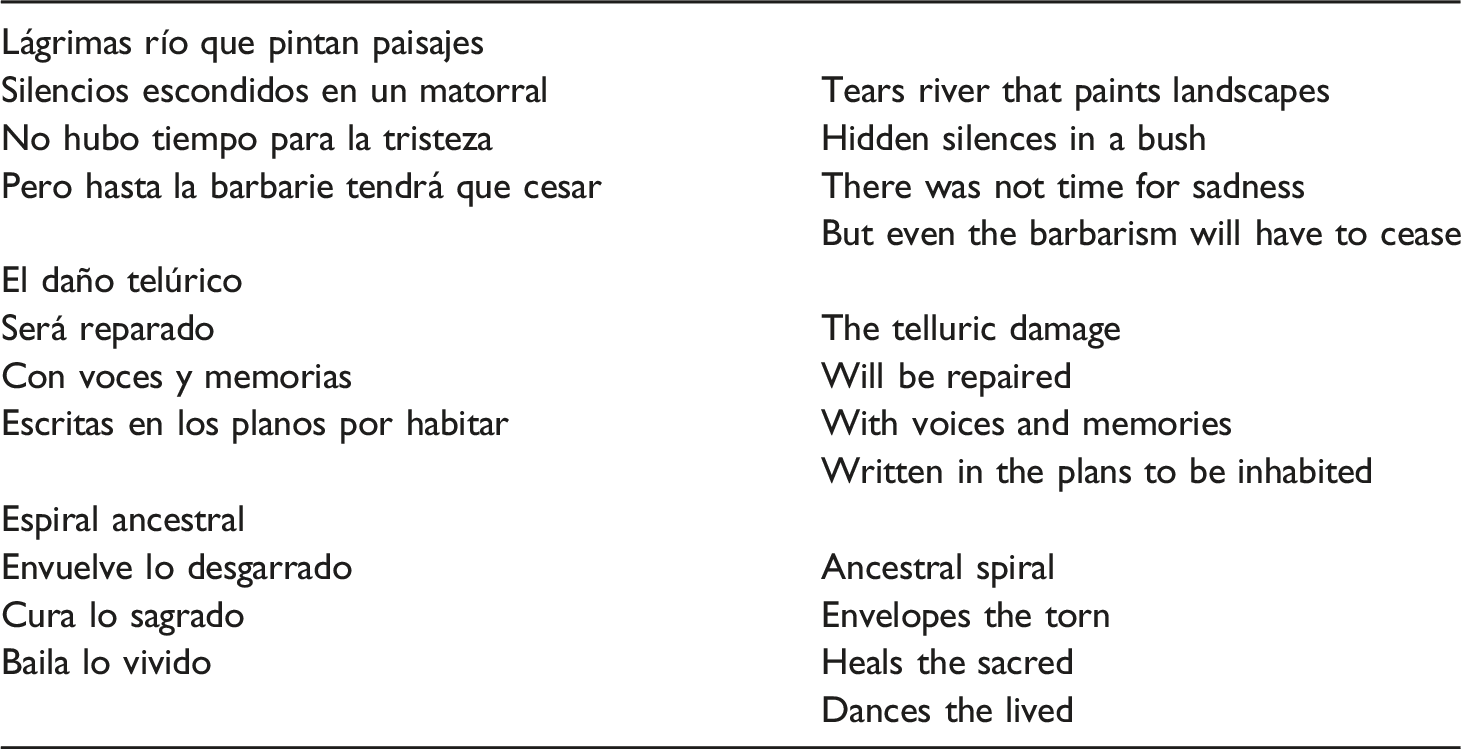
The DNA, snails, ferns, tornados, and galaxies follow the geometries of a spiral. A curved pattern following a central point shapes a multitude of natural formations. Some attribute a sacred quality to spirals and have inspired ritual architecture in different cultures. Spirals have become a polysemic symbol since ancient times. They represent life, creation, growth, and evolution. Some consider spirals to embody the cycle of rebirth and the mother goddess. In the case of plants, like the fern, the geometry of the spiral allows growth while staying secure. The persistent motion of rotation for self-perpetuation is believed to be the most efficient form of growth in nature.
Territorial healing addresses the collective geo-traumas resulting from chronic violence. Framing territorial healing as a spiral implies understanding it as a socio-spatial process at multiple scales that follows an enabling trajectory of transformation and rebirth with a sense of security. Territorial healing, as a collective process, has its own rhythms moving towards a center that carries the energy of life. The spiral journey of territorial healing faces the open wounds and scars contained in the feelings of being uprooted, broken, devastated, grieving, and dispossessed. Like in the nautilus, territorial healing also requires an aperture to the spatial-temporal travel in the territory and nurture from it. Likewise, the spiral of territorial healing is configured by several chambers -or cavities-, vectorial in nature, where different stages of rebirth take place in an iterative process (see Figure 1). In this sense, the spiral does not represent a directionality or a progression but rather a symbol of self-generation and a geometrical construct that allows us to delimit discrete segments that we use to distinguish the components of the healing process. If we extend our metaphor of the spiral, we would have to imagine the confluence, the dance, of several spirals that weave together and create loops: memory, reparation, peace-building, etc. The braid-spiral would be the result of this weaving on the body-territories. Spiral of territorial healing - Collage. Catalina Ortiz.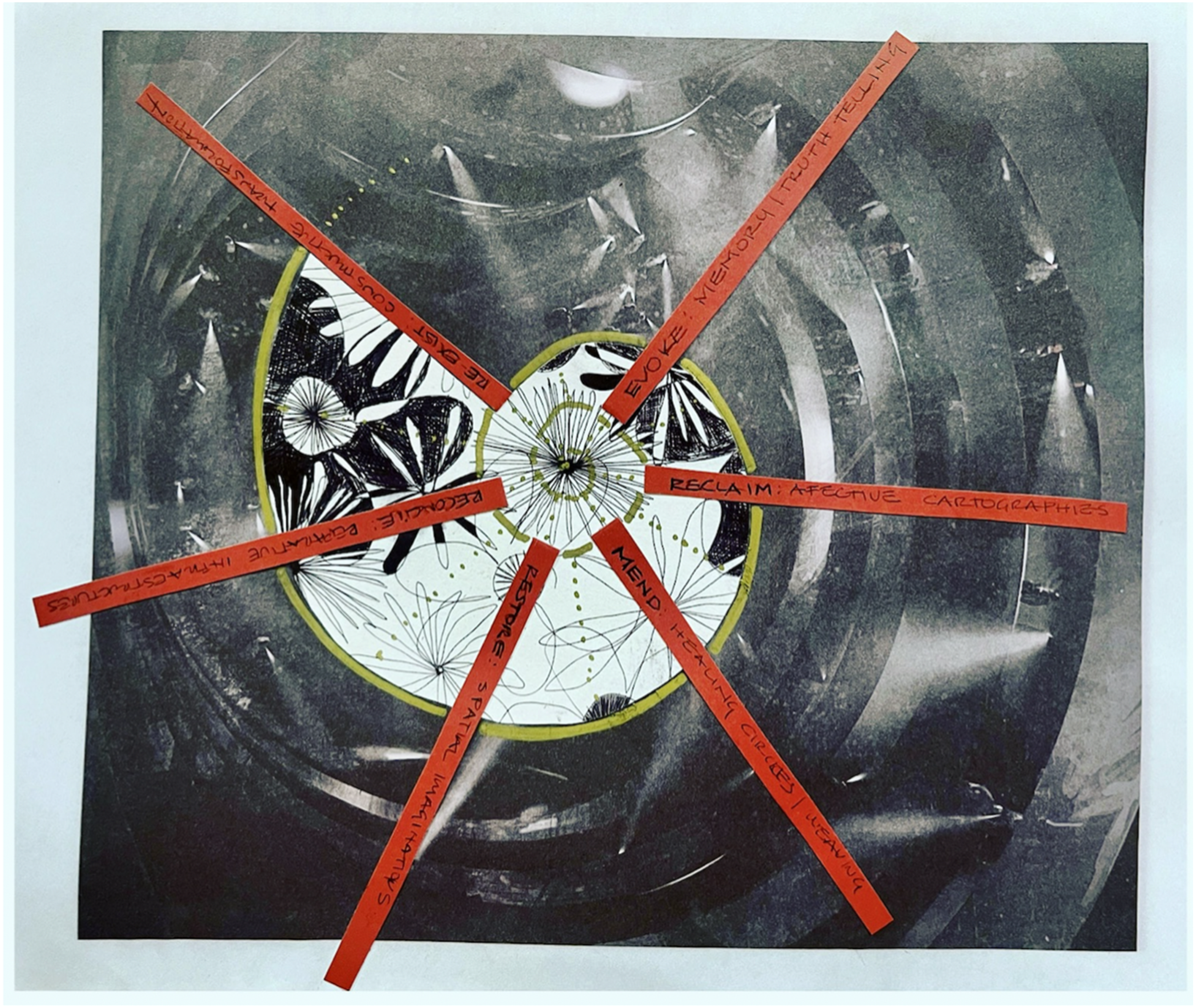
In this article, we illustrate the iterative strategies of territorial healing as a spatial intervention with communities affected by violence and enduring conflicts:
Evoke: Narratives of territorial memory and truth-telling
Territorial healing relies on evoking and truth-telling through narratives. It should not be forgotten that when trauma emerges - as a concept of the wound of the psyche - it is closely linked to the technique created by psychoanalysis of “healing through words”. Here the role of collective memory is paramount. But memories are not only memories, but they are also traditions, they are identities, they are denunciations; they are ways of constructing the meaning of the past. Memories are alive, that is, they must be told and retold. Narratives contribute to articulating collective memories around the trajectories of the subjects. Memories also become a place. The process of memory reconstruction helps to symbolize the place one inhabits as well as an opportunity for truth-telling as a precondition of the non-repetition of atrocities. Precisely for this reason, territorial healing requires creating reparative stories with different social actors to challenge collective emotional issues inscribed in territories and the epistemological violence towards racialized groups (Ortiz, 2022). Territorial healing requires other narratives to emerge, those other epistemes (Barreto, 2014) as possibilities for narrating other worlds. The proposal is not only in the construction of counter-hegemonic narratives, but to work outside the hierarchical devices. It is the configuration in their epistemologies of the problems of inhabiting, the enunciation of traumas, their impacts and possible treatments, and their resistances. Territorial healing requires a polyphony of stories that narrate collective memories of damage and hope allowing coexistence and the sharing of experiences of overcoming mistrust.
Reclaim: Affective cartographies of ‘body-territory-earth’
Fostering body-based practices and togetherness are crucial for place-based trauma healing. Gendered bodies, souls, and territories as most wounded by several forms of violence. Our starting point is that the territory is part of the plot with which trauma is signified, and that territory is re-signified by traumatic experiences. Decolonial feminist geographers advocate for using visceral methods, such as body map storytelling, that operate on the ontological unity between bodies and territories and shared sensory spatial experiences (Sweet and Escalante, 2015). The co-production of maps with communities affected by violence includes to “draw the territory on the body, [where the] knowledge is co-created with the voices and experiences of participants…” (Zaragocin and Caretta, 2021: 9). This methodology challenges Western notions separating bodies and land (Sweet and Escalante, 2017) and reveals the emotional elements of non-discursive aspects of the trauma to emerge and be linked to the territories inhabited. This approach gives clues to identify and reclaim the contested spaces and sites of historical trauma -territorial wounds- to address the collective fears and attachments those spaces carry through visual, hands-on, and participatory approaches. In this way, reclaiming resonates with framing ‘healing as a cosmic-political path’ (Cabnal, 2019) for liberation and emancipation of bodies and the earth.
Mend: Therapeutic circles and collective weaving
Territorial healing involves mending the socio-spiritual-spatial ruptures brought by geotrauma. Drawing on Therapeutic planning, we can learn from the use of meetings with communities affected by intergenerational trauma as “healing circles'' (Erfan, 2017) based on two key premises: a) it “is a belief that a group has, within itself, the knowledge, creativity, sensitivity, and power it needs to solve its own problems'' (Erfan, 2017: 5) and b) that in healing “there is no destination to be reached; even those who have been travelling the path for years often struggle with their next step. In short, healing is an ongoing process of self-transformation” (Waldram et al., 2008: 7 quoted in Erfan, 2017: 6). While healing circles operate as woven narratives, also the metaphorical and material action of weaving have been used for symbolic reparation and territorial peace pedagogies (Bernal Huertas, 2020). Threads, stitches, needles, and knots are associated with the actions of weaving, embroidering, and untying that can also produce an aesthetic, ethical and political mediation in reparation processes (Arias-Lopez, 2017). For instance, in Colombia, the ‘Embroideries of Memory Collective’ includes women who were forcibly displaced by the armed conflict that are collectively constructing plural truth-telling using textile language (Rodriguez Castro, 2022); as one of the participants expresses "When we have so much pain in our hearts, weaving helps us to bring out those thoughts and express what we often cannot tell anyone" (Arias-Lopez, 2017).
Restore: Rest, spatial imagination and joy
Territorial healing focuses on restoring from emotional and physical exhaustion brought by geotraumas and reimagining a possible future. Collective restoration involves political actions that enhance well-being, meaning, and purpose (Ginwright, 2015). To restore, rest is crucial. Rest is a healing portal as it disrupts cycles of historic trauma and has a deep spiritual dimension (Hersey, 2022). Rest is a practice of collective care and an integral part of healing justice movements to claim reparations and a precondition for enabling collective imagination (Hersey, 2022). That is why trauma healing approaches need “to relate to the past to build from the present and towards the future” (Pinto-Garcia, 2022: 5) to heal territorial wounds. In this way, the role of planning becomes critical for re-shaping damaging urban conditions and spatial imaginations. While environments that feel dangerous, unstable, or unpredictable cause hyperarousal to people also chronic traumas can trigger long-lasting mental and physiological effects; in contrast, a physical environment that “communicates consistency, predictability and care will calm our nervous system” (Greenwald, 2022). Planners’ role in social learning and healing becomes central to cultivating a “therapeutic imagination” and transforming spatial imaginaries of harm (Schweitzer, 2014). However, restoring from collective traumas not only requires rest and spatial imaginations, but the urge to restore the sacred relationship between bodies and earth through collective joy. Black liberation and queer indigenous scholarship advocate to “foster joy as a rebellious and healing affective orientation that opposes injurious colonial constructions” (Ashcroft, 2022: 6).
Reconcile: Reparative infrastructures and land restitution
Territorial healing has a very material nature to make reparative and spatial justice tangible. The reconciliation needed in wounded territories requires that structural violence gets addressed; whether is the land theft from settler colonialism to armed groups control, to patterns of racial segregation or the precariousness of self-built neighbourhoods that host forcibly displaced people or refugee camps all are sites of intervention to bring about reparative infrastructures and land restitution. For instance, the Landback movement in North America argues that “to truly dismantle white supremacy and systems of oppression, we have to go back to the roots. Which, for us, is putting Indigenous Lands back in Indigenous hands” (Landback, 2020: np). Another example is the Colombian process of Land restitution as a part of the comprehensive reparation of the Victims Law. This law defines the right of victims to have their property returned to them when it was dispossessed or abandoned because of the armed conflict in tandem with other mechanisms that guarantee non-repetition. These examples offer a political framework for organizing and mobilizing to claim to States. In a similar light, reparations to victims and peacebuilding through infrastructure constitute a means of state building, as well as a generation of the material supports of community life in which material and affective processes coexist (Ramírez Zuluaga, 2022). As planners, we need to devise how to frame context-specific infrastructure design, construction, and maintenance through the lenses of reparation and reconciliation.
Re-exist: Transformative reparations
Territorial healing proposes the exploration of myriad forms of “re-existence” (Alban Achinte, 2018). Re-existence is the manifestation of the “ontological reconstruction of being… of the healing of the multiple wounds produced, for more than five centuries, in bodies, spirits and nature by the tearing action of the coloniality of power” (Gómez, 2015: 10). Re-existence taps into the power of aesthetic practices out of the western cannon that free our subjectivities. For instance, Alban Achinte (2018) in the processes of ethnocultural revitalization of the communities of the Colombian Pacific, has highlighted art as a pedagogical tool for the visibility and dignification of symbolic practices of indigenous and Afro-Colombian communities. Through spiritual rituals, music, dancing, poetry and painting ethnic communities, as social subjects, are making proposals for the re-signification of their presence, the strengthening of their identities and the conception of their history. As Ibrokhim (2021) puts it: “to heal is to be in community, in solidarity, to ask for a different world, both inner and physical. To heal is to understand that the wounds in us are revolutionary, that shake up the lies of the world” (4). Then, re-existence is crucial for a “transformative reparation” (Saffon and Uprimny, 2010) as it connects memory, cosmovisions and represents the political dimension of artistic creation. The reconnection with memory to resignify the present and depict new futures links back to the strategy of evoking following the spiral path.
Conclusion
For urban planning to be relevant to the current civilisational crisis has to retool its conceptual apparatus and methodological approaches. We have argued that the concept of territorial healing provides a more robust understanding of how to frame the political project of reparative justice in space. We believe that the concept of territorial healing can be used as an approach to continue the work of dismantling colonial policies; it brings a new understanding of the territory as an agent of socio-political transformation. In this paper, we have offered a theoretical-methodological entry point to frame the strategies of territorial intervention with communities affected by violence-related trauma. Learning from current debates on decolonial healing, reparative planning, and urban peacebuilding, we have weaved premises and operational strategies to address the territorial wounds brought about by multiple forms of violence, such as colonialism, structural violence, war, and racial violence. We proposed that a territorial healing trajectory requires weaving the mapping of body-territory-earth (Cabnal, 2019), collective memory, and spatial imagination as a strategy to manage existing conflicts through therapeutic dialogue and the shaping of reparative infrastructures. To do so, we have used the metaphor of the territorial spiral to connect the different dimensions of healing in its impetus to protect the flourishing of life and seek liberation.
In response to geo-trauma (Pain, 2021), territorial healing also proposes layered strategies to tackle multiple temporalities and geographies to weave the socio-spatial ruptures experienced by communities. Instead of focusing on healing spaces, we take a broader approach to frame territorial healing as a capacious political strategy and collective territorial process. We have argued about a holistic approach to healing. It goes beyond a clinical perspective, which means an individual-centred, institutionalized and Western-centered approach; we advocate for framing healing in a comprehensive perspective: collective, historical, cultural and above all territorial. In theorizing territorial healing by engaging with poetic and visual depictions of the metaphor of the spiral, we introduce an innovative way to analyse the territorial possibilities of planning practices to engage with communities, mostly racialised, impacted by multiple forms of space-based violence. This contribution nurtures the debates around decolonial planning and the spatial grammar of urban peacebuilding. Territorial healing, as an emerging concept, will expand as future research can show the myriad context-dependent interpretations of it and the practices that can inspire. The more we understand the spatial dimensions of collective healing the more we can recalibrate urban planning praxis to restore our broken world.
Footnotes
Declaration of conflicting interests
The author(s) declared no potential conflicts of interest with respect to the research, authorship, and/or publication of this article.
Funding
The author(s) disclosed receipt of the following financial support for the research, authorship, and/or publication of this article: This work was supported by the Global Challenges Research Fund (A104788).
