




Abstract
Plans and policies rely on knowledge about communities that is often made by actors outside of the community. Exclusion from the creation of knowledge is a function of exclusion from power. Marxists, feminist, decolonial and postmodernist theorists have documented how the knowledge of some subjects is disqualified based on their gender, race, socio-economic position or a range of other constructed differences. Often, several of these constructions intersect in one person’s life, compounding their exclusion in ways that are both relational and structural (Crenshaw, 2017). Participatory planning approaches bring members of the community into contact with planning authorities in an effort to include their voices and interests in official plans. Essential to meaningful engagement in such a process is the participant’s ability to turn their ideas into change through the exercise of their agency. When that potential for transformation is missing, participation is tokenistic at best and dangerous at worst (Cooke and Kothari, 2001, Hickey and Mohan, 2004; Forester, 2020). When planners ask people whose agency is restricted by institutional and cultural forms of subjugation to talk about issues that adversely impact them, but over which they have little control, we can create exposures to internal and external risks that we are ill-equipped to mitigate. How can planners work towards social transformation without shifting the burden of speaking truth to power onto community members? One of the ways in which power and knowledge are related is through the complicated process of communication. Reflecting on power and communication in planning practice, this paper contemplates the question: when working with communities that have been historically excluded from the creation of knowledge about themselves, should planners strive for undistorted communication or should the distortion in communication be analysed for what it can tell us about agency and power, and opportunities for resistance and transformation?
Keywords
Introduction
Knowledge and power are inextricably linked. Creating and propagating knowledge is always an exercise of power and power is always a function of knowledge (Foucault, 1980). Within the epistemic traditions of modernity, the creation of knowledge as a positivist project relies on the discreditation of ‘non-objective’ thought as a means of fortifying the authority of Western science. Exclusion from the creation of knowledge is a function of exclusion from power. Marxists, feminist, decolonial and postmodernist theorists have documented the ways in which the knowledge of subjects who do not fall within the halo of Western epistemic privilege is disqualified and relegated to the realm of folklore, wisdom or local belief, (anything but science) based on their gender, race, socio-economic position or a range of other constructed differences. Often, several of these constructions intersect in one person’s life, compounding their exclusion in ways that are both relational and structural (Crenshaw, 2017).
Unpacking the complex relationships between knowledge and power can help planners to better serve the communities with which they work. One of the ways in which power and knowledge are related is through the complicated process of communication. The centrality of communication in planning practice has been made evident through decades of theorizing on the topic. Reflecting on power and communication in planning practice and illustrating the difference in communication within different methodological approaches, this paper contemplates the question: when working with communities that have been historically excluded from the creation of knowledge about themselves, should planners strive for undistorted communication or should the distortion in communication be analysed for what it can tell us about agency and power, and opportunities for resistance and transformation?
Plans and policies rely on knowledge about communities that is often made by actors outside of the community itself (Rydin, 2007). Participatory planning approaches bring members of the community into contact with planning authorities in an effort to include their voices and interests in official plans. Essential to meaningful engagement in such a process is the participant’s ability to turn their ideas into change through the exercise of their agency. When that potential for transformation is missing, participation is tokenistic at best and dangerous at worst (Cooke and Kothari, 2001, Hickey and Mohan, 2004; Forester, 2020). When planners ask people whose agency is restricted by institutional and cultural forms of subjugation to talk about issues that adversely impact them, but over which they have little control, we can create exposures to internal and external risks that we are ill-equipped to mitigate. How can planners work towards social transformation without shifting the burden of speaking truth to power onto community members?
Communicative planners strive to create the conditions for unconstrained, free and equal communication in participatory planning activities. Communicative planning theory seeks to make planning more equitable by developing more inclusive dialogue through the improvement of the quality of communication between planning stakeholders (Westin, 2022). Seminal communicative planning scholars drew on the Habermasian goal of creating open, undistorted, truth-seeking communication in planning contexts (Sager, 2018).
Forester’s (1980, 1982, 1989) version of communicative planning sought to correct power-related distortions in communication through bottom-up community empowerment, while Healey (1999; 2003, 2006) saw the opportunity to transform power relations by increasing agency in the micro-practices of planning, what she called the fine grain of planning practice. Like Innes’ (2004; 1999, 2016) prescription for participatory planning to use consensus-building tools to strive towards undistorted or authentic communication, such approaches appeal to planners concerned with people whose voices have been excluded from conventional planning conversations.
Members of such communities, however, remain bound by the real constraints that shape their identities, both at the planning table and outside of the planning conversation (Innes, 2004). The idea of encouraging an authentic dialogue in which everyone is equally empowered to speak can become problematic when it is not accompanied by the same equality of rights outside of that communication space. Purcell (2009) suggests that employing the tools of communicative planning without accompanying socio-legal change legitimates neoliberalism. He insists that ‘communicative action reinforces existing power relations rather than transforms them’ (Purcell, 2009, 141).
The pursuit of Habermas’ ideal communication has been critiqued by Foucauldian planners whose concerns about participatory planning centre around the opportunities that are lost by trying to overcome power in communications between the planner and the community. Flyvbjerg and Richardson’s (Flyvbjerg and Richardson, 2004) critique of the theoretical foundation of participatory planning insists that ‘communicative planning theory fails to capture the role of power in planning. As a result, it is a theory which is weak in its capacity to help us understand what happens in the real world; and weak in serving as a basis for effective action and change’ (45).
Flyvbjerg and Richardson (2004) insist that ‘[f]reedom is a practice, and its ideal is not a utopian absence of power. Resistance and struggle, in contrast to consensus, are…the most solid basis for the practice of freedom’ (53). They suggest that if the goal of planners is to create planning opportunities which aspire to Habermas’ ideal society, ‘then the first task is not to understand the utopia of communicative rationality, but to understand the realities of power’ (Flyvbjerg and Richardson, 2004: 49).
Understanding how resistance can be exercised through communication is key for planners hoping to engage historically oppressed communities. This issue is most often addressed in the cultural competence of planners and this set of skills could benefit from a more refined focus on the dialectic relationship between identities and their impacts on communication. While communicative planning theories and their critiques have done planners a service by focussing our attention on the nuances of communication, the question remains if undistorted communication should be the planner’s goal or if the distortion in communication should be used to help the planner understand the social, political and material limits to the actions of community members.
This paper draws on insights from discourse analysis, trauma-informed psychology and the literature on arts-based research to illuminate several limits to the communicative action of different members of a territorially stigmatized community, and to highlight the opportunities presented by the planner’s attention to how such limits are navigated by its members.
Recognizing what is sayable and what is off-limits, when and to whom, and detecting opportunities for resistance through attempts to transgress such limits, may offer more opportunity for planners to support communities facing oppression than striving to create temporary pockets of undistorted communication in planning activities. By illuminating the structures of power that constrain speech, planners can identify spaces in need of transformative social change.
By bringing critical, affect-attuned, trauma-informed communication tools into the practice of participatory planning, planners can enhance their cultural competence for communication. Planning scholars have already worked with such tools to elaborate the importance of emotion in the process of planning (Erfan, 2013, 2017; Forester, 1999, 2009, 2020). Sandercock (2003) pushed the centrality of emotion even deeper with her concept of the ‘therapeutic planning process’, a space in which groups can safely discuss the unspeakable. She defines therapeutic planning as the opportunity for conflicting parties to discuss historic injustices and current conflicts without fear of being attacked or dismissed (2003). Sandercock and Atilli’s (2014) work on therapeutic planning brings together critical race theory’s attention to the historical and cultural context of communication with the power of art and multimedia as tools to elicit stories exploring painful subjects to help build counternarratives in planning.
The analysis offered in this paper adds to this literature, paying careful attention to power in the micropolitics of communication in planning, specifically the process of participatory planning with a territorially stigmatized community with a long history of colonial, racial and class-based oppression. It illustrates the utility of different methodological tools for illuminating the limits to communication and opportunities to transgress them and suggests that such tools can help planners develop deeper insight into the constraints faced by community members outside of the spaces created by communicative planning activities. Specifically, it uses the concept of discursive limits from Foucauldian discourse analysis (Jäger & Maier, 2009) as an analytical framework, and explores the utility of three methodological innovations as tools to illuminate constraints and opportunities for community members to resist such limits by communicating in ways that suit them: (1) an attention to the indexical, as opposed to only the referential, functions of language in interviews (Matoesian & Coldren, 2002), (2) Gilligan et al.’s (Gilligan et al., 2006) Listening Guide for analysing speech on difficult topics and (3) collective projective storytelling and the value of fiction in developing counternarratives.
Discourses, knowledge and power
Attention to discursive limits is essential to planners’ understanding of, and impact on, the lived experiences of communities targeted by participatory planning because discourses are not coincidental, they are an exercise of power (Jäger and Maier, 2009: 10). According to Foucault (2005), subjects are created by and situated within a discourse, thereby determining the limits of the subject’s voice (what they can say) and agency (what they can do) in accordance with their prescribed role, identity or subject position. Attention to discursive limits is the responsibility of those engaged in planning because discourses are sustained or changed by the knowledge we create about communities.
Discourses are informed by épistémès (Foucault, 2005), systems of knowledge that have been created to support truth claims and to provide validation for social action by determining what is included in and excluded from the truth, the norm or the acceptable (Graham & Slee, 2008). Racism, misogyny, heterosexism and colonialism are beliefs in the superiority of one state of existence over others, made material by and enacted through policy and practice: maleness over femaleness, whiteness over blackness, for example. The dominant épistémès that inform Western knowledge production are rooted in these beliefs and still carry their legacies which constrains what kinds of knowledge get validated (Mignolo, 2009) and included in plans and policies, especially when that knowledge is made by people from outside the community.
Argentine philosopher Walter Mignolo (2009) insists on the decolonization of knowledge through epistemic disobedience, which requires the delinking of knowledge production from the epistemic privilege of the First World. The epistemological and methodological practices through which such knowledge work can be achieved have been accumulating through the contributions of critical scholars in recent decades, including work highlighting the importance of situated knowledges (Haraway, 1988), standpoints (Harding, 2004), Indigenous knowledges (Tuhiwai-Smith, 2021) and oppositional consciousness (Sandoval, 2013), as well as the need to move towards ‘nonrepresentational’ approaches to knowledge production (Thrift, 2008) that more effectively capture sentient-social life and the symbiotic relationship between the discursive and material aspects of embodied experience (Batacharya & Wong, 2018 p. 389). This epistemic shift demands a revised understanding of the nature of communication. Recognizing and addressing the limits to direct verbal communication within the production of knowledge about planning issues is an important step in the decolonization of planning.
Communication with communities that have experienced extended periods of oppression cannot rely on the same techniques as communication with dominant groups that are privileged, unstigmatized and favoured by social institutions. Generations of Eurocentrism and differential power have created patterns of exclusion, stigmatization and violence that condition the communicative acts of people experiencing oppression. Conquergood (2002) insists, ‘[s]ubordinate people do not have the privilege of explicitness, the luxury of transparency, the presumptive norm of clear and direct communication, free and open debate on a level playing field that the privileged classes take for granted’ (146).
Schutte’s (1998) concept of ‘cultural alterity’ highlights the significance of this disparity in speaking positions, insisting ‘the culture of the subaltern group will hardly be understood in its importance or complexity by those belonging to the culturally dominant group unless exceptional measures are taken to promote a good dialogue’ (56). She laments that this issue of cross-cultural incommensurability is ignored by conventional communication methods: ‘What my interlocutor fails to recognize is that delimiting my capacity to speak in my culturally differentiated voice will have an effect on what I say in response’ (60).
Planners interested in working effectively with communities need to be skilled in methods beyond those conventionally used in rational planning. The production of knowledge looks different in different communities, but too often limited training and resources lead planners to attempt to force knowledge production with communities to fit the rationalist, text-based mould of positivism. Discourse analysis offers tools to support the integration of such skills into the work of planners.
This paper draws on a 2016–2019 case study that explored the impacts of Cuba’s economic and social restructuring on youth with a group of 15 racially and territorially stigmatized teenagers whose community is at the forefront of these changes. The historic centre of the Cuban capital, Habana Vieja, is the most rapidly gentrifying neighbourhood on the island and its unique redevelopment is emblematic of the changes embraced by the government since the fall of the Soviet Union. It has also remained the symbolic and material locus of marginalization, poverty and immorality on the island, stigmatized from the establishment of the walled city during colonial times, through its abandonment in the republican era, to the community’s recent redevelopment as a site of heritage tourism.
The study discussed here documented the ways in which the market-led redevelopment of Habana Vieja impacts the use of public space and identity development by its adolescent residents. The methods used in this project provided opportunities for participants to create alternative visions of urban space for people like themselves, contributing to the collective identity work of a group of teens who have largely been side-lined within their own community. The new spatial imaginary created by such redevelopment changes the ways in which local residents use space in Habana Vieja and impacts how and what they know about their community and themselves in ways that primarily benefit people outside of the community and potentially harm those within it. This paper explores the complicity of participatory planning methods in the creation of knowledge about a community that has long been vulnerable to external representation and subsequent state intervention.
Oppressive knowledge stigmatizes communities
Wacquant (2008) defined territorial stigmatization by extending Goffman’s (1974) characterization of stigma as a quality that adheres to people and shapes social relations. The concept highlights the ‘role of symbolic structures in the production of inequality’ (Wacquant et al., 2014 p. 1270), and stresses how the mutual pollution of people and places can be manipulated to justify intervention and oppression. Horgan (2018) emphasizes the deliberate political production of territorial stigma and its provision of a ‘political pretext for justifying gentrification led displacement’ (502) and other forms of intervention or retreat. He demonstrates how the deliberate stigmatization of a neighbourhood through the purposeful cultural misrecognition of its inhabitants is part of the ‘strategic armoury of gentrification’ (Horgan, 2018: 506).
In Habana Vieja, a racialized and economically disadvantaged community established in the mid-1800s by people exploited for and excluded from the spoils of colonial conquest, territorial stigmatization has played an important role in recent tourist-led gentrification and resident displacement. Much attention has been paid by the state to the individual social characteristics that facilitate the intergenerational reproduction of poverty in this neighbourhood (Espina Prieto, 2008). This political downloading of responsibility for poverty to the household reinforces the negative stereotypes related to race and poverty that were key to colonial structures of exploitation and socially validated through religiously informed concerns for morality. The perceived inability of a community to adequately care for themselves is ‘mobilized as part of the justificatory armoury for state/market-led intervention or retreat’ (Horgan, 2018 p. 502).
Residents of Habana Vieja know how the material impacts of this social dynamic shape their lives and they negotiate territorial stigmatization as part of their ongoing identity work. Residents that experience place attachment (Shaykh-Baygloo, 2020) to Habana Vieja balance their place identity and community loyalty with their individual concerns and experiences when discussing issues in their neighbourhood with outsiders, lest they reinforce the negative stereotypes used to morally undermine their community. Acknowledging and documenting the prevalence of morally stigmatized behaviour in Habana Vieja would reinforce the territorial stigmatization that validates the devaluation and disposability of local residents made material through gentrification and forced displacement. When discussing local planning related issues in this study, participants carefully navigated the risky path of documenting issues of concern within the neighbourhood without reinforcing negative stereotypes that are used to justify intervention in, and oppression of, their community. In Habana Vieja specifically, inadequate infrastructure leads to severe overcrowding in social housing and transportation. While the frustrations and inconveniences of overcrowding are commonly discussed, the safety implications, especially for young women, are rarely officially acknowledged. While engaging residents in participatory discussions of planning issues is a step towards including local voices in decision-making, identifying and understanding the limits to their use of voice in such a context is key to designing plans and policies that create relevant, effective and sustainable change.
In our case, dominant discourses restricted what was sayable for a ‘good kid’, a ‘good Cuban’ and a ‘normal girl/boy’. From a Foucauldian Discourse Analysis perspective, Jäger and Maier (2009) insist that discursive limits can be verbally extended or narrowed down through the use of certain rhetorical strategies. They identify strategies such as relativizations, allusions, and implicatures and other ‘tricks’ that indicate to a discourse analyst that ‘certain statements cannot be said directly without risking negative sanctions’ (Jäger and Maier, 2009: 12).
Discursive limits to voice and agency are upheld by forces beyond a conscious fear of negative sanctions and their limits can be stretched by strategies other than intentional rhetorical ones. Such limits can also be indicated and transgressed through embodied communication (vocal cues such as tone, volume, inflection and pace, and body language such as facial expression, body posture, gesture, eye movement, touch) and material practice (engagement with space and objects) without the use of the spoken word (Adjei, 2013; Gee, 1999; Matoesian & Coldren, 2002; Tait, 1995). By paying close attention to the instances in which discursive boundaries are met and respected, or met and transgressed, planners can identify the ways in which structures of power limit the voice and agency of certain groups, and pinpoint opportunities for transformative social change.
Conventional Western models of communication assume a self-contained and autonomous subject, a linear communication format, a stable code, and they are abstracted from lived reality. However, more recent, circular communication theories recognize messages as the ‘cooperative products of senders and receivers, and [as such] the reading of available signs become a primary task of the receivers’ (Dissanayake, 2013: 18). Understanding voice as a form of communication beyond the spoken word is an important contribution of such theorists, many of whom explore the role of the unconscious in communicative acts. For example, (Lacan, 1968), for whom language is made up of any signifying system, insists that it is in the moments when speech fails that the unconscious manifests. This connection between unspoken communication and the unconscious is what motivated our use of performance and art as complimentary methods to verbal communication such as interviews and diaries, in this project. Voice, then, consists both of that which is expressed, through and beyond words, and that which is interpreted by the receiver (Higgins, 2016). Paying close attention to the complexity around what is communicated and how, is one way voice can be used to estimate or better understand constraints to agency. In what follows, I will highlight how three different analytical tools can help planners identify how communication is conditioned by discursive relations of power in three different participatory planning activities.
Ideal communication versus real life
Relationships play an important role in communication. The principal investigator for this project (the author) is a female, White, Canadian planning scholar that speaks fluent Spanish. The rest of the engagement team were male and female Cuban university faculty and graduate students of various non-White racial identities. The teenage participants are referred to by the name they used for themselves, the muchach@s (a gender-neutral transcription of the Cuban term for ‘kids’). Data was collectively analysed by the team on an ongoing basis and engagement activities were collectively designed based on emerging needs. Over a period of three years, this project involved 4 different phases of community engagement: (a) scoping and recruitment, which involved community interviews and focus groups following a snowball sampling approach; (b) the collective creation and performance of two Popular Theatre pieces by the muchach@s; (c) a range of ethnographic and participatory activities such as walking interviews and diaries with the muchach@s; and (d) the collective creation and dissemination of a short film by the muchach@s.
In this research, there were four topics that were clearly off-limits in the discursive conventions of the community members yet appeared repeatedly in the data: sexual abuse, emigration, illegalized livelihood strategies and heteronormativity. Through an attention to the micropolitics of communication, I illustrate how one of these topics, sexual abuse, was clearly an issue that impacted the community’s wellbeing, but one they were unwilling to discuss directly. Despite being off-limits for direct discussion, it repeatedly permeated their sense-making process through the use of rhetorical devices, embodied communication and material practice and was clearly related to planning issues such as social housing and transportation.
Sexual abuse is defined here as ‘unwanted sexual activity, with perpetrators using force, making threats or taking advantage of victims not able to give consent’ (Sexual Abuse, 2021) APA.org. During the initial scoping activities, dozens of local youths and two local key informants were asked directly if sexual abuse was an issue in their community. Every one of the youths said ‘no’ and the responses of the key informants are discussed in detail below. The issue emerged as important in both of the popular theatre performances (discussed below) and became a key storyline in the short film. The topic also emerged spontaneously in two of the diary interviews (discussed below). The activities discussed here include direct verbal communication in two key informant interviews, one with a community psychologist and another with a social worker that runs the local youth support centre, indirect communication through two diary entries and subsequent interviews reflecting on those diaries with two of the muchach@s, and the second Popular Theatre performance written and performed by the muchach@s.
By illustrating the resistance strategies employed by participants through these different data collection experiences, this paper explores the utility of these three analytical tools to illuminate discursive constraints and identify opportunities for community members to resist discursive limits.
The value of indexical functions of language
Key informant interviews (KII) are often considered the least ethically delicate form of data collection due to a presumed balance in power in a peer-to-peer interaction between ‘experts’. However, an attention to the micropolitics of communication using tools from linguistics, psychology and embodiment theories help identify the limits to what even ‘experts’ can say (Mason-Bish, 2019; Mishler, 1991). When synthesizing direct verbal communication activities like KIIs, planners often rely on content analysis procedures in which they ‘reduce raw data to a few digestible findings’ (Myers, 1998: 106). The literal and narrow focus of content analysis tends to prioritize the referential functions of language (themes and content) over its indexical functions (context and allusion). The key informant interview, however, is a co-constructed dialogue mutually constituted between the interviewer and interviewee (Duranti, 1986; Goodwin, 1986; Gubrium & Holstien, 2003) and the indexical functions of such conversations can be as meaningful, if not more so than the content delivered. Briggs (1989) insists that ‘Most of what goes on in the speech event is indexical not referential’ (42) and as a result, content analysis tends to ‘bleach the poetic, prosodic, and nonverbal aspects of language from analytic consideration, ignor[ing] how they may interact in communicative performance, and thus omit[ing] their relevance in [a] report’ (Matoesian & Coldren, 2002: 472). Silence in an interview is commonly associated with withholding, resistance, something that is so obvious it goes without saying or something that is unsayable (Denzin, 1997; Kawabata & Gastaldo, 2015; Montgomery, 2012; Poland & Pederson, 1998). In the cases in which silence is a form of self-censorship, intentional or subconscious, it indicates a perceived risk in discussing certain issues (Poland & Pederson, 1998). While much has been said of the emancipatory potential of speaking ones’ truth, critical and decolonial pedagogies require a respect for the practical realities of those who experience the expectation of such disclosures (Cameron, 2012; Janes, 2016; Razack, 1993; Williams, Labonte, & O’Brien, 2003).
Following Matoesian & Coldren (2002), we paid special attention to the indexical functions of language (verbal and body) in our analysis of key informant interviews. In the key informant interview with the local family psychologist, there was no mention of sexual abuse made during our on-record discussion of local issues. When asked off-record if the housing shortage and overcrowding led to incest in Habana Vieja in the same way it did in other parts of the region she responded, ‘Maybe before, but the education that the Revolution has provided has really stamped that out. People know that’s not ok, and they don’t do it here. This is not Honduras’! This KI used the rhetorical strategy of juxtaposition to distance the Cuban culture from that of other Latin American countries, using one of the poorest countries in the region to highlight the moral integrity of Cubans by contrast. In this way, she firmly reinforced a discursive limit by indicating the risk of questioning the honour of Cubans and the moral values of the Revolution that we would be taking if we were to further discuss the topic. While she discussed alcoholism, teen pregnancies, and low educational attainment extensively during our interview, all factors highlighted by state-sponsored studies about the social issues impacting Habana Vieja, the psychologist reacted with strong emotion to my question about incest and her response was decisive and direct, indicating the sensitivity of the topic.
During his interview, the local social worker revealed the discursive limits on the subject of sexual abuse and violence quite effectively using both rhetorical devices and embodied communication. He brought up the topic of interfamilial violence during his interview, when discussing the topics of the ideological and practical value-formation workshops he led: ‘We also talk about violence, because this neighbourhood has the tendency to get a bit violent, violence in families as well…’, he said. And then he listed alcoholism, drugs and prostitution as comparable topics they had to deal with in the community before moving on to discuss the methodology of his workshops.
Later in the interview, when asked to expand on his mention of violence in the community, the KI used meiosis (a euphemistic figure of speech meant to understate importance) and embodied communication (for more on this method see Matoesian & Coldren, 2002 or (Ayrton, 2019) to downplay the severity of the issue: [Me]: “Before you mentioned violence. Can you expand a bit on what goes on in this neighbourhood? Because I’ve been told by others as well that it’s a ‘hot’ neighbourhood.” [Social Worker]: “Yyyyeeeeeaaaa…[very high-pitched]…wwwwweeeellllllll…[very extended pronunciation followed by long pause], like all neighbourhoods in the capital, or any part of the world! [hands gesture palms to sky in a shrug]. At times it gets violent here in the sense that there can be arguments, there can be fights…that’s why it’s a neighbourhood that’s….uh…..uh…[short pause]…I think that from the very history of this neighbourhood, I think that’s what makes its reputation…”.
He goes on to link the supposed culture of violence in the community directly with the historic marginality, poverty and racism of colonialism and their generational reproduction. He describes the exclusion of the community from the walled city during colonial times as the catalyst for the local social conditions and perceived inferiority of values, and as symbolic of the abandonment of this community by the state, extenuating his earlier claim about violence in the community so as to not bring the shame of something like sexual abuse onto his already stigmatized community.
Later, when discussing what we had observed as a lack of girls practicing sports in their free time, I asked if it was possible that girls were more expected to do chores at home, if there was still a significant gender rights imbalance in this neighbourhood: [Social Worker]: “[Laughing slightly] Of course, of course, of course! We are talking about a highly male chauvinist neighbourhood! [Energetically] For all the female empowerment, for all the theory, the workshops, the courses, the television spots and posters, male chauvinism is very strong here, of course…” [Me]: “Is gender-based violence still a problem here?” [Social Worker]: “[Much lowered pitch and volume, eyes averted] Well, I believe so… I guess so, no? [shrugs] .... [further lowered volume and pitch, eyes still averted] I guess it is…[silence until I began a new topic]”.
The sudden modulation of his voice and the reluctance in his body language indicated that we had reached a discursive limit and further discussion of gender-based violence was unwelcome at that time. This embodied communication illuminated the discursive limits to what he, as a good Cuban or resident of Habana Vieja, could say to an outsider about gender-based violence in his own community. The embodied communication of the social worker highlights the sentient-social nature of such limits, illustrating how they restrict voice and how responses to such limits can manifest through nonverbal communication.
Theses interviews demonstrate the highly mitigated nature of even expert voices. The ways in which the KIs position themselves in relation to the topic may also illustrate the limits of their perceived agency. The social worker refers to the supposedly extensive work done by the government to reduce misogyny and incest but decries the community’s extensive history of oppression as the deep root of a problem that is beyond even the most concerted efforts to build ‘female empowerment’. The issue of sexual abuse seems to be well beyond his professional scope, so much so that his work does not address it. As mention of the issue caused distinctly emotional reactions in both KIs, the limits on their voices may indicate limits to what they can do in response to it, the limits of their agency. The strong taboo around sexual abuse that becomes apparent through the indexical analysis of these two interviews points to a potential opportunity for change, possibly in resisting the individualization of responsibility for, and shame around, the consequences of intergenerational trauma and the structural violence of poverty.
The value of listening under narratives
Even in the most intimate accounts, and those captured in ‘safe spaces’, we cannot assume the conditions of communicative rationality. Engagement with the field of psychology presents several opportunities for planners to heighten their attunement to the micropolitics of communication.
Comparably complex approaches to the discussion of sexual abuse were displayed in the diaries and diary interviews of two of the muchach@s. A careful analysis of the direct and personal nature of this type of communication, and the intimacy of the diary format, offer the opportunity for a closer reading of the voices used to recount these difficult experiences. The Listening Guide (Gilligan et al. 2006) method is predicated on the need to ‘listen under parts of a narrative with an ear to how marginalized and oppressed people negotiate their lives on the flip side of power’ (Sorsoli and Tolman, 2008): 489). This type of analysis demands multiple interpretive readings of the same text, listening for ‘plot’, ‘self’ and ‘contrapuntal voices’, in turn. According to Sorsoli and Tolman (2008), the Listening Guide maintains ‘allegiance to narrative as a fruitful manner of exploring lived experience’ (497) while acknowledging ‘that people may have difficulty putting into words and may resist talking about…experiences that reveal violations of acceptable or conventional thoughts, feelings, or behaviours, given the teller’s positionalities and those of the subjects of the narrative’ (497). When using these principles to review the diary data, two distinct voices can be heard in each girls’ account of sexual abuse.
Elena’s (pseudonym, 16) written record about a man rubbing his genitals against her on a crowded bus took up more than half of that day’s diary entry and ended in a large-font, cross-page expression of exasperation, ‘What a day, my god’! Yet, it was written in a tone that involved significant humour, hedging and understatement as ways to downplay the severity of the incident, distance herself from the discomfort, and lighten the tone of the taboo conversation; ‘…and the sweetest part was the look of satisfaction on his face, a face ripe for a good slap’. The final line of the written story was, ‘I should have slapped him in the face but in the end, I calmed down and didn’t think about it anymore’. This line captures the interplay between the protective voice of outrage and defence, and the vulnerable voice of powerlessness and pain that was common to the accounts of sexual abuse found in the data.
The movement between these two voices in Elena’s diary entry and diary interview illustrate the discursive limits of what is sayable as well as the agentic positioning of the speaker in relation to the issue at hand. In this case, Elena knows that it is her right to feel violated (she uses the word ‘insultada’ which translates to insulted, abused or disrespected) by the occurrence and she can describe the steps she feels she should have taken to address the offence, but she also demonstrates a lack of agency to take those steps. She expresses her disgust over the ‘expression of pleasure on his face that made me want to slap the shit out of him…’. She speaks of the coping mechanisms she invoked as a result of the gap between what she felt she should have done and what she felt she could do: ‘but in the end I calmed myself and didn’t think about it anymore’.(Figure 1) The final page of Elena’s journal entry belied her exasperation with the incident on the bus, although she downplayed its significance in her writing and at points in our interview.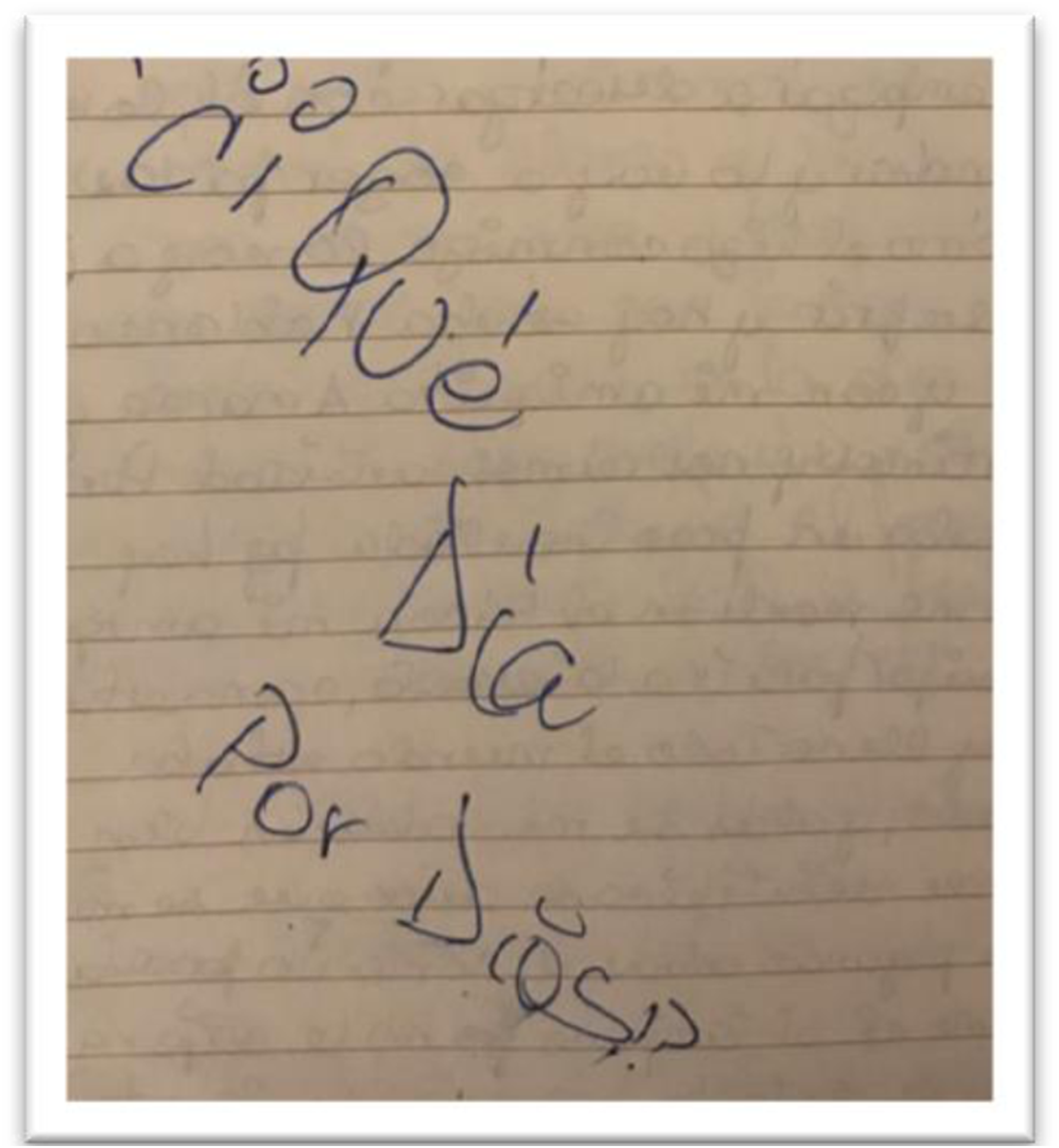
Elena’s agency was complicated by her subject positioning and the public nature of the event. When asked why she didn’t do any of the things she says she wanted to do, her response illustrates the power of the complex and intersecting discourses limiting her expression of outrage as well as her ability to protect herself, Well, I turned and looked at him, I gave him a look, but since he had his headphones on, listening to music, it was like he wasn’t paying any attention to me, and since, since there wasn’t long until I was getting off the bus, and what’s more, because I’m Black, as soon as I make a bit of noise on the bus, they say “Those Blacks!”
Before provoking the popularly imposed sanctions that would ensue if someone in her subject position, a young, Black girl from a poor neighbourhood, were to publicly challenge a White man for using her body as sexual object without her permission, she considered it safer to wait until she could get off the bus. ‘In the end I got off the bus and I had to deal with it [claps hands as if washing them]’. Despite her intention to calm down and not think about it anymore, the space dedicated to the event in her diary indicates the impact it had on her.
Sara (pseudonym, 14) discussed her grandmother’s boyfriend leering at her while she sleeps or dresses, in her diary interview. It relied on aposiopesis (a sudden breaking off of speech) and euphemism rather than humour. ‘I don’t feel good in my house…because there’s a man, he’s always there…my grandmother’s boyfriend…my grandmother says he’s not going to leave, that we should leave and find somewhere else to live…just having to see his face makes me feel unsafe in the home…he’s shameless and my grandmother doesn’t realize it’. Her account involves an ongoing violation from which she is unable to remove herself, and a breach of trust with close relatives, like her grandmother and mother who do not protect her.
Sara also moves between a protective voice and a vulnerable voice, highlighting the space between what she felt should be done and what she felt she could actually do. [Me] “He makes inappropriate comments to you?” [Sara] “[aggressively] No! Impossible! He knows that I’m ok to a certain point…that if he says something to me I’ll slap him like crazy…[much lower volume and pitch] but…it’s his gaze…it’s the…and since there’s only one room…it’s one bed right beside the other…I have to sleep in a t-shirt and pants and he’s right there and I have to…you know…so there are times that I get up in the middle of the night to go to the bathroom and he’s awake and leering at me…and that just…it scares me, you see…wherever I go he stares at me…”
Sara’s subject position as a child that is underhoused also complicates her agency to respond to the threat from her grandmother’s boyfriend. Her hesitancy to articulate the exact details, speaking in incomplete sentences, indicates the sentient-social limits to her voice, similar to those demonstrated by the local social worker.
The Listening Guide method allows us to analyse the relationships between the various voices identified in the data, which is essential for bringing our awareness to ‘the social forces that may affect the ability to articulate one’s experiences’ (Sorsoli and Tolman, 2008: 511). In this case, it helps us to identify the tensions between the outraged and vulnerable voices in Elena’s account, highlighting the ways in which her public experience is exacerbated by the dominant discourse due to her inferior subject position. In Sara’s account, it helps to highlight the tensions between her protective, empowered voice that insists she would defend herself if his behaviour crossed a certain line, and her vulnerable, abandoned voice that reveals that his behaviour in what should be the private safe space of her bedroom is already damaging to her. In both cases, their experiences of violation are not validated by the other social actors around them, and they identify indirectly how this lack of discursive solidarity, their lack of confidence in the likelihood that people around them will validate and support their complaints, severely limits their personal agency. The muchach@s indirect indications that they lack the support they need to advocate for themselves in such situations points to a potential opportunity for change, maybe in terms of awareness raising at the community level, or in terms of social service provision to youth.
The value of fiction and performance
The significance of this lack of community validation and solidarity, and the lack of perceived agency it reveals is represented starkly in the muchach@s’ second popular theatre performance, demonstrating the value of using fiction and performance to explore discursive limits. Furtive communication and the use of fiction to push discursive limits are important survival tactics for many oppressed groups who do not have the privilege of explicit, free and direct communication without the danger of severe social sanctions from the dominant group (Conquergood, 2002: 146).
Sandoval (Sandoval, 2013) expands Fanon’s (Fanon, 2008) metaphor of the ‘white mask’ to discuss the relationship between subaltern knowledges and the use of clandestine communication for survival. She contrasts ‘the process of masking as survival under colonization by race, a disguise that, as dominant powers have it, conceals, represses, denies, deforms, or erases’ (83), with the power of the disguise which ‘enables the tactical deception of the imposter who controls – between skin and masks, an interspace’ (Sandoval, 2000: 83). This interspace can allow individuals to transgress discursive limits, expanding the range of what is sayable, enabling a fuller, however furtive, expression of their lived experience.
In our work, the use of fiction was significant, both ethically and practically for exploring discursive limits. The experiences the muchach@s wanted to relate sometimes fell outside of the limits of the discourses of a ‘good kid’, a ‘good Cuban’, and a ‘normal girl/boy’, putting them in the uncomfortable position of having to choose between suppressing ‘unacceptable’ parts of their experience, or transgressing discursive limits and facing the consequences that followed. Specifically, discussing issues of sexual abuse connected to the overcrowding of Habana Vieja risked reinforcing the territorial stigmatization that validates the tourism-led redevelopment of the neighbourhood and the displacement of its residents. The creation of fictional characters and stories allowed them to push discursive limits more safely than they could in real life by giving them the power to navigate the interspace (Sandoval, 2000) between reality and fiction.
In this study, we explained our interest in the connections between the particular challenges of living in Habana Vieja and common perceptions of local youth as ‘delinquents’, and then asked the muchach@s to share their feelings on the subject by ‘telling us stories about people like you’, as opposed to asking them directly to tell us personal stories. Projective techniques allow participants to ‘ascribe their own motivations, feelings and behaviour to other persons in the stimulus material, externalizing their own anxieties, concerns and actions through fantasy responses’ (Kitzinger and Powell, 1995: 348). This approach can be combined with interpretivist analysis methods to ‘reflect contemporary discourses upon which subjects draw in making sense of experience’ (Kitzinger and Powell, 1995: 349).
Performance was also an important component of this work given its ability to take data collection beyond what Conquergood (2002) calls ‘the hegemony of textualism’ (147). Performance allowed us to consider nonverbal acts that are key to communication including embodied communication and all that which is withheld from text but expressed ‘through intonation, silence, body tension, arched eyebrows, blank stares, and other protective arts of disguise and secrecy – what de Certeau called ‘“the elocutionary experience of a fugitive communication”’ (Conquergood, 2002: 146).
In response to our questions, the muchach@s produced two live public performances of original popular theatre (Boal, 1979, 1995; Prentki and Selman, 2003), and one short film. These fiction pieces were informed by the data generated through the complementary ethnographic and participatory research methods in the phases a and c of this project.
One of the most telling treatments of the topic of sexual abuse in our work was the way in which it was included in the second popular theatre performance. The muchach@s worked together to write and rehearse the piece for one week. At the beginning of the week a scene was developed in which two sisters run into each other in the common area of their apartment building and one sister notices that the other, Carolina, is carrying a warm can of beer and some aspirin, in her purse. (This is an allusion to the locally well-known home remedy to provoke a miscarriage to terminate an unwanted pregnancy. This had to be explained to the author but was known to the Cuban team, the muchach@s and the muchach@s’ mothers that were on site as we worked). When asked repeatedly and insistently by her sister about who got her pregnant, Carolina replied, noticeably upset, that it was Quintero, their stepfather. We had already met their stepfather in an earlier scene. He was a caricature of a loud, offensive drunk who was disrespectful and sexually aggressive with their mother.
As the sisters talked, their mother arrived, and Carolina’s sister told her mother the news. The mother expressed frustration but not surprise, and shortly thereafter they were interrupted by a group of people congregating in the common area for a residents’ meeting. Carolina slipped away as the meeting began. When residents were asked by the administrator to pay 5 USD for a water shipment, Carolina’s mother exclaimed that she didn’t have that much money to spare, she had several children to rear and one of them was even pregnant. The crowd gasped exaggeratedly and asked who was pregnant. The girl proclaimed excitedly that her sister Carolina was pregnant, and encouraged by the crowd’s shock she added, ‘And I bet you can’t guess who knocked her up’! The titillated crowd of residents begged to know, and she exclaimed excitedly ‘Quintero’! In pantomime-like form, the residents asked in unison, ‘Who’? and she repeated, ‘Quintero, that drunk! My stepfather’! at which the residents gasped and laughed, repeating his name excitedly as the mother shook her head, with her hand over her eyes.
At this point, Quintero stumbled into the scene, drunk, uttering homophobic slurs and making sexually suggestive comments to one of the elderly female residents at the meeting. Residents looked at him with disdain but did not confront him. A minute later, Quintero stumbled out of the scene to get another drink as residents shook their heads in disgust. The subject of the pregnancy and the related sexual abuse was not raised again for the duration of the play.
The treatment of this topic in the play exemplifies the use of rhetorical devices and embodied communication to expand the discursive limits on a topic that the muchach@s did not feel comfortable discussing directly in non-fiction data collection. Satire is type of comedy ‘committed ethically to promote the process of social change, yet also committed comically to use the symbolic violence of ridicule and artful insult’ (Caron, 2016). Menippean satire criticizes mental attitudes rather than societal norms and sees evil and folly not as social diseases, like other satires do, but as ‘diseases of the intellect’ (Frye, 1957). Shifting the responsibility and agency for evil to the individual in such a way minimizes the problem by suggesting it is coincidental, not endemic, personal, not structural. The use of a caricature also served to diffuse the tension created by the inclusion of such a taboo topic in a public performance, providing the audience with a humorous distraction in the bumbling Quintero. The muchach@s’ personalization of the problem draws on dominant discourses that download responsibility for ‘delinquent’ or ‘immoral’ behaviour to the individual or household. They represented the social context as they perceive it, but they did not reflect on or critique the behaviour of perpetrators or enabling bystanders.
Quintero’s time on stage always centred on his disrespecting or insulting someone, yet despite his mistreatment of every other character with which he had contact and their clear disdain for him, Quintero was never confronted or admonished by another character. The other characters in the play skirted Quintero’s bad behaviour, expressing disapproval to each other tacitly through embodied gestures (eyerolls, sustained gazes, turning away) but were not empowered to confront the problem directly. Even in the fictitious version of their world, the muchach@s’ voice and agency appeared highly constrained; like in the diary interviews, the muchach@s’ lack of expectation of community validation or solidarity indicates a lack of perceived agency in themselves and in the adults in their community.
Conclusion
When doing participation with groups that face oppression it is the planner’s ethical imperative to recognize the mechanisms and power of the dominant discourses that condition how problems are framed, spoken about, and responded to (Zanotto, 2020). By virtue of the dominant discourse’s mandate to maintain the status quo, knowledge produced within its boundaries is necessarily incomplete, and relying on such knowledge for problem solving can hinder progress, reify problematic conceptualizations of certain populations, and further entrench inequalities. Given their cyclical nature, conventional approaches to knowledge production can marginalize the knowledge of populations that are materially marginalized by the dominant discourse.
Noticing the ways in which discourses limit expression and position subjects can allow us to question the functions such discourses seek to enact, and to potentially unsettle the practices through which they do so. Davies and Harre (1990) argue that the way in which a discourse exerts power is through its provision of a conceptual repertoire (how and what one can know) and a location within the structure of rights (how and what one can do) (263). By reflecting on how individuals position themselves through communication, we can gain insight into their perceived location within the structure of rights. Reflecting on communicative planning’s efforts to achieve undistorted communication as a way to work more effectively with historically oppressed communities, this paper contemplates instead the value of analysing the distortions in communication for what they can tell us about agency and power, and opportunities for resistance and transformation. For example, the policy implications of the information revealed about overcrowded housing and the incidence of sexual violence in Habana Vieja through this project should form the basis for a more serious appreciation of the personal security impacts of the housing crisis, especially for young women. Overcrowded housing has largely been considered a necessary inconvenience in the state’s efforts to provide homes for all Cubans, but this study raises questions about the safety of those homes that should encourage policymakers to reconsider the priority assigned to addressing the housing crisis.
Schutte’s (1998) notion of cultural incommensurability is helpful in articulating the responsibility of the planner to bridge this gap in understanding. The decolonial imperative to decentre dominant ways of knowing requires that planners learn skills that support Schutte’s (1998) cultural alterity – a way of knowing that ‘demands that the other be heard in her difference’ (61). Communication without attention to cultural incommensurability can lead ‘the dominant speaker, relating only to fragments in the other’s narrative, [to] believe that the whole message was transmitted, when only part of it was’ (Schutte, 1998: 62).
The analysis offered in this paper adds to the literature on participatory planning, discussing practical tools that can help planners to pay careful attention to power in the micropolitics of communication and develop deeper insight into the constraints faced by community members outside of the spaces created by communicative planning activities.
Miraftab’s (2017) call for an ontological shift in planning theory demands a move from the Rawlsian notion of justice in terms of individualized rights and fairness to a ‘Youngian notion of justice based on recognition of difference and its politics’ (278). This analysis reflects on how the individualized notion of voice pursued in some communicative planning approaches, the belief in the ability of a person to communicate freely about an issue that troubles them, is not effective, even potentially risky, when not accompanied by the necessary structure of rights and entitlements in their lives. The decolonization of planning requires innovative forms of research and engagement, including data collection and analysis techniques, that place ‘a high stake on the incommensurable as that which requires recognition (rather than erasure or denigration in relation to a dominant culture)’ (Schutte, 1998: 63). Attention to the micropolitics of power in communication represents an opportunity for expanding participatory and communicative practice in the service of decolonial planning.
Footnotes
Declaration of conflicting interests
The author(s) declared no potential conflicts of interest with respect to the research, authorship, and/or publication of this article.
Funding
The author(s) disclosed receipt of the following financial support for the research, authorship, and/or publication of this article: Social Sciences and Humanities Research Council of Canada and International Development Research Centre (108279-011).
