




Abstract
One of the main criticisms of participatory planning is its tendency to produce mediocre outcomes due to the compromises made in the search for consensus. As a remedy, there have been recent proposals to enrich participatory processes with stronger visionary leadership. We want to broaden this debate by highlighting the relationship between successful leaderless self-organisation and more conventional forms of participation. We argue that although processes driven by self-organisation can be difficult and confusing, they hold strong creative potential. We demonstrate their dynamics by using an analogue model that contrasts liquid movement with social movement. We conclude that participatory processes with a high amount of self-organisation have not only strong creative potential, but also the potential to constitute a new politics of participation in cities.
Introduction
The tradition of participatory planning is tied to enhancing democratic processes in cities (Griggs et al., 2014). This is visible, for example, in collaborative planning (Healey, 1997, 2003) with the idea of the broad involvement of different institutions and actors. Deliberative planning (Forester, 1999, 2013), in turn, focuses on weaving different forms of practical expertise together. In addition, the approach of communicative planning (Innes and Booher, 2004, 2015; Purcell, 2009) emphasizes the importance and complexity of the participation of communities.
As a consequence of the communicative turn in planning, the discussions on the methods and tools of participation have overtaken the planning process, often at the expense of the outcome (Van Dijk, 2021; Leino and Laine, 2012; Fainstein, 2010; Innes and Booher, 2015). When the ideal procedure becomes the goal, the effort goes into finding an agreement through a series of negotiations. This generally leads to compromises, meaning the quality of what is produced becomes compromised as well (Van Dijk, 2021; Allmendinger and Houghton, 2012; Sager, 2002). The diversity of possible planning outcomes often starts to narrow down as the carefully organised participatory forums ensure the communicative aspect takes place (Legacy, 2017; Albrechts et al., 2019).
There are several suggestions and viewpoints on how to overcome this tricky situation (Allmendinger and Houghton 2012; Albrechts et al., 2019). Some of the most recent discussions have emphasised the need for stronger leadership within participatory processes (Van Dijk, 2021; Sotarauta et al., 2017) and focusing on the rules guiding citizen participation formulated by professionals (Slaev et al., 2019). These openings have aimed to ensure that the end-result of planning is at the centre of attention throughout the communication. There are also suggestions to add creativity by including design cycles to ensure the exploration of more diverse solutions than agreement-seeking processes generally achieve (Koning and Van Dijk, 2021; Van Dijk, 2021). We contribute to this discussion, claiming that participatory processes can become more creative and focused on spatial solutions also without strong administrative-organisational leadership and meticulous procedural details. Thus, our research objective is to follow how participation evolves when no specific actor is taking the lead.
In this paper, we start by looking into self-organisation as a specific mode of citizen participation in urban planning, relating it to leaderless and anarchist approaches. Then we present an analogue model as a tool to understand self-organisation. After analysing our case study, we discuss both the empirical findings and the potentials and challenges of this analogue model. We conclude by reflecting on how our findings contribute to the crisis of participation.
To participate: Is the role given to or taken by the citizens?
Urban planning and design have a long tradition of public participation (Arnstein, 1969; Healey, 1997; Forester, 1999; Innes and Booher, 2004; Laurian and Shaw, 2009) with varying methods, from local forums and workshops to game simulations (Faehnle et al., 2014; Kahila-Tani et al., 2016; Leino et al., 2018; Sjöblom et al., 2021). These diverse means position citizens in different roles. Most often, the role offered to the public is that of an informant, sharing local knowledge for the professionals to work on (Kahila-Tani et al., 2016; Faehnle et al., 2014). However, even though the ways of public participation are continuously being developed, it is common for these methods that citizens react to plans and design ideas produced by someone else, but rarely initiate any.
One stream of participatory planning debate explores modes of self-organisation (Rantanen and Faehnle, 2017). These viewpoints, on the one end, lean on theories of complexity science (Portugali, 2000; Leino, 2012), and on the other end, encapsulate a wide array of ideas around informal and insurgent planning (Eizenberg, 2019). For us, self-organisation is ‘a more or less spontaneous process without externally applied coercion or control’ (Mitleton-Kelly, 2003). Both the complexity theory perspective, as well as the informal planning debate, have emphasised how the limited view on interaction and public influence is natural to planning processes, because they strive to be controlled systems (Portugali, 2000; Leino, 2012; Albrechts et al., 2019). In comparison to institutional planning processes that tend to be carefully orchestrated and to focus on maintaining the existing socio-spatial order (Albrechts et al., 2019), self-organisation represents the level of greatest autonomy.
In this paper by leadership we refer to administrative-organisational leadership that controls the work of institutionalised procedures, especially concerning process outcomes. Leaders in this context hold a position in the city administration or political bodies, thus having organisational resources that are not available to other actors (Haus and Heinelt 2004, 27). They also have responsibility with respect to institutional procedures and are accountable for their actions in public.
Our empirical example scrutinises the dynamics of leaderless self-organising citizen participation taking place within more conventional forms of urban development. The case has some features of anarchist approach to planning that Newman (2011, 348) has defined as “to question and break down the hierarchical structures and the intellectual division of labour usually associated with the planning process; to show that people have a capacity to plan for themselves and to act cooperatively in the organisation of physical space”. The anarchist approach emerges spontaneously and emphasises people’s capacity to act cooperatively in the organisation of physical space. This does not need to lead to a chaotic world, as there are many examples of self-organised communes and collectives which have arranged their own spaces in highly rational and efficient ways (Newman, 2011; Hillier, 2017; Knapp, 2017).
What seems to be lacking is a thorough analysis of the dynamics in a process that is operating between the ‘formal proceedings’ of administrative-organisational urban regeneration and self-organising leaderless citizen participation. For this reason, we apply a specific analogue model of Bénard cell to perceive the details of dynamics and how the process that has no self-evident administative-organisational leader moves from one phase to another. In doing so, we illustrate the operability of an analogue model coming from natural systems as a tool to analyse self-organising citizen participation. Natural systems are often self-organising, meaning that they (re-)organise and transform without external coordination. In cases like these, self-organisation is guided by multiple uncoordinated interactions between a system’s parts and feedback mechanisms, resulting in synchronised behaviour (Rantanen and Faehnle, 2017).
Making sense of the dynamics with an analogue model
An analogue model refers to a material system that is known in detail and that thus constitutes a real-life model of a theoretical idea (Haila and Dyke, 2006, 14). Knowing one complex system in detail makes it possible to create a model describing its dynamics. This model becomes a tool to identify similarities and differences between systems. Once the dynamics of the model and the system under study have been set in parallel, the comparison can be scrutinised. While analogue models are not true or false, they can be either productive or misleading (ibid.). They have been used especially when there is a need to recognise the characteristics of new phenomena (Haila, 2007; Pólya, 1971). Analogue models are used, for instance, in the field of transition studies (Lovio et al., 2011), and to understand the complexity of social processes (Peltonen, 2006; Law and Mol, 2002).
As conceptual tools, analogue models resemble metaphors but go beyond them by grasping the dynamics of action (Haila and Dyke, 2006). Planning scholar Chettiparamb (2006, 74-75) sees metaphors “as vehicles for the transfer of concepts, ideas and notions from one domain to another”. She employs the ‘theory of metaphors’ as a framework for evaluating theory transfer. Her framework (ibid., 87-88) is particularly helpful in understanding the difference between analogue models and metaphors. First, the framework specifies adequate knowledge of the target domain and source domain of the metaphor. In our study, we are not trying to develop a theory but to understand patterns of action. Second, the framework demands an explication of key similarities and analogies across domains that justify the transfer of a theory based on metaphor (ibid.).
Our aim is not to transfer a theory, rather it is to understand how action emerges in one field by understanding the patterns of action in another field. This comes close to ‘structure-mapping’, which is important in forming analogue models. It emphasises that an analogy works by comparing knowledge from one domain to another to map how systems of relations are formed (Gentner and Jeziorski, 1993), and even more importantly, how they evolve. This relates to Chettiparamb’s third normative point as she “calls for an attempt to abstract and elucidate essential relational features from the source domain which contribute to establishing a causal claim or a cognitive claim.” (Chettiparamb, 2006, 88). This is an important phase for theory transfer as through this metaphor’s denotative and connotative meanings become visible. Our aim is not to map denotative or connotative meanings, but to analyse the empirical case from ‘inside’, as members of the process, and develop a practical view of understanding the action dynamics with the help of the analogy model. Thus, we are not aiming to relate the imported abstraction to other theories, our objective is more modest: it is to analyse events that occurred in a particular process, and to generate an understanding of how to grasp practical events alike.
In sum, the idea of the analogue model is practice-oriented, it is used to understand the sequence of events. As we comprehend how the process folds out it may help to recognize similar patterns in another case with the same kind of features. We use the analogue model of the Bénard cell because it has proved to be productive in analysing the dynamics of human self-organisation leading to collective action (Peltonen, 2006).
Environmental policy scholar Peltonen has used the Bénard cell model in analysing the birth of the Finnish Green party. According to him, the use of the analogue model helps to understand relational and emergent properties by contrasting liquid movement with social movement (Peltonen 2006, 153). From Peltonen’s work, we learned how following individual action provides clues as to how people become involved and the movement starts to flow. Even more importantly, his analysis points out how social processes that give rise to movements should not be approached as strictly linear goal-oriented processes but merely as emergent evolutionary systems that act along their accumulated dispositions and allow for novel forms of self-organisation (ibid., 171).
Visual representation of Bénard cell analogue model and its phases (Authors).
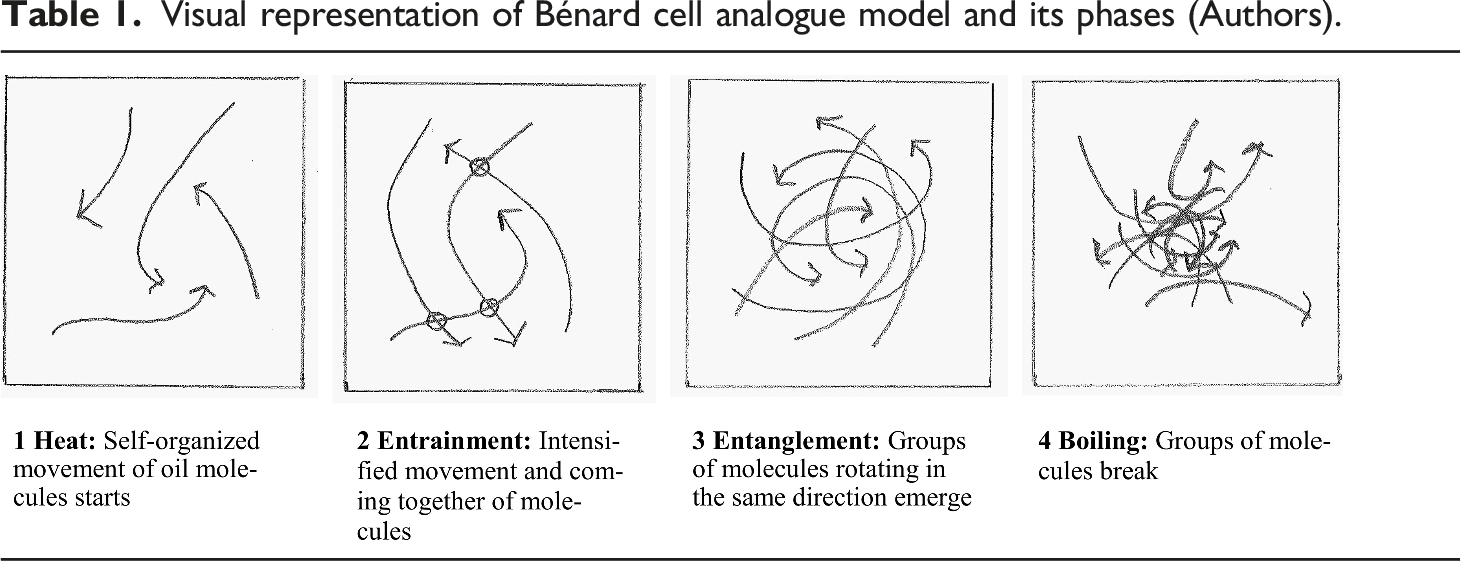
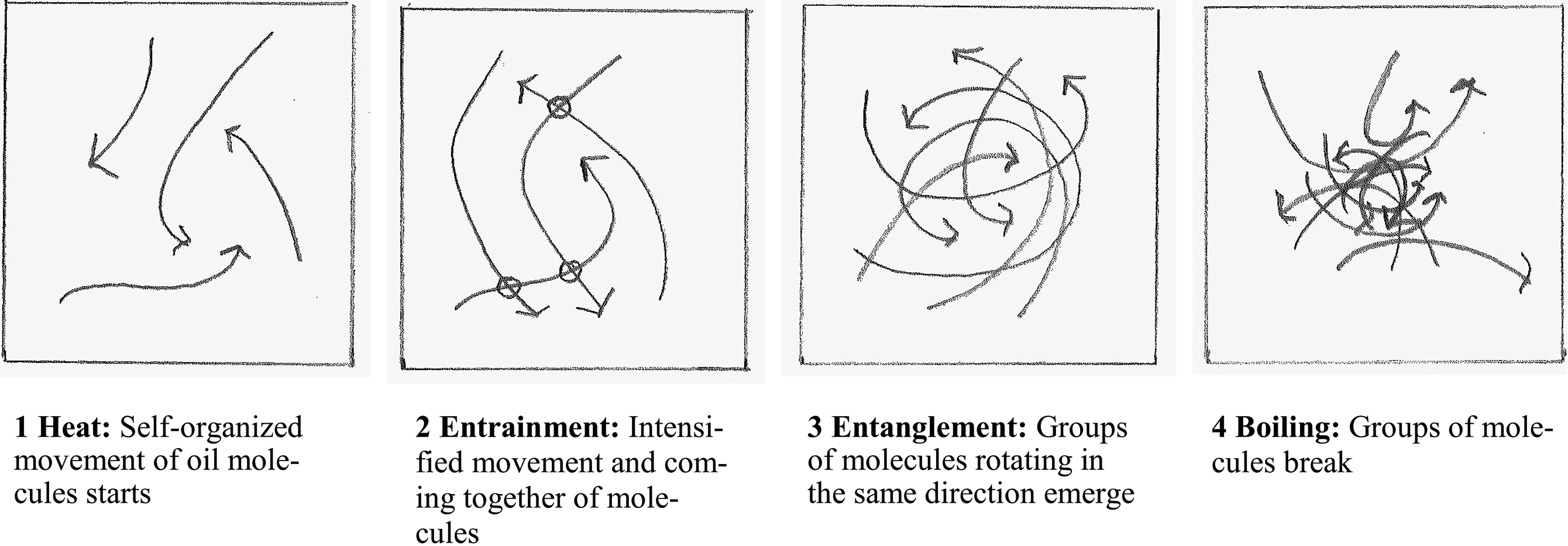
We identified the aforementioned four phases of heat, entrainment, entanglement and boiling as the most productive for us when setting our case study of people’s participation in parallel with the Bénard cell model. In our view, this means that an analogue model is not a rigid tool, but it is always sensitive to the context in which it is applied. To us, the first phase of rising heat in the Bénard cell can be compared to situations in which individual restlessness and energy are about to create action, pushing people to participate (Peltonen 2006, 152). Gamson (1992, 31–32) interprets this rising heat as an essential driving force for collective action to emerge, boosting the social movement.
The entrainment of oil molecules in the second phase of the Bénard cell model can be compared to how people become involved in collective action. One thing leads to another, and there is no single driving force (Peltonen, 2006; Letiche, 2000). This enables us to pay attention to the variety of people’s paths to participate. Each entrainment is relational as a response to the heating situation, be it in personal life or in the political climate of society (Peltonen, 2006, 157-161).
In the third phase, the collective action of Bénard cells has emerged from the entanglement of agent and structure. This entanglement is mutually constitutive, meaning that the actors are moving the process but at the same time are moved by it (Peltonen, 2006, 154). An illustrative example is how an environmental movement builds up from its participants but also moves them by affecting even their personal lives (ibid.).
In the fourth phase, the oil is boiling. The action becomes too heated and molecule groups start to break. This can be compared to situations where people's collective aims are no longer met. This phase of the analogue model has not been recognised in previous research on social movements (Peltonen, 2006). We wanted to analyse whether the elements of the boiling phase were possible to identify in the process of self-organised participation. In the following, we will describe our case study in more detail and then move on to the analysis.
Case study: Building a public sauna as a participatory experiment
Our empirical case concerns the process of building a public sauna in a new planning district in Tampere, the second biggest metropolitan area in Finland. This district called Hiedanranta is located four kilometres from the city centre and has no housing yet. The City of Tampere purchased the land in 2014 from a paper and pulp industry company (Alatalo et al., 2018). The district was used as an experimental platform for the city in 2015–2020. These experiments also involved citizen participation. Several vacant buildings – from brick factories to a manor house by the lake – were used for different collaborations with citizens and other actors. Thus, there are business start-ups, artists, skateboarders, university courses, research projects and diverse cultural events activating the district. The city council is planning housing in the area for 25,000 people and hopes to create 10,000 new jobs (Alatalo et al., 2018). The official city planning procedure has involved more traditional public participation, such as workshops, online forums, and public hearings (Sjöblom et al., 2021).
Our case study is one of the participatory experiments arranged in the developing area: Hiedanranta sauna project. The project started in 2017, when the researchers of this paper initiated the idea to collaboratively design and build a sauna that was to be open to anyone at any time, free of charge, and maintained by the local community. The interest in building a public sauna connected people: around 50 participants came to the first meeting and roughly 100 were involved in the project during the first two years.
Although the process of designing a public sauna in Hiedanranta received wide publicity as well as support from many city officials, there were other public officials who made the realisation of the sauna difficult by hindering the agreements for land use and being reluctant to find functional solutions. Gradually, the enthusiasm of the participants withered as the procedure of obtaining different permits was prolonged month after month.
Our analysis focuses on the second attempt of building Hiedanranta sauna and more precisely on the summer of 2019 (see also Havik and Altés Arlandis, 2022). The second attempt started in March 2019
The 2019 relaunch happened so quickly that no clear roles regarding responsibilities or leadership were settled. The participants who designed and built the sauna were diverse citizens working or spending their leisure time in the Hiedanranta area, city officials, an architecture class from Delft University, researchers from Tampere University and local sauna enthusiasts. One important feature of the process that had started in 2017 remained the same in the new phase: the Hiedanranta public sauna was an open project. Participants and their roles were not fixed, meetings were advertised on an open Facebook group, and everybody was welcome to join the project as they wished. The outcome was also open: while the target was to build a sauna and rough guidelines were set, the plans were negotiated and developed down the line while building, among the people present.
Our approach was participatory action research, where the reflective process is directly linked to action, influenced by an understanding of history, culture and the local context and embedded in social relationships (Baum et al., 2006, Kindon et al., 2007). Action research aims to engage the complex dynamics of a specific context (Stringer, 2013, 1). Thus, the focus is on knowledge generated in action and through iterative cycles of adjusting practice following insights from research (Reason and Bradbury, 2008). In our study, the intensity of action did not allow us to do traditional observation or interviews. Instead, we as researchers, gained a close insider experience and a thick understanding (Wagenaar and Cook, 2003) of the self-organisation dynamics and the different phases involved. The intensity did not only push us to new roles and novel modes of action but it also made us apply our academic understanding creatively and in quicker iterations than usually. We participated actively throughout the whole sauna building process. Our aim, along with other participants, was to build a sauna, but also to support community-building and citizen participation in the planning of the Hiedanranta area.
The data analysed includes two research diaries written by a researcher and a research assistant during the process 2019. The diaries include photographs taken mostly during the construction phase, and they were fed by discussions with other people and actor groups who joined the project.
To understand the self-organisational dynamics, we set the process of participation in reference to the Bénard cell model and its phases characterised by heat, entrainment, entanglement and boiling. Previous research findings support the recognition of these phases. The first three phases are present in the analysis of the emergence of social movements (Peltonen, 2006). The fourth phase has been recognized by Jalonen et al. (2020), who point out that collective action may lead to collective destruction, especially if the interests driving the action lose coherence.
Dynamics of participation without a distinct leader
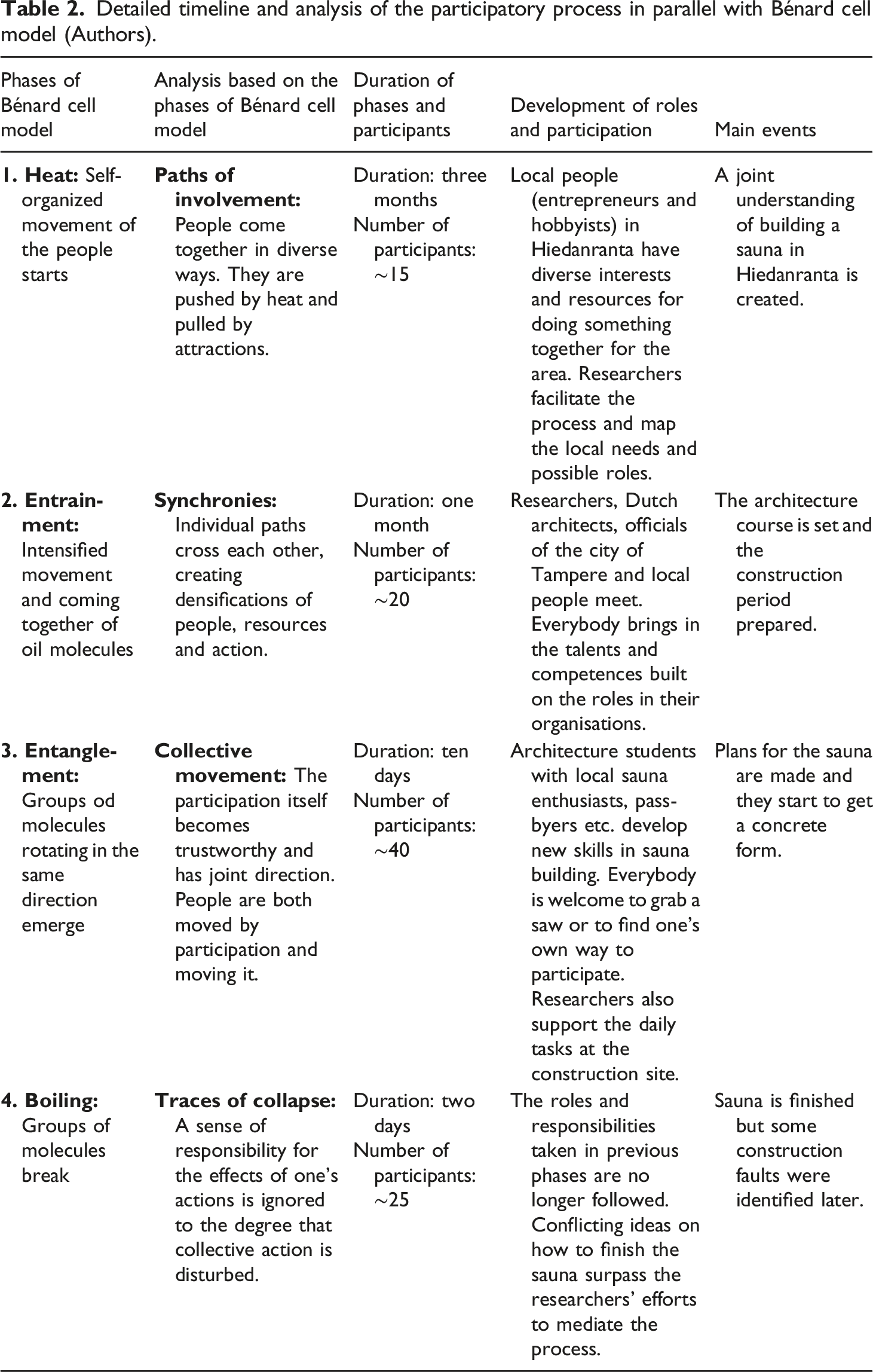
Detailed timeline and analysis of the participatory process in parallel with Bénard cell model (Authors).
Paths of involvement
In the first phase, people were both drawn towards each other and driven by heat, a kind of restless energy both in society and people’s personal lives. Individuals came together via various paths. The local participants, for instance – skateboarders, artisans, artists, workers in societal enterprises and small-sized green industries – had each found their way to Hiedanranta for their own reasons, yet most came due to cheap rents and exciting vacant industrial spaces. Their daily activities were based near the sauna lot, and thus they naturally found themselves interested in the project. There were both local as well as individual sources of heat pushing to participate. In the area, many groups had solidified themselves during their first years and now had extra energy to think of new collaborations outside their established social spheres. In addition, some individuals had strongly felt for a while that the area needs a sauna.
Following the different paths of involvement, we recognized attraction as a source drawing people together. To participate, there must be something interesting enough that invites people. Attraction describes how the decision to participate follows a feeling, a kind of hunch of a possible positive experience, rather than a rational choice (Peltonen, 2006). The majority of the people who had joined the sauna project in 2017 had given up after two years, as the process got repeatedly stuck despite the laborious efforts. In the spring of 2019, there were still some participants left, most of them older men with experience in the construction industry or project management. They were used to the rigidity of building projects, as one explained to us: Don’t you worry, this is nothing. It is normal that projects get stuck like this all the time. That’s how it goes. (Field Diary A, April 2019)
These people exemplify a glue-like attraction to the sauna project. They were especially attracted to the idea of building something concrete together, and this attraction was strong enough to keep them attached even without the actual building phase in sight. Their know-how of the local circumstances and previous stages of the project were vital in several ways. Their persistent work had secured a lot for the sauna after a process in which several places had been debated, designed and deemed improper before the final agreement. Their actions had accumulated material resources for the sauna, such as the two containers that were ready to be used. Thus, they were essential actors in terms of maintaining the heat in the process that was close to dying out – they kept things alive in a way that everything was ready to be jump-started once the right kinds of new energy poured in.
New energies to heat up the sauna process came in the form of sudden attractions, like infatuations, of which one of the strongest was the opportunity to collaborate with the Dutch architecture course (described in more detail as part of the next phase). In fact, people who participated following sudden attraction brought vital extra flushes of energy to all phases.
Synchronies
In the second phase, entrainment brought together the different paths of people, resources and action. Some of these crossings of paths were vital for the process, while others can be perceived more as a growing source of energy, creating intensity that eventually boosts actors to participate and do things together. The intensity in this case resulted from a limited time frame and an increasing number of people taking part in the action.
The turning point was the involvement of the students from Delft, who first arrived in Hiedanranta in June 2019. The agenda of their university course was to experiment with building a wooden sauna and some other wooden structures. The idea of doing something in Hiedanranta was first introduced in late March, and the students arrived in Finland at the beginning of June. The students had no previous understanding about the Hiedanranta sauna project and its history when they arrived in Finland. The two weeks when the students were in Finland created the necessary push: it was now or never. Everything needed to happen within those two weeks, and the preparations had to be ready by that time.
The energy boost for a collective movement can emerge from several things taking place simultaneously (Gamson, 1992). In the sauna process, the energy boosts emerged when the paths of actors crossed each other. The crossings or comings together that we recognized as vital for the sauna building were named synchronies. We recognized three synchronies that were essential for the process to move on.
The first synchrony took place when the teacher from Delft, the culture coordinator of Hiedanranta, a Tampere University researcher and the Head of the Hiedanranta Development Programme met in May 2019. The previous public sauna experiment had ended not only in the disappointment of the activists, but it had also left people within the City organization disappointed with the activists, and there was frustration towards the rigidity of the system. Thus, when information about a new opportunity to realize the sauna project reached the Hiedanranta Development Programme, it was received with enthusiasm: This feels like the stars aligning! Now the combination works: the teacher handles the course, the researcher the former activists, the culture coordinator the local communities, and we from the City organize the funds. (Field diary A, May 2019)
There was also a good deal of future promise seen in the co-operation with the esteemed Architecture Department of Delft. These promises were strong enough for the City to take on the risks of the experiment once more.
The second synchrony is related to the previously unresolved issue of acquiring the building materials. Originally, it had been proposed that the City would acquire the materials, but this turned out to be too slow for the project. The involvement of the local skateboarder association solved the situation: they had both the general and local know-how. More importantly, they had the courage to take the risk of buying the materials at their own expense before there was clear information regarding how and when the City would pay them back. This demonstrates the possible agility of participation without clear leadership to overcome earlier obstacles.
The third synchrony took place when the sauna activists, local actor groups and Dutch students came together in June 2019. The local actor groups joined the design phase with the idea of adding a stage in front of the sauna building. After the students had settled down and had their work running, volunteers were invited to work with them. Every day one or two activists or local actors worked with the students (Figure 1). They also took part in discussions concerning design solutions and structural issues. This coming together of the activists, local actors and students brought meaning to everyone’s work. Activists could see that their previous struggles had been worth it, and they were again invited to join. The students felt welcomed and appreciated; they understood they were a part of a continuum, a process that had started before them and would continue after their input. Students, local sauna activists and people from the area working together. (Photo: Veera Turku).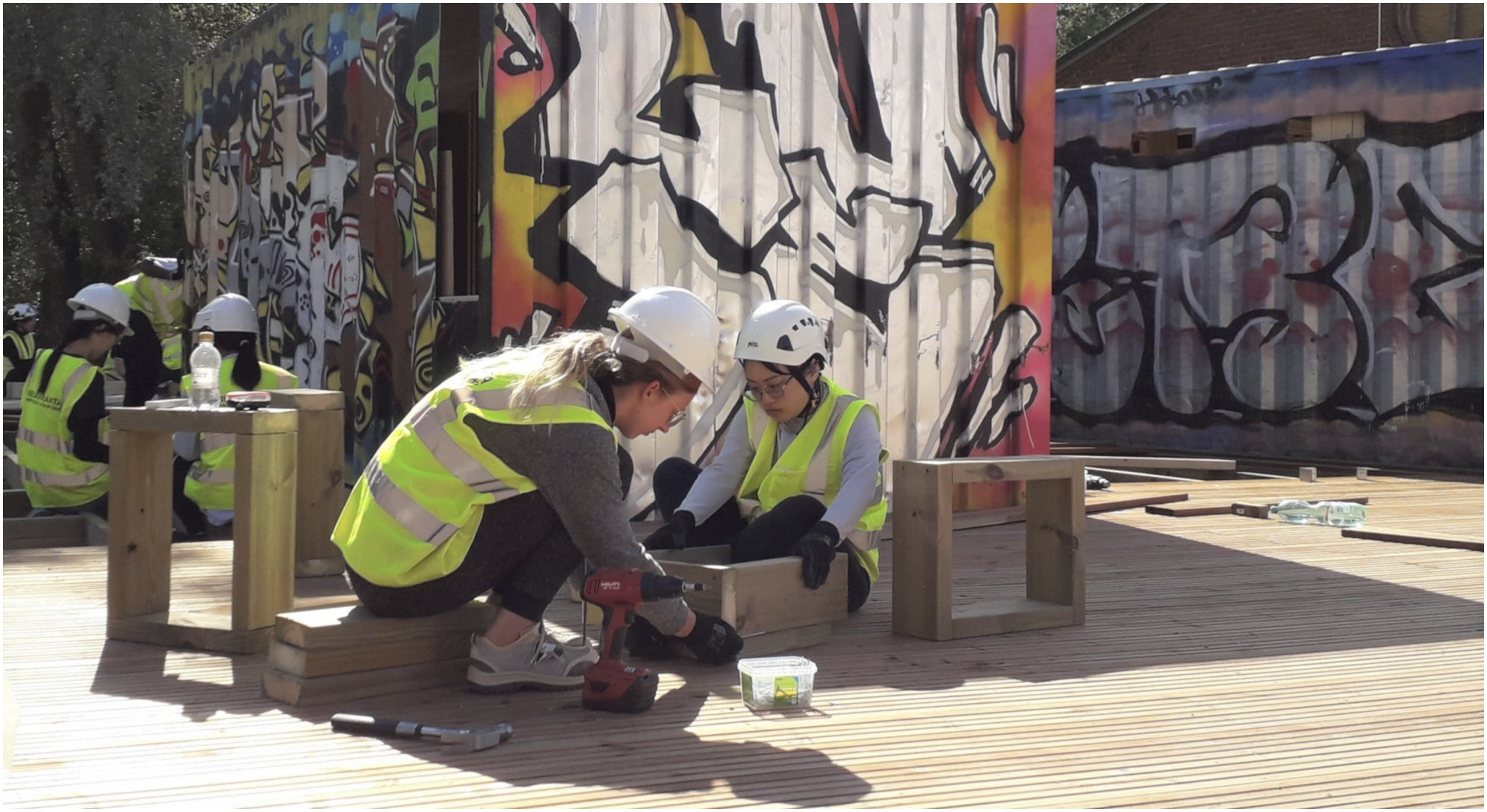
The intensity of the second phase challenged the City organization. The groundwork for the sauna was to be done by the City and was supposed to be ready when the students arrived. Still, there were opposing forces in the City organization who were not ready to take the risk for such an experimental project. This led to internal paralysis within the City organization, with the groundwork grinding to a halt. The intensity of the situation pushed another civil servant to take an individual risk to be the official constructor. In addition, the City bureaucracy could not keep up with the time frame: in the end, the sauna was granted its planning permission, and other legal agreements were settled only after the building was completed.
Collective movement
In the third phase, the collective movement was strongest. Similar to the Bénard cell, once the collective movement had emerged, it had the power to maintain its direction. The movement itself became trustworthy and had a clear attraction of its own. Participants who had been promised a salary for their work kept on working even without contracts. Building the sauna became a world of its own that people knew would have its deadline in two weeks. Many had agreed to take certain days off from the site, yet they could not keep themselves away, feeling they might be left out of something important. The discussion with a skateboarder participating in the project illustrates the difficulties of leaving the site: He has two tickets to an art and music festival. With a pass to VIP catering, hotel, and all. Yet he does not want to go. He said he would rather curl up in a corner of the sauna as it feels so good. (Field diary A, June 2019)
The process continued to attract novel participants, and its intensity pushed the more adept participants to take on new tasks, leaving gaps for newcomers to fill. The facilitators found themselves stepping into new boots. This illustrates how a process without clear leadership stimulates adaptive roles, making participation more agile and resilient. For the students to be able to concentrate on the building work, many of the daily tasks were taken on by the research assistant. She started to take care of the groceries and cook evening meals, as the cooking seemed to stress some of the students. She also organized the washing of laundry, fetched medicine from the pharmacy and settled small quarrels brought up by the intense living together. The university researcher in turn found herself increasingly often mediating between opposing interests. In her mediating role, the researcher was balancing between supporting the movement towards the realization of the sauna and keeping the process regulated enough to please the authorities.
As the process was steadily moving on, more and more people wanted to contribute. New people had novel ways to participate, bringing with them both what they thought was missing and what they thought was an easy task for them. One shared music through a window opening on to the construction site, taking part even while doing other work. Another started making information posters, noticing a crucial thing missing while pondering how to participate with her physical disability.
The notion of entanglement is useful for understanding the dynamics of this phase. It demonstrates how people take on new roles as the process enables them to do so and because the process pushes them to novel action. Moreover, as the process produced more action and gathered people and resources, it also made participation more attractive (Figure 2). This again draws in new people to join the process, adding to the intensity. These different entanglements feed the collective movement and tie it together. The attraction of the process was so strong that it pushed people to work at night-time. One activist came to work at the site after his daily job, to which he returned in the morning. (Photo: Aleksi Martikainen).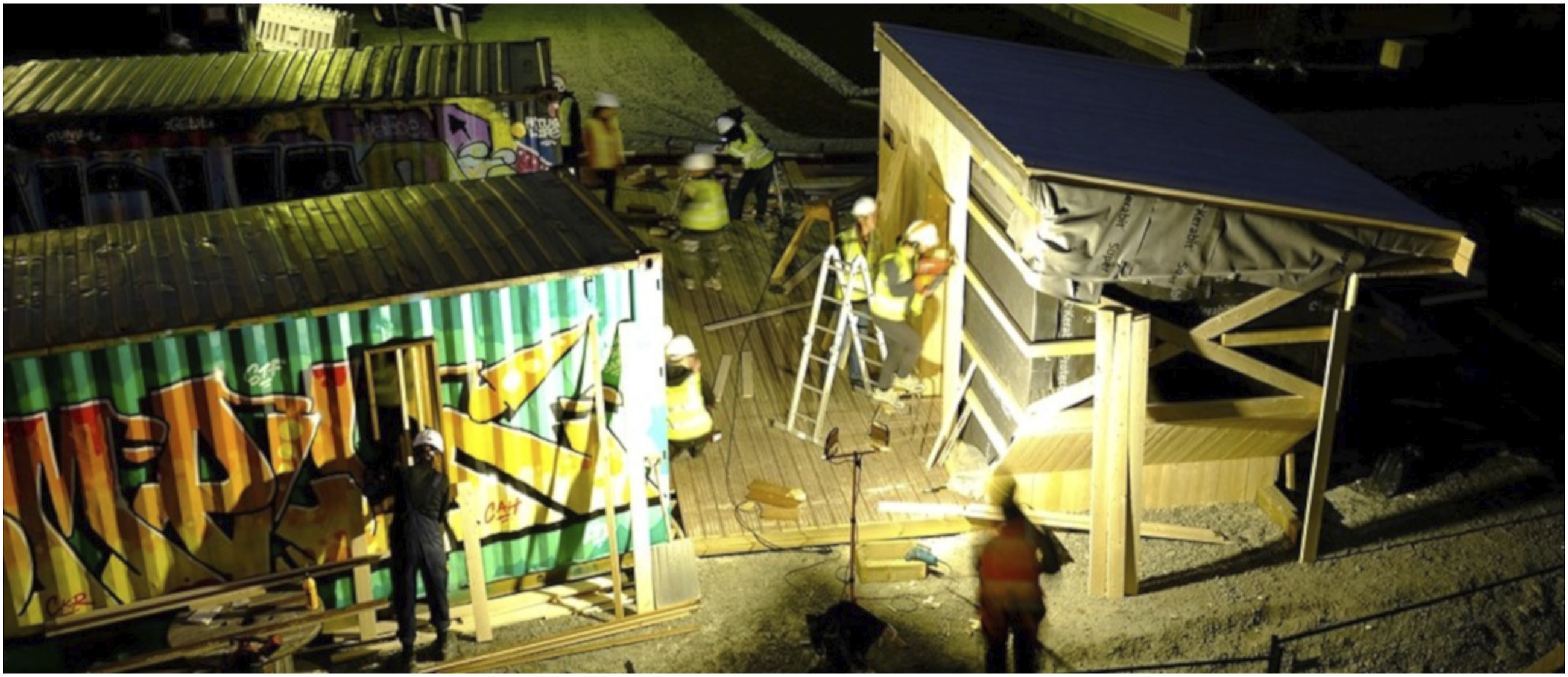
Traces of collapse
In the fourth phase of participation, the intensity grew excessively. In the Bénard cell model, the groups and movement of the oil molecules start to break in the presence of excessive heat. In our study, we recognized similar cracks. While the intensity of participation grew, some issues were pushed aside because of time constraints. Some of the former sauna activists felt excluded because of the tight building schedule, to which they felt they had not had time to adjust. Towards the end of the two weeks, the intensity started to break the collective movement. The construction site became messy, which was a safety issue. People were extremely tired, refusing to rest. Expensive tools were left on site without a guard. There was no shared understanding of timetables anymore. A certain kind of rebellion broke out; people rid themselves of the responsibilities they had earlier voluntarily taken. It has started to rain. There is sawdust everywhere. The circular saws should be taken under shelter, but people explain with serious faces that they cannot stay on to carry them. (Field diary B, June 2019)
The quote illustrates one of the major challenges of a participatory project without distinct leadership: there was no agreement on how and by whom the intensity could have been reduced when the process started to collapse. The process continued through its emerged strength even when slowing down and clearer coordination would have been necessary.
To sum up, participation started to break due to the same elements that had given birth to it. In the beginning, the free format of participation allowed the process to emerge, challenging the dominant rigid participatory structures. After a while, the intensity pushed people to take on new roles to the degree that earlier roles and responsibilities were discarded. Eventually, too much intensity created more asynchronies than synchronies. Participation became partly self-destructive due to excessive working hours and the messy division of roles. Nevertheless, sauna was finished and opened to public use.
Analogue model revealing the importance of emergent participatory action
Our analysis on the participatory process without strong administrative-organisational leadership utilised the Bénard cell analogue model as a research method. With the Bénard cell model, we were not aiming to develop a theory but wanted to understand the patterns of self-organised action. To avoid the risk of taking an analogue model as an explanation for the phenomena and thus getting misled (Haila and Dyke, 2006; Haila, 2007), we paid attention to the parts where the model and the process analysed differ from each other. For example, focusing only on heat as a driving force could mislead one into not noting the pulling forces of attraction. In public participation, the boundaries between different phases are not so distinct as, for instance, in the Bénard cell when the oil starts to boil. Taking the analogue model as an explanation could mislead us to think that participation could simply be heated up, like oil molecules can be, to reach the desired interaction. Knowing that human action is not that deterministic, our focus has been on the sequence of phases of participation and how they follow or might not follow each other. Participation can get stuck in the first phase, no matter how much heat is created. From there, it might jump quickly to the phase of co-destruction if there is not enough delicate and talented support for synchrony or entanglement. This means that participation without strong administrative-organisational leadership still needs facilitation, especially regarding phase transitions.
Our initial idea to work with the Bénard cell analogue model followed that of Peltonen’s work (2006): we wanted to understand how people participate and how collective action emerges if there is no clear leadership in the project. Peltonen focused on the dynamics of a historical process conducting the analysis long after the self-organising process had taken place. He scrutinised the research in the emerging phase of the process (ibid., 2006). In our study, we quickly noted that both our data and the model itself provided tools to study the process beyond the starting phase. In doing so, we were able to apply the model in a more nuanced way, thus developing the model itself further by clarifying the phases and elements on which to focus (see Tables 1 and 2). The model helped us in following the self-organisation of people throughout the whole process, revealing the thick dynamics of self-organising action.
Analogues are situational; their meaning and value come from how much they help in clarifying the analysed phenomena. Our empirical case study was simple enough for recognising the qualitative similarities in the dynamics of participation and the Bénard cell example. The ground for the comparison was found in the equivalent patterns of action. The next question is then how, and what does the analysis offer for carefully orchestrated institutional planning procedures? Our case shows that with a certain freedom, content-driven participatory planning can be creative, have integrative energy and, even realise a concrete end-result. The case illustrates that people want to participate and create concrete outcomes if the process is meaningful to them. One way to ensure meaningfulness is to leave room for people themselves to define how and for what purpose they participate. Rather than having specific predetermined roles, participants can invent and adopt novel roles during the process.
Even though experiments with a high amount of self-organisation represent a minority within the institutional participatory processes of urban development, we argue that self-organisation is a fundamental source of activity and creativity. By creativity, we refer to the diversity of possible outcomes through the inputs of self-organising participants. This creativity increases the capacity to overcome obstacles in situations where more formal participatory procedures may be stuck for a longer period.
Institutionally led participatory processes may lose in the variety of participants and in the creativity of the process. A public hearing arranged for one evening does not last long enough for a glue-like attraction to develop. These kinds of events usually keep participants' tasks quite specific and limited. As we see it, self-organising part of the process can increase the capacity of formal institutionally organised participation. Even though strong administrative-organisational leadership can be effective in the short run, in cases of urban regeneration and development, community involvement and citizen participation are central in mobilising more common desire and commitment for local area improvement (Haus and Klausen, 2011). This brings us to the fundamental reasons why citizens participate or why cities want people to participate – to make everyday life in a certain place better. Participation for that does not start somewhere and end, but it is ongoing, shifting in different forums and varieties of ways, with different issues at stake (Leino and Laine, 2012).
Conclusions
According to Goodin (2008), democracy should be designed in such a way that it encourages people to come together to discuss common problems and find solutions. Moreover, it should inspire citizens to engage actively with one another in the joint management of their collective affairs, thus developing their own capacities and perspectives (Goodin, 2008, 2). However, citizens often seem to be, as Hajer (2003, 98) describes, on ‘standby’. There must be an initiative that triggers people to reflect on what they value and to act on it (Hajer, 2003, 98). In our case, even though the issue of building a public sauna was mundane and small-scale, it became constitutive of the politics of participation. The project attracted not only experienced urban activists, but also unusual participants, like retired or unemployed men with much free time and shy people. It was remarkable that these people found their way to the project by inventing their roles themselves, simultaneously demonstrating how the usual roles for public participation had ruled them out.
Crafting an invitation to participate in a democratic experiment is active and delicate matter. The process needs to balance between proposing alternative possibilities that intrigue people and leaving enough ambiguity and open-endedness to allure the participants’ desire to influence the experiment (Binder et al., 2015). This requires understanding the issue in question, while also pointing to the importance of not knowing the answers. The invitation also points towards the more active involvement of the participants – that they are invited to perform something new together (Munthe-Kaas and Hoffmann, 2017).
There is a growing concern about the de-politicization of planning in general (e.g. Inch, 2012; Legacy, 2017). Many argue that consensus-seeking participatory processes in particular evade politics in planning and prevent citizens from challenging public discourse (Metzger et al., 2015; Slaev et al., 2019). Participation in planning is in crisis if it is approached as a ‘one fits all’ format organised by formal planning institutions (Albrechts et al., 2019). Thus, instead of focusing on participation, we should focus on the agency of citizens. When there are multiple ways to form an agency it provides space for expressing disagreement and conflict. This creates practices and institutions needed for a vibrant public sphere (Mouffe, 2005, 76) and for constructing alternative futures (Albrechts et al., 2019). Continuing from this, we want to stress the re-politicising potential that self-organising participation can offer for planning.
The empirical case illustrated the powerfulness of proactive citizen participation. The participants were not acting against something but for building a better public place and more livable neighbourhood. Although citizens presented alternative ways of proceeding, they did not come up against the city's administrative organisation as such. The planning and building ideas were demonstrated in practice. All the participants understood that ideas were seeking their shape through the making. Thus, there is a difference between providing a possibility to participate and citizens getting involved and contributing to the governance capacity in one way or another.
A vital result from the perspective of citizen participation as political action is that the process allowed personalised participation. People could define for themselves when, how and in what role they would participate. They recognised their assets themselves, often overcoming general expectations. This is important to note: the participants hardly thought of themselves as activists or as political actors, even though their actions were radically new to themselves and to their surroundings. To challenge the established institutions and to provoke a shift in participatory planning, we need novel ways of knowing that constitute an epistemology of multiplicity for planning practice (Albrechts et al., 2019).
Thus, with this study, we foreground the remarkable power of citizen participation once more, not as something that needs to be constantly steered and controlled, but as something that has the power and potential as long as citizens have enough freedom and time to realise their ideas and passion.
Footnotes
Acknowledgements
We want to thank all the people who participated in the planning and building of Hiedanranta sauna. We are also grateful for the constructive feedback by the three anonymous reviewers.
Corrections (April 2023):
The article has been corrected with some minor textual errors.
Declaration of conflicting interests
The author(s) declared no potential conflicts of interest with respect to the research, authorship, and/or publication of this article.
Funding
The author(s) disclosed receipt of the following financial support for the research, authorship, and/or publication of this article: This research was supported in part by the Academy of Finland; 303481 and 351019.
