




Abstract
This essay examines the implications of interdisciplinary debates on the power of “weak theory” for planning practice. Focusing on the North American planning context, I argue that the concept of “weak theory” – with its emphasis on specificity and mid-level generalizations and its openness to doubt and contingency – has long been a source of discussion about social interventions, but the significance of this approach for understanding cities and informing city planning practice remains largely unappreciated. This essay critically reflects on the concept of “weak theory” and examines how it can promote intellectual diversity and enhance planning practice by making theory less dogmatic and more accessible.
Introduction
In May 2020, the Development & Heritage Committee of the city of Windsor, Ontario, Canada heard arguments on two rezoning proposals for converting single-unit dwellings into multifamily housing. Writing in dissent, the Director of Planning and Physical Resources at the city’s Police Department argued that increasing the neighborhood’s residential density would endanger public safety in an area that had already reached its “social carrying capacity.” In contrast, the Executive Director of the city’s Planning Department argued that the correlation between density and safety, and the notion of “social carrying capacity,” were mostly “in the mind of police” and had no “bearing in planning theory or law” (Dalson, 2020). The Committee sided with city planners. Note that the term “planning theory” was invoked by city planners in this case to support their professional judgment; but it was also used disparagingly by a newspaper columnist at the Edmonton Sun, Canada in 2017 to criticize planners’ ideas as demeaning and patronizing. Railing against a new project to limit car lanes on the city’s main street, the columnist accused “anti-car, pro-bike” planners of marketing their “big, fat fail[ed]” idea as a roaring success. Planners, he charged, “are sure that their concept is good, [but we] are too uneducated to understand it,” because “we didn’t study planning theory at university [and] haven’t been to planning conferences where giddy hipsterish ideas are shared” (Gunter, 2017).
While these cases may be more pertinent to discussing the usefulness of planning theory, I’d like to use them as an entry point to probe an obliquely related issue: the perception of the strengths and weaknesses of planning theory. For, despite their disagreement as to whether planning theory leads to “good” practical judgments, both cases seem to acknowledge a certain sense of “strength” and power of planning theory. In the first case, the strength of theory portrays theory-as-wisdom or theory-as-virtue, validating planners’ expert knowledge. In the second case, however, the strength of theory is blamed for leading to an attitude of condescension or intimidation that begets defensiveness and wariness. These contrasting interpretations prompt me to ask: should the strength of theory be the overarching rationale, or the master criterion, for assessing its effectiveness? What happens, that is, if we let go of strength-in-theory as an imperative and, instead, rely on a weaker, less ambitious version of theory that humbly acknowledges its limited domain and omits to subsume all aspects of social reality under one unified overarching framework?
I pose this question against the backdrop of fierce criticism of the muscular image of planners since the 1960s – be it the view of planners as hardy guardians of the public interest who speak truth to power with “scientific objectivity,” or as lordly technocrats who advance the interests of the powerful in the form of urban renewal and regeneration. From this perspective, the image of city planners as powerful professionals exhibiting strong conceptual understanding should have been relegated to the historical past. But I also raise the question of weakness-in-theory at a time when the global rise of strongman politicians, together with increasing threats of climate change and the persistence of anti-Black, misogynist, ableist, and nativist violence, urges urban planners to show nothing but strength to address “wicked problems” and be radical and insurgent, rather than humble and pragmatic. These are two competing but equally “strong” claims, one against and the other in favor of the “strength” of planning theory. These claims have charged planners with theoretical dogmatism and bureaucratic overreach, on the one hand, and with acquiescent muddling-through and shoulder-shrugging humility, on the other. With these debates in mind, this essay examines whether and how recent arguments on the power of “weak theory” can play a role vis-à-vis the double-edged sword of “strong” planning theories.
Let me acknowledge at the outset that the term “weak theory” is not a coinage of this essay; nor is it related to recent anti-theoretical claims, such as “the death of theory” when post-structuralism was in retreat (Davis, 2004), or “the end of theory” when big-data analytics promised nirvana for every urban problem (Anderson, 2008). Rather, weak theory is a loose bundle of concepts used predominantly in an interdisciplinary body of writings (e.g., Tomkins, 1963; Sedgwick, 2003; Dimock, 2013; Saint-Amour, 2018; Stanley, 2019) to challenge the sovereign hold of strong habits of thought to determine which types of research deserve the label theoretical and which ones don’t. These scholars have questioned the idea that only “strong” theory is “good” theory, because of its ability to unify far-flung phenomena and provide an overarching framework to explain social reality. Neither is the strength of a theory its ability to be impervious to criticism or doubt, much less its capacity to function as “a universal solvent of all that resists its sway” (Jay, 2020: 16). Instead, proponents of weak theory define their methodology as accounting for “near phenomena,” and their aim as seeking to know, but not necessarily knowing before their inquiry (Sedgwick, 2003). Weak theory, so conceived, looks “just a little way ahead, behind, and to the sides” to appreciate unintended consequences and provisional practices (Saint-Amour, 2018: 445). It considers a finite subset of site-specific problems and relationships as its object of inquiry to present what Louis Menand calls “a one-dot theory” of sideways movements (2015: 73). Theory, in this vein, operates “more like a flashlight than the sun” – to borrow Charles Hoch’s apt metaphor (2017: 299).
But insofar as weak theory does little more than describe, it is subject to charges of insufficiency and deficiency – note Georg Lukacs’s critique that “description is a mere filler” or “a symptom of decadence” (1936: 110, 132). Also, insofar as weak theory aims to “de-dramatize totality without repudiating it” (Lavery and Saint-Amour, 2019), it faces accusations of quietism or lack of rigor, similar to the charges made against William James’s advocacy for “tender-minded,” as opposed to “tough-minded,” habits of thought (1988: 491). 1 Further, where weak-theoretical projects heed Wittgenstein’s call to focus on concrete cases and resist the temptation of abstraction (1958b), they become vulnerable to liberal critiques of status-quo conservatism. And where weak theorists try to challenge established orthodoxies, not by blasting theoretically but by “spilling over the edges” of the objects they explain (Fulford, 1992), the way Jane Jacobs did in The Death and Life of Great American Cities (1961), their research risks being dismissed as normatively blunt or blatantly anti-intellectual, as in Lewis Mumford’s gendered review of Jacobs’s book: “Mother Jacobs’ home remedies for urban cancer.” 2 Given these charges, why embrace a term of derogation, weak, in a weakly theorized field, planning? More broadly, at a time when one no longer needs in-depth theoretical analyses to see social dominance and injustice, what’s the point of doubling down on theory, let alone dabbling in “weak theory”?
My aim is not to address these questions head-on; nor do I give a priori privilege to weak theory over strong theory, let alone claim that the time of strong planning theories has passed and, in its wake, weak theory has dawned. Rather, my aim here is twofold. After a brief note on conceptual clarification, I first examine recent debates surrounding the concept of “weak theory” across various fields of study. I then explore the precedents of these debates in the planning field, with a particular focus on the history of city planning in the United States. I argue that even though the notion of “weak theory” is considered a recent theoretical trend in fields that study the conditions of (post)modernity, it has long animated discussions in the “applied” field of urban planning, because of the field’s salient characteristic – practice – and its location at the contentious interface of the state, market, and civil society. In fact, since its “pragmatic turn” in the 1980s (Healey, 2009), the planning field seems to have largely shifted away from abstract, mega-theorizing and is now focused more on relational, contingent, and practice-inspired approaches to social change. Despite this major methodological shift, the significance of adopting a weak-theoretical approach for thinking about cities and city planning remains largely unappreciated. The essay ends by reflecting on the implications and limitations of these trends for intellectual diversity and social activism in planning education and practice.
The weak, the strong, and the plea: What they mean and why they matter?
A call for “weak theory” may invite criticism that the term weak “sits at the center of a dense array of slurs by which marginal subjects have been kept marginal” (Saint-Amour, 2018: 438). Validating this concept would imply endorsing the impulses of oppressive structures that employ the term “weak,” invariably and normatively, as a synonym for woman, queer, disabled, immigrant, the poor, or colonized “wretched of the earth” (Fanon, 1965). I use the terms “weak” and “strong,” however, in their descriptive sense (i.e., non-normative, non-evaluative), which has to do with questions of conceptual range and generality. I follow Eve Sedgwick (2003) and Paul Saint-Amour (2018), who argue that a theory’s “strength” in a normative sense (its effectiveness, vitality, or explanatory power) is not commensurate with a theory’s “strength” in a descriptive sense (its breadth of reach, sureness of purpose, or generality of claims). Put differently, what is “weak” and yet effective about weak theory is its localized purview, limited claim, and openness to doubt and contingency, not its lack of rigor or generalizability. To quote Anthony Appiah (2021): “A weak theory which makes no claims to certainty and is undisturbed by inconclusiveness and mess can produce strong writing, not to mention vigorous analysis.”
Be that as it may, one of the challenges of considering “good” planning theory as something other than “strong” theory in the descriptive sense is that it may appear powerless against social conflict and oppressive power that demand “strong” planning interventions in the normative sense. Hence, acknowledging the usefulness of “weak theory” in today’s planning academia entails a risk. We risk performing what Quentin Skinner called the “evaluative-descriptive” speech act (1973: 298), wherein to describe a certain idea or phenomenon is viewed automatically as commending that idea or phenomenon. That is, the act of describing something is viewed as attributing superiority to it. This is why I have titled this essay “a plea.” As J. L. Austin notes in A Plea for Excuses (1956: 3), when we plead, we not only express “a genuine uncertainty and ambiguity as to what we mean”; we also acknowledge a set of standards that judge our actions or intentions as unacceptable or disallowed. 3 Pleading in this context means embracing uncertainty and seeking possibilities. I will return to this point later. But first, let me “describe” what weak theory is, or claims to be.
Weak theory: Analysis of a descriptive term
Recent attention to the notion of “weak theory” has been spurred by a series of contributions to the 2018 special issue of the journal Modernism/modernity and its Print Plus platform afterward. 4 These publications show that the ideas behind the concept of weak theory have a long history in various branches of philosophy and social theory, such as pragmatism, Marxism, and deconstructionism. Not only does this mixed assemblage of overlapping and contrasting affinities signify the “weakness” of weak theory – again, in a descriptive sense, as diffuse and fragmented rather than precise and solid; it also makes the act of “defining” weak theory unwieldy, even problematic. But then, how to explain a term that defies fixation without sliding down the slippery slope of relativism as if “everything goes”?
Wittgenstein’s concept of “family resemblance” offers a useful way to untangle the messy debates on weak theory. To Wittgenstein, the conceptual confusions that we encounter when trying to “get clear about the meaning of a general term” arise from “our craving for generality,” i.e., the urge to find “common elements in all applications” of a general term – be it beauty, knowledge, or arithmetic (1958b: 17). This urge, which presumes that the less general is incomplete, leads to “the contemptuous attitude towards the particular case,” or rather, towards all but one case that is considered general or representative. Various uses of a general term, Wittgenstein argues, don’t share a fixed essence. Rather, they form a network of crisscrossing similarities the way members of a family do: “build, features, color of eyes, gait” (1958a: par. 66). No member of a family may have all the features; some may even have opposite traits. 5 But we recognize them as relatives, because “what runs through the whole thread” is just a “continuous overlapping of [its] fibers” (par. 67). Games and instances of language form a family, Wittgenstein says. Weak theories, I suggest, form a family too. They share some common “properties,” but these properties are not “ingredients” of all formulations of weak theory the way “alcohol is of beer and wine” (Wittgenstein, 1958b: 17).
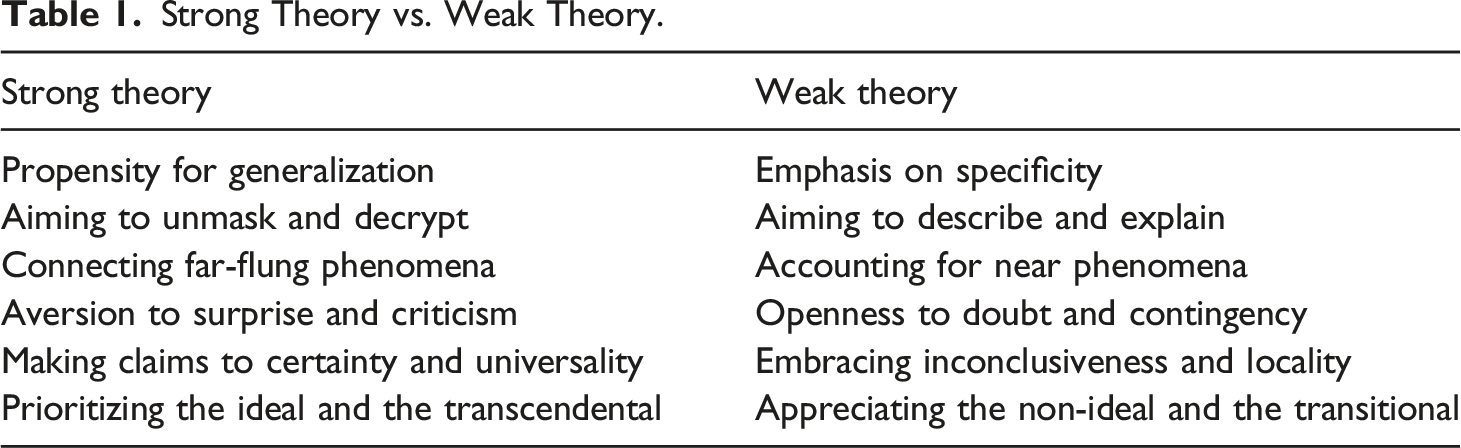
For Eve Sedgwick (2003), who draws on psychologist and cybernetician Silvan Tomkins’s book, Affect-Imagery-Consciousness (1963), the aim of weak theory is to extend knowledge by means of explanation without extending that explanation too widely. The act of theorizing, Tomkins says, involves maximizing positive and minimizing negative emotions in the theorist, such as excitement or humiliation (1963: 428–442). Theories that fail to minimize negative emotions – to deflect criticism or explain new circumstances – tend to become “stronger” by connecting a wider array of disparate objects into their fold to increase their applicability. Strong theories, in other words, become stronger by equating the breadth of a theory’s reach with its richness, and the grandness of a theory’s claims with its goodness. Advocates of weak theory view this indicative mood of strong theory as monopolistic. They argue that the effectiveness of a theory would increase if we limited its reach, restricted its domain, and localized its purview – i.e., if we practiced “a weaker, lower-level kind of theorizing” (Dimock, 2013: 733).
Thus, for Sedgwick, orthodox Marxism is a strong theory when it becomes increasingly totalizing and teleological in opposing an ultimate strong phenomenon: Capitalism. Likewise, “high modernism” is a “muscle-bound” theory for James Scott (1998: 4), as it looks at everything through the same spectacles. So were the classic secularization theories of the 1960s for those who saw the imposition of a single moral value system as “tautological” (Gorski, 2003: 117). True, the act of theorizing, since it is inherently a mode of selective scanning and amplification, is bound to be seen as somewhat tautological to those whose experiences and practices have been the subject of theoretical speculations. It is partly for this reason that, according to Paul de Man (1986), “resistance to theory” is part of the theory itself, emerging automatically along with the claims that a theory makes (Jay, 1996; Gouldner, 1973). But strong theories, with their propensity for overgeneralization and their aversion to doubt and criticism, Sedgwick argues, also tend to be strongly tautological, even “paranoid” (2003: 136). No wonder that at the end of one of his essays, Freud talks about the “striking similarity” between paranoia and theory, including his own theory and his patient’s delusion: “the delusions of paranoiacs have an unpalatable external similarity and internal kinship to the systems of our philosophers” (1955: 261).
Against the axiom of strong theories that “a future [is] never for a moment in doubt,” weak theory welcomes uncertainty and inconclusiveness (Dimock, 2013: 733). It envisions a different goal for theorizing than telling us what we already know (e.g., the world is a place of domination) or foretelling what we cannot know (e.g., all state-led plans are bound to fail). Consider Sedgwick’s response regarding the latter assumption: “They might, but then again, they might not” (2003: 124). Weak theory thus settles for a lower level of plausibility and generalizability to provide a fresh look at certain phenomena that everyone knows something about, such as mundane forms of power or everyday practices. It scratches the surface of familiar phenomena to help understand how theory works in action (in actual lived situations) rather than in abstraction. A weak-theoretical work, for instance, may explain how modest accomplishments were achieved despite adverse conditions, or how local efforts might have failed even with ample resources. Weak theory, in this view, is neither a substitute nor a refutation of strong theory; it is an attempt to appreciate specificity and recognize unintended consequences and provisional practices. Stated succinctly, weak theory functions like a wedge under a door, at once resisting closure and leaving open the questions that we thought were settled.
For Kate Stanley (2019), the potential of weak theory is primarily pedagogical. “The aura of difficulty, inaccessibility, or significance” that surrounds terms such as theory and modernity, she says, prompts students to either attack or retreat from theory – an obstacle to their learning. When a theory’s strength is appraised by its ability to intimidate, and its virtue by its capacity to overwhelm, that theory becomes remote or “foreign” to students – and vice versa (Readings, 1990). Weak theory, in contrast, moderates the rigid assumptions of theory and tempers them into quotidian terms. As a result, students’ engagement with theory may become more intimate, rather than intimidating. Further, by foregrounding the ordinary everydayness of theory, weak theory helps conceive theoretical studies as what Wai Chee Dimock calls “a non-sovereign field” – i.e., as differentially constituted, loosely mediated, and multicentric with no primacy assigned to a genre or an author (2013: 738). In this context, weak-theoretical projects draw attention to off-center locations and peripheral creative practices whose theoretical and heuristic forces are not registered by strong habits of thought. For Sedgwick, this kind of theoretical exposition has “reparative” impulses and therapeutic effects (2003). It allows us to see what we cannot unsee afterward and hear voices that we didn’t know we needed – or whose urgency we didn’t feel – until we heard them. Teaching theory, in this vein, is an invitation to forge relationships with unfamiliar ideas and practices, with different identities and traditions (hooks, 1991). It is no surprise then that weak theory has gained much traction in fields that address issues of difference, inequity, and belonging, such as gender, queer, and indigenous studies as well as human geography and urban studies (Gibson-Graham, 2008, 2014; Williams, 2017; Wright, 2015).
The debates on the merits and perils of weak theory are, in fact, an outcome of heated debates on the reach and limits of “theory” itself in the humanities and social sciences in the second half of the twentieth century. As the concept of theory, after a period of apparent triumph in the 1960s, faced criticism from both the right and left of the ideological spectrum in the 1970s, theory in general and grand theory in particular became identified as “a game of mastery” dominated by “those who arrogantly pretended to speak for the whole” through their “God’s eye view above the fray” (Jay, 1996: 168–171). One upshot of the so-called “theory wars” of the 1970s was the widespread weariness about the usefulness of theoretical paradigms in the 1980s. With theory on the defensive, new arguments emerged for the self-sufficiency of the alternatives to theory, such as practice, narrative, or experience, vis-à-vis the totalizing tendencies of master theories. Anti-theoretical skeptics, who pushed these arguments to an extreme, produced manifestos “against theory” (Knapp and Michaels, 1982), declaring that “the theory’s day is dying” (Fish, 1985: 455). Proponents of theory, in response, argued that “what makes theory necessary, if by itself insufficient, is precisely the no less blatant incompleteness of its others” (Jay, 1996: 178). That is why advocates of weak theory over the past two decades have sought to strike a middle ground between opposing positions by embracing the incompleteness of both theory and its putative others without claiming completeness or resorting to the simplistic dichotomy of “good vs. bad” theory.
Similar debates have emerged recently in political philosophy regarding “ideal and non-ideal theory” following John Rawls’s theorizing about justice as fairness (Valentini, 2012). Rawls characterized his theory of justice as “ideal theory,” which identifies the end-state principles of “a perfectly just society” (1999a: 8), as opposed to “non-ideal theory,” which tackles “unfavorable conditions” and the pressing problems of injustice through transitional improvements and “gradual steps” (1999b: 5, 89). Rawls did not question the merits of non-ideal theory, but he argued that ideal theory is “the only basis for the systematic grasp of [how to address the] more pressing problems” (1999a: 8), because without the ideal first identified, “non-ideal theory lacks an objective, an aim, by reference to which its queries can be answered” (1999b: 90). This normative superiority of end-state theorizing, however, has been challenged by Amartya Sen (2006). For Sen, end-state theorizing, or what he calls a “transcendental” or “totalist” approach, is “neither necessary nor sufficient for answering questions on the advancement of justice” (p. 237). The transcendental approach, Sen argues, cannot by itself answer the practical question of how to “assess whether some social change would advance justice or hinder it” (p. 236), because such an approach views society as still “on the nonjust side even after the reform” (p. 217). In contrast, Sen has advocated a relational, comparative approach to justice, an approach that pursues context-specific “inquiries about advancing justice or reducing injustice” and considers the “incompleteness of judgments about social justice,” not as a sign of failure, but as a way to recognize “what is sometimes seen as the intellectually mushy world of graded evaluations in the form of better or worse” (2008: 339). The debates on weak theory have similarly emphasized recognizing, rather than isolating, the practical needs and institutional limits of transitionally improving the structural causes of social injustice.
We should hesitate, however, before claiming that weak theory is an unsung hero holding the key to all mythologies of strength. Even if we set aside strong criticisms of weak theory that it promotes “baggy limpness” in the name of weakness and “emotional slither” in the guise of humility (Murphet, 2019) – there are still conceptual risks in weak-theoretical projects. In particular, in attempting to counter strong ideologies with a similarly totalizing argument, weak theory risks becoming itself arrogant – and possibly ineffective, as Tomkins argued (1963: 461). The challenge would be to keep one’s theory weak rather than allow it to drift towards a doctrine or dogma (Saint-Amour, 2018: 455). Marshall Berman calls this kind of drift “a bad faith, a self-deception” in the context of capitalist modernity: revolutionary ideas and movements that “manifest themselves through the media of the market” will be easily assimilated by the market and eventually “melt into the same modern air” that dissolves the bourgeois order they are trying to challenge (1982: 118–119).
Strong Theory vs. Weak Theory.
Weak theory & planning theory: An old but controversial relationship
To a planner, the idea of “weak theory” described above may seem relevant, but not entirely new to current debates in planning theory. My aim here is to probe this sensibility a bit deeper, with examples from the history of city planning efforts in the United States. I acknowledge that planning theory is a fairly new sub-field, emerging only in the late 1950s, 6 and that it is a relatively small part of a relatively “minor” field in social policy: city planning. But despite such “smallness” (or perhaps because of it), planning propositions have often faced accusations of undue strength or weakness as these propositions counter dominant views of the state, market, and civil society in daily practice. With this consideration in mind, this section elaborates on how the rhetoric of strength and weakness of public interventions influenced the foundational ideas of city planning in the late nineteenth century and eventually shaped the sub-field of planning theory since the 1950s.
Narratives of strength and weakness in city planning (1880s-1950s)
The promise of public planning as a function of state power became of interest in the United States in the late nineteenth century as dreams of national rebirth with rapid industrialization emerged after the Civil War. The newly expanded powers of the federal government during Reconstruction offered new opportunities to address entrenched forms of social and racial hierarchies and counteracted the ideology of laissez-faire individualism and localized state action. Those who found their sources of social and economic power threatened by the moral urgency of reform sought hard to turn the new moment to preserve existing social hierarchies by means of brute force. The result was “a revived ethic of martial valor,” which, enforced by an ethos of Anglo-Saxon supremacy and muscular Christianity, sought national glory through the subjugation of African Americans within the U.S. and war overseas (Lears, 2009: 13). This involved flexing strong muscles at home (as in the racial terrorism of Jim Crow legislation) as well as exercising military power abroad, as in the Philippines. This martial approach emerged along with urban planners’ imperial ambition of the ideal city, aptly called the White City in the 1893 World’s Columbian Exposition, and ultimately influenced the 1905 plan for Manila, both directed by Daniel Burnham, who advocated a strong role for urban planners as professionals who should make “big plans” that “stir men’s blood” (see Moore, 1921: 147).
But in addition to strong muscles, proponents of martial virtue also needed a strong “theoretical answer to the rising criticism” of White supremacy (Hofstadter, 1959: 46), an answer they discovered in Herbert Spencer’s concept of Social Darwinism as the survival of the fittest (1868). Spencer extended Darwin’s theory to human society and the social world. If evolution was a natural and unplanned process of gradual change, then purposeful intervention would disrupt the social order: “You can’t make the world all planned and soft; the strongest and best survive.” 7 While this rhetoric of strength and weakness was not about “theory” per se, it enabled Social Darwinists to accord theoretical legitimacy to racial domination, eugenics, and imperialism (Fabian, 2014). As David Starr Jordan, the first president of Stanford University, argued, poverty and crime were caused by biological deficiency, not by environmental or social forces: “It is not the strength of the strong but the weakness of the weak which engenders exploitation” (1913: 35). Likewise, William Graham Sumner, the first professor of sociology, combined evolutionary biology with classical economics and the Protestant ethic to condemn social protectionism as a “plan for nourishing the unfit,” as if “waste makes wealth” (1885). Charity was fine so long as it did not question inequality, but planned social action, like public planning, was an evil to be resisted. “The strong and the weak,” Sumner proposed, were “equivalent to the industrious and the idle.” The industrious were “men of the Protestant ideal” who saw “the Ricardian principles of inevitability and laissez-faire [as] at once Calvinistic and scientific” (Hofstadter, 1959: 51). Religion and science were harmonious. “Progress and Providence were one” (Lears, 2009: 108).
Social Darwinism, an anti-planning theory of organic evolution, was not the only “strong theory.” There were also some pro-planning ideas with equally capacious views of social progress. For example, the Social Gospel Progressives, joined by John Dewey, sought public policies to end the war between labor and capital and improve the living conditions of new migrants in cities. Lester Ward, an early advocate of social planning who criticized the use of biology to explain social phenomena, also argued that Comte’s idea of “sociocracy” – the planned control of society through a collective agreement among its members – was a viable alternative to socialism and individualism (1915). While these progressives strived to replace one strong theory with another, others sought to challenge mythologies of strength by pitting abstract theoretical claims against the realities of ordinary life. Jane Addams, a feminist settlement-house worker who “disrupted the public equation of heroism with manhood” (Lears, 2009: 22), urged young professionals to seek reform through hands-on experience. Likewise, William James argued that reform begins not with empty formulas or abstract thinking, but by direct observation and localized, specific action. So did W. E. B. Du Bois in The Philadelphia Negro (1899), an empirically specific account of the plight of African Americans, showing what “everybody knows it exists,” but few knew “in what form it shows itself or how influential it is” – namely, “color prejudice” (p. 229). These individuals, who could be seen as pioneers of weak theory, viewed dominant strong theories as being constructed to justify dominance in the name of regeneration, instead of recognizing that regeneration must be rooted in lived experience.
City planning emerged in this context as a public profession tasked to address urban problems created by industrialization and rapid urban growth, such as unsanitary congestion, through coordinated public actions led by powerful city governments. Exhibiting strength, as such, attended the profession from the outset and sparked the debates between Benjamin Marsh and Frederick Law Olmsted, Jr. (Peterson, 2009). Both Marsh and Olmsted envisioned a “strong” field of expertise that could shape the city as a whole. But they differed on whether such “strength” required tackling inequality and poverty directly – an activist view advocated by Marsh; or if it meant adopting a more conservative and technically-informed approach to control urban growth with beautiful urban design – a procedural view held by Olmsted (1910: 20). Marsh, who believed that “government must prevent what charity can only mitigate” (1909: 2), agreed that the City Beautiful movement could articulate its vision of public interest; but he criticized the movement for concentrating only on aesthetics and neglecting how the other half lives, as Jacob Riis (1890) had documented. Marsh also agreed with the Social Gospel progressives who sought social change through public policy, but he faulted these progressives for relying solely on “Christian love” as a moral drive for reform, neglecting that “it is blasphemy to preach the gospel of love to a man who is paying rent on exploited land” (1909: 2). Olmsted, on the other hand, doubted whether professionalism and social activism could go hand in hand. He also criticized the tendency of some proponents of the City Beautiful movement for stretching their theory of the “good city” to an unimplementable level to avoid criticism that idealist planners could not define, let alone guard, public interest (Peterson, 2003: 330). To Olmsted, Marsh was also guilty of similar theoretical expansionism. He thus sought to tone down Marsh’s view of what city planners could accomplish to a less ambitious conception of city planning as primarily a “technical art” of urban design, distinctly different from social and economic planning.
Olmsted’s advocacy for aesthetics and limited intervention ultimately prevailed over Marsh’s call for bold state action. It helped the field of city planning to consolidate institutionally and legally, 8 but it also left social issues, such as poverty, inequality, and racism, which were not to be addressed by city planners. Planners were supposed to be technically skilled artists, not social activists. In this way, planners did not require any social theory to fulfill their professional responsibilities, as they were to “use first intuition, then reflection” (Hall, 2002: 388). However, the Great Depression that followed revived Marsh’s argument, as New Deal planners led by Rexford Tugwell sought to create a theoretically-solid and explicitly socially-oriented professional field that could act at not only the urban, but also the regional and national levels. Warning that resistance to national planning in the U.S. risked “a revolution on the French model” (1932: 92), Tugwell proposed a strong view of planning as “the fourth branch of government” (1939). In contrast, Fredrich Hayek led the criticism of Tugwell’s desire to plan with his disparaging remark that “it is the resentment of the frustrated specialist” that “gives planning its strongest impetus,” making it as dangerous as fanaticism (1944: 57). Ultimately, neither Tugwell nor Hayek fully succeeded in achieving their contrasting visions. But their debates, like those of Marsh and Olmsted, shaped the profession’s goal as somewhere in between the two opposite views: as comprehensive but not so progressive; as technical but not so apolitical; and as procedural but not so bureaucratic (Hall, 2002).
Strong vs. weak planning theory (1950s-Onward)
My interpretation of the emergence and evolution of city planning, outlined above, suggests that there have been simultaneous efforts to both strengthen and weaken the field’s central concept: planning. Prior to the 1950s, these efforts were primarily centered on the professional scope of city planners. But the emergence of “planning theory” in the late 1950s raised questions of strength- and weakness-in-theory as well. This was particularly the case as universities, notably the University of Chicago, offered new interdisciplinary doctoral degrees in planning, shifting away from the field’s traditional emphasis on Architecture and Urban Design. Many social scientists also sought to lay a strong philosophical foundation for a field that, despite its growing professionalization, was deemed weakly theorized. City planning thus gradually became an applied social science field, concerned not merely with physical design, but with theoretically-informed social interventions developed in academia (Sarbib, 1983). This transformation, Peter Hall argues, yielded paradoxical results: While it added academic legitimacy to the field, it also planted “the seeds of [the field’s] destruction,” as it split planning into two groups: “one, in planning schools, increasingly and exclusively obsessed with the theory of the subject”; the other, in the offices of local authorities, “concerned only with the everyday business of planning in the real world” (2002: 386).
As planners’ understanding of the complexities of cities expanded, so did the strength of the theories they proposed, such as Rational Comprehensive Planning and Synoptic Planning. The rise of strong planning theories in the 1960s was concomitant, even causally entangled, with the rise of strong social theories of the time, such as social modernization and political secularization theories. As planning embraced rational methods of decision-making, triumphant rationality was viewed as an emblem of the “disenchanted” world – in the Weberian sense (1930) – in which chance had become tamable and choice liberated from the shackles of the mythical and the sacred (Manouchehrifar, 2018). Meanwhile, the new science of cybernetics and feedback-process theories gained increasing attention in planning circles. This was a time when the research by Tomkins, a cybernetician at Princeton who worked on “weak affect theory,” had not yet influenced planning debates. What inspired planners, instead, was the research on “cybernetics and society” by Norbert Wiener, a mathematician at MIT, which forged the strong theory of systems planning to subvert the linear processes of comprehensive planning introduced by Patrick Geddes. Despite their conceptual differences, strong planning theories of the 1960s agreed on the idea that the more wide-ranging, technically informed, methodologically muscular, and coherent a planning theory is, the more effective and useful it will be. That is, a new consensus emerged that the “strength” of planning theory in the normative sense was commensurate with its “strength” in the descriptive sense.
By the mid-1960s, criticism of strong planning theory came from several directions. Noticeable was the research by the self-proclaimed “non-specialists,” notably, Jane Jacobs. Her book, The Death and Life of Great American Cities, was not grounded in a theory in the conventional sense, but it challenged the effectiveness of the dominant theory of her time, Rational Planning, by revealing its effects on ordinary urban citizens. “Like a true amateur,” Robert Fulford (1992) said about Jacobs – and a weak theorist, I’d add – Jacobs offered a critical, yet optimistic description of a phenomenon, the street life, which many thought they already knew. Her book revolutionized city planning, not because of its theoretical novelty, but rather because of the way it moved the emotions and the minds of the readers, by way of surprise; however, Jacobs, in my view, didn’t try to keep her theory weak (she didn’t like to be called weak in theory). 9 She eventually expanded her work widely in Cities and the Wealth of the Nations (1984) to a general theory of planning bridging regional, national, and even international scales.
Another effort to weaken strong planning theories came as a series of empirical studies of planning practice by political scientists from the philosophical Right (e.g., Meyerson and Banfield, 1955; Altshuler, 1965; Lindblom, 1959). To these scholars, city planners’ claim to have comprehensive knowledge and technical power to articulate public interest was inconsistent with the way planners actually worked in their daily job: far removed from their stated goal of being comprehensive, neutral, and scientific. Planned efforts, they argued, would be more effective if planners narrowed their goals, worked on problems as they arose, and realized that professionals do not rationally analyze every aspect of a problem, but rather “muddle through” with incremental changes because of organizational and political constraints (Lindblom, 1959). These criticisms, combined with the calls for “advocacy planning” (Davidoff, 1965) and “flexible planning” (Solasse, 1967) amidst the urban riots of the 1960s, shattered the myths of strong theories and could be seen as the moment of origin of what is now called “soft planning” (Cavaco et al., 2022). At the same time, social anthropologists and Marxist human geographers joined the criticism of conventional and technocratic planning theories for favoring the powerful, instead of the urban poor (Gans, 1968; Peattie, 1968; Harvey, 1970).
Against such wide-ranging critiques of conventional planning theory and the calls for a humbler, less arrogant, and weaker style of theorizing, John Friedmann (1969, 1973), who has been called the “Pope of planning” (Douglass, 2016: 255), sought to construct a general theory of planning (Sanyal, 2018) that could address social, political, economic, and epistemological problems. He defined planning broadly as all forms of social activity that required the application of knowledge to action (see, Friedmann, 2011). This expansion of the field along multiple axes at once, however, raised the question of theoretical expansionism, prompting Aaron Wildavsky to argue that “if planning is everything, maybe it’s nothing” (1973). Albert Hirschman also criticized this kind of search for mega-paradigm as a “hinderance to understanding” (1970: 239). He urged that instead of trying to master reality by “compulsive and mindless theorizing,” planners should focus on the specificity of each problem, understand the limits of well-intentioned action, and learn from the unintended consequences of public policies (Sanyal, 1994). Hirschman, a development economist who implemented the Marshall Plan in Europe, would later spend much of his life “nibbling at small questions to overturn and reframe grand theories” (Adelman, 2013: 647). He viewed the purpose of theory as seeking “possibilities rather than certainties” (1978: 49), a pursuit that begins with “petits steps” and “mini-building blocks” and remains open to doubt and surprise.
Around the same time, but from a different direction, Marxist geographers questioned procedural planning theories as narrowly focused on abstract normative questions of what planning ought to be, rather than explaining how planners actually worked in capitalist societies (Harvey, 1978; Sanyal, 2000). Allen Scott and Shoukry Roweis blamed planning theory more severely. They called conventional planning theory “powerful theory,” aiming to keep theory “immune to the possibility of empirical refutation” by laying “claims to universal validity” (1977: 1098). Normative planning theories, they argued, try to realize themselves as the reality, instead of describing social reality as it is. Their critique of powerful planning theory was in line with Tomkins’s 1963 writing on weak theory, and it preceded Sedgwick’s formulation of strong theory as averse to criticism. But like Jacobs, Scott and Roweis also transformed their critique of strong planning theory into their own “viable unified theory of urban planning” (1977: 1097).
The debates between proponents and opponents of strong planning theory, while rich in content, nonetheless left the question of “action” out of the equation. This issue became distinctly salient in the 1980s, as public planning faced massive attack by the strong theory of neoliberalism. Several scholars, notably, John Forester (1980, 1982) and Charles Hoch (1984a, 1984b), then introduced the idea of pragmatism to help planners move past the dichotomies of conventional vs. critical, or doing good vs. being right. Planning theory, these critical pragmatists argued, had mostly focused on either promising ideas or criticizing ideologies. What was missing was a proper understanding of how urban planners actually worked in action, not how grand theoretical ideas were conceived in abstraction. As Forester commented, “no matter how much planners theorize, somebody still has to do the work” (2017: 280). Forester and Hoch balanced the normative and descriptive objectives of planning inquiries, and, in doing so, they also balanced the normative and descriptive senses of what is to be considered the “strength” of planning theory. What they urged was not that planners should give up theorizing, but that they should start by observing what planners do despite many constraints before judging their actions based on any grand theory. This “bias for practice” was shared by equity and advocacy planners, such as Paul Davidoff and Norman Krumholz, and it also overlapped with research by organizational theorists, like Donald Schon, whose theory of reflective practice explained how professionals develop their knowledge and enhance their skills through a double-loop learning process (1983).
The pragmatic turn of planning theory in the 1980s drove a major disciplinary shift towards a more modest, practice-focused, and actor-oriented form of theorizing in the field (Healey, 2009). With the dominant theory of the field “weak” enough, in the descriptive sense, to allow understanding of horizontal relations, planning theories in the 1990s focused on the ways planners could work effectively in diverse contexts, not by adhering to strong theories but through communicative and collaborative practice that could lead, if needed, to negotiations among competing stakeholders (e.g., Forester, 1989; Healey, 1992; Innes, 1995; Susskind et al., 1999). This move towards learning from action in the 1990s also led to scholarships that questioned the conventional ways the normative aspect of “weakness” was understood by theorists and practitioners. Robert Beauregard (1995), for example, urged planning theorists to resist the temptation to make theory “strong” on ontological ground and instead accept their position as “edge critics.” This position, he stressed, was not a sign of “weakness” but an opportunity “to launch critical incursions and articulate radical politics” from the margin (p. 163). Bish Sanyal also criticized the ideology of “weakness,” which viewed practicing planners’ ideas that “don’t fit into well-defined theoretical constructs” as “a sign of their intellectual weakness” (2002: 118). Practice, he argued, is the starting point, not the mere endpoint, for theoretical inquiry. He urged planning theorists to better understand how professional planners embrace uncertainty and theoretical inconsistencies to develop their own theories of action – that is, to theorize from practice, not the other way around.
As a result, since the start of the twenty-first century, discussions of planning theory have largely moved away from a general theory of planning and focused more on relational and practice-based approaches to social change. There is a renewed search to better understand how ordinary citizens perceive concepts, such as justice, power, or complexity, and how planners may need to continuously revise their understanding of such concepts to construct strategies for social action. For the proponents of “strong theory,” this shift in emphasis will yield nothing but a confusing plurality of incoherent ideas. But from the perspective of those who appreciate the possibilities of “weak theory,” this new turn will draw planners’ attention to the contextual specificity and flexibility of planning ideas. Viewed as such, the immanent theory of the field might have become largely “weaker” in the descriptive sense (i.e., more diffuse, contingent, and pragmatic), but also, at the same time, “stronger” in the normative sense (i.e., self-critical, reflexive, and deliberative). What I mean is that the (sub)field of planning theory over the past two decades has flourished as the terms planning and theory have largely narrowed their definitional gaze and relinquished the tendencies they had acquired during modernization for broad generalization and abstraction. This shift has led to scholarship on storytelling (Forester, 2013; Sandercock, 2003; Throgmorton, 2003), evidence-based planning (Davoudi, 2006; Krizek et al., 2009), soft planning (Allmendinger and Haughton, 2009), as well as the ways planning practitioners theorize (Whittemore, 2015).
Reflections – in lieu of conclusions
In lieu of conclusions that imply a sense of closure and finality, I’d like to finish this essay by reflecting on some of the limitations and potentials of adopting a weak-theoretical approach in urban planning. Consider, first, the aim of weak theory to produce mid-level explanations of familiar phenomena, rather than engaging directly with grand ideas or with ideological battles. The risk here would be to simply leave out the questions of “the state” or “capitalism” for the sake of limiting the scope of investigation and not expanding it too widely. Further, to avoid addressing normative questions of what ought to be done – that “little, dirty secret of planning theory” (Forester, 2017: 280) – in favor of offering descriptions, thick or thin, risks making planning inquiries ineffective in facilitating social change. More broadly, I wonder whether the planning field’s move away from overgeneralization in the past two decades might have led to a kind of over-specialization that can isolate substantive planning issues from each other, rather than taking them as overlapping and mutually constitutive. After all, while strong theory is subject to accusations of overgeneralization, weak theory is vulnerable to the risk of narrow-specialization, which can limit the possibilities for cross-boundary collaborations. This risk can be salient in discussions of planning theory, given that planning theory, despite recent improvements, remains a mostly single-authored field. 10
Moreover, as the history of city planning in the U.S. indicates, if activism is the urgent need of the moment, as it was after George Floyd’s death at the hands of the police, weak theory may not be the most effective way to plan. However, weak-theoretical projects open new possibilities for self-disciplinary criticism that can facilitate modes of disciplinary reckoning with long-standing but overlooked problems of injustice and inequity. 11 This is because weak theory emphasizes detailed accounts of social phenomena that everyone knows exist, but few value as significant (note Du Bois’s work). As Sidgwick argues, the reparative function of weak theory urges us to see openings with the hope “that the future may be different from the present,” even if that opening means considering “such profoundly painful, profoundly relieving, ethically crucial possibilities as that the past, in turn, could have happened differently from the way it actually did” (2003: 146). Weak-theoretical approaches, therefore, modestly promote the emerging calls for “unsettling planning theory” (Barry et al., 2018; Porter, 2015) by accommodating the unforeseen, recognizing self-organizing, and embracing the complex and uncertain realities of planning practice (Moroni, 2015). They also empirically question the conventional ethics of care in planning theory, which often neglects the weak in both human communities and non-human ecosystems (Forester, 2021; Jon, 2020; Metzger, 2016).
Relatedly, much of the debate on weak theory, including this very essay, has been geographically restricted to Western settings or to the contributions of scholars from or living in the global North. Yet, weak theory’s attention to local practices and marginalized places offers practical pathways to, as Sen says, “bring in distant voices” that are “critically important to the reach and strength of public reasoning” and allow “being globally interactive, rather than being intellectually sequestered” (2006: 237–238). This includes foregrounding not only the theoretical contributions of marginalized groups whose works or identities are often dismissed as normatively weak, but also the creative practices and “hidden successes” (Sanyal, 2007) of local activists and planning practitioners who are usually viewed as readers of collections of “planning theory for practitioners” (Brooks, 2002; Haughton, 2019), rather than as authors of “planning theories of practitioners.” True, a kind of gatekeeping has long viewed, and may still view, theorizing as a luxury available only to a few, and planning theory as a predominantly cross-Atlantic venture that is “quite alien, to cite but one example, to Asian academic life” (Friedmann, 1998: 248). But that same tendency has also been challenged in recent years by scholarship on the “Southern Turn” in urban studies and planning, inviting us to “go South,” “see from the South,” and explore “new geographies of theory” (Yiftachel, 2006; Roy, 2009, 2005; Parnell and Robinson, 2012; Watson, 2009; Carolini, 2020; Miraftab, 2009). A key challenge for the weakening and de-centering goals of these works would be to avoid drifting towards the same universalistic pretentions and homogenizing tendencies of the epistemologies and theories they aim to de-colonize.
Lastly, it is not “a name” for which this essay makes a plea; it is the possibility of a way of thinking and theorizing about cities and city planning that embraces doubt and emphasizes specificity and mid-level generalizations; that makes no claims to certainty and welcomes improvisation; that is undisturbed by inconclusiveness and appreciates provisional practices and unintended consequences; and that does not try to defend itself at every moment against criticism and refutation. Doing so includes rejecting the tendency of strong-theoretical habits of thought to specify at least some threshold or minimum qualifying traits below which a given work is considered non-theoretical. This does not mean that weak theory is a refutation of or a substitute for strong planning theory. Rather, it suggests that strong theoretical accounts are not the one-and-only “good” ways to help planners understand the complexity of urban phenomena and address the lasting problems of injustice in contemporary cities. After all, as bell hooks reminds us, theory should serve as a “healing, liberatory function” to see the world differently, not as an exclusionary tool “to formulate and impose standards of critical evaluation that would be used to define what is theoretical and what is not” (1991: 4).
Footnotes
Acknowledgements
I am especially grateful to Bish Sanyal, who read different drafts of this essay with much care and provided generous feedback. I would also like to thank: John Forester, Angelique Chettiparamb, Balakrishnan Rajagopal, Courtney Bender, Lawrence Susskind, Alison Isenberg, Mario Gandelsonas, Aaron Shkuda, and colleagues at the Princeton-Mellon Initiative in Architecture, Urbanism, and the Humanities for their comments on earlier drafts of this essay.