




Abstract
This paper systematises knowledge of public participation by bringing together existing concepts and theories from planning literature to conceptualise the 3A 3 -framework of participation. The framework presents participation as an emergent phenomenon, shaped by the dimensions: actors, arenas and aims. Each of these dimensions consists of three interacting elements. The framework highlights interdependencies between these elements and reflects them in the light of their embeddedness in planning processes and the wider social, cultural, political, spatial and temporal context. The framework can be used to gain a better understanding of what constitutes the phenomenon of participation. It enables the reflection of different forms of participation and contributes to more nuanced, and context-sensitive conceptions of and approaches to public participation in planning.
1. Introduction
Public participation has become a widely used concept in the rhetoric and practice of planning, and an accepted approach in the formulation and implementation of spatial plans, urban policies, or development projects (Tippett and How, 2020). However, while participation is typically recognised as a distinct practice, it is rarely explicitly defined; it remains abstract and encompasses a variety of meanings and forms. As a result, some scholars refer to participation as engagement, co-creation, collaboration, consultation or deliberation and the term is used for almost every interaction with individuals or groups in planning (Alfasi, 2021). Accordingly, participation as a concept sometimes refers to institutionalised forms of gathering input from citizens, while also being applied to forms of informal politics and actions at the grassroots level geared towards developing or designing places (Miraftab, 2004; Cornwall, 2004).
Building on the school of thought associated with collaborative planning (Healey, 2006), deliberative planning (Forester, 1999), radical planning (Beard, 2003), and communicative rationality (Innes and Booher, 2010), we see public participation as embedded in a wider – more or less organised – planning process that is nested within a particular context. We furthermore adopt a view of participation as being emergent and thus never completely definable ex ante (Garau, 2012). What evolves from this is an understanding of participation as a phenomenon that does not pre-exist, but instead is continuously being made and shaped through its dimensions (Chilvers and Kearnes, 2016).
This paper attempts to systematise knowledge of participation by bringing together concepts and theories from multiple academic fields with an emphasis on literature from planning theory and practice as well as development studies. We argue that gaining a better understanding of participation in its variety of forms requires a further unpacking of the dimensions which shape the phenomenon of participation in the first place. We thus present a new conceptual framework: the 3A 3 -framework of participation. The framework presents three dimensions of participation, which are embedded in broader planning processes and particular contexts. Each dimension is constituted by three interacting elements. The first dimension –actors – addresses the subjects involved in participation, their roles and applied recruitment strategies. The second dimension – arenas – examines how participatory processes are structured; it captures the spaces, formats and rhythms of participation. And lastly, the third dimension – aims – encompasses the issues, rationales and outcomes of participation.
The framework presents participation as a fluid and emergent phenomenon and allows for reflecting interactions and interdependencies between the different elements that constitute it. The focus is not on evaluating, ranking or classifying certain forms of participation, but rather on providing a conceptualisation for better understanding what shapes the phenomenon. In doing so, it allows a comparison of different forms, spanning informal community-led actions and more institutionalised forms of participation. In contrast to many existing models of participation, neither the phenomenon itself nor its dimensions are conceptualised as continuums, but as a web of dynamic interactions of the elements. The framework can thus be used as an analytical tool, to provide a better understanding of how the different elements are linked and how their continuous interactions inform the phenomenon of participation. We furthermore suggest that it can be used as an operational tool, as it may provide guidance for refined, more contextually situated forms of participation in practice. This may help planning scholars and practitioners to navigate through the terminological and ideological vagueness and to develop more subtle and context-sensitive understandings of and approaches to participation.
In what follows, we first introduce the 3A3-framework. The subsequent section then unpacks each of the dimensions and their elements. In the final discussion, we highlight the emerging interdependencies of the elements within and across the three dimensions. The paper concludes with a discussion of how the framework can be used to gain a better understanding of the ways these elements are weaved together and of how their emergent constellations ultimately inform the phenomenon of participation in both theory and practice.
2. The 3A3-framework of participation
This research presents a conceptual study, which aims to generate new insights by reflecting on the relationships between elements that make up participation. We build on Jaakkola’s (2020: 21) differentiation of approaches to conceptual articles, and apply “theory synthesis” by integrating knowledge across multiple theories or literature streams and aim to offer a “new or enhanced view of a concept or phenomenon by linking previously unconnected or incompatible pieces in a novel way”. The included theory and literature thus covers different geographies and multiple academic fields. Also informed by the authors’ experiential knowledge (Ewing and Park, 2020), we nevertheless mainly focus on literature from planning literature and development studies, with additions from environmental management and public administration where seen fitting. Ultimately, the material was selected based on its accuracy and potential to contribute to reflecting on the various elements of participation.
We started the literature review by generally exploring the concept of participation. This included an analysis of the historical development of the concept as well as of previous attempts to capture the phenomenon. From there, we moved on to more empirical studies, reflecting on how participation plays out in practice with the aim of identifying elements which inform it. The elements of the framework have then been developed in an iterative process of thematically grouping the material and through the identification of core themes (Patton, 2002). Following the approach of a qualitative content analysis, we used analytic codes to categorise the text and establish a structure of thematic ideas (Gibbs, 2007). Our findings are presented in a descriptive manner with a focus on the (re)connection of existing theoretical and conceptual knowledge.
Acknowledging the broad range of existing concepts, typologies, and theories of participation – including models in the form of ladders (Arnstein, 1969; Hurlbert and Gupta, 2015), cubes (Fung, 2006; Gaventa, 2006), wheels (Davidson, 1998), matrixes (White, 1996) or interacting and mutually constitutive spaces (Cornwall, 2004; Miraftab, 2004) – the intention of this article is not to depreciate these theoretical contributions. We rather want to build on them and to explore ways of how this existing knowledge can be synthesised. Our intention was to move away from the mainly linear frameworks that have been introduced in the past and that primarily present tools to assess empirical cases of institutionalised forms of participation by evaluating them against pre-defined criteria (Chilvers et al., 2018). Here, the main focus is on providing a tool which helps to understand participation as it emerges, and not necessarily as it should be. Doing justice to the diversity of forms participation may take, we find inspiration in Chilvers et al. (2018) conceptualisation of participation as a relational and emergent concept and adopt this understanding.
The 3A3-framework of participation consists of three components: (1) the context in which a planning process is embedded; (2) the planning process itself; and (3) the phenomenon of participation, which itself is made up of three dimensions - actors, arenas and aims (Figure 1). These dimensions have been developed, building on scholars of participation, who have previously raised the questions: Who? How? and Why? (see Cohen and Uphoff, 1980; Fung, 2006; Chilvers et al., 2018). The 3A3 -framework of participation.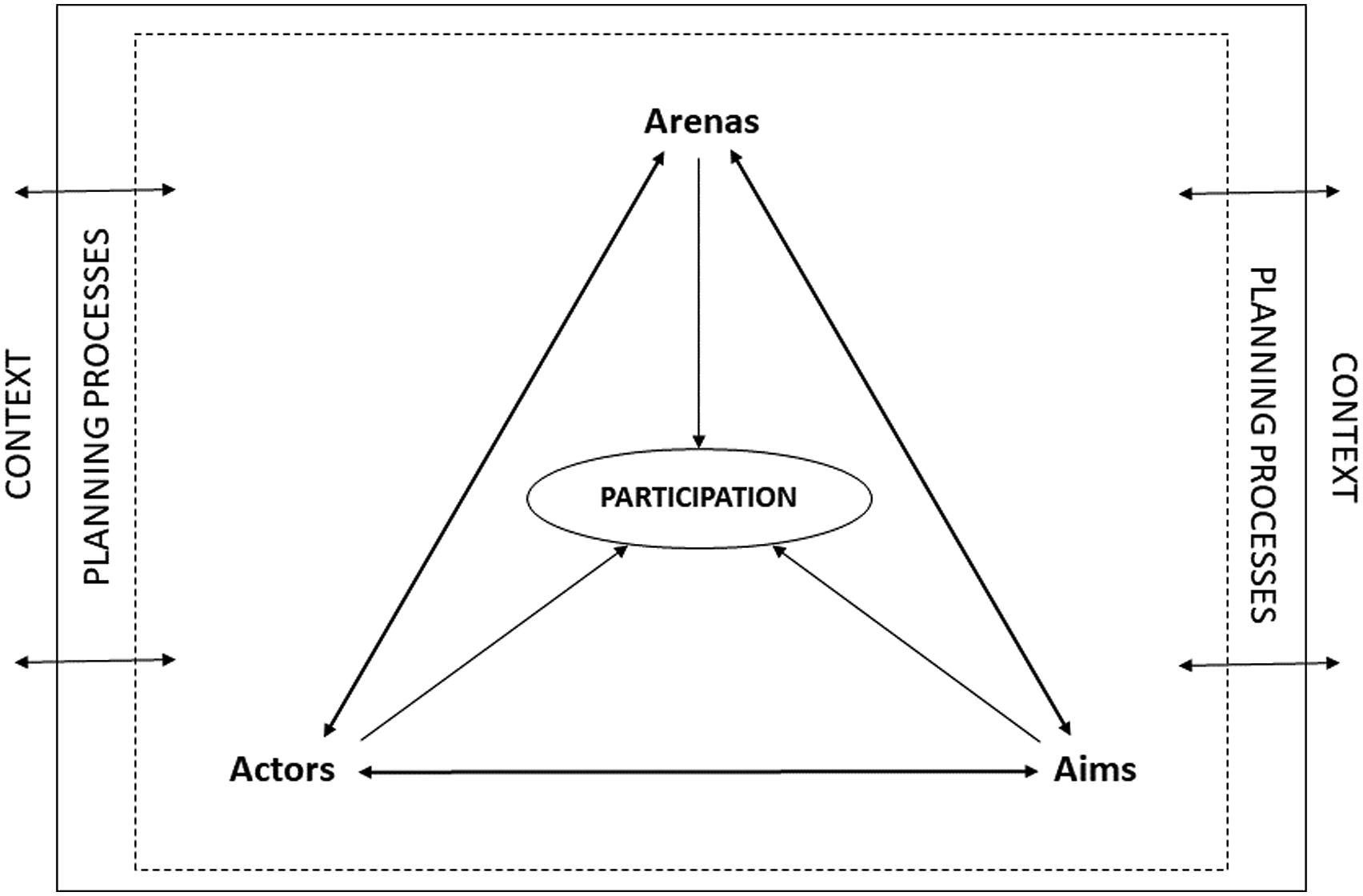
Building on an understanding of participation being relational and emergent (Chilvers et al., 2018), we here argue that the three dimensions themselves are not static but continuously evolving. We thus shift the focus of the 3A3-framework to further unpacking the three dimensions of participation. Figure 2 presents our three dimensions – actors, arenas and aims – including the identified elements that constitute them. We thereby acknowledge that these elements are neither clear cut nor do they present an exhaustive list of factors shaping participation. They are rather a first attempt to capture aspects that influence how the three dimensions are constituted. The dimensions of participation and their elements.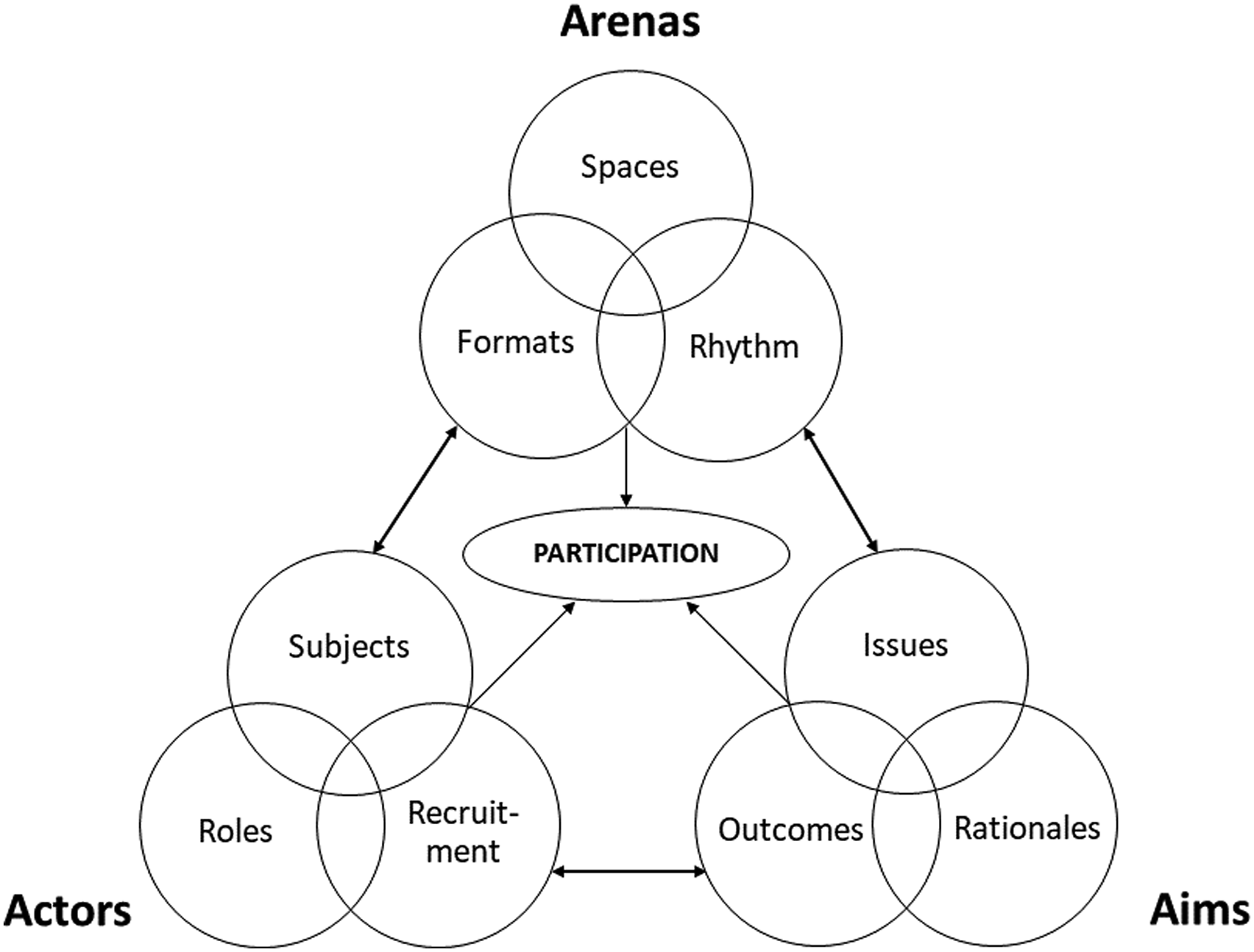
We will now turn to the overarching components - the planning process and context - and will then discuss each of the dimensions in more detail in the subsequent section.
2.1. Planning processes and the wider context
We understand participation as applied in different forms across different stages of the planning process and focus on participatory practices, which Nabatchi and Leighninger (2015) classify as direct forms of participation. This refers to forms of participation in which people are personally involved and actively engaged. It therefore excludes indirect forms of participation, which refer to more passive forms, like voting or donating money. We also keep an open definition of planning and see it as a process that is focused on the development and design of a place, which also includes community-led and insurgent forms of planning (Miraftab, 2009). We thus not only focus on participation as a tool in planning, but also pay attention to forms of participation that become the very practice of planning (Frediani and Cociña, 2019).
Within planning processes, participation touches down at various moments. In formalised processes this may refer to the agenda setting, the design, implementation or the decision-making stage. In less formalised processes, these stages are not as straightforward. Taking this into consideration and applying a broad definition of participation, we see it as a collective act and a moment, or a series of moments, in which people come together to jointly tackle a task and contribute to shaping a place. Thereby, these moments are to some degree organised and orchestrated and not purely coincidental. Hence, participation in planning refers to the intentional bringing together of people in a space to plan, and potentially implement, spatial change.
Planning processes, and thus participation, are embedded in a wider context, meaning in social, cultural, political and economic structures (Chilvers et al., 2018). Participation furthermore takes place in specific geographic locations at particular moments in time (Hickey and Mohan, 2004). Hence, it does not exist in a vacuum; prevalent power hierarchies in society, the political culture, and civic assets inform planning processes and participation (Nabatchi and Amsler, 2014). In relation to urban regeneration, Falanga (2020) suggests three different layers of context,: the macro-, meso- and micro-context. All of them are permeated by questions of power (Hillier, 2002; Brownill and Carpenter, 2007; Cooke and Kothari, 2001).
The macro-context refers to overarching dynamics such as the socio-political background. Bäcklund and Mäntysalo (2010) show how conceptualisations and understandings of participation have changed over time and have been influenced by shifts in democracy, planning and development theory. The promotion of participation as a way of strengthening political legitimacy in the 1960s was guided by a normative understanding of democratic government in western societies (Leal, 2007). Beebeejaun (2018) points out that still today, debates about public participation are heavily influenced by Anglo-American planning thought, even in contexts with very different social economic and cultural realities. Participatory processes are thus shaped by normative political discourses and existing social and historical patterns of communication and domination (Florisbelo and Guijt, 2004).
The meso-context encompasses more concrete policies and regulatory frameworks. This not only refers to formal institutional regulations, but also the de facto rules of the game (Williams, 2004). At this level, scholars have been pointing towards vertical power hierarchies within participatory processes, which may foster practices of manipulation and elite co-option, fostering frustration and exploitation (Cooke and Kothari, 2001; Chattopadhyay, 2015).
The micro-context covers the administrative tools and practices of a participatory process. These produce what Kotus and Sowada (2017) refer to as distinct “participation cultures”, which refer to a specific tradition or way of doing things. Power also shapes dynamics on the micro-level. Here it is important to reflect on the relationship between stakeholders and societal power hierarchies. In regards to local planning, (Hillier, 2002: 4) points out that any decision “cannot be understood separately from the socially constructed, subjective territorial identities, meanings and values of the local people and the planners concerned”.
Power within participation is thus both experienced in encounters in everyday life and as part of systems (Nelson and Wright, 1995). Whereas some see these power dynamics in a rather critical light and point to risks associated with it (Cooke and Kothari, 2001), others frame it as “capacity and agency to be wielded for positive action” (Gaventa, 2006: 24). Tewdwr-Jones and Allmendinger (1998), for example, point out that without power, participatory spaces lack legitimacy and are in danger of being seen as “talking shops”. Arnstein (1969) also framed participation as a mechanism for redistributing power among the actors involved in the process – with the aim of increasing citizen power and thus empowering a part of society that has previously not been heard.
The way participation unfolds is always shaped by the planning process and different layers of context it is embedded in. At the same time, the outcomes of participatory processes, in return, feed back into those contextual elements (Newig, 2007). Thereby, the context is not pre-deterministic; it can potentially both enable and constrain participation. However, these overarching elements always interact with all the other elements of the 3A3-framework, which we will now discuss in more details.
3. Dimensions of public participation
The 3A3-framework consists of three dimensions, actors, arenas and aims, of which each is constituted by three elements (Figure 2). We will now independently discuss each of these elements before bringing them back together in the discussion, highlighting interdependencies within each dimension, as well as across dimensions.
3.1. The actors dimension
The first dimension of participation refers to the actors; the who of public participation. It touches on the subjects involved in participation, discusses their roles and lastly turns to applied recruitment strategies.
3.1.1. Subjects
Public participation by definition involves people – here referred to as the subjects of participation. In planning, this generally entails three categories of subjects: those representing (1) civil society, (2) the government or state, and (3) the business sector. More recently, increased attention has been given to a more diverse set of subjects in urban policymaking, including foundations, universities, non-profit organisations, as well as more marginalized and everyday residents (Kaufmann and Sidney, 2020).
In literature, civil society representatives are equated with the public, the people, citizens, or the community. They can broadly be divided into three groups of subjects: (1) institutionalised civil society, such as NGOs; (2) less institutionalised civil society, such as neighbourhood groups or other identity and interest groups; and (3) non-institutionalised civil society, such as individuals representing their own interests. Equally, subjects representing the government can be divided into different groups including politicians (elected officials) and public administrators (appointed officials). Delegates from the business sector often consist of developers and locally anchored firms. They constitute important private actors involved in urban planning that seek profit and political influence from developing the city (Logan and Molotch, 1987; Stone, 1989). In doing so, they can also interfere in participatory processes. However, this third group of subjects is rarely discussed as ones involved in participation. Overall, there is a strong tendency to focus on the citizen-side of the equation (Gaventa, 2004).
Whereas a distinction of different groups of subjects is helpful in the analysis of participatory processes, it also renders the impression of clearly defined homogeneous groups (Cornwall and Coelho, 2007). It is important to recognise that within these broad categories of subjects, there are people with different interests and identities (Innes and Booher, 2004; Arnstein, 1969). This is underscored by the critique that the community is often misleadingly treated as a fixed and unproblematic entity, as one identifiable group with the same natural, social and administrative boundaries (Williams, 2004). Moreover, there is a tendency to overlook the fact that the composition of people participating is not static and may change over time (Schlossberg and Shuford, 2005).
3.1.2. Roles
Subjects embody different roles in participatory processes. In institutionalised forms of participation, roles are for example described as initiators or sponsors, decision-makers, facilitators, mediators, or very broadly the participants. Within less institutionalised, sometimes ad hoc, forms of participation, roles are less clearly defined. However, overall, it can be said that there is no fixed set of roles; not every participatory process involves the same roles. At the same time, subjects may embody more than one role at a time; e.g. in institutionalised forms of participation initiators often also serve as organisers and funders (Nabatchi and Leighninger, 2015). Roles and their attributed competences can furthermore be socially constructed through the process of participation itself (van Dam et al., 2015; Turnhout et al., 2010; Inch, 2015). Referring to the participants as ‘beneficiaries’, ‘clients’ or ‘citizens’ influences the way in which these subjects are perceived, which in return shapes what they are seen to be able to contribute or entitled to decide and act upon. In reference to institutionalised forms of participation, Newman (2011) points out that this can lead to the promotion of more conform participants by authorities and the open problematisation of those, who follow a more oppositional approach. Roles are thus also relational (Arnstein, 1969) and may change over time.
Generally, the assignment of roles to particular subjects does not find broad attention in the participation literature. They are rather treated as a given fact (Nabatchi and Leighninger, 2015). For example, in institutionalised forms of participation, government agencies are mostly automatically assumed to be the initiators of institutionalised participatory processes in planning. Yet, in contrast to these state-sponsored participatory processes, participation literature also discusses examples of participatory processes led by civil society and regular citizens (Nunbogu et al., 2018). These two forms of participation is differentiated by referring to top-down and bottom-up – sometimes also referred to as ‘insurgent’ – forms of participation (Miraftab, 2009).
Acknowledging power dynamics between subjects with differing competences, it also important to note that the abilities and competencies ascribed to a role are shaped by complex micro-politics of knowledge production and use (Mosse, 2001). Every subject has different forms of knowledge – e.g. local or everyday knowledge, technical expertise or procedural knowledge. The types of knowledge that are valued and given priority differ within and across processes (Legacy, 2012). Thereby, knowledge hierarchies are rarely accidental (Epstein, 1996). Experts, for example, provide scientifically codified knowledge, which is often prioritised over everyday knowledge in institutionalised decision-making (Baud et al., 2011). Thereby, power dynamics are also played out through the use of language (Nabatchi and Leighninger, 2015).
Having said this, power dynamics do not only exist between subjects with different roles, but also among those with similar functions (Arnstein, 1969). People’s attitudes and level of trust, in the process itself as well as towards other roles, are critical for unpacking the micro-level dynamics of participation (Nabatchi and Leighninger, 2015; Åström, 2020). Conflicts may arise from differences in the values of subjects or unclear divisions of roles (Bovaird, 2007). This can also lead to possible role conflicts; also as some subjects may embody multiple roles at the same time (Barnes et al., 2003). Despite these potential sources of conflict, bringing together subjects with different roles presents one of the main reasons for why participation is called for.
3.1.3. Recruitment
Participatory processes rarely involve everyone affected. Therefore, there are different recruitment processes applied to include – or exclude – subjects. In some cases, the choice of recruitment method is explicit and transparent. However, in most cases it remains implicit (Schlossberg and Shuford, 2005). Nevertheless, some scholars have theoretically categorised recruitment mechanisms. Fung (2006), for example, distinguishes different selection methods, spanning more inclusive and more exclusive forms, and thus creating a continuum of open (self-selection) to closed (small limited number of subjects) selection.
Open self-selection mechanisms often build on the assumption that all subjects are equally able to engage in such activities (Cornwall and Coelho, 2007). Contrasting this assumption, some scholars show that different characteristics, abilities and needs shape people’s ability to get involved (Barnes et al., 2003; Brownill and Inch, 2019). These are commonly linked to people’s socio-economic and occupational status, including people’s level of education and income. Manzo and Perkins (2006: 340) furthermore point out “who we are and where we feel we belong are influenced by gender, race, ethnicity and class”. These and other predominant social categories influence people’s ability to be involved in participatory processes. Additional factors may relate to people’s need for cognition, their personal and political self-confidence, openness towards conflict, ideological intensity, proximity to social networks, or level of activism and voluntarism (Nabatchi and Amsler, 2014). Also, spatial distances and their level of affectedness regarding the issue (Kotus and Sowada, 2017) are discussed as factors for being “legitimately concerned” (Metzger et al., 2017: 2517) and thus for being (dis)qualified from taking part.
As there will always be a smaller group of people speaking for others, Blakeley and Evans (2009) characterise participation as a minority sport. Importantly, Cornwall (2008) also reminds us that whereas having a seat at a table is important, being involved does not necessarily mean having a voice. There are thus different forms of recruitment strategies; those which largely favour already privileged subjects to raise their concerns, and those which are accompanied by measures to also include the voices of more marginalised groups, allowing them to exert (some) influence over decisions (Tippett and How, 2020).
3.2. The arenas dimension
The second conceptual dimension of participation is the arenas-dimension. This section is structured into three parts – we first take a closer look at spaces of participation, before turning to the formats and then the rhythm of participation.
3.2.1. Spaces
Within participation discourses, spaces relate to both the physical environment in which public participation takes place, as well as to the socially constructed sites (Cornwall, 2004). They are thus different to, but not independent of, the spatial and historical context.
Generally, the physical environment gets relatively little explicit attention in the literature. Van Maasakkers and Oh (2020: 196) conclude that only few scholars have engaged with “perhaps the most elemental consideration in designing participatory processes: how to create physical environments for productive interaction and conversations”. According to the authors, the venue is critical and should be carefully considered, as depending on its design, planners can exert significant influence over the process.
In contrast, several scholars have conceptualised participation as a spatial practice. For example, in her influential work Cornwall (2004) draws on Lefebvre’s (1991) concept of space and acknowledges them as socially constructed and fluid. Accordingly, she distinguishes two particular types of spaces: invited spaces and popular spaces. Invited spaces describe sponsored spaces, which are institutionalised forms of participation. In contrast, popular spaces are more insurgent and counter-hegemonic; they are often ad hoc and non-formalised. Gaventa (2006) uses a similar typology, but differentiates three different spaces of participation: invited spaces, claimed/created spaces, and closed spaces of participation. The last category referring to spaces which people are forbidden or hindered from entering.
Scholars have also reflected on the connection of, and diffusion between, such participatory spaces (Miraftab, 2020). Whereas spaces are created for a specific purpose, they can be used differently with changing features over time. Different spaces may furthermore exist simultaneously; their boundaries are permeable so that people and their experiences can travel within and across them. For example, participation in one space may trigger the creation of new spaces through mobilising people for action outside of the original space (Legacy, 2017). Closing invited spaces for participation for some people may thus indirectly give them a voice by eluding them to invented spaces (Miraftab, 2004). At the same time, insurgent practices can also be weaved into formal spaces. Hilbrandt (2017) for example shows how people use invited spaces to stage and express dissent and by doing so delay urban planning.
3.2.2. Formats
Within the different spaces, participation may take varying forms (Cornwall, 2004). This refers to different kinds of interactions, as well as the breadth and depth of participation, and is linked to what some scholars refer to as the institutional design or infrastructure of participation (Fung, 2006; Fung, 2015; Nabatchi and Leighninger, 2015). We refer to this as the format of participation.
There is a well-established body of scholarship engaging with the design of participatory processes; analysing factors for their success or failure and trying to find ideal types of participation. Formats often discussed in literature are public hearings and meetings (Nabatchi and Amsler, 2014; McComas, 2006), deliberative fora like citizen juries (Papadopoulos and Warin, 2007), or participatory budgeting (Fung, 2015; Baiocchi and Ganuza, 2014). Other forms of engagements include listening and learning sessions, competitions, interactive websites, working groups, ‘choosing our future’ forums or community meetings (Legacy, 2012).
The repertoire of participation is continuously expanding. Growing attention has, for example, been given to new forms of online engagement. Whereas technology allows for new forms and practices to be explored (e.g. collecting input via social media or through virtual games), their value remains disputed (Afzalan and Muller, 2018). While they may attract more citizens and engage a more diverse audience, there is also the danger of data security and of intensifying social inequalities due to the digital divide (Nabatchi and Amsler, 2014). Moreover, as Newman et al. (2004) point out, these new forms do not really replace older forms of participation, but interact with them.
3.2.3. Rhythm
The rhythm-element addresses the time-component of participation. This is different to the temporal context, which more broadly refers to the temporal environment participation is embedded in. Here, we discuss the choreographies and temporal aspects of participatory processes themselves (Felt, 2016).
Generally, three different temporal modes of participation can be identified: one-off events, fixed longer-term engagements – for example three events over the course of several months – and on-going, open-ended processes. Participatory processes furthermore differ in regards to their degree of synchronisation and their design of sequences. Sometimes, they do not follow any fixed schedule. In some cases, participatory moments are orchestrated in parallel and happen simultaneously, whereas in some instances again, they follow a specific order. Furthermore, participatory elements happen in different intervals. Some sequences follow a regular time schedule, whereas others happen in irregular intervals or on ad hoc basis. For institutionalised forms of participation, Bobbio (2019) finds that there is a tendency to pre-define the duration of participation with strict control over time. Similarly, Nabatchi and Leighninger (2015) highlight that it is often assumed that public participation should be periodic and temporary, whereas in reality the temporal features are more diverse. Nevertheless, sustained forms of participation appear in deed to be rarer (Nabatchi and Leighninger, 2015).
Participation also differs depending on the actual timeframe of each of the events. This not only includes the overall timeframe, but also how these agenda items are managed; for example, how much speaking time is allocated to different subjects, how much time there is for discussions and negotiations, or the timeframe for when a decision needs to be reached. The rhythm of participatory events is important; Baker et al. (2005) for example, find in their survey among city administrators that more control over speakers’ presentation time makes them perceive public meetings to be more successful.
3.3. The aims dimension
The third dimension of participation is the aims-dimension. This is made up of the following elements: the issues, rationales and outcomes of participation.
3.3.1. Issues
Participation is seen as a solution to a wide range of problems in planning. According to Lane (2005), the definition of the planning problem largely defines how a participatory process is designed and implemented. Nevertheless, the how tends to get more attention than the what (Silver et al., 2010; Leino and Laine, 2012).
Borrowing from public policy literature, there are ways to distinguish different kinds of problems (Hurlbert and Gupta, 2015). Hisschemöller and Hoppe (1995) argue that there are three different types: structured problems, moderately structured problems and unstructured problems. Each of them requires different forms of participation. For example, whereas structured problems are usually addressed in closed networks and largely draw on expert knowledge, unstructured problems, also referred to as wicked problems, require multiple perspectives to tackle them (Rittel and Webber, 1973). Accordingly, (Tippett and How, 2020: 128) conclude that participation in planning is “especially important when trying to solve wicked problems that span sectors and levels of scale”. Defining the problem at the onset of a participatory process is thus a central task.
Overall, there is a tendency to assume that participation only addresses one issue at a time (Chilvers et al., 2018). However, social theories and methods are slowly shifting towards developing “a broader perspective on how diverse practices of participation interrelate and connect up across wider systems” (Chilvers et al., 2021: 250). Thereby, also the level of controversy of a topic or decision can matter in regards to how it is addressed (Rowe and Frewer, 2004). Empirical evidence shows that issues that might cause conflicts tend to be avoided in participation. Instead, the public is invited to take part in discussing non-conflictual and non-political issues (Åström, 2020).
3.3.2. Rationales
Participation is shaped by underlying ideologies and rationales. This includes the intentions of individuals at the subject-level but also the rationales for why participation is called for in the first place. These are often linked to discourses of participation being a tool for more democratic, sustainable, legitimate and responsive processes and projects (Fung, 2006). At the same time, some scholars openly question the transformative potential of participation. In the field of Development Studies, Cooke and Kothari (2001) refer to participation as “the new tyranny” and illustrate through a rich collection of case studies that participation can be mobilised to serve the political agendas of donor agencies, NGOs or the private sector, rather than actually achieving change. Leal (2007) links this to the push for participation in the neo-liberal era and criticises that within this setting, participation has been reduced to a series of methodological packages and techniques, losing its transformative and empowering potential. In practice, it often remains unclear who is involved in participation and for what purpose (Nabatchi and Leighninger, 2015). As a result, participation can easily be reframed (Cornwall, 2008) and reduced to a rhetorical exercise (Hilbrandt, 2017).
A commonly cited differentiation of rationales is “participation as a means” and “participation as an end” (Oakley, 1991; Nelson and Wright, 1995). The former refers to participation as a tool for finding a solution to a specific issue in the form of implementable objectives and goals. In contrast, the latter refers to participation as an end in itself; as a democratic tool to empower communities to take control of their own development. Similarly, Reed (2008) suggests to differentiate normative and pragmatic benefits of participation; the former focussing on benefits for the democratic society and equity, while the latter are more geared towards finding concrete and sustainable solutions for a specific issue. This might include conflict aversion or meeting legal requirements.
The rationales for participation at the subject-level are linked to the motivations of subjects to participate in, or to abstain from, participation. For the participants, some scholars assume that people have an intrinsic wish to be involved and that they would do so if given the opportunity (Garau, 2012). Others build their argument on rational choice theory, meaning people are making strategic decisions based on weighing options and considering what they get in return (Bovaird, 2007). Other theories for people’s involvement are linked to social network theory, which assumes that people get recruited for collective action based on existing relationships (Blakeley and Evans, 2009). Others again stress that people’s rationales are based on the particular content of an issue (Irwin and Horst, 2016) or linked to the fact that participation simply might be fun and entertaining (Davies, 2016). People’s involvement can furthermore be triggered by (perceived) external threats to their neighbourhood and the wish to protect the area from unwanted change (Leino and Laine, 2012). For representatives of the government or the private sector, rationales are primarily linked to their mandate (Yang and Pandey, 2011).
Even though literature on participation mainly focuses on active citizens (Zakhour, 2020), it is equally important to assess who does not get involved and why. In this regard, literature mostly points towards a variety of different obstacles, which lead to the exclusion of some subjects. These include time constraints, the physical distance to venues, or high economic costs (Blakeley and Evans, 2009; Barnes et al., 2003). Cornwall (2008) also points out that (self-)exclusion can be a strategic choice; some people find it easier or more beneficial not to participate. This can be motivated by an unfamiliarity with the issue, mechanisms and procedures (Barnes et al., 2003). Landau and Freemantle (2016) furthermore show, that mobile or marginalized urban dwellers, often do not trust the state and engaging with the city means to live and survive in it without being bound by it, as they see their future elsewhere.
3.3.3. Outcomes
There have been different attempts to categorise outcomes of participation (Rowe and Frewer, 2000; Webler and Tuler, 2000). In line with the differentiation of participation as a means and as an end, scholars present the distinction of tangible outcomes – such as a plan or product – and intangible outcomes – such as relationships, practices and ideas (Innes and Booher, 1999). Scholars like Fung (2006; 2015) emphasise these intangible outcomes. He, for example, argues that participation is needed as it has the potential to advance three core values of democratic governance, namely effectiveness, legitimacy, and social justice. In a similar vein, Silver et al. (2010) see the benefits of participation in its potential to promote social inclusion, foster empowerment, and in its redistributive potential. Bobbio (2019) points to the learning component as an important outcome of participatory processes, whereas Innes and Booher (2004) emphasise the creation of an active citizenry. Tangible outcomes on the other hand, are linked to a concrete outcome and material benefits. Newig (2007) suggests a middle ground approach to analysing outcomes of participatory processes. Whereas he is mainly concerned about outcome effectiveness and legitimacy of participatory processes, he suggests that both an analysis of the immediate results as well as of the longer term substantive output and outcomes of the participation process is needed. This is important, as Voorberg et al. (2015) in their review of co-production processes with citizens, point out that there is an evident lack of attention and thus empirical data on tangible outcomes of co-production. Eriksson et al. (2021) confirm, that there is little research about what happens to people’s input after the participatory event.
One of the main challenges for evaluating different forms of participation is that it is difficult to measure something that is vaguely defined at the outset (Rowe and Frewer, 2004). Yet, there is broad agreement amongst scholars that finding ways to evaluate participation and its envisaged outcomes is crucial. In this regard, Collins and Ison (2009: 362) make use of Arnstein’s metaphor of the ladder of participation and point out that “ladders do not exist in free space”. And Tippett and How (2020: 111) remind us it is important to think about “where the ladder is placed, and where it leads to”.
4. Interdependencies of the elements
Outlining the elements shaping the three dimensions of participation highlights how the dimensions themselves are not static, but continuously evolving. Indeed, the elements do not exist independent of each other, but are in an ongoing dialogue within and across the dimensions. The phenomenon of participation is thus continuously shaped by the dynamic interrelationships of its elements, while being embedded in the planning process and wider context. We will now turn to some of these interdependences and discuss how the different elements are connected.
The most obvious interdependencies of the elements emerge from within one dimension. For example, within the actors-dimension, the elements subjects, roles and recruitment strategies are all linked. This can be seen in the pertinent discussion on the power and politics of knowledge production in participation in planning. Legacy (2017) defines participation as power-laden and ultimately a political act. Accordingly, not everyone is equally able to be part of participatory processes and make themselves heard. Scholars generally reflect critically on such power imbalances as they might impede the transformational potential of participatory processes and lead to the further marginalisation and exclusion of some groups (Chilvers and Kearnes, 2016). Power-holding subjects, such as planners, generally have more room for manoeuvre to guide the process in their interest (Bond and Thompson-Fawcett, 2007). These dynamics are also a means of control, as they may influence who can find a seat at the table and what role they get assigned to.
Just as elements are linked within each of the dimensions, they are also in dialogue with the elements from other dimensions. These relationships are manifold and connect each of the elements. In order to illustrate these linkages, we will discuss three examples of interdependencies across dimensions, each with a different entry point. The sequence of links between the elements does not indicate one-directional or deterministic relationships between them, but presents one of the possible options of weaving through the web of elements; they are all linked and connections may always go both ways. Figure 3 illustrates the examples discussed below. Interdependencies of the elements.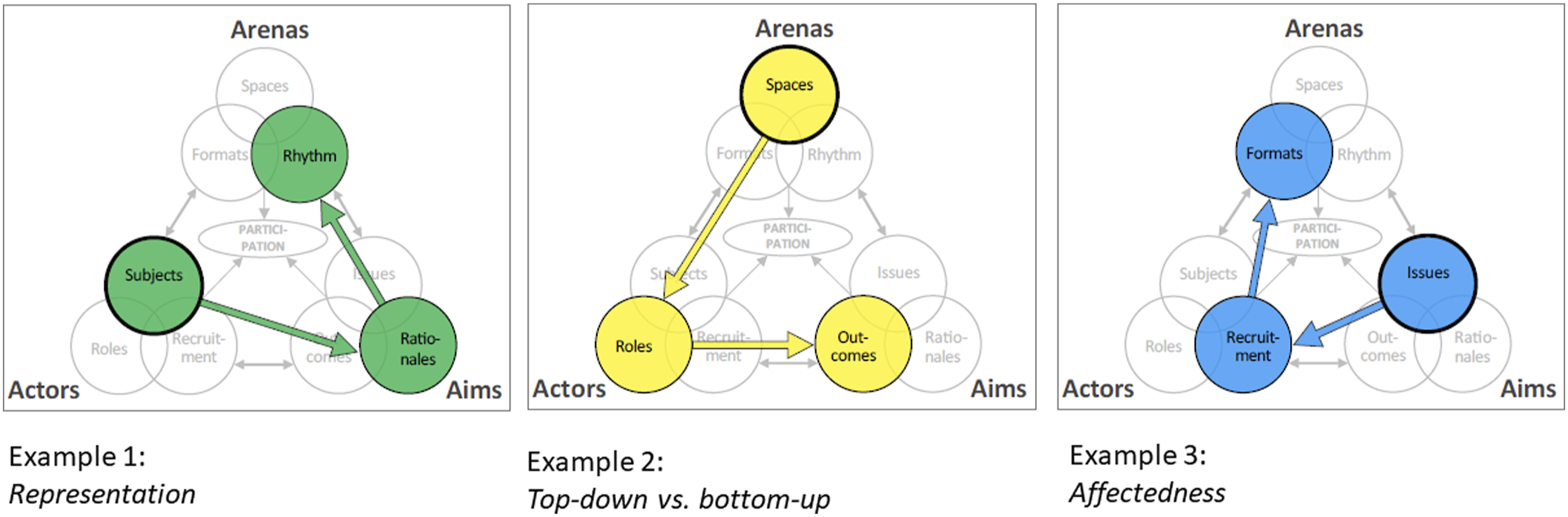
As a first entry point, we use the subject-element and link it to the elements rationales and rhythm. The connection between these elements can be illustrated by referring to the widely discussed concept of representation within participation literature (Cornwall and Coelho, 2007). Each subject brings their own rationales to the participatory process. And as not everyone is equally able or willing to enter such a process, this raises the question of whose interests, concern and needs are represented. Representativeness is then often identified as a criterion for effectiveness of participation (Yang and Pandey, 2011; Rowe and Frewer, 2000). Interestingly, discussions of representation are thereby frequently informed by the assumption that participatory processes are developed in a trajectorial fashion and that subjects’ interests, concern and needs will remain constant over time. Accordingly, participation is perceived as a sequence of events that follows a linear logic in order to achieve its envisaged outcome. Nevertheless, some scholars point to the iterative nature of knowledge production (Gaventa and Cornwall, 2006; Hurlbert and Gupta, 2015). This creates a connection to the rhythm element, as the involved subjects and their rationales may also inform the frequency and duration of participatory processes.
As a second entry point, we use the spaces-element. Here, we link spaces to roles and outcomes. As elaborated above, Cornwall (2004) distinguishes between invited and popular spaces of participation. This links to the differentiation of top-down and bottom-up processes, discussed under the roles-element. Whereas top-down refers to formalised forms of participation, which are orchestrated by subjects of authority (most commonly the state), bottom-up forms of participation call on everyday practices deployed by people to shape their surroundings with “minor political acts that undermine and disrupt seemingly censual planning” (Hilbrandt, 2017: 542). Such forms can create spaces for dialogue and provide people the opportunity to shape the development of their own community (Miraftab, 2009). Consequently, invited spaces are generally steered through top-down processes, while popular spaces emerge from bottom-up initiatives. This highlights the connection between spaces and roles, which is reciprocal; roles may change over time because of changes in the physical and social spaces, while spaces can change due to new roles. The types of space and roles allocated in the process meanwhile also inform which outcomes are in the range of possible. This means that the room for manoeuvre differs depending on whether it is, for example, a state-led consultation process or forms of community-led deliberation.
For a third example, we choose the issue-element as an entry point and link it to recruitment and format. The content and the scale of a given issue largely inform who can – or should – participate. This links to the idea that in participatory processes, people are supposed to be involved when they are considered to be “legitimately concerned” (Metzger et al., 2017: 2517). Their level of affectedness by an issue is thus often used as a mechanism to recruit subjects. This in return may also influence how a process can be facilitated. The breadth and depth, in which an issue is addressed, as well as the constellation of people involved can greatly inform what format of participation is chosen in a given planning process and seen as appropriate. The format of participation linked to the immediate delivery of basic services will for example very likely differ from a process, which gathers input for a longer-term planning strategy.
The way in which the elements are linked thereby also depends on the planning process and the wider context, including the normative understanding of what participation is and what its goals are. The discussed examples reveal a bias towards more institutionalised, top-down forms of participation in which a subject of authority invites the wider public to discuss a certain issue. Discussing connections between the elements based on literature on more bottom-up forms of coproduction is more challenging, also because “they are often left out by existing narratives about ‘participation in planning’” (Frediani and Cociña, 2019: 144). Within a framework of participation that is applicable to many different forms of participation, it is thus critical to also reflect on these normative concepts and accompanying systems of meanings that generally inform the phenomenon of participation.
From this exercise, we can see that all the elements of the 3A3-framework of participation are neither independent of each other nor static, but are subject to continuous change. If one element changes, it is likely to catalyse change in the others elements. Meanwhile, they are also embedded in a broader process of spatial change and thus not independent of the wider social, cultural, political, spatial and temporal context.
5. Conclusion
The concept of public participation is widely acknowledged, promoted and applied in planning. While in practice, the concept is rarely questioned in its raison d’être, its definitional vagueness makes it prone to misunderstandings and misuse. In this paper, we have therefore argued that – in addition to existing models and typologies aiming at classifying different forms of participation – a more conceptual understanding is needed, which helps unpack the phenomenon of participation.
Through theory synthesis, we developed the 3A3-framework of participation. The framework presents participation as an element embedded in a planning process, which is situated in a particular context. Public participation is thereby conceptualised as an emergent phenomenon, which is continuously shaping and simultaneously being shaped by the dynamic interaction of its dimensions. The framework introduces three dimensions of participation: (1) the actors dimension addressing the who, (2) the arenas dimension speaking to the how, and (3) the aims dimension conveying the why of participation. Within the framework, the dimensions do not represent continuums, but rather a web of different interacting elements. Accordingly, the actors-dimension is informed by the participating subjects, their roles and applied recruitment strategies. The arenas-dimension speaks to the design of the processes and its elements are the spaces, formats and rhythm of participation. Lastly, the aims-dimension is constituted of the issues, rationales and outcomes of participation.
The 3A3-framework contributes to planning theory in two ways: (1) it presents participation as an emergent and fluid concept; and (2) the framework highlights how different elements, which constitute the phenomenon of participation interact. It thus offers a basis for understanding how the emergent interdependencies render participation to be a subject of continuous change. The framework builds on previous attempts of capturing participation (Arnstein, 1969; Fung, 2006; Cohen and Uphoff, 1980; Chilvers et al., 2018) and further expands existing models by unpacking the who, how and why dimensions. Accordingly, it shifts the focus away from the evaluation of practical examples to a more conceptual approach of disentangling the phenomenon itself. And in doing so, it allows us to reflect on different forms of engagement, embracing the diverse practices of people contributing to the development and design of places and their particular embeddedness in the wider social, cultural, political, spatial and temporal context.
The framework presents a multifaceted, conceptually broad, yet flexible framework, which permits the critical examination and unpacking of the dimensions and elements shaping the phenomenon. Accordingly, it can be used to gain a better understanding of how the different elements are weaved together and how their continuous interaction informs the phenomenon of participation. As an analytical tool, the framework allows a structured way of studying similarities and differences, while drawing attention to the importance of not only understanding the dimensions of participation, but also the shifting configurations of their elements. As an operational tool, it furthermore provides guidance for navigating the different arrangements of elements in different participatory processes.
Having said that, we need to accept that every framework presents a simplification of reality and that mapping out a concept like participation, is a balancing act between acknowledging and appreciating complexity and working towards a conceptual disentanglement. Hence, we are aware that every form of condensing knowledge is also prone to the erasing of complexity and to reinforce and prioritise certain forms of participation. We therefore recognise that the framework does not resolve the ambiguousness of the concept, nor does it provide a recipe for ‘good’ participation in practice. Also, concerns related to structural power asymmetries and hegemonic normative underpinnings will remain. We therefore acknowledge that our framework comes with its own limitations and that the elements presented are not an exhaustive list of factors shaping the dimensions and only represents one way of conceptualising participation. Future research could build on this conceptual exercise, discuss other connections between the elements or use a more abductive approach to test the usefulness of the framework.
Nevertheless, we believe that the framework may not only contribute to a more reflexive practice but also to more flexible and adaptable processes, as moving away from the idea of participation being a linear process might encourage more reflections on the process and its potentials along the way; even after an initial direction has been chosen (Felt, 2016). Having said this, we also recognise that the specific configuration of elements cannot always be chosen freely, but might sometimes be prescribed by the context, e.g. through the legal requirements of planning law. However, strategically assessing these pre-defined limitations, can help gaining a better understanding of the nature of participation, and we can learn to use it where it is functional and avoid it where it is not. Acknowledging the multifaceted, transformable and context-specific nature of participation, we therefore suggest that conceptualisations of participation should focus on building common conceptual grounds and a language that enables us to abstractly reflect, discuss and compare forms and manifestations of participation. We hope that the 3A3-framework provides a foundation for more nuanced reflections of how participation may evolve across and within different contexts, also to overcome the narrow framing of participation based on its understanding in institutionalised settings that conform to the Anglo-American planning condition. We believe it can contribute to enhancing research and applications of public participation and lead to a more nuanced discussion about the phenomenon in both theory and practice.
ORCID iDs
Katrin Hofer https://orcid.org/0000-0002-2182-9059
David Kaufmann https://orcid.org/0000-0002-4185-4550