




Abstract
In 1967, Henri Lefebvre developed the Right to the City (RTC) as ‘a cry and demand’ for ‘a transformed and renewed right to urban life’. In Brazil, the RTC was institutionalised in the City Statute in 2001. We examine the trajectory of the RTC in Recife, Brazil, through the lens of Alain Badiou’s set-theoretical ontology of inconsistency, which argues that there is a fundamental disjunction between belonging and inclusion. The articulation between belonging and inclusion produces four different arenas of power and categories of being in the city that we develop as a heuristic framework for analysing the trajectory of participation in Recife, where the struggle for the RTC resulted in a system of popular participation. This system operated under the precept that ‘everyone who lives and works here belongs here’, in opposition to urban capital’s drive to include everything and everyone in the market. However, the RTC was captured within a discourse of participation and inclusivity (what we denominate the ‘RTC for All’) becoming an element in a post-political fantasy, resulting in the decay of popular participation. Nevertheless, we argue that the emancipatory and revolutionary potentiality of the RTC, as advocated by Lefebvre, remains powerful as long as the disjuncture between people’s desire for belonging and capital’s drive for inclusion is foregrounded.
Introduction
A year before the May 68 Event in Paris, Henri Lefebvre coined the Right To the City (hereafter RTC) as a ‘cry and demand’ for ‘a transformed and renewed right to urban life’ (Lefebvre, 1996 [1967]: 158). The RTC was for him a political principle that expressed the desire to belong in the city, which encompassed, amongst other claims, the right of inhabitants to participate in and enjoy the creation of urban life. This was nothing short of imagining a communist society in which use-value is tied to belonging and the sovereignty of working people, as against the capitalist fantasy of the competitive city animated by the drive to include everything and everyone into the rule of the market to produce surplus value. The RTC was developed by Lefebvre as a signifier for revolutionary change, what Badiou years later would characterise as the Idea of Communism (Badiou and Engelmann, 2015), which they both shared with other academic activists who were inspired by the great historical revolutionary upheavals.
Our aim in this article is to establish a dialogue between Lefebvre and Alain Badiou, exploring how Lefebvre’s theorisation of the RTC as a praxis of urban life can be complemented by Badiou’s critique of the state, capital, and electoral politics (2005 (1988); 2008). Lefebvre and Badiou shared a commitment to the emancipatory spirit of the 1968 social upheavals and both critiqued the failure of the parliamentarian left to relate with the revolutionary potentiality of these disruptions. Both theorised the possibility for radical change; Lefebvre by theorising the Moment that would redeem the city of its capture by capital and the state, and Badiou through fidelity to the revolutionary Event. Although Badiou never engaged with urban planning and development, we contend that his philosophical work is highly relevant for the analysis of the spatial production of inclusion and exclusion (De Vries, 2016a).
A key argument in this article is that Badiou’s insistence in the disjuncture between belonging (as the realm of the people) and inclusion (as the domain of state and capital) serves to recapture the revolutionary intent of Lefebvre’s Idea of the Right to the City as ‘neither a natural right nor a contractual one’’ (Lefebvre, 1996b [1973]: 194). This goes against the instrumentalisation of the RTC in policy circles as a slogan for governance purposes (Mayer, 2003; Brenner et al., 2009). The RTC has, since the 1990s, become an element in a discourse of inclusivity for all aimed at finding common ground for diverse and often contradictory struggles (Kuymulu, 2013). The RTC morphed into an empty signifier, as expressed in the interpretation of the RTC as ‘cities for all’ in the shared vision of the 2016 New Urban Agenda (see point 11 in UN-Habitat, 2017). As de Souza puts it, today the RTC simply means ‘the right to a more “human” life in the context of the capitalist city and a “reformed” liberal representative democracy’ (De Souza, 2010: 315).
Belonging and inclusion are for Badiou two different ways of counting (Badiou, 2005 [1988]). Whereas the state aims at the inclusion of the poor in governmental structures through targeting, eligibility criteria, labelling (representing people as members of categories) the poor struggle to belong in the city (presenting people as individuals). This disjuncture between belonging and inclusion makes the situation incomplete, exposing ‘the real’ of a situation, its ineradicable incompleteness, its rootedness in antagonism (Roskamm, 2019). By developing a heuristic framework based on this ontological disjuncture (Figure 1), we shed light on how the disjunction between belonging and inclusion animates RTC struggles. Disjuncture between belonging and inclusion.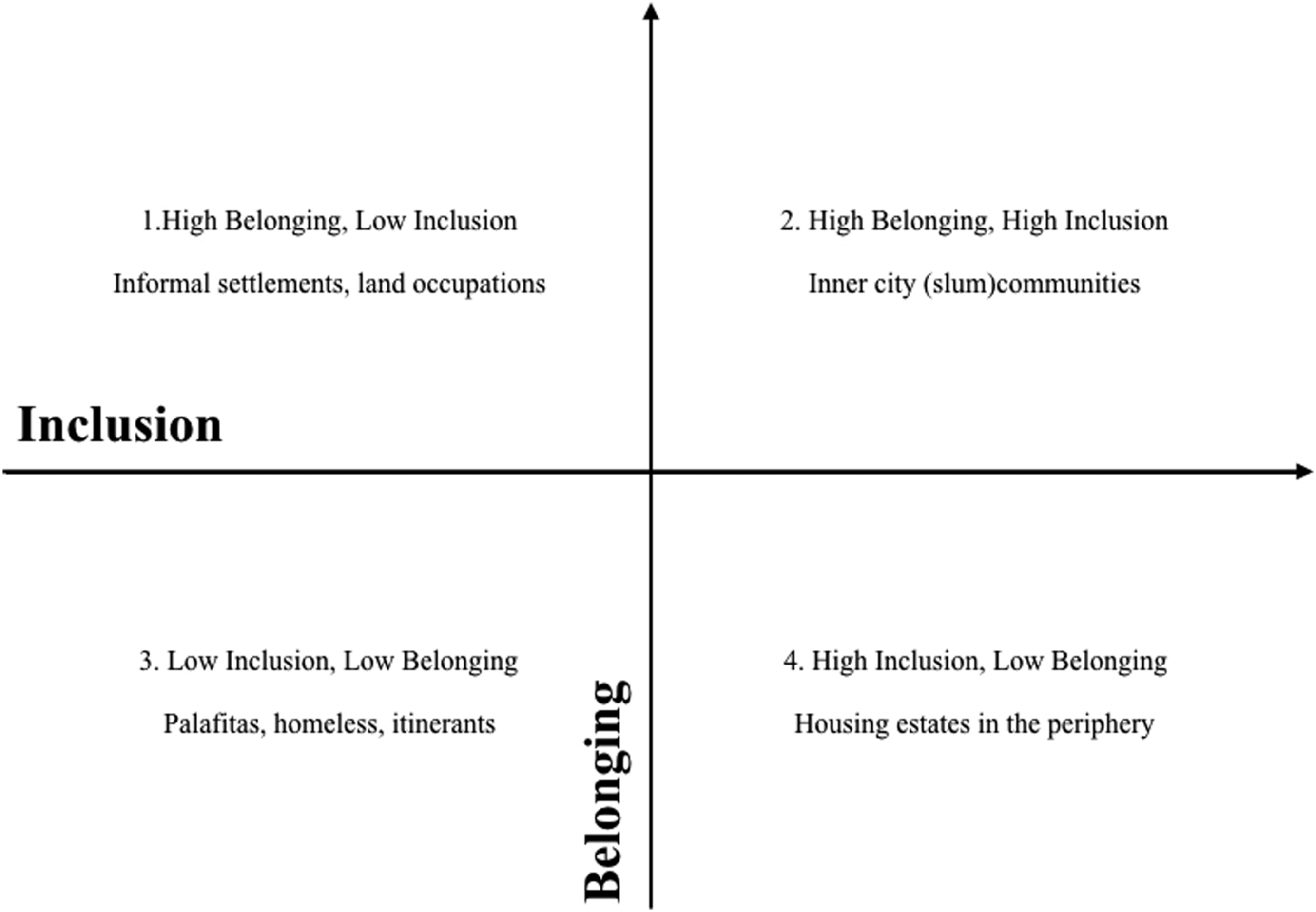
Brazil played a pioneering role in the deployment of the RTC banner as an instrument for urban reform (Fernandes, 2007; Friendly, 2013). In our empirical case 1 , we analyse the trajectory of participatory planning in Recife as a good example of the institutionalisation of the RTC in Brazil. Recife is a city that played a pioneering role in deploying the idea of the RTC in popular struggles against the military dictatorship (1964–1985). It was the site of a strong popular movement grounded in the needs and aspirations of slum dwellers that struggled for the RTC through informal land occupations (Fortin, 2014). The popular movement lay at the root of the emergence, in 1987, of the PREZEIS (Plan for Regulating Special Zones of Social Interest), an internationally acclaimed participatory planning system designed to legalise and provide slums with infrastructure (Carrière, 2021; De Souza, 2001). However, what began as a powerful democratic participatory process aiming at the transformation and renewal of urban life, degraded into an arena of competition between community leaders operating as brokers for politicians and real estate interests.
We show how the corruption of the participatory system ensued from the expansion of a range of inclusionary mechanisms deployed by capital and the state on different spatial scales. In the process, the RTC was captured within a discourse of participation and inclusivity for all, becoming an element in a post-political fantasy, far removed from the popular movement’s struggle for belonging and the right to urban life. The result was the subordination of participatory democracy to the electoral logic of representative democracy (in Badiou’s terms ‘the excess of representation over presentation’). In the process, the PREZEIS became an electoral market where community leaders compete for the favours of politicians and corporate interests based on their capacity to garner votes. This was indicative for the decay of the popular movement.
The excess of inclusion (representation) over belonging (presentation) manifests itself, in the eyes of the state, through the presence of a part that cannot be included. This, in Recife, was the case of the palafitas, houses on stilts in the water. Their location in rivers and waterways near mangrove vegetation gives them a special attraction, exemplifying the exoticism of Third World poverty besides iconic images of modernity, as illustrated in postcards of the city where palafitas are pictured next to highways and middle-class high-rise buildings (Koster and Nuijten, 2012: 179). With the ascendancy of a leftist neoliberal municipal regime in Recife during the administrations of the Partido de Trabalhadores (2000–2013), the palafitas came to be seen as a source of shame, symptomatic of the contradictions between the regime’s discourse of inclusivity and its complicity with corporate aspirations to transform the city into a World-Class City. Consequently, the stilt houses stand for the ineradicable element that ‘ungrounds’ the city, for its inherent antagonism, as an inevitable by-product of re-development projects in a context of high precarity. The palafitas function as ‘the stain’ that stands for the impossibility of the RTC for All, because they expose a category of people that neither belong nor are included.
In the following section, we discuss the depoliticisation of the RTC after its institutionalisation in Brazil. Then, we build on Badiou’s theorisation of the disjuncture between belonging and inclusion to elaborate a heuristic frame for the analysis of socio-spatial struggles in the city. Thereafter, we use this framework to discuss the trajectory of participation in Recife and document how the shift from belonging towards inclusion led to the decay of the popular movement. In the conclusion, we reflect on how Badiou’s philosophy of inconsistency can recapture Lefebvre’s communist Idea of the Right of the City from its banalisation as a conciliatory slogan, emptied of its revolutionary potentiality.
The right to the city in Brazil
A year after its appearance in France, Lefebvre’s Droit a la Ville (Right to the City; Direito a Cidade) was available in Brazil (Machado, 2008: 89). The book was an inspiration for sociologists, architects and lawyers who struggled against the military regime (1964–1985). With the slogan ‘The RTC for All’, the Brazilian Urban Reform Movement (Romeiro et al., 2015: 9) played a central role in the dissemination and institutionalisation of this concept and brought together diverse social actors who were critical about the use of the city as a source of profit and who promoted popular participation.
In 2001, the City Statute institutionalised the RTC in Brazil as the ‘right to urban land, housing, environmental sanitation, urban infrastructure, transport and public services, work and leisure, for present and future generations’ (Instituto Pólis, 2002). The City Statute is a federal law regulating urban policy in the 1988 Constitution, hailed as a highly progressive instrument for promoting urban reform (Fernandes, 2007; Friendly, 2013). The City Statute (1) defends claims for belonging to the city by prioritising the use-value of land and buildings over their exchange value and (2) ensures inclusion by promoting participatory governance. As Raquel Rolnik (2013: 54) puts it: ‘the entire process of formulation, approval, enforcement, and interpretation of the City Statute has been a history of disputes between different urban reform projects in the country, particularly between a rights-based approach of the urban reform movement and a market-driven competitive cities spatial regime paradigm’. Since the City Statute socialist mayors set out to design progressive policies in a neoliberal capitalist environment, adopting the trope of the ‘inclusive city’ as a compromise formation that enabled them to pursue social justice without antagonising private urban developers (Cary, 2007; Melo, 2010).
Presciently, two years before his death, in 1989, Henri Lefebvre published an essay in Le Monde in which he argued for the need to rethink the RTC (2014 [1989]). Lefebvre’s foreboding was that the revolutionary intent of the RTC would be diluted by its incorporation in a discourse of social reform and modernisation aimed at creating a city that is both inclusive and attractive for investors. The critical question posed by Lefebvre was whether we could still use the language of the RTC in a context where there is a marginalisation of inhabitants who share the use-value of the city in comparison to those trying to realise its exchange value (Kuymulu, 2013). In this essay, he summarised the RTC as ‘nothing less than a revolutionary concept of citizenship’ (Lefebvre, 2014 [1989]), because citizenship for Lefebvre is not derived from a legal status gained from membership in a nation-state, but from the very idea of inhabiting the city (Purcell, 2003).
This was precisely the fate of the RTC in Brazil where it was deprived of its revolutionary content (Belda-Miquel et al., 2016; De Souza, 2010). To (re)emphasise the emancipatory political dimension of the RTC, the remainder of the article argues that Alain Badiou’s critique of the state, capital, and electoral politics neatly complements Lefebvre’s theorisation of the RTC as a praxis of urban life. At first sight, Lefebvre and Badiou have little in common. Lefebvre was highly critical of French structuralism while Badiou was deeply influenced by structuralist authors such as Althusser and Lacan. Yet, both elaborated their theories as a critique of the present; Lefebvre through his critique of everyday life, the commoditisation of the city, and the homogenisation and sanitisation of public space (Zieleniec, 2018) and Badiou by critiquing ‘the state of the situation’ as the violence of the excess of inclusion over belonging (ibid 2005 (1988)). We now turn to this disjunction.
Badiou’s disjunction of belonging and inclusion
Belonging and inclusion are usually posited as two positive requirements in the struggle for the RTC: belonging expressing the phenomenological dimension of claims for place and inclusion as a strategy for countering the exclusionary effects of urban development interventions. The question then becomes whether belonging harnesses inclusion or vice versa; should inclusion target groups that belong to be more effective, or should belonging be promoted to facilitate inclusion? This continuous dialogue, we argue, reproduces an expert discourse about the possibilities and pitfalls of participation. Contrary to views that assume a natural compatibility and sequence between belonging and inclusion, we follow Alain Badiou’s subtractive ontology of inconsistency to argue that there is a fundamental contradiction between those terms, that they operate in different, disjunctive, dimensions that stand in an orthogonal relationship to each other.
Referring explicitly to the structure of the state, Alain Badiou (2005 [1988]) makes a critical distinction between “the situation” and the “state of the situation”. The situation presents individuals and counts them as belonging to a given site, whereas the “state of the situation” re-presents the same individuals as members of given categories and counts them as part of a governmental system. For Badiou, the state is not interested in individuals but rather aims to include them in governmental categories to rule over them (2005 [1988]). Whereas the state aims at the inclusion of the poor in governmental structures to maximise their productive power while minimising their mobility, the poor struggle for belonging, acting on the prescription that ‘everyone who lives and works here belongs here’ (Badiou and Žižek, 2009: 36). Inclusion in his view is a way of producing consistency in an inconsistent world, and in doing so, it counts individuals in such a way that they fit within determined categories. Governmental inclusion per definition works selectively – through targeting, eligibility criteria, and labelling – and as such renders invisible individuals who belong but do not comply with the criteria. Consequently, people are not counted as individuals, but as parts, or members, of larger, problematic, categories to be dealt with in special ways (i.e. vulnerable groups at risk, the homeless, internally displaced people, etc.).
This is what Badiou calls the excess of inclusion over belonging, referring to forms of inclusion disconnected to people’s actual experiences of, and desires for, belonging (2005 [1988]). Badiou insists that inclusion is always a kind of violence and that the excess of inclusion over belonging always brings forward an element that is surplus to the situation. This part that cannot be counted as a part of the whole – ‘the part of no part’ – functions as the site of a possible Truth-Event. In Recife, this was the case during the massive occupations in the 1970s during which the people confronted the dictatorship.
The disjuncture between belonging and inclusion expresses itself in spatial and political terms. Spatially through the resettling of subaltern populations in housing estates – often in the city’s periphery – or simply, getting rid of them through violent evictions. In political terms, inclusion works through the creation of representative, electoral, mechanisms aimed at bolstering the legitimacy of the state. In Recife, this is the typical realm of patron-client relations in which politicians seek out individuals within the low-income communities for political canvassing in return for monetary support (Koster and De Vries, 2012). Here, inclusion refers to the incorporation of individuals both as political representatives and as clients.
Contrary to electoral attempts that count votes rather than people, belonging gives priority to presentation – everyone belongs, everyone’s voice counts. We argue that the difference between these two ways of counting exposes the city’s antagonisms, its inherent inconsistency. In Recife, belonging expresses itself in spatial terms through the desire to become a community that is part of the city, while resisting governmental attempts to get rid of surfeit populations that cannot be accommodated in the slums. In political terms, belonging manifests itself in a popular movement that supports land occupations and fights against evictions, while engaging in participatory slum governance and planning structures aimed to defend the right of the poor to inhabit the city centre. In short, the demand for the RTC is a desire for belonging and the preservation of use-value, while the drive of the market for inclusion is propelled by the insatiable need to make profits, converting the city into an object of accumulation (Harvey, 2003).
In Recife, the articulation between belonging and inclusion produces four different arenas of power and categories of being in the city. These categories do not make up a model, yet they provide us with a heuristic framework (Figure 1) for analysing the trajectory of participation in Recife. The categories, that we summarise in figure one, are as follows: 1. High belonging, low inclusion: slum-communities where the popular movement is still strong with a high capacity to counter the drive of the market. Here the poor struggle for the RTC (popular sovereignty). Participatory structures operate as arenas of struggle between the popular movement and politicians who vie for the control of community leaders through patron-client relations. 2. High belonging, high inclusion: integrated communities in the inner city, where the market exercises a strong force to privatise land, in this way corrupting the PREZEIS. Here we see the decay of the popular movement in line with the fantasy of the RTC for All, leading to stealthy forms of resettlement and eviction. The result is the sidelining of the participatory system by opportunistic alliances between community leaders, politicians, and real estate interests. 3. High inclusion, low belonging: Violent forms of uprooting of populations. This is especially the case of relocations of evicted slum dwellers to housing estates in the periphery without organised forms of popular protest. 4. Low inclusion, low belonging: those who neither belong nor are included. This is about people on the move, on the edge of the void (Badiou, 2005 [1988]), living in stilt houses (palafitas) in the mangrove areas of the city, often undocumented itinerants, not included in the “state of the situation”, and whose belonging to the city is put in doubt (De Vries, 2016a). This category constitutes the evental site in which the no-part claims the right to be part of the city, as manifested in the great occupations in Recife at the end of the 1970s.
As we argue next, participatory development, under the fantasy of the RTC for All, is a good example of Hillier and Gunder’s argument (2005) that planning coalesces around empty signifiers deployed to cover over fundamental antagonisms. Often mentioned in a ‘neutral’ discourse of participation and inclusivity for all, the RTC has consequently become part of reformist urban planning by promising to manage the disjuncture between belonging and inclusion.
The trajectory of participation and the right to the city in Recife
The military’s takeover and the failure to evict the poor from the city
Recife, and the state of Pernambuco more generally, experienced high levels of political mobilisation in the 1940s and 1950s, starting with hygienist programmes against ‘subnormal’ dwellings (Pontual, 1999). The society for the eradication of mocambos (shacks) promoted the eviction of large numbers of slum dwellers from the city, using a distinct language of shacks being the origin of contagious diseases, violence, and promiscuity. The violent expulsion of the poor was met by a strong working-class movement. Leftist mayors such as Pelopidas Silveira and Miguel Arraes enacted laws to facilitate access to housing to the working class (De Moraes, 2019). A large number of resident associations (associações de moradores) were established, supported by the emergence of several Grassroots Ecclesial Communities of the progressive wing of the Catholic Church, inspired by Liberation Theology (Assies, 1991). The principle was very straightforward; everybody who lives here (with or without property titles) belongs.
However, in the 1960s, the CIA defined Recife as a possible area of leftist Castroist insurgency. After the military takeover of 1964, which installed a military regime that would last until 1985, the neighbourhood associations were targeted as instruments of communist insurgency (Fortin, 2014). The military, however, failed to cleanse the city by resettling the poor to the periphery as part of metropolitan urban development projects that catered to the middle and upper classes.
Consequently, the Interamerican Development Bank and the World Bank, amongst others, decided to invest in institutional development in Recife, promoting participatory slum upgrading projects (Koster and Nuijten, 2012). With World Bank funding a Postgraduate Centre for Urban Studies was created (the MDU) in 1974, which generated much knowledge about urban processes and participatory interventions and produced committed urban professionals (De Moraes 2019). This process was indicative of a shift from an authoritarian language of anti-insurgency towards one that supported the search for reformist solutions to urban struggles in the city. As we discuss next, during the military regime, the first participatory initiatives were set up to create community leaders attached to political parties originating from the military regime through patron-client relations.
The popular movement drafts a law to defend the right to the city of the poor
In 1979 the Archbishop of Olinda and Recife, Dom Hélder Câmara, founded the Justice and Peace Commission (CJP) to defend political prisoners and the rights of slum dwellers (favelados). In this context, the 1980s witnessed the re-emergence of a strong popular movement that fought for affordable housing. In contrast with the period before the dictatorship, neighbourhood associations did not play an important role in processes of popular mobilisation as they had been eradicated or coopted by the military government. After the government passed an amnesty law, the CJP reoriented its activity towards providing support to the popular movement that engaged in a swath of land occupations following major floods that left many people homeless (Gallart, 2019: 61).
This was a struggle for the RTC from the side of belonging. It has been calculated that between 1978 and 1981 between 150 and 250 thousand people were involved in 80 new land occupations (Assies, 1994: 107). Many families rendered homeless due to the floods (quadrant 4, low inclusion, low belonging) took part in the land occupations (quadrant 1, low inclusion, high belonging). In addition, given the failure of industrialisation policies, people who were violently resettled to the periphery by the military regime returned to the inner-city land occupations. These massive land occupations at the time accord with a move from quadrant 3 (high inclusion, low belonging) to quadrant 1 (low inclusion, high belonging).
As we later argue these occupations provided the site of an event of a supernumerary category, that of the poor, the excluded, the part of no part, on the edge of the void. The popular movement desired the RTC and embodied popular sovereignty. The state reacted by creating a governmental apparatus of inclusion through slum upgrading programmes (quadrant 2) and resettling (quadrant 4).
Also, in 1979, the military National Renewal Alliance (ARENA) appointed the young ex-state treasurer Gustavo Krause as mayor of Recife (1979–1982). Krause convinced the military regime that evicting the poor was not a viable option. He set up Community Planning Nucleus (NPC) in poor neighbourhoods, popularly referred to as barracões (large shacks), that operated as field offices where residents could participate in decision-making concerning slum development projects. Krause also pledged that land titles would be granted to areas where ‘communities are organised at the grassroots’ (Fortin, 2014). This turned out to be a treacherous promise as it robbed the popular movement of its voice, the latter insisting on the fundamental disjunction between government promises of inclusion and the popular struggle for belonging.
In this way, Krause created an important network of community leaders, strongly attached to him and his party through patron-client relations. He thus took over the strategy of the left and started to encourage the phenomenon of community leadership. Rather than with resident associations, the municipality formed direct relations with community leaders, some organised within the popular movement and others as clients of rightist politicians. This was the start of a struggle for hegemony between the popular movement that relied on the educational work of activists attached to the CJP and the electoral strategies of (rightist) political parties well versed in the funnelling of governmental resources through patron-client relations. As acknowledged by various scholars, Krause’s NPC was the start of urban participation in Recife, before the deployment of a formal participatory system by parties left of the centre (Leal, 2003; Fernandes, 2004; Koster, 2019).
In 1983 a new zoning law (the Law on Land Use and Occupancy) divided the city into 27 Special Zones of Social Interest (ZEIS), in effect recognising the legal existence of slums (defined as subnormal housing areas). These were characterised as ‘spontaneously existing and consolidated housing settlements, with special urban norms, in the social interest of promoting their legal regularisation and their integration into the urban structure’ (LUOS, n° 14.511/1983). Yet, to regulate these ‘special urban norms’ in the ZEIS, legal professionals with close connections to the urban popular movement started to draft a law that would become known as the PREZEIS (Plan for Regulating Special Zones of Social Interest). The movement included community leaders, the Grassroots Ecclesial Communities, neighbourhood associations, students, NGOs such as the CJP, and urban planners. It was at this point that the RTC came to play a role in shaping urban policies. 2
In 1986, the first democratically elected mayor Jarbas Vasconcelos introduced the Municipality in the Neighbourhood Program (MNP), a precursor to the Participatory Budgeting programme promoted by the Worker’s Party later. The MNP was a decentralised urban development programme in which the mayor held office in low-income neighbourhoods on set days of the month. The programme aimed at creating a direct link between community leaders and the City Hall (Montambeault, 2016: 143). More than a form of consultation, this was the start of a form of participatory planning in which the communities were invited to provide proposals for investments in infrastructure and services. The municipality visited the communities to inform them of how much money was available for them and the communities then debated what should be done with the resources. However, no independent funds were provided to the programme. Like Krause, Jarbas was known as an ambitious and highly competent politician in urban matters. However, unlike Krause, Jarbas coveted the support of civil society organisations connected to the urban popular movement in Recife.
During these years of democratic opening, the RTC became the banner for the struggle for belonging in land occupations. With the return of democracy, we see a stabilisation of the situation as described in quadrant 2 (high inclusion, high belonging). At the same time, the hegemonic struggle over the control of community leaders indexed the strength of popular sovereignty. Given the lack of housing in the inner city and the expansive drive of real estate capital, homelessness and dispossession (quadrant three; low inclusion, low belonging) remained a threat.
In terms of our heuristic framework, it can be stated that at this point the acknowledgement of the disjunction of belonging and inclusion in the political debate was high. While popular politicians like Krause and Jarbas were interested in including the poor through electoral politics and participatory governance there was a clear distinction between what we could call rightist and leftist populism, the latter drawing on the struggles of the popular movement for belonging. As a result, the ZEIS emerged as an arena of struggle between governmental inclusion (in tandem with real estate interests) and claims for popular sovereignty.
The institutionalisation of the plan for regulating special zones of social interest
In 1987 Jarbas Vasconcelos signed the PREZEIS that institutionalised the RTC of ZEIS residents. The most important principles concern (a) the prioritisation of the right to housing over that of ownership, (b) the prevention of real estate speculation and (c) limiting removals and resettlement to the minimum required” (PREZEIS, N° 14.947/1987). This entails that relocations due to infrastructural development take place within the neighbourhood and that compensation in terms of housing is provided to evicted renters as much as to evicted proprietors. Also, in contrast to the Municipality in the Neighbourhood Program, the PREZEIS had an independent budget, the Special PREZEIS Fund. Each ZEIS would set up a Commission for Urbanisation and the Legalisation of Land Tenure (COMUL) responsible for titling and infrastructural improvement, with the support of civil society organisations. Community delegates were elected by residents (thus not only house owners but also renters) to take decisions around infrastructure and land legalisation issues. The COMUL delegates worked closely with civil society representatives, NGOs that had been part of the process of establishing the participatory system, and municipality technicians. This was the beginning of a participatory democratic deliberative process based on the RTC principle that ‘everybody who lives and works here belongs here’, in stark contrast with the representative electoral process that operates according to the electoral interests of political parties strongly vulnerable to the interests of corporate forces. However, the former was always vulnerable to the influences of the latter for the reason that COMUL delegates were not rewarded monetarily for their work.
An important distinction between the participatory democratic process and the representative electoral process is that the latter provides community leaders with possibilities to accrue an income during electoral times as political brokers. Community leaders would campaign for delegate positions to show politicians their electoral value. The result was a struggle for hegemony between community leaders funded by (mostly rightist) political parties and others who paid allegiance to the RTC as a struggle for belonging. Often these different roles – that of political broker and representative of the popular movement coincided in the same person (Koster and De Vries, 2012). In terms of our heuristic framework, this meant that the struggle for belonging was always compromised by the inclusionary drive of capital and the state.
During the 1990s, the PREZEIS turned into a contested space of governance defended by the centre-left and boycotted by the right (Marinho, 1998). At the same time, many politicians of the right were using the PREZEIS to contact community leaders who were ready to offer their services during electoral times as political brokers. This was also a period that many NGO personnel went to work for state agencies and the private sector, the COMULs and the PREZEIS becoming less interesting as sources of income.
In 2000, 15 years after the popular PREZEIS law was first drafted, a survey among ZEIS residents where there was a COMUL found out that more than one-third were not aware of the existence of the COMUL (CJC et al., 2000). Amongst those who knew the representatives in the COMUL, almost half was unaware of their duties. They also found that two-thirds of the respondents did not receive regular information about the PREZEIS. The lack of knowledge in the communities about the COMUL/PREZEIS was indicative of the undermining of the participatory democratic process by electoral politics and the retreat of NGOs from the participatory process. While lip-service was paid to the RTC and the participatory system by political parties from the left the latter was increasingly seen by the right as an instrument for electoral politics. However, as we will see the greatest threat to the PREZEIS did not come from the right but from the reformist left.
The post-political fantasy of the inclusive city for all
A new period for the PREZEIS was initiated when the newly elected mayor of the Workers’ Party (PT), João Paulo Lima e Silva (2001–2004), turned the Municipality in the Neighbourhoods/Participatory Budgeting Program into Participatory Budgeting (PB), using slogans such as ‘inclusive development’ and ‘reversal of priorities’ (Nunes, 2015). After gaining the elections, the PT saw the PREZEIS as the legacy of politicians, such as the charismatic Jarbas, who shifted from the centre-left towards the centre-right (the PMDB party) after having played an important role in the democratisation process. While the PT had presented itself as the successor of the popular movement, it prioritised the Participatory Budgeting program over the PREZEIS. In addition, the former was much broader than the PREZEIS, since it also dealt with health, education, sports, and culture. Also, PB had more funds at its disposal than PREZEIS (Pacheco et al., 2017).
The PREZEIS was further weakened after an administrative reform implemented in 2005, during the second mandate of the PT (2005–2008) which left the PREZEIS without competent municipal experts or a sufficient budget (De Moraes, 2019). The PREZEIS was transferred to the secretariat of participation, rendering it subservient to the PB. The result was the centralisation of funding through PB and the increased dependence of community leaders on PB and the PT politicians in charge of it. This move was very much resented by community leaders with strong historical attachments to rightist populist politicians such as Krause and Jarbas.
Under the PT the RTC became part of the fantasy of the inclusive and competitive city, as expressed in the slogan of the ‘RTC for All’ (Romeiro et al., 2015). This mode of operation has been described as a leftist neoliberal populism devoid of politics, in which class struggle is foreclosed (Nuijten et al., 2012). In planning terms, this was evinced by a dual planning system (De Vries, 2016b; Melo, 2010): strategic planning for the formal city (aimed at creating a competitive World-Class City appealing to investors and the (upper) middle classes), and participatory planning for the informal city (aimed at improving the living conditions of the poor and their aspirations to belong to the city). Strategic planning was operationalised through large projects meant to improve mobility and access to new areas at the city level, hence valorising urban real estate investments. Participatory planning was operationalised through participatory slum upgrading projects under the remit of PB. However, the attempt to overcome the disjuncture between belonging and inclusion led to “the tyranny of participation” (Cooke and Kothari, 2001) along with a shift in urban governance from participatory politics towards the electoral politics of real estate interventions (Nuijten et al., 2012).
Exemplary for this dual planning approach was the creation of a second type of ZEIS, in 2008, that would enable partnerships with the private sector. The ZEIS 2 areas are defined as inhabited public land to be provided with infrastructure and dedicated to the provision of social housing for families negatively affected by urbanisation projects (De Moraes, 2019). This prioritised inclusion over belonging (quadrant 3) and spawned the development of public conjuntos residenciais (housing estates) along with residential towers built by private developers, using the legal figure of Public-Private Partnerships. It also presaged the rise of a new type of urban development predicated on alliances between developers and ‘corrupted’ COMUL delegates who negotiated the sale of ZEIS land to the former. A case in point is Brasilia Teimosa, a ZEIS on the waterfront, famous for resisting efforts by the municipality and developers to evict the population to convert the area into a residential area around a yacht club (Fortin, 2014). Erstwhile combative residents who had fought with the popular movement to impede the privatisation of the area became important community leaders with close relations with the PT and developers while investing in the purchase of houses for speculation purposes (Nunes, 2015).
The fantasy of class conciliation did not last long, as the increasing closeness between real estate interests and the PT government left its mark in a series of corruption cases, which would become a very serious setback for the party. One such case was the authorisation conceded to the New Recife building consortium to convert a large area of former docks into an upper class residential area, in exchange for financial support for electoral campaigns (Ocupe Estelita, 2014). The result was the discrediting of leftist politics in Recife as community leaders, formerly associated with the popular movement, were stained by corruption accusations.
These accusations and internal divisions within the party weakened the PT in Recife. Many community leaders within the PREZEIS withdrew their support for the PT and switched to the Brazilian Socialist Party (PSB), a centre-left party with close connections to the Recife elite. The election of the PSB (2012–present) meant the end of 12 years of PT hegemony.
Post-participatory times
In 2012, the PSB terminated PB, initiating a ‘pseudo-participatory’ programme called Recife Participates, designed to facilitate dialogue between the government, the private sector, community leaders, and civil society organisations. Recife Participates, however, never got off the ground with community leaders complaining that it only exists on paper (Koster, 2019). Whereas the PT attempted to bridge the disjuncture between belonging and inclusion through a dual planning strategy, under the PSB this disjuncture is ignored, privileging private developers in urban planning.
For example, the PSB became a fierce advocate of the massive New Recife beautification project on the former Estelita docks signed on the last day of the PT government. New Recife is a socially and environmentally highly controversial project that includes the building of luxury residential towers, theatres and parks at the waterfront (Alcântara et al., 2016). The construction of the high-income towers was initiated in 2019. This project, which will go together with future urban mobility projects and market-led gentrification, threatens the surrounding ZEIS areas, most of them instituted already in 1983. Furthermore, gentrification projects such as New Recife demand improvements in transport accessibility, leading to new slum upgrading projects in nearby ZEIS areas and thus the relocation of the poor to housing estates. In this way, new urban environments with high turnover, insecurity, and precarious community relations are created, exemplifying the violence of the excess of inclusion over belonging that relocation entails (quadrant 3).
With the breakdown of the participatory system, the fantasy of the RTC for all has lost much track. Class struggle in the city, however, remains in the form of stealthy occupations. The neoliberal drive to sanitise the city and commoditise urban space results in ever new rounds of dispossession leading to the proliferation of new palafitas (stilt dwellings: quadrant 4) and a new round of small-scale land occupations on the fringes of the big New Recife project (quadrant 1) organised by ZEIS residents who complain that they can no longer afford the high rents. In Badiouan terms, this is the ‘part of no part’ that cannot be included in the city (De Vries 2016a) and that drives the poor to engage in land occupations for the sake of survival.
The PSB government responds by creating public-private partnerships to build social housing estates (quadrant 3), with a key role played by slum-community leaders in the process. These occupations were tolerated by the municipality. Through coopted community leaders, the PSB politicians mobilised the squatters of the land occupations to support the New Recife project. In effect, slum leaders attached to the popular movement could not disown the occupations, yet they saw other ‘opportunistic’ community leaders benefit politically and financially from it (da Silva, 2015).
In 2014 the Occupy Estelita (OE) movement brought many people onto the streets in opposition to the New Recife project. The OE movement was perceived as one of the foremost RTC social movements in Brazil (Romeiro et al., 2015). Also, in November of that year, David Harvey attended the occupation of the area in Recife and declared that this was one of the most important urban movements of the moment at the global level (Harvey, 2014; Alcântara et al., 2016).
The OE movement, however, failed to connect with the demands of the poor for the right to live and work in the city. It was not the beginning of the resurgence of the popular movement in Recife as Harvey suggested. There are several reasons for this. To begin with, the popular movement was fractured and weakened by the strong anti-PT mood in the country and the city. Further, the OE movement was a middle-class environmental movement that, whilst receiving support from leftist community leaders in neighbouring ZEIS, was not seen as a true occupation movement. To stop construction work, OE activists set up a camp at the project area and mainly waged their campaign through social media (Alcântara et al., 2016). The activists were more concerned with Recife’s cultural heritage, the corruption scandals, and with making the Recife project more inclusive and environmentally friendly. In doing so, OE drew on the example of Occupy Wall Street, in a city that rather than occupying squares, has a longstanding tradition of massive land occupations (da Silva and De Vries, 2021). In short, Occupy Estelita exposed the difference between the defence of the RTC by an environmentalist movement fighting for inclusive participatory planning through symbolic occupations and the struggle of poor slum dwellers for the RTC by engaging in land occupations that bring about a true rupture in the state of the situation.
Slum upgrading and the missing ground of the city
From the above, we can conclude that the trajectory of the RTC in Recife evolved along two paths: as a cry for belonging by the popular movement and as a discourse of inclusivity used by political parties. As long as these paths were clearly separated and the struggle was waged within the participatory system the distinction between these two paths remained clear. The use of the discourse of inclusivity by the leftist PT signified a heavy blow to the popular movement, especially when the party became associated with widespread corruption practices. The Ocupe Estelita movement was not able to connect with the popular movement as it did not find ways to incorporate the demands for belonging of the poor in their struggle.
At this point, it is important to highlight the role of slum upgrading projects as part of city-wide strategic planning as instruments for blurring the disjuncture between poor people’s desire for belonging and the inclusive drive of capital and the state. The discourse of inclusivity is highly instrumental for legitimising slum upgrading. Slum upgrading is defended as a need to include the slums in the city. The critical question however is, whose city? The city of the poor (those who are present and belong) or the World-Class City dreamt by capital? As argued, inclusivity stands for the normalisation of the situation to conform to the needs of capital and the state.
Slum upgrading, under capitalist conditions, is part of urban processes of gentrification, leading to the rise of house prices and rents in the slum. And even worse, with heightened pressures by corporate interests to appropriate slum territory in central locations in the city. Slum upgrading always goes together with evictions and the relocation of people to new environments where they are expected to conform to dominant notions of citizenship. The poor are included in a monetary economy under situations of precarity. As a result, they are compelled to sell their properties and go to live in precarious, ‘subnormal’ locations, often in palafitas. Contrary to the open violence of the military during the dictatorship, when the poor were simply expelled from the city, we see currently in Recife an insidious form of violence exerted against the poor. They can either opt for relocation to housing estates (with high levels of violence) or move to stilt houses or engage in new (stealthy) occupations as an exit strategy.
In terms of our framework, the stilt houses stand for the return of the repressed, the response of the real after the foreclosure of the disjunction between belonging and inclusion. The palafitas symbolise the ineradicable element that ‘ungrounds’ the city as an inevitable by-product of re-development projects in a context of high precarity. These are the sites where the itinerant proletariat in Recife live, often undocumented, who resist being located in housing estates by the state. In short, the palafitas stand for the impossibility of the RTC for all.
The current proliferation of palafitas in Recife exposes the missing ground of the city, its inherent antagonism, the impossibility to both cater to the elite and serve the interests of the poor; while unveiling the contradictions amongst the popular classes. Acknowledging the missing ground of the city is important because it foregrounds the Truth underlying the desire for belonging that drives popular movements in their struggle for the RTC, as in Recife. Here, Lefebvre’s and Badiou’s theorisation of the Moment and the Event is important. The Moment is Lefebvre’s name for the redemption of the city from its capture by capital and the state. For Badiou, the Event is generative of a Truth, and the site of a supernumerary part that resists inclusion in the situation. For both, inclusion always is a kind of violence. Badiou helps us to understand the Moment as the result of an excess of inclusion over belonging, bringing forward an element that is surplus to the situation, a part that cannot be counted as a part of the whole – hence ‘the part of no part’ – that functions as the site of a possible Truth-Event. In Recife, this was the case during the massive occupations in the 1970s during which the people confronted the dictatorship.
Conclusion
This article analysed the morphing of the RTC from a powerful and evocative concept used by the popular movement to evoke the right of the poor to live and work in the city into a multivalent slogan deployed by policy-makers and politicians to satisfy all constituencies – rich and poor – depriving it of its original, revolutionary, meaning. As the RTC was captured within a discourse of participation and inclusivity for all, it became an element in a post-political fantasy that disavows the desire for belonging and the right to urban life. The result was the decay of the popular movement, the perversion of the popular participation process, and the surge of a new urban development model pivoted around big investment projects.
We argued that as long as the disjuncture between belonging and inclusion was clear there was an open struggle for hegemony in Recife, juxtaposing the reality of the city of slums with the elite’s aspirations of creating a World-Class City. Ironically, it was an allegedly leftist administration that set out to foreclose the disjuncture, resulting in the decay of a powerful popular movement. Hence, our argument that the demand for the RTC remains powerful as long as the gap, or void, that ‘un-grounds’ the city is exposed and acknowledged. Ontologically this is important because the foreclosure of antagonism/disjuncture is concomitant to the denial of the existence of a no-part.
We also showed that the inclusionary drive of capital and the state through slum upgrading projects led to the expansion of the category of the part of no part, in the form of stilt houses, or palafitas. The contradiction of a leftist neoliberal regime that paid lip service to the aspirations for belonging of the poor while catering to the expansionary drive of the elite expressed itself in an obsession with, and the will to, cleanse the city of palafitas.
This theorisation of Badiou’s disjuncture of belonging and inclusion combined with Lefebvre’s conceptualisation of the Right to the City has important implications for efforts to rethink planning theory from the perspective of the global south, especially what has been denominated insurgent planning. Before broaching this subject, we should bear in mind that what rendered the participatory planning process in Recife unique was that it refused to differentiate between different categories amongst the poor. All residents (homeowners, renters, squatters) were invited to participate in the participatory planning process. This was a participatory democracy by the poor and for the poor, contrary to the representative democracy that claims to rule for all.
Insurgent planning has been defined as the ‘planning practices that respond to neoliberal specifics of dominance’, those that are ‘counter-hegemonic, transgressive and imaginative’ (Miraftab, 2009; Roy, 2009). It draws on Holston’s concept of insurgent citizenship ‘as a counter-politics that destabilises the dominant regime of citizenship, renders it vulnerable, and defamiliarises the coherence with which it usually presents itself to us’ (Holston, 2008: 34). The experience of the participatory planning process in Recife enables us to propose a concept of insurgent planning that is not merely anti-neoliberal and imaginative but also anti-capitalist and revolutionary, fitting within Badiou’s Idea of Communism (Swyngedouw, 2010; Badiou and Engelmann, 2015). This is a rethinking of planning that draws its strength from the principle that ‘everyone who lives here has the right to live and work here’. It highlights the persistence of a no-part that stands for the inconsistency of the urban situation while acknowledging that the popular classes are divided, some being homeowners and others renters, some being able to pay for services and others not, some even not having identity papers as a minimal requirement for the status of citizenship. Focusing on slum upgrading, rather than on differentiated clams for citizenship, helped us to come to this understanding of exclusion and division as that which characterises the state of the situation.
Hence, our claim for a concept of insurgent planning that insists that it is only through the Event that the poor come to be a historical actor, as an element that disjoints and reconfigures the state of the situation when the part of no part says ‘we are here to stay, and not only that but we are going to be part of the administration of the city’. Furthermore, this is a concept of insurgent planning that takes critical distance from reformist programmes and planning approaches aimed at ameliorating the situation of the poor while paying allegiance to what Badiou (2008) denominates capitalo-parliamentarism (i.e. the complicity of capitalism and the state in the commoditisation of social value).
In Recife, this was the strategy followed by the Commission of Justice and Peace, created by the theology of liberation wing of the Catholic Church, when it came to operate as the body, or the party, of the dispossessed, after the massive land occupations at the end of the 1970s. This was the Event/Moment that exposed the in-existence (in the eyes of the state) of a category of people, literally at the edge of the void, that neither belonged nor was included.
Footnotes
Declaration of conflicting interests
The author(s) declared no potential conflicts of interest with respect to the research, authorship, and/or publication of this article.
Funding
The author(s) disclosed receipt of the following financial support for the research, authorship, and/or publication of this article: This project has received funding from the European Research Council (ERC) under the European Union’s Horizon 2020 research and innovation programme (grant agreement No. 679614).
