




Abstract
Urban development and land release policies in the city fringes are criticised because they often fail to achieve their objectives such as providing affordable housing for low to moderate-income groups as well as provision of infrastructure and transportation. From a Marxian point of view, urban development plans fail because of the inherent contradictions of capital, and consequently, maximisation of surplus-value becomes the main objectives of land supply policies. In this paper, I draw on the Lacanian concept of drive and use the homology between Marxian surplus-value and Lacanian surplus-enjoyment to explain how the market rationality of neoliberalism (late-capitalism) deflects the desired objectives of urban development plans (UDPs); that is, the desire to provide affordable housing and urban services and infrastructure instead facilitates speculative activities on land in the suburban areas of a metropolis, such as Perth, Western Australia. In particular, the paper focuses on the neoliberal intuitional and financial dimensions of UDPs. In conclusion, I suggest how planners may deal with the pressure of the lack in the hegemonic discourse of neoliberalism in order to avoid the stuckness of the logic of drive materialised in the operation of planning institutions.
Keywords
Introduction
The history and theories of planning show that planning’s missions are related to the provision of solutions to market failures (Allmendinger, 2002; Brooks et al., 2012; Sandercock, 1998). Friedmann (1987) explains that planning emerged with the modern era to pacify the adverse effects of capitalism. Based on this understanding and following Harvey (1985: 177), I assume that modern planning as the ‘corrector of imbalances’ within capitalism must deal with the causes of market failures that result from the underlying contradictions of neoliberalism as the latest mode of capitalism. These contradictions of capital, including exchange-value versus use-value and influence urban planning’s practices, such as UDPs. Harvey (2014) argues that the dominant role of exchange-value in the provision of housing means that the adequate use-values of housing remain unmet. Harvey (1985, 2014) further contends that while planning policies aim to provide affordable housing, these policies often result in price rises that make houses unaffordable for low-income groups.
According to Harvey (2014: 17) in addition to ‘the basic costs of a house’s production (labour and raw materials)’ two other costs increase the exchange-value of a house: ‘first, the profit mark-up of the speculative builder, who lays out the initial necessary capital and pays the interest on any loans involved, and, secondly, the cost of acquiring, renting or leasing the land from property owners’. Under the neoliberal economy, ‘the ruthless pursuit of maximising exchange-values has diminished access to housing use-values for a large segment of the population’ (Harvey, 2014: 22). Previously, ‘the enhanced exchange-value of housing [became] a hot item’ (Harvey, 2014: 20) and neoliberal policies, including financing housing through more derivatives, complicated and problematic mortgages, and shrinking public sector support for housing and infrastructure and an increase in individual debt, resulted in the economic crisis of 2008 within the housing and financial sectors.
The definition of use-value and exchange-value and their differences as the basic concepts of economics first appeared in Smith’s (1977[1776]) work and continues as one of the core concepts of Marxian analysis of the market economy. According to both Smith and Marx (2008[1867]), use-value is the usefulness/utility of consuming a good. In the case of housing, the use-value of a house provides ‘a place where people can build a home and an affective life’ (Harvey, 2014: 15). However, exchange-value includes the cost of production (wage, interest, rent), plus surplus-value, interest on loans, and capitalised rent (land price). Marx (2008[1867]: 104) explains that surplus-value is an excess that is created over the original value in the circulation of money-commodity-money. Marx demonstrates that surplus-value that is produced and owned by capitalists is the main spring of capital accumulation and the whole system of capitalism.
Marx (2008[1867]: 163) further explains that the contradiction between use-value and exchange-value (particularly in the labour market as a factor of production) is the source of surplus-value. According to Marx (2008[1867]), surplus-value indicates the return on production and creates an increase in the value of the invested capital. This increased value has no use-value, but it is necessary to keep the circulation of capital and capitalism in motion. Different methods that capitalists apply to increase surplus-value (such as extending labour hours) create capitalism as a mode of production.
Žižek (2008b) argues that the inherent contradictions of capitalism make it different from previous modes of production. The contradictions/obstacles of capitalism produce a creative, self-enhancing, productive system that maintains capitalism rather than abolishing it (Schumpeter, 2009[1947]; Žižek, 2008b). ‘It is this internal contradiction which compels capitalism to permanent extended reproduction – to the incessant development of its own conditions of production’ (Žižek, 2008b: 53). Lefebvre (2003[1970]) contends that as a consequence of the contradiction between exchange-value and use-value in the urban space, particularly in the case of housing, the function of home-ownership changes to a form of saving as a speculative financial mechanism.
Inspired by Marx’s concept of surplus-value, Lacan (seminars of 1962–3 and 1964) introduced object petit a 1 /surplus-enjoyment, which is both a surplus meaning, and a surplus-enjoyment; namely, surplus-enjoyment is not an object but rather the excess of enjoyment ‘which has no ‘use-value’, but persists for the mere sake of enjoyment’ (Evans, 2006[1996]: 129). Žižek (2008a, 2008b) greatly extends Lacan’s theories of surplus-enjoyment to re-envision Marx’s theories of surplus-value. According to Lacan (2006), surplus-enjoyment is the cause of desire. In Hegelian terms, it can be defined as a desire to be ‘desired’, or ‘loved’, or ‘recognised’ (Kojève and Queneau, 1969); for example, gaining prestige within one’s community is highly desirable. As Žižek explains, the surplus entity as both enjoyment and value always remains hidden beneath the surface; it is a product and a profit that cannot be seen but it is necessary for the sake of the accumulation of capital. Žižek (2008b: 54) argues that ‘if we subtract the surplus, we lose enjoyment itself, just as capitalism, which can survive only by incessantly revolutionizing its own material conditions, ceases to exist if it ‘stays the same’, if it achieves an internal balance’. Marx (2008[1867]: 411) argues that ‘so far as the capitalist is personified capital, it is not values in use and the enjoyment of them but exchange-value . . . that spur him into action’. Based on the Marxian approach, surplus-value is the cause and immediate purpose of the capitalist mode of production, with the aim of surpassing the limitation of capital accumulation. From a Lacanian approach, capitalism/neoliberalism needs the surplus-enjoyment that is signified by ‘social and political [bonds] and relations’ (Olivier, 2009: 27).
Gunder (2003b, 2004) first introduced Lacan’s work to the planning discipline. In his works, he applies and develops concepts of desire and fantasy as well as Lacanian enjoyment to analyse planning policies and plans (Gunder, 2003a, 2003b, 2010). For example, Gunder (2015) argues that planning’s legitimacy is rooted in statistics, authorities, and hegemonic discourse, and planning is inherently entangled in the values of the hegemonic discourse of neoliberalism. Gunder (2016) utilises the Lacanian concept of fantasy to analyse how this hegemonic discourse uses fantasy to cover over its fissures. In addition, Gunder and Hillier (2009) use the Laclauian concept of empty signifiers to argue that planning has coalesced its plans and policies around empty signifiers that are often deployed as ideological tools or as capitalism’s fantasies to cover over the failures of the market. According to Laclau (2005), empty signifiers are the most important tools of politics. An empty signifier is a promising word and/or rhetoric. It embodies an unachievable fullness and also ‘promise[s] a fullness that is lacking’ for subjects when they deploy the empty signifier in their practices, for example, freedom, justice, or sustainability (Glynos and Howarth, 2007: 122). Gunder and Hillier (2009) argue that some of the inherent biases in planning practices, such as maintaining higher prices in the housing market through regulations and codes, are camouflaged with the fantasy of protecting the public interest.
However, the homology between the Lacanian concept of surplus-enjoyment and the Marxian concept of surplus-value in planning practices, as well as the relationship between desire and drive and the way in which the drive concept is helpful for planning, has remained largely unexplored. In this paper, I contribute to planning theory by discussing this homology and the relationship between surplus-value and surplus-enjoyment, as well as the difference between desire and drive in generating surplus-enjoyment, in order to analyse the financial and institutional dimensions of a case of a UDP under neoliberalism in Perth, Western Australia. Also, I explain that the mechanism of drive is a helpful concept that clarifies how seeking the two surpluses of enjoyment and value is the reason for planning’s failures in achieving policy objectives.
I maintain that through the psychoanalytical status of drive, neoliberalism has structured the subjective level of planning actors – agents of planning including planners, planning institutions and organisations, decision makers, as well as planning documents, plans, policies, sub-divisions, land, and infrastructures – to unconsciously deviate from the promise of filling the lack of affordable housing and instead carry out speculative land activities to obtain surplus-value and surplus-enjoyment.
My focus in this paper is on the analysis of the Ellenbrook development plan in Perth, Western Australia (WA). The following section explains the methodology of the research, before discussing the Laclauian interpretation of the Lacanian lack within the discourse of neoliberalism and how it shapes UDPs such as Ellenbrook. The subsequent sections explain how a lack of affordable housing and infrastructure creates a desire to fill the lack. Following this is an explanation of how the Lacanian concepts of drive and surplus-enjoyment can be useful in analysing a UDP under neoliberalism. The article concludes by suggesting a way out of the stuckness of drive in both the universal and particular contexts of planning practices, specifically UDPs.
Methods of analysis and data collection
Following Laclau and Mouffe (1985), I utilise Political Discourse Theory (PDT) as a method of discourse analysis that focuses on the ontological investigation of the nature and relations of discourse elements including objectivity, structures and social relations as well as subjectivity (actors), words and actions (Glynos et al., 2009; Torfing, 1999). Using PDT provides a strong analytical tool to deconstruct the nature of planning actors’ subjectivity as well as the financial and institutional structure of planning under neoliberalism. It also assists in analysing the linguistic and non-linguistic elements of planning documents and reports. In this paper, these include the Ellenbrook urban development plan and design projects, land release policies, laws, bylaws, planning codes, ventures and contracts, official financial and institutional reports and ledgers, and documented speeches or orders of authorities. The paper aims to understand how the objectives of the Ellenbrook plan were created and developed and how they deviated from the initial promises of filling the lack of affordable housing towards more neoliberal market-oriented outcomes.
I employ PDT because it provides one of the most dynamic means available for discourse analysis (Glynos et al., 2009). PDT provides me this opportunity to apply Marxian and Lacanian concepts through a Laclauian approach. PDT utilises a post-analytical approach to deal with the issues of two mainstream methodological approaches in planning: deficiencies in the positivistic/scientific approach, and the normative (Glynos and Howarth, 2007) and ethical shortcomings of post-structuralism, that is, the ‘reduction of the truth-dimension to textual truth effect’ (Žižek, 2008b: 172). Accordingly, PDT offers a unique approach to bridging the dichotomy of universalism (positivistic/scientific approach that suggests a unique universal theory, explanation and solution for all cases which are usually developed based on scientific methods) and particularism (post-structuralist view that emphasises more qualitative and analysis of particular cases and context-dependent solutions). Utilising this approach, the research framework and analysis of the data subsequently relies on a post-Marxist interpretation using a Lacanian lens.
I use the Laclauian discursive interpretation of lack to analyse the discourse of neoliberalism rather than the Freudian/Lacanian clinical analysis of lack. Consequently, I suggest the logic of the surpluses of both value and enjoyment as the main driver of the universal practice of suburban land development and land release policies. I also introduce the differences between Lacanian mechanisms of desire and drive as the subjective cause of the unachieved goals of these policies. However, I analyse and identify the operation of these universalities in the particular context of the Ellenbrook case. Finally, I suggest particular and universal contingencies for the problem. Specifically, the post-analytical approach critically re-examines and deconstructs the established structures, concepts, and discursive and social relations to expose them as elements that simplify the reality of phenomena (Glynos and Howarth, 2007). Using PDT, I consider a truth dimension to deal with post-structuralism’s lack of a normative aspect. I propose that the Marxian analysis of market failures, including contradictions of capital accumulation and different Lacanian modes of enjoyment adhering to the accumulation of capital, is the overlooked truth dimension of the phenomenon investigated in this paper.
Deploying an abductive mode of reasoning provides PDT with the possibility of ‘complex movement between problematisation, interpretation, and ontological investigation and projection’ (Glynos and Howarth, 2007: 35). According to Peirce (2004[1994]), every new and progressive idea and concept that leads to change is derived from abduction. Abductive inference is built on the premise that social reality consists of structures and internally related objects and knowledge of this social reality can be achieved by going beyond what is empirically observable and asking questions and developing concepts that are fundamental to the phenomena under study (Peirce, 2004[1994]). For example, Sober (2009: 30–31) explains this mode of reasoning through the following example: Suppose you see someone crossing campus carrying several philosophy books. You wonder whether the person is a philosophy major. Two hypotheses to consider are, H1: The person is a philosophy major H2: The person is an engineering major According to [your supposition which is related to what is familiar to you], the observation you have made favours H1 over H2.
However, according to Sober, if there is doubt about this result as something may have been missed, it is necessary to examine whether the observation strongly supports the hypothesis. You may ‘ask yourself what the alternative hypotheses are and you might consider a third hypothesis such as H3: The person isn’t a student, but is in the business of buying and selling philosophy books’. At this point, an abductive inference has been applied through the provision of an alternative hypothesis.
Abductive reasoning provides effective analytical tools relating to critical realism – the critique of structures, norms, circumstances, or any other actual and real data that have been obscured (Danermark, 2002). Abductive inference primarily focuses on ‘inferring what is not observed’ (Sober, 2009). It examines the overlooked circumstances and elements in the theoretical frame (Glynos and Howarth, 2007). According to Danermark (2002: 80–98), Marx provided an excellent example of abductive reasoning when he reinterpreted and redescribed the history of humankind and presented a new framework for the political economy based on a new theory of value. In sum, abduction is a way of (re)interpreting data and is used to form a new concept or theory for a phenomenon or a practice.
An analysis of plan and policy documents shows that a demographic housing demand forecast and an economic assessment often lead to the recognition of a lack of sufficient housing in the market, thus justifying a land release policy at the city fringes and a suburban land development plan. However, abductive reasoning reveals two series of overlooked and hidden logics.
The first is the inherent contradictions of capital, the logic of maximisation of surplus-value materialised in the neoliberal institutional dimension of planning, and speculative land activities at the objective level of neoliberal discourse on urban development. As Gunder and Hillier (2009) explain, this discourse operates through empty signifiers, such as the home of the Australian Dream, and through their attributed meanings and relations. The second is modes of enjoyment that are beyond the structure of plans and policies and the field of signifiers, but as Žižek (2008b: 140) explains, ‘at the same time internal to it’.
Based on abductive reasoning, I argue that the homology between surplus-value and surplus-enjoyment and the differences between the two Lacanian mechanisms of desire and drive in pursuing these surpluses explain how the operation of planning institutions results in suburban development plans succumbing to the vicious cycle of speculative land trade by circulating around the lack of affordable housing. They also explain how the neoliberal approach shaped the rationale behind the contradictions of the Ellenbrook plan and its unachieved objectives.
To investigate how surplus-value and surplus-enjoyment are connected and operate as the driver of the Ellenbrook development and metropolitan growth in Perth, I investigated and analysed all annual financial, ledger, and housing reports and their outcomes for a period of 14 years between 1999 and 2013. The annual reports revealed overlooked facts concerning the operation of the State Housing Commission (SHC) of WA and the Ministry of Housing in Perth’s new developments, including Ellenbrook.
The function of lack in the discourse of neoliberalism
According to Lacan (2006), the concept of lack within the symbolic order is at the core of psychoanalysis and all other concepts are meaningful in their relation to this ‘missing thing’. The symbolic order is one of the three orders (Symbolic, Real, and Imaginary) on which Lacan based his work. For Lacan, the symbolic is the realm of language, social structures and social bonds, law and regulations, which together constitute culture and society. Desire, fantasy, and drive are related to the different ways a subject confronts and deals with an identified lack in the existing symbolic order. Laclau and Mouffe (1985) and Laclau (2005) developed the concept into a discursive structure and explain that lack is the cause of the struggle between subjects to present new promises or empty signifiers to cover over this lack and maintain the hegemonic discourse.
It is argued that every hegemonic discourse, such as neoliberalism, maintains at least one lack that puts pressure on the discourse and questions its completeness, such as the lack of affordable housing and neoliberalism’s failure to respond to that lack (Gunder, 2016). ‘[E]very symbolic order is penetrated by an impossibility – a lack – that has to be filled or covered-over for it to constitute itself’ (Glynos and Howarth, 2007: 14). Laclau (2005) argues that under the pressure of a lack, a promising empty signifier emerges, which ‘signals the introjection of this signifier as “enigma-plus-promise”’ (Glynos and Howarth, 2007: 130). To Laclau (1996), this empty signifier promises to make possible the fullness of a lack; for example, ‘Justice for All’ is an empty signifier that promises justice for an unjust situation. An empty signifier promises a meaning, which makes a political struggle possible. This marks the lack or the incompleteness of the existing hegemonic discourse and ‘it also engages subjects in a concerted effort to decipher it, thereby uniting them’ (Glynos and Howarth, 2007: 131).
The moment a lack emerges represents a ‘dislocatory event’ for the hegemonic discourse (Laclau, 2005). Lacan (2006) uses psychoanalysis to explain how a subject reacts to the lack (the ‘dislocatory event’) in the symbolic order. He points out that the subject may seek to fill the lack, deal with it, or avoid it and escape the induced anxiety. Drawing on Lacan, Laclau (2005) and Glynos and Howarth (2007) maintain that the pressure of a lack and the subsequent Lacanian anxiety – a concern over incompetence and insecurity – results in the subject’s continuous attempt to replace this anxiety with enjoyment. Further, according to Laclau (2005), the way in which the subject characterises the lack defines his/her political engagement and understanding of the failure of the hegemonic discourse. In particular, the increasing lack of affordable housing reveals the failure in the hegemonic discourse of neoliberalism – a failure ‘evident in moments of dislocation’ (Glynos and Howarth, 2007: 129). However, it is the recognition of this failure that can help the subject to reorganise his/her mode of enjoyment to create an alternative discourse (Thurston, 2004).
The following sections explain the three interwoven concepts of desire, fantasy, and drive in relation to the identified lack of affordable housing in the case of the Ellenbrook UDP in Perth.
A desire raised to fill the lack of affordable housing
Facing an identified lack, such as affordable housing, in the symbolic order – neoliberalism – creates a desire in the subject to fill the lack. The subject expects to obtain surplus-enjoyment from filling the lack (Glynos and Howarth, 2007; Žižek, 2008a). As Laclau (in Butler et al., 2000) argues, facing the dislocatory moment, a unique desire can emerge to fill the lack and create a new discourse to replace the old one.
According to Lacan, the object cause of desire is surplus-enjoyment. As explained, for Lacan, surplus-enjoyment, which is inspired by Marx’s concept of surplus-value, ‘has no “use-value,” but persists for the mere sake of enjoyment’ (Evans, 2006[1996]: 129). Specifically, Žižek (2008b: 51) explains that the homology between Marxist surplus-value and Lacanian surplus-enjoyment in the continuity of capitalism is the logic of capitalism.
Žižek argues that manipulating surplus-enjoyment becomes a source of surplus-value and profit. Namely, the homologous logic of the existence of lack which produces a constitutive and constant surplus for both Marxian surplus-value and Lacanian surplus-enjoyment is, according to Žižek, a logic that ‘Marx did not succeed in taking into account’ (Žižek, 2008b: 51); it is the logic for the operation of capitalism as a totality.
The emergence of an identified lack, such as an economic crisis, a lack of affordable shelter, or any other failures to meet the needs and necessities of a society, creates the desire for an action to fill it through a policy that provides for the public good, such as housing (Gunder, 2016). In this regard, the desire is always unique and requires a search for a common meaning. According to Laclau (2005), at this moment a fantasy using promising empty signifiers emerges to offer an alternative by promising a new discourse to cover the lack, thus providing the subject with surplus-enjoyment. As Laclau (2005) explains, this empty signifier suggests the development of a new plan or policy as a new discourse.
In WA, the identified lack of housing and urban services is intertwined with the wealth gained from the production and export of minerals, gas and oil especially to china. Perth is the services capital for mining related industries. Correspondingly, for several decades, Perth has experienced strong economic growth with resultant high labour market driven immigration since the 1980s (Alexander et al., 2010). The money from the export of mineral resources from WA operates as a magnet for business, industry, employment and economic growth.
Accordingly, Perth has faced many issues, including increasing demand for new infrastructure, high housing demand, and consequently a lack of affordable housing. These issues created a desire for the Western Australian Planning Commission [WAPC] to offer Metroplan 2 policies to deal with the anxiety and concern created by the lack of infrastructure and unmet demand for affordable housing in the state of WA, specifically Perth (WAPC, 1990).
Metroplan policies released new lands in the metropolitan region to respond to the demand. According to the Australian Bureau of Statistics (2012), Perth showed the highest urban growth rate of any capital city in Australia at 26% between June 2001 and June 2011. Most of this growth, including Ellenbrook, was in the outer suburban fringes of the city. The Ellenbrook Plan and Perth urban development policies were approved and enacted during the early 1990s based partially on objectives to provide affordable housing to low and moderate-income groups (WAPC, 1990).
Suburban development: A fantasy to respond to the lack of housing and infrastructure
The concept of fantasy is related to desire. According to Lacan (2006: 532), fantasy ‘is defined as an image set to work’ in the symbolic order; however, the fantasy’s ‘fundamental use is the means by which the subject maintains himself [sic] at the level of his vanishing desire’ to fill the lack. Fantasy acts as a defence ‘against the lack’ and it is used to veil lack within a hegemonic discourse (Evans 2006[1996]: 61). In the case of dislocatory events, when contingencies attempt to reveal failures of a hegemonic discourse, the discourse deploys a fantasy to defend its integrity and consistency and to present itself as a fixed and infallible discourse (Glynos and Howarth, 2007).
Fantasy promises to provide a subject with a mysterious enjoyment through fixing and filling the incompleteness of hegemonic discourse. This is what policies and plans do at the subjective level of planning by providing fantasies such as the promise of ‘liveable cities’, ‘housing for all’, ‘sustainability’, among many other such empty signifiers (Gunder and Hillier, 2009). Plans and policies are fantasies promising to cover the lack, for instance, the lack of housing, by providing the object of desire that seeks to fill the lack.
As soon as a lack is identified, such as the lack of affordable housing, planning actors attempt to provide solutions to the identified lack, including politicians, planning organisations from central to local government, and the private sector (Gunder, 2016). Responses, or claimed responses, to demands such as social or public issues, are always the subject of political debates, especially during elections (Laclau, 2005). Based on the market rationality, an economic assessment often calculates the lack of affordable housing and estimates the number of homes that should be provided to meet the demand within a market. In most cases, land supply and urban growth policies are suggested as the solution for this identified lack (Bahmanteymouri, 2016). As Dean (2009a) explains neoliberal free market discourse maintains its hegemonic locus through different fantasmatic scenarios for instance when it fails to provide affordable housing, the hegemonic discourse maintains and shields its operation through the fantasy of a better life-style, that is, through the policy promise of new urban development in city fringes to cover over the failures of the discourse of the free market operation.
Fantasies shaped the plan
A series of fantasies shaped and presented the new urban development in Ellenbrook, Perth as an acceptable practice of planning. The early phase of the development began in the late 1980s with the emergence of neoliberalism as a universal discourse. The core underlying image created by neoliberal market rationality was that home ownership led to a better life, success and security, and an optimistic economic projection for future income and investment (Forrest and Hirayama, 2014). This image, through the rhetoric of the Australian Dream, was ‘the centrepiece of the spread of middle-class lifestyles’ – in Australia (Forrest and Hirayama, 2014: 2). In its early phase, the Ellenbrook urban development was shaped by this fantasy of suburbanism as a better lifestyle, coupled with fantasies that pictured an ideal image of home ownership as the materialisation of success and an optimistic economic investment in Perth.
Within the capital cities of Australia, the Australian Dream was the neoliberal fantasy that framed housing policies and urban development policies, ‘with their distinct economic, institutional and cultural elements’ (Forrest and Hirayama, 2014: 2). It was expected that the dream would materialise as ownership of a detached house with a garden and barbecue in the suburban areas of each capital city. Following this dream, by 2006, 78% of Australians lived in detached houses (Moran, 2006). Subsequently, policies relating to suburbanism and urban development in the fringes of metropolitan cities were regarded as the most important and influential in terms of the supply of housing in Australia. Based on projections of population growth, the urban land area expanded faster than the urban population size, leading to a decline in the average urban population density in Perth (McLaughlin, 2011).
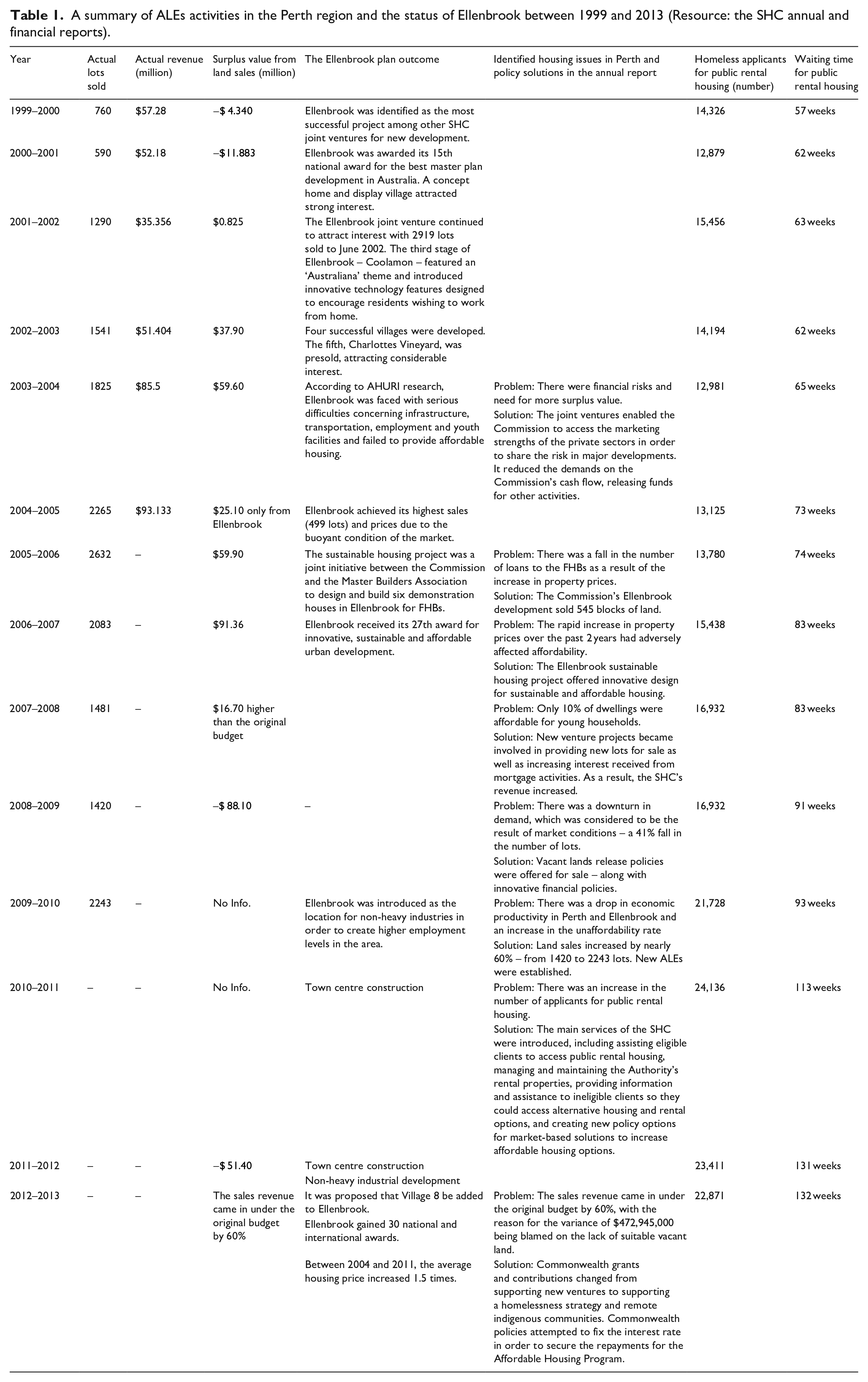
To maintain the desire of filling the lack through the neoliberal fantasy of the free market operation (Dean, 2009a), innovative semi-private institutions and Arm’s Length Entities (ALEs) were established to facilitate this operation. In the next years, other fantasies were deployed to maintain the initial desire that arose from the identified lack of affordable housing and to continue the Ellenbrook urban development practice. For example, the SHC (2006–2007: 9) report upheld the fantasmatic picture of commendable urban design in Ellenbrook by bestowing it with 27 awards for its innovative and sustainable design practice. It was also recognised as one of the best practices of Public Private Partnerships as well as private sector investment (see Table 1).
A summary of ALEs activities in the Perth region and the status of Ellenbrook between 1999 and 2013 (Resource: the SHC annual and financial reports).
In particular, the rationality of the Ellenbrook development emanated from an economic assessment in the State Planning Commission (SPC) report in 1992. The economic assessment identified the lack of enough affordable housing in Perth, which subsequently created the desire for completeness. The economic impact assessment offered the Ellenbrook development plan to meet the demand of affordable housing. The 1992 SPC report (McLeod and Co. and Feilman Planning Consultants Pty Ltd, 1992) explained that Ellenbrook was planned to accommodate approximately 20,000 new homes, which represented 10% of the next 15 years of metropolitan expansion and supply of land. The report’s economic impacts assessment explained that a 10% reduction in land supply in Perth would cause an 11% increase in land prices over the metropolis. Moreover, the report explained that the price increase meant that the average lot price of $50,000 would increase to $55,000 and cause the value of land to rise by $825,000,000 over the next 15 years. This economic assessment justified the establishment of Ellenbrook as a necessity.
Ellenbrook’s main rationale was to provide a supply of land to meet demand in order to ensure the lack of affordable housing was filled, particularly for low and moderate-income groups, and to prevent speculative increases in price. Importantly, the Ellenbrook development plan was aligned with the land-supply policies for housing affordability in Perth: The development of Ellenbrook has major implications for housing affordability. The failure to ensure a sufficient supply of land imposes a cost on intending consumers, and on the general community. By ensuring an adequate supply of new land, the possibility for short-term land speculation and subsequent land value instability are significantly reduced, which in turn reduces the likelihood of excessive price escalation. (McLeod and Co. and Feilman Planning Consultants Pty Ltd, 1992: 12)
National policies and the state level of planning are influenced by the global neoliberal approach to planning, that is, deregulation and land release policies in suburban areas in favour of urban development and low-density housing in suburbs (Gurran, 2011). Associated with neoliberal trends, different private and semi-private institutions and organisations emerged, purportedly facilitating the free market mechanism. One of these innovative mechanisms in Australia are the ALEs that work under a wide national policy of public-private partnership (PPP) to attract private finance for public projects (Wettenhall, 2003). Ellenbrook was developed by Ellenbrook Joint Venture based on an agreement between the SHC of WA through Homeswest, which is its housing ALE, and private companies, such as Sanwa Vines Pty Ltd (City of Swan, 2011).
In sum, global neoliberalisation and the fantasy of the Australian Dream of homeownership, as well as the previously mentioned economic impact assessment, shaped the practice of the Ellenbrook development. Fundamentally, the economic assessment that identified increasing demand and the lack of supply appeared natural and compelling and consequently the land release plan as an accepted and normal practice of planning in the Ellenbrook area was regarded as a solution to fill the lack.
The Ellenbrook plan’s promises and objectives
The initial objectives of the Ellenbrook development plan included the following:
(1) Provision of enough housing in the city fringes to respond to the projected flows of immigrants and money (Alexander et al., 2010).
(2) Prevention of house price rises throughout the Perth metropolitan area by supplying land on the fringes (McLeod and Co. and Feilman Planning Consultants Pty Ltd, 1992).
(3) Contribution to economic development (normally reflected in the GDP) through the provision of job opportunities, infrastructure, and accommodation for flows of labour and urban development itself.
(4) Provision of public transportation and arterial roads to the Perth city centre and other parts of the metropolitan region (McLeod and Co. and Feilman Planning Consultants Pty Ltd, 1992: iii).
(5) Provision of a significant portion [1:12] of affordable public housing for low-income groups in this new land development plan (RobertsDay Company, 2005).
Using the Lacanian concept of drive as another mode of enjoyment, the following section outlines the changing directions of the Ellenbrook UDP since its initial objectives. It explains how the initial objectives were redirected from filling the lack to speculative activities on land and maximisation of surplus-value and inevitably surplus-enjoyment.
From desire to drive, surpluses maintained the UDP
Table 1 summarises the financial and lots sales operation of the SHC and its ALEs in both Ellenbrook and the whole Perth region. Investigation of the ALEs’ operations illuminates how the market incentives and continuously increasing surplus-value from land sale activities through new land release and urban development practices sustained the Ellenbrook development. In particular, financial reports showed that from 1999 to 2013, surplus-value worked as the driver of continuous construction in Ellenbrook and of metropolitan growth in Perth. While the reports showed a short fall in achieving the urban development objectives, such as provision of infrastructure and affordable housing, they introduced annual surplus from the yield and sold land activities to facilitate further urban development. The failure of planning to achieve its objectives can be understood based on the difference between two Lacanian concepts of desire and drive in constructing the neoliberal mission of planning agents.
Lacan (1998[1981], 2006) refers to two concepts in relation to lack: desire and drive. For Lacan, drive and desire are different but both are closely related to an identified lack. ‘Desire is one and undivided, whereas the drives are partial manifestations of desire’ (Evans, 2006[1996]: 49). In other words, if surplus-enjoyment sets desire in motion to seek an object, ‘drive does not seek to attain the surplus-enjoyment [from filling the lack], but rather circles around it’ (Evans, 2006[1996]: 128). As Žižek (2008a: 147) argues, drive is a ‘stuckness’ for a subject on a ‘certain impossible point around which it circulates, obeying a “compulsion to repeat”’.
If the aim of desire is to attain surplus-enjoyment through filling the lack, drive knows that it is easier and often more consistently joyful, though also perversely painful, to attain and maintain a tiny surplus-enjoyment through circulation ‘around’ the lack. Žižek (2008a) and Dean (2012) explain that the drive function is possible only in the case of inverting the fantasy. Therefore, drive is the remainder of desire after its subject inverts the fantasy, allowing the attainment of a small degree of excess enjoyment from the lack itself, instead of simply striving to fill the lack (Žižek, 2008a).
Lacan argues that the objects of drive are partial objects not because they are parts of a total object, but because ‘they represent only partially the function that produces them. In other words, in the unconscious only the pleasure-giving function of these objects is presented’ (Evans, 2006[1996]: 138). In this manner, during the functioning of drive, the whole purpose of overcoming lack and becoming whole [again] or other dimensions of this function are missed. According to Žižek (2008a: 328), While, as Lacan emphasizes, the . . . [surplus-enjoyment ] is also the object of the drive, the relationship is here thoroughly different: although, in both cases, the link between object and loss is crucial, in the case of the . . . [surplus-enjoyment] as the object-cause of desire, we have an object which is originally lost, which coincides with its own loss, which emerges as lost, while, in the case of the . . . [surplus-enjoyment] as the object of the drive, the ‘object’ is directly the loss itself – in the shift from desire to drive, we pass from the lost object to loss itself as an object. That is to say, the weird movement called ‘drive’ is not driven by the ‘impossible’ quest for the lost object; it is a push to directly enact the ‘loss’ – the gap, cut, distance – itself.
Lacan explains how drive suggests a potential mode of satisfaction, providing a path between sublimation and idealisation around an object (Evans, 2006[1996]). To Žižek (1999: 304), the succinct definition of drive is, The moment when, in our engagement in a purposeful activity (activity directed towards some goal), the way towards this goal, the gestures we make to achieve it, start to function as a goal in itself, as its own aim, as something that brings its own satisfaction.
Dean (2012) discusses the relationship between capitalism and drive and maintains that what is important about the mechanism of drive is the way it provides the subject with another way to enjoy. Unable to satisfy or to constantly maintain desire, the subject enjoys in another way.
Drive is not a quest for a fantastic lost object; it’s the force loss exerts on the field of desire. Drives don’t circulate around a space that was once occupied by an ideal, impossible object. Rather, drive is the sublimation of desire as it turns back in on itself. (Dean, 2012: 173)
Human desire is always a desire to desire (Žižek, 1999: 109), a desire that provides an enjoyment of being the object-instrument of the hegemonic discourse (neoliberalism), an enjoyment that can never be fully attained. In contrast, drive attains enjoyment in the thwarting of aims, the missing of goals; failure provides its own sort of success. ‘If desire is like the path of an arrow, drive is like the course of the boomerang’ (Dean, 2009b: 4).
The difference between desire and drive can explain the reasons behind the rejection of the contingency of the hegemonic discourse of neoliberalism/capitalism. In fact, the desire for a caring society is sublimated into several drives. We ‘renounce any project of a global social transformation, and limit ourselves to partial problems to be solved’ (Butler et al., 2000: 101). Drive provides a ‘closed loop of circular satisfaction, of the repetitive movement that finds satisfaction in its own circular loop, thus nonetheless relies on the failure to achieve the goal we were aiming at: drive’s self-affection is never fully self-enclosed, it relies on some radically inaccessible X that forever eludes its grasp – the drive’s repetition is the repetition of a failure’ (Žižek, 1999: 304). In drive, ‘one doesn’t have to reach the goal to enjoy. Enjoyment attaches to the process, thereby capturing the subject. Enjoyment, no matter how small, fleeting, or partial, is why one persists in the loop of drive’ (Dean, 2012: 103).
This logic of failure in achieving affordability goals and relying on the surplus-value from repetitive land release and sale activities, accompanied by the surplus-enjoyment attached to this process, is marked as the successful operation of the planning institution and has shaped the operation of most of the land release and urban development policies under neoliberalism. An analysis of SHC financial reports revealed that from 1995, the land trade activities within Ellenbrook shaped the core financial and institutional dimensions of the practice.
From 1999 to 2005, the reports showed that annual surplus-value from land sales in the area operated as the most important driver for the housing organisations and their operation. Ellenbrook was shaped based on the ALEs’ operation and according to the reports, there was always a need for a constant surplus-value from property sales for the ALEs to continue working (SHC, 1999–2005). In fact, this surplus-value became the logic that made their existence possible. ALEs are quasi-private companies that purportedly facilitate the free market operation and are largely used for urban development in Australia (Wettenhall, 2013). The SHC reports explained that the main objective of these ALEs, including Homeswest, was to assist low to moderate-income groups in WA to purchase their own homes through the financial mechanism of home loans, or to enable renters in WA state public housing to enter the private rental market (SHC, 2002–2003).
ALEs are also defined as ‘self-funding organisations . . . that generate surplus funds or a dividend to the council’ (ANZSOG, 2013: 5) and/or to other managerial organisations within cities such as the SHC. An economic rationale justifies the operation of these entities – a rationale that assumes there is a time lag between demand and supply, and the demand side often is greater than the supply side. Therefore, this rationality leads to an expectation that the market’s participants will gain constant surplus-value from land trade activities. This operates as an incentive for the self-funding organisations. In this regard, the expectation of higher prices in the future encourages ALEs to yield more lots for sale in order to obtain higher surplus for the next year to yield even more lots. This system of financing made it possible for the WA Ministry of Housing to act as a ‘for-profit’ corporation and the reports considered that the number of lots and the amount of surplus and profit gained from them was an achievement and a reason for continuous development (SHC, 2000–2009). As Gunder (2016) argues, the neoliberal rationale of entrepreneurial success creates an image of winners from these planning organisations’ point of view and this image maintains their operation at the subjective level of actors.
Each yearly SHC report focused on the number of sold and yield lots and the revenue and income prediction of the next financial year (see Table 1). The 2002–2003 SHC report more specifically outlined the successful outcomes of Ellenbrook: Four successful villages have been developed and the project continues to mature. The fifth, Charlottes Vineyard, has been presold, attracting considerable interest. Work on the town centre development is commencing. Lot sizes range from 348 to 3,000 m2, at prices of $68,000–$127,000. 18% of purchasers in Ellenbrook are existing residents who have experienced the benefits of living in a superior subdivision. These residents are selling their original homes and re-investing within the development to take advantage of increased property prices and to build a more substantial dwelling. (SHC, 2002–2003: 43)
However, these repetitive land release practices did not result in the provision of affordable housing. In 2005, the SHC announced a fall in the number of loans to FHB: ‘[T]he reduction in expenditure for Loans to Homebuyers is mainly due to the decline in loan applications as a result of the increased property prices adversely affecting the lower to middle income earners’ ability to purchase a property’ (SHC, 2005–2006: 102). Once again, as Table 1 shows, land supply was suggested as a solution with the Commission considering up to 545 blocks of land for sale at Ellenbrook. In the 2006–2007 report, it was explicitly expressed that ‘the rapid increase in property prices over the past two years’ had adversely affected affordability (SHC, 2006–2007: 71). While the annual report showed the successful operation of the SHC and nine Joint Ventures (ALEs) in terms of high revenue from land yields and sales activities, leading to the recommendation that this mechanism be used for further development; numbers and statistics from the Commission reports revealed a rollback in achieving the SHC’s aim of provision of affordable housing (see Table 1).
The 2005–2006 SHC report clearly stated that the SHC and Landstart (an Australian ALE) continuously released vacant land for sale to,
assist in the supply of lots for the construction of public housing
encourage home ownership by providing a continual supply of affordable land in attractive and sustainable communities
bring in revenues to fund the Commission’s social housing programs (SHC, 2005–2006: 25)
The surplus from land sales was one of the most important resources relied on by the SHC and the Ministry of Housing. The report clearly presented that a higher surplus-value from the land market transactions was a sign of annual success and an economically efficient method to finance further urban development for the provision of affordable housing. However, the above objectives appeared to operate paradoxically; that is, there was a maximisation of surplus-value through urban growth and a simultaneous provision of affordable housing that the reports from the following years, particularly those from 2007 to 2013, showed were not fully achieved, as reflected in the increasing number of applicants for public rental housing and the waiting time to access them (see Table 1).
The economic crisis of 2008 exacerbated the unaffordability issues. From 2009, the Labour Government reformed some of the policies and drew on affordable housing and social housing policies; however, the policies once again focused on the neoliberal rationale of ALEs as the tools of free market operation. Nevertheless, none of these companies and corporations showed capacity, power, or interest in providing an effective response to the lack of affordable housing. According to the executive director of the Property Council of WA, private investors were reluctant to put their money into affordable housing construction (Trenwith, 2012).
Neoliberal mission of planning: Enjoying the surplus-value
Although many planners, such as Alexander et al. (2010) and Hillier (2002), have criticised the Ellenbrook plan for failing to meet its promise of providing affordable housing for targeted groups, it received awards for its good design practice, PPPs and private sector investment.
The 2000–2001 SHC report explained that the outcomes of ‘Landstart’s Joint Venture include some of the most respected and progressive community developers, and projects have attracted Australia-wide interest’ (SHC, 2000–2001: 59). Ellenbrook in particular was introduced as the most successful project amongst others for specific design, concepts, and use of progressive technology such as cable TV, which together were ‘attracting strong interest’ (SHC, 2000–2001: 60). A later SHC report (2006–2007: 9) showed that Ellenbrook received 27 awards for an innovative, sustainable, and affordable mechanism of financing for urban development.
In the 2003–2004 report, the importance of the Joint Venture operations for the SHC was reemphasised (SHC, 2003–2004: 40): The Joint Ventures enable the Commission to access the innovative presentation and marketing strengths of the private sector and partnerships for sharing the risk in major developments. The Joint Venture method also reduces the demands on the Commission’s cash flow, releasing funds for other activities.
Failures in providing transportation and infrastructure
Based on my conversation with a senior planner from Swan City and one of the managers of the RobertsDay Company, as well as my site visit in 2014, I realised that Ellenbrook faced two main difficulties and problems: a lack of efficient public transportation and inappropriate access to the city and other regions. ‘Ellenbrook was developed prematurely’, thus leading to the problematisation of service and infrastructure provision (Alexander et al., 2010: 60). Khan and Schapper (2012) explain that the LWP Property Group and RobertsDay Company sponsored the Ellenbrook local community to support and resolve the transport problems in Ellenbrook as a serious issue.
Failures in provision of affordable housing
The SHC (2007) reported that the number of applications for public rental housing in Perth increased from 13,780 in 2006 to 15,438 in 2007. In addition, the average waiting time for public rental housing increased from 74 to 83 weeks, while the number of approved home loans showed a fall during this time. In the 2006–2007 report, it was explicitly expressed that ‘the rapid increase in property prices over the past two years’ had adversely affected affordability (SHC, 2006–2007: 71). Thus, despite the successful operation of the SHC, nine Joint Ventures (ALEs), and high revenue from land yields and sales activities, the numbers and statistics from reports revealed a rollback in achieving the SHC’s aim of providing affordable housing.
As explained, the economic impact assessment reported that deletion of Ellenbrook from the Perth development plan would cause an 11% increase in land prices over the metropolis over the next 15 years (1992–2007). The Ellenbrook development was shaped and implemented based on this simple economic assessment, leaving it unclear whether land supply caused the price to increase or drop in both local areas and the metropolis. Considering the 189% increase in average lot prices during a 10-year period (1994–2004) in Ellenbrook (RobertsDay Company, 2005), it seems that the simple rationale of land supply to approach and identify demand and meet the land-market equilibrium could not justify a practice of suburban land development and land release.
Furthermore, regarding efficient transportation and sufficient infrastructure as two important factors of affordability, the Australian Housing and Urban Research Institution (AHURI) (Newman et al., 2003) revealed that Ellenbrook was facing serious difficulties concerning infrastructure, transportation, employment, and youth facilities and had failed to provide affordable housing. Therefore, it appears that except for its financial success and design awards, the Ellenbrook development as a practice of planning largely failed to achieve its objectives. Despite the failures of the neoliberal discourse resulting in the economic crisis of 2008, this discourse continued working through the rationale of the free market and PPPs as the best solutions for the provision of affordable housing.
While at the initial stage, the attainment of surplus-enjoyment from filling the lack established the desire for the Ellenbrook plan, in the next phase, despite the successful financial operation of the SHC and its ALEs, and high surplus-value from land yields and sales activities, the numbers and statistics from reports revealed a rollback in achieving the SHC’s desired objective of providing affordable housing. The reports showed that the provision of affordable housing was not attained and this failure continued to cause anxiety and concern, reflected in the SHC annual reports. However, even if it was difficult, if not impossible, to attain surpluses from filling the lack of affordable housing, planning actors were able to achieve a tiny amount of surplus-enjoyment by other means, such as from buying and selling lands in the newly developed area.
The Lacanian concept of fantasy explains how the actors used different fantasies, such as the Ellenbrook awards for design practice and innovative and sustainable urban development, in order to cover the failures of the market. In addition, at the subjective level of planning, actors inverted the structure of fantasies and found it easier and more joyful to circulate around the identified lack and gain profit and partial enjoyment from the impossibility of fully filling the lack of sufficient affordable housing under neoliberal rationality. Indeed, the mechanism of drive sustained a partial but repetitive, accessible enjoyment that allowed the actors to continue their association with the practice. This is in accordance with the neoliberal mission identified in Lefebvre’s (1996: 84) concept of ‘planning of developers’.
[Neoliberal planning agents] conceive and realise without hiding it, for the market, with profit in mind. What is new and recent is that they are no longer selling housing or buildings, but planning. With or without . . . [fantasy], planning becomes exchange-value. The project of developers presents itself as opportunity and place of privilege: the place of happiness in a daily life miraculously and marvellously transformed.
Here, ALEs as neoliberal planning institutions make themselves the instrument of the market discourse’s enjoyment. As Lacan (2008) argues, when these institutions as capitalist agents become the object-instrument of capitalism, they then, through market discourse, deploy the most appropriate knowledge and technology in order to produce and maintain the repetitive surplus-enjoyment. Indeed, the only technology and knowledge which are allowed are what are related to the neoliberal mode of production and surplus-value.
Conclusion: A way out of the stuckness of drive
A discursive interpretation of the Lacanian concept of ‘the lack’ was the core of this article. PDT assisted in explaining how the objectives of the Ellenbrook urban development policy were set, yet the policy’s objectives remained largely unachieved despite the practice providing high surplus-value. Also, PDT aided in distinguishing the differences between the notions of desire and drive in regard to the lack of affordable housing. The practice started with an economic impact assessment that identified a lack of affordable housing in the market. The desire to fill the identified lack of affordable housing was the fantasy of the Ellenbrook suburban development plan in its first phase.
However, introducing the universally acceptable mechanism of self-funding planning organisations such as ALEs neoliberal financial facilitators and institutional tools to supply affordable housing thwarted other means to achieve the plan’s objectives except surplus from speculative land activities. At the subjective level of the neoliberal planning, it was the tiny surplus-enjoyment gained from circling around the lack of affordable housing that made it possible for the self-funding planning organisations in Perth to exist as well as the suburban development plan to continue. With this neoliberal mechanism, failure in achieving the objectives was a success and the surpluses that were supposed to be gained in order to facilitate more housing supply became the main objectives of the UDP.
Following Lacan, understanding the different mechanisms through which to face the lack provides an ethical standpoint for actors and assists in investigating the ways in which actors deal with a materialised lack in the hegemonic discourse. This ethical standpoint explains how subjects recognise a lack as a problem and how they address that problem; namely, how and with which mode of enjoyment subjects treat the lack – for example, creating a fantasy, providing a new discourse, or the way they enjoy the lack – discloses the ethical point of view pertaining to a practice including that of a new UDP or a research practice. According to Lacan, the mechanism of drive is a perversion. But the question remains, is there any possible way out of the stuckness of drive?
From an economic point of view, I argue that the universal answer to this question is rooted in the original role of planning as the ‘corrector of imbalances’ (Harvey, 1985: 177). Due to the inherent contradictions of capital and capital accumulation, markets are always in a state of inequilibrium and planning must deal with imperfect market situations. The contradiction between use-value and exchange-value and the maximisation of surplus-value redirect the role, institutional dimensions, and financial mechanism of planning under neoliberalism to the ‘planning of developers’ (Lefebvre, 1996: 84). As a result, the neoliberal planning system is often involved in the maximisation of surplus rather than the correction of the failures of the market economy, such as providing affordable housing for lower income groups. Therefore, the original role of planning and the reality of imperfect markets should be strongly considered in the process of plan and policy making. Marxist analysis of the market failures and contradiction of capitalism can be helpful in redefining the role of planning and in making policies and plans (Holgersen, 2020). Nonetheless, the question is how these universal theoretical solutions may offer a useful approach to breaking the circle of drive and assist planning to achieve promises of urban land development plans, particularly in the case of Ellenbrook, Perth.
In the case of the Ellenbrook urban development, the state and Federal Government as well as the Commonwealth, as the main actors in Australia that are able to finance large-scale projects and policies, should provide infrastructure, efficient transportation and affordable housing in the area. It was stated clearly in the SHC’s annual reports that the shortfall in achieving goals was the result of insufficient budget and finance from the Federal Government to provide affordable housing. As explained, the system of financing for self-funding organisations is the main cause of the mechanism of drive and the organisations are stuck in speculative activities as the logic of their existence.
Although neoliberalism has set the agenda for planning on the universal scale, this suggestion is applicable merely in this case – every case and context might have different contingencies as a way out of the stuckness of drive. Moreover, the role of planning as a corrector of imbalances is not limited to the government’s intervention in the market. Planning is equipped with different approaches, tools and techniques for dealing with market failures, which should be examined in their relationship to different cases.
Footnotes
Acknowledgements
The author thanks the editor and the anonymous referees who all contributed to make a better article.
