




Abstract
How does public participation in planning and environmental governance engender democratic legitimacy? Drawing a distinction between the optimistic and critical participation literature, I argue that both these strands of research have tended to neglect the public’s perspective on this question. This oversight has, in effect, produced strongly normative and essentialist understandings of democratic legitimacy that treat legitimicy as intrinsic to either process or substance of participatory governance. Proceeding from an anti-essentialist understanding of democratic legitimacy, which primarily relies on contemporary social perceptions and expectations of democratic institutions, I outline a normatively agnostic framework for exploring how legitimacy is engendered through participation. Using this framework to investigate citizen experiences of participation processes in Sweden, I highlight how democratic legitimacy can gainfully be understood as a multidimensional, provisional, and contingent quality that individual citizen participants “confer” and “retract” in a plurality of ways. Based on this, I conclude by suggesting that sustained research engagement with the public’s expectations and experiences of participatory governance can reveal critical insights into the potentials and challenges for realizing democratic planning outcomes.
Keywords
Introduction
The past decades’ enthusiastic deployment of public participation activities in planning and environmental governance have partly been fueled by participation’s expected potential to revitalize liberal representative democracy and confer democratic legitimacy to public institutions that are increasingly perceived to operate at a distance from the private lives and concerns of ordinary citizens (Fung, 2015; Monno and Khakee, 2012; Tahvilzadeh, 2015). But how does public participation engender democratic legitimacy according to the scholarly debates in this field? And how is it engendered if viewed from the perspective of those who are to confer legitimacy: the public?
In this article, I argue that these debates have tended to neglect actual legitimacy demands and what determines them in favor of broadly abstract, theoretical-normative understandings of democratic legitimacy which foreground if it is engendered or not, but rarely how, in what forms, and by whom. In line with recent calls for more normatively agnostic and measured approaches to the study of participatory governance (Braun and Schultz, 2010; Metzger et al., 2017; Turnhout et al., 2010), my overarching aim is to bring attention to how strong normative assumptions regarding the inherent democratic merits of participation conceal many of the complex motivations, expectations, and experiences these arrangements produce among citizens.
In the article, I employ Alvesson and Sköldberg’s (2018) reflexive problematization methodology which involves a three-step approach of “identifying, articulating and proposing an alternative to a dominant assumption” (p. 398). The methodology proceeds from the idea that between empirically driven “gap-filling” research and excessively critical “overproblematizations,” there are also occasions for assumption-challenging investigations of existing research facilitated through the provision of alternative frameworks. In a first step, I sketch a typology of the existing literature by drawing a distinction between optimistic and critical strands of participation research in planning and environmental governance. I suggest that an ongoing source of contestation regarding the democratic merits of participation can be traced to their use of different democratic theories which produce different normative standards of assessment. The optimistic strand has primarily drawn on deliberative democratic theory to foreground how the political and symbolic meaning of the process of participation provides citizens with a foundation to confer public trust toward established institutions, whereas the critical strand has drawn on participatory democratic theory to emphasize how public trust is engendered through a strengthened self-determination that comes from having concrete influence on substantive political issues.
These conflicting standards have produced ample empirical investigations supporting both claims. The recurring theme in the critical literature is that delegation of power away from authorities onto marginalized groups or the general citizenry only account for the outliers among participatory activities which, rather than revitalizing democracy, has shown to further the “disenchantment and distrust among citizens” (Monno and Khakee, 2012: 86), lead to “consultation fatigue” (Bickerstaff and Walker, 2005: 2135), and “obscure, and indeed sustain, broader macro-level inequalities and injustice” (Cooke and Kothari, 2001: 14). Indeed, the two strands are more or less in agreement that devolvement of authority is rarely at stake in participatory practice. But the more optimistic scholars have on their part empirically traced how such activities may still engender “aspects of democratic citizenship,” which are said to be at least as important to a “healthy democracy” than whether or not citizens “have real power and a say in decision-making” (Michels and De Graaf, 2010: 489). Despite, or reflecting both such findings, researchers in the wider field of public administration who try to take stock of the long-term effects of direct forms of citizen engagement tend to conclude that “so far, the effect of participation on legitimacy is unclear” (Fung, 2015: 513; see also Abels, 2007; Marien and Kern, 2018; Wang, 2001).
In the article, I argue that the impasse between the two strands also reflects what they have in common: lacking an explicit empirical grounding in citizens’ own expectations and experiences of participation, both come to produce somewhat essentialist understandings of democratic legitimacy which treat it as an intrinsic property to either the process or substance of the individual participatory event. In a second step, I contrast these commonalities to a more open and searching understanding of democratic legitimacy, in the article facilitated through the work of historian Pierre Rosanvallon (2011). Proceeding from an anti-essentialist understanding of democratic legitimacy, Rosanvallon traces a pluralization of emergent demands on democratic institutions which straddle and go beyond dominant assumptions regarding citizens’ expectations of public institutions. Combined, they frame democratic legitimacy as a multidimensional, contingent, and provisional quality which, precluding empirical analysis, cannot easily be confined to either substance or process of political decision-making.
Accordingly, in a final third step, I employ Rosanvallon’s understanding of democratic legitimacy as an “empirically-based theory” in the context of participatory governance practices in Sweden. My aim here is not to perform “legitimacy audits” of Swedish public participation, nor to work inductively or test a framework against “empirical reality.” Instead, the empirical material, primarily consisting of citizen accounts of participation activities, is used “as a way to work ‘against’ dominant thinking” (Alvesson and Sköldberg, 2018: 398). The experiences framed here help render democratic legitimacy a multidimensional quality that can be “conferred” and “retracted” in a plurality of ways, sometimes by one person in the same participatory event. Based on this, I argue that a sustained research engagement with the social expectations and experiences of participatory governance can reveal critical insights into the potentials and challenges for realizing democratic planning outcomes.
My ambition with the article is not to denigrate the rich contributions made by the existing literature, but to build on them by teasing out new avenues for exploring the pluralization of actual legitimacy demands that has accompanied the past decades’ somewhat euphoric deployment of participation activities in planning and environmental governance. The article proceeds from the idea that the continued pursuit of procedurally narrowing down “what works best when” (Rowe and Frewer, 2004: 547) as well as the sustained critical exposition of the at times “tyrannical” (Cooke and Kothari, 2001) manifestations of participatory governance can gainfully be strengthened through a more lucid understanding of the ambiguous and contested nature of democracy and how the basis for its legitimacy changes as part of its development.
The remainder of this article is structured as follows: in the next section, I sketch a typology representing the core thinking in the scholarly debates in planning and environmental governance surrounding participation and democratic legitimacy. In the third section, I introduce the key points of Rosanvallon’s treatment of democratic legitimacy, which is then contrasted with the above conventional understandings. In the fourth section, I employ Rosanvallon’s considerations as a framework for investigating citizen experiences of participation activities. The article concludes with a summation of the insights obtained from utilizing this framework as well as what they potentially mean for further research.
Participation and democratic legitimacy
Legitimacy is a concept of central concern for scholars in planning and environmental governance, addressing not only the justification or securement of the individual plan or policy decision but also the democratic nature of the political-administrative system from which planning derives its authority (Mäntysalo et al., 2015). Yet, despite how participation and collaborative-type planning have long been seen as critical vehicles for “re-enchanting democracy” (Healey, 2012), there is considerable disagreement on the democratic merits of participatory planning (Day, 1997), all the while the actual mechanisms behind its legitimacy-enhancing capacities have long been left implicit in the debates (Taylor, 2019). In this section, I outline a typology of the participation-focused literature in planning and environmental governance (see Table 1). The aim is to identify the underlying assumptions in this literature in an effort to articulate what is often left unexamined or taken for granted in the debates: the public’s own expectations of participation activities. I build on Chilvers’s (2009: 401) helpful entry-point to this literature and his distinction between, on one hand, optimistic strands of research incorporating both the “developmental” and “evaluation” literature concerning concrete methodologies for how participatory activities can be institutionalized and evaluated, and on the other hand critical strands of research clustered under their shared ambition to better understand the “construction, performance, and discourse” of participation (see also, for example, Tahvilzadeh, 2015; Turnhout et al., 2010).
Optimistic, critical, and agnostic understandings of democratic legitimacy and participatory governance.
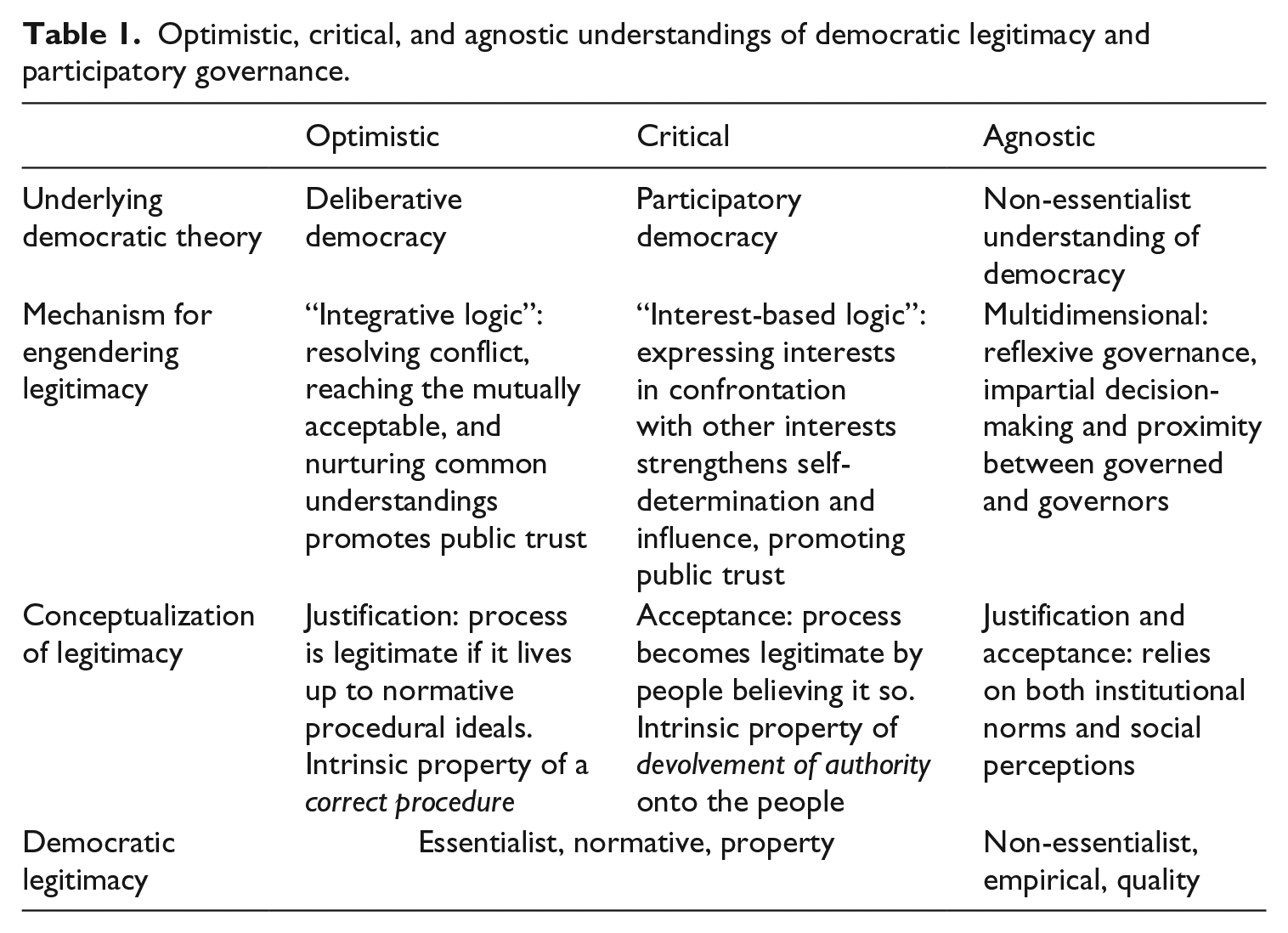
Deliberative and participatory democracy
The contrast between the optimistic and critical research strands could, first, be understood as a difference in relative emphasis between different democratic theories. Much of optimistic research has explicitly drawn on deliberative theories to either develop (e.g. Healey, 1997; Innes and Booher, 2010) or evaluate (e.g. Fiorino, 1990; Webler, 1995) participatory governance practices. Emerging around the 1990s as an academic normative-political project before their proliferation into actually existing practices, deliberative theories hold that the ideal political decision-making scenario is one that takes place between equal individuals who defend their claims with reason and who are swayed not by self-interests or others’ coercion but by the force of the better argument (Gutmann and Thompson, 1996; Habermas, 1996).
The scholarly critique leveled at optimistic participation researchers is well rehearsed, the core of which concern their seemingly naïve view on power relations and how the emphasis on “consensus” serves to maintain rather than challenge existing hierarchies (see Tewdwr-Jones and Allmendinger, 1998). It is on these grounds some critical theorists conceptualize participatory arrangements as neoliberal governance strategies deployed to neutralize resistance to, and placate victims of the past decades’ welfare restructuring policies (e.g. Purcell, 2009). But the undercurrent to such critique has since long been a central part of the participation debates in planning, harking back to Sherry Arnstein’s (1969) Ladder of citizen participation, which bluntly conveyed the idea that activities which do not entail actual delegation of power to citizens only serve as “manipulation” of public trust. Underpinning much of this critical strand of research, then, is a less explicit but no less normative position grounded in different variations of participatory democratic theories, the roots of which can be traced to the social movements and democratic debates of the 1960s (see Pateman, 1970). If deliberative theorists are concerned with democratizing decision-making, participatory theorists have aimed at “democratizing democracy,” seeing as their concern the transformation of the structures which obstruct “opportunities for individuals to participate in decision-making in their everyday lives as well as in the wider political system” (Pateman, 2012: 10).
Integrative and interest-based logics
A second point of contention between the two strands of research—largely informed by the theoretical distinction above—concerns the mechanisms for how democratic legitimacy is engendered through participation. The optimistic strand often foregrounds procedural dimensions of participation. Here, the legitimacy-enhancing capacity tends to concern the way in which the perceived “fairness” of the process (Tyler, 2003), the networks, and “social capital” gained from the experience (Putnam, 2001) and how a mutual understanding (Habermas, 1996) and moral agreement (Gutmann and Thompson, 1996) around political decision-making are expected to foster citizen engagement and public trust toward established democratic institutions (e.g. Healey, 1997; Innes and Booher, 2010; Webler, 1995). Gustafson and Hertting (2017) aptly refer to such notions as based on an integrative logic since attention is paid to participation’s capabilities to resolve conflict and nurture common understandings. In contrast, the critical strand proceeds more from an interest-based logic where democratic participation is conceptualized as a space for disagreement on substantive political issues and where the merits of such activities are pinned on their relative possibility for—often marginalized—individuals and groups to express themselves in confrontation with other interests (e.g. Hillier, 2002; Miraftab, 2009; Monno and Khakee, 2012). Here, then, the legitimacy-enhancing mechanism of participation concerns how citizens are expected to foster public trust through a strengthened self-determination and increased influence over a political system that serves them.
Justification and acceptance
A third point of contention concerns how the two strands conceptualize legitimacy. As Bernstein (2011) notes, deliberative theorists tend to proceed from the reasoning that for authority to be considered legitimate it needs to be justified on explicit theoretical and normative grounds. This conceptualization is also prevalent in the optimistic participation strand where normative procedural criteria function almost as “legitimacy audits” of participation activities (e.g. Webler, 1995). By contrast, critical scholars rely on a more sociological and empirical conceptualization of legitimacy, being more concerned with how actors come to justify processes as legitimate and how they come to be accepted as such (see, classically, Flyvbjerg, 1998). Nevertheless, as noted above, many critical scholars proceed from the normative assumption that such acceptance primarily comes from the devolvement of authority. In other words, that citizens’ motives for engaging in participatory arrangements mostly stem from an ambition to discuss and influence concrete issues (e.g. Monno and Khakee, 2012).
The missing perspective of the public
While the assumptions underpinning the two strands function as important normative grounding for the development, evaluation, or critique of participatory governance practices, they nonetheless lead to something of a double bind in the debates where the emphasis on one dimension tends to engender a critique on what is left out. As much as the two strands differ, this impasse also reflects what they have in common.
First, the expectations, motivations, and experiences of the public have long been in the background in the participation debates. This is an understandable lacuna in the optimistic literature where procedural criteria are derived explicitly from normative theory (but see, for example, Santos and Chess, 2003). But it is also recurrent in the critical literature where—arguably resonant of the historical roots of participatory democratic theory—those who do rely on the testimony of citizen participants often limit their analytical lens to already committed citizen activists with clearly defined grievances in need of redress, which effectively foregrounds the same interest-based mechanisms which the literature already draws on (but see, for example, Inch, 2015). The critical strand’s emphasis on the “action” of citizen engagement is somewhat mirrored by the optimistic strand’s tendency to investigate satisfaction with participation activities immediately after the event (but see, for example, Gustafson and Hertting, 2017). Second, then, is that these biases toward the normative-theoretical and the immediacy of the outcomes of participatory governance produce rather essentialist understandings of democratic legitimacy, where it is a priori assumed as an intrinsic property of either the process or substance of the individual participatory event.
Both these tendencies arguably reflects what some describe as the “unhistoricized” treatment of democratic legitimacy in the wider political theory literature, where standards are developed from contemporary understandings of democratic theory despite how the basis of legitimacy has changed over time and as part of the development of democracy (Bernstein, 2011: 22). For instance, critical planning scholars have been exceptionally good at investigating the democratic legitimacy of planning institutions in the context of emergent neoliberal restructuring policies (e.g. Mäntysalo et al., 2015), but demands placed on these institutions—that is, the social perceptions of what democratic legitimacy substantially is and should be—are often treated as constants.
It should be duly noted that this typology is intended to represent some of the key sources of disagreement in the participation debates and the relative difference in emphasis scholars tend to make in this literature. Accordingly, there are many other assumptions and approaches underpinning the participation literature. Furthermore, most authors have increasingly come to acknowledge and incorporate contributions from both sides of the debates (e.g. Healey, 2012; Hillier, 2003). But as should be clear from the discussion above, there is also much to be learned from moving beyond normative, theory-based understandings of democratic legitimacy onto the more empirical question regarding what citizens demand from democratic institutions today. In the next section, I explore this question through the work of historian Pierre Rosanvallon.
The pluralization of democratic legitimacy
Rosanvallon’s (2011) inquiry into the nature of democratic legitimacy is resonant of both the deliberative and participatory democratic tradition. His polemic targets are also aggregative, “minimalist” understandings of democracy and his ambition is to expand its meaning well beyond the electoral-executive functions of the state. But this ambition is guided as much by normative ideals as it is by empirical observations of actual legitimacy demands in the historical development of democracy.
Using a mixture of historical and recent empirical research, he begins his inquiry by tracing the contemporary disillusionment with democracy to the inherent ambiguities about its meaning. According to Rosanvallon (2011), democratic regimes have since their inception struggled with trying to reconcile a tension between two contradictory democratic ideals: the “will of the majority” and the “will of the people.” The conventional legitimacy of democratic governments, he contends, rests on a twofold conflation between these ideals. First, that majority rule can act as a stand-in for the whole of society and, second, that the circumstances in which a government is established—the ballot box—is representative of its democratic nature. This “double fiction” where “the part stands for the whole, and the electoral moment stands for the entire term of government” has “little by little come to be seen as an intolerable distortion of the truth” (Rosanvallon, 2011: 2). This is especially the case in recent decades, he argues, when socio-political identities have diffused, decision-making processes have become more opaque, and neoliberal restructuring policies have made governments unable—or unwilling—to secure legitimacy through sweeping political projects. But the dissolution of this fiction has in turn led to new demands on democracy and to a “radical pluralization of the forms of legitimacy” (Rosanvallon, 2011: 8).
Rosanvallon (2011) catalogs these demands under three “qualities,” which are now complementing and competing with the legitimacy-conferring capacities of a regime’s electoral-executive functions: the legitimacy of reflexivity, impartiality, and proximity. A demand for reflexivity is traced from the rise of constitutional courts which are subjecting electoral majorities to outside scrutiny. For Rosanvallon (2011: 6) it corresponds to a “multiplication of the expressions of social sovereignty,” that is, the demand for more complex understandings of “the people” and how to represent it. Growing demands for impartiality are elicited from the proliferation of independent regulatory authorities that act as correctives to legislative powers. Here Rosanvallon identifies new expressions of the founding ideal of democracy: power as an “empty space” which no one can monopolize. These institutions’ impermanence and independence converge with demands for “more public justification of policy decisions, greater openness, and above all, greater impartiality” (Rosanvallon, 2011: 82). Finally, proximity refers to the growing demand for its complementary opposite: a “close attention to the particularity of each situation” that can be met by “caring about each individual, taking the diversity of contexts into account, and preferring informal arrangements to mechanically applied rules” (Rosanvallon, 2001: 172). Here, he draws on social psychology studies (e.g. Tyler, 2003) as well as the recent decades’ proliferation of literatures on the “politics of care” (e.g. Held, 2006) to underscore how citizens have become as conscious of the behaviour of decision-makers as to the exact content of the decisions they make.
An agnostic understanding of democratic legitimacy
Having presented some of the key points in Rosanvallon’s understanding of democratic legitimacy, I now move on to clarify how his point of departure differs from the two dominant modes of thinking in the participation literature as well as how it might be gainfully used as an alternative, agnostic framework for investigating participation (see Table 1).
In contrast to how much of the optimistic and critical literature elicits their understandings of democratic legitimacy, the demands outlined above are not grounded in established democratic standards since, for Rosanvallon, these are precisely the ones that are dissolving. The demands are “historicized” in the sense that they are elicited empirically in regard to what a democratic populous demands from institutions today.
For this reason, the identified demands largely transcend the distinction between integrative and interest-based mechanisms for how democratic legitimacy might be engendered through participation. Contrary to the critical literature’s interest-based logic, where citizens are assumed to mainly judge participatory governance according to its relative treatment of concrete issues to discuss and influence, the identified demands allow for a more open understanding of the complex motivations and expectations that people may attach to political processes. But also in line with the critical strand, and as Rosanvallon (2011: 202) takes great care to point out, the affirmation of new forms of legitimacy that emphasize how politics is portrayed as much as the precise nature of what it hopes to achieve might well transform politics in a “more fundamentally democratic direction,” but “it can also instigate a fatal decline” as the accomplished performances of affable decision-makers potentially conceal “the revival of old and terrifying perversions of democratic rule.” Accordingly, acknowledging democratic legitimicy’s multiple dimensions by not assuming an all too normative position on what it constitutes does not negate a critical examination of its potential subversion.
For this reason too, the demands transcend the conceptual distinction between legitimacy as “justification” and “acceptance.” For Rosanvallon (2011), they include both these dimensions as they “share with institutions the ability to embody values and principles, but at the same time they remain inoperative unless socially recognized as such” (p. 7). Rosanvallon (2011) understands democratic legitimacy as a socially constructed and contingent phenomenon, a dynamic quality or “invisible institution” (p. 8). Like “trust,” it is “never definitively acquired,” remains “precarious, always open to challenge, and dependent on social perceptions of institutional actions and behavior” (Rosanvallon, 2011: 7). This anti-essentialist, broadly sociological approach avoids treating legitimacy as an intrinsic property of the process or substance of the individual participatory event. Rather, it becomes a question of contingency open to empirical scrutiny at different time-spaces whose dimensions of participation might be more or less important for the engenderment of democratic legitimacy.
In the remainder of the article, I employ this understanding of democratic legitimacy as an agnostic “empirically-based theory” to explore citizens’ experiences of participatory governance practices in Sweden. To be sure, Rosanvallon does not elicit these demands from the social expectations of participatory governance processes but from the historical ensemble of various institutions in the development of democracy. But my concern is less on the specific contextual meanings of each demand per se and more on how they help underscore the plurality of ways in which people have come to judge institutions as (un)democratic. As Rosanvallon (2011) notes, they can more broadly be read as different of ways of examining the “will of the people”: “The idea is that there is more than one way to act or speak ‘on behalf of society’ and to be representative” (p. 8). Accordingly, I use them as a resource to underscore how a different way of thinking about democratic legitimacy can open new avenues for exploring the democratic merits of participation. The legitimacy of reflexivity and the demands for more complex expressions of social sovereignty are used as a framing device for material that highlight the complexity of citizens’ experiences of participation and the ambiguous and provisional outcomes such complexity produces. With impartiality, I frame experiences that point to more generalized dimensions of democratic legitimacy that transcend specific occurrences within the individual participation event. Finally, proximity is used to frame citizen experiences that are not necessarily tied to integrative or interest-based logics but instead to the behavior of public officials. Together, they help render democratic legitimacy a multidimensional, contingent, and provisional quality, which thus impede on conclusively framing it as an essential part of the process or substance (or process and substance) of any given participatory event.
The public’s experiences of public participation
The empirical material’s context concerns participatory governance of Swedish local authority planning, where the motives for deploying such activities are often strongly tied to the expected legitimacy-enhancing capacities of participation. In Sweden, one of the more instrumental policy sectors shaping contemporary participatory arrangements can be traced to the millennial parliamentary inquiry aimed at investigating the state of Sweden’s democracy (SOU, 2000). While Sweden had and, by international standards, still has a strong civil society, high voter turnouts, and high levels of trust toward political institutions (SOU, 2016), the inquiry took urgent note of how Sweden’s ability to secure democratic legitimacy through welfare output was showing sharp signs of faltering. This vulnerability, it was concluded, necessitated a move towards a more “participatory democracy with enhanced elements of deliberative democratic theory” (SOU, 2000: 243). The past two decades has thus seen a strong upsurge in interest and deployment of participation activities among municipal authorities. Today a large majority of municipalities affirm that they work with public participation alongside the statutory planning consultations (SOU, 2016). But despite this widespread interest, Swedish local authority politicians remain relatively skeptical of delegating authority to citizens outside the channels of conventional representative institutions (Karlsson, 2012). Expectedly then, case studies conducted in Sweden suggest that substantial influence on political issues is rarely at stake in these participation processes (e.g. Monno and Khakee, 2012; Wiberg, 2018). The Swedish context is thus resonant of developments abroad in how policymakers and planners tend to construe participatory arrangements as something of a threat to representative democratic institutions and yet paradoxically view participation as a critical means for strengthening democracy (Tahvilzadeh, 2015).
Notwithstanding this generalized context, the three studied municipalities, Täby, Järfälla, and Norrtälje, represent a somewhat diverse case selection. They are all part of Stockholm County and have a similar population size ranging between 60,000 and 80,000 people, but they substantially differ in terms of income and education levels, demographics, as well as experiences with participatory governance. Täby, located 15 km north of the City of Stockholm has one of the highest average incomes in Sweden and it has traditionally been hostile to population growth and urban development. However, recent political majorities have changed their tune and the municipality now has several ongoing urban development projects, consequently provoking discord between many of its citizens and public authorities. By contrast, Järfälla, a neighboring municipality to the City of Stockholm, has had a rapid population growth since the 1960s and more closely mirrors Stockholm County in terms of income, education, and demographics. However, a regional negotiation regarding infrastructure investments has committed Järfälla to further urban developments and densifications in the municipality, which has also provoked several citizen protest movements. Norrtälje has a relatively low average income compared to both Täby and Järfälla and, relative to Sweden, low education levels. Located in the northern rim of Stockholm County, it also has a much larger rural population than any other municipality in the County with roughly half of the population living outside urban nodes. While recent urban densification projects have provoked some discord among urban residents, there is also a deeply rooted schism between the rural population and the municipal administration in Norrtälje, developed under what is perceived as decades of austerity measures favoring the municipality’s urban centers over its rural parts (Degerhammar et al., 2019).
These contextual differences necessarily create different conditions for how the public come to produce their expectations and experiences of participatory arrangements. Nevertheless, the empirical material presented here (while admittedly contingent on its particular and local context) is used as a more generalized backdrop to explore the limitations of existing theory regarding participation and democracy legitimacy, as well as what a more agnostic reading could bring to light.
Methods
The material has been constructed through a qualitative research methodology. It is based on the combination of observations of municipally led participatory activities and semi-structured interviews with citizen participants of these same activities. The first stage of the research was conducted in 2017 when I observed 20 participatory activities in the three municipalities. The activities ranged from plain information meetings regarding development projects to stakeholder consultations and workshops concerning regulatory plans and policy documents.
Using contact information secured during the observations, I conducted in-depth interviews with the citizen participants of these events in the spring and autumn of 2018. A total of 37 participants were interviewed; 23 of these were men and 14 were women; 21 were of working age and 16 were seniors. In an effort to put less emphasis on the immediate experiences of the events, the interviews generally took place between 5 and 10 months after the activity in question had taken place. The questions asked to the participants were fairly open-ended in an effort to elicit narratives regarding their experiences. The earlier observations were particularly helpful in this regard: providing context to the questions, sometimes jogging the memory of the interviewees, and serving to explore alternative and divergent understandings of particular situations or events—including my own.
In the article this material is presented as “breakdowns,” that is, empirical encounters “facilitated through the selective interest of what does not work in an existing theory” (Alvesson and Sköldberg, 2018: 388). Each section begins with observations of participation events which are largely illustrative of existing theory, but which are then followed by citizen accounts that in one way or other conflict with such a reading. Finally, these encounters are interpreted in relation to Rosanvallon’s approach to democratic legitimacy to facilitate a more “productive and non-commonsensical understanding of ambiguous social reality” (Alvesson and Sköldberg, 2018: 388).
The legitimacy of reflexivity
The demand for more reflexive and complex expressions of democratic rule is here used to highlight how citizens’ complex expectations and experiences of participation produce ambiguous and provisional outcomes. This, in turn, impede on conclusively treating democratic legitimacy as intrinsic to integrative logics, which the optimistic research strand tends to emphasize, or interest-based mechanisms, as highlighted by the critical strand.
At a first glance, many of the observed participation activities seemed to fit firmly into the frame of practice which critical scholars have condemned as veiled attempts to placate victims of the recent decade’s neoliberal restructuring policies. Such was ostensibly the case for a series of participation activities in the outskirts of Norrtälje, the large rural municipality situated on the northern rim of Stockholm County. Officially, these activities aimed at collecting local residents’ input on a new rural vision program. But the timing of the activities clearly revealed its political trappings: first on the list of visits were precisely the same rural communities targeted by a recent school decommission ordinance, prompting a number of disparate communities to organize in resistance (“The ruling majority depends on these meetings going well,” the planner in charge had candidly told me). In the meetings, the angered citizenry managed to wrestle the agenda away from the municipality’s highly prescribed workshop-format (which had involved posters, post-its, and colored pencils) onto their issue at stake: the reopening of their schools. However, the ensuing verbal onslaught of the municipal representatives seemed to do little for the locals’ cause and the schools remained closed even after a local referendum came out in favor for their issue.
In the ensuing interviews with some of these citizen participants, many still express dissatisfaction with the participation activities due to the lack of prescribed opportunities to lift their particular issue. Such discontent largely echoes the interest-based logic of the critical strand in which the democratic value of participation activities rests on their relative displacement of authority onto the citizen, or as one participant puts it: “We don’t want a feeling of participation, we want participation” (woman, thirties). At the same time, some of these same participants also express satisfaction with collectively demonstrating their discontent toward the municipal administration. One of the citizen activists remembers how they “took over that meeting” from the perceived narrow framing set by the hired consultants: “We said, ‘We will not do it like that, this is what we will discuss, this is what we think is interesting; we do not intend to do as you intended,’” adding, surprisingly, “And they actually adapted to it” (woman, thirties). The format of the ensuing meetings in other rural communities also came to be substantially different from the prescribed workshop-design of the earlier ones, which was picked up by some of the original participants who had chosen to continue to engage in the activities: It was a bit semi-semiotic in the beginning, with the cutting and pasting and the colored pencils, and then ending with some general write-up on a poster. But then they changed the format. After two meetings or so they adapted. In the beginning we laughed at them, but it got better to be sure. And that’s wise of them. (Man, forties)
Some of the other participants in these ensuing meetings express clear dissatisfaction with what was still perceived as narrow frames for discussions and with how their opinions seemed “filtered” by the consultants so as to be “consistent with what was already written down” (woman, fifties). But others seemed highly satisfied with both process and substance of the rural meetings, likening them to that of “democracy seeping all the way out in its limbs” (man, fifties).
Similarly ambiguous outcomes could be observed in virtually all participation activities studied in the three municipalities. But it was particularly evident in how many of the interviewees found it difficult to confer meaning to the activities without first knowing how their views had been considered by the authorities. This often led to conditional statements such as, “if [the participation meeting] has any effect, it was very democratic” but that “it remains to be seen” (man, fifties). Interestingly, even when the eventual planning decisions seemed favorable to participants, many still report feeling sidelined since the decision was not supplied to them from the mouths of the local authorities but instead “confirmed when we saw it in the local newspaper” (man, sixties), or when they “heard it from the boat club” (woman, forties), or when they were “told about it by a guy who had been to political rally” (man sixties) and who had presumably heard it directly from the Mayor. For many, such experiences served to imbue authorities’ decision-making procedures with an aura of capriciousness where even if their input did have bearing on the decisions made, it became less meaningful since “you never really get to know so” (woman, seventies).
These ambiguous outcomes and experiences add to the well-rehearsed critique of the optimistic strand’s ambition to procedurally narrow down what constitutes “successful” participation, since what ostensibly made some activities a resounding failure—that the prescribed format was “hijacked” by citizen activists—was precisely what made it meaningful to some of the participants. But conversely, they also illustrate how the critical strand’s interest-based logic fails to fully capture the complex nature of citizen’s demand for political influence. For even when seemingly hollow participatory activities were deployed in a rather blatant attempt to placate an angered citizenry it not only failed, but the space also became a meaningful site for locals to express their dissatisfaction toward the municipal administration; to voice their concerns and demand accountability. In a similar way, the provisional and conditional manner in which other participants ascribe meaning to the activities also highlight the inherent problems associated with utilizing normative theory as a ruler for measuring the democratic nature of participatory activities. In line with Rosanvallon’s reading of democratic legitimacy, these experiences of participation activities render it as dynamic quality that can never definitely be acquired nor conclusively linked to either an integrative or interest-based mechanism.
The legitimacy of impartiality
Here, demands for impartiality are center staged in an effort to illustrate the generalized dimensions of democratic legitimacy which render it as a kind of capital, dependent on the history of actions of institutions rather than on any specific person, action, or event.
In contrast to the contentious meetings in Norrtälje, there were some participation activities which from only observing them seemed to be more consistent with what the optimistic strand emphasizes: the role of such activities in securing important public goods through conflict-resolving forms of deliberations while engendering public trust in the process. In the City Hall of Täby, the more affluent municipality of the County, the Planning Office had set up a series of consultation meetings concerning a new comprehensive plan. In line with the County’s ambition to combat the ongoing housing shortage, large areas were designated for densification and many were affected, including homeowners who had spent as much money on their homes “as an ordinary worker earns in their lifetime,” as one of them disclosed. But if the plan was controversial the atmosphere in these meetings rarely let that on, which often seemed calm and cautiously optimistic. The municipality had opted for an “open-house” set up with half a dozen planners spread across 30 or so citizens. With the consultation proposal spread in front her, one planner pointed to the chapter titled “The public interest,” to explain to some participants why their homes had been targeted for densification. In another engagement, a planner was explaining to a couple that since the municipality does not own the land the densification cannot be carried out without the homeowners’ consent, while adding that the plans likely entailed a lucrative increase in their property values. By the end of these evenings, it was not uncommon that some homeowners would ask the planners which developers come recommended, seemingly eager to translate the plans into reality.
In the ensuing interviews, some do express satisfaction with how the open-house format and one-on-one talks allowed one to “dwell back and forth a bit” (man, forties) with municipal representatives. But for others, the same format made it difficult to mix high and low since you’re standing next to a local resident who’s very upset about what will happen on his or her property in relation to their neighbor who’ll be getting something better. (Woman, forties)
Accordingly, some participants had attended these meetings less out of concern for their own property values and more with an ambition to better understand what the densification proposals meant for the municipality as a whole. But with “too few officials and politicians, where even when you finally got hold of someone they disappeared to someone else,” the format left them feeling neglected in favor of participants with more clearly defined interests (man, sixties). Participants of other consultation meetings voice similar frustrations over the perceived institutional bias toward participants with “stakeholder entitlements,” somewhat bewildered by how those who represent collective concerns are seemingly attributed with less credibility that than those who represent themselves (i.e. the “authentic” public; Braun and Schultz, 2010).
Many also challenge a conventional treatment of planning consultations as a space for negotiating the “private interests” of local inhabitants and the “public interest” which the planners and policymakers make claims to represent. Their experiences instead seem to point to a reversed role ascription in which locals come to represent more collective concerns. This is a struggle nonetheless deemed difficult due to a salient conviction that decisions are more likely to be determined by ingrained economic interests, short-term profit motives, and semi-fraudulent conduct than the result of carefully weighed deliberations. “Corruption” is a recurrent term used among some of the interviewees, especially in the rural areas of Norrtälje where the municipality’s planning procedures are usually the subject of local controversy. “You get afraid when you start digging into these processes; who owns what and why? Who is a friend with whom?” one local notes, frustrated by a bitter dispute with the municipality regarding leasing rights of one of the closed public school buildings (woman, thirties). Most seem to share the stance of one citizen participant of the Täby consultations who, reflecting on his own previous work experience as a planner, contends that “these are processes that take place completely outside the purview of any ordinary citizen” (man, eighties).
In sum, the accounts framed here highlight a demand for impartial procedural arrangements which are not just ideals which participants refer to in the abstract, but which seem central in shaping their expectations and subsequent experiences of participatory activities. Such demands are thus consistent with parts of the integrative logic emphasised by the optimistic literature, where people come to judge institutions based on how they live up to the precepts of a kind of “procedural justice” (see Tyler, 2003). But contrary to both strands, which tend to treat legitimacy as intrinsic to the process or substance of the participatory events themselves, the accounts also point to Rosanvallon’s (2011: 95) sociological reading of demands for impartiality as a more generalized quality that “cannot be instituted by a simple procedure” but “needs to be perpetually constructed and validated.” As shown above, participants draw as much on their previous life experiences and the history of actions of public authorities as they do on their current circumstances for conferring judgment on institutions. Accordingly, this dimension of democratic legitimacy shines light on the limited capacities of participation to engender public trust in communities where it is already well eroded, and on how such capacities are highly linked to the responsiveness of public management toward issues far outside the participatory planning framework.
The legitimacy of proximity
So far, I have highlighted how the complexity of participants’ experiences elude conclusive treatments of democratic legitimacy according to either research strand’s logics, as well as how demands for impartiality potentially impede its engenderment through any given action or event. Here, I look at another dimension of legitimacy which is not necessarily tied to the process or substance of participation in order to highlight how the actions and behaviors of decision-makers during these events may still have bearing on citizens’ disposition toward public institutions.
In a detached housing area in Järfälla, the municipality which shares its borders with the City of Stockholm, several neighbors had mobilized against the municipality’s plan for a new residential building in a nearby green space. The Planning Office had therefore decided to host information meetings with the locals to inform about the project, as well as the delays that had arisen due to the possible discovery of a protected bat species in the area. Similar to the meetings in Norrtälje, the atmosphere in these meetings was consistently tense, and the municipal representatives were overrun with critical sentiments and queries by the locals.
But in the interviews with citizen attendees, some of them still express satisfaction with the meetings. One attendee emphasizes how the municipal representatives’ knowledge of the green space’s social and ecological qualities was gratifying: You got the chance to make your voice heard. And [the municipal representatives] expressed their own opinions. And these environmental aspects were made clear. The person who was in charge of environmental concerns, or I’m not sure if he was, but he highlighted things that I had no idea where there. (Woman, sixties)
Another participant was so pleased with how one of the planners behaved, with “a good a tone of voice and the like,” that he called him up the next day to offer praise, reasoning that “you have to distinguish between the issue and the person, so to speak” (man, sixties). Similarly, in another consultation meeting in Järfälla, members of a local crafts association were concerned about how a school refurbishment plan would affect their leasing rights of a nearby locale, but in the interviews with participants they mostly emphasize the municipal representative’s “politeness,” “honesty,” and “architectural knowledge,” prompting one of them to reflect that “I didn’t think it was so democratic so I was quite surprised” (woman, seventies).
Such positive sentiments about the behavior of municipal representatives might well be products of what Rosanvallon and others have described as the accomplished performances of decision-makers used to neutralize opposition. But in none of the above cases did the engendered satisfaction with the participation activities alter the participants’ fundamental positions on the matter at hand. Regarding the contentious information meetings in Järfälla, one participant remembers that “the overall impression was that I was very happy when I left,” while adding somewhat amusingly, “except that it was still getting built, that is” (man, sixties). And for some participants, the planners’ insightful awareness and evocative recognition of various qualities in their local environments only seemed to have further entrenched their positions: “It made me even more excited and I felt that of course we need to keep this space” (woman, sixties).
Many participants were also conscious of behaviors among municipal representatives which felt depreciative toward them and their grievance, as was the case in the very first of the rural meetings in Norrtälje where many simply decided to leave due to the consultants’ perceived “spritely attitude” (man, forties) and deployment of “kindergarten methods” (woman, forties) in the face of their issue at stake. Among citizens whose motives for engaging in a participation activity was not grounded on a specific issue in need of redress, the conduct of municipal representatives was also recognized. Another participant of the Täby consultations retells his impressions of one of its representatives: This one official just dismissed me, who was there to get some information, to go and talk to his boss’ boss’ boss’ so to speak. And that wasn’t very nice of this person. We talked about that on the way home. But it doesn’t have much to do with your research, it’s more of a detail and what I remember in the context. (Man, sixties)
This way of expressing more affective memories surrounding the behavior of decision-makers, where it is framed almost as a parenthesis and seemingly unimportant to participation research, was somewhat typical among the interviewees, despite how behavioral impressions was at times more vividly recalled than, for instance, the specificities of the projects which the meetings concerned.
To conclude, the accounts here highlight how participants not only attach meaning to participation activities in relation to their relative influence as the critical strand tends to argue, or for that matter the relative fulfillment of procedural criteria, which is emphasized in the optimistic strand, but also based on whether or not the participants feel they have been listened to, treated with respect, had their grievances acknowledged, or their local environments appreciated. Combined with the earlier accounts above, this renders democratic legitimacy a multidimensional quality which can be “conferred” and “retracted” in a plurality of ways through participation activities, sometimes by the same person and at the same time.
Concluding discussion
The aim of this article has been to explore how democratic legitimacy may be engendered as part of participatory governance activities if viewed from the perspective of the public. My concern has proceeded from the argument that the existing literature in planning and environmental governance has tended to neglect this perspective, which in effect produce broadly normative and essentialist understandings regarding the democratic merits of participatory governance. The optimistic literature on this subject has primarily drawn on the deliberative democratic theories to underscore the procedural and more intangible democratic merits of involving citizens in environmental planning and governance. On the other hand, critical researchers have primarily grounded their normative claims in participatory democratic theory to highlight how the lack of substantial influence at stake in actually existing participation tends to frustrate any potential endangerment of public trust these activities might otherwise promote. Although the underlying distinction between the two strands is a fundamental one, it should not be mistaken for an essential difference in how they understand democratic legitimacy: lacking an explicit empirical grounding in citizens’ own expectations and experiences of participation activities, both treat democratic legitimacy as an intrinsic part of either the process or substance of the participatory events.
To offer a less compromising position on the subject I have employed an alternative, more open and searching understanding of democratic legitimacy to investigate citizens’ experiences with participation in Sweden. The framework essentially involved situating citizens’ experiences at three levels of investigation, producing three lenses or dimensions for understanding democratic legitimacy in relation to participatory governance. The experiences framed concurrently affirmed and problematized the two dominant strands in the participation literature. The ambiguous outcomes at a distance from any unequivocal measure of failure or success served to underscore the inherent difficulties associated with utilizing procedural normative theory as a democratic measurer for participatory activities. But conversely, and in contrast to the grand narrative of the critical research, the accounts also suggested that citizens may come readily equipped with ideas about procedural (and behavioral) dimensions of democracy and judge institutions accordingly, even when such judgment would seem counterintuitive to their material self-interest or pursuit for self-determination.
Admittedly, ambiguities such as these are partly why procedural theorists insist on the need for “some ideal against which to compare its performance” (Webler, 1995: 38). But regardless of the merits of such ideals, as shown above, they nonetheless risk obscuring the “unpurposeful infrastructures” (Metzger et al., 2017), which always organize participatory arrangements into a practice with “fundamentally unpredictable outcomes” (Turnhout et al., 2010: 37). In line with previous agnostic approaches to the study of participation, these outcomes frame participatory governance as a complex ensemble of arrangements that can be “both enabling and restricting at the same time” (Braun and Schultz, 2010: 404). This also shines further light on the need for “reimagining planning as caring” and how “cultivating compassion” among planners could potentially create spaces for critical political expressions to emerge even within the highly constricted and narrowly delimited framings participation activities tend to produce (Lyles and White, 2019; Wiberg, 2018).
At the same time, assuming a less essentialist understanding of democratic legitimacy also necessitates exploring ways in which it might be engendered beyond prescribed forms of public participation. Indeed, given the pluralization of expectations and demands placed on participation, it is difficult to imagine that it can somehow reach a “perfect equilibrium.” Rather than some form of “stairway to democracy heaven,” the multiplicity of ways people interpret participation and democracy instead seems to render the well-known Ladder of citizen participation more akin to what recent voices describe as an M C Escher lithograph: “an apparent upward motion which nevertheless surprisingly seems to constantly remain on the same level” (Metzger et al., 2017: 2532). Accordingly, it should not come as a surprise when participants, finding themselves caged by prescribed forms of engagement, routinely decide to “jump of the participatory ladder” so as to “articulate an independent political voice and disrupt the planning process” (Laskey and Nicholls, 2019: 348).
Indeed, such obstructive public mobilizations might, alongside prescribed forms of engagement, also serve as important vehicles for furthering democracy, especially in light of the neoliberal and increasingly undemocratic governance tactics employed by public authorities. However, they also come with considerable and often overlooked costs, including the individual social and economic costs among those who choose to mobilize (Inch, 2015), as well as potential systemic and institutional costs of placing the onus of responsibility for safeguarding democracy solely in the arms of the active citizen (Zakhour and Metzger, 2018). Rosanvallon (2006: 97) acknowledges the intrinsic democratic nature of this disruptive and episodic form of citizen engagement, observing that “the people is indeed in this case truly universal, a realized promise of social totality, and an immediately active force of sovereignty.” But he nevertheless contends that “the whole question of democratic politics” concerns the fate of the democratic subject after such episodes have taken place, that is, “How can it retain a recognizable form, and how to hear its disappeared voice when the event is over and done?” (Rosanvallon, 2006: 97).
Interestingly, possible venues for exploring such questions could potentially be found in some of the classic but much maligned texts in planning theory. Andreas Faludi’s procedural planning theory is still often interpreted as an undercurrent to instrumental rationality and a defense of the technocratic style of planning that public participation was meant to challenge. However, much of his early work was actually dedicated to a scathing critique of the positivist planning paradigms of yesteryears and the capricious “creative leap” promoted by their Geddes-type master planners—“a ‘method’ fit for working with the enlightened maharajas who gave Geddes planning commissions but not for democratic planning” (Faludi, 1987: 9). Accordingly, Faludi’s overt emphasis on the “procedure” and “methodology” of planning—as opposed to its “substance”—can gainfully be read as a controversial but nonetheless serious attempt to temper planners’ supposedly transcendental reasoning with more impartial and democratic decision-making instruments. In a similarly regretful reading, Patsy Healey’s (1997) groundbreaking Collaborative Planning has had the somewhat dubious legacy of being widely translated as “more participation,” which sadly overshadows one of the central arguments made in the book: that the point of generating democratic legitimacy among governance institutions is so that the public does not feel the need to participate. As Healey (1997) noted, “hard infrastructures” (e.g. ethical judgments, non-formal courts, redistribution of resources, rights and duties) could have the possibility to transform planning institutions “such that people would trust their governance machinery sufficiently that challenges were the exception rather than the norm” (p. 239). Rereading some of these two thinkers’ works thus evinces a clear concern with the precarious democratic nature of planning and environmental governance institutions and a committed search for institutional measures that could strengthen their legitimacy—within participation but also well beyond.
Yet, such a pursuit for broader democratic institutional arrangements also requires engaging with new and unexplored avenues. If democracy is to be understood in a less essentialist manner, a concept whose meaning shifts over time and as part of the history and future development of democracy, it would also require a continuous engagement with the public’s perceptions and expectations of democratic institutions. To put it differently: a sustained democratization of democratic theory-development. Accordingly, my intent with this article has not been to downplay the rich contributions made by existing participation research, which has thus far kept the question of participation’s democratic merits a permanent item on the research agenda. I hope this article can be a contribution to this sustained engagement.
Footnotes
Acknowledgements
The author is grateful to Jenny Lindblad, Jonathan Metzger, Sofia Wiberg, Nazem Tahvilzadeh, Maria Håkansson, and Annika Rabo for their valuable comments and suggestions on an earlier draft. The author also wishes to thank the three anonymous referees whose high-quality feedback has helped to further sharpen the article.
Funding
The author disclosed receipt of the following financial support for the research, authorship, and/or publication of this article: This work was supported by the VINNOVA project “DECODE—Community Design for Conflicting Desires,” led by Björn Hellström under Grant 2016-03724.
