




Abstract
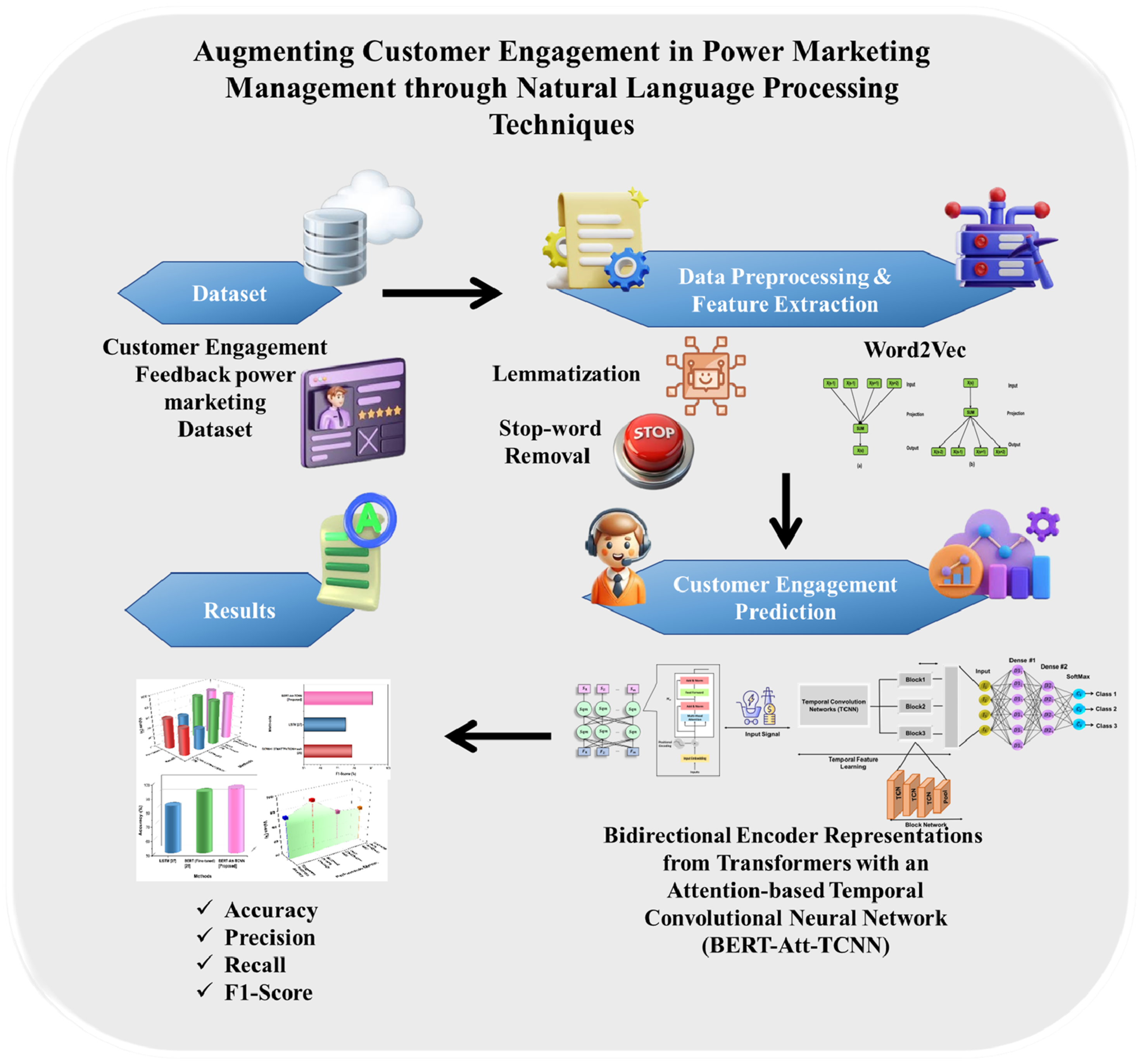
Customer engagement is a cornerstone of successful power marketing, especially as energy providers move towards digital transformation. However, traditional marketing strategies often fail to capture real-time customer sentiment and adapt dynamically to individual needs. The research introduces a data-driven method utilizing deep learning (DL)-based Natural Language Processing (NLP) techniques to interpret and respond to customer feedback, thereby enhancing engagement through personalized, timely, and context-aware communication. Data was collected from social media, customer service chat transcripts, and online feedback from energy company websites. The text was refined using preprocessing techniques such as lemmatization and stop-word removal. Word2Vec was used for feature extraction to capture the semantic meaning and context of customer expressions. The proposed method integrates Bidirectional Encoder Representations from Transformers (BERT) with an Attention-based Temporal Convolutional Neural Network (Att-TCNN) to capture contextual and temporal features in customer communication. The system uses BERT to understand customer language and track behavioral patterns by extracting contextual word representations and processing them through temporal convolution layers enhanced with attention, focusing on relevant text sequence parts. This hybrid BERT-Att-TCNN approach supports sentiment classification, topic identification, and engagement prediction, delivering personalized, adaptive, and real-time customer engagement in power marketing. Python was used to implement and train the model efficiently. Results from experimental evaluation demonstrate that the proposed BERT-Att-TCNN model achieved performance metrics ranging from 90 to 96%, highlighting the model’s robustness and reliability compared to traditional NLP models. This hybrid approach ensures scalable, intelligent, and real-time engagement in modern power marketing management.
Keywords
Get full access to this article
View all access options for this article.