




Abstract
Care partners who have a loved one living with dementia are at risk for psychological distress and burden. As a result, a variety of programs to support dementia care partners have been designed, but dance/movement therapy (DMT) remains underexplored for care partner well-being. As such, the purpose of this study was to understand the experience of a novel DMT intervention designed to promote resilience among carers. Semi-structured interviews were conducted with 9 female care partners who took part in a pilot study. Reflective journals and interviews were transcribed and then thematically analyzed with an inductive approach. Three themes emerged pertaining to participants’ experiences of the DMT program. Holistic engagement theme emphasized the powerful impact which the body-mind approach of had for carers, above and beyond verbal therapy. Liberation theme highlighted how beneficial movement was to enable carers to feel “free” to express themselves. Connection to others theme demonstrated the impact of movement to foster supportive relationships between carers. Participants suggested that future iterations of this program should have more sessions with time to process DMT activities in-depth. Overall, results suggest that DMT is a promising approach to support care partner well-being holistically, by providing creative opportunities for them to move, process, and connect. These findings can be built upon in future creative-arts therapy interventions for care partners.
Introduction
When an individual is diagnosed with dementia, there is a ‘caregiving assumption’ that close relatives will step in to provide care (Bailey & Harrist, 2018). Yet, caring for one’s spouse or parent with dementia can be associated with psychological distress (Schulz et al., 2020). The projected rise of dementia diagnoses worldwide suggests a pressing need to support individuals with dementia as well as the family members who care for them (Teahan et al., 2018). Given the progressive nature of dementia, dementia care partners face accumulative stress and can experience greater burden than other types of aging caregivers (Kim & Schulz, 2008). Research on interventions which aim to target psychological dysfunction (e.g., depressive symptoms) in dementia care partners is plentiful yet lacking in effect size and quality (Schulz et al., 2020). Despite preliminary support for approaches such as cognitive-behavioural therapy or mindfulness-based therapies for care partner wellness, more work is needed which explores strengths-based approaches which facilitate meaning-making and promote healthy emotional expression (Chen et al., 2024; Wrede et al., 2024).
Systematic reviews of creative-arts therapies in the context of dementia indicate that individuals living with dementia and their care partners may benefit from embodied opportunities to express through the arts (Irons et al., 2020). However, the majority of such programs have focused on the impact of the creative-arts on the person with dementia (Watt et al., 2024), such as reducing their ‘problem’ behaviours (Beard, 2011). While dyadic programs for care partners and individuals with dementia to attend together can promote relational enjoyment, (Fontanesi & Newman-Bluestein, 2024; Hill et al., 2018), they may also lead to additional care partner burden, rather than carer respite (Casey et al., 2019; Irons et al., 2020). While a few pilot music therapy studies have explored therapeutic songwriting for carers to attend to their own needs (García-Valverde et al., 2021), more programs are needed which are designed specifically to be therapeutic for the care partners, to focus on self-care (Waligora et al., 2019) and replenish personal resources (Palacio et al., 2020).
In particular, there is a need for programs which support carers holistically: by engaging the physical body, mind, and emotions simultaneously (Schulz et al., 2020). Dance/movement therapy (DMT) meets such aims as a ‘whole person’ approach (Serlin, 2020) in which movement is used therapeutically to promote emotional, social, cognitive, and physical integration (ADTA, 2022). DMT has shown benefits in other populations such as decreases in depression and anxiety (Koch et al., 2019) and improved stress-management and mood (Martin et al., 2018). Despite such evidence, limited if any research has examined how DMT could benefit care partners apart from their loved one with dementia (Watt et al., 2024). Furthermore, very little research has investigated how/why DMT enacts positive change (De Witte et al., 2021), in the context of dementia care partners (Champagne, 2024).
The purpose of this study was to explore care partners’ experiences of a novel DMT intervention, which was designed to promote resilience, guided by a comprehensive theoretical model (Champagne, 2024). This study will explore how DMT can contribute to carer well-being, above and beyond traditional psychotherapeutic approaches such as cognitive-behavioural therapy or talk support groups. Participants’ suggestions for future iterations of this DMT program will also be shared, to inform future creative-arts interventions for this population.
Methods
Design & Intervention
This qualitative study is part of a larger dissertation research project in which qualitative and quantitative data were collected to understand the impact and experiences of a new DMT program with a pre-post convergent mixed-methods approach (Figure 1). The quantitative impacts of the intervention are reported elsewhere (Champagne & Mock, 2025). Pre-post mixed-methods data collection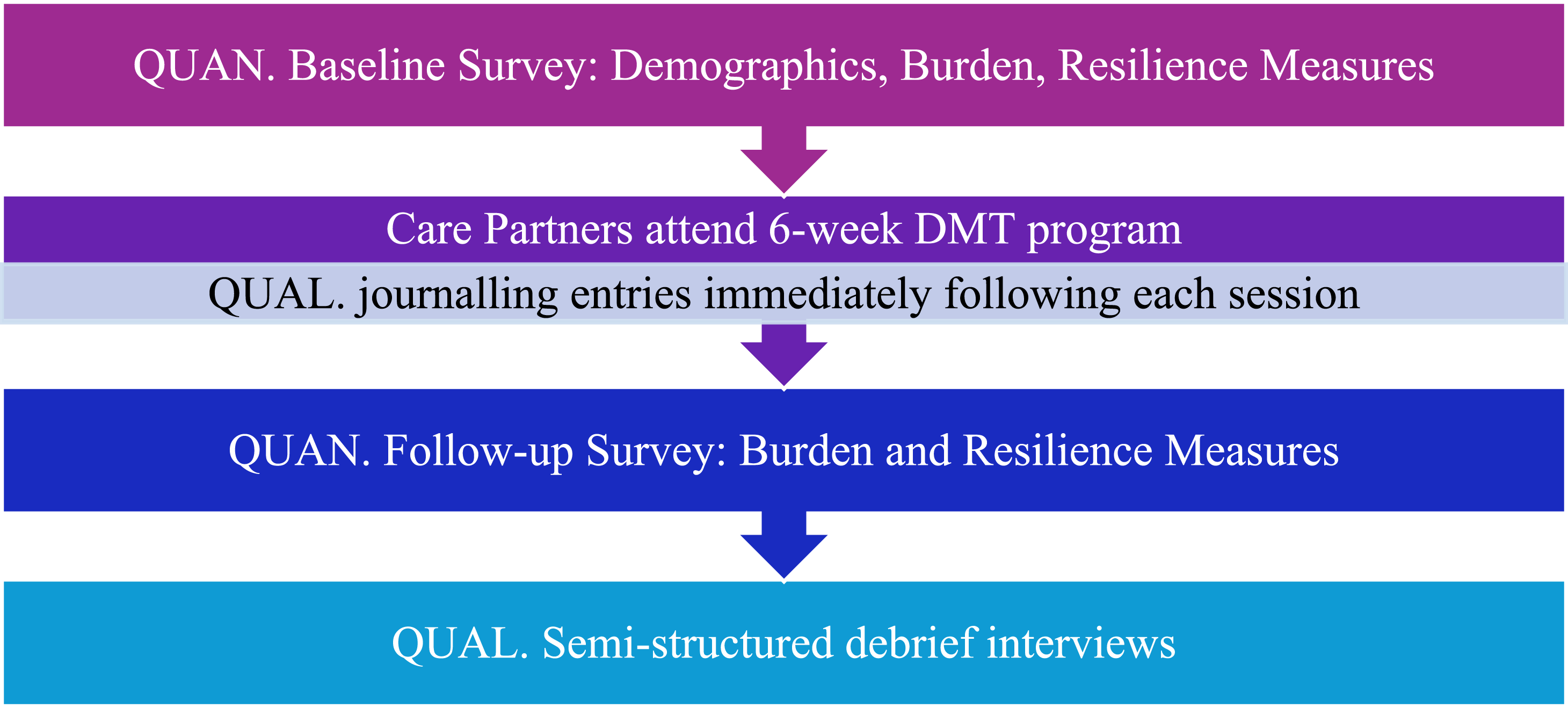
Participants in the current study took part in a 6-week DMT intervention in Toronto, Ontario, which was guided by Champagne’s (2024) model of caregiver resilience and DMT mechanisms. 6-Week programs are common among dementia care partner interventions using a creative therapeutic approach (e.g., Baker et al., 2018). The DMT program was once a week for 6 weeks, and each session lasted for 60-min. Each session included a check-in and warm-up, exploring different DMT activities designed to target different resilience factors (e.g., meaning-making through symbolic movement), and ended with closure and time for reflection and journalling.
Researcher Position
The intervention was facilitated by the author. She has completed the ADTA’s alternate route DMT program and has been working as a dance therapist with older adults for five years. The author was supervised by a knowledgeable board-certified DMT throughout the duration of the DMT program, to guide the author in her dual role as therapist and researcher. Additionally, immediately following each DMT session, the author took reflective notes of what happened during the session, to keep a trail of her experiences, thereby attending to sincerity in qualitative research (Tracy, 2010).
Structure and Objectives of DMT Sessions
In week 1 and 2, the focus of the sessions was to introduce participants to the modality of DMT and to one another. Gentle, improvised movement was explored and participants identified where they felt certain emotions in the body (e.g., happy, anxious, sad) (Wengrower, 2015), as well as where they felt numb or disconnected. They also explored the sensation of “grounding” with movement to connect to their embodied resources. In week 2, Laban’s elements of movement (shape, effort, space, time) were explored with guided improvisation (Bartinieff & Lewis, 1980). The ways in which movement elements (e.g., bound flow) corresponded to life experiences was discussed. Care partners then engaged in mirrored movement in dyads, to facilitate connection with other carers (Fuchs & Koch, 2014). In week 3, participants collaborated to create a ‘resilience landscape’ with a variety of DMT props, including coloured silk scarves and bouncy stress balls. Participants decided when, how, and for how long to explore each prop with improvised movement to a variety of up-beat music tracks. Positive emotions, play, and teamwork were activated.
In week 4 and 5, symbolic movement was explored, to give care partners opportunities to confront challenging emotions (e.g., grief, sadness) and process aspects of their identity in creative and non-verbal ways (Capello, 2009). In week 4, carers created a personal movement poem, which represented three distinct time points of their life: the past (before their loved ones’ diagnosis), the present, and their imagine future. These movement poems were shared one at a time, as the group acted as a witness, enacting principles of authentic movement (Whitehouse, 1956). In week 5, to attend to self-care needs, participants worked as a group to brainstorm “I am” and “I need” statements (e.g., I am tired, I need support). These statements were then collaboratively choreographed into a group dance to foster empowerment and group support. The sixth session focused on integration and closure. Participants led the session by revisiting previous movement activities they wanted to explore in more depth (e.g., mirrored movement) and concluded by writing each other notes of encouragement.
Data Collection
Interview Guide
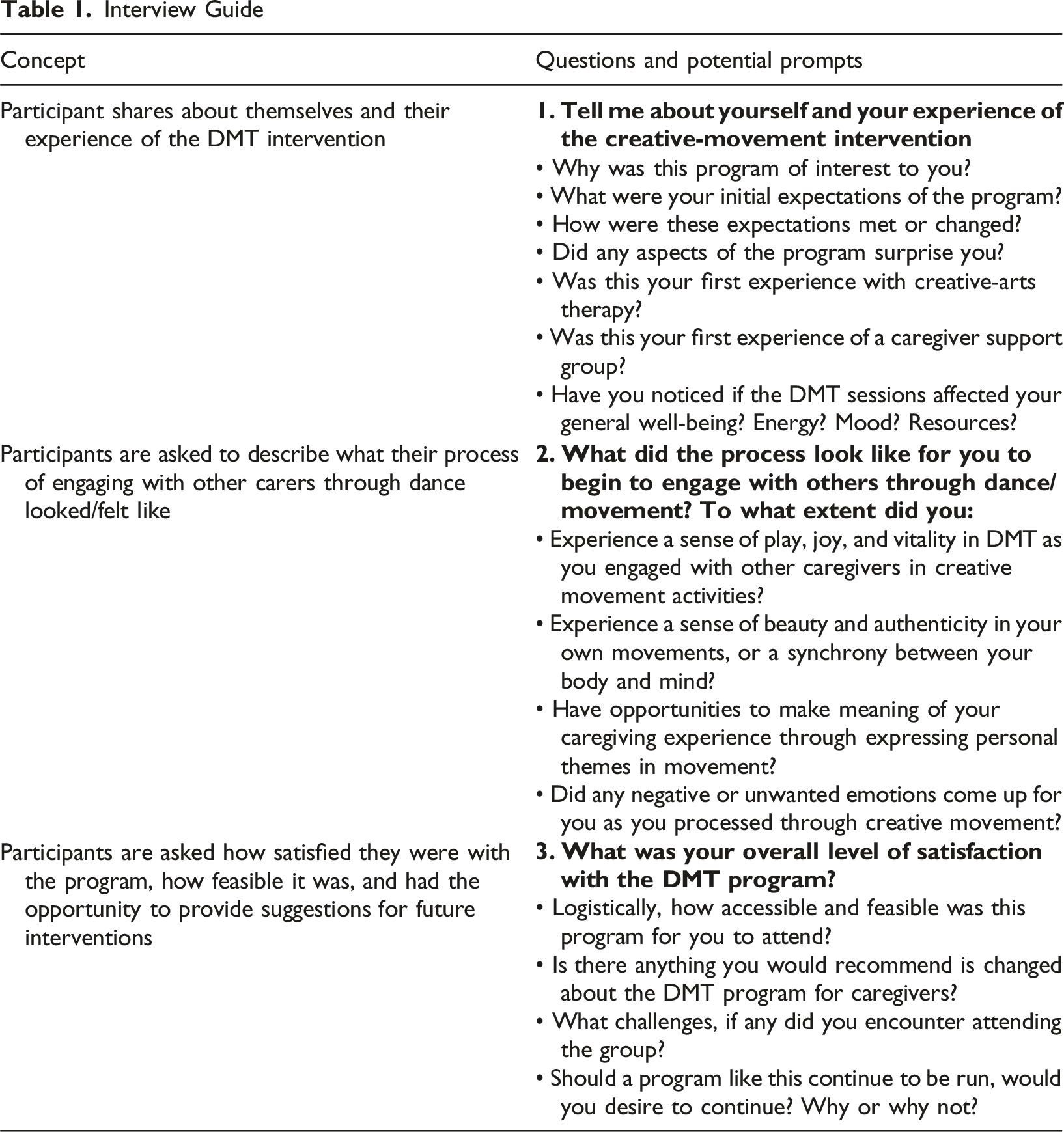
Participants & Procedure
The sample included nine care partners from Toronto who participated in the pilot study for this new DMT program. Care partners all lived in the community with their loved one with dementia. To accommodate different days and times in which care partners had alternate care arranged for their relative (e.g., Personal Support Worker visit or dementia day-program), the same DMT group program was run three separate times, on different days of the week. Group 1 had three participants, Group 2 had four participants (one who could not complete an interview), and Group 3 had three participants. Participants were recruited through local organizations in Toronto including the Alzheimer’s Society of Toronto. Inclusion criteria were: (1) they had attended at least 5 out of the 6 DMT sessions, (2) primary care-provider of a loved one with a neurodegenerative condition (e.g., dementia) and (2) could respond to survey measures and interview questions in English. The initial aim was to have 6-8 participants per group, for a total of 20 participants. However, due to recruitment and scheduling challenges, we stopped when 10 participants had completed the program. The lead author who facilitated the DMT sessions conducted the interviews. Interviews took place over Zoom and were on average, 46 min long. The interviews were recorded, and transcripts were drafted with Otter. ai and then manually checked line-by-line to ensure accuracy. Data was collected between June and October 2024, within 2 weeks of each participant finishing the DMT program. This timeframe was chosen so that participants would have some time to consolidate their experiences of DMT, while keeping experiences fresh in their minds.
Data Analysis
Thematic analysis was conducted, following Braun and Clarke’s (2006) steps. In particular, inductive coding was performed, to search for patterns of experience from the bottom-up (Braun & Clarke, 2006). Dedoose software was used to code the data into themes and sub-themes and Lincoln and Guba’s (1985) criteria for trustworthiness in qualitative research was attended to. Reflective journals and interviews were transcribed. The post-session journals provided experiential data of specific movement activities, whereas the interviews provided descriptions of DMT experiences overall. These two forms of data were integrated and analyzed together. As such, the quotes presented in the results section come from both journals and interviews. The author re-read and re-listened to all transcripts to become familiar with the data, establishing credibility through prolonged engagement (Lincoln & Guba, 1985). Then, initial codes were assigned to selected quotes with a trail of memos and reflections. Codes were then established into themes, which were grouped conceptually (Braun & Clarke, 2006). At this stage, peer debriefing with a board-certified dance/movement therapist, Dr. Rebekka Dieterich-Hartwell took place, to establish dependability (Lincoln & Guba, 1985). The lead author frequently returned to the raw data to look for more poignant examples of themes or pieces of evidence which challenged initial interpretations, thus establishing referential adequacy and credibility (Lincoln & Guba, 1985).
Results
Participant Demographics
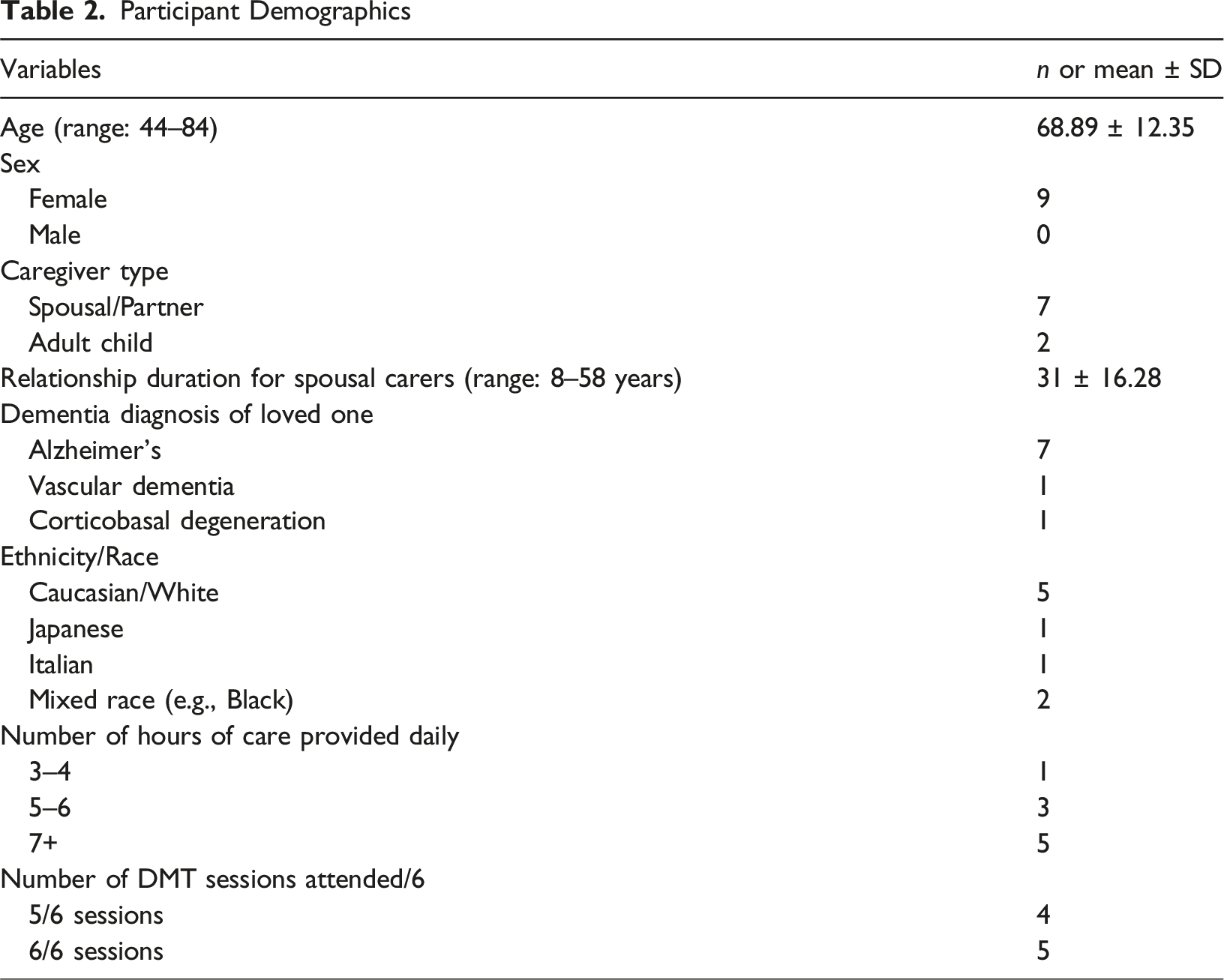
Three themes emerged from the qualitative data about care partners’ experience of the DMT program: holistic engagement, liberation, and connection to others (Figure 2). These themes are dynamically interrelated and not mutually-exclusive. Additionally, a fourth theme captures carers’ suggestions for future iterations of this program. Themes of care partners’ DMT experiences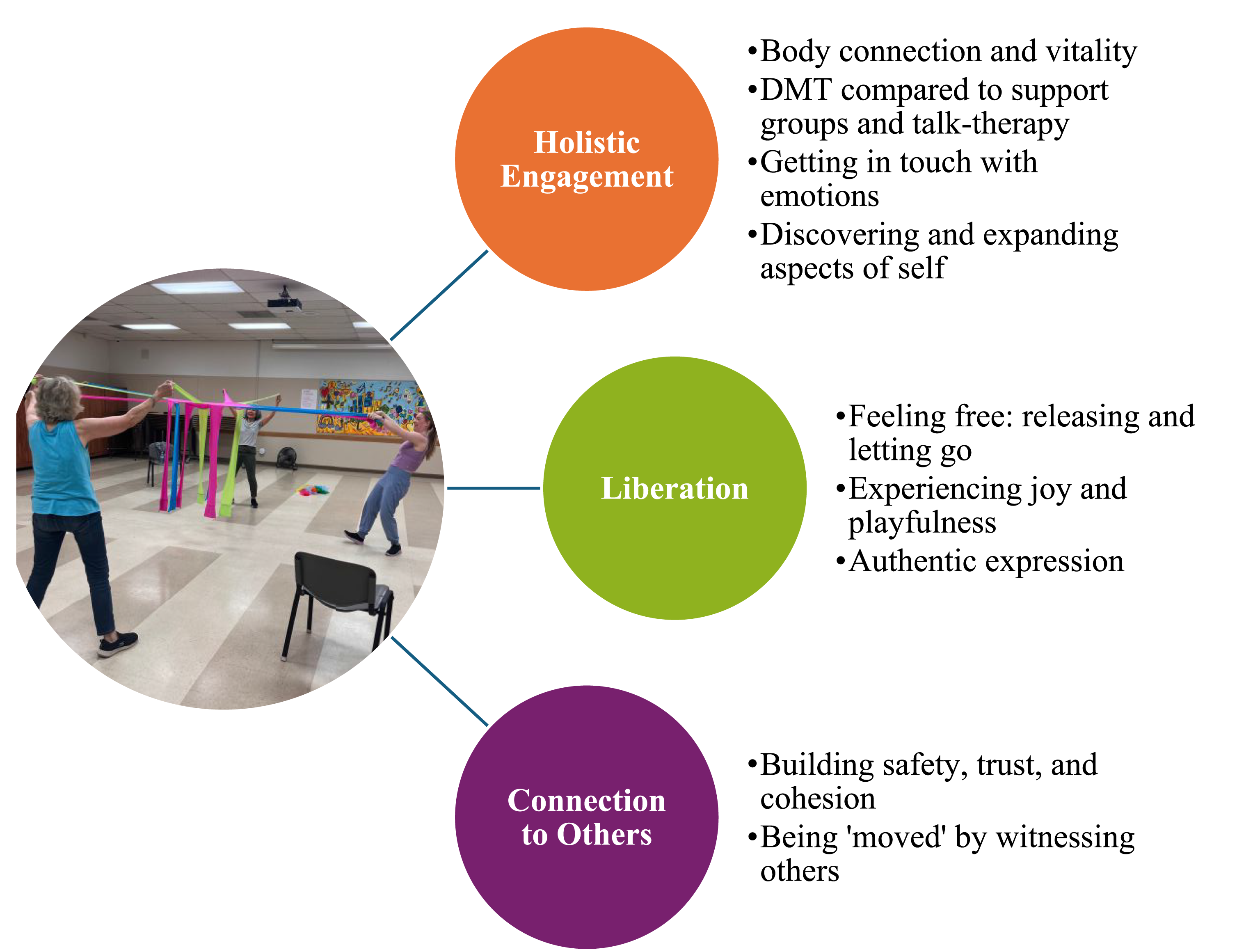
Theme 1: Holistic Engagement
The first theme was related to how DMT engaged care partners holistically: body, mind, and emotions. This theme was mentioned by all participants, and includes four subthemes: body connection and vitality, DMT compared to support groups and talk-therapy, getting in touch with emotions, and discovering and expanding aspects of self.
Body Connection & Vitality
Care partners described how dancing with others gave them opportunities to reconnect to their physical body. For example, Care Partner 1 emphatically shared “It (DMT) did have a different impact. And the impact was that your body was involved, not just your mind and your mouth. Yes, and it’s relatively easy to intellectualize, but when your body’s involved, it’s a totally different experience.” This participant continued to explain how movement led to vitality: Obviously, I'm coming up to 80, and I enjoyed it in a very fundamental way. Not just physically, but emotionally, that primarily and emotionally…a beautiful interlude where you could move and stretch and leap around and even, it didn’t matter if you were ungainly or, you didn’t even feel stupid, you just moved. Movement, and you just did it, yes, quite simply, you just did it, and it was joyful, and your body felt alive in a way.
Care Partner 10 also explained her experience of connecting to her body in a movement improvisation on the sensation of grounding: I wanted to feel all the parts of my body too…I've begun to see that it's important to connect body, mind and spirit and so on. But somehow, with the flow of the movements and the moving and just kind of talking while we're moving internally, I was really starting to feel, “Oh, hi legs, you want some attention too.” “Oh, feet, you need, you need some love.”
DMT Compared to Support Groups and Talk-Therapy
Care partners described how DMT was different from support groups or verbal therapy. Dancing was distinctively more impactful, compared to “sitting” and “talking”. Pertaining to support groups, Care Partner 4 explained about DMT: “You’re not sitting around in a circle and just talking about all your problems… the movement, the joy, the music, you know, it adds such a dimension to it that, it’s the lightness that we need.” Similarly, Care Partner 2 shared: “It (DMT) brought out positivity compared to bringing out negativity. When you’re in a support group, it’s always a lot of trauma, right? All you do is sit and listen to problems.” Similar insights about support groups were shared by Care Partner 10: After a while, I had to withdraw myself from those programs, because I was spinning my wheels and I was carrying the same thoughts, and I was acting in the same ways that weren't really working. I'm not dismissing by any means the problem solving and support group approach, but I think this (DMT) is a whole other domain that that has infinite possibilities…I think the more we can move, the better. We need more working through the relationship of the mind and the body so that all this stuff just doesn't get stuck there.
Care Partner 8 shares how DMT went beyond her experiences of talk-therapy, because she could not intellectualize her way out of what was surfacing: Nevermind the talk therapy about what I can expect to happen with my husband. I know the road we're on. I can tell you that for me personally, I have always known that I can get closer to what I'm feeling by moving my body rather than head-talking. I've done a lot of therapy in my many years of living on this earth, and I'm not adverse to it, but when I did stuff with movement, I knew, ah, I can't talk my way out of this. I can go deeper and that's what I want.
Getting in Touch with Emotions
Care partners highlighted how DMT gave them a platform to delve into and express their emotions. For example, Care Partner 4 explained: A lot of the programs that I've attended, which I love to, is because I love doing things with my husband. You know, it's always been the partnership. This is a program that offered the caregivers their own time and space. It offered a place to come and really get in touch with our emotions and whatever it is that we're dealing with, to face it, but at the same time, to leave feeling light, because we've expressed it, we've let it out in the dance.
Furthermore, the ability of DMT to bring emotions to the surface was emphasized by Care Partner 5: I had no idea, having had a context of counseling and art therapy, how immediate you could access some deeper-felt emotions that you might not even know there through movement and dance. I was very surprised at that, so I thought that was a real positive for dance therapy, because I was surprised at the immediacy.
Dancing brought to the surface unexpected emotions for participants as they moved “the movement poem was powerful. It brought up emotions that I thought I had dealt with” (Care Partner 8). Care Partner 3 also emphasized this: But as I dance and try to express something, the emotion that came up was quite interesting, and it was very good, because, you know, unless it comes out, it doesn't release, right? And so, I felt like I was able to release some emotional tension inside and be able to see what's inside of me.
Discovering and Expanding Aspects of Self
Participants explained how aspects of their identity were discovered or transformed in the DMT environment. Speaking about DMT, Care Partner 9 expressed: I don't know what I expected, but it was interesting, and it was good, and it was curious, and like, a whole different world for me…I've never done anything like that before. I've never done, like, therapy or anything like that, either. It's gotten me thinking about music and dance and art, and how much I used to enjoy it, and how little it's been in my life for a long time now.
Furthermore, speaking about experiencing the joy of movement, Care Partner 1 enthusiastically stated: I don't dance. Ever. Um, it's not been part of my life, and I don't know why… You showed a way. You showed me part of myself that was buried and long forgotten. If it was ever activated, I don't know.
She continued to explain how in the DMT session, she could be “somebody almost other than me in a safe environment. And I would like to have taken some of that out, but it’s difficult. But I did have it inside me for the Monday.” Together, these examples highlight the potent impact that movement had for carers, to enable them to reconnect with their bodies attend to their emotions through dance.
Theme 2: Liberation
The second theme was related to liberation. DMT was unanimously described as “liberating”, with over 150 statements coded for this theme alone. The subthemes were feeling free: releasing and letting go, experiencing joy and playfulness, and authentic expression.
Feeling Free: Releasing and Letting Go
Care partners revealed how compared to their everyday lives, in which caregiving may impede their autonomy and freedom, DMT provided opportunities to release tension and feel “free”. Movement helped care partners to let go and loosen up: “as we did the mirroring movement. I felt freedom” (Care Partner 2). Care Partner 4 expressed: “who doesn’t like to dance, who doesn’t like to feel that? It just, it’s just a more friendly way of letting go…for me, this was much more liberating because of the movement.” Care Partner 8 described her experience of moving with coloured scarves in DMT: It was very evident to me to say, “Wow, I'm feeling this freedom to just take these scarves and do whatever I want with them!” I loved running around with the scarves and whatever happened happened, and just feeling the freedom of that. Because most of my life, my experiences now, emotionally and physically, are not free.
Additionally, Care Partner 1 explained similar feelings about the freedom she felt in DMT: You know, literally, that sense of freedom was antithetical to everything in my life. And listen, I've had a good life. I'm not complaining, but I've always had issues, but they've never stopped me doing what I'm supposed to do… The sense of freedom experienced with this group is, literally, the highlight of the week.
Furthermore, Care Partner 10 shared how enjoyable it was to experience the freedom of making her own choices in DMT: I liked that approach, when we got up and we were moving, there wasn't a time limit on it, and there wasn't a right answer or wrong answer. It was just, we are here to experience what's going on in our in our bodies and it was great. It was really, very, very freeing.
Additionally, she described how freeing it was to express her story through movement in week 4: I found the experience truly profound and freeing. I was able to clearly move from past to present to future with the shifting emotions. I wanted to be in touch with each piece of the poem so that the narrative would flow… what a magnificent, safe moment.
Experiencing Joy and Playfulness
Care Partners reported how DMT liberated them to experience joy and playfulness. Care Partner 2 explained: “just the colours and the process, it was a lot of fun, and it brought a lot of joy to all of us…. That short period of time of fun really helped me tremendously.” Care Partner 3 explained how improvised movement activated a ‘childlike space’, which she came back to outside of the session: Day to day life as a caregiver, I seldom feel great or free. This program gave me an opportunity to be like a child, and it felt really great… if you can bring people into that kind of childlike, innocent, playful space, it's a place to go back to. You know, when crisis mode comes. It's almost like a meditation, kind of… and that's a really great space to be because you are always task oriented, and you forget about being playful in the headspace. So that's really helped me a lot.
Care Partner 1 shared similar sentiments about how DMT helped her to feel a pure, childlike joy: I've always had to be the one in charge, the one who does things, the one who keeps calm beneath the surface, but this, these little hours with you, it was different… it was a great sense of unalloyed uncomplicated joy that you notice when you see puppies playing.
Furthermore, Care Partner 9 expressed similar feelings about how movement brought her joy and a sense of play: “I really enjoyed quick movement, spinning, it felt joyful to be playful and like something I can’t get to do very often.”
Authentic Expression
The last aspect to the theme of liberation was how dancing enabled care partners to authentically express themselves. Speaking about the caregiver movement poems in week 4, Care Partner 5 shared: It felt very authentic. You know, these grief journeys, you just don't really have a lot of time for anything that isn't authentic…it was also impactful for me to see other people expressing their journey. And I could see it… in a visceral way, what they were going through in a way that was so symbolic and that you can't always express with words or would take too long to go through the intellectual processes to communicate what you're feeling. So, this artistic expression just got to it got to the heart of it in a very immediate way, and you don't have many opportunities to do that. So, I was really struck by that.
Furthermore, Participant 10 shared how the movement journeys helped her to process her own story: But I think that all of us, I mean, you could feel the movement of the soul, if you will. You could feel everyone's transitions from one section to the other. It was very powerful that day… I hadn't ever really thought it through in a movement manner. Certainly, thought it through, but I probably would have got stuck in the middle and resented the beginning, I would have resented the beginning and then got stuck in the middle of the present and then afraid to present anything for the future.
Theme 3: Connection to Others
All participants described how dancing led to supportive connections with other care partners. Two sub-themes were identified: ‘safety, trust and cohesion’ and being ‘moved’ by witnessing others.
Building Safety, Trust, and Cohesion
Participants described how dancing with other carers facilitated cohesion. Movement interactions were described as “emotional, and they were deep, and they were heartfelt, and they felt sincere, and I felt like they understood what they were going through.” (Care Partner 9). Carers reflected on how despite just meeting the other women, they felt deeply connected through how they connected with movement: And I liked the non-verbal, I liked feeling what they were feeling being transmitted through movement, and in a way that helped me. It helped me just to be able to share that with what they were going through, what I was going through, and saying, yeah, there's a kinship here, and it's and it's supportive. (Care Partner 8)
Furthermore, participants described how knowing that everyone else there could relate to the challenges of caring for a loved one with dementia established trust: It was a time where I was able to just go and be free because everybody else is in this similar situation and you knew that you shared so much in common, so you felt comfortable with letting your emotions and your feelings and your thoughts and your hopes and your fears be very open…because as we move through connecting with each other, you knew that you're on the same journey, and there were no inhibitions, everything was so genuine, and, you do feel as if you got that connection (Care Partner 4)
This participant also shared how having a small group further promoted emotional safety: You know, feeling free, and, you know, safe, and sharing their experiences…and the fact that it was a small group had a lot to do with that. If it was a larger group, you probably would not get that level of comfort and cohesion with each other.
Despite coming from different backgrounds, ages, and life experiences, movement acted as a catalyst for ‘coming together’ which was surprising and profound. Care Partner 1 expressed: “It was interesting how you managed to get us to meld… it seemed bizarre that you could bring us all together like that and make the meetings so meaningful.” And Care Partner 9 also shared: “we didn’t really have to say very much. That was a little bit, kind of profound in its own way, even though they’re basically strangers.”
Being ‘Moved’ by Witnessing Others
Participants described being powerfully ‘moved’ by seeing what was expressed in movement, including grief and challenging emotions. For example, referring to the movement journeys in week 4, Care Partner 6 shared: “The journey from past to future, especially the movement expression of the present represented frustration, anxiety, fear and overwhelm. Also, witnessing others’ movements was so moving and precious.” And Care Partner 2: “You know, watching other people go through their journey made me feel at ease that I’m not the only one that has those experiences, that everybody has the ups and downs in life, and that we’ve all been able to overcome them and still go on.” Other participants spoke about the deep impact of witnessing each other’s movement journeys: I felt like it was a sacred space of honoring another's heartfelt, authentic journey. It's a privilege, and it's heartfelt, and it strikes you deeply… It was also helpful to see others express. I could relate as well as honour others journey in a shared way. To explain further, so much of the caretaker journey is isolating. This helped me feel less alone. (Care Partner 5)
Care Partner 4 also spoke about this experience: You know, I think we all were able to just express ourselves in that. And it was very powerful…I'm sure as each of us went through it, we, we were living those emotions, and then, as, you know, looking on to others, you really, really felt, you know, their journey, their pain, their hopes, yeah, that was a very powerful exercise.
Feasibility, Satisfaction, and Suggestions
Overall, participants reported being quite satisfied with the program, but they shared some fruitful suggestions for the future. Primarily, they wanted more time to “go deeper” by having more sessions and longer sessions. Care Partners explained how DMT was something they looked forward to every week, and that they wanted it to continue beyond 6 weeks because of the release and pleasure it gave them. Some participants expressed grief when the 6-sessions were coming to an end. Care Partner 1 shared: “But by the last session I was fearful. The sessions were almost over & I would no longer have the intimacy & joy of movement this group had given me.”
Furthermore, participants expressed that if they could continue DMT, they would like longer sessions to process more elements in depth. Care Partner 5 shared “I don’t mean to say it in a negative way, it’s positive actually, that that I wish there was more time in each of the elements, because I found we needed more time.” Speaking about wanting more time to process the caregiver movement journeys, Care Partner 6 explained: And maybe have an extended time, like, beyond an hour, maybe an hour and a half is a good idea, or even a two-hour group, because I don't think we processed it enough, like, I think we all very moved by each other's journey, but we really didn't talk a lot about it with each other.
Care Partner 5 suggested that perhaps a retreat format would help them to go “deeper”: And it occurred to me, like, wouldn't this have been great, if this was part of a half day or even a full day retreat, because then you could delve in deep, people were committed to the day, and then there would have been time to have a debrief.
Furthermore, Care Partner 8 described how she wanted more time for movement: “I would like more movement, at least an hour of the movement part of it, for me, would have been good. I was always sorry when it ended.” Participants also expressed wanting to explore more aspects of themselves through movement, such as their emotions. Care Partner 10 explained: We could have done so many wonderful things if we'd had more time that would speak to what is going on in the whole person ... I would do more storytelling in the creative process, more narrative-based, more movement like, okay, so “what happened this week?” Let's do that in a movement way.
Participants also expressed wanting to have more social time before or after the DMT session, to enjoy the company of the other women in their group. For example, Care Partner 2 explained: “I would think I would like it to be longer than 1 hour where there is a little bit of time to, you know, just have a coffee and just chat and get to know the group better… I don’t get to do that at home very often.”. Care Partner 4 shared about how comforting it was to be able to be open with her DMT group: You know, many people in our situation, you get to the point where you don't share a lot of things anymore, because you don't feel people want to hear or they understand, but in an environment like that (DMT) where, you know, there's this commonality, we're all in the same boat, and that little opportunity to just sit there and say, “Oh my god, I had such a terrible morning”, you know, “I couldn't get my husband going” and this or that.
Participants also discussed how important it would be to keep this group in-person, rather than translating it to a virtual format. Three participants expressed how beneficial it was to get out of their home environment and have their own ‘space’. Care Partner 1 exclaimed: It has to be outside of your home environment. Because a) I don't know about others, but we don't physically have that space to leap around. And also, in your own home, everywhere you look, “oh, I meant to paint that and oh, I've got to put a nail in there” … So, you have to be outside of that environment to clear your mind. It cannot be done on Zoom. I know it can't.
Other participants described their experiences with other virtual programs for carers. Care Partner 5 explained: And I found it brutal in many ways. You could only get a quarter of the real value of the program. I did take an art class with caretakers, and it was over Zoom. And for me, I wouldn't do it again. I wouldn't do it again, because you're not really seeing anyone else's work, you sort of show it, but not really.
These comments underscore the need for caregivers to have DMT programs which are in-person, to experience a sense of respite and clear their mind. Other participants shared that while in-person programs are ideal, they recognize that as their relative’s dementia progresses, this may become more challenging logistically. For example, Care Partner 2 explained: “You know, these people get worse, and you can’t leave your home. What are you supposed to do? What happens to the caregiver? Nobody’s thinking about them anymore. And that is a really big problem.”
Discussion
This study explored the in-depth experiences of a new DMT program designed for care partners of people with dementia. The qualitative data revealed three themes of experience: holistic engagement, liberation, and connection to others.
In holistic engagement, DMT offered something which was unlike support programs care partners had experienced before through engaging their body, mind, and emotions. DMT is rooted in the belief that attention to the body and movement fosters holistic therapeutic change (De Witte et al., 2021). While some research has suggested integrating physical activity within multicomponent interventions (Schulz et al., 2020), DMT goes beyond exercise. Broadly, dancing has a protective effect on health, and can buffer depression above and cognitive-behavioural therapy (Noetel et al., 2024). DMT integrates these benefits of exercise with other coping skills, such as making sense of ongoing stressors in a creative way. While cognitive-behavioural and educational approaches may be beneficial, DMT was experienced as a “powerful” modality for the ways which movement accessed “deeper” emotions for participants. Indeed, DMT “is founded on the premise that it is possible to discover the meaning of our felt experience by exploring fully our potential for authentic movement” (Alperson, 1974, pp. 158, 160).
In liberation, care partners described how the refreshing sense of freedom they experienced in movement was a much-needed release. Having opportunities to foster autonomy is integral to an overall sense of well-being (Ryan & Deci, 2000). Yet, caregiving strain can impede on one’s sense of identity and autonomy. These results are consistent with results from Shim’s (2015) DMT intervention for individuals living with chronic pain in which dancing “allowed them to break off/out of this state and to move toward a more open, free, and insightful state of being, such as having ‘freedom’” (Shim, 2015, p. 147). This state of being ‘uninhibited’ brought up positive emotions such as joy and inspiration, which can broaden ones’ thoughts and replenish coping resources (Fredrickson, 2013). Furthermore, experiencing the joy of movement, in rhythmic connection to others can promote a psychological state akin to flow (Csikszentmihalyi, 1996), enabling care partners to be meaningfully absorbed in the creative process (Dieterich-Hartwell et al., 2022).
In connection, care partners described how DMT provided them with non-verbal opportunities to connect with other carers who could understand what they were going through. Movement facilitated bonds of trust between women who did not know each other prior to DMT. As participants saw other care partners expressing their stories with dance, they felt a sense of assurance that they were not alone. Through symbolic movement, participants engaged in meaning-making which has been highlighted as integral to caregiver coping (Chen et al., 2024). By sharing these movement symbols in a supportive group, this can reinforce feelings of being validated, seen, and understood (Koch, 2017). Care partners are at risk for being socially isolated, and thus, finding ways to contribute to their sense of social and emotional support (Kinchin et al., 2022) is essential.
Implications for Future Programs
There is an increasing awareness of the importance of supporting care partners, as they adapt to the needs of their loved one with dementia. However, the majority of programs designed to support carers well-being are psychoeducational (Schulz et al., 2020). While some creative-arts therapy programs for people living with dementia include care partners (e.g., Melhuish et al., 2019), to the best of our knowledge, this is the first study to explore a DMT program designed for the care partners themselves. The present study provides initial support for how DMT may benefit care partners as movement served as a platform for them to symbolically express their identity and life-story through time. Finding meaningful ways to manage grief as dementia progresses is key in facilitating carer coping and well-being (Kinchin et al., 2022). Some music therapy research (McConnell et al., 2024) has suggested that the creative-arts can act as a bridge to support carers as they move from anticipatory grief to bereavement and coping with loss. Relatedly, more work could explore whether DMT could support carers in their grief journeys.
Strengths and Limitations
A strength of this study was the continuous data collection. By collecting data immediately following five DMT sessions with reflective journals, and with post-program debrief interviews, a more thorough picture of the experience of the intervention was captured. This strategy provided specific examples of how different DMT activities were experienced on a weekly basis, as well as overall impressions and insights. While the present study utilized a range of data collection methods, more member checking for theme development would have been optimal to improve dependability (Lincoln & Guba, 1985). Additionally, having more team members available to assist with coding would have improved data triangulation efforts (Creswell, 2022).
Conclusion
The experiences of DMT which were described in the present study offer a preliminary understanding of the ways which DMT may benefit care partners of an individual with dementia. These findings emphasize the unique benefits of providing carers with a holistic group-based program that gives them opportunities to process and express themselves creatively. Future research is warranted to further explore how DMT may support care partners.
Footnotes

Ethical Considerations
This study was approved by the Institutional Review Board at the University of Waterloo.
Consent to Participate
Written informed consent to participate was obtained prior to the DMT intervention and again at interviews.
Funding
The authors disclosed receipt of the following financial support for the research, authorship, and/or publication of this article: This work was supported by a SSHRC doctoral fellowship.
Declaration of Conflicting Interests
The authors declared no potential conflicts of interest with respect to the research, authorship, and/or publication of this article.
Data Availability Statement
Due to the sensitive and personal nature of the interview data, it is not publicly available.