




Abstract
Memory clinics provide ongoing, community-based care for people living with dementia as well as supporting their carers. Much of the research to date has measured quantitative carer outcomes, which may fail to demonstrate the true value of the clinics to carer well-being. Therefore, this paper seeks to understand the carer’s role and explore the impacts of a memory clinic on the carers of people living with dementia. A qualitative descriptive approach was used to inform semi-structured interviews with six carers and five clinic staff with direct carer contact. Interviews were audio-recorded and analysed using thematic analysis. Three themes were identified: perceptions of the carer role, psychological well-being and experience of the clinic. Carers experienced the hard work of their caring role and struggled with losing their sense of self and their social networks. The psychological well-being of carers was impacted by feelings of frustration, fatigue, depression and grief. Carers’ experiences of the clinic focused on the positive impact resulting from individualised education, respite in a safe space and networking resulting from the memory clinic. The memory clinic was perceived as a valuable support for carers, with individualised support, respite and networking highly regarded. The primary limitations were the challenge of clinic access and the availability of additional clinic days.
Introduction
Internationally, approximately 50 million people live with dementia, with numbers projected to triple by 2050 (World Health Organisation, 2021). Of the estimated 219,000 Australians currently living with dementia (Australian Bureau of Statistics, 2020), 2 in 3 are living in the community (Australian Institute of Health and Wellfare, 2023). With so many people living with dementia in the community, family members often step up to fulfil the carer role (Australian Institute of Health and Welfare, 2023). This responsibility can negatively impact carers, who may be challenged by difficult behaviours and the constant care needs of people living with dementia (Large & Slinger, 2015). However, the well-being of carers is essential in ensuring people living with dementia can be cared for effectively in the community.
Multidisciplinary memory clinics are a key source of support for people living with dementia and their carers in the community. Memory clinics can provide post-diagnostic care and individualised treatment plans for the person living with dementia, and provide support and counselling services to both people living with dementia and their carers (Noel et al., 2017). Types of support offered by memory clinics include individualised care planning and symptom management, providing resources and information about available services, and building carer capacity (Hooper & Collins, 2019; Teahan et al., 2021).
Existing literature about the impact of memory clinics on carers has demonstrated some positive impacts in terms of carer burden, psychological health, and carer satisfaction (Beattie et al., 2025). In their study, Kovaleva et al. (2021) demonstrated a significant decrease in carer distress relating to the people living with dementia, delusions and anxiety. Similarly, statistically significant reductions in carer burden have been reported (Ngoc Huong Lien et al., 2020; Saisunee et al., 2021). However, these quantitative findings have been mixed and there are some challenges in measuring the quantitative outcomes of a clinic when the disease process is on a downward trajectory (Beattie et al., 2025). Additionally, there has been limited qualitative evaluation to understand how memory clinics impact and support carers. Such qualitative insight could provide important knowledge of the carers’ experience of the clinic that could inform the model of care to ensure that it meets carer needs. Therefore, this study aimed to explore the experiences of carers for people living with dementia attending a post-diagnostic memory clinic.
Methods
Study Setting
A qualitative descriptive approach was taken for this study. Qualitative descriptive research is particularly appropriate to be used in research seeking to gain an understanding of peoples’ experiences in healthcare (Neergaard et al., 2009).
Participants were drawn from carers attending and staff working at a multidisciplinary, nurse practitioner (NP) led memory clinic for people living with dementia. The memory clinic is a multidisciplinary, NP-led clinic, offering post-diagnostic support to people living with dementia and their carers. The memory clinic opened in September 2022 in regional New South Wales, Australia and operates one day per week. The clinic offers a range of individualised and group programs. The NP provides individual consultations for health and well-being issues on request. These consultations were funded via the Australian Government Medicare program and attracted no cost to the patient. Registered nurses and a NP provide art therapy and cognitive stimulation programs, while a registered nurse who is a trained instructor provides yoga sessions. A mental health nurse facilitates a monthly carer support group and exercise sessions are facilitated by an exercise physiologist. While other sessions were free, the yoga classes were charged at AUD$10 per session and exercise classes were funded under the Medicare program. Both the person living with dementia and their carer are encouraged to participate in the programs for 1–2 hours each week for up to 12 months.
Participants
Carer participants were included in this study if they were identified as caring for a person living with dementia who attended the memory clinic. Staff participants were included if they had a role in the clinic that involved direct contact with carers.
Participants were given information about the study when they attended the clinic and those interested in participating contacted the research student (AB). Once study information had been provided, if they agreed to participate, a mutually convenient time was scheduled for an interview.
Data Collection
A semi-structured interview guide was developed for carer and staff participants, based on the literature (Beattie et al., 2025) and feedback from experts in qualitative research and dementia care. Questions sought to explore carers’ experiences of providing care and attending the clinic, while staff participants were asked about their experiences of carers.
Interviews were offered either face-to-face or over Zoom, depending on participant preference. Face-to-face interviews were completed in a private room and audio-recorded on a voice recorder. Participants interviewed via Zoom were sent a link via email to a recorded Zoom meeting. Interviews were conducted by the first author, a Bachelor of Nursing (Honours) student (AB). AB is a female new graduate baccalaureate prepared registered nurse with an interest in aged care and dementia. They had received interview training prior to commencing data collection and were supervised by experienced qualitative nurse researchers (AM and EH) during the study. Both AM and EH have experience in working with older people, and AM is a NP who specialises in aged care.
Data Analysis
Participants
Ethical Considerations
The study was approved by the University of Wollongong Human Research Ethics Committee (Approval no 2022/082). Informed consent was gained at the beginning of interviews. Participants could cease the interview at any time.
Results
Participants
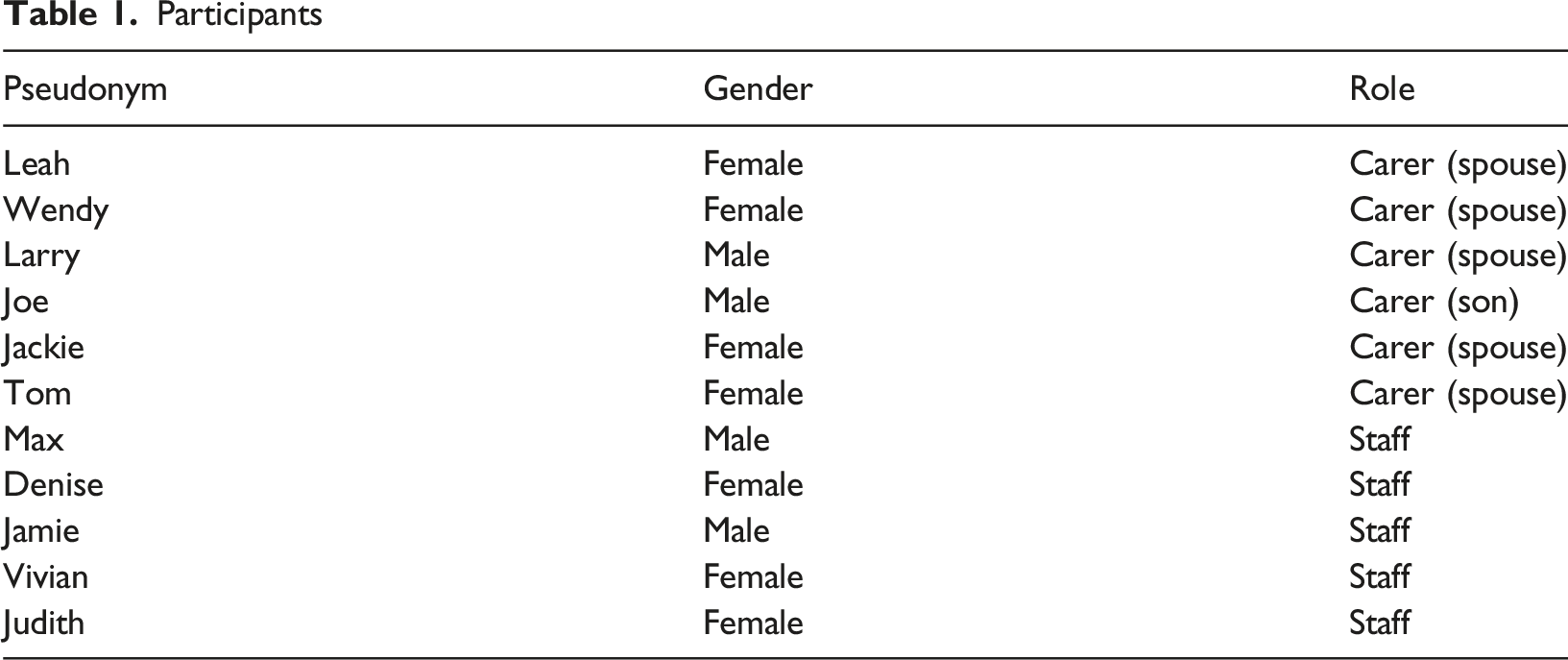
Of the seven carers approached to participate, six consented and were interviewed. Two of the carer participants were male and all but one were a spouse of the person living with dementia. Five staff consented to participate, of whom two were male. The professional role of staff is not reported to maximise participant anonymity.
Themes
Three themes were identified from the interview data, namely; perceptions of carer role, psychological well-being and experience of the clinic. Each of these themes is described below with quotes from participants provided to illustrate findings.
Perceptions of Carer Role
Carer participants explained their role as “very challenging” (Larry), “intense, it’s hard work, it’s frustrating” (Wendy) and “mentally, it’s quite tiring, because my mind is always ticking” (Jackie). Staff participants also described how the carer role is “a 24-hour job, it’s a seven-day-a-week job and they’re not getting a break and they’re exhausted” (Denise). Understanding these perceptions informed the role of the clinic in their experience.
Many carer participants spoke about the increasing challenges as the dementia progressed. As explained by Larry; “as her condition progresses, it’s obviously getting more and more challenging”. Wendy shared a similar experience; “it was just gradually more intense. His independence has gone, and I just have to do everything for him now”.
Some carer participants openly recognised that being a carer resulted in a loss of their own self and their previous roles in life. ‘It’s more or less like my role is just carer now. It’s not a wife anymore” (Wendy). “You had to be part of a relationship beforehand, and you have to move to a different sense of relationship when you're a carer. You are domineering, and at the same time, a servant” (Tom).
Beyond their loss of previous roles, carer participants also expressed that “when you become a carer and your partner has dementia, your network diminishes really quick” (Larry). They described a diminishing social circle as they “can’t do what you could do before” (Tom), “we don’t get out, we can’t get out” (Larry). Leah poignantly described the impact of this on her; “It just makes your own world so much smaller because all of a sudden you’re in a big world where you do lots of things. And it sort of diminishes into that caring reality where all you do is care”.
Some carer participants also described how the attitudes of friends/family who struggled with the person living with dementia and their needs exacerbated these feelings of isolation. “Because friends realise the limitations, so you don’t get asked to go to places and they don’t want to – I suppose they’re a little bit apprehensive about dealing with [person with dementia] in that situation. Because it is fairly – I think it is confronting” (Larry). “When I see people who haven’t seen [person with dementia] for a little while and then they see her, I know they’re a bit shocked about her decline. And I think people struggle with that. So, you end up being a bit isolated from your previous group. You see them less” (Larry). “I don’t think they know what to do, and they can’t even probably handle a conversation with him. Because he can’t participate so much anymore” (Wendy).
Beyond family/friends, however, other carer participants spoke of challenges regarding how “people get frustrated very quickly in a public environment with her” (Larry). This led to fewer outings/travel and less social engagement. A staff participant described how “they [carers] just feel so isolated” (Max). The clinic was a support strategy that helped to address these issues for the carers.
Psychological Wellbeing
Negative emotions such as frustration, fatigue, depression and grief were described as impacting carers’ psychological well-being. Reflecting on the impact of caregiving, Denise described her experience in working with carers, “they’re just tearing their hair out because it is a full-time job”.
Carer participants recognised that they “need to be patient, but it can be – you do feel frustrated regardless” (Leah). As “things are much slower because I’m caring for him,” Leah further described how she needed to remind herself “not to lose my patience and not to get frustrated, because he did not choose to have dementia.” A staff participant described how carers “say it is very frustrating because the person they knew before isn’t the same as they are now” (Max).
Feelings of fatigue and being overwhelmed were expressed by multiple carer participants. Sometimes I feel I’m getting really overwhelmed” (Leah). “Mentally, it's quite tiring, because my mind is always ticking” (Jackie).
Another carer participant, Larry, reflected on the importance of adapting to their situation as a way of coping. “I’m sort of running on empty all the time. But I’m learning to cope with that. It’s just what I have to do”.
Experiences of grief were also discussed by carer participants, Jackie expressed how they “went through stages, like grief process...you start with denial.” Also “saying that this can't happen to this nice gentleman” (Jackie). Larry explained; “I’ve had a lot of depression and trying to come to terms with it.”
Jamie, a staff participant, expressed their discussions with carers within the clinic. “We talk about aspects [of] their own experience such as grief. One of the key features in a lot of the carers’ discussions is related sadness and loss, and we talk about grief and... coping with grief”.
Some carer participants expressed being able to move through grief and negative emotions to reach a more settled place of acceptance. “I came to terms with it. I said, this is what he is now. So that acceptance helped me (Jackie).
Experience of the Clinic
Carers’ experiences of the memory clinic were described as overwhelmingly positive. The subthemes of individualised education and support, positive respite experiences in a safe space, networking and suggestions for future development were identified.
Individualised Education & Support
Carers’ individualised education at the clinic was identified as a positive element that assisted in the caring role. Larry explained, “I’ve reached out to the staff here at different times to just get some information about her condition… and so they help me with understanding her condition and how I can best care for her… I stumbled at the start, I had no idea.” Larry also reflected on the benefit of having people other than himself implement activities and interventions for his person living with dementia. Staff participant Denise described; “So they also want strategies that they can do at home with them that are safe… but they’re needing instructions on, “What can you suggest that we do with them at home, what other things do you suggest that we can do with them.”
Carer participant Wendy saw the clinic as their main support network, “I haven’t got any other support, really. It’s just here, it’s good”. While Larry explained the importance of knowing that the clinic was there if he needed support; “Having them here and, I mean, they’ve made it very clear to me, if I need to call them or talk to them, or just have someone to talk to, I think that’s really important.”
This ongoing support was affirmed by staff participant Vivian who explained “they [carers] just really appreciate the authentic relationships that are being developed.”
Respite
While better understanding the individual issues was helpful, Larry described his experience of how the caring role involved “being 24/7 with [person living with dementia]. In the five and a half years, I’ve only had one weekend and one day away from her in five and a half years. So, they’re the only breaks.” Therefore, being able to have some respite while the person living with dementia was well cared for at the clinic was highly valued. Staff participants reflected on the gratitude expressed by carers at being able to have some time out; “I think they feel grateful... from some comments that have been made, or things that I've observed...a...sense of peace, you know they're like, 'OK, this is a good environment to be in and I can actually rest, like I get a little bit of downtime” (Vivian). “It does give people timeout…they know that the [person living with dementia] is working in a programme and they’re not a carer at that point” (Jamie).
The importance of having a safe and yet stimulating environment for the person living with dementia, while the carer had respite, was recognised by both staff and carer participants, with Judith describing; “For people to be dropped off and know that they're in good hands and whatever else but they're doing things that are still stimulating.” “I know she’s well cared for, and she’s doing therapies, which is great, and she’s having a bit of fun... And that gives me two hours’ break as well” (Larry). “When [person with dementia] is there I know he is in safe hands. And I have two hours… I don’t get a lot of downtime” (Leah).
The respite provided by the clinic allowed carers to set aside their caring roles and engage in other activities. Leah explained: “For me, it’s really good because it’s a safe place for him... I know I can just go and not have to worry about him.” “I sometimes take my computer and do some work, or I can go into town or do some shopping. I can just sit and read a book and have a coffee somewhere”.
Networking
Both carer and staff participants emphasised the value of the Carers Support Group in providing a space for carers to share experiences and seek support. “The Carers Support Group... is really good for the carers. Carers can actually come into the same space, they can air things, talk over things (Vivian).
Tom discuees the “feeling that there were people who cared or who tried to make the situation a little better, who tried to show [them] ways in which [they] could improve the situation.” While Larry reflected on the importance of attending the clinic for him; “just talking with [staff] and the guys here, it just helps me understand [person with dementia]’s condition, which is helpful” (Larry).
A key observation was that “it has had an impact on the carers just because they don’t feel alone.” (Vivian). Carer participants explained the importance of not feeling alone on their well-being, Jackie says; “I think the best thing is that I'm not alone. I am not the only one going through this process”.
Tom also explored this concept stating; “It doesn't sound much, but it's a lot. It's a lot. I mean, it's whether it's when people care, you find that people care. I had an enormous experience of it.” Jackie found comfort being surrounded by other carers in similar situations: “It's comforting. And you sort of say, oh, well, if all these people are with me, I should be able. It gives you strength”.
Suggestions for the Future
While no negative feedback about experiences with the clinic emerged from the interviews, a few suggestions for improvement were received. Carer participants commented they would benefit from increased clinic times and more access. Larry explained; “The clinic’s only one day a week. And if it was another day, that would be fantastic.”
Other carers identified that beyond the benefits, attending the clinic involved a significant time commitment. “I think it is worthwhile to go. It can sometimes be a bit time-consuming because we...leave here at 8 in the morning because the traffic usually is really bad in the morning. And we won’t get back until lunchtime, so a whole morning is gone” (Leah).
Staff participants suggested increasing the frequency of the carer support meetings, as Denise explained “I do find that carer support is huge in where we’re at with the level of dementia that some of these people have.” Jamie discussed the potential for adding “outreach in relation to… visiting and connecting with people in their homes.” Another staff participant proposed informal activities for carers to promote connection and enhance respite from their person living with dementia. “Maybe the carers could go and have lunch together…just going to go for a walk over into the Botanic Gardens and just give [them] some you time (Vivian).
Discussion
This study has provided insights into the experiences of carers attending a memory clinic drawing on personal accounts from interviews with carers and memory clinic staff. The findings have highlighted the significant impact that caring for a person living with dementia has on a carer and the carer’s perceived value of attending a memory clinic. Identifying strategies to support carers successfully is important in keeping people living with dementia in the community for as long as possible (Morton et al., 2021). Discussions of the impacts of caring, the sense of the carer’s role, and the impact of memory clinics on carers can further inform such support strategies.
It was evident from carer participants in this study that caring for a person living with dementia significantly impacted them and their well-being. Such feelings of being ‘overwhelmed’ whilst adjusting to the carer role have been previously described (Hooper & Collins, 2019). When examining the literature, varying results can be noted in the effectiveness of memory clinics in reducing carer burden, this may be related to different interventions and data collection methods. Providing care for people living with dementia imposes a substantial burden on the psychological well-being of carers and can result in carers feeling overwhelmed (Reuben et al., 2022; Walter & Pinquart, 2019). Being overwhelmed as a carer has been demonstrated to predict worse depression amongst carers and be linked to increased carer burden (Reuben et al., 2022). This highlights the importance of specifically developing and evaluating services to meet the needs of carers to reduce the risk of being overwhelmed by the situation.
Participants in this study expressed how the memory clinic helped provide individualised education and support to guide them in caring for their significant other. Other studies evaluating memory clinics have similarly described how carers sought information on how to best care for people living with dementia and appreciated the opportunity for individualised professional support (Liu et al., 2021; Noel et al., 2017). Education and support programs tailored for carers of people living with dementia have been shown to reduce carer burden (Saisunee et al., 2021). These findings emphasise the importance of equipping carers with the knowledge and skills to best care for their significant others’ individual needs.
The memory clinic was seen by participants in this study as a safe space where carers could leave the person living with dementia for respite. Time for self-care activities or activities of enjoyment is often a challenge for carers, due to time constraints and exhaustion (Hooper & Collins, 2019), respite is an important strategy to provide carers with relief from their caring role (Teahan et al., 2021; Walter & Pinquart, 2019). In their meta-analysis of carer interventions, Walter and Pinquart (2019) found that respite improved both carer burden and anxiety levels. Short-break respite and day-care programs were highly rated by carers (Teahan et al., 2021), as they allowed them to have breaks from the person living with dementia and provided opportunities for emotional support from clinicians (Tretteteig et al., 2017). Beyond the availability of respite services, participants appreciated the meaningful nature of activities undertaken while the person was attending the clinic. Meaningful activities for people living with dementia have proved beneficial as engagement in creative or social exercises generates a sense of accomplishment, purpose and satisfaction in the person living with dementia (O’ Shea et al., 2020; Older People’s Commissioner for Wales, 2018). This can be reflected in the psychological well-being of the carer through relief in the person living with dementia’s engagement in meaningful activities (Saisunee et al., 2021).
Finally, participants in this study valued the networking opportunities provided by the clinic. Carer support groups have been reported to provide a safe space for carers to receive external validation of their experiences and emotional support (Hooper & Collins, 2019). This is particularly important as isolation and inadequate support systems increase the risk of carer burden (Large & Slinger, 2015). The results from this study show carers reflecting on the positive nature of networking opportunities provided by the carer support group and creating the opportunity for carers to share their experiences (Large & Slinger, 2015). Adequate support systems may enable the caregiver to focus on the positives of caregiving and therefore reduce the burden of caregiving and facilitate the caregiver to grow through their role (Hooper & Collins, 2019), resulting in improved overall well-being.
Limitations
As participants were approached from one memory clinic run by a single NP in a regional area, findings should be interpreted with caution. Investigating carers' experiences at other clinics will build an understanding of their experience in broader clinics. Additionally, the clinic included is a stand-alone clinic with no direct affiliations with specific gerontology or dementia services. Therefore, referrals are ad hoc and interest in the memory care clinic may indicate carers’ engagement in seeking support and further education compared to the broader population of carers. Most carer participants in this study were spouses of the people living with dementia. This may have influenced their perception of the role and the clinic. Future studies should consider the diversity of family members who may assume the carer role for people living with dementia. Finally, due to resource constraints, interviews were only completed in English. While this reflected the largely English-speaking cohort attending the specific memory clinic, further research should consider the needs and experiences of carers from non-English-speaking backgrounds.
Conclusion
Carers of people living with dementia face a challenging role in adapting to the losses within their life and coping with the relentless workload of the caring role. Memory clinics create a unique opportunity to provide support and empowerment to carers of people living with dementia. This study provides a somewhat unique perspective on the impact of a multidisciplinary NP-led memory clinic on carers given its qualitative approach. Carers identified the importance of the individualised education and support provided by the memory clinic as they adapted to challenges and the caring role. The ability to receive respite and for the person living with dementia to have meaningful activities was highly regarded. Appreciation of connection to services and opportunities for education should also be noted as positive benefits of the memory clinic. Findings from this study should be used by health professionals to understand the needs and experiences of carers and to inform the development and evaluation of community-based services for people living with dementia and their carers.
Footnotes
Acknowledgements
The authors would like to sincerely thank the carers and staff who so generously gave their time to participate in this study.

Author Contributions
AB, AM & EH were responsible for the conceptualisation, methodology, formal analysis and project administration. AB & EH were responsible for recruitment and data curation. AM & EH were the research supervisors. AB drafted the manuscript and all authors contributed to the review and editing.
Funding
The authors received no financial support for the research, authorship, and/or publication of this article.
Declaration of Conflict of Interest
AM is the nurse practitioner leading the memory clinic – while she provided study information, she was not involved in participant recruitment or management of data before it was de-identified.
Data Availability Statement
The datasets generated during and/or analysed during the current study are available from the corresponding author on reasonable request.