




Abstract
Around the world people with dementia face stigma and social exclusion. An interdisciplinary team from Seattle, Washington, and Vancouver, British Columbia led a collaborative project developing cross-border community partnerships to increase awareness and reduce stigma, promote social participation of people with dementia, and enhance their well-being. The work was organized around three themes - citizen engagement, social entrepreneurship, and creative expression – and involved regular meetings so researchers, community providers, and people with dementia and care partners could know each other better. Dementia Without Borders was organized as an end-of-project celebration, a public festival bringing together community members from both countries to share what the team had learned from each together. The event took place at the Peace Arch, an international park straddling the border between Washington and British Columbia. Over 140 people arrived on their respective sides, created banners, and walked together to the Peace Arch to meet and exchange gifts with those coming from the other country. A picnic shelter was used to display art created by people with dementia and outdoor tables allowed everyone to eat together and listen to poetry readings and musical performances. Feedback was overwhelmingly positive with many expressing a sense of hope and belonging. This project has leveraged the symbolic power of an international border to generate new ideas about fostering social inclusion and reducing stigma for people with dementia. It shows the importance of place and history, building relationships on trust and participation, and being flexible and responsive to opportunities for social innovation.
Keywords
Introduction
Dementia is recognized globally as a human and social problem of significant scope. Demographic trends, coupled with the move toward earlier diagnosis, means that more people are living longer with dementia (PHAC, 2019; Rizzi et al., 2014). In this context, how to support their rights and capacity to live a good life is emerging as a critical issue. The concept of social citizenship is gaining traction as a rights-based approach affirming that people with dementia are “entitled to experience freedom from discrimination and to have opportunities to grow and participate in life to the fullest extent possible” (Bartlett & O’Connor, 2010, p. 37). Researchers and decision-makers are increasingly drawing on these ideas in a global public health effort to increase awareness and ensure that people with dementia can “live a life with meaning and dignity” (WHO, 2017). In Canada, people with dementia have created a “Charter of Rights” (Mann, 2020) to empower each other and remind “every Canadian to protect and respect the rights of people with dementia so we are seen as valuable and vital community members” (ASC, 2018).
Yet stigma remains a major concern and people with dementia still experience discrimination and social exclusion, a persistent and pervasive problem that reduces quality of life and limits social participation (Biggs et al., 2019; Herrmann et al., 2018; Nguyen & Li, 2020). Developing community supports to meet the needs of this growing population is not a niche effort of professionals and specialists, but a collective social responsibility that requires increased public understanding and awareness.
This article describes a community project that was organized to address this very issue. As an interdisciplinary team of community-based researchers and practitioners, we wanted to create a space for community conversation to increase awareness and reduce stigma, and promote social participation of people with dementia and enhance their well-being. The seeds were planted in 2017 when three team members from Vancouver and Seattle first met at a conference in London. We discovered much in common given our shared interests in dementia, citizenship, and the arts, but had little knowledge of each other’s work – the community-engaged research that was happening in British Columbia, and the social innovations that were underway in Washington state. Funding and communication structures do not always extend across international borders, so when the University of British Columbia offered a 1-year seed grant to promote cross-border “research-industry partnerships” between Seattle and Vancouver, we leapt at the opportunity. Beginning in March 2018, activities were undertaken so these two communities, separated by a three-hour drive and an international border, could know each other better, with dementia researchers, community service providers, and people with dementia sharing knowledge and expertise.
Our collaboration was organized around three themes: citizen engagement, social entrepreneurship, and arts in dementia. Citizen engagement (CIHR, 2019) reflected our commitment to ensuring meaningful and active participation by people with dementia in all stages of the work. We had long supported such engagement through our focus on social citizenship. This project allowed us to extend into the realm of social entrepreneurship (Martin & Osberg, 2007) by leveraging innovative community partnerships with over 10 groups that were creating new opportunities for people with dementia to be engaged in their communities. This included social clubs, community choirs, a public art museum, city parks, senior centres, and a theatre troupe. Many of these partnerships had a particular focus on harnessing the expressive power of arts in dementia (Zeilig et al, 2014) as a way to better understand lived experience and share this knowledge more broadly. This meant that through poetry, painting, theatre, and music, people with dementia could be enabled to participate in community dialogues on living well to the end of life.
Throughout the year, a core team of researchers and community service providers met by teleconference about once a month to share experiences, ideas, and questions. These meetings were informal opportunities to get to know each other and to explore plans for future collaborations. Most importantly, we also travelled back and forth on four occasions to meet with research and practice colleagues, community agencies, and people with dementia themselves. These visits were pivotal. We learned a great deal by hearing and seeing new ideas in action to reduce stigma and promote inclusion, and meeting directly with people with dementia themselves. For example, a meeting between two Canadian researchers and 10 people with dementia from Seattle’s The Gathering Place 1 resulted in a vibrant discussion about advanced care planning and community service use. Group members asked incisive questions about our different political and social contexts in Canada and the US. This led us to think in new ways about the significance of place, considering how patterns of citizen engagement and social entrepreneurship in our two cities reflect different structural forces and cultural beliefs about the roles of government and private industry in matters related to health and well-being.
The project culminated with a public festival - Dementia Without Borders - designed to share what we had learned from each other over the year. The idea came from a discussion over a team dinner in the fall of 2018. We were enjoying a lively, free-flowing conversation about the importance of public visibility, advocacy, arts-based activities, and community engagement. Building on the idea of a “field trip” to bring people with dementia together (a suggestion that had come from The Gathering Place), we decided that a Cascadia-wide celebratory event would allow us to put into action what we had learned. Given everything we had learned from people with dementia about the significance of creative expression, we wanted it to be a kind of performance art to show - not tell - our respective communities new possibilities for reducing stigma and fostering inclusion. 2
Planning
With a small amount remaining in our budget, we began planning in March 2019 for a July event. Three aspects to our planning process proved to be critical to the eventual success of Dementia Without Borders: (1) Choosing the right place; (2) Inclusive planning; and (3) Solving transportation.
Choosing the right place
Our first priority was choosing a place that would be meaningful, welcoming, and accessible. Inspired by Japan’s Run Tomo - a nation-wide relay run by people with dementia, family, and friends (Robinson-Carter, 2020) - we first imagined Americans walking north and Canadians walking south to meet at the border. Looking more carefully at where the crossing would take place, we realized we had a rare opportunity. Dementia Without Borders would be held at the Peace Arch, an international park straddling the border between Washington and British Columbia. This unique space provides free access for people from both sides; there are no border controls, and no passports required. There are spacious lawns and colourful gardens, and in the centre a large concrete arch with words inscribed: on one side “Brethren Dwelling Together in Unity”, and on the other “Children of a Common Mother”. This seemed to convey the right kind of message for the event, and the park solved practical issues with a group picnic site and shelter on the Canadian side that was less than a kilometre’s walk from the American parking lot.
Inclusive planning
Planning an inclusive event meant having people with dementia and care partners directly involved from the beginning. A care partner from Seattle joined the planning committee, as did two people with dementia (one from each city). These two preferred to not attend meetings, but provided regular and meaningful consultation and guidance (generally by phone) as we proceeded.
Our short time line and limited budget presented challenges when it came to engaging community partners. We knew of organizations throughout the region that would be interested, but were unable to do the groundwork to have them more formally involved in planning. Instead, we relied on our individual relationships, sending emails between meetings, letting organizations know what was happening, and asking for support. The strength of these relationships meant that more organizations were involved than might otherwise have been possible.
Solving transportation
Our most significant challenge was getting people to and from the event. Peace Arch Park is a two-hour drive from Seattle, and about 45 min from Vancouver. Transportation is a well-known concern in relation to age-friendly communities (Menec et al., 2011), and a particular problem for people with dementia who are no longer driving. Being aware of this issue, we decided early on to charter two buses. While this took a lot of resources, the buses served more than a functional purpose; they solidified people’s commitment to attend despite the distance, and they extended the day in a really positive way. People had the experience of going somewhere together, and enjoying the journey. The social connections were especially important for the longer trip to and from Seattle, where people played music and sang, and chatted amongst themselves.
What happened on the day
Over 140 people came from both countries. It was a diverse group in terms of ethnicity and racialization, gender, and age. There were many people with dementia, family members, and friends, including children. The event was scheduled for 4 hours spanning the noon-hour. This meant the day would not be too long for those who had far to travel, and everyone could share a meal. We did not plan a tight schedule, but rather envisioned three key activities: walking, eating, and sharing art.
Community walk – welcoming and greeting
The arrival time was an opportunity for people to meet each other and extend a welcome across the border. People began appearing in the Canadian and American parking lots around mid-morning where they were invited to help create a large Dementia Without Borders banner. Around 11:00, each group was signalled to begin walking. Many walked slowly, and some were in wheelchairs. Each group carried their banner through the flower gardens, and negotiated the lines of traffic waiting to cross the border. Eventually, coming in sight of each other, they joined at the Peace Arch to exchange Dementia Without Borders wristbands as a gift. The excitement was palpable. People shook hands and embraced, asking where each other was from. They posed for pictures, and members of the press conducted brief interviews. There was a lot of laughter (Figure 1). Meeting at the peace arch.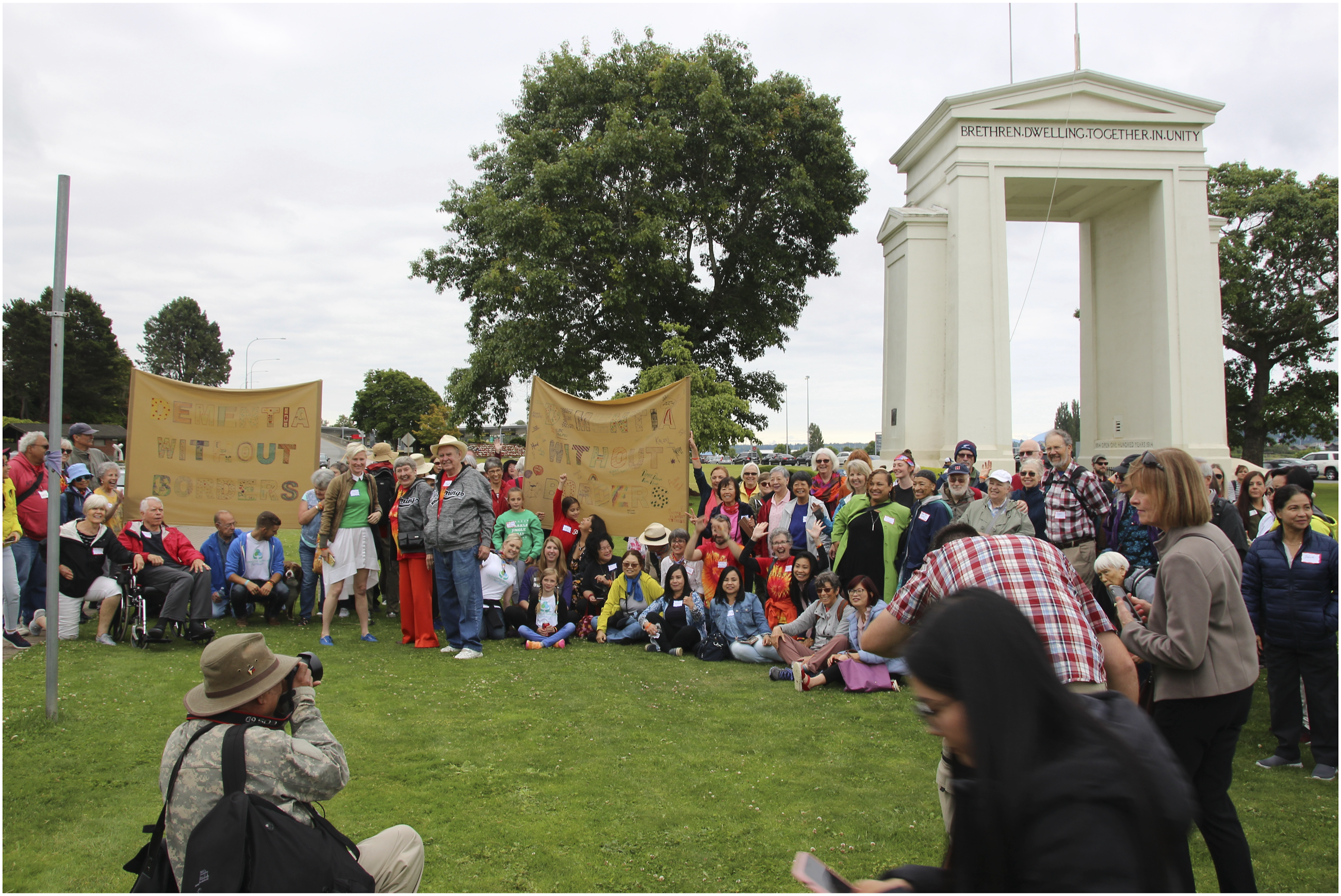
Shortly before noon, everyone came together as a single group to perform a community walk through the park, carrying the banners, occasionally stopping to explain to people watching from their cars. As they arrived at the picnic site and got settled, the planning team was introduced. We acknowledged our gathering on the traditional, ancestral, and unceded territory of the Semiahmoo people, and two people with dementia from “each side” – a Canadian and an American - offered further welcomes.
Lunch time – sharing a meal
Dementia Support Northwest from nearby Bellingham, WA had generously agreed to organize a lunch for everyone. Our funds were limited, but this group extended these resources to offer a delicious meal with live music. As they cooked at the outdoor grills, people gathered in small groups around picnic tables to enjoy the music and the food. We had provided games and activities that we thought might be useful to foster conversation, but they proved to be unnecessary. While people tended to sit with those they already knew (usually those from their own communities), conversations across tables erupted spontaneously (Figure 2). Eating together at Peach Arch Park.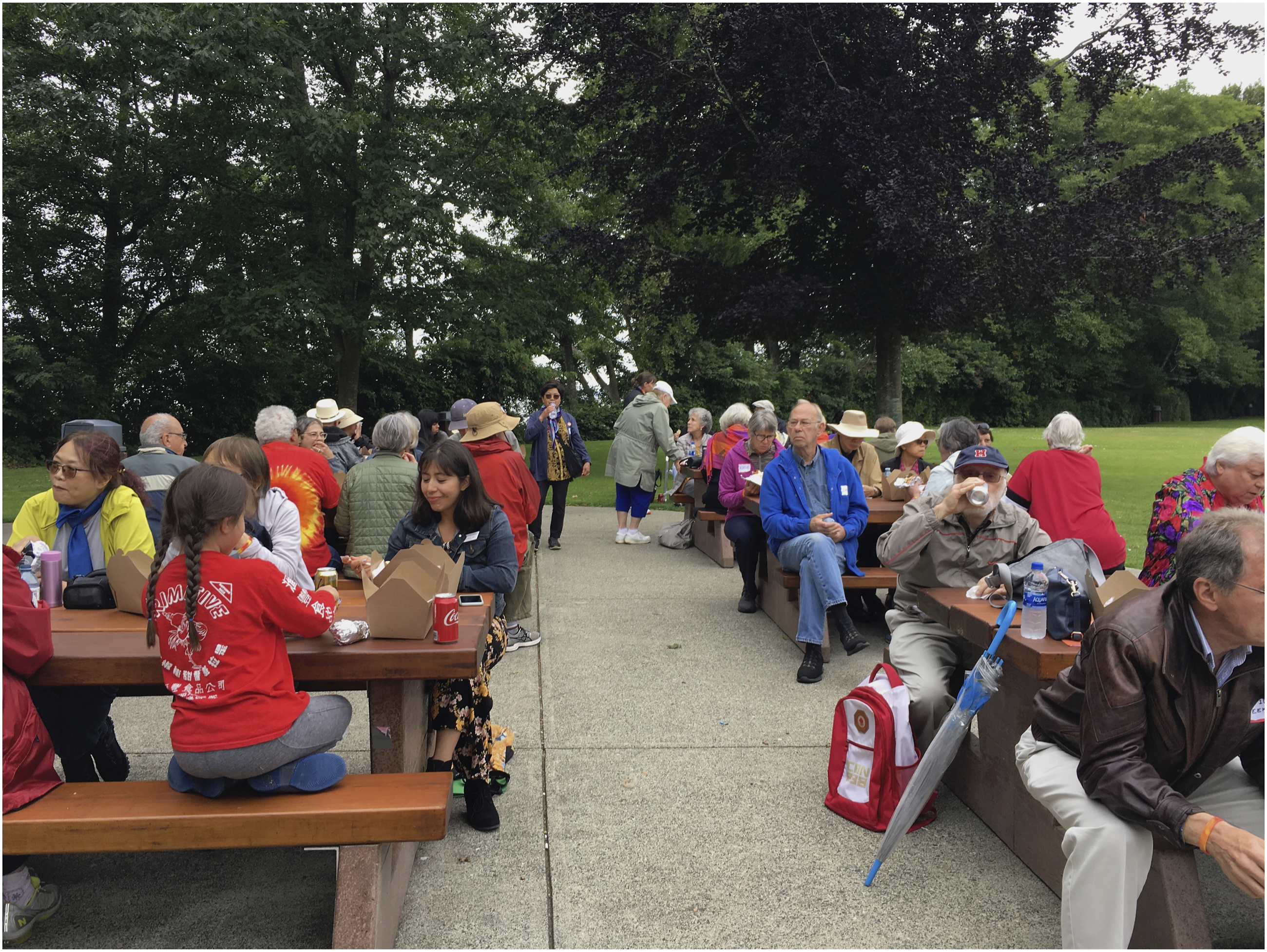
Creative expression – people with dementia sharing their experiences
The heart of Dementia Without Borders was a celebration of creative activity led by people with dementia during and after the meal. Invitations had gone out with the request for people with dementia to share examples of their creative work. We knew and encouraged certain individuals and groups to contribute, but the word spread and we were overwhelmed by the response. People simply brought what they had, and the shelter was turned into an exhibit space for sculptures, paintings, collage, drawings, and videos of dance performances. Work by more than 20 people with dementia was represented; its diversity and aesthetic impact was inspiring. Outdoors was a performance space where two people with dementia read their poetry, and a well-known singer from the Seattle area led everyone in a soaring version of “Reach Out and Touch (Somebody’s Hand)” (Figure 3). Sharing in a performance of Reach Out and Touch (Somebody’s Hand).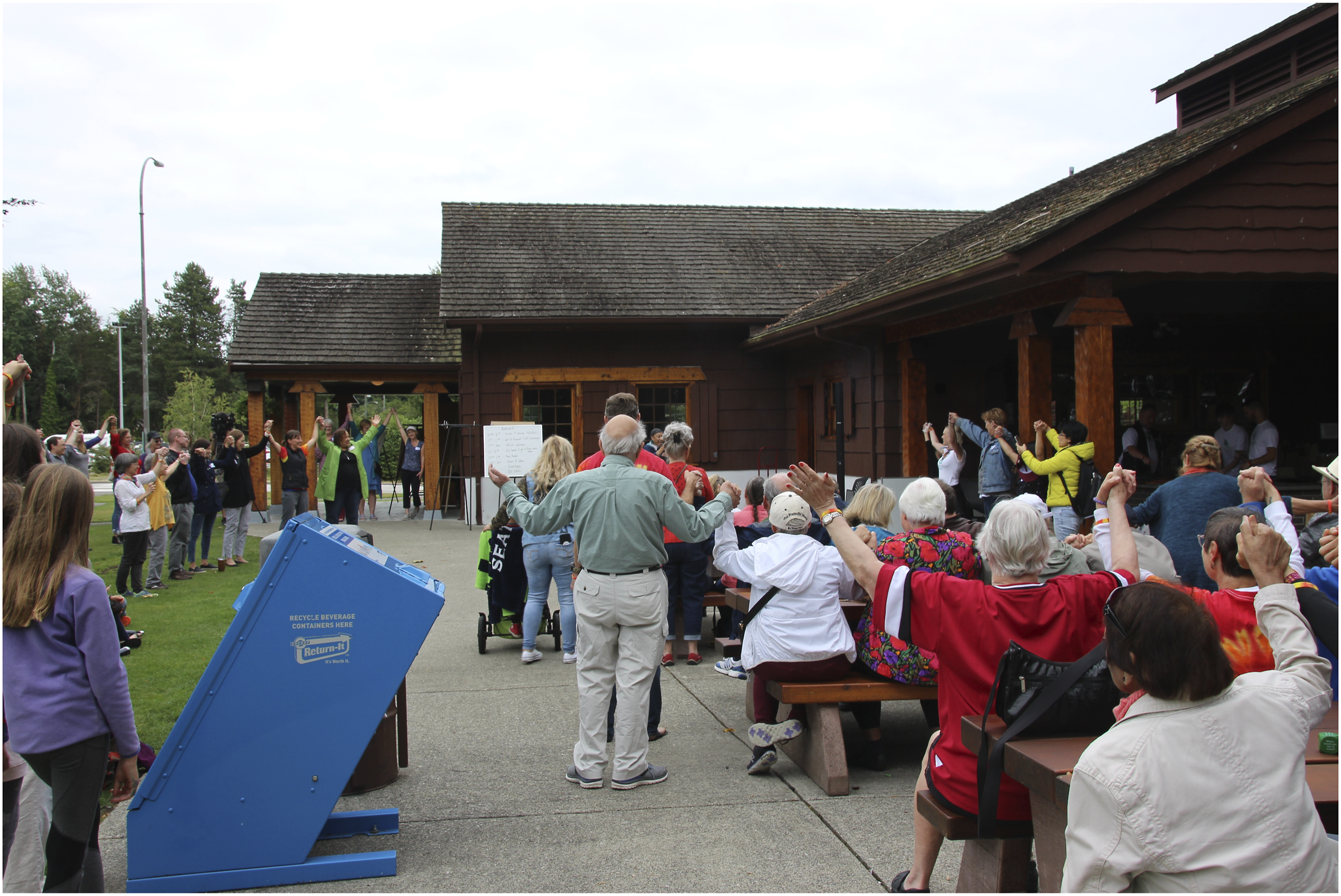
Participation was an important value guiding the day. There was live music throughout the afternoon for people to dance, a Vancouver group offered tai chi instruction, and for those preferring to express themselves visually, there was opportunity to contribute to the creation of a community quilt.
What we heard back
In the days leading up to the event when people called for information, we learned what was attracting them to come and what was holding them back. Most often, people were excited because they and their friends and neighbours felt they did not know enough about dementia and this was a welcome opportunity to learn more. Sometimes, we heard from people with dementia who had not told anyone of their diagnosis. They wanted to come, but were also nervous, not wanting to be “outed” in a public way. They were reassured to learn that they did not need to share their diagnosis and could come “just for the fun”, being especially curious and excited by the special arts focus of the event. Some others (especially those living alone) found it difficult to figure out how they would get there, even with the support we offered in organizing a bus. Overall though, the feedback we received from our respective communities through the planning process emphasized the importance of the location; people were keen to meet their neighbours across the border, even if it was hard to get there.
Comments from attendees were overwhelmingly positive with people most commonly expressing a sense of hope and belonging. This was awesome! Thanks for a wonderful day where we celebrated life instead of being told “How the end is coming”.
For some, it was their first time to speak openly about having dementia, and meeting others in this space was a joy-filled experience. Thank you for uniting all those on this path of dementia. Very uplifting! See you next year!
The significance of the space itself did not go unnoticed. The most powerful thing for me was seeing each country walking toward each other at the Peace Arch and then exchanging bracelets.
A man (recently diagnosed with dementia) expressed how positive this event was, but made the point that it was “very different at the other border”. He seemed to be referencing recent news stories about the struggle of immigrants and their children at the border between the US and Mexico.
Reflecting back and looking forward
Dementia Without Borders was a singular event. It is hard to imagine it ever being replicated, especially in these times of community lockdowns and border blockades (Kenwick & Simmons, 2020). Yet, it offers important lessons for the greater project of eliminating stigma and promoting social participation by people living with dementia.
We recognize that the relationships we had developed and nurtured over the year created good soil. As a team we came to know and trust each other; we had common values and aspirations, an eagerness for innovation, and a working style that allowed us to “go with the flow” to plan an event that would be flexible and responsive to opportunities for innovation. We settled on a loose agenda guided by a vision of “enjoying life” and “doing it together”. The result was that everyone felt welcomed and very much a part of things. In this way, the notion of dementia without borders extends understanding of social citizenship by challenging the discourses and practices that maintain boundaries between “us and them”. This was not a health fair created by experts for people with dementia. It was community artistry, a co-created performance that showed everyone new possibilities for what it might mean to live well with dementia. Providing opportunity for creative expression allowed people with dementia to engage as full participants with the capacity to contribute in meaningful and joyful ways.
We also recognize the importance of where Dementia Without Borders took place. The grace of this particular location did not go unnoticed. Being together on the land, sharing a meal beside the ocean, surrounded by trees and brushed by the warm air was an important part of the experience. Also crucial was the fact that it was a place of freedom. The Peace Arch was seen as a kind of “magic loophole” where the people of two nations could gather freely without fear.
This project has leveraged the symbolic power of an international border to raise awareness of the importance of social connection and community engagement for people with dementia. At the same time though, it has exposed the “contradictions of community – that is, community being both home (a location of refuge, similitude, and familiarity) and border (a place of peril, difference, and unfamiliarity)” (Drevdhal, 2002, p.8). These tensions are embodied in the history of Peace Arch Park. The monument was erected in 1921 to memorialize the 1814 Ghent Treaty that had brought peace to the region, and honor the “shared language, cultural values, and ancestral heritage” between two nations (Kuenker, 2011, p. 102). Over the past 100 years, the Peace Arch has served as a kind of “imagined community” (p.96), with people coming from both sides of the border to celebrate festivals and fairs, rallies and marches (Clark, 2005). Like other “parks of peace” around the world, it has often been a place of positive social disruption (Gough, 2000). Our own intent to engage the broader public in seeing dementia in new ways aligned well with this tradition.
Yet the border between Canada and the US is also increasingly a place of unrest, of perilous passage for immigrants and angry blockades. The rhetoric of peace, brotherhood, and common mothers also overlooks the colonial roots of this border that divides the traditional territory of the Semiahmoo people (Kuenker, 2011; Miller, 1996). Those living on the reserve adjacent to the provincial park (and whose land was expropriated decades ago to create the picnic site where we gathered) were aware of this event. Our planning did not leave enough time to develop this relationship, but community leaders shared the invitation with their members, and taught us what we were to say in acknowledgment of the complicated history of the land. This limited experience helped us realize that reducing stigma and fostering inclusion for people with dementia must be part of the larger project of reconciliation, recognizing how the history of a place and its people is tightly connected to the work we are doing, and that we have much to learn from each other moving forward (Jacklin & Walker, 2020).
In some respects, this collaborative project came to an abrupt halt with the pandemic. When the international border at the Peace Arch closed in March 2020, our attention turned inward to our own communities, and we were able to take what we had learned from Dementia Without Borders to shape the direction of change that was taking root closer to home. Now three years later, Seattle has opened The Memory Hub, 3 a new community centre and garden for people experiencing memory loss that will serve as an important place for connection and meaningful engagement. Vancouver is in the midst of the Building Capacity Project, 4 using asset-based community development to build relationships amongst community groups and develop inclusive partnerships with people with dementia (Phinney et al., 2021). These groups are learning as we did about the importance of flexibility and being open to new possibilities. As we move forward in our respective spheres of influence, we anticipate that the lessons of Dementia Without Borders will continue to inspire and shape the kinds of community conversations that need to happen if we are to better understand and accept the challenges and the gifts that people with dementia have to offer.
Footnotes
Declaration of conflicting interests
The author(s) declared no potential conflicts of interest with respect to the research, authorship, and/or publication of this article.
Funding
The author(s) disclosed receipt of the following financial support for the research, authorship, and/or publication of this article: University of British Columbia Collaborative Research Mobility Award (UBC-UW Dementia Collaborative, 2018-2019).
Notes
 : A Place for Dementia-Friendly Community, Collaboration, and Impact. Marigrace develops and facilitates programs that promote living well with dementia, and works closely with community partners spearheading initiatives to challenge stigma and build understanding.