




Abstract
Citizenship has provided an important conceptual framework in dementia research and practice over the past fifteen years. To date, there has been no attempt to synthesize the multiple perspectives that have arisen in this literature. The purpose of this paper is to explore, reflect on, and contrast, the key concepts and trends in the citizenship discourse as it relates to people with dementia. Using a scoping review methodology, forty-nine articles were identified for review. Despite the use of different descriptors, thematic analysis revealed four core themes underpinning citizenship discourse: 1) the relationality of citizenship; 2) facilitated agency and autonomy; 3) attention to stigma, discrimination and exclusion; and 4) recognition of the possibilities of identity and growth. Overall, this scoping review found a major emphasis on expanding definitions of agency and autonomy to render citizenship unconditional and inclusive of the diverse life experiences of people living with dementia. Notably, there is recognition that a more intersectional lens for embedding the subjective experience within a broader socio-political context is needed. Whilst the adoption of a citizenship lens in dementia research and practice has had real-world implications for policy and research, its exploration and use continue to be led by academics, highlighting the importance that future research involve input form people with dementia.
Introduction
Historically, research and practice have framed dementia – or neurocognitive disorder (NCD) - through a deficit-focused biomedical approach, which assumes that the primary experience of people living with dementia could only be understood in relation to neuro-cognitive degeneration and loss. Recognizing the limitations of this dominant approach for understanding, a personhood lens was introduced a few decades ago through the work of pioneers such as Kitwood (1989; 1997) and Sabat and Harré (1992). This lens meaningfully expanded the scope of understanding the dementia experience beyond neuro-cognitive loss to take into account the influences of people’s personal histories and relationships. This relational lens posits that the lived experience of people with dementia is shaped by how they interact with their interpersonal environment, noting particularly the negative impact of a societal lens that presumes incapability and defines the person by the diagnosis of dementia.
Despite its importance and impact on broadening how people with dementia are understood and treated, the personhood lens has been critiqued for failing to recognize people with dementia as active agents with existing rights, and to adequately account for the power imbalances in society that cause stigma and discrimination. Pioneering work by Bartlett and O’Connor (2007) used the language of social citizenship to advocate for integrating a more critical and socio-political lens to understand the lived experience of dementia. These ideas were then more formally developed in their 2010 book, Broadening the Dementia Debate: Toward Social Citizenship, which included a working definition and conceptual framework of ‘social citizenship’ to provide a common foundation and direction for the advancement of research and practice using this approach. They define social citizenship as ʻa relationship, practice or status, in which a person with dementia is entitled to experience freedom from discrimination, and to have opportunities to grow and participate in life to the fullest extent possible. It involves justice, recognition of social positions and the upholding of personhood, rights, and a fluid degree of responsibility for shaping events at a personal and societal levelʼ (p. 37).
Whilst this framework provides a core foundation for considering a citizenship-based lens in dementia studies, multiple theoretical perspectives in subsequent research have now arisen. To date, there has yet to be an attempt to compare and synthesize this body of knowledge. In particular, it is unclear how the conceptual ideas underpinning the different citizenship approaches extend and/or challenge one another. The purpose of this paper is to review the literature on citizenship of people living with dementia to explore, reflect on, and contrast, the key concepts and trends in the citizenship discourse. Synthesizing and integrating the multiple perspectives that have emerged through conceptual and empirical development in this area will help make explicit the core assumptions and values that underpin this approach, whilst simultaneously identifying tensions and discrepancies that exist among the different perspectives. These observations will be useful in articulating this approach, setting priorities, and charting the direction for future development of this body of knowledge.
Methods
A scoping review methodology was adopted to map the literature on citizenship and dementia and extract themes that represent the body of knowledge in this area. The steps involved in this review process included: (a) identifying the research question; (b) identifying studies pertaining to the research question; (c) screening and selecting studies; (d) charting data, and (e) collating and summarizing the results (Arksey & O’Malley, 2005). Scoping reviews are ideal for a quick and broad examination of the range of literature on a given topic.
The research question: ʻHow has citizenship been defined and applied in dementia research?ʼ guided this review. The search string with Boolean operators used to conduct the search for articles in this paper were (dementia OR Alzheimer*) AND (citizen* OR ʻhuman rightsʼ OR agency OR discrimination). The addition of the keywords ‘agency’ and ‘discrimination’ was intended to produce a more expansive range of articles in the initial pool for screening. The databases accessed to search for articles were Academic Search Premier, AgeLine, CINAHL Complete, Global Health, Google Scholar, Medline with Full Text, PsycINFO, Social Sciences with Full Text, JSTOR, and Web of Science.
The following inclusion criteria were followed to screen the articles: • publication type: peer-reviewed journal article including research studies or discussion papers; • publication date range: 2007–2019; • language: English; • topic of discussion or study population: persons living with dementia, and conceptualization and/or application of citizenship in the context of dementia care.
Figure 1 outlines the process of screening of articles. Firstly, the titles and abstracts of the 8866 search results were screened according to the inclusion criteria. Following this first stage of screening, 8657 results were eliminated due to the failure to meet inclusion criteria, particularly, the lack of fulfilment of focus on people living with dementia and/or the adoption of a citizenship framework. The full-text articles of the remaining 209 items were then screened based on the same inclusion criteria. At this stage, 173 articles were eliminated due to their lack of conceptualization or emphasis on citizenship of people living with dementia (e.g., not adopting a citizenship approach to understanding and conceptualizing the dementia experience or briefly mentioning extant perspectives on citizenship but not applying them in the study context). Consistent with scoping review parameters (Arksey & O’Malley, 2005), additional papers from the reference lists of included articles were hand-searched which fielded an additional five articles. Forty-one articles were finalized for in-depth review at this stage. Step-wise process of screening articles.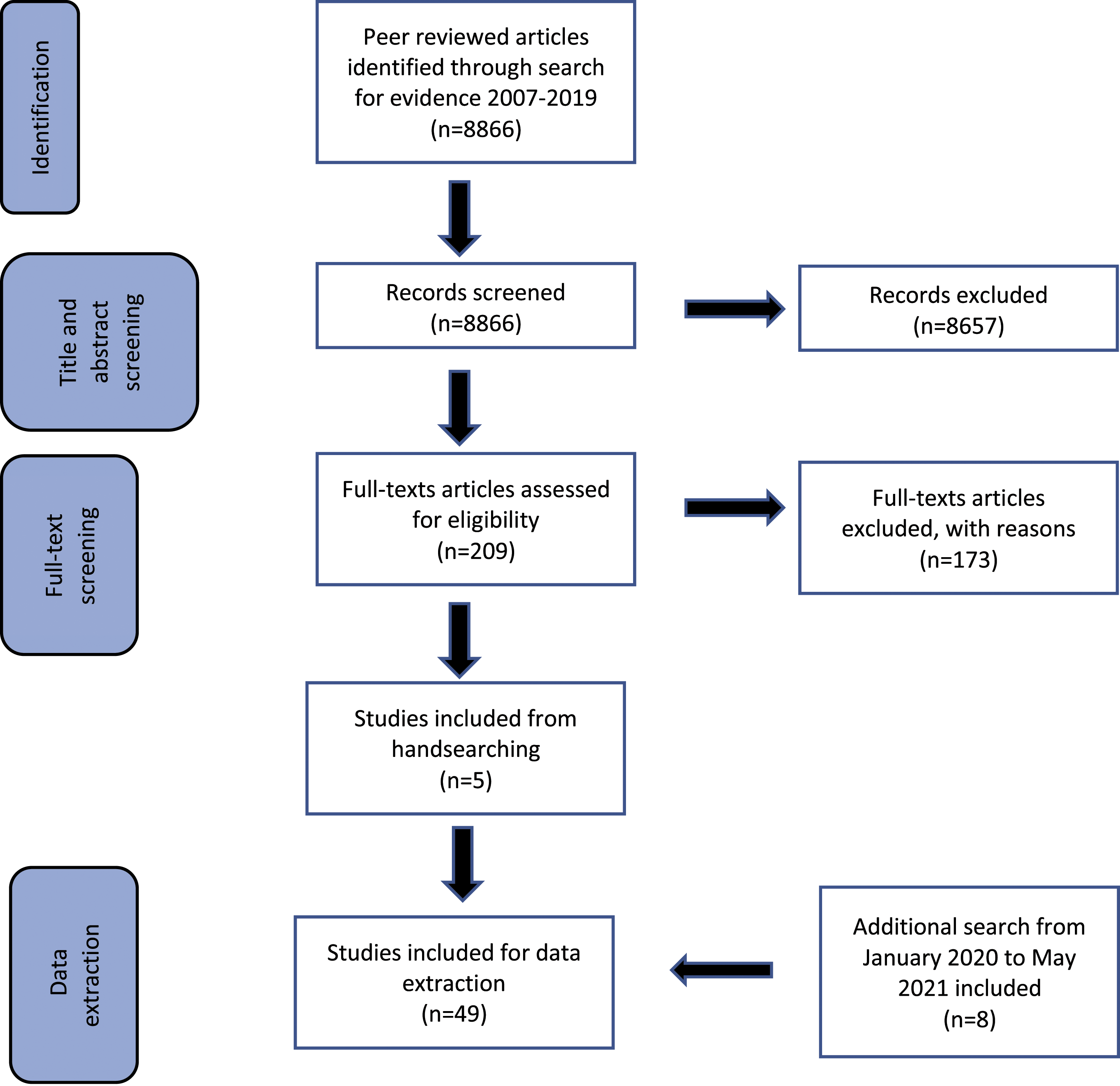
The key findings, propositions, and arguments from these items were extracted, focusing on the language being used with respect to citizenship and dementia, as well as the main components of citizenship discussed in the articles. The extracted data were closely examined for common themes, which were then identified and used to organize and tabulate the data into a chart. The analysis of the extracted data to derive key themes was loosely based on the principles of thematic analysis (Braun & Clarke, 2006), however, no formal qualitative coding was conducted.
Following the analysis of the 41 items, published between 2007 and 2019 (original search), a subsequent search was conducted using the aforementioned keywords and databases for articles published up to May 2021. This second stage search resulted in eight additional articles and was done as both an update and to see how new and emerging directions in research aligned with the interpretation of key themes and concepts thus far – it helped to validate and tighten the existing analysis. This resulted in a final total of 49 items included in the review. Overall, this includes 21 conceptual papers, one scoping review and 27 research studies - all of which utilized qualitative methods, ranging from ethnographic observations and interviews to focus groups. This set of papers, with only three exceptions – two research papers (O’Connor et al., 2018; Wiersma et al., 2016) and one conceptual paper (Mann, 2020)- did not explicitly include co-authors who lived with dementia.
Results
Whilst the articles all adopted the language of citizenship as a general concept, authors often used specific terms to label their approach, for example narrative citizenship (Baldwin, 2008), social citizenship (Bartlett & O’Connor, 2007, 2010), relational citizenship (Kontos et al., 2016), micro-citizenship (Baldwin & Greason, 2016; Mitra & Schicktanz, 2020), and active citizenship (Birt et al., 2017). Some authors also explicitly grounded their conceptual approach theoretically, most notably in the case of critical disability studies (e.g., Bartlett & O’Connor, 2007; 2010; Egdell et al., 2018), the application of the ethics of care framework to understanding citizenship in the context of dementia (e.g, Brannelly, 2011, 2016; Gilmour & Brannelly, 2010), and narrative theory (e.g., Baldwin, 2008; Baldwin & Greason, 2016).
Key Themes of Citizenship.

The relationality of citizenship
A core foundation of all reviewed literature is the importance of relationships and how they can position individual and collective experiences, rights, and responsibilities. In fact, relationality is an overarching theme that connects all of the other themes and involves recognizing the varying, complex and synergistic relationships that contribute to citizenship. This is not unexpected – discussions of citizenship pick up on the relationally-oriented personhood literature. What emerges as different in the citizenship literature though is the move beyond interpersonal relationships to consider broader institutional and societal responses.
In many instances, relationality is framed within the social citizenship perspective as first developed by Bartlett and O’Connor (2007; 2010). Prevalent in this perspective is citizenship as social practice, specifically the relational and dynamic practice through which people living with dementia relate to fellow citizens, and are connected to the community and society-at-large (Bartlett & O’Connor, 2007, 2010; Brannelly, 2011; Phinney et al., 2016). Importantly, this can include everyday social practices and interactions in the community (e.g., home, neighbourhood, care settings), thus shifting more traditional citizenship perspectives situated in civil and political participation to a wider range of practices of cohabitating and interacting with others (see for example: Baldwin & Greason, 2016; Bartlett, 2016, 2021; Birt et al., 2017; Brannelly, 2011; Clarke & Bailey, 2016; Gilmour & Brannelly, 2010; Kelly & Yarwood, 2018; Keyes et al., 2019; O’Connor et al., 2018; Seetharaman & Chaudhury, 2020).
The concept of relationality in citizenship was further extended by Kontos and colleagues in their model of relational citizenship (Kontos et al., 2016). Drawing in earlier work revolving around embodied selfhood (Kontos, 2005), relationality is intertwined with recognising how people with dementia express their sense of selves via their bodies (Kontos et al., 2016). This intra-relational perspective has been important in extending the citizenship discourse for people living with advanced dementia, for whom embodied self-expression and the relationality of human connection become critical means of engagement as citizens in the world (Grigorovich et al., 2019). This challenges dominant narratives that premise creativity purely on individual cognition, and instead, foreground the interaction between pre-cognitive and pre-reflective capacities of the body and an enabling environment as being central to the everyday creativity of people living with dementia (Kontos et al., 2020). The embodied citizenship lens has been used to explore creative, artistic and sexual expression of citizenship for people living with dementia (Grigorovich & Kontos, 2018; Kontos et al., 2017; Kontos & Grigorovich, 2018a, 2018b).
Whether envisioned or understood as a social practice or embodied experience, there is emphasis in this body of literature on citizenship as relationally enacted in different spaces and places. For example, Kelly and Yarwood (2018) explore what it means to be a citizen living with dementia in rural environments, focusing on how citizenship unfolds in rural contexts and in the way “people engage with society, its social practices and daily routines” (p. 103), while Kelson et al. (2017) discuss practices of social citizenship in the context of public art in an urban setting and Ward et al. (2016) consider expression of citizenship and the relationships that older women with dementia have with one another and with their hairdressers in hair salons. Bartlett (2016) calls for a consideration of citizenship “within the practice of ‘ordinary’” (p. 455), focusing on citizenship within domestic contexts and the micro injustices that can occur in these daily and relational spaces which can erode citizenship. Clarke and Bailey (2016) build on this by explicating how people’s long-term knowledge of and familiarity with the physical-social environment of the community helps facilitate their citizenship practices, while changes in the environment over time could cause feelings of estrangement, which in turn, undermine citizenship. In addition to this focus on day-to-day space, a smaller body of research has explored how decision making and considerations of capacity for people with dementia occur within legal and political spaces and can be understood relationally (for example, Boyle, 2010; Nedlund & Larson, 2016; Sonnicksen, 2016; O’Connor, 2019). Recognizing the importance between relationality and temporality, the importance of safe spaces, such as advisory or mutual aid groups of people living with dementia, as places for preserving citizenship by ensuring individuals feel comfortable and safe expressing ideas, thoughts and feelings, has been examined (for example, Örulv, 2012; Wiersma et al., 2016). This includes the concept of care-collectives, conceived as a network of “certain agents brought together in time and space, shifting along with changes in the relations comprising them” (Ursin & Lotherington, 2018, p. 63), further expanding understandings of the relational processes involved in citizenship, and the various ways in which they can occur. In the sections that follow, these ideas related to relationality will be further developed.
Facilitated agency and autonomy
A second, interrelated theme is focused on reconceptualizing the closely related concepts of agency and autonomy in relation to citizenship of people living with dementia. Whilst agency generally referenced taking action (process) and autonomy was linked to independence (status), it was often unclear in this review that people were using the language of agency and autonomy in differentiated ways. Hence, for practical purposes, we have collapsed the two terms into one theme.
Overall, within this body of literature, there is emphasis on the adoption of an “unconditional and inclusive” approach to the conceptualization of agency (Bartlett & O’Connor, 2007, p. 114; see also,; Bartlett, 2014a; Grigorovich et al., 2019). Accordingly, people living with dementia are repositioned as capable of communication, participation, and contribution on some level (Baldwin & Greason, 2016; Marsh et al., 2018; Nedlund & Nordh, 2015; Österholm & Hydén, 2016), and also capable of desires, needs, power, competencies, experiential expertise, and rights to challenge the status quo and effect change (Bartlett & O’Connor, 2007, 2010; Gilmour & Brannelly, 2010; Nedlund & Nordh, 2015; Örulv, 2012; O’Connor et al., 2018; Wiersma et al., 2016). This literature consistently rejects the notion that the agency of people living with dementia be framed through a deficit-focused medical lens focusing solely on cognition. Such a view is perceived as exclusionary and incomplete, restricting the right to participate in one’s own life, resulting in denial of citizenship (see for example, Bartlett & O’Connor, 2007, 2010; Brannelly, 2011; Nedlund & Larsson, 2016). Overall, the literature specifically challenges the cognitive biases that position people with dementia as incapable and lacking awareness, subjectivity and decision-making abilities (Baldwin, 2008; Boyle, 2008; Gilmour & Brannelly, 2010; Grigorovich et al., 2019; Grigorovich & Kontos, 2018; Kontos et al., 2016; Sonnicksen, 2016). Many of the articles challenge the notion that citizenship is simply a status conferred upon people, and instead, emphasize people’s active involvement in making decisions and taking action, drawing attention to citizenship as a process. For example, the idea of “active citizenship” is generally understood as a right to full participation in everyday life and in activities in the wider socio-political arena. Active forms of participation may be expressed in the case of people living with dementia, for example, “tak[ing] control of social situations” and “actively manag[ing]” the decision to disclose their diagnosis (Birt et al., 2017, pp. 202–203; see also; O’Connor et al., 2018).
Implicitly, and in some cases explicitly (for example, Bartlett & O’Connor, 2007), the person living with dementia in this body of literature is positioned as more than just a passive ‘recipient of care’. However a precarious balancing act in considering agency and autonomy within the context of dementia emerges: Specifically, supporting agency and autonomy in dementia is identified as an ongoing process of preserving and maintaining people’s abilities and capacity for action for as long as possible while also recognizing the inevitability of changing/evolving abilities due to dementia progression (Bartlett & O’Connor, 2007, 2010; Keyes et al., 2019; Nedlund & Nordh, 2015; O’Connor, 2020). Recognizing this complexity, this body of literature has grappled with the need to conceptualize participation across a continuum, drawing attention to the ‘less active’, ‘nuanced,’ or ‘passive’ forms of participation of those who are further along in their dementia trajectory. For example, notions of narrativity and embodiment have been invoked to draw attention to how people with dementia may enact subtle forms of agency and autonomy even in the later stages of dementia (see for example Baldwin, 2008; Baldwin & Greason, 2016; Clarke & Bailey, 2016; Dupuis et al., 2016; Grenier et al., 2017; Grigorovich & Kontos, 2018; Keyes et al., 2019; Kontos et al., 2020; Kontos & Grigorovich, 2018a; Robertson & McCall, 2020). Birt et al., (2017) note that the “passive mode” of citizenship shows a greater emphasis on facilitation by others, whereby “the actions of others recognize and acknowledge the nuanced ways in which people with severe dementia may display agency” (p. 205). Hence, the role of others in supporting agency and facilitating autonomy is particularly prominent in this body of literature, explicitly addressing how interpersonal, social, political, and legal structures can either facilitate or inhibit citizenship of people with dementia (Bartlett, 2014a, 2014b; Birt et al, 2017; Gilmour & Brannelly, 2010; Kontos et al., 2016, 2017; Ursin & Lotherington, 2018).
This begins to extend discussions related to agency and autonomy in important ways. Firstly, much of this literature explicitly challenges exclusionary approaches to citizenship that draw on dichotomous understandings of independence and dependence. Instead, agency and autonomy are reframed through the lens of interdependence. For example, Mitchell et al. (2020) argue for replacing more traditional views of autonomy with one that is relational, consisting of interdependence and reciprocity, and Brannelly (2016) draws on an Ethics of Care framework as a conceptual heuristic for conceptualizing this shift. This approach allows others to not only see people living with dementia as requiring support in making decisions, but also as being capable of making meaningful contributions to decision-making. For example, Baldwin (2008) proposes the notion of narrative interdependency, which involves supporting people living with dementia to have the opportunity, time, and resources to develop their own narratives and help shape policy narratives by becoming involved in decision-making processes. These ideas are being translated into new approaches to care, suggesting that adopting an interdependence-based approach in relationships of people living with dementia and their care partners helps facilitate people’s control and choice through collaborative decision-making (Brannelly, 2011; Keyes et al., 2019; O’Connor, 2020).
Secondly – and extending the notion of interdependence - this body of literature conceptualizes agency and autonomy through the interplay of rights, resilience, and protection, emphasizing the need for a balance between supporting people’s right to take risks and cope with challenges, and ensuring that they are safe and cared for when not able to do so themselves (see Baldwin & Greason, 2016; Behuniak, 2010; Brannelly, 2016; Clarke & Bailey, 2016; Marsh et al., 2018; O’Connor, 2020; Phinney et al., 2016). These authors emphasize the value in recognizing vulnerability and dependence across the dementia trajectory to better understand power relations and inequalities, and delineate additional rights that address the specific needs and challenges of people living with dementia. However, tensions emerge regarding how this balance is understood and addressed. Reconceptualizing care and protection as ʻpractices that impinge on human rights that people may object toʼ (Brannelly, 2016, p. 309) gives people living with dementia the opportunity to provide their consent to receiving care and have greater choice, control, and autonomy in care decisions (Nedlund & Larsson, 2016). O’Connor (2020) recognizes that while people living with dementia can be deemed incapable of making some decisions in their lives, they may still be involved as active participants in those decisions and quite capable of making other decisions.
It is suggested that recognizing vulnerability and protection would make for a more inclusive model of citizenship (see for example, Behuniak, 2010) and help maintain, recognize, and support the agency and autonomy of all people living with dementia (Grenier et al., 2017) but to date, there is only limited direction in this body of literature as to how to achieve this.
Stigma, discrimination and exclusion
Perhaps one of the clearest defining features of the citizenship and dementia discourse is the emphasis on positioning stigma, discrimination and exclusion as a critical aspect of the dementia experience. All reviewed articles draw attention to these issues in some way, framing them as being in violation of people’s rights and the principles of citizenship. Specific aspects discussed related to this include: misuse of power (Bartlett & O’Connor, 2007); furthering negative stereotypes about dementia, for example, conflating diagnosis with incapacity (Bartlett, 2014a; Behuniak, 2010; Birt et al., 2017; Grenier et al., 2017; O’Connor et al., 2018); placing the onus of systemic failure (e.g., resident-to-resident aggression in long-term care) on the individual and dementia (Grigorovich et al., 2019); othering, devaluing, and de-legitimizing people’s position as citizens on the basis of vulnerability and dependence (Brannelly, 2011; Gilmour & Brannelly, 2010; Grenier et al., 2017); imposing restrictions on participation based on inaccurate judgement or assumption of capacity (Birt et al., 2017; Boyle, 2008, 2010; Nedlund & Larsson, 2016; O’Connor, 2020); and mis-representation of people living with dementia in policy narratives (Baldwin, 2008; Nedlund & Nordh, 2015). The importance of recognizing how social location (Bartlett & O’Connor, 2010; O’Connor, 2020), including gender inequities (Bartlett et al., 2018), may inform these experiences of stigma and discrimination in diverse ways is being recognized as an important area for further development.
Resisting and eliminating sources of injustice and oppression and facilitating people’s right to be free of stigma and discrimination are framed as central to the citizenship of people living with dementia (Bartlett & O’Connor, 2007, 2010; Brannelly, 2016). Some of the articles reviewed made recommendations to promote freedom from stigma, discrimination, and exclusion. These included: legal recognition of gross (more overt) violation of rights, as well as subtle (less obvious) forms of stigmatizing and discriminatory perceptions, attitudes, and practices in day-to-day practices (ie. Kelly & Innes, 2013); appointing third-party capacity advocates to ensure that people living with dementia are not discriminated against on the basis of lack of capacity and prevented from participation in decision-making (ie. Boyle, 2008); and ensuring that all assessments of decision-making capacity begin with the presumption of capacity (ie. O’Connor, 2019).
This body of literature draws attention to the possibilities that personal experiences of stigma and discrimination may motivate people living with dementia to take action through advocacy and education (see for example, Bartlett, 2014b; O’Connor et al., 2018; Russell, 2020; Seetharaman & Chaudhury, 2020). However, it also recognizes that stigma associated with the diagnosis and systemic barriers may pose challenges to people’s efforts to resist discrimination, thus necessitating adequate external support (Egdell et al., 2018; Kontos et al., 2017). The literature also suggests the empowering nature of peer interaction and support helps people recognize their shared experiences of stigma and discrimination as consistent with a citizenship lens (Örulv, 2012; Wiersma et al., 2016).
Identity and growth
While the review found emphasis in the literature on continuity and maintenance of social people’s identities, multiple authors (Bartlett, 2016; Bartlett & O’Connor, 2007, 2010; Grigorovich et al., 2019; Kontos & Grigorovich, 2018a, 2018b) also focus on the opportunities for growth and development as an inherent right for those with dementia. Specifically, Bartlett and O’Connor (2010) challenge the notion of fixed sense of self that fails to account for the possibility of changes not only due to cognitive decline, but also in terms of shifting priorities or desires as the dementia progresses. In relation to the goals of dementia care, a minority of the articles reviewed explicitly argue against a narrow focus on ‘maintaining’ and call instead for the promotion of human flourishing and supporting positive potentialities such as creativity and imagination of people living with dementia (Grigorovich et al., 2019; Kontos & Grigorovich, 2018a, 2018b). O’Connor (2019) discusses the right of people living with dementia – similar to everyone else - to grow and change their mind.
Several articles (Baldwin & Greason, 2016; Bartlett, 2014b, 2014a; Bartlett & O’Connor, 2010; Birt et al., 2017; Brannelly, 2016; Clarke & Bailey, 2016; Kelly & Yarwood, 2018; Keyes et al., 2019; O’Connor et al., 2018) suggest that the continuity of identity, fulfilment of social roles, and maintenance of a sense of belonging and solidarity to the community affect people’s citizenship. According to these articles, citizenship is influenced by: “the interaction between engagement/participation, meaning-making, and identity, as experienced through one’s life story” (Baldwin & Greason, 2016, p. 293, see also; Bartlett & O’Connor, 2010) and, the tension between the maintenance of social roles and evolution of identities over the course of progression of dementia (Birt et al., 2017; Brannelly, 2016; Clarke & Bailey, 2016). Citing the discrepancy between the representation of people living with dementia in policy narratives, and the subjective narratives based on their lived experience and identities, Baldwin (2008) calls for bridging the gap between citizenship and self. Bartlett and O’Connor (2010) suggest that the values and meanings that the person living with dementia considers to be important shape their participation and actions as citizens, and therefore, emphasize the concept of sense of purpose as a central component of citizenship, which varies from person to person.
The articles reviewed suggest that a citizenship approach that focuses on identity helps reveal individual differences and disaggregates the category of people living with dementia, especially by drawing attention to the importance of social location (Bartlett & O’Connor, 2007). At the same time, it also facilitates collective and shared identities that foster a sense of solidarity (Bartlett, 2014a, 2014b; Wiersma et al., 2016). Bartlett and O’Connor (2010) extend the idea of taking account of the multiple identities of people living with dementia drawing on intersectionality theory to suggest recognize that the concept of social location as more representative of how people’s power relations with others shape the way they construct their identities and are perceived by others. The importance of moulding a citizenship approach that is more intersectional and sensitive to diversity and difference, for example, acknowledging how race, gender, socio-economic status and ethnicity (to name a few) help construct the experience of living with dementia in a particular way, is identified as grossly in need of further work (Bartlett et al., 2018; Bartlett & O’Connor, 2007, 2010).
Discussion
All of the reviewed literature touches on aspects of Bartlett and O’Connor’s (2010) original definition of social citizenship, in terms of considerations of citizenship as a relationship or practice of some kind. Similarly, the articles reviewed in this paper stress the importance of upholding the rights of people living with dementia, as well as the need for individuals to be free from stigma and discrimination. There is also emphasis on citizenship being equated with opportunities for growth, as well as being able to participate in meaningful ways in life. Overall, this scoping review found a major emphasis on expanding definitions of agency and autonomy to render citizenship unconditional and fully inclusive of the diverse life experiences of people living with dementia. The alternative conceptualizations of agency and autonomy help introduce greater equity and fairness in citizenship practices and eliminate discrimination based on cognitively-biased standards.
The articles positioned people living with dementia differently: a) as active agents with power (Bartlett, 2014a, 2014b; Marsh et al., 2018; Wiersma et al., 2016); b) as people who are vulnerable (Behuniak, 2010; Brannelly, 2016; Grenier et al., 2017), and c) as both active and passive participants (Baldwin & Greason, 2016; Bartlett & O’Connor, 2007; Birt et al., 2017; O’Connor, 2019). This variation in positionality could be attributed to the emphasis on different stages of the dementia experience. For example, most articles focused on citizenship in the early stages, whilst fewer focused on the late stages of dementia. One particularly important strand of this work has focused on integrating principles of embodiment into relationship-centred care, particularly in long-term care settings and for people with advanced dementia, as one strategy for ensuring more inclusive practice that affords people living with severe dementia increased opportunity to exercise citizenship (Kontos et al., 2017).
Although not addressed in all of the literature, it is important to note that there was some emphasis on a person’s sense of self and identity, and how that configures with citizenship. Certainly, citizenship has been connected with the preservation of a person’s identify (Clarke & Bailey, 2016), and with providing a sense of belonging and meaning in one’s life (Baldwin & Greason, 2016; Brannelly, 2016). In addition, Bartlett (2014a, 2014b) has focused on the shared, distinctive and collective identity that can arise for citizens with dementia. What seems clear is that a temporally integrated perspective is necessary to gain a more sophisticated, deeper and nuanced perspective of the full spectrum of citizenship practices across the dementia continuum. In particular, questions regarding how the exercise of citizenship evolves in relation to changes of abilities, life situation, roles, and identities in the dementia trajectory (Bartlett & O’Connor, 2007) emerge as an important area for development. Adopting a more dynamic citizenship approach that takes into account the progressively evolving nature of people’s cognitive capacities due to dementia will enable the delineation of different strategies for different situations, as opposed to a one-size-fits all approach (Nedlund & Nordh, 2015). This kind of tailored approach could be meaningfully developed in future theoretical/conceptual research to better account for the unconditional and total inclusion of people living with dementia as citizens.
From this review, three particularly notable and pertinent areas for future research and conceptualizing emerge. First, although previous research (Bartlett & O’Connor, 2007, 2010; Hulko, 2011; Innes, 2009; O’Connor et al., 2010) has advocated for the need to develop a more intersectional lens for embedding the subjective experience of living with dementia in the broader sociocultural context, to date, with a few exceptions this intersectional lens has not been drawn upon. For example, Bartlett et al. (2018) explored gender but none of the articles explicitly addressed culture, socio-economic status and/or race. Overall, the literature is dominated by a Western view of citizenship. Future research is required that integrates an intersectional lens into perspectives of citizenship of people living with dementia in order to more comprehensively articulate how power associated with people’s differing social locations implicates the exercise of citizenship and rights. This would include exploring how concepts such as autonomy and rights may have decidedly different meanings within the context of more collectivist cultures.
Second, although citizenship implies both rights and responsibilities, to date the focus of scholarship related to citizenship in dementia has focused solely on explicating rights. No attention has been given to understanding citizenship as both rights and responsibility. This raises a third point. Whilst there is some recognition that the language of citizenship has facilitated a move forward in conceptualizing how people living with dementia are understood and responded to, there is also a lack of consensus regarding the appropriateness and applicability of a citizenship discourse as the best discourse for moving forward. For example, some attention is being given to the language of vulnerability as a potentially useful reframe for addressing the rights of people living with dementia, whilst simultaneously ensuring that people can access the care and services to which they are entitled (see for example, Hall, 2010; Behuniak, 2010). Recognizing the importance of tying vulnerability to notions of interdependence, future research on the citizenship perspective could more usefully explore ways to resolve the tensions between vulnerability, rights and responsibilities.
Conclusion
This scoping review has drawn out the different concepts, approaches, and interpretations that shape current understandings of citizenship in the context of dementia practice and research. Thematic exploration of the reviewed literature demonstrate the relationality of citizenship, the nuances of agency, that autonomy can be facilitated, and that there is a strong focus on human rights given a context of stigma and discrimination. These themes are consistent with the definition of citizenship initially proposed by Bartlett and O’Connor (2010) but have been uniquely developed by different researchers. Despite these consistencies, this review does show that citizenship remains to a certain extent an “elusive” concept (Bartlett, 2016), and can be a “malleable and precarious enactment” (Ursin & Lotherington, 2018, p. 1).
Nevertheless, understandings of how the citizenship approach translates into research and practice has begun to expand and the articles covered in this review focus on contexts as varied as long-term care, recreation programs, voting, advocacy, the workplace, and support groups. The adoption of the citizenship approach in dementia studies has important real-world implications and aligns with several policy and practice frameworks, including the PANEL + framework (World Health Organization, 2015), the United Nations (2006) Article 12 of the Convention on the Rights of Persons with Disabilities (CRPD), dementia-friendly communities (DFCs) (Alzheimer’s Disease International, 2016), as well as various national charters (Alzheimer Scotland, 2009; Alzheimer Society of Canada, 2015). Since the concept of citizenship within the context of dementia care, research and practice was first introduced, its strong uptake and consistent use as a pivotal theoretical perspective in dementia studies is apparent given the scope of the literature that this review has uncovered. Despite its potential practical implications, its exploration and use continues to be led by academics. More work is required to actively involve people with dementia in considerations of citizenship, particularly to hear from them what it means to be a citizen living with dementia. Effort should be made to explore intersectional perspectives to reveal understandings of the diversity and heterogenity of citizenship and citizenry within the dementia context. Hard questions need to be asked as to whether current conceptualizations of citizenship adequately capture the requirements and perspectives of people living with dementia, particularly in a world that is increasingly cognizant of the need for recognizing human rights and for eliminating stigma and discrimination.
Footnotes
Declaration of conflicting interests
The author(s) declared no potential conflicts of interest with respect to the research, authorship, and/or publication of this article.
Funding
The author(s) disclosed receipt of the following financial support for the research, authorship, and/or publication of this article: The authors gratefully acknowledge that this work was conducted as part of a Canadian Institute on Health Research (CIHR) funded research study.
