




Abstract
The use of touchscreen tablets, such as the iPad, offers potential to support the person with dementia staying in a care setting, ranging from a long-term care home to an adult day programme. Although electronic devices are used among people with dementia, a comprehensive review of studies focusing on their impact and how they may be used effectively in care settings is lacking. We conducted a scoping review to summarize existing knowledge about the impact of touchscreen tablets in supporting social connections and reducing responsive behaviours of people with dementia in care settings. Our research team consists of patient partners and family partners, physicians, nurses, a medical student and an academic professor. A total of 17 articles were included in the review. Our analysis identified three ways in which touchscreen tablets support dementia care: (1) increased the person’s engagement, (2) decreased responsive behaviours and (3) positive effect on enjoyment/quality of life for people with dementia. Lessons learned and barriers to the use of touchscreen tablets in the care of people with dementia are described. Overall, only a few studies delineated strategies that helped to overcome barriers to technology adoption in care settings. Knowledge translation studies are needed to identify effective processes and practical tips to overcome barriers and realize the potential of assistive technology in dementia care.
Introduction
According to the World Health Organization (World Health Organization, 2019a), the number of people with dementia is estimated to reach 82 million by 2030. In Canada alone, where this review was conducted, half a million people are presently living with dementia, with 25,000 people diagnosed every year (Alzheimer Society of Canada, 2019). Given the current lack of medical treatment to prevent dementia and reverse symptoms, people with dementia, their family care partners and healthcare practitioners face concerns related to appropriate care and quality of life. As the ability to communicate complex ideas and express emotions verbally becomes increasingly compromised for people with dementia, there is a growing need for appropriate, evidence-based psychosocial care to understand and minimize responsive behaviours. Anxiety, agitation and emotional distress associated with cognitive decline are often a response to environmental stress (Dupuis et al., 2012; Hung et al., 2017). These responsive behaviours can pose safety risks, as well as having the potential to hinder care and change family relationships for people with dementia (Savundranayagam & Lee, 2017).
Adjustment to a new environment, such as a busy hospital ward, is particularly stressful for people with dementia, especially if family and friends are not able to travel to or stay in the care setting to offer support and comfort when needed. Distance, work and other family pressures may thus have a negative effect on the number and quality of visits from friends and family, who themselves may experience stress as they adjust to their new, secondary roles in which they have reduced input into care planning (Moyle et al., 2014). In this paper, a care setting refers to a health service setting that is staffed by paid care providers; a hospital unit, a long-term care home or a day programme are examples. For the person with dementia in such are setting, staying connected with friends and family members is important for maintaining cognitive health (Birt et al., 2020).
As Siniscarco et al. (2017) point out, technology-based communication activities can be used to re-connect friends and family with the person with dementia in hospital in order to provide person-centred care. Technology designed to assist in maintaining and supporting connection with family care partners and healthcare professionals has been studied to identify its value and potential to support care for people with dementia. Yet, the evidence base on feasibility and impact of the use of touchscreen tablets for people with dementia in care settings has not been well established, as indicated in various literature reviews (e.g. Joddrell & Astell, 2016b; Van der Roest et al., 2017). There is a lack of knowledge in implementation strategies to inform clinicians on what makes a technological intervention work for people with dementia in a particular care setting and why; we also need to learn more about the barriers that need to be addressed (Vichitvanichphong et al., 2018). For example, the iPad study conducted by Hung et al. (2018) highlights the complexity of knowledge of skills required to play family videos on an iPad to support dementia care in a hospital ward.
Previous reviews have examined the features and usability of touchscreen tablets for people with dementia, with several studies focused on tablet use in reminiscence therapy (Astell et al., 2018; Samuelsson & Ekström, 2019). For example, Joddrell and Astell (2016b) note that several physical characteristics of the iPad and Android touchscreen tablets make them useful for people with dementia. Eliminating external keyboards and the mouse reduces the cognitive load required to use iPads and Android touchscreen tablets, which makes the touchscreen interface easy to use (Dynes, 2018). In addition, most touchscreen tablets like the iPad are small enough to be carried around and are easily customized to hold materials and information adapted for a specific individual or individuals (Joddrell & Astell, 2016a; Swan et al., 2018). A recent study showed positive results of using video-conferencing on iPads to support family connection with residents in the care home, though both staff and residents also reported issues related to physical frailty and cognitive impairment (Moyle et al., 2019). For example, an early study describes how ‘Giraff’, a robot with video-conferencing abilities, was tested in long-term care homes with mixed outcomes. While social connection between family caregivers and people with dementia was improved, intermittent internet connectivity in the care home limited the extent to which family members could use the robot effectively (Moyle et al., 2014).
Concerns have also been raised that people with dementia as well as care home staff may not accept new touchscreen tablets or may not know how to use them due to their lack of familiarity with the technology and the novelty of the various emerging software programmes (Perry & Beyer, 2012). While there have been growing efforts in the development of applying touchscreen tablets to support dementia care, there is a need to gain a more comprehensive understanding of what works, what does not and what helps to overcome the barriers to such technology use in formal care contexts.
Purpose
The purpose of this scoping review is to summarize existing knowledge on the use of touchscreen tablets to support the connection of persons with dementia with their families and caregivers. We also want to know: Does the use of touchscreen tablets help to reduce responsive behaviours in care settings? What may hinder and enable family members and care providers to use tablets effectively in care settings? The findings will inform the design of the next study. In our next study, we will use the evidence mapped in the scoping review to engage hospital staff and families to co-produce practical strategies for supporting the use of touchscreen tablets (i.e. iPads) to innovate and improve dementia care in hospital wards.
Study questions: What has been reported in the literature regarding the impact of touchscreen tablets in supporting social connections and reducing responsive behaviours of people with dementia in care settings? What strategies may support family members and care teams in the use of touchscreen tablets with people with dementia?
Methods
The methodology for this review draws on the scoping review guidelines developed by the Joanna Briggs Institute (Peters et al., 2015). The objectives, inclusion criteria and methods for this scoping review were specified in advance and documented in a protocol (Hung et al., 2019).). Scoping reviews are generally used to determine the extent of existing evidence, to summarize existing evidence of relevant literature in a field that is underdeveloped and to identify the key themes and contexts within a research topic (Armstrong et al., 2011). A scoping review is appropriate for this study because the topic of touchscreen tablets use for people with dementia in care settings is novel and has not been fully examined. This study maps out the empirical evidence on the key impact of the use of touchscreen tablets and to identify strategies that have been used to support the adoption of touchscreen tablets in care settings.
Inclusion criteria
Population
This scoping review considered studies that included older adults (aged 60 or older) regardless of types and stages of dementia.
Concept
Any touchscreen tablet interventions delivered to support social connection and reduce responsive behaviours were included. For example, we included psychosocial interventions such as music and drawing applications, family videos and videoconferencing interventions. Diagnosis and disease screening application were not included in this review as the focus was on promoting social connection and reducing responsive behaviours.
Context
This scoping review included literature from studies conducted in care settings, such as hospitals, nursing homes, assisted living facilities, etc.
Search strategy
This scoping review was conducted by a diverse team including two patient partners, three family partners, two physicians, two nurses, a medical student and an academic professor.
A gerontology research librarian in the University was consulted to select the search terms. We searched identified keywords and index terms across databases: MEDLINE, AgeLine, Cumulative Index to Nursing and Allied Health, Cochrane, PsycINFO and IEEE. Search terms included: touchscreen, iPad, tablet, mobile technology, assistive technology, dementia and Alzheimer. Studies published in English from 2009 to May 2019 were included. We framed our search parameters for 10 years because our preliminary search identified limited studies before 2009. After the launch of Apple iPad in 2010, there was an increase in interest and studies about using touchscreen tablets among older people, including people with dementia. The search was also extended to Google for grey literature (i.e. organizational reports, newsletters and other articles not indexed in library databases). All empirical peer-reviewed publications as well as documents from the grey literature that examined the use of touchscreen tablets for older adults with dementia were considered for inclusion. Studies in all designs, including quantitative and qualitative research, as well as small feasibility pilots and user experiences were considered.
Inclusion and exclusion criteria were applied to selected articles. Articles were included if they: (i) focused on older people with dementia, (ii) targeted any intervention of touchscreen tablets, (iii) were studied in care settings (e.g. nursing homes, day programmes and hospitals) and (iv) described outcomes that had relevance in promoting social connection and improving well-being (e.g. improvement in mental health and quality of life). Reference lists of articles were hand searched for additional sources. Google Scholar was used to find published articles, organizational reports and related articles. All reports on the same study were considered if the relevant outcomes of interest are different; otherwise, only the most recent report was included in the review.
The review process involved two levels of screening: a title and abstract review followed by a full-text review. A data analysis software programme, NVivo12, was used to conduct coding for full-text review in selected articles to identify themes that summarize the literature and answer the two review questions. We mapped the selected articles in a summary table (see Table 1) by domains: author and country, setting, participants, intervention, impact, barriers and strategies. In research meetings, the whole team, including patient and family partners, took part in analysing the extracted data sorted according to potential themes. We compared and discussed different interpretations to resolve conflicts. The extracted data were collectively evaluated, refined and collated into categories to develop the final themes. See Figure 1 for the PRISMA flow diagram (Peters et al., 2015) that describes the review process. See Table 1 for the results charted to answer the two scoping review study questions: evidence of impacts and strategies to overcome barriers.
Studies of touchscreen tablet intervention in care settings.

CIRCA: Computer Interactive Reminiscence and Conversation Aid; NPI: Neuropsychiatric Inventory; QOL-AD: Quality of Life in Alzheimer's Disease.
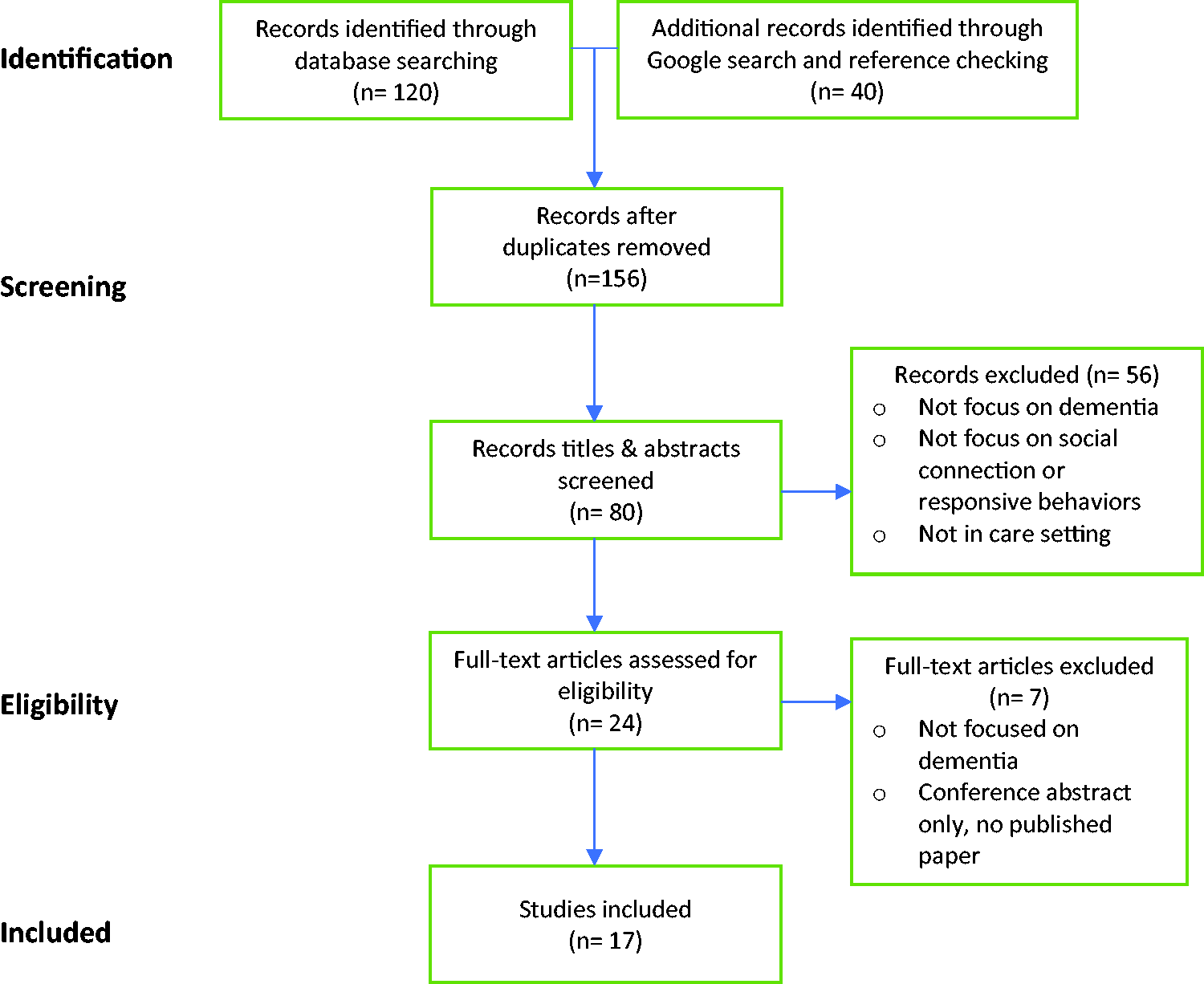
Preferred Reporting Items for Systematic Reviews and Meta-Analyses (PRISMA) flow diagram for the scoping review process.
Ethical considerations
Ethics approval is not required for this scoping review study because the methodology of the study only consists of data from articles in public domains. As a team that includes academics and clinicians working with people living with dementia, we engage in team reflection in regular meetings and use the guidance of the ethical framework ‘ASK ME’ specifically developed for co-research with people with dementia (Mann & Hung, 2018). ASK ME stands for Avoid assumptions, Support the person to do their best, consider Knowledge needed to be put into action, Meet early and regularly and consider Ethical sensitivity and responsibility.
Results
Summary of search findings
In this review, the literature search yielded 17 articles meeting the eligibility criteria. Table 1 describes the characteristics of the studies and relevant data related to the two review questions (i.e. the impact of the touchscreen tablets and enabling strategies to barriers). The studies were conducted in the United States, Canada, the United Kingdom, Australia and New Zealand. Settings included long-term care centres, day programmes, hospitals and other healthcare settings staffed by paid care providers. While all the studies utilized some type of a touchscreen tablet as the intervention, there was a wide range of variation of how the intervention was delivered and the impact people with dementia experienced in the care settings (Table 1). Touchscreen tablets were mostly used as general tools for playing games, digital reminiscence therapy, simulated presence therapy and communicating with family. Some studies utilized specialized hardware and software, including the Computer Interactive Reminiscence and Conversation Aid researched by Astell et al. (2018) and the ‘Giraff’ telepresence robot investigated by Moyle et al. (2014).
Analysis of the included studies identified three main impacts associated with the use of touchscreen tablets in the care of persons with dementia: (1) increased person’s engagement/participation, (2) decreased responsive behaviours and (3) positive effect on enjoyment/quality of life for persons with dementia. There were no distinct relationships between the different types of touchscreen intervention and each of these main impacts. Barriers to the use of touchscreen tablets among people with dementia in care setting were also discussed.
Improved engagement
Active engagement in activities has been identified as a potential factor in maintaining function and a sense of well-being in patients with dementia (Vikström et al., 2008). Engagement is the ‘act of being occupied or involved with an external stimulus’ (Cohen-Mansfield et al., 2009, p. 300). Participant engagement can be assessed in a variety of ways, including qualitatively by coded observations or caregiver surveys, or quantitatively by time spent in activities or scales.
In this review, 10 studies measured engagement qualitatively. Several studies utilized a mixed-method design. These mixed-method designs in particular includes a combination of observation, interviews and questionnaires to capture comprehensive and detailed data about the interactions between the participant, the intervention and the facilitator (Hung et al., 2018). Data collection in the studies often used video recordings of the participants’ interactions with subsequent transcription. Thematic analysis would then be conducted to identify verbal and non-verbal behaviours representative of engagement. Astell et al. (2010) and Hung et al. (2018) identified shared eye gaze as indicators of engagement. Some studies also recorded semi-structured interviews with caregivers or facility staff, with subsequent thematic analysis. Nine studies found improvement in overall engagement (Astell et al., 2010, 2016; Evans et al., 2017; Leng et al., 2014; Moyle et al., 2014; O’Connor et al., 2011; Pringle & Somerville, 2013; Swan et al., 2018; Vahia et al., 2017). Aitken (2015) did not find a significant difference in engagement with the use of iPad digital memory books as measured through conversation quality and quantity.
Quantitative evaluation of engagement was conducted by two studies. Leng et al. (2014) used Dementia Care Mapping observation tools and found greater improvement in Mood and Engagement scores with iPad group activities compared to traditional care activities such as cooking and crafts. Pringle and Somerville (2013) found increased duration of engagement with the use of touchscreen tablet reminiscence therapy.
Reduced responsive behaviours
Responsive behaviours refer to reactions that arise from environmental stress or unmet needs (Dupuis et al., 2012). Behavioural and Psychological Symptoms of Dementia (BPSD) such as psychosis, depression and apathy have been reported to affect nearly all individuals with dementia over the course of the disease (Forester & Vahia, 2019). Regardless of the term used, it is important to understand what causes a verbal or physical behaviour and to take actions to address the person’s need (Cunningham et al., 2019; Hung et al., 2016). Responsive behaviours and BPSD often arise during care activities and may pose a safety risk to the one who requires care and those who provide care. Studies have used clinical tools such as the Neuropsychiatric Inventory (NPI) and Cohen-Mansfield Agitation Inventory (CMAI) to assess agitation in patients with dementia and track changes in agitation levels.
In this review, we found three studies that assessed agitation using quantitative tools (Loi et al., 2017; O’Connor et al., 2011; Vahia et al., 2017) and one study that utilized a mixed-method design (Hung et al., 2018). All four studies found decreases in responsive behaviours that were associated with use of iPad intervention. Each quantitative study used different quantitative measures with the studies by Loi et al. (2017) and O’Connor et al. (2011) included methods to control for caregiver or researcher presence. Loi et al. (2017) demonstrated a decrease in NPI scores with the use of iPad apps compared to control interventions (newspapers and magazines) and usual care in events of agitation. In particular, Loi et al. (2017) found decreases specifically in agitation and anxiety within the NPI. O’Connor et al. (2011) examined changes in CMAI scores in a single participant with the use of video simulated presence of family members via iPads and found a decrease in resistance to care using a single-system ABA withdrawal design. However, results showed that the intervention effect was short-lived, due to the participant forgetting the viewing of videos.
Vahia et al. (2017) used a study-specific five-point agitation scale to track changes in agitation in 36 participants recruited from an inpatient unit. They found reduction in agitation scores in response to a variety of apps, chosen specifically for each participant. Additionally, the iPad intervention was more effective if the participant had a lower severity of cognitive impairment (Vahia et al., 2017). However, in Hung et al.’s study (2018), even patients with advanced dementia were found to benefit from having decreased resistance to care following iPad intervention.
Improved overall quality of life
Overall quality of life is often the key consideration when caregiving for people with dementia. The World Health Organization (2019b) defines quality of life as the ‘individual’s perception of their position in life in the context of the culture and value systems in which they live and in relation to their goals, expectations, standards and concerns.’ The Quality of Life in Alzheimer’s Disease (QOL-AD) scale is a well-researched tool that provides a cross-sectional subjective assessment of overall quality of life in people with Alzheimer’s Disease (Kahle-Wrobleski et al., 2016). One component of the QOL-AD includes the ability to enjoy activities, such as reminiscence.
Analysis of the literature revealed five studies that measured quality of life changes for people with dementia. Two studies measured QOL-AD scores before and after invention with iPad reminiscence therapy (Astell et al., 2018; Subramaniam & Woods, 2016). Both studies found improvements in quality of life scores. Subramaniam and Woods (2016) also found decreases in the scores of Geriatric Depression Scale after four weeks with access to a digital life storybook. Four studies used observation and video recordings to assess enjoyment and mood changes associated with the use of iPad interventions (Critten & Kucirkova, 2019; Hung et al., 2018; Leng et al., 2014; Loi et al., 2017). Critten and Kucirkova (2019) found improved feelings of confidence, empowerment and increased self-esteem during the study duration. Hung et al. (2018) and Leng et al. (2014) found improved mood shortly after the iPad intervention.
Subramaniam and Woods (2016) also conducted resident and staff interviews with subsequent qualitative thematic analysis and found there was enhanced communication between staff and relatives, which may indirectly improve the residents’ quality of life. In their multi-site mixed-method study, Upton et al. (2011) collected qualitative data on the general use of iPads in dementia care settings and commented on their effect on quality of life, specifically with regards to introducing novelty, mastery and access to relationships.
Barriers to implementation
Many challenges arise with the incorporation of a new form of technology such as touchscreen tablets in care homes. One of such challenge identified in our analysis was physical accessibility. Residents often found it challenging to hold the device, whether due to its weight or even the placement of their thumbs inadvertently freezing the screen (Evans et al., 2017; Upton et al., 2011). The reflective surface of the device led to visual issues in seeing the screen for some residents (Upton et al., 2011). Confidentiality and protection of patient/resident information was raised as a concern since data could be stored by touchscreen tablets similar to other electronic devices (Evans et al., 2017). The novelty of the technology made it difficult for staff to achieve familiarity, especially without prior training (Evans et al., 2017; Loi et al., 2017; Subramaniam & Woods, 2016); this was crucial to consider since staff actions dictated effectiveness of implementation as measured by patient/resident well-being (Leng et al., 2014; O’Connor et al., 2011).
Technical problems were also raised with the technology itself, including the high consumption of battery energy by the apps, lack of internet or Wi-Fi reception and faulty software (Evans et al., 2017; Moyle et al., 2014). Staff in multiple studies agreed on the need for further funding of supplies, training and investigations into touchscreen technology used in care settings (Moyle et al., 2019; O’Connor et al., 2011). The latter can be justified by issues with generalizability in the analysed studies due to the limited variety of settings (Astell et al., 2018) or sample size (O’Connor et al., 2011).
Discussion
In this scoping review study, we describe the existing research on the use of touchscreen tablets to support social connection in people with dementia in order to reduce responsive behaviours. Our analysis revealed that people with dementia, families and care providers are interested and can use touchscreens tablets in various care settings, including daycare, long-term care and hospitals. There is also positive evidence to show that touchscreen tablets can be used as an effective way of increasing social engagement, reducing responsive behaviours and improving overall quality of life.
Touchscreen devices are commonly used at home and have been studied more in the home environment, compared to care settings (i.e. places staffed with paid healthcare providers). Adopting technology to support dementia care in formal care settings is a timely topic and under-researched subject area, despite the promising potential benefits of application. Our results are similar to those of a recent review by Hitch et al. (2017) that reported evidence in promoting greater engagement, communication, positive emotions and social connections among people with dementia and family care partners in the home environment. In another review by Tyack and Camic (2017) that examined the use of touchscreen tablets among people with dementia and informal caregivers in the home environment, benefits were found in relation to mental health and social relationships. In our review of care settings, the findings showed that the use of iPads in one-to-one, small-group and large-group activities can help to build rapport, increase engagement and help staff discover the interests and capabilities of individuals with dementia, allowing for improved social connections and better communication with family members (e.g. Swan et al., 2018). Promising research in the field of dementia care suggests that touchscreen tablets potentially can be used as a viable non-pharmacological intervention to prevent and relieve responsive behaviours and BPSD (Upton et al., 2011; Vahia et al., 2017).
Although there are clear benefits to using touchscreen tablets, there is still only limited evidence to aid clinical staff and families in adopting iPads or other touchscreen tablets to support dementia care in formal settings such as general hospitals, where patients with dementia often have limited meaningful stimulation and reported feeling bored (Hung et al., 2017). Future research should include staff, patient and family partners in a participatory process to identify practical strategies to address barriers to the implementation of interventions involving touchscreen tablets. Only a few studies in our review delineated strategies that enabled successes or helped to overcome barriers to technology adoption in care settings. Knowledge translation studies are required to identify pragmatic solutions aimed at overcoming barriers. Practice exemplars are needed to demonstrate how, what enables and in what context, assistive technology can be used effectively in dementia care. Furthermore, to be successful, the adoption of technology requires a system-wide approach, involving resource allocation, leadership, support from policy makers and administrative staff, and the involvement of knowledge users in future research. For example, a named person in a dedicated role (e.g. a nurse leader) needs to be in charge of the touchscreen tablets. The role would involve all aspects of maintenance, including charging, updating, etc. In addition, a system-wide approach would need to incorporate safety procedures to prevent theft of the hardware, download software changes, protect user passwords and confidentiality of patient/resident data, etc. Future research could focus on how to adopt and adapt innovation into practice, particularly in exploring how individual stakeholders within organizations are impacted.
The findings from our scoping review provide useful insights into the impact of touchscreen tablets in dementia care and identify examples of some of the barriers to their use. There is a need for more knowledge about how touchscreen devices can be used effectively to meet the diverse range of needs of people with dementia in care settings. For example, the mechanics of subtle touch (tapping, dragging, swiping, releasing, double-tapping, etc.) can be challenging and frustrating for some users to learn, especially for those who have arthritis in their fingers and older adults (Neves et al., 2019). Also, education and training may be needed for all involved to enable and maximize the benefits of the touchscreen technology. The challenge of high turnover among both voluntary and paid care staff in some care settings also needs to be accounted for in developing education and training programmes. Furthermore, if the iPad or tablet is used for a variety of activities (e.g. music, movie, games, artwork, FaceTime, reminiscence, etc.), the touchscreen technology may be more likely to become integrated in everyday care routine. A protective cover that can be sterilized between patient use may be required.
Strengths and limitations
This review involved knowledge users, including frontline clinicians, patients and family partners in selecting the research questions, implementing the design and writing the scoping review. Our two patient partners and three family partners in the project actively engaged in discussion about priority setting, developed research questions and performed parts of the research itself. Patient and family engagement helped to ensure that our study is relevant and valuable to the patients and people who are affected by the research.
The review is limited to literature published in English; publications in other languages were not searched. Scoping reviews are intended to broadly map existing literature. In keeping with the aim of the scoping review, we did not assess the quality of the studies. The search in the current review focused on databases judged to be the most appropriate for the aim of this review; however, it is possible that relevant articles and reports may have been missed.
Conclusion
This scoping review has identified a range of evidence reporting the use of touchscreen tablets in care settings. Key benefits of using touchscreen technology to support dementia care are increasing social engagement/participation, decreasing responsive behaviours and promoting enjoyment/quality of life among people with dementia. Importantly, a lack of evidence around enabling strategies indicates that knowledge translation research is needed to support the implementation of touchscreen tablet technology in care settings. Barriers to the use of touchscreen tablets include physical accessibility, privacy issues and technical problems. Details of lessons learned, including what works and what does not in what situations, should be reported to inform future models of practice and evidence synthesis for improving quality of care and quality of life for people with dementia.
Footnotes
Declaration of conflicting interests
The author(s) declared no potential conflicts of interest with respect to the research, authorship, and/or publication of this article.
Funding
The author(s) disclosed receipt of the following financial support for the research, authorship, and/or publication of this article: The research for this article is funded by alzheimer society.
