




Abstract
Including the ‘voices’ of people living with dementia in a meaningful way is pivotal in shaping local, national and international health and social dementia care research. The Alzheimer’s Society (United Kingdom) funded Angela Project (2016–19) was aimed at improving the diagnosis and post-diagnostic support for younger people living with dementia. From the outset, the Project Team ensured that the knowledge and expertise of people living with a younger onset dementia was integral to all decisions taken in respect to overall project design, implementation, and dissemination processes. This was achieved by establishing two project public and patient involvement (PPI) forums; a London PPI Forum and a Bradford-based local PPI Hub. This paper describes how the two groups were formed; the format of the meetings; and the key points learnt by the Project Team from involving people with dementia in all aspects of developing and delivering the Angela Project. Ultimately, the aim is to demonstrate to other researchers in the dementia field how the perspectives of those with a diagnosis can be included in research studies in an active and meaningful way.
Keywords
Introduction
Since the launch of the Commission for Patient and Involvement in Health in 2003, there has been an ever increasing commitment to strengthen the influence of the ‘public voice’ in shaping local and national health and social care provision in the United Kingdom (UK). Underpinned by the notion of placing the needs, desires, wants and aspirations of the person at the heart of health and social care delivery in a truly person-orientated approach (Draper & Tetley, 2013); it is perhaps not unsurprising that the call for greater inclusion of public and patient involvement (PPI) in all aspects of health and social care commissioning, evaluation and service improvement has also grown significantly over the past decade (Mockford et al., 2012; Repper & Breeze, 2007; Simpson & House, 2002). Against this contextual backdrop, the active and meaningful involvement of the public and patient perspective in all aspects of the health and social care research agenda has also been gathering momentum in the UK (Parkes et al., 2014) and abroad (Gove et al., 2018; Roberts et al. (2020). Despite the increasing awareness of PPI contribution to the effectiveness and impact of research, progress seems to be slow and primarily led by UK-based studies (Domecq et al., 2014; Miah et al., 2019) as several major funding bodies in the UK now require explicit evidence of lay involvement in all stages of the project design, review, development and delivery process (Boote et al., 2002; Boote et al., 2006; Boote et al., 2010; Boote et al., 2011; Gillard et al., 2010; Ives et al., 2012; O’Donnell & Entwistle, 2004; Rose et al., 2003; Sweeney, 2005).
Alongside these successive policy developments, and perhaps even empowered by them, there has also been a gradual groundswell of opinion in the UK from people living with dementia and unpaid carers, who feel they no longer should be just the subjects of dementia research but should be supported to actively participate in its design and development (Beard, 2012; Rivett, 2017). In 2010, people living with dementia and their carers contributed to the publication of the National Dementia Declaration for England (DAA, 2012), which was subsequently used to inform the Prime Minister’s Challenge published 2 years later (DoH, 2012). Led by the Alzheimer’s Society, the original National Declaration was reviewed during 2016–17 by over 80 people with dementia and unpaid carers (DAA, 2018); and one of the outcomes of this review was the creation of five ‘We’ statements, built on the five key themes which had emerged during the review process. The fifth dementia statement, crafted by people with dementia and carers alongside key stakeholders, focuses on research. It clearly and simply states that people diagnosed with dementia have the right to ‘know and decide’ if they wish to take part in dementia research. People with dementia want to be integral to research study design, development, and completion; and they want to be supported and, some would argue should be empowered to do so if they wish to be involved (Nuffield Council of Bioethics, 2009).
In tune with these emergent messages, the Angela Project Team actively sought to include the ‘voices’ of younger people with dementia and carers in the overall study design, data collection and analytical processes and the dissemination of findings. This paper describes the approaches used by the Project Team to capture a broad range of views from younger people with dementia at all stages of the study’s progress from its initial inception through to the production of project outputs. The Angela Project Team wish to share with other researchers in dementia research, the key lessons they have learnt from the PPI representatives involved in their study. This paper illustrates how one nationally focussed project has successfully been shaped by the views of younger people with dementia and their carers.
Background: designing and developing the Angela project
In the summer of 2016, a UK-based research team from University College London, University of Northampton, University of Bradford and the University of Surrey successfully acquired Alzheimer’s Society project grant funding to design, develop, and conduct research into improving diagnosis and post-diagnostic support for younger people living with dementia and their carers. Known to the team, the case of Angela had inspired the initial idea for the project proposal. Like many younger people (under the age of 65), Angela experienced a delay of several years between visiting services and receiving a confirmed diagnosis. In addition, the results of a national survey conducted by the team highlighted few age appropriate activities, or short and long-term care, available for younger people with dementia (Rodda & Carter, 2016). Finally, several of the project team are members of the Young Dementia Network (YDN), which was launched in 2016 to build a community of people, including those with dementia, carers, researchers, service providers and clinicians, who have witnessed first-hand the impact of dementia on younger people and their families. The idea for the Angela Project came directly from observing the experiences of people like Angela but was also informed by the results of the survey and supported by the YDN.
The Angela Project aimed to improve the accuracy of clinical diagnosis and post-diagnostic support for younger people with dementia. To improve clinical diagnosis, with regard to accuracy and approach, the Workstream 1 team reviewed the existing scientific evidence and gathered the opinions of a panel of leading experts in the field, including the views of people with dementia and carers, via a Delphi approach to develop ‘quality indicators’ for diagnosis. Subsequently, the team have audited a sample of clinical case notes to ascertain how they compare to the minimum standard that has been developed. To inform improved post-diagnostic support, the Workstream 2 team collected data on service use and satisfaction, family support and examples of good practice from people with young onset dementia and their families. This was via a national online and paper survey, focus groups and individual interviews. The team also interviewed providers and commissioners of services specifically for younger people with dementia across the UK, to ascertain the barriers to delivering good services and what would help them to provide improved services (Stamou et al., 2018; 2020; 2021; 2022). Ultimately, the project aims were to improve the diagnostic accuracy and recommend more appropriate forms of post-diagnostic support for people with a younger onset dementia.
A Project Steering Committee and a London-based Public and Patient Involvement Forum (the PPI Forum) were responsible for overseeing design and delivery, monitoring progress, providing support and guidance to the project team and ensuring that the ‘voices’ of those who live with and support those with dementia were central throughout all stages of the project. The Steering Committee was made up of 13 individuals, excluding the Project Team. The criteria for being invited to sit on the Project Steering Committee included; being a UK or international clinical expert in young onset dementia, such as a Clinical Psychologist, Consultant Neurologist or Psychiatrist; being a representative of a younger onset dementia group, that is, the Young Dementia Network; being a person with younger onset dementia or caring for someone with a younger onset dementia, or a member of the project team. The carers were recruited via the Support Group Co-ordinator at Rare Dementia Support and the Alzheimer's Society UK whom were contacted by the Principal Investigator inviting members to join the Steering Group. The Committee met six times during the 3 year project at a University College London site. The meetings began with lunch and were two hours in duration, including a refreshment break. Chaired by an independent academic with expertise in dementia research, the format of the meetings included a welcome and apologies, presentations by each workstream on progress to date, followed by discussions and an opportunity for the Chair of the PPI Forum to feedback on the PPI forum meetings. Members who wished to contribute to the discussions were encouraged to do so by the chair. Family members and the representative with dementia were given regular specific opportunities to ask questions or contribute ideas. To enable their active involvement, all presentations included visual representation of findings which were easy to follow, slow pace and plain language without use of jargon and a clear agenda of key topics for discussion and feedback. A member of the Project Team met the person with dementia in advance of each meeting to discuss the agenda and points the person would like to make. This was especially important given her expressive language difficulties. The Researcher then accompanied the person with dementia to and from the meetings to address challenges with travelling and enable participation. The Researcher had developed strong rapport with the person living with younger onset dementia and discreetly intervened when clarifications were needed, to ensure the person’s voice would be heard.
Alongside the Steering Group and London PPI Forum meetings; a local Bradford-based Hub also met to assist the Project Team to design and test data collection tools, advise on how best to recruit people with a diagnosis and carers, provide feedback on coherence and relevance of findings and assist with disseminating the project outcomes and recommendations. Enabling a greater breadth of involvement than would be possible via just the London-based Forum. The Northern UK Bradford–based PPI Hub was established with three younger people and three carers from the Pathways Breaks Charity. The Project Team consulted with this group on recruiting materials, process and documentation for the different study stages; the design, appropriateness and efficiency of data collection instruments and methods of participating, such as through the online platform, paper-based survey and face-to-face interviews; the plausibility and relevance of study findings and outcomes. While all elements of oversight are equally critical to the project’s design and delivery, it can be argued that the role of the PPI Forum and Hub in the ANGELA project was integral to its overall success. It is an aspect of the project’s organisation which was highly commended by the Steering Committee, Ethical Approval Committee, and international experts as being an essential element of the project’s success. In fact, it was the members of the Steering Committee who felt that others wishing to include the lay perspective in their own research could learn from the experience of the Angela Project Team.
Process: Organising the PPI forum and local hub meetings
The London PPI Forum
The PPI Forum met six times, twice a year, during the Angela Project. These meetings were not over a fixed time frame, but were organised to coincide with key activities within the project such as designing the project website, reviewing participant recruitment materials, and developing data collection tools. Each meeting was chaired by the CEO of Dementia UK (a UK-based third sector organisation), who is also a member of the YDN and who has a background in younger people with dementia research. Every meeting was also attended by the Principal Investigator, one Co-investigator, and two Research Assistants. The meetings were usually attended by two Alzheimer’s Society monitors, two people with dementia and one carer (Please see Figure 1 as an example of a London PPI Forum meeting). One person with dementia (KO) and supporter were invited to be Angela Project PPI representatives via the YDN; and one person with dementia (TS) was personally invited by the Principal Investigator when they met at the YDN Conference. The meetings were organised by a project administrator in conjunction with Dementia UK. The agenda, minutes from the previous meeting and any key documentation generated by the research team was circulated to all PPI Forum members via email at least one week prior to each meeting to allow ample time for review. Meetings were held at London Dementia UK Headquarters as this was familiar and accessible to both people with dementia. The building is dementia-friendly and includes easy access to an elevator, clear contrasting signs at key decision points to help visitors navigate the premises and prevent confusion and large quiet meeting spaces with adjunct kitchen facilities. Meetings usually commenced at 11 a.m. and finished at 3 p.m., allowing participants to travel at off-peak times and take part without becoming too tired. All expenses incurred in hosting the PPI Forum meetings (venue hire and refreshment costs), and by the individual PPI representatives (travel) were reimbursed from within the project grant on the day of the meetings. There was always a short break for lunch and refreshments were available throughout with breaks as required. A picture taken from our October 2017 PPI meeting with people with young onset dementia, their supporters, the Research Team, the CEO of Dementia UK and Alzheimer’s Society Monitors. The photograph was taken after having obtained full consent from all involved.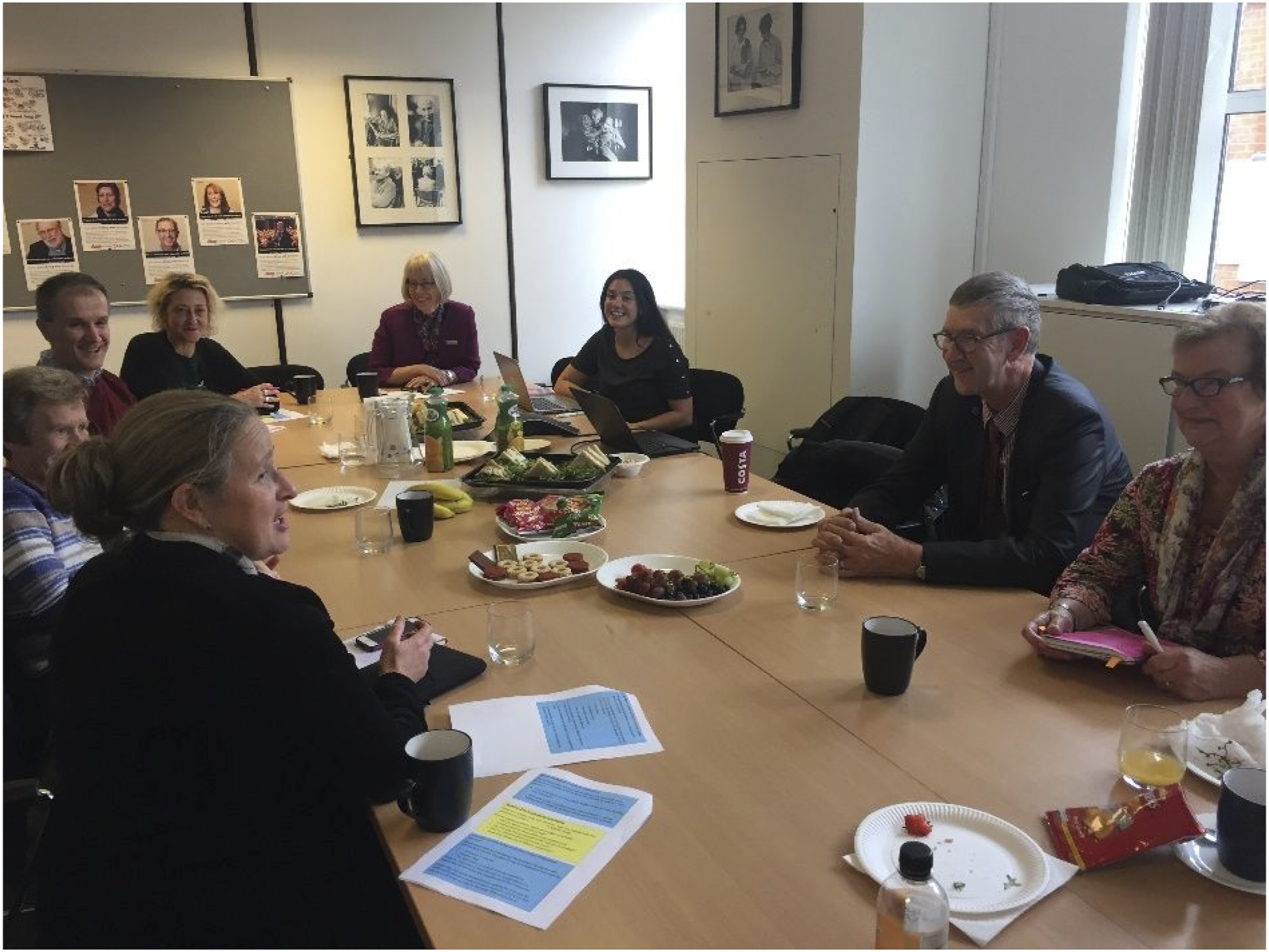
The Forum meetings commenced with the Chair’s Welcome, addressing the practical aspects of each event, a review of the minutes of the previous meeting for accuracy and completion of identified action points. This was usually followed by an overall project progress report from the Principal Investigator and an individual update on progress from each of the two workstreams. There was then a more extensive discussion about an identified aspect of each workstream requiring feedback from the Forum PPI members. The Chair would invite each person with dementia in turn to comment specifically on the item under consideration before project team members entered into the discussion. The supporter did not enter into the discussion as they were there solely to support their loved one but would comment if specifically asked to do so by their relative. An example of one such discussion centred on interview schedules and questionnaires focussing specifically on the merits of paper-based versions and online platforms. This resulted in members with dementia offering to pilot both options and feedback on ease of use.
Through the PPI Forum, members helped to shape the wording of questions, the presentation on both paper-based printouts and online platforms, the recruitment information and flyers and the interview schedules and questionnaires. In addition, there was consideration during meetings about the project logo, website and the development of this journal paper. Throughout each activity, all Forum members were actively encouraged to discuss, ask questions and provide feedback on any aspect of the project under discussion. Meetings closed only after the date and time of the next meeting had been negotiated as being acceptable to all members. Following each meeting, the minutes were checked by the project team for accuracy and circulated to all Forum members prior to the next meeting.
The local Bradford PPI Hub
The Bradford PPI Hub was established at the beginning of the project by the University of Bradford to provide supplementary feedback for the workstream on improving post-diagnostic care. A project team member participated in a meeting of the local Pathways Breaks Support Group to develop rapport with potential study PPI participants. The facilitator of the Pathways group was already known to the University, which enabled the project team member to approach her and ask if he might attend. At the meeting, which was held at a local community venue in the early evening, the facilitator introduced the project team member as a guest and researcher who was seeking support and input for a study. He and all present introduced themselves and then the project team member was able to join in the social aspects of the meeting, as well as having time on the agenda to talk about the study and its objectives. He outlined the potential value of the group’s input as consultants during the different stages of the study and the group were happy to agree. For the focussed discussion, all attenders were provided with ‘I want to speak’ yellow cards for people to raise to indicate an immediate desire to contribute to the discussion while in the ‘moment’. Flyers and leaflets for the survey were subsequently distributed to the group members. The group spent 30 minutes discussing and providing oral feedback on the format, wording, content and message of these materials, along with comments on the study logo. The discussion took place at a slow pace to facilitate involvement of all members. Once all comments had been received and noted, the group members were asked if they would be interested in helping to pilot the project survey across the different modalities that would be used in its delivery (online, on paper or face-to-face). Six members confirmed their interest. This first informal meeting enabled the project team member to establish rapport and trust with the group and further resulted in an open invitation for him to join the monthly meetings if he would like to. Rapport was maintained by the project team member attending four further meetings as an observer, taking part in group social outings and attending other PPI events organised by the University of Bradford in which the Pathways group members participated.
One person with dementia who was a computer user piloted the online version with the help of their carer; a second younger person with dementia, who was not a computer user, completed a paper copy jointly with their carer, and the third person, who was living in a care home, completed the survey through a face-to-face meeting with the support of their carer. For the project team to gain insight into the survey’s design, length, content, wording, appropriateness and efficiency of the three different administration methods these three couples took part in cognitive interviews (Willis, 2004).
The project team member offered to have pre-meetings with these volunteers to ensure they felt at ease. Pre-meetings took place with the two couples that completed the online and paper versions of the survey, as well as with the supporter that took part in the face-to-face meeting with the person for whom they cared. The first two couples took part in the pilot phase during separate meetings which took place on the University campus in a pre-booked quiet room. Refreshments and snacks were available, and participants were informed that a break could be taken at any time. The project team explained the proposed process to the PPI members to ensure a clear understanding and informed consent. The aim was not to gather data, but rather to learn from them whether the questions in the survey made sense and were possible to answer. The PPI members were encouraged to express themselves freely and not worry about the researcher’s feelings as their honest feedback was essential for the study. Permission to record the session was acquired at the outset so as to focus on the process and not have to take notes; then PPI members were given the information sheets which they read and briefly discussed with the researcher to determine whether the content was clear and concise enough.
The participants were informed that while completing the survey, they were to ‘think out loud’, so it would become clear what they were thinking about when answering the questions. They were also informed the researcher might ask some ‘probe’ questions during the process to clarify their responses. As the survey required recall of information, the probe questions allowed the team to acquire a better understanding of whether the PPI members were able to recall the information being sought, the kind of information recalled, strategies they used and potential difficulties they faced. The researcher was also able to find out how participants interpreted the questions and constructed their answers. The probe questions helped the team determine the appropriateness of the survey wording, acceptability of questions and overall length. Each meeting concluded with general feedback and comments about the participants’ experience, difficulties they faced, elements they found useful and suggestions that would help improve their experience.
A similar process was followed during the interview with the third couple which took place in the care home where the person with dementia was residing, on a date and time that was suitable for them. During the process, laminated yellow cards with the major survey questions were used to help the person with dementia actively engage and contribute to the interview.
Findings: Lessons learnt from participating in the PPI forum and hub
The purpose of establishing the Angela Project PPI Forum and Local Hub was to ensure the views of people with a younger onset dementia and carers were integral to the project team’s decision-making. After all, the ultimate aim of the Angela Project was to improve the experience of the diagnostic process and post-diagnostic support for this population group. It was therefore essential that people with a younger onset dementia and carers were acting as representatives on both PPI Groups. Having summarised the approaches to capturing their views, the project team were not only keen to ascertain how incorporating PPI had shaped the overall project design and development but also to ascertain if participating in project PPI meetings has been a positive, beneficial and worthwhile experience for all involved. To that end, the views of the London PPI Forum representatives (KO and TS), Researchers (VS and MOM) and the Principal Investigator (JC) were captured. During the penultimate PPI Forum meeting, all members were invited to email the Co-investigator (JP) who had attended the PPI meetings with their perspectives on how they felt PPI had benefitted the project. Their views are presented as ‘lessons learnt from the PPI representatives’ and ‘lessons learnt by the Project Team’.
Lessons learnt from the PPI representatives
From the outset of the study, the project team were clear that they wanted to work in an ‘authentic partnership’ (Dupuis et al., 2011) with people diagnosed with young onset dementia and informal carers to help shape the overall design of the project. This meant that the PPI representatives were mutually respected as equal stakeholders in the project’s intended outcomes. They were viewed as having expert knowledge of the condition and therefore integral to decision-making throughout the study’s evolution. From the team’s perspective, it was essential that representatives felt welcome, effectively supported, and part of the project team from the beginning. Being part of the YDN, KO was able to support the grant application as it was under-review by the funding body, so he has been involved in a meaningful and active way from the inception of the initial idea as illustrated below:- “Having been there at the “birth of the Angela project” I am delighted to be a part of the PPI for this ground-breaking project. I was thrilled to be able to lead from the Research Network in speaking on its behalf back in March 2016 when the project was tabled for discussion at the Alzheimer’s Society Research panel and board on which I serve”
The project team also wanted to understand the motivation of the PPI representatives to get involved in the research, so they could ensure that individual expectations were addressed as far as possible. The focus for KO’s and TS’s involvement was both experiencing and witnessing the plight of some people with younger person with dementia while facing a challenging journey to a confirmed diagnosis and then being offered limited opportunities for post-diagnostic support. TS describes her own such experience:- “She reflected on her experiences with neurologists and psychiatrics and the differences in how they spoke and dealt with her diagnosis…. She highlighted how when she went in for a diagnosis, she went on her own – having lived alone, it would have been unusual to invite someone to come with her. She asked, how would you capture the views of people who live alone?” [TS]
Then KO explains the motivation underlying his own desire to support younger person with dementia research projects, such as the Angela Project:- “Although I sit on many Project and Local Advisory Groups and Steering Groups, for me none have such importance compared to the Angela Project. For far too long those with Young Onset Dementia have had a very poor deal from the diagnosis service and an appalling lack of suitable post diagnostic support. This project seeks to make a significant contribution towards addressing this” [KO]
Lessons learnt by the project team
From the outset of the project, the project team have recognised the importance of consulting with young people with dementia in order to ensure that their views have directed the course of the research; to that end, the team have considered the work of the PPI meetings to have been critical to shaping the direction of the study. From the initial meetings, the members have assisted with designing the project logo and website; the production of information leaflets and participant recruitment posters and flyers:- “From the simple aspects of our work, such as the project logo, to significantly more complicated ones, such as the design and efficiency of the data collection instruments, the members’ views have provided an internal continuity” (VS).
The project has evolved considerably from inception as it has been shaped by the PPI group feedback. Both the research team and PPI members have been ‘incredibly open-minded’ about the suitability of certain aspects of the study design, discussing them in a constructive and supportive atmosphere. The members have significantly influenced key strategic decisions that the study team have taken, in particular, shaping the way that data has been collected. They have advised on the inclusion of key questions in the surveys and questionnaires, identified neglected areas that the team had not considered and suggested how to make language more accessible for participants when developing questionnaires:- “The PPI members also consulted with us on the wording of questions, and situations where we had used technical words (which needed to be simplified)” (MOM).
The members have also provided essential advice on how material should be delivered to study participants. For example, the project team enquired about the most suitable method for sending questionnaires to people with dementia and their supporters to complete. Erroneously, the assumption was made that the preferred format would be a hard copy printed version, as opposed to using an online platform:- “Our PPI members looked at both versions of this questionnaire, and to our surprise, the PPI members found the online version significantly easier and more accessible - this then made us aware that the online version may be the preferred method when it comes to data collection, as well as the importance of having the two different options available” (MOM).
As well as being extremely influential in helping the study team to create project materials, working closely with the PPI members has also encouraged individual research team members to reflect on their own personal approaches to public involvement in research. Placing the needs of the person with dementia and their carers at the heart of the study has ensured that its focus remains person-centred. For one researcher, the members views have not only ‘formed the basis of the solid methodological foundations of the study but have also made it consistent with the human values of our research team and the person-centred approach on which the team’s work has been built’ (VS).
The importance of inclusivity has also been a strong message which has resonated throughout the Angela study; and establishing the PPI Forum and Hub has ensured that people with dementia and carers have had a strong voice throughout all stages of the study’s design and development. From a team perspective, attending meetings has afforded them with opportunities to check out ideas and suggestions. For the Study team, ‘a dementia study is stronger if people with dementia are involved in all aspects of the design’. Active and meaningful consultation, via the Forum and Hub meetings, ensures that the purpose and design of the study has been informed by the suggestions and recommendations of those who are central to its purpose. As one researcher explains:- “I leave each meeting feeling assured, and that the project is stronger after each PPI meeting” (MOM).
The value of involving people with dementia and carers in the Angela Project via the PPI Forum and Hub cannot be over-stated. For the Project team, they have found it to be a ‘rewarding’ experience and have formed some ‘good relationships’. The Forum discussions have been both ‘lively and interesting’, and members have been ‘enthusiastic in their continued support’ throughout the data collection phases. As the study drew to a close, the PPI members continued to show ‘a deep interest’ in the emerging findings. Having completed ‘Angela’, the project team are now able to reflect back on how ‘pivotal’ the PPI contribution had been on the robustness and direction of the study. As one of the researchers observed:- “I knew PPI would be informative in the design of the study, but I did not realise, how pivotal our PPI group would be to the project. They have been our helping hand, and it’s been important to feedback to our PPI members as our project continues to mature” [JC].
Discussion
As demonstrated in the Dementia Declaration (2018), people with dementia and carers want to be actively involved in research that affects them; and given the right support in a constructive environment, they are more than capable of developing their own projects (Schack Thoft et al., 2018), let alone shaping the design of those developed by research teams (Dupuis et al., 2011). In designing the Angela Project, the inclusion of PPI Forums was never in question. The Project Team had always embraced the notion that people with a young onset dementia would positively add to the Project team by contributing valuable insights, however impartial (McCoy et al. (2019), into their own condition and care experiences. Within the team, there was a unanimous recognition that each PPI member’s contribution would provide a unique lived experience, demonstrating the complexity of each person’s dementia diagnosis (Alzheimer’s Society, 2021). With this caveat in mind, the team also felt the PPI representatives’ expert knowledge, and understanding of the research process would be extremely influential in helping to make decisions about the overall design of the project, which indeed proved to be the case. After all, improving the journey to diagnosis and post-diagnostic experiences for all younger people with dementia and carers was at the heart of the project.
From the outset of any research, it is essential that the study objectives are communicated clearly to the PPI representatives in order to maximise their engagement (Dijk et al., 2020). It is also essential that all members understand the extent of the potential commitment that might be required, and what the project team’s expectations are in relation to the nature of their involvement. In establishing the PPI Forum and Hub for the Angela Project, the focus of the PPI representatives was about ensuring the creation of a robust study design that was truly open-minded and person-centred. It was essential that the Forums were established very early in the process to highlight the significance of the PPI representatives’ views in shaping the design and development of the study protocol (Armstrong et al., 2013). The team wanted to understand and learn directly from Forum members so that the whole project reflected and built upon their experiences, motivations and expectations for participating. Pickett and Murray (2018) found that those living with dementia have frequently got involved with projects they feel have a worthy cause. In the Angela Project, this was illustrated by KO’s motivation to participate clearly stemming from his personal desire to help improve the diagnostic and post-diagnostic experiences of people similar to himself with a young onset dementia.
To maximise the positive input that PPI representatives can bring to any project, care needs to be taken when setting up the mechanisms of consultation, including the financial implications and the impact on their physical and emotional wellbeing (Dijk et al., 2020). The Angela Project consulted with their potential members from the outset of the project to ascertain the suitability of the venue, preferred time of day, frequency and duration of meetings, payment of expenses and nutritional requirements. It was decided that the meeting needed to be accessible in terms of venue, and relatively inexpensive to attend, hence the establishment of both a Northern Hub and Southern PPI Forum. A minimum of two people should be invited to participate in the Forum to provide peer support to each other. In addition, project teams should always consider issues of ongoing consent and build into their planning a requirement to regularly review member’s capacity and engagement levels to ensure no concerns arise. Daly et al. (2017) suggest that ongoing participation for some members could be problematic due to increasing memory loss; and levels of cognitive decline during the course of a 3 year project can be significant. Although this was not the case within the time frame of the Angela Project; the team did undertake informal reviews of the PPI members ongoing wellbeing during the course of the project. While we did not need to change the PPI representatives on these Forums, the Project Team were always open to recruiting new representatives should the need have arisen. The project budget was sufficient to adequately reimburse members for travel, and the meetings were well organised, co-ordinated and communicated in advance of planned meeting dates. Our PPI representatives preferred communication by email, which they could refer back to for the details of the meetings. Previous minutes, agendas and supportive documentation was sent to members at least a week in advance of the meeting, allowing adequate time for them to read and assimilate the information.
The format of the meetings should be entirely person-centred and fully inclusive. Therefore, they need to be organised at a time of day to suite the PPI members, that is, late morning to early afternoon (11 a.m.–3 p.m.); and should be planned around adequate refreshments (including lunch) and sufficient breaks to support the members’ ability to concentrate. In addition, consideration should be given to communication methods to enable all group members to participate as fully as possible. Armstrong et al. (2013) advocate that good communication creates a supportive environment in which members feel confident enough to share and feel that their contributions are truly valued. The Bradford Group employed two strategies, organising pre-meetings with individuals where appropriate; and issuing members with ‘I want to speak’ yellow cards to indicate an immediate desire to contribute to the discussion while in the ‘moment’. The London Group made use of pre-reading prior to each meeting, and considerate listening, and extensive pauses, as required during the meetings, to support individual contributions to discussions and maximise participation. In addition, the Forum meetings always began with a brief project update led by the Principal Investigator, supported by a Co-Investigator and the two Research Assistants. This ensured that the information provided demonstrated how PPI feedback had influenced overall progress, participant recruitment, data capture and analysis, and dissemination activities, including being supported to lead on a journal publication (Oliver et al., 2019). The Chair also ensured that the questions, views, and feedback of members were addressed during every agenda item or responded to ‘in the moment’ as queries arose.
The extent of KO’s participation, and that of his fellow members, on the PPI Forum and local Hub clearly demonstrated that given the right support in a constructive environment, it is possible to undertake a sustained period of PPI consultation in support of the design, development and implementation of a national project investigating the diagnostic processes and post-diagnostic support for people with young onset dementia. From the perspective of the PPI members, KO’s remarks about the potential importance of the Angela Project to challenge current provision and processes for people with a younger person with dementia epitomises the significance they attribute to being involved in the project. From the perspective of the Angela Project Team, there seems to be no doubt that ensuring that public and patient involvement is an integral aspect of the study has meant that the ‘project now has a richer granularity which could not have been achieved from a researcher-only perspective’ (JC). Clearly, both the members with dementia and carers and the study team have generally had a very positive experience and appear to have grown together in a way that they are now keen to share with the wider dementia research community.
Conclusion
The PPI forums have been very influential in terms of the work our team has conducted on diagnostic processes and post-diagnostic care and support for people with young onset dementia. The active and meaningful participation of the PPI Forum and Hub members has clearly demonstrated how the person-centred approach can place the needs, desires and aspirations of the person with dementia and carers at the heart of health and social care delivery and research in the field. Their active input has increased our understanding of how research activities should take place when working with this group. Lessons learned for other researchers included securing sufficient funding to ensure the activities can take place and members are properly reimbursed for their involvement; ensuring the meetings are held in an accessible venue, at a suitable time of day, and with adequate refreshments and breaks; documentation is distributed well in advance of the meeting in both an electronic and hard copy format; there is at least two PPI representatives on the Group to provide mutual support; and the wellbeing of the members is informally monitored and reviewed throughout the process. It justifies the guidelines from the National Dementia Declaration for England (DAA, 2018) and the Prime Minister’s Challenge (DoH, 2012) not only from an ethical point of view, but from a practical one as well since the contribution and expertise of our PPI Forum members have improved the Angela Project in ways that would not have been possible without them.
Footnotes
Declaration of conflicting interests
The author(s) declared no potential conflicts of interest with respect to the research, authorship, and/or publication of this article.
Funding
The author(s) disclosed receipt of the following financial support for the research, authorship, and/or publication of this article: This work was supported by the The Alzheimer's Society (AS-PG-15b-034).
