




Abstract
The ways in which friends behave can greatly influence the experience of living with dementia. For example, previous research has highlighted the negative implications that dwindling friendships have on one’s leisure engagement after a diagnosis of dementia. In this study, we share findings from a study that highlights the interplay between leisure, friendship, and dementia to demonstrate the complementary relationship that can exist. Specifically, we describe ways friendship can be a bridge to maintaining leisure engagement and how leisure can, in turn, support the maintenance of friendships for individuals with dementia. Data were gathered through individual, dyad, and group interviews conducted with individuals with dementia and their friends and family. Our findings have implications for friends of individuals with dementia who may be searching for ways to support the continuation of mutually enjoyable leisure experiences. Findings also have implications for the ways leisure providers can more fully attend to the relational needs of individuals with dementia in order to help support their continued friendships.
Demographic trends indicate that rates of dementia are increasing worldwide, and it is projected that 82 million people will be living with dementia by 2030 (World Health Organization, 2020). A dementia diagnosis can put individuals at an increased risk of social isolation and loneliness (de Medeiros & Sabat, 2013). With growing recognition of the damaging health effects associated with social isolation and loneliness, policy attention has focused on initiatives to alleviate these pressing social issues (Alliance for Healthier Communities, 2020). Despite the association, social isolation and loneliness do not have to characterize living with dementia, particularly if individuals with dementia are able to maintain valued friendships and enjoy meaningful experiences. Indeed, Canada’s national dementia strategy focuses on enhancing quality of life of individuals with dementia through the creation of dementia inclusive communities, where the participation and contribution of individuals with dementia is supported and valued (Public Health Agency of Canada, 2019). Spending time with friends and engaging in meaningful experiences can support participation and contribution.
Research has demonstrated a link between a supportive social network and the well-being of individuals with dementia (MacRae, 2011; Phinney et al., 2007). Harris (2011) argued that the maintenance of long-term friendships is instrumental for helping individuals with dementia continue to live well after their diagnosis. Supportive relationships have the potential to reduce some of the negative impacts of dementia (MacRae, 2011). However, since dementia often affects a person’s ability to interact and communicate, this type of illness can test a friendship (Spencer & Pahl, 2006). Certain actions taken by individuals with dementia as well as their friends also make friendships difficult to sustain. For example, individuals with dementia may withdraw from social situations in order to avoid negative reactions from others or limit social interactions they find increasingly challenging (Vikstrom et al., 2008). Friends also may withdraw from a person with dementia because they are uncertain about how to act, they feel uncomfortable, or they find it too difficult to see the changes (e.g., loss of cognition and communication challenges) that are taking place within their friend (Harris, 2013; Sabat & Lee, 2012).
As a social phenomenon often organized around friends and family, leisure can provide the basis for social support networks (Kleiber et al., 2002). Often the need for companionship and friendship drives people to participate in shared leisure activities (Iso-Ahola & Park, 1996). While social leisure can become more challenging after a diagnosis of dementia (Vikstrom et al., 2008), social support derived from engaging in leisure with friends has important implications for well-being (Iso-Ahola & Park, 1996). Continued leisure engagement also helps individuals with dementia live life to the fullest and derives meaning from their leisure experiences (Dupuis et al., 2012; Genoe & Dupuis, 2011).
The purpose of this study is to describe ways friendship can help support continued leisure engagement, and how shared leisure experiences can, in turn, provide the basis for continued friendships for individuals with dementia. We consider this a timely topic considering that supportive friendships and meaningful leisure engagement can help alleviate social isolation and loneliness—two growing societal concerns that if left unchecked—are likely to pose serious health and quality of life implications for the increasing number of individuals affected by dementia. Given the concerns related to quality of life for individuals with dementia, the dementia strategy for Canada highlights dementia inclusive communities as a political priority (Public Health Agency of Canada, 2019). Within a dementia inclusive community, individuals with dementia would receive encouragement and support to participate in community life—and friendship and leisure would be integral components of such participation.
Meanings and experiences of leisure for individuals with dementia
Research has been helpful in highlighting the complexity associated with leisure experiences within the context of dementia. Leisure can be both challenging and stressful as well as meaningful and identity-affirming for individuals with dementia. Leisure that tends to be most challenging for individuals with dementia often requires cognitive and social resources. Di Lauro et al. (2017), for example, found that after a diagnosis of dementia, individuals are less likely to engage in leisure activities with their spouses, especially if activities were cognitively demanding or required a high level of social interaction. Genoe and Dupuis (2014) also found that individuals with dementia tend to withdraw from leisure activities when they become too cognitively challenging.
Innes et al. (2016) explained that while many people experience certain types of leisure, such as social outings and holidays, as a time for relaxation and bonding with others, individuals with dementia and their care partners often find these types of leisure pastimes to be difficult to navigate. These leisure activities become difficult when individuals lack opportunity, appropriate accommodation, and available support services. As Innes et al. (2016) describe, “The leisure worlds of people with dementia can be reduced dramatically as coping with the condition can see previously active individuals’ time–space prisms of leisure…compressed to narrowly prescribed service specific out-of-home domains” (p. 3).
Vikstrom et al. (2008) found that individuals with dementia are more likely to withdraw from social leisure when they are not able to fulfill their previous roles, such as a dinner party host, in the way they had become accustomed. Vikstrom et al.’s (2008) study highlighted some of the ways that friends also make social leisure experiences more difficult for individuals with dementia to sustain. Specifically, they reported one of the main factors affecting social engagement opportunities for individuals with dementia is having friends who stop calling or visiting when they learn about their dementia diagnosis.
Despite the challenges individuals with dementia experience within the realm of leisure, meaningful leisure experiences can be life enhancing by enabling individuals with dementia to experience new things, use their remaining abilities, and engage in acts of self-expression (Dupuis et al., 2012; Fortune & McKeown, 2016; Genoe & Dupuis, 2011; Phinney et al., 2007). Meaningful and preferred leisure can provide stimulation, normalize the experience of living with dementia, and lessen anxiety experienced by the person with dementia and their family care partner (Menne et al., 2012). By enabling individuals with dementia to exercise choice and control in their lives, leisure experiences provide opportunities for individuals to resist loss of autonomy and independence that others may try to impose on them (Genoe, 2010).
Genoe and Dupuis (2011) observed that leisure in the lives of individuals with dementia served as an important space for upholding valued identities and creating new aspects of the self. Individuals with dementia who participated in their study described leisure as an important way to maintain meaningful engagement in their lives and in communities. Phinney et al. (2007) discovered that meaningful activities for individuals with dementia are those that provide a sense of enjoyment and pleasure, connection and belonging, and personal identity. Dupuis et al. (2012) also found that meaningful leisure experiences provide individuals with dementia with opportunities for self-expression, social connection, fun and playfulness, contributing, breaking from routine, finding balance, and growing and developing.
When individuals with dementia have opportunities to inform and direct their own leisure experiences, they are better able to ensure these experiences are reflective of their strengths and limitations (Fortune & McKeown, 2016). Often these experiences are social in nature and consist of mutual social support among people who are also on the dementia journey. Phinney and Moody (2011) also emphasize the importance of creating an environment for individuals with dementia to feel accepted and understood, especially by others who are going through the same thing. They highlight the importance of providing opportunities for individuals with dementia to contribute in ways that are meaningful to them. Han et al. (2016) stress the importance of knowing and understanding an individual with dementia as a unique person who has rich life experience, interests, and strengths. They also stress the value of incorporating this knowledge into the planning of leisure experiences.
Despite growing research that is advancing our knowledge about leisure in the lives of individuals with dementia, we are seeing little research highlighting the interplay between leisure, friendship, and dementia. Research that does exist suggests friends are not always supportive of continued leisure engagement after a diagnosis of dementia (e.g., Vikstrom et al., 2008). Thus, this study aims to fill this gap by shedding light on the ways friendship can be a bridge to maintaining leisure engagement and how leisure can in turn support the maintenance of friendships for individuals with dementia. Before we describe the findings of our research, we discuss the research context and process.
Research context and process
The purpose of our study was to explore the meaning of long-standing friendships and learn about the ways in which these friends maintain their connections as they negotiate life with dementia together. Our study was informed by Carstenson’s (1993) socioemotional selectivity (SES) theory, which suggests that as people age or face significant illness, with awareness that there is limited time remaining in life, they prefer experiences and interactions with familiar people (e.g., family members and long-standing friendships). As a theory guiding research on friendship in later life, SES helps to explain the tendency for individuals, despite changes in health, to prioritize friendships characterized by meaningful interactions (Blieszner et al., 2019).
We used hermeneutic phenomenology to guide our exploration. The aim of hermeneutic phenomenology is to gain deep understanding of “the nature and meaning of our everyday experiences” (van Manen, 1997, p. 9). Thus, this approach was useful for examining how individuals make sense of lived experience in terms of “how they perceive it, describe it, feel about it, judge it, remember it, make sense of it, and talk about it with others” (Patton, 2002, p. 104).
After receiving ethics clearance from our university research ethics boards, we began to contact community-based organizations that provide programs and services for individuals with dementia as well as assisted living and long-term care (LTC) homes. We shared information about our study and explained that we were interested in speaking with individuals with dementia and their friends. As one aspect of our study involved gaining an understanding of how friendships change after a diagnosis of dementia, we sought participants who knew each other for 5 years or more prior to a diagnosis. Staff at the various organizations we contacted agreed to share the study information with potential participants. We also circulated information about the study via our social networks. We invited potential participants to contact us by telephone or email to learn more about the study. In some cases, family members of individuals with dementia contacted us to express interest in the study but then explained that their family members did not meet the criteria because they no longer maintained contact with the friends they had prior to their diagnosis. If, after hearing more detail about the study, individuals indicated that they met the criteria and were interested to participate, we scheduled interviews. In a few cases, individuals who wished to speak about friendships that developed since their diagnosis contacted us, and we welcomed this perspective as well.
We initially set out to conduct dyadic interviews with people living with dementia and their friends together. However, we soon realized that we would need to be flexible in order to accommodate participants’ preferred ways of participating. Some participants wanted to conduct the interview alone, while others opted to participate in a group interview involving multiple friends at once. Several family members also contacted us and wanted to participate. Either family members wanted to participate alongside a person with dementia or they believed it would be stressful for their family member with dementia to participate and wanted to share information with us about our topic of study.
Participants.
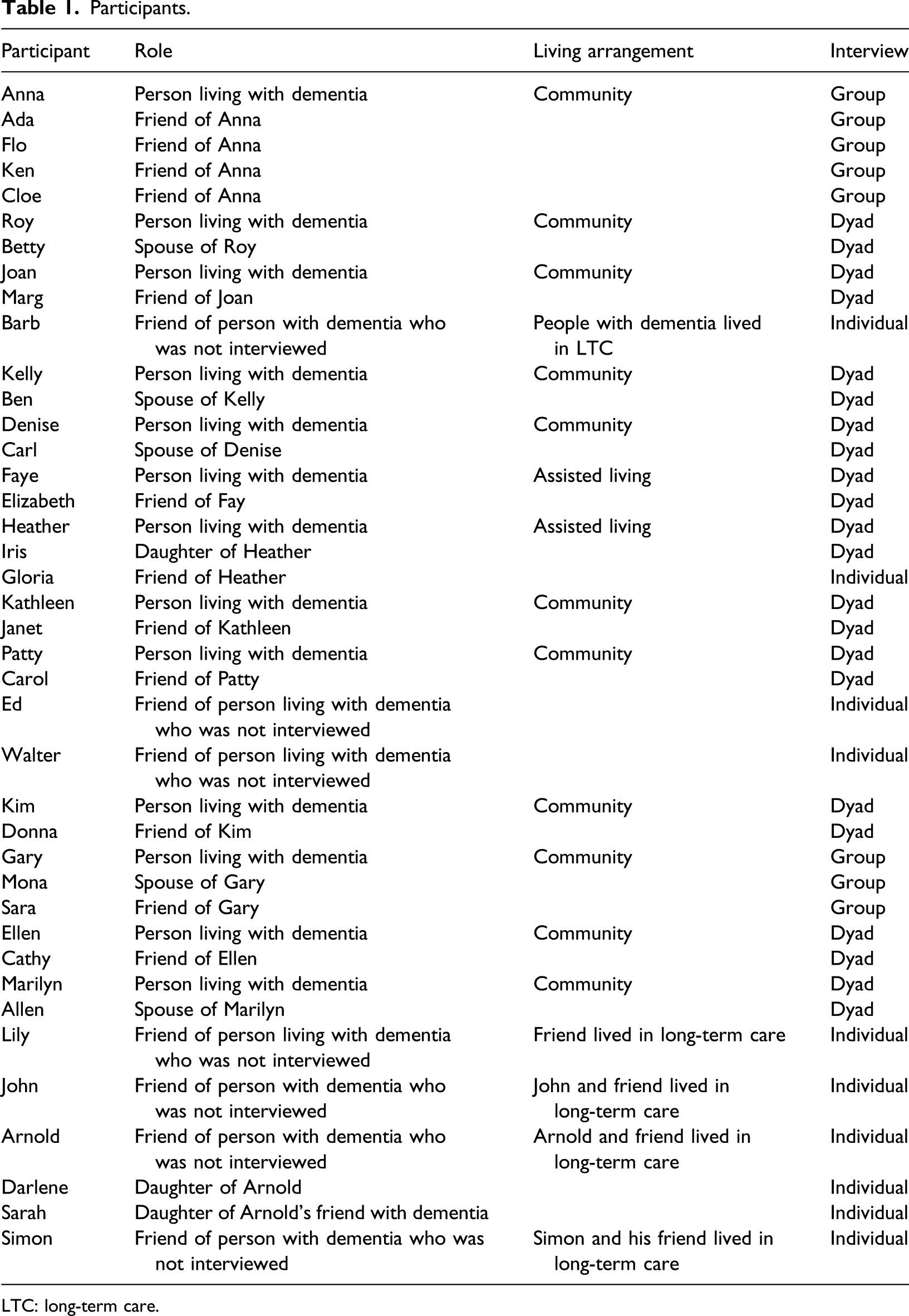
LTC: long-term care.
Interviews were conversational in nature and focused on the nature of the friendship and its meaning, as well as changes in friendships since a diagnosis of dementia. Interviews ranged in length from 30 minutes to 2 hours. Sample interview questions include: How did your friendship begin? How have you usually spent time together? What are some things you most enjoyed doing together? Please describe changes to your friendship since the diagnosis of dementia. What do you consider challenges to maintaining your friendship? How are you addressing these challenges? Can you identify ways that your leisure activities/pastimes have helped to strengthen your relationship?
We used thematic analysis (Braun & Clarke, 2006) to analyze the interviews. We began our analysis by reading each interview transcript several times in order to get a sense of the data as a whole. We then followed a process of systematic data coding by identifying aspects of data that were relevant to developing a better understanding of the meaning of long-standing friendships, and the ways in which individuals maintain their friendship after a diagnosis of dementia together. Next, we searched for themes by collating codes into groups and subgroups and identified patterns of meaning (themes). We reviewed the themes and their subthemes and considered how they contributed to the whole. After we identified themes, we worked together to examine and interpret our themes and come to consensus about what each theme reflected.
We have reported on themes related to strategies used to sustain friendships elsewhere (authors, in review), so in this paper, we are reporting specifically on themes related to participants’ experiences of leisure and friendship. First, we describe the strategies participants adopted to maintain leisure engagement with their friends who have dementia. Second, we discuss the ways shared leisure experiences were instrumental for helping to maintain friendship after a dementia diagnosis.
Findings: The role of leisure within the context of friendship and dementia
As we analyzed the data, we became increasingly aware of the centrality of leisure in participants’ shared experiences with their friends. They highlighted a number of strategies they used to continue to engage in leisure with friends after a dementia diagnosis. They also described ways shared leisure interests helped to sustain their friendships. We identified two main themes that capture this symbiotic relationship: adopting strategies to maintain leisure engagement and drawing on shared leisure to maintain friendship.
Adopting strategies to maintain leisure engagement
Both individuals with dementia and their friends recognized the value in maintaining leisure engagement after a diagnosis. They understood that there would be changes in leisure participation and identified different strategies that would enable them to continue to engage in shared leisure experiences. These strategies involved focusing on their friend with dementia, ensuring comfort and familiarity, providing direction, and drawing on the support of a group.
Focusing on my friend
Friends of individuals with dementia understood that if leisure experiences were personally meaningful and enjoyable, their friends would derive much more pleasure from the experience. Conversely, they knew if leisure experiences did not incorporate their friends’ interests, they would be inconsequential and perhaps even cause distress. As Cloe explained, focusing on her friend meant taking notice of what piqued her friend’s interest: “I notice sometimes when we go to the museum to see something….if she likes something, she will keep repeating, “That was good. That was lovely.” If she doesn’t like it, it’s already gone. She’s swept it already.”
Flo stressed the need for her friend to be able to have choice even if it meant that it would take a little longer to complete a leisure activity: We sit together; this is when we do our colouring. I let her choose the page that she wants. It takes a lot of time because she goes through it and through. She forgets why she’s doing that and we go again, and we stop like three, five times just going through the pages, until we choose one and after it’s the colour. So we need to go through all the colours again and again, and say, “Blue. Okay.” It’s fun.
Acknowledging that her friend requires more attention since her diagnosis of dementia, Barb spoke about changing the approach she took with her friend in order to provide the additional attention she believed her friend needed: I think activities have to be focused on her. She went through a period where if we were at supper in a restaurant and there was somebody else there, if the attention was not directed to her, she would get angry and you could see it. I take it that if you have that disease, you lose a lot of your confidence so you need affirmation; you need attention. So for the most part, what I do is basically direct it [attention] toward her.
For Carol, focusing on her friend meant prioritizing the time they spend together. She spoke of wanting to live in the moment and enjoy doing things together to avoid having regrets about missed opportunities: I want to make sure there are certain things we do together now. Like, just don’t put it off ’cause I don’t want to look down the road in five years and say, “Shit, I wish I’d done that. I wish I hadn’t sat on that”. Or we didn’t say, “Oh, we’ll do that next year…”
Ensuring comfort and familiarity
Another strategy adopted by friends of individuals with dementia was ensuring their friends spent time in settings that offered an element of familiarity and enabled them to experience the comfort of being in surroundings with which they were accustomed. Barb, for example, spoke about dining out at the same restaurant each time she went to dinner with her friend. As she explained, the restaurant was familiar and staff treated her friend well: Now, somebody had said to me, “You always go to [name of restaurant] to eat. Why don’t you try something different?” The thing is she knows the waitresses and they all make a fuss over her and she always gets a hug when she goes in….I think it’s important.
Walter spoke about how a sense of comfort and familiarity can also come from engaging in familiar pastimes. He explained that while his friend, Jim, who has dementia, may no longer recognize the group of men who comprise his circle of friends, Jim still enjoys how they spend time together because it is something with which he is accustomed: I don’t think Jim really realizes this is going on every week…He’s basically like, “Yeah, I was home and these guys came around and picked me up and took me to the pub.” But he really enjoys it, no doubt about it. That’s the kind of thing he always would have enjoyed. He always enjoyed going out for a beer with some of the boys.
Darlene spoke about her father’s friendship with Al, who had dementia. Both men lived on different units in the same LTC home. Darlene’s comments illustrate the value she noted in establishing a routine for visits so both friends could experience the comfort of continuing their regular interaction: They would sit together and they’d be side by side the whole time. They’d have their little chit chats and go for coffee after. And when I was there, I’d try to get Dad over at least once a day to see Al or Al would come over to our unit….That was important for both of them to see each other.
Providing direction
Some friends of individuals with dementia with whom we spoke described changes in their approach when it came to engaging in shared leisure with their friend. Specifically, they talked about taking a more proactive approach to ensuring their friend would participate in a valued leisure activity by providing direction when needed. Carol, for example, spoke about how her approach changed when she realized that her friend did not always remember they had previously made plans: I realized she didn’t always remember. So that’s it. The one change is I don’t wait for her. ….I don’t say to her, “Call me if you want to do this.” I say, “Do you want to do this? Put it in your calendar.” And I’m probably more directive that way…and I might give her more of a heads-up about something….I wouldn’t have thought of that before.
Lily also spoke about how her friend, who lived in the same LTC home she did, needed additional direction and encouragement in order to continue participating in the leisure activities they always enjoyed together: In the summertime, we used to go for walks down the street. I’d go down to her room and I’d say, “Let’s go for a walk down the street.” And she didn’t say no, but she says, “Oh I’m not dressed.” I said, “Get your stuff on. I’ll wait for you out here.” Then she would do that.
Simon similarly described how his approach with his friend became a little more directive when he realized she was becoming tentative about participating in some of their preferred leisure programs taking place in their LTC home: “I’m going down to watch the show. Do you want to come?” And she’d say, “What is it?” And I’d say, “People are singing and that.” She didn’t say no but she didn’t answer. And I said, “Come on!” So I’d get her to go down with me.
Drawing on the support of a group
For some participants, doing things in groups provided an additional layer of comfort because there would be more people available for support if needed. Ed described an ongoing relationship between former work colleagues who continued to support one of their colleagues who has dementia and include them in their regular get-togethers. As Ed explained, the group dynamic worked well for continuing to include his friend with dementia: Because it’s a group activity, it’s great for everybody….I’d like to stress this is not a one-to-one situation. I don’t know at what level the friendship occurred with the other members in the group, but most of them, I would say, it was a relationship that happened because of work together. We enjoy each other’s company as a group activity.
Mona described a social group to which she belongs comprised of individuals with dementia and their spouses. She conveyed her appreciation for the ability of group members to look out for one another during their social engagements. As she stated, “We go on trips, you are with other people, and we watch each other’s backs.” Sara, who is a member of the same group, spoke about her enjoyment within the group and particularly appreciated how the group put her at ease because of its lack of judgment: Well, it [the social group] makes us happy and it gives us a reason to be together. And the company, we enjoy, you know, all of us. We’re a group where we kind of enjoy everyone. We don’t study. We don’t judge. We take each other as we are.
Gary, who has dementia, described a group situation where he gets together with other people who have dementia. He similarly spoke about the ease that comes from being among friends who also have dementia: But you need to go out with your friends. You need to be social. And if you make friends who have dementia, I think that’s really important because then you have a really good time because you just let go. My philosophy, who cares? If they do something, who cares? However, friendship is so important, it’s really important.
The theme, adopting strategies to maintain leisure engagement, highlights the various strategies participants are using to ensure the continuance of leisure engagement after a diagnosis of dementia. Our next theme, drawing on shared leisure to maintain friendship, speaks to the role leisure can play in helping friends to stay connected and enjoy the time they spend together.
Drawing on shared leisure to maintain friendship
Participants in this study described many ways that leisure was an integral component of their friendships. This sentiment was evident when they reminisced about spending time together prior to the dementia diagnosis and when they described how they are continuing to spend time together now.
Recognizing leisure as the basis for connection
Recounting how they spent time together throughout their friendship, participants often pointed to a mutual leisure interest. Ed, for example, described how he and his friend shared various common interests: “We played cards at his house all the time. Otherwise, in common it was, well, we went to various parties, various peoples’ houses, dances, Christmas dances, and things like that.” Marg also pointed to a common leisure interest as the basis for her friendship. She stated, “I think our friendship started because of a mutual interest in art so there is that comfort there.” Roy, who had dementia, described fond memories he had of spending time together with his friend over the years they have been friends: “We used to love going out on Sunday afternoons just for a drive and stop in somewhere and have a coffee or lunch or something….and just talking to each other.” Betty also recounted how she and her husband enjoyed the time they spent with their friends: “Jeff has been such a good friend to us over the years….we did a lot of things with Jeff and his wife….We went to movies. We went out to eat.”
In addition to shared leisure interests being the basis for connection and time spent together, leisure was also instrumental for helping friendships to endure despite the changes and challenges dementia brought about.
Continuing to do things that both enjoy
It was evident in our conversations with participants that time spent together with their friends often revolved around the things they most enjoyed, which in turn made the friendship easy to maintain. Sara, for example, explained that the leisure interests she has always shared with her friend carried on after his diagnosis of dementia: “Gary and I always have had a bond with enjoying art, literature, poetry, and movies. This is what we still talk about.” Donna described enjoying the time she spent with her friend who has dementia and admired her friend’s tenacity for ensuring they maintained their leisure routine: “I enjoy Karen….we go walking before Tai Chi and she’s usually the one who goes, “OK, we’re going!”” Gloria recounted how reading is a mutually enjoyable activity for both her and her friend: She likes books, and I do, but she can’t read. She’s blind. So I read to her, and I enjoy it and she enjoys it. We just always have to find a time when we’re both available and neither of us would nap or something.
Janet described how a mutually enjoyable pastime helps her to spend time with her friend on a regular basis: “We go to the symphony together…We have got symphony tickets so we go to that all the time.” Similarly, Lily spoke about how shared leisure was the basis for the time she spent together with her friend: “We listen to his opera CDs together or read passages of prose or literature together.”
Barb, who regularly visits her friend who lives in a LTC home, described how these visits enable her to not only spend some quality time with her friend, but also enjoy some of the leisure activities provided within the home: I like coming on Wednesday. It’s kind of a selfish thing. On Wednesday afternoon, there is an activity where they have music, they have very good people coming in and playing and singing, and then there’s an art activity. Then usually we’ll go back to her room and we’ll have our Oh Henry break. You can imagine what that is. And then we will sing.
When Barb spoke about some of the other ways she and her friend spend time together, a shared interest was at the heart of it: “This is a fantastic park. Judy loves dogs and I love dogs. And we will often see dogs.”
Marg’s comments are illustrative of how shared leisure can make friendship easy to maintain despite the challenges dementia may impose: Our friendship comes easy because we both enjoy art, we go to the movies, the theatre, we both like books and playing Scrabble. So in that sense we don’t have to work at it. We can always pick up where we left off and there is a continuity there without even thinking about it.
Discussion
As the findings of this study suggest, leisure continues to play a central role in individuals’ lives after a diagnosis of dementia. Friends play an instrumental role in helping to address some of the challenges inherent in leisure participation so individuals can experience and enjoy leisure together. Participants in this study highlighted a number of different strategies used to ensure continued leisure engagement. Regardless of the strategy used, the underlying message is that continued leisure engagement requires collaborative efforts. It is unreasonable to expect individuals with dementia to be solely responsible for addressing all of the challenges they may experience concerning leisure engagement. Friends in this study realized the need for support and took steps to ensure leisure experiences were personally meaningful, comfortable, and familiar. They also created a reassuring environment by providing direction and relying on the support of a group. Individuals with dementia also recognized the value of shared leisure experiences and took the initiative to continue to participate in enjoyable leisure pastimes with their friends.
SES theory is helpful for explaining our findings. In particular, this theory advances the idea that older adults prefer smaller social networks comprised of familiar people who provide emotional closeness (Cartenson, 1993; Carstensen et al., 1999). During our study, we heard how familiarity was an important aspect of relationships and leisure experiences. SES theory holds that companionship and social support become increasingly important motivators for leisure participation later in life (Burnett-Wolle & Godbey, 2007). The importance of companionship and social support was evident in our study when participants spoke about the comfort and joy they derive from being part of a social group. SES theory helps explain how older adults may adapt to changing circumstances by focusing on their most important relationships and prioritizing emotionally meaningful exchanges (Blieszner et al., 2019). For example, some participants in our study spoke about prioritizing time spent together and ensuring they do things they most enjoy doing together now since the future can be uncertain.
Unmet social needs can lead to social isolation and loneliness later in life, particularly for older adults with illnesses such as dementia who are prone to being misunderstood and stigmatized (de Medeiros & Sabat, 2013). However, maintaining strong ties to friends can help older adults retain a sense of meaning (Blieszner et al., 2019). Realizing that friends of individuals with dementia may be inclined to distance themselves after the diagnosis (Vikstrom et al., 2008), it was encouraging to speak to friends who stayed committed to the friendship despite the challenges and changes brought about by dementia. When individuals with dementia receive support, cooperation, and encouragement from their relationships and social interactions, it can help them create meaning in their life and sustain their identities (MacRae, 2011). Our findings showed that friends of individuals with dementia also derive meaning from engaging in mutually enjoyable experiences.
Harris (2011) demonstrated ways friendships add richness, a sense of connectedness, and comfort to the lives of individuals with dementia. She found friendships were most likely to continue when friends focused on remaining strengths, worked around limitations, and treated the person with dementia as a ‘whole’ person rather than focusing only on their illness. Lasting friendships were also those that were mutually rewarding for both friends. These friendship traits were present in our study as participants focused on their friend with dementia and offered the support needed for their continued leisure engagement. While these traits are likely to be characteristic of close-knit and committed friendships that can withstand challenges, we also observed that friendships get an added boost when friends continue to find ways to have fun together. It is undoubtedly more difficult for friendships to endure if friends experience time spent together as obligation. As our findings suggest, shared leisure can mitigate some of the difficulties posed by health changes by increasing the likelihood of mutually rewarding experiences.
While this study showed that it is entirely possible for friendships to be sustained between an individual with dementia and an individual without, some participants also spoke about the value inherent in the friendships they formed with others based on the shared experience of dementia. Participants specifically described being more at ease and able to be themselves when they are in situations where they know others can relate and do not judge them for their actions. This finding suggests that as important as it is to find ways to support continued friendships, it is also important to support individuals with dementia to develop supportive relationships with individuals who are in similar situations. Previous research has suggested individuals with dementia tend to experience discomfort when engaging in leisure in social settings with others who do not have a dementia diagnosis (Di Lauro et al., 2017; Vikstrom et al., 2008). Thus, opportunities for individuals with dementia to engage in leisure alongside other individuals with dementia are likely to lead to enhanced social opportunities. This idea is in keeping with findings from research conducted by Fortune and McKeown (2016). Individuals with dementia who participated in their study spoke about the joy they derived from being with others who share their experiences living with dementia and who can offer comfort and understanding. If we overlook the relational possibilities that exist when people connect across shared experiences, we miss opportunities to design leisure opportunities that provide support to such connections.
Practical implications
This study highlighted useful strategies that can help maintain shared connection and enhance time friends spend together after a diagnosis of dementia. Understanding that with some adjustments, time spent together can continue to be mutually enjoyable may provide reassurance and hope to friends who are confronting the uncertainty of living with dementia. Findings from this study have implications for individuals with dementia, their friends, and leisure providers.
Our study suggests that it would be helpful for individuals with dementia to talk with their friends after they receive a diagnosis and discuss how to maintain valued shared leisure experiences. Such open communication can prove useful for both individuals with dementia and their friends as they discuss their shared priorities for leisure engagement and discover ways to support as well as to ensure comfort and familiarity. Individuals with dementia may also want to seek support from other individuals on the dementia journey by either initiating or joining a social leisure group where they can enjoy social experiences in the company of others on a similar journey. Friends who may be unsure of what changes to expect and feel uncertain about how to best support their friend with dementia may also find solace and support from group leisure activities. We heard in this study how group experiences could provide assurance that additional support is there if needed.
Participants in this study rarely discussed formally organized leisure programs and services. However, our findings suggest implications for leisure providers who offer programs and services to individuals with dementia. Given that adult day programs are among the most commonly available leisure services for individuals with dementia who live in the community (Phinney & Moody, 2011), leisure services tend to focus predominantly on individual needs. This study highlights the necessity for leisure to support relational needs as well. By intentionally designing leisure experiences to support the development and maintenance of relationships, providers can increase the likelihood that individuals with dementia will experience feelings of inclusion and belonging (Fortune & McKeown, 2016). This study highlights the relational benefits that would come from leisure providers directing more attention toward ensuring there are opportunities for individuals with dementia and their friends to engage in meaningful leisure experiences together. For example, leisure providers could plan and facilitate leisure outings in the community in order for individuals with dementia and their friends to continue to enjoy valued leisure experiences. Our study participants spoke about having mutual interest in a range of community leisure experiences such as attending the symphony, visiting art museums, and going to the movies. Leisure providers are well positioned to help support such continued leisure engagement.
This study also suggests a role for leisure providers working within assisted living and LTC homes to play in helping to support the maintenance of friendships for residents with dementia. Leisure in LTC has received some attention for helping to create social environments supportive of relationships. Fortune and Dupuis (2018), for example, highlighted ways leisure experiences are instrumental for nurturing a relational community within LTC when they are intentionally designed to strengthen relationships and help create community inside the home. Whyte and Fortune (2017) also discussed how the creation of natural social spaces within LTC homes could encourage spontaneous leisure experiences and support a more enriched social environment. While the role for leisure to support relationships in assisted living and LTC homes is apparent, there has been little attention directed toward the ways that leisure experiences can be specifically designed to support residents in maintaining their existing friendships. This study suggests that if friends are included in leisure programs offered within the home, and these programs are mutually enjoyable for both individuals with dementia and their friends, they can provide meaningful opportunities for both friends to spend quality time together.
Limitations and opportunities for future research
The purpose of this research was to explore the meaning of long-standing friendships and learn about the ways in which these friends maintain their connections as they negotiate life with dementia together. However, there are a number of limitations and opportunities for future research to note. First, we initially aimed to speak to individuals with dementia who were living in the community, in assisted living, and in LTC to gain a broader picture of friendship in dementia and to understand how friendships may change as the disease progresses and specifically how it may be influenced by changes in residential status. However, we experienced challenges with recruiting participants residing in assisted living and LTC. Second, while we believed conducting dyad interviews with individuals with dementia and their friends would help to provide a more complete picture of their shared friendship, this type of interview potentially limited what friends were comfortable to share with us in terms of both changes and challenges experienced within the friendship. Third, we did not always speak to friends who had long-standing friendships. In some cases, friendships formed after a dementia diagnosis with individuals who also have dementia. While learning about these types of friendships provided additional insight into the importance and nature of friendship after a diagnosis of dementia, they did not advance our thinking about long-standing friendships and how these are maintained within the context of dementia. Fourth, while we did not explore gender in this study, future research should consider the role of gender in sustaining supportive relationships after a diagnosis of dementia. Since more than half of our participants are women, we might speculate that it is more likely for friendships to take on greater significance for women later in life and in particular during life changes, such as changes in health status. There is also reason to expect women will more likely to be in positions of providing care after a dementia diagnosis (Strang, 2001). Thus, further research is needed to better understand gender differences in relation to dementia and friendship.
Further research is needed to better understand the ways friendships change and grow throughout the dementia journey as well as to understand changes that occur within the realm of leisure after a diagnosis of dementia. It would helpful to have longitudinal studies that follow friends over time to gain greater insight into how time spent together may shift as dementia progresses. Additional research into the origins and types of friendships (e.g., friendships formed at work and friendships formed based on shared leisure interests) could also help determine if certain types of friendships or friendship qualities are better able to withstand changes brought about by dementia. While this study focused on friendships in urban settings, it would also help to understand friendship and leisure from the perspective of individuals living in rural settings.
Conclusion
Much of the exclusion individuals with dementia experience when it comes to leisure results from their discomfort in social settings and the distancing of friends (Di Lauro et al., 2017; Vikstrom et al., 2008). Propensity for loneliness and isolation after a diagnosis of dementia is also a cause for concern (de Medeiros & Sabat, 2013). Thus, we need to continue to find ways to address loneliness and isolation by supporting the maintenance of friendships. While this study suggests friends can play an important role in the continued leisure engagement of individuals with dementia, there is also a supporting role for leisure providers. Directing greater attention toward the ways leisure providers can best support the relational needs of individuals with dementia can go a long way to ensuring more meaningful and enjoyable leisure experiences as well as the maintenance of friendships. We see this article as providing hope that we will eventually get to a point where leisure and friendship remain integral to the lives of all individuals with dementia and the vision of dementia inclusive communities becomes a reality.
Footnotes
Declaration of Conflicting Interests
The author(s) declared no potential conflicts of interest with respect to the research, authorship, and/or publication of this article.
Funding
The author(s) disclosed receipt of the following financial support for the research, authorship, and/or publication of this article: This work was supported by the Social Sciences and Humanities Research Council of Canada under grant number 430-2016-00516.
