




Abstract
An innovative service for the palliative and end-of-life care of people with dementia was introduced at a UK hospice. This evaluation involved analysis of audit data, semi-structured interviews with project staff (n=3) and surveys of family carers (n=15) and professionals (n=20). The service has increased access to palliative, end-of-life care and other services. Improvements were reported in the knowledge, confidence and care skills of family carers and professionals. Carers felt better supported and it was perceived that the service enabled more patients to be cared for at home or in their usual place of care.
Background
The provision of palliative and end-of-life care for people with dementia is limited, as is the evidence base regarding the best methods of providing palliative and end-of-life care for this patient population (Raymond et al., 2014; Sampson, 2010; Sampson et al., 2005). There is also a lack of evidence on how best to support the family carers of people affected by dementia (Raymond et al., 2014). Within the UK, high numbers of dementia patients are not in receipt of palliative care. This can be linked to the long and unpredictable disease trajectory of dementia which leads to difficulty in recognising when a patient with dementia is approaching the end of life (Alzheimer’s Society, 2012; Alzheimer’s Society and Marie Curie Cancer Care, 2015).
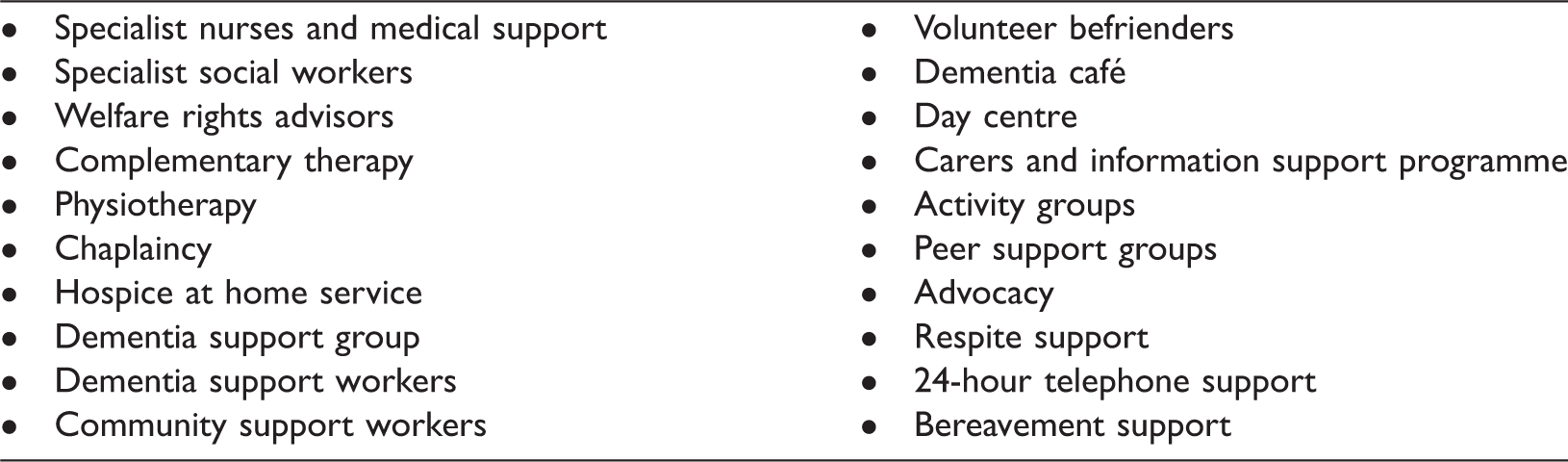
In March 2014, a Hospice in South Wales partnered with the Alzheimer’s Society to introduce a new service to improve palliative and end-of-life care for people with dementia. Through this collaboration, the Hospice provides palliative and end-of-life care expertise via a Community Palliative Care Nurse Specialist; and the Alzheimer’s Society provides expert knowledge of dementia through a Dementia Support Worker. An open referral system was introduced and patients and families given access to a wide range of services, detailed in Table 1. Patients who are referred to the Project receive support from both the Nurse Specialist and Dementia Support Worker, depending on need. The support comes in the form of regular visits and telephone calls, which may involve patient care, information, advice, education and training. The day centre also provides the opportunity for carers to socialise and support one another. The service covers all types and stages of dementia, for any patient with a confirmed diagnosis of dementia.
Services provided to patients and families with dementia.
Education and training was provided to health and social care professionals, volunteers, families and members of the public. Training covered topics such as: symptom management; information on dementia; end-of-life care; advance care planning (ACP) and emotional support. Through training and engagement, the project also focused on developing relationships with local services, as it aimed to achieve greater continuity and linked up care and support for patients with dementia and their families.
This paper reports the main impacts of the service, based on an evaluation of 16 months of the Challenge Project’s implementation within the local area (April 2014–July 2015).
Methods
A mixed method approach was used to evaluate the implementation and impact of the service on service users and healthcare staff. A total of 35 surveys comprising open and closed questions were completed by: healthcare professionals (n=20); current carers (n=9); bereaved carers (n=6). Surveys of carers and former carers were administered by a researcher at the Hospice. The survey for healthcare professionals was made available to nursing and care home staff and other community healthcare professionals within the local area via the Bristol Online Survey tool. The quantitative data collected in the surveys was analysed using descriptive statistics. Qualitative free text data were entered into NVivo 10 and analysed using a thematic approach. Free text data contained in generic feedback evaluation forms routinely collected by the hospice were also analysed using this approach (n=22).
Three semi-structured interviews were undertaken with the Nurse Specialist, Dementia Support Worker and the Clinical Services Director. The interviews explored staff experiences of delivering the project and their views on the impacts and future work of the project. Interviews were recorded, fully transcribed and analysed for key themes. Clinical audit data from April 2014 to August 2015 were analysed using descriptive statistics. The data included the number of people with dementia who: have a preferred place of death and die in their place of preference; have an Advance Care Plan (ACP) in place; die with an integrated care plan (ICP) in place; access palliative and end-of-life support pre and post introduction of the Challenge project.
This study was approved by Cardiff University School of Medicine Research Ethics Committee. Informed consent was obtained from all participants.
Results
Impact on patients and families
Referral data suggest that the project had a positive impact on service use by patients and families, demonstrating the following key increases:
75% Increase in referrals of patients with dementia to the hospice palliative care team since the pre-project year (April 2013 to March 2014, n=44) and the first year of the project (April 2014 to March 2015, n=77).
287.5% Increase in referrals of patients who are being cared for in their own home since the pre-project year (n=8) and first year of the project (n=31).
More dementia patients in need of palliative (57) rather than end-of-life support (40) in the period April 2014 to August 2015. Prior to the project, all referrals were reported to be for end-of-life care only.
Family carers valued the support provided to them by the project, with the majority (14, 93%) of respondents rating the service ‘Extremely Helpful’ (n=10) or ‘Quite Helpful’ (n=4). A majority of carers also indicated that the project had led to improvements in their knowledge, confidence and practical skills (n=11, 69%). Specific areas of improvement or benefit are detailed below.
Managing symptoms and administering medications (n=7, 44%) Addressing challenging behaviour (n=5, 31%) Knowing what is best for the person (n=9, 56%) Understanding the condition (n=10, 63%) Being able to communicate with family member or friend (n=5, 31%) Coping skills as a carer (n=9, 56%) Helped keep family members or friends at home or usual place of care (n=15, 100%) Increased the amount of care provided to them (n=13, 81%) Enabled a better quality of life for the carer, family member or friend (n=13, 81%).
In their free text responses, carers described the frequency of contact with project staff and their responsiveness to their individual needs for support, including emotional support and facilitating access to other services. Informal carers and family members described how the project enabled them to feel less isolated and ‘safe’. Families were reassured by the home visits and 24-hour telephone support available which was seen as a ‘safety net’ that provided peace of mind. Carers also commented on the close relationships which they built up with the project staff and the comfort that they took from the kind and compassionate approach of the staff. ‘Always there when needed, to help support myself as carer, and my husband who likes to chat at times with people that has patience to listen and who understands the situation’. (Current Carer)
A number of respondents described how they have benefited from the respite opportunities provided by the project, and acknowledged the role played by the nurse in encouraging them to recognise their need for a break. This support enabled carers to ‘get other things done’ and reduced feelings of stress and depression. This package of practical, educational and emotional support provided by the project was identified by a number of respondents as crucial to enabling them to care for their loved ones at home. ‘Everyone we have met has been so helpful. I feel without this ongoing support [patients name] would have needed to go into a residential home as I could not cope. She loves visiting the Hospice every Tuesday’. (Current Carer)
Impact on health and social care organisations and professionals
Survey responses from the majority (n=14, 70%) of professionals indicated that they found the project ‘extremely helpful’ (n=13) or ‘quite helpful’ (n=1) (six respondents did not answer this question). Their views on the more specific benefits of the project are detailed below.
Helped implement ICPs for dementia patients (n= 17, 85%); Supports the establishment of ACP (n= 16, 80%); Allows patients to remain at their preferred place care (n= 18, 90%); Provides high-quality education to staff (n= 18, 90%); Facilitates an improved understanding of the disease progression of dementia (n = 19, 95%); Highlights the early implementation of palliative care (n= 18, 95%).
In their comments, many noted the helpful dementia awareness training sessions that they had received from the Project, along with specialist advice given to them on a more ad hoc basis. Reported benefits included signposting to external organisations and facilities and improved understandings of dementia and approaches to care, including some changes to practice. ‘We have many patients on our caseloads who are effected with dementia, and due to in-service training and the support of having a Challenge Project nurse in our team I feel this has enhanced our service to another level’. (Practitioner)
Conclusion and recommendations
The Challenge Project has improved access to appropriate palliative, end-of-life care and other services for people with dementia and their families, with many now being referred earlier in their disease trajectory. It has led to self-reported improvements in the knowledge, confidence and care skills of family carers and acts as an important source of emotional and respite support for patients and families. In turn, it seems that the service has also enabled more patients to be cared for at home. By providing comprehensive training and education, and acting as a valued point of contact and advice, the Project has positively influenced the knowledge and practice of some local health and social care professionals, leading to earlier referrals, improved understandings, communication practices and more collaborative ways of working when caring for patients and families with dementia.
This was a small-scale evaluation with associated limitations. The absence of baseline data on care planning made it difficult to determine the influence of the project on such outcomes, while the low numbers of survey responses limit the generalisability of results. Further research is needed to more rigorously assess the effectiveness and value of this service model in relation to: referral rates, place of care; uptake of care planning; patient and carer quality of life; the knowledge, confidence and skills of families and health and social care professionals and associated healthcare costs and savings.
Footnotes
Acknowledgements
Our thanks go to all of our participants, to Alison Jones who helped disseminate the survey, arrange interviews and prepare the audit data, and to Jordan Van Godwin, Stephanie Sivell, Despina Anagnostou and Fiona Morgan for their work on the project.
Declaration of Conflicting Interests
The author(s) declared no potential conflicts of interest with respect to the research, authorship, and/or publication of this article.
Funding
The author(s) disclosed receipt of the following financial support for the research, authorship, and/or publication of this article: This evaluation study was jointly funded by Aneurin Bevan University Health Board Research and Development Department and South East Wales Academic Health Science Partnership (SEWAHSP). The project was also supported by Marie Curie Cancer Care core/programme grant funding to the Marie Curie Research Centre, Cardiff University (grant reference: MCCC-FCO-11-C). EH and AN posts are supported by Marie Curie Cancer Care core grant funding (grant reference: MCCC-FCO-11-C).