



Abstract
Multivariate functional data can be intrinsically multivariate like movement trajectories in 2D or complementary such as precipitation, temperature and wind speeds over time at a given weather station. We propose a multivariate functional additive mixed model (multiFAMM) and show its application to both data situations using examples from sports science (movement trajectories of snooker players) and phonetic science (acoustic signals and articulation of consonants). The approach includes linear and nonlinear covariate effects and models the dependency structure between the dimensions of the responses using multivariate functional principal component analysis. Multivariate functional random intercepts capture both the auto-correlation within a given function and cross-correlations between the multivariate functional dimensions. They also allow us to model between-function correlations as induced by, for example, repeated measurements or crossed study designs. Modelling the dependency structure between the dimensions can generate additional insight into the properties of the multivariate functional process, improves the estimation of random effects, and yields corrected confidence bands for covariate effects. Extensive simulation studies indicate that a multivariate modelling approach is more parsimonious than fitting independent univariate models to the data while maintaining or improving model fit.
Keywords
Introduction
With the technological advances seen in recent years, functional datasets are increasingly multivariate. They can be multivariate with respect to the domain of a function, its codomain, or both. Here, we focus on multivariate functions with a one-dimensional domain
Multivariate functional data have been the interest in different statistical fields such as clustering (Jacques and Preda, 2014; Park and Ahn, 2017), functional principal component analysis (FPCAs) (Chiou et al., 2014; Happ and Greven, 2018; Backenroth et al., 2018; Li et al., 2020), and registration (Carroll et al., 2021; Steyer et al., 2021). There is also ample literature on multivariate functional data regression such as graphical models (Zhu et al., 2016), reduced rank regression (Liu et al., 2020), or varying coefficient models (Zhu et al., 2012; Li et al., 2017). Yet, so far, there are only few approaches that can handle multilevel regression when the functional response is multivariate. In particular, Goldsmith and Kitago (2016) propose a hierarchical Bayesian multivariate functional regression model that can include subject level and residual random effect functions to account for correlation between and within functions. They work with bivariate functional data observed on a regular and dense grid and assume a priori independence between the different dimensions of the subject-specific random effects. Thus, they model the correlation between the dimensions only in the residual function. As our approach explicitly models the dependencies between dimensions for multiple functional random effects and also handles data observed on sparse and irregular grids on more than two dimensions, the model proposed by Goldsmith and Kitago (2016) can be seen as a special case of our more general model class.
Alternatively, Zhu et al. (2017) use a two-stage transformation with basis functions for the multivariate functional mixed model. This allows the estimation of scalar regression models for the resulting basis coefficients that are argued to be approximately independent. The proposed model is part of the so-called functional mixed model (FMM) framework (Morris, 2017). While FMMs use basis transformations of functional responses (observed on equal grids) at the start of the analysis, we propose a multivariate model in the functional additive mixed model (FAMM) framework, which uses basis representations of all (effect) functions in the model (Scheipl et al., 2015). The differences between these two functional regression frameworks have been extensively discussed before (Greven and Scheipl, 2017; Morris, 2017).
The main advantages of our multivariate regression model, also compared to Goldsmith and Kitago (2016) and Zhu et al. (2017), are that it is readily available for sparse and irregular functional data and that it allows to include multiple nested or crossed random processes, both of which are required in our data examples. Another important contribution is that our approach directly models the multivariate covariance structure of all random effects included in the model using multivariate functional principal components (FPCs) and thus implicitly models the covariances between the dimensions. This makes the model representation more parsimonious, avoids assumptions difficult to verify, and allows further interpretation of the random effect processes, such as their relative importance and their dominating modes. As part of the FAMMframework, our model provides a vast toolkit of modelling options for covariate and random effects, of estimation and inference (Wood, 2017). The proposed multivariate functional additive mixed model (multiFAMM) extends the FAMM framework combining ideas from multilevel modelling (Cederbaum et al., 2016) and multivariate functional data (Happ and Greven, 2018) to account for sparse and irregular functional data and different study designs.
We illustrate the multiFAMM on two motivating examples. The first (intrinsically multivariate) data stem from a study on the effect of a training programme for snooker players with a nested study design (shots within sessions within players) (Enghofer, 2014). The movement trajectories of a player's elbow, hand, and shoulder during a snooker shot are recorded on camera, yielding six-dimensional multivariate functional data (see Figure 1). In the second data example, we analyse multimodal data from a speech production study with a crossed study design (speakers crossed with words) (Pouplier and Hoole, 2016) on so-called ‘assimilation’ of consonants. The two measured modes (acoustic and articulatory, see Figure 3) are expected to be closely related but joint analyses have not yet incorporated the functional nature of the data.
These two examples motivate the development of a regression model for sparse and irregularly sampled multivariate functional data that can incorporate crossed or nested functional random effects as required by the study design in addition to flexible covariate effects. The proposed approach is implemented in
Multivariate functional additive mixed model
General model
Let
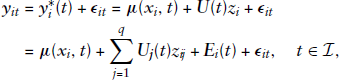
We assume an additive predictor
For random effects
Although technically a curve-specific functional random intercept, we distinguish the smooth residuals
For a more compact representation, we can arrange all
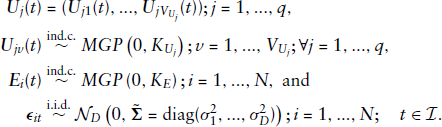
We assume that the different sources of variation
Model (2.1) specifies a univariate functional linear mixed model (FLMM) as given in Cederbaum et al. (2016) for each dimension
Given the covariance operators (see Section 3), we represent the multivariate random effects in Model (2.1) using truncated multivariate Karhunen-Loève (KL) expansions
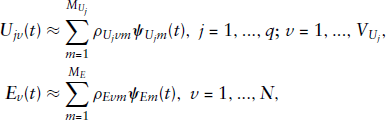
Using KL expansions gives a parsimonious representation of the multivariate random processes that is an optimal approximation with respect to the integrated squared error (cf. Ramsay and Silverman, 2005), as well as interpretable basis functions capturing the most prominent modes of variation of the respective process. The distinct feature of this approach is that the multivariate FPCs directly account for the dependency structure of each random process across the dimensions. If, by contrast, for example, splines were used in the basis representation of the random effects, it would be necessary to explicitly model the cross-covariances of each random process in the model (cf. Li et al., 2020). Multivariate eigenfunctions, however, are designed to incorporate the dependency structure between dimensions and allow the assumption of independent (univariate) basis coefficients
We use a two-step approach to estimate the multiFAMM and the respective multivariate covariance operators. In a first step (Section 3.1), the D-dimensional eigenfunctions
Step 1: Estimation of the eigenfunction basis
Step 1 (i): Univariate mean estimation
In a first step, we obtain preliminary estimates of the dimension-specific means

This preliminary mean function is used to centre the data

Based on the covariance kernel estimates, we apply separate univariate FPCAs for each random process by conducting an eigendecomposition of the respective linear integral operator. Practically, each estimated process- and dimension-specific auto-covariance is re-evaluated on a dense grid so that a univariate functional principal component analysis (FPCA) can be conducted. Alternatively, Reiss and Xu (2020) provide an explicit spline representation of the estimated eigenfunctions. Eigenfunctions with non-positive eigenvalues are removed to ensure positive definiteness, and further regularization by truncation based on the proportion of variance explained is possible (see, e.g., Di et al., 2009; Peng and Paul, 2009; Cederbaum et al., 2016). However, we suggest to keep all univariate FPCs with positive eigenvalues for the computation of the MFPCA in order to preserve all important modes of variation and cross-correlation in the data.
Step 1 (iv): Multivariate eigenfunction estimation
The estimated univariate eigenfunctions and scores are then used to conduct an MFPCA for each of the

Happ and Greven (2018) show that estimates of the multivariate eigenvalues
We offer two different approaches for the choice of truncation orders


In the following, we discuss estimating the multiFAMM given the estimated multivariate FPCs. We base the proposed model on the general FAMM framework of Scheipl et al. (2015), which models functional responses using basis representations. To make the extension of the FAMM framework to multivariate functional data more apparent, the multivariate response vectors and the respective model matrices are stacked over dimensions, so that every block has the structure of a univariate FAMM over all observations
Matrix representation
For notational simplicity we assume that the functions are evaluated on a fixed grid of time points

with
We estimate

using appropriate penalty matrices
The block-diagonal matrix

where
Choosing the number of basis functions is a well known challenge in the estimation of nonlinear or functional effects. We introduce regularization by a corresponding quadratic penalty term in (3.5). Let
Modelling of random effects
We represent the

The
For a given functional random effect, the penalty takes the form
Estimation
We estimate the unknown smoothing parameters in
We propose a weighted regression approach to handle the heteroscedasticity assumption contained in
As our proposed model is part of the FAMM framework, inference for the multiFAMM is readily available based on inference for scalar additive mixed models (Wood, 2017). Note, however, that all inferential statements do not incorporate uncertainty due to the estimated multivariate eigenfunction bases, nor in the chosen smoothing parameters. The estimation process readily provides, amongst other things, standard errors for the construction of point-wise univariate confidence bands (CBs).
Implementation
We provide an implementation of the estimation of the proposed multiFAMM in the
Applications
We illustrate the proposed multiFAMM for two different data applications corresponding to intrinsically multivariate and multimodal fuctional data. The presentation focuses on the first application with a detailed description of the multimodal data application in Supplementary Material C. We provide the data and the code to produce all analyses in the Supplementary Material (
Snooker training data
Data set and preprocessing
In a study by Enghofer (2014), 25 recreational snooker players split into two groups, one of which had instructions to follow a self-administered training schedule over the next six weeks consisting of exercises aimed at improving snooker specific muscular coordination. The second was a control group. Before and after the training period, both groups were recorded on high-speed digital camera under similar conditions to investigate the effects of the training on their snooker shot of maximal force. In each of the two recording sessions, six successful shots per participant were videotaped. The recordings were then used to manually locate points of interest (a participant's shoulder, elbow, and hand) and track them on a two-dimensional grid over the course of the video. This yields a six-dimensional functional observation per snooker shot
Screenshot of software for tracking (lines) the points of interest (circles) (left), two-dimensional trajectories of the snooker training data set (grey curves, right). For both groups of skilled and unskilled participants, three randomly selected observations are highlighted and every line type corresponds to one multivariate observation, that is, one observation consists of three trajectories: elbow (top), shoulder (right) and hand (bottom). The start of the exemplary trajectories are marked with a black asterisk with the hand trajectory centred at the origin
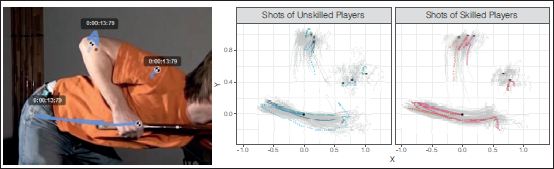
Screenshot of software for tracking (lines) the points of interest (circles) (left), two-dimensional trajectories of the snooker training data set (grey curves, right). For both groups of skilled and unskilled participants, three randomly selected observations are highlighted and every line type corresponds to one multivariate observation, that is, one observation consists of three trajectories: elbow (top), shoulder (right) and hand (bottom). The start of the exemplary trajectories are marked with a black asterisk with the hand trajectory centred at the origin
In their starting position (hand centred at the origin), the snooker players are positioned centrally in front of the snooker table aiming at the cue ball. From their starting position, the players draw back the cue, then accelerate it forwards and hit the cue ball shortly after their hands enter the positive range of the horizontal
We adjust the data for differences in body height and relative speed (Steyer et al., 2021) and apply a coarsening method to reduce the number of redundant data points, thereby lowering computational demands of the analysis. Supplementary Material B provides a detailed description of the data preprocessing. As some recordings and evaluations of bivariate trajectories are missing, the final dataset contains 295 functional observations with a total of 56,910 evaluation points. These multivariate functional data are irregular and sparse, with a median of 30 evaluation points per functional observation (minimum 8, maximum 80) for each of the six dimensions.
We estimate the following model

with

The dummy covariates
Cubic P-splines with first-order difference penalty, penalizing deviations from constant functions over time, with 8 basis functions are used for all effect functions in the preliminary mean estimation as well as in the final multiFAMM. For the estimation of the auto-covariances of the random processes, we use cubic P-splines with first-order difference penalty on five marginal basis functions. We use an unweighted scalar product (3.3) for the MFPCA to give equal weight to all spatial dimensions, as we can assume that the measurement error mechanism is similar across dimensions. Additionally, we find that hand, elbow, and shoulder contribute roughly the same amount of variation to the data, cf. Table 1 in Supplementary Material B.3, where we also discuss potential weighting schemes for the MFPCA. The multivariate truncation order is chosen such that 95% of the (unweighted) sum of variation (3.4) is explained.
The MFPCA gives sets of five (for
Dominant mode (
) of the subject-and-session-specific random effect, explaining
of total variation and shown as mean trajectory (black solid) plus (
) or minus (
)
times the first FPCs (left). An asterisk marks the start of a trajectory. Estimated covariate effect functions for skill (right). The central plot shows the effect of the coefficient function (solid) on the two-dimensional trajectories for the reference group (dashed). The marginal plots show the estimated univariate effect functions (solid) with pointwise 95% CBs (dotted) and the baseline (dashed)
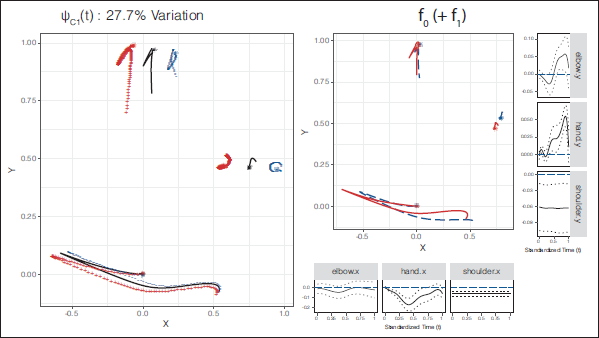
Dominant mode (
) of the subject-and-session-specific random effect, explaining
of total variation and shown as mean trajectory (black solid) plus (
) or minus (
)
times the first FPCs (left). An asterisk marks the start of a trajectory. Estimated covariate effect functions for skill (right). The central plot shows the effect of the coefficient function (solid) on the two-dimensional trajectories for the reference group (dashed). The marginal plots show the estimated univariate effect functions (solid) with pointwise 95% CBs (dotted) and the baseline (dashed)
The left plot of Figure 2 displays the first FPC for
The central plot on the right of Figure 2 compares the estimated mean movement trajectory for advanced snooker players (solid line) to that in the reference group (dashed). It suggests that more experienced players tend towards the dynamic elbow technique, generating a hand trajectory resembling a straight line (piston stroke). Uncertainties in the trajectory could be represented by pointwise ellipses, but inference is more straightforward to obtain from the univariate effect functions. The marginal plots display the estimated univariate effects with pointwise 95% confidence intervals. Even though we find only little statistical evidence for increased movement of the elbow (horizontal-left and vertical-top marginal panels), the hand and shoulder movements (horizontal centre and right, vertical centre and bottom) strongly suggest that the skill level indeed influences the mean movement trajectory of a snooker player. Further results indicate that the mean hand trajectories might slightly differ between treatment and control group at baseline as well as between sessions (
Data set and model specification
Pouplier and Hoole (2016) study the assimilation of the German /s/ and /sh/ sounds such as the final consonant sounds in ‘Kürbis’ (English example: ‘haggis’) and ‘Gemisch’ (English example: ‘dish’), respectively. The research question is how these sounds assimilate in fluent speech when combined across words such as in ‘Kürbis-Schale’ or ‘Gemisch-Salbe’, denoted as /s#sh/ and /sh#s/ with # the word boundary. The 9 native German speakers in the study repeated a set of 16 selected word combinations five times. Two different types of functional data, that is, (ACO) and electropalatographic (EPG) data, were recorded for each repetition to capture the acoustic (produced sound) and articulatory (tongue movements) aspects of assimilation over (relative) time
Each functional index varies roughly between
Index curves of the consonant assimilation dataset for both ACO and EPG data as a function of standardized time
(grey curves). For every consonant order, three randomly selected observations have been highlighted and every line type corresponds to one multivariate observation, that is, one observation consists of two index curves
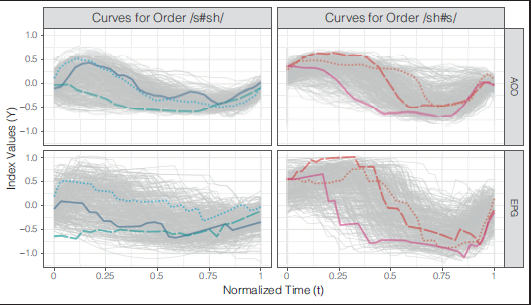
Index curves of the consonant assimilation dataset for both ACO and EPG data as a function of standardized time
(grey curves). For every consonant order, three randomly selected observations have been highlighted and every line type corresponds to one multivariate observation, that is, one observation consists of two index curves
For comparability, we follow the model specification of Cederbaum et al. (2016), who analyse only the ACO dimension and ignore the second mode EPG. Our specified multivariate model is similar to (4.1) with
The multivariate analysis supports the findings of Cederbaum et al. (2016) that assimilation is asymmetric (different mean patterns for /s#sh/ and /sh#s/). Overall, the estimated fixed effects are similar across dimensions as well as comparable to the univariate analysis. Hence, the multivariate analysis indicates that previous results for the acoustics are consistently found also for the articulation. Compared to univariate analyses, our approach reduces the number of FPC basis functions and thus the number of parameters in the analysis. The multiFAMM can improve the model fit and can provide smaller CBs for the ACO dimension compared to the univariate model in Cederbaum et al. (2016) due to the strong cross-correlation between the dimensions. We find similar modes of variation for the multivariate and the univariate analysis as well as across dimensions. In particular, the word combination-specific random effect
Simulations
Simulation set-up
We conduct an extensive simulation study to investigate the performance of the multiFAMM depending on different model specifications and data settings (over 20 scenarios total), and to compare it to univariate regression models as proposed by Cederbaum et al. (2016), estimated on each dimension independently. Given the broad scope of analysed model scenarios, we refer the interested reader to Supplementary Material D for a detailed report and restrict the presentation here to the main results.
We mimic our two presented data examples (Section 4) and simulate new data based on the respective multiFAMM-fit. Each scenario consists of model fits to 500 generated datasets, where we randomly draw the number and location of the evaluation points, the random scores, and the measurement errors according to different data settings. The accuracy of the estimated model components is measured by the root relative mean squared error (rrMSE) based on the unweighted multivariate norm but otherwise as defined by Cederbaum et al. (2016), see Supplementary Material D.1. The rrMSE takes on (unbounded) positive values with smaller values indicating a better fit.
Simulation results
Figure 4 compares the rrMSE values over selected modelling scenarios based on the consonant assimilation data. We generate a benchmark scenario (far left boxplots), which imitates the original data without misspecification of any model component. In particular, the number of FPCs is fixed to avoid truncation effects. Comparing this scenario to the two scenarios left and centre illustrates the importance of the number of FPCs in the accuracy of the estimation. Choosing the truncation order via the proportion of univariate variance explained (Cut-Off Uni) as in (3.5) gives models with roughly the same number of FPCs (mean
rrMSE values of the fitted curves
, the mean
, and the random effects
and
for different modelling scenarios. The three leftmost scenarios correspond to different model specifications in the same data setting
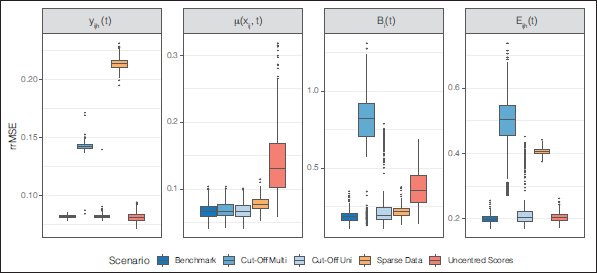
rrMSE values of the fitted curves
, the mean
, and the random effects
and
for different modelling scenarios. The three leftmost scenarios correspond to different model specifications in the same data setting
Our simulation study thus suggests that basing the truncation orders on the proportion of explained variation on each dimension (3.5) gives parsimonious and well-fitting models. If interest lies mainly in the estimation of fixed effects, the alternative cut-off criterion based on the total variation in the data (3.4) allows even more parsimonious models at the cost of a less accurate estimation of the random effects and overall model fit. Furthermore, the results presented in Supplementary Material D show that the mean estimation is relatively stable over different model scenarios including misspecification of the measurement error variance structure or of the multivariate scalar product, as well as in scenarios with strong heteroscedasticity across dimensions. In our benchmark scenario, the CBs cover the true effect
The proposed multivariate functional regression model is an additive mixed model, which allows to model flexible covariate effects for sparse or irregular multivariate functional data. It uses FPC based functional random effects to model complex correlations within and between functions and dimensions. An important contribution of our approach is estimating the parsimonious multivariate FPC basis from the data. This allows us to account not only for auto-covariances, but also for non-trivial cross-covariances over dimensions, which are difficult to adequately model using alternative approaches such as parametric covariance functions like the Matèrn family or penalized splines, which imply a parsimonious covariance only within but not necessarily between functions. As a FAMM-type regression model, a wide range of covariate effect types is available, also providing pointwise CBs. Our applications show that the multiFAMMs can give valuable insight into the multivariate correlation structure of the functions in addition to the mean structure.
An apparent benefit of multivariate modelling is that it allows to answer research questions simultaneously relating to different dimensions. In addition, using multivariate FPCs reduces the number of parameters compared to fitting comparable univariate models while improving the random effects estimation by incorporating the cross-covariance in the multivariate analysis. The added computational costs are small: For our multimodal application, the multivariate approach prolongs the computation time by only 5% (104 vs. 109 minutes on a 64-bit Linux platform).
We find that the average point-wise coverage of the point-wise CBs can in some cases lie considerably below the nominal value. There are two main reasons for this: One, the CBs presented here do not incorporate the uncertainty of the eigenfunction estimation nor of the smoothing parameter selection. Two, coverage issues can arise in (scalar) mixed models, if effect functions are estimated as constant when in truth they are not (e.g., Wood, 2017; Greven and Scheipl, 2016). To resolve these issues, further research on the level of scalar mixed models might be needed. A large body of research covering CB estimation for functional data (e.g., Goldsmith et al., 2013; Choi and Reimherr, 2018; Liebl and Reimherr, 2019) suggests that the construction of CBs is an interesting and complex problem, also outside of the FAMM framework.
It would be interesting to extend the multiFAMM to more general scenarios of multivariate functional data such as observations consisting of functions with different dimensional domains, for example, functions over time and images as in Happ and Greven (2018). This would require adapting the estimation of the univariate auto-covariances for spatial arguments
Footnotes
Acknowledgements
We thank Timon Enghofer, Phil Hoole, and Marianne Pouplier for providing access to their data and for fruitful discussions. We also thank Lisa Steyer for contributing the data registration of the snooker training data and the reviewers and editors for their helpful suggestions.
Declaration of conflicting interests
The authors declared no potential conflicts of interest with respect to the research, authorship and/or publication of this article.
Funding
The authors disclosed receipt of the following financial support for the research, authorship and/or publication of this article: Sonja Greven, Almond Stöker, and Alexander Volkmann were funded by grant GR 3793/3-1 from the German research foundation (DFG). Fabian Scheipl was funded by the German Federal Ministry of Education and Research (BMBF) under Grant No. 01IS18036A.
Supplemental material
Supplementary materials for this article are available from