



Abstract
Qualitative research can offer participants a rare opportunity to openly discuss their marginalised and/or stigmatised identities. In doing so, they may engage with the emotional complexities of identity and begin to reframe how they view themselves. Participation in qualitative research, therefore, holds the potential to be transformative; shaping how marginalised and/or stigmatised individuals perceive and accept their identities. Realising this potential, however, requires careful and intentional research design. While previous scholarship has outlined approaches for making research more inclusive, this research note advances the concept of transformative research practice. We draw on our own experiences as researchers to argue that qualitative research should not only seek to include but also to empower participants. Specifically, we propose four guiding principles designed to ensure that research encounters provide meaningful opportunities for participants from marginalised and/or stigmatised groups to experience transformation through their engagement in the research process.
Keywords
Introduction
Qualitative in-depth interviews and focus groups can have a therapeutic effect on participants who get the opportunity to discuss phenomena that may be important to them (Birch & Miller, 2000). These interviews offer an opportunity to provide one’s opinion to researchers who are engaged in the conversation with the purpose of hearing and learning from the participant (Hopf, 2004). For participants from marginalised and/or stigmatised identities, such research interaction may be a rare occasion to talk about their identity and provide an opinion from that perspective. Herein, we highlight that these occasions can have a significant impact on participants with marginalised and/or stigmatised identities, and the way they see themselves – making it imperative to ensure it is designed to affirms and positively transform how one sees their identity.
Literature has argued for inclusive research approaches and has put forward guidelines for conducting research with marginalised groups (Lewis et al., 2023) including LGBTQ + people (Lewis & Reynolds, 2021), people with a disability (Trevisan, 2021), and First Nations people (Lawrence et al., 2023). These papers typically take a deficit perspective and focus on making the project design more inclusive, but not necessarily on the interaction between the researcher and the participant or how it can transform (enhance or detract) how participants see themselves. This paper draws on the notion of transformative experiences (Chirico et al., 2022) to advance this discussion by positioning qualitative research as an experience that can be designed to have a transformative outcome for participants from marginalised and/or stigmatised identities. The interaction possible within qualitative research centres on building a trusting and respectful environment between the researcher and the participant (Birch & Miller, 2000) and can therefore affirm or devalue an individual’s identity. Such an experience can contribute to a sense of self-actualisation for participants from marginalised and/or stigmatised identities if it is designed to be transformative (Chirico et al., 2022; Villiger, 2024).
Herein, we focus on marginalised and/or stigmatised identities who experience stigma and/or marginalisation in complex and multilayered ways (Goffman, 2009; Link & Phelan, 2001). This includes, but is not limited to, members of the LGBTQ + community, people with a disability, First Nations peoples, people from diverse ethnicities, and those who experience stigma because of characteristics like their age and body type. Given growing social interest in inclusion, such groups are increasingly becoming the focus of research, particularly qualitative research designed to explore their behaviours and perceptions. However, the research may not be conducted by researchers who share in that identity – impacting the process. A transformative research experience can offer new ways of knowing oneself and the world through a shift in perspective from stigmatisation, frequently internalised by marginalised groups, to affirmation and the explicit valuing of their identities. Consequently, transformative research practices may not only help enhance how one may see themselves but also help gain access to richer insights participants may not otherwise feel comfortable sharing.
As researchers in this space, we have interviewed participants who may opt to participate because of their marginalised identity but struggle with the stigma attached to it. For instance, one of the authors interviewed a lesbian person with a disability, for whom coming out at home could mean that she would not have the physical supports she needs for her wellbeing. Yet she chose to participate to have her voice heard and acknowledged this was one of the few times she could be out in a safe environment. That interview concluded with the participant noting how good it felt to talk to someone she could share her authentic self with. Indeed, as more and more qualitative market and social research is conducted with marginalised and stigmatised identities, it is likely researchers will encounter participants who are not entirely comfortable or positive about their identity making a transformative approach imperative. More generally, it is likely that research will include people from marginalised and/or potentially vulnerable groups even if studies are not designed specifically to focus on them – considering, for instance, that 16% of the world’s population have a disability (World Health Organisation, 2021), and 80% identify as heterosexual (Ipsos, 2021). In this paper, we introduce the notion of transformative research practice, defining it as ‘research practices that create an experience which enhances how participants perceive the marginalised/stigmatised aspects of their identity’. We use the word transformative because such interactions can have the effect of transforming how individuals feel and understand their identity – moving it from a characteristic that is stigmatised to one that is potentially valued. We argue transformative research practices are not only designed to be inclusive of marginalised and/or stigmatised groups but are curated so the interaction between the researcher and the participant shifts how the individual sees their own identity. Accordingly, we draw from our experience as qualitative researchers to put forward principles for designing transformative qualitative research experiences.
Research as a Transformative Experience
Originating from the experience economy, the concept of transformative experience has been given some interdisciplinary consideration. For instance, the tourism literature argues for an experience to be transformative, it needs to be personalised which makes it “more meaningful and potentially life-changing” (Amaro et al., 2025, p. 142). In education, the passion of the educator, combined with the connection they foster with the students was found to contribute to a transformative learning experience (Pugh et al., 2023). These studies indicate how an experience is designed and managed can contribute to transformative outcomes.
Transformative experiences have been conceptualised as peak experiences within the individual’s lives (Kirillova et al., 2017) that encourage reflection (Amaro et al., 2025) and result in a change in the individual’s perception (Villiger, 2024). Chirico et al. (2022, p. 14) offer a parsimonious definition positioning transformative experiences as “brief experiences, perceived as extraordinary and unique, entailing durable and/or irreversible outcomes, which contribute to changing individuals’ self-conception, worldviews, and view of others, as well as their own personality and identity by involving an epistemic expansion (as new forms of knowledge of the self, others, and the world) and a heightened emotional complexity (emotional variability, high intensity, mixed emotions)”. This definition highlights that for an experience to be transformative, it should have the effect of challenging one’s perception of themselves within their social context and should arouse an emotional response.
As an experience that people do not have regularly, participating in qualitative research can function as a transformative experience and contribute to how the individual sees themselves. In qualitative research participants are actively involved in personal discussions and disclosures and through doing so are led to reflect on aspects of their life, such as their stigmatised and/or marginalised identity, that they may not otherwise consider (Birch & Miller, 2000; Lewis et al., 2023). The interpersonal and interactive nature invites possibilities for emotional and cognitive engagement with topics that may be sensitive or complex (Hopf, 2004) and therefore conducive to heightened emotional complexity. This highlights that qualitative research interactions can function as a peak experience that encourages reflection and have potential to result in personal change if they are designed to do so.
Despite the approach used qualitative research is an interaction between two people within a space (online or offline). The research process might require participants to enter new physical or virtual spaces and interact with new people. Therefore, both how the individual interacts with the participant and where this interaction happens is salient in informing transformative outcomes and need to be designed and managed. For instance, failing to provide an accessible physical interview space for a participant with a disability communicates an implicit devaluing of their contribution based on their disability – setting the tone of the interaction before the researcher can even ask any questions. Similarly, a failure to respect people’s pronouns and affirm how they see themselves can have a similar effect once the research discussion begins causing the participant to be guarded about what they disclose.
Transformative Research Principles: a Framework
Transformative qualitative research practices should offer participants enhanced ways of knowing themselves and the world; while concurrently enabling the navigation of complex emotional responses (Chirico et al., 2022; Thambinathan & Kinsella, 2021). To this aim, reflecting on our own experience as qualitative researchers, we put forward four interrelated principles underpinning transformative research practice. These principles were designed by first identifying practices that we believe facilitate a transformative research experience and then combining them into higher order themes. By enabling a deeper and critical examination of a phenomenon, such reflective practice can contribute to understanding an experience (like qualitative research) and inform practice (Zahra & Sharma, 2004).
The emerging four principles are illustrated in Figure 1 which situates these principles as synchronous and interrelated, in that each principle informs the others and cumulatively have an impact in creating a transformative experience for the participant. These principles are underpinned by the notion of understanding our positionality and bias as a researcher, curating interactions and spaces that demonstrate and value diversity, and positioning research as a collaborative exchange in which participants are the holders and sharers of their own knowledge, experiences, and perspectives. Principles of Transformative Research Practice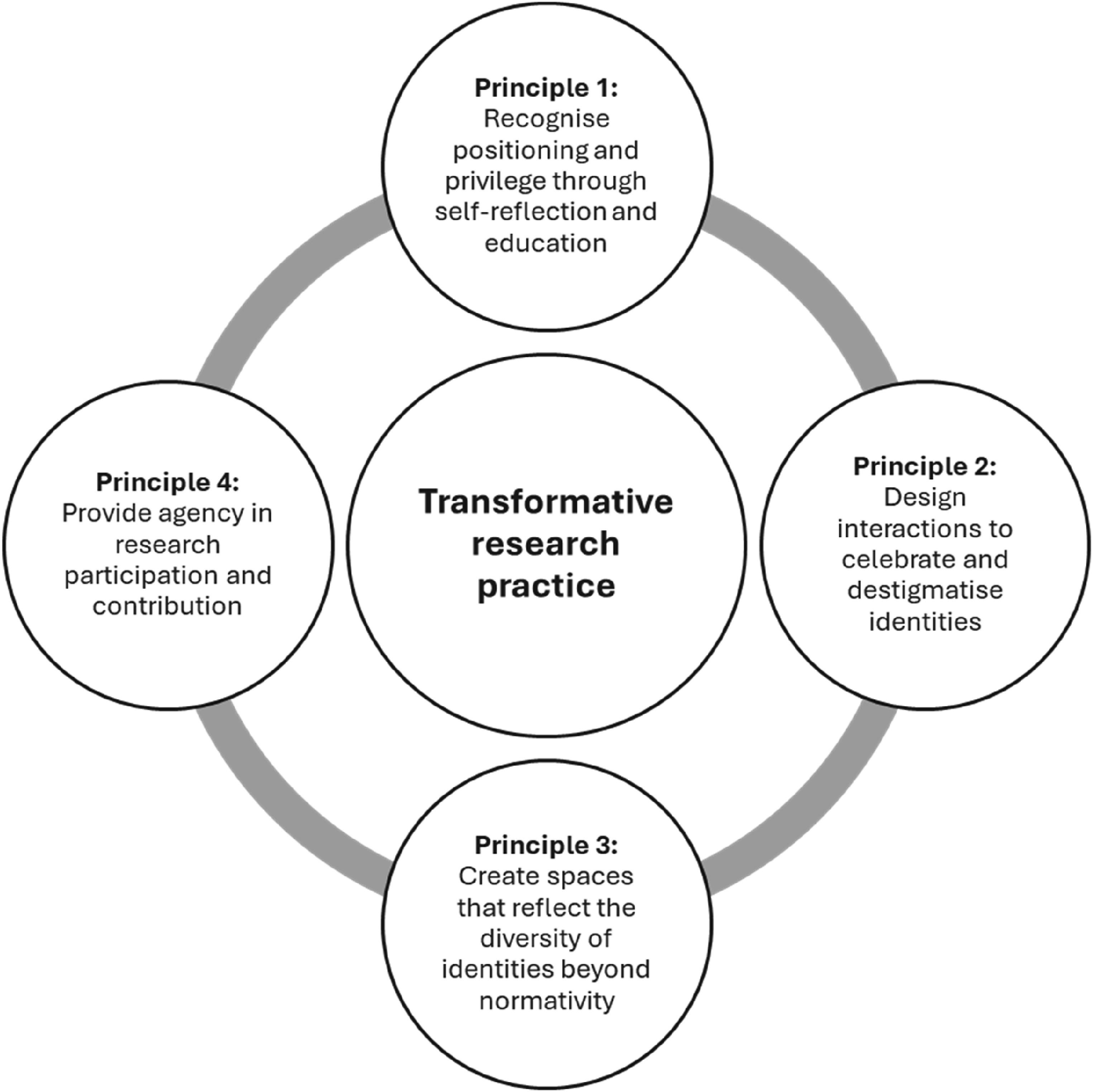
Principle 1: Recognise Positioning and Privilege through Self-Reflection and Education
Transformative research practice requires the researcher to engage in self-reflection and education and be cognisant of one’s positionality. This encompasses considering one’s identity and lived experiences of privilege (and disadvantage) which are shaped by systemic and structural factors (Lewis & Reynolds, 2025). Critical self-reflection and education enable the researcher to consider how their lived experience differs from their participants and consciously or unconsciously shapes their perceptions of their participant groups, influencing their interaction with them. For instance, this can include considering how one’s experience as a cis-gendered-heterosexual researcher may differ from that of an LGBTQ + person, how social environments create pre-dispositions that impact how an LGBTQ + person may be viewed, and consequently the assumptions made when recruiting and interviewing an LGBTQ + person within a research context. As part of this process, consideration may also be given to who would be most appropriate to interview the participant considering the topic and the participant group. For instance, a female participant from a religious background may be more comfortable talking with a female interviewer about topics that may be personal or otherwise sensitive.
The notions of self-reflection and education are underpinned by the fact that we are all influenced by our social environment and therefore restricted in our world views to our own lived experiences and biases. This can have detrimental impacts in research, for instance, biases that position people with disabilities as being vulnerable can inform how research is designed and reported in effect taking away agency from them, and perpetuating narratives of vulnerability. Accordingly, to enable the creation of a transformative research environment, the researcher needs to first have their own form of epistemic expansion and engage in emotional complexity - to reconcile their lived experience with that of the groups they aim to research. Such self-reflection and education may include consultation with members of the community forming the participant groups to inform the researcher about foundational knowledge relevant to the project, as well as identify barriers that may prevent participants from contributing authentically. Such barriers may be structural – such as the accessibility requirements of different groups, or perceptual imposed based on the unconscious biases of the researcher – based on as how the topic and the group is framed in the researcher’s mind. Ultimately, such self-reflection and education mean that participants can engage in discussing complexities without having to educate the researcher about foundational knowledge about their identity.
Principle 2: Design Interactions to Celebrate and Destigmatise Identities
Researchers need to curate their communication approaches to establish an affirming environment by using active listening practices and language that is appropriate and suitable for the participant group. Doing so demonstrates emotional sensitivity and is important because participants may need to recount events associated with positive or negative experience which can be emotionally saturated and complex. Undertaking transformational research practices requires creating an environment that enables participants to share and unpack emotional complexities. In this regard, as a conversation technique, through active listening the researcher can probe and clarify details of a participant’s experience while being cognisant about the language and non-verbal cues the participant uses to describe that experience. In doing so, it can encourage the participant to reflect on their experience (Louw et al., 2011), creating an opportunity to consider their experience and therefore themselves in ways that challenge perceptions of stigma they hold. Such practices may take the form of probing questions where the researcher identifies opportunities to discuss how one’s identity impacts their experiences; or active disclosures where researchers reveal aspects of their own diverse identities to create a sense of commonality and reduce concerns about judgement. It can include enabling the participant to process their emotions by recognising a pause from a participant as thinking time, rather than assuming finalisation of a response, as well as offering the participant to pause an interview if they appear to be emotionally impacted. In this context, the researcher also needs to be mindful of their own emotions and how they project them onto on the participant. For instance, a participant may share a negative experience but not want to be treated as vulnerable because the experience may have in effect empowered them.
Concurrently, researchers must consider how language choice will affirm participant self-perception (Nind & Vinha, 2014; Szulc, 2023). Affirming language can communicate a sense of safety for participants to engage with emotionally complex subject matter. This may require the researcher to adjust terms throughout the interview based on the verbal and non-verbal cues used by the participant to express their ideas. Appropriate language can include descriptions of gender and/or sexual orientation, self-identification of a specific cultural group, or person-first versus identity-first language choices to describe disability. The research should also consider when not to mirror participant language, considering their own positionality to avoid inappropriate expressions, for example when derogatory terms have been reclaimed and are only suitable to be used by the participant group.
Principle 3: Create Spaces that Reflect the Diversity of Identities Beyond Normativity
How a space is designed communicates who is allowed within that space. Enabling transformative research requires the creation of “vibrant, safe spaces” for participants to speak openly (Nind & Vinha, 2014, p. 103). Building a safe space is essential to ensuring participants are comfortable and confident to engage with questions that address complex and potentially challenging aspects of their experience and emotions. The researcher can inform the sense of inclusion evident in the space by considering and accommodating multiple diverse identities – externally visible and invisible – participants may have. Research highlights that marginalised groups pay attention to cues not only related to their specific group but also those related to other marginalised groups (Lewis et al., 2025) and use these cues as evidence to infer their own safety and inclusion. For instance, in an events context, disability access while not relevant for some LGBTQ + people signalled that the event organiser had considered the needs to other groups (Ong et al., 2022).
For an experience to be transformative researchers need to consider that an individual can have multiple identities (for example being an ethnic minority with a disability), and design spaces that welcome such identities. This can be challenging because subtle signs within a space can construct an image of that space. For instance, participants may use multiple elements of the place – e.g. the signs/posters and symbols, the way the researcher is dressed, and the accessibility provisions in physical space - to form an opinion of how inclusive that space is (Ong et al., 2022). Proactively curating spaces without requiring participants to disclose their identities or request accommodations can reduce discomfort before and during the interview. This helps ensures participants can focus their attention on providing responses for the researcher (Trevisan, 2021) as opposed to being vigilant about their responses. Curating accessible interview spaces should include consideration of pathways to the space as well as ambient aspects like temperature, scents, lighting and noise within the room (Szulc, 2023). Such considerations can also be relevant in the online space – in terms of the virtual background the researcher may choose or the clothing and accessories they may wear – such as the use of Pride colours.
Principle 4: Recognise Agency in Research Participation and Contribution
To create environments that affirm identities while centring on the participant, it is important that researchers are cognisant of the participant’s agency in if and how they to contribute to the research. This requires a shift in paradigme which can position the participant as sub-ordinate to the researcher, towards one that positions research as a collaborative exchange and the researcher as an interlocutor sharing the participant’s experience. Rather than replicate a power imbalance that constructs the researcher as dominant in the exchange of data (Taylor & Williamson, 2024), researchers should ensure participants are in control of the experience, how much they disclose, and how they disclose this information. This can mean researchers may need to also embrace non-traditional forms of data and research design. For instance, the use of yarning cirles as sources of data in First Nations work in Australia where stories and experiences can be shared as data (Smith, 2021). Collaborative approaches like co-design and participatory action research (PAR) might also be considered, where the participant group is central to research design. Giving participants agency also calls for transparency in the research process - including how research data will be used. Providing this information is important to promote agency for participants from marginalised and stigmatised groups who often experience objectification and dehumanisation in traditional research processes (Lewis et al., 2023).
Applying These Principles to Qualitative Research
Applying Transformative Research Principles
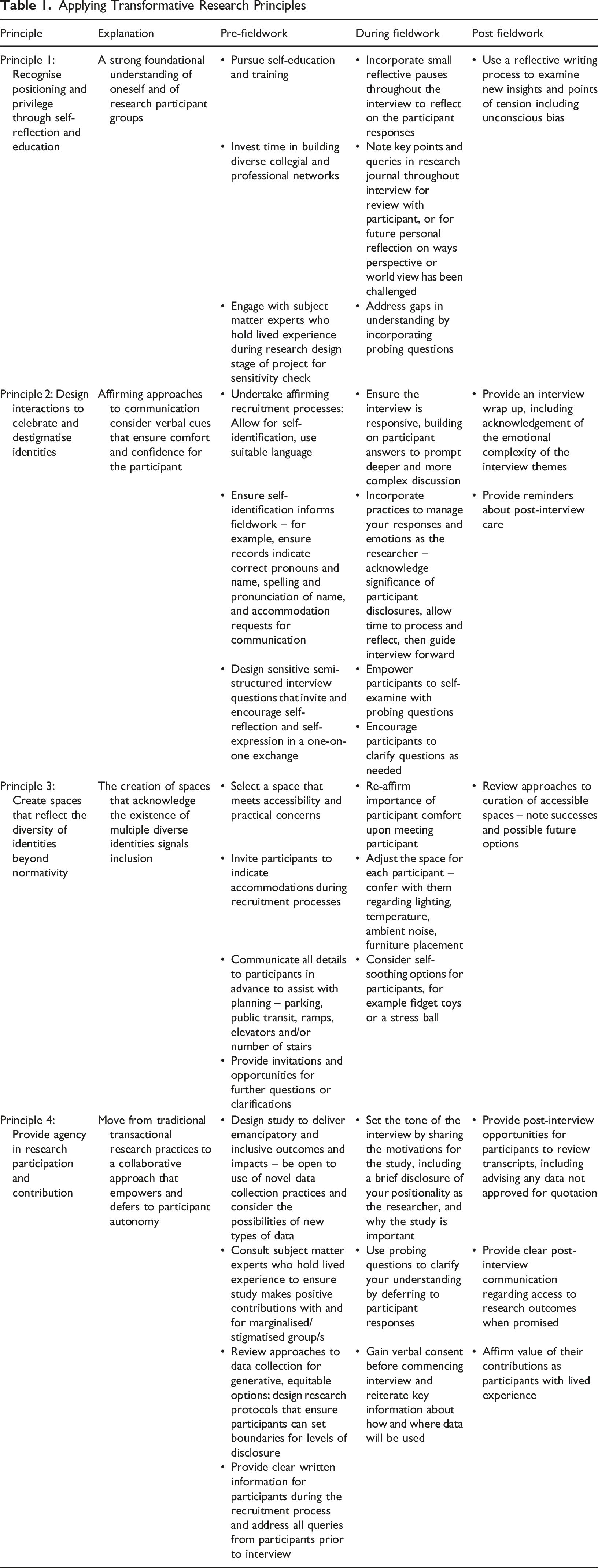
While these principles have been designed for researchers conducting research with a group they do not belong to, they also have relevance for in-group researchers – that is researchers who are members of the group they are researching. Being a member of the same marginalised/stigmatised group participants are from can help provide common ground, but should not automatically be taken to mean that they share an identical lived experience of that identity. For instance, the LGBTQ + communities represents a collection of different groups, with different identities and lived experiences. Further, within each group, for instance gay men, there can be differences based on ethnicity and socio-economic status, which can confer privilege. This means there is still a need to self-reflect/educate or recognise one’s privilege in line with Principle 1. Researchers from marginalised/stigmatised groups may also have different levels of comfort with displaying their identity – such as through the use of Pride colours/pins relevant to Principle 3.
Conclusions
This article introduces the notion of transformative research practice and puts forward principles to ensure qualitative research experiences can be transformative for participants from marginalised and/or stigmatised groups. The four principles highlight the importance of being self-reflective and deliberate in research practice. This will help ensure participant’s identities are affirmed instigating a potentially transformative experience. Such a focus shifts the narrative from designing inclusive research towards transformative research that not only enables marginalised and/or stigmatised participants to participate and also results in enhancing their world view about themselves and their identities.
Footnotes

Funding
The authors received no financial support for the research, authorship, and/or publication of this article.
Declaration of conflicting interests
The authors declared no potential conflicts of interest with respect to the research, authorship, and/or publication of this article.