



Abstract
The SARS-CoV-2 pandemic strongly influenced daily practices, and this manifested in social interactions, communications and consumption. This work addresses the relations between branding and cultural trends in strategic communication and advertising in different contexts of the pandemic. First, we reviewed the concepts of branding and cultural trends. From there, it was necessary to develop a methodological proposal to articulate a connotative semiotic analysis with the semiotic square and a cultural trend mapping. The analysis was carried out through an independent and comparative reading of two-time phases: confinement (2020) and end of constraints (2022). Three telecommunications brands in Portugal act as case studies in a random and probabilistic sample of two audiovisual texts from Christmas campaigns each. Finally, a theoretical-operational triangulation is obtained between branding, cultural trends and semiotic analysis in promoting local brands that redefine spaces, social relations, and identity expression during and after the COVID-19 pandemic confinements.
Introduction
This paper explores how strategic communication pieces from major Portuguese brands from an important sector, such as telecommunications, have addressed cultural trends. Our research follows the more difficult pandemic moments and years, from 2020 until the end of the main limitations in 2022. This comparative study allows us to see how cultural trends impact communication pieces; and how the pandemic affected communication content, advertising, and strategies in the sector. Our problem, and the knowledge gap, lies in the way trends are translated into brands in different contexts and visible through their communication pieces. This paper contributes to an answer with a specific semiotic analytical framework, contextualized in the following question: How did the Portuguese telecommunication sector highlight cultural trends in different moments of the COVID-19 pandemic?
For this purpose, our conceptual-methodological framework will focus on (1) branding and its relation to culture, drawing attention to authors such as Batey (2013), Holt (2004), Kotler and Gertner (2002), and Floch (1993); (2) on trend analysis (Dragt, 2017; Gomes et al., 2021; Higham, 2009; Powers, 2019) to review the main operational concepts for the analysis; and (3) semiotic protocols in the context of advertising analysis, following mainly a connotative Barthesian approach (Barthes, 1986, 1991) and the semiotic square (Greimas & Courtés, 1979), both with some scholarly actualizations (Gomes & Malafaia, 2020; Volli, 2015; Oswald, 2015, 2012; Bianchi, 2011; Mick et al., 2004; among others). Our cases represent three important telecommunication brands in Portugal, with a stratified sample of two communication pieces from 2020 and 2022 for each. This work is an in-depth narrative analysis of each communication piece to address the main imprinted meanings. Results show clearly that the three brands, even in two different contexts, address cultural trends and are impacted by them in constructing the communication narrative.
Branding
Historically, brands are perceptible factors of identification, used for recognition and differentiation of what is branded. However, brands are also cultural signs. They are “sets of meanings” (Batey, 2013, p. 33; McCracken, 2005, p. 179) that promise something to their audiences, strongly linked to sensory stimuli consumers collect in their interactions with the brands. Through exposure, selection, organization, and interpretation of experiences, brands fulfill a material identification role and, as Kotler and Gertner say, “incite beliefs, evoke emotions and prompt behaviours” (Kotler & Gertner, 2002, p. 249). In this sense, Jean-Marie Floch proposes that, like any language and social practice, brands can be defined as objects of meaning and understood as significant cultural realities (Floch, 1993, pp. 21–22). Hence, the semiotic approach contributes to work on brand communications and analyzing social consumer behaviors linked to advertising or commercial design, among other related areas (Floch, 1993). Brands provide materialistic, social, and cultural meanings by generating and organizing possible worlds through stories and intangible benefits, which support people in the construction of their personal and syncretic identities, projects and imaginaries while encouraging and giving meaning to their consumption (Kapferer, 2012; Semprini, 2006). This functional, semiotic, and cultural perspective of brands will be essential to articulating our applied analysis method.
From this operational viewpoint, trends can be found behind brands as mediators and in the communities for which they are managed, communicated and shared through cultural patterns and icons. Brands connect material identification with some complex and abstract meanings through actions of sociocultural consumption (Kapferer, 2012, pp. 7–8 and 44–45; Santos, 2012, p. 104; Semprini, 2006, pp. 36, 139–141 and 289; Floch, 1993, p. 32). This connection depends on different actors involved in possible contacts with what is branded and on the management process of each brand –also known as “branding”–. With branding, brands are named and marketed. However, they can also be transformed into more valuable signs by working with images, symbols, perceptions, and feelings, which stimulate beliefs, evoke emotions, and trigger behaviors (Batey, 2013, p. 28; Kotler & Gertner, 2002, p. 249). Thus, branding increases the value of brands and their recognition and preference in a symbolic, performative, and identifying way.
Strategically, branding achieves further success and brand recognition when that brand embodies a story that goes beyond a name, logo, or design. Sometimes, this story overcomes the product, service, organization, person, place, or whatever is being branded. Branding fills with cultural meaning those empty material markers that make up a brand, involving the product’s daily experience of consumers, the brand’s own communication and that of others, and the recognition and social discussion that surround it (Holt, 2004). We will use branding as a dynamic process focused on strategic communication of a brand as the core of value for the audiences. That process goes from simple persuasion to creating or managing narratives and trends.
Branding managers and analysts require a deep knowledge of brands, their consumers, and their contexts. We will take Douglas Holt’s proposal in which this knowledge should focus on: social changes, social categories of identification, brands as historical-social actors, people as integral subjects and not just consumers, and understanding of the identity value of the texts of the culture of masses over their qualities in terms of trends and entertainment (Holt, 2004, pp. 209–210). We also agree with Cantú et al. that cultural analysis of the sociocultural context of brands allows for establishing strategic bases (Cantú et al., 2019, p. 198). Cultural and consumer trends must be studied through behavior patterns and the construction of meanings in communication, product design or brand management. This can be seen through audiovisual productions with significant potential for identifying, analyzing, and monitoring sociocultural trends (Gomes, 2022), for example, in advertisements that offer powerful stories and cultural connotations.
Cultural Trends
Cultural trends are a social structure that encompass mindsets, patterns, and objects. They are social movements of change that go into specific directions (Cramer et al., 2016, p. 41; Dragt, 2017, p. 14; Kongsholm & Frederiksen, 2018, p. 25; Powers, 2019, p. 5; Vilar & Hellín, 2021, p. 17). They translate themselves into patterns of behavior and consumption. In a way, they represent a cycle of influence between objects/manifestations (Gomes et al., 2021, pp. 232, 235–236; Cramer et al., 2016, p. 44) that appear in the sociocultural landscape – products, but also practices, representations and artifacts in general. They impact the cultural environment and behaviors, and they shape and are shaped by new ideas – smaller or bigger changes in mindsets. This operational concept of trends is an essential basis for our research. They are the structures that will ultimately be identified with our case study objects.
Trends are an important indicator for strategy, business, and brand management – this is regularly, and latently, present in existing bibliography (Powers, 2019; Higham, 2009). They provide valuable insights on the consumer and the macro cultural environment. Considering how they shape lifestyles, interests, perceptions, and behaviors, they are a key compass to consider. There has been a discussion between trends and Marketing. In terms of trends marketing, William Higham addresses three processes: identification, interpretation, and implementation (Higham, 2009, p. 49). Regarding the latest, we “have to establish which trends are most relevant to their particular situation and then determine how they can exploit them most effectively” (Higham, 2009, p. 51). The author adds that trends are an important instrument for marketers and that business uses trends in one or another point in the business process. Articulating trend insights with business is important for marketing strategies and trends can provide a basis for impact analysis and identify potential benefits (Higham, 2009, p. 193). As Devon Powers says, “cultural change makes for good business, no matter what direction it goes” (Powers, 2019, p. 7). Trends can be used earlier when developing a strategy, but they can also act as a review instrument to audit already created objects, including narratives. We will follow this last process to see the connections between the brand narratives in advertising and already identified macro cultural trends.
Trends can have different densities according to their nature, impact, and audiences. They can be mega trends, macro trends or micro trends (Cramer et al., 2016, pp. 49, 54; Higham, 2009, pp. 87–88). Mega trends are too broad for the purposes of this research, but macro and micro trends simultaneously have a large scope and a specificity to them that allows us to take key insights for strategic purposes.
This trend analysis follows within the scope of Trend Studies, a conceptual-methodological approach (Gomes et al., 2021) that closely articulates the analysis of cultural trends to Culture Studies (Gomes et al., 2021; Powers, 2019).
We will be using the already identified trends and trend map from the Trends and Culture Management Lab. 1 Nonetheless, it is important to address the processes and protocols for trend analysis and identification. Gomes et al. (2021) mapped procedures and proposed an integrated protocol, discussing different works (Kongsholm & Frederiksen, 2018; Dragt, 2017; Cramer et al., 2016; Higham, 2009; among others). It starts with contextual analysis; to information systematization; trend architecture; trend DNA and text (Gomes et al., 2021, pp. 246–260) – from collecting data to organizing it and identifying the building blocks of a trend to addressing it in a cohesive and informative text. In 2022, Gomes and Cantú also highlighted the methods and elements/sections that can be used when building a trend report that focuses on trend identification: identification of the Nature, Context, Objectives, and Methodology; Desk Research; Observation (urban immersions and direct observations); Questionnaires; Coolhunting; PEST; Systematization; Trend Narratives; Insights (Gomes & Cantú, 2022, pp. 70–71). As the authors suggest, in terms of marketing and branding, this type of report gives insights on consumer behavior changes and points for paths to new strategies and communication narratives (Gomes & Cantú, 2022, p. 72).
Methodological application and case analysis
Semiotic protocol for cultural trend analysis in strategic communication texts.
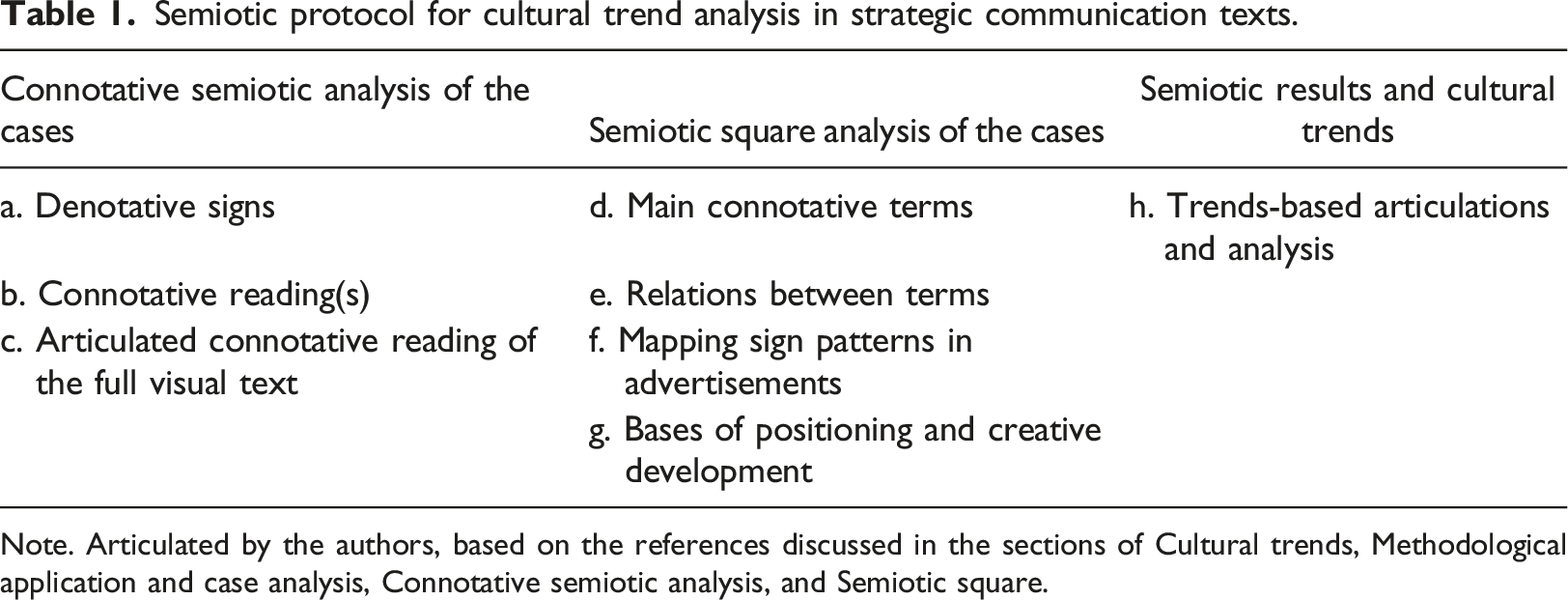
Note. Articulated by the authors, based on the references discussed in the sections of Cultural trends, Methodological application and case analysis, Connotative semiotic analysis, and Semiotic square.
It is worth mentioning that, although we worked protocols based on rather classic methods of semiotics, such as the semiotic analysis model (Barthes, 1986, 1991) and the semiotic square (Greimas & Courtés, 1979), we considered specific procedural adjustments to these methods shared more recently by specialists (Bianchi, 2011; Gomes & Malafaia, 2020; Mick et al., 2004; Oswald, 2012, 2015; Volli, 2015). Variations on the semiotic square have been approached to study products, brands, marketing, and advertising (Floch, 1993; Galli et al., 2019; Østergaard et al., 2015; Perusset, 2023; Rossolatos, 2012a; among others). 3 Others have used the semiotic square approach to build a linguistic protocol for trend identification and analysis and to see movements in a cultural map within the square (Stock & Tupot, 2015, 2020). 4 However, here we intend to use and combine semiotic methods to read and discuss contemporary objects of brand communication and their strategies through their audiovisual texts, in light of already identified cultural trends.
Connotative semiotic analysis
There is already a large tradition in applying semiotic analysis to advertising and branding. From a visual perspective (Rose, 2001) to a marketing one (Oswald, 2012, 2015; Rossolatos 2012b, 2018), an interpretative advertising tradition has promoted a close reading and in-depth analysis of narratives and meanings imprinted into advertising pieces. There is a large following of the Peircean model and construct for semiotic analysis, and there are works that already articulate this perspective in terms of advertising and trends (Bogo & Machado, 2022; Silva, 2015; Vilar & Hellín, 2016). There are also other works that articulate trends and semiotics (Bogo & Machado, 2022; Vilar & Hellín, 2021) and one specifically in terms of our case study, Gucci (Cantú, 2022).
In our work, we will start with the protocol by Roland Barthes (1991, 1986), following a Saussurean perspective, to review denotative, connotative, and mythical aspects. Following the Saussurean paradigm, as Mick et al. highlighted, “its basis in language has led to an intense focus and extensive insights on (a) the nature and role of structure in communication and meaning, (b) the nature and role of symbolism […], and (c) the cultural relativity of communication and meaning due to arbitrariness” (Mick et al., 2004, p. 5). As Bianchi added, “semiological studies of advertising have a descriptive rather than an evaluative intent” (…), “adopting a procedure that involved ‘breaking down’ the object in order to understand how it functioned” (Bianchi, 2011, pp. 244–245). This perspective, following specifically the developments of Barthes, has been reviewed in advertising terms by Volli (2015), Oswald (2015, 2012), Gomes and Malafaia (2020), Gomes (2022, 2021), and also articulated with trends by Gomes (2020).
We start this exercise by identifying the most relevant signs in each case object, following the Saussurean understanding of the sign as a dyad composed of the signifier and the signified. We will apply the perspective of a second order of the semiological system (Barthes, 1991, p. 113) but following Barthes’s review of denotation and connotation (Barthes, 1986, pp. 89–94). So, at the first level, we have the denotative reading/sign, and at the second level, the connotative reading/sign (Barthes, 1986, p. 90). For Volli, there is also a third level following these two, the advertising sign, where the connotative signs are used to evoke the product/brand (Volli, 2015). This perspective contextualizes the first steps of our protocol: (a) identify the main signs in a denotative fashion; (b) provide the connotative reading of each; (c) articulate the different connotative readings to see the visual text as a whole and provide a unified connotative reading of the visual text as a full connotative sign. This last point follows the possibility highlighted by Barthes: “several denoted signs can be grouped together to form a single connotator […] the units of the connoted system do not necessarily have the same size as those of the denoted system” (Barthes, 1986, p. 91). This description protocol follows the exercise of Gomes and Malafaia (2020).
Semiotic square
To reach a next level with results obtained from the previous independent semiotic analysis, we will face and articulate the different connotative readings of visual texts as integrated signs. In this sense, Ugo Volli’s perspective stands out, which recommends taking advantage of the character of the opposition of meanings typical of the semiotic approach, also seeking analysis of textual units in pairs and not in isolation (Volli, 2015, Chapter III, par. 3). Laura Oswald agrees, appealing to approach advertising as a system or network, through a binary analysis compared between different advertising texts, “with an audit of the recurring patterns structuring brand meaning” (Oswald, 2015, p. 42). For this purpose, both authors (Oswald, 2015; Volli, 2015) work with the semiotic square, initially proposed by Algirdas Julien Greimas (Greimas & Courtés, 1979). This Greimassian semiotic square is “the visual representation of the logical articulation of any semantic category” (Greimas & Courtés, 1979, p. 364). It intends to represent an implicit conceptual framework through a kind of semantic map within the specific significant universe of the analyzed discourse or text (Chandler, 2022, p. 124).
The semiotic square considers a minimum of four different and comparable terms, operationally related and with various levels of categorical complexity (Greimas & Courtés, 1979, pp. 364–368). Specifically, it presents four types of relations regarding the observed semiotic category: opposition or contrariety on the upper horizontal axis –S1-S2–; subcontrariety on the lower horizontal axis –no S2-no S1–; deixis or complementarity on the verticals –not S2-S1 and not S1-S2–; and the contradiction along its diagonals –S1-not S1 and S2-not S2– (Chandler, 2022, pp. 124–126; Volli, 2015, Chapter III, pp. 8–14; Greimas & Courtés, 1979, p. 366).
It is relevant to emphasize that in the original proposal of the Greimasian semiotic square, the opposite terms that underpin the tool –S1 and S2– are determined as an affirmation versus a denial (Greimas & Courtés, 1979, pp. 365–366). However, it also opens the possibility of squares based on other types of terms whose relationship of contrariness is less antagonistic, such as, for example, “be” and “seem” (Greimas & Courtés, 1979, p. 367). Furthermore, the authors’ approach on which we base our application of this method makes the selection of the two opposite terms even more flexible, as scholars have seen by tensioning concepts for the management or study of strategic brand communication, narratively and culturally defined to guiding interpretation and persuasion (Floch, 1993; Oswald, 2015; Perusset, 2023; Rossolatos, 2012a; Volli, 2015). Volli recommends that, especially for advertising analyses, over the negative opposites of the black and white type, we can confront terms such as white and red in the case of Italian politics, white and blue in the case of Italian football, white and green as symbols of snow and field, white monks and gray monks, or white blood cells and red blood cells (Volli, 2015, Chapter III, par. 9–10). Likewise, for the advertising field, Oswald suggests the importance of the semiotic square to analyze binary but whose tension is culturally defined, such as those linked to genders such as masculine and feminine, or to dimensions such as modern and traditional, which are perceived rather than antonyms as contextual stereotypes or paradigms, with several gray areas between them (Oswald, 2015, pp. 25–26 and 45).
From the aforementioned perspective, to interpret the cultural trends of recurrent connotative signs by tensioning the binary poles of the cultural category and their brand interactions (Oswald, 2015, pp. 43–45), we will add this tool to represent paradigmatic dimensions of the studied brand category. Thus, the semiotic square leads to the next steps of our protocol: (d) highlight two main connotative terms in tension from the cases of each brand and define their contradictory terms to have the four vertices; (e) visualize relations between the different terms to name the four axes; (f) map most used signs between advertisements by means of grouping under the axes; (g) articulate results to see the bases of evolution of positioning and creative development of each brand. This approach allows us to reveal semiotic results and cultural trends (based on section 2) through (h) trends-based articulations and analysis, represented in comparable texts from advertising campaigns in different moments/contexts.
Case presentation
For this study, we considered three telecommunications brands that remained active in their local communication in Portugal during the COVID-19 pandemic. These three brand cases are MEO, NOS and Vodafone. They concentrate a relevant part of the Portuguese market in the category. For our study, two audiovisual advertisements were randomly chosen for each case: one from the containment stage of the pandemic at Christmas time in 2020; and another from the end of the confinement stage at Christmas time in 2022. 5
Connotative semiotic analysis of the cases
Case 1.1. MEO Natal 2020: “Neste Natal o MEO vem com tudo” (https://youtu.be/100ZzFNiQ8k)
Denotative and connotative readings from case 1.1.
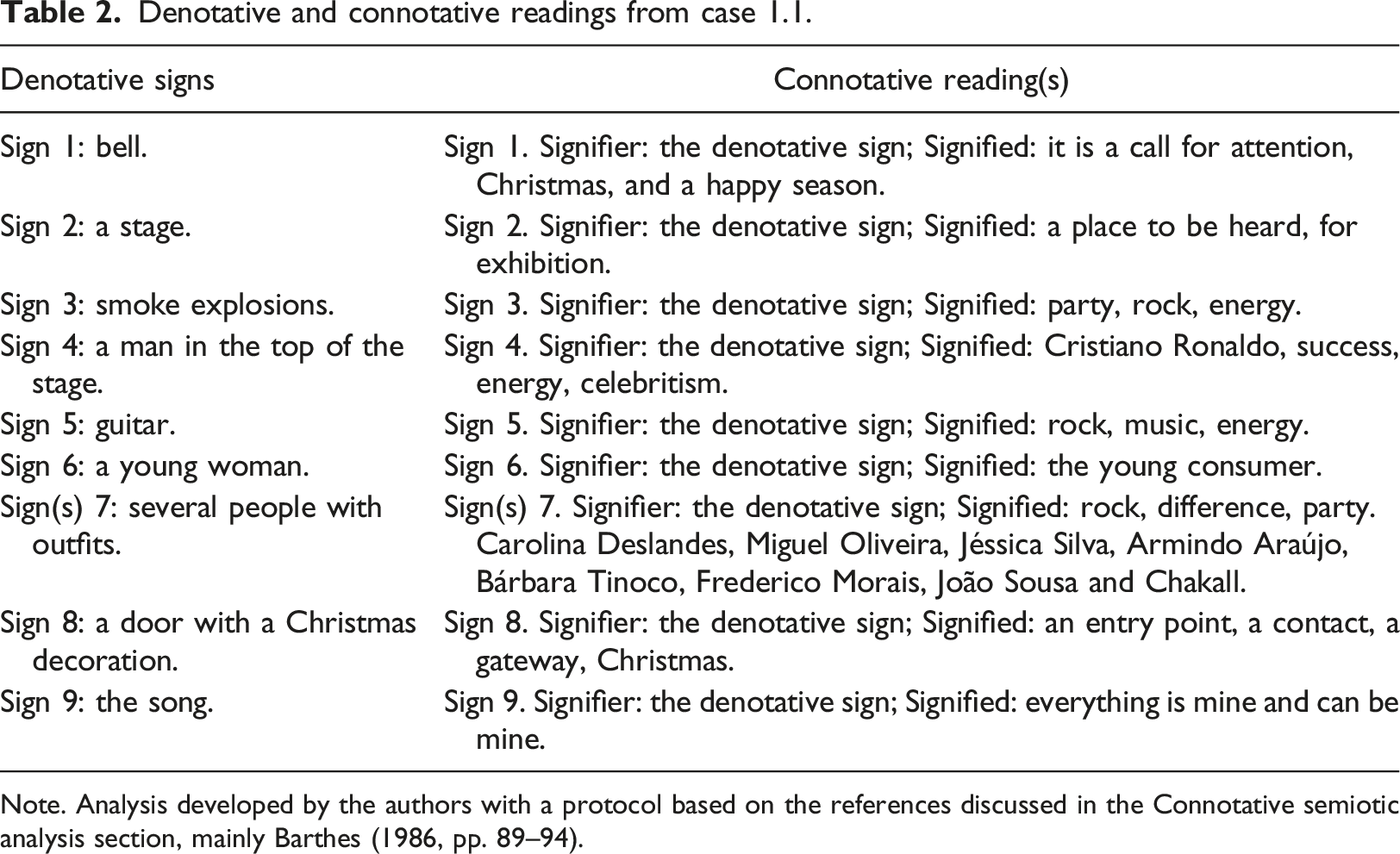
Note. Analysis developed by the authors with a protocol based on the references discussed in the Connotative semiotic analysis section, mainly Barthes (1986, pp. 89–94).
Articulated connotative reading of the full visual text
It connects different signs of Christmas and rock to give a representation of energy, party, activity, “celebritism” and a call to action. A Christmas Rock that empowers people to have everything the brand offers.
Celebritism in its various arts is the initial motto, mainly with Cristiano Ronaldo, that calls youth to action and rock – those that want technology and fast internet and demand it from their parents, from the stage to the Christmas family assembly.
Christmas and rock may seem distant or polarized, but musicality combines the mentioned positive adjectives. In a certain way, the calm of the family Christmas stage is rocked by young people who come from a rock concert, promoting the idea of crashing into a party and rocking the calm and traditional Christmas set, also showing tolerance and that anyone can step in and access the brand’s offer.
Case 1.2. MEO Natal 2022: “Há Natal nas diferenças” (https://youtu.be/ykSh57XUFeU)
Denotative and connotative readings from case 1.2.
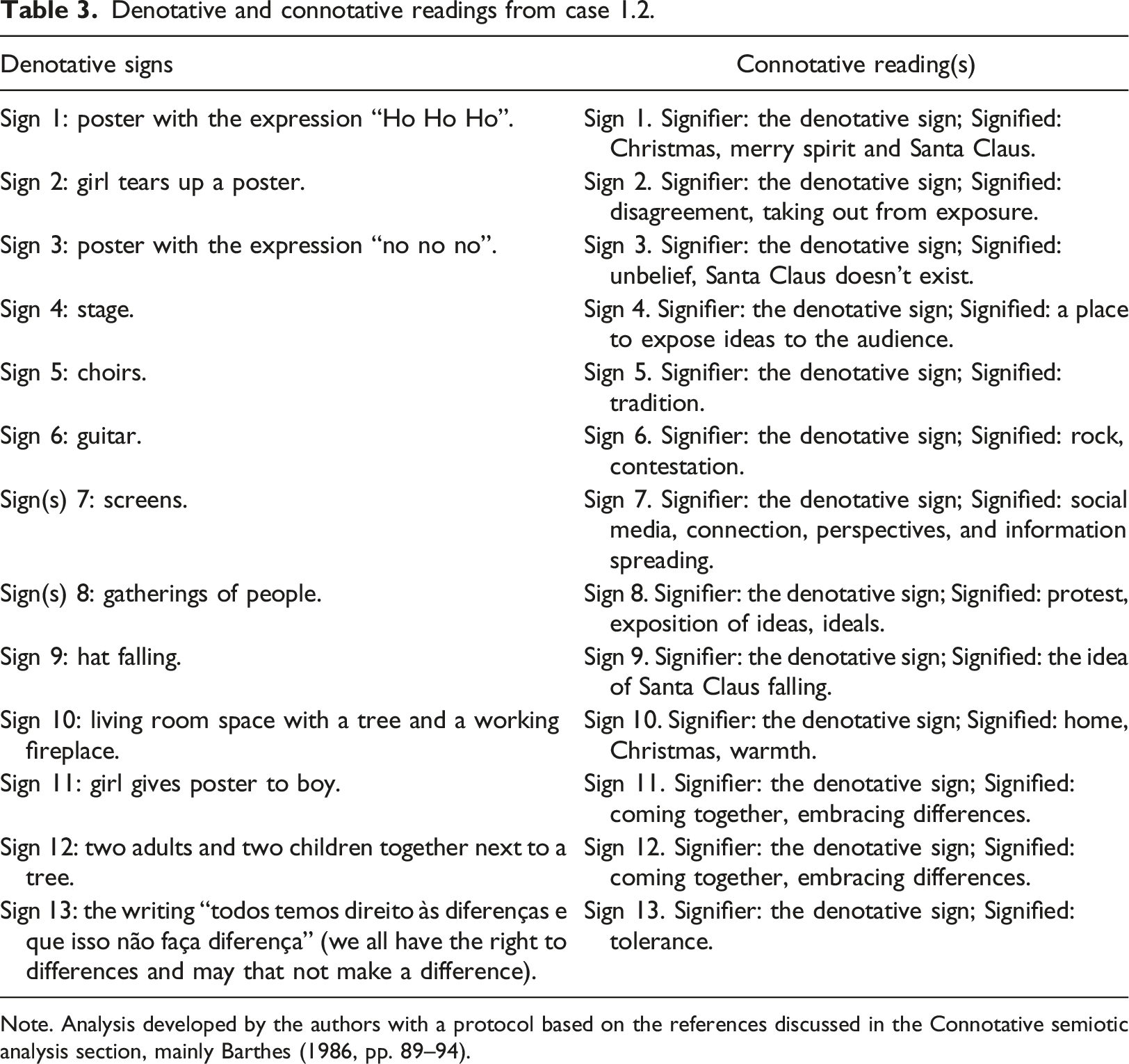
Note. Analysis developed by the authors with a protocol based on the references discussed in the Connotative semiotic analysis section, mainly Barthes (1986, pp. 89–94).
Articulated connotative reading of the full visual text
It is a discussion about a Christmas symbol, Santa Clauses, to highlight the polarization of opinions on the streets and social media, as an exposure of disagreements that, in the end, are overcome with listening, respect and coming together. It appeals to the idea that we can all come together (at Christmas) no matter the differences of opinion: to promote tolerance and togetherness in family/friends union around Christmas.
In the first interpretation, polarization takes the stage: to believe or not in Christmas “magic” and Santa Claus. In a way, it calls for, or underlines, the need for engagement with issues and politics in a metaphor that uses Santa Claus. We have rallies, protests, manifestations, and, as in the advert before, rock also takes a center place in empowering. Social media and the rapid exchange of news, opinions and data also highlight the need and inevitability of being online and information being shared and (re)contextualized.
At the same time, it highlights the right to different opinions but extrapolates the violence and negative discourses that can come from it. The advert calls attention to being more understanding and tolerant of different perspectives. In the end, we can make an exploratory interpretation that different opinions can coexist with good disposition and communication.
Case 2.1. NOS Natal 2020: “A separação” (https://youtu.be/Aa4T3Cop2eM)
Denotative and connotative readings from case 2.1.
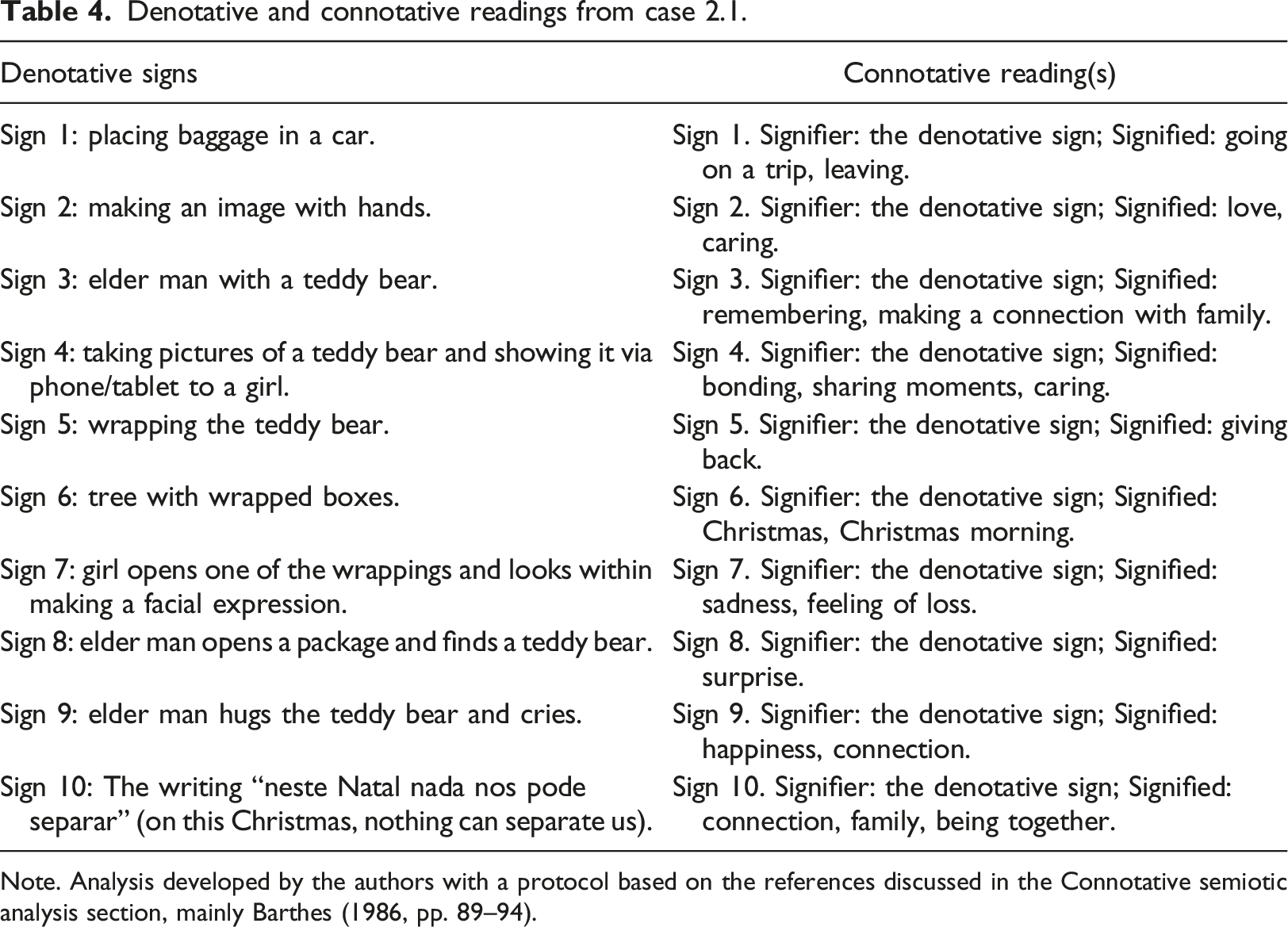
Note. Analysis developed by the authors with a protocol based on the references discussed in the Connotative semiotic analysis section, mainly Barthes (1986, pp. 89–94).
Articulated connotative reading of the full visual text
It addresses distance and the need to connect and be in touch. Christmas calls for family experiences and the digital connection via an object of affection offers a bridge between what we believe to be a grandfather and a granddaughter. It calls for the need to connect when being distant and to share experiences that generate positive emotions.
It is about sharing experiences and emulating home closeness. The text shows a digital connection as a bridge and opportunity to be in touch and limit the distance and isolation caused by the pandemic. It reminds us that Christmas is seen as a family custom.
There is also an idea of caring. In this challenging year, caring for one another and showing that we care is essential. Caring for the bear is an extension of the connection with the granddaughter.
Case 2.2. NOS Natal 2022: “O carrossel” (https://youtu.be/b7PLmnIWly4)
Denotative and connotative readings from case 2.2.
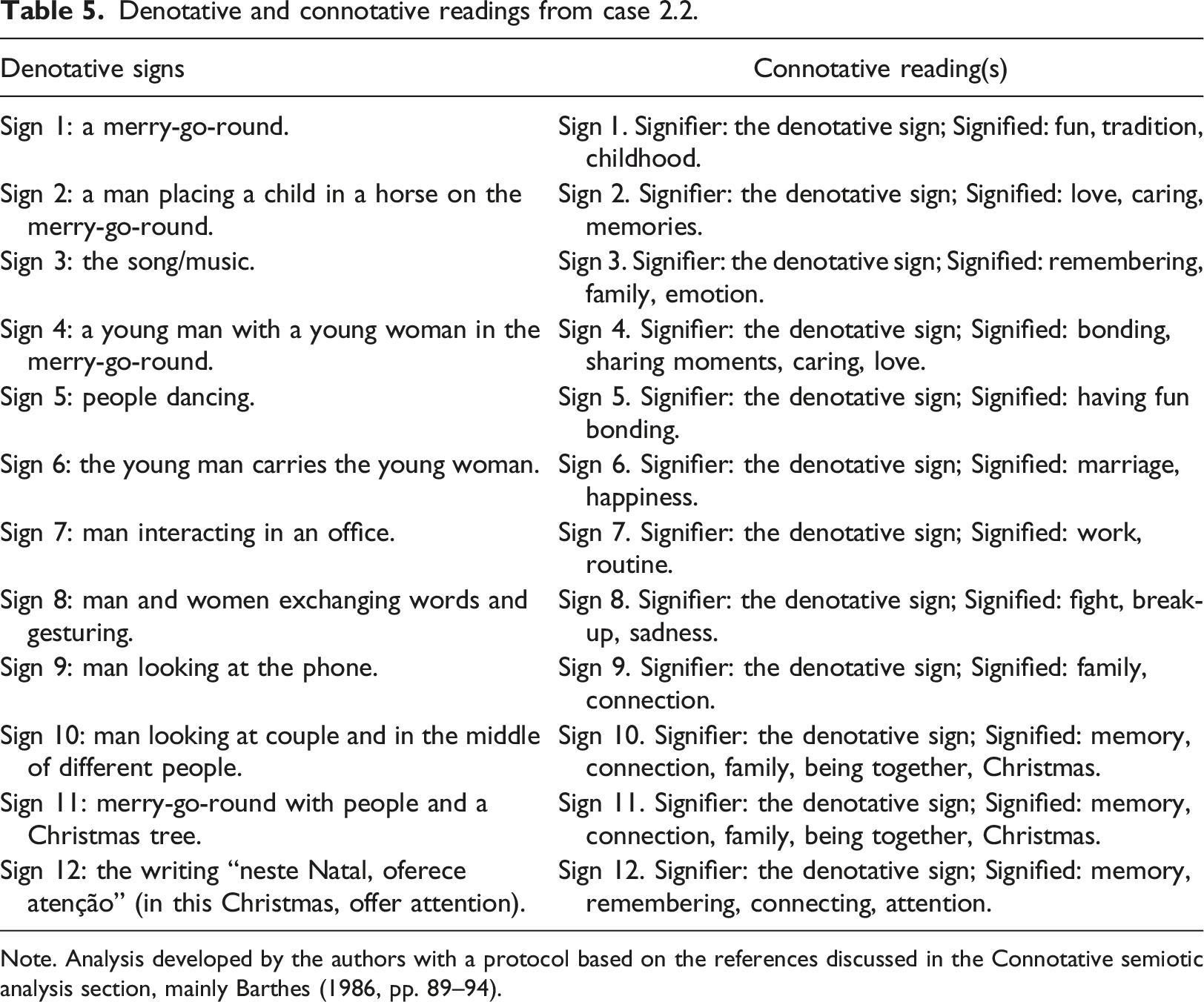
Note. Analysis developed by the authors with a protocol based on the references discussed in the Connotative semiotic analysis section, mainly Barthes (1986, pp. 89–94).
Articulated connotative reading of the full visual text
It deals with tradition, family, and memory in an articulate way to call out the need to give affection and share experiences. The merry-go-round is one of the main signs that go from happiness to other emotions, joining the family at the end – a place of memory and belonging.
Different signs point to important relations highlighting temporal development: tradition - old game fairs; family - fathers and son; memory - the transition of key-scenes with growing characters. The merry-go-round illustrates a circle/cycle in motion with high and low moments but with the possibility of returning to the beginning or balancing the processes. Christmas is also recurrently seen as a moment to remember loved ones who may no longer be so close and to introspect about the year and our lives.
These articulations highlight the importance of giving attention and sharing experiences: inviting not to neglect the problems of loved ones throughout their lives. Again, it is about self care and looking after others. The advert calls for attention to give importance to what is really important by highlighting family again.
Case 3.1. Vodafone Natal 2020: “Canto de Natal” (https://youtu.be/d3iiW7sAXPw)
Denotative and connotative readings from case 3.1.
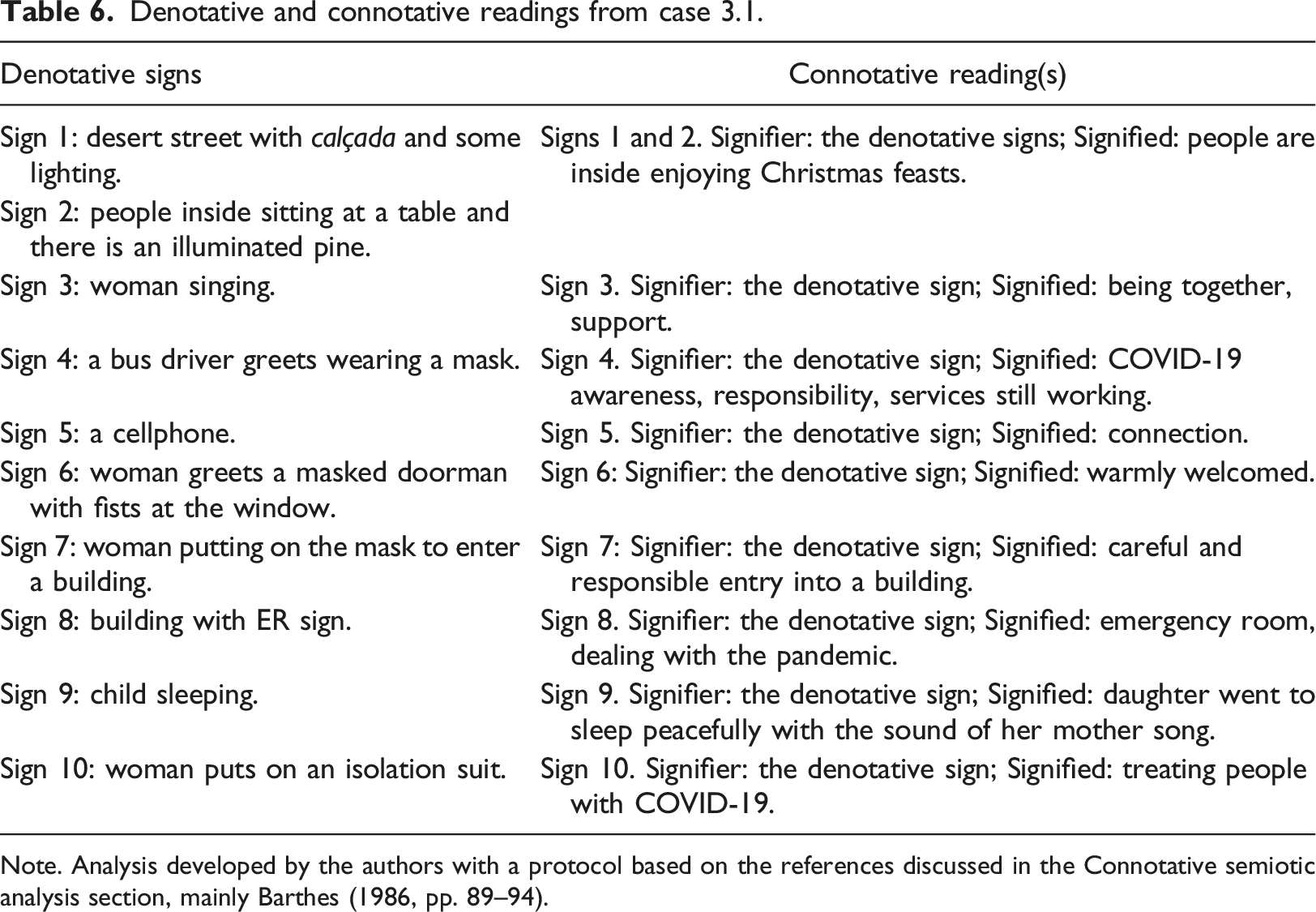
Note. Analysis developed by the authors with a protocol based on the references discussed in the Connotative semiotic analysis section, mainly Barthes (1986, pp. 89–94).
Articulated connotative reading of the full visual text
It calls out the responsibility of being home during the COVID-19 pandemic, with desert streets, while services work and health providers fight against the pandemic helping people. While this, the brand provides a connection point to accompany loved ones.
Health providers are the only ones moving in this scene. It is about being engaged whit the different people who need us. Even those who must leave the house can “be” in the family’s daily moments.
It directly underlines the context of COVID-19 while showing that technology can create bridges and presences for those who need our accompaniment while we need to attend to others who require our professional medical attention. In sum, the text is about strong and facilitation of connection.
Case 3.2. Vodafone Natal 2022: “Partilha o que estás a sentir” (https://youtu.be/a1zesVBH5yc)
Denotative and connotative readings from case 3.2.
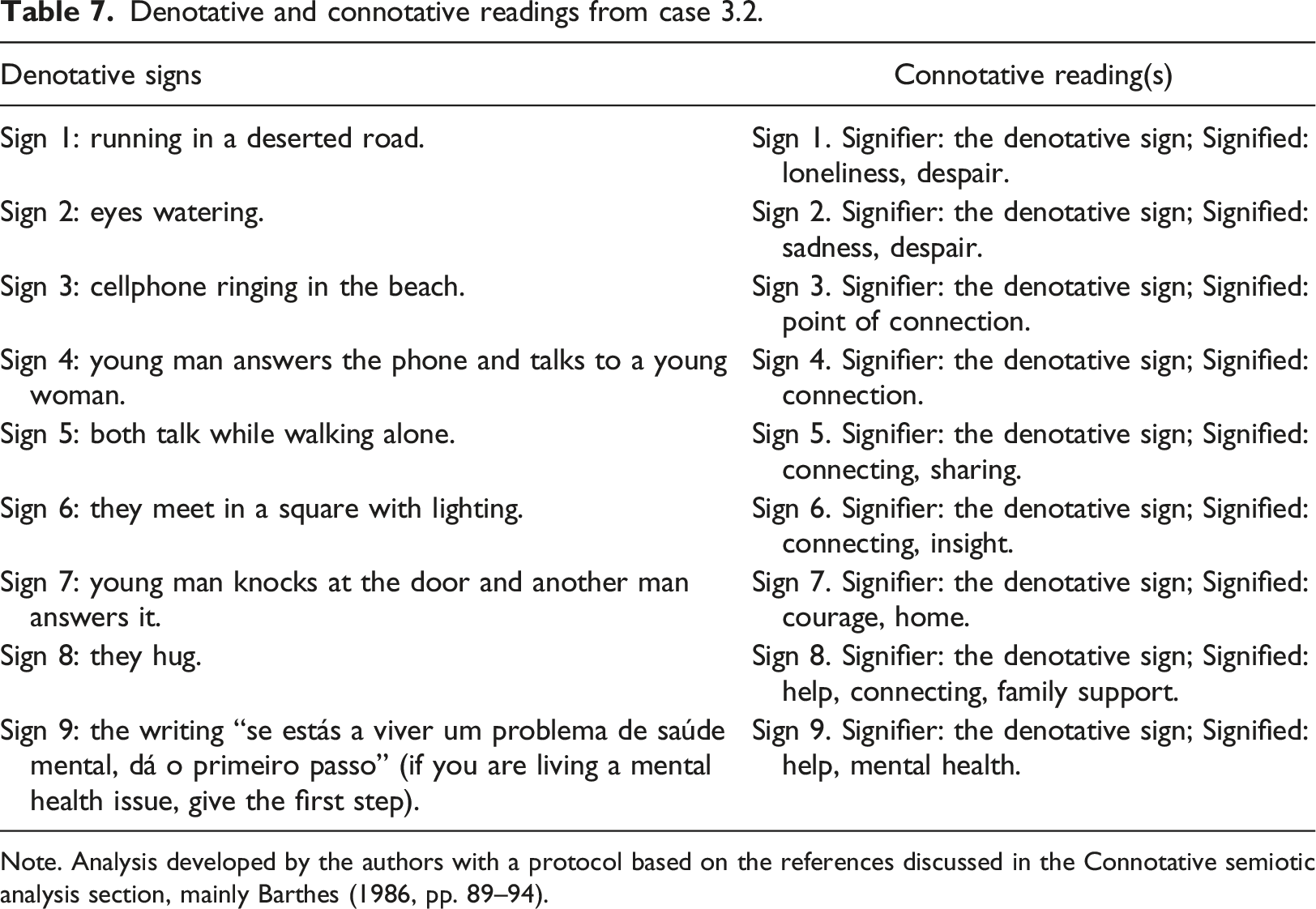
Note. Analysis developed by the authors with a protocol based on the references discussed in the Connotative semiotic analysis section, mainly Barthes (1986, pp. 89–94).
Articulated connotative reading of the full visual text
It highlights moments of sadness and loneliness from mental health issues and finding help to cope, deal, and heal. Like the advert before, it is about strengthening connections. Staying engaged is essential to help, support and care for others.
On the advert, we go from the illustration of abandonment (scenes of being alone and suffering) to a moment of help and dialogue and understanding (when she talks with him and hugs him in the end), to a final moment of engagement –connection– and accompaniment where the cellphone is presented as a bridge for direct –familiar– care and communication.
Again, the cellphone and brand are bridges, connections and awareness elements, essentials in times of personal and group crises, such as during times of confinement.
Semiotic square analysis of the cases
MEO: Christmas advertisements 2020 and 2022 (Cases 1.1 and 1.2)
Main connotative terms
For this semiotic square (Figure 1), we will use: EMPOWERMENT as the first term –S1–; POLARIZATION as its term in tension –S2–; WEAKENING as a contradictory term to the first –not S1–; and TOLERANCE as a contradictory term to the second –not S2–. Semiotic square from cases 1.1 and 1.2. Note. Analysis developed by the authors with a protocol based on the references discussed in the Semiotic square section, mainly Greimas and Courtés (1979, pp. 364–368).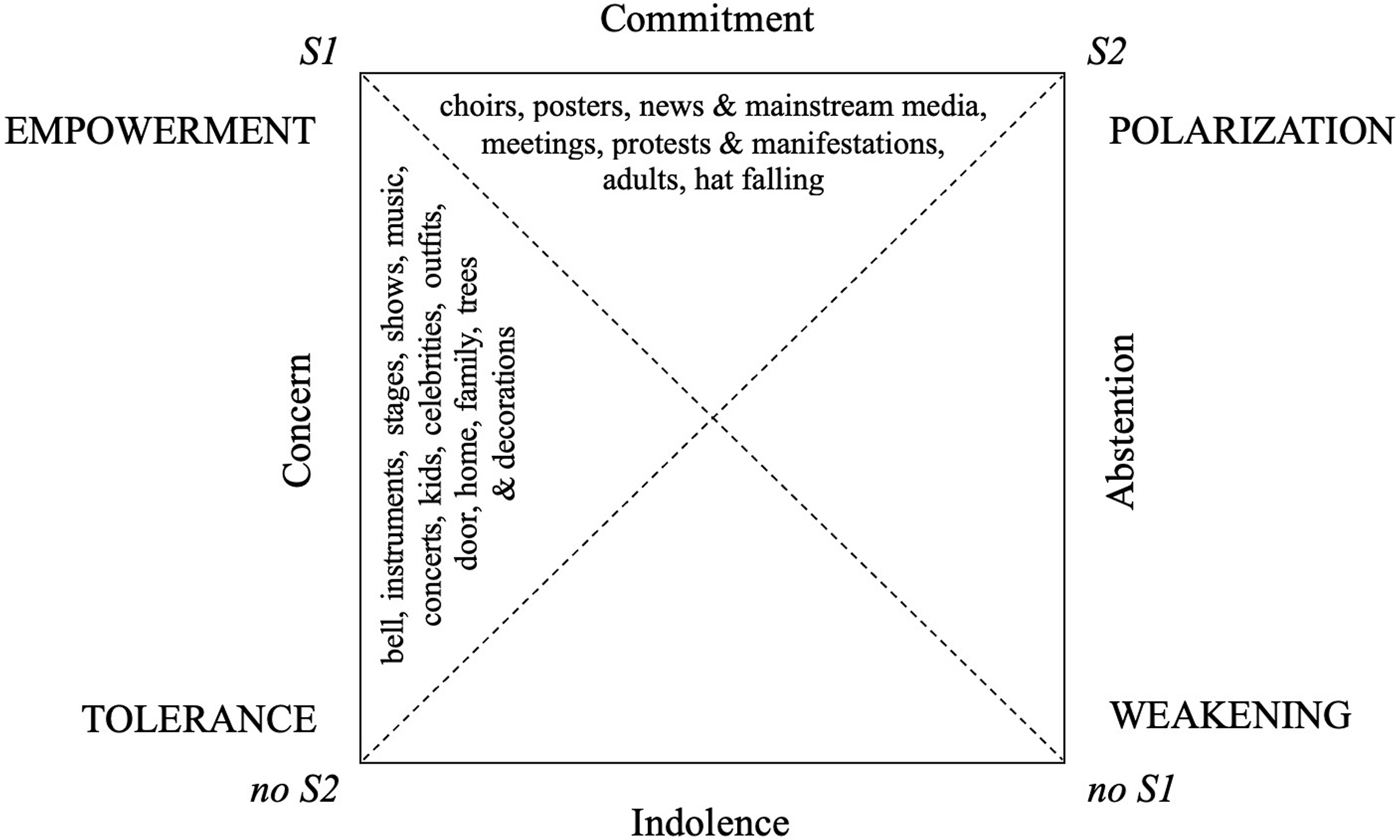
Relations between terms
With the two main terms and their contradictory ones already defined –S1-not S1 and S2-no S2–, to conceptualize the other relations, it is suggested that: Commitment as the axis of opposition –S1-S2–; Indolence as the axis of subcontrariety –not S2-not S1–; Concern as the axis of positive deixis –not S2-S1–; and Abstention as the axis of negative deixis –not S1-S2–.
Mapping sign patterns in advertisements
Based on the main terms and their relations, we will map the signs used between both advertisements by grouping: under the Concern axis, the signs of bell, electric instruments, stages, shows, music, concerts, kids, celebrities, outfits, door, home, family, Christmas trees and decorations; and under the Commitment axis the signs of traditional choirs, posters, news and mainstream media, meetings, protests and manifestations, adults, and Santa’s hat falling.
Bases of positioning and creative development
MEO’s positioning strategy focuses on the meaning of empowerment, contrasting its relationships with tolerance and polarization. In both cases, the brand shares patterns and cultural icons that represent forms of concern, with high levels of energy, calls to action and festivities. This creative development also offers commitment possibilities by sharing ideas related to forms of communication, manifestations and gatherings. At the same time, it seeks to repel possible prejudices of weakening, linked to signs of abstention and indolence, most related to apathy, disagreements and insurmountable differences of opinion.
NOS: Christmas advertisements 2020 and 2022 (Cases 2.1 and 2.2)
Main connotative terms
For this semiotic square (Figure 2), we will use: AFFECTION as the first term –S1–; ISOLATION as its term in tension –S2–; NEGLECT as a contradictory term to the first –not S1–; and ATTENTION as a contradictory term to the second –not S2–. Semiotic square from cases 2.1 and 2.2. Note. Analysis developed by the authors with a protocol based on the references discussed in the Semiotic square section, mainly Greimas and Courtés (1979, pp. 364–368).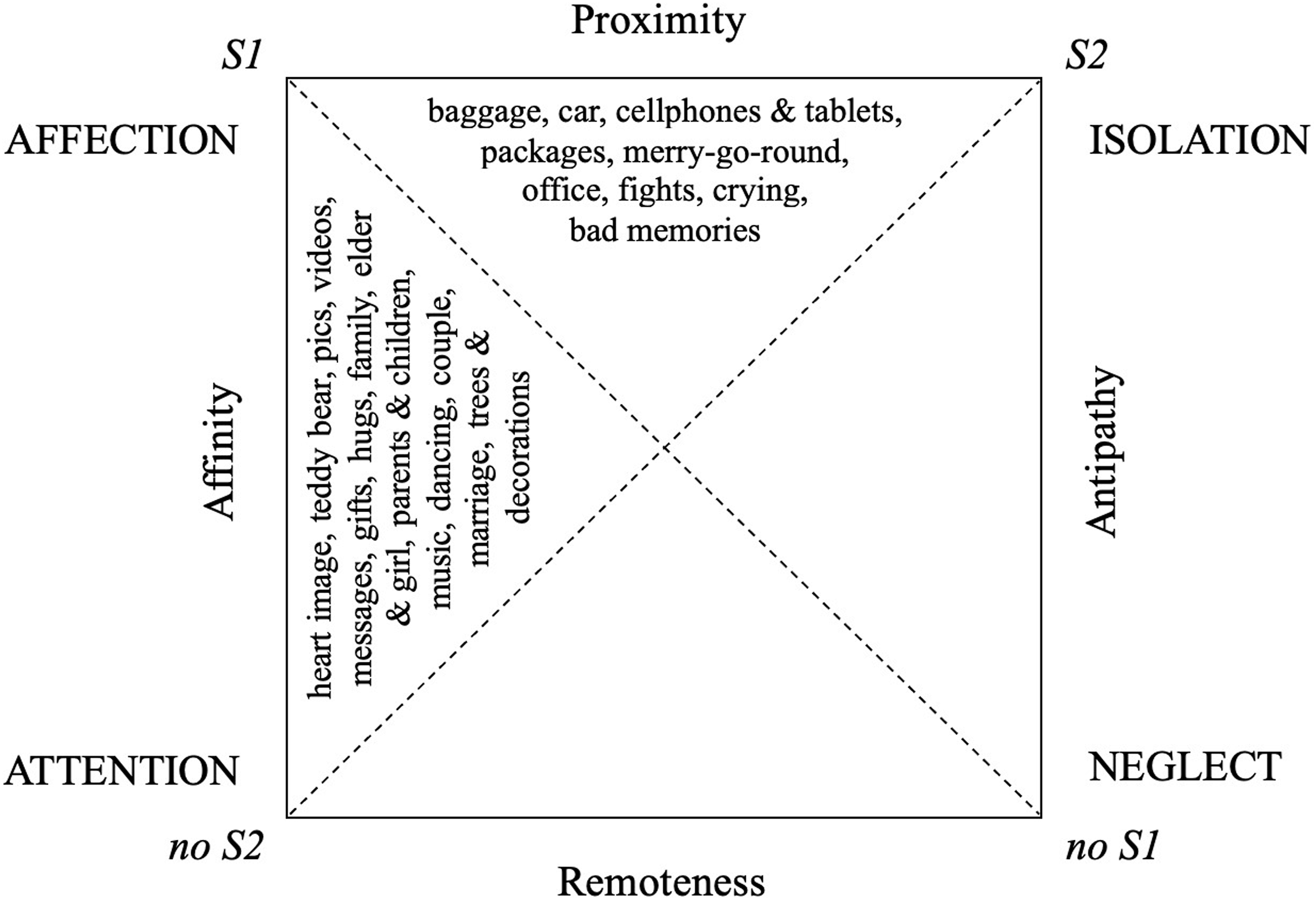
Relations between terms
With the two main terms and their contradictory ones already defined –S1-not S1 and S2-no S2–, to conceptualize the other relations, it is suggested that: Proximity as the axis of opposition –S1-S2–; Remoteness as the axis of subcontrariety –not S2-not S1–; Affinity as the axis of positive deixis –not S2-S1–; and Antipathy as the axis of negative deixis –not S1-S2–.
Mapping sign patterns in advertisements
Based on the main terms and their relations, we will map the signs used between both advertisements by grouping: under the Affinity axis, the signs of the heart image with hands, teddy bear, pictures, videos, messages, gifts, hugs, family, elder man and girl, parents and children, music, dancing, couple, marriage, and Christmas trees and decorations; and under the Proximity axis the signs of baggage, car, cellphones and tablets, packages, merry-go-round, office, fights, crying, and bad memories.
Bases of positioning and creative development
NOS’s positioning strategy focuses on the meaning of affection, contrasting its relationships with attention and isolation. In both cases, the brand shares patterns and cultural icons that represent forms of affinity, with high levels of being in touch, family experiences and beliefs. This creative development also offers proximity possibilities by sharing ideas related to trips, media and personal memories. At the same time, it seeks to repel possible prejudices of neglect, linked to signs of antipathy and remoteness, most related to separation, traumas and loneliness.
Vodafone: Christmas advertisements 2020 and 2022 (Cases 3.1 and 3.2)
Main connotative terms
For this semiotic square (Figure 3), we will use: ACCOMPANIMENT as the first term –S1–; DISENGAGEMENT as its term in tension –S2–; ABANDONMENT as a contradictory term to the first –not S1–; and ENGAGEMENT as a contradictory term to the second –not S2–. Semiotic square from cases 3.1 and 3.2. Note. Analysis developed by the authors with a protocol based on the references discussed in the Semiotic square section, mainly Greimas and Courtés (1979, pp. 364–368).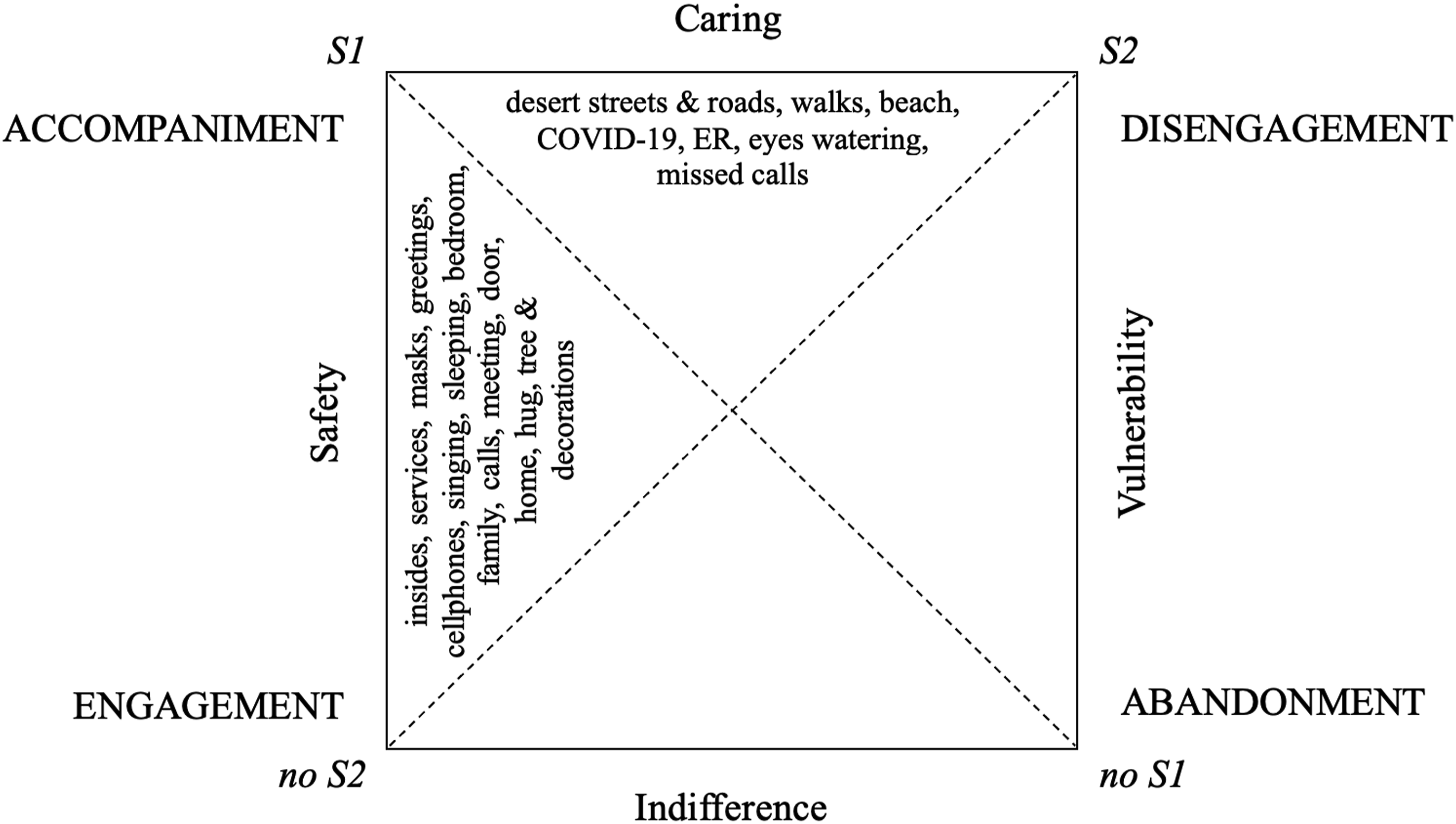
Relations between terms
With the two main terms and their contradictory ones already defined –S1-not S1 and S2-no S2–, to conceptualize the other relations, it is suggested that: Caring as the axis of opposition –S1-S2–; Indifference as the axis of subcontrariety –not S2-not S1–; Safety as the axis of positive deixis –not S2-S1–; and Vulnerability as the axis of negative deixis –not S1-S2–.
Mapping sign patterns in advertisements
Based on the main terms and their relations, we will map the signs used between both advertisements by grouping: under the Safety axis, the signs of insides, services and workers, masks, greetings, cellphones, woman singing, child sleeping, bedroom, parents and family, calls, meetings, door, home, hug, Christmas tree and decorations; and under the Caring axis the signs of desert streets and roads, walks, beach, COVID-19, ER, eyes watering and missed calls.
Bases of positioning and creative development
Vodafone’s positioning strategy focuses on the meaning of accompaniment, contrasting its relationships with engagement and disengagement. In both cases, the brand shares patterns and cultural icons that represent forms of safety, with high levels of responsibility, providers and companions. This creative development also offers caring possibilities by sharing ideas related to social crisis, human relations and awareness. At the same time, it seeks to repel possible prejudices of abandonment, linked to signs of vulnerability and indifference, most related to sadness, mental health issues and COVID-19.
Semiotic results and cultural trends
For this analytical protocol, we will use the trends identified by the Trends and Culture Management Lab from the School of Arts and Humanities, University of Lisbon, considering its methodological approach to the identification and analysis of trends. i. Regarding the MEO videos, the brand aims to empower the audience through scenes of concern and commitment. There is a clear connection, especially in the second one, with the topic of polarization in a general connection with the “Protagonist Identities”
6
macro trend and a specific connection to the “Polarizations”
7
micro trend. The brand addresses both celebritism and contestation, but it is always connected to the concepts of identity and expression, these are transversal in both adverts. It is interesting how the brand captured the zeitgeist of differences and polarizations and presented the conflict positively and with a happy ending. Addressing the topic generates a process of understanding and identification in the audience that will recognize the social dynamics and positively end the viewing of the narrative. In a way, it also addresses the “Anchored Narratives”
8
macro trend in the importance of symbolic repositories and how they operate the construction and reconstruction of narratives since the nature of Christmas and Santa Claus is called into question: this calls for a tolerant discussion of collective memory representations and the discussion around mental constructions. ii. In terms of NOS, the brand is looking to transmit affection, with affinity and proximity representations. Although there could be something to explore regarding isolation, mainly from the second video, the main topic of family and attention goes to deeper topics beyond specific cultural patterns. The first video directly connects to the “Ergonomic Connections”
9
macro trend. This idea of being perpetually connected and linked with our loved ones and our topics/narratives/communities of interest is growing in a way that generates a blur between realities – proximity and accessibility become two of the most important commodities, and we can see that in the narrative. The potential of digital connection, breaking the walls between space and physical-digital boundaries, is present as an affinity opportunity. iii. Vodafone’s adverts work on accompaniment, balancing safety and caring signs. There is a connection between these two brand objects and the iterations of the last four years regarding the macro trend “Lifestyles Redesign”
10
, either at the level of the changes that the COVID-19 led confinement generated or regarding the mental health issue and abandonment. It is a macro trend that has suffered profound changes in a small amount of time, dealing with mindsets of the moment. This trend highlights the challenges that came with the pandemic and the many that ensued from it and new hostile and violent contexts. It shows how we adapt to new realities and how it takes a tool to engage with other people and the entire world. Again, it generates a process of identification and connection with the audience while highlighting and calling attention to important issues of the day.
The three brands, in one video or both, have displayed a connection to three different macro trends, one each, with no overlapping of mindset trends.
Conclusion
The paper addresses connections between cultural trends and brands’ strategic communication. How can we identify trends in brand communication objects and how different contexts affect their narratives? The proposed sample associated with the confinement and post-confinement periods of the SARS-CoV-2 pandemic gave us a good contrast. Nevertheless, the results still show that trends impact both moments and advertising translated into their narratives. All the brands in our sample were responding to cultural trends. Those trends are linked to daily practices, such as social interactions, communications, or consumption.
The proposed protocol also successfully articulated two semiotic practices –connotative analysis and the semiotic square– to determine the main signifieds/meanings to examine associated cultural trends. This results in a contribution to the debate of using semiotics in trend analysis, highlighting the interpretative character of Trend Studies and the importance of hermeneutical practices and the review of objects that possess evident and comparable narrative qualities.
It is interesting to underline that each brand addressed different macro trends. With brands from the same sector, it could be assumed that they emphasize similar mindsets. However, the results show that not only do they not underline the same micro trend, but they also incorporate meanings that are present in the structure of different macro trends. It means the involved promotion strategies work with different mindsets and behavior patterns. From “Protagonist Identities” in terms of polarization; the “Ergonomic Connections” and the end of barriers between the digital and the physical; and the “Lifestyle Redesign”, these trends have different idea structures. Through these examples of local promotion of telecommunications brands in Portugal, we contrast redefinitions of spaces, social relationships, and identities around the pandemic context. This comparison shows us that different macro trends can be used to develop strategies and communication narratives even in the same timeline and sector of activity.
This specific approach can serve different applied purposes with professional implications:
First, it provides a temporal audit review that can work with the protocols of Laura Oswald (2015, 2012) that mainly focuses on meaning. It gives insight into narratives and how a storyboard can provide specific readings, but it especially highlights and addresses the signs that are present and the main meanings that the viewer can perceive. With this, we can see the evolution of meanings and how they translate into and from the brand’s core identity. Taken to its maximal potential, marketers can see the mapped evolutions and connections of the main meanings over the years and how the brand is ressignifying itself. This point presents a diachronic potential of analysis.
Second, by articulating both perspectives, we create a two-stage approach to confirm the primary potential meanings the creatives imprinted in the objects. This process aligns with approaches by authors such as Batey (2013), Holt (2004), Kotler and Gertner (2002), and Floch (1993) from an operationalization of functional, semiotic, and cultural branding. It can be applied once the objects are created, but they can also be used constantly in the creative process of mockups and storyboards to test the imprinting and deconstruction of meanings.
Third, the comparative and complementary approach of direct competitors in specific moments or topics can let us see how each adapts and responds to particular circumstances. By analyzing meanings, we go to the root of each brand’s communication, individually or by groups/categories. This point is tactical for advertising management and competitiveness, where, as Volli (2015) or Oswald (2015) have proposed, cultural signs and persuasive narratives take special prominence.
Fourth, with the combination of tools, the manager/analyst also acquires a practical chain workflow for the strategic communication of brands. It supports understanding from the classical sign –textual and, simultaneously, implicit– to the advertising sign –evocative and activating–, as we saw in the scholarly discussion (Barthes, 1986, 1991; Mick et al., 2004; Bianchi, 2011; Volli, 2015; Oswald, 2015, 2012; among others). Thus, our protocol connects cultural and brand communication keys to visualize the logic of the connotative articulations of the audiovisual texts of the brand and then discover bases for positioning and creative development of the advertising campaign in dynamic and competitive contexts.
Footnotes
Declaration of conflicting interests
The author(s) declared no potential conflicts of interest with respect to the research, authorship, and/or publication of this article.
Funding
The author(s) received no financial support for the research, authorship, and/or publication of this article.
