



Abstract
Over the past decade, political advertising via social media has grown rapidly, spurred by microtargeting, which looks to deliver specific messages to tightly defined audiences. Microtargeting strategies have been claimed to be effective, but questions remain around their cost, when looking to optimise impressions for a given budget. We analyse 11,837 ads aired on Snapchat over a two-year period leading up to the 2020 presidential election in the United States, which differ in the number of targeting criteria applied. We compare the number of impressions and the spend per ad placement (measured in CPM), whilst also considering the length of advertising schedule. We find that using fewer targeting criteria and longer schedules increases impressions with comparable or lower spend than microtargeting. These findings are in line with those from traditional broadcast media, such as TV, highlighting the relevance of existing media scheduling knowledge from traditional platforms for political advertising on newer, digital media.
Introduction
Politicians have for a long time relied on mass advertising as an important campaign tool for reaching voters – an approach commonly known as political advertising (Benoit et al., 2007, p. 509). Television has historically been a key media platform for political parties and political interest groups to reach large numbers of potential voters fast. In the last decade, political advertisers – like many advertisers generally – have migrated bigger portions of their budgets to ‘newer’, digital media, especially social media (Petrova et al., 2021; Towner & Dulio, 2012).
One among several reasons why social media advertising is garnering significant investments from political campaigners is because it can be used to reach very specific demographic/voter segments and with bespoke messaging (Fowler et al., 2021). This tactic is known as microtargeting and entails simultaneously using multiple targeting or audience selection criteria to control who sees what version of a campaign message (Fulgoni et al., 2016). Prior research has documented the appeal and general effectiveness of social media political advertising, especially when used in combination with broader reaching tactics, such as TV advertising (Spenkuch & Toniatti, 2018; Fowler et al., 2021). However, the literature is lacking empirical evidence concerning two key aspects of social media investment outcomes, which form the focus of the present study. The first aspect is how microtargeting tactics relate to the impressions achieved and the efficiency of those impressions (cf. fewer targeting criteria, aligned with scaling the campaign). The second aspect is to factor in the length of the advertising schedule, as how many weeks the campaign is ‘on air’ is also a planning and budgetary consideration. Addressing these tactical considerations, which shape how campaigns achieve strategic objectives, makes a significant contribution to advancing empirical research on political advertising via social media (e.g., Fulgoni et al., 2016; Fowler et al., 2021; Mathur & Moschis, 2022). More broadly, this study also contributes to marketing research on social media advertising, especially research on the implications of microtargeting tactics.
We address the research questions by analysing a sample of 11,837 paid-for Snapchat political advertisements delivered between August 2018 and October 2020 in the United States ahead of the 2020 presidential election. We concentrate on the observed performance of these campaigns, in terms of impressions and their unit cost (measured in thousand), given inherent differences in the number of targeting criteria used and length of advertising schedule. Cost-efficiency is one of the key criteria for determining the overall success of a campaign, as political advertisers would want to put their message in front of the right people and across as many people as possible for a chance to influence their voting behaviour. Snapchat, among social media options, is suited to this investigation, because another reason for the growth of political advertising via social media is the possibility to reach voters normally difficult to reach, such as younger consumers (Aldrich et al., 2016; Sprunt, 2020). Compared with older cohorts, those aged 18–34 years spend the most time with apps or websites on a smartphone, and, conversely, view television the least (Nielsen, 2021). This age group is important for politicians to reach to encourage action, as they are less likely to vote compared to older groups, as seen in the 2016 and 2020 US Presidential Elections (Fabina, 2021). In the United States, Snapchat is a smaller platform in terms of active users (25% of the adult population for Snapchat vs. 69% for Facebook, for example) but has comparable penetration among the 18–29 cohort (65% for Snapchat and 70% for Facebook) (Auxier & Anderson, 2021). The sheer volume of political advertising spend on presidential elections in the United States makes it a highly relevant context for this research. Advertising spend on the 2020 presidential election was estimated to reach $14 billion (Schwartz, 2020), compared to $12 billion in the 2016 US Federal Election, which was already 20% more than the 2012 US Election (Fulgoni et al., 2016).
Besides contributing to research on political advertising via social media and, more broadly, microtargeting in social media advertising, this study makes several practical contributions. The results offer some clear benchmarks showing how microtargeted campaigns hold up against a more traditional ‘wide, unsegmented’ approach, which still prevails in traditional non-digital media; yet is somewhat counterintuitive for hyper-contextualised digital domains, such as social media. Marketers within political circles, and marketers of interest groups wanting to nudge or influence the population on important issues, such as political matters, may re-consider the value of microtargeting with respect to campaign deliverables.
Background
Political Advertising
Political advertising has been defined as the primary method by which a source (usually a political candidate or party) attempts to reach the voter population through mass channels; doing so entails communicating political messages to influence political attitudes, beliefs and/or behaviours such as voting (Fowler et al., 2018; Kaid, 1981). Developments in media and technology have led to the expansion of this seminal definition to the following: “… any messages primarily under the control of a source used to promote political candidates, parties, policy issues, and/or ideas through mass channels” (Kaid, 2004, p. 156). This broader definition includes, by default, any advertising message promoting social issues such as climate change, taxation or favouring a particular candidate or party in political advertising.
Several studies report that increased exposure to a candidate with paid advertising improves the likelihood of voting for that candidate (Franz & Ridout, 2007; Goldstein & Freedman, 2000). Accordingly, political parties and interest groups deploy significant advertising budgets to ensure voters are aware of the candidates or parties and their programs, or to compel voters not to support opponents. Out of these large budgets, an ever-increasing proportion of resources are being diverted from traditional non-digital media such as TV advertising to hyper-contextualised digital media such as social media. Lin (2017) reports a positive influence on the election outcomes when the political candidates have an active social media presence.
Commentators often attribute Donald Trump’s victory over Hillary Clinton in the 2016 US presidential election, somewhat to his active use of social media. Although Clinton outspent Trump on TV, her team lacked social media presence (Denton Jr., 2017). However, there are mixed support for the effectiveness of political advertising on social media, with some research finding that social media ads had very small estimated effects on voting results (Copcock, Green, & Porter, 2022; Hager, 2019) whereas Mathur and Moschis (2022) posit that social media will likely have the greatest effect on undecided potential voters.
A key, well-documented feature of social media advertising is the ability to target very specific segments, which is attractive for political campaigners who want to tailor the messages to certain voter groups. Options for targeting via social media include the choice of audiences based on their data-profile, digital footprint and behaviour, look-alikes, location, and much more. The abundance of targeting criteria that can be selected from is often described as microtargeting, entailing the simultaneous use of multiple selection variables to craft and diffuse a highly customised advertising message. In fact, in political advertising, microtargeting is a strategy that pinpoints voters or households to help tailor specific messages based on voter turnout data, attitudes and preferences (Fulgoni et al., 2016). The concept is said to have been broadly embraced by political campaigners, who modelled it on customer relationship management practices (Issenberg, 2012). Although it has been documented to be successful, especially if complemented with broader reach tactics such as TV advertising (Diamond & Bates, 1992; Fowler et al., 2021; Kaid & Holtz-Bacha, 2006; Spenkuch & Toniatti, 2018), microtargeting presents important challenges in political advertising, as follows.
Broad Reach vs. Microtargeting
In political advertising, there is contrasting evidence of the viability of broad-reaching approaches versus microtargeting, and everything in between. For example, too broad of a target cannot deliver customised and relevant messages that could swing minority groups (Denton, 2017; Elder & Phillips, 2017). In particular, focusing on one media platform may miss reaching crucial undecided voters (Kaid, 2002). Therefore, despite differing views on its influence (González, 2017), delivering targeted messages for specific population segments remains attractive to political advertisers. Yet, some studies suggest messages that are too narrow limit the broadcasting of information to all voters (Fulgoni et al., 2016; Rothschild, 1978). In the present study, we investigate this issue of balancing reach and targeting, based on the following premises.
Firstly, brand-building principles based on evidence from brand performance metrics and advertising data, favour broader targets, which means reaching as many potential buyers as possible (Binet & Field, 2017; Ephron, 1995; Sharp, 2010). In this vein, political brand-building translates into a campaign reaching all eligible voters, even those outside the pre-specified target segments, which is logically opposite to microtargeting. The recommendation for prioritising media reach with a bigger audience reflects that brands grow primarily through recruiting more buyers, rather than increasing loyalty (e.g., positive, sustained impact on the acquisition of new customers and the expansion of the customer base, see Riebe et al., 2014; Romaniuk et al., 2014). In contrast, efforts to target smaller cohorts, based on restricted criteria, can only be of limited usefulness to achieve sustained growth because potential buyers/voters that do not meet the criteria are missed and so have no chance of having their attitudes or behaviours affected (Graham & Kennedy, 2022; Kennedy & Hartnett, 2018; Sharp, 2010). Empirical evidence supports the use of complementary media choices and tactics for political advertising (see Atkin & Heald, 1976; Denton Jr., 2017) to reach and influence voters. More importantly, reaching all voters has been shown to be consistently crucial for political ads, as it would be safer to consider that many or most voters are undecided until the moment that they cast their vote (Benoit et al., 2007; Fulgoni et al., 2016; Rothschild, 1978).
Secondly, from a media planning perspective, beyond the target audience there is campaign length to consider. Advertisers have been encouraged maximise weeks on-air (Ephron, 1995). One reason for this is because an advertising message is most effective when received close to purchase, and more advertised weeks covers more purchases. For political advertising, and in particular elections, this is one of those unique situations where the purchase/voting occasion is fixed in time. Therefore, it is logical to increase advertising intensity immediately prior to that date. However, there is also an argument for elongating a political social media campaign. It is possible that a fixed budget scheduled across more days/weeks, could accumulate more impressions opportunistically by virtue of access to a greater number of users/sessions occurring on the platform. Scheduling impressions over more weeks, which invariably involves multiple exposures for some users, means these impressions are spread out over time, which is shown to have superior memory effects (Sawyer, et al., 2009).
Thirdly, with respect to campaign measurement, cost-efficiency is one of an important criteria used to evaluate campaign success (along with the tangible outcomes of the campaign). Analyses of metrics such as CPI (Cost per Impression) and CPM (Cost per Thousand Impressions) speak to the efficiency of the media buy, which directly contributes to the cost effectiveness of the campaign. CPI is defined as the cost to offer potential customers (voters in the case of political advertising) one opportunity to see an ad (Farris et al., 2010). It is desirable for advertising campaigns to have lower CPMs, which measures cost-efficiencies in generating impressions with a given budget. If microtargeting proves less efficient in its outputs than alternatives, this sheds a different light on campaign effectiveness with respect to cost.
In line with these premises, this study empirically evaluates the performance of political advertising campaigns with more targeting criteria (microtargeting tactic) versus fewer targeting criteria (closer to a broad reach tactic). The focus is the comparison of impressions and the cost of those impressions (using CPM), with varying social media advertising schedules. To this date, in terms of scheduling and placement, there has been no attention on the effectiveness of microtargeting in terms of achieving impressions and their cost-efficiency. A large-scale descriptive study, such as this, is a much needed missing ‘piece’ for a more generalisable verdict on the feasibility of such a strategy.
The specific research questions are as follows:
What is the performance of social media political ads based on many targeting criteria versus fewer targeting criteria in terms of (a) impressions and (b) cost-efficiency?
How does this performance vary when taking the length of advertising schedule into account? The context of our analysis is Snapchat advertising, a buoyant platform with built-in power for specifically targeting younger demographics (Auxier & Anderson, 2021; Hutchinson, 2022) and offering advertisers multiple options for microtargeting. Younger US citizens (i.e., 18–24 years of age) show high levels of abstention from voting, which makes them among the most targeted of the electorate in political advertising (Glasford, 2008; Lee Kaid et al., 2007). Traditional broadcast media such as TV are likely to be less effective at reaching younger cohorts, as they are likely to consume more digital media such as social media (Binet & Field, 2013; Nielsen, 2021). When an advertiser sets-up a campaign on Snapchat, they need to set a budget that is either for the duration of the campaign or a daily budget. Regardless of how the campaign is set, the budget is based on the selected target audience, defined based on combinations of variables such as location, age and gender, as well as target audiences that are matched to an internal database (akin to Facebook’s lookalikes, see Snapchat, 2021b). Snapchat then defines paid impressions as the total number of times the ad was served, tracking when the ad fully renders on a device for the first time in a viewing session (Snapchat, 2021a).
Methods
The study is based on data made publicly available by Snapchat.
1
Specifically, we analysed all 11,837 political ads aired on Snapchat in the United States between August 8, 2018, and October 28, 2020. The dataset contains the following variables: • Creative: a unique URL for the advertisement. • Spend: the ad spending in USD. • Impressions: the total number of times the ad is served across Snapchat users, reported when the ad fully renders on a device for the first time during a viewing session (Snapchat, 2021a). • Start and end date: the period when the ad is served to Snapchat users. • Organization name: the organization launching the advertising. • Targeting criteria: o Gender o Age (e.g., 18+, 18–24, 18–39, 25–34 and so forth, as set by the advertiser) o Geographic variables (to be included or excluded from targeting): regions, electoral district, radius targeting (i.e., specific geographic latitude or longitude), metros (i.e., particular cities), post codes, location categories (e.g., college and universities, airports, restaurants) o Interests, including values such as: “Adventure Seekers”, “Pet and Animal Lovers”, and “Women’s Lifestyle” o Segments, containing pre-defined segments specified by the advertisers and supplied to Snapchat (specific details of these segments are not described in the platform, so how these segments are defined is unknown) o Language, such as “en” (English), “es” (Spanish), etc. o Advanced demographics, such as “Married People”, “New Parents”, “Education (Bachelor’s Degree)” etc., pre-defined by Snapchat o User device variables, including Targeting Connection Type, OS Type and Targeting Carrier (ISP)
Boolean variables were created to denote whether there were specific values defined within each targeting variable – if there were no criteria set for the targeting variable, the respective dummy variable would be set to ‘0’, otherwise it would be set to ‘1’. Specific for Age Bracket, any values other than ‘18+’ were considered to have set narrower age criteria (i.e., a ‘1’ instead of ‘0’). Further coding was done to create the following variables: • Number of targeting criteria set by the advertiser for each ad or the number of specific conditions applied; for example, assuming the advertiser chose to target specific groups from a certain electoral district, with a certain age and gender, and being single adults, that ad would have been coded as having four criteria; the more criteria, the greater the microtargeted approach. • Cost per Impression (CPI): Spend divided by Impressions. • Cost per Thousand Impressions (CPM): CPI * 1000. • Scheduling Length: in days (End Date – Start Date).
Note: As part of the descriptive analysis, we compared whether the campaign creative was delivered using image or video (stored as AdFormat, with 0 = image and 1 = video), and the length of the video in seconds. Analysis of formats and creative content are outside of the scope of the research, but this descriptive information is included in our study to provide context to the types of political advertising on Snapchat. We do not evaluate how effective the content or the format of the ad was in influencing voters’ intention or behaviour; these data were not collected. The scope of this research relates to the cost-efficiency of the campaign to reach potential voters (a key consideration to measure a campaign’s success).
The ads analysed were those that were classified by Snapchat as political advertising and may not necessarily fit the narrow definition of political advertising. These ads include causes such as family planning, environmental protection, and substance addiction that may be in line with the policies of a particular party or candidate over the other. Unlike election focused ads, cause-related advertising may not be subject to an event date or deadline. Hence, for these ads, spending and campaign periods can be scheduled anytime. There was also no information given whether each ad placement was set with a budget for the duration of the campaign (i.e., if the ad attracted a high number of impressions within a short period and exhausted the fund, then the on-air period would be lower) or whether it was set with a daily budget (i.e., the amount per day would be spent to attract the impressions it could afford).
Data Description
Political Advertising on Snapchat.
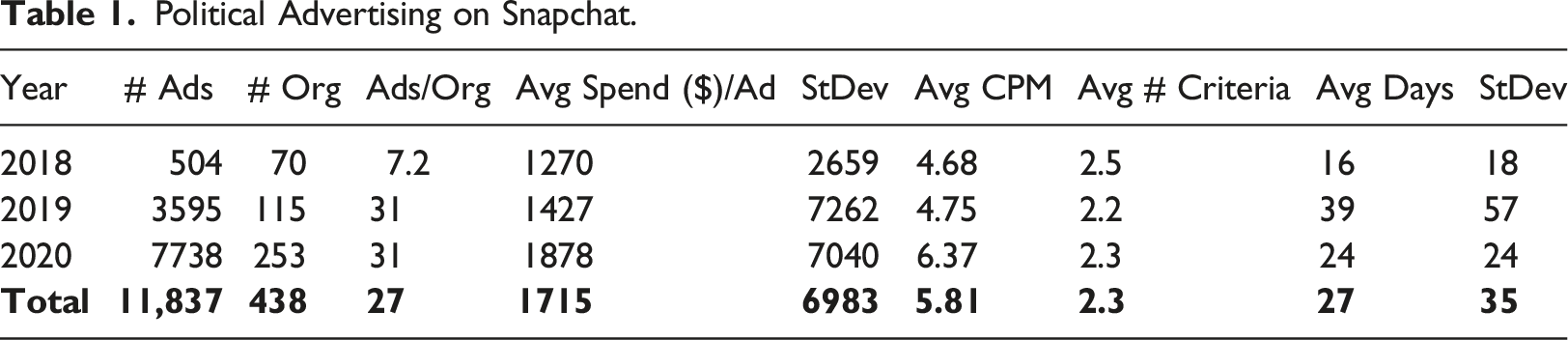
About two thirds of the political ads on Snapchat are video or moving images, with the remainder still images. Across the sample, the CPM for still images is similar to the CPM for video, on average, with the mean differences not varying significantly ($5.74 for images and $5.84 for videos). However, the mean difference for impressions between still images and video is significantly different (images: 223,508; videos: 663,139), (t(11,835) = −6.869, p < 0.001). The contrast in impressions was likely due to the difference in spend across the two formats. On average, the spending for image ads was $677 compared to $2195 for video ads (t(11,835) = −11.056, p < 0.001).
The average length of video ads is 13 seconds (SD: 12; Median: 10; Mode: 15). The length of video ads also increased over time, from 7.9 seconds (SD: 2.4) in 2018 to 9.7s (SD: 10.8) in 2019 and 15s (SD: 12.5) in 2020.
On average, each advertisement was served to Snapchat users with two to three criteria. Half of the ads were set with pre-defined segments by the advertisers, 45% were set with the regions (states) to be included, and 44% were served using age criteria (see Figure 1). Only one in ten ads were targeted towards a specific gender. Selection criteria for political advertising on Snapchat. Note. (I) = Included; (E) = Excluded.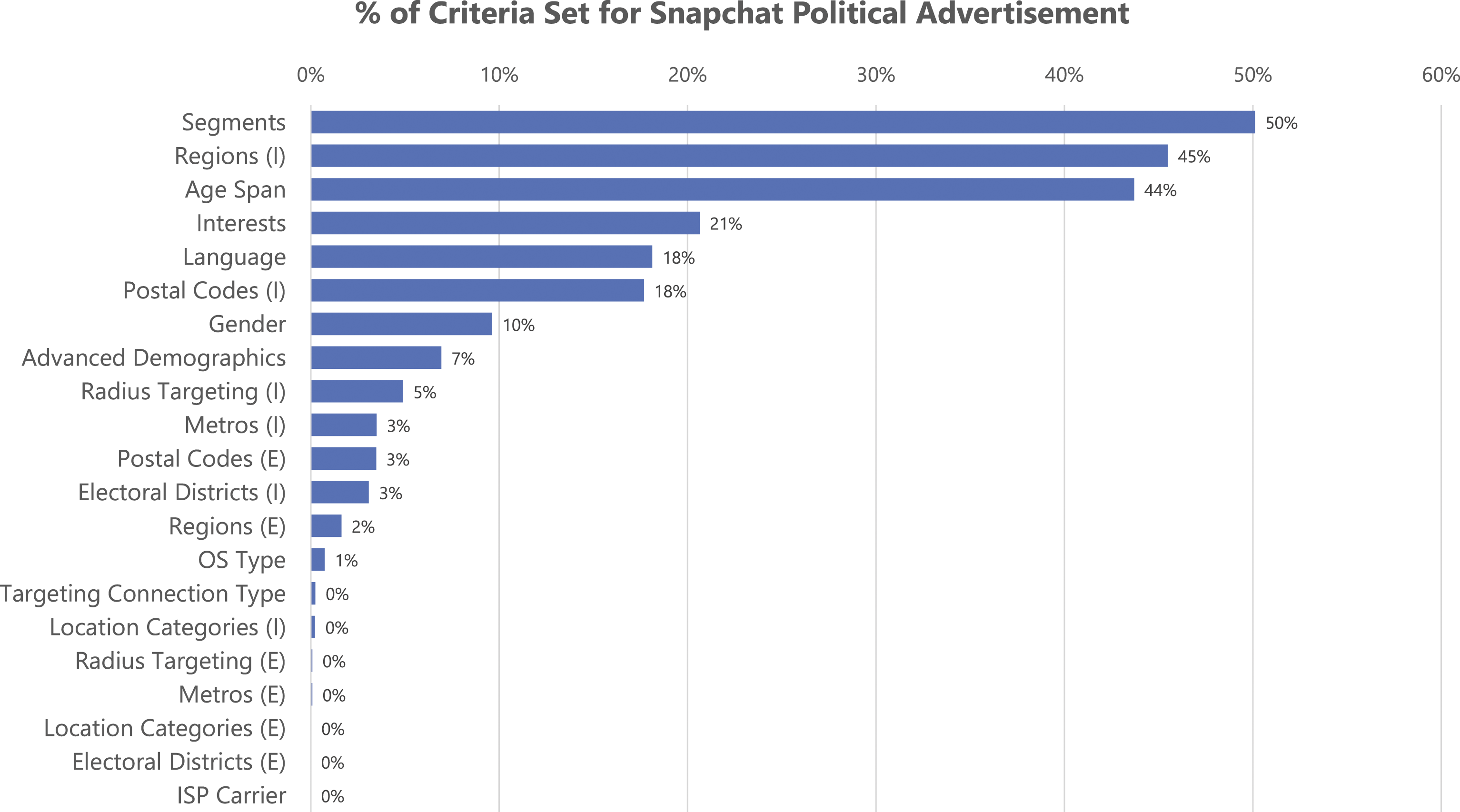
Data Analysis
To address RQ1, the analysis involved an examination of descriptive statistics to compare how the campaigns performed in terms of impressions and CPM, given the number of selection criteria used. To answer RQ2, we used multiple regression analyses to predict the effect of the number of selection criteria, ad spend, the scheduling length, and the ad format on impressions and CPM. The following variables were entered in the initial models: Spend, AdFormat (used as a control variable), SchedulingLength (Days), as well as the following Boolean variables whether selection criteria were specified or not: Regions_Included, Regions_Excluded, ElectoralDistricts_Included, Radius_Included, Radius_Excluded, Metros_Included, Postcodes_Included, Postcodes_Excluded, LocationCategory_Included, Interests, OperatingSystem, Segments, Language, Advanced_Demographic, TargetingConnectionType, Age, and Gender.
Non-significant variables (p > 0.05) were excluded from the final models, with the following variables included into the final regressions: • Impressions as the dependent variable – independent variables: Spend, AdFormat, SchedulingLength (Days), Regions_Included, Metros_Included, Interests, and Segments. • CPM as the dependent variable – independent variables: Spend, AdFormat, SchedulingLength (Days), Regions_Excluded, Radius_Excluded, Metros_Included, Postcodes_Included, Postcodes_Excluded, LocationCategory_Included, Interests, OperatingSystem, Segments, Language, Age, and Gender.
There was no multicollinearity across the variables selected for the final models, with the Variance Inflation Factor (VIF) close to 1 for both models. Supplementary Appendix A shows the details of the final model specifications for both impressions and CPM.
Results
Correlations: Numbers of Criteria Set with Impressions and CPM.
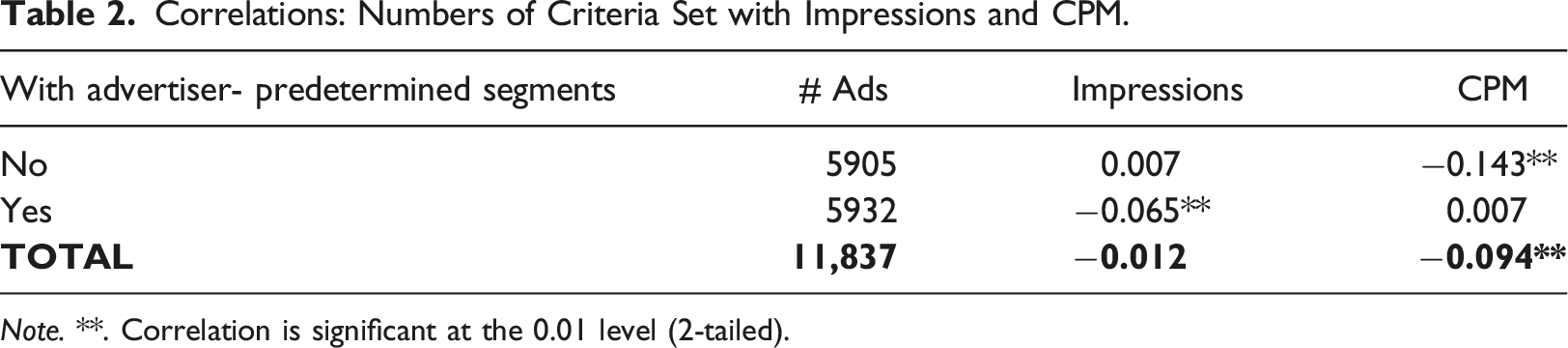
Note. **. Correlation is significant at the 0.01 level (2-tailed).
CPM and Impressions for the Numbers of Criteria Set.
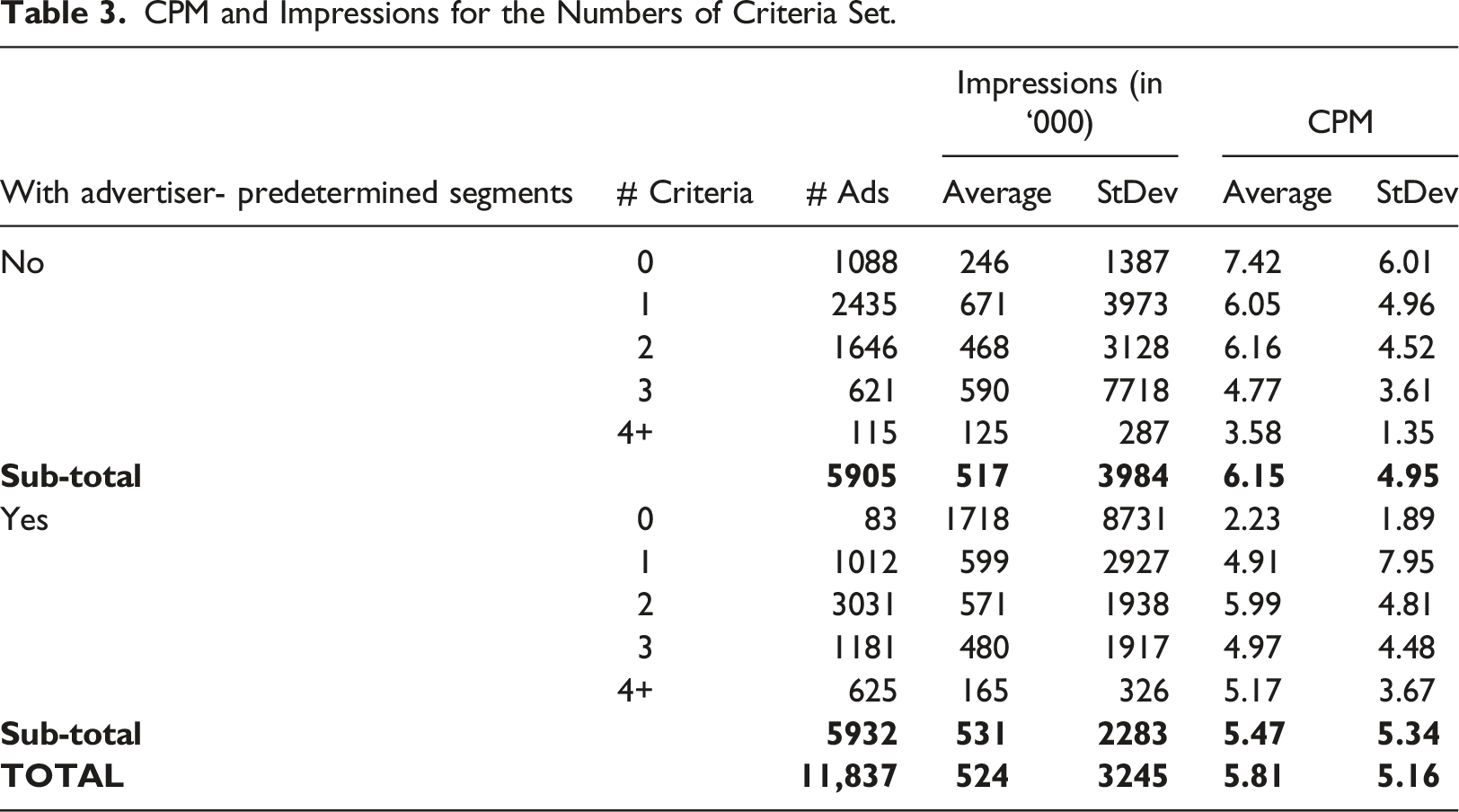
Impression and CPM figures across different numbers of targeting criteria show that among those without any predetermined target segments as supplied by the advertiser, ads with four or more criteria had the lowest CPM (M = $3.58; SD = 1.35). However, such ads also registered lower comparative impressions, suggesting that there were few Snapchat users who would fit narrowly defined selection criteria. Conversely, ads with predetermined segments reported lower CPMs with no further targeting criteria (M = $2.23; SD = 1.89) and for one additional criterion (M = $4.91; SD = 7.95). These ads also registered higher or similar number of impressions compared to other ads with more criteria. Similarly, ads without predetermined segments but targeted at Snapchat users with four or more criteria reported lower impressions compared to those with fewer targeting criteria.
Spend, Impressions, and CPM for Various Scheduling Length (Days).
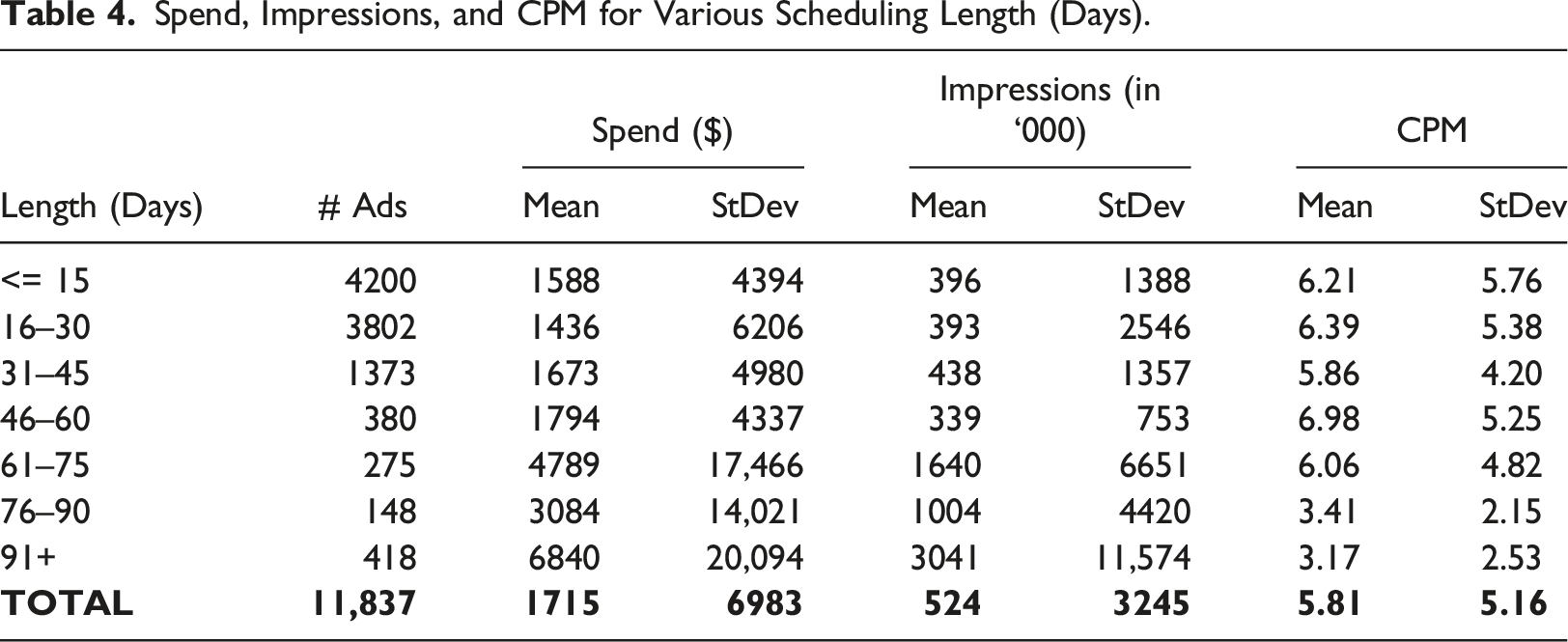
The correlation between spend and the scheduling length was significant, low, and positive [r(10,594) = 0.14, p < 0.001]. This suggests that there was some variability in the amount spent across different scheduling lengths, despite ads scheduled over a longer period being more likely to be associated with bigger spend. The high standard deviations for ad spend across all scheduling lengths corroborates this finding. Moreover, in general, it is unsurprising to see a strong, significant, and positive correlation between ad spend and the number of impressions [r(11,835) = 0.79, p < 0.001]. Hence, it can be concluded that ads scheduled across a longer period were likely to register more impressions and produced comparatively lower CPM.
For more definitive answers to RQ1 and RQ2, we complemented the descriptive analyses discussed so far with multiple regression analyses. The regression models for CPM and impressions were as follows: + (2414 × SchedulingLength) – (173071 × Regions_Included) + (223748 × Metros_Included) + (126249 × Interests) – (185124 × Segments) – (0.02 × SchedulingLength) – (1.69 × Regions_Excluded) – (3.69 × Radius_Excluded) + (0.85 × Metros_Included)+ (1.57 × Postcodes_Included) – (1.57 × Postcodes_Excluded) – (3.33 × LocationCategory_Included) – (0.97 × Interests) – (1.71 × OperatingsSystem) – (0.67 × Segments) – (0.87 × Language) – (1.15 × Age) + (0.64 × Gender)
The model to predict impressions was significant and could account for 65% of the variability [F (7,10,588) = 2811.75, p < 0.01]. Spend was the largest individual predictor [ß = 0.80, t(10,595) = 137.41, p < 0.01], followed by Segments [ß = −0.03, t(10,595) = −4.70, p < 0.01] and Regions_Included [ß = −0.03, t(10,595) = −4.48, p < 0.01]. The full specification for the model can be found in Supplementary Appendix Table A.1 to A.3 in the Appendix.
The overall model for CPM was also significant [F (15,10,436) = 43.06, p < 0.01]; however, it only accounted for 6% of the variability of the CPM. The poor explanatory power may be likely due to the actual criteria that were set for the ad placement (i.e., which specific metropolitan cities, postcodes, regions to include or exclude). Key predictors for CPM are SchedulingLength [ß = −0.12, t(10,451) = −12.36, p < 0.01], followed by Postcodes_Included [ß = 0.11, t(10,451) = 11.26, p < 0.01] and Age [ß = −0.11, t(10,451) = −10.71, p < 0.01]. Further details of the model for CPM are provided in Supplementary Appendix Table B.1 to B.3 in the Appendix.
In summary, the main results emerging from the regressions are as follows. Video ads and targeting criteria which include specific cities and interests helps accumulating impressions, along with bigger ad spend and longer campaign period. However, having predetermined segments and specific regions is also likely to reduce ad impressions. At the same time, video ads and targeting criteria which include specific cities, postcodes, and gender increase the campaign’s CPM. Longer campaigns and specifying regions, radius, and postcodes to exclude, along with selecting a phone’s operating system, predetermined segments, age, and language would reduce the CPM.
Discussion and Implications
This study explored the deliverables of political advertising in Snapchat, a growing social media platform that skews towards the younger population. Its usage for political advertising can be interpreted as a strategy to reach and sway the opinion of younger voters, in particular. This study sought to see how a wide reach approach or microtargeting (narrow audience selection based on multiple targeting criteria), and the scheduling length of the advertising campaign affect the performance of the advertising plan in terms of CPM (Cost per Thousand of Impressions) and the number of impressions.
The first key result concerns the importance of striking the right balance between using some audience selection criteria and achieving wider coverage of the voting population. For instance, although ads with no pre-defined segments by advertisers and set with four or more selection criteria achieved lower CPM than fewer selection criteria, on average the impressions were lower compared to ads with fewer selection criteria. Ads with advertiser’s pre-defined segments registered the lowest CPM, whilst also achieving more impressions on average, without any further selection criteria. The lower CPM for more extensive targeting criteria may also be an artefact of Snapchat’s pricing policy, with CPM being typically charged higher for narrower target segments than on traditional media.
Regarding political advertising, the regression results also suggest that selection criteria could be directed more towards geographic rather than demographic considerations so that the right information can be conveyed to the relevant state, county, or the local candidates – in line with Ephron (1998). This strategy could assist in capturing vital additional votes. Selecting the target audience for political advertising is ultimately in line with the statement by Sharp and Romaniuk (2016): targeting is like salt in cooking; adding a little bit is sensible; too much is detrimental.
The second key result is the emphasis on a longer advertising schedule to achieve more impressions (Ephron, 1995). The CPM for ads with a longer scheduling period was also lower compared to ads that were on-air for a shorter amount of time. When the advertising is not timebound, advertisers would reach more audience by scheduling it across a longer period – thus, increasing the probability of reaching more members of the audience who are exposed to the advertising message. Indeed, longer days on air for an advertisement is one the strongest predictors in the multiple regression model for impressions, with longer scheduling would result in lower CPM as well.
The results carry some theoretical implications that learnings and knowledge built around media planning for general advertising are likely to be applicable for political advertising, that targeting selection in moderation (focusing on geographic criteria) is likely to produce more favourable impressions and the efficiency for the ad placement rather than adopting microtargeting strategy. The importance of longer days on-air also carries a theoretical implication that ad scheduling on social media would be more similar to traditional media if the budget is set on a daily basis, so that the cost could be spread over a longer period. If the budget is set for the length of the campaign without any daily limit, ad placement on social media differs in its possibility to build a large number of impressions in a short time period – possibly capturing users who stay on the platform over an extended period. The closest analogy to traditional media would be scheduling an ad multiple times across prime time shows on one television channel, which would attract a large number of viewers. However, there would be an associated higher frequency of viewing, as the ad would capture the same group of viewers who consume a lot of television programs – and missing light viewers who do not tune in on the day.
Consequently, we can derive a series of practical implications from this study, which can be relevant to campaign managers and marketers involved in political fields such as pre-elections roadshows. Although there are factors distinguishing political and general advertising, e.g., the stronger focus on the message and the periodic seasonality, political advertisers should apply established knowledge in general advertising to promote a political party, a candidate, or a social cause. Rather than focusing on microtargeting, setting short campaigns, or unintentionally doing so by setting a campaign without a daily budget, advertisers could support fewer ads with broader voter appeal across as long a period as applicable with a daily budget limit. Rather than focusing on the period closer to key election with high intensity by political parties or interest groups, issues can be highlighted earlier than the traditional campaign periods. Furthermore, rather than focusing on microtargeting possibilities, political advertisers should instead use social media platforms for their reach capability. It is also important to consider that the social media platform may already have an inherent skew towards specific demographics; thus, further selection criteria would further ignore the majority of the audience who are key for the success of the overall campaign.
Limitations and Directions for Future Research
Although based on a large sample of data covering thousands of Snapchat ads, as with any study, this research is not exempt from limitations. The absence of a true reach metric (i.e., unique voters exposed to the advertising) in the dataset is a limitation of the study, with reach being crucial for brand building. Impressions, like GRP (Gross Rating Points) or TARP (Target Audience Rating Points) metrics for television, are affected by the frequency to which the ad is served. Although exposure capping can be applied on social media advertising, the same number of impressions may mean more users are exposed a few times, or a select target audience being served with the same ad at high rotation. Therefore, future research should explore the usage of reach (captured as unique impressions or views) rather than impressions to measure the effectiveness of wide-reaching targeting specifications versus microtargeting, as well extended versus limited on-air periods. The research would also benefit from replications and extensions using other social media platforms, e.g., Twitter and TikTok, to build empirical generalisation and to differentiate between platform idiosyncrasies and the overall social media practice. To further build generalisability, future research may also consider political advertising in different countries (with varying regulations and political contexts) where social media platforms are actively used for political advertising, as well as political advertising on other platforms (via mobile apps and in-apps) (Stocchi, et al., 2022). Another potential avenue to investigate is the CPM progression closer to key dates in the political calendar (e.g., presidential and mid-term elections) to further build knowledge in political advertising and media planning.
Content analysis is outside the scope of the study, and largely irrelevant due to the dependent variable (whether the Snapchat ad was served, not how long it was watched or how it affected voting attitudes or behaviour). However, an application of the results would be to implement fewer consistent messaging devices that appeal to a larger (and inevitably diverse) community of voters that inevitably may be as effective to reach and influence, and easier to manage than multiple tailored messages on smaller segments.
Finally, exploring the quality of the creative along with the nature of the campaign scheduling and how they influence voting outcomes would also be a significant area of future investigation (Hartnett et al., 2016; Williams et al., 2022). These explorations should also consider how the content is related to various interest groups and parties, and how the spending, frequency and the number of ad placements evolve closer to the actual election. Connecting media planning and content analysis, future research may also consider how ad content links to targeting criteria and scheduling patterns in influencing voting outcomes. Understanding factors such as the relationship between exposure frequency and messaging in political advertising and the role of branding, would aid future political advertising practices.
Supplemental Material
Supplemental Material - Reaching Voters on Social Media: Planning Political Advertising on Snapchat
Supplemental Material for Reaching Voters on Social Media: Planning Political Advertising on Snapchat by Arry Tanusondjaja, Aaron Michelon, Nicole Hartnett, Lara Stocchi in International Journal of Market Research
Footnotes
Declaration of Conflicting Interests
The author(s) declared no potential conflicts of interest with respect to the research, authorship, and/or publication of this article.
Funding
The author(s) received no financial support for the research, authorship, and/or publication of this article.

Supplemental Material
Supplemental material for this article is available online.
Note
References
Supplementary Material
Please find the following supplemental material available below.
For Open Access articles published under a Creative Commons License, all supplemental material carries the same license as the article it is associated with.
For non-Open Access articles published, all supplemental material carries a non-exclusive license, and permission requests for re-use of supplemental material or any part of supplemental material shall be sent directly to the copyright owner as specified in the copyright notice associated with the article.
