




Abstract
This article discusses participatory methods for data gathering in the context of a partnership between a Swiss-based media development organization, Fondation Hirondelle, and a research team at the University of Sheffield. In 2018–2019, the partnership conducted fieldwork which focused on the impact of radio on women listeners in Niger. The project used participatory methods of data gathering in the form of workshops and focus group discussions (FGDs). The article examines the advantages and limitations of combining the practical experience of international development organizations and the in-depth research capabilities of academia. To triangulate this collaboration and to navigate the limitations of FGDs, the use of workshops is discussed as an important method for providing feedback among the radio practitioners and experts in Niger. The article examines the usefulness of combining these methods and reshaping their application to promote participatory research with radio audiences and practitioners.
Introduction
In development studies, data collection methods must be carefully considered to ensure that they are participatory; that representative samples of beneficiaries, experts, and community members are consulted; and that results feedback to those consulted in a transparent manner. In addition, usable and reliable data needs to be obtained within reasonable budgets through a logistically feasible process. Data collection methods which are based on participation and feedback are essential for development workers and communication researchers who must negotiate the ethical and political implications of data collection so as not to replicate the uneven power dynamics of extraction from the Global South to the Global North (Domatob, 1988; Madianou, 2019).
This article contributes to existing theoretical discussions on data collection techniques, participatory methods, and market research. At a time of increasing demand for public policy and decision-making to be evidence-based, creating demonstrable impact, and greater academic-practitioner engagement, we analyze the advantages and limitations of combining workshops and focus group discussions (FGDs) with the practical experience of international development organizations and academic researchers to ensure a reflexive participatory approach to gathering data. This discussion is based on a pilot study conducted collaboratively in Niger in 2018–2019 1 by a research team from the University of Sheffield, in the UK, the Swiss-based media development organization, Fondation Hirondelle, 2 and radio practitioners and audiences in Niger. The study explored the understudied role that radio plays throughout Niger in the context of women’s empowerment. The primary methods employed for this study were FGDs and workshops—both standard methods for data collection. However, we propose that they can be carefully designed to maximize positive participation in the context of collaborative research projects.
In evaluating the methodological approach of this project and its findings, the article addresses the strengths and weaknesses of the study’s collaborative approach and its use of FGDs and workshops and discusses how these might be applied to other contexts. It focuses on the advantages and limitations of participatory data collection methods themselves, rather than the resulting data (for details, see Heywood, 2020). FGDs are a standard and widely used form of data collection, something that is reflected in the literature. However, when discussing the proposed design of the FGDs for this project, additional feedback mechanisms with radio practitioners and experts in Niger emerged as being necessary. These went beyond the FGD itself and workshops were introduced as both a way of integrating feedback and findings with stakeholders and beneficiaries, while also enriching and contextualizing data from the FGDs.
Research context
The article draws data from a larger research project assessing radio’s impact on women’s empowerment in the Sahel in collaboration with Fondation Hirondelle. Created in 1995, this nongovernmental organization (NGO) aims to practise and defend “responsible and accurate journalism in conflict and post-conflict situations” while providing “information to populations faced with crisis, empowering them in their daily lives and as citizens” (Fondation Hirondelle, 2020a). In 2016, they created, and now run, Studio Kalangou—a radio studio in Niger. The Studio, which claims editorial independence (Heywood, 2020), broadcasts 2-hr daily information programs in five languages from Niamey throughout Niger. Rather than broadcasting directly to audiences, it transmits its programs via satellite to commercial and community radio partners throughout the country which then rebroadcast them using their own FM networks. In 2018, they asked the research project to assess the impact of two series of women-related radio programs on women’s rights and empowerment broadcast by Studio Kalangou. This study’s collaboration enabled the NGO to fill their own research capacity gap by seeking research expertise from academia (Morton et al., 2002).
Fondation Hirondelle (2020b) considers the inclusion of gender issues in programs to be essential, particularly women’s empowerment. Many of Studio Kalangou’s programs cover aspects of women’s empowerment, including health issues, sexual violence, and child marriage. However, the impact of these programs must be determined. This is especially important in Niger, where gender inequality is extensive with high child marriage rates (United Nations International Children’s Fund [UNICEF], 2018), low literacy rates particularly among women (Save the Children, 2016), extensive gender-based violence, and widespread polygamy (United Nations [UN] Women, 2016). Independent factual information broadcasts can raise women’s voice in society and combat disempowerment (Heywood & Tomlinson, 2019). In conflict and crisis areas (Heywood, 2018), radio is often the main source of information to which many women, in particular, have access. Radio can provide women with information and raise awareness, awakening and reinforcing critical consciousness, self-esteem, and self-belief (Kabeer, 1994; Sen, 1985).
Nigerien radio has a long history of involving its listeners in its content production, through phone-ins and live studio audiences (Agosta, 2001; Chignell, 2009; Heywood, 2020). Indeed many of the project’s participants stated they regularly call local radio stations using mobiles, marking a change from pre-mobile passive ways of listening. Although Studio Kalangou does receive some listener comments and feedback via social media, audience participation is not a feature of their broadcasts. One technique, therefore, to collect feedback is by directly asking listeners through surveys, questionnaires, interviews, and FGDs. In this case, FGDs and workshops were the primary methods of data collection. This is rooted in the principle that FGDs and workshops foster participation and community building through repeated, face-to-face interactions. This is reflected both in the literature and in our own findings.
Collaborative working
NGO-academic collaboration is increasingly a condition of funding. Partners need to be carefully chosen to ensure complementarity without eliminating overlap (Green, 2017). Because academics often lead funding applications, a hierarchy emerges undermining a balanced partnership, creating issues of ownership and unconscious assumptions about the other (Cottrell & Parpart, 2006). Therefore, each party’s role must be clear from the outset. While both parties may have similar end goals, each has their own objectives and competing agenda with different target audiences; academics’ targets are publication driven, which is a slow process and less relevant to NGOs who want quick, implementable, measurable solutions on the ground.
Nonetheless, there are advantages. The first clear benefit of NGO/academic partnerships is knowledge exchange: “NGOs provide access to empirical experience and evidence, and the academic partner brings theoretical framing and methodological expertise” (Aniekwe et al., 2012: 4). NGOs benefit from the partnership by gaining levels of expertise, working time, and academic funding to which they might not have access. They obtain findings from assessments conducted to high standards of academic rigor. Working independently to NGOs, academics can assess the quality of internal dynamics and outputs. Second, collaboration is financially advantageous as it is valued by donors and policy maker communities; NGOs’ impact can be assessed by an independent “third-party,” and the capacity to co-produce research raises their credibility and perceived professionalism. Academics gain access to networks and primary data which is unavailable online or via secondary sources. In-kind contributions from NGOs also boost funding applications making bids appear more attractive and credible.
While complementary working practices are important, challenges do exist. Relationships take time to build, delayed by a lack of shared language, approaches, and bureaucratic procedures. It is no secret that NGOs and academia work at different speeds, the former wanting immediate results to respond to specific events while academia works slower, often producing lengthy and complex documents which must be made more accessible for practitioners (Roper, 2002). Practitioners can be subject to additional research-related tasks, while managing their usual workloads. This can lead to push back from practitioners, objecting to perceived negative criticism from researchers outside their organizations.
Focus groups
To facilitate successful collaborations between NGOs and researchers, it is useful to turn to shared methods of data collection. FGDs are methods used both by academic researchers and for the work of NGOs, defined as “a group of individuals selected and assembled by researchers to discuss and comment upon, from personal experience, the topic that is the subject of the research” (Gibbs, 1997: 1). Academic researchers have also used FGDs to monitor and evaluate the impact of development policies and projects, offering “more reliable data about the process of project implication” than relying on donor or government documentation alone (Elahi et al., 2015). FGDs are considered a quick, relatively cheap and easy data collection method which is reliable, contextual, and non-hierarchical. If well managed, they enable an atmosphere of trust where marginalized or inhibited persons gain the confidence to speak. Discussants debate chosen topics for a limited time and they may, or may not, know each other, creating group dynamics which enable the identification of different views around the research topic and an understanding of the issues from the perspective of the discussants themselves (Barbour & Kitzinger, 1999; Kamberelis & Dimitriadis, 2013; Morgan, 1996). Moderators can ask predetermined questions or lead open-ended conversations, but always steer discussions, manage group conflict, and encourage quieter discussants to speak. FGDs can have disadvantages, triggered by the intersectional nature of the group’s composition, gender, education, social status, and also dominant personalities (Merryweather, 2010). Consensuses may therefore prevail rather than the desired diversity of views because discussants become conciliatory, feeling inhibited in group situations (Stokes & Bergin, 2006). Nonetheless, FGDs are advantageous in consulting a plurality of voices and in obtaining relevant information over and above the interview question. The potential pressure of a one-to-one researcher/subject interviews is shifted away from the research subject. The latter is, instead, placed in a non-hierarchical environment which, if managed tactfully and skillfully by the moderator, can be supportive and democratic (Wilkinson, 1999). When applied to sensitive subjects and combined with expert local advice from workshops, they prove a valuable data source.
FGDs are also standard and common qualitative data collection methods in business (Hartman, 2004) and market research. In commercial settings, FGD participants assume the role of the “consumer” in the sometimes theatrical staging of the FGD directed by a marketer (Grandclément & Gaglio, 2011). Indeed, FGD’s performative nature demonstrates that they are not ideologically neutral but can propagate global, capitalist hierarchies “where Western consumers are at the end of development and poorer, non-Western people are at the beginning” (Cayla & Peñaloza, 2011: 338). Slippage between data collection in the Global South for research purposes and commercial interest in big data has raised criticism, especially concerning vulnerable populations such as migrants and refugees (Madianou, 2019). In the quest for larger and deeper data sets, researchers and humanitarian groups risk rendering FGD participants into a means to an end, rather than the end in itself. It cannot be assumed that FGDs are innate and unproblematic methods of collecting rich qualitative data. Indeed, data collection by scholars based in the Global North can highlight and reinforce inequalities and power hierarchies. These dynamics must be carefully and systematically assessed in the initial planning of FGDs.
For example, in Niger, FGDs discussed women’s disempowerment and many sensitive issues that could potentially trigger diverse reactions among the broad selection of discussants and the influence of the project’s cross-cultural and cross-lingual nature on in-group exchanges and participation had to be considered. Many of the project’s female discussants were illiterate or had low education levels. Group dynamics in FGDs are pertinent as they shift the balance of power from the researcher who is then outnumbered by the discussants. Power hierarchies can be reproduced with dominant (peer) voices taking over and silencing other inhibited voices. Therefore, the setting is important to mitigate potential discomfort. As Quintanilha et al. (2015) state, “[w]hen discussions occur in a nonthreatening, nonjudgmental setting, discussants who historically have had limited power may feel more comfortable, and assured, about sharing their social constructions of health with peers and researchers” (p. 1). In other words, despite the sensitive subject matter, the collective discussion of these topics in a non-judgmental setting can both allow free discussion and be subject to group hierarchies.
The moderators’ ability to create safe spaces for free discussion is inherently connected to their own subjectivity and relationship with the discussants. The power dynamics within the moderator-discussant relationship is also linked to the culturally rooted research methods and questions, which in turn are based on Western traditions (Christopher et al., 2014). Researchers and development workers must therefore consider their own positionality in a culture and also sub-culture while designing and participating in FGDs. Indeed, the positionality of all group members must be considered, especially when research conducted in the Global South gains greater visibility when conducted by researchers in the Global North, reinforcing dominant power imbalances.
FGDs can foreground the imbalance between the researcher “outsider” ignorance and the researched “insider” knowledge and, subsequently, become contextualizing in nature. On one hand, there is the moderator (the researcher) who can be dominated by stronger discussants and subsequently by irrelevant issues. This can be especially problematic for female researchers in traditionally patriarchal societies with male discussants challenging the nature and subject of a project on the basis of gender (Sultana, 2007). On the other hand, some responses in the presence of other discussants may lead to social desirability bias, or the “tendency to say things which place the speaker in a favourable light” (Nederhof, 1985: 264). This takes two forms: either the desire to generate a positive self-image and not disclose self-stigmatizing information; or the desire to disclose a socially acceptable response to an item, issue, or activity (Krumpal, 2013). As avoiding such bias is aspirational, this project made all attempts to place discussants at ease, refrain from judgmental comments, and allow them to express themselves freely and at length. However, the desire for social approval can be exacerbated by bystander effects (Aquilino et al., 2000; Krumpal, 2013) and discussants’ responses may be influenced if they fear repercussions because the subjective opinions they voice do not coincide with those of bystanders.
Workshops
By working concurrently, workshops and FGDs can facilitate feedback among different stakeholders beyond the NGO-researcher participation to include users and practitioners (here, radio audiences and journalists). This combination of methods allows a triangulation of information flows and dialogues, as discussed below.
Workshops function as a specific form of research methodology. In particular, the problem-solving workshop has long been applied as a method in conflict resolution, as a form of research as well as practice (Fisher, 2004). Workshops can be a laboratory to test theories, models, and findings. Workshops bring different stakeholders with different aims and perspectives together within a common aim. In development contexts, workshops are a form of localized empowerment (Tareen & Abu, 1998). Qualitative analysis of workshops suggests that they foster collectivity and connection for practitioners and researchers and create opportunities to produce data about an issue. However, like FGDs, workshops are not ideologically neutral and are conditioned by the norms and power hierarchies associated with Western epistemology. Ouédraogo and Hendricks (2015) call for the testing of “the universality of these [dominant] paradigms that reveals the now global view of knowledge construction” (p. 1). The collaborative nature of workshops as a collective gathering of different stakeholders offers opportunities for non-Western epistemological approaches to emerge. However, this must be integrated into the design and implementation of the workshop as an activity.
This project recognized that local experts’ advice was needed because conducting focus groups in isolation risks ignoring “histories of colonialism, development, globalization and local realities,” leading to “exploitative research or perpetuation of relations of domination and control” (Sultana, 2007: 375). The involvement of experts was therefore solicited to develop the researcher-discussant interaction and ensure a participatory approach. Traditionally, workshops are not data collection events but complement FGDs, gaining expertise and shaping the research through participants’ reflections (Caretta & Vacchelli, 2015: 4). Importantly, they are opportunities to feedback findings from the FGDs back into the communities. Moderators initiate activities and then, rather than leading the discussion which is the case with FGDs, take a back seat, while ensuring, as with the FGDs, that dominant voices do not reduce the diversity of discussions. Participants run mind mapping activities, Strengths, Weaknesses, Opportunities, and Threats (SWOT) analyses, storyboarding, and discussions (Chambers, 2002). Contrasting with FGD discussants who draw on past experiences, workshop participants plan and discuss future scenarios and a consensus is fed into the research design.
Workshops also benefit development workers. If conducted outside NGOs’ influence, they present an opportunity to gather unbiased feedback and reflection. This is important when an imbalance of resources and visibility exists between “outsiders” and “insiders,” which is the case here: White researchers from Europe gathering data in Niger. There is, however, the risk that participatory approaches and feedback are relied upon to satisfy new funding demands in an evolving market of aid financing (Madianou, 2019). In combination, FGDs and workshops encourage participation across a broader range of collaborators by introducing other groups of experts outside of academia, in addition to the NGOs.
Method
FGDs
Twenty focus groups were conducted in and around Niger’s capital, before and after two women-related radio series were broadcast. Safety restrictions prevented travel beyond this area. 3 The same discussants were involved in both sets of FGDs. To overcome dominance during discussions, which can occur in patriarchal societies, the project divided the groups into male and female respondents, and then the women’s groups were divided into married and unmarried women to prevent the older women dominating the younger women. This ensured that the women’s experiences were similar in the corresponding groups. There were eight groups of married (older) female listeners, eight groups of non-married (younger) female listeners, and four groups of male listeners. The groups were organized into rural and urban locations as the experience of women’s empowerment would differ in each and would be influenced accordingly. The NGO’s input proved beneficial in the project’s early stages, enabling the academic partner to access local radio partners who, in turn, organized the recruitment of the discussants.
The FGDs were organized at the NGO’s partner radio stations, either inside or outside in a public space often with bystanders. Groups were convened at the same time to ensure attendance, with possibly four groups for the whole day arriving at 9 am. Conducted outside, bystander effect during the FGDs was considerable. Tact had to be employed to ask the waiting groups to move away from the FGD in progress to avoid hearing the questions in advance. Care had to be taken to ensure that some married women’s FGDs were held out of the sight of husbands as many women had not received permission to take part. Separating the FGDs by gender was therefore essential for gathering data along lines of differentiated gendered experiences and reactions to the radio.
The hour-long FGDs were in French, due to budgetary constraints, with bilingual discussants translating into local languages when necessary. All discussants were asked similar questions in both rounds about their understanding of women’s empowerment, their radio use, their role and status in society, and influences shaping women’s lives. It was important to repeat similar questions, which were shaped by the workshop discussions, to determine changes in the answers, reflecting a change in knowledge. The moderators were a French-speaking Anglophone woman from a UK university and a Francophone man from the Swiss NGO, both White and “outsiders,” a recognized limitation of the project. Budget permitting, trained Nigerien FGD facilitators would have been better placed to conduct the FGDs. Social desirability bias was a strong consideration and discussants had to be put at ease and encouraged to speak freely. Given that the discussion of women’s empowerment often revolves around “the use of one’s voice,” it became essential to especially encourage the women to speak in terms in which they were comfortable. The FGDs were recorded, transcribed, and analyzed in French using the software NVivo. All names of discussants and locations were anonymized.
Workshops
A series of three workshops was organized, one before each of the two FGDs and one on the project’s completion. The original delegates were from local women’s associations, and media, journalism, and training organizations, representing various aspects of the overall project. All attended all events with additional delegates being invited to subsequent events as the research progressed. Delegates’ agreement to participate in subsequent workshops allowed them to follow the project’s progress and proved mutually beneficial; the research team presented their interim findings which delegates were able to incorporate in their own work; and delegates provided feedback and suggestions for the project’s next stages.
Approximately 20 people attended the first two workshops at the radio studio, and over 50 attended the third at a local hotel. The third workshop also invited representatives from consulates, embassies, regulatory bodies, and other international nongovernmental organizations (INGOs), allowing final results to be widely disseminated. It also invited local radio partners, through whom we recruited the FGD discussants, as representatives of local communities to relate their experiences of the project, its impact on them and their communities, and to give feedback regarding the development and design of future projects. Transport costs were covered and overnight accommodation was provided where necessary.
Workshops were structured to foster collaboration and to encourage networking among the four groups (practitioners, audiences, NGOs, and researchers; see Figure 1) and also among the delegates themselves. Many delegates knew each other or each other’s associations but did not frequently meet. This was important as the knowledge exchange would then extend beyond the remit of the research project. Delegates were made aware of the purpose of the workshops through letters of invitation which included overviews and updates of the project and the workshop agenda. Following coffee and networking opportunities on arrival (and repeated over lunch), the morning’s plenary session allowed delegates, the research team, the NGO, and the radio studio to introduce themselves and their work and express their expectations for the workshop. Subject areas were then discussed which included planned topics for discussion in the FGDs and how they should be approached, radio presentation of these topics, and terms to be used, among others. Detailed presentations of the project were given.
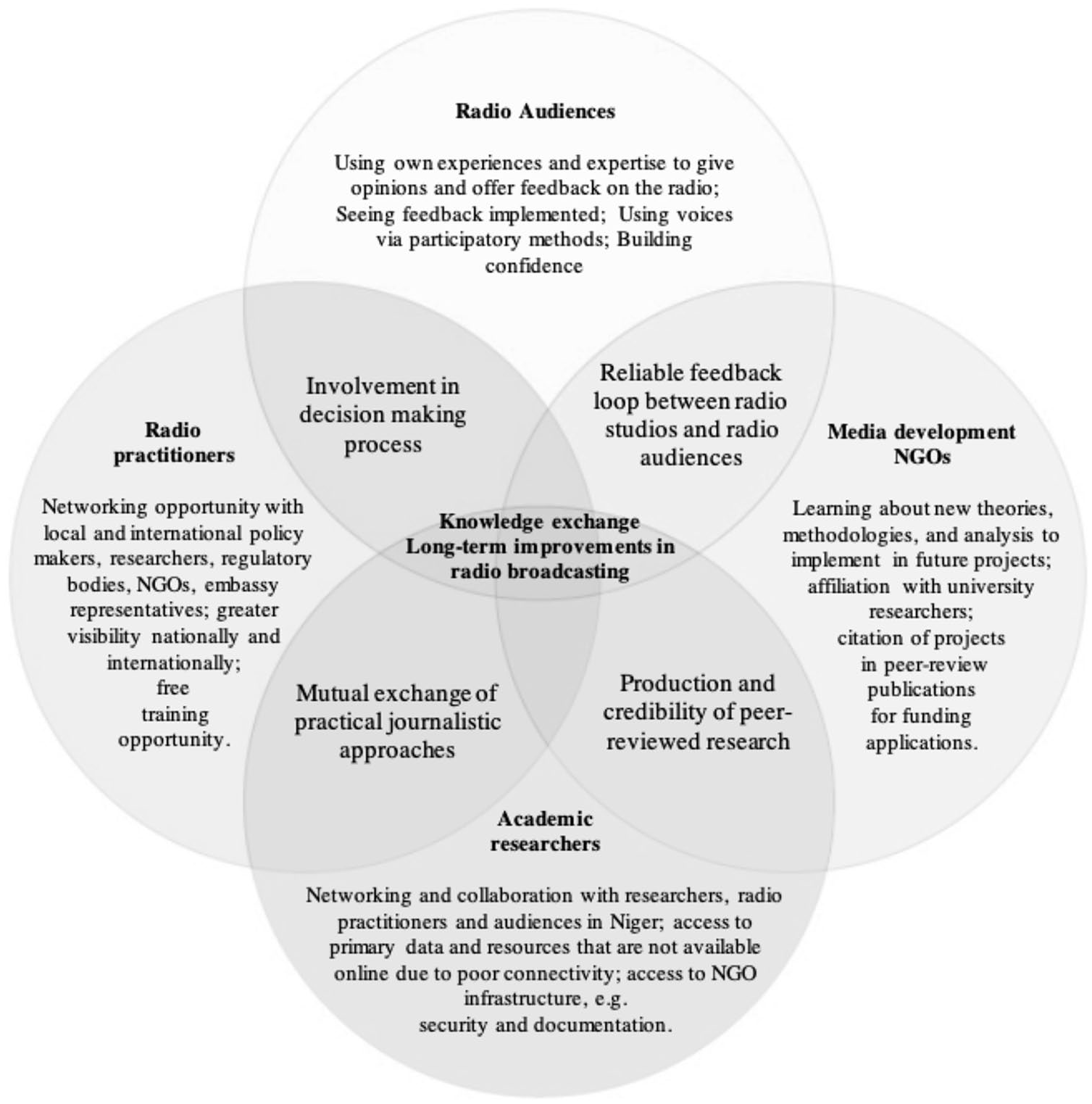
Benefits of collaborative partnerships from the perspective of radio audiences, NGOs, academics, and radio practitioners.
90-min afternoon breakout sessions were organized during which delegates were given topics to discuss. The NGO representative and the academic moderated these sessions, and in the final larger workshop they monitored timings and gave prompts. Breakout sessions promoted freedom of expression preventing certain voices dominating and facilitated the exchange of comments, suggestions, and corrections for forthcoming FGDs. The sessions enabled a critical dialogue around terms and discussions on definitions of “empowerment,” beyond the development, top-down approach. This informed future FGDs and considerations of its use by journalists, civil society organisation (CSOs), and NGOs. The final plenary session invited one person from each session to present their findings. It was important that the moderators did not drive this session as knowledge exchange was a main aim. According to anonymous feedback, the presentations “allowed for fruitful exchanges between CSOs and the media” and created a “framework of exchange with competent participants through whom you can learn.” The workshops concluded with discussions for the next steps (recommendations and best practice), topics for inclusion next time, and other potential invitees. The workshop was limited to 1 day, a recognized disadvantage. Another limitation was the number of delegates and we recognized the need to be flexible and include more people, for example, from youth associations. Feedback forms were circulated and were used for a subsequent impact case study and to inform the progress of the project. Many delegates exchanged details and requested that contact information be circulated. A report was sent to delegates with contact details of those who had given permission.
The article now critically examines the following research questions:
What are the benefits and limitations of FGDs and workshops in collaborative projects between researchers and NGOs?
To what extent can combining FGDs and workshops methods mutual offset their limitations?
Can this methodological approach improve feedback and participation among practitioners (radio professionals) and beneficiaries (audiences)?
Findings
Benefits and limitations of FGDs
FGDs proved useful for discussing gender issues. It was confirmed during the FGDs that separating male and female discussants would allow each the freedom to speak without being inhibited by the presence of the other, especially on the subject of gender. Women’s empowerment was the topic of discussion and each group could discuss the other without the risk of incurring the latter’s opprobrium, but also with the support of their own group members. Indeed, solidarity along lines of gendered and generational identity often emerged as a principal feature of the FGDs which would not be characteristic of one-to-one interviews or surveys. For example, younger women spoke about their lack of collective power against their fathers: “If a dad decides, we can’t do anything about it” (Unmarried women, rural 1), whereas generational divides were also raised during the FGDs, for example, regarding early marriage:
For old people, it’s not really “early” marriage, for them it was normal to get married when you’re 12 or 13. But now that young people are more aware regarding the various negative effects that child marriage has, lots of them are against it and they’re really doing their best to get it stopped. (Unmarried women, rural 2)
This solidarity, promoted within FGDs, also generated a setting of confidence and trust where discussants expressed how to circumvent paternal constraints. Many young girls shared how they find boyfriends at school and ceremonies in the hope they would be able to persuade their fathers to give them some freedom. Talking openly about traditionally forbidden activities was facilitated within FGDs as the girls felt comfortable in the knowledge that, because the researchers were “outsiders’’ and not from their community, they could talk openly without fear of being betrayed. While this was facilitated by the researchers’ foreign presences in the FGDs, similar power dynamics could be reproduced by researchers from Niger, but from a different community or social group. Trained Nigerien FGD facilitators would be attentive to local forms of knowledge (Romm, 2015) and be better placed to conduct FGDs in Niger. It is thus recognized that the FGDs were limited by the researchers’ outsider status.
Other similar FGD conversations promoted groups’ multi-vocality and some discussants revealed an awareness of being in a more privileged position than others of their age, highlighting the intersectionality among groups and the need for researchers to consider this in their population sample to ensure useable data:
“Is there equality in your families?” “Yes” “In mine, yes” “Is this equality rare in Niger?” “It’s quite rare. There are other families where it’s just the dad who makes all the decisions.” (Unmarried women, rural 1)
The discussant-moderator relationship of trust promoted an open atmosphere and a readiness to speak. One group stated, “you said you’d come back, that you’d be back at the end of the year, and you have. We’ve waited for you and have gathered our thoughts. We’re ready to talk” (Married women, urban). This demonstrates that FGDs are particularly successful when repeated over regular intervals and that singular interactions risk breaking fragile bonds of trust and retrench the relationship of “extraction” between the Global South and North.
The solidarity and associated trust resulting from being within a like-minded group extended to the discussion of sensitive subjects, which may not have occurred in mixed environments. When debating the consequences of child marriage, for example, and rather than conspiring to evade such real issues or obscure them, the FGDs enabled men to feel at ease talking, among themselves, about child mothers and fistulas, or topics “which we don’t learn about at school” (Urban Men 1) however embarrassing they still considered it:
Regarding health, when women give birth very young, they can’t stop urinating. You know, things like that . . . It’s taboo. It’s because they’re not educated. They’ve got a complex about talking about it to their daughters and they’ll hide behind religion and say that if you talk about things like that you’re encouraging depravity. (Married women, urban 2)
It transpired, so long as the groups were separated by gender, that discussants would discuss sensitive topics in front of others and that group support encouraged greater openness. The FGDs provided the forum to recount anecdotes about “a friend who” or events in another village in such detail that their own involvement could be questioned. According to one radio station director, the spirit of openness and trust in FGDs was underpinned, counter-intuitively, by the presence of two foreign researchers because, as stated above, they were not from their community. Here, the contextual nature of the outsider-insider dynamic of the focus group triggered self-reflection and debate on social norms and practices which may not be possible in mixed groups:
“Does that mean that you couldn’t tell an imam about a case of early marriage?” “No!” “No. No way” “You just couldn’t” “Religion doesn’t ban young girls of 12 or 13 getting married. Since, each time, in the Muslim religion they give the prophet Mohammed as an example. They say that he married Aicha when she was 9. Each time, that’s the example they give to say, in Islam, it’s not forbidden for a young girl to marry.” “And imams get out verses which say that marriage isn’t forbidden at that age. So, no, you couldn’t turn to an imam to stop early marriages.” (Unmarried women, urban 1)
Benefits and limitations of workshops
The three workshops, organized before two rounds of FGDs and at the end of the project, complemented and triangulated some of the findings from the FGDs. Having two moderators from different backgrounds (academia and NGO) enabled different perspectives to be introduced to the discussions. The discussions of sensitive topics provided the opportunity to invite experts to talk about issues such as female genital mutilation, child marriage, and gender-based violence. Relying on FGDs to gain such detailed information would have resulted in inadequate and possibly inaccurate data. The researchers gained up-to-date contextual information about the FGDs’ specific locations and additional information about community structures and the operations of organizations.
The interdisciplinary workshops were knowledge exchange opportunities for both the researchers and the delegates. The latter were encouraged to provide feedback on latest developments, laws, and attitudes. Workshops also allowed the researchers to obtain literature, much of which is not available online, enabling local research to gain a voice in academic fields, dominated by Western scholarship. Because of the project’s participatory nature, high levels of interaction prevailed, especially as the project developed and updates were shared because it was recognized that recommendations had been incorporated in the FGDs and the analysis. This was exemplified by the discussion of the term “empowerment,” its translation and use in FGDs. Delegates, in groups, were asked to discuss this term, what it meant to them and to the groups they dealt with, what the obstacles were to women achieving empowerment, and how it could be promoted. The presentation of the findings was mutually beneficial and the differences in understanding were illuminating, with appreciation of the “discussions of different definitions around empowerment and especially the Nigerien context which deserves reflection.” Despite the participants’ shared objectives, terminology needed clarification and could not be assumed.
Complementarity of FGDs and workshops
Thanks to the networks and contacts that emerged through the NGO/academic collaboration, the scope of the FGD as a simple data collection tool expanded. Repeat FGDs reinforced relationships of trust that were especially important when discussing sensitive gender issues and it was possible to triangulate the feedback of FGD findings by running workshops with other stakeholders, such as radio journalists and civil society associations. According to the anonymous feedback forms, delegates appreciated the professional development, the opportunity to network, to focus exclusively on issues surrounding women’s empowerment in the media, and to gain access to data collected by the project. Notably, journalists at the workshops stated they aimed to implement these learnings directly in their reporting on women’s empowerment: “We learned how the notion of women’s empowerment is perceived by Studio Kalangou and the listeners. And the necessary approach to get guests involved, how to bring out the best in them.” Above all, workshop delegates appreciated “the fact that participants are at the heart of the workshop,” for example during the breakout sessions, and the opportunity to discuss the research findings in groups, rather than be passive participants in a workshop with a top-down approach.
The workshops proved essential for establishing new avenues of work and collaboration between NGOs, researchers and media practitioners. Disadvantages of FGDs are evident as they are time-consuming (for discussants and researchers alike) and potentially limited in terms of geography and topic (especially in conflict and post-conflict areas). Indeed, this project was restricted to 100 discussants in 20 focus groups. The workshops helpfully suggested sections of society which were not included but could be targeted in future work to ensure greater representation of matriarchies, ethnicities, geographical areas, youth, and the inclusion of ever-increasing conflict zones. 4 Additional data collection methods were usefully discussed including the use of WhatsApp voice messages to target large areas and also illiterate populations. While this would have its benefits, many of the advantages of FGDs would then be sacrificed. Some delegates called for the inclusion of “youth associations” and for the workshop to become an annual occurrence organized by Studio Kalangou itself to discuss issues relating to women’s empowerment and radio. In this respect, the cohesion between the research and Studio Kalangou can be strengthened through the workshops, as a way of providing training based on the project’s findings. Another recommendation for the workshop was to prolong the number of days for exchange and training on gender issues, such as women and social media. While the workshop series was a success, greater material investment is required for long-term sustainability by and for the delegates who wish to continue this work.
The collaborative approach
The collaboration provided a complementary framework for both the FGDs and the workshops and areas of mutual benefit emerged for radio audiences (consulted in FGDs), NGOs, academics, and radio practitioners alike. The academics gained access to radio networks and listeners enriching their data collection and raising their in-country visibility. They also received in-kind contributions through the radio studio, transport to the FGDs and administrative and logistical support. The workshop networking opportunities gave the academics access to national and local information and documentation, be they academic or gray literature, not available online because of limited or unstable internet connection and technology in Niger. The NGO gained access to funding, independent impact assessments, and new methodologies. Both parties benefited from increased credibility: the academics’ research became more “real” and not purely theoretical because of listener population access and has gained further research funding for bigger projects; and the NGO’s activities became evidenced-based because of the collaboratively collected and published data which have supported subsequent funding applications by the NGO and were used in reports. As discussed below and shown in Figure 1, the radio audiences and local radio practitioners also benefited from being an integral part of the project. Audiences became empowered through the interaction and, during the second FGDs, became aware of the impact of their voice on the radio studios through changes to broadcasts. They also recognized that they were part of the feedback loop with the radios and the NGO, stated at workshops via the radio partner representatives. Local radio practitioners received networking opportunities during workshops gaining greater visibility within communities. Their feedback and opinions were consulted during the workshops and they confirmed they felt directly involved in the decision-making process. They also stated they benefited from the research outcomes which they incorporated into their practice. Finally, and closing the loop, the academics benefited from the mutual exchange of practical journalistic approaches through their interactions with the radios.
Conclusion
This article contributes to existing theoretical discussions on data collection by examining methods used in the assessment of radio’s impact on women’s empowerment in Niger. It demonstrated that collaborative programs of FGDs and workshops can draw out the best in NGO and academic partnerships, while mitigating their weaknesses. This project was a pilot study with limited time and budget resulting in restrictions on the ability to hire local moderators and conduct research over a larger area. As a result, integrating opportunities for feedback was all the more urgent. Running workshops with radio professionals and other experts helped produce a reflexive, participatory approach to gathering data within communication research.
Although much has been written on FGDs and workshops (Barbour & Kitzinger, 1999; Caretta & Vacchelli, 2015; Kamberelis & Dimitriadis, 2013; Krumpal, 2013; Morgan, 1996), little has been written about their combined use to promote NGO-academic partnerships and collaborative work with radio audiences to support the values of empowerment. Running FGDs and workshops concurrently is one way to strengthen collaborative research. Noteworthy in this investigation is that when the knowledge and input of radio audience and radio practitioners is combined with the expertise of academics and NGO practitioners, a transparent and empowering environment emerges enabling differing objectives to be met.
The study demonstrated how FGDs were empowering for men and women but were optimized, leading to greater openness among discussants when groups were segregated along gender and generational lines. Participatory FGDs and workshops can also combat market-driven approaches to data collection, which serve to reinforce uneven power dynamics between the Global South and North for the benefit of international humanitarian organizations as they bid for funding in an ever-increasingly marketized and competitive funding environments (Madianou, 2019). Both FGDs and workshops must be repeated over time and with the same participants and moderators to build trust. In workshops, time must be allocated to ensure clear understandings of key research terms, thus avoiding overly contextual discussions (FGDs) in the absence of shared points of reference. FGDs, while costly and time-consuming, can be gender and generationally organized to be useful. By participating in knowledge exchange, and providing feedback directly to radio communities, women gain access to new networks of influence via listener groups. This strengthened collaboration also benefits NGOs, who gain accountability, and researchers whose work is enriched by no longer representing top-down imposed solutions. Transparent and clearly defined NGO-academic collaboration can be an effective partnership for the delivery of participatory methods of data collection, especially if the multiple positionalities of researchers and discussants are considered from the outset.
At a time when digital solutions are increasingly sought for human problems, face-to-face FGDs and workshops ensure solutions can be community-led and impactful for beneficiaries and affected communities—not just the NGOs and researchers—and if reiterated over time, they reinforce collaborative knowledge and build trust and credibility. Here, collaboration between researchers, NGOs, and communities of listeners in Niger ensured that the data collected through these methods resulted in accountability, evaluation, and greater agency on the part of the listeners themselves, to the benefit of all stakeholders.
