



Abstract
Recent research shows that people not only visit a cultural event because of the quality of what is offered, but also to show something of their personality to relevant reference groups. This “signaling-by-cultural-experiences” can be considered as another variant of conspicuous consumption. The term was coined more than 100 years ago, but some recent developments in consumer behavior, such as a shift from material to immaterial purchases and increased visibility of consumption behavior through social media made conspicuous consumption a relevant issue once again. This appears to be particularly relevant for cultural events, as experiences in this area are ephemeral and can only be transmitted using means which allow the transmission of visual and auditive signals. To achieve the intended result of signaling, the cultural event that has been visited must be made visible and known to those others, otherwise you cannot signal anything. Social visibility is, in other words, a precondition for conspicuous consumption, in particular for visitors to cultural events. This social visibility is the central topic in the present contribution. Paying visits to three cultural forms is the subject of the research: visits to Museums, Classical music concerts, and Cultural festivals. The main conclusion from this study is that the social visibility of cultural visits can clearly be improved. This applies much more to Museums and Classical concerts than to Cultural festivals. As face-to-face communication about cultural visits is currently being done more frequently than communication through social media, the study suggests offering more facilities for communication using social media during cultural visits. However, facilitating social media communication requires overcoming existing barriers. Practical implications are sketched out and respondents’ suggestions for improving the facilities for posting their experiences on social media are presented. The suggestions, as made by the respondents, can provide inspiration for Museums and Classical concert venues.
Keywords
Introduction: conspicuous consumption plays a role in cultural visitor choices
In daily life, consumers make choices from among a variety of goods, services, and intangible experiences. These include a durable good, such as a laptop or a car, a daily good such as butter or milk, a service like a bank, an immaterial experience such as visiting a museum or concert or experiencing a holiday. Common to these products is that two different reasons for choices made are important: (1) the individually experienced quality, utility, or pleasure that the product gives, (2) the possibility of signaling “something” through this consumption behavior to the social environment (relevant others) and that “something” may be status/wealth/income but also personality. Research into consumer behavior has long focused on (1). However, more research has recently been done following the second explanatory line, in which the concept of “conspicuous consumption” is central (Bronner & de Hoog 2018a, 2018b, 2019).
The economist Veblen introduced the term “conspicuous consumption” as early as 1899. His idea, as laid out in The Theory of the Leisure Class, was that consumers can engage in “signaling-by-consumption” (Veblen, 1899), which means showing something to others through their consumption behavior. For a long time, economists focused on studying this phenomenon from the perspective of durable goods, such as cars or watches, and their status-signaling potential to others. However, several recent developments have given conspicuous consumption a new dimension. To begin with, the increasing role of preferences for immaterial experiences over preferences for material products is important (Trentmann, 2017; van Boven & Gilovich, 2003; Yang & Mattila, 2017). As Woodward (2010) remarks, “The Facebook generation does not define what they own, but what they know and what they do or experience” (p. 7). Triggs (2001) too notes that “What at one time may confer status may later be acquired by all and confer no status. People must always try to acquire new consumption goods in order to distinguish themselves from others” (p. 101).
Furthermore, there is a shift from exuding status to showing personality (Chen, Yeh, & Wang, 2008), and the third recent development is that the social visibility of consumption behavior has increased enormously due to the widespread use of social media (Heffetz, 2011; Josiassen & Assaf, 2013). Rather than status, it currently signals more of your personality. Instead of stressing one’s status by possessing durable goods, the new trend is more about having personal and intangible experiences. This development broadens the original Veblen definition of conspicuous consumption. Chen et al. (2008) define conspicuous consumption as “the extent of one’s behavioral tendency of displaying one’s social status, wealth, taste or self-image to one’s important reference groups through consumption of publicly visible products” (p. 686). This definition expresses the idea that conspicuous consumption is more than status and wealth alone, but is also about self-image, that reference groups are important in the two-way communication process and that visibility of the product (“visible products”) plays a key role. The important role of the communication process was also already noted by Veblen as Trigg (2001) remarks, “all this requires is an effective network for word to get around about a person’s degree of leisure and the objects he or she possesses” (p. 101). We propose to use the definition by Chen et al. (2008) as a starting point for the research, but we do want to add another element to it.
The definition given by Chen et al. does not include the method or channel used for “displaying.” The definition was published in 2008 and at that time it was mainly about observable behavior (driving a certain car) or face-to-face communication (during a birthday party, announcing “I am going on holiday to . . . ,” “I am going to such-and-such an exhibition . . .”). Social media emerged in the period after the publication of this definition and, at the moment, they play a very important role in the communication process. As a consequence, we propose—in 2019—to reformulate a part of this definition. The definition of conspicuous consumption used in this study is “the extent of one’s tendency to display, using face-to-face contact or social media, one’s social status, wealth, taste or self-image to one’s important reference groups through consumption of publicly visible products.” We limited the communication media to freely accessible media. Media like radio and television can only be accessed when one is invited to report about experiences during a cultural event, whereas print media select from letters sent to these media.
With regard to these “visible products,” research into conspicuous consumption is mainly dedicated to durables. Scott (2010) concludes that “Few leisure researchers today use Veblen to explain leisure phenomena” (p. 293). To fill this gap, we focus on visitors to cultural events, the latter acting as an example of an experiential good. Bronner and de Hoog (2019) have investigated this experiential product before. This study shows that there are substantial differences between the various forms of cultural participation as regards the role that conspicuous consumption plays for visitors. It plays a relatively large role for visitors to Classical concerts, exhibitions in Museums, and festivals. However, status-signaling appears to have hardly any influence on cultural choices made, in contrast to personality-signaling.
To summarize, recent research shows that people visit a cultural event not only because of the quality of what is offered but also to show something of their personality to others. As a variant on Veblen, we could briefly describe this as “signaling-by-cultural-experiences.”
Social visibility as a precondition for conspicuous consumption
The perspective outlined above inspired the authors to design additional research into an important precondition for a visitor being able to realize this signaling function: social visibility (see also the term “visible” in our definition of conspicuous consumption). If you, as a museum visitor, want to display something of your social status, wealth, taste, or self-image to others by visiting exhibition x, this can only lead to the desired impression if the other person is informed about what you have seen and experienced while visiting that exhibition. This visibility is a precondition for realizing conspicuous consumption. More knowledge about this visibility of visiting is important, on one hand to better understand consumer behavior, but, on the other hand, it can also be used when marketing cultural events. For this, a chain reaction consisting of six steps can serve as a starting point:
A cultural event, such as an exhibition, is initiated;
Marketing is primarily focused on the quality and background of what is offered;
Facilities are provided to increase the social visibility of the exhibition by, for example, allowing visitors to share their experiences with others during visits (possibility of selfies, photo opportunities, facilities for text-posting);
Visitors and potential visitors will communicate with each other about the exhibition;
The mutual communication ensures that conspicuous consumption can occur;
This can generate a snowball effect in terms of stimulating others visiting the exhibition.
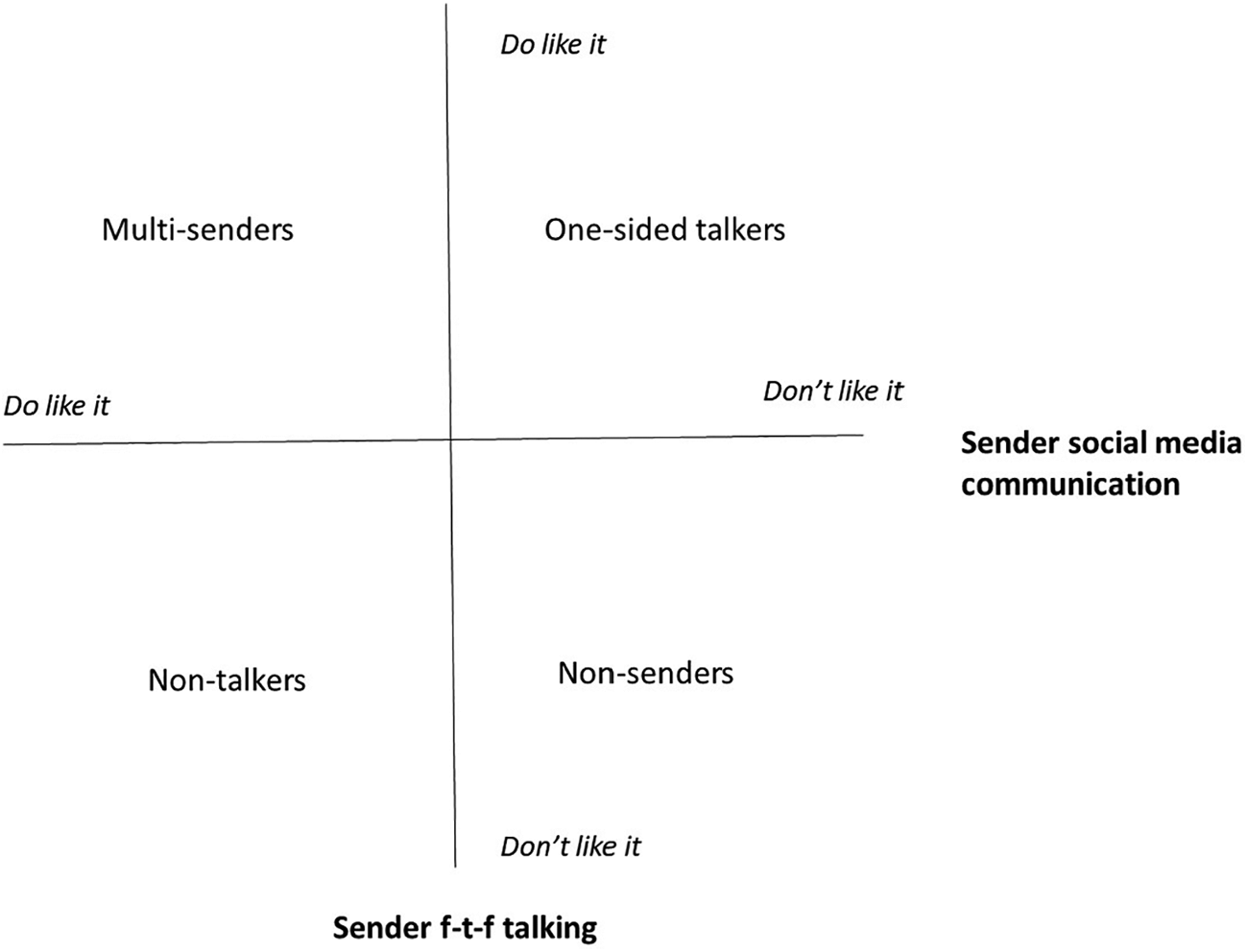
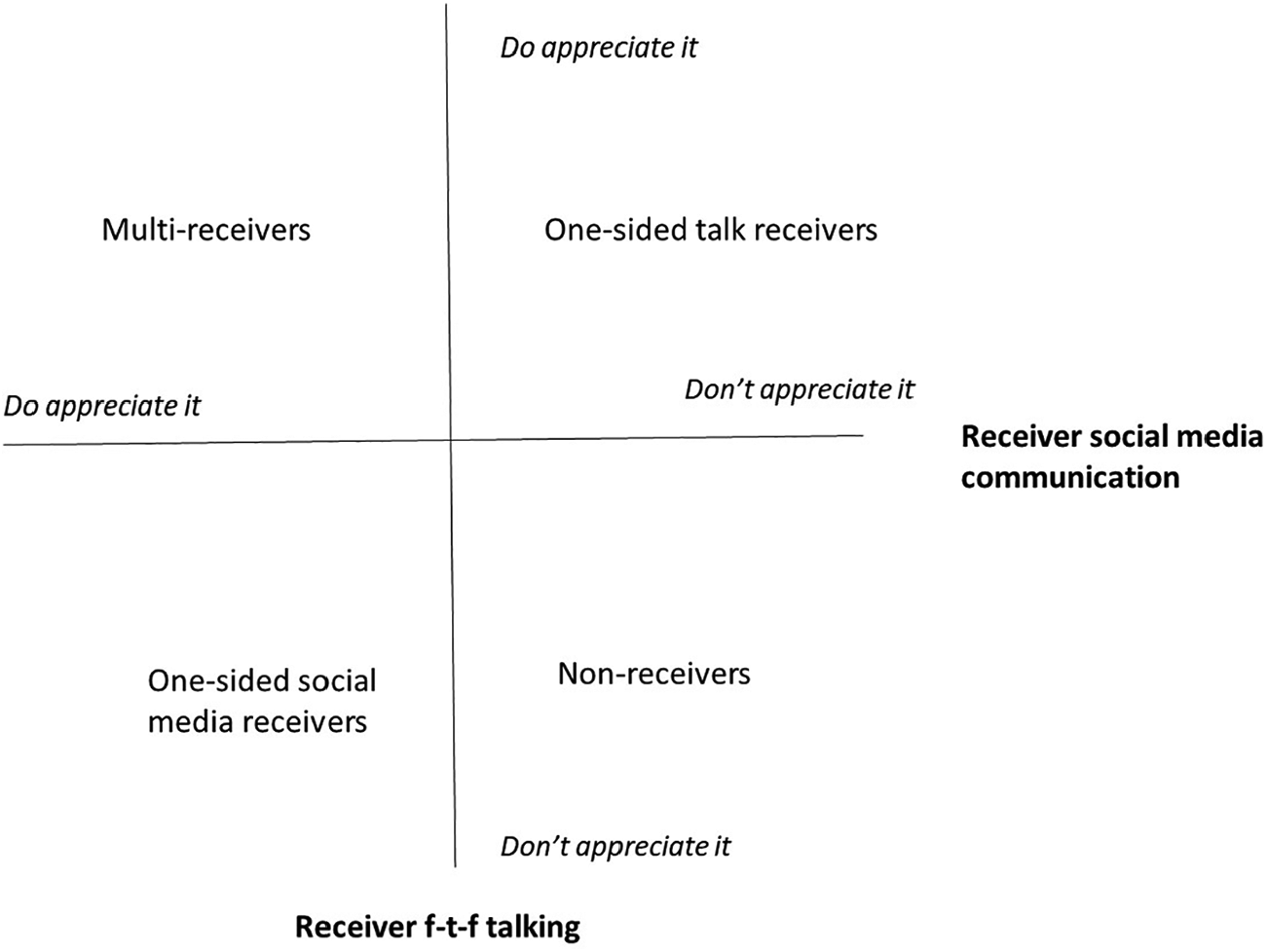
This relevance to both science and marketing inspired a study concerning how visitors communicate with each other about cultural visits and their experiences during those visits. This communication process entails a distinction between the sender and the receiver roles. Simply put, we refer to the talker and the listener, with a distinction between traditional face-to-face communication and communication using social media. These two dimensions (sender / receiver and face-to-face / social media) lead to two 2 × 2 grids that are the theoretical basis of the study. Based on these two dimensions, eight segments can be constructed—four sender segments and four receiver segments:
Sender segments
Multi-senders: like to communicate about their visit to a cultural event either by talking face-to-face to friends and acquaintances or by posting photos or text on social media.
Non-talkers: do not like to talk face-to-face about their cultural participation but like to communicate about it by using social media.
One-sided talkers: like to talk face-to-face about their cultural experiences, but do not like to do this by using social media.
Non-senders: do not like to communicate about their visit, neither face-to-face nor through social media.
Receiver segments
Multi-receivers: appreciate it when they receive face-to-face messages and social media posts about others’ experiences during a visit to a cultural event.
One-sided social media receivers: do not appreciate receiving face-to-face messages from others about their experiences when visiting a cultural event, but do appreciate receiving this information through social media.
One-sided talk receivers: appreciate receiving face-to-face messages about cultural participation by others, but dislike social media in this respect.
Non-receivers: do not appreciate receiving face-to-face messages and receiving social media messages about others’ visits to cultural events.
Figure 1 shows the grid for the sender role. A cultural participant communicates about a cultural visit either face-to-face or through social media to important others in his or her social environment. More communication will lead to more social visibility and less communication will lead to less social visibility regarding the visit.
Sender grid.
At the top left-hand side of Figure 1 is the segment which likes to talk face-to-face about the cultural visit and also likes to communicate about it through social media, and therefore makes the largest contribution to social visibility (Multi-senders). At bottom right is the group which least likes to communicate about their visit through both channels and therefore makes the smallest contribution (Non-senders). There are also two segments which communicate about their cultural visit using only a single channel. These are located at bottom left (social media users only [Non-talkers]) and at top right (only face-to-face talkers [One-sided talkers]). The latter two segments make a limited contribution to the social visibility of their visits.
Figure 2 shows a similar grid for the receiver role. At top left is the segment which most appreciates receiving messages about cultural visits, through face-to-face contacts as well as through social media; these are the Multi-receivers. At bottom right is the segment which least values receiving information about cultural visits by others, briefly described as Non-receivers. The top right-hand segment only appreciates receiving spoken information (One-sided talk receivers) and the bottom left-hand segment only appreciates receiving social media information (One-sided social media receivers).
Receiver grid.
The research question in this study concerns how large the sender and receiver segments are and whether these segments differ from each other in terms of socio-economic background variables.
The study was designed and carried out based on the grids in Figures 1 and 2. The next section describes this design in more detail.
Operationalization and questionnaire
We already mentioned that research conducted earlier (Bronner & de Hoog, 2019), showed that there are substantial differences between the various forms of cultural participation as regards the role that conspicuous consumption plays in them. A relatively large role was found with regard to visiting Classical concerts, exhibitions in Museums, and festivals. Based on this finding, we limited this research into the social visibility of cultural participation to visits to Museums, Classical concerts, and Cultural festivals. For each cultural form, a filter question was first asked: did one participate in one or more of the three cultural forms and, if one did participate, six follow-up questions were presented. In total, the questionnaire consisted of 3 (cultural forms) × 7 (participation question plus six follow-up questions) = 21 questions. Below, the questions asked are described, taking museum visits as an example. For the other cultural forms, the term “museum” was replaced with “classical concert” or “cultural festival.” For the latter, several examples were included (like Oerol, Uitmarkt, Pinkpop, and IFFR), as the variety for this category is much larger than for the other two cultural forms.
Museums
Answer possibilities: not/1–2 times/3, 4, or 5 times/6–10 times/more than 10 times
Filter: questions Q2 and Q3 are only asked if a museum is visited at least once a year
Answer possibilities: Q2a/Q2b/Q2c and Q2d are fully applicable/applicable/slightly applicable/neutral/not so applicable/not applicable/not at all applicable
Answer possibilities: museums do enough/don’t do enough
Filter: this question is only asked if the answer possibility “don’t do enough” is given to Q3a
Answer possibilities: an open question The Q1 question is first asked for the three cultural forms. If a respondent participates in one or two forms they are questioned about these forms and if the respondent participates in three forms, two forms are randomly selected and randomly administered.
Fieldwork and analysis
The questionnaire described earlier is fairly brief and including it in a survey covering only this topic would be too expensive. However, it turned out to be possible to combine the culture questions with questions about sports experience. These are two non-profit and leisure subjects that combine well. The fieldwork in the Netherlands was carried out by Hendrik Beerda Brand Consultancy in collaboration with the research agency No Ties. The basis for the sampling is a large access panel. From this panel, a stratified sample was drawn in such a way that socio-demographic strata were represented in the sample in proportion to the population. Because of the high response (nearly 90%) only a very limit weighing had to be applied. The response is high because respondents are rewarded and the initial subject (sports) is very popular. The total sample is n = 774 and this sample is representative of the Dutch population 18+ on crucial socio-economic criteria. After the sports-related questions, the following sentence was presented to these respondents: “In this survey we have so far talked about sport. Finally, we would like to ask you a few questions about a different subject, namely your cultural visits, such as visiting Museums, Classical concerts or Cultural festivals.” As described above, a participation question (Q1) was first asked per culture form. It was determined whether the respondent participated in these three forms of culture. If so, then, as mentioned above, two cultural forms were chosen at random. After the fieldwork, the following sampling sizes are available:
Museum sample comprises 485 respondents;
Classical music concert sample comprises 152 respondents;
Cultural festival sample comprises 227 respondents.
These three sub-samples can be considered as representative for the participants of the relevant cultural form.
The fieldwork was carried out at the end of November / beginning of December 2018. Computer assisted self-interviewing (CASI) was used for the data collection. Respondents can answer the questions at home at a time that is convenient to them and can take the time they need to answer the questions (Bronner & de Hoog, 2016). This customer-friendly approach increases response and data quality, as was shown by Bronner and Kuijlen (2007, p. 186).
In the next section we describe the analysis steps that were performed on the three sub-samples and the results.
Results
The data from the questionnaire required some processing before they could be used. This involved six steps as follows:
Step 1. Re-scaling the 12 scales (three cultural forms and two communication behaviors, see Q2a/Q2b/Q2c/Q2d in the section “Operationalization and questionnaire”) so that the highest score is “fully applicable” (7) and the lowest score is “not at all applicable” (1).
Step 2. Recoding these 12 scales in a dichotomy; the values 7, 6, 5 are coded as “applicable” and the values 4, 3, 2, 1 as “not applicable.” This allows the data to fit into the theoretical grid with the four quadrants described in the section “Social visibility as a precondition for conspicuous consumption.”
Step 3. Constructing sender grids for each of the three cultural forms with the focus on active communication behavior (sender role) for face-to-face communication and communication through social media.
Step 4. Cross tabulations were made between these four cells of the grid (sender segments) and age, gender, social class, and visit frequency. These analyses were performed for the three cultural forms: Museums, Classical concerts, and Cultural festivals.
Step 5. Constructing receiver grids for each of the three cultural forms with the focus on passive communication behavior (receiver role) for face-to-face communication and communication through social media (see Figure 2). Cross tabulations are made between these four cells of the receiver grid (segments) and age, gender, social class, and visit frequency. These analyses were performed for the three cultural forms: Museums, Classical concerts, and Cultural festivals.
Step 6. Description of the results for each of the three cultural forms (see below).
The results are presented for each cultural form separately.
Results: Museums
Sender segments
Table 1 shows how the 485 visitors to Museums are classified as senders based on their answers in the questionnaire (see Figure 1 for the basic Sender grid).
Sender grid Museums (n = 485).

Table 1 shows that the largest segment (43%) is the one concerning the One-sided talkers. For realizing maximal visibility, the Multi-senders segment (31%) should be the largest one. The Non-senders segment is fairly large, and visitors in this segment can be stimulated to communicate more about their museum visits.
These sender segments were related to four socio-demographic background variables: age, gender, social class, and visit frequency. Only the relationship with age was significant (see Table 2).
Sender grid Museums related to age (% horizontally).
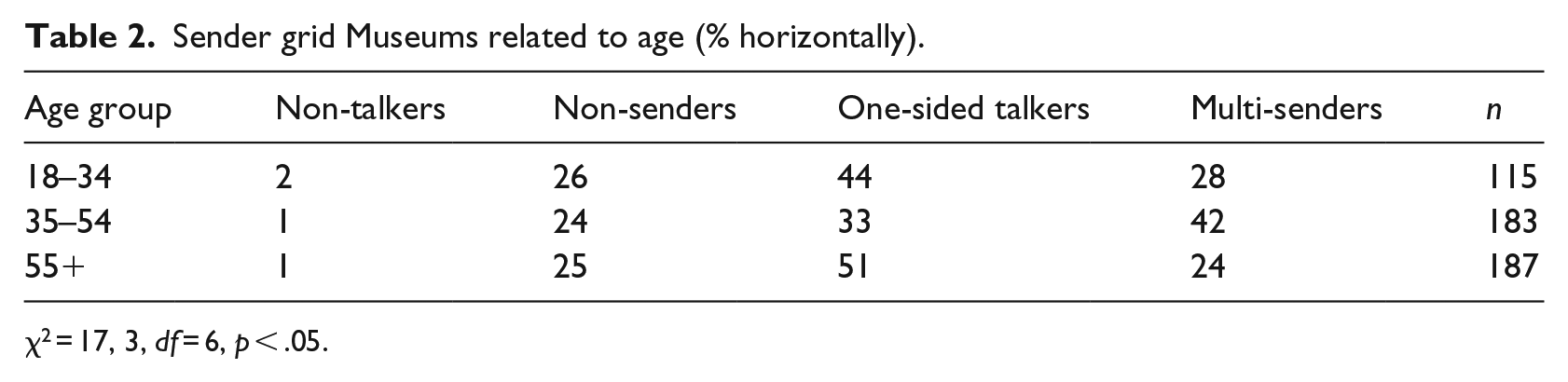
χ2 = 17, 3, df = 6, p < .05.
With regard to age, there is no linear relationship with age, as could be expected because younger people are overall much more active on social media than older people. In fact, the youngest and oldest people are both under-represented in the Multi-senders segment. In the 35–54 year age group, Multi-senders predominate. Figure 3 illustrates this unexpected result graphically.
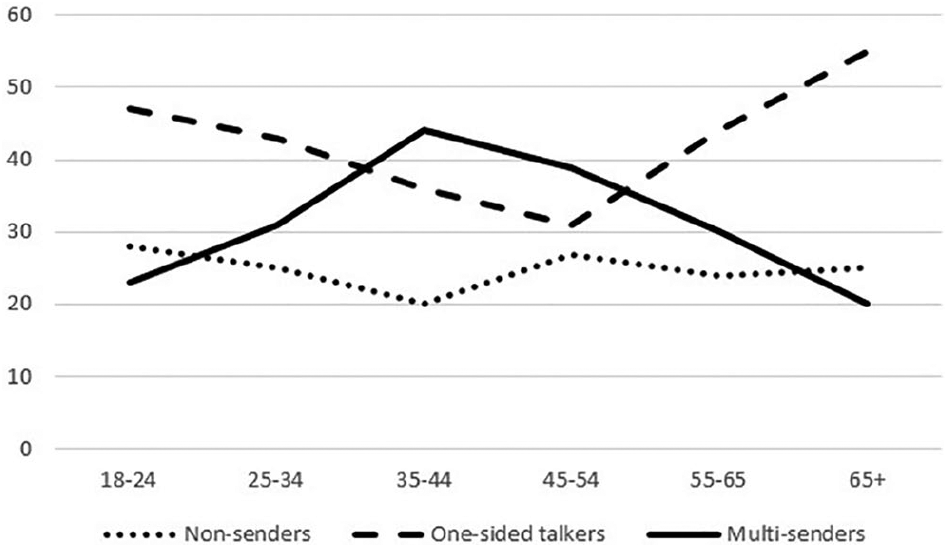
Relationship between Museums sender segments and the age of visitors.
In Figure 3 the vertical axis shows the percentage of visitors who belong to the three main sender segments; the Non-talkers have been omitted because there are too few of them. The horizontal axis shows the six age categories; these six categories were reduced to three in Table 2 to reduce the complexity of that table. As can be seen in Figure 3, the conclusion from Table 2 does not change when all six age categories are represented.
Receiver segments
Table 3 below shows how the 485 visitors to Classical concerts are classified as receivers based on their answers in the questionnaire (see Figure 2 for the basic Receiver grid).
Receiver grid Museums (n = 485).

From Table 3, it can be seen that the Non-receiver segment is the largest. This will not be helpful for the visibility of Museums. To increase visibility, one could encourage people to use other people as sources of information about what Museums have to offer. Of course, non-receiving is indirectly related to non-sending: if nobody sends anything there cannot be much receiving either. However, the question asked about receiving does not measure actual receiving behavior but whether people appreciate receiving messages about cultural visits by others, which makes the link between sending and receiving less direct.
The receiver segments were also related to the socio-demographic background variables: age, gender, social class. Only the relationship with age was significant (see Table 4).
Receiver grid Museums related to age (% horizontally).
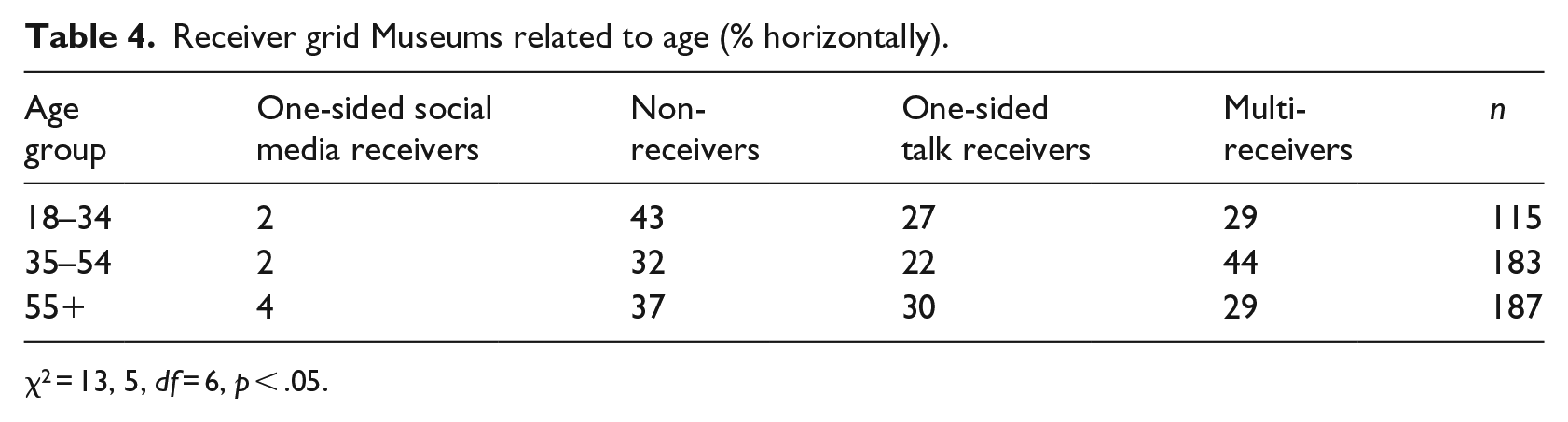
χ2 = 13, 5, df = 6, p < .05.
Table 4 shows that in the 35–54 year age group the largest group is the Multi-receiver segment. Again, the younger and older visitors are less inclined to receive messages from other people about their museum visits. As a consequence, the distribution for the receiver segment is quite similar to the one for the sender segment shown in Figure 3.
Results: Classical concerts
Sender segments
Table 5 below shows how the 152 visitors to Classical concerts are classified as senders based on their answers in the questionnaire (see Figure 1 for the basic Sender grid).
Sender grid Classical concerts (n = 152).

Table 5 shows that the One-sided talkers are the largest segment, followed by the Non-senders. The Multi-sender segment is smaller than the same segment for Museums. This segment which causes the largest visibility finishes third, a clear signal that much must be done to improve the visibility of Classical concerts.
These sender segments were related to the socio-demographic background variables. Only the relationship with age was significant (see Table 6).
Sender grid Classical concerts related to age (% horizontally).
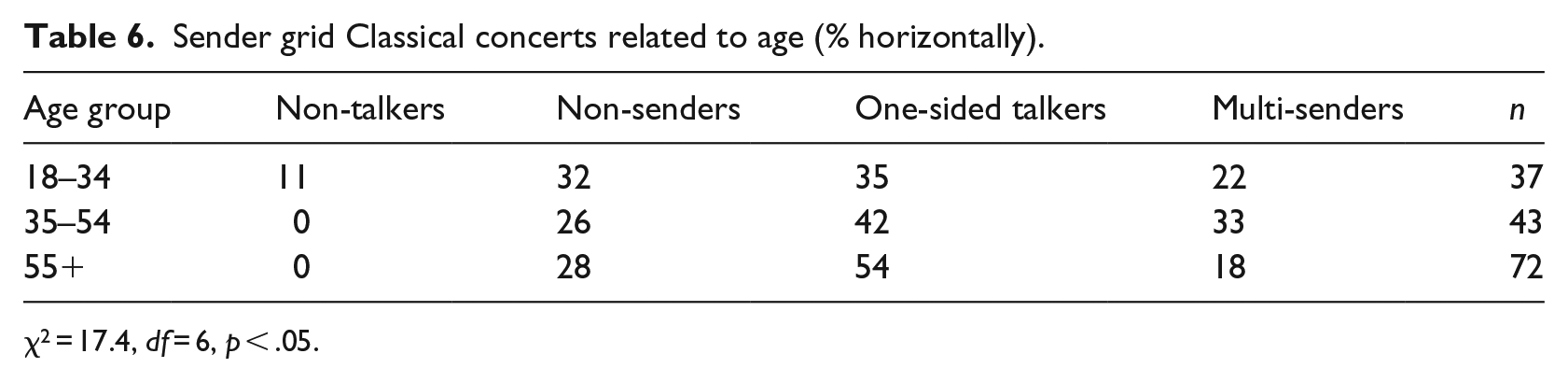
χ2 = 17.4, df = 6, p < .05.
The pattern in Table 6 is quite similar to the one in Table 4: younger and older people are under-represented as Multi-senders and over-represented as Non-senders. The distribution of age groups over the four segments is almost the same as shown in Figure 3.
Receiver segments
Table 7 below shows how the 152 visitors to Classical concerts are classified as Receivers based on their answers in the questionnaire (see Figure 2 for the basic Receiver grid).
Receiver grid Classical concerts (n = 152).

One-sided talk receivers are the largest group in Table 7, followed by the Non-receivers. Just as with the Sender segment, the segment that is most receptive to messages from others about their visits to a Classical concert finishes third. Clearly, more can be done to encourage visitors to Classical concerts to become informed about other people’s experiences during such concerts.
These receiver segments were related to the socio-demographic background variables. Only the relationship with age was significant (see Table 8).
Receiver grid Classical concerts related to age (% horizontally).
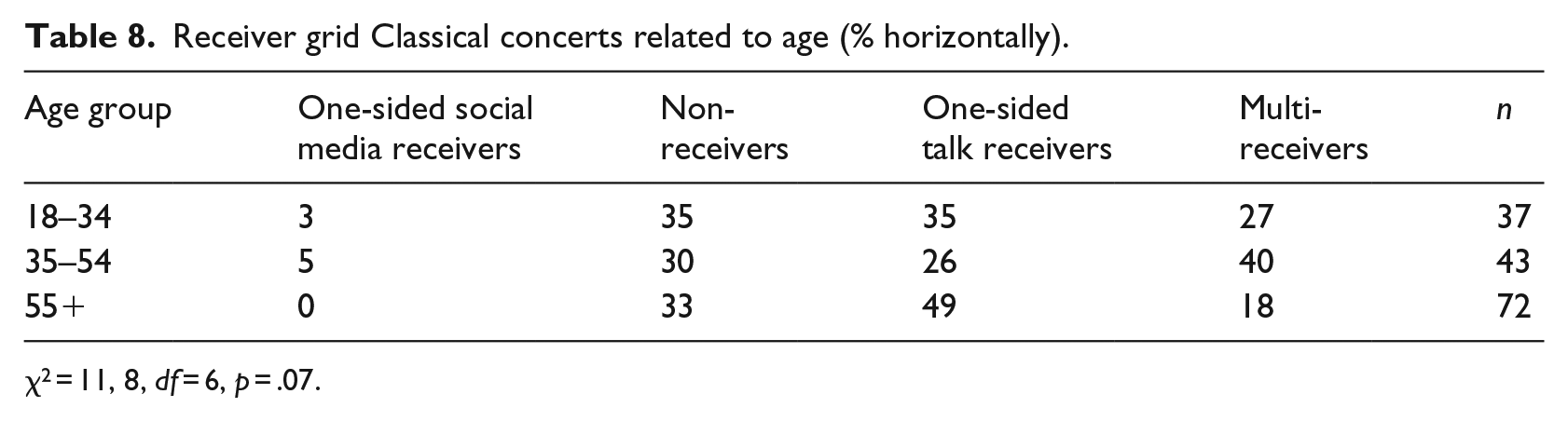
χ2 = 11, 8, df = 6, p = .07.
The distribution of the age groups across the four receiver segments concerning Classical concert is quite similar to the one found for museums, but is even a bit more marked. Evidently, the younger and older age groups are prime targets for efforts to increase their inclination to receive messages from other people about what they experienced during their visits to Classical concerts.
Results: Cultural festivals
Sender segments
Table 9 below shows how the 277 visitors to Cultural festivals are classified as senders, based on their answers in the questionnaire (see Figure 1 for the basic Sender grid).
Sender grid Cultural festivals (n = 277).

In Table 9 the Multi-senders are the largest group of visitors. The difference as compared with Museums and Classical concerts is substantial: 27% more than for Classical concerts and 19% more than for Museums. About 73% of the visitors to Cultural festivals do tell other people about their experiences at these festivals. Clearly, Cultural festivals enjoy more active communication by visitors to others about their visit than Museums and Classical concerts do. This proves that increasing the visibility of a cultural form can be achieved.
These sender segments were related to the socio-demographics. Only the relationship with age was again significant. As with the other cultural forms, the Multi-sender segment is largest for the 35–54 year age group: in the age group 18–34, 51% is a Multi-sender; in the age group 35–54, 62% is a Multi-sender; and in the age group 55+, 27% is a Multi-sender.
Receiver segments
Table 10 below shows how the 277 visitors to Cultural festivals are classified as Receivers based on their answers in the questionnaire (see Figure 2 for the basic Receiver grid).
Receiver grid Cultural festivals (n = 277).

The pattern in Table 10 is similar to the pattern in Table 9, with only a decrease in the number of One-sided talk receivers. So with regard to activating the receiving side of the visibility of Cultural festivals, the same applies for the sending side. Again, only the relationship with age was significant.
Results: comparing the three cultural forms
The previous paragraphs focused on each cultural form separately. These paragraphs compare the three cultural forms.
Table 11 shows the size of the sender segments for the three cultural forms.
Size of Sender segments for different cultural forms (% vertically).
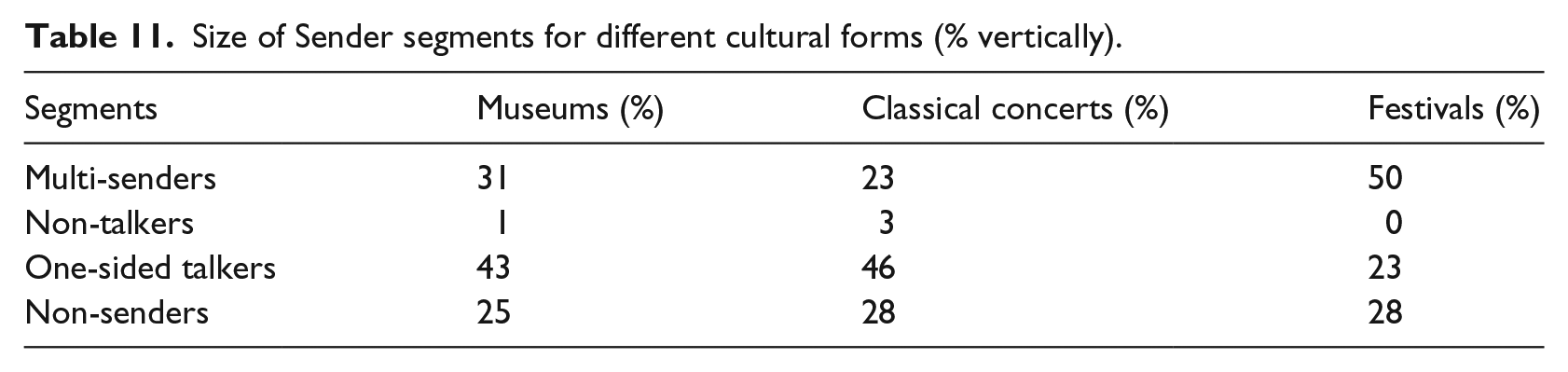
With regard to Museums and Classical concerts, the largest segment (43% and 46%) is comprised by the One-sided talkers, whereas to create the highest visibility, it would be desirable for Multi-senders (31% and 23%) to comprise the largest group. The Non-senders segment is also relatively large (25% and 28%). It is precisely among this group that sending could be encouraged.
We find different results for festivals. The Multi-senders segment is the big winner here (50%). This is a considerable difference as compared with the percentage of Multi-senders in the Museums and Classical concerts sample: 27 percentage points higher as compared with Classical concerts and 19 percentage points higher as compared with Museums. So there is more active communication about festivals than there is about Museums and Classical concerts. The social visibility of festivals is greater than that of Museums and Classical concerts.
Table 12 shows the size of the receiver segments for the three cultural forms.
Size of receiver segments for different cultural forms (% vertically).
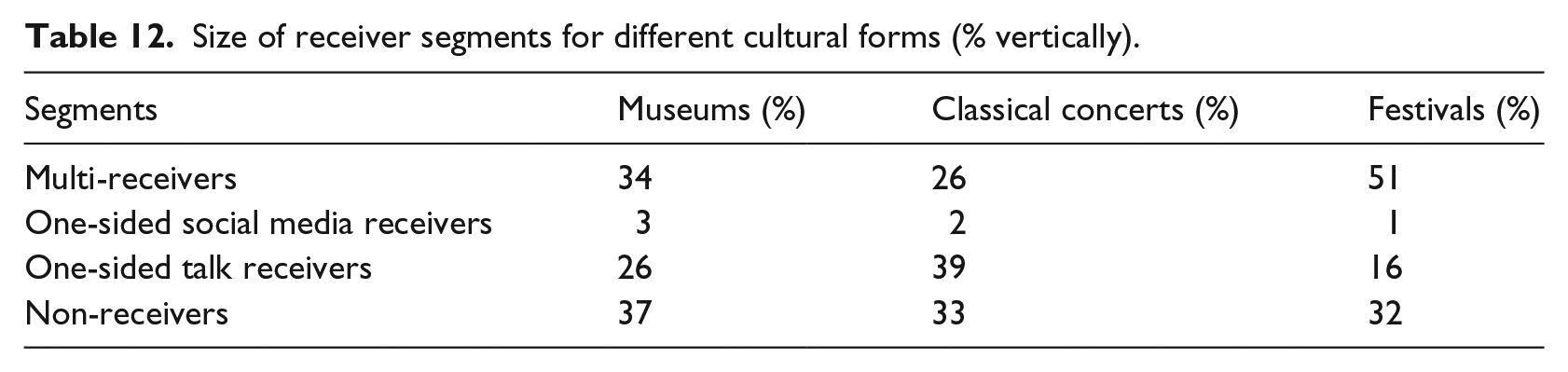
Table 12 shows that the Non-receivers segment as regards Museums and Classical concerts is the largest (37% and 33%), which is not favorable for the visibility of these forms of culture. From the perspective of greater visibility, people should be encouraged to better appreciate that information about Museums and Classical concerts can be acquired through others. Just as with the sender segments, with the receiver segments we also see a different picture as regards festivals. The Multi-receiver segment is the largest here (51%). This confirms the observation that at festivals, visitors appreciate social visibility by others more than is the case with Classical concerts and Museums.
Finally, the analysis shows that to a large extent Multi-receivers and Multi-senders overlap.
Results: comparison of conspicuous consumption and social visibility
Next, we look at the relationship between communicative behavior and the importance of conspicuous consumption. We compare two studies for this, one reported in Bronner and de Hoog (2019) and the current one. In the first study, we have the results regarding a question about the importance of the signaling identity when visiting Museums, Classical concerts, and Cultural festivals. In this study, we focus on communication behavior for these three forms of culture that leads to social visibility, which is a prerequisite for conspicuous consumption. The question is whether the communication behavior aligns with the desired identity-signaling. In other words, with respect to people who attach importance to identity-signaling: do they also communicate in such a way that they achieve the necessary social visibility? In both studies, the strongest relationship is with age, and that is why we compare conspicuous consumption scores and the visibility scores as determined on the basis of the questions in this study for the three age categories. We do this for all three cultural forms.
Museums
Table 13 below shows the three age categories in the rows that are also used in Table 4. The first column shows the average score that the age segment has on the desired identity-signaling scale from the previous study, and the second column shows the percentage of Multi-senders that belong to the age category.
Identity-signaling score of age categories as compared to percentage of Multi-senders (Classical concerts).
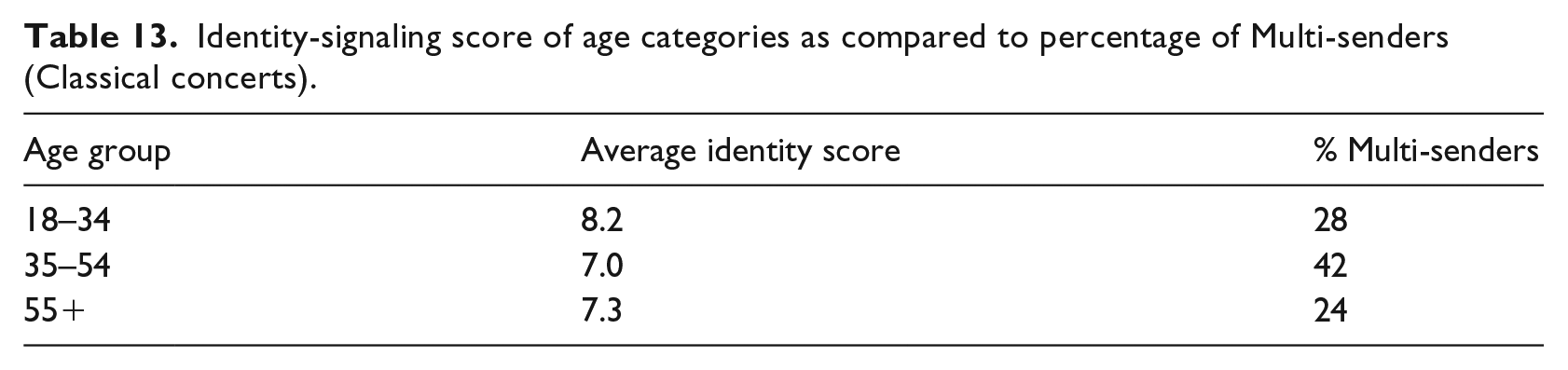
From Table 13 it can be seen that there is a considerable discrepancy between the desired identity display in the context of conspicuous consumption and the communication activity necessary for signaling this display. Young people have a relatively high identity score but a relatively low visibility score (% Multi-senders). This calls for efforts to encourage young people in particular to contribute to the visibility of Museums.
Classical concerts
Table 14 was compiled in the same way as Table 13.
Identity-signaling score of age categories as compared to percentage of Multi-senders (Classical concerts).
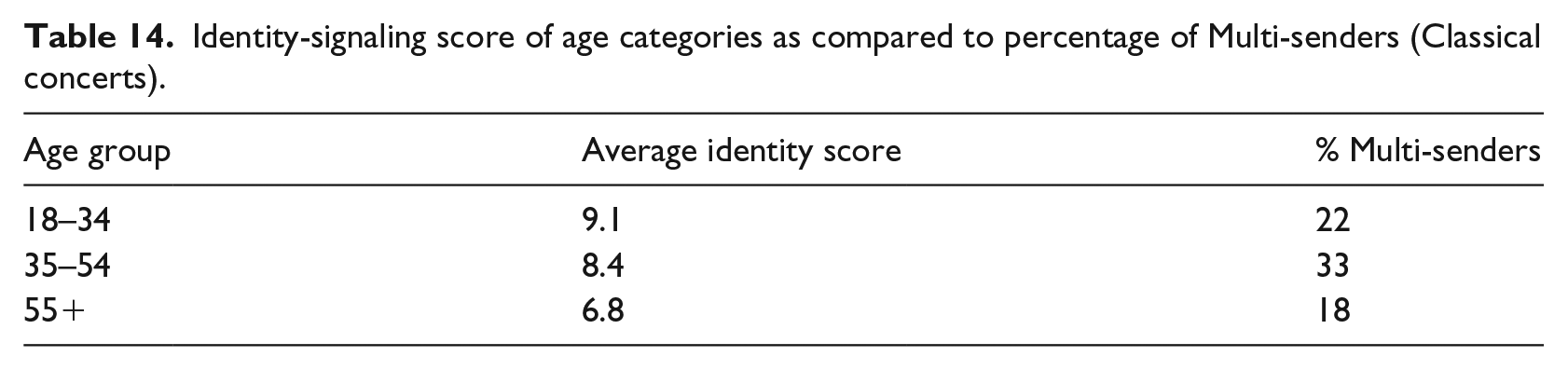
Also, based on this table, it can be concluded that the largest discrepancy can be found among the youngest group. In the other two age groups, there is a better balance between communication behavior and desired identity-signaling.
Cultural festivals
Table 15 below was compiled in the same way as the tables above.
Identity-signaling score of age categories as compared to the percentage of Multi-senders (Cultural festivals).
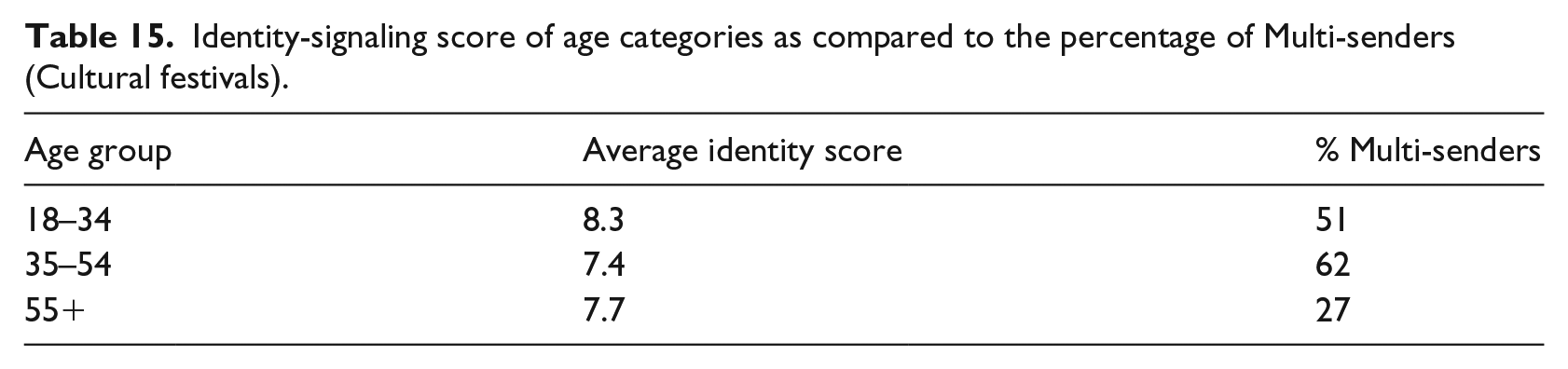
Broadly speaking, the same conclusion applies to Cultural festivals as applies to Museums and Classical concerts. However, it seems that the elderly can still be encouraged to communicate more about their visits to Cultural festivals, because they have a relatively high identity score.
Results: visitors’ suggestions for increasing the visibility of their experiences
This issue is addressed using questions Q3a and Q3b as described in the “Operationalization and questionnaire” section.
The answers on Q3a indicate that concerning museums, 20% of the respondents are of the opinion that these do not do enough to help people to post photos or text on social media. For Classical concerts, this is 23% and for Cultural festivals 10%. Striking is that younger people are more dissatisfied with the help of Classical concerts (37% is dissatisfied in the age category 18–34, 19% in 35%–54%, and 18% in the category 55+; χ2 = 6.06, df = 2, p < .05). This could be an explanation for the lower social visibility scores of younger people, in particular for Classical concerts.
The majority of the suggestions were made for Museums and Classical concerts. Below, we list some illustrative examples of suggestions for these cultural forms. As there were not many suggestions for cultural festivals, we omit them.
Museums
Stimulate posting by initiating a prize-winning campaign, for example “the most beautiful selfie of the week”;
If the taking of pictures is permitted, make this very explicit;
Museum should be active as a vlogger;
Posting about a visit is rewarded by a discount, in the museum shop, for example;
Pointing out the best places for taking pictures;
Create the possibility of buying a digital photo or artifact that can be sent to others;
Create a “social media wall” in the museum where visitors can place their pictures, and make the wall accessible through Internet.
The general idea behind these suggestions is that a museum should make it clear if the taking of photos is allowed, and encourage and facilitate it. Creating “selfie spots” is mentioned most frequently.
Classical concerts
Use YouTube for showing the combination of sound and images;
Be more permissive as regards taking photos and making recordings;
The setting is very formal: you’re afraid to use your mobile devices if it is not encouraged. Make clear what is allowed and what is not.
In contrast to Museums, suggestions for Classical concerts are not so much about matters such as selfies, but more about allowing and encouraging the reporting of experiences in general.
Conclusions and implications
Conspicuous consumption is a concept with a long history. Veblen (1899) coined the term conspicuous consumption in his book The Theory of the Leisure Class. His idea was that consumers may be “signaling-by-consuming.” A consumer decision may be explained not only by the intrinsic utility that a product offers. What a product also symbolizes to others is an important additional explanatory factor (Corneo & Jeanne, 1997). Conspicuous consumption is important to those who attend Cultural festivals, Classical music concerts, and visitors to Museum exhibitions, as was shown in the study by Bronner and de Hoog (2019).
Cultural visits and cultural experiences often have a signaling function to others, but to achieve the desired result of that signaling, the event that has been visited must be visible and known to those others, otherwise you cannot signal anything with it. This social visibility is a precondition for the realization of conspicuous consumption and was the central topic of this study.
Social visibility involves the way in which people communicate with each other about cultural visits and their experiences during these visits. For this communication process, a distinction is made between the sender and the receiver role. Simply put, the talker and the listener. Furthermore, a distinction is made between traditional face-to-face communication and communication through social media. These two dimensions (sender / receiver and face-to-face / social media) lead to eight different segments: four sender segments and four receiver segments.
Bronner and de Hoog (2019) showed that there are substantial differences between the various forms of cultural participation with regard to the role of conspicuous consumption. A relatively large role is played by visiting Classical concerts, exhibitions in Museums, and Cultural festivals. That is why we have restricted research into the social visibility of cultural participation to Museums, Classical concerts, and Cultural festivals. For each cultural form, a filter question was first asked concerning whether respondents participated in a cultural form, and subsequently six follow-up questions were presented to the participants. Segments are constructed based on the answers to these questions.
The research question in this study concerns how large the sender and receiver segments are and whether these segments differ from each other in terms of socio-economic background variables.
Segmentation by age clearly shows that the middle-age category (35–54) makes the largest contribution to the visibility of cultural visits. The relationship with age is not linear, but looks more like a parabola. The youngest and oldest age groups are most similar to each other because they contribute less to visibility. Both age categories include relatively few Multi-senders and Multi-receivers, in contrast to the middle-age group, which includes a relatively large number of Multi-senders and Multi-receivers. The finding that the most active communication role is played by the middle-age group applies to both sending and receiving roles and to all three cultural forms investigated: a very consistent finding in this study. With regard to Cultural festivals, the percentage of Multi-senders and Multi-receivers is clearly higher than is the case with Museums and Classical concerts, but the pattern of the relationship with age is the same as with Museums and Classical concerts. With Classical concerts, it is also striking that the elderly are strongly represented in the One-sided talkers segment.
Possible explanations for the low social visibility scores of younger people could be, first, that some cultural forms do not do enough to help people to post photos or text on social media, and, second, that younger people are less interested in communicating about cultural because they think their messages will not be appreciated by their contemporaries. The first explanation is supported by evidence concerning Classical concerts and the second by the limited number of younger people in the Multi-receiver segment.
An analysis combining previous research on conspicuous consumption by Bronner and de Hoog (2019) and results from this research (see Tables 13 [Museums], 14 [Classical concerts], and 15 [Cultural festivals]) shows that there is a considerable discrepancy between the desired identity-signaling of experiences derived from cultural visits in the context of conspicuous consumption and the communicative activity necessary to realize this desired identity-signaling. Younger people have a relatively high identity-signaling score, but a relatively low visibility score. This holds true for all three cultural forms. Based on this, it seems to be a good strategy to especially encourage younger people to contribute to the visibility of these cultural forms by using means of communication, as their identity-signaling intentions make them receptive targets. In addition, providing more facilities for posting photos or text on social media is important because, in particular for Classical concerts, our results show that especially young people are dissatisfied with the offered opportunities for communication of their experiences to relevant others.
An important conclusion from this study—based on the size of the eight segments—is that the social visibility of cultural visits can clearly be improved. This applies much more to Museums and Classical concerts than to Cultural festivals. As face-to-face communication about cultural visits is more appreciated than the actual communication through social media (as appears from the straight counts of the questions that form the basis of the segments), it provides a reason for creating more facilities for using social media during cultural visits. Facilitating communication requires overcoming barriers. Cultural management still creates barriers, as Hughes and Moscardo (2017) indicate, “although museums are increasingly incorporating new digital and social communication into their exhibition techniques and marketing, many have remained opposed to allowing or encouraging visitors to use MCDs (mobile communication devices) in exhibitions” (p. 35). There is also skepticism in cultural circles about allowing selfies, but as Budge (2017) concludes, based on a content analysis of photos taken in museums, “none of the images containing people are ‘just’ selfies (images which intentionally situate a person as the central focus or main subject)” (p. 79). In other words, the person is never the main subject of a selfie in a museum. It follows that the exhibited objects are made visible through social media to relevant others in the social environment by way of the selfies of the visitors.
Finally, in the survey suggestions for helping people to put photos or reports on social media were asked. In general, their answers show that a museum must make it clear that taking photographs and videos is permitted and must also encourage and facilitate it. The most frequently made suggestion in this context is the creation of selfie spots in the museum. Suggestions for Classical concert stages are not so much about matters such as selfies, but much more about allowing and encouraging the reporting of experiences.
In short, we know from previous research that people want to signal something of their personality to others with cultural visits and cultural experiences. To be able to signal this to relevant others, social visibility of a museum visit, concert or festival visit is necessary. This research shows that sending and receiving messages about the visit can be raised to a higher level, especially when it comes to communication through social media. The higher figures, as found for Cultural festivals, could be a target for Museums and Classical concerts. In addition, suggestions made by the respondents can provide inspiration for Museums and Classical concerts with which to improve their visibility, which can also attract new visitors.
