



Abstract
Our study investigated the acculturation process in a new culture from the perspectives of immigrants (interviewees) and members of the receiving culture (interviewers). One hundred and seven semi-structured interviews were carried out with foreigners from 38 countries who lived in Hungary for at least a year. Using a grounded theory approach, the perspectives and feelings of the interviewers were also analysed in addition to the interview texts. The results reveal that the receiving culture shows what we call a ‘two-stage receptive attitude’, which comprises at first, closedness and later, openness towards foreigners. A binary set of attitudes as ‘traveller or guest’ was observed in immigrants; the ‘guest’ makes efforts to take the host as a complementary actor into consideration, integrating the depths of the foreign culture, while the ‘traveller’ tastes the surface of a foreign culture and collects experiences. Based on our analysis, the dual modes of the traveller and the guest are interpreted as two ideal typical role conceptions or role realisations. Our study increases awareness of the complexity of the acculturation process, as the unique design provided insights into the importance of analysing the perspectives – in addition to those of the interviewees – of the reports from members of the receiving society to add to our understanding of cross-cultural encounters. In addition to its methodological novelty, the present study contributes to the literature by providing an in-depth understanding of the “traveller versus guest” typology and, accordingly, proposing ways to investigate how these two types might function in an organisation.
Introduction
This paper is related to the topic and discourse of acculturation. We consider the various acculturation strategies (Rudmin, 2003), the alternative statuses described by Gillespie et al. (2010) and the communication systems model (Kim, 2017), which also shows that a successful acculturation process depends to a large extent on the openness of the receiving culture, as acculturation is a two-way process. Theoretical approaches suggest that stereotypes about others and self-image are formed in a context of interdependence (Arias and Bryla, 2018), but few empirical observations and interview-based studies have addressed these issues in a way that integrates these insights into applied research methodology itself. As a main contribution, we focus on how the acculturation process is perceived by members of the receiving culture, and not only through self-reports.
Our research, based on qualitative methodology, fills this gap by using an unusually large sample of 107 respondents for interviews. The interviewees, who were of foreign origin and had lived in Budapest for at least 1 year, were interviewed by Hungarian university students. The interviews were transcribed by the interviewers, partly in a meaning-compressing manner and partly in a narrative manner. For the researchers, these interview notes provided the raw study material, as a corpus of texts, which offered a unique and unprecedented opportunity to conduct a theory-driven analysis of the conceptual and interpretative framework in which acculturation is ‘mirrored’ in cultural self-image and in stereotypes of other cultures. However, there were obvious limitations to the relatively direct access to the (foreign-born) interviewees’ representations and the interviewers’ (members of the receiving culture) representations, and we believe that the research findings (e.g., the notion of a two-stage receiver attitude or the ideal-types of travellers and guests) point to the need for further research. However, the interview results have important implications worthy of further reflection, as they raise substantive questions that directly affect individual role perceptions and institutional policies that are central to social spaces such as multicultural metropolises, international relations networks in university, or multinational corporations and their local offices.
The Hungarian context is also novel; adaptation to its culture has recently been explored by Malota and Mucsi (2023), and its cultural background is described in the related section.
In the following sections, we first present some of the main findings and approaches in the literature on acculturation. We then detail the research methodology used, including the selection of the interviewees, the composition of the interview panel that took notes, and the phenomenological-hermeneutic approach used in the analysis. The backbone of the paper is the presentation of the findings, which range from the reflexivity of the interviewers through the issue of cultural stereotyping (and the elaboration of the notion of a two-stage receiver attitude), to a description of the approximate characteristics of the traveller and guest ideal-types. Finally, we summarise and nuance the key findings, which, in addition to contributing to the theoretical interpretive framework, are relevant to applied research.
Theoretical background: The acculturation process and stereotyping
Acculturation occurs ‘when groups of individuals having different cultures come into continuous first-hand contact, with subsequent changes in the original culture patterns of either or both groups’ (Phinney et al., 2006: 72). Acculturation strategies refer to the various pathways people might follow when adapting to a new or unfamiliar culture. Through cultural contact, people might change their beliefs, behaviour, language, and technologies (Sam and Berry, 2010), so acculturation is viewed in the context of relationships between an individual’s frame of reference and behaviour and the environment of the receiving culture (Abodohoui et al., 2020; Anderson, 1994; Berry, 2005; Shinnar et al., 2012; Thirlwall et al., 2021).
When encountering a new culture and communicating with a different cultural group, difficulties in communication, misunderstandings, identity crises, threats to emotional well-being, and social alienation might occur.
The acculturation process and the choice of acculturation strategies are influenced by several factors: cultural distance (differences between the home and receiving culture) (Kadam et al., 2021; Selmer et al., 2007), biological factors (e.g., age, lifestyle, health) (Okpara, 2016), personality (Stoermer et al., 2021) and experience (e.g., previous foreign experiences, previous information, intercultural training) (Okpara, 2016).
Recent research emphasises the role of intercultural competencies, the need for and possibilities for cross-cultural adjustment, and the need to consider differences between cultures ‘abroad’ and ‘at home’ (Maznevski, 2020; Stahl et al., 2010).
Several authors agree that immigrants’ adjustment process takes place and is managed at three levels: national/locational, personal, and organisational (Hajro et al., 2019; McNulty and Brewer, 2020; Taylor et al., 2021).
Kim’s (2017) dynamic model of ‘stress, adaptation, and growth’ proposes that as a reaction to an initial stress, the individual learns to cope with new cultural norms and thus starts adapting to the new culture. According to the integrative communication theory of cross-cultural adaptation, stress serves as a stimulus for cultural learning and adjustments in one’s original habits and leads to adaptation and a higher level of self-integration (Kim, 2017).
Several authors have identified acculturation strategies, including two dimensions and four possible outcomes, depending on the level of importance of preserving one’s own cultural identity (ingroup orientation) and the importance of preserving relationships with other groups (outgroup orientation) (e.g., Rudmin, 2003; Snauwaert et al., 2003).
Rudmin (2003) identifies four statuses, namely, assimilation, primacultural, bicultural, and culturally independent. Gillespie et al. (2010) explored the possible implications of Rudmin’s four acculturation statuses for Mexican managers encountering the culture of the United States and found that bicultural or culturally independent (cosmopolitan) managers are more likely to reach upper management positions. Bicultural individuals can serve as conflict mediators to solve difficulties resulting from cross-cultural communication in a business environment (Hong, 2010), and culturally independent individuals are free from cultural blinders and exhibit skills related to objectivity and rationality (Gillespie et al., 2010).
Ward’s (2008) study suggested that immigrants generally prefer bicultural integration over assimilation, but this process is not fully understood in an organisational context (Barker, 2017). Additionally, criticisms have been raised regarding how to measure acculturation and the fourfold typology. For example, according to Navas et al. (2007), immigrants are more likely to assimilate to the local culture in public areas and less likely to assimilate in private aspects of culture, and this finding is supported by several new studies (e.g., Barker, 2017; Thirlwall et al., 2021).
According to the uncertainty/anxiety management model (Gudykunst, 1998), the environment and the situation play important roles, as appropriate intercultural communication requires an informative, supportive environment. In the communication system model (Kim, 2017), adaptation occurs through communication, where the receiving culture’s openness to strangers, the level at which it forces its culture onto people arriving from other cultures, and the (political, economic, etc.,) strength of the ethnic group in question are important factors in the success of adaptation/acculturation.
According to Arias and Bryla (2018), ‘fear of otherness’ has different shapes, ranging from official, institutionalised policies to individual positions; as we turn towards the other, we also orient or cohere around the self, which forms a ‘sticky interface’ between individuals (Arias and Bryla, 2018: 4).
In the Central and Eastern European region, where the problems and assumptions of ethnic and cultural diversity and the associated problems of the integrity of multicultural societies are less relevant due to the unique historical past and specificities of social development, a phenomenological and hermeneutical perspective seems to be adequate for conceiving of the role of prejudices essentially within the natural framework of human thought. In relation to cultural adaptation and attitudes, the phenomenological perspective focuses on the typification practices of cognition and their endless transformations in response to new experiences (although these practices are associated with mindsets that are sometimes more open or more closed). (cf. Gadamer, 1989; Schuetz, 1944)
Cultural context: Country description of Hungary
Through the transformation of the CEE region, several sociopolitical and economic changes occurred that also affected international management (Koveshnikov et al., 2022).
Hungary is a postsocialist country in Central Europe, which, as a result, has been a closed country for decades. Migration from socialist countries was typical before regime change, and the country became open in the 1990s. Significant immigration has not been observed, and accordingly, ethnic homogeneity is more common. The most populous immigrant groups are typically ethnic Hungarians who originate from across the border in neighbouring countries, followed by people from China. The number of Hungarian minorities in neighbouring countries is significant due to the annexation of the territory after World War I.
Hungary is a monolingual state. The official language, Hungarian, is an agglutinative language and ‘thus is considered ‘unlearnable’ for most speakers of European languages’ (Navracsics and Molnár, 2017: 30). According to Eurobarometer (2022), Hungarians have the 2nd lowest level of foreign language knowledge after the UK; only 2% of the population can read and write in more than two other languages, which is well below the EU average.
According to the European Social Survey (2022), levels of support for migration are the lowest in Hungary among the 21 European countries surveyed, although levels are also low in some other Eastern European countries. In the 2015/2016 academic year (i.e., during the European migration wave), the Századvég Europe Project was launched, which comparatively examined, among other things, the issue of migration and the perceptions of the populations in several European countries. In the first wave of the 2016 survey, 84% of Hungarians were either somewhat or very concerned about the problem of illegal immigration into their country (Századvég, 2016). Other research findings showed that the level of xenophobia in Hungarian society during this period exceeded the levels previously experienced (Sik, 2015).
From the perspective of the national history of Hungarian society, it should be emphasised that a history of statehood lasting more than a thousand years has given rise to a strong sense of national identity and national pride, as well as a sense of connection to the past. Among the changes that occurred in the past centuries, the peace treaties that ended the First World War uniquely caused Hungary to lose more than two-thirds of its territory and more than half of its population. Even a hundred years later, this historical trauma is still vivid in the cultural memory of Hungarians, and the perception of woundedness in the collective identity of Hungarians is outstanding even according to European standards (László and Máté-Tóth, 2023; Zeidler, 2020). For a number of generations growing up after 1920 (including the university students who conducted the interviews), a homogeneous cultural milieu is the default expectation of their everyday experience. In addition, the word assimilation (in relation to the threat of ethnic survival in territories separated from the motherland) is often used in the context of millions of Hungarians living in territories annexed to neighbouring countries as a result of border changes and in the teaching of history in public education.
Based on the complex background described above, the main research questions guiding this study are as follows: How did the interviewees from different countries and with different cultural backgrounds come into contact with Hungary, and what are the experiences of these interviewees with the Hungarian culture as a “receiving” environment? What are the (ideally) typical recurring features of these experiences and interpretations that arise during the interviews and in the accompanying notes, based on further interpretation of the intersubjective interview situation? How can typical conceptual connections be drawn on the basis of the culturally and situationally diverse sample represented in the textual corpus about the process of acculturation in the lives of foreigners living temporarily or permanently in Hungary? In addition, what kind of narratives about the cultural environment of Hungary are reported by university students in the accounts of the acculturation process itself, and how do the interviewers rephrase these narratives?
Methodology
Data collection, language of interviews and the interviewers
Our research ‘raw material’ consists of 107 semi-structured interviews with foreigners of European, American and Asian origin, who had lived in Budapest for at least 1 year; these interviews were conducted by students of the Intercultural Communication programme at Corvinus University of Budapest. The interviewers were students majoring in international business, and the average age was 21.5 years.
The interviews were conducted by native Hungarian speakers living in Hungary and were conducted in English or, in some cases, in Hungarian. The problem of different languages was not a significant issue in the research, as two languages were used in the process, with all participants having an appropriate level of language proficiency. In addition, there were no significant differences between the interviewers in terms of culture or language skills, and their social status was mostly homogeneous.
Access to participants was arranged through sampling with both direct personal contact and snowballing. The low number of items (one interview per person) helped to address the boredom of the interviewers and thus resulted in clearer reflexivity.
Questions for the semi-structured interview outline were developed considering the main concepts of the acculturation process, and predefined questions and recommended subquestions were provided.
Participants – heterogeneity of the qualitative sample
The respondents had been living in Hungary for at least a year. This inclusion criterion was driven by the intent to ensure that respondents had moved towards cultural adjustment that requires a longer period of stay (Barker, 2017). The quota sampling technique was used based on the geographical continent because of the cultural distance between the home and receiving cultures (Hofstede, 1980), and the physical distance and travel frequency between the countries were determined to be important aspects. The sample was divided into three equal subsamples of people from Asia, Europe and the Americas. Arbitrary sampling was defined within quotas (Malhotra, 2010).
The respondents in the sample were from 38 countries, with the highest proportions of people from the USA (20.8%), China (9.4%) and Vietnam (7.5%). Fifty-eight percent of respondents were male, and 42% were female. The average age was 31 years (ranging from 18 to 70). The time spent in the receiving culture varied between 1.5 and 25 years. Great variation was found in travel and immigration plans, with permanent residency on one end of the scale and additional travel on the other. The detailed demographics of the sample are provided in the Appendix 1.
Analysis in MAXQDA software, grounded theory
The interviewers were trained in selecting the interviewees, preparing the interviews, and writing the reports (the average length was four pages). The fact that the interviews were typically close to 1 hour in length is also an indication of one of the main limitations of the research. The interviewers were only able to provide a very narrow cross-section of meaningful conversations in such a framework, and the researchers conducting the text analysis had access to a rather filtered corpus of texts, which was highly influenced by individual attitudes and interpretations. Thus, the texts analysed were themselves idiosyncratic analyses of the interviews, based on thematic guidelines and a set of criteria but essentially depending on the technique of meaning condensation.
Two researchers who worked in parallel on the reports written by the interviewers participated in the analysis of the text corpus. This was done by verbalizing the revealed patterns and researcher interpretations and by making the analytical techniques performed in the MAXQDA software visible to each other. The researchers also discussed and refined, at several points, what results could be identified. Primarily, the researchers followed the principles of grounded theory, developing and refining concepts based on transcripts and striving to establish a coherent and authentic system (Corbin and Strauss, 2014).
Although we coded the corpus with nearly 800 text locations and the code tree contained a large number of subdivisions, the main objective of the analysis was to develop a convincing theoretical framework using concepts that we developed directly from the interview notes. As such, we followed the principle of theoretical saturation used in interview research, which in this case meant that recurring patterns were not coded repeatedly for each occurrence. Instead, we placed greater emphasis on analytical notes, called memos in the MAXQDA software, and their synthesis.
Findings
In discussing the results of the analysis, we will focus on the central concepts (mirror effect, two-stage receptive attitude, traveller or guest) that emerged during the interview analysis using grounded theory. These were developed in a theory-driven way (in line with the method used) by means of memos created during the reading and coding of the text corpus. We begin the presentation of the results with a subsection that specifically includes and analyses the reflections of the receiving country members (university students who recorded the data).
Stereotypes and reflexivity
One of our examination aspects was whether the responses indicated anything about themselves, such as their feelings, knowledge and opinions. The majority of the texts (66%) did not contain such a section. The rest of the texts contained some evaluative lines about the interviewees from the interviews. We evaluated the passages according to their positive and negative content, and we discovered either a neutral descriptive section or particularly positive content.
We analysed the comments not only for parity but also by topic. Four main areas emerged in the content: (1) the mood of the interviewer, (2) the mention of interesting elements, (3) self-reflection on the knowledge set, and (4) self-reflection in the area of prejudice and sensitivity. Regarding the mood of the interviewer, they mainly reported that they were nervous, excited, or perhaps shy at the beginning of the interview, but some felt that the task was too difficult. It is true that when we drew up the main thread of the interview, we always paid attention to the mood of the interviewee, but we think less about the mood of the interviewer. For example, one interviewer noted: “I knocked excitedly on the door of the girl's dormitory room.” (female interviewer, interviewee: woman from Ecuador)
Another wrote: “As soon as he said that, it dawned on me that when we met ten minutes ago, I had seen him for the first time in my life, and he immediately hugged me, which was also strange.” (female interviewer, interviewee: man from Chile)
All interviewees reported that the initial feeling of discomfort was replaced by a pleasant feeling during the interview. During the data collection, when several interviews are conducted, a kind of dullness and indifference may naturally appear, and the researcher must change the group or motivation of the interviewers to detect this.
The most common textual element was the ‘it was interesting’ type of annotation. This feeling can lead to distortion in the results, so it is important for researchers to notice these issues as well. The interviewer should also pay attention to the verbal and nonverbal parts that are not as interesting to them, where often the real research result is, as it does not appear in the interview itself.
The self-reflections concerned two kinds of content: on the one hand, their knowledge and, on the other hand, their own values, behaviour and prejudices. Along the lines of the former, the interviewer’s knowledge affects the results and interpretation. It is recommended to conduct a preliminary assessment of the knowledge of the interviewers about the topic of the research. Due to the wide range of values and behaviours, self-reflections are particularly useful for the researcher conducting the analysis. At the same time, the ability to self-reflect varies from person to person; therefore, this requires preliminary assessment and training.
It was clear from the analysis that the interviewers experienced the interview situation differently in terms of their mood, their knowledge, and their ability to self-reflect, and their different experiences had an impact on the interviews. These differences are unavoidable, but knowledge of them and the use of that knowledge in the analyses leads to better-quality research results.
Mirror effect: Cultural (self-)stereotypes – and how to revise them
As it is intrinsically linked to the methodology used, the results are presented by analysing the stereotypes about Hungarian culture (and the Hungarian people) as the core area of the acculturation processes reflected in the interviewers’ notes. Since these texts were recorded and filtered by university students who were raised in Hungarian culture, we cannot pass over the fact that a specific case of phenomenological experience is present, a revision in the process of typifying stereotypes about one’s own collective identity. These revisions are brought to the surface in the interviewees’ recorded narratives by the stereotypes they reflect, which are potentially different from existing stereotypes. The process of typification and the description of the naturalness of stereotypes and the continuity of their revision are exhaustively addressed in the phenomenological sociological literature (e.g., Hernádi, 1984).
The most frequent subjective comment was surprise, which clearly reveals the differences between imagined stereotypical elements and those discovered during the interviews. Most differences were related to two areas: the image of the country and the adjustment of those living in it. Typically, interviewers imagined that foreigners had an unfavourable opinion of Hungary and would report several negative experiences, including rudeness, weak language skills, and a lack of public security. In contrast, most respondents reported pleasant experiences.
Another area of difference was related to cultural adjustment. Most surprises were based on ideas that immigrants cannot learn the language or can only do so with great difficulty (which, given the insular nature of the Hungarian language, ultimately seems to be a reasonable expectation), that they cannot adjust to local conditions and do not like traditional food and drink: “Almost everyone, except for the father, speaks the Hungarian language on a native level, which was a great surprise for me.” (man, interviewer of a Japanese family living in Hungary for 9 years)
Relevant research shows that Hungarians’ perceptions of the nation are clearly in along cultural lines (cf. Pew Research Center, 2017). This perception of national identity seems to be reflected in the surprise that those who arrived from abroad, even years earlier, have mastered the Hungarian language, which is otherwise generally considered highly difficult to learn: “To my great surprise, Jack had very different opinions about the country and the people than what I first expected. He described Hungary as a land rich in tradition and history and said he was sorry that its history was not taught in more detail abroad.” (man, interviewer, about a man from the United States)
In Hungary, not only is the sense of national pride very high, but the presence of national shame is also evident (according to the results of a nationally representative survey of the Hungarian adult population along the most important sociodemographic variables conducted by Századvég in 2021). On a seven-point scale, where one end was pride and the other end was shame, a relatively significant proportion of respondents (15.6%) indicated a value corresponding in with shame (Századvég, 2021). The fact that the interviewees painted a more positive picture of the country and its culture than the interviewers may also be because members of the younger generations are more critical of the right-wing government policies in place since 2010 and more dissatisfied with the prevailing social conditions than other generations (Bauer et al., 2022). The interview notes suggest that this is particularly true for young university students who are living in the capital and thus spend their everyday lives exposed to relatively cosmopolitan values.
On the other hand, through memetic transmission and representative communication, members of the receiving culture could have a self-professed national identity that strongly influenced the image they formed about the country. Accordingly, the opinions of foreigners are more or less in line with the characteristics Hungarian people already know so well: the Hungarian people are pessimistic, sad, stressed, and overburdened. “The girl from Ecuador has this message for them: smile and be more accepting!” (woman from Ecuador)
The general feeling is bad; there is a lot of poverty and many economic problems. Hungarians eat greasy food, live an unhealthy lifestyle and are reserved and xenophobic. They focus on the past, have nationalistic values, and the bureaucratic procedures are tiresome. These stereotypes are reflected in the research raw materials.
Nevertheless, there are several factors—most likely not independent of the projected image—that foreigners sense and consider positive: The cuisine, the products and the specialties that are the flagship identifiers of Hungary’s image, the education system, the language, and the beauty of the built environment along with the landscape. The availability and frequency of public transportation falls into this category as well. They also spoke highly of entertainment opportunities and low prices. As an apparent contradiction, often the same people who mentioned that Hungarians were reserved and xenophobic praised the kindness, hospitality, helpfulness, directness, and honesty of local people. How can these ambivalences be resolved, if at all?
Two-stage receptive attitude (the “host’s” expectations of “guests”)
From the responses, it can be concluded that members of the receiving society have a two-stage receptive attitude. These two “rounds” express a temporal succession, and the second stage is a kind of inner circle. From the point of view of the ingroup, the outer “wrap” is broken through (through various mutual gestures and joint actions).
A typical pattern of interaction seems to be that Hungarians avoid uncertain situations and are initially hostile to those who enter into dialogue with them in a more or less unknown language. However, in some cases, this culture shock, which is reversed among participants in the dialogue in some respects, is later resolved (in the “second stage”), but a resolution requires reciprocal gestures on both sides. This is illustrated in the following note by a university student, who tries to reflect the thoughts of his interviewee, an American man, about his experience of what we call the two-stage receptive attitude in a very flexible way: “Assimilation is not made easier by the fact that Hungarians tend to shy away at first and are averse to nonlocals. However, I also experienced a positive factor that assists assimilation: the more Hungarians get to know someone, the more they become exceptionally hospitable, and once they feel that someone belongs to their community, they consider that person to be a full member, regardless of his or her origin.” (man from the United States)
Although during the preparatory course for the research, the university students learned about key concepts in the relevant literature, the interviewer’s description of the use and choice of words did not seem to differentiate between the different meanings of integration and assimilation.
Feelings of quasigroup belonging can be evoked by very small gestures of courtesy, such as knowing a word or two of the local language. After taking this ‘first step’, a foreigner can enjoy the advantages of the honest, direct, and helpful attitudes present in the second stage.
Among the factors that made the adaptation process difficult for foreigners, language barriers were clearly the most prominent. On the one hand, the difficulty of the Hungarian language makes integration more difficult, and on the other hand, the low level of foreign language skills, especially in transnational languages (mainly English), of the population is a recurrent obstacle to everyday contact. Accordingly, the experiences and opinions of foreigners are often drawn from very different dual sources—for example, the intercultural atmosphere of the (typically supportive) university environment is sharply different from interactions with the (typically standoffish) bureaucratic administration or encounters with people on the street. The power imbalance between the “foreign” and host cultures cannot be ignored, and Wallerstein’s centre-periphery relations (Wallerstein, 1983) also model a kind of subordination in terms of language use. In this respect, Hungary, with its language that is neither Romantic nor Germanic, and its post-Communist heritage, occupies a peripheral position on the “travellers’ map of the world”. Since global discourse sets expectations in terms of knowledge of foreign languages and English in particular, it seems natural to expect foreign travellers to be able to move around in an environment that is otherwise foreign to them. Although further research with a different methodology is clearly needed to provide necessary support, the concept of the two-stage receptive attitude seems to be an important result of our analysis, as we have not encountered a description of the phenomenon with similar content and meaning in the literature. “This—so few people speaking English—wouldn’t have been a problem, if the Hungarian language wasn’t a terribly difficult one.” (woman from Mexico).
An important component of the two-stage receptive attitude may therefore be the experience that during a simple everyday interaction, an attempt to establish intercultural contact can easily be experienced by both parties (foreign and Hungarian) as a cultural shock, to which the reaction can easily be negative and show a closed, anti-foreign attitude. In addition, of course, we must also take into account the basic assumption that Hungarians maintain a certain distance from foreigners but can be extremely welcoming towards members of their own group, even if they are loosely connected. Deep analysis is not necessary; the feeling of belonging to one’s own group can be triggered by very small gestures of politeness, such as knowing a Hungarian word. After taking such a “first step”, the stranger becomes a guest who naturally benefits from the sincere, direct and helpful attitude of the two-stage receptive attitude into the inner circle.
Traveller or guest? Two ideal types of alternative role perceptions
Based on our results, we identify the “traveller” and “guest” attitudes, which correspond to two different approaches to cultural adjustment. The guest dives deeper into this process and takes his or her complementary actor, the host, into consideration, while the traveller collects experiences and does not become deeply immersed in the new culture.
These attitudes, which should not be interpreted as two sharply distinct categories but rather as two endpoints of a spectrum that includes halfway cases, could be identified among not only foreigners but also Hungarians. Thus, the variations in the attitudes of the two interactants lead to different situations and experiences. In the case of hosts, “guide” and “host” are the two endpoints.
The guest takes his or her complementary actor, the host, into consideration, and they get to know each other through mutual effort and gestures, integrating the depths of the foreign culture. Thus, the guest becomes an insider as an increasingly accepted member of the other group: “Of course, the behaviour of the Hungarian people was strange for him at first because the Arabian culture is rather far off from ours, but Mohamed did not let the stereotypes and prejudices influence him in forming his own opinion. He abstracted from what he first heard or thought about us, our culture and customs, and got to know the country and the inhabitants instead.” (woman, interviewer of a man from Saudi Arabia)
In contrast, the traveller tastes the surface of a foreign culture as one might in a colonial empire, visiting one centre after another and forming expectations about the local people. This is not to suggest that people from former colonial countries are more likely to choose traveller-associated behaviours in foreign countries, by using the colonial parallel, we shed light on the social actions that are more likely to be associated with the conception of the ideal role presented in this study: “It would require a heroic effort for Hungarians who do not speak English to not look at me as a tourist. However, my English-speaking course-mates do not see me that way, and that’s enough for me.” (woman from Mexico)
As seen from the interviewer’s interpretation, reciprocal gestures (and in our interpretation, the interactional schema and context of the two-stage receptive attitude) can open the way to cross-cultural relations: stepping out of a supportive cosmopolitan medium into the wider medium of social situations. “However, it gave her hope that when she learned a few expressions from her Hungarian classmates, she was able to use them well in everyday life. In her experience, whenever she came up with a word, Hungarians not speaking English became way more helpful and brought to the surface the kind of hospitality she had read about so much before coming here.” (woman, interviewer about a woman from Mexico)
Characteristics of the traveller versus the guest.
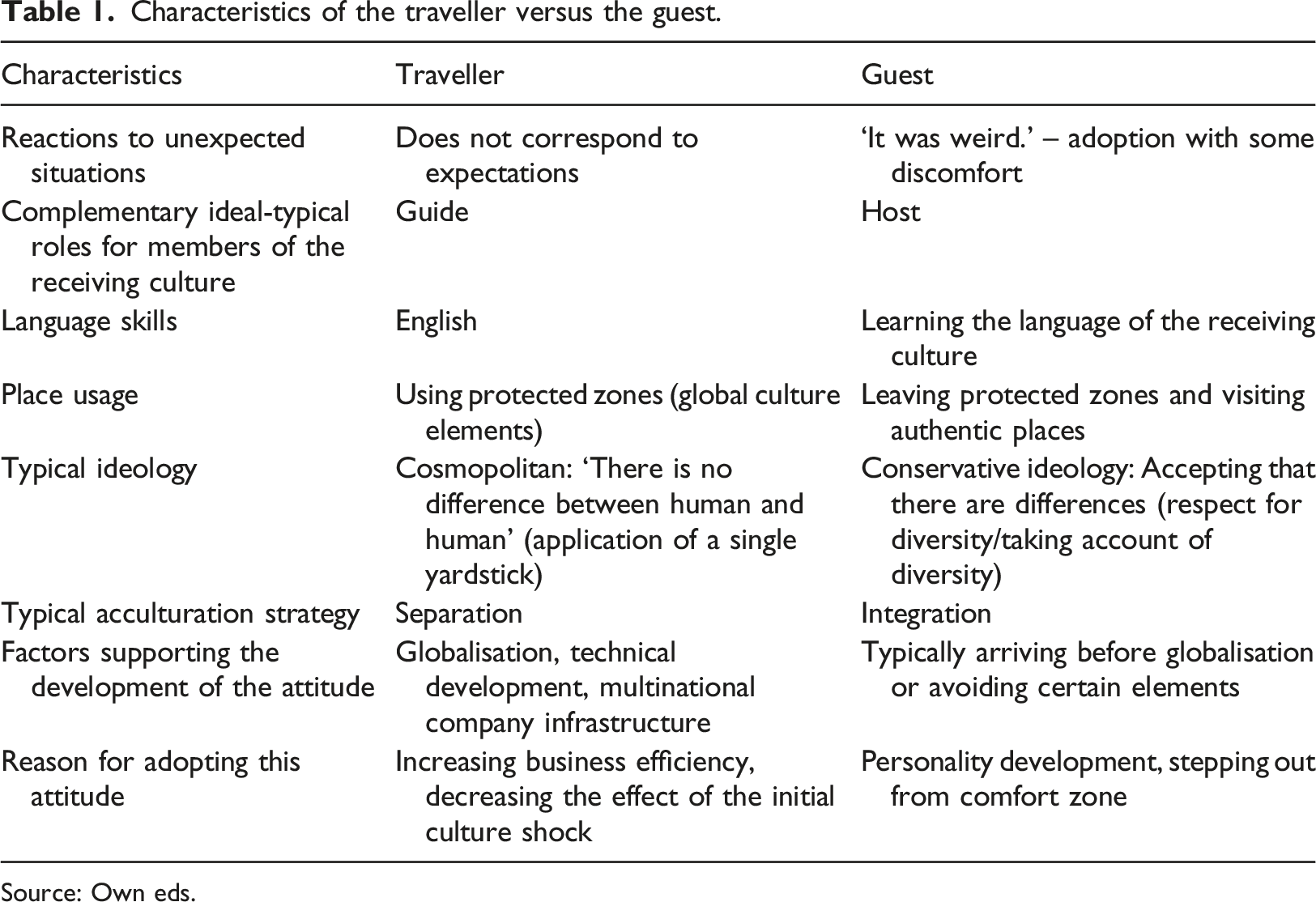
Source: Own eds.
A potentially significantly prolonged transitional period without major acculturation choices, brought about by globalisation and technological development, has created greater inequality between societies, involving a centre-periphery relationship and a new travelling class. The temporary expatriate (for several years or more) can decide whether to behave as a guest in the old way during this long transitional period or to take the simpler option of becoming a traveller. The guest relies on the complementary role of the host and, through mutual effort and gestures, gets to know each other better, integrating the depths of the foreign culture and slowly becoming an insider, who is gradually more accepted into the other group.
The traveller, on the other hand, tries out the surface of a foreign culture as someone from a colonial empire might, visiting centre to centre and setting expectations for the locals. The 21st-century traveller is a collector of experiences, a lover of the products of cultural travel and a traveller who seeks to minimise effort. In contrast, even if the guest settles for a relatively short period, he prefers integration as one of the possible acculturation strategies. Even when doing the same, the traveller does so within a segregated medium, based on a local nuance of the familiar, risk-free supranational medium.
The culture industry specialising in travel – to use the still apt expression of the Frankfurt school of criticism (Horkheimer and Adorno, 1972) – naturally also produces the apparent opposite of colonial tourism: the authentic experiences “gourmets”, who are richly represented in the “adventure” programmes on certain television channels and who are catered to by travel agencies. Globalisation and the development of the technical base have certainly played the most important role in creating the conditions for the newly perceived traveller, but we must not forget the social discourse that ideologically drives potential guests to increasingly see themselves as travellers. The cosmopolitan value system is the dominant knowledge framework that is perhaps most evident in both filters of our research—in what the interviewees said and in the interpretations of the interviewers.
According to this perspective, globalisation has primarily positive effects, and the closed-mindedness of Hungarian society towards foreigners is increasingly breaking down thanks to the spread of liberal values, giving way to the expansion of tolerance (for more on the generational aspects of the silent revolution and the critique of its implications for changes in the values in the Western world, see Inglehart and Norris, 2016; Schäfer, 2022).
The objective interviewer’s notes strikingly often contained subjective value judgements, which mostly consisted of praising the openness and open-mindedness of the foreign interviewees. Obviously, as the space of opportunity unfolds, it cannot be expected that the growing masses of people living abroad in an environment alien to their own country will make hasty decisions about their acculturation strategies. The prolonged liminality phase presents both the ‘foreigner’ and the representatives of the host culture with new choices. The traveller role, it is true, requires less effort on everyone’s part, but it is also true that it often permits only superficial experiences and, with the isolation of cultures, can easily lead to the emergence of insular ‘colonial cosmopolitan outposts’ (if the idea of a world society is seen as a utopia).
Of course, there can also be doubts about the role of the fraternity. The decline in its popularity is probably also because the gestures and efforts associated with it may seem superfluous, even disingenuous, given that the choice among acculturation strategies will be limited by the time spent in the place in question. Although we do not wish to establish a clear hierarchy between the ideal roles of travellers and guests, it may be worth asking critically which role is more conducive to intercultural dialogue – the increasing numbers of travellers or people who are genuinely open to a deeper understanding of each other’s culture, who act as a bridge, who are guests in each other’s countries? “I know that because I do not speak the language much, some of my experiences or observations may not be based on accurate facts in the eyes of some. I am also aware that presently I am a guest in someone else’s country. I do not wish to offend anyone with my views, and I am very grateful to have a warm welcome from most people.” (man from England)
Discussion and implications
Jackson (2021: 6) argues that cross-cultural management studies often have very narrow perspectives and suggest ‘taking a view of everything from everywhere’. Similarly, Volpone et al. (2018) and Taylor et al. (2021: 229) state that the gap in studies of cross-cultural adjustment implies a need for new approaches to understanding the acculturation process, and thus, exploring ‘who is to adjust, to whom or to what, and how the process may be supported’ can contribute to advancing research in the field.
Reflexive practices are also required in critical cross-cultural management approaches to become aware of, and critical of, the role of the researcher and the context (Bourdieu, 1990; Romani et al., 2020b). According to Romani et al. (2020a, p.55), reflexivity is ‘an introspective exercise in which researchers engage to become aware of and then engage with the fact that who they are is closely linked to their knowledge production’. In the Findings section, we show some results connected to reflexivity, as many authors have drawn attention to the importance of the researcher’s role and reflexivity in cross-cultural studies (Bourdieu, 1990; Mahadevan, 2011; Mahadevan and Kilian-Yasin, 2017; Romani et al., 2020a, 2020b).
Intercultural research has further limitations because it relies on self-reports, namely, by assessing acculturation processes as perceived by acculturating individuals rather than by receiving culture members (Barker, 2017).
According to Lee and Westwood (1996), individuals who do not plan to stay for more than 2 years might not be sufficiently motivated to adjust to a new culture. Cerdin and Selmer (2014: 1290) also noted that expatriates with shorter periods of stay in the receiving culture ‘only adjust their behaviour, temporarily adopting new social skills to more easily get by in the foreign location, keeping their basic values and norms more or less intact’.
Our research examined the acculturation process from two directions, focusing on the perspectives of immigrants and members of the receiving culture. The methodological innovation, namely, examining the impressions of interviewers, revealed intercultural aspects of the value system and world view of future managers (international business students). The “mirror effect” results indicate that this group has openness and intercultural contact as dominant values.
The feeling of “surprise”, a kind of culture shock, was observed among immigrants, indicating the attitude and capabilities of the mainstream receiving society, experiencing closedness and a lack of language skills. However, the analysis (interviewer’s notes of the interviews) clearly indicates that the self-image of members in the receiving society is worse than the image that immigrants hold of them (although this shift may be explained by the [perceived or real] expectations of the interviewees and the possible “impression-making” intentions of the university students).
The most important topics included language skills, which is an important factor in the perspectives of both immigrants and members of the receiving society (Maitner and Stewart-Ingersoll, 2016). Multinational companies and university environments were characterised by knowledge and use of the English language; thus, foreigners who spoke English were able to easily and confidently be present in these scenes and did not need to know the language of the receiving culture. Using the English language facilitated swift adaptation to the organisation and decreased the level of culture shock, which could lead us to think about the traveller type as preferred by multinational companies. However, in relation to the wider perspective of critical management studies (Romani et al., 2020b), another result somewhat modifies this impression.
Knowledge of the local language – even to a small extent – can be the key to the second stage of the two-stage reception, allowing individuals to feel better within the organisation, while culture shock can decrease in the everyday environment as well. Several studies call attention to the importance of acquiring the local language (e.g., Maitner and Stewart-Ingersoll, 2016), which our results also support.
In both their self-evaluations and in the interviewers’ evaluations, travellers adopted cosmopolitan values (being a world traveller), whereas guests adopted conservative values (which respected national values). In examining acculturation strategies, we found that cosmopolitan attitudes (described by Gillespie et al., 2010) were more common among travellers, while integration was more common among guests. Second-culture internalisation enables bicultural individuals to gain greater integrative complexity (Tadmor et al., 2009), which is in line with our findings that openness and the ability to identify good aspects of the host culture were evident in guests’ attitudes.
As indicated previously, there seems to be a connection between the respondents’ time of arrival in the receiving country and the type to which they belonged. Globalisation and technology development also favoured the emergence of the traveller type. However, the two types diverged not only along these lines but also in the individual goals of expats: guest types were among those arriving within the last 3 years (from the time of data collection; i.e., in the first half of the 2010s or in the middle). This also shows that the models of traveller and the guest that we formulate in this study are not real but ideal types in the Weberian sense.
The main contribution of the study is to understand the acculturation process, the different role conceptions and role expectations for visitors and hosts from a phenomenological and hermeneutic perspective. This study aligned with qualitative research methodology from the perspective of the development of mutual processes to typify others and explore stereotypes. Following the methodological principles of grounded theory and based on a large number of interviews, we have outlined a pair of ideal types (traveller and guest) that can help us better understand the intercultural experiences, conflicts and dilemmas of our time.
Conclusions, limitations and future research implications
As a result of its different research approaches, this study sheds light on the complex nature of the acculturation process. Our distinctive methodology yielded valuable insights into the importance of analysing the perspectives and viewpoints – in addition to those of the interviewees – of the reports from members of the receiving society. This additional perspective enhances our comprehension of cross-cultural contacts.
We found that this approach entailed addressing not only difficulties in communication and translation but also stereotypes and images of different cultures, whether more stable or more malleable, that could be expressed on several levels.
Using a grounded theory approach, the researchers investigated the experiences of immigrants regarding their acculturation process, and several results were obtained using our reflexive approach. The two-stage receptive attitude and the “guest or traveller” types are explained. These findings provide several important insights that enrich the literature on acculturation and on its research methodologies.
The present study not only introduces a new methodology but also enhances the existing literature by offering a comprehensive analysis of the “traveller versus guest” typology. Furthermore, it suggests approaches to explore the functioning of these two types within an organization. In our model—built from the bottom up, following the methodology of grounded theory—the traveller and the guest are treated as ideal types. These ideal-typical concepts do not express types that can be applied one-to-one to individuals in social reality but are explicitly intended to strengthen the analysis and “understanding” (cf. Weberian understanding sociology, Swedberg, 2018). We find it important to highlight the value exemption of the phenomenon; neither set of behaviours is better than the other (although in the relevant parts of the analysis, the researchers indicated their own value judgements, which ultimately tend to support a guest-type role). The two forms of behaviour are interesting because of their differences in goals, cognitive processes, and attitudes.
The “two-stage” receptive attitude is in line with our previous empirical research, as foreigners researching Hungary have been stating for years that Hungarians tend to be cold and unsmiling to start with but become friendlier later on (self-citations). The risk to foreigners is a higher initial stress that entails more effort to break cultural boundaries, but the advantage can be a deeper understanding and acceptance of one another’s cultures, along with the formation of several web-like, weak relationships between modules, which are of key importance for the stability of connected societies.
In addition to new approaches to researching cultural adaptation, our study has unique practical applications. Business students’ experiences while participating in this study will contribute to their understanding of tolerant attitudes in cross-cultural management, as this type of encounter with a foreign culture at work leads to different outcomes and behaviours than those observed through university courses. They also gained experience of cultural diversity and encounters with other cultures. Of course, the application and applicability of these experiences in concrete situations raises further questions that are beyond the scope of this research. Moreover, the insights and ideal types (traveller and guest) formulated in the analysis could, in our view, provide a good framework for interpretation in intercultural encounters, both for those who take part in them and for those who, by virtue of their work, play a key role in the development of such interactions, events and contact opportunities (e.g., international study coordinators, liaison officers, and travel agents).
As with all research, this study has limitations. Due to its qualitative nature and the unique attributes of the interviewers, the ability to generalise the results is limited. The use of interview data is also limited by the selection of respondents’ thoughts and the interpretations by the interviewers. Among the research constraints, the communication barrier created by the different cultural communication styles of interviewers and interviewees may importantly raise difficulties. Additionally, some language barriers could arise among those with a lower level of English knowledge (although in this respect, the lecturers running the course[s] ensured that adequate language skills were present in all university students participating in the research).
Among the difficulties of communicative “translation”, it is worth highlighting, first, that the corpus of texts analysed consisted of students’ notes, which followed (at least apparently) the course and specifics of the conversations with the interviewees. These notes were at times, more closely taken, and at other times, more loosely taken. In addition, these notes also contained, to varying degrees, the values and subjective interpretations of the interviewers. In addition, positive statements may have notably changed the overall picture on at least two levels. On the one hand, the interviewees may have felt during the interview that it was important to paint a positive picture of Hungarian society overall (and thus may have given answers that were expected or thought to be expected out of politeness); on the other hand, the students themselves may have thought that the evaluation they received during the university course would be more positive if they reported a “well done” interview overall. Although we have been careful to analyse the interview notes as objectively as possible, we cannot exclude the possibility that in extracting the essence from the interview notes, we ourselves, as researchers, placed a particular interpretive lens on the corpus. As noted in the analysis, the cosmopolitan university milieu comprises a particular set of values and relational habits, somewhat akin to the variety in an airport or a depot of international companies “representing” global culture.
Intercultural research has limitations because it relies on self-reports by assessing the acculturation processes as perceived by acculturating individuals rather than by members of the receiving culture (Barker, 2017). Our approach highlights possibilities to overcome this limitation, involving “others” and identifying culture-specific features of “how to build a bridge with others”.
Footnotes
Declaration of conflicting interests
The author(s) declared no potential conflicts of interest with respect to the research, authorship, and/or publication of this article.
Funding
The author(s) received no financial support for the research, authorship, and/or publication of this article.

Demographic characteristics of interviewees.
Age
Percent (%)
18–25 years
50
26–35 years
20
36–45 years
12
46–55 years
11
56–65 years
6
66–75 years
1
Gender
Percent (%)
Men
58
Women
42
Country
Percent (%)
Afghanistan
0.9
Azerbaijan
0.9
Bulgaria
0.9
Canada
2.8
Chile
0.9
China
9.4
Columbia
0.9
Cuba
0.9
Denmark
0.9
Ecuador
0.9
Finland
0.9
France
0.9
Germany
5.7
Hong Kong
0.9
India
1.9
Iraq
0.9
Italy
4.7
Japan
2.8
Kazakhstan
0.9
Laos
1.9
Mexico
2.8
Mongolia
3.8
Netherlands
1.9
Pakistan
0.9
Peru
1.9
Poland
0.9
Portugal
0.9
Romania
0.9
Scotland
0.9
Serbia
0.9
South Korea
1.9
Spain
2.8
Sweden
0.9
Switzerland
0.9
Syria
0.9
Thailand
0.9
UK
2.8
Ukraine
1.9
USA
20.8
Venezuela
0.9
Vietnam
7.5