




Abstract
Drawing on learning and generational theory, we investigate the effect of socio-economic and contextual conditions on managerial learning and organizational development. Using data from 3657 managers across 20 countries, we untangle the interactive effect of national culture and generational cohort on learning goal orientation (LGO). Managers from younger generations (e.g. generation X) had a stronger LGO than those in older generations (e.g. Baby Boomers, those born between 1946 and 1959). Performance orientation (PO) moderated the relationships so that the gap was stronger in high PO cultures. A validation of a model using hierarchical linear modelling (HLM) supports a cross-level moderation model of PO on LGO. Our study provides important first evidence of the value of the multilevel analysis to understanding LGO in different groups of managers, improving scholarly capacity to understand the multilevel and cross-level effects that govern the workplace. It also supports cross-level studies for the development of global managers from different generational groups. We extend LGO research by identifying the contextual influence and how this impacts on the behaviour of managers across different societal ‘structures’ (e.g. generations) and societies (e.g. cultures). The results provide practical suggestions that make a difference in the workplace.
Introduction
Developing managerial talent is critical in times of rapid change (Day et al., 2009; Dragoni et al., 2009). To manage talent effectively, there is increasing evidence for the need to understand management learning, and in turn, organizational learning, to compete effectively and achieve sustainable growth (Tarique and Schuler, 2010). A learning orientation is therefore at the forefront of the managerial role (Briscoe and Hall, 2006; De Clercq et al., 2017).
Managers with a stronger learning goal orientation (LGO) are more likely to be in developmental assignments and to achieve a higher level of competence based on those experiences (cf. Dragoni et al., 2009) and be adaptable in a global context (Cegarra-Navarro and Dewhurst, 2007). Thus, LGO has been largely demonstrated to be at the foundation of individual and organizational learning and development, but no studies have yet surfaced that show the basis of the LGO of managers across the growing diversity of the managerial workforce, for example, across different generations and national contexts, a relevant question in cross-cultural management (cf. Barmeyer et al., 2019; Taras et al., 2011). As the workforce across the globe has become increasingly diverse, the global workplace environment has created the need to change the business (cf. Cummings et al., 2016) and the design to high-quality jobs (Daniels et al., 2017), but also to manage diversity (cf. Tarique and Schuler, 2010; Von Bergen et al., 2012; Zander and Romani, 2004). Drawing on learning and generational theory, this research investigates the effects of socio-economic and contextual conditions on managerial attitude towards learning, hence organizational learning too, because developing individual and team learning at the aggregate level leads to stronger organizational learning (Bui and Baruch, 2010; Popper and Lifshitz, 2000). For example, LGO may drive the development and deployment of organizational capabilities (Che-Ha et al., 2014).
In going beyond associating LGO with generations, and accounting for context (e.g. addressing both the micro/individual and the macro level/national culture), we address a key theoretical concern for talent developer/human resource management (HRM) professionals who have called for greater understanding of and evidence on how generational differences translate into actual workplace attitudes (e.g. learning and development orientation). Despite earlier work that LGO differs across generational cohorts (D’Amato and Herzfeldt, 2008), almost no current theory incorporates generational differences in manager LGO studies and contextual factors (e.g. national culture) as potentially important ‘boundary conditions’. The assertion that attitudes to learning are similar under all generations and national cultures and is just an individual attitude is unfounded. Accordingly, our first objective was to explore how socio-economic and political conditions affect LGO. LGO originates from the idea that increased effort usually leads to increased learning and improved ability (VandeWalle et al., 2001) and those with an LGO believe abilities are plastic and they engage to develop or to refine their skills to achieve mastery in new activities (Brett and VandeWalle, 1999; Dweck, 1986, 2000). When a task is then approached from an LGO perspective, individuals strive to understand something new or to increase their competence (Button et al., 1996) and therefore, is at the foundation of managerial training and development.
We develop and test a model linking LGO and generational cohorts to understand similarities and differences across generations. We did so by utilizing theory on learning (Dweck, 1986) and generational cohorts’ theory (Edmund and Turner, 2005; Lyons and Kuron, 2014; Mannheim, 1952). Second, we examine the role of national culture as a boundary condition inherent in managers’ experience in LGO. We examine managers’ LGO across generations and the moderating role of national culture as reflected in performance orientation (PO), which measures how society or the national culture is encouraging and rewarding performance improvement and excellence.
By combining literature on LGO, generational groups, and national cultures, we offer theoretical propositions of generational cohorts and development and we provide practical implications. Our study advances nuanced understanding of (1) the foundation of LGO across generations of managers, (2) the differences across generations in terms of LGO, and (3) what role national culture (here PO) or the context plays between LGO and generational groups.
We contribute to the LGO literature and broader HRM of people at work by integrating generational groups and national culture in the study of learning, furthering a cross-cultural perspective on leadership and learning (Jönsson et al., 2015).
Our study provides important first evidence of the value of this approach to understanding LGO in different groups of managers. When the multiple levels of the workplace are not taken into account (e.g. individual, organization, cultural context), it is a challenging task for scholars to understand their effects (Li et al., 2017). We make a contribution to the study of cross-cultural management by exploring the impact of culture and generational cohort on LGO. We extend LGO research by identifying contextual influences on the expression of LGO and respond to the calls to account for the behaviour of managers across different societal ‘structures’ (e.g. generations) and societies (e.g. cultures). The results provide a theoretical contribution in terms of associating cultural differences with LGO, as well as practical suggestions for human resource managers and other top management positions to use this contextual knowledge while trying to make a difference in the workplace.
This article is structured as follows. First, we briefly review recent literature on generational cohort theory. Second, we address the importance of considering generational and national cultures as the antecedents of LGO. Finally, we examine the interactive relationship among LGO, generations and national culture.
Theoretical background and research hypotheses
Learning goal orientation
LGO is defined as the pattern of cognition and action that results from consistently seeking to develop competence by gaining new skills and mastering tasks; it is an internal mindset that motivates individuals to learn and develop his or her competence (Dweck, 1986). As those individuals seek challenges that provide them with learning opportunities, an LGO is conducive to the acquisition of knowledge and skills (Brett and VandeWalle, 1999). Individuals with a high LGO believe that abilities are malleable and incremental in improvement; they yearn to refine their skills and continuously strive to acquire new learning or master new activities (Brett and VandeWalle, 1999). As such, they tend to focus on the task itself and are motivated by the potential for present and future development, not on a narrow interest for immediate results (Porter and Tansky, 1999).
LGO is the preference for those striving to learn in challenging situations and relates to both skill acquisition and intrinsic motivation. It may influence people’s willingness to solicit and use feedback to improve their skills and competencies (Dweck, 1986). In addition, when obstacles are encountered, high learning-oriented people tend to deal with challenges by investing additional effort to develop and master new skills (Brett et al., 1999). They are also likely to cope effectively with both negative and positive feedback by putting substantial effort into problem-solving activities to identify and apply the strategies needed to succeed (Elliott and Dweck, 1988).
Several studies demonstrated the benefits of an LGO in the workplace for the person as well as the organization (Li and Bagger, 2008). Individual benefit is apparent because when a task is approached from an LGO perspective, individuals strive to expand their knowledge and to increase their capabilities (Heyman and Dweck, 1992). As for the organizational competitive advantage, the mastery-oriented response pattern involves seeking challenging tasks and maintaining a high level of performance under challenging conditions and turning failures into useful feedback. This leads to an increased effectiveness in problem-solving and enhances overall performance (Elliott and Dweck, 1988). Overall, those with high LGO aspire to participate in training activities and developmental processes so that they can apply what they learn (Brett and VandeWalle, 1999). They also seek greater information in the form of direct inquiry, which predicts role, organization, and social learning (Tan et al., 2016).
In sum, individuals with a high LGO reflect upon the effectiveness of their own thought processes (Schmidt and Ford, 2003), demonstrate higher levels of emotional competence (Porath and Bateman, 2006), are proactively engaged, solicit feedback from others, and set challenging but achievable goals for their performance (Brett and VandeWalle, 1999).
Thus, LGO has been associated with a variety of positive outcomes. These are, to name a few, performance (Albert and Dahling, 2016; Porath and Bateman, 2006), self-efficacy, creativity (To et al., 2015), motivation to learn (Colquitt and Simmering, 1998), organizational commitment and innovativeness (Farrell, 1999) and training outcomes (Brett and VandeWalle, 1999). They are also less apt to suffer career plateauing (Allen et al., 1999).
Managers, through their explicit and implicit emphasis on learning, can have a significant impact on employee motivation, attitudes, and behaviour towards learning (Dweck, 1986). Managers with high LGO are more likely to encourage their employees to pursue skills development initiatives, to learn from failures and mistakes, to establish learning goals for their team, to provide constructive feedback, and to encourage experimentation with novel work practices (Cannon and Edmondson, 2001). Thus, those managers are likely to create a work climate that values and expects learning.
It is unclear whether managers differently develop and display their LGO as they belong to different generations. Different generations might differently seek challenging tasks, experiences that provide growth and development, feedback and an openness to new learning experiences.
Generational cohort theory
The current workforce comprises employees from 20 to up to 80 years of age. With such diversity, the interest for generational differences is growing, such as differences in psychological traits, work styles, well-being, and development interest (Twenge et al., 2012). As HRM professionals must learn how to effectively work, motivate and develop employees from different generations, the last two decades have witnessed a surge of research examining similarities and differences across generational cohorts (Lyons and Kuron, 2014). For example, research has demonstrated that personality factors such as neuroticism and narcissism are increasing with successive generational cohorts while self-assuredness and achievement decline (Gentile et al., 2010; Stewart and Bernhardt, 2010) and younger generations express greater interest in careers that are expressive of extroversion and social influence (Bubany and Hansen, 2011).
Research attention has also focused on identifying generational differences in work values (e.g. pay, autonomy and working conditions) and work-related outcomes (e.g. prestige, accomplishment and fulfilment), showing more of a divide among generations in the artefacts/specific behaviours rather than in the declared values (D’Amato, 2016; Lyons et al., 2010). Underlying leisure values increased with successive generations, whereas work centrality and the value of social interactions at work decline (Twenge et al., 2010). In addition, the importance of job security decreases in the expectations of the younger generations (D’Amato, 2016).
The difference in work values has several implications as generational differences in personality and work values result in differing psychological contracts and work attitudes (e.g. D’Amato and Herzfeldt, 2008; Solnet and Kralj, 2011). Successive generations reported lower commitment (Brunetto et al., 2012; D’Amato and Herzfeldt, 2008; Solnet and Kralj, 2011) and job satisfaction (Solnet and Kralj, 2011).
Studies on turnover mostly show greater intention to quit with successive generations (Solnet and Kralj, 2011), although a European-based study reported increasing intention to quit between Early and Late Boomers and decreasing for Generation X (D’Amato and Herzfeldt, 2008).
While the previous suggests there is ground to support generational differences, ‘further work is needed to flesh out mediators and moderators in the relationship between generation and work-related variables’ (Lyons and Kuron, 2014: 139), as this societal phenomenon has practical implications for HR strategy.
Generational groups and differences at work
Despite criticisms on the theoretical basis and empirical evidence for the idea that there are generational differences in the workplace (Parry and Urwin, 2011), the generational debate is likely to increase for the practical value of knowing and understanding how different age or generational groups might act or behave in the workplace. Generational cohort theory provides the theoretical lenses explaining why groups of workers belonging to different generations might differ in terms of work attitudes and subsequent outcomes. In fact, there is consensus on the definition of generational cohorts as people who were born at about the same time experience similar historical, economic, political, technological and sociological events at critical development stages (Edmunds and Turner, 2005). The exposure to those events shapes and forms a generation’s attitudes, values, beliefs and expectations. Consequently, those in the same generational cohort tend to display similar behaviours and report similar life experiences (Kupperschmidt, 2000).
Important changes in the Western labour market took place beginning in the 1980s, which changed the experiences, values and opinions of Generation X, compared to the Baby Boomer generation (Kupperschmidt, 2000). Baby Boomers joined the workforce when most Western countries were progressing widely and offering full employment and well-defined career structures (Edmunds and Turner, 2005). In comparison, Generation X experienced a more competitive labour market characterized by downsizing and re-engineering. Consequently, Generation X’s psychological contract might be intrinsically different from Baby Boomers. Indeed, Generation X considers taking personal responsibility for career development, commitment and adaptability to work and global mobility in exchange for development opportunities, challenging assignments and the promise of employability rather than job security (Cavanaugh and Noe, 1999; D’Amato, 2016).
Building on previous studies – and considering both the advancement in research of LGO in educational studies and the lack of a similar wider understanding in management studies, but for a handful of studies (cf. Bozer and Jones, 2018) – we study LGO to identify generational trends. In fact, similarly to what happens for other organizational variables (cf. Kinnie et al., 2005), it might be that the sociopolitical conditions that define specific employment circumstances might determine a different orientation towards learning in managers from different generational groups. Thus, we investigate differences in LGO across generations. To date, there is evidence of generational differences in work attitudes (cf. Twenge, 2010) with notable effect size when comparing generations. In particular, younger generations tend to have higher learning orientation compared with Baby Boomers (Korn, 2010). Yet, further research among the managerial population would offer much needed understanding regarding the impact of generational shift, because the current retirement phase of the Baby Boomers poses a challenge to the management of people at work (Twenge, 2014). For example, this happens when Baby Boomers may not wish to retire and can continue working (Altman et al., 2020).
Generation X’s general attitudes towards work – greater training and development, faster career progression, greater work challenges – are more closely related to the concept of LGO and the preferences of those generational cohorts. Therefore, in line with Korn (2010), we argue that Generation X will be more likely to have higher LGO than Baby Boomers. Thus:
This means a consideration for generations as a cohort and social phenomenon, framing age, period and cohort effects as complementary, rather than opposing (Foster, 2013). Furthermore, framing generations as multi-dimensional rather than monolithic, the ‘social forces’ perspective offers a distinctive conceptualization of the phenomenon (cf. Lyons and Kuron, 2014), as in the original Mannheim’s (1952) theorization.
LGO across national cultures
Shared generational identity will result in common work-related expectations (e.g. psychological contract) leading in turn to satisfaction/dissatisfaction, commitment and turnover intention (D’Amato and Herzfeldt, 2008). Overall, cross-sectional and time-lag studies conducted in different countries and industry sectors mostly showed differences among generations, although this might also suggest that differences may be growing as generations proceed through their respective life cycles (Gursoy et al., 2013). Thus, environmental conditions can make LGO more salient, together with the implicit promise of employability (Vantilborgh et al., 2013). In addition, different cultural groups may have different conceptions of what leadership and management entails (Koopman et al., 1999).
As organizations tend to employ a progressively more diverse workforce and as the world of work is becoming increasingly global, studying LGO across national cultures is becoming equally important. The national culture influences human behaviour by defining acceptable and unacceptable behaviours. This includes LGO, much like it does for other work attitudes such as organizational commitment (Gelade et al., 2008) or societal norms (Gelfand et al., 2011).
Learning varies across national cultures (Joy and Kolb, 2009), but how and why LGO specifically may differ across cultures requires investigation, ‘given the potential for variation in the experience of sociocultural and socioeconomic events for people in different countries, and in different strata within countries’ (Macky et al., 2008: 860).
National culture refers to the set of norms, behaviours, beliefs and customs that exist within the population of a sovereign nation. National culture pertains to how a group of people organizes and perceives the world (Hall, 1973) bounded by their political and economic conditions. The literature has reported several dimensions of national culture, one of which being PO. 1 According to the Global Leadership and Organizational Behaviour Effectiveness (GLOBE) model of culture, probably the most recent and comprehensive efforts to measure the cultures of the world (Taras et al., 2016), PO ‘reflects the extent to which a community encourages and rewards innovation, high standards and performance improvement’ (House et al., 2004: 239). In other words, PO refers to the extent to which a collective (either organization or society) encourages and rewards (or should encourage and reward) group members for performance improvement and excellence (Chhokar et al., 2008). Javidan (2004) observes that individuals in high PO societies value training and development, have a can-do attitude, value and reward individual performance and achievement, view feedback as essential for improvement, value taking initiative, believe that anyone can succeed so long as he/she tries hard enough and believe in the value of schooling or education (i.e. training).
Based on the above, the goals of high-PO cultures are congruent with high LGO (understanding something new in training and education, belief that their skills and ability can be improved). We therefore believe that in order to understand LGO, it is important to assess the value high PO cultures place on training, learning attitude and initiative. Thus:
The interaction effect between generational cohort and national culture
The literature has so far found evidence that LGO positively influences organizational performance, although this direct relationship does not seem to be empirically conclusive (Rauch et al., 2009). Similarly, Suliyanto and Rahab (2012) demonstrate that the learning organization cannot directly improve the organization’s performance but rather that it must pass through other variables that may intervene between organizational learning and business performance. Although LGO is an individual variable, its effect occurs also at the level of corporate culture. This means that it might be mediated by factors that impact directly on business performance. Going one step further, we explore the potential mediating role of national culture between generational cohorts’ effects and LGO. Given the theory and empirical evidence above, PO might be related to LGO through generations. We expect that the more a culture presents a PO, the more likely the generation will develop its LGO, possibly via proactivity orientation (Joo and Ready, 2012). Based on this logic, we hypothesize that PO mediates the relation between generations and LGO.
Mannheim’s (1952) theory posits that generations take shape within a specific socio-historical location; this questions the generational configuration of one society onto another (Lyons et al., 2015). Global influence might manifest differently in various national contexts and the encounter with unique historical and cultural environments (Vincent, 2005). For instance, the influence of social media and the spread of consumer culture has probably different meanings within traditional cultures where they represent incremental steps towards modernity, compared with Western cultures (Lyons et al., 2015).
Thus, a society’s unique context should be considered when a generational scheme is adopted in research. In fact, the generation’s location provides a specific range of opportunities and experiences (e.g. collective memories, cf. Schuman and Schuman, 2012). This lays the foundations for future attitudes and behaviours as well as their overall mindset (Gilleard, 2004; Mannheim, 1952).
The same generation could display different values and beliefs across different countries (Chen and Lian, 2015; Parry and Urwin, 2011). Indeed, in order to share a similar set of beliefs, values, attitudes and expectations, individuals must be exposed to similar social, economic and political events. Yet those crucial events are likely to differ across geographical locations. For example, Baby Boomers in the United States or China are likely to report different attitudes and life experience as the so-called ‘defining events’ during the formative years that might be different or might have impacted differently on them (Salahuddin, 2010; Stark and Poppler, 2018).
Extrapolating from the previous, we argue that the same generational cohort might vary in terms of LGO across different cultures. In other words, generational cohort and national culture are likely to interact when it comes to predicting LGO. Thus:
LGO determines where learning will take place and the nature of what is learned (DiBella et al., 1996). The orientation towards learning might nevertheless be subjected to historical, geographical or cultural conditions, or a combination of the previous. With this test, we try to define how cultures might differentially impact on LGO across generations.
Method
Participants and procedures
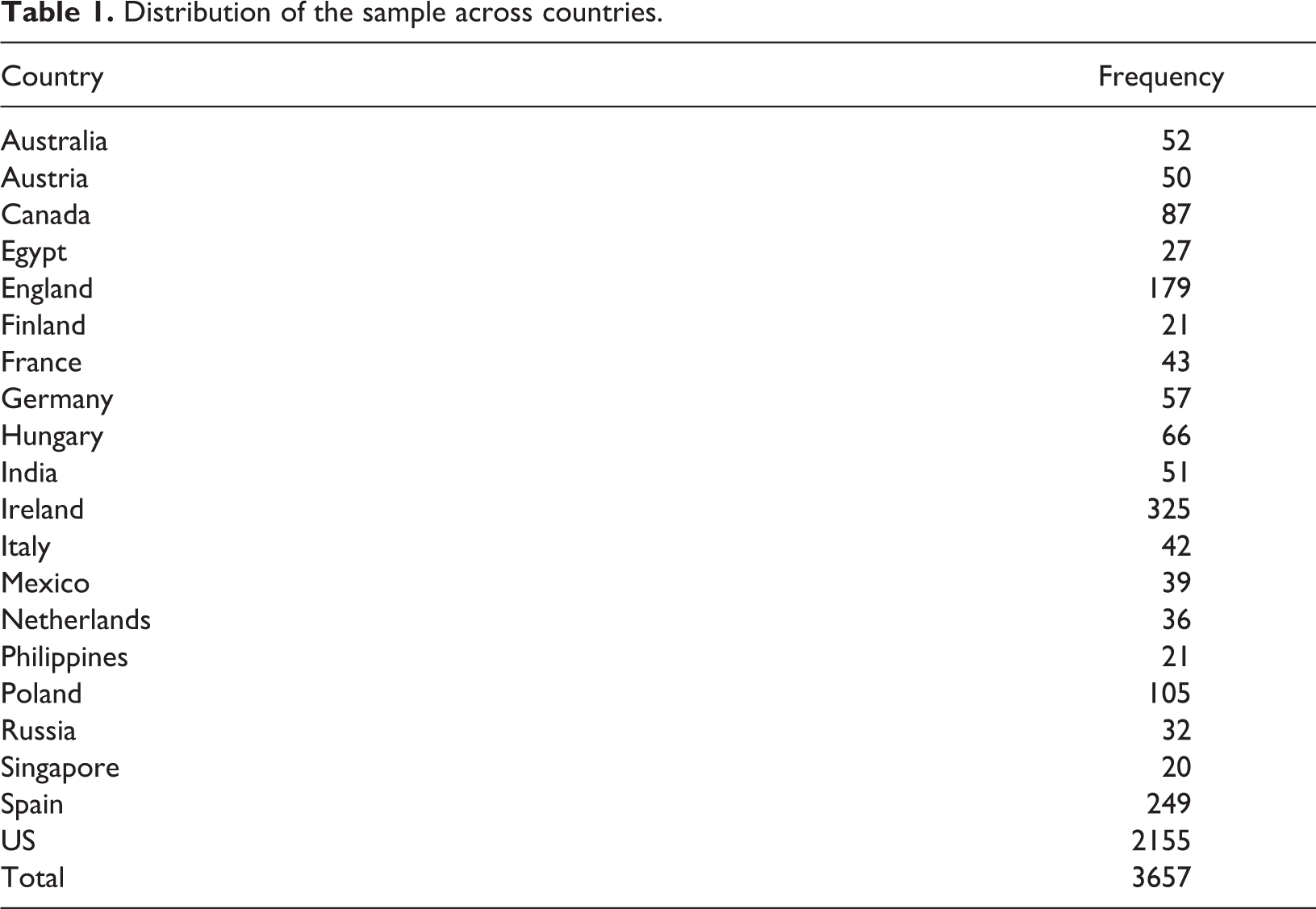
To test our hypotheses, we used a purposive sample. Data were collected from managers and executives who had previously attended a leadership development programme. We were granted access to the data by the global company that focuses on delivering executive education. Our sample consisted of 3657 respondents from 20 countries across 4 continents. We included in the sample only managers whose country was part of the GLOBE programme (House et al., 2004) and if their birth year was between 1946 and 1980. In total, 11.6% were Early Baby Boomers (born from 1946 to 1951), 27.5% were Late Baby Boomers (born from 1952 to 1959), 44.1% were Early Generation X (born from 1960 to 1970), and 16.8% were Late Generation X (born from 1971 to 1980); 60.3% were men and 39.7% were women. The majority (75.6%) had a university degree. Furthermore, 20% of the participants were top/executive; 25.5% upper/middle management; 29.1% management; 25.4% first level or professional. Managers (a) were from countries used in the original GLOBE study (House et al., 2004) and (b) numbered at least 20 in each country. Distribution across countries is provided in Table 1. In sum, we assess managers across the world for which we had a measure of national culture and LGO. This means that we were able to address cultural/national/contextual variables together with institutional factors (e.g. generations) and individual-level variables.
Distribution of the sample across countries.
Measures
Learning goal orientation
To measure LGO, we used a three-item measure (cf. D’Amato and Herzfeldt, 2008) that reflects commitment to learning and open-mindedness. A sample item is On the job I am developing the skills I need for the future. The scale ranged from 1 = strongly disagree to 5 = strongly agree. We selected this scale because it is specifically designed for and previously validated with working professionals. The internal consistency in the research sample was adequate (α = 0.73).
Performance orientation
We used the cultural practices scores of PO from the work of the GLOBE research (see House et al., 2004 for a detailed review). Consistent with past research (e.g. Parboteeah et al., 2004), we used the societal practices scores (i.e. ‘what is’ judgments; the way things are) because our research is interested in how the perceived culture (i.e. what a culture is) relates to LGO.
Note that GLOBE’s cultural dimensions (House et al., 2004) emerge from a long-term multi-phase programme designed to conceptualize and validate country national cultural dimensions and their relationship with leadership (Parboteeah et al., 2004).
Analysis
Multilevel analysis with hierarchical linear modelling (HLM) (Raudenbush and Bryk, 2002) was performed to analyse the hypotheses. Given that participants are naturally nested within countries, HLM is a viable alternative to test a conceptual model covering two levels of analysis. HLM can be used to determine whether PO as a level-2 variable (the published societal practice score for PO assigned as a ‘level-2’ country variable) acts as a cross-level main effect on LGO, and whether it is a cross-level moderator of the level-1 relationship between generational cohort and LGO. With HLM, we managed multilevel data, where the outcome variable exists at the lower level, and predictor variables exist at both levels. Indeed, HLM simultaneously investigates relationships within and between levels (Raudenbush and Bryk, 2002) and accounts for variance among variables at different levels (Shen et al., 2018).
Results
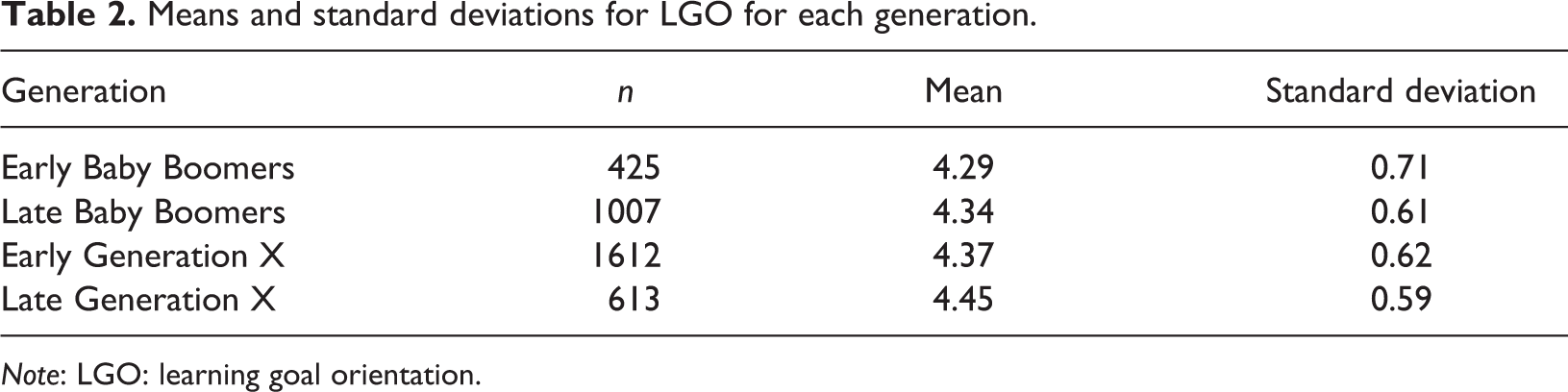
To test hypothesis 1, that younger generations are higher in LGO than older generations, we conducted a one-way analysis of variance (ANOVA). The grouping variable was generational cohort. The outcome variable was LGO, with higher scores relating to higher LGO. The ANOVA was statistically significant, F (3, 3653) = 6.81, p < 0.001, η 2 = 0.01. Table 2 presents means and standard deviations of LGO for each generational group.
Means and standard deviations for LGO for each generation.
Note: LGO: learning goal orientation.
Post hoc least significant difference (LSD) tests show that the late Generation X was significantly higher in their LGO than each of the other generations. Early Generation X was significantly higher in LGO than Early Baby Boomers. Late Baby Boomers and Early Baby Boomers, according to the post hoc LSD test, were statistically the same in LGO.
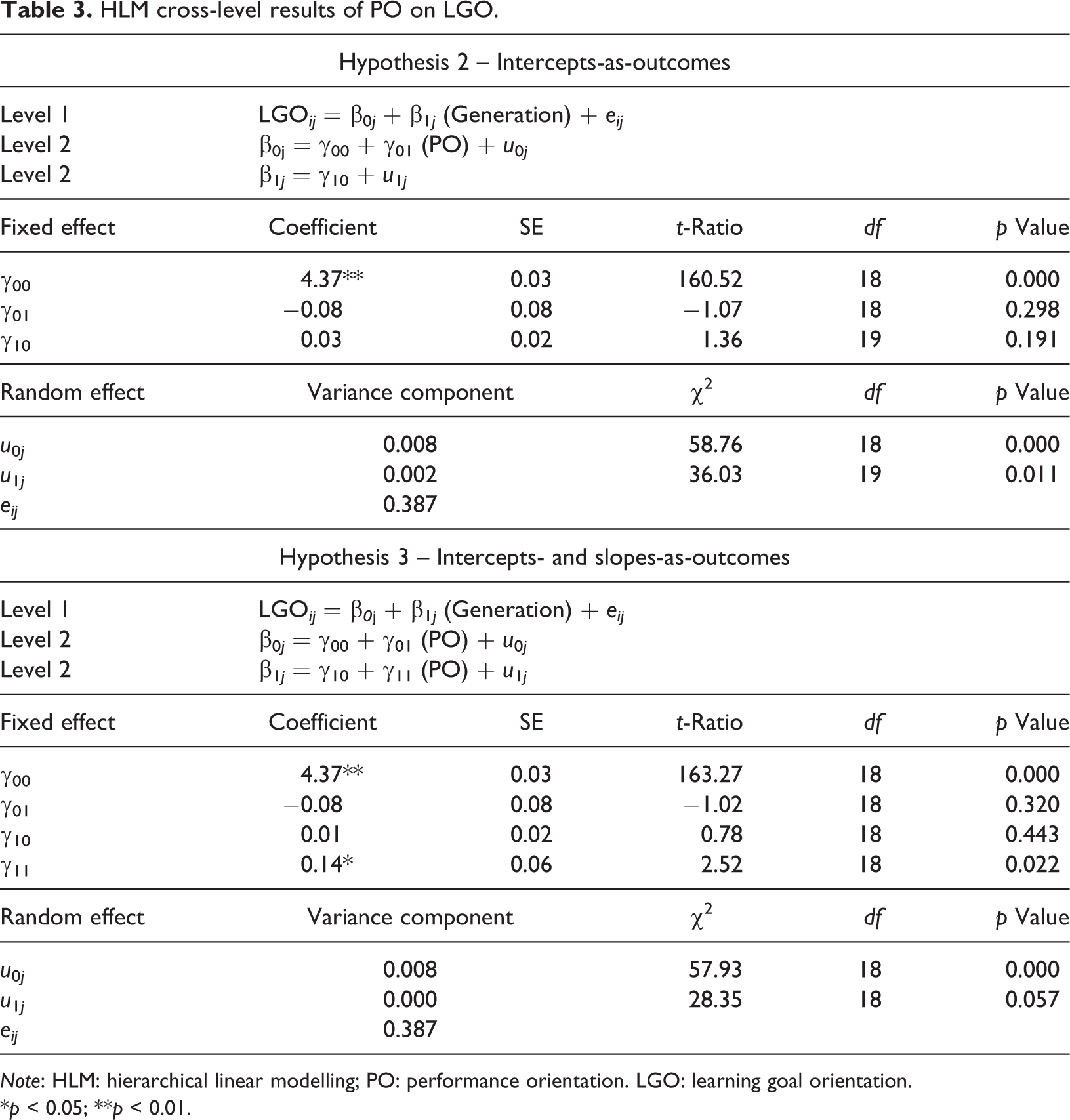
Our next analysis tested hypothesis 2 or whether the national cultural variable of PO had a main effect on LGO (i.e. is PO a cross-level main effect?). Given that we found differences in LGO among generational groups from results of hypothesis 1, we controlled for generational groups in this HLM intercepts-as-outcomes analysis. We coded generations as 1 = Early Baby Boomers, 2 = Late Baby Boomers, 3 = Early Generation X, and 4 = Late Generation X. We then centred the variable around the group mean. Results of our intercepts-as-outcomes analysis (see the top of Table 3) reveal that PO did not have a cross-level main effect on LGO, γ 01 = −0.08, t (18) = −1.07, p = 0.298. Thus, hypothesis 2 is not supported.
HLM cross-level results of PO on LGO.
Note: HLM: hierarchical linear modelling; PO: performance orientation. LGO: learning goal orientation.
*p < 0.05; **p < 0.01.
To test hypothesis 3 to determine whether PO acted as a cross-level moderator, we ran an HLM intercepts- and slopes-as-outcomes model. We again controlled for generations in a similar manner as the previous analysis. Results are in the bottom of Table 3. The test for hypothesis 3, γ 11 = 0.14, t (18) = 2.52, p = 0.022, is statistically significant. PO is a level-2 cross-level moderator. This relationship is shown graphically in Figure 1, using the societal practices-centred score for one standard deviation above and below the mean. Younger generations (those at the far right of the figure) are higher in LGO in high PO countries than low PO countries.
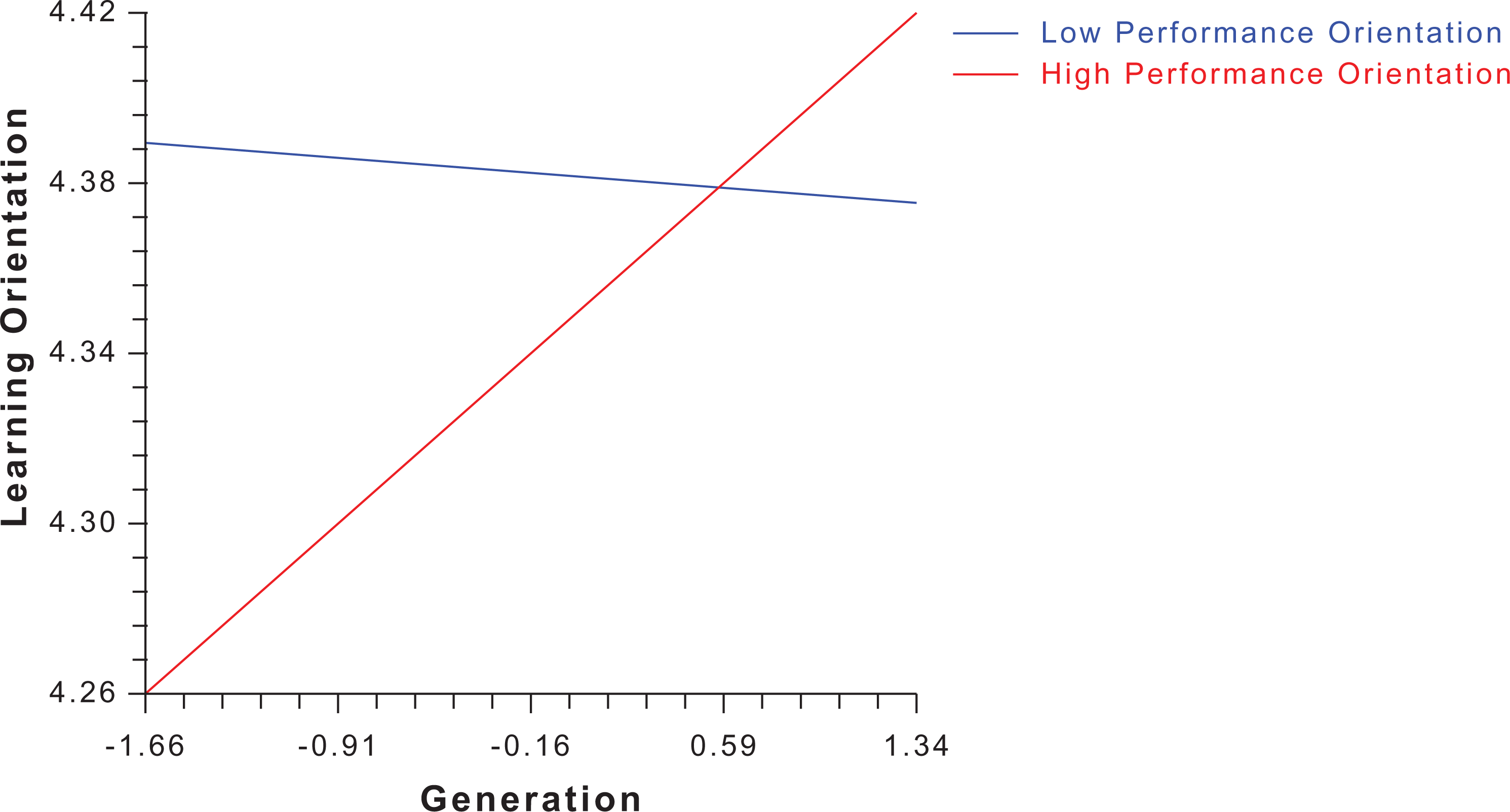
The moderating effects of PO on the relationship between generational cohort and LGO. LGO: learning goal orientation.
Discussion
As research on generational differences in the workplace accumulates, there was not long ago a call for further work to delve into the mediators and moderators in the relationship between generations and work-related variables, together with greater consideration of context and methodological rigor (Lyons et al., 2015). Also, studies mostly concentrate on a single nation or cultural context (Miah and Bird, 2007), while in fact we need to expand on the knowledge of how generations compare across national borders.
Modern organizations tend to employ an increasingly more diverse managerial workforce, in terms of both age and national culture; a practical question is on their LGO that might create different expectations. Learning leads to permanent capacity for change (Illeris, 2018) and is the managerial characteristic facilitating the organizational learning process (Real et al., 2012). Individuals with high LGO do not have just interest for the task but also for present and future development, for both themselves and their reports as part of their responsibilities. In fact, it is now commonly recognized how the first and utmost leadership task is on providing talent development. Yet only a handful of studies have investigated predictors of LGO in the managerial population (D’Amato and Herzfeldt, 2008; Matsuo, 2017; Payne et al., 2007) and none examined the combined effect of societal and political conditions, such as generational cohorts and culture.
We addressed this understudied issue by analysing how generational groups and national culture are related to managers’ LGO. Although we are fully aware of the criticisms in the current debate on the concept of generations and the trade-off among generational cohort and age group (cf. Parry and Urwin, 2011), we used generational cohort theory as this provides the theoretical lenses explaining why managers belonging to different generations might differ in terms of LGO. More specifically, we examined whether generational groups are related to LGO and then, using a multilevel framework, whether the cultural dimension of PO (House et al., 2004) acts as either a cross-level main effect between generations and LGO or as a main effect on learning.
Our results demonstrate that managers in younger generations (e.g. Generation X) have higher LGO than those in older generations (e.g. Baby Boomers). Empirical support for our first hypothesis corroborates previous studies (D’Amato and Herzfeldt, 2008). As those studies examined generational differences in LGO within the same cultural context, we add a new contribution to the literature on LGO by investigating the role that national culture plays on managers’ LGO. Although research has been conducted on national cultures, less is known on the influence that national culture has on the individual attitudes in the workplace (Macky et al., 2008) and to the best of our knowledge, no study specifically addresses LGO.
We did not find support for the effect hypothesis of PO on LGO (hypothesis 2). This means that LGO is not strictly dependent on national culture. This finding echoes the work from Joy and Kolb (2009) who found marginal support for the direct effect of culture on learning styles. Because culture might be useful in explaining cross-level moderation outcomes, we demonstrate that PO acts as a cross-level moderator. That is attitudes towards LGO were stronger for younger than older generations of managers in high PO cultures. This confirms the impact of culture on LGO across generations.
With our empirical investigation, we make several contributions. Contextual variables and their mediating role are very relevant in developing HR strategies (Beltrán-Martín et al., 2017), but the research on HRM has mostly neglected contextual variables. In this study, we provide a clear ground for taking context into account (e.g. national culture) in developing HR strategies. Thus, accounting for generational cohorts too, we consider the socio-economic and the political conditions for HR managers in their effort to provide the right environment for development across generational cohorts.
Managers’ LGO goes beyond affecting individual learning and development. Accounting for the context suggests the existence of a relationship between generational groups and LGO, and as no previous research has investigated whether national culture is related to LGO, we addressed this gap in the literature – although more investigation is certainly needed.
With the globalization of business and the increased demands on managers to deal routinely with other cultures and their business practices (Porter and Tansky, 1999), it is a must for companies to put individuals’ behaviours in perspective. Our study advances knowledge and understanding of how culture hinders or reinforces learning, and how this links with different generations of managers. The newly acquired knowledge can serve the purpose of developing HRM practices appropriate across generational cohorts and national boundaries or to minimize culture shock and generational conflict.
This is a further strength as in our empirical investigation, we address the tenet of generational theory that the generations are the product of their social and historical context (e.g. generational groups are unique to that national culture). This means that we were also able to disentangle the complexities of generational differences examining the moderating effects of cultural variables (PO) on individual attitudes (LGO).
Context matters (Kaufman, 2015) and there is the need to account for the behaviours of managers across societies (Boxall and Purcell, 2016). Previous research on generations has largely ignored the important role that context might play when discussing generations in the workplace or HR practices in general. In addition, the majority of studies failed to take into account the unique cultural as well as historical condition context-specific factors that turn into different generational configurations in different countries (Lyons et al., 2015). In addressing PO as a cultural variable, we overcome this criticism of past research.
Theoretical contribution
Our work advances current management development research by moving beyond explaining the impact of LGO in the workplace and in fact relating LGO to contextual variables, such as generations, context and their interaction. By integrating frameworks from the generational literature, which emphasizes examining attitudes as the results of developmental experiences, it shows that collective developmental experiences – not just the career stage – affect managers’ LGO. We demonstrate how managers’ LGO was related to being in high PO cultures (Figure 1). Thus, our results contribute to the management development literature by demonstrating that manager characteristics are influenced by cultures that strive for achievement. This also adds up to the debate on whether LGO is a trait or a state (cf. Watson et al., 2018).
Academic research on generational differences in work-related variables has been mostly descriptive rather than explanatory and has not proceeded from an explicit theoretical framework (Festing and Schäfer, 2014; Joshi et al., 2011). This study thus contributes to the literature in different ways.
First, by focusing on the interaction of generations with national cultures, two unexplored antecedents of LGO, we extend the knowledge in the field. Previous research identified individual-level antecedents of LGO in the general organizational population. Yet, whether generational and national predictors of LGO exist remained a theoretical question to be answered. By demonstrating that PO acted as a cross-level moderator of the relationship between generations and LGO, we explicitly show the impact of national culture in managers’ learning attitudes across generations.
Second, by breaching the gap between ‘micro’ (LGO at the individual level) and ‘macro’ (culture) phenomena, our article provides robust evidence that enables a better understanding of complex phenomena in the workplace. Context, or the environmental force at a higher level affecting a focal behaviour (George and Jones, 1997), contributes to the understanding of group-level knowledge and interventions. Using multilevel analysis, we assess the context and how this builds directly into generational theory, unveiling how individuals shape and are shaped by the context and highlighting systematic differences in managers’ behaviours or attitudes.
We demonstrated PO is a cross-level moderator of the relationship between generations and LGO (hypothesis 3). Theoretically, this means that by adding a further level of examination, or the ‘location’, we also performed an in-depth exploration of generational identity, or one’s adherence to prototypical generational attitudes and norms (Lyons et al., 2014). This means treating generations as a social entity instead of descriptive categories, providing a stronger ground for research and theory development.
Research on LGO adds to the boundaryless (Arthur, 1994) and protean career (Hall, 2004) literature, as the career literature suffers from fragmentation (Baruch et al., 2015). There is widespread agreement among career scholars that environmental disruptions related to globalization, technology, organizational structures and cultural values have resulted in ‘new career’ forms (Lyons et al., 2015; Sullivan and Baruch, 2009), with a trend from linear to multidirectional career paths (Baruch, 2004). Studies consistently suggest that careers have become less stable and linear, more mobile and more multi-directional (i.e. downward, lateral and changes of occupation) for successive generations (Lyons et al. 2015). With our study, we help to identify a major factor that causes individuals to be more or less proactive and successful in their careers, and the role that culture plays in such work transitions.
Implications for practice
Organizations spend a substantial amount of resources on training and development, which are expected to enhance organizational performance by developing a skilled workforce (Watson et al., 2018). As evidence accumulates regarding the strategic role of LGO, organizations are encouraged to design work environments that support LGO and, in order to promote and sustain such environments, to hire managers with a high attitude towards learning. HRM can be influential in promoting LGO and culture. Our results advance the understanding of the generations who might secure highly developmental assignments and under what cultural conditions they do so. This could be used by HRM professionals in their planning for talent development in the managerial population.
Second, different leader behaviours are needed in business situations in different countries to successfully guide and motivate employees (Littrell and Valentin, 2005). LGO defines leaders’ behaviour and constitutes another point of reference for companies and their HRM practices. This provides a further frame of reference for global HRM.
Third, managers from different generations in high PO cultures do have different expectations about the developmental opportunities that are available or offered in the company as part of their psychological contract development (Baruch and Rousseau, 2019). This covers a wide range of organizational activities, from developmental and stretching assignment, to the different potential they have on acting as a role model towards their employees. This confirms the need for diversity and equality management, which is not about treating everybody in the same way but treating them in a way that meets their potential as well as their realistic expectations. Thus, LGO should be addressed differently from an individual-level variable, regarding development and training. HRM professionals should consider cross-cultural differences when defining their talent strategy, in particular within multi-national corporations. The managers’ cohort will help frame the vision for talent management in high PO cultures. Creating different career and development paths is likely to better engage those managers and in turn, the workforce as a whole. In sum, managing diversity will benefit the company as a whole in terms of improving the overall performance in high PO cultures.
Last but not least, in accordance with studies on multicultural perspectives supporting that dual identity theory in mediating conflict across groups (Iweins et al., 2013), generations and national context further provide some ground for a reflection on LGO and its potential in the workplace.
In conclusion, recommendations aimed at fostering learning in the workplace might be advanced. The first recommendation is to capitalize on the managers’ LGO by recognizing and rewarding that differently across generational cohorts in high PO cultures. This will encourage managers and their attitude and stances in order to effectively pass on this culture and promote organizational learning. Managers in younger generations and high PO cultures might not view themselves as learning facilitators. Recognizing and rewarding their LGO in a global context will help this to become a trigger for learning for themselves and their reports, and therefore to be reconfigured as a key strategic resource. Companies from high PO countries should encourage managers to learn from failures and mistakes (Cannon and Edmondson, 2001) and to experiment with novel work practices (Bui and Baruch, 2012). Without systematic and constant support, dedication and motivation from their organization, managers might be less likely to promote learning.
In contexts where a war for talent prevails, or where some generations are giving way to subsequent ones, a strong interest in training, development and career advancement makes highly engaged and extensive talent management activities even more crucial for attracting and retaining talented individuals (Festing and Schäfer, 2014). This means that understanding the generations cohabiting the workplace can lead to better recruitment, retention, succession management, communication, employee engagement and conflict resolution (Dencker et al., 2008). This is of utmost relevance for the managerial ranks, as they are at the forefront to define and perpetuate the organizational culture and set the company’s tone.
LGO is the managerial characteristic facilitating the organizational learning process (Real et al., 2012) and younger managers in high PO tend to show a proactive behaviour at work that promotes organizational learning and the knowing process. Changing workforce demographics have highlighted the need to provide differential development opportunities for workers in different age groups (van Rooij, 2012). Organizations might face a greater challenge in differentially promoting and nurturing an LGO across organizations. Training, development and feedback initiatives should be differentially designed and implemented. HR departments should work hand-in-hand with managers and effectively communicate skill-development initiatives available to employees. Managerial evaluation and promotion systems could also take into account the extent to which managers’ explicitly and implicitly emphasize learning in their subordinates.
LGO is also relevant for the intrinsic potential of learning for change, as learning is the process of acquiring knowledge, which leads to a change in the behaviour. As learning is the application of knowledge through doing something different (Cameron and Green, 2019), younger generations of managers in high PO cultures show potential for driving and sustaining change. Therefore, they are better positioned as change agents or champions.
Limitations and future research
Among the limitations of this study is our effect size (η 2 = 0.01), which traditionally is considered a ‘small’ effect size in nature; the practicality of our results should be interpreted appropriately. Another potential limitation is that our analytical sample was not necessarily fully representative of the population as a whole, as it represents mostly managers and a covers a limited, though large number of countries where the number of respondents from each country was uneven. Nevertheless, similar samples have been frequently used in cross-cultural research (Vandenberghe et al., 2001). Using HLM, we controlled for such sample imbalance across Level 2 units (Raudenbush and Bryk, 2002), so the results are methodologically sound.
Another potential limitation of this study might be the fact that we did not include millennials. Non-millennials are about 85% of the total working population in Western countries (cf. US Bureau of Labor Statistics, 2018), and with the growing tendency across countries to delay retirement, they are bound to remain in the same proportion. This percentage might even increase when we consider the managerial population. Therefore, we focused on these generations that have been out of school for longer but still need to fight for their employability. To the best of our knowledge, this study is a first step in understanding the relationship between LGO in generational groups across national cultures. This is a reason for the concise, focused nature of the model, which does not include many variables. Future research should build on our initial findings to refine our understanding. To improve the validity of our findings, we welcome research that includes data from African and Latin American countries as well as from a variety of organizations and professions. In addition, as Generation Y comes into the managerial workforce, future research might specifically focus on the LGO of this youngest generation. Finally, organizational culture, together with national culture, is likely to play a role in employees’ LGO. Future research should attempt to build a structure taking into account simultaneously the organizational culture together with the national culture, to partial out the relative explained variance.
It is worth nothing that H3 was not supported, and a more comprehensive study with a wider set of variables may offer stronger explanatory power to understand the main effect on LGO.
Also, the operational side of working with managers with high LGO in medium to low PO cultures (e.g. Greece, Russia and Argentina) should be directly addressed as with the rise of globalization, companies are increasingly accessing new markets as far as the workforce is concerned. Local managers are more and more common now in strategic positions in global/foreigners’ companies or both inpat and expat.
Conclusions
Research on LGO treating age or generational cohorts and national culture as substantive variables is scarce. This is one of the first studies to consider them simultaneously and start the discussion. This study in fact examines the complexity of LGO across generations and culture. We contribute to the LGO literature by integrating contextual variables, such as national cultures and generational expectations towards learning, into a comprehensive research model that stimulates the organizational reflection and might provide some insights into these complex phenomena and its support on business performance. Also, our study contributes to the literature on generational cohort theory by evidencing the importance of diversity in talent management and providing practical suggestions for managing talent across generations in high-performing cultures.
As LGO has been positively associated with individual and team performance, modern organizations are encouraged to foster work environments that support LGO. Acting as role models and influencers, managers with high LGO have the formal and informal power to promote, develop and support their employees’ own LGO. As such, they have a key role in promoting learning within the organization. In an attempt to identify such managers, our study reveals that generational differences exist when it comes to predicting managers’ LGO and that such differences are reinforced in particular cultural contexts. This study offers the first insight into the broad scenario of generational and cultural antecedents of LGO.
Footnotes
Declaration of Conflicting Interests
The author(s) declared no potential conflicts of interest with respect to the research, authorship, and/or publication of this article.
Funding
The author(s) received no financial support for the research, authorship, and/or publication of this article.
