



Abstract
While leadership is one of the most studied areas among organisational scholars, research interests in the impact of cultural values on leadership perceptions and behaviours remains ongoing. In fact, most studies adopt a universal or rather Western viewpoint on leadership. As such, the literature is largely unaware of the cultural differences in leadership perceptions, such as those in the Arab World. Drawing on implicit leadership theories (ILTs), our study aims to develop and validate a research model in which Islamic leadership principles (shura, al-amanah, and itqan) and Arab tribal values (ayb, wasta and karam) are associated with leadership behaviours. Data were collected from 544 managers from Jordan and analysed using structural equation modelling. Based on our findings, we present empirical evidence detailing how cultural values are related to leadership behaviours. Results show that Islamic principles encourage relation and task leadership orientations, but negative practices derived from the Arab values of ayb and wasta provide obstacles.
Introduction
To date, research focusing on how culture influences leadership behaviours and perceptions is somewhat limited (Lord et al., 2020; Offermann and Coats, 2018; Takeuchi et al., 2020; Wang et al., 2022). Despite prior research demonstrating the significant relationship between culture and leadership style (House et al., 2004; Ling et al., 2000), the current literature favours a universal or Western viewpoint when studying leadership (Takeuchi et al., 2020). Research such as Lord et al. (2020) and Offermann and Coats (2018) highlighted that the literature is largely unaware of the cultural differences in leadership perceptions.
Particularly, leadership research in the Arab World has not received significant attention from organisational and management scholars (Abdalla and Al-Homoud, 2001; Elbanna et al., 2020; Kabasakal et al., 2012; Kemp et al., 2015; Neal et al., 2007). Elbanna et al. (2020: 1) noted that the Arab World “is engulfed with managerial and organisational dilemmas, which, if adequately investigated, would profoundly enlighten practitioners and management scholars”. Some scholars asserted that leadership behaviours in the Arab World are influenced by Islamic teachings (Beekun and Badawi, 1999; Sarayrah, 2004), while others emphasised that the Arab traditions have the major influence (Al-Faleh, 1987). In general, the Arab culture seems to influence leadership behaviours and perceptions to favour the relation-oriented style (Abdalla and Al-Homoud, 2001; Kabasakal et al., 2012). However, we have a limited understanding of how leaders’ identifications with Islamic principles and Arab values are related to leadership behaviours and perceptions, and further investigation is required (Koburtay et al., 2020, 2022). Thus, we hold the lens on implicit leadership theories (ILTs) (Rush et al., 1977) and culturally specific approach (Bass and Stogdill, 1990; Dickson et al., 2003) to specify how managers’ identifications with cultural values can shape their leadership behaviours and orientations in the Arab World.
ILTs help describe the cognitive structures or schemas involving attributes and behaviours characterising ideal leadership in a specific cultural context (Rush et al., 1977). Further following ILTs, a culturally specific approach argues that leadership prototypes and perceptions systemically vary across cultures (Dickson et al., 2003; House et al., 2004). This approach suggests studying specific cultures and leadership because different cultures have different assumptions and beliefs about the perception of effective leadership attributes and behaviours (Jogulu, 2010). Offermann and Coats (2018: 521) highlighted that “examining ILTs within specific cultural contexts is important in understanding local views of leaders, and would be an important area for future research.”
In response to these calls, this study first aims to develop and validate a model in which Islamic leadership principles and Arab tribal values are associated with leadership behaviours. To achieve this aim, we used the Excellence in Leadership (EIL) framework developed by Selvarajah et al. (1995) based on ILTs and a culturally specific approach. The EIL was developed to investigate the influence of culture on leadership excellence in specific cultural settings in Asian countries. Its application has then been expanded to African countries (Shrivastava et al., 2014) and Europe (De Waal et al., 2012; Perényi et al., 2020) by incorporating cultural and national-specific values. The EIL framework allows for specific cultural values to be considered and investigate their relations with leadership behaviours. Thus, we included the Islamic leadership principles of Al-amanah, shura and itqan, and the Arab tribal values of ayb, wasta and karam to understand how leaders’ identifications with these values may influence their leadership excellence.
In this study, we aspire to make the following contributions. First, we contribute to research on culture and leadership by developing and empirically testing a leadership model in the Arab World that has been predominantly theoretical and normative (Abdalla and Al-Homoud, 2001; Kabasakal et al., 2012). In so doing, we show how identifications with Islamic leadership principles and Arab tribal values are associated with leadership perceptions. Second, by examining Islamic principles and Arab values, we do not only introduce a novel contextual approach to leadership in the Arab World but likewise add to the existing studies that have focused on studying leadership as a universal phenomenon rather than considering the context of where leadership operates (Dickson et al., 2003; House et al., 2004). Third, we develop scales to measure the Arab tribal values of ayb, wasta and karam, which can contribute to further understanding of these cultural constructs in organisational research.
The Arab world context
Islam
As a religion, Islam is built upon five pillars that represent the religion’s core creed and the minimum obligation to its followers. The pillars include the belief in one God (Allah, Arabic word) and the Prophet Mohammed, peace be upon him (PBUH) as the last Prophet to mankind, alongside praying, fasting, almsgiving, and pilgrimage (Schumm and Kohler, 2006). In Islam, the Holy Qur’an and the Sunnah are the main sources of Islam and present the normative teachings of Islam (Nigosian, 2004). The Qur’an is the verbatim word of God revealed to the Prophet Mohammed (PBUH). It presents values and principles that guide Muslims’ lives, work, and relationships, including leadership behaviours (Beekun and Badawi, 1999). The Sunnah or Hadith is the Prophet’s sayings, actions, and behaviours. Together, the Qur’an and Sunnah outline guidance and details to Muslims to guide them in various aspects of their life, including values and ethics, social relationships, family affairs, inheritance, economics, politics, and even military tactics (Alqhaiwi et al., 2023b; Beekun and Badawi, 1999).
Islam and leadership
Although Islam does not provide a concrete theory of leadership, research on Islamic teachings placed considerable attention on leadership behaviours and theories (Ali, 2009; Shah, 2006). This research stream translated the Islamic teachings of justice, responsibility, receptivity, courage, integrity, and compassion found in the Qur’an and Hadith to behaviours in the workplace (Kriger and Seng, 2005). Based on the literature, we highlight three Islamic principles driven by the Qur’an and Hadith to be relevant to leadership. The main leadership principles in Islam are (1) Al-amanah (trust), which implies justice, behaving in a just manner, and truthfulness (Beekun and Badawi, 1999; Toumi and Su, 2022); (2) shura (consultation) in the decision-making process and solving problems (Campbell, 2008; Sarayrah, 2004); and (3) Itqan (workmanship) which expresses self-improvement and striving for self-betterment to get the job done (Budhwar et al., 2019; Tlaiss, 2015).
Accordingly, Islamic principles of leadership can influence leadership behaviours with values of respect, trustfulness, cooperation, fulfilment of job requirements, and consultative decision-making style (Abbasi et al., 2010). Notwithstanding this, research conducted in the Arab World reported that Islamic principles had not been properly applied in the workplace (Alqhaiwi et al., 2023b; Koburtay et al., 2020, 2022; Tlaiss and McAdam, 2021). Rather, they are influenced by the Arab values that cause the authorisation of management practices, nepotism and bureaucracy, which are inconsistent with Islamic teachings (Budhwar et al., 2019).
Arab tribal values
For the last four decades, research conducted in Jordan and the Arab World has paid considerable attention to the influence of Arab tribal values on leadership behaviours (Abdalla and Al-Homoud, 2001; Al-Faleh, 1987; Elbanna et al., 2020; Tlaiss and Kauser, 2011). In the Arab World context, “practices of management and leadership are generally premised on tribal Bedouin traditions” (Koburtay et al., 2020: 425), resulting in a noticeable top-down authoritarian management system (Robertson et al., 2002), gender inequity (Koburtay et al., 2020), and third-party conflict resolution techniques (Weir, 2020). Which is however inconsistent with the Islamic teachings that are considered dominant in the Arabs lives (Tlaiss and McAdam, 2021). Therefore, scholars discussed the gap between normative Islamic principles and real practices in the workplace (Budhwar et al., 2019). In this regard, researchers initiated a move to highlight the incompatibility between Arab tribal values and Islamic principles and their impact on management practices (Tlaiss and McAdam, 2021; Koburtay et al., 2020). Despite these efforts, research investigating the influence of Arab tribal values on leadership behaviours is still lacking (Elbanna et al., 2020; Koburtay et al., 2020). Moreover, there is a need for research to be informed by the ongoing debates on how identification with these cultural values relates to leadership behaviours (Koburtay et al., 2022; Tlaiss and McAdam, 2021).
Based on previous leadership and management research in the Arab World, we highlight the three Arab tribal values of ‘ayb’ (shame), ‘wasta’ (nepotism), and ‘karam’ (generosity) in our framework. Ayb emphasises controlling leaders’ behaviours to meet society’s expectations (e.g., Koburtay et al., 2022; Tlaiss and McAdam, 2021), wasta as a social network tool used in organisations (e.g., Harbi et al., 2017; Sidani and Thornberry, 2013) and karam emphasises on individuals being morally generous (e.g., Abdalla and Al-Homoud, 2001; Kabasakal et al., 2012). This research stream showed progress in understanding the role of these values in organisations. However, this research stream is either qualitative (e.g., Koburtay et al., 2022; Tlaiss and McAdam, 2021) or brought these cultural values to justify cluster analysis using global leadership instruments (e.g., Abdalla and Al-Homoud, 2001; Kabasakal et al., 2012) which does not provide enough evidence to measure leaders’ identifications with these values and how these identifications are related their behaviours. In this study, we develop specific scales to measure these values and into a leadership model to understand their relationships with leadership excellence.
Theoretical framework and hypotheses development
We used the Excellence in Leadership (EIL) framework developed by Selvarajah et al. (1995) to study the influence of culture on the perception of leadership excellence. The EIL has five dimensions: Personal Qualities, Managerial Behaviours, Organisational Demand, Environmental Influences and Excellent Leader. The framework was used in studies in a variety of countries in Africa (Shrivastava et al., 2014) and Europe (De Waal et al., 2012; Perényi et al., 2020) because it allows for its dimensions to be adapted to specific cultural values. For instance, EIL allowed testing of specific cultural values such as face-saving (personal quality) in Thailand (Selvarajah et al., 2013), consideration for others (managerial behaviour) in China (Taormina and Selvarajah, 2005), and uncertainty avoidance (environmental influences) in the Netherlands (Selvarajah et al., 2018). The EIL was selected in our study because it allows for integrating specific cultural values and investigates their relations with leadership behaviours. In our study, EIL, as perceived by Selvarajah et al. (1995), is viewed in terms of behaviours exercised by an individual in a leadership position. This view allows an understanding of managerial preferences reflected by cultural values. We used Personal Qualities operationalised by the Arab tribal values (ayb, wasta, and karam) and Islamic principles (al-amanah, shura and itqan), and Excellent Leader (relation and task orientation) dimensions of EIL to reflect cultural values and investigate leadership excellence in the Arab World using a sample from Jordan.
Excellent leader
The early research on behavioural leadership by the Ohio State University (Fleishman, 1953; Halpin and Winer, 1957) identified two primary leadership components, consideration toward subordinates, viewed as a Relation-oriented leader and initiation of structure toward the task, viewed as a Task-oriented leader. Relation orientation emphasises the degree to which managerial behaviours strive to maintain positive interpersonal interactions between team members (Fleishman, 1953; Lee and Carpenter, 2018). Task orientation emphasises the degree to which leaders’ behaviours are concerned with accomplishing assigned tasks by organising task-related activities (Fleishman, 1953). It was argued that a leader could be either relation or task-oriented (De Vries et al., 2010). However, identifying the behaviours that underpin each form of leadership requires a deep understanding of the given cultural context (Jogulu, 2010). In our study, excellent leader refers to a combination of behaviours and attitudes desired in a leader in a given cultural setting and conceptualised by relation-oriented and task-oriented behaviours (Selvarajah et al., 1995). The extent to which leaders’ behaviours are emphasised depends on the cultural values subscribed to (Shrivastava et al., 2014; Selvarajah et al., 1995). Therefore, we use the term identification with the cultural values to reflect the extent managers identify with these values. In this context, managers’ identification refers to the extent to which a manager accepts each cultural value within their own morality.
Personal qualities dimension
Personal qualities refer to “the personal values, skills, beliefs, attitudes and behaviours of the leader irrespective of profession or organisation” (Selvarajah et al., 1995: 39). These qualities determine a person’s approach in all life aspects, often deep-rooted in cultural values and religious beliefs. Accordingly, the three Arab tribal values of; (1) ‘Ayb’ (Shame), (2) ‘wasta’ (Nepotism), and (3) ‘karam’ (Generosity), and the Islamic principle; (4) ‘al-amanah’ (trust) (5) ‘shura’ (consultation) and (6) ‘itqan’ (workmanship) are taken as personal qualities.
Ayb - shame
Ayb is a social phenomenon that controls leaders’ behaviours to meet society’s expectations and cultural approval. The understanding of ayb in Arab societies demonstrates a sense of what behaviours are socially accepted. In organisations, ayb plays a dual role as it influences workplace behaviours positively and negatively. Ayb helps establish a positive work environment built on respect, appreciation, and support among members. On the other side, ayb shapes the social formalities and enforces social pressure that influences leaders’ effectiveness. Leaders may thus behave in a certain way that meets the social expectations to avoid ayb or to not be shamed. Leaders who do not meet social expectations will bring ayb/shame to themselves and be subjected to social pressure (Sidani and Thornberry, 2013).
On the other hand, task orientation directs leaders to fulfil the task requirement and improve the quality of their working unit (Yukl et al., 2002). However, this might not be in the interest of leaders who value ayb. For instance, a task or service that does not let leaders help friends or relatives or return favours to fulfil the task requirement, which does not meet social expectations, is likely to allow leaders to withdraw their contribution to avoid shame. Munt (2017) noted that shame might be the hidden force for leaders withdrawing from task engagement. Leaders do not complete the task to avoid the judgement of others or meet social acceptance, such as whether the leader cooperated or complied with the prevalent social norms and rules (Murphy and Kiffin-Petersen, 2017). Accordingly, the following hypothesis is posited.
Managers who identify with ayb will be less likely to consider task orientation as excellent leadership. Social control and expectations as characteristics of ayb are directed to regulate individuals’ interactions to maintain a healthy relationship with others (Heinrichs et al., 2006). Understanding social norms and behaving according to society’s moral standards can create a natural dynamic whereby greater cooperative behaviour, appreciation and support (Acemoglu and Jackson, 2015). Accordingly, leaders who value the notion of ayb in the Arab cultural context are likely to consider relation orientation as an optimal way to lead. Relation orientation emphasises the degree to which managerial behaviours strive to maintain positive interpersonal interactions with team members (Fleishman, 1953; Lee and Carpenter, 2018). Leaders who value behaving according to social expectations, return favours and look to maintain social acceptance are likely to view mutual respect, appreciation, and support with subordinates as excellent leadership. Therefore, the following hypothesis is posited.
Managers who identify with ayb will be more likely to consider relation orientation as excellent leadership.
Wasta – nepotism
Wasta is a powerful and popular social network tool used in Arab World organisations. Its use in organisations has influenced business activities and management styles (Baranik et al., 2021; Cunningham and Sarayrah, 1993). It has been effectively used to underpass the formal organisational process in favour of a client (Alsarhan and Al-Twal, 2023). The literature classified wasta as one of the greatest challenges to researchers and managers in the Arab World (Alsarhan, 2022; Berger et al., 2015). We follow previous literature and define wasta as an informal social network tool used to achieve desired interests via a patron, usually, the patron is a relative or friend (Cunningham and Sarayrah, 1993; Hutchings and Weir, 2006).
Leadership research in the Arab World paid considerable attention to wasta practices (Weir, 2020). Research reported wasta to negatively influence performance appraisal processes (Harbi et al., 2017) and employee motivation and morale (Alsarhan and Valax, 2021) due to the preferential treatment of relatives or friends, which may create a sense of inequity between employees. We argue that leaders who value offering promotions, creating opportunities and seeking solutions that mainly benefit relatives and friends over the qualified employee are less likely to value subordinates’ motivation. That is because wasta is not meant to care for others but for the individual using it (Al-Twal et al., 2023). Accordingly, the following hypothesis is proposed.
Managers who identify with wasta will be less likely to consider relation orientation as excellent leadership.
Karam – generosity
Karam (generosity) is an outstanding Arab trait. Its value addresses the importance of socialising and is generated when communicating with others. Karam refers to the moral obligation and nobility of character in which individuals are morally generous toward others and society (Ali, 2009). The moral obligation and nobility of character are represented in individuals’ responsibility to show good behaviours, help others, and be tolerant and forgiving (Ababneh et al., 2022).
Karam is an important competency that contributes to the relation-orientated leadership style in the Arab World (Dorfman et al., 2012; Kabasakal et al., 2012). It includes leadership behaviour, such as helping new employees and subordinates with heavy workloads and being attentive to their needs (Van Dierendonck and Patterson, 2015). In Arabs organisations, karam is the way to develop and strengthen relationships between members (Ababneh et al., 2022). Ali and Al-Owaihan (2008) noted that karam is a necessary component of subordinates’ welfare. A generous leader is forgiving, willing to help others and has good intentions (Ababneh et al., 2022), which is therefore seen as an important component of relation-oriented leaders who give recognition for good work and motivate employees (Yukl, 2012). Given the nature of Karam, we envisage the following.
Managers who identify with karam will be more likely to consider relation orientation as excellent leadership.
Al-amanah – trust
Al-amanah (trust) is a core component of Islamic leadership. Beekun and Badawi (1999: 1) summarised leadership in Islam by noting, “Leadership in Islam is a trust… that is form of as an explicit contract between leaders and followers to guide and protect them and treat them fairly and with justice. Hence, the focus of leadership in Islam is on integrity and justice.” Fulfilling Al-amanah in leaders requires characteristics such as; Adl (justice); Taqwa (being mindful of Almighty God); and Sedq (truthfulness) (Budhwar et al., 2019; Zaim et al., 2022). Leaders who meet these requirements and keep these characteristics in their duties are viewed as trustworthy. The Prophet (PBUH) explained this in Hadith when his companion (Abu Dharr) asked to take over a leadership position. The Prophet said, “O Abu Dharr, you are weak, and [leadership] is a trust; it is a disgrace and regret on the Day of Judgment except for those who claim it rightfully and fulfil its responsibility” (Muslim). Thus, leaders are expected to demonstrate these characteristics and be held responsible for the decisions made and behaviours performed under their leadership (Abbasi et al., 2010).
Leadership research in the Arab World emphasises the relation-oriented leadership style (Abdalla and Al-Homoud, 2001; Kabasakal et al., 2012). Trust is classified as a strong predictor of a relation-oriented leadership style (Yuan et al., 2018). Muslim leaders who value honesty and trustworthiness are likely to develop healthier working relationships (Zaim et al., 2021) and increase subordinates’ job performance (Zaim et al., 2022). The Islamic concept of Al-amanah asserts that the relationships between leaders and subordinates are based on honesty and promise-keeping (Branine and Pollard, 2010; Zaim et al., 2021), which are the keys to relation-oriented behaviour (Yuan et al., 2018). Accordingly, the following hypothesis is proposed.
Managers who identify with al-amanah will be more likely to consider relation orientation as excellent leadership. We also hypothesise that Al-amanah is related to task-oriented behaviours. Scholars noted that trust in a leader is critical in task-oriented behaviours (Mo and Shi, 2017; Schaubroeck et al., 2011). Yang and Mossholder (2010) reported that high levels of trust in leaders significantly predict employees’ in-role behaviour by facilitating greater task-oriented behaviours. Their argument was based on the fact that trust allows leaders more attentional resources to be devoted to accomplishing the job. Similarly, Al-amanah requires leaders to hold responsibility for the leadership position by justly allocating the tasks and facilitating the team efforts to achieve the shared objective (Wijaya Mulya and Sakhiyya, 2021; Zaim et al., 2022). Therefore, the following hypothesis is proposed.
Managers who identify with al-amanah will be more likely to consider task orientation as excellent leadership.
Shura – consultation
Shura (consultation), which emphasises a consultative method for making decisions, represents the primary principle of Islamic leadership (Campbell, 2008). Shura refers to the process of involving subordinates in an extensive discussion of a matter to ensure that the best-given view on that matter is captured (Sarayrah, 2004). The process involves taking subordinates’ advice, listening to them, respecting their cognitive capacities and thus being part of the decision-making process. Shura requires leaders to seek subordinates’ advice and opinions in a given matter to reach the perfect decision that covers more insights and prescriptive about the matter.
Leaders’ consultations with subordinates have been proposed as an important factor of relation-oriented leadership behaviour (Fleishman, 1953). This interaction between leaders and subordinates maintains positive interaction between them (Lee and Carpenter, 2018) through trust, respect and appreciation (Yukl et al., 2002). Therefore, we argue that leaders who value considering subordinates when making decisions are likely to consider respect, honesty and appreciation of subordinates’ ideas as excellent leadership. Accordingly, the following hypothesis is forwarded.
Managers who identify with shura will be more likely to consider relation orientation as excellent leadership.
Itqan - workmanship
The Islamic leadership principle of Itqan (workmanship) is mainly concerned with the conscientiousness of self-improvement and hard work to improve the quality of the products and services (Branine and Pollard, 2010; Tlaiss, 2015). Itqan refers to self-improvement and striving for self-betterment to complete the work perfectly (Budhwar et al., 2019). Leaders are expected to complete tasks perfectly and improve the quality of their contributions and work outcomes by learning new knowledge and developing new skills. Itqan is, thus, associated with the passion for excellence and the desire to perfect personal and professional matters (Hassi, 2012). It encourages leaders to put their maximum effort into fulfilling the job's requirements, master their work, excel in it, and promote quality. As such, leaders who value itqan where they may strive to improve the quality of their work and working unit to perfection, are likely to encourage subordinates to fulfil work requirements and maintain high levels of work standards. Accordingly, we postulate the following:
Managers who identify with itqan will be more likely to consider task orientation as excellent leadership. Figure 1 shows the hypothesised relationships between Arab tribal values, Islamic leadership principles and leadership excellence.
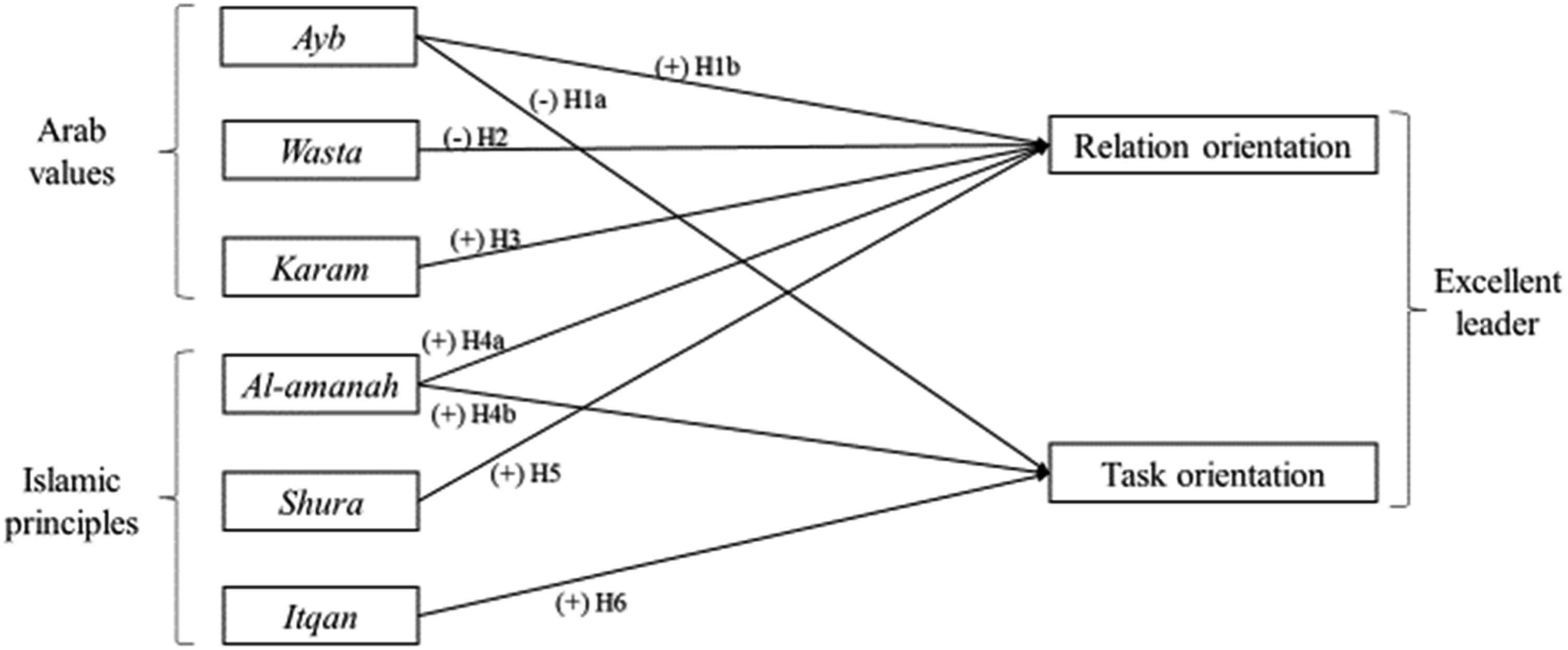
Research model.
Methods
Research context – Jordan as a focus
In Jordan, as in other Arab countries, leadership prototypes are influenced by Islamic teachings and Arab traditions (Koburtay et al., 2020). Jordan’s culture shares significant values of tribalism and authoritarian norms and traditions with other Arab countries (Al-Twal et al., 2023; Koburtay et al., 2022). Islam also plays a major role in society as 97% of Jordanians are Arabs, with 93% being Muslims (92% Sunny and 1% Shia), while 6% are Christians, and 1% practice other religions (Department of Statistics Jordan, 2023). However, scholars asserted that interpretations of Islamic teachings are impacted by Arab tribal values and mindsets (Caputo, 2018; Koburtay et al., 2020), which thus influences leaders’ behaviours (Al-Faleh, 1987; Sabri, 2012).
From a research point of view, Jordan has been the focus of many scholars to further understand management development and leadership in the Arab World (see for example, Al-Twal et al., 2023; Caputo, 2018; Weir, 2020). That is because “Jordan is characterised by the presence of powerful tribes that play a dominant role in society; tribal systems influence various institutions and impact business functioning and HR processes” (Koburtay et al., 2022: 6). Resulting in high power distance and tolerance of uncertainty (Sabri, 2012), HR practices (Al-Twal et al., 2023), gender inequity in leadership positions (Koburtay et al., 2020), nepotism in the hiring and promoting of leaders (Baranik et al., 2021) and reducing employee motivation, morale and job satisfaction (Alsarhan and Valax, 2021) in Jordanian organisations. Therefore, this study selected Jordan as a context to generate evidence for the impact of tribalism features and Islamic principles on the perceptions of excellence in leadership.
Sample and procedure
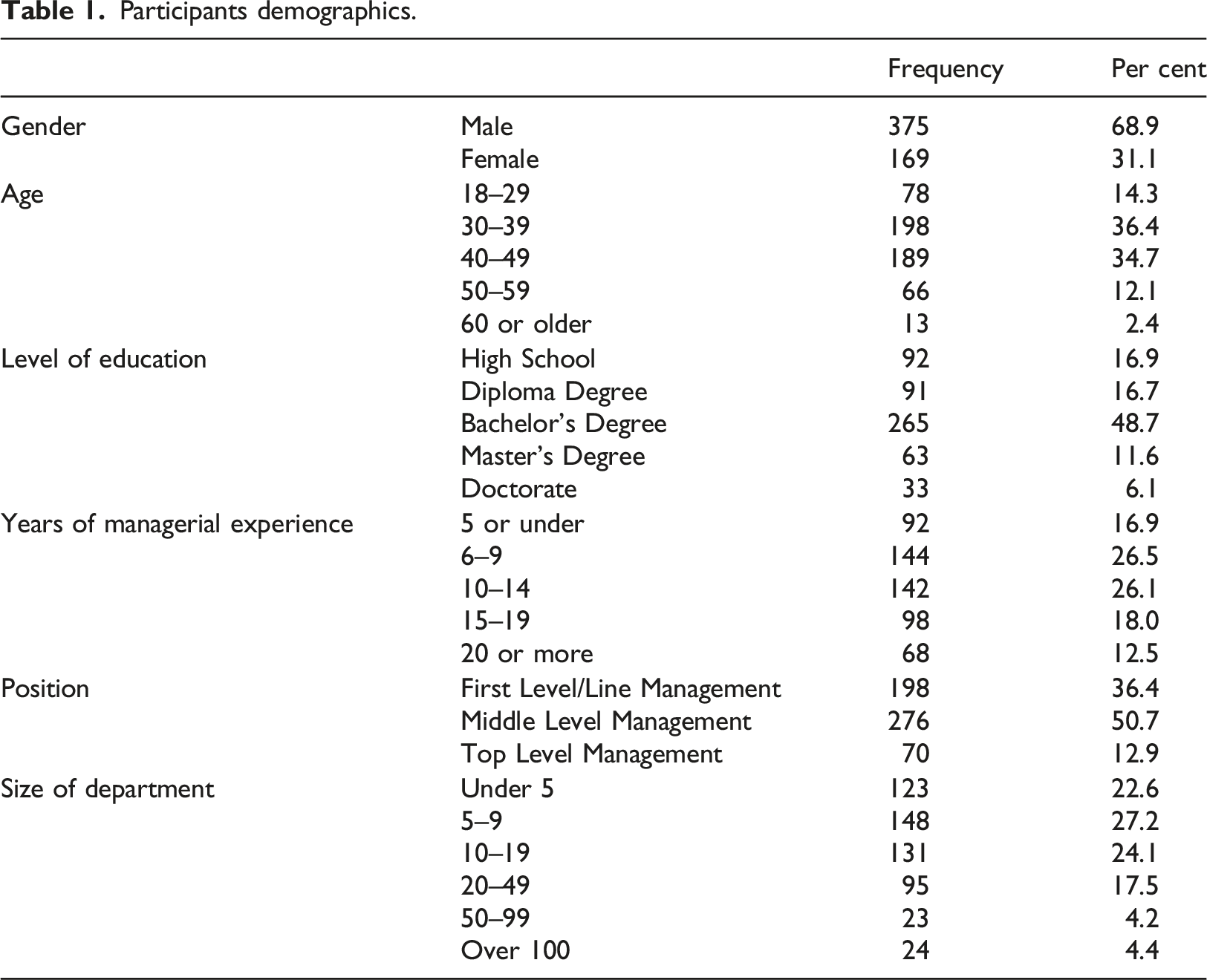
Participants demographics.
Measures
All substantive items (see below) were assessed using a 5-point Likert-type scale (1 = strongly disagree; 5 = strongly agree). Because our intent is not to identify behaviours exercised by specific managers, the statement, “I believe a manager should”, was included before each item to reflect managers’ perceptions of what behaviours are valued to display by the excellent leader. The survey was translated from its original language, English, into Arabic through a back-translation approach by four bilingual academics who are fluent in English and native in Arabic (Brislin, 1986).
We used 19 items from Selvarajah et al. (1995) to measure EIL constructs in the Arab World. Al-amanah was measured using four items. Sample item: “Be dependable and trustworthy”; the coefficient alpha was 0.75. Shura was measured using four items. Sample item: “Consider suggestions made by employees”, and the coefficient alpha was 0.76. Itqan was measured using three items. A sample item: “Continue to learn how to improve performance”, and the coefficient alpha was 0.77. Relation orientation and task orientation were measured using four items for each. A sample item for relation orientation: “Give recognition for good work”; the coefficient alpha for this scale was 0.73. A sample item for task orientation: “Organise work time effectively”, and the coefficient alpha for this scale was 0.76.
Furthermore, we developed three construct scales to measure the Arab tribal values of ayb, wasta and karam based on an intensive process of reviewing existing literature and an understanding of these cultural values. A pool of 165 items across the new constructs was generated based on the definition of each cultural value. The items were compared and refined to reflect each cultural construct and ensured to be clear to the reader. The final scales are displayed in the appendix. Ayb was measured by the Shame-Ayb Scale (SAS), four items developed to provide an assessment of how leaders may behave to avoid social pressure and meet social expectations. Sample item: “Return favours even if it is not in organisational interest”. The coefficient alpha of SAS was 0.83.
Wasta was measured by Nepotism-Wasta Practices Scale (NWPS), eight items developed by reviewing studies concerned with studying concepts similar to wasta, such as Guanxi in China (Ai, 2006), Blat in Russia (Michailova and Worm, 2003) as well as reviewing wasta studies in the Arab World (Arasli and Tumer, 2008; Hayajenh et al., 1994; Tlaiss and Kauser, 2011). The NWPS reflects assessments of giving preferential treatment to relatives and friends. Sample item: “Exceed the established laws and rules to help relatives and friends”. The coefficient alpha of NWPS was 0.90.
Karam was measured by Generosity-Karam Scale (GKS). We used three items from Smith et al. (1983), and two items were developed in this study. The GKS reflects an assessment of diverse behaviours associated with generosity, such as helping, comforting, sharing, and cooperating. Sample item: “Help others who have heavy workloads”. The coefficient alpha of GKS was 0.83.
Data analytic strategy
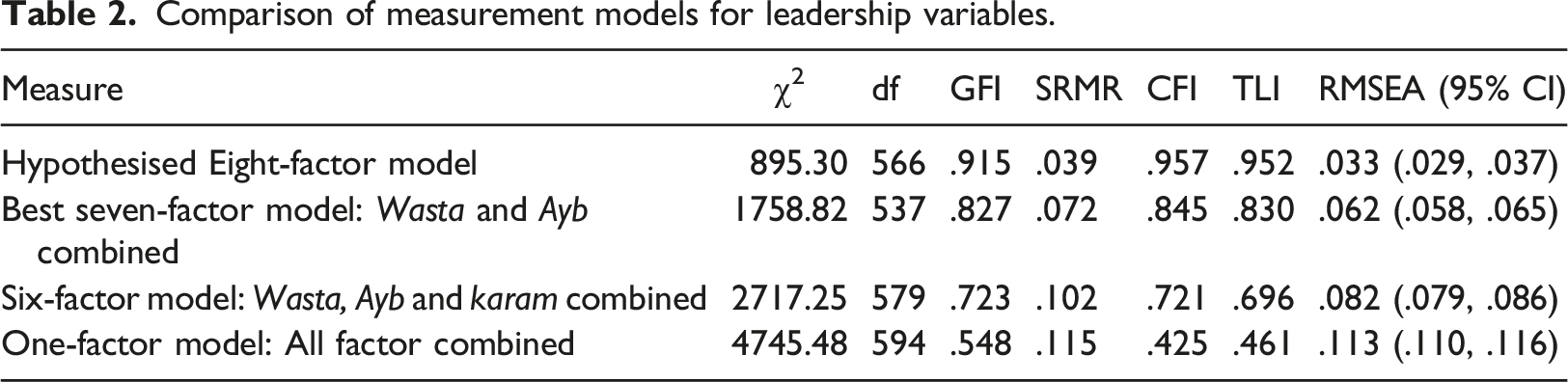
To test the hypothesised relationships between leadership constructs, we used structural equation modelling (SEM) conducted using AMOS 28 in a two-phase procedure. First, we tested the measurement model fit and validated the measure prior to testing our proposed model. A good fit occurs when goodness-of-fit index (GFI) surpasses .90, comparative-fit index (CFI), and Tucker–Lewis coefficient (TLI) surpasses .95, the standardised root mean square residual (SRMR) is under 0.5, and when root mean square error of approximation (RMSEA) is under 0.06 (Hu and Bentler, 1999). Second, following the establishment of the measurement model, we tested our hypotheses using path analysis with a 5000 bootstrap sample (Hayes, 2017).
Common method variance
Given that the data was collected through a single source using a 5-Likert scale, a concern about the common method variance (CMV) bias may exist. To address this potential concern, we followed Podsakoff et al. (2003) by assuring participants’ anonymity and confidentiality of the data. Prior to distribution, we conducted a pilot study to test and revise the survey with twenty managers. In the analysis phase, we added the ‘Mindful Attention Awareness Scale’ consisting of four items in the survey as a marker that is theoretically unrelated to other constructs in our model (Lindell and Whitney, 2001). The marker variable revealed that the concern for CMV bias is low as significant correlations remained significant after the removal of the marker variable.
Results
Measurement model
Comparison of measurement models for leadership variables.
Descriptive statistical analysis
Descriptive statistics, correlations and reliabilities.
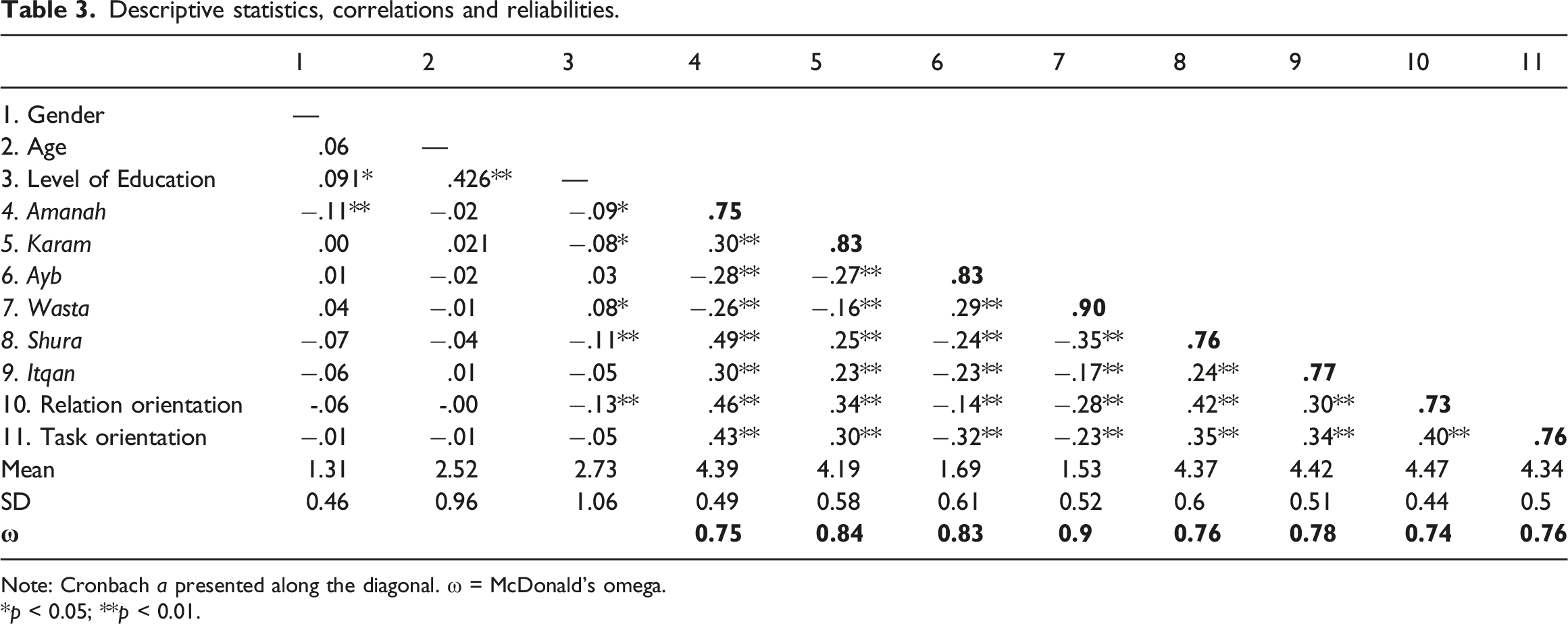
Note: Cronbach a presented along the diagonal. ω = McDonald’s omega.
*p < 0.05; **p < 0.01.
Construct reliability and validity
We assessed the reliability using the omega coefficient (ω) (McDonald, 1999), which accounts for the factor loading and error variance of the construct’s items (see also, Hayes and Coutts, 2020). The construct reliability ranged from 0.74 (for task orientation) to 0.90 (for wasta), above the 0.70 benchmark (Hair et al., 2018). The newly developed scales of karam, ayb and wasta showed high reliability of greater than 0.80 (see Table 3).
We examined the discriminant validity using chi-square difference tests. We constrained the correlation between one pair of constructs at a time and assessed the changes in the model fit using the Satorra-Bentler scaled chi-square difference test (Satorra and Bentler, 2001). We run chi-square difference tests to examine each pair of constructs against each other. In each test, imposing this constraint resulted in worst model fit, smallest chi-square = 25.597, p < .05, indicating the presence of discriminant validity of each measure.
Hypotheses testing
Findings from the structural equation model.
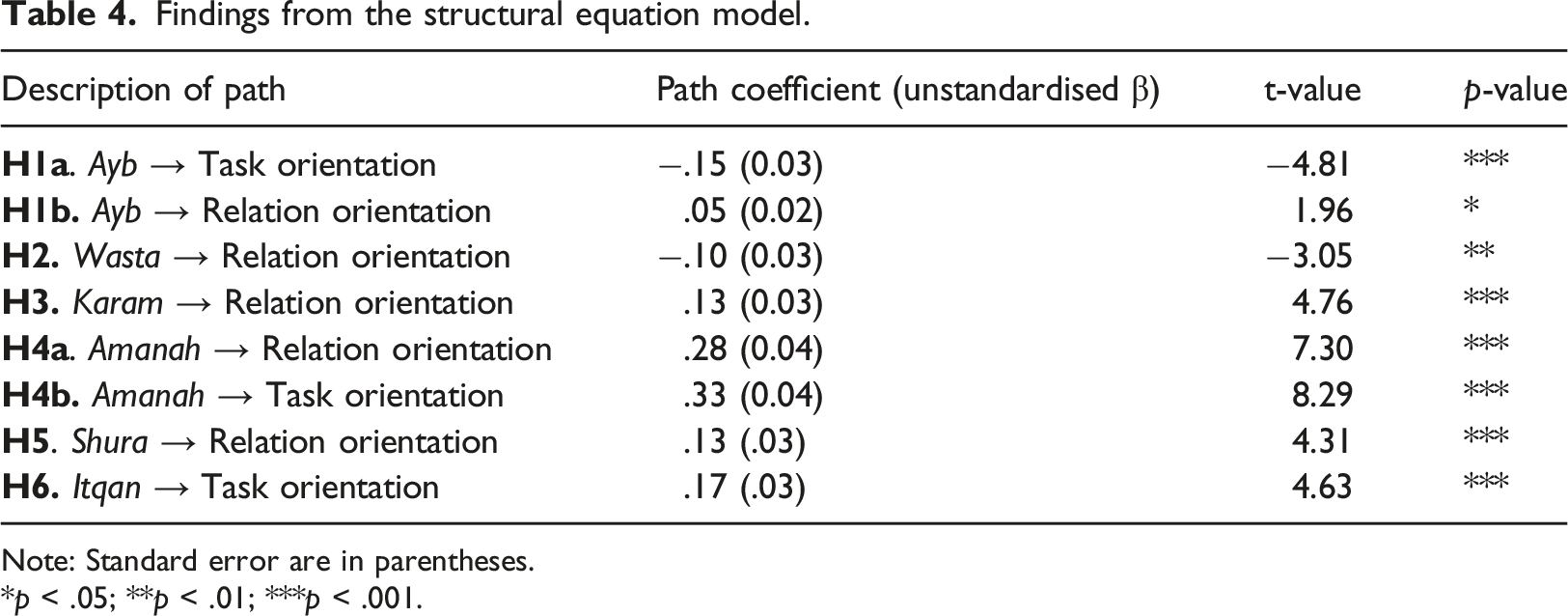
Note: Standard error are in parentheses.
*p < .05; **p < .01; ***p < .001.
Discussion
Theoretical contribution
Our study has three theoretical contributions. First, our study advances the culturally specific approach to leadership by developing a leadership profile for leadership in the Arab World. Although leadership has been extensively researched in organisational settings (Bass and Stogdill, 1990; Yukl, 2012), this research focused on understanding the universal phenomenon of leadership while discounting the context where leadership operates (Dickson et al., 2003; Galperin et al., 2022). Given that the influence of social culture and leadership is still a promising area of research (Blake et al., 2022; Lord et al., 2020), our study extends this understanding by developing a profile for leaders in the Arab World.
Second, our study advances ILTs research by incorporating Islamic principles and Arab tribal values to understand leadership behaviours in the Arab World. Previous leadership research following ILTs in the Arab World identified team-oriented leadership as a preferred style due to societal practices that embody humane and in-group orientation (Abdalla and Al-Homoud, 2001; Kabasakal et al., 2012). Our study extends this understanding by identifying the cultural factors that influence leaders’ behavioural orientations. For instance, our results showed that the notion of ayb is negatively related to task orientation but positively to relation orientation. Moreover, our results showed that leaders’ relation orientation is encouraged by the Islamic principles of Al-amanah and shura and the Arab value of karam. This is consistent with previous leadership research, which found that consultation (Stogdill, 1950; Yukl et al., 2002), trust (Fleishman, 1953), and generosity (Graham, 1995; Yang and Mossholder, 2010) are important to relation-oriented leadership behaviour. Therefore, our study takes a further step to confirm the importance of these values in leadership in the Arab World, contributing to advancing the application of ILTs in the Arab World.
Third, by providing evidence of links between Arab tribal values, Islamic leadership principles, and leadership perception, the current study adds to leadership research specific to the Arab World. To the best of our knowledge, this study is one of the first to provide empirical evidence for the direct links between Arab tribal values (ayb, wasta and karam) and Islamic leadership principles (shura, al-amanah, and itqan) and leadership perceptions. Furthermore, while previous research examined the influence of Arab cultural values (e.g., wasta) on HR practices (Al-Twal et al., 2023) and employees’ outcomes (Alsarhan and Valax, 2021), the current study provides evidence for the influence of these values on leadership perceptions. By so doing, the current study responds to Alsarhan (2022) and Zaim et al. (2022) calls for further investigations into Arab values and Islamic principles in organisations.
Lastly, our study contributes to the quantitative approach to studying leadership in the Arab World, which has been limited to a qualitative approach (Koburtay et al., 2020, 2022). Although some research claims that the quantitative method is insufficient to understand leadership perception in cultural settings (Conger, 1998; Parry et al., 2014), it is only recommended after a deep understating of the cultural context (Stentz et al., 2012). Flowing from a rich understanding of the Arab culture, the quantitative approach in our study provides baseline data on the relationships between cultural values and the traditional dimensions of leadership behaviours (Bryman, 2004). Our study develops measures associated with the cultural values of ayb, wasta and karam that have been extensively studied in qualitative management and leadership research in the Arab World (Koburtay et al., 2022; Metcalfe, 2007; Tlaiss and McAdam, 2021; Tlaiss and Kauser, 2011). The findings of our study thus extend the understanding of the effect of these cultural values and contribute to the application of quantitative methods in management and leadership research in the Arab World.
Practical implications
Our study also provides the following practical implications for organisations. First and most importantly, our study findings offer insights to international organisations into how excellent leadership is perceived in the Arab World. Our findings advise international organisations to make good use of the leadership model developed in this study, specifically when leadership behaviours are motivated by cultural values. For instance, our findings revealed that wasta is negatively related to leaders’ behaviours. Thus, international organisations can frame their policies to stem wasta practices. International organisations might have specific internal rules and regulations to control the practices of wasta. They might be required to state that wasta practices are regarded as misconduct and unethical that violates the rules and values of the organisation. Our findings also revealed that ayb and karam are related to relation-oriented behaviours. International organisations can provide training to managers to understand these values, which might help understand subordinates’ needs and how managers are expected to behave in certain situations.
Yet, our findings advise policymakers in the Arab World to monitor managers’ behaviours in organisations. Our findings advise policymakers that changes are needed to occur to the understanding and application of some cultural values. Previous research referred to the role of traditional management practice and understanding in reaching a meaningful change in Arab societies (Koburtay et al., 2020; Sidani and Thornberry, 2010). Our findings extend this understanding by revealing that relying on individuals’ consciousness is insufficient to stem the unethical practices of wasta and ayb. Rather, policymakers are advised, with a significant commitment, to frame HR policies and organisational values by understanding the tribal structure for management development in the Arab World.
Limitations and future research
As with any study, our study has a number of limitations. Among these is the use of a cross-sectional design that is susceptible to CMV bias (Podsakoff et al., 2003). In our study, however, this risk was minimised by ensuring participants’ anonymity and confidential use of the data (Podsakoff et al., 2003). Moreover, the marker variable approach (Lindell and Whitney, 2001) suggested that CMV threat is low in this study. Future research should use a time-lagged and experimental design to further alleviate such threats and address the causality failure in this study. Furthermore, leadership research stressed the importance of assessing leadership behaviour in specific cultural contexts through participant observations or in-depth interviews (Conger, 1998; Parry et al., 2014). Although we treated this through a rich understanding of the cultural values, future inquiries should use a mixed method to allow for a further understanding of the culture and can substantiate relationships of the framework’s variables (Stentz et al., 2012).
Our research model should be retested in Arab countries other than Jordan to enhance its generalisability. Our findings can be applicable, with caution, to other countries in the Arab World with more or less values of Arab traditions and Islamic principles. However, since the workplace is strongly influenced by Arab values (tribalism) in Jordan (Koburtay et al., 2022; Sabri, 2012), differences should be detected between our findings and other findings from other Arab countries. Furthermore, our study is limited to a public organisation, which limits its generalisability. Private sector organisations are also influenced by tribalism features (Alsarhan and Al-Twal, 2023). Therefore, future research should retest our model in the private sector, such as hospitality and healthcare organisations, to increase the generalisability of our findings. Yet, our study looked at the literature conducted in English only. Although English is a promising language for research in the Arab World (Metcalfe, 2007; Tlaiss and McAdam, 2021), a greater amount of research is conducted in Arabic – specifically, research associated with Islamic teachings and Arab traditions.
Future research should incorporate the Arab tribal values developed in this study into organisational behaviour research. This research can be directed to investigate the influence of these values on subordinates’ performance and wellbeing and include any possible interaction between these values. For instance, future inquiries can be directed to investigate the influence of wasta practices on employees’ emotional exhaustion and anxiety. Moreover, future research should extend our model by incorporating the Islamic principles of ihsan and haqq that might also impact leadership behaviours in the Arab World.
Supplemental Material
Supplemental Material - Excellence in leadership in the Arab world: Islamic principles and tribal values. Evidence from Jordan
Supplemental Material for Excellence in leadership in the Arab world: Islamic principles and tribal values. Evidence from Jordan by Zaid Oqla Alqhaiwi, Timothy Bednall and Eva Kyndt in International Journal of Cross Cultural Management
Footnotes
Acknowledgements
I would like to express my heartful thanks to Prof Christopher Selvarajah and Dr Samir Shrivastava for their constructive comments while developing the measures and research design.
Declaration of conflicting interests
The author(s) declared no potential conflicts of interest with respect to the research, authorship, and/or publication of this article.
Funding
The author(s) received no financial support for the research, authorship, and/or publication of this article.
Ethical statement

Supplemental Material
Supplemental material for this article is available online.
Appendix
Items used to assess the Arab tribal values.
Managers reflected their degree of agreement with all items by indicating to what extent they agree with each item on a scale from (1) strongly disagree to (5) strongly agree. The statement, “I believe a manager should”, was included before each item to reflect managers’ perceptions on what behaviours are valued to display by the excellent leader. Note: These items can be used for research purposes.
Arab tribal value
Items
Ayb/Shame
1. Behave in a manner to gain society’s approval.
2. Be concerned about what other people may think of their ability to do things.
3. Return favours even if it is not in organisational interest.
4. Be concerned about what other people think of the sort of person I am.
Wasta/Nepotism
1. Exceed the established laws and rules to help relatives and friends.
2. Seek solutions that mainly benefit friends and relations.
3. Create opportunities for friends and relatives.
4. Value the benefits of family members and friends rather than the benefits of the organisation.
5. Be aware of and support subordinates who have kinship or friendship with high-level executives.
6. Favour friends and relatives over other employees.
7. Offer promotions and rewards to unqualified relatives or friends.
8. Factor in personal relations while making decisions.
Karam/Generosity
1. Attempt to understand the reason behind others’ actions.
2. Be a forgiving person.
3. Help others who have heavy workloads.
4. Volunteer for things that are not required.
5. Help others who have been absent.
References
Supplementary Material
Please find the following supplemental material available below.
For Open Access articles published under a Creative Commons License, all supplemental material carries the same license as the article it is associated with.
For non-Open Access articles published, all supplemental material carries a non-exclusive license, and permission requests for re-use of supplemental material or any part of supplemental material shall be sent directly to the copyright owner as specified in the copyright notice associated with the article.
