




Abstract
BACKGROUND:
Many recent studies recommend ethical leadership as a key antecedent to improving employee performance in organizations.
OBJECTIVE:
Therefore, this study aims to examine how ethical leadership affects employee performance by focusing on the role of Islamic work ethics and knowledge sharing.
METHODS:
Based on data obtained from 196 Muslim employees who work in the three stone milling companies located in Central Java - Indonesia, this study uses a survey in the form of a questionnaire and Structural Equation Modeling (SEM) based on Amos 24.0 software to test hypotheses in the proposed research model.
RESULTS:
The results of this study prove that ethical leadership has a significant effect on employee performance, Islamic work ethics, and knowledge sharing. Furthermore, Islamic work ethics and knowledge sharing significantly improve employee performance.
CONCLUSION:
The findings in this study further confirm that Islamic work ethics and knowledge sharing play an important role in linking ethical leadership and employee performance.

Introduction
The stone milling industry has experienced a leadership crisis in recent years [1, 2], despite the growth of companies in many countries. The leadership crisis hindered and slowed down the growth of the industry because the leaders in this sector needed an adequate leadership style to achieve the desired goals. In addition, the stone milling industry has a bad reputation for causing high rates of accidents and hazardous activities in the workplace, such as loss of life, lack of concern for health and safety, unskilled workforce, and low compensation. Therefore, the appropriate leadership style is needed to direct and inspire employees working in the stone milling industry so the common goals would be well achieved.
Leadership plays an important role in influencing organizational sustainability to improve and maximize employee performance. One of the leadership styles that has also received great attention from practitioners, researchers, and academics is ethical leadership, which focuses its emphasis on promoting moral behavior, which is able to improve ethical behavior and employee performance [3]. Bedi, Alpaslan [4] found that ethical leadership has a significant positive effect on ethical behavior, employee performance, organizational commitment, and job satisfaction. On the other hand, ethical leadership has a negative effect on job stress, turnover intention, and counterproductive work behavior.
Ethical leadership performs a unique leadership style that appears to use attractive communication, practicing exemplary, caring, integrity, and altruism [5–7]. Ethical leaders are always honest, trustworthy, and fair and behave professionally in their personal and work lives [5]. Ethical leaders manage employees and organizations with clear minds and hearts [8]. Likewise, when making decisions, ethical leaders always consider whether the decision is ethical, appropriate, and fair to all parties [3, 9].
Ethical leadership is positively related to the quality of employee performance [10–14]. Leaders who practice ethical leadership behavior, always perform better in instilling trust and confidence in employees to perform accurately and with quality. Ethical leadership always does what is right by setting the best example and example for employees. This causes employees to be motivated to realize higher quality work because they believe their performance will be appreciated, recognized, and properly rewarded.
A study by Kelidbari, Fadaei [15] found no significant relationship between ethical leadership and employee performance. Similarly, Park, Kim [16], Zhu, He [17] concluded that ethical leadership does not directly affect employee performance but must go through a mediator variable. Meanwhile, the study by Zaim, Demir [18] found that ethical leadership only partially affects employee performance, where the dimensions of ethical leadership (such as justice, wisdom, and temperance) have a significant effect, while courage and dependent dimensions have no effect at all on employee performance. Even Yang [19] found a negative relationship between ethical leadership and employee well-being in the workplace. The heavy burden and pressure placed on employees by leaders decreased employee welfare when working under ethical leadership. Therefore, based on the empirical research gap of previous studies, this study aims to examine how ethical leadership affects employee performance mediated by Islamic work ethics and knowledge sharing. Ethical leader in organizations is believed to be able to encourage hard work and knowledge-sharing behavior as well as increase work dedication, responsibility, and high commitment to the values of Islamic work ethics of employees to produce the best performance in order to achieve the organization’s competitive advantage.
Literature review and hypotheses development
Employee performance
Employee performance is one of the most important things in the organization. Babin and Boles [20] define employee performance as the level of productivity of an employee concerning the work assigned to him/her. Some indicators that can be used to measure employee performance, according to Babin and Boles [20], are enthusiasm, quality of work, quantity of work, ability to work together, and focus on service delivery. According to Karatepe [21], in his research, employee performance indicators include 3 things: work quantity, work quality, and focus on service delivery.
In relation to other variables as its antecedents, employee performance has been widely studied by experts scattered in various works of literature. These studies prove that employee performance is influenced by ethical leadership [10, 23] that ethical leadership encourages employee confidence and self-actualization to generate higher performance, Islamic work ethic [24–27] that Islamic work ethics increase the willingness and self-awareness of employees to show positive performance achievements, and knowledge sharing [28–30] that sharing knowledge makes it easier for employees to apply that knowledge in solving problems and resulting in better, faster, and more efficient performance. Even further, Islamic work ethic [31] and knowledge sharing [32, 33] function as the key mediator variables in linking ethical leadership and employee performance. Encouraged by ethical leadership, employees display a high commitment to Islamic work ethical values and collect and donate their knowledge to achieve quality performance.
Ethical leadership
Leadership has a very diverse definition [34], where the main focus is on the process of influencing, guiding, and directing the behavior of people in their workplaces so that they are willing to carry out assigned tasks [35–37]. Leaders need to demonstrate ethical and high-quality behaviors so that they are able to direct employees to achieve the short-term and long-term goals of the organization [38, 39].
Brown, Treviño [3] proposed a theory of ethical leadership that plays an important role in promoting the improvement of employee attitudes and behavior in the workplace. Ethical leadership is the behavior and actions of leaders that are normatively appropriate in building interpersonal relationships with employees through communication, reinforcement, and decision-making [3]. Ethical leadership promotes ethical behavior by practicing and being consistent with normative ethical principles such as trust, honesty, and fairness [40]. The combination of integrity, ethical standards, and fair treatment of employees is the cornerstone of ethical leadership [3].
In the view of Brown and Treviño [5], ethical leadership highlights and emphasizes high integrity, shared values, and fair treatment in conducting business transactions. Ethical leaders always inspire behaviors that are beneficial to employees, encourage a high level of pride and commitment to the organization, and shape employees’ positive attitudes in viewing the content of their work [41–43]. By applying the principles of trust, responsibility, respect, and an understanding of human rights, ethical leadership is able to help employees to find appropriate solutions to various problems, communicate opportunities, and increase feelings of empowerment so that they are willing to share knowledge while in their environment and stressful work [44, 45].
Ethical leaders demonstrate an attitude of openness, honesty, friendliness, fairness, and truth [46]. Ethical leaders also tend to encourage employees to make useful suggestions for the organization. In addition, with an attitude of openness and honesty, ethical leaders motivate employees to express their experiences and opinions and report information regarding various problems that exist in the workplace without fear of negative feedback [3, 47]. Thus,
H1: Ethical leadership has a positive and significant effect on employee performance.
H2: Ethical leadership has a positive and significant effect on knowledge sharing.
H3: Ethical leadership has a positive and significant effect on Islamic work ethics.
Islamic work ethics
Work ethics concern a set of values and beliefs that are applied in work and business. So far, work ethics has focused on the view of life in the Western world held by European and American society, especially capitalism [48], which has shaped other people’s views on work [49]. In fact, there is an unavoidable fact that the values and beliefs in Western society, in which Protestantism dominates, and Eastern society, in which Islam and Confucianism dominate, certainly have very different ways of doing work and business. Western society indicates work-related beliefs and behaviors that lead to hedonism [50, 51], while Eastern society leads to devotion and worship of God [52, 53].
The basic concept of Islamic work ethics comes from the Qur’an, namely in the form of the word of God in its entirety and the words of the prophet Muhammad. Prophet Muhammad taught every individual to work hard. In fact, this hard work will make the individual look nobler, where he does not spend his time and age in neglect.
The Islamic work ethic is conceptualized as a work ethic that is essentially based on Islamic values and teachings [54, 55], which distinguishes it from other work ethics. The Islamic work ethic is very concerned with the intention/process rather than the result, where all activities are considered unethical (even though they have benefits) when the activity is carried out in violation of religious law [56, 57]. According to Valentine and Godkin [58], three fundamental aspects need to be considered in making ethical decisions, namely moral philosophy (beliefs), organizational relationships and values (principles), and opportunities (conditions respecting ethical decisions) [59].
Islamic work ethics can shape employees’ psychological and emotional states so that they produce the best performance [26, 60]. Employees with an Islamic work ethic are more likely to work with sincerity, skill, honesty, responsibility, and gratitude [61]. Employees with internalized Islamic work ethics will make ethical decisions because they fully believe God is watching and knows what they are doing [62].
H4: Islamic work ethics has a positive and significant effect on employee performance.
H5: Islamic work ethics mediates the relationship between ethical leadership and employee performance.
Knowledge sharing
Knowledge is one of an organization’s most valuable intangible assets [63, 64]. Knowledge must be adequately managed [64] because superior knowledge is able to produce appropriate decisions and actions in the organizational context [65]. The more knowledge is transferred, shared, collected, and applied within the organization, the greater the benefits of creating new knowledge [64].
Knowledge management is a series of processes, such as knowledge acquisition (gathering new knowledge from external sources), knowledge sharing (spreading acquired knowledge to others), and knowledge application (internalizing and integrating knowledge within the organization) [66, 67]. Furthermore, this study will focus more on the discussion of knowledge sharing because it is commonly acknowledged to be one of the most important aspects of knowledge management [63, 69] and is very effective in facilitating the achievement of competitive advantage.
Knowledge sharing is a process or behavior of donating and gathering knowledge among employees to develop knowledge capital for each other’s work success [70, 71]. Donating knowledge reflects an individual’s behavior that is voluntary and proactive in communicating personal intellectual capital to co-workers. In contrast, knowledge gathering reflects a process by which individuals gather skills and knowledge from co-workers to master what they already know [68].
Nonaka and Takeuchi [72], Wang and Noe [73] assert that knowledge sharing is seen as very important to be applied in organizations because it allows individuals to take advantage of the existing knowledge base (both inside and outside the organization) so that they are able to produce solutions that create, and also enables organizations to develop new platforms for the development and introduction of new products and services. Tønnessen, Dhir [74] prove that knowledge sharing significantly affects employee performance in various situations, for example, in the Covid-19 era. Likewise, Singh, Mazzucchelli [75] found that knowledge sharing positively increases employee innovation and performance at the individual and organizational levels. Thus,
H6: Knowledge sharing has a positive and significant effect on employee performance.
H7: Knowledge sharing mediates the relationship between ethical leadership and employee performance.
Methods
Sample
The sample is part of the population that is carefully selected to represent the population [76]. This study’s sampling technique was purposive sampling, which is a technique for determining research samples based on certain criteria [77], such as religion, education level, position, and work experience. The data in this study were collected from Muslim employees working at various levels and functions in the 3 stone milling industries in Central Java –Indonesia.
Data collection in this study used a survey in the form of a questionnaire distributed to 273 employees. Due to the difficulty of conducting surveys on employees in the Covid-19 era, the alternative used is to entrust a questionnaire to the human resource manager at the company that is the object of research, which is ultimately distributed personally to the prospective respondents surveyed. After they answered the given questionnaire, the questionnaire was then returned. There were 273 questionnaires distributed, and 204 responses were returned (74.73% response rate). There were 8 incomplete questionnaires because the respondents needed to respond to several questions on certain items (such as Islamic work ethics and knowledge sharing), so they were omitted from the data analysis. Therefore, the last data that deserves to be analyzed in this study used 196 questionnaires (valid response rate of 71.79%). As shown in Table 1, respondents in this study were aged between 31 and 50 years (76.53%), while 87.75% were male and 12.25% were female. Of the total respondents, 74.49% have a senior high school qualification, and 16.33% have a bachelor’s degree. Respondents’ work experience ranged from 5 to 10 years (41.84%).
The demographic profile of the sample
The demographic profile of the sample
All variable measurement items used in this study were adapted from previous studies that tested the same variables as the proposed model. In detail, each measurement item of each variable is explained as follows.
Ethical leadership. Ethical leadership is measured using 6 indicators (e.g., My supervisor listens to what employees have to say) adapted from Brown, Treviño [3], namely listen well to what employees say, make decisions fairly, ethically conduct his/her personal life, discipline employees to comply with the ethical standards set, set an example of how to do things with the right way, and define success not only by the results but also by how to get them.
Islamic work ethics. Islamic work ethics is measured using 6 indicators (e.g., Dedication to work is a virtue) adapted from Udin, Dananjoyo [78], Yousef [79], namely dedication to work that is beneficial to oneself and others, being fair and generous at work, always do the exercises to the best of their abilities, work is not the main goal, but a means to encourage personal growth and social relationships, life is worthless without work, and always works hard to fulfil responsibilities.
Knowledge sharing. Knowledge sharing is measured using 5 indicators (e.g., I share my experience and knowledge with colleagues) adapted from He, Peng [80], Hu, Horng [81], Udin, Dananjoyo [82], namely sharing work experiences and useful knowledge with others, sharing what is known to colleagues, taking the initiative to share work-related knowledge, taking time to help and share with others, and promoting new knowledge learned to coworkers.
Employee performance. Employee performance is measured using 4 indicators (e.g., Employee adequately completes his/her assigned duties) adapted from Astuty and Udin [83], Williams and Anderson [84], namely the ability to do work, quality of work, punctuality, and ability to cooperate.
The questionnaires were distributed using a Likert scale ranging from 1 to 7, where 1 = strongly disagree and 7 = strongly agree. In this study, the data obtained were statistically processed utilizing SEM-based AMOS 24 software. SEM is a model that assigns testing a more sophisticated network model [85].
Results
Using SEM-based AMOS 24 software to analyze the data, since the CR value for skewness and kurtosis is less than 2.58, Table 2 demonstrates that the univariate normality test has been satisfied. This indicates that each indicator has skewness and kurtosis, which all make up the shape of a normal curve. A multivariate normal distribution is indicated by the multivariate normality test findings, which demonstrate that the CR value is 0.167, which is less than 8 [86]. In addition, the value of the determinant of sample covariance matrix = 0.000, indicating no multicollinearity in the proposed model.
Assessment of normality
Assessment of normality
Table 3 shows that the internal consistency reliability for each construct is greater than 0.7, which is indicated by the CR coefficient values ranging from 0.833 to 0.941. Convergent validity is determined by looking at the scale indicator factors in each construct along with the average variance extracted (AVE) value. The results showed that all loading factors were greater than the cutoff value of 0.7 [87], ranging from 0.799 to 0.911, and all factor loading values shown in Table 3 and Fig. 1 exceeded the cutoff value of 0.5, ranging from 0.566 to 0.894.
Loading factors
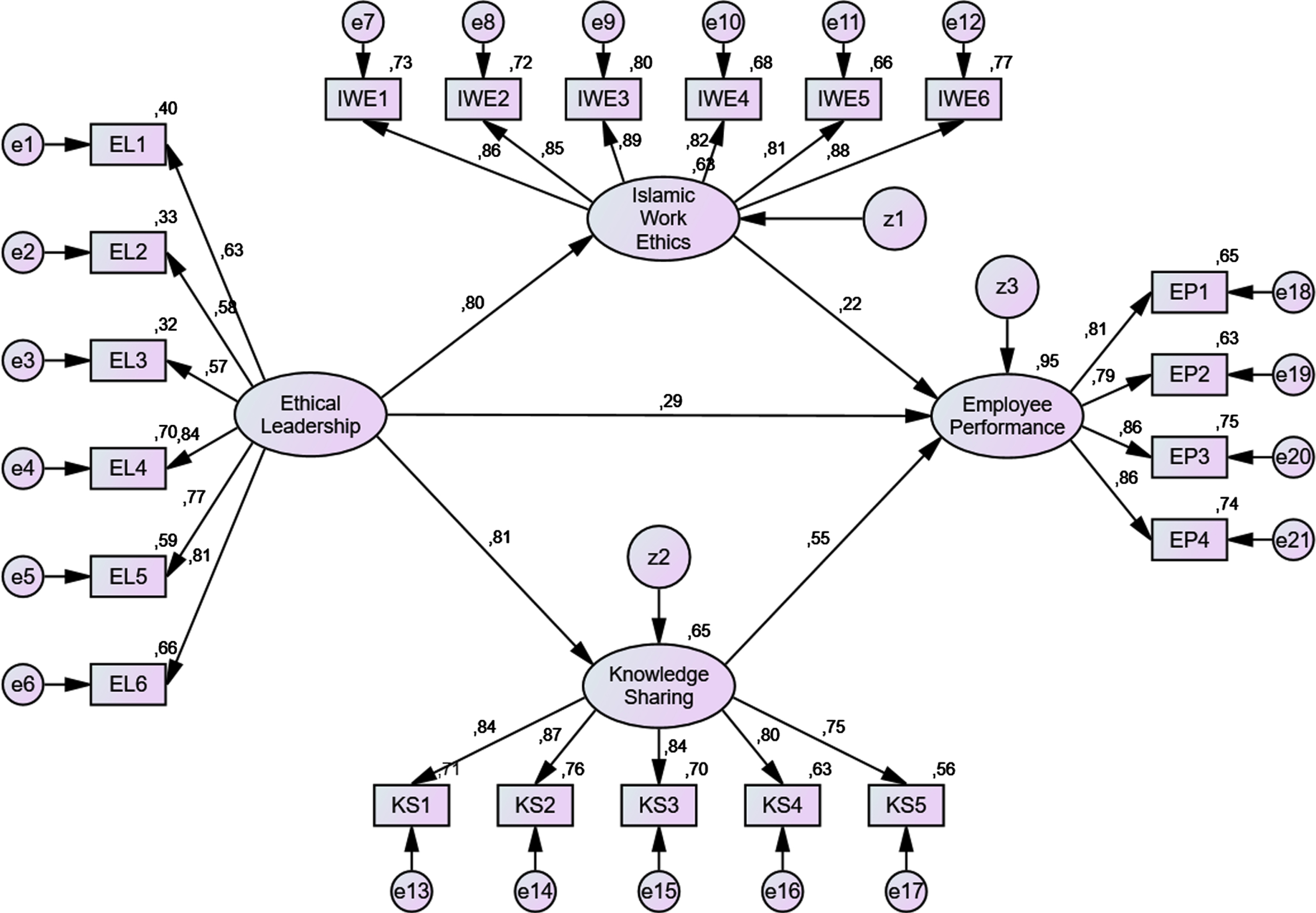
Research framework.
By using SEM-based AMOS 24 software, this study uses confirmatory factor analysis (CFA) to confirm the overall measurement model. A good measurement model, according to Hooper, Coughlan [88], Steiger [89], requires a goodness fit index (GFI), adjusted goodness fit index (AGFI), and Tucker-Lewis index (TLI) values greater than 0.90, and the value of the root mean square error of approximation (RMSEA) must be lower than 0.07. This research model at each stage shows an acceptable measurement fit with a satisfactory discriminant validity value: RMSEA = 0.059, 0.066, 0.017, 0.000, 0.060, CMIN/DF = 1.678, 1.845, 1.054, 0.994, 1.694, GFI = 0.986, 0.977, 0.990, 0.995, 0.875, AGFI = 0.942, 0.938, 0.969, 0.974, 0.873, and TLI = 0.985, 0.987, 0.999, 1.000, 0.958. Therefore, the results of the CFA test shown in Table 4 confirm that the latent constructs in this research model are well-stated and defined in the data.
Confirmatory factor analysis
Table 5 shows a significant positive effect between ethical leadership and employee performance (β= 0.290, C.R = 3.169, ρ< 0.005) at the 5% significance level, which supports H1. A significant positive effect was also found between ethical leadership and knowledge sharing (β= 0.806, C.R = 9.410, ρ< 0.005), which supports H2, and between ethical leadership and Islamic work ethics (β= 0.796, C.R = 10.280, ρ< 0.005) which supports H3. Furthermore, this study found a significant positive effect between Islamic work ethics and employee performance (β= 0.223, C.R = 3.398, ρ< 0.005), which supports H4, and between knowledge sharing and employee performance (β= 0.548, C.R = 6.911, ρ< 0.005) which supports H6.
Hypotheses testing
Note: *** ρ< 0.05.
By referring to the procedure proposed by Baron and Kenny [90] to test H5 and H7 about the mediating effect of Islamic work ethics and knowledge sharing in the relationship between ethical leadership and employee performance, this study proves that the indirect effect of Islamic work ethics (β= 0.305, ρ< 0.005) and the indirect effect of knowledge sharing (β= 0.496, ρ< 0.005) mediates the relationship between ethical leadership and employee performance. Therefore, taken together, H5 and H7 in this study are supported, where knowledge sharing mediates the relationship between ethical leadership and employee performance more than Islamic work ethics. It stands to the reason that when work is not seen as a form of worship to God, employees may experience conformity to set standards. Conversely, when employees perceive work as a form of worship and self-actualization, they will produce the performance that exceeds expectations when driven by ethical leadership.
This study found that ethical leadership is very effective in improving employee performance. This research is strengthened by the findings of previous studies [10, 91] that ethical leadership encourages employees to work hard and learn better to produce superior performance. Ethical leadership can activate and encourage employee persistence to enrich knowledge, which can be used in completing the best performance. Ethical leaders are respected and well-followed by employees because they teach ethical and exemplary values that make it easier for organizations to achieve competitive advantage [92].
Ethical leaders improve employee morale, encourage organizational productivity, and strengthen employees to show a high moral identity, both when they carry out work and when they are in the organization. Ethical leadership provides new insights into realizing mutually helpful behavior and enhancing employees’ positive performance in organizations [93]. When ethical leaders demonstrate high integrity, exemplary, honesty, fairness, friendliness, and concern for others, employees become amazed and present other emotions of praise [94] that stimulate their willingness to help others and promote high performance.
Ethical leaders develop employees’ professional commitment, contributing to increased knowledge-sharing behavior [95]. Ethical leaders are able to create and encourage a learning culture among employees to improve performance at the individual, team, and organizational levels. Ethical leaders hold and apply high ethical standards to employees in successful work so that they play an active role in shaping organizational goals and also voluntarily assist colleagues by sharing relevant knowledge regarding the achievement of organizational goals [96].
Arijanto, Suroso [97] found that comfortable knowledge sharing mediates the relationship between ethical leadership and innovative employee performance. Ethical leaders who display exemplary character in sharing can encourage employee motivation to collect and donate their knowledge throughout the organization to produce superior performance. In addition, knowledge sharing promotes innovative performance, which forms the basis for organizational development [98, 99].
Ethical leadership can shape employees’ positive attitudes and behavior [100]. Employees who work under ethical leadership are more likely to show positive results and proud performance [10, 101]. Ethical leaders set a good example by displaying ethical behavior and character in daily tasks to make it easier for employees to realize Islamic work ethics. The Islamic work ethic of employees who work under ethical leadership greatly empowers and facilitates employees in displaying positive behavior because they feel internalized work motivation [102].
Ethical leadership promotes Islamic work ethic values of employees to consistently appear pro-organization, support the work environment, and always be good-oriented for the life of the world and the hereafter. Several characteristics, such as kindness, fairness, caring, honesty, friendliness, concern for others, and social responsibility, are the main features of ethical leaders and Islamic work ethics that significantly influence employees’ perceptions in developing and promoting superior and proud performance standards at all organizational levels. Ethical leadership enhances the Islamic work ethic of employees so that they feel significant life satisfaction when completing work.
This study, furthermore, found that knowledge sharing significantly improves employee performance. Sharing knowledge related to experience and useful information supports the ability of employees to produce the best performance achievements in the organization [103]. Sharing knowledge between fellow employees or between employees and the organization is able to assist employees in accumulating information and shared experiences to develop well, generate new ideas and present innovative ideas to solve problems at work and in the organization.
Conclusions
This study concludes that ethical leadership significantly affects employee performance and Islamic work ethics and knowledge sharing. Ethical leadership is able to shape employee attitudes and behavior by sharing information showing positive performance achievements, and having a developing Islamic work ethic. Furthermore, Islamic work ethics and knowledge sharing significantly improve employee performance. The findings in this study further confirm that Islamic work ethics and knowledge sharing play an important role in linking ethical leadership and employee performance.
The findings of this study provide very important practical implications for leaders and managers in the stone milling sector. In particular, this study shows that ethical leadership contributes positively to improving Islamic work ethics, knowledge sharing, and employee performance. Leaders who appear as role models with high integrity for employees, it is very important for them to be actively involved in knowledge-sharing behavior, work with an Islamic work ethic that is full of responsibility and display the best quality of work because employees model the behavior of ethical leaders who are admired.
This research has limitations, which can be used as the main basis for further research. First, this study only considers work ethics based on an Islamic religious perspective without examining the relative value of other types of ethics, such as Protestant, Confucian, Buddhist, and/or Hindu. Differences in religion, country and work environment can help overcome problems related to improving knowledge sharing and employee performance. Second, although typical Western culture is very different from non-Western culture (i.e., Eastern culture) [104], this study tries to apply the amalgamation of management theories and concepts developed by advanced Westerners and non-Westerners. Therefore, future research needs to separate the theoretical concepts related to the variables studied according to the relevant setting because Eastern culture tends to emphasize collectivism, generosity, simplicity, honesty, and protection for weak individuals, so it is very relevant to examine the concept of Islamic leadership [105, 106]. Third, limitations were also found in the data of this study, where out of 273 respondents who were asked to participate, only 196 filled out the questionnaire properly. This further limits the generalizability of the findings significantly. Therefore, further research should involve a larger sample across organizations, religions, cultures, and countries to obtain generalizable findings.