



Abstract
This paper explores the potential of conducting multiparadigm research within and beyond cross-cultural management, using narratives to examine how organizations shape migrant integration experiences and trajectories. It highlights the strengths of paradigmatic multiplicity in research with examples of three illustrative studies respectively using functionalist, interpretive and critical perspectives, while also considering the boundaries of these individual approaches. The paper proceeds to explore the potential of adopting a multiparadigm approach within a research strategy that places narratives at the centre of enquiry. It identifies the scope and focus of future research for a socially and politically important area of enquiry; it evaluates the application of diverse paradigm-driven methodological perspectives including the challenges involved in using them alone and in combination; and it develops a transferable framework to guide research in cross-cultural management, organization and migration studies that helps to assure procedural and conceptual rigour, and to generate practicable insights that facilitate successful integration outcomes.
Introduction
Studying integration is crucial for cross-cultural management and migration research because the processes and outcomes of mobility-related interactions and experiences are key concerns for both fields. Cross-cultural management research recognises that migrants can add value to organizations through their alternative perspectives and problem-solving strategies, which can be accessed and used strategically when migrants are integrated effectively into the workforce (Fitzsimmons et al., 2011; Grosskopf et al., 2022; Hajro et al., 2017; Hong and Minbaeva, 2022). However, cross-cultural management and migration research has shown that the inclusion of migrants in specific workplaces, and labour markets more widely, requires us to understand the factors that shape practices and experiences of integration (Fang et al., 2013; Hajro et al., 2021; Janta et al., 2012; Lugosi et al., 2016).
Integration is conceptualized within the context of the current discussion as a multidimensional, non-linear, and relational set of processes, which have the potential to create diverse opportunities and challenges for individuals, groups and organizations (Ager and Strang, 2008; Klarenbeek, 2021). Multidimensionality recognises that there are psychological, social and economic domains of practice, with subjective and objective indicators of change or continuity, and migrants may pursue and experience diverse notions of embeddedness across these domains. For example, migrants may become economically embedded in a geographical location through employment but remain socially or politically disconnected from their locality. Migrants may also choose to adopt new cultural norms in some aspects of their lives, e.g. regarding language use or customs at work, while continuing to maintain established practices in other life domains, e.g. in domestic foodways. Integration is non-linear insofar as it cannot be reduced to simplistic, unidirectional evolutions in identities or statuses from ‘outsider’ to ‘integrated insider’. The adoption of norms, values and practices may be selective and impermanent; identity transitions may not occur; they can be discontinuous, and change is contingent upon disparate contextual factors. Relationality stresses that intercultural exchange and identity work take place in social and political contexts with diverse interpersonal dynamics, cultural imperatives, institutional regimes and governance structures. Migrants must negotiate ascribed identities and statuses, e.g. those imposed through legal recognition or administrative labelling, and exercise their agency to construct their notions of selves in socio-cultural settings and political-economic landscapes (for an overview see Nardon and Hari, 2022). To understand the unique experiences of integration, the factors that shape its processes and outcomes, and how to manage the associated challenges, requires us to examine the role of organizations at the centre of migration-related and cross-cultural exchange.
Emerging work has shown that workplaces as organizations play a key part in shaping migrants’ settlement experiences and integration trajectories (Hajro et al., 2019; Lee et al., 2020; Nardon et al., 2021). Research has also demonstrated that access to and experiences in organizations more generally can enable financial independence, social participation, cultural learning and intercultural exchange, which opens pathways to inclusion into a foreign society (Landes and Barmeyer, 2018; Lugosi et al., 2016; Morano-Foadi et al., 2023). Organizations can also perpetuate migrants’ social and economic exclusion leading to marginalisation (Hajro et al., 2019; Lee et al., 2020; Risberg and Romani, 2022). A significant challenge for cross-cultural management studies concerns the adoption of effective methodological strategies to capture, analyse and interpret migrants’ subjective, lived experiences, from which to create effective strategies to optimise migrants’ integration trajectories and improve outcomes. More specifically, it is important to question the appropriateness of methods for studying how migrants interpret and convey or ‘narrate’ their experiences, for example of organizational interactions, challenges and facilitators that shape their integration trajectories and strategies. Questions regarding methodologies also require us to examine critically how paradigm-specific epistemological and ontological assumptions underpinning research shape the insights that are created, and how the knowledge generated through empirical work translates into impactful change.
Research examining migrants’ integration from a cross-cultural perspective is paradigmatically plural, with studies adopting particular epistemological stances in pursuing specific disciplinary, intellectual, emancipatory, political, or utilitarian economic agenda (Al Ariss et al., 2013; Cerdin et al., 2014; Golnaraghi and Dye, 2016; Golnaraghi and Mills, 2017; Guo and Al Ariss, 2015; Hajro et al., 2019; Mahadevan and Kilian-Yasin, 2016; Syed, 2008; Syed and Özbilgin, 2009; Syed and Pio, 2010). The multiple perspectives adopted in past research reflect disparate and, some could argue, incommensurable paradigmatic traditions, and this paradigm plurality can be seen as a weakness for proponents of accumulative knowledge (Pfeffer, 1993). Other scholars have argued that developing a sensitivity for different paradigms (Gephart, 2004; Grosskopf and Barmeyer, 2021; Lincoln et al., 2018; Patel, 2017) and even combining multiple paradigms within a study is a strength because it allows for multiple foci, questions, interpretations, and perspectives that can enrich comprehension of social phenomena (Gagnon et al., 2022; Manroop, 2017; Patel, 2017; Primecz, 2020; Romani et al., 2011; Sanchez et al., 2022). This particularly applies to the complex issues of migration and migrants’ integration experiences, which often raise heated debates, with multiple political and economic issues at stake (Brettell and Hollifield, 2021; Patel, 2017; Sandberg and Alvesson, 2021). No single perspective can effectively examine or comprehend such multidimensional and controversial subjects. Multiparadigm studies have been recognised for their theoretical contributions (Lewis and Grimes, 1999; Lewis and Kelemen, 2002; Patel, 2017), but they also raise methodological challenges (Patel, 2017; Romani and Primecz, 2019). It is therefore essential to understand the underpinning assumptions of specific paradigmatic perspectives to subsequently appreciate how a multiparadigmatic approach can utilise their combined strengths to study how migrants narrate their unique experiences.
Based on the human, organizational and methodological challenges outlined above, this paper has two objectives. First, to identify the important features and evaluate the strengths of key paradigmatic approaches to show how their use in a multiparadigm methodological strategy is apposite in studying the complex issue of migrants’ subjective integration experiences. Second, to support our first objective, to examine the potential to use narratives as common components in combining paradigmatic approaches. Narrative methodology is widely applied within migration studies; however, more often than not, there remain ambiguities regarding authors’ underlying ontological and epistemological assumptions (de Fina and Tseng, 2017). We argue that clarification of these issues can sharpen contributions of narratives when analysing migrants’ integration experiences in organizations. Moreover, the burgeoning research on migrants’ organizational experiences has not attempted to conceptualize or evaluate how multidisciplinary approaches could be used to study migrants’ narratives. In response to the limitations in existing knowledge concerning narrative approaches, migration experiences and the application of multiparadigm perspectives, this article advances knowledge in three ways. First, it shows the distinct contributions of key paradigmatic approaches by demonstrating how they were applied in an illustrative sample of published studies that examined migrants’ organizational experiences. Second, it critically discusses how the individual strengths of paradigmatic approaches may be combined to generate new insights. Third, in proposing this research agenda, it distinguishes between the different componential roles that the three paradigmatic approaches have in relation to narratives; specifically, to understand, to critique and to enact change. Narratives are thus conceptualised as (a) method, (b) as the focus of enquiry i.e. its empirical object, but also (c) as ‘devices’ i.e. the products of research, with specific transformative capacities and trajectories when applied to studies of migrant integration.
The insights developed through this paper advance research design and execution, and, importantly, the potential to develop impact pathways from academic work, in cross-cultural management, organizational studies and migration research in several ways. First, by critically evaluating specific paradigms and subsequently proposing a multiparadigmatic approach to research design and its translation into a research strategy, it accounts for and overcomes the limitations of any singular paradigmatic tradition. This consequently strengthens the rigour of research processes, the trustworthiness of the findings and the transferability of its conclusions, regardless of whether these are assessed according to positivist terms of seeking actionable outcomes, interpretivist terms regarding the richness, authenticity and the complexity of findings, or criticality in terms of addressing inequality and issues of power. Second, conceptualising the role of narratives within a multiparadigm strategy provides a consolidated framework for applying narratives within empirical research. Specifically, it illustrates how narratives can be used within a single study to (a) capture the structuring of migrants’ experiences, including the potential to map cause and effect relations with which to develop practical interventions; (b) examine sensemaking processes to understand subjective experiences of migrants and those of other organizational actors, which enable researchers to comprehend individuals’ positionality and to integrate disparate perspectives; and (c) to interrogate the power relations and structural inequalities that migrants encounter, which facilitates the ability to address them. In examining the potential to deploy narrative approaches this way, the paper thus provides a transferable framework for application in studies of cross-cultural management and migration where the processes and outcomes of integration are core issues.
The first part of the paper presents three widely adopted paradigms: functionalist, interpretive and critical. We then use three studies reflecting the paradigms to illustrate their features and boundaries before outlining how their unique contributions could be utilised. In the subsequent sections we, first, explore how narratives can be used to study migrants’ subjective experiences in the context of organizations; second, discuss how narratives could be approached and utilised in each paradigm; and third, evaluate the methodological challenges and opportunities of a multiparadigmatic approach to studying migrants’ narratives. We conclude by outlining how these insights translate into an agenda for researching intersections of organizations and migrants’ integration, focusing on migrants’ narratives and utilizing a multiparadigm perspective.
Paradigmatic multiplicity in research on organizations and migrant integration
Similarly to many other social science fields, studies of cross-cultural management, organizations and migrant integration are paradigmatically divided. Each study tends to be conducted within one research paradigm, and consequently their findings, conclusions and transferability are bounded by the paradigm’s research agenda, ontology and epistemologies. To highlight the distinctive features, methodological strengths and thus also boundaries of research performed in different paradigms, we chose to examine three previously published studies that explored how recruiters contribute to migrants’ employment evaluating their insights, contribution and boundaries. Other studies with a similar focus and positioned in different paradigms would have equally served the purpose. However, these studies allowed comparability because of their common focus on migrants and organizational domains of recruitment, and their paradigmatic positioning is diverse.
While there is no clear consensus in social sciences, and more specifically in organization studies and cross-cultural management, on which research paradigms do or should provide the ideal frameworks for research (Sandberg and Alvesson, 2021), three sets of theories and their underlying assumptions seem to be the most influential and relevant to current studies in migration studies and in cross-cultural management (Szkudlarek et al., 2020): the positivist (Sackmann, 2020), interpretive (Gertsen and Zølner, 2020) and critical (Romani et al., 2020a) paradigms. We are fully aware of various taxonomies of paradigms, including the subcategories that are derived from or represent extensions to these three essential paradigmatic approaches (Burrell and Morgan, 1979; Deetz, 1996; Lincoln et al., 2018; Hassard and Cox, 2013; Held, 2019; Lincoln et al., 2018; Manroop, 2017; Niittymies et al., 2022; Patel, 2017; Rabetino et al., 2021; Romani and Primecz, 2019). However, we maintain that the three selected paradigms have clearly distinct basic assumptions; numerous publications are based on these paradigms, and there is critical mass in the research communities who adopt them; consequently, they fulfil the criterion of being distinct and fundamental paradigms (Primecz, 2020: 129). They constitute distinctive world-views, self-consistent communities, and they are used in empirical studies to construct findings according to a clear set of (implicit or explicit) beliefs, theories, methodologies, and communication practices (Patel, 2017). Moreover, postmodernism, once a notable research paradigm, has become largely exhausted (Calás and Smircich, 1999) while other disciplinary traditions opened ways to further alternative paradigms, for example post-positivism, critical realism or poststructuralism, which are considered only sporadically (cf. Kornau et al., 2020; Manroop, 2017; Niittymies et al., 2022; Rabetino et al., 2021); consequently, in cross-cultural management, these three paradigms appear to be prevalent (Szkudlarek et al., 2020). Importantly, examining these three core paradigms enables us to capture and account for the essential features of alternative (sub)paradigms, including their disparate ontological and epistemological assumptions concerning ‘reality’ (or realities), ‘truth’ claims, and their conceptions of power.
Studies in the functionalist paradigm: Distinctive contributions
The functionalist paradigm (Burrell and Morgan, 1979), sometimes labelled as the “positivist paradigm” (Donaldson, 2003; Sackmann, 2020) builds on the assumptions that social science is similar to natural science, and scientific models are also valid for capturing human experience. Advocates believe that reality can be measured objectively, and that relations between different variables can be assessed in a linear, cause-effect fashion (Patel, 2017). Functionalist research often adopts quantitative approaches, using multivariate statistical analysis that helps to develop models of independent and dependent variables, and also test hypotheses (Patel, 2017), and it has a strong tradition in cross-cultural management mainly in dimensional models (e.g. Hofstede, GLOBE, Schwartz, European/World Value Survey; Sackmann, 2020). It is also possible to collect data with qualitative methods (e.g. structured interviews, non-participant observation or document analysis) in this paradigmatic tradition, but the purpose is still to develop replicable and generalizable models. For example, ‘grounded theory’ strategies may be applied to develop models from systematized qualitative data (Glaser and Strauss, 2006). Functionalist organizational and management research aims to help operators and managers make better decisions, and to improve organizations’ effectiveness and efficiency (Donaldson, 2003). More important, these aims are pursued with the assumption of a single, common reality, and that attitudes, behaviours, experiences and their outcomes can be captured to make predictions about causes and effects in generating practical, applied, and thus ‘impact-focused' solutions.
An example of work developed in the functionalist tradition is Almeida et al. (2018), who studied the causes of underemployment of skilled migrants from non-English speaking backgrounds in Australia. Almeida et al. (2018) adopted a mixed method design, combining a survey and interviews with employers to investigate the causes in-depth. They concluded that decision makers have poor understanding of skilled migrants’ cultural capital, particularly when migrants come from countries employers are unfamiliar with, mainly non-English speaking ones. The study concluded that to develop their internal resource capabilities, employers should train their employees in cross-cultural management and implement diversity policies. Changing values and attitudes of employees would enable companies to benefit from a larger pool of applicants including migrants. In doing so, this article explores cause and effect relationships, isolating a series of individual and organizational variables that account for the discrimination of recruiters against non-Western migrant applicants. Inherent in its attempt to validate hypotheses is the desire to identify factors that are assumed to be essential insofar as their systematic organizational governance will determine predictable utilitarian outcomes. It assumes a causal set of relationships between homogenised actors and mediating/moderating variables. Moreover, it embraces an instrumental perspective by aiming to help organizations to become more efficient by identifying levers that enable them to increase their capabilities.
Studies in the interpretive paradigm: Distinctive contributions
The interpretive paradigm searches for possible sense-making and the social construction of realities (Hatch and Yanow, 2003; Gertsen and Zølner, 2020). The focus of interpretive studies is on actors’ perspectives, trying to understand different frames of meanings, or even developing negotiated meanings (Brannen and Salk, 2000; Romani et al., 2011). The ultimate premise of interpretive approaches is that social and organizational phenomena are constantly changing, with actors always constructing and reconstructing reality. A nominalist ontological position within this paradigm rejects cultural universals, thereby acknowledging the contextualised and subjective nature of reality (Patel, 2017). Studies within the interpretive paradigm focus on understanding actors and their experiences, assuming that the researcher plays an active role in knowledge creation as the research object and subject cannot be fully separated (Lincoln and Guba, 2006). Interpretive research is usually based on qualitative data collection techniques using semi- or unstructured interviews, textual and visual analysis, or participant observation, drawing on ethnographic sensibilities (Geertz, 1973). Research in this tradition does not necessarily seek to develop static explanatory models; rather it aims to gain insights into actors’ complex situations (d’Iribarne et al., 2020); it also acknowledges the co-existence of multiple realities within societies (d’Iribarne, 2009; Patel, 2017). Moreover, knowledge is created through communicative interaction and human action. Data are produced intersubjectively between researchers and research participants, all being social actors engaged in dialogue. The constructed nature of social reality (Berger and Luckmann, 1969) leads to anti-essentialism, which means that all social phenomena are created and recreated, never pregiven or determined; instead it is a contextually situated dynamic process in which there is ongoing, interactive reconstruction of cultural realities (Gertsen and Zølner, 2020). The fundamental assumption of interpretive research differs from functionalist insofar as the former does not assume that social science follows the same rules as natural sciences (Hatch and Yanow, 2003).
An example of a study conducted in the interpretive paradigm is by Olakivi (2020). The author analysed in-depth interviews with social care managers in Finland who regularly employ care workers with migrant backgrounds. The researcher explored how recruiters’ agency is constructed through discursive practices during interviews, considering the broader political context without assuming the existence of deterministic overarching structural power relations. The Nordic political context implies that the managers’ occupational agency is expected to best serve their clients (Finnish older clients and their relatives) and do not contribute to increasing societal inequalities through the production of ethnic hierarchies (the exploitation of low-paid migrant workers). Managers of social care emphasized their agency or structural constrains in navigating between their home country’s alleged expectations and migrants’ interests. Olakivi identified patterns of interpretations and construction processes by paying attention to managers’ reference to migrant workers sometimes as professionals and other times as members of ethnic groups. The study identified how organizational actors can draw upon multiple resources to construct situationally changing and eventually contradictory representations.
In contrast with functionalist approaches, such interpretive studies do not seek to evaluate the respective weight of various factors determining recruiters’ behaviours but show the ongoing subjective and relational construction of meanings in their recruitment practices. This type of study thus sheds light on the social drama of migrants’ integration by giving access to the representations and sensemaking strategies that the actors construct in their interactions.
Studies in the critical paradigm: Distinctive contributions
The critical paradigm seeks to understand social phenomena by trying to unmask social inequalities, injustice and exploitation, challenging these through the empowerment of the disenfranchised. Research in this tradition emphasizes power inequalities, unequal chances, discrimination and structural differences among different social groups regarding exclusion from the labour market, (under)employment, or restriction of upward career mobility (Bleijenbergh et al., 2018; Zanoni et al., 2010; Romani et al., 2020b). Critical approaches uncover the allegedly neutral nature of cultural differences and highlight the inequalities and possible exploitative relationships between societies, organizations and social actors (Primecz et al., 2016), consequently denaturalization might lead to scientific breakthroughs (Romani et al., 2020a). Critical approaches thus reveal possible oppression and unfair treatment of social groups, such as migrants, while also arguing for fairness and equality of people regardless of their societal, cultural or ethnic background, proposing solutions to reach just societies and organizations (Romani et al., 2018a, 2018b, Romani et al., 2020b). In the current phase of globalization with its legacy of colonization, critical studies might provide a specific and relevant insight to migrant integration issues in cross-cultural management (Romani et al., 2020a).
An example of work in this paradigmatic tradition was by Romani et al. (2019). They conducted an organizational ethnography of diversity initiatives at a Swedish company to reveal how HR professionals, engaged with diversity and inclusion, were unaware of how their efforts eventually contributed to the reproduction of inequalities. Researchers investigated a case organization using interviews, observation and document analysis reflexively. They approached the organization with critical scrutiny, remaining sensitive to social inequalities. Their findings highlighted that ‘benevolent discrimination’ was difficult to notice by well-intended decision-makers because they were convinced that their commitment to diversity and inclusion, and their condemnation of existing discrimination in their societies, assured positive outcomes of their actions. Nonetheless, researchers identified systematic and structural ethnic and class inequalities in the case company. This study showed that the critical paradigm goes beyond the discourse of social actors and highlights discrimination of migrants where most studies would detect only the positive messages regarding good intention of diversity and inclusion initiatives. Research in this paradigm therefore interrogates and remains sceptical of the perceived dominant social order, using insights to speak out against all kinds of domination in organizations.
Three example studies on practitioners’ roles in the recruitment of migrants.
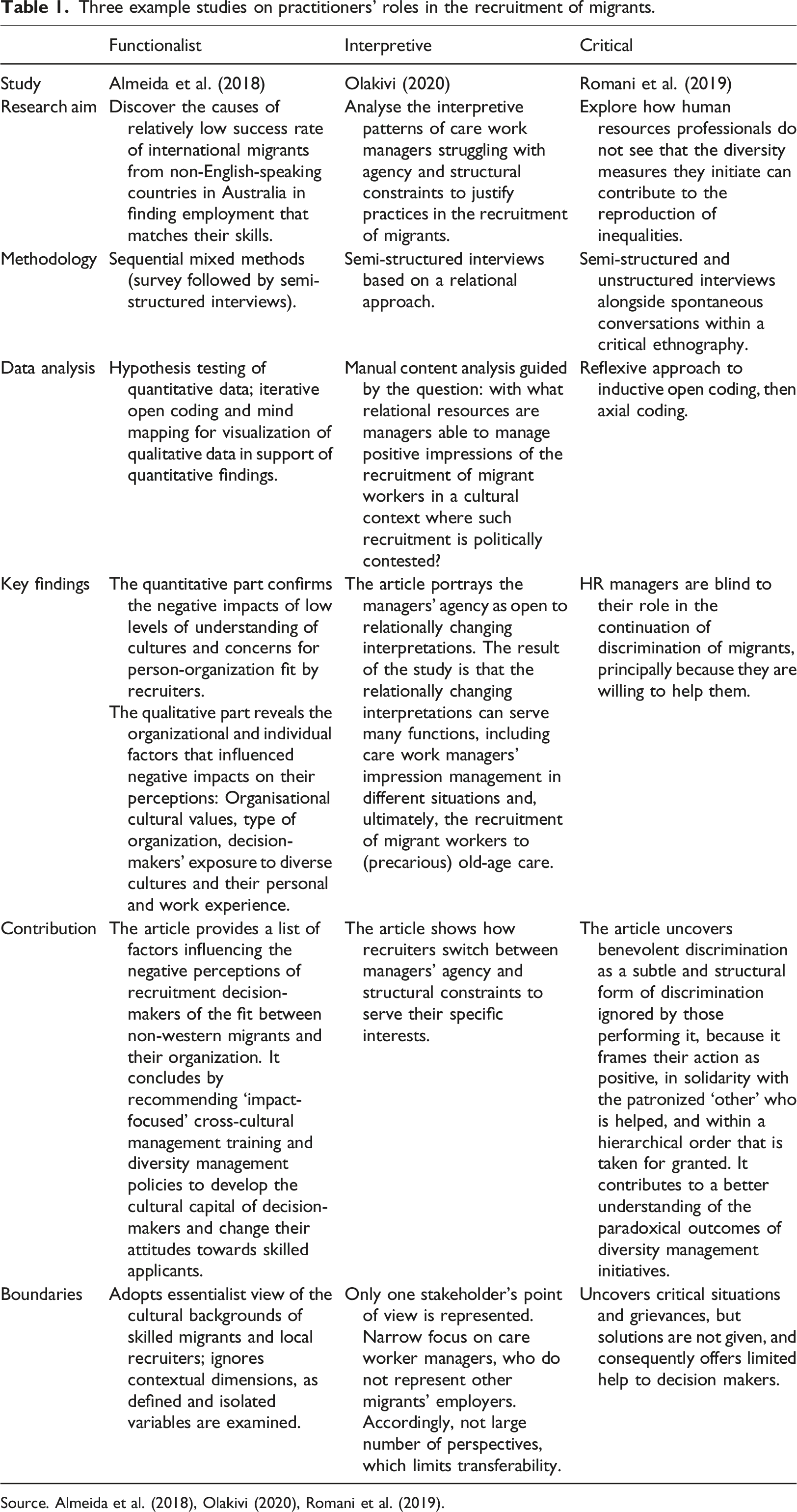
It is important to stress that in presenting these three paradigmatic traditions, we recognise that it risks essentializing complex research traditions, foregrounding some features above others to generate an operationalizable taxonomy for the purposes of the argument. Furthermore, in citing these illustrative examples, we are actively positioning these studies in those paradigmatic fields, whereas their authors may contest this enclosure into these paradigmatic traditions. We are keen to stress that these paradigmatic distinctions and illustrations are used as sensitizing devices. Our aim is to stress key features of each research approach to highlight its strength and the singularity of its contributions. We do so as a first step in arguing for a multiparadigm approach that combines distinctive views and research traditions to develop an enriched understanding of a phenomena.
Combining distinctive contributions
Researching intersections of organizations and migrants’ integration by combining the strengths of these paradigmatic approaches presents a series of opportunities for enriched enquiry. Functionalist work may attempt to isolate and focus on clearly discernible organizational and human factors, or variables, and subsequently determine how their relative presence (or absence) impacts on migrants’ integration trajectories or experiences. Arguably, the ability to specify factors and assess their impacts empirically to show causal relationships provides significant scope to translate the insights generated by such work into practice. It supports the agency of all stakeholders, migrants, managers, HR departments. However, focussing on operationalizable variables forces researchers to ignore a wide range of contextual and especially subjective elements that may also play an important role. In addition, working with a constant variable makes it difficult to acknowledge the fluid, constructed and contested nature of social reality, which is something that an interpretive study is better equipped to do. Furthermore, the potential influence of confounding variables, for example, abstract societal discourses, are difficult if not impossible to integrate within an empirically-driven exercise, when it is quite commonly addressed in critical studies. As with each paradigm, the strength of the functionalist approach is also linked to its boundaries, which appear to be addressed by other perspectives.
Work in the interpretive paradigm is explicitly concerned with the nuances of subjective experience, sensemaking and thus the social construction of reality. In doing so, it is better able to acknowledge the role of a wide range of contextual, organizational and personal factors that may intersect in shaping human experiences, behaviours, attitudes and perceptions. The willingness to accept complexity, subjectivity and fluidity of phenomena, and the inherent locality of the knowledge that is produced can benefit from a combination with a positivist perspective that will establish the primacy of some variables. In addition, the subjective ontology aims to depict the social world the way it is experienced by the actors studied, implicitly assuming that they are the agents of their social constructions. However, adding a critical perspective, for instance by acknowledging that actors’ sense-making is shaped by power relations, offers further opportunities to extend the scope and impacts of enquiry.
The critical paradigm, in its problematization of power and inequity, stresses the need for transformation and challenges embedded social norms and systems. Such work is also able and explicitly willing to account for how societal, institutional and organizational factors intersect to shape human experience. However, these features may also make this type of research the most difficult to translate into organizational actions. This is partly because organizations are inherently sites of uneven power relations, often reflecting wider societal and structural inequities, which manifest themselves in but are arguably beyond the scope of the organization. This is where critical studies can benefit from interpretive studies that access how each organizational member makes sense of a given situation and thus uses semantic tools to act in the situation. Moreover, the concern with critique, which can be driven by a moralizing intellectualization of human experience, may restrict opportunities for collaboration between practitioners and academics. Critical enquiry may thus extend to ‘critical performativity’ (Wickert and Schaefer, 2015) – translational acts that try to engage practitioners in creating change. Articulating and addressing common interests between critical scholars and practitioners requires a shared lexicon and spaces of interaction necessary for constructive dialogue leading to change (Lugosi, 2020). The drive towards practical application which characterises functional approaches thus has a potentially useful role in shaping the processes and (impact) trajectories of critical, interpretive research.
In light of the distinctive insights afforded by each paradigm, a multiparadigm approach is proposed to study intersections of organizations and migrant integration. Arguably, creating research projects that incorporate the features and aspirations from across the paradigms can help to appreciate the societal, structural, institutional, organizational and subjective factors that shape migrants’ integration experiences and trajectories, including how migrants’ and other stakeholders interpret and construct meanings in, across and in relation to organizations. Such research can aspire to uncover problematic power relations and structurally embedded inequities while aiming to generate knowledge of drivers, mediating factors and outcomes that translate into operationalizable insights for practitioners and academics. In line with literature on multiparadigm analyses in organizational studies (Gagnon et al., 2022; Lewis and Grimes, 1999; Patel, 2017; Romani et al., 2011; Primecz et al., 2015; Schultz and Hatch, 1996), the remainder of this paper discusses the potential of utilising multiple paradigms to examine intersections of organizations and migrant integration. Advocating this line of enquiry and expressing its agenda requires us to identify a common conceptual and empirical point of reference. We propose narratives as a possible common reference point. To justify its applicability, the next section discusses how narrative approaches have been utilised in organizational research before exploring how they could be operationalized in a multiparadigm enquiry that focuses specifically on migrant integration.
Building on paradigmatic multiplicity with narrative approaches
The relevance of narrative approaches for studying migrant integration in organizations
Narrative approaches have increasingly become adopted within social sciences generally, and in organizational studies specifically (Clandinin, 2020; Czarniawska, 2004; Gabriel, 2015, 2018; Kourti, 2016; Rosile et al., 2013). Scholars have demonstrated that narratives play important roles in organizational life and some even argue that stories are so central to organizations that they could not function without them (Mitroff and Kilmann, 1975; quoted in Gabriel, 2015: 277). Narrative inquiries/analyses aspire to capture interpretations and meanings in organizational life. Examining narratives therefore implies adopting a storied and context sensitive view of human lives and organizational phenomena (Clandinin, 2020; Tsoukas and Hatch, 2001), which provides new understanding of a variety of topics (e.g. Gabriel, 2015; Rosile et al., 2013; Tsoukas and Hatch, 2001). This includes visions, strategies, emotions and desires as well as cultures and identities within organizations (Essers and Tedmanson, 2014; Johansen, 2014; Johansson and Śliwa, 2016; Kourti, 2016). Telling stories is a way to make sense of events as well as of the role that one fulfils in an organization (Czarniawska, 1998). From this perspective, narrators define “who they are” by inscribing themselves in a story and they associate themselves with a group of people they would like to resemble while dissociating from others. Hence, narratives and storytelling serve to construct and deconstruct in-group and out-group boundaries (Essers and Tedmanson, 2014; Johansen, 2014; Johansson and Śliwa, 2016; Kourti, 2016), and are, therefore, at the core of migrants’ integration experiences and strategies.
Across the wide range of narrative approaches in organizational studies, one can identify the assumption that telling stories constitute a universal phenomenon through which individuals and organizations convey meaning to events, experiences and lives. It follows that narrative modes of knowledge differ from an abstract and logico-scientific ones based on measurable data or on comparing and contrasting phenomena and categories (Bruner, 1986; quoted by Czarniawska, 2004: 18). While the latter knowledge aims at providing accurate or reliable accounts of actual events, narrative knowledge offers insight into how different people experience such events including their emotions and desires related to these.
However, as documented by reviews of narrative approaches in organizational studies (Clandinin 2020; Gabriel, 2015, 2018; Rosile et al., 2013), narrative approaches also come in multiple forms giving raise to some conceptual confusion. Some scholars use ‘narrative’ and ‘story’ interchangeably while others distinguish between the two concepts, yet, not in the same way. That is, for some, a narrative requires an account with temporal chains of inter-related actions that are undertaken by actors with a purpose while a story constitutes a particular kind of narrative (Gabriel, 2018: 64; Czarniawska 2010). According to Czarniawska, a story is a narrative with a plot that brings together specific events into one meaningful whole by suggesting causal relations (Czarniawska, 2004). Yet, for others, such as Boje (2008), stories are individual verbalized accounts that relate to events in the presence or are anticipated to be achievable in the future, while narratives are larger and more formal formations that shape our experiences into coherent and believable accounts.
Another difference relates to the level of analysis. Some address narratives at either the micro-, meso-, or macro-level (Kourti, 2016; Van Hulst and Ybema, 2020); others adopt a multiple-level approach, for example, positioning individual narratives within ‘meta-narratives’ in the wider (social, cultural and political) context and as part of an extended networks of other events (Essers and Tedmanson, 2014; Johansen, 2014; Johansson and Śliwa, 2016; Zohar, 2019). Finally, there are ontological differences related to whether a narrative is seen to ‘reflect/represent’ or to ‘constitute’ social reality; and whether the aim of the research is to ‘uncover’ narratives and the underlying meaning structure or to contribute in changing these (Gabriel, 2015).
This brief glimpse into organizational scholars’ use of the concept of narratives also illustrates that their use of narrative analyses/inquiry differs depending on the paradigms in which they operate, (Gabriel, 2015; Rosile et al., 2013; Clandinin, 2020) including the three paradigms that we introduced above as functionalist, interpretive and critical. The interpretive paradigm tends to dominate with its ‘stories-as-sensemaking’ approach, according to which narratives are ‘sensemaking devices’ (Weick, 1979, 2001) or ‘cognitive maps’ (Wilkins, 1984) that assist organizational actors in making sense of past or anticipated events and experiences (i.e. Czarniawska and Gagliardi, 2003; Gabriel, 2000). However, there is also a power perspective, introduced by Boje (1991) contending that organizations consist of multiple and fragmented narratives, some of which dominate while others are marginalized (Boje, 1991). Research has shown that narratives become instruments of disciplinary power (Wilkins and Ouchi, 1983) and organizational socialization (Gabriel, 1991) that serve to foreground certain events and actions while de-emphasising others (Boje, 2001); and similarly, to silence and even to ridicule certain voices (Czarniawska, 2008) while legitimizing others (Brown, 2002). One also finds narrative enquiry within the positivist paradigm (Gabriel, 2018; Rosile et al. 2013). Practitioners, consultants, managers, and leaders have adopted narratives as techniques to effectively disseminate ideas, construct organizational culture and identity, and induce change (Brown et al., 2009; Gabriel 2015; Peters and Waterman, 1982).
In line with the argument of this paper, we do not position ourselves within a specific scientific paradigm since our aim is to discuss how narrative inquiry can be applied in three scientific paradigms as a way to enrich research and theorizing. We argue that this requires increased conceptual awareness and reflection upon the implication of our ontological and epistemological assumptions when doing narrative enquiries, when reporting research and when evaluating the quality of narrative research (Rosile et al., 2013). In the following sections, we discuss how and why narratives could be used in multi-paradigmatic organizational enquiry concerning migrants’ integration experiences and strategies. We explain how narratives can be approached from different paradigmatic perspectives, and the methodological challenges and opportunities they present. In doing so we aim to show how the use of narratives in research incorporating several paradigms can enrich this area of enquiry.
Narratives through the lenses of the three paradigms
Narrative studies of organizations across paradigms.
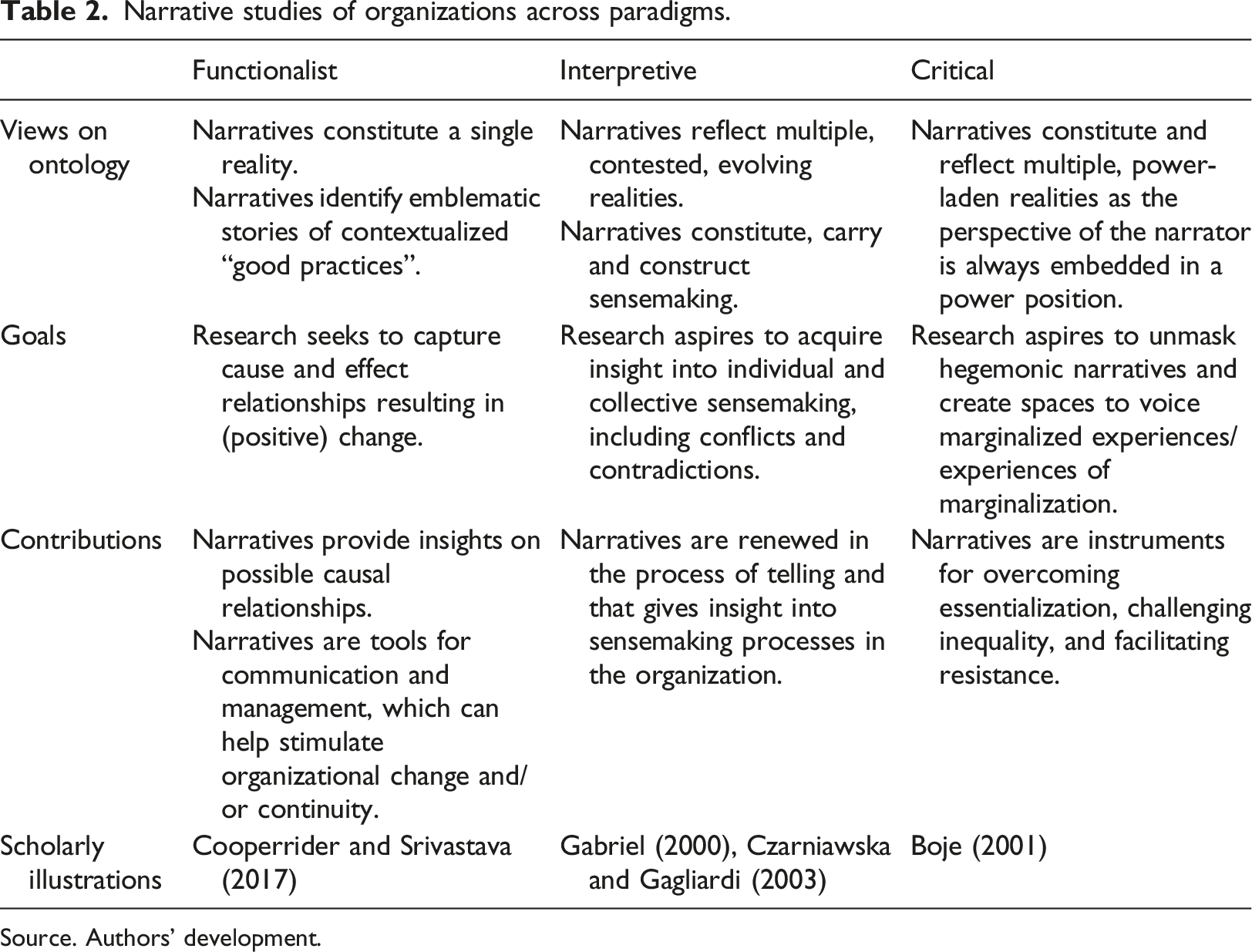
Source. Authors’ development.
From a functionalist paradigm perspective, narratives are conceived as representing the ‘objective reality’ that the researcher endeavours to capture through the confrontation or triangulation of narratives, trying to find cause-effect relations and/or trying to identify hidden structures that shape meaning making. Narratives may be seen to help identify linear relationships between organizational stories and practices. Hence, storytelling appears as a management tool that can be used to enhance organizational change, identities and practices (Brown et al., 2009). In short, they are potentially ‘devices’ deployed (purposefully) to enact change. Regarding migrants’ integration experiences within and through organizations, questions within this paradigm can be: “Which narratives about and by migrants respectively enhance and constrain their organizational identification?” and “Can this learning be generalized?”
From an interpretive paradigm perspective, narratives reflect social actors’ various worldviews and realities. A narrative is mostly conceived as an account of events that involves temporal chains of interrelated actions undertaken among characters with purposes, emotions and desires (Czarniawska and Gagliardi, 2003). Narrative analyses allow for exploring how various actors ascribe meaning to their experiences and construct the social reality in and through social interaction within a given contextual and situational setting. It follows that narrative analysis is applied as an analytical tool for acquiring insights into manifold subjective experiences and how these are formed within a particular organizational context. Hence, analysis is likely to focus on exploring narratives within the social and cognitive structures in which actors tell the stories. Regarding migrants’ integration in and through organizations, narrative analyses in the interpretive paradigm are apt for raising question such as: “How do migrants’ – as well as other organizational actors – make sense of practices of integration within particular organizations?” or “How can learning regarding migrant integration practices and experiences be transferred to other organizational contexts?”
From a critical paradigm perspective, narratives are not necessarily coherent sequences with an explicit plot but can also emerge as webs of meaning with the potential to become narratives when actors strategically mobilize these to pursue their interests (Boje, 2001). Hence, concurrent stories are told but some narratives are more dominant and widely diffused and shared. In this perspective, analysis is likely to focus on revealing how some narratives constitute instruments of power, mostly tacitly, and how they support the hegemony of a dominant ideology and the interests of particular groups. Organizations, while being inclusive, might also set high demands regarding conformity and the internalisation of specific values, discourses and ideologies (Ortlieb et al., 2020). In addition, critical researchers aim at making audible alternative stories that are rarely heard. Regarding migrants’ integration within and through organizations, narrative analysis in a critical perspective may raise questions such as: “What is the dominant narrative on the ‘integrated’ migrant?”, “Which ideology is behind it and whose interest does it serve?”, “What alternative narratives exist?”, “What narratives are silenced?” and “Which narratives are heard and which are not?”
In both interpretive and critical approaches, narratives themselves are processes: telling stories contributes to shaping realities. In studying migrant experiences and trajectories, narratives are likely to constitute an inherent part of their integration processes. When telling a narrative, a social actor positions him or herself in relation to the story. As MacIntyre (2007: 231) argued: “I can only answer the question ‘What am I to do?’ if I can answer the prior question ‘Of what story or stories do I find myself a part?’”. In this perspective, the very act of narrating organizational practices of integration comes to constitute symbolic devices for interpreting integration experiences and developing strategies (Abkherz et al. 2018).
Moreover, both approaches perceive narratives as dynamic, continuously evolving in relation to the situational and contextual settings in which they are told. The interplay of societal, organizational and individual narratives is key in understanding the social world. When telling a narrative, individuals are likely to customize extant narratives by relating these to their own experiences and to a given time and place. Hence, narratives carry ambiguity, leaving openings for the negotiation of meaning. Several versions of one narrative might coexist.
Developing a multiparadigm research strategy via narratives
Functionalist, interpretive and critical works have produced numerous research outcomes in cross-cultural management and migrant integration studies over the last decades, but a combination of these paradigmatically distinct research results has not been detectable. We propose the adoption of a multiparadigmatic strategy to research migrant integration to gain further insights for the benefit of cross-cultural management, organization and migration studies. Moreover, we situate narratives at the centre of this multiparadigm approach, as Figure 1 illustrates. Conceptualising a multiparadigm narrative approach to studying migrant integration. Source: Author’s development.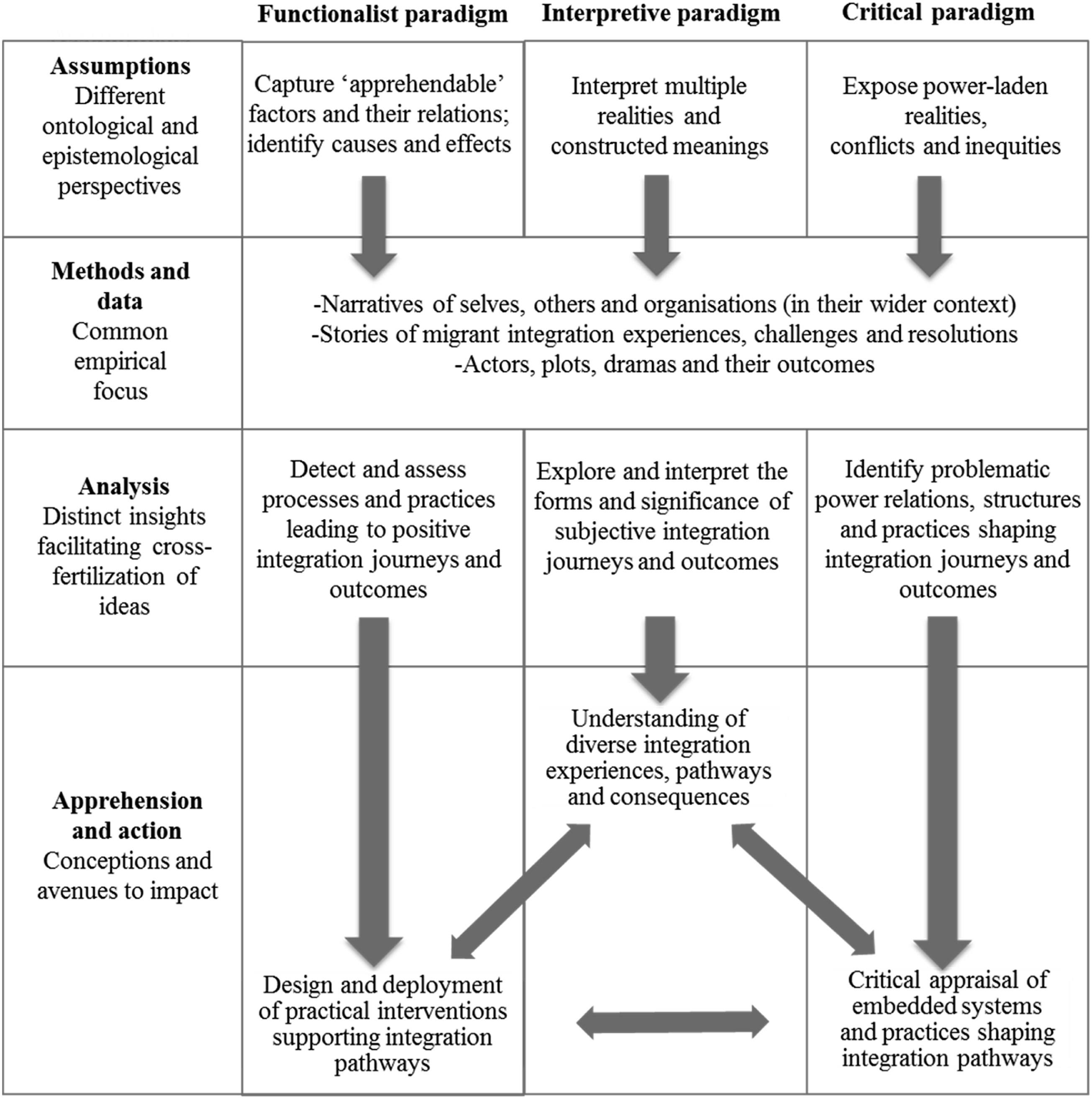
As reflected in Figure 1, conducting multiparadigm enquiry requires researchers to apply distinct paradigmatic approaches in parallel (Lewis and Grimes, 1999) before their insight can be cross-fertilized to avoid unreflective paradigm mixing (Hassard and Kelemen, 2002). Eliciting and capturing narratives enables data collection to draw on functionalist, interpretive and critical principles, and for analysis to utilise the underpinning assumptions and practices of each paradigm. The three separate analyses inevitably lead to different insights, and the reflexive practice of combining these insights opens up the possibility generate novel discoveries for theory and practice.
Methodological challenges and opportunities of multiparadigm narrative research
Research on organizations shows that narrative approaches can create new understandings of organizational experiences and practices (Gertsen and Søderberg, 2011). For example, capturing and analysing narratives allows researchers to explore various organizational actors’ subjective experiences of organizational practices of integration. This provides understanding and learning from different organizational stakeholders. Examining narratives helps to anchor practices within particular organizational and societal contexts and to compare across these. Hence, while focusing on organizational practices, a narrative approach can move research beyond single organizations by examining inter-organizational experiences, i.e. how migrants engage with stakeholders from diverse institutions in and across different organizational spaces. This points to the opportunities afforded by multi-sited and comparative studies to identify and potentially distinguish between contextualized and universal issues shaping migrants’ integration experiences. Finally, narrative approaches are likely to provide thick descriptions, helping to communicate research findings through “tools that merge subjective and objective forms of data collection and analysis” (Dundon and Ryan, 2009; quoted in Rosile et al., 2013: 558).
The collection and identification of particular types of narratives raise a number of methodological challenges. Cultural factors may strongly influence where and how researchers and participants can conduct interviews (Guttormsen, 2018). Language ability is also likely to shape the relationship between interviewers and interviewees, including researchers’ ability to ask questions and migrants’ capacities to narrate experiences in a chosen common language. Research may adopt narrative and/or open, life-history methods, encouraging contributors to tell their stories with minimal prompting. This type of approach to eliciting data shifts the analytical responsibility on the researchers and the processes of coding and ordering, through which they can identify insightful narratives regarding learning or access to work, for example. However, if the objective of empirical research is to generate what may be termed ‘instructive’ reflective narratives around transformational moments, which can be used in future developmental initiatives, this may require the use of semi-structured interview formats and specific elicitation techniques. These data creation strategies may involve foregrounding practical concepts e.g. ‘challenges’, ‘resolutions’ or ‘learning’, or latent sensitizing concepts e.g. ‘threshold moments’ when recruiting and briefing migrant participants, and in prompts during interviews. This raises the potential criticism that acts of psychological priming and framing thus anticipate certain forms of narratives, whilst risking the exclusion of alternative narratives or interpretations of events by respondents (Lugosi, 2017). It is also important to acknowledge the role of power between the interviewer and interviewee. Migrants may feel obliged to adopt or follow the storylines of socially legitimate narratives on integration when talking to researchers from the ‘host’ society. The risks posed by these methodological challenges must be fully acknowledged and, where possible, their impacts should be negated to legitimize data-generation choices.
Conclusions and implications for research and practice
Cross-cultural management has continued to integrate novel insights from other disciplines and alternative paradigmatic traditions; and functionalist, interpretive and critical approaches are already recognizable research practices in the field (Szkudlarek et al., 2020). The multiparadigm approach proposed here extends the strengths of unidisciplinary perspectives and enables future inquiry to overcome the limitations of narrow, segmented lenses used to study integration experiences, trajectories and strategies. Utilizing multiple approaches in combination may help to identify interdependencies and webs of entanglements between different dimensions of integration. Multiparadigm inquiry provides a rigorous but accommodating strategy to examine complex organizational phenomena involved in migrants’ integration strategies, including the development and adoption of support mechanisms, the challenges posed by personal barriers, group dynamics, cultural norms and linguistic practices, the diversity of integration pathways and the different range of outcomes. Moreover, the strategic generation, analysis and cross-fertilization of narratives in multiparadigm research, can provide rich insights into unique experiences, which avoids reductionist conceptions of migrants’ integration journeys or outcomes, whilst generating information that may be used to develop practical interventions essential for cross-cultural management.
Implications for research
Incorporating a critical paradigm perspective in empirical enquiry enables researchers to question the notion of integration itself, placing it at the heart of power struggles between stakeholders. This perspective can help to: identify dominant narratives on integration at the societal and organizational levels; examine how they are imposed on migrants by various actors and institutions; explore what strategies migrants adopt in response to these narratives; and evaluate what kind of resistance and counter-narratives are produced. From this paradigmatic perspective, emphasizing the narratives of “dominated individuals”, voicing usually unheard producers of alternative narratives, is a first step towards social change and larger inclusion. For instance, narratives are powerful tools for denouncing discrimination in the workplace and making stakeholders aware of the need to make cross-cultural management practices in organizations more equitable. Narratives epitomize social inequalities and convincingly encapsulate and convey analyses that deconstruct systems that entrench discriminatory behaviours.
Complementing critical perspectives with interpretive ones, which give voices to multiple stakeholders, enables research to broaden knowledge about how integration unfolds in cross-cultural management practice. Research can capture the diverse range of experiences amongst migrants, and other organizational stakeholders, including co-workers, mentors, case workers, state body representatives, whom they encounter during their settlement process and engagement with the labour market. By bringing together the narratives of multiple actors, research can aim at detailing organizational practices shaping integration trajectories and the integration strategies that are adopted. It can highlight the various meanings of organizational practices that contribute to social integration, the latter being eventually defined differently depending on the stakeholders.
Narratives may be used to identify higher-order, abstract themes about the dynamics of intercultural encounters, for example, whether they are bound to notions of conflict or hospitality that emerge in a societal context. Theoretically, these accounts can provide insights into how existing social and cultural discourses are mobilized during narrated encounters, and in the subsequent processes of reflective sensemaking. Contextualization enables further exploration of what meanings of integration underlie narratives and which practices they reference. For example, it can help to question whether integration is mainly perceived as one-way internalisation of and compliance with dominant discourses, or as two-way negotiation requiring adjustments from all stakeholders and the emergence of new hybridized organizational practices. Cross-cultural management research can thus critically examine the role of organizations in the representations of ideal trajectories of integration in receiving countries, which echo specific societal models of integration.
Combining these three perspectives will enable research to address the multi-faceted process of hybridization by exploring how migrants navigate between constructed ‘home’ and ‘host’ cultures, what hybrid forms of identities and practices are produced, and what their consequences are for power regimes. Such investigations can contribute to move forward the field of cross-cultural management and account for the emergence of increasingly culturally diverse societies.
Implications for practice and impact-focused enquiry
Incorporating a functionalist, impact-focused approach in multiparadigm enquiry suggests that research can enrich knowledge by providing details of practices underpinning successful, sustainable integration strategies (Dietrich and Hellgren, 2018). Research can endeavour to find common ground among protagonists’ narratives to identify emblematic stories of contextualized good practices of migrant integration. Migrants’ reflective accounts offer ways for them to narrate the challenges they encountered, how those situations were managed, in practice, and what they learned about the ‘host’ culture, and about themselves that could be helpful to others. It may be useful to focus on transformational, ‘threshold-crossing’ experiences, including the actors involved and the situational factors, which help to understand ‘social dramas’ in their socio-cultural contexts.
Viewed from a functionalist perspective, narratives can thus be conceptualised and deployed in action-oriented research as ‘learning devices’. Within cross-cultural management, success stories identified through analysis adopting a functionalist perspective could be used to communicate the learning associated with migrants’ experiences and their engagement with individuals from ‘host’ communities, other migrants and organizations. Such success stories will have different applications for disparate audiences. ‘Impactful’ stories could potentially support migrants’ socialization into ‘host’ cultures through transmission of their codes in a more meaningful way than with traditional teaching methods. Migrants’ narratives may offer inspiring role models and help newcomers to consider their integration journey in more concrete and ‘realistic’ ways. For the people working with migrants, including coaches, managers, and colleagues, narratives concerning ‘what works’ (or does not) can create bridges and mutual learning, which enables the development of management practices that facilitate effective integration experiences in organizations.
Footnotes
Declaration of conflicting interests
The author(s) declared no potential conflicts of interest with respect to the research, authorship, and/or publication of this article.
Funding
The author(s) received no financial support for the research, authorship, and/or publication of this article.
