




Abstract
Some 20 years ago, Shenkar (2001) criticized several of the underlying assumptions of the cultural distance (CD) construct. Despite this, researchers continue to use the same metric which fails to address many of the underlying problems. As a result, CD studies seem to generate results which are often contradictory. Rather than rejecting the distance metaphor, the main objective of this study is to provide a more in-depth measure of CD that addresses the assumptions of linearity, symmetry, equivalence, and discordance. We propose that, while the size of the cultural distance between home and host countries may be relevant for some dimensions, it is incomplete, as it does not account for the distinct characteristics of the cultural dimensions, the direction toward countries with different profiles and the contextual settings of the study. We test our hypotheses on a sample from the Orbis database consisting of foreign subsidiary firms from Latin America, other emerging markets from outside the region, and from developed countries operating in 10 of the largest economies in Latin America. Our dataset includes 4226 firm-year observations and a combination of 168 home and host countries. Latin America provides a suitable context for this study, not only because of the diversity of firms from different contexts operating in the region, but also because the region allows us to investigate the influence of home country history and tradition on firms’ ability to conduct business in different cultural contexts. Our assessment of CD shows in a precise manner that size together with direction might be adequate for describing the effects of some dimensions of CD on firm performance, while for other dimensions, it is clearly a matter of country profile. By combining our metric with different national culture frameworks, future studies would be able to complement and strengthen our findings and conclusions.
Keywords
Introduction
Some 20 years ago Shenkar (2001) criticized several of the underlying assumptions of the cultural distance (CD) construct. Despite those early efforts, Shenkar’s later contributions and the work of several other scholars (Shenkar, 2012; Verbeke et al., 2017; Zaheer et al., 2012), international business (IB) studies continue to rely almost exclusively on the Kogut and Singh (1988) composite index (Konara and Mohr, 2019) which treats CD as symmetric, linear and attributes the same importance and negative effect of distance to all dimensions of national culture. As a result, there is an ever-growing concern regarding the usefulness of the construct as contradictions in empirical findings and theoretical explanations suggest that the “knowledge of distance, in terms of conceptual specification and consequences for IB practice, is incomplete and sometimes ambiguous” (Verbeke et al., 2017: 17).
It has been more than 40 years since Geert Hofstede (1980) provided us with a set of indices to compare cultures. Originally, four dimensions were identified which was later expanded to six. In 1980, Hofstede argued that cultural values remain fairly stable over time. However, since then, technology and globalization have advanced at a fast pace causing cultural values to change at a much faster rate than expected (Taras et al., 2012). During this period, several different frameworks emerged in an attempt to provide more accurate and timely assessments of national culture. These new frameworks include the World Values Survey which are updated periodically; the GLOBE cultural framework (House et al., 2004) which measures not only cultural values but also cultural practices (which change at a much faster pace, causing the measurements to deteriorate at a much faster speed); and the decade-by-decade updated indices for Hofstede’s dimensions provided by Taras et al., 2012. Nevertheless, in terms of how these changes affect the overall distance between countries, data from the World Values Survey shows that “values have not been converging over the past three decades. . . . while economically advanced societies have been changing rather rapidly, countries that remained economically stagnant showed little value change. As a result, there has been a growing divergence between the prevailing values in low-income countries and high-income countries” (World Values Survey, n.d.).
Despite these notable efforts to provide a more accurate assessment of national culture, the vast majority of studies still rely on the Kogut and Singh (1988) composite index which suffers from the several limitations raised by Shenkar (2001). In order to contribute to this debate, the main goal of this study is to provide a more in-depth measure of CD that addresses in a quantitative way the concerns related to the assumptions of linearity, symmetry, equivalence, and discordance. This is an important methodological contribution, as our measure of CD can be used in combination with different national culture frameworks such as the ones mentioned above. In that sense, rather than rejecting the distance metaphor, which represents the degree of dissimilarity between countries (Hutzschenreuter et al., 2016), our assessment of CD shows that the size of the distance might be more relevant in discussing the effects of some dimensions. In other cases, the cultural profile of the country and the particular national culture dimension under consideration were found to be important factors in driving firm performance. By measuring CD in specific dimensions and directions separately, our assessment of CD shows in a more in-depth manner the effects for the different dimensions toward host countries with different cultural profiles.
Tests are performed on a sample from the Orbis database consisting of foreign subsidiary firms operating in 10 of the largest economies in Latin America over a period of three consecutive years from 2013 to 2015. The analysis is based on panel data including a total of 4226 firm-year observations resulting in a highly diversified combination of 168 different home and host countries. This level of diversity is an important consideration when investigating the effects of distances (Bae and Salomon, 2010; Beugelsdijk et al., 2015; Franke and Richey, 2010; Van Hoorn and Maseland, 2016). Further, as pointed out by Aguinis et al. (2020: 615), Latin America provides a relevant context for this study due to “societal, cultural, and economic characteristics that make the region an ideal ‘natural laboratory’ to build and test management theories.” We consider the diversity of firms operating in the region to be essential to our discussion of the effects of CD. Therefore, we analyze and compare the effects across sub-samples with different characteristics including foreign subsidiaries from developed countries, from Latin America and from other emerging markets outside the region.
By analyzing the effects of the dimensions of CD and the direction towards host countries with different cultural profiles and on sub-samples with different characteristics, our findings provide additional insights into how CD affects firm performance. This study contributes to the distance-profile conflation debate by showing that distance is more relevant to understanding the effects of some dimensions of CD, while for other dimensions, it is clearly a matter of profile. Moreover, results indicate that history and traditions seem to play an important role which creates more or less favorable conditions for firms to accommodate the effects of CD depending more on the origin of the firm than the cultural similarities between the home and the host countries. In that sense, we argue that any attempt to generalize the effects of CD without taking into account its specific characteristics and the contextual settings of the study can be misleading as “contextualization identifies boundary conditions or limitations surrounding the generalizability of our IB research findings” (Teagarden et al., 2018: 303).
Furthermore, it needs to be emphasized that in this study we do not attempt to provide a model capable of predicting the performance of foreign subsidiary firms in Latin America, such as when testing complex interactions and different configurations of elements, dimensions, and conditions (Fainshmidt et al., 2020). Instead, we propose an explanatory model (Shmueli, 2010) for testing our hypotheses regarding the specific characteristics and effects of CD and include only the most relevant controls known to affect the financial performance of firms operating in different industries (Capon et al., 1990). As pointed out by Shmueli (2010: 289), “both explanation and prediction are necessary for generating and testing theories, yet each plays a different role in doing so.” Based on this analysis future researchers will have available an improved metric for testing the effects of CD. Better measurement will allow future studies to more confidently explore different configurations and interactions among the dimensions which will increase our understanding regarding the implications of this important construct. Furthermore, being aware of the specific implications of CD can help firms to identify alternatives to accommodate the effects in a more satisfactory manner.
This paper is organized into five major sections. Following the introduction is presented, in Literature review and hypotheses, a review of the literature and a formal statement of the hypotheses to be tested. The third section focusses on our research method and approach to model estimation. Results are presented in the fourth section, while the fifth and final section offers a few concluding observations.
Literature Review and Hypotheses
In the IB context, distance is used metaphorically as a generic term to represent the degree of dissimilarity between pairs of countries (Hutzschenreuter et al., 2016). Distance disturbs the flows of information between the firm and international markets (Johanson and Vahlne 1977) and can create complexity (Vermeulen and Barkema, 2002) and friction (Shenkar et al., 2008) in cross-border activities. Cultural distance is the dominant concept used to discuss the differences between countries in IB research, however institutional, geographic, economic, and psychic distance are also used (Hutzschenreuter et al., 2016).
Distance related studies rank at the top of the IB research agenda which has prompted some authors to suggest that “international management is management of distance” (Zaheer et al., 2012: 19). Verbeke et al. (2017) show that a search for the word “distance” in the titles and abstracts of papers published in five leading IB journals over the period from 1990 to 2015 reveals that two annual volumes of each of these journals could be filled solely with papers on the topic of distance.
In earlier studies on international management, authors had approached the topic employing the psychic distance concept, which represents the sum of factors preventing the flow of information from and to the market (Johanson and Vahlne, 1977). Psychic distance is, however, a broad concept which makes it difficult to operationalize (Shenkar, 2001; Tihanyi et al., 2005). A more practical alternative is to narrow the discussion and focus on the implications of cultural distance (CD). This more narrow stream of research has benefited from the contributions of Hofstede (1980) who provided a practical scale and measurements of cultural values in several countries which could be easily operationalized using the Kogut and Singh (1988) composite index (referred to as the KS index from now onwards). The CD construct represents the “extent to which the shared norms [ideas, beliefs] and values in one country differ from those in another” (Drogendijk and Slangen, 2006: 362).
Given that CD is one of the elements included in psychic distance, it is assumed to affect performance in a negative manner as it increases the costs associated with adjusting to the host country’s culture (Cuervo-Cazurra and Genc, 2011). The latter authors argue that culture is one of the elements included in the obligation dimension which do not allow comparisons in terms of better or worse, meaning that cultures are simply different. In fact, most studies investigating the implications of CD emphasize its negative effects (Beugelsdijk et al., 2018; Stahl and Tung, 2015), arguing that CD creates friction (Shenkar, 2001; Shenkar et al., 2008) as it increases the cost of doing business (Williamson, 1975) and, therefore, represents a liability of foreignness (Zaheer, 1995).
Despite its popularity in the IB research agenda, the divergence in empirical findings and contradictory theoretical explanations have raised concerns that the “knowledge of distance, in terms of conceptual specification and consequences for IB practice, is incomplete and sometimes ambiguous” (Verbeke et al., 2017: 17). Others have gone further by recommending that when it comes to distance, despite the popularity of the topic in the IB literature, results indicate that we may be on the wrong track (Shenkar, 2012). Despite the fact that scholars such as Zaheer et al. (2012: 18) indicate that “the conceptualization of cultural distance as linear, fixed, objective, symmetrical, homogeneous and always challenging is, as Shenkar (2001) so brilliantly argued, flawed and not particularly useful in its current state,” the majority of distance related studies in IB continue to rely almost exclusively on the KS composite index (Konara and Mohr, 2019) which does not take into account these issues.
However, since Shenkar (2001) criticized many of the underlying assumptions of the CD construct (e.g. linearity, symmetry, discordance, equivalence, etc.), there has been a notable effort to address some of these concerns. The systematic negative effect attributed to CD (i.e. the discordance assumption) has been challenged as there seems to be evidence that in some cases cultural differences might lead to innovation and superior performance (Boschma, 2005; Vaccarini et al., 2017). The illusion of symmetry has been addressed by studies that indicate that depending on the observers’ perspective, the effects of CD might in fact be asymmetric (Correa da Cunha, 2019; Magnani et al., 2018; Selmer et al., 2007). Still, some argue that the commonalities (or differences) between home and host countries is what really matters (Williams and Grégoire, 2015), while others challenged the assumption of linearity as the psychic distance paradox suggests that a shorter distance can in fact represent a disadvantage as the “perceived similarity can lead to carelessness and failure” (O'Grady and Lane, 1996: 329). Furthermore, as the majority of studies combine the dimensions of CD in a single composite index, they fail to address the assumption of equivalency (Shenkar, 2001), which can be problematic as some dimensions can have a greater (or lesser) impact on performance, while others might have no effect at all (Hofstede, 1989; Maseland et al., 2018; Tallman and Shenkar, 1994).
Despite this evidence, studies continue to rely almost exclusively (Konara and Mohr, 2019) on the same metric (i.e. the KS index) that treats CD as directionless, linear, symmetric and attribute the same importance (weight) and negative effect to all dimensions of culture as it increases the post-entry costs associated with managing in a culturally distant host country (Kogut and Singh, 1988). In fact, authors have indicated that the “empirical pattern of the KS index may be described as ‘jack of all trades but master of none.’”It appears that the index is broad enough to partially capture many of the effects described above, but captures none of them well” (Maseland et al., 2018: 8). Others have urged researchers to stop using the KS index altogether as it calculates the squared value of the Euclidian distance which “exaggerates” the distances between countries (Konara and Mohr, 2019).
Thus, CD is indeed a much more complex construct than it is generally acknowledged—one which cannot be effectively measured using simplistic alternatives that neglect its salient characteristics. Moreover, culture represents a complex set of interrelated and potentially interactive dimensions (Beugelsdijk et al., 2017; Lytle et al., 1995; Tsui et al., 2007) that jointly, in a given configuration, produces a specific outcome (Fainshmidt et al., 2020). Given the above, we propose that before attempting to discuss the combined effects of different configurations of the dimensions of national culture included in the CD construct, it is essential to provide a more accurate and complete measure that addresses the concerns related to the underlying assumptions.
Refining the CD Construct
Diagrams are powerful tools that can be used to present complex and sometimes abstract theoretical relationships. In international management and international business research, scholars, tend to “think in terms of conceptual diagrams consisting of boxes and arrows to inform our research. Boxes of course represent concepts, constructs or variables, and arrows represent the relationships among them” (Thomas et al., 2011: 1073). However, the recent critiques regarding the usefulness and the reliability of the CD construct (Shenkar, 2012; Verbeke et al., 2017; Zaheer et al., 2012), indicate that the vast majority of studies that rely almost exclusively on the KS index (Konara and Mohr, 2019) might have been blindly following the recommendation to focus on the arrows (Thomas et al., 2011) while still using the same old boxes.
Rather than rejecting or proposing a substitute metaphor (such as friction by Shenkar, 2001), we build on the important contributions from several previous studies. We provide a more in-depth and nuanced assessment of CD which is capable of addressing in a quantitative manner, the concerns related to the assumptions of symmetry, linearity, equivalence and discordance.
The Assumption of Symmetry and Linearity
We build on the recommendation of Zaheer, et al. (2012: 23) who indicate that in order to investigate the effects of CD towards host countries with different characteristics “it is best to fix one entity as the focal entity and define all other entities of interest with respect to the focal entity, as a positive difference between their characteristics could have quite different effects than a negative difference.” By adopting this approach and using the six dimensions of Hofstede, Stor (2021) has shown that a configuration of different dimensions of positive and negative CDs constitute a contextual factor that influences the evaluation of different human resource management practices and their performance outcomes. Based on this important evidence, we measure the different dimensions of CD separately. Instead of using the negative and positive distances, however, we adopt the approach used by several other authors (Hernández and Nieto, 2015; Konara and Shirodkar, 2018) to account for the direction of formal institutional distance and include a dummy variable (i.e. true or false condition) to separate the distances towards host countries that score higher from the distances towards host countries that score lower, in comparison to the firms’ home country.
By measuring distances for each dimension in opposite directions using separate and independent variables, it is possible to evaluate if the effects in both directions are the same, pointing to symmetric behavior. However, if the effects are the opposite, we can assume opposing symmetry (i.e. opposition). It is important to note that “opposition is a fundamental form of symmetry” (Sabelli and Kauffman, 2012: 127). Thus, when the effects in opposite directions are neither the same nor the opposite, it might be an indication of asymmetric behavior.
The assumption of linearity implies that the effects of CD increase proportionally to the size of the distance. To facilitate analyzing, the assumption of linearity for each CD dimension in specific directions, we propose a graphical representation (see Figure 1) that includes the size and sign of the effects (coefficients) as well as the main characteristics (i.e. mean scores for the home and host countries) of the sub-samples which highlight the characteristics of the distances. Our conceptual model for measuring CD.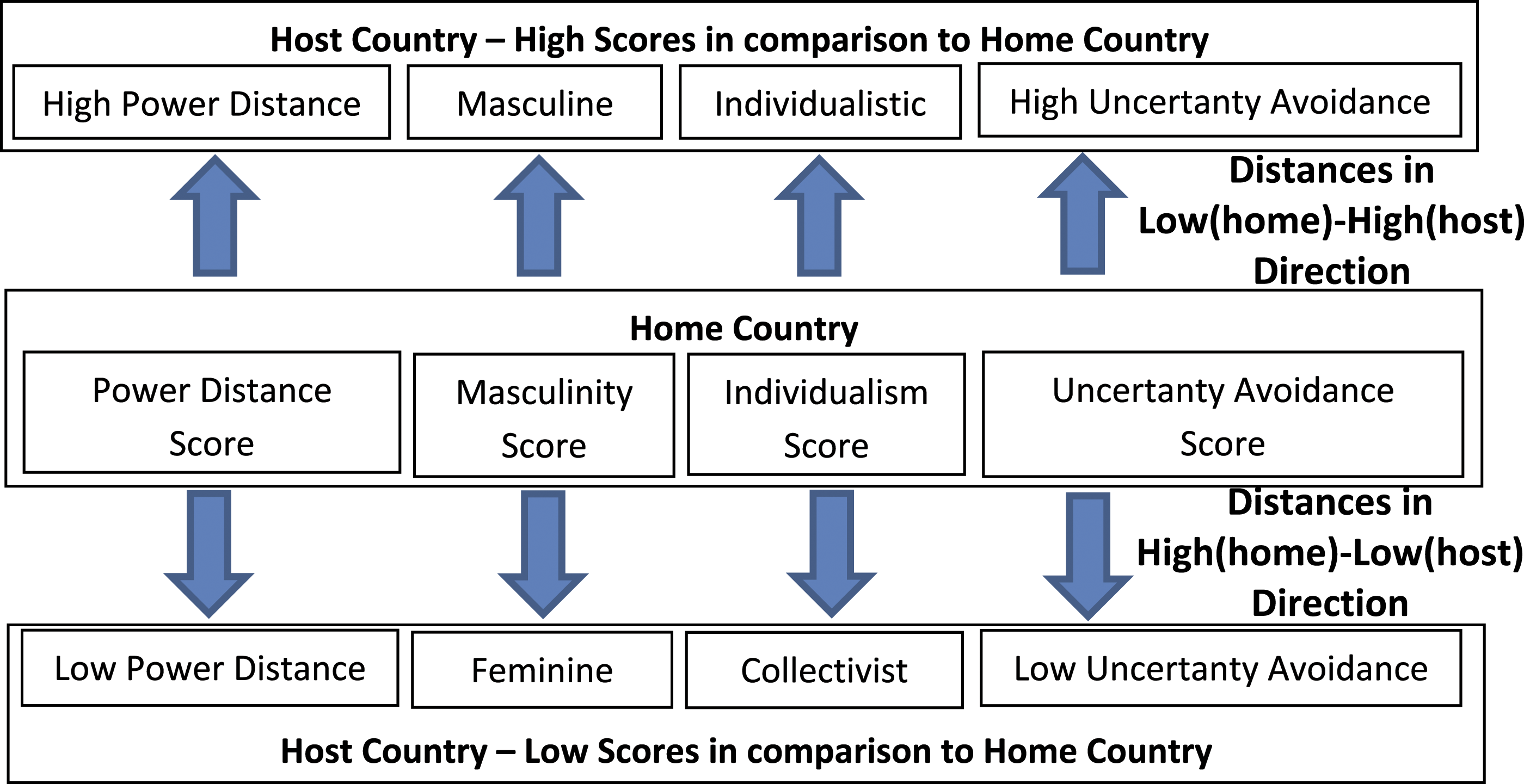
The Assumption of Equivalence
We address the assumption of equivalence by testing the effects for each dimension of CD separately as we consider that some dimensions can have a greater (or lesser) impact on performance, while others might have no effect at all (Hofstede, 1989; Maseland et al., 2018; Tallman and Shenkar, 1994). Furthermore, although culture represents a complex set of interrelated and potentially interactive dimensions (Beugelsdijk et al., 2017; Lytle et al., 1995; Tsui et al., 2007), that jointly, in a given configuration, produces a specific outcome (Fainshmidt et al., 2020; Stor, 2021), we argue that before attempting to investigate the combined effects of different configurations of the dimensions included in the CD construct, it is essential to understand the specific effects of each dimension.
The Assumption of Discordance
The assumption of discordance implies that CD increases the costs of doing business (Johanson and Vahlne, 1977; Kogut and Singh, 1988; Williamson, 1975). In fact, Shenkar (2001) proposed friction as a substitute metaphor, which seems to be confirmed by the majority of empirical studies which highlight the negative effects of CD (Beugelsdijk et al., 2018; Stahl and Thung, 2015). However, there seems to be a growing number of studies showing that the effects of distance are in fact asymmetric and depending on the direction, the effects of distance can be perceived as easier or more difficult to accommodate (Magnani et al., 2018; Selmer et al., 2007). Thus, by considering the direction of the distance towards host countries with different profiles, we argue that some characteristics of the national culture can affect performance in a more positive way as they are easier to accommodate in comparison to distances in the opposite direction.
Cultural Distance Measurements
By reviewing cross-cultural studies over the years, Taras and Steel (2009) indicate that since Hofstede published Culture’s Consequences in 1980, research on culture has effectively became research on values. Since then, several models have been developed. Although a comparison of the different cross-cultural models is not the objective of this paper, we recognize that each has its merits and shortcomings. For several reasons, in this study, we use Hofstede (1980) National Culture Model which includes power distance, Individualism versus Collectivism, masculinity versus femininity and uncertainty avoidance. First, we consider the model adequate for testing our assumptions given that its validity, reliability, and usefulness have been confirmed over time, and in a wide variety of settings (Deephouse et al., 2016; Hofstede, 2001; Kirkman et al., 2006; Li and Parboteeah, 2015; Oyserman et al., 2002). Secondly, despite being considered a bit dated, biased, and simplistic when compared to other frameworks such as the GLOBE project that includes 18 dimensions, “Hofstede’s theory has persisted over several decades, most probably because of its simplicity and the complicity of management studies” (Jackson, 2020: 3). Therefore, by keeping it simple and focusing on the four original dimensions our model provides a straightforward approach to testing our assumptions and producing relevant insights for practitioners regarding how cultural distances towards host countries with different profiles can affect doing business in that context. Moreover, for the context of this study, the Hofstede model has greater geographic coverage (Shi and Wang, 2011). While Hofstede’s model covers 17 countries, the GLOBE project includes only 10 countries in Latin America and the Caribbean. Additionally, the updated indices of Hofstede provided by Taras et al. (2012) classifies countries as either South America or Central America and does not provide updates for Mexico, the second largest economy in Latin America which is geographically located in North America. Finally, we opted for using the four original dimensions of Hofstede and did not included long-term orientation and indulgence versus restraint, as for these two dimensions which were added later, data are not available for various countries included in our sample.
In Figure 1, we present our conceptual model for measuring CD which addresses in a quantitative way the underlying assumptions of the construct. We propose measuring distances separately not only in terms of specific cultural dimensions but also by including the direction of the distances towards host countries that can either score higher or lower when compared to the firm’s home country. For example, in the case of masculinity versus femininity, a high score corresponds to a masculine society whereas a low score relates to a feminine culture. Similarly, for the Individualism versus Collectivism dimension, a high score relates to individualistic cultures while a low score can be associated with a collectivist society. Thus, the resulting distances are measured in terms of magnitude which is always positive, and direction which can be either low-high (i.e. a lower score in the home country in comparison to a higher score in the host country) or high-low (i.e. a higher score in the home country in comparison to a lower score in the host country).
The specific characteristics of each cultural dimension highlight the differences in each of the opposite sides of the scale that justify the assumption of asymmetric effects on performance. The arguments and the hypotheses indicate that within each cultural dimension, the effects of CD toward host countries with specific characteristics should affect firm performance in different ways. Thus, as presented in Figure 1, we break down the “generic” CD box into specific boxes that include the size and direction of the distances for each cultural dimension, making it possible to formulate assumptions and investigate the precise effects for the associated arrows. Furthermore, we develop our hypotheses and testing procedures considering the contextual characteristics of the study (Teagarden et al., 2018) as we agree that “many IB phenomena are inherently configurational, both hypothesis formulation and empirical design should be aligned with this reality” (Fainshmidt et al., 2020: 456).
Cultural Distance and Financial Performance
Since its introduction (Johanson and Vahlne, 1977), behavioral elements (e.g. psychic distance) have been included to explain the commitment decisions (i.e. antecedents) of firms to foreign markets. Others have focused on the resulting effects and attempted to explain how CD affects the outcomes of internationalization. Hult et al. (2008) conducted an extensive review of how subsidiary performance has been assessed in IB research and identified three categories: financial, operational, and overall effectiveness, which can be assessed both objectively and subjectively. The vast majority of IB studies emphasize the negative effects of CD (Beugelsdijk et al., 2018). This suggests that CD represents a liability of foreignness, which implies that “there are higher costs for a foreign firm operating in a particular market compared to a local firm, which should lead to the lower profitability of foreign firms in overseas markets, all else being equal, and perhaps even to a lower probability of survival in the long run” Zaheer (1995: 347). Therefore, we assess the effects of CD on the performance of foreign subsidiaries using an objective approach by focusing on the financial performance and measure it using profitability as it represents a “relevant dimension of the firm’s resource position and of its performance” (Vahlne and Johanson, 2017).
Next, we propose several hypotheses that take into account the characteristics of the cultural dimensions and the context of the study.
Distances towards high versus low Power Distance host countries
According to Hofstede, power distance represents “the extent to which the less powerful members of institutions and organizations within a country expect and accept that power is distributed unequally” (Hofstede, 1989: 28). It represents inequality being defined from below, not from above in a way that a society’s level of inequality is endorsed by both, its leaders and followers. Thus, power distance seems to be one of the dimensions that firms might be able to adjust to, and manage within, due to the fact that different ways of exercising authority can be employed depending on the cultural setting. In high power distance countries, managers must respond to the expectations of subordinates providing clear guidance and control whereas in low power distance settings, management can take advantage of the greater willingness of employees to participate and provide feedback.
Furthermore, authors have found that high Power Distance discourages employees from using their own judgment and intelligence in making decisions (Chin and Pun 2002; Tata and Prasad 1998). This condition can have different implications for firms depending on their experience and ability to accommodate distances in terms of this cultural dimension. Thus, developed country firms might have the expertise in operating (and managing) in both low and high power distance societies, the former related to their home context, while the latter relates to their experience operating in less developed countries.
Moreover, in high power distance societies in Latin America when majority control is retained by the parent firm from a developed country, it helps to legitimize the decisions and control exercised by the parent firm. This can reduce resistance and costs associated with delayed decisions, leading to positive effects on company performance. The legitimization of developed country firms is also supported because these firms are known to possess superior capabilities and resources that provide a competitive advantage over domestic firms that lack the expertise to operate in highly competitive markets (Cuervo-Cazurra and Genc, 2012).
Furthermore, when operating in Latin America, developed country subsidiary firms might benefit from a condition known as the Gulliver complex (Brachfeld, 1951) which explains why expatriates from developed countries are treated better, and as a result, adapt in a more satisfactory manner than Latin American expatriates, even though they are more culturally distant (Felix et al., 2019). The differentiated treatment of individuals from developed nations and the prejudice against the local culture is also explained by Rodrigues (1993) who describes it as “the mongrel complex” (i.e. “complexo de vira-lata” in Portuguese). Similar to the Gulliver complex, the mongrel complex is a socially constructed phenomenon that relates to Latin America’s colonial heritage and explains why Latin Americans see themselves as being culturally inferior when compared to the colonial powers (i.e. the developed world). In that sense, as people in Latin America perceive foreigners from more developed countries as superior, firms from more developed countries will adjust better when doing business in the region as the less powerful members of institutions and organizations within a country expect and accept that power is distributed unequally (Hofstede, 1989), therefore, orders will be followed with less resistance.
Furthermore, due to the historical trajectory of developed countries, these nations have accumulated centuries of experience dealing with countries with different levels of power distance. Due to several factors including experience, history, and traditions, we hypothesize a positive and symmetric effect on the performance of foreign subsidiary firms from developed countries as these firms might be able to accommodate the effects of CD for this cultural dimension in a more satisfactory manner when operating in countries that score higher or lower in terms of power distance.
Developed country and emerging market firms might be affected in different ways due to the characteristics of their home countries. Studies have shown that high power distance correlates to low levels of economic development (Hofstede et al., 2010). Therefore, being from high power distance home countries should provide an advantage for foreign subsidiary firms from emerging markets when operating in host countries that score high in power distance. In this type of environment, people not only accept but also expect that power is distributed unequally (Hofstede, 1989). In that sense, foreign subsidiaries from emerging markets know how to correspond to these expectations. On the other hand, when CD is towards low power distance host countries, foreign subsidiaries from emerging markets will face greater challenges adjusting to the cultural preferences in this type of environment. For instance, in low power distance host countries, superiors, and subordinates consider each other as essentially equal and subordinates expect to be consulted before a decision is made that affects their work (Hofstede et al., 2010). While adjusting to low power distance host countries can be costly, failing to correspond to these expectations will create friction between the subsidiary firm and the foreign host country, which will impact performance negatively. Therefore, we hypothesize:
Distances towards high versus low uncertainty avoidance host countries
This dimension of national culture represents a society’s tolerance for ambiguity. It measures the extent to which members of a society feel either uncomfortable or comfortable dealing with unstructured situations. According to Hofstede, unstructured situations are novel, unknown, surprising, and different than usual. Another important characteristic of uncertainty-avoiding cultures is that these societies try to minimize the possibility of “surprising” (unpredictable) situations by following strict laws and rules, by safety and security measures, and, on the philosophical and religious level, by a belief in absolute truth: “There is only one Truth and we have it. All others are wrong.” (Hofstede et al., 2010: 227). Thus, uncertainty avoidance represents “the extent to which the members of a culture feel threatened by uncertain or unknown situations” (Hofstede, 1989: 113). According to Hofstede, “people in uncertainty-avoiding countries are also more emotional and are motivated by inner nervous energy. The opposite type, uncertainty-accepting cultures are more tolerant of opinions different from what they are used to; they try to have as few rules as possible, and on the philosophical and religious level they are relativist and allow many currents to flow side by side” (Hofstede and McCrae, 2004: 62).
When home and host countries differ in terms of their tolerance for ambiguity, costs associated with accommodating these differences increase regardless of the direction of the distance. For instance, a manager from a low uncertainty avoidance home country may find workers in a high uncertainty avoidance society to be resistant to change and uncomfortable with unstructured situations. Conversely, a person from a high uncertainty avoidance country might feel unease in a society that scores low on this dimension as decisions are made too fast in the face of highly uncertain situations. In that sense, differences in uncertainty avoidance might cause one (partner) to feel as if opportunities are being missed due to excessive precaution and resistance to change while the other (partner) will certainly blame failures as being the result of impulsive and negligent behavior. Adjusting to distance in this cultural dimension reflects the tradeoff between the perceived loss of control and the flexibility required to respond fast to changes in market conditions. Thus, for this dimension of CD, the effects on performance are expected to be symmetric as regardless of the direction of the distance, there will be additional costs and a negative effect on performance. Therefore, the following hypothesis is presented:
Distances toward Individualistic versus Collectivistic host countries
This dimension represents the extent to which individuals are integrated into groups. According to Hofstede and McCrae (2004: 63), in individualist societies, “the ties between individuals are loose: Everyone is expected to look after himself or herself and his or her immediate family. In collectivist societies, people are integrated from birth onward into strong, cohesive in-groups, often extended families (with uncles, aunts, and grandparents), protecting them in exchange for unquestioned loyalty. The word Collectivism in this sense has no political meaning: It refers to the group, not to the state.”
When considering how conflicts are settled in individualistic and collectivistic cultures, Ting-Toomey (1999: 211) states: For individualists, effective conflict negotiation means settling the conflict problem openly and working out a set of functional conflict solutions conjointly. Effective conflict resolution behavior (e.g., emphasizing the importance of addressing incompatible goals/outcomes) is relatively more important for individualists than is appropriate facework behavior. For collectivists, on the other hand, appropriate conflict management means the subtle negotiation of in-group/out-group face-related issues – pride, honor, dignity, insult, shame, disgrace, humility, trust, mistrust, respect, and prestige – in a given conflict episode. Appropriate facework moves and countermoves are critical for collectivists before tangible conflict outcomes or goals can be addressed.
Thus, collectivist societies might in fact create significant challenges (obstacles) for foreign firms regardless of the familiarity firms may have dealing with collectivist cultures in their home countries. This could be an indication that “persons in an individualist culture are expected to act according to their own interests, and work should be organized in such a way that this self-interest and the employer’s interest coincide” (Hofstede et al., 2010: 119). However, in a collectivist society, the same authors indicate that the group interests prevail, therefore, the managerial practices and objectives of a foreign subsidiary firm should fit and be accepted by the group in the host country.
The implications of collectivist power have been discussed by Cyert and March (1963) who indicate that the costs associated with accommodating the needs and interests of different groups lead to satisfactory rather than optimal decisions from an organization standpoint. When it comes to the implications for the performance of foreign subsidiary firms operating in collectivist host countries, we argue that the costs are higher when compared to individualistic societies due to the greater coalition power groups exert in this type of environment. In collectivist host countries, managing conflicting interests between foreign subsidiary firms and local stakeholders create greater costs leading to lower performance when compared to individualistic societies. This is due to the fact that groups have greater bargaining power when compared to single individuals.
Hofstede et al. (2010) provide scores for Individualism versus Collectivism for 76 countries which reveal that “Individualism prevails in developed and Western countries, while Collectivism prevails in less developed and Eastern countries” (Hofstede, 2011: 12). According to Triandis et al. (1988: 324), “an essential attribute of collectivist cultures is that individuals may be induced to subordinate their personal goals to the goals of some collective, which is usually a stable ingroup (e.g. family, band, tribe), and much of the behavior of individuals may concern goals that are consistent with the goals of this ingroup. . . . on the other hand, in individualist cultures people often drop those ingroups that are inconveniently demanding and form new ingroups.” Thus, the importance of group affiliation in collectivist societies is higher as they are viewed as more permanent constructs, whereas in individualistic cultures group affiliation is less permanent and less important. Given language and other cultural differences, and the importance of in-groups in collectivist societies, it is unlikely that foreign firms would be readily accepted. The result is likely to be conflict, a more complicated decision making process and reduced performance. Essentially, when foreign subsidiary firms are not accepted and fail to conform to the expectations of the in-groups in more collectivist host countries, costly sanctions are likely to be imposed for non-conforming behavior (Triandis et al., 1988).
Thus, in collectivist societies, when interests between foreign firms and local groups diverge, it might in fact create a sense of “us,” the locals, against “them,” the foreigners. Therefore, the effects for this dimension of CD challenge the assumption of linearity and highlight the host country profile effects as regardless of the magnitude of the distance, the effects towards collectivist societies will be negative. In order to test this assumption, we propose the following hypothesis:
Distances toward Masculine versus Feminine host countries
Another issue to be considered is the different emotional roles which are attributed to different sexes. According to Hofstede and McCrae (2004), the findings from the IBM studies indicated that (a) women’s values differ less among societies than men’s values; and (b) men’s values vary along a dimension from very assertive and competitive and maximally different from women’s values on one side to modest and caring and similar to women’s values on the other. Hofstede (1980) termed “masculine” the more assertive pole while the modest, caring pole was called “feminine.” According to Hofstede, “masculinity pertains to societies in which social gender roles are clearly distinct (i.e. men are supposed to be assertive, tough, and focused on material success whereas women are supposed to be more modest, tender, and concerned with the quality of life); femininity pertains to societies in which social gender roles overlap (i.e. both men and women are supposed be modest, tender, and concerned with the quality of life)” (Hofstede, 1989: 82–3).
Therefore, when distances are toward masculine societies there will be less tolerance of differences, competition will be intense, and disputes will be settled by the exercise of power. This can make things more difficult increasing the costs of doing business when compared to distances towards feminine and more receptive host country cultures. Thus, for this dimension of cultural distance, we expect opposing symmetric effects as distances toward host countries with more feminine cultural profiles should affect performance in a positive way, and in a negative manner when distances are towards host countries with more masculine cultural profiles. Therefore, we propose the following hypothesis:
The case of Latin American firms
Although many countries in Latin America share a similar post-colonization history, the cultural aspects may differ to a great extent. Inglehart and Carballo (1997: 35) indicate that “certain Latin American societies such as Mexico and Peru, have been heavily influenced by indigenous American cultures; while others such as Argentina have been less influenced by them, but have had relatively large amounts of recent European immigration.” This is explained by a process called acculturation (Berry, 1974, 1990) which posits that the prolonged first-hand contact and interaction among different cultural groups such as the European and the natives in many Latin American countries may have caused significant changes leading to cultural diversity within the region.
However, despite the acculturation process that took place in Latin America since colonization (Inglehart and Carballo, 1997), there are still significant similarities in terms of national culture among these countries when compared to other emerging markets from outside the region. In fact, Gupta et al. (2002) show that the shared cultural values among several Latin American countries create a specific and unique cultural cluster that distinguishes Latin America from other regions. Thus, the cultural similarities that exist among the countries within the region might provide an advantage to Latin American firms in dealing with cultural distances when compared to other emerging market firms from outside the region. The following hypothesis is, therefore, provided:
Method and Model Estimation
Sample and Procedures
Data are from ORBIS. This database includes a large variety of foreign subsidiaries from developed countries as well as from emerging markets, including Latin America. The sample consists of subsidiaries operating in the 10 largest host economies in Latin America, that is, Argentina, Brazil, Colombia, Chile, Ecuador, Mexico, Panama, Peru, Uruguay, and Venezuela. The data cover a period of three consecutive years (2013–2015) resulting in a total of 4226 firm-year observations. Although cultural values remain fairly stable over time (Hofstede, 1980), we consider that, following the same individual subsidiary firms over an extended period reduces the risk associated with highly volatile conditions in the region that can affect the financial performance of these firms in the short run.
Furthermore, in order to compare the effects of CD on performance the data are disaggregated into three sub-samples, that is, developed country firms, all emerging market firms, and finally a sub-sample consisting only of emerging market firms from Latin America. The same foreign subsidiary firms are observed during the period, however, some sub-samples may be unbalanced, that is, data for every period might not be available for at least one subsidiary. Countries were classified according to the World Economic Situation and Prospects (WESP) 2015 report from the United Nations which classifies countries in three broad categories: developed economies, economies in transition and developing economies. According to the WESP report, several countries (in particular the economies in transition) have characteristics that could place them in more than one category, therefore Russian Federation (an economy in transition) was included in the emerging markets group.
The emerging markets sub-sample includes firms from 22 different home countries of which 12 are from Latin America (number of subsidiaries in parenthesis): Argentina (8), Brazil (35), Chile (34), Colombia (14), Costa Rica (7), Ecuador (9), El Salvador (1), Mexico (18), Panama (31), Peru (13), Uruguay (7), and Venezuela (7) and 10 are from countries outside the region: China (38), Hong Kong (9), India (4), Israel (4), Malaysia (1), Pakistan (1), Republic of Korea (3), Russian Federation (2), Singapore (3), and Turkey (1). In the developed country sub-sample, there are a total of 22 home countries: Australia (2), Austria (6), Belgium (17), Canada (33), Denmark (1), Finland (6), France (97), Germany (96), Ireland (1), Italy (59), Japan (34), Luxembourg (28), Netherlands (59), New Zealand (4), Norway (4), Poland (1), Portugal (9), Spain (271), Sweden (21), Switzerland (48), United Kingdom (85), and United States of America (331). There are a total of 168 combinations of different home and host countries and a comparable number of firms which, given the large number, should provide the means to make robust and credible generalizations regarding the effects of distance (Bae and Salomon, 2010; Beugelsdijk et al., 2015; Franke and Richey, 2010; Van Hoorn and Maseland, 2016). In other words, the data should be sufficiently diversified to avoid the distance-profile conflation while providing adequate (and relevant) cultural variability within the sub-samples (Gupta et al., 2002). This is important as the effects of CD might be dependent on the contextual characteristics of the home and host countries (Meyer, 2015; Teagarden et al., 2018). Furthermore, our data include approximately 70% service firms and 30% industrial firms in each sub-sample which, according to the OECD value added by activity website, provides a good representation of the economic activity in most countries.
Panel data method
For the present study a panel data model was employed, which, according to Baltagi and Raj (1992), combines cross-sections with time series. This method permits one to evaluate the relationship between several variables by following the same firms over a particular period of time. This feature of panel data is particularly relevant for the context of this study as the volatile conditions in Latin America can affect firms in specific ways in different time periods. Therefore, by following the same individual subsidiary firms over an extended period of time, panel data provide more robust estimates as it checks the consistency of the models across several time periods.
Tests were performed using the generalized linear regression (GLS) model which has been extensively used on empirical studies with panel data (Bertschek, 1995; Kumar and Aggarwal, 2005; Xie and Li, 2018). Our decision to use the GLS random effects regression was based on the results of the Hausman test. One advantage of using GLS random effects is that it estimates the effects of time-invariant variables (Xie and Li, 2018), which becomes a relevant feature for our study as CDs calculated using Hofstede’s dimensions remain constant over time. It is important to mention that although we recognize that over the past decades, cultural values might be changing at a rather steady pace (Taras et al., 2012), these changes seem to affect all countries' scores on the Hofstede dimensions relative to the scores of other countries, causing the distances between countries to remain the same (Beugelsdijk et al., 2015).
Computing Cultural Distance
In order to demonstrate the limitations of attempting to capture the effects of CD without considering the direction toward host counties at the opposite sides of the scale, tests include a variable calculated as a single component of the KS index for each of the national cultural distance dimensions. Distances in opposite directions are calculated for each dimension of CD using two separate and independent variables identified by “LH” (Low score in the home country and High score in the host country) and “HL” (High score in the home country and Low score in the host country).
Distances in the LH and HL directions are calculated as presented in the conditional Equations (1) and (2), respectively.
Equation (1). Distance in LH Direction

Equation (2). Distance in HL Direction

In Equations (1) and (2), I = value for the cultural dimension; k = cultural dimension k; j = home country; u = host country, “V” stands for the variance of the cultural dimension k for the home countries j included in the sample.
Dependent Variable
Financial Performance (Profit Margin)
When considering the alternatives for assessing firm performance, particularly in turbulent environments such as in emerging markets, sustaining the company’s profit margins becomes even more challenging and reflects management’s effectiveness in investing in projects that add value (Chopra and Mier, 2017). Furthermore, profit margin is less susceptible to the influences of different asset valuations that result from the time of investment or depreciation (Geringer, Beamish & daCosta, 1989; Contractor et al., 2003). When comparing firms in different industries, profit margin provides a more equitable alternative to measure firm performance as firms in different sectors use assets differently. Therefore, financial performance is measured in terms of subsidiary’ profit margin which was obtained from the Obis database.
Independent Variables: Cultural Distance
The four original dimensions of Hofstede (1980) are adopted to compute CD. The four dimensions are: power distance (PDI); Individualism versus Collectivism (IDV); masculinity versus femininity (MAS), and Uncertainty avoidance (UAI). The fifth and six dimensions of Hofstede’s framework (long-term vs. short-term orientation and indulgence vs. restraint) were not included because data are not available for many countries in our sample.
Control Variables
We control for the industry sector characteristics (i.e. industrial vs. service firms), industry sector and subsidiary annual growth, subsidiary size (i.e. total assets and sales revenue) and subsidiary market share, which according to Capon et al. (1990) have been found to have the most significant effects on the financial performance of firms across different industries.
Industry Sector (Industrial or Service)
As indicated by several authors including Contractor et al. (2007), controlling for the industry sector is an important consideration as firms in different sectors may respond differently to external and internal elements. The implications for the industry sector in which the firms operate were already indicated by Kogut and Singh (1988) in the sense that this variable may influence the type and magnitude of investments. Habib and Victor (1991) indicate that services differ from the output of industrial firms in terms of intangibility and simultaneity of production and consumption. Knight (1999) suggests that services may also require extensive customization and cultural adaptation in order to conform to local expectations. Furthermore, controlling for the industry sector allows researchers to capture inter-industry differences as service and industrial firms differ in terms of capital investment requirements (Capon et al., 1990).
Companies were separated into either service or industrial (0 and 1, respectively), based on the NACE code recorded in the Orbis database and the World Bank Classification. Firms in the agriculture, construction, fishery, manufacturing, and mining sectors were classified as industrial firms, while service firms include a broad range of activities including education, health, sales, consulting, finance and insurance, real estate.
Industry Growth (annual revenue growth)
According to Capon et al. (1990), controlling for industry and firm growth, particularly when measured in terms of sales, is one of the most important elements that affect financial performance as it shows the ability of the firms to maintain market share. Therefore, we control for industry sector growth as previous studies point to a positive relationship between industry sector growth and firm profitability (Hay and Morris, 1991) as it relates to the increased demand for firm’s products and services. It should be noted that due to data limitations we have used operating revenue as a proxy for sales in this study. Both series are, however, highly correlated (r = 0.99).
The data for the host country industry sector growth were collected from the Organization for Economic Co-operation and Development (OECD) website for each of the host countries and years. Codes from Orbis reported in NACE (Nomenclature of Economic Activities) were matched to the ISIC (International Standard Industrial Classification of All Economic Activities) used by the OECD to report the annual growth for each industry sector.
Subsidiary Growth (annual revenue growth)
Additionally, we control for subsidiary revenue growth. In order to increase revenue, firms may need to commit resources and make investments which can impact in a negative way the short-term financial performance. Data for subsidiary annual operating revenue were collected from the Orbis Database. As noted above, operating revenue is highly correlated with sales revenue.
Subsidiary Size (Total Revenue and Total Assets)
Subsidiary size may affect performance as larger firms may have access to resources not available or accessible to smaller firms. In that sense, larger companies may have access to superior resources, such as productive assets, technologies and human capital which place larger companies in a superior position. Hannan and Freeman (1984), indicate that larger firms have access to more resources which allow them to overcome market disruptions. Additionally, larger corporations also have more resources which allow them to attract more qualified human capital, which in the case of a multinational company, includes hiring managers with international experience. Further, larger firms can invest more in research and development in order to deliver products and services tailored to the specific needs of foreign markets.
We include subsidiary total assets and subsidiary sales revenue, which according to Capon et al. (1990) are the most frequently used measures of firm size. These data were collected from the Orbis database for each period of the study.
Subsidiary Market Share
Subsidiary market share is also included as a control variable as there are indications that “as market share increases, a business is likely to have a higher profit margin, a declining purchases-to-sales ratio, a decline in marketing costs as a percentage of sales, higher quality, and higher priced products” (Buzzell et al., 1975). Subsidiary market share for each period was calculated by dividing the subsidiary annual revenue obtained from the Orbis Database by the total revenue of the industry from the OECD website. As noted above, operating revenues and sales are highly correlated.
Preliminary tests
In order to select the proper estimator, tests revealed a low p-value for the Breusch–Pagan test and high p-value for the Haussman test pointing to the Random Effects estimator to be the most adequate. Additionally, the White’s test indicated the presence of heteroskedasticity, which was corrected using the Heteroskedasticity and Autocorrelation Consistent (HAC) covariance estimation which have been extensively discussed in the econometrics literature (Andrews, 1991; MacKinnon and White, 1985; White, 1980) and is now routinely used.
In order to test for multicollinearity, we calculated the variance inflation factor (VIF) which for all the models tested had individual values lower than 2.0 for all the variables. These results are well below 10.0, which is the maximum recommended by Neter et al. (1990).
Analysis of Results and Discussion
The effects of cultural distance random effects (GLS) estimates dependent variable: Profit margin.
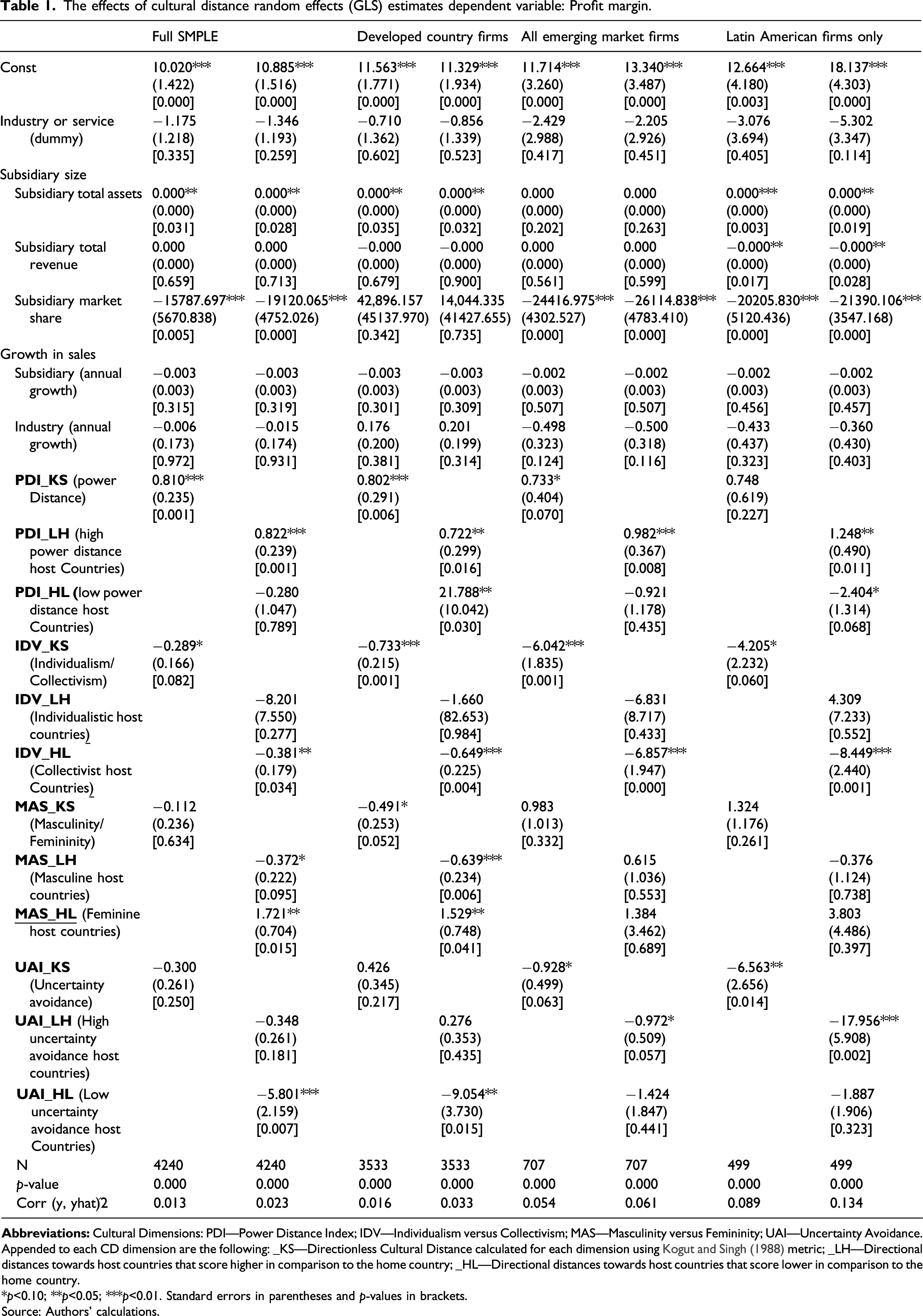
Appended to each CD dimension are the following: _KS—Directionless Cultural Distance calculated for each dimension using Kogut and Singh (1988) metric; _LH—Directional distances towards host countries that score higher in comparison to the home country; _HL—Directional distances towards host countries that score lower in comparison to the home country.
*p<0.10; **p<0.05; ***p<0.01. Standard errors in parentheses and p-values in brackets.
Source: Authors’ calculations.
Results in Table 1 highlight the improved explanatory capacity of the models when cultural distances are measured in specific directions. The implications for the direction of CD can be verified as the specific effects for each dimension of cultural distance measured in opposite directions (i.e. LH or HL) can either complement or offset each other. For instance, the DIST_MAS_KS (i.e. CD for the masculinity vs. femininity dimension calculated as the single component of the KS index) in the full sample presents a non-statistically significant effect on performance, however, when distances are measured in specific directions separately, results reveal that MAS_LH (i.e. distances towards host countries with masculine culture profiles) affect performance in a statistically significant and negative manner whereas distances in opposite directions (i.e. MAS_HL, distances toward feminine host country profiles) affect performance in a positive and significant way. The same pattern can be verified in different variables which confirm that the direction of CD is an essential characteristic of the construct (Zaheer et al., 2012) and that not all dimensions of cultural distance have a negative effect on performance.
By testing the effects of CD in specific directions and also by separating the full sample into sub-samples based on the characteristics of the home countries, the results highlight the implications of context (Meyer, 2015; Teagarden et al., 2018) as the effects of some dimensions of CD seem to be dependent the characteristics of the samples. Our findings highlight the importance of adopting a “sampling strategy for cross-cultural research to ensure that an adequate sampling of cultural variability is included in the samples” (Gupta et al., 2002: 11). Results show that when the effects for cultural distances are tested in sub-samples of firms with similar characteristics (i.e. developed country firms, all emerging markets firms and Latin American foreign subsidiaries only), the explanatory capacity (i.e. the pseudo R-squared which, for the case of random effects estimators, was computed as the correlation between the predicted and the actual y values) of the models increase significantly.
Next, we highlight the specific effects of CD by providing a graphical representation that includes the size, sign and significance of the coefficients as well as the main characteristics of the samples which makes it is possible to discuss the effects in each direction based on the characteristics of the distances. The mean values for the home countries and the host countries for each sample reveal important characteristics and cultural differences for the subsidiary firms included in the analysis. By comparing the mean value of the cultural dimension in the home countries and the minimum and maximum scores in the host countries, our assessment of CD shows the major characteristics and patterns for each dimension and direction of CD.
The implications of distances towards high versus low power distance host countries
Figure 2 presents the implications for the direction and magnitude of CD for the power distance dimension. Effects for the direction and magnitude of CD for the power distance dimension on the financial performance of foreign subsidiary firms in Latin America. Source: Authors’ calculations.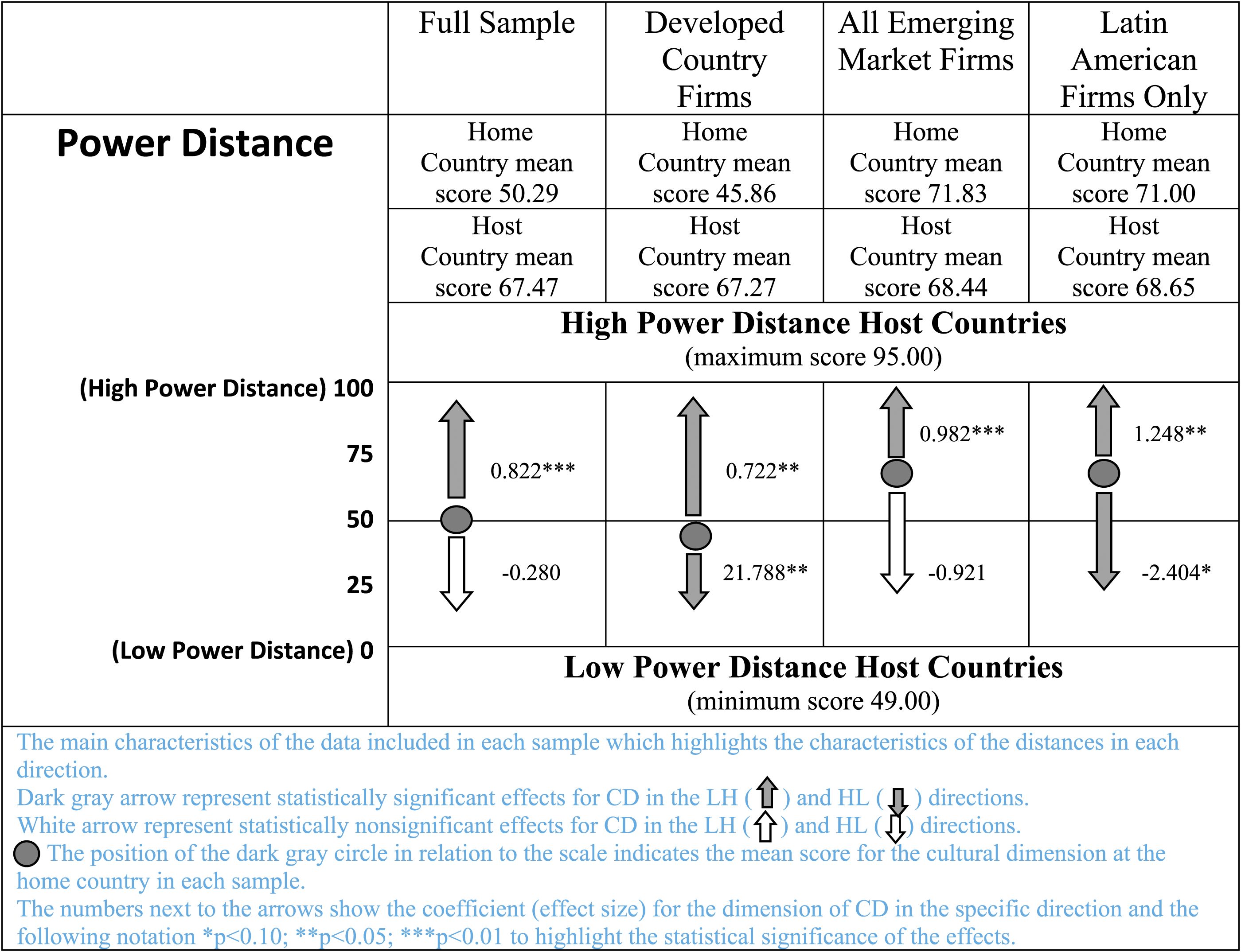
Results support hypothesis H1 showing that developed country firms seem to have the ability to perform well in both high and low power distance host countries. Regardless of direction we observe a positive and statistically significant impact on performance. Moreover, by comparing the size of the coefficients our results indicate that when operating in host countries that score lower (HL direction), the positive effect on performance increases.
In regards to the effects of the performance of foreign subsidiaries from emerging markets, the findings support hypothesis H1a as these firms seem to have the ability to perform well when operating in host countries with higher levels of power distance. Financial performance does suffer, however, when these emerging market subsidiaries operate in low power distance host countries.
In the case of foreign subsidiaries from Latin America, there is a positive effect on performance when operating in host countries which score higher in terms of power distance but a negative and significant effect when doing business in host countries which score lower on this cultural dimension. These findings reject hypothesis H5 and suggest that foreign subsidiary firms from Latin American might in fact underestimate and fail to recognize and adjust to the cultural nuances in their own region. As previous studies have shown that “expatriates originating from developed countries adapt in a more satisfactory manner than Latin American expatriates, even though they are more culturally distant” (Felix et al., 2019: 71), our findings seem to confirm that this is also the case in regards to the effects of the Power Distance dimension of CD on the performance of foreign subsidiary firms operating in Latin America.
The implications of distances toward high versus low Uncertainty Avoidance host countries
The implications for CD for the uncertainty avoidance are presented in Figure 3. Effects for the direction and magnitude of CD for the uncertainty avoidance on the financial performance of foreign subsidiary firms in Latin America. Source: Authors’ calculations.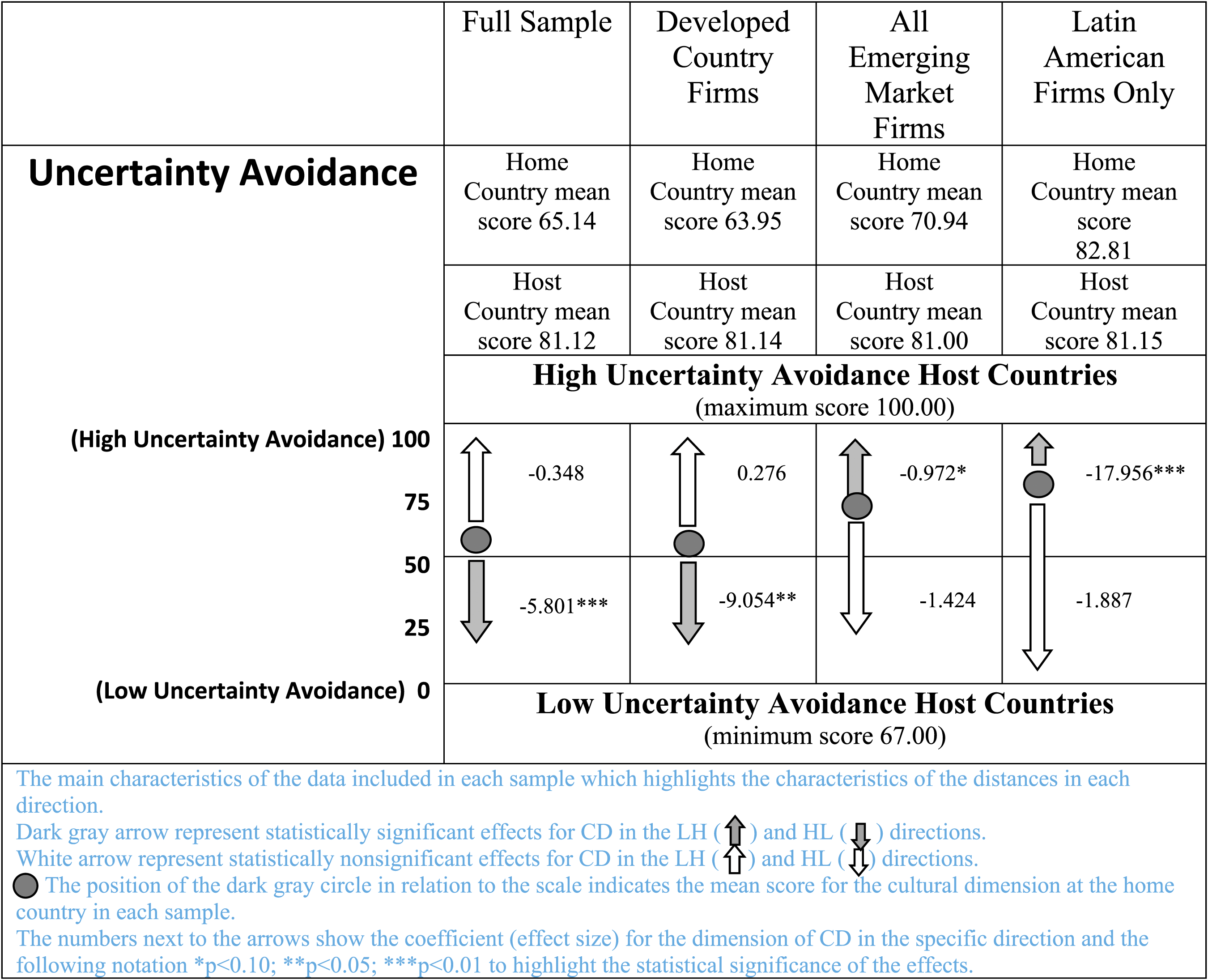
These results also do not support H5 as despite the cultural similarities that exist within Latin America (Gupta et al., 2002), foreign subsidiaries from the region do not have an advantage when compared to other emerging market firms when dealing with the implications of distances in terms of uncertainty avoidance. Despite being more similar, as noted by the mean scores for the home and the host countries included in the sample, the size of the effect (negative coefficient) shows that Latin American firms are in fact at a disadvantage when compared to other emerging market firms operating in the region. Similarly, the results for the developed country sample reveal that despite the shorter distance, as indicated by the mean value for the home country and the minimum value for the scores of the host countries, there is a negative and significant effect when distances are towards host countries that score lower in terms of uncertainty avoidance. These findings support hypothesis H2 and suggest that even slight differences between the home and the host country in terms of their tolerance for ambiguity and risk are sufficient to impact performance in a negative way.
The implications of distances toward individualistic versus collectivistic host countries
Results for CD in terms of Individualism versus Collectivism are presented in Figure 4. Effects for the direction and magnitude of CD for the Individualism versus Collectivism dimension on the financial performance of foreign subsidiary firms in Latin America. Source: Authors’ Calculations.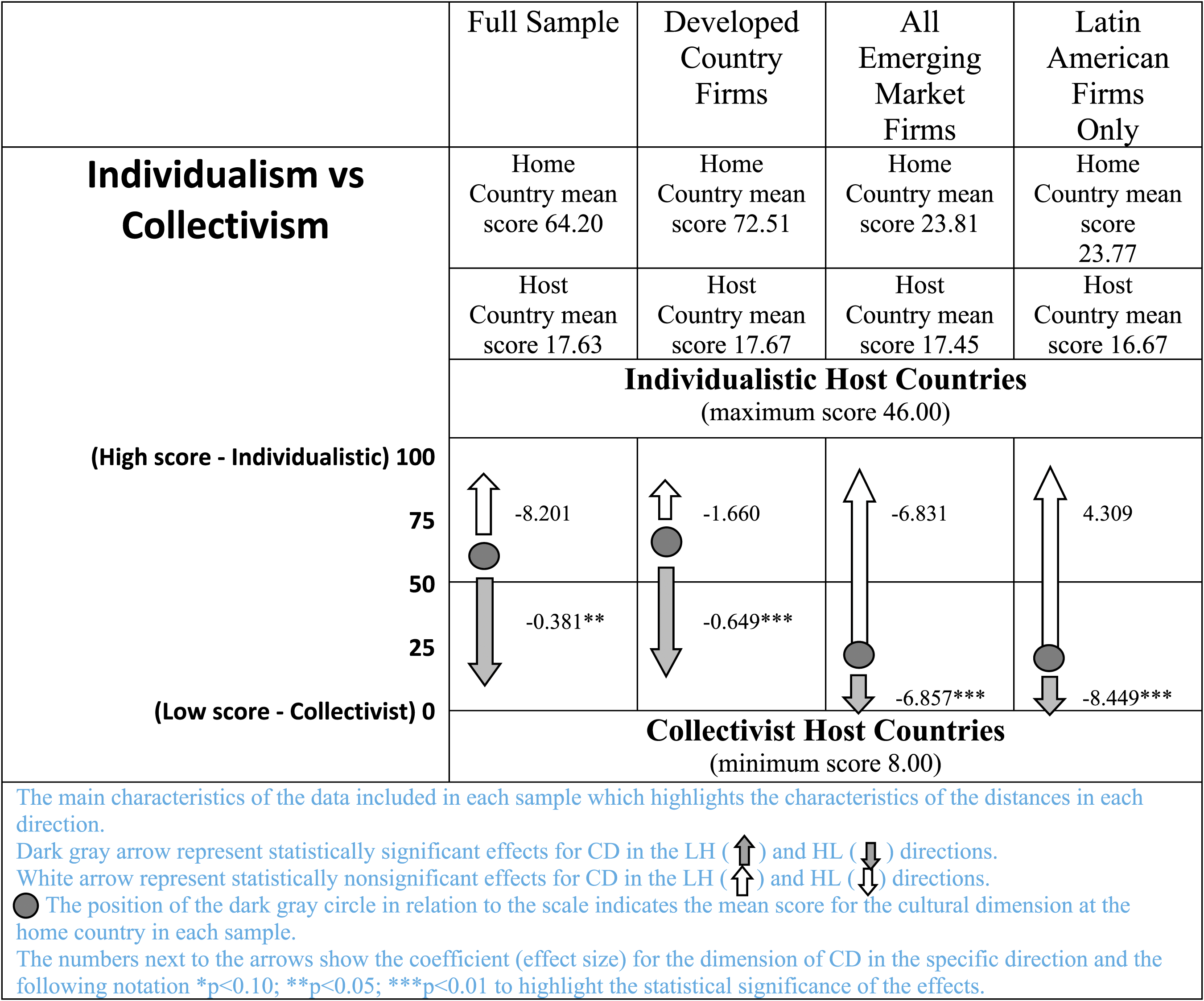
Our results presented in Figure 4 support hypothesis H3 as for all the sub-samples, distances toward collectivist societies impact performance in a highly negative way. Moreover, the results for the emerging markets and the Latin American foreign subsidiaries sub-samples, show that the similarities between the home and the host countries do not facilitate the acceptance of foreign firms into local stakeholders’ groups in a collectivist host country. Therefore, in collectivist societies, when interests between foreign firms and local groups diverge it might create a sense of “us,” the locals, against “them,” the foreigners, which will ultimately increase the costs of doing business regardless of cultural similarities between home and host countries. Our findings reveal that when operating in collectivist societies, there are greater costs associated with accommodating the needs and interests of different groups that result in satisfactory rather maximized performance (Cyert & March, 1963). Furthermore, in contrast to the power distance dimension which firms seem to accommodate the effects in a more favorable way depending on either the cultural similarities, or the experience, history and traditions, the effects when operating in Collectivist host countries seem to be entirely conditioned by the characteristics of the host country profile.
The implications of distances toward masculine versus feminine societies
Findings for the masculinity versus femininity CD dimension are presented on Figure 5. Effects for the direction and magnitude of CD for the masculinity dimension on the financial performance of foreign subsidiary firms in Latin America. Source: Authors’ calculations.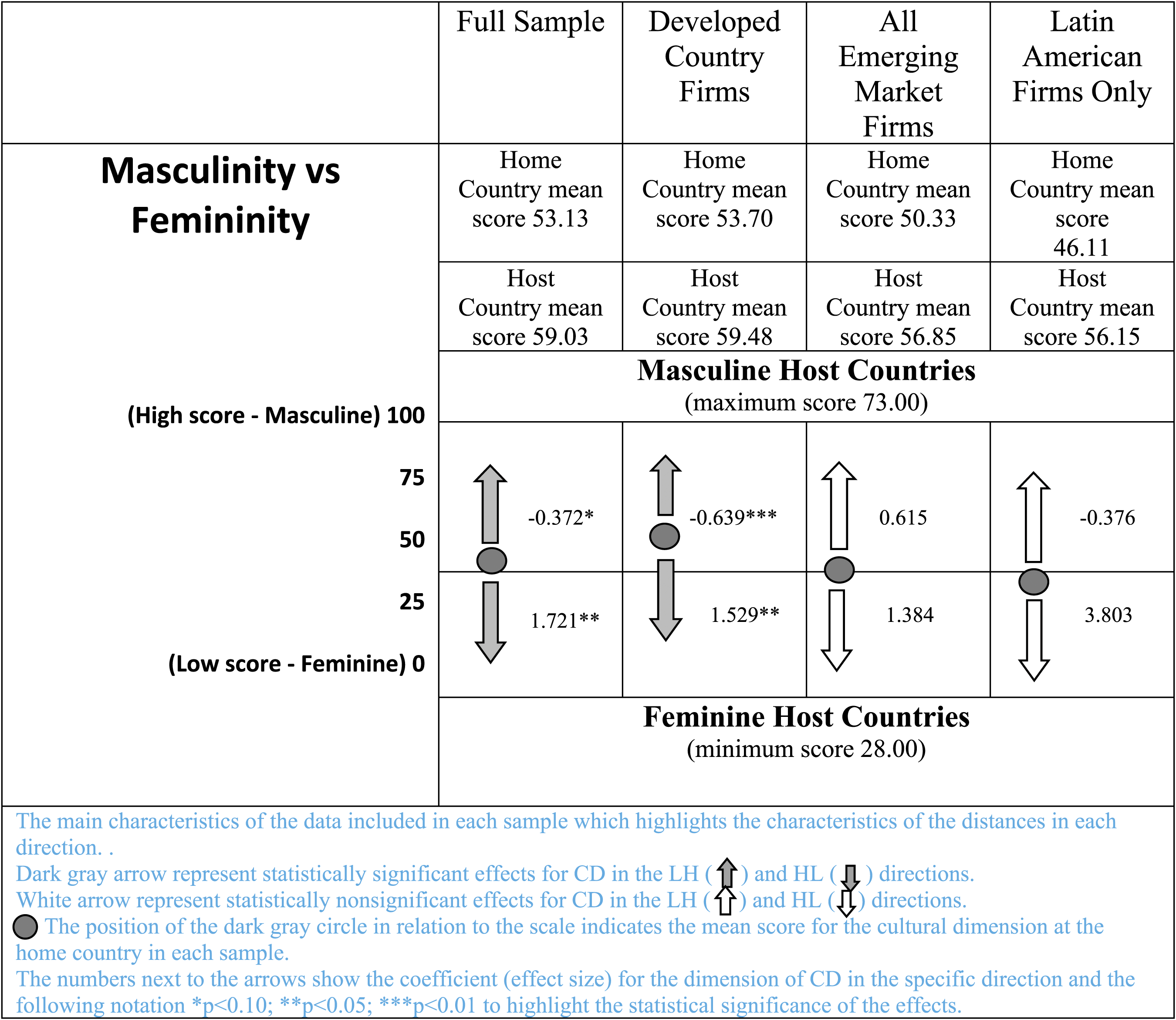
The results presented on Figure 5 partially support hypothesis H4 as the full sample and the sub-sample including only foreign subsidiaries from developed countries show a positive and significant effect toward feminine host countries and a negative and significant effect when distances are in the opposite direction (i.e. masculine host countries). Moreover, a mean score of 53.70 for the home country of the sub-sample including developed country foreign subsidiary firms only show that the home countries of these firms are in the masculine side of the scale; however, the results show that distances towards the opposite side of the scale (i.e. feminine host countries), despite the greater distance, seem to offer better conditions to do business. Furthermore, findings for this dimension of CD do not support hypothesis H5 as the effects on the performance of foreign subsidiaries from Latin America are not statistically significant.
Final Considerations
Theoretical Implications
Since its introduction, the CD construct has been considered a liability of foreignness as it increases the costs and reduces the profitability of firms operating in distant foreign markets (Zaheer, 1995). Accordingly, scholars have argued that “a country cannot be considered to have a more developed culture because it scores higher values on a scale of cultural attitudes; it merely has different cultural attitudes. When the firm moves to a country with different cultural attitudes, it has to develop knowledge about how to operate there. Moreover, on these dimensions the direction of movement does not matter; moving from Country A to Country B is equally disadvantageous as moving in the opposite direction” (Cuervo-Cazurra and Genc (2011: 445). These assumptions are embedded in the Kogut and Singh (1988) composite index, which over the years became the most popular approach to compute CD (Konara and Mohr, 2019). Despite Shenkar’s (2001) critiques of several underlying assumptions of the construct, we continue to use the same metric (i.e. KS composite index) which seems to emphasize the liability implications of CD (Beugelsdijk et al., 2018). Nevertheless, a few more recent studies have shown that in some cases, CD can lead to positive outcomes (Boschma, 2005; Vaccarini et al., 2017), which might depend on a combination of different dimensions of CD in specific directions (Stor, 2021), therefore emphasizing the nonequivalent and asymmetric characteristics of the construct (Correa da Cunha, 2019; Magnani et al., 2018; Selmer et al., 2007; Shenkar, 2001; Zaheer et al., 2012).
This study attempts to contribute to the literature by providing a more in more in-depth and nuanced assessment of the CD construct. We have attempted to address key concerns raised by Shenkar (2001) regarding the assumptions of linearity, symmetry, equivalence, and discordance. Rather than rejecting the distance metaphor, we build on the important contributions from previous studies and propose that while the size of the distance might be more relevant in discussing the effects of some of the dimensions of CD, it is incomplete as it does not account for the direction towards countries with different profiles, the specific characteristics of the national culture dimensions and the contextual settings of the study. By testing the effects of CD on samples including firms with different characteristics, we show that although diversity in the sample might be important when investigating the effects of distances (Franke and Richey, 2010; Van Hoorn & Maseland, 2016), our findings suggest that we should be parsimonious in attempting to generalize the effects of CD as they are clearly dependent on the contextual characteristics of the study. Furthermore, our findings show that for some dimensions of CD, firms seem to have the ability to accommodate the effects in a more satisfactory manner, while for other dimensions, performance seems to be driven by the host country profile.
Our results indicate that not only experience in managing in similar contexts, but also history and traditions, seem to explain to a great extent the effects of the Power Distance dimension of CD. When dealing with the effects of CD, despite the greater distance, foreign subsidiaries from developed countries seem to have an advantage when compared to foreign subsidiaries from Latin America. Two possible explanations, both challenging the assumption of linearity, are provided. From the psychic distance paradox perspective, these findings indicate that for the case of foreign subsidiaries from Latin America, the “perceived similarity can lead to carelessness and failure” (O’Grady and Lane, 1996: 329), while the Gulliver (Brachfeld, 1951) and the Mongrel (Rodrigues, 1993) complexes explain that due to the colonial heritage and traditions in the region, developed country firms are perceived as superior and their culture is accepted with less resistance when compared to other subsidiary firms from the region.
Furthermore, our findings for the Uncertainty Avoidance dimension of CD challenge the assumption of linearity as the effects toward host countries that are more similar to the firm’s home country are negative despite the shorter distance. This is an indication that even slight differences between the home and the host countries in their tolerance for risk and ambiguity can increase the costs of doing business and impact the financial performance in a negative way. Conversely, the less negative effects for distances towards host countries that are more distant could be an indication of a positive tradeoff between moving too fast and being conservative in the assessment of risk in the foreign host country.
For other dimensions, such as Individualism versus Collectivism as well as masculinity versus femininity our findings challenge the assumptions of symmetry and linearity as there is clear evidence that regardless of the size of the distance, some cultural characteristics in the host country profile seem to provide better or worse conditions for firms to do business regardless of the (size) of the distance. Distances toward collectivist host countries seem to affect the performance of all subsidiary firms in a negative way regardless of similarities between the home and the host countries such as the case of foreign subsidiaries from Latin America operating in the region. More feminine host countries seem to provide better conditions for foreign subsidiary firms from developed countries to do business when compare to distances towards more masculine societies. Foreign subsidiaries from more masculine developed countries seem to be affected in a positive way when operating in more feminine host countries, regardless of the greater distance.
Managerial implications
We investigate the effects (outcomes) of CD on the performance of subsidiary firms in Latin America. Being aware of these implications provides important insights for firms interested in the region as it allows them to identify opportunities to take advantage, or minimize the effects, of CD when doing business in Latin America.
The patterns of investments of emerging market firms indicate that the investment decisions of these companies might not be conditioned and constrained by the perceived CD (Luo and Tung, 2007). When compared to traditional multinational companies (i.e. developed country firms), studies have shown that Latin American firms have a higher propensity to opt for full control over their investments as CD increases (Malhotra et al., 2016). However, there seems to be indications that the potential benefits associated with their foreign investments depend on the ability to manage culturally distant markets (Luo and Tung, 2018).
Furthermore, rather than having an advantage, our findings indicate that foreign subsidiary firms from Latin American might in fact underestimate and fail to adjust to the different cultural nuances within their own region. Although focusing on Latin America, these findings may well represent the pattern for firms operating in different regions. Being aware of the specific implications of CD, firms can evaluate other options such as alternative markets to invest in, how to enter foreign markets with different cultural characteristics as well as the adoption of managerial practices that minimize the negative effects on financial performance.
Limitations and suggestions for future research
This study has a number of limitations which provide fertile ground for additional research in this area. The current research focuses mainly on the direct effects of the different CD dimensions on the financial performance of foreign subsidiary firms in Latin America. Culture represents a complex set of interrelated and potentially interactive dimensions (Beugelsdijk et al., 2017; Lytle et al., 1995; Tsui et al., 2007) that together produces a specific outcome. Future researchers can adopt the metrics developed in this paper and the criteria used for testing the effects of CD to follow the recommendation of Fainshmidt et al. (2020) and Stor (2021) and further explore different configurations and interactions among the dimensions. This would be important in terms of increasing our understanding regarding the implications of CD on firm performance. Furthermore, further research in different country contexts is needed in order to strengthen our findings and conclusions. Additionally, work on the differences in institutional structure such as how formal institutions might moderate the effects of CD, could also shed new light in terms of explaining how the effects of CD might depend on the specific host country context.
Finally, it is important to acknowledge that Hofstede indices have been changing over the past decades (Taras et al., 2012). However, data from the World Values Survey show that there has been a growing divergence between the prevailing values in low-income countries and high-income countries. Our measurement should provide a more accurate assessment of distances between pairs of emerging market countries, while it might underestimate the actual size of CDs between developed countries and emerging markets. In order to validate our assumptions and strengthen our conclusions, future studies can adopt our metric for computing CD in combination with other national cultural frameworks such as the World Values Survey, GLOBE project (House et al., 2004) and the updated indices for Hofstede provided by (Taras et al., 2012).
Footnotes
Declaration of conflicting interests
The author(s) declared no potential conflicts of interest with respect to the research, authorship, and/or publication of this article.
Funding
The author(s) received no financial support for the research, authorship, and/or publication of this article.
