



Abstract
Cross-cultural management (CCM) research comprises a variety of disciplines with different thematic, paradigmatic, and methodological assumptions. Since there has been no systematic analysis of the development of topics, paradigms, and methods, this article draws a landscape of these analyzing 777 articles published in two leading journals between 2001 and 2018. Results show that corporate culture, human resource management, and cultural dimensions are main topics in CCM and that positivist and quantitative papers outweigh interpretive and qualitative articles. We examine a convergence of the positivist and interpretive paradigm in 2016 and 2017, what might indicate a possible upcoming paradigmatic shift in CCM. However, positivist articles rise again since 2017. Using computer-aided tools, this study serves as a basis for future literature reviews.
Keywords
Introduction
Cross-cultural management (CCM) is a young and interdisciplinary research field—and due to its great number of approaches, problems, researchers, and disciplines—continues to be subjected to undergoing thematic and methodical shifts in the paradigm. CCM at its core is the vast interconnection of very distinct fields of social sciences, which stem from diverse research traditions. Researchers from various backgrounds and institutions bring together a great variety of ontological, epistemological, and methodological assumptions regarding the characteristics of culture and its influence on organizations and management. International management (IM) not only approaches the challenges of interculturality within organizations, but also confronts organizational sociology, psychology, anthropology, ethnology, cultural studies, or linguistics (Chanlat et al., 2013). The development of CCM has been described by several authors (Adler, 1983; Boyacigiller et al., 2004; Peterson and Søndergaard, 2012; Phillips and Sackmann, 2015). So, for example, regarding the topics, Nancy Adler demonstrated in her 1983 seminar work that, between 1971 and 1980, only 3.6 percent of the articles published in American management journals addressed cross-cultural issues (p. 230). Nowadays, there are several journals specializing in CCM; however, a landscape of that scholarly community which encompasses specific theoretical and conceptual frames, research questions and topics, assumptions and paradigms, approaches, and methods is still missing.
Although there has been research on the development of topics, paradigms, and methods in related disciplines like IM (Acedo and Casillas, 2005; Stahl and Tung, 2015), human resource management (HRM) (Davoine and Gmür, 2012; Gmür, 2003, 2007), women in management (Davidson and Burke, 2000), female expatriation (Salamin and Hanappi, 2014), or multicultural teams (Santistevan and Karjalainen, 2015), there have been no meaningful systematic analyses of the development of the aforementioned in CCM.
To give an overview of the actual landscape of CCM, this article illuminates the development of CCM-related research between 2001 and 2018, in an attempt to distinguish which thematic, methodical, and paradigmatic changes can be identified. Moreover, within the scope of this article, important authors from contributing institutions are identified. To answer these questions, we conducted a quantitative and qualitative analysis based on 777 articles published in two leading journals of CCM research—the International Journal of Cross Cultural Management (IJCCM) and Cross Cultural and Strategic Management (CCSM).
This article is divided into four sections. The first section gives an overview of the development of the field of CCM as well as the conceptional assumptions upon which this work is based. The second part describes the research methodology, as well as the text-analyzing online tool Voyant (Sinclair and Rockwell, 2019) which was used for a first data analysis and visualization. The third part presents the results obtained and offers a qualitative analysis. The conclusion offers some remarks and recommendations for further research based on the additional relations that can be extracted from the data.
Conceptional background
The field of CCM: Development, disciplines, and topics
CCM research stems from international business (IB), international management (IM), comparative management (CM), and international cross cultural management (ICCM) (Phillips and Sackmann, 2015; Pudelko et al., 2015). It differs from IB—which particularly considers all functional activities of a company regarding the reciprocal influence between the macro level of the environment and the meso level of the organization—to CM—which compares the specificity of management in different systems still operating on a macro and meso level—CCM instead focuses on phenomena of agency, behavior, interaction, and influences among actors on the micro level of individuals in organizations (Adler and Gunderson, 2008; Barmeyer and Mayrhofer, 2008; Bjerregaard et al., 2009; Usunier, 1998).
In general, CCM research is concerned with managing human behavior in organizations and the role of culture (Holden, 2002: 46). Nancy Adler, one of the pioneering researchers in this field, defines it as follows: Cross Cultural Management studies the behavior of people in organizations around the world and trains people to work in organizations with employees and client populations from several cultures. It describes organizational behavior within countries and cultures; compares organizational behavior across countries and cultures; and, perhaps most importantly, seeks to understand and improve the interaction of co-workers, clients, suppliers, and alliance partners from different countries and cultures. (Adler and Gunderson, 2008: 13)
CCM subsists by contributions from different disciplines such as business studies, economics, cultural anthropology, psychology, sociology, and linguistics (Barmeyer and Franklin, 2016; Chanlat et al., 2013; Holden, 2002). This fact strengthens the incorporation of a variety of theoretical reference frameworks, paradigms, and research methods into one field of research but also brings the danger of a lack of conceptual depth and methodological blurriness. During the last years, a great number of scholars from various disciplines have made significant advances for CCM.
Stemming from the positivist research tradition of IB, CCM represents rather macro-analytically and quantitatively oriented methods, which instead of explaining behavior in intercultural situations emphasizes statistically abstract generalizations (Boyacigiller et al., 2004: 141). Along with the gradual entry of humanistic and social disciplines into business studies (Chanlat, 1998), its prevailing positivist position got tackled by the interpretive paradigm (D’Iribarne, 2009; Geertz, 1973; Redding, 2005). The main critique by scholars positioned in the latter was the denial of context and agency (Bjerregaard et al., 2009; Claeyé and Jackson, 2012; Jackson, 2002). Generalizable assumptions about human values and behavior in management could not be held by the expanding community, as quantitative methodology was criticized for being too short to understand and explain agency in an international context (e.g. Brannen and Doz, 2010; Pudelko et al., 2015). So, influencing research fields like anthropology and ethnography, among others, led then to the rise of interpretative research designs and qualitative methods in ICCM in the 1990s and 2000s (Brannen and Salk, 2000; Phillips and Sackmann, 2015; Sackmann and Phillips, 2004).
In the literature, a shift from the “hard factors” of business studies toward the integration of “soft factors” like culture and human behavior could be recognized (Adler, 1983; Pudelko et al., 2015), as well as the transformation from a separating view of context and culture toward the embeddedness of units of analysis in a cultural context. Moreover, regarding the level of analysis of the concept of culture, Boyacigiller et al. (2004), Sackmann and Phillips (2004), and Pudelko et al. (2015) examine some changes from culture comparison to intercultural interaction, from a static perspective of culture toward a dynamic one, and a shift from deductive to inductive methods, that is, from theory testing to theory generation. Nowadays, an increasing number of publications are based on critical perspectives and postcolonial paradigms (Jackson, 2012; Jack and Westwood, 2009; Mahadevan, 2017; Primecz et al., 2016; Ybema and Byun, 2009).
Those multidisciplinary contributions finally lead to an “imbalance among paradigms” (Primecz et al., 2009), a topic that will be further analyzed within this study. Prevailing topics concern themselves with the intersections that conflate managerial and cultural perspectives.
Classical topics of CCM in textbooks (Adler and Gunderson, 2008; Browaeys and Price, 2008; Mayrhofer, 2017; Schneider et al., 2014; Thomas and Peterson, 2017; Usunier, 1992) or edited volumes (Barmeyer and Franklin, 2016; Bhagat and Steers, 2009; Chanlat et al., 2013; Holden et al., 2015) are, in addition to cultural concepts and cultural dimensions, comparative or intercultural leadership, teams project groups, intercultural challenges in assignments abroad, or international mergers and acquisitions. Organizational topics cover for instance strategy, structure, diversity, knowledge management and change, the development of intercultural competences and intelligence, and intercultural negotiations or intercultural marketing (Usunier, 2019). Moreover, common topics in CCM are intercultural communication (Adler and Gunderson, 2008; Gudykunst et al., 1988; Kittler et al., 2011), negotiated meanings and identities (Primecz et al., 2011; Ting-Toomey, 2012; Yagi and Kleinberg, 2011), and negotiated working practices (Barmeyer and Davoine, 2019; Brannen and Salk, 2000). Other topics are more concerned with HRM (Jackson, 2002, 2014), as career paths and patterns across cultures (Davoine and Ravasi, 2013; Evans et al., 1989), expatriation (Black et al., 1999), management styles (Laurent, 1983), and language studies (Brannen, 2004; Piekkari et al., 2014; Pudelko et al., 2015) which considerably gained importance within international HRM over the last years (Brannen and Mughan, 2017; Welch et al., 2005). All these authors from manifold research streams and topics follow different research paradigms and methods, which will be addressed in the next sections.
Research paradigms
A research paradigm is defined as the model or pattern that guides the way in which practitioners approach and interpret knowledge. It offers accumulated results of practices and tools, upon which a scientific community can more specifically examine various aspects of preexisting knowledge (Kuhn, 1970: 23–24). Burrell and Morgan (1979) understand the meaning of a paradigm with respect to social sciences as “the philosophical assumptions which underwrite different approaches to social science” (p. 1). These “assumptions” relate to the ontological, epistemological, methodological, and human nature of the research practice regarding the nature of the social world (Burrell and Morgan, 1979: 1). Further, Romani (2008) related the four paradigms of Burrell and Morgan to CCM research and extended it including the paradigm proposal of Deetz (1996). However, this study focuses on the original model proposed by Burrell and Morgan (1979), which depicts the subjective—objective and interpretive—functionalist dichotomy.
Due to the sheer complexity behind classifying contributions located within the paradigms of radical humanist and radical structuralist approaches, the following study examines the journal articles regarding the positivist and interpretive paradigm (Mahadevan, 2013). In accordance with Romani (2008) and Gioia and Pitre (1990), who showed that in publications, the number of articles stemming from a positivist or interpretive paradigm overweigh considerably in IM, we focus on the ontological level, that is, the horizontal axis of Burrell and Morgan (1979) only.
The functionalist paradigm, otherwise known as the positivist paradigm, is placed on the objective continuum and concurrently rooted within natural and social science research practices, “seek[ing] to explain and predict what happens in the social world by searching for regularities and causal relationships between its constituent elements” (Burrell and Morgan, 1979: 5; Donaldson, 2003). These regularities are transformed into laws and predictive models, such as cultural universals and dimensions (Romani et al., 2014: 18), allowing for an objective comparison between cultures and behavioral patterns. Examples of positivist models in the field of CCM are social value systems and rank that compare societies using dimensions, such as the work of Hofstede (1980, 2001), Trompenaars (1993), Schwartz (2012), the GLOBE project (House et al., 2004), or the World Values Survey (Inglehart et al., 2005).
On the other side, the interpretive paradigm places itself on the subjective side of the investigative dimensions. Unlike in the field of natural sciences, there is no utility in finding laws in the regularities of the social world (Burrell and Morgan, 1979: 5; Hatch and Yanow, 2005: 65), since the goal of social science research should be rather understanding (Weber, 1949). From the interpretive paradigm, people are seen as “sense-makers” who create social realities (Romani et al., 2014: 18; Weick, 1995). This particularity gives reality a relativist perspective (Neuman, 2014: 109) that rejects the role of the researcher as an “observer” and focuses on the perspectives of particular individuals involved in the studied phenomena (Burrell and Morgan, 1979: 5). Examples of interpretive research in the field of CCM are qualitative case studies from Chevrier (2011), D’Iribarne (2012), D’Iribarne et al. (2020), Chevrier and Viegas-Pires (2013), Viegas-Pire (2013), or Barmeyer and Davoine (2019). All these publications are influenced by the interpretive approach of Geertz (1973), who considers culture as a system of meaning.
Based on this classification and in reference to paradigms in organization, studies conducted by Gioia and Pitre (1990), Primecz et al. (2009), and Romani et al. (2018) show that there are indeed contributions existent in all of the mentioned four paradigms in CCM. Contributions located in the positivist paradigm fairly outweigh the ones in the other three paradigms. Despite the attempts to approach culture in business studies like in cultural dimensions (e.g. Hofstede, 1980, 2001), the cultural distance model (Kogut and Singh, 1988; Shenkar, 2001), or the Culture, Administration, Geography, Economy (CAGE) model (Ghemawat, 2001), the underlying paradigm mainly prevails in a positivist nature; the dynamics of culture are still widely neglected (Brannen and Doz, 2010; Phillips and Sackmann, 2015; Schmid and Oesterle, 2009). So, culture is still used either as an independent or dependent variable, or even as a moderator that affects management concerns (Donaldson, 2003).
Some CCM researchers have therefore concluded that the gap between the paradigms used in CCM on the interface to IB (Brannen and Doz, 2010; Pudelko et al., 2015) is still present, and therefore evidence of the lack of integration between positivist and interpretive perspectives and methods. In response to these findings, Mahadevan (2013) suggests in line with Romani et al. (2018) an interplay between paradigms. Primecz et al. (2009) also plead for a meta-paradigmatic approach in CCM, which, citing Gioia and Pitre (1990), allows “a pluralistic, multiple-perspectives view” (p. 595) to comprehend social phenomena in their nature.
Research methods
Social science scholars apply either qualitative, quantitative, or mixed methods (Opp, 2014: 111). Those can be in line with the abovementioned paradigms. In most cases, quantitative research methods are related to the functionalist paradigm (Deetz, 1996: 193; Romani et al., 2014: 23–24). They are characterized by the validation or refutation of a hypothesis, which is based on the statistical evaluation of the empirical data collected through quantitative tools like surveys, demographic data, economy-related figures, or experiments (Neuman, 2014: 176). These methods aim to reduce the complexity of social phenomena to a set of quantifiable and statistically verifiable variables (Bortz and Döring, 2006: 138; Creswell, 2003: 18).
Unlike quantitative methods, qualitative methods often draw on the interpretive paradigm, amassing data from reality in the form of words and images. They take into account research data in relation to their social context and derive the meanings of the phenomena studied (Flick, 2014a; Neuman, 2014). The main goal of qualitative research is to discover relationships, connections, relations (Kleining, 1982: 229), applying tools like interviews, audiovisual recordings, documents, transcriptions, images, and content analysis (Neuman, 2014: 176).
Quantitative and qualitative methods can be used complementary in a mixed-methods design. This asserts that combining both of these methods offers a broader and more complete understanding of phenomena (Creswell and Clark, 2011; Jick, 1979; Kleining, 1982). In order to properly choose, and then make sense of the research object and its defining hypotheses, qualitative methods should be applied prior to quantitative ones (Kleining, 1982). After the validation of hypothesis by quantitative methods, qualitative research can explain phenomena with a higher degree of detail (Flick, 2014b).
Although researchers are aware that combining various methods offers the most reliable results for research, quantitative research methods are much more commonplace in CCM, in relation to mixed methods (Bortz and Döring, 2006: 302). One of the few mixed-method studies in the field of CCM is GLOBE (House et al., 2004), combining quantitative surveys with follow-up qualitative interviews with managers around the globe.
Methodology
Even if this can be discussed and criticized as an “obsession” (Chevrier, 2014), it can be claimed that academic Anglo-Saxon academic journals are becoming the most important publication media in the academic world (Gmür, 2003; Schmid and Oesterle, 2009). In line with the assumption about the growing importance of journal publications (Davoine and Gmür, 2012; Harzing, 2010), our analysis is based on journal publications in two relevant journals of the research field of CCM: the Cross Cultural & Strategic Management Journal (CCSM) 1 (Emerald Publishing, 2019) and the International Journal of Cross Cultural Management (IJCCM) (SAGE, 2019). For pragmatic reasons, we focused on only two journals thematizing CCM. Table 1 shows an overview of the journals selected.
Overview of examined two journals.
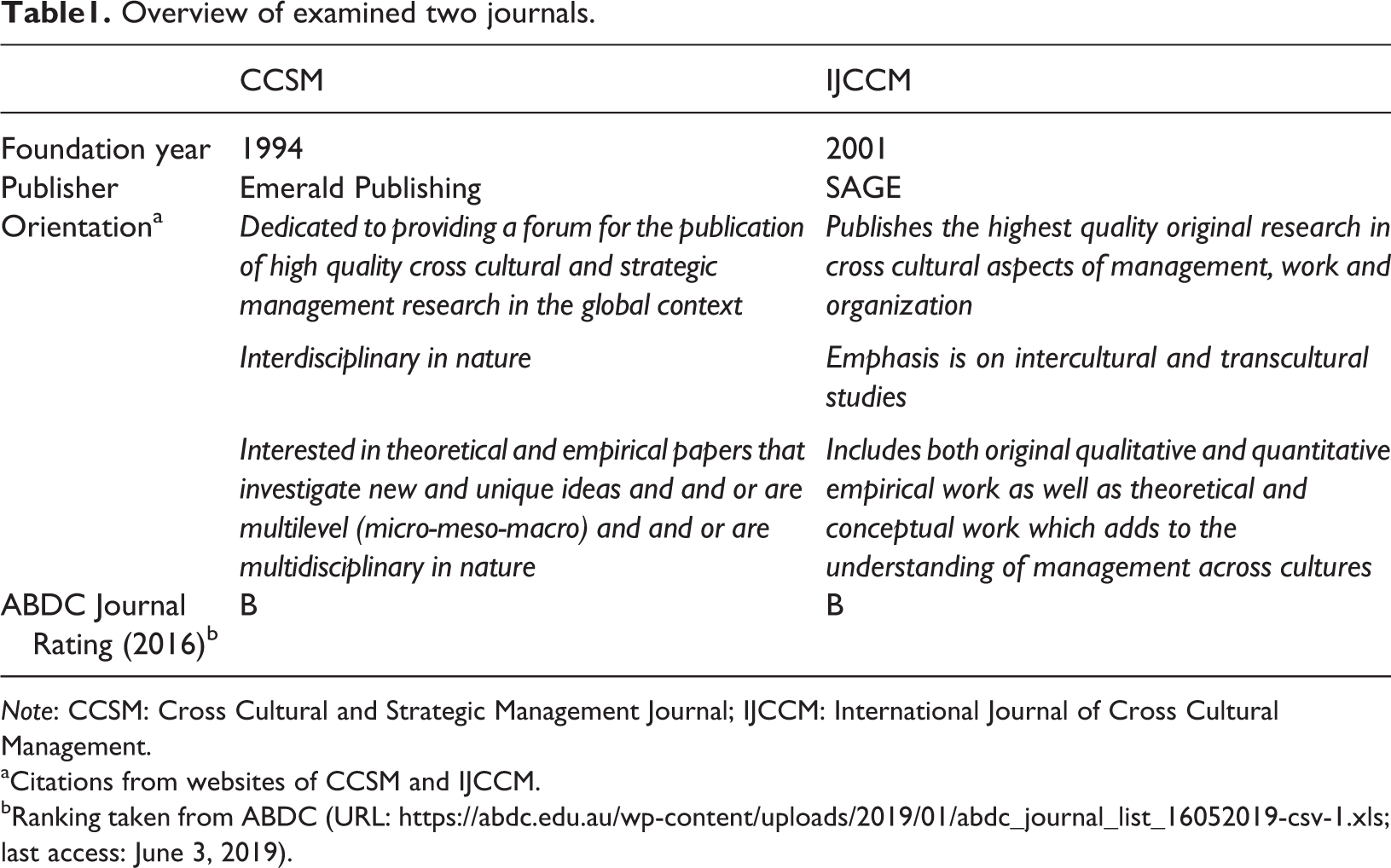
Note: CCSM: Cross Cultural and Strategic Management Journal; IJCCM: International Journal of Cross Cultural Management.
aCitations from websites of CCSM and IJCCM.
bRanking taken from ABDC (URL: https://abdc.edu.au/wp-content/uploads/2019/01/abdc_journal_list_16052019-csv-1.xls; last access: June 3, 2019).
Both journals hold international importance and include “Cross Cultural Management” in their titles. They feature high-quality articles with a broad range of methodologies and outcomes and, therefore, are excellent indicators of the trends and topics of interest, which are relevant to this field of study.
For this study, a total number of 777 articles published from 2001 to 2018 were reviewed. Table 2 shows the number of articles. We excluded book reviews and editorial articles from the beginning. From the 777 articles, we further subtracted 210 theoretical articles and used 567 empirical articles for analysis of research paradigms and methods. However, all publications—empirical and theoretical—are considered for the thematic analysis.
Number of articles considered.
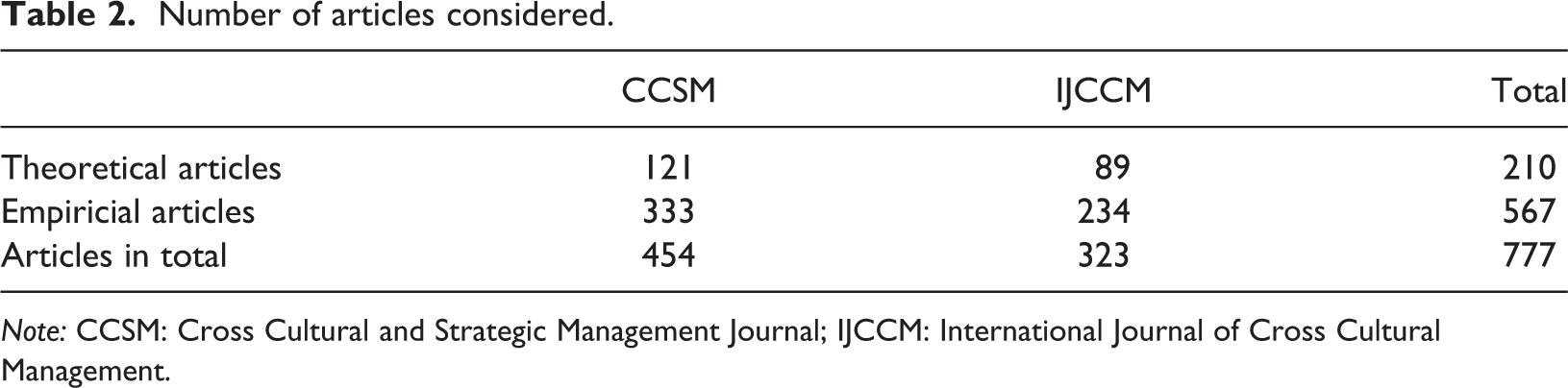
Note: CCSM: Cross Cultural and Strategic Management Journal; IJCCM: International Journal of Cross Cultural Management.
First, all articles were collected in a content management system and further exported to an excel sheet with the indication of journal, year, issue, authors, titles, and keywords. Further, information about the content and the topics was added, as well as the underlying paradigms and methods applied in the theoretical and empirical studies. The latter were classified qualitatively by content analysis.
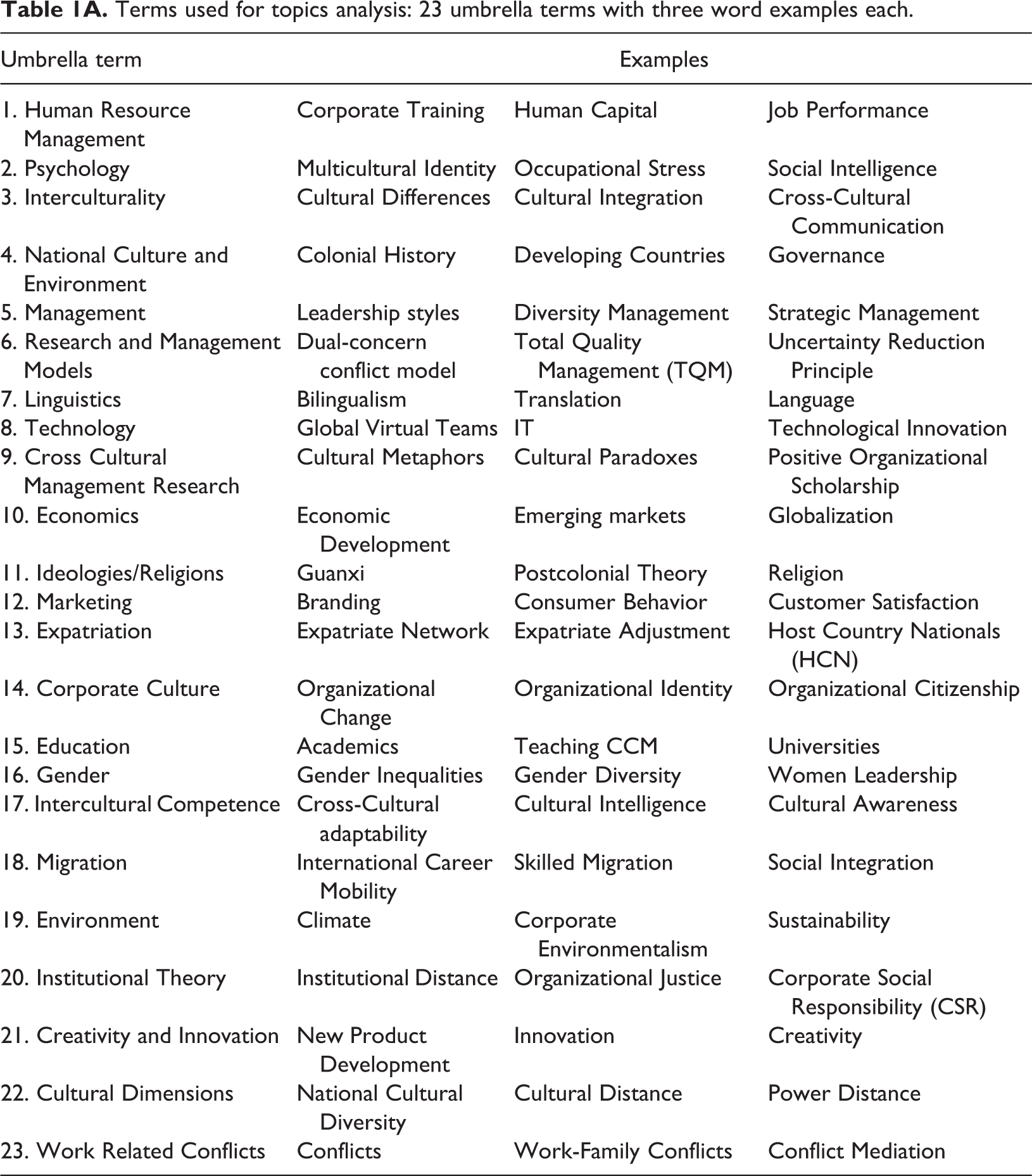
The topic classification followed mainly the keywords and the topics mentioned in the abstract. The authors of the articles tend to clearly specify the topics and scope of their research; so this way, every time a new research topic was mentioned, it was listed in a spreadsheet, in which each topic was associated in columns with related subjects. There was no limitation on the number of topics assigned to each article, since the main goal was to find the best describing terms that would cover all topics researched. The final list of non-repeating topics contained 295 different terms, all which were extracted from publications within both journals. Subsequently, they were subclassified under 23 umbrella terms in an effort to reduce the complexity of the visualization (see Appendix 1, Table 1A, for each three examples for every term). Again, this was achieved by finding appropriate term correspondences with already existing, more generic terms (Stahl and Tung, 2015: 393).
Following, the paradigm classification of the articles is based on the horizontal axis of the paradigm diagram (see Figure 1) presented by Burrell and Morgan (1979). This “simplified” version separates between the objective, functionalist, and the subjective, interpretive approach to social sciences research (Romani et al., 2018). Functionalist approaches were identified by the presence of a deductive method (Kleining, 1982) or the use of generalist, regulative models and theories regarding national and organizational culture. Interpretivist articles were identified after sorting out the articles with positivist approaches and finding detailed descriptions of the research subjects and its context, a descriptive and inductive analysis of data and the lack of generalizing and regulative models or theories. These characteristics were normally found in research articles based on in-depth interviews, case studies, and some studies of theoretical nature. The extraction logic used for this classification is based on the model of Booth et al. (2016), as shown in Figure 2.
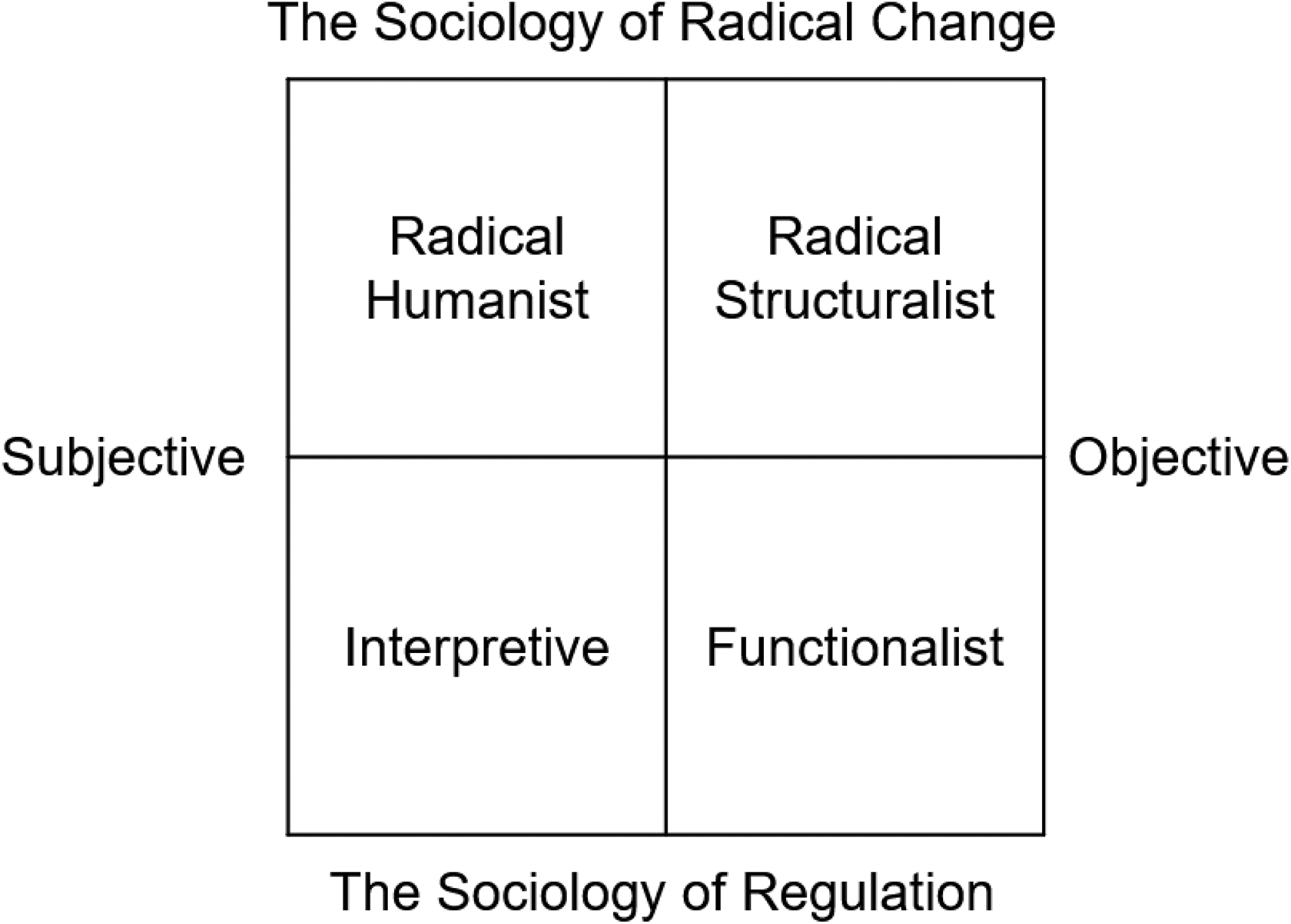
Paradigms in social science (Burrell and Morgan, 1979: 22).
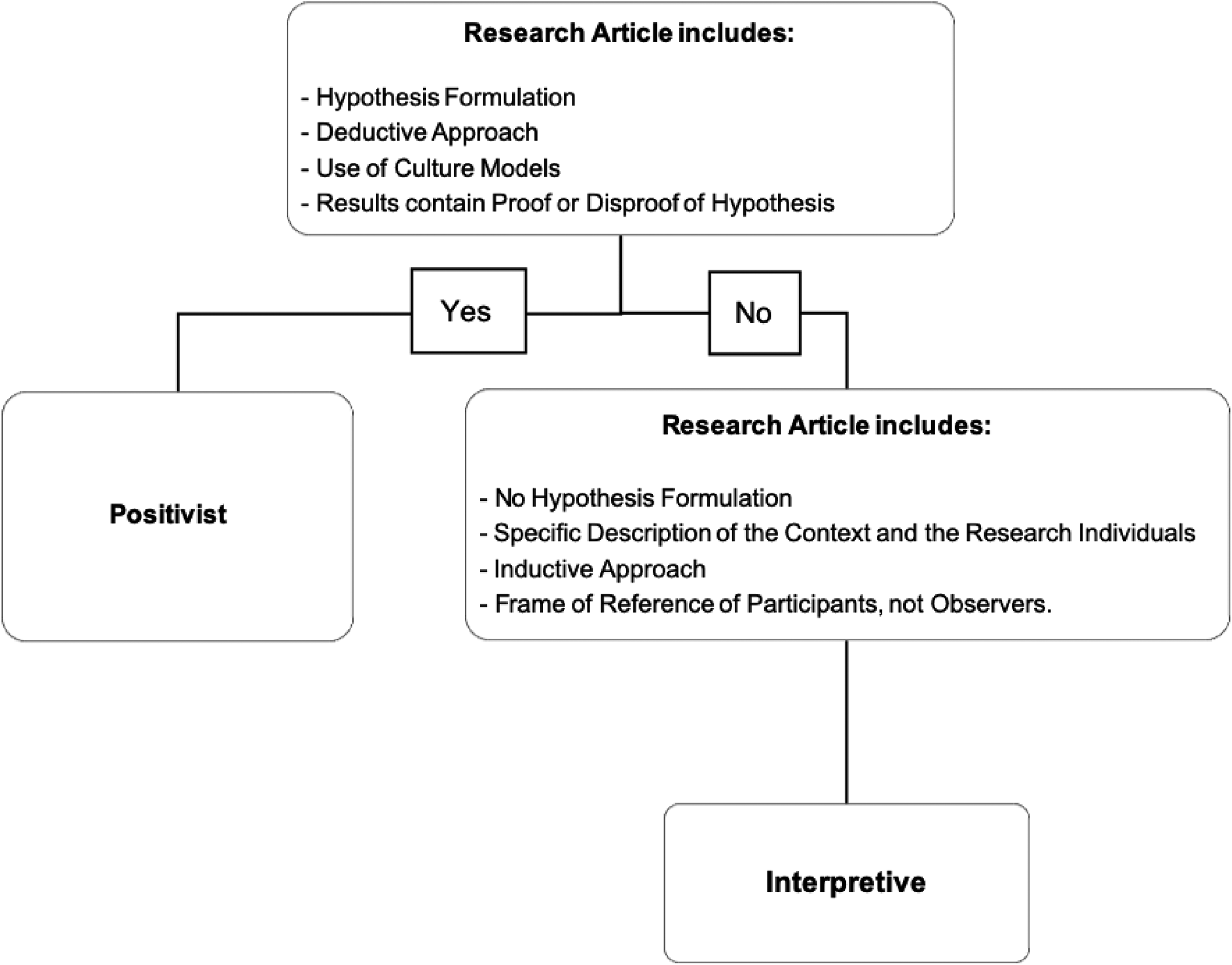
Research map for positivist and interpretive approaches based on Booth et al. (2016).
Regarding the classification of the research method of each article, the first step was sorting out all theoretical and conceptual articles. Next, abstracts and the methodology section were scanned for any mention from the authors about the qualitative, quantitative, or mixed-methods nature. This was then compared and confirmed by observing if there was any quantitative procedure, such as surveys or statistical tools during the evaluation of their studies. In the absence of any of these elements, there were found mostly qualitative approaches in the form of interviews’ analysis or case studies (Flick, 2014a; Kleining, 1982; Niedzwetzki, 1984). In fewer cases, the articles based their research on both, qualitative and quantitative methods, these ones were classified as mixed methods (Jick, 1979). The extraction logic used for this part of the classification follows as well the format of Booth et al. (2016), as shown in Figure 3.
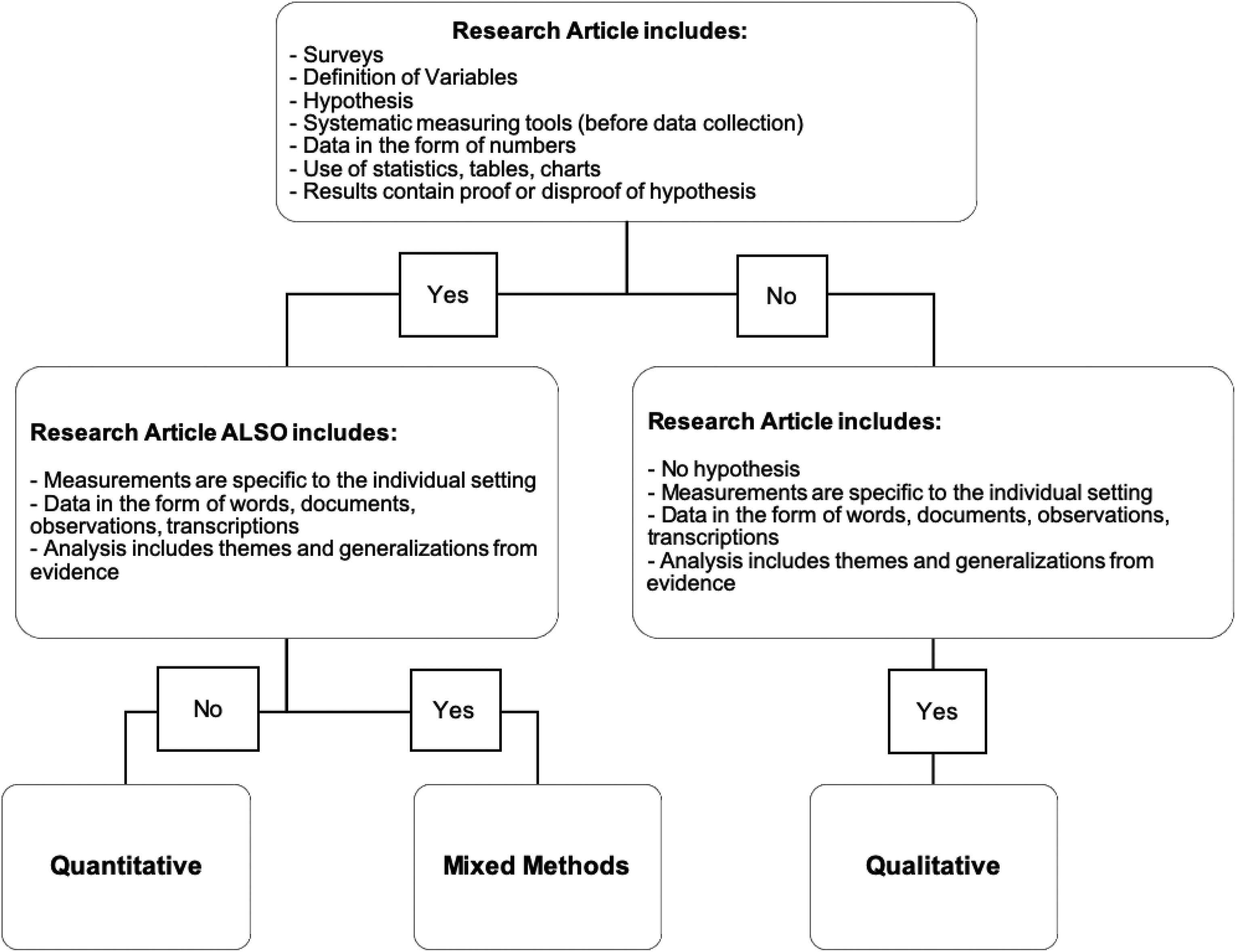
Research map for quantitative, qualitative, and mixed methods based on Booth et al. (2016).
We used Voyant Tools (Sinclair and Rockwell, 2019) as a tool for statistical visualization. The tool is an open source and web-based application which is used for text analysis, enabling quantitative and frequency analysis of words used in a text or corpus. It offers a variety of representation possibilities for different data formats, so for example the development of word frequency along a time span or the frequency of some terms in relation to others. For analysis, we transferred the word frequencies to an excel sheet and visualized the development of paradigms and topics by graphics.
Results
The following section contains the description and analysis of the results found in the two journals. In a first step, the data of the merged journals together will be presented, following the data of every journal on its own in a second step. After visualizing and describing the results, the analysis follows. We are aware that a systematic analysis—based on journal articles—is only one possible way to identify trends in a certain academic field.
Development of research topics and main related authors
Figure 4 shows the 18 most common topics found in both journals. “Management” as a main topic has a relative occurrence of 16 percent (in relation to the total number of topics listed). As well, the terms “interculturality,” “corporate culture,” “human resource management,” and “cross cultural management research” were identified as the mainly used words and represent around 50% of the whole corpus.
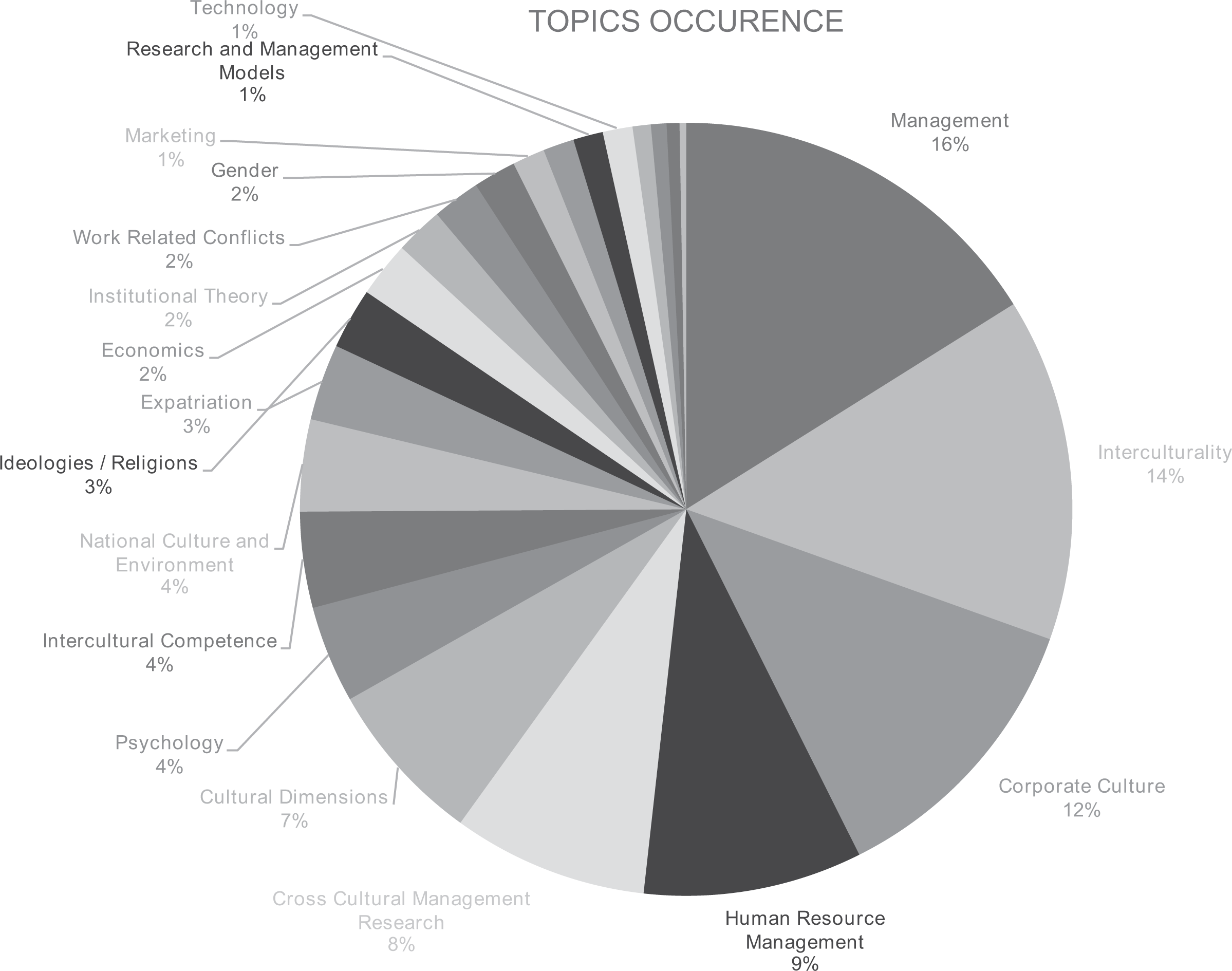
Most common topics in merged journals.
However, due to the overall thematic alignment of cross-cultural and intercultural management in multinational organizational settings, that is, multinational companies in both journals, the terms “management,” “interculturality,” and “CCM research” were subsequently substracted for being too general. Finally, the top 10 topics from the two merged journals are listed in Table 3.
Ten most common topics in merged journals.
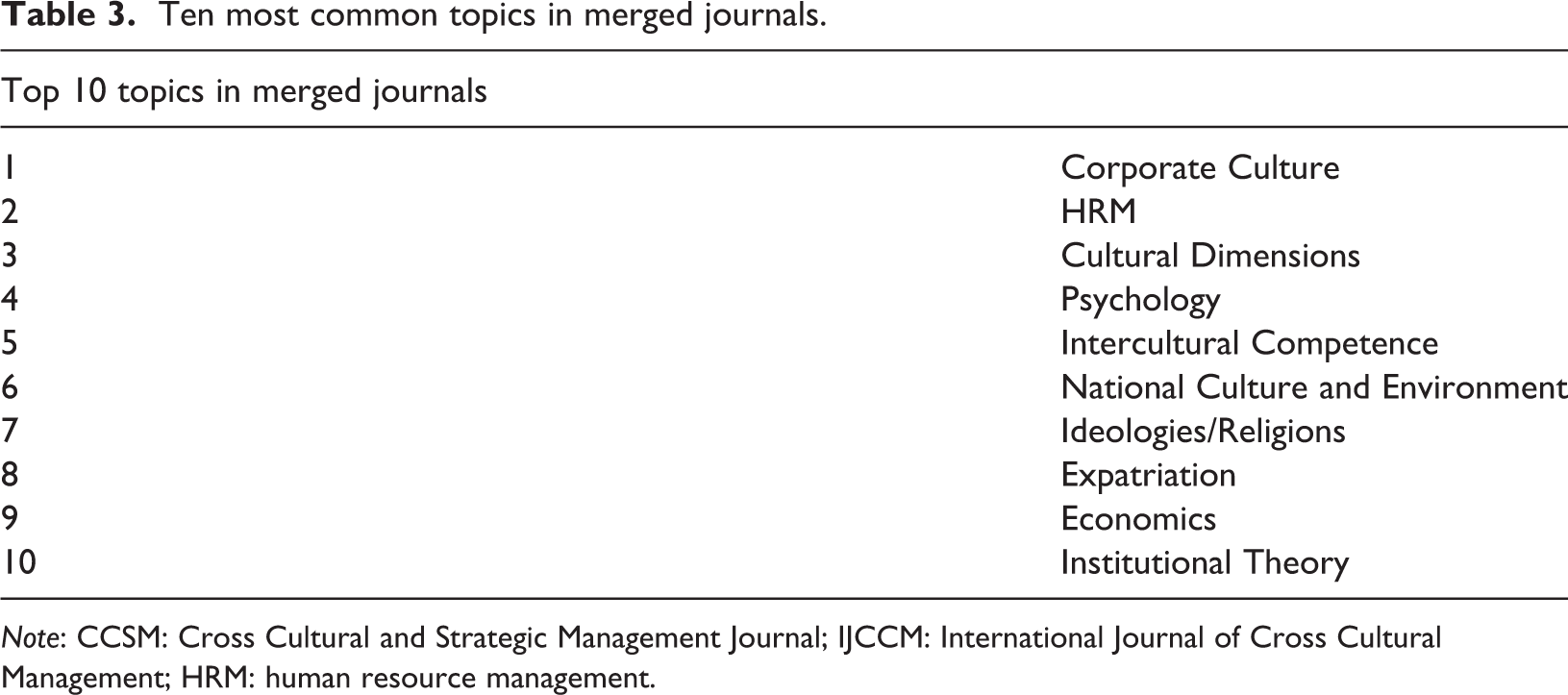
Note: CCSM: Cross Cultural and Strategic Management Journal; IJCCM: International Journal of Cross Cultural Management; HRM: human resource management.
Regarding the authors with most publications, our analysis led to the results visible in Tables 4 and 5. Authors with a minimum of three publications were considered, resulting that in IJCCM 14 authors and in CCSM 17 authors are listed. On the first sight, the European and US-American anchorage of the two journals becomes clear: In the European journal IJCCM, most authors are from European institutions, while there are more authors publishing in CCSM are assigned to US-American institutions.
Most publishing authors in IJCCM.a
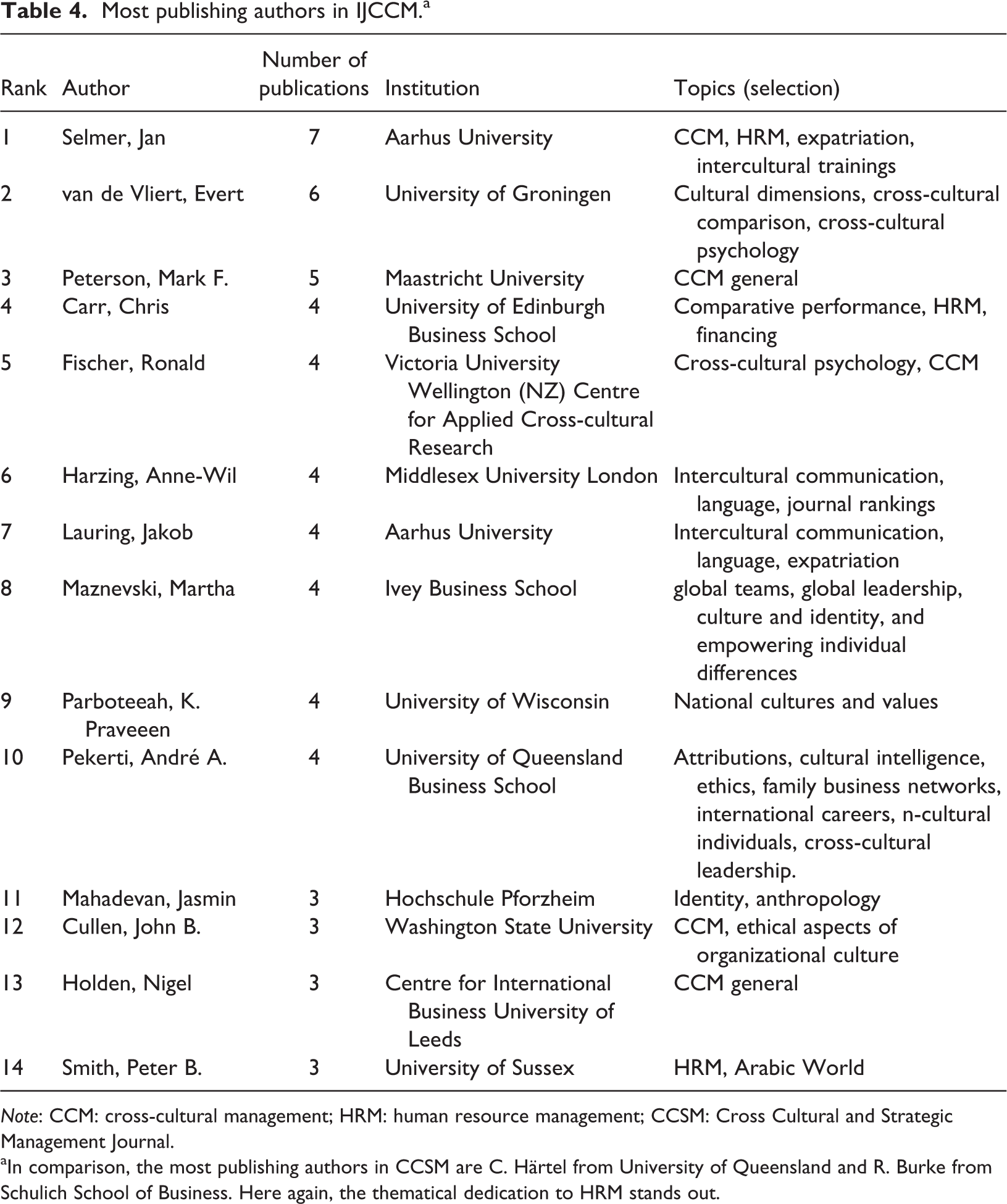
Note: CCM: cross-cultural management; HRM: human resource management; CCSM: Cross Cultural and Strategic Management Journal.
aIn comparison, the most publishing authors in CCSM are C. Härtel from University of Queensland and R. Burke from Schulich School of Business. Here again, the thematical dedication to HRM stands out.
Most publishing authors in CCSM.
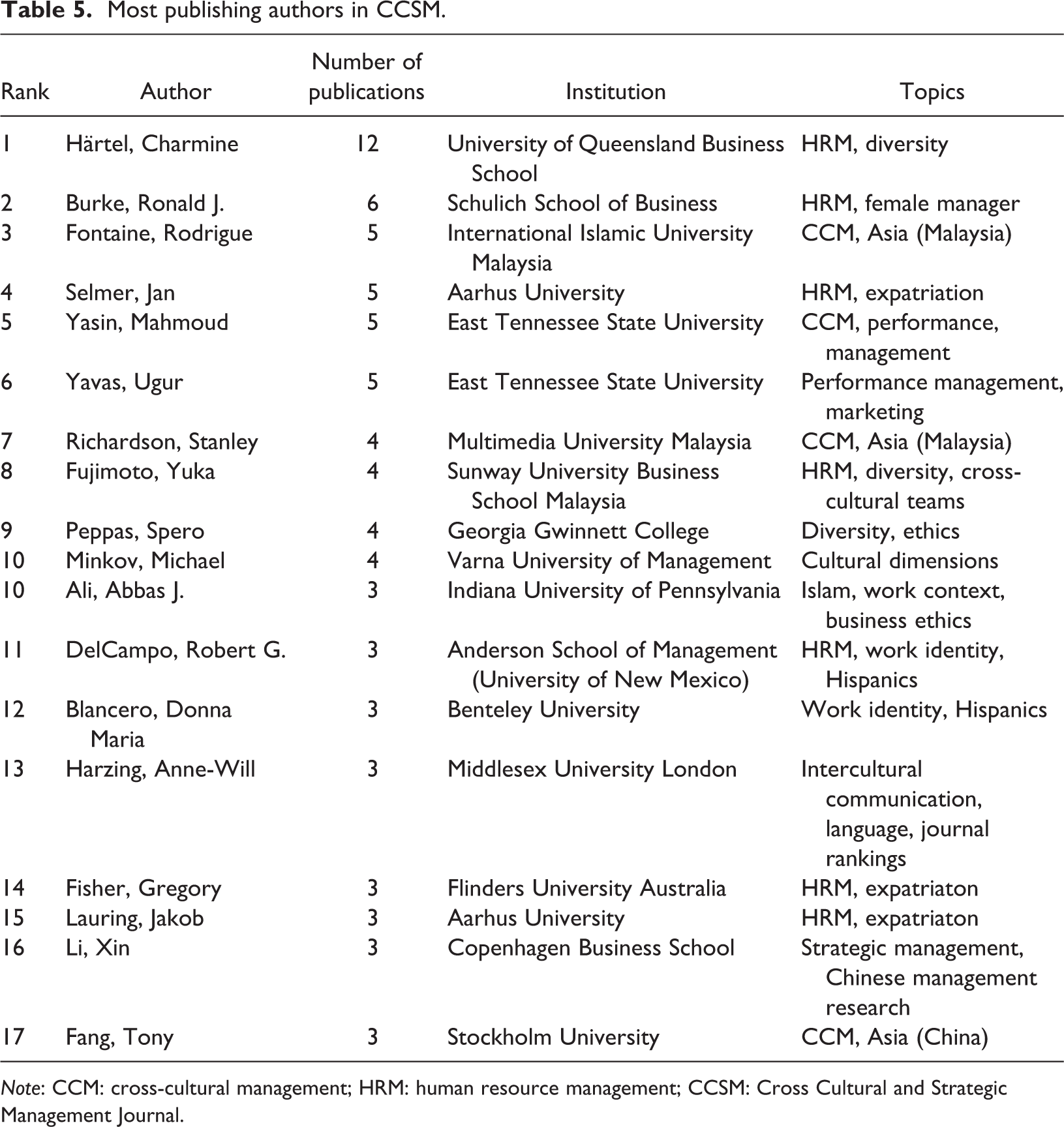
Note: CCM: cross-cultural management; HRM: human resource management; CCSM: Cross Cultural and Strategic Management Journal.
The top three authors in IJCCM between 2001 and 2018 are J. Selmer from Aarhus University, followed by Evert van de Vliert of the University of Groningen and M. F. Peterson from Maastricht University. These results are also in line with two of the most common topics—cultural dimensions and HRM.
Development of research paradigms
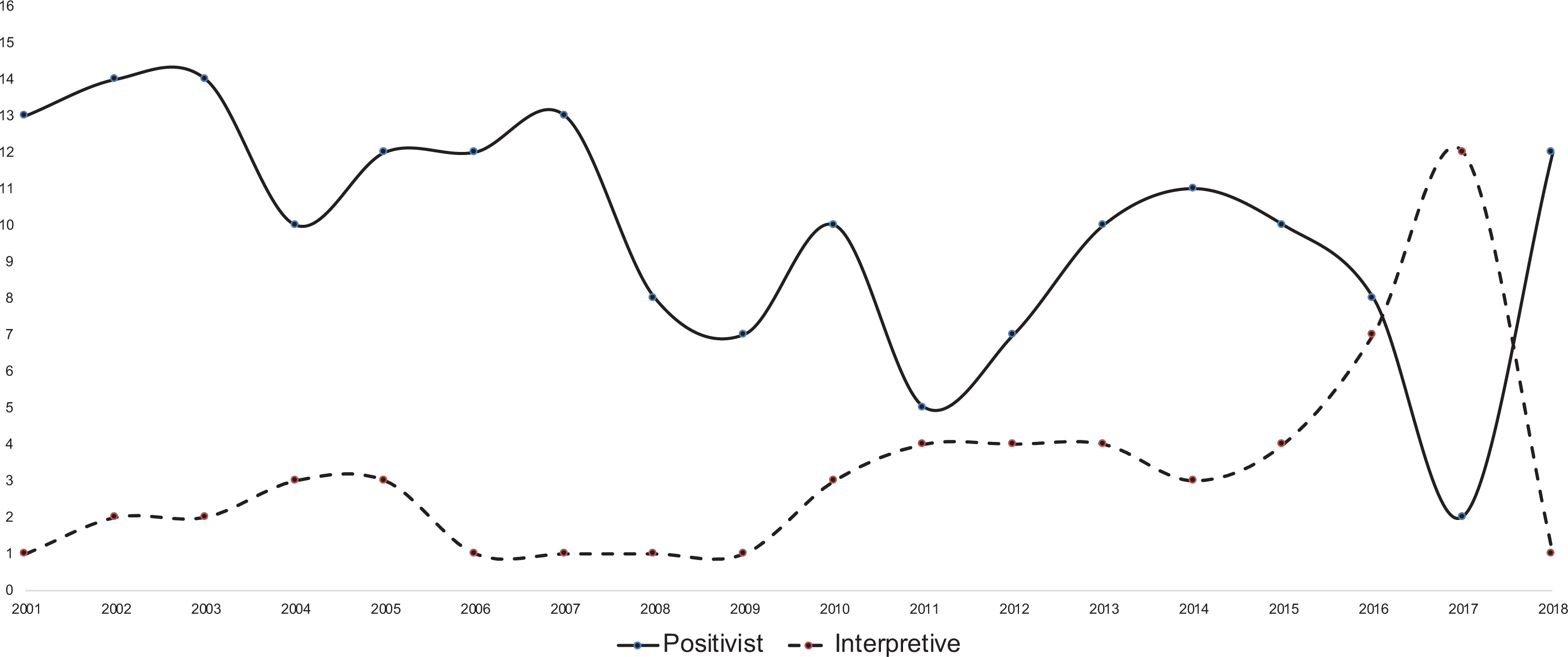
The paradigms used for the visualization were positivist and interpretive. Figure 5 shows a plot of the research paradigms occurrences in the merged journals over time.
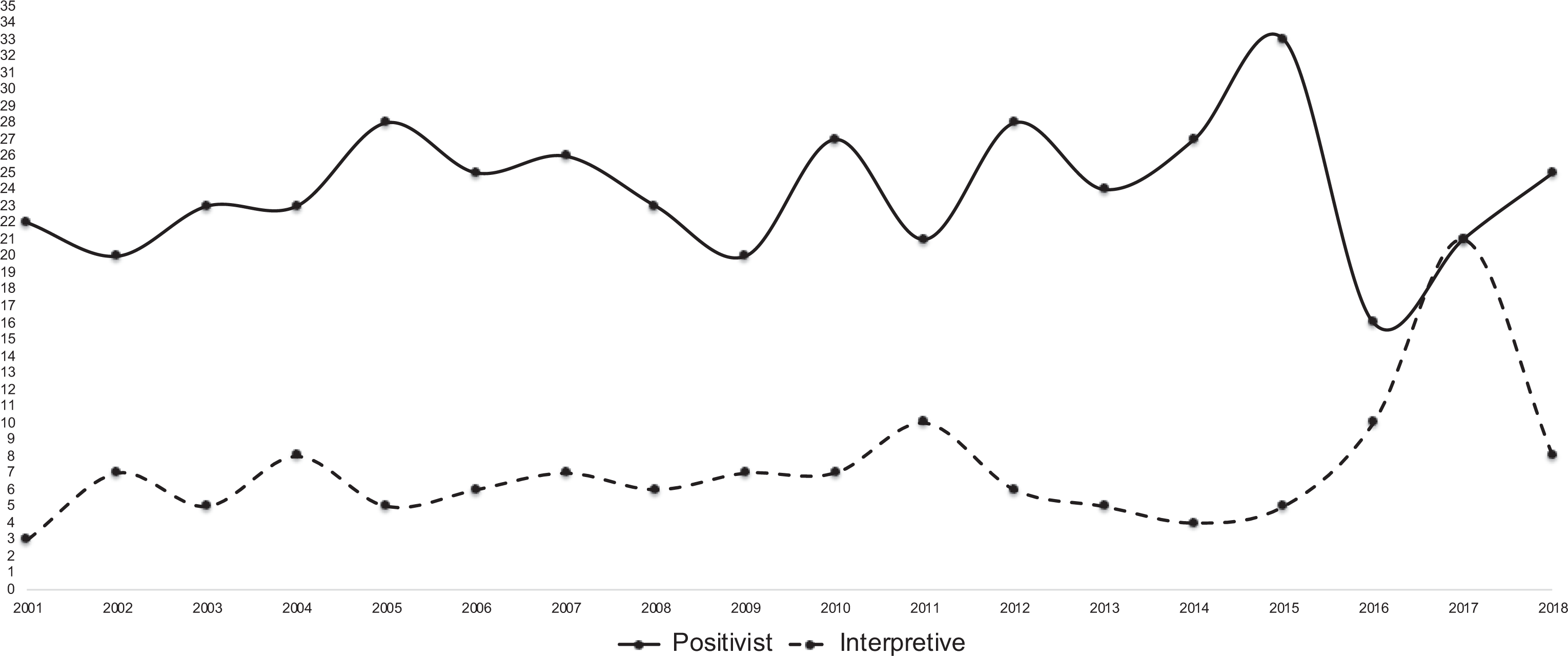
Research paradigms in merged journals by year.
Figure 5 of the paradigm represented in both journals shows the clear dominance of publications with positivist approaches for the totality of the period examined. However, after positivist publications reached its highest peak in 2015, there is a sudden and significant reduction in the number of positivist publications in 2016, which coincides with the highest peak of the number of papers with interpretive approaches in 2017. However, after 2016 positivist articles rise again, interpretive ones decline again. Publications with a positivist approach appeared 434 times in both journals, representing 77 percent of the corpus. The interpretive approach was used in 133 articles, which denote 23 percent of the total publications:
From a total of 333 empirical articles in the CCSM, the research paradigms were implemented with the following frequency: positivist 256 (77 percent) and interpretive 77 (23 percent).
From a total of 234 empirical articles in the IJCCM, the research paradigms were implemented with the following frequency: positivist: 178 (76 percent); interpretive: 56 (24 percent).
Regarding the research paradigms, the positivist approach is, by far, the most used in cross-cultural research publications, representing 77 percent of the papers published in both journals (see Figure 6). These results are in line with existing studies about the prevailing positivist paradigmatic state of the art in CCM (Brannen and Doz, 2010; Phillips and Sackmann, 2015; Primecz et al., 2009). Despite the call for a paradigmatic shift from positivist to interpretivist contributions in CCM (e.g. Brannen and Doz, 2010; Primecz et al., 2009), the claim of these authors still seems to be unheard by the research community. Even, against the aspiration to encourage publications from an interpretive paradigm, the contrary seems to manifest as publications located in a positivist paradigm, rather increased than decreased after 2008. Indeed, this development of the maintenance of positivist approaches may be linked to the predominant idea within the scientific community of positivist-quantitative methodologies as the only source of scientific accuracy, which therefore hold a higher esteem in scientific legitimacy (Babones, 2015; Donaldson, 2003; Niedzwetzki, 1984). Nevertheless, the sudden decrease of positivist papers in 2016 until 2017 might be an indicator for further consideration of interpretive designs, although the curve of positivist articles rises again in 2018, which should be reviewed by a subsequent analysis.
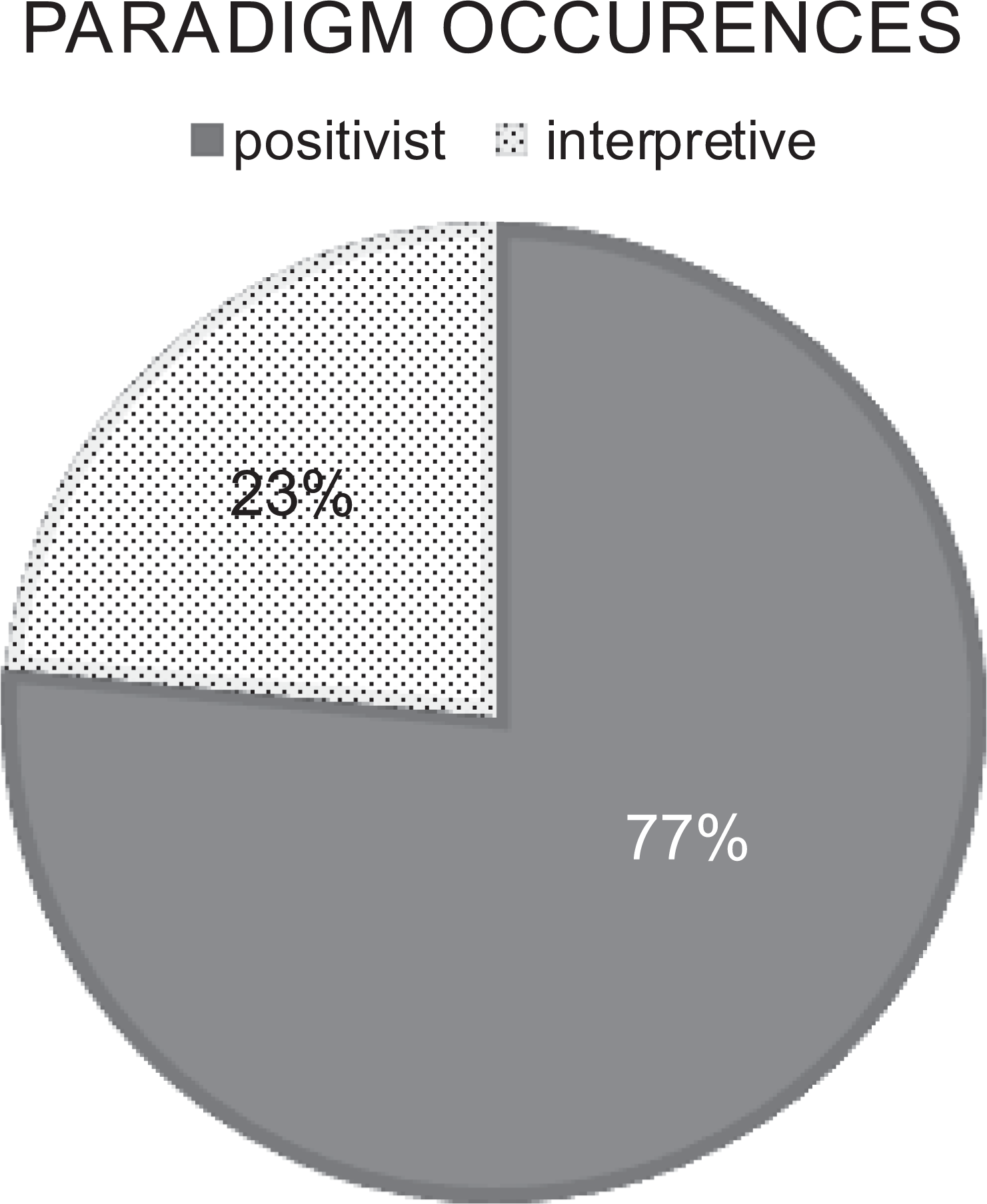
Research paradigm in merged journals in percentage.
However, when examining both journals separately (Figures 7 and 8), it becomes clear that the nature of the research paradigms in each journal is slightly different. The CCSM shows a stronger divergence of positivist and interpretive research paradigms, while the IJCCM exhibits a higher variation of both. Data reveal that the CCSM is in general a more positivist-oriented journal, publishing over all more positivist papers than the IJCCM. However, whereas positivist papers slightly increase in CCSM at the expense of interpretive articles (divergence), in IJCCM both perspectives rather approximate since 2006 (convergence). Nevertheless, the number of interpretive papers exceeded that of the positivist ones in 2016 only in the IJCCM. Although the CCSM followed a similar trend in 2016 of publications, the change was more notorious in the IJCCM. However, the two journals differ with regard to the latest development: whereas in 2018, it seems that the two paradigms slightly converge in CCSM, articles of the two paradigms drift apart again in IJCCM since 2017.
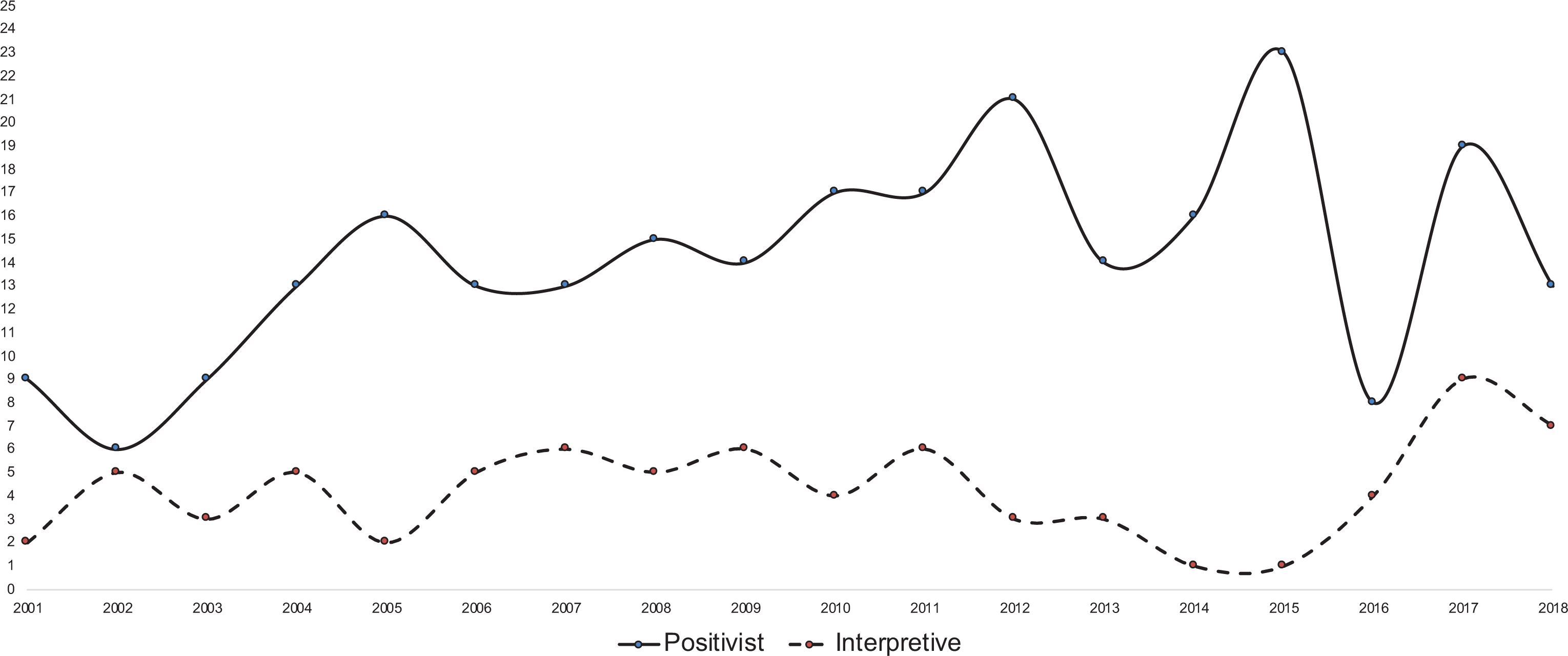
Research paradigm in CCSM per year. CCSM: Cross Cultural and Strategic Management Journal.
Research paradigm in IJCCM per year. IJCCM: International Journal of Cross Cultural Management.
In this regard, one aspect that stands out as one of the factors inducing the research and/or publications may be the influence exerted by certain recognized authors in the research field. This is shown by the great number of articles that offer solely reviews or complementary research of positivist studies on topics such as “cultural dimensions.” On the other hand, the special issue on CCM research presented by the IJCCM in the year 2009 may also be responsible for the spike in interpretive publications that took place during the following 3 years. However, proving the causality of these two factors would need a complementary study, such as a co-authorship review. In turn, the interpretive spike in IJCCM in 2017 can as well be linked to the special issue on “Language in Global Management and Business” in IJCCM in 2017, publishing almost only interpretive articles. However, here, the special issue does not seem to entail further interpretive studies as positivist articles rise again.
Development of research methods
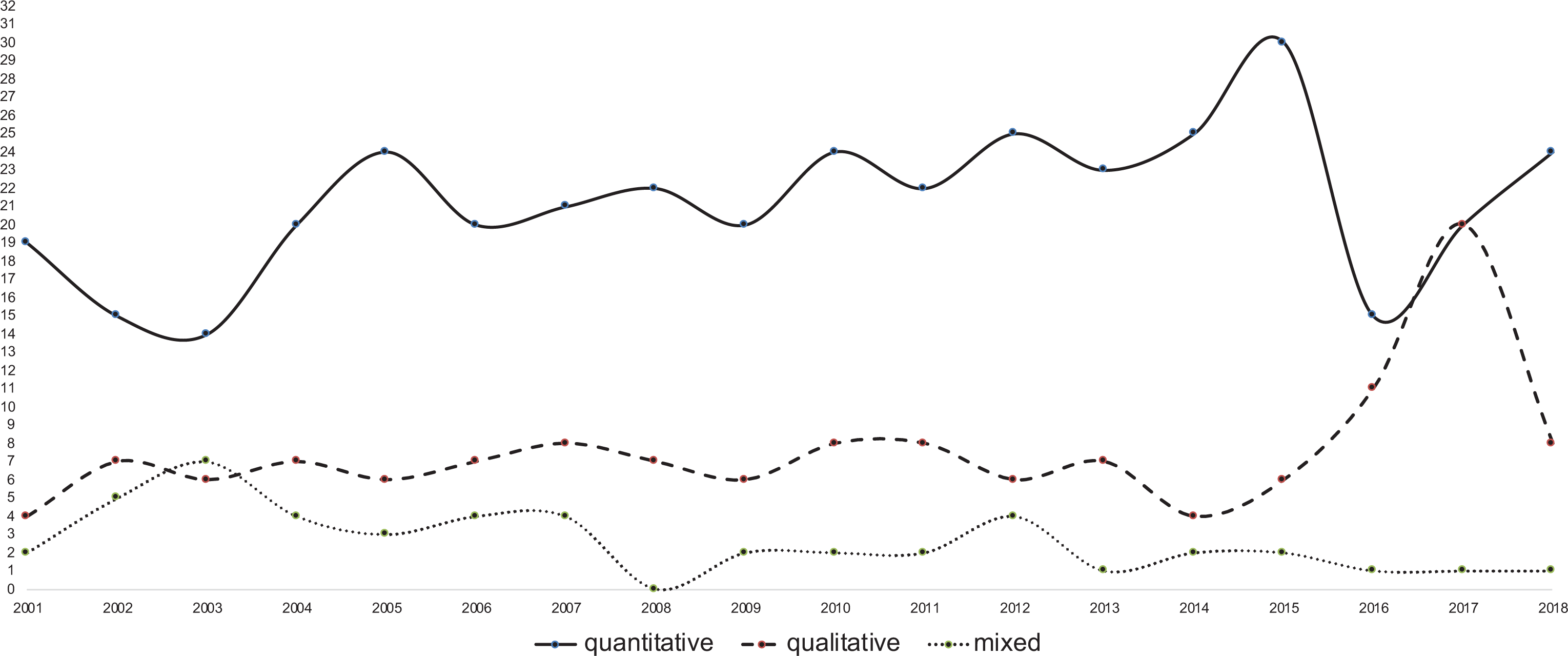
Following, the development of research methods will be presented. The logic follows the same as above. Figure 9 shows the plot of the research methodologies over time in the merged journals.
Research methods in merged journals by year.
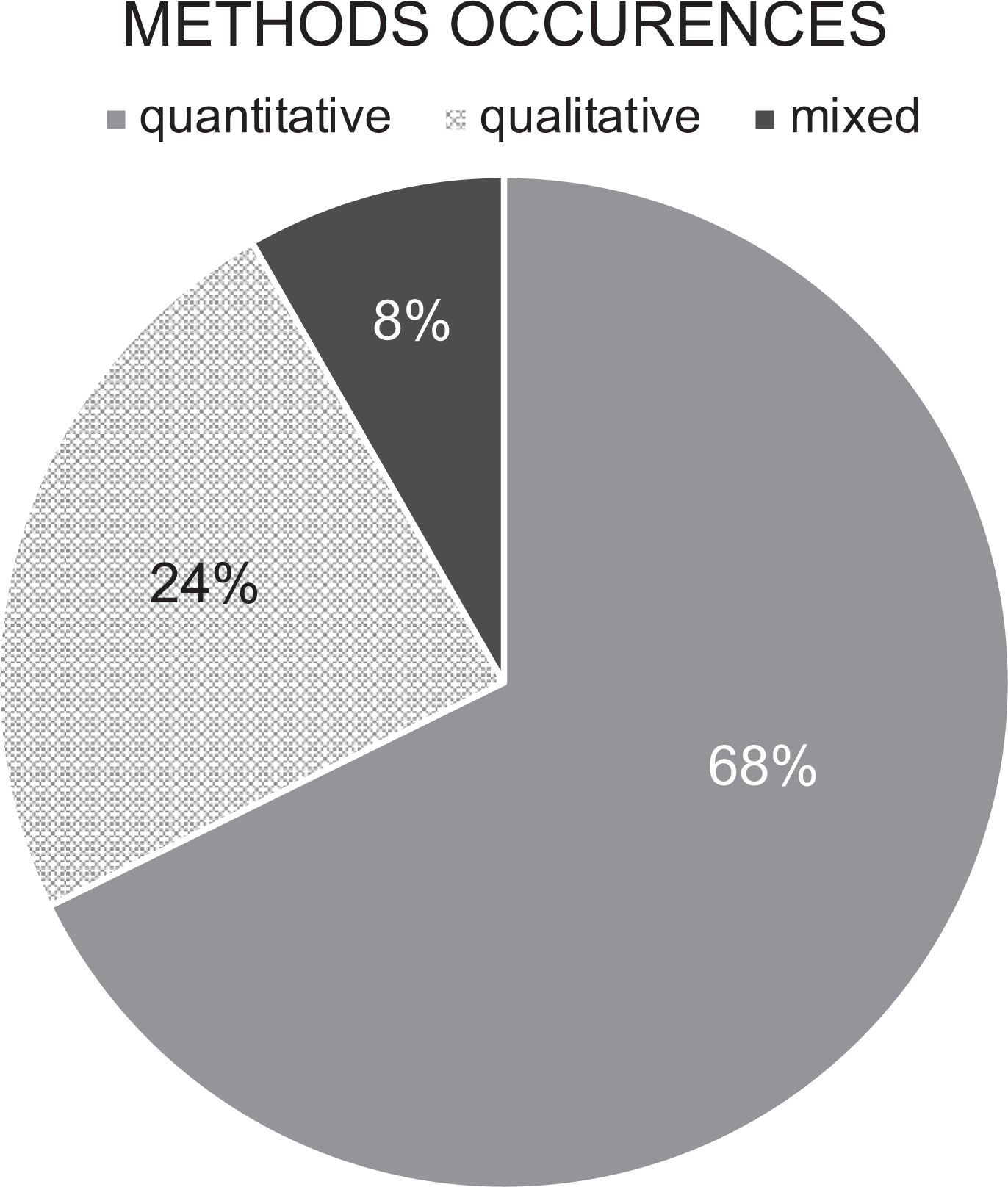
A subsequent representation of the method occurrences (Figure 10) shows that quantitative research method is used in 384 articles, which represent 68 percent of the corpus. The qualitative research method follows it with 136 articles that represent 24 percent, and mixed methods are only used in 47 articles, representing 8 percent of the corpus.
Research methods in merged journals in percentage.
In line with the results regarding the research paradigms, there is a clear dominance in the use of quantitative methods in CCM publications in the two journals. The slightly growing pattern of quantitative research methods exhibited in Figure 9 is only interrupted by a significant decline in the year 2016—a reduction of almost 50 percent in relation to the preceding year—which coincides with an increase in the number of papers with qualitative research methods, followed by an increase again in 2017 and 2018. However, the overall occurrence of papers with quantitative methods is almost three times larger than that of papers with qualitative or mixed methods. After their peak in 2002, qualitative publications stay relatively constant, and finally rise again between 2014 and 2017. Mixed methods show three peaks during the period analyzed, while they are almost equal with the numbers of qualitative papers published in 2003. Nevertheless, despite the existing recommendations of combining research methods in social sciences (Brannen and Doz, 2010; Flick, 2014a; Jick, 1979), the mixed-methods approach is the lesser used technique in the publications reviewed. The rare application of mixed-methods research design can be explained by the complexity of integrating both approaches. When using mixed methods, researchers need to have the sufficient expertise in quantitative—as well as qualitative methods, which is a considerable undertaking for a single person, or a small group of researchers involved.
From a total of 333 empirical articles in the CCSM, the research methods are implemented with the following frequency: quantitative 238 (71 percent), qualitative 74 (22 percent), and mixed methods 21 (6 percent).
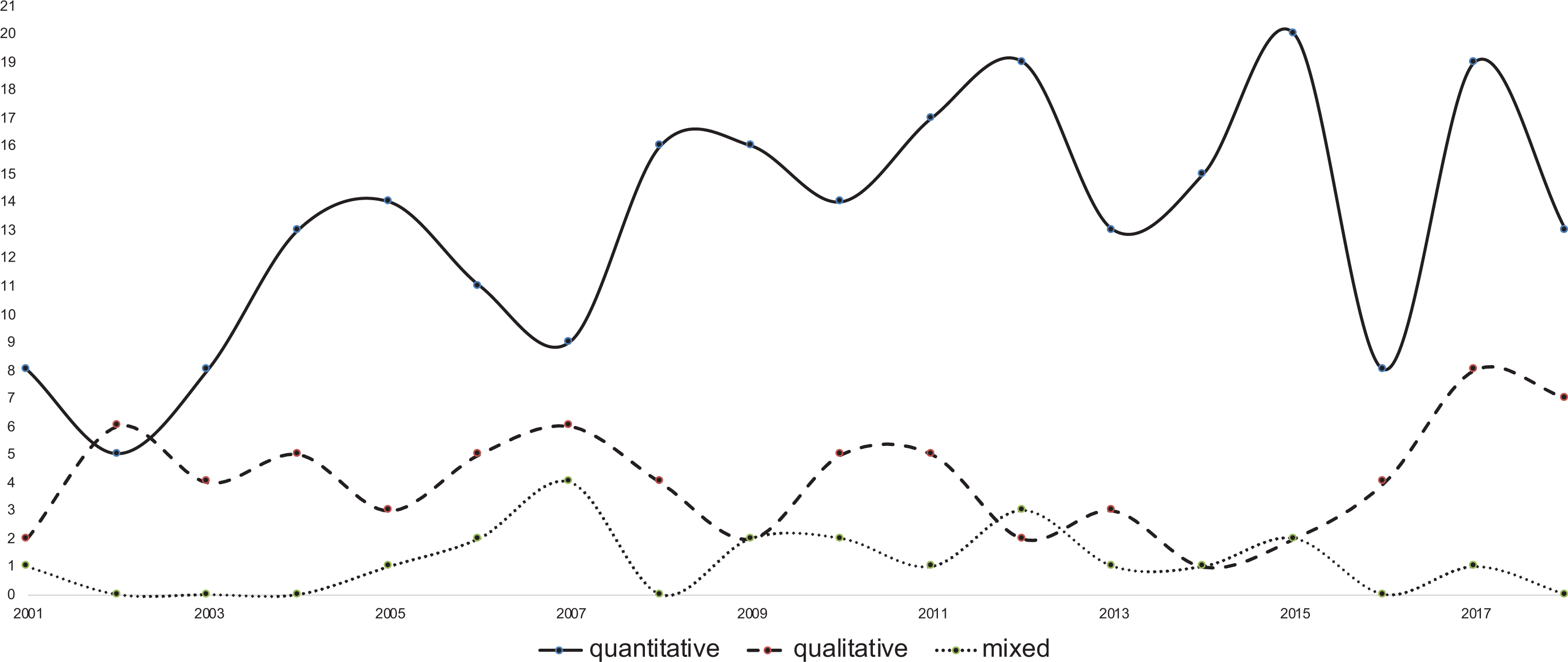
In Figure 9 of the merged journals and also in CCSM, an overall rise of quantitative publications can be observed. Overpassing the number of qualitative papers in 2002, a drop can be recorded in 2006, followed by a rise and preponderance of qualitative and mixed methods in the decade to follow. Only in 2013 and after their peak in 2015, the number declines considerably in 2016 to a number of eight articles. After starting with six publications in 2002, the number of qualitative papers diminishes in the years to follow and never surpasses the six publications per year until 2017, favoring quantitative methods. Only in 2017, the numbers of quantitative and qualitative papers converge again to 8 in number. Mixed-methods publications stay relatively low in number during all the 18 years.
From a total of 234 articles in the IJCCM, the research methods are implemented with the following frequency: quantitative 146 (62 percent), qualitative 62 (26 percent), and mixed methods 26 (11 percent).
Here, the variations are much more distinct: quantitative papers vary considerably in number of the years, revealing the highest peak of 12 publications in 2007 and 11 in 2018, followed by the lowest of 4 in 2009 and 2 in 2017.
From Figures 11 and 12, which consider both journals separately, we recognize the journal’s preference for publications with quantitative research methods in CCSM. The number of publications with mixed and qualitative research methods in the IJCCM is almost the same as the number of quantitative papers. From a total of 234 papers in the IJCCM, 62 percent had quantitative, 11 percent mixed, and 26 percent qualitative research methods. On the other hand, the publications with a quantitative research method represent 71 percent of the papers in the CCSM; and only 22 percent are qualitative, with combined methods at 6 percent. Qualitative publications approach the quantitative ones in number only in some years (2002, 2007, 2016). Nevertheless, an overall decline has been documented in qualitative articles after 2002 with a slightly rise again in 2016 and 2017.
Research methods in CCSM by year. CCSM: Cross Cultural and Strategic Management Journal.
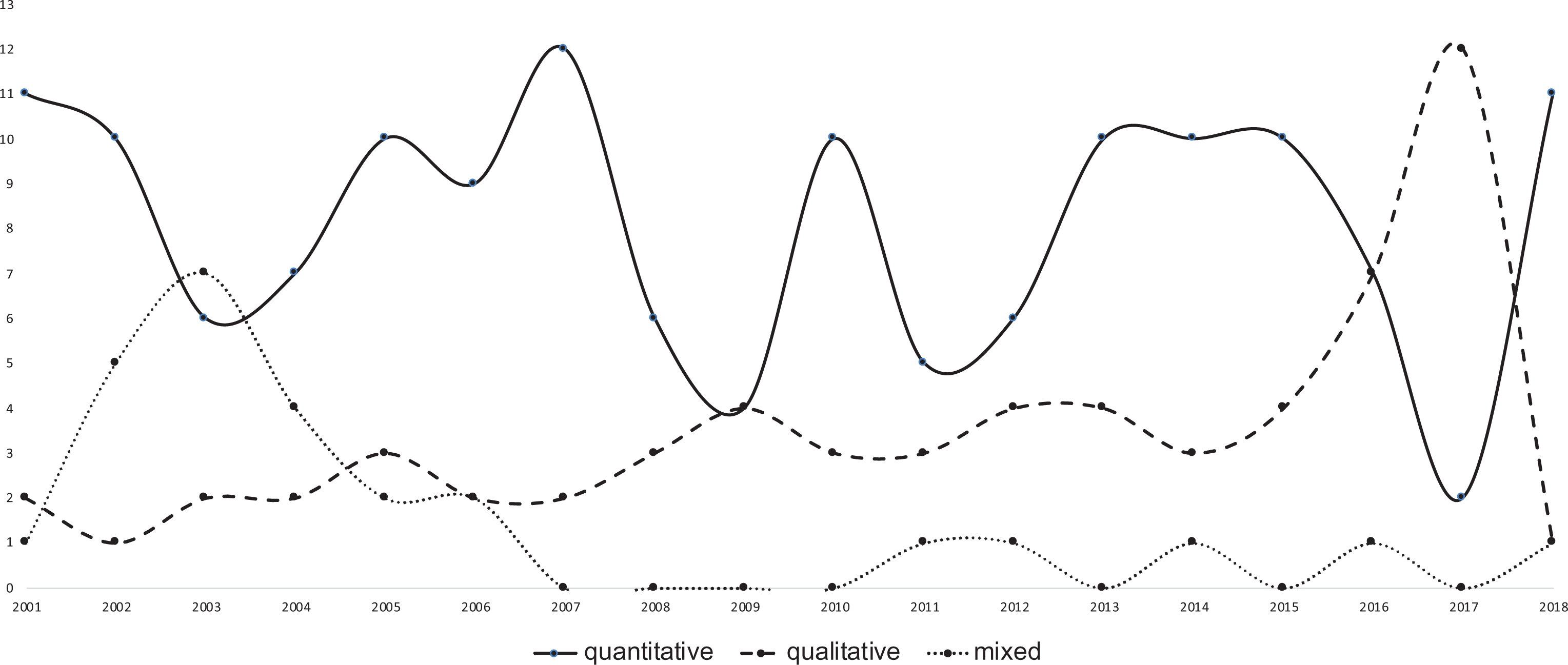
Research methods in IJCCM by year. IJCCM: International Journal of Cross Cultural Management.
The longitudinal changes of the research methods seen in both journals follow a similar pattern as those of the research paradigms. This trend is not surprising and has already been addressed by many authors, who recognize the hegemony of quantitative practices in the social sciences (Babones, 2015; Deetz, 1996; Flick, 2014a; Oesterle and Wolf, 2011; Romani et al., 2014; Vijverberg, 1997). A reason for the changes of applied methods in published papers may be due to the appointments of the editors in chief of the respective journals. The editors in charge function as gatekeepers for the approval—or disapproval—of papers submitted. So, the decrease of quantitative papers may be influenced by the appointment of Rosalie L. Tung, the Editor in Chief of the CCSM in 2015. In a paper published in 2016, she mentions the need to change and adapt the traditional strategies and methodologies used in cross-cultural disciplines in order to understand the challenges encountered in a more interconnected and heterogeneous world (Tung, 2016: 149). Her more reflective perspective may be one of the factors that have influenced the change in the direction of the selection of the papers (Oesterle and Wolf, 2011) published in the CCSM.
Also, Terence Jackson, current Editor in Chief of the IJCCM, is characterized for a special interest in promoting indigenous research and CCM research in sub-Saharan Africa from a nontraditional perspective as well as from a critical standpoint (Jackson, 2012). This may be one of the factors influencing the more heterogeneous research methodologies found in the papers published recently in the IJCCM.
The decline of qualitative papers, and the rise of quantitative ones, can be attributed to the scientific legitimacy of positivist, generalizable results (Babones, 2015; Niedzwetzki, 1984). Moreover, the dominance of quantitative papers might be due to the selection of the two anglophone journals. As the anglophone research community is characterized by a research heritage of performance and effectiveness, it is used to be more of quantitative nature than, for instance, the francophone one (Santistevan and Karjalainen, 2015).
Discussion
This study systematically examines research topics, paradigms, and methodical approaches of CCM over time in two leading academic journals of the research field: CCSM and IJCCM. The study resulted from the need to draw a landscape of the research field, and with it, illustrated the thematic, paradigmatic, and methodological changes taking place in CCM publications between 2001 and 2018. This study compliments the very few former studies in this field (e.g. Adler, 1983; Boyacigiller et al., 2004; Peterson and Søndergaard, 2012; Phillips and Sackmann, 2015). In general, the journal analysis shows that, in comparison with 1983 (Adler 1983), CCM can nowadays be seen as its own discipline which does intersect with other disciplines but puts light on own topics. Results of this work even proof the variety of research topics, the dominance of the positivist paradigm, and the influence of quantitative methods in the academic publications of both journals.
Regarding the topics, a quantitative analysis shows the persistent importance of Hofstede’s heritage of the cultural dimensions in recent CCM, cross-cultural HRM and practices, and the dominant consideration of corporate culture. Furthermore, the most common topics were corporate culture, HRM, cultural dimensions, cross-cultural psychology, intercultural competence, national culture, ideologies/religions, expatriation, economics, and institutional theory.
Further, the general dominance of positivist and quantitative articles over interpretive and qualitative (Brannen and Doz, 2010; Pudelko et al., 2015) could be proven in both journals. Here, we recognize a clear trend in the relation between research methods and paradigms (Babones, 2015). The claim for an increase of qualitative research designs from an interpretive perspective in CCM (e.g. Brannen and Doz, 2010; Primecz et al., 2009) seems partially to be heard—as the convergence of the numbers of interpretive/positivist and qualitative/quantitative articles in 2017 reveal.
The articles since 2016 show that topics such as language, power relations, and gender issues are becoming increasingly important in CCM research, which are located rather in an interpretive, critical, or postmodern paradigm (Primecz et al., 2016). This might represent the first herald of a possible paradigm shift toward more qualitative studies in CCM research.
However, already in 2018, the positivist paradigm with quantitative methods is again favored in CCM. This could be due to the enduring higher esteem of generalizable results, as proof for scientific accuracy and therefore scientific legitimacy (Babones, 2015; Niedzwetzki, 1984). As well, it might be due to the fact that anglophone publications show to follow a quantitative research tradition (Santistevan and Karjalainen, 2015). An analysis of the future publications is necessary to prove if this trend holds on.
By further analysis, the question of which factors determine the dominance of the three elements arises. Concerning topics, there is surely a sort of Zeitgeist that in an increasingly globalized world contributes to the emergence of research topics which show practical relevance for international organizations.
Paradigms and methods are strongly influenced by academic disciplines. But what is the role of academic journals here? How are thematic and editorial orientations influenced? In the choice of accepted papers, not only the scientific standards—which are culturally and temporarily based conventions—play a key role, but also the editorial board and the editors in chief (Oesterle and Wolf, 2011). In this line, changes in the editorial board of the journals, so for example with Rosalie Tung as editor in chief for CCSM and Terence Jackson for IJCCM, may favor increasing consideration of qualitative studies due to the qualitative research background of these scholars, authors, and editors.
However, although the shift of editors in chief and the publication of special issues may explain methodological changes observed along the examined period, it is difficult to determine the exact causality, that is, the extent to which the publications influence the work of researchers or vice versa that determines the trends discovered in this study. The development observed in the year 2017 and the causal relations underneath are worthy, complementary research efforts. Particularly, it would be necessary to examine the further development of the research papers taking place in the years following 2018 in both publications. In relation to this, an overview of the publications of the IJCCM in 2019 confirms the trend observed in 2018, which indicates a higher number of quantitative over qualitative papers again.
There are some evident limitations in our study and indications for future research.
The first limitation concerns the choice and selection of the corpus. It might be in doubt that academic journals only represent the field, as textbooks, monographs, or edited volumes also play a key role within a research field. An analysis of these publications could be promising in further research.
A second limitation is linked to the fact that only two journals, both of English-speaking countries, were examined. This is of course problematic: The analysis of publications in international journals is also an analysis of Anglo-Saxon literature and thoughts. Chanlat (2014) as well as Tietze and Dick (2013) narrowed their focus on the hegemony of Anglo-Saxon thought and writing, with the result that ideas, theoretical frameworks, and results from other linguistic regions are less visible. In particular, the French works of Philippe D’Iribarne (2009), D’Iribarne et al.’s (2020) school (Chevrier, 2009, 2011; Viegas-Pires, 2013), and other Francophone researchers (Barmeyer and Davoine, 2019; Chanlat et al., 2013; Chanlat and Pierre, 2018; Dupuis, 2014) can be attributed to an interpretive, rather than a functionalist paradigm. Articles in other languages from French, German, Spanish, Russian, or Chinese journals were not considered. This important linguistic enlargement could be done in the future by an international research team.
The third limitation concerns itself with using just three elements—topics, paradigms, and methods—to analyze the research field of CCM. To get a more complete overview of the CCM filed, research could be extended to include elements of a scientific community, such as the origin of the authors, importance of the academic institution, specific theoretical, and conceptual frames and research questions. Moreover, within the paradigms, only two of the four paradigms from Burrell and Morgen (1979) were regarded: the functionalist and interpretive. A further study shall also include the radical humanist and radical structuralist paradigm, or the critical and postmodern ones (Primecz et al., 2016).
A fourth limitation is that we focused only on journals of CCM, while neglecting to include other academic journals in our research that publish in IB and IM, or organizations’ studies with CCM topics. In the future, the data corpus could be extended to journals in these fields like the Journal of International Business Studies, International Business Review, Journal of World Business, Critical Perspectives on International Business, or Organization Studies. Other longitudinal analysis of this kind, comprising of the publications from other journals, would make it possible to have more representative evidence of the nature of the research field and the relations existing between the methodological orientation of each journal, the organizational world, and the scientific community in the field of CCM.
As a final statement, besides the relations analyzed in this study, there are countless other relations that can be further examined based on the raw data that were obtained from the classification of the journals. For example, it would be of interest to combine and cross topics with research methods in paradigms to study if some CCM subfields show special characteristics regarding qualitative or quantitative methods and interpretive or positivist paradigms. In this sense, it is of importance to mention that the easier access to and the implementation of new computer-assisted tools enable the application of automatized methods that, as a complementary tool, enhance the work of researchers in social sciences. Just like it was in the case with Voyant Tools, it is recommended to look for and make use of other open-source tools that can be used for different research purposes.
Footnotes
Declaration of conflicting interests
The author(s) declared no potential conflicts of interest with respect to the research, authorship, and/or publication of this article.
Funding
The author(s) received no financial support for the research, authorship, and/or publication of this article.

Note
Appendix 1
Terms used for topics analysis: 23 umbrella terms with three word examples each.
| Umbrella term | Examples | ||
|---|---|---|---|
| 1. Human Resource Management | Corporate Training | Human Capital | Job Performance |
| 2. Psychology | Multicultural Identity | Occupational Stress | Social Intelligence |
| 3. Interculturality | Cultural Differences | Cultural Integration | Cross-Cultural Communication |
| 4. National Culture and Environment | Colonial History | Developing Countries | Governance |
| 5. Management | Leadership styles | Diversity Management | Strategic Management |
| 6. Research and Management Models | Dual-concern conflict model | Total Quality Management (TQM) | Uncertainty Reduction Principle |
| 7. Linguistics | Bilingualism | Translation | Language |
| 8. Technology | Global Virtual Teams | IT | Technological Innovation |
| 9. Cross Cultural Management Research | Cultural Metaphors | Cultural Paradoxes | Positive Organizational Scholarship |
| 10. Economics | Economic Development | Emerging markets | Globalization |
| 11. Ideologies/Religions | Guanxi | Postcolonial Theory | Religion |
| 12. Marketing | Branding | Consumer Behavior | Customer Satisfaction |
| 13. Expatriation | Expatriate Network | Expatriate Adjustment | Host Country Nationals (HCN) |
| 14. Corporate Culture | Organizational Change | Organizational Identity | Organizational Citizenship |
| 15. Education | Academics | Teaching CCM | Universities |
| 16. Gender | Gender Inequalities | Gender Diversity | Women Leadership |
| 17. Intercultural Competence | Cross-Cultural adaptability | Cultural Intelligence | Cultural Awareness |
| 18. Migration | International Career Mobility | Skilled Migration | Social Integration |
| 19. Environment | Climate | Corporate Environmentalism | Sustainability |
| 20. Institutional Theory | Institutional Distance | Organizational Justice | Corporate Social Responsibility (CSR) |
| 21. Creativity and Innovation | New Product Development | Innovation | Creativity |
| 22. Cultural Dimensions | National Cultural Diversity | Cultural Distance | Power Distance |
| 23. Work Related Conflicts | Conflicts | Work-Family Conflicts | Conflict Mediation |