




Abstract
Cross-cultural management (CCM) studies is a multi-paradigmatic discipline which is commonly differentiated into functionalist (positivist), interpretive and critical, and intercultural training is its applied version in practice. Paradigms are ‘lenses’ from which to view reality. If paradigms are juxtaposed – considered in light of each other – apparent contractions across paradigms might be resolved and metatheoretical insights across multiple paradigms may be achieved. This article exemplifies paradigm juxtaposition based on a clearly specified empirical problem, namely: ‘how to manage Muslim minorities at work’. Based on the Burrell and Morgan taxonomy, paradigms may be differentiated based on two dimensions, namely objective and subjective, and regulative and radical change approaches. This article firstly shows how juxtaposing these four paradigmatic lenses enables a more holistic and sophisticated approach to the ‘problem’ for which the intercultural training is ordered and thus results in a better-fitting and more nuanced intercultural training practice. Secondly, this article establishes why the present academic practice of subsuming multiple approaches under the umbrella term “critical CCM” is insufficient for solving contemporary cross-cultural management problems. Consequently, critical CCM studies need to be re-differentiated into objectivist and subjectivist worldviews.
Keywords
A medium-sized high-tech company in former East Germany needs to employ high-skilled engineers in its research and development department. The company is local, but a market leader in a specialized global niche nonetheless. Due to shortage of skilled labour in Germany, corporate Human Resources (HR) now turns to the international market. For facing this internationalization challenge, a new corporate head of HR has been hired from a major German international player. Corporate HR identifies and interviews potential international candidates via an international agency. These are highly-skilled research engineers who think of themselves as “global talents”; for them, Germany is but another stepping stone in their international career. The company helps with formalities and with settling in Germany, and, suddenly, there is an international workforce at the offices. The new research engineers originate from a variety of countries, ranging from Serbia to Indonesia; they are fluent in the English language – the universal language of science, also in this local German company –, and they are very competent on the job. Work-wise, there are no complaints by any of the managers (all of them ethnic German). However, HR starts getting managerial and employee complaints about perceived ‘irreconcilable cultural differences’: Somehow, the new international employees do not seem to fit, and the perceived reason is their ‘practicing Muslim religion’, or in other words: their ‘saying prayers’ at work. Historically, religiousness at work was shunned in East-Germany, also in this company; there has never been a corporate Christmas party, and there is no sending of Christmas cards to clients and partners. Most employees from the region identify as atheist; they also find the Christian beliefs and practices of some of their West-German colleagues ‘rather strange'. However, it is ‘Muslim religion’ that now tips the scale. HR thus decides for organizing an intercultural training program on “Islam” and “working together with Muslims”, and, for delivering this service, an intercultural training agency is contacted.
Ethnographic vignette, distilled from own research
Introduction
Cross-cultural management (CCM) studies is about understanding and, consequently, managing cultural diversity and categories of difference between cultures. Intercultural training is an applied cross-cultural management tools for achieving this goal (Mahadevan, 2023b). In contrast to a previous era, cultural diversity, and the need to approach categories of difference in an interculturally competent manner, no longer manifests primarily ‘abroad’ but mainly ‘at home’ (Maznevski, 2020), due to people’s mobility and migration, and the history thereof (Mahadevan, 2023a). Rather than ‘training for going abroad’, intercultural training thus needs to focus on ‘training for cultural diversity at home’ (Maznevski, 2020). This article shows how the categories of difference which managers and trainers proceed from, in this case: as related to Muslim minorities at work, result in a more or less sophisticated, and thus a better or worse fitting intercultural training practice. This article shows this by juxtaposing the paradigms that might underlie intercultural training activities.
Paradigms provide ‘lenses’ through which one conceptualizes reality (Hatch and Cunliffe, 2006), and, depending on the respective glasses which one is wearing, the realities of what will be perceived as ‘cross-cultural management truth’ will change (Mahadevan, 2020b; 2024a). Contemporary paradigmatic delineations in CCM studies differentiate the discipline into functionalist (or: positivist), interpretive and critical (or: power-sensitive) (Barmeyer et al., 2019). Juxtaposition (based on Lewis and Grimes, 1999) is a multiparadigm technique by means of which paradoxes may be comprehended in theory and practice, thus allowing for cross-fertilization across paradigms.
Paradox (also see Lewis, 2000) refers to “a statement or situation that may be true but seems impossible or difficult to understand because it contains two opposite facts or characteristics” (Cambridge Online Dictionary, 2024). Paradoxes in relation to difference categories are relevant to CCM studies: They are a common experience in a culturally-complex world (Mahadevan, 2023a), in which the demarcation lines between cultures and identities are often blurred and context-dependent, and in which people are both similar and different to each other, depending on context and the identity factors that come to the foreground for specific purposes and in a specific situation (Mahadevan and Primecz, 2024). Or, in other words: any difference category that is chosen for explaining the opening case (national culture) might be contradicted by another one (e.g. religion), or even be counterbalanced by the assumption of a shared engineering culture across nationality and religion. Such overlaps and tensions between difference categories often seem irresolvable and create strong feelings of otherness in organizations (Mahadevan, 2024c).
This article argues that, prior to training for cultural diversity at work, cross-cultural management scholars and intercultural trainers need to reflect upon the paradigmatic assumptions which they make. This is relevant because the paradigmatic assumptions made shape the categories of difference (thus: the problem) for which the training is ordered, designed and conducted. I argue that, for the best possible outcome, managers and trainers need to hold different paradigmatic viewpoints against each other, and, this way, become aware and explicate their tacit assumptions of what constitutes the presumed ‘difference’ to be managed. I propose paradigm juxtaposition as a specific multi-paradigmatic method (Lewis and Grimes, 1990) for doing so.
My argument is based on 18 months of pre-COVID ethnographic research in a German company (see Mahadevan and Kilian-Yasin, 2017). This research delivered a key ‘practical’ cross-cultural management problem which I densified in the introductory vignette (for vignette methodology, see Agar, 1995), namely: what kind of intercultural training activity to deliver for managing ‘Muslim minorities at work’? Muslim minorities, and their descendants, are a relevant cultural minority group to be considered by intercultural training practice in many Western countries (Romani et al., 2018c), also Germany (Weichselbaumer, 2016). Religious diversity, also as related to Muslim minorities, has therefore become a key cross-cultural management theme (overview in Peltonen, 2020) and a relevant intercultural training need. Through paradigm juxtaposition, I show how a (much better) training can be conceived with the help of four different paradigmatic ‘lenses’, resulting in a more holistic approach for the resolution of the ‘problem’ for which the training is ordered.
The contributions of this article are methodological, practical and meta-theoretical. Methodologically, paradigm juxtaposition is introduced as a novel multi-paradigmatic approach to CCM studies. The practical contribution lies in the problem-based, empirical multi-application of paradigm juxtaposition, enabling the design of more sophisticated and better-fitting intercultural training activities. Thirdly, through referring back to the Burrell and Morgan (1979) paradigm taxonomy, I show that the present paradigmatic delineation in CCM studies into merely three paradigms (positivist, interpretive, critical) obscures a key difference within the critical paradigm, namely the distinction between subjectivist and objectivist assumptions about social reality. I therefore identify the need to differentiate critical CCM studies into two approaches which I label ‘critically-interpretive’ and ‘critically-functionalist’. These interrelated contributions are exemplified by, but not limited to, the phenomenon of Muslim minorities at work and to designing and delivering an intercultural training activity with regard to the empirical problem of ‘managing Muslim minorities at work’.
In order to make this contribution, I firstly outline the contours of the intercultural training business and provide an overview on the main CCM paradigms, namely functionalist, interpretive and critical. Referring back to the Burrell and Morgan (1979) matrix, I then develop a more nuanced and better-fitting paradigm taxonomy for cross-cultural management studies, making the point that the critical CCM paradigm needs to be differentiated based on the worldviews underlying it, namely into critically-interpretive (subjectivist) and critically-functionalist (objectivist). Referring back to the empirical intercultural training problem of this article, namely the question of how to ‘manage Muslim minorities at work’, I then discuss the possibility of a multi-paradigmatic intercultural training business by juxtaposing the difference category of ‘Muslim minorities’. Next, I draw specific and general implications for how to design and conduct an intercultural training activity, and for paradigmatic delineations in CCM studies. Finally, I summarize and conclude.
Cross-cultural management paradigms and the intercultural training business
Intercultural training refers to an external human resource (HR) development activity which is commissioned by the internal HR department and executed by an external training agency, for a group of employees in need of this training (Szkudlarek, 2009). The focus of intercultural training activities lies on applied and easy-to-use models, with the goal to develop participants’ intercultural competencies, thus: their abilities to act more effectively and appropriately in a context characterized by cultural diversity (Spitzberg and Changnon, 2009). Many of these trainings are short-term preparatory activities (e.g. one- or two-day seminars, see Szkudlarek, 2009; Mahadevan, 2017). A good intercultural training needs to include appropriate learning methods, such as experiential learning (Kolb, 1984), facilitated by means of intercultural simulations or role plays, to make participants approximate the cultural context for which their intercultural competencies are being developed (Leeds-Hurwitz, 2010; Pusch, 2004).
The interrelations between those trained, those commissioning the training and those executing it have been referred to as ‘the intercultural training triangle’ (Mahadevan, 2017), and the experts of how to develop intercultural competencies (in this case: the trainers) are sometimes named ‘Interculturalists’ (Dahlén, 1997). As Szkudlarek (2009), and Romani and Szkudlarek (2014) show in their investigations of the intercultural training business, the processes in the intercultural training triangle are complex and not easy to steer. As a major issue, those facilitating the intercultural training activity might overstress cross-cultural differences or the ‘otherness’ of the target culture of the training in order to sell their service to the organization and to support own claims to cultural expertise, this being a major ethical issue in the intercultural training business (Dahlén, 1997; Szkudlarek, 2009). Furthermore, academia has found the intercultural training business to be overly simplistic, for instance, due to focussing solely on cross-national cultural differences (Mahadevan, 2017) or due to relying on simplistic intercultural interaction models (Mahadevan, 2023b). Given the complexities of how people perceive their ‘otherness’ in relation to each other in today’s world (e.g. Mahadevan, 2024b; Mahadevan and Primecz, 2024), a ‘better’ intercultural training is thus a training that is sophisticated enough to take alternative explanations beyond national culture into account and that is also critical of any explanation which seems to ‘solve the problem’, which then results in a more nuanced and, ultimately, ‘better-fitting’ training practice.
The empirical problem of this article
In corporate practice, there is always an empirical problem for which an intercultural training is ordered, designed and conducted. The empirical problem of this article is depicted in the introductory vignette, namely: How to ‘manage Muslim minorities at work’? The vignette thus also establishes the difference category that seems to be the ‘problematic’ one, namely ‘religious-based difference’, as related to the new minority groups of ‘Muslims’.
The authority of the vignette is rooted in the empirical process from which it stems (Agar, 1995; Van Maanen, 2006), namely from 18 months of part-time ethnographic research in German company which was conducted post 9/11, prior to the so-called refugee crisis in Europe, and pre-COVID. In previously published articles, I have elaborated upon methodology (Mahadevan, 2012a; Mahadevan and Moore, 2023), and I have also contextualized this research both spatially and temporally (Mahadevan and Kilian-Yasin, 2017; Mahadevan, 2024c). For the purpose of this article, it is mainly the vignette itself, and what it implies for how to handle categories of difference with regard to a multi-paradigmatic intercultural training practice, that is relevant, not the process of when and how this vignette came into being.
What are paradigms, and why does one need to consider them?
CCM studies are characterized by different paradigmatic orientations (see Lowe et al., 2007; Primecz et al., 2009; Romani et al., 2018a), commonly referred to as positivist or functionalist (Sackmann, 2020), interpretive (Cardel Gertsen and Zølner, 2020) and critical CCM studies (Primecz et al., 2016; Romani et al., 2018b), with some authors also considering postmodernism as a distinct, fourth paradigm (Romani et al., 2018). Based on a systematic literature analysis conducted by Barmeyer and colleagues (2019), the main paradigms in present CCM studies are positivism (functionalism) and interpretivism, with critical CCM studies as the upcoming paradigmatic orientation (also see Romani et al., 2018b). All paradigmatic orientations have the potential to inform intercultural training activities in practice. However, what remains unclear is: which paradigm to choose, and for which reasons and to what purposes?
Generally speaking, a paradigm is an assumption, rule or principle that people within a certain school or discipline accept as true, and the way in which researchers study their object of interest or in which managers approach their practice is usually in-line within these paradigms (Hatch and Cunliffe, 2006: 1-18). Paradigms influence cross-cultural management research and practice on three levels, namely ontology (what is reality and how can we understand our existence?), epistemology (what is knowledge and how can we obtain it?) and method (how can we study this reality?), and, because the answers to the stated questions seem ‘true’ (see before), researchers and managers might not be aware of the paradigmatic perspectives underlying their doings. From this angle, the biggest danger to intercultural training in practice is thus following a certain paradigmatic orientation without being aware of doing so. Furthermore, there is the question as to whether existing paradigmatic delineations in CCM studies provide researchers and practitioners with the ‘full picture’ and adequate advice of how to approach and, consequently, manage categories of difference.
A differentiated paradigm taxonomy for cross-cultural management studies
For answering the questions how categories of difference should be conceptualized by CCM studies, this article goes back to the first paradigmatic taxonomy that was suggested to management and organizations studies, namely the Burrell and Morgan (1979) matrix. This taxonomy also lies at the heart of present paradigmatic delineations in CCM studies (see Romani et al., 2018b). However, when CCM studies received the original typology, a relevant distinction was obscured, and limits the disciplinary potential of providing advice for how to approach categories of difference. This limitation will be outlined in the following.
The Burrell and Morgan (1979) taxonomy, and how it was received by CCM studies
In their original taxonomy, Burrell and Morgan (1979) describe four paradigms which they differentiate with regard to two dimensions: objective ontology (reality exists objectively) versus subjective ontology (reality is interpreted by humans), and sociology of regulation versus sociology of radical change. This results in four, not three paradigms.
Objectivism versus subjectivism is a relevant demarcation line: If one assumes reality to be objective, then one pays attention to systems and functions and wishes to ‘measure’ cross-cultural differences. If one assumes reality to be subjective, then one pays attention to meaning, and how it is constructed between people (intersubjectively).
Regulation versus radical change orientation determine the definition, goals and practices of ‘good’ research and practice in different ways: Within the sociology of regulation, one trusts systems and meaning-making to fulfil their purposes. The objectivist regulatory perspective understands systems and social structures to be well-functioning; the subjectivist regulatory perspective assumes meaning to be coherent and converging. Consequently, ‘good’ research and practice are about contributing to or improving upon social regulation. Depending on the underlying worldview, this means to contribute to well-functioning systems and structures (functionalism) or to find the best possible way of how meaning is regulated (interpretivism).
However, if one is critical of systems and meaning-making (sociology of radical change), then systems and social structures are assumed to be oppressive (objectivist radical change), and meaning is assumed to be contested and diverging (subjectivist radical change). Consequently, ‘good’ research and practice are about locating the need for and facilitating radical change. ‘Radical change’ refers to a change that is fast-paced and systemic, and that modifies the very essence of social and organizational structures or practices. Depending on the underlying worldview (objectivist or subjectivist), the focus of radical change is either on fundamentally changing ‘how the system works’ (radical structuralism) or on moving beyond dominant, hegemonic meanings, e.g. by deconstructing and offering alternative readings of the social world (radical humanism).
A paradigm taxonomy for cross-cultural management studies.
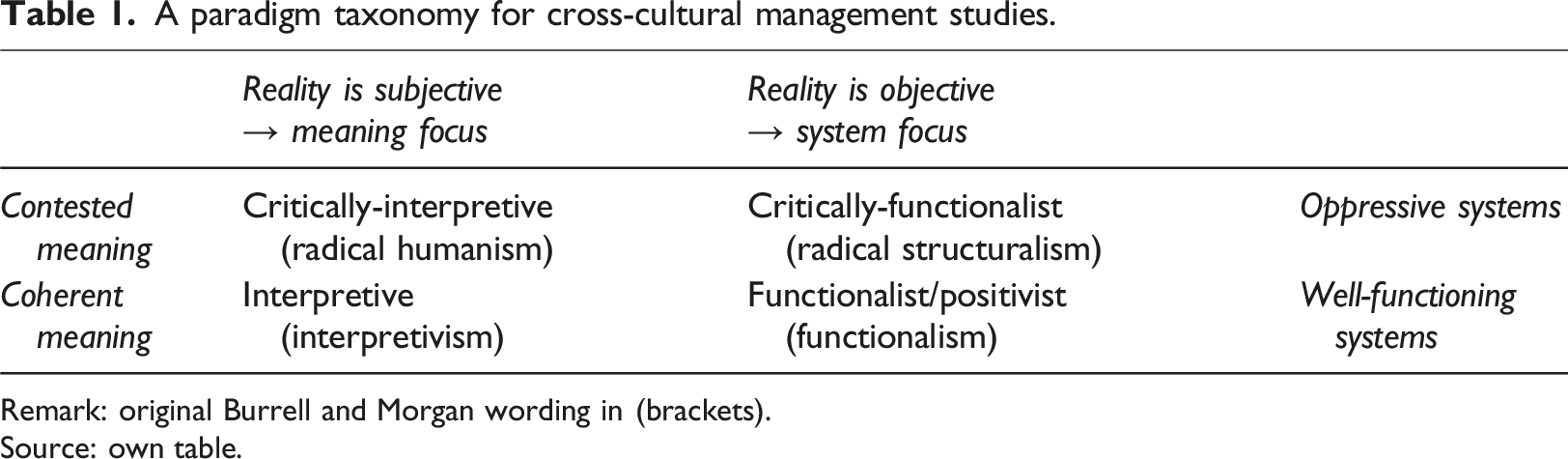
Remark: original Burrell and Morgan wording in (brackets).
Source: own table.
Paradigmatic delineations for conceptualizing the empirical intercultural training problem
In the following, I discuss the main four CCM paradigms (as outlined in Table 1) and show how the paradigmatic angle chosen changes the conceptualization of the phenomenon ‘Muslim minorities at work’ and, consequently, how one should approach this thus-conceptualized reality (see Figure 1). Problem-based application of paradigms in intercultural training. Source: own figure, inspired by Burrell and Morgan (1979), based on Mahadevan (2023: 111).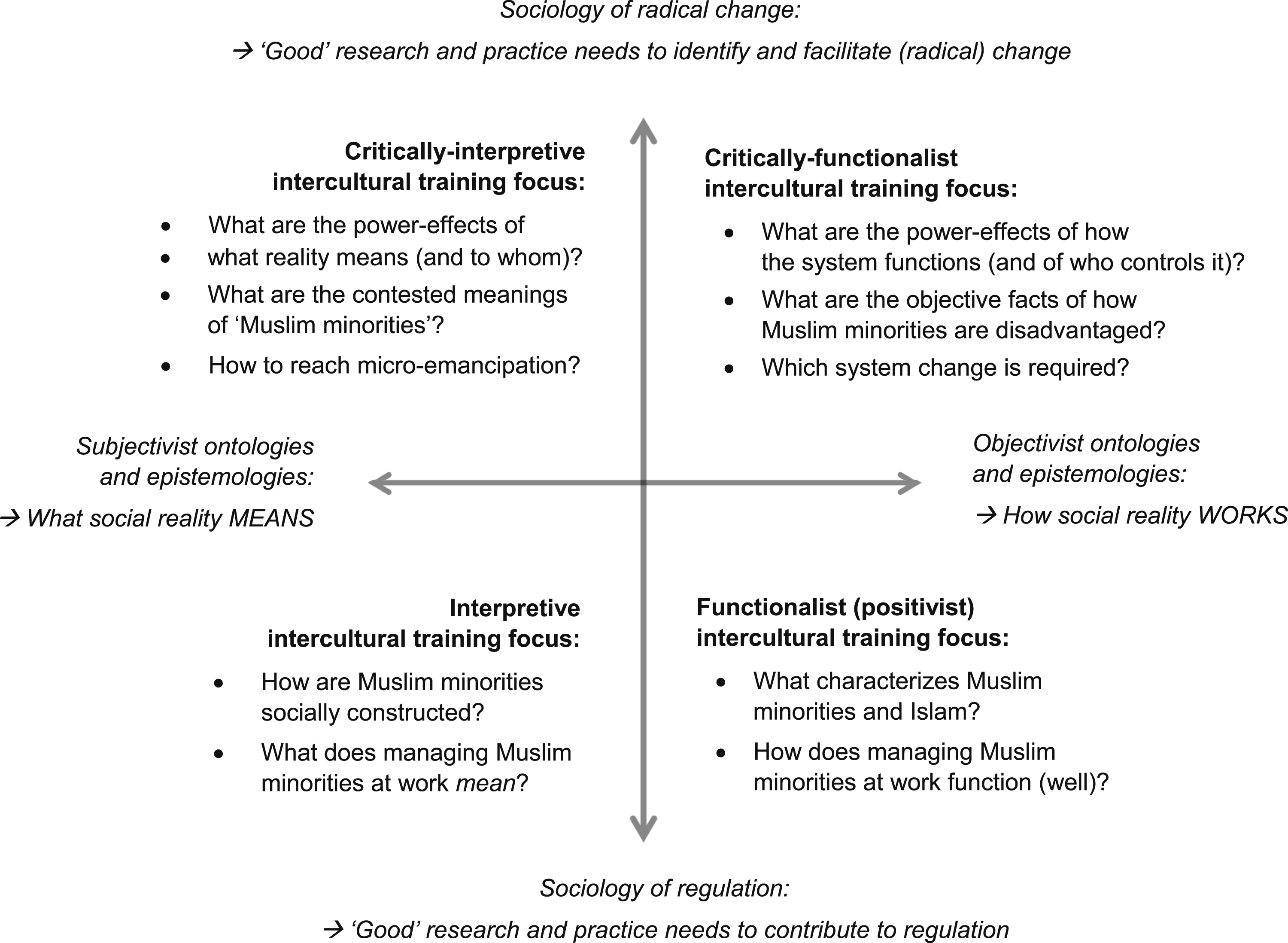
Objective versus subjective ontologies refer to the demarcation line between positivist (in terms of Burrell and Morgan, 1979: functionalist) and interpretive or social constructivist (Berger and Luckmann, 1966) assumptions about reality. In line with Burrell and Morgan (1979), I use ‘functionalist’ instead of ‘positivist’, in order to differentiate between ontology and epistemology (the presumed realities of how to analyse difference categories) on the one hand, and the understanding of what constitutes difference on the other hand (how difference categories ‘function’ vs what they ‘mean’) more clearly (also see Mahadevan, 2020a).
An approach to CCM studies is functionalist if rooted in the belief that the world exists objectively (based on Comte, 1907). The focus of objectivist approaches to intercultural training are thus on quantifiable, objectively ‘true’ cross-cultural differences. Questions to be asked to the subject matter are thus: What characterizes Muslim minorities, and what is Islam? How does managing Muslim minorities at work function well? (Figure 1). The study by Ali and Al-Owaihan (2008) on Islamic HRM provides an example for such an approach.
Conversely, subjectivism assumes that people make sense of the world: they interpret reality (Schwartz-Shea and Yanow, 2012). Consequently, any investigation of or training for cultural difference can neither be ‘objective’ nor should it be. Questions to be asked to the subject matter are thus: How are Muslim minorities socially constructed? What does managing Muslim minorities and Islam mean? (Figure 1). The study by Essers and Benschop (2009) provides an example for such an approach.
Cutting across objectivist and subjectivist ontologies, the sociologies of regulation and radical change are the second delineation to be considered. Whereas the sociology of regulation (functionalism and interpretivism) assumes that social, economic or organizational systems are always drawn towards equilibrium of opposing forces, such as management and workers in a company, theories of radical change (radical structuralism and radical humanism) assume that contemporary organizations, economies and societies are inherently unjust and unfair to the majority or at least a certain portion of people: they want to change reality to the better. This means that the sociology of radical change adds a power-element to the cultural analysis which is missing in the sociology of regulation: A critical intercultural training views culture and cross-cultural differences as ‘power-laden’, in contrast to ‘power-free’: it therefore has to be ‘power-sensitive’ (also see Mahadevan, 2023b).
Critical CCM studies encompass objectivist and subjectivist worldviews. A critically-functionalist intercultural training wishes to discover objective social reality (and is therefore linked to positivism). The vehicle for change is thus objective system change, e.g. a fairer and more equal economic system or a more equal and inclusive headquarters-subsidiary relations. Questions to be asked to the subject matter are thus: What are the objective facts of how Muslim minorities are disadvantaged? Which system change is required? (Figure 1) For example, a critically-functionalist intercultural training might focus on statistics concerning how Muslim employees are discriminated against in the West, e.g. when it comes to hiring practices. The study by Weichselbaumer (2016) on the discrimination faced by Muslim migrant women wearing headscarves in Germany provides an example for such an approach.
Conversely, critically-interpretive CCM shares with interpretivism the idea that social realities are socially constructed, yet, in contrast to interpretivism, it does not assume that their meanings are coherent and power-free, but rather assumes that meanings are power-mechanisms, and that the process by which some become dominant is problematic. The vehicle for change is therefore the micro-emancipation of single actors, so that their neglected positions are also considered, and increased reflexivity regarding those meanings that are neglected or have become dominant, and the process of how this has happened (Romani et al., 2018b). Questions to be asked to the subject matter are thus: what are the contested meanings of ‘Muslim minorities’? How to reach micro-emancipation? (Figure 1). For example, a critically-interpretive intercultural training might focus on why Muslim employees are perceived as religiously different in the first place, which meanings are excluded by this perception, and why and how this dominant label is problematic (on the labelling of Muslim minorities see Mahadevan and Ilie, 2017). The study by Mahadevan et al. (2017) on how German perceptions of a ‘traditional Arab world’ frame interactions with Muslim employees in a German-Tunisian cooperation to the disadvantage of a female Tunisian research engineer provides an example for such an approach.
Research might also combine both aspects, for instance, by asking the question how history has created unequal knowledge- and power-relations between headquarters and subsidiary in a multinational corporation. This inequality might manifest as dominant structures (critically-functionalist) or as dominant discourses and interpretations (critically-interpretive), or as a combinatation of both (see Mahadevan, 2011).
The possibility of a multi-paradigmatic intercultural training
After having outlined the main CCM paradigms in relation to how intercultural trainings are conceptualized, I now discuss the possibility of a multi-paradigmatic intercultural training practice. I suggest the specific method of paradigm juxtaposition as the most useful approach. I will then illustrate its application via the introductory example.
Are paradigms commensurable?
Researchers of management and organizations have since long discussed whether multiparadigm research is possible or not (Gioia and Pitre, 1990; Hassard and Kelemen, 2002; Lee, 1991; Lewis and Kelemen, 2002; Scherer, 1998; Scherer and Steinmann, 1999). Romani et al. (2011: 434) summarize three main perspectives: The isolationist perspective (e.g. Scherer, 1998) argues in favour of competing paradigms; it holds paradigms to be incommensurable (Schultz and Hatch, 1996: 531-532; Romani et al., 2011: 434). The integrationist perspective (e.g. Donaldson, 1998) argues for paradigm integration and against the presumed ‘myth’ of incommensurability (Donaldson, 1998). The multiparadigm perspective (e.g. Lewis and Grimes, 1999) argues for paradigm crossing (Schultz and Hatch, 1996); it uses multiple references for combining partial understandings towards deeper insights. This means that multiparadigm research does not judge one paradigm against each other or tries to streamline them, but rather values all paradigms for their potential to inform each other (Lewis and Kelemen, 2002). It “involves using paradigm lenses (X and Y) empirically to collect and analyse data and cultivate their diverse representations of organizational phenomena” (Lewis and Grimes, 1999: 673). Consequently, Patel (2017), and Grosskopf and Barmeyer (2021) argue for multiparadigm sensitivity in CCM studies.
Paradigm juxtaposition as a feasible multiparadigm approach
Paradigm juxtaposition is a multi-paradigmatic form of meta-theorizing. Metatheorizing refers to the process of building theories across and beyond paradigms (see Lewis and Grimes, 1999). The implicit assumption of the multiparadigm perspective is that the researcher is capable of learning and handling multiple paradigms (Kuhn, 1996: 202, Romani et al., 2011: 434-5). One way of doing so is viewing paradigms in light of each other (paradigm juxtaposition), so that their differences, similarities and interrelations may be comprehended (Gioia and Pitre, 1990; Lewis and Grimes, 1990; Lewis and Kelemen, 2002).
Juxtaposition means the practice of placing paradigms side by side for contrast (Lewis and Grimes, 1990); it is a practical way of ‘juggling’ paradox, that is: “a statement or situation that may be true but seems impossible or difficult to understand because it contains two opposite facts or characteristics” (Cambridge Online Dictionary, 2024). Therefore, even if metatheorizing does not actually build meta-paradigmatic theory, juxtaposing still helps to embrace plurality and explore apparent contradictions (Lewis, 2000): in my own words, it creates a kaleidoscope of partial truths in which all viewpoints are equally relevant. Paradigm juxtaposition thus enables the intercultural manager or trainer to ‘see’ more in the situation and to question their assumptions about what constitutes the presumed ‘cultural difference’ to be managed (and how this should be the case).
Nonetheless, the question remains as to how paradigm juxtaposition might be feasible and fruitful in practice. This article therefore suggests applying it to a clearly defined empirical problem, in this case: ‘religious-based difference’ as related to Muslim minorities at work. It then outlines the connections, contrasts and implications within and across paradigms and reflects upon the fruitfulness of the interaction.
Juxtaposing difference categories: ‘Muslim minorities’ in light of four CCM paradigms
In this section, I juxtapose all four CCM paradigms (see Table 1) as related to the empirical problem of this article, namely how to design and conduct an intercultural training activity concerning religion and Muslim minorities at work. This way, I identify novel contrasts, connections and implications. Building upon Figures 1 and 2 summarizes the outcome of this approach. Juxtaposing difference categories in practice: contrasts and connections. Source: own figure, inspired by Burrell and Morgan (1979) and Schulz and Hatch (1996).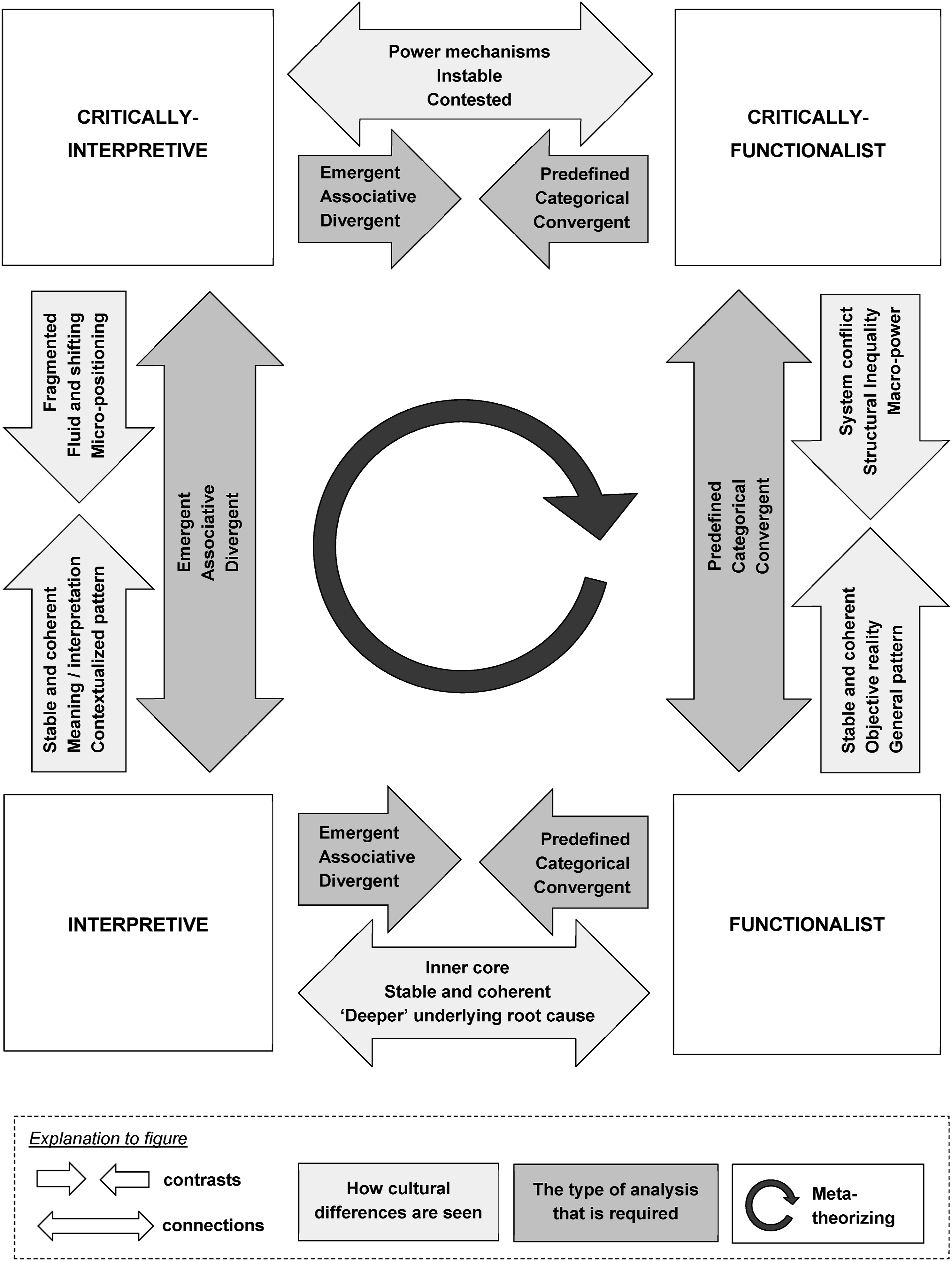
Figure 2 is partly based on Schultz and Hatch’s (1996) analysis of the interpretive and the functionalist paradigm in light of each other. I have built upon their work to include the critical paradigm, thus arriving at four distinct approaches to difference categories in CCM.
Connections between functionalist (positivist) and interpretive CCM
Functionalist (positivist) and interpretive CCM studies are commonly understood as fundamentally different approaches (e.g. Barmeyer et al., 2019). Yet, when viewing the functionalist and interpretive understanding of culture in light of each other, Schultz and Hatch (1996) find that both seek coherent patterns, understand culture as static and wish to find the ‘essence’ underlying the variety of cultural phenomena. They both thus emphasize coherence and convergence over fragmentation and divergence. Schultz and Hatch (1996) speak of ‘essence’ when describing the interpretive and functionalist tendency to seek coherence and convergence. However, as ‘essence’ is a highly problematic term with regard to culture/national identity, I have changed this wording to ‘core’ (see Figure 2).
Both functionalist and interpretive CCM are rooted in the assumption that cultures are coherent, and both produce comparably static views of reality (also see Mahadevan, 2024a); they therefore presuppose the stability of cultures, and of difference categories such as ‘Muslim minorities’. Linked to this approach is the understanding that the phenomenon studied, in this case: difference categories, are sufficiently homogeneous (Mahadevan, 2020b): the Muslim perspective does exist. Thus, both interpretive and functionalist CCM work with the idea of cultural convergence and coherence: from the multiplicity of actual behaviour and visible cultural manifestations, there is a shared, underlying norm to be deduced, and it is this invisible, shared part of culture which is relevant to people’s orientations, motivations and behaviour. Interpretive CCM, for example, looks for deeper meaning, and functionalist CCM deduces value orientations from cultural manifestations. Furthermore, both interpretivism and functionalism assume that the most meaningful parts of culture are ‘below the surface’. This is evidenced by common intercultural training activities, when, for example, participants are asked to visualize culture by means of an iceberg or fill in an ‘onion’ of culture. The iceberg metaphor is related to the interpretive understanding that inside (emic) and outside (etic) meanings of culture differ, and that invisible meanings below the surface are expressed by symbolic behaviour, the purpose of which can only be approximated by those who comprehend the emic perspective. Thus, the iceberg metaphor in intercultural training symbolizes how ‘cultural meaning’ shapes the behaviour of those who share this meaning and becomes incomprehensible to those who do not. The onion metaphor is related to Geert Hofstede, it usually depicts values, such as religion, at the inner core, and ritualized practices, such as prayer as the facet which links inside and outside of the onion. It thus shows how deeper cultural layers ‘work’ in shaping and unifying people’s behaviour.
Interpretive and functionalist CCM thus share the assumption that surface manifestations of difference categories such as religion, gender or age, represent a deeper value or meaning core – either regarding what this category means or how this category functions. Both interpretive and functionalist CCM are thus rooted in the understanding that there is a deeper, inner ‘core’ attached to a certain difference category: a shared meaning or reality of ‘being Muslim’ does exist.
Contrasts between functionalist and interpretive CCM
The contrasts between functionalist and interpretive CCM emerge from how they analyse difference categories such as ‘Muslim minorities’. Functionalist CCM is rooted in objectivism (Burrell and Morgan, 1979); it thus wishes to identify the traits of a ‘Muslim minority’ objectively. Consequently, the intercultural trainer needs to consider the facts of Islamic beliefs and practices at work, in order to better integrate the new co-workers. Conversely, interpretive CCM is rooted in subjectivism (Burrell and Morgan, 1979); it understands culture as meaning systems and assumes these meaning systems to be subjective (Primecz et al., 2016). One would need to differentiate, for instance, between inside (emic) and outside (etic) views on what something ‘means’ (Peterson and Pike, 2002), in this case: what it means (from inside vs outside perspective) to ‘be Muslim’.
Schultz and Hatch (1996) identify the functionalist framework as predefined and universal; its model of analysis as categorical, and its analytical process as convergent. Conversely, interpretivism conducts an emergent and specific analysis (it wishes to contextualize), it reads meanings associatively, and its analysis is divergent (generalization from a single-case basis). If one applies their reasoning to CCM studies, the following insights emerge (see Figure 2): Interpretive CCM searches for patterns via an emergent and specific analytical framework. Conversely, functionalist CCM uncovers coherent patterns via a predefined and universal analytical framework.
From an interpretive perspective, coherent patterns of meaning are linked to specific contexts, they are contextual. Functionalist CCM, however, considers coherent patterns to be general. This means that, from a functionalist viewpoint, the Muslim perspective exists regardless of other influencing factors, such as gender or age, whereas, from an interpretive perspective, individuals might develop different perspectives on ‘what it means to be Muslim’, depending on life experiences, education and so on. However, these meanings, too, are considered to be comparably stable, converging and homogeneous within a shared lived experience: they are meaning ‘systems’.
As Figure 2 shows, functionalist CCM approaches the core of difference categories via identifying classifications and causal relations (a categorical approach), e.g. reports, statistics or quantifiable data such as cultural value orientations in the tradition of Hofstede (1980). Conversely, interpretive CCM approaches the core of difference categories through associative approaches which interpret meanings and explore the connections between them (e.g. ethnography, single cases, stories, shared experiences).
The functionalist production of stable difference categories is reached through a convergent analytical process which brings elements of social analysis together; the interpretative production of static difference categories is reached through a divergent analytical process which looks for coherence in multiple interpretations. For example, in intercultural training practice, a convergent functionalist analysis would mean to consider the different cultural value orientations of employees’ respective countries of origin and identify what these have in common. The interpretive divergent analysis would gather ‘stories’ and lived experiences, and identify what these have in common. Both are existing approaches to how intercultural trainings are conducted in practice, and both produce stable categories of cross-cultural differences. The shared assumption is that divergence and conflict need to be overcome, and that difference is only the intermediate step towards complementarity, synergy and integration.
Considering both paradigms in intercultural training practice requires acknowledging how ‘being Muslim’ involves universal aspects but on the other hand to also explore how the experience of ‘being Muslim’ is context-specific. The latter would mean, for instance, that there are actually multiple ‘Muslim minorities’ to be considered, for instance, based on country of origin of specific Muslim employees (e.g. Serbia vs Indonesia). Secondly, because interpretive reality emerges via the interrelations of inside (emic) and outside (etic) perspective (based on Peterson and Pike, 2002), the intercultural training activity should not only consider ‘the Muslim perspective’ but also the specific worldviews of non-Muslim employees (e.g. Christian/West-German vs Atheist/East-German). From an interpretive viewpoint, emic and etic are interrelated and subject to perspective (not objectively ‘true’): how ‘being Muslim’ is constructed only emerges in relation to what it means to be ‘Christian’ and ‘Atheist’.
Contrasts between functionalist and interpretive CCM, and critical CCM
The Burrell and Morgan (1979) taxonomy differentiates between two approaches to social reality: the sociology of regulation and the sociology of radical change. Functionalist and interpretive CCM are regulation theories, whereas critical CCM is a radical change theory.
Regulation theories assume that social systems, also organizations, groups and societies, naturally strife towards coherence and an equilibrium of forces. In that sense, mainstream (cross-cultural) management itself is a regulation theory, as managing (cross-cultural differences) is not generally assumed to be impossible. Scholars and practitioners may contribute to regulation in two ways, by improving upon ‘how cross-cultural management works’ (functionalism) or ‘what cross-cultural management means’ (interpretivism). An intercultural training identifying shared cultural meanings or shared objective facts is thus a ‘training of regulation’.
The second approach, the sociology of radical change (Burrell and Morgan, 1979), also known as the sociology of conflict (Dahrendorf, 1959), assumes that social systems, also organizations, groups and societies, are naturally conflict-prone, because they are made up of systemic and structural inequalities, and of individuals and groups promoting their own interests and privilege over and against the position of others. It then becomes the researcher’s and manager’s task to achieve change to the better (Romani et al., 2018b, 2020a), and the methods promoted by a critical CCM studies (Romani et al., 2020b) are underpinned by this idea. An intercultural training identifying structural inequalities or empowering marginalized participants is thus a training of ‘radical change’.
Therefore, the most fundamental contrast between functionalist and interpretive CCM, on the one hand, and a critical CCM, on the other hand, is that they identify different theoretical and practical responsibilities, based on what they assume constitutes social reality (a tendency towards equilibrium, or constant conflict): either the requirement to contribute to regulation (rooted in the stability assumption) or the need for a change to the better (rooted in the conflict assumption).
Contrasts within critical CCM: Subjectivist versus objectivist radical change
What critical CCM approaches have in common, is their power-sensitivity. They assume that social reality is conflict-prone, and that power is always part of which cultural difference categories manifests and how, and for whom (also see Mahadevan and Primecz, 2024; Primecz and Mahadevan, 2024).
However, what constitutes ‘conflict’ differs within the critical perspective: a critical CCM that is rooted in the objectivist paradigm views power as in terms of structures and systems. Objectivist power is therefore often conceptualized on macro-societal or larger systemic levels, as, for example, Marxist theories do. For instance, one needs to consider the systemic role of organizational and global power-configurations in shaping how cultural difference is explained, as described by Kakar and Mahadevan (2020) for the case of a Chinese mining operation in Pakistan. Consequently, in the critically-functionalist paradigm, inequalities of power are about system-conflicts which challenge the coherent patterns presumed by a sociology of regulation. For instance, if the majority of Muslim employees in a company choose to practice their religion at work: what kind of systemic pressure is put upon secularist Muslim or Atheist employees? Or, as Mahadevan (2012b) suggests, normative assumptions about ‘how to be a good research engineer’ often involves the idea of non-religiosity, based on the professional value of rational and ‘scientific’ problem-solving. If this idea is systemic: how will this negatively affect those who work as research engineers and find inspiration in their religiosity?
In the critically-interpretive paradigm, power is not about large inequalities, but rather about the fragmentation of cultural patterns. This fragmentation is brought about by individual and group-related, often micro-level acts of positioning, and by the fluidity of any difference category itself. Postmodernism (Derrida, 1978) exemplifies this idea: any dominant meaning, it is assumed, can be deconstructed to reveal multiple alternatives. The case of two ‘Muslim’ women in Germany described by Mahadevan et al. (2020a) is an example of such an approach: it reveals that the reality of ‘being Muslim in Germany’ intersects with other influencing factors such as education, gender, class, family support and the village/metropolis divide. In an intercultural training activity, it then becomes the task to ask which perspective on being ‘Muslim’ is hegemonic, for instance, a certain school of Islam, a certain image of those practicing it, or a certain gender. Based on this assessment, it then becomes the trainer’s responsibility to reveal neglected perspective and positions, such as queer Muslim lived experiences, which are convincingly described by Rahman and Chehaitly (2020).
Both objectivist and subjectivist ideas of how social reality is contested and conflict-prone imply that any identifiable difference category, thus: any ‘problem’ identified for an intercultural training activity is not convergent and coherent (as presupposed by the regulative paradigms) but divergent and contested. Both critical approaches ask for power-sensitivity so that better, multiple and more complex understandings of the problem, as related to multiple standpoints and interests, can be identified. Based on this power-sensitive analysis, one then needs to work towards change to the better – either by micro-emancipating hidden neglected perspectives and individuals (being critical with regard to meaning) or by changing objective power structures on systemic levels (being critical with regard to function).
Connections within subjectivist/objectivist ontologies, and across responsibilities
The contrasts within each of the responsibilities (regulation/radical change) are also the analytical connections within each of the ontologies (subjectivist/objectivist). Both interpretive and critically-interpretive CCM involve emergent, associative and divergent techniques, whereas both functionalism and critical functionalism require predefined, categorical and convergent approaches. For instance, in both an interpretive and a critically-interpretive intercultural training, participants would share their stories, so that associations can be made and that perspectivity can be established.
Both positivist and critically-functionalist CCM employ predefined and universal analytical frameworks, and in contrast to interpretivist and critically-interpretive CCM, these frameworks are focussed on objective insights. For instance, cultural value orientations might be used in both functionalist and critically-functionalist intercultural training activities, it is just that different responsibilities follow from the data, based on whether one assumes social reality to naturally lean towards equilibrium or to be rooted in conflict.
What connects interpretivist and critically-interpretive CCM is their perspectivity and a divergent analytical process. However, interpretivist CCM departs from the assumption of coherence, whereas critically-interpretive CCM embarks from understanding that difference categories are fragmented and changing, and emerge from how individuals position themselves in relation to and against others. For instance, whereas an interpretive intercultural training activity would assumed that the etic and the emic perspective are the two relevant homogeneous meaning systems to be considered with regard to ‘being Muslim’, a critically-interpretive intercultural training would rather demask both as dominant and hegemonic discourses and practices, and reveal the hidden and marginalized multiplicity of meaning within both.
Contrasts between radical change and regulation
A critically-interpretive CCM challenges the ‘core’ and stability of difference categories; it questions patterns and focusses on cross-cultural difference as a changing and fluid social construction of difference. In contrast to a critically-interpretive CCM, interpretivist and functionalist approaches might therefore neglect processes of recontextualization and translation, as well as the social hybridity and cross-fertilization across labels such as ‘Muslim’ which are proposed by radical humanism (based on Derrida, 1978). For instance, both regulatory ontologies fail to ask the question why certain ethnic or religious minority groups are still considered as ‘different’ after generations, despite the social world being a constant process of change, or whether alternative categories beyond a merely religious marker of difference (‘Muslim’) should be considered to do justice to complex life experiences. In contrast to a critically-interpretive CCM, both regulatory paradigms might therefore neglect the individual power of positioning.
A critically-functionalist CCM assumes that culture is rooted in institutionalized and systemic inequalities. For instance, cultural value orientations can be assumed to merely measure the value orientations of the ethnic majority in any given country (Mahadevan et al., 2020b). Perpetuating these scores in an intercultural training activity would therefore contribute to systemic inequalities and the marginalization of inner-national minority groups – both regarding the objective scores and also their effects on what a certain national identity ‘means’. In contrast to a critically-functionalist CCM, both regulatory paradigms might therefore underestimate the power-effects of social structures and system conflict.
The purpose of a ‘critical’ intercultural training activity would thus be to challenge the presumed problem to be solved: the difference category ‘religion’ and ‘Muslim’, and to offer alternative explanations of what separates and what connects people at work. The conceptualization proposed by Mahadevan and Primecz (2024) can provide managers and trainers with advice regarding how to implement this goal.
Implications for cross-cultural management and intercultural training
Implications for this specific case
Based on the connections between the paradigms within the sociology of regulation (interpretive and functionalist CCM), the following implications, as related to the introductory vignette, emerge: If the intercultural training activity limits itself to the idea of a stable, coherent ‘core’ to difference categories, as proposed by both interpretive and functionalist CCM, it would not question the existence of a group of ‘Muslim employees’. Rather, it would understand this group as being fairly homogeneous and also as being different from a group of ‘non-Muslims’. The intercultural training agency would thus either deliver a training programme based on facts and figures or cultural and religious differences, and Islam (functionalist) or a training programme based on how the meaning system of Muslim employees and Islam differs (interpretivist), or a combination of both.
However, when viewing both sociologies of regulation in light of each other, there is already a first level of cross-fertilization: Because these coherent patterns are both general (as proposed by functionalism) and contextual (as proposed by interpretivism), management should consider Muslim practice and Islamic beliefs as an objective and general pattern, but at the same time also try to find out what it ‘means’ to be Muslim to those who are part of the Muslim minority (emic) and to the non-Muslim majority (etic) which. In this case, the etic perspective involves both Christian and Atheist worldviews, as most employees from former ‘West’-Germany self-identified as Christian, and most employees from former ‘East’-Germany self-identified as Atheist. Thus, what the interpretive viewpoint adds to the functionalist one is the need to differentiate between emic and etic perspectives. Consequently, the intercultural training agency would need to pay attention to methods such as experiential learning activities (based on Kolb, 1984) in which people draw from and exchange their lived experiences, and to also allow room for the sharing of cultural perceptions across emic and etic. The intercultural training would thus change the activity from a training focussing on Islam to a general awareness training on ‘beliefs at work’, and anything else would be unethical from an interpretive perspective.
Still, only considering interpretive and functionalist regulation theories does not challenge the difference category ‘Muslim’ as such; it still presupposes that difference does, indeed, emerge from religious diversity at work. Here, critical radical change theories are helpful because they understand difference categories as power-mechanisms. For the intercultural training activity, this then means to consider how the very label ‘Muslim’ already signifies power-inequalities, and to hold both micro- and macro-levels of power and the fluidity and stability of power in mind when doing so. For example, as Romani et al. (2018) conclusively argue in their study on diversity initiatives directed at immigrants’ employment in Swedish organizations, HR professionals are often blinded by the power-inequalities associated with difference categories, and this ‘blindness’ severely limits the success of corporate diversity programs.
The intercultural training agency would thus have to consciously explore how the presumed group of ‘Muslim employees’ is also heterogeneous, based on other difference categories such as gender, age, class, country of origin, and many more. Experiential learning activities might accompany this process, for instance, via grouping participants not based on religion but based, for example, on whether they identify as a ‘city person’ or a ‘village person’, to highlight that there are always connections across differences and that there are always alternatives to the categories which seem dominant.
A critically-interpretive view on difference categories implies that cultural identity is nothing fixed but emerging from fluid processes of creating a concept of ‘self’ and ‘other’, in a specific situation, in relation to relevant others, and within certain boundary conditions (Mahadevan and Primecz, 2024). This means that on the micro-level of a critically-interpretive reality, the very label ‘Muslim’ is already an act of power-laden positioning (Mahadevan and Ilie, 2017). Any intercultural training activity would thus need to include reflexive questions such as: Why was this label chosen above all others? Is it really the major identity marker that defines highly-skilled research engineers from a variety of countries? For example, as Mahadevan et al. (2017) highlight, those expecting ‘a traditional Muslim world’ will even perceive it when actual interactions and the individuals which they encounter provide them with clues to the contrary.
Against this background, wider responsibilities emerge. For instance, it then becomes the trainer’s task to not contribute to dominant ideas of Otherness, in particular, if those ‘spoken about’ are not present (Szkudlarek, 2009). At the same time, the intercultural trainer should also not exoticize a certain group, thus portraying them as more alien and religious then they actually are (a process referred to as ‘Othering’, see Mahadevan and Primecz, 2024). Thus, a joint team-development or an exchange across presumably different groups would be preferable over a setting where one group is briefed on another one that is not present.
Furthermore, the cross-cultural management of ‘Muslim minorities’ does not emerge within a vacuum but is informed by discourses already existent (e.g. Mahadevan and Kilian-Yasin, 2017), in this case: discourses on Muslim minorities and Islam. Simply speaking, discourses convey how a subject, phenomenon, individual et cetera is (not) ‘normally’ thought of, spoken about, referred to or dealt with, mainly on a collective level. From the perspective of the sociology of radical change, discourses have power implications and might advantage some over others. For example, discourses of the veil are highly contested and often contradictory (e.g. Golnaraghi and Dye, 2016; Mahadevan et al., 2020a), and it must be assumed that no intercultural training activity can be truly free of them.
Furthermore, societal discourses on what constitutes ‘successful integration’ or who is the ‘model immigrant’ influence organizational-level sensemaking and practices, with consecutive exclusive effects (Romani et al., 2018c), also in relation to Muslim minorities (Weichselbaumer, 2016). For example, in the literature on mobility and migration, ‘whiteness’ and a ‘Western origin’ are routinely associated with identifying ‘global talents’, which makes it more likely that inferior migrant status is projected upon highly qualified non-White individuals or migrants from the ‘non-West’ (Guo and Al Ariss, 2015; Zanoni et al., 2010).
Questions of ‘Muslim belonging’ have become particularly relevant after the attacks on the World Trade Centre in New York on September 11th, 2001 (e.g. Liao et al., 2016), and societal discourses towards Muslim minorities have changed from being highly supportive to being highly restrictive (Liao et al., 2016: 1-2). Therefore, one needs to start questioning the corporate problem-definition of the introductory vignette and to ask whether it could truly be free of pre-existing, already power-laden discursive frameworks.
A scientific report published by the German ministry of the interior (BMI), summarizing previous representative studies, finds that 52% of the respondents (2019) “perceive Islam as a threat”, and 55% of respondents (2021) disagree with the statement “Islam fits into German society” (BMI, 2023: 50). This is only slightly higher than for other Western European countries such as France (38 and 39 percent, respectively, p. 55) and Great Britain (35 and 37 percent, respectively (p. 55), and these proportions have not changed much over the course of several years, including the time from which the ethnographic vignette of this article has emerged. It would thus also be the intercultural trainer’s responsibility to present these findings and to engage in a reflexive discussion about them, and to be able to deal with and manage the heated emotions and perceived identity threats originating from there.
On the other hand, there are, indeed, discriminatory practices and crimes committed in the name of religion, also Islam, and the question arises when religious convictions are no longer rooted in the shared middle required for a pluralist and inclusive society and organization (Mahadevan, 2024a). Or, in other words: which are the ‘healthy’ conflicts to engage with and to learn and grow from, and which are the dysfunctional and harmful processes of separation to be avoided by all? Ultimately, this requires viewing difference categories in relation to other relevant societal, economic and political fields. The critically-functionalist perspective seems highly relevant to this exercise, as it allows for approaching questions of ethics, democratic principles and human rights objectively, thus drawing the line between ‘freedom of belief’ and between harmful practices of intolerance towards others, as emerging from how individuals and groups interpret and act upon their religiousness.
As trainers cannot foresee for what purposes the knowledge which they provide participants with is used by those participating (Szkudlarek, 2009), they have to make sure to level power-inequalities during the activity itself. If the intercultural trainer then identifies structural, discursive or micro-level inequalities, they need to work towards micro-emancipation (Alvesson and Willmott, 1992) or marginalized groups, that is: to identify and contribute to ways in which power-inequalities as linked to certain identities are reduced (Romani et al., 2018b). Developing a code of ethics for these purposes, as suggested by Romani and Szkudlarek (2014), would thus be essential. However, as the ‘shared middle’ across existing differences and potentially unresolvable frictions needs to constantly re-negotiated, such a code of ethics constitutes a compass for navigating practice, not a codified rulebook which, once defined, remains ‘true’ for all and every situation.
Implications for intercultural training development in general
Paradigm juxtaposition answers the call for a more responsible cross-cultural management and intercultural training practice. It does so by changing the difference categories from which to proceed. Perceptions or categorizations of ‘difference’ in a culturally diverse context, of which ‘Muslim minorities’ are but one of many examples to which this approach seems applicable. As Dahlén (1997) has argued in his classic ethnography of the intercultural training business, trainers are prone to ‘oversell’ national cultural difference to construct themselves as the experts who can overcome difference. How organizations, managerial and other professionals, and intercultural trainers ‘package’ their knowledge is thus essential for which difference categories are assumed to create the problem, and national culture may not be the (only) relevant difference category to be considered. If trainers and HR managers alike understand that intercultural training is about juggling paradox, not about overcoming difference, trainers may be able to make their services in enabling this process their new selling point. Part of the task is to challenge and deconstruct those difference categories, such as cultural dimensions, which otherwise become a self-fulfilling prophecy. This underscores the relevance of integrating postmodern (critically-interpretive) practices into cross-cultural management theory and practice, as demanded for by (Ailon, 2008), which might increase higher disciplinary legitimacy.
Intercultural training as enabling participants to juxtapose difference categories by means of a multi-paradigmatic practice would involve the following (based on Figure 2): Regarding their patterns, difference categories should be considered both as a generality and as a contextuality. Regarding their core, one should acknowledge the clarity and ambiguity of difference categories simultaneously. Establishing the clarity of difference categories (in this case: how members of the group ‘Muslim minorities’ are similar to each other and different from other groups) requires categorical analysis; establishing the ambiguity of difference categories (in this case: how members of the group ‘Muslim minorities’ are different to each other but similar to other ‘non-Muslims’ with whom they share certain other diversity markers) requires associative thinking. When seeking to produce representative views of difference categories (such as ‘Muslim minority’) at a given point in time and in a specific context, one should study both their stability and fluidity, and their equality and inequality (to consider the need for radical change on both interpretive and structural levels). When seeking to produce a radical change/regulative approach to difference categories, one should pay attention to the implications of power and the lack of power-implications on two levels, namely structure and interpretation, and to assume that power-free/power-laden interpretations can be both coherent and fragmented. As a result of this ongoing process of juxtaposing multiple views on reality, a more nuanced and sophisticated approach to intercultural training is facilitated.
This is highly relevant in light of the commonly-held idea in academia that the intercultural training business fails to serve its purposes (namely to develop intercultural competencies for culturally diverse settings) because trainers are less qualified than academics (Mahadevan, 2017). However, as Mahadevan (2023a) shows in her 15 years’ ethnography of the German intercultural training business, this business itself is implicated by intersectional power-inequalities, such as its gendered nature (e.g. women trainers are paid less and work under more precarious conditions than men). If a reflexive process of juxtaposing paradigms were part of how the commissioning HR department, the intercultural trainer and those to be trained interact, it could also remedy the existing shortcomings of the intercultural training business, similarly to the suggestions made by Gagnon and colleagues (2022) for how to better achieve equality, diversity and inclusion goals in practice.
Summary and conclusion
Paradigms are ‘lenses’ by which reality is conceptualized. This means that, depending on the respective glasses which cross-cultural management is wearing, the realities of what constitutes a ‘good intercultural training’ will change. Adopting multiple paradigmatic lenses can therefore inform the development of more sophisticated and nuanced, and thus better-fitting intercultural training activities, and the article showed a way of doing so for a specific empirical intercultural training problem, namely ‘how to manage Muslim minorities at work’.
Key to an improved intercultural training practice is the need to ‘juggle’ difference categories. For becoming aware of the blind-spots associated with single paradigms and for a less myopic cross-cultural management practice, I proposed the multiparadigm technique of juxtaposing contemporary CCM paradigms across the Burrell and Morgan (1979) taxonomy. Paradigm juxtaposition requires researchers and practitioners to juggle paradigms and to reflect upon the fruitfulness of this approach so that they can become aware of and explicate their tacit assumptions of what constitutes the presumed ‘difference’ to be managed. This way, they will develop more nuanced difference categories from which they proceed, and, consequently, manage the problem at hand in more sophisticated ways. In order to achieve the highest cross-fertilization, paradigm juxtaposition should involve a specific empirical problem, in this case: the need to manage ‘Muslim minorities’ at work.
The first contribution of this article is that it develops an approach towards a better intercultural training practice. As a practical approach to multiparadigm research, problem-based paradigm juxtaposition increases reflexivity and even allows for cross-fertilization across otherwise incommensurable paradigms. In this case, it furthermore revealed why and how the commonly practiced differentiation of CCM studies into three paradigms – interpretive, functionalist and critical – is insufficient for approaching difference categories and for commissioning, designing and conducting intercultural training activities. Rather, and this is the second contribution of this article, it becomes evident that the critical CCM paradigm needs to be differentiated based on the ontologies from which social reality is critiqued as power-laden, namely into critically-interpretive (subjective ontology) and critically-functionalist (objective ontology). To achieve this contribution, this article went back to the original Burrell and Morgan (1979) matrix. When applied to difference categories at work, such a differentiated approach facilitates a more nuanced cross-cultural management and intercultural training practice. Prior to managing ‘difference’ cross-cultural management scholars and theoretically-informed practitioners thus need to reflect upon the paradigmatic assumptions which they make.
Footnotes
Acknowledgments

Declaration of conflicting interests
The author(s) declared no potential conflicts of interest with respect to the research, authorship, and/or publication of this article.
Funding
The author(s) received no financial support for the research, authorship, and/or publication of this article.