



Abstract
Most of us believe that it would be unjust to act with indifference about the plight of future generations. Zipper arguments in intergenerational justice aim to show that we have duties of justice regarding future generations, regardless of whether we have duties of justice to future generations. By doing so, such arguments circumvent the foundational challenges that come with theorising duties to remote future generations, which result from the non-existence, non-identity and non-contemporaneity of future generations. I argue that zipper arguments face several significant challenges. The ought-implies-can challenge points out that because prior generations determine what later generations can transfer, they determine how much they ought to transfer. In addition, both intentional and non-intentional non-compliance can break the chain of duties towards future generations on which zipper arguments rely. Some versions are surprisingly resilient especially in real-world circumstances. This paper does not show that zipper arguments inevitably fail, but all ways forward come at significant theoretical costs. Unless the challenges posed here are met (or shown as irrelevant), theorists of justice cannot side-track the foundational challenges that come with doing intergenerational justice.
Keywords
Introduction
Do we have reasons of justice to care about how remote future generations fare? 1 Denying this would entail that justice allows us to be indifferent to the plight of people living far in the future. Let us call this justice-indifference. Embracing justice-indifference implies that it is not unjust to leave future generations with depleted natural resources, a planet hostile to agricultural activity, unsafely stored nuclear waste, and so on. Justice-indifference is not an attractive option, and most of us will want to reject it. In addition, most will be extremely hesitant to endorse a theory of justice that embraces or even permits it under some circumstances. Avoiding justice-indifference is not as straightforward as it may seem. For reasons discussed below, it is not easy to ground duties to future people. Some philosophers have argued that we can avoid it without showing that we have duties of justice to future generations. They do so by an appeal to the fact that human generations do not arrive spontaneously in sequential fashion. New generations are created continuously, and generations overlap. Children born in 2023 co-exist with people born early in the 21st century and mid-22nd century. Through this chain of generations we have, arguably, duties regarding future generations. We may have duties regarding without having duties to.
Arguments for duties regarding future people take the form of zipper arguments (Gheaus, 2016; Gosseries, 2001; Hubin, 1976; Mazor, 2010; Vanderheiden, 2006). 2 Such arguments derive duties between generations from duties between birth cohorts. If justice requires equality between overlapping generations G1 and G2, and equality between G2 and G3, it also requires equality between non-overlapping G1 and G3; and between G1 and G200.
This way of thinking about intergenerational justice is appealing. It captures the reality of intergenerational relations much better than highly abstract theorising about non-overlapping generations, which treats people as if they arrive as fully formed adults, common in the philosophical literature (e.g., Olsaretti, 2022). Moreover, if the argument works, justice-indifference is avoided, regardless of whether or not we find a satisfactory answer to the meta-ethical, ontological and foundational issues that come with more straightforward arguments for an intergenerational scope of justice.
The theoretical as well as practical stakes are high. Yet, despite the appeal of zipper arguments, they have generated limited critical discussion in the literature on intergenerational justice. This paper addresses this by raising several possible worries about zipper arguments, with two aims. First, it shows that zippers are quite resilient in the face of some objections levelled against them, although sometimes at a theoretical cost. Second, I argue that while justice-indifference can be avoided in many cases, significant challenges remain. A robust solution allows us to reject justice-indifference in all, not just under some contingent set of, circumstances. In some cases which result in justice-indifference zipper arguments appear to be silent. This paper does not – and given the possible diversity of zipper arguments could not – conclusively show that no zipper arguments could face these challenges. It does show that the challenges are significant. At the very least – even if there is a zipper-argument which successfully meets the challenges posed here – these challenges will help us to determine which zippers do and do not work.
This paper discusses justice because zipper arguments are found in the literature on intergenerational justice. One may wonder why indifference must be avoided on the grounds of justice: there could be other types of wrongs. Why can’t we have a theory of intergenerational justice based on zipper arguments and a theory of non-justice based moral duties that includes direct non-justice-based duties to future people? 3 Philosophers often assign particular importance to justice, intergenerational justice being no exception (Barry, 1978: 205; Gheaus, 2016: 492). We can demand that people act on duties of justice, and often duties of justice are enforceable. Duties of justice are often regarded as taking priority over other types of considerations, like those of charity or beneficence. In other words, they are more stringent or weighty, not easily overridden by other types of considerations. If this is right, whether we classify duties regarding future people as duties of justice or otherwise has serious implications (Miller, 2007: 248). Whether something is a duty of justice or not matters for how much we can be asked to sacrifice to live up to the duty, and whether others can enforce or demand our compliance. 4
Does it matter that we have duties to act in a particular way regarding future generations? Is it not enough that we care about what happens to them, and that we value their flourishing? This would imply that there are no binding moral reasons to act in a particular way. I will not defend the claim that we need robust duties to future people. Instead, I will assume most readers will share the starting point that (at least part of) the reason why we should avoid that future generations lead bad lives is that it would be a serious wrong not to do so, that we have weighty reasons to avoid it and that compliance can be demanded. Saying that it would be ugly, unkind, or uncharitable does not capture this. 5
This paper proceeds thus: first, I set out the challenges that theories of intergenerational justice face, which zipper arguments aim to circumvent. Second, I will introduce the structure of arguments from overlap. In section “Mayfly and future generations,” I engage with the familiar objection that arguments from overlap cannot deal with cases in which there is no overlap between generations, and show that zipper arguments might be more resilient than initially thought. Section “Ought implies can and zippers-arguments” raises the ought-implies-can (OIC) objection, which questions the plausibility of the key assumption that gets zipper arguments started. Section “Zippers and the weakest link” discusses what happens if the zipper breaks, and one generation cannot (or does not) live up to their duties. The conclusion discusses the role that zipper arguments can play, and the options we have to avoid justice-indifference going forward.
Why zippers?
One may think that avoiding justice-indifference is easy. If it is our considered moral judgment that the wellbeing of future generations is a matter of justice, the scope of justice is intergenerational. Those who defend cosmopolitan principles in debates about global justice take such a strategy spatially, claiming that arguments for a limited geographical scope of justice fail. Why not similarly reject limits on the scope of justice intergenerationally? This answer faces obstacles, different from those cosmopolitan extensions face (e.g., Gosseries, 2014; Vrousalis, 2016). I will discuss these difficulties under the headings of non-existence, non-identity and non-contemporaneity. 6
First, non-existence. The individual members of future generations do not, by definition, exist yet. One may think that existence is a necessary condition for having moral status, or at least rights. Insofar as we are talking about future people (who do not yet, but will, exist), it is clear that we can do things to set back their interests. We can harm them by making their lives worse. They will have rights, and arguably we can violate these rights now (Gosseries, 2008; cf. Preda, 2016).
Second, (most) individual members of future generations are not future but possible people. Possible people exist in some, but not all, possible future states of the world. Who will come into existence depends on decisions that previous generations take. A stylised Parfit (1984) inspired example will help here.
Intuitively, G1 should opt for policy A. However, this policy radically changes peoples’ lives, affecting who is born. We could only have been conceived by the exact people that conceived us at the moment they conceived us (Parfit, 1984: 351). Given the difference between policy A and B, most – if not all – of the people who make up the generation living 300 years from now under policy A would not exist under B, and vice versa. G1 opts for B. Do members of G6 have a justice-based complaint against G1? They are not harmed by the implementation of this policy 7 : they would not have existed at all under the alternative. Life under B is the only existence on offer. This is the non-identity problem (NIP). Can one be wronged by an action if that action is also a necessary condition for one's existence? 8 This is a challenge for all person-affecting moral theories. 9
The third obstacle is non-contemporaneity. Many theories of justice ground duties of justice in certain types of associations or interactions, as duties of friendship are grounded in the relation between friends. Examples include shared (political) culture, shared community, shared coercive institutions or membership of a cooperative venture for mutual advantage. 10 It is not clear that the relevant obligation-generating relations exist (or could exist) between non-overlapping generations (e.g., Gardiner, 2009: section II). 11
Some conclude that we should give up on duties (of justice) to future generations (see Beckerman and Pasek, 2001; Heyd, 1992; Mazor, 2010: 382–284). Notably Ronald Dworkin concluded that: “our concern for the future is not a concern for the rights and interests of specific people […]. Our concern for future generations is not a matter of justice at all but of our instinctive sense that human flourishing as well as human survival is of sacred importance” (Dworkin, 1994: 77–78). Others deny this, while offering creative and plausible solutions. 12 My goal here is not to evaluate the plausibility of any of them. What matters is that the challenges are significant, and that consensus on whether there is a solid reply, and what this reply is, is thin at best.
There are good reasons to try work around these challenges. First, one may want to avoid justice-indifference even if one thinks these challenges are decisive. Second, there are good reasons to avoid justice-indifference without an appeal to the meta-ethically controversial solutions currently on offer. Maybe it would be best to overdetermine our rebuttal of justice-indifference. Or, for political liberal reasons, one may find zipper arguments appealing because they carry very little metaphysical baggage. There are also real-world reasons for wanting to avoid handing political actors and citizens a free pass to act as if future generations did not matter. Parfit realised this, when he wrote that we should “conceal this problem [NIP] from those who will decide whether we increase our use of nuclear energy” (Parfit, 1984: 449–550).
Zipper arguments in intergenerational justice
New generations come into existence continuously, and several birth-cohorts overlap in terms of temporal existence. Zipper arguments derive duties regarding remote future generations from justice between birth-cohorts. Several types of argument appeal to overlap to show that future generations fall under the scope of moral consideration. We can distinguish between motivational, meaning-based and moral arguments. Motivational arguments appeal to the fact that we care for the generation(s) immediately after us. I may not care very much about how my great-great-grandchildren fare, but I care about my grandchildren. My wellbeing depends on theirs. They care about their grandchildren as I care for mine. The wellbeing of their grandchildren is similarly dependent on the wellbeing of the next round of grandchildren. Hence, I have reasons to care about my great-great-grandchildren. One could also appeal to the value of shared transgenerational projects. In a non-trivial sense, our capacity to lead flourishing lives depends on the flourishing of future generations (e.g., Heyd, 1992; Meijers, 2020; Scheffler, 2013).
Within moral arguments from overlap we can distinguish between arguments which aim to ground duties to future people and those which aim to ground duties regarding future people (zipper arguments). One may appeal to overlap to show that we do stand in a duty-generating relation to future generations. Communitarians claim we share an intergenerational community. Others think we stand in reciprocal relation with future generations (Heath, 2013). These are direct responses to the challenges mentioned above, not a way around them. They presuppose an answer to the first two concerns (non-existence and non-identity), and show that the third concern (non-contemporaneity) can be overcome. This paper is not directly aimed at these types of argument, but some of the arguments discussed apply to them too. After all, grounding duties to future people through arguments from overlap requires a stronger type of intergenerational chain than grounding duties regarding future people. Hence, if the “easier” enterprise fails, it is likely the more demanding will, too.
What makes zipper arguments special is that they aim to show that we have duties regarding future people. If I have a duty to you, I owe it to you that I act on it. If I have a duty regarding you, I have the duty to act in a particular way towards you, but I may not owe this duty to you. Duties regarding others are familiar. If A promises B to buy C a Gin and Tonic, A has a duty to B regarding C. If A does not buy C a G&T, A fails her duty to B, not to C. If I fail my duties regarding you, you cannot complain that you have been wronged. The challenges discussed above are challenges to the idea that we have duties to, not duties regarding future generations. If we can establish such duties, our success at avoiding justice-indifference is no longer conditional on tackling the issues discussed above.
A clear example of a zipper argument is provided by Axel Gosseries when he writes that he believes that “obligations to remote future generations can be dealt with through the prism of our obligations towards the generation that directly follows us” (Gosseries, 2001: 296; see also Gosseries, 2005). Imagine a simplified world, where everybody dies at 100 and reproduces at 50, and generations come in waves every 50 years. At any point in time, only 2 generations are alive. We'll use this abstract model of intergenerational overlap in the rest of the paper.
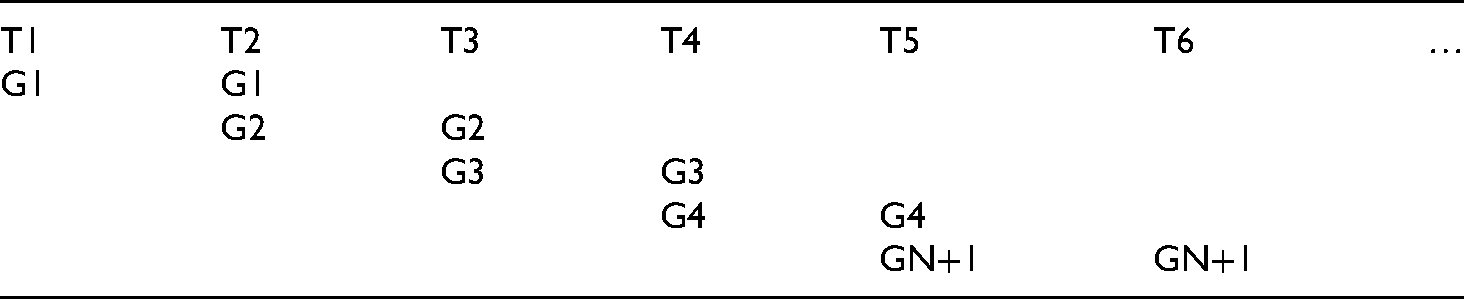
G1 and G2 are contemporaries for a significant amount of time, so moral duties between them face none of the obstacles mentioned. G2, similarly, shares part of their temporal existence with G3. G1 and G2 have duties to each other, as do G2 and G3. To link G1 with G3, one needs one more step, a version of what I'll refer to as the linkage claim: G2’s ability to act on their duties to G3 falls (partially) under the duties G1 has to G2. As Gosseries states, G1 “should make sure to transfer to the next generation enough for that generation to be capable in turn to satisfy its own intergenerational obligations” (Gosseries, 2001: 297). In other words, it would be wrong to put G2 in a position where they cannot act on their duties. G1 has duties regarding G3. 13
Zipper arguments work for a variety of views. Gosseries appeals to reciprocity, but an argument that appeals to equality as a distributive principle works, too. If justice requires equality between G1 and G2, and between G2 and G3, it requires equality between G1 and G3. It would be wrong for G1 to transfer a world in which G2 would have much more than G3. True, G2 could split the difference and restore equality with G3, but at the cost of life-time inequality between G2 and G1. If G2 is liable to the claims of G3, life-time equality between G1 and G2 is violated (see also Mazor, 2010). Threshold views, like sufficientarianism and a Rawlsian just savings principle can follow a similar template. For zipper arguments to rule out justice-indifference, the substantive moral requirements must be demanding. Take the view that we owe it to the next generation that they can share the resources there are fairly with those who come after them. Even if G1 one leaves very little for G2 to share with G3, there is still a way to fairly divide these resources. There are fair and unfair ways to allocate food in a famine. A rejection of justice-indifference suggests serious concern with future generations. 14
The following sections raise challenges to zipper arguments’ ability to avoid justice-indifference. Some readers may believe zipper arguments cannot robustly avoid justice-indifference, and that zipper arguments need to be rejected. However, the discussion below will show that some zipper arguments are particularly resilient in unexpected ways. Other readers may think zipper arguments are a good way to capture our duties to future generations. However, the arguments will show that significant challenges remain, although some versions fare better than others. Finally, some will think that zipper arguments are a good way to bracket several theoretical doubts about duties to future generations: what matters is that in realistic scenarios we avoid justice-indifference. This paper challenges this position by showing that zipper arguments have some problematic implications (to varying degrees), often also in realistic scenarios.
Mayfly and future generations
Zipper arguments, it seems, always rely on temporal overlap of generations. Imagine a counterfactual world in which there is no such overlap, and people are like mayflies: the next generation is born after the previous generation has died. Tim Mulgan proposes this as a test-case for theories of intergenerational justice: we must be able to conclude, even in a mayfly-world, that we owe something to the next generation. He claims that “no adequate political theory may conclude that the current generation of Mayfly people has no duties whatever to the next generation” (Mulgan, 2001: 284). Although one may bite the bullet here and accept that there are no duties of justice between mayfly generations, I assume most defenders of zipper arguments want to avoid justice-indifference. 15 And to do so robustly, we need to be able to answer the mayfly case, where there is no generational overlap. This bodes badly for zipper arguments. 16
In the mayfly scenario, all duties which arise from temporal co-existence would vanish. A narrower path forward remains: although there is no overlap, there is a strong connection between different generations. After all, the previous generation creates the subsequent generation. This is, on associational and interactive accounts of justice, not enough to create full-blown duties of justice. But it seems unlikely that creating a generation does not come with duties towards those created, although on many views they will not be considered duties of justice. For those willing to endorse such duties, procreative duties would still apply to the members of G1.
The objection would have more force in a more farfetched example:
In this counterfactual world there is no overlap. Moreover, G1 is never responsible for the existence of G2. Here, zipper arguments cannot show that we have reasons of justice to act. There is no way to zip past alien intervention. To avoid justice-indifference robustly, we would need a theory of justice which establishes duties of justice even to people whose existence does not connect to us directly. 17
This discussion points to an important fact about zipper arguments in general, and to ways in which zipper arguments may be strengthened. They do not necessarily rely on overlap. It helps to distinguish between three ways in which different generations might relate. First, they may overlap temporally. Second, they may be connected without overlap (a causal connection, for example, through procreation). Third, they might be non-connected subsequent generations which do not relate at all. Only in cases of the last kind would zipper arguments inevitably fail to generate duties. In the second case, one may think we cannot speak of full-blown duties of justice, but other types of duties resting on a thinner connection than temporal overlap may be passed on. Unless one thinks procreative duties are duties of justice, justice-indifference is not avoided in these hypothetical cases.
Ought implies can and zippers-arguments
The second worry about zipper arguments starts from the observation that there is something odd about the linkage claim. Zipper arguments as described in section “Zipper arguments in intergenerational justice” seem to assume that duties G2 would have to G3 if they could act on these duties would survive G2's inability to do so. The complaint G2 has against G1 (regarding G3) seems to be: you have put us in a position where we have (a) a duty to G3 and (b) lack the capacity to act on this duty. However, if ought implies can is true, these cannot both hold. If G2 cannot act on their duties to G3, G2 ought not. As a result, G2 does not have this duty to G3. G2 is not placed in a position where they have a duty they cannot act on, and G1 did not act wrongfully by placing them in such a position. This puts pressure on the linkage claim: if G1 can make the duty to G3 disappear by making it impossible for G2 to act on it, zipper arguments do not get started.
What damage does this do to zipper arguments? Take a sufficiency-based zipper: G1 owes G2 sufficiency. G1 leaves G2 a world in which they live just above sufficiency, but not a world in which they can raise G3 above sufficiency. In such a situation, it is unclear what G1 has done wrong. G2 gets what they are owed, and because G2 cannot lift G3 above sufficiency, it ought not. G1 has honored its obligation to G2 and did not violate any duties regarding G3.
We see a similar dynamic with other zipper arguments. Take a zipper argument which appeals to indirect reciprocity, as explored by Gosseries. Suppose we have a duty to pass on to the next generation as much as we have received from the previous generation. G1 passes on the required amount A to G2, but places G2 in a situation in which it is impossible for them to pass on amount A to G3. They can only pass on amount A-n. G2 at this point does not owe amount A, but at most A-n. G1 honored its duty to G2, G2 simply has a severely devaluated duty compared to what duty they would have had, had G1 left them in a better condition. To be clear, this is not a problem of non-compliance. The zipper does not break because G1 fails to act on its duty. A reciprocity – or sufficiency – based zipper of this kind, seems unable say that there is anything is wrong with disregarding G3.
Residual duties and liabilities
One response is to point out that G2 will live with G3 for a considerable amount of time, and even if G2 does not owe G3 the same as G1 owed to G2, G3 will still have demands of justice on G2. This opens up several replies to the OIC objection. First, one may claim that the duties simply change if G1 does not leave G2 enough. Duties are different in the counterfactual where G1 leaves less, but they are duties nonetheless. Duties of justice are inextinguishable: G2 will still need to treat G3 justly. But what doing so entails has been changed by G1. This is correct, but it does not deflect the objection. First, duty D, which G1 has to G2 is not passed on to G2. Hence, although the chain between generations is not entirely broken, the duty has changed. For those patterned theories affected, it means the pattern of justice does not apply intergenerationally: what G2 owes to G3 is something else. Context-sensitive demands of justice still apply between G2 and G3, they are no longer part of any intergenerational zipper. If G2 cannot keep G3 above sufficiency (or equality), they do not have a duty to do so. By transferring less, G1 changes what is owed regarding future generations from G2 onwards. Views of justice that prescribe a particular state of affairs, such as ‘divide the available resources fairly’ or ‘bring as many as people as close to sufficiency as possible’, survive the ought implies can (OIC) objection, but may end up implausibly undemanding. It may matter to us that remote future generations can live together fairly, but this is realised when they can fairly share extremely scarce resources and lead terrible lives. Hence, justice-indifference is not effectively ruled out. Unlike mayfly cases, such cases are not highly unrealistic. Especially if we take into account climate change tipping points, there may be a point at which it becomes literally impossible for an intermediary generation Gn to lift a future generation Gn + 1 above sufficiency.
Second, one can offer a stronger reply – theoretically and in practice – based on zipper arguments as developed by Joseph Mazor. Although Mazor defends egalitarianism of natural resources, his view offers argumentative ammunition for egalitarian views more generally. The counterfactual duties G2 has if G1 does not transfer enough to act on the original duty, in many cases requires a sacrifice of G2. As soon as G2 needs to dig into their own fair share of entitlements to meet their duties to G3, G2 has a legitimate complaint against G1. G1 left them too little to keep both their fair share and act on their duties of justice. In other words, because G2 is liable to claims from G3, G1 needs to transfer what they owe G2 + the liabilities to claims from future generations. Of course, G3 will be liable to the claims of G4, and thus G2's liability consists of its duties to G3 and G3’s liability. And so on. Unlike the linkage claim which takes the present as a starting point emphasizing that G1 owes G2 the capacity to act on its duty, Mazor points out that G1 owes G2 protection from foreseeable future liabilities. It is liabilities, not duties, which constitute the link to remote future people. Apply equality in natural resources to a simple case: there are 60 pieces of manna to divide among three generations. If G1 transfers 30 to G2, there is equality between these two generations. But G3 is also entitled to an equal share, so G2 will have to share its 30 with G3, leaving both with 15 manna only. But this creates life-time inequalities between G1 and G2: to make sure there is equality between them, G1 needs to leave enough to cover G2’s liabilities to G3. Hence, all ought to receive 20 manna (Mazor, 2010: 404–406). 18 So, even though G1 can change the duties G2 has by transferring less, the zipper argument still works. If G1 does not transfer enough, this is simply a case of non-compliance.
This response is available to those zipper arguments which rely on transitivity, most importantly life-time egalitarian views. This shows that the OIC does not lead to justice-indifference automatically for such views. Does it never? Suppose one embraces life-time egalitarianism (of what does not matter for the example).
There is life-time equality between G1 and G2 in this scenario, but G1 left G2 in such a position that they cannot establish life-time equality between themselves and G3. Because at T3 G2 transfers all the resources left, there is no residual liability. G1 has not placed G2 in a position where they are liable to dip into their own fair share to meet their duties to G3. 19 Our egalitarian principle is not extended past G2. Egalitarian zipper arguments cannot condemn G1 for creating this situation. Although egalitarian views, unlike some other views, do not fall into the OIC objection immediately, there are hypothetical scenarios where egalitarian principles run into trouble. In realistic scenarios this zipper argument seems unlikely to lead to justice-indifference in the context of this objection. 20
Even if there is a way around such counter examples, the OIC objection does point to something interesting: G1 creates the circumstances in which G2 acts, and hence it determines to a very large degree what duties G2 has. G1, by not complying with the demands of the zipper argument, devaluates the demands of justice. If G1, unjustly, leaves too little for G2 from that point onwards the zipper argument requires equality at the lower level: because G1 changes what more remote generations can owe to each other, it determines what they do owe to each other. This is an issue of non-compliance, which will take center stage in the next section.
Acquiring duties
A closer look at another prominent zipper argument, developed by Anca Gheaus, sheds light on ways in which zipper arguments could try to avoid the OIC objection, suggesting how justice-indifference could be avoided in cases where a duty is not passed on to the next generation. Gheaus's zipper argument hinges on the idea that people who would make adequate parents have a rights-generating interest in the resources to parent, and to do so permissibly (i.e., without violating others’ entitlements). The ability to parent under these conditions is necessary for leading an adequate life. Hence, G1 owes G2 the ability to parent permissibly. G2 can only permissibly parent if G3 can lead an adequate life (which includes the possibility to parent). Suppose that G4, if it exists, will not be able to lead a good enough life. G3, then, has a decision to make: give up parenthood or parent wrongfully. Because each generation owes it to the next generation that they can procreate permissibly, as soon as one generation – no matter how remote in the future – cannot, the entire zipper unravels (Gheaus, 2016: 503). G1 cannot raise a G2 in which all members have a right to procreate, because G2 cannot raise a G3 in which all members have a right to procreate, etc. 21
Gheaus's argument is vulnerable to the OIC objection. If G2 cannot have children who will be able to procreate permissibly, it cannot owe their children the possibility to procreate permissibly. And assuming that the lack of the ability to parent cannot otherwise be compensated for, there is no residual liability. G1 acts on its duty to G2, and G2 simply does not have the duty to G3. Gheaus might respond that in this case, people should simply not have children. But this is only true if it is wrong to create someone who will not be able to parent. In order to show that this is true, one has to assume a minimal answer to the non-identity problem (see also Unruh, 2021). But Gheaus offers this zipper argument as a way around such answers. 22
Drawing on Gheaus's argument we can find an alternative route to link G1 to G3. People have an interest in acquiring certain types of duties. This may sound odd, but this is so only if one considers duties a net burden. But duties are part and parcel of most of the projects that make our lives go well. One cannot, for example, enjoy parenthood without taking on parental duties. The same could be said for other relationships and projects. Friendship, loving relationships, family. But also projects we undertake with others, intellectual, aesthetic, social, scientific, etc. Without the opportunity to take on certain types of duties, certain kinds of valuable relationships and projects are unavailable. And some of these relationships and projects are the kinds of things we care about from the point of view of justice (if only because of the kind of goods that these projects and relationships give access too) (e.g., Meijers, 2020).
The wrong that G1 commits is not (as Gosseries suggests) that it puts G2 in a position where it cannot act on its duties to G3. Rather, the wrong G1 commits against G2 consists in undermining G2's capacity to engage in the kind of relationship with G3 that entails such duties. Suppose you and Ahmed want to become friends by exchanging letters. I intercept your letters and you and Ahmed never become friends. This is wrong, not because I prevent you from acting on your duties of friendship to Ahmed, but because I undermine your ability to form a friendship with Ahmed hence preventing you from acquiring duties of friendship.
This argumentative move resolves an issue possibly fatal (on her own terms) to Gheaus's argument. 23 Her argument rests on the claim that it is wrong to procreate if the resulting child will not be able to lead a fully adequate life (that is, without the capacity to parent permissibly). For Gheaus, creating someone who leads a less than adequate life is like making an impossible promise. An impossible promise cannot generate a genuine duty in me. The wrong is making a promise I know I cannot keep. 24 Similarly, Gheaus argues that by creating a child, we take on a set of duties. If we procreate knowing that we cannot act on these duties, we wrong the children by creating them despite this. But this does not follow without assuming we can wrong someone by creating them, who would not have existed otherwise, i.e. a duty not to create a life that is not adequate. We cannot rely on this assumption when providing any argument which aims to circumvent these foundational issues. Gheaus presupposes an answer to non-identity.
Emphasizing the interest in acquiring duties allows Gheaus's argument to work without these premises. We can rephrase the wrong to G2 in terms that do not appeal to duties to future and possible people. Being able to act on the duties that come with parenthood is necessary to enjoy the full goods of parenthood. Moreover, it is questionable whether one can enjoy the goods of parenthood in the knowledge that one's children will not lead flourishing lives. If the opportunity for parenthood is part of a fully adequate life, and if contemporaries owe each other fully adequate lives, G1 owes this to G2. So, even if G2 does not wrong G3 by bringing them into a world in which they will not flourish (because of OIC), G1 has still significantly diminished G2's capacity to enjoy its relationship with G3. G1 wrongs G2 by preventing G2 from enjoying the full relationship goods of parenthood (with G3), by preventing it from taking on all the duties that come with parenthood. And this is enough to get the zipper going.
This argumentative move does not only apply to parenthood and procreation. Our lives are heavily intertwined with the lives of future generations (Davidson, 2015; De-Shalit, 1995; Heyd, 1992; Scheffler, 2013, 2018; Thompson, 2009). Many of the plans that give meaning to our lives are transgenerational, and they would lose much (if not all) of their meaning without the existence and flourishing of future generations. Engaging in these transgenerational projects becomes impossible if we do not transfer enough for remote future generations. G1, then, seriously limits G2’s capacity (as well as its own capacity) to lead fully adequate lives. So, even without claiming that G3 would be wronged by G2 not acting on its putative duties, we can show the wrong in placing G2 in a situation where it cannot (or can only at a very large cost) engage in projects that entail such duties. For the members of G2 to lead fully adequate lives, it needs to be able to acquire duties to G3. And they need G3 to lead a fully adequate life, which entails duties to G4. And so on.
Such a reply arguably relies on mildly perfectionist grounds. 25 It presupposes a somewhat substantive view on what a good life consists of. It appeals to the importance of the opportunity to engage in types of projects that presuppose duty-laden relations with the next generation. More anti-perfectionist inclined liberal theorists of justice might be hesitant to pay this theoretical price to ground duties to future people. 26
Through an appeal to the interest G2 has in acquiring the kind of relationship that entails duties, one can show that G1 has duties to put G2 in a position where they can both acquire and act on their duties. But even if one thinks such a commitment is not impermissibly perfectionist, zipper arguments face other obstacles.
Zippers and the weakest link
It is impossible to close a zipper which has one broken tooth. What about non-compliance in intergenerational transfers: can we slide past a broken tooth, that is, a generation that cannot comply, or even deliberately defects?
Consider the following case:
This is a reverse time bomb case: instead of asking whether we have reasons not to harm future generations (e.g., storing nuclear waste in ways that will cause mayhem hundreds of years from now), our question is whether we have reasons to benefit remote future people not directly connected to us. 27 This example is a hard case for zipper arguments: can we, by drawing on a zipper argument, say that G1 has a duty to build the bunker? 28
Future compliance
There are two routes to defend zipper arguments. First, one could argue that G1 not only owes G2 the resources to act on its duties to G3, but that it owes them success in so acting. In some ordinary cases we have a duty to ensure people are in a position to act on their duties, as well as a duty to ensure the object of their duty is realised if they fail. To see why this route is not successful, think of the duty society has towards parents. Most will agree that we, as a society, owe parents the means to act on the duties they have to their children. But if the parents fail, others have to ensure the children receive their due anyway. Although we owe something to parents qua parents, the duty to take care of children if their parents fail is best understood as a duty to the children. Similarly, it seems odd to say that G1 owes building the bunker to G2. If we owe it to anyone to ensure that the consequences of G2's negligence are not too serious, it is to G3. But relying on a zipper alone does not get us there. We would have to stipulate a duty on behalf of G1 to realise the object of G2’s duty, that is, a direct duty to G3. This is not to say, of course, that it is impermissible for G1 to realise G2's duty in the face of its non-compliance. But justice-indifference is not ruled out.
Second, one may appeal to our responsibility in shaping future generations. If the members of G2 are so immoral or unjust that they refuse to do what they should, G1 must have failed in some way. They created and shaped G2 to a large degree. However, only if we can show that there is no way for G2 to have such a seriously immoral position without its parents being to blame, this argument is not likely to shift all the burdens to G1. From the mere fact that G2 fails we cannot deduce that the blame is on G1. In response, one could present this argument in an institutional form. One might think that G1 should have established and maintained stable just institutions, and passed them on to the next generation. Only severely dysfunctional institutions would not survive generational renewal. If institutions are stable for the right reasons, the next generation will also have shown allegiance to them. The objection, then, would be that if G2 fails in its duty completely, it simply cannot be true that G1 did all it should: it did not transfer stable just institutions.
The institutional argument is unconvincing, for two reasons. First, it is unclear why G1 would have a duty to create institutions which would survive far into the future. This seems to assume what these arguments are trying to prove: that G1 owes something with regards to remote future people. It cannot be that G3 has a legitimate complaint against G1 for not transferring sustainable institutions. Second, for G2 to have a complaint against G1 on these grounds is somewhat odd. “You did not fail to make sufficient transfers to me, but you failed to force me to comply with my duty.” Although it may be permissible for G1 to force G2 to act on its duty, I cannot see why it would have been required of G1. True, in cases involving contemporaries, it may be required. If A has a binding duty to B, and A fails to comply, it may be permissible for C to force A into compliance (e.g., Tadros, 2011). But this is because B has moral standing. Here, we are trying to avoid appealing to the third party’s (G3) claims (on G1) directly. Moreover, there is something worrisome about creating institutions so strong, so stable that it would be impossible for G2 to renege on its duties. This would entail an impermissible amount of intergenerational domination. After all, we stipulated that G2 can, but does not, act on its duties to G3.
One may point out that this kind of domination is not needed. After all, under just institutions it is highly unlikely that G2 will renege completely on their duties to G3. A just society is not simply one with the right distributive pattern and the right institutions, but the citizens of such a society support the principles underlying the society. There is stability for the right reasons. If G2 fails, it is at least partially on G1, for having failed to create such a society. One could call this an ethos argument.
Past non-compliance and force majeur
This defense of zipper arguments fails, too. This reply only works in cases of overlap, cases like mayfly people and alien control lead to justice-indifference. There are two, more decisive, problems. The first stems from the fact that the temporal location of the defecting generation does not matter much. Consider the following case.
29
In this case something (at least intuitively) very bad will happen if G2 does not act. But does G2 have reasons of justice to act? It is not directly connected to G4. This case puts pressure on our initial reply to the beneficial bunker. The present generation cannot, in any way, be held responsible for the way its ancestors acted. It did not raise them, shape their societal ethos or the institutions they lived under. Hence, the institutional and ethos-based attempts to fix the zipper cannot avoid justice-indifference. Non-compliance may be in the past, and we are not responsible for having shaped generations before us or the institutions they lived under.
The second reason these arguments fail arises from cases where the failure to act on the putative demands of justice to overlapping generations is the result of exogenous events, or force majeure. Consider the following case:
I deliberately leave more room between the generations here, and make G3 the generation that does not (because it cannot) act on its putative duty. After all, a plausible argument that G1 would have duties to help the incapacitated G2 to act on its other-regarding duties can easily be constructed (see previous section). Does G1 have reasons of justice to make a transfer directly to G4? It seems not. If the zipper breaks, and one generation cannot make the relevant transfer to the subsequent generation, the chain of duties is broken. 30
One may object, at this point, that it is not fair to reject an argument based on non-compliance (or force-majeur). After all, all theories of intergenerational justice are vulnerable to the non-compliance of intermediate generations: direct duties are just as inefficient as cases of non-compliance. Note, however, that for zipper arguments the problem is different from the usual worries about non-compliance: it is not just that non-compliance entails that duties regarding future generations are violated, but in many cases non-compliance leads to the disappearance of these very duties due to zipper arguments’ reliance on a chain of duties. 31
Real-world relevance?
One may wonder what threat these examples pose to zipper arguments. Does it mean they may fail in some stylised, highly counterfactual cases? Or are there real-world cases in which zipper arguments result in justice-indifference? Rigged time-bomb may seem like a far-fetched example, but it is somewhat familiar. Issues of climate change show some structural similarities to the rigged time-bomb, in cases where historical emissions are involved. Even if the current generation may not be responsible for all the emissions that cause climate change, not solving them will trigger long term effects that generations after us cannot fix. Take zipper arguments which rely on a chain of duties being carried forward. If certain effects – of climate change 32 or nuclear waste – are only felt much later by G6, it is unclear what G2 does wrong by not preventing these effects caused by G1. They are not failing their obligation to G3, nor are they placing G4 in a position where they will fail theirs.
Liability-based zippers, because they take future generations as their starting point and work their way back, perform better. As long as there is something G5 has a duty do to support G6, G5 can demand protection from this liability to G4, all the way back to G1 (or, if G1 already placed the real-world equivalent of the bomb, G2). This will be the case in most realistic cases (including in cases structurally like unlucky generation). Very often, even if a harmful event cannot be prevented, earlier generations can either pass on some compensation for the harm or means of (partial) adaptation.
Does liability necessarily persist in realistic cases? A counter-example has to be a case where G5 can say to G6 in the face of an impending disaster: we are sorry, there is nothing we ought to do for you. Such a case has to meet one of the following conditions. Either G5 cannot advance the plight of G6, or G5 cannot be required to advance the plight of G6.
An example of the first case may be one where in which G6 will lose something which is strictly non-substitutable. Say, human extinction due to climate change: if the planet will become uninhabitable during the lives of G6. Any compensation G5 could offer seems wholly inadequate. But even in such cases, one may think G5 is likely to be liable to claims from G6 to make their lives go better in other domains. The fact that a good is non-substitutable doesn’t rule out all forms of compensation. A more clearcut case involves a different kind of impossibility to act:
33
Zipper arguments, even liability zippers, have difficulties with this case. These arguments rely on foreseeable liabilities, but in this case the effect is unforeseen by those who would have been liable. Given that some of the waste that humanity produces poses a risk for a very long time, similar cases could realistically appear.
Alternatively, a counter-example would be one in which G5 can do something to help G6, but lacks the duty to do so. There are limits to what we are required to do for others, which places some limit on G5's ability to acquire liabilities. An example is equality at subsistence level. If G5 lives just above subsistence, one may argue that they’re not liable to claims from G6 because sacrifices which bring them under subsistence level cannot reasonably be demanded. We cannot rule out that zipper arguments may encounter issues in situations that, however unlikely it is that nobody in G5 will be liable, could come about.
Zip it?
Zipper arguments aim to circumvent the foundational challenges in intergenerational justice. They aim to show we can ground a justice-based concern for remote future people regardless of whether we have duties of justice to future people, through the chain of generations. This paper shows that zipper arguments cannot robustly avoid indifference. In a range of both hypothetical and realistic cases, zipper arguments fail to identify what appear to be obvious cases of injustice as unjust. In cases where there is no overlap (mayfly cases), or where one generation does not or cannot play their role in the chain of generations, the zipper breaks and zipper arguments fail to provide adequate guidance. The ought implies can objection targets the structure of zipper arguments: we cannot wrong future people by placing them in a position where they cannot act on their duty, if they cannot the duty never arises in the first place. Although zipper arguments have considerable means to avoid some of these challenges, no argument currently on the market meets them all. 35
What is the upshot of this analysis? Those who want their theory of justice to avoid justice-indifference, and hang on to the idea of intergenerational justice, have four options. The first option is to give up on zipper arguments and ground duties to future people directly. However, those who pursue zipper arguments are generally worried about or skeptical of our ability to do this. Hence, this is not an obvious option. Moreover, the ability of zipper arguments to meet some of the challenges raised, provides reasons to withhold wholesale dismissal.
The second option is to take up the challenges this paper poses. Perhaps one thinks that there is a zipper-argument which can navigate all the challenges raised in theory and practice. Rather than concluding that the challenges pose a fundamental objection to zipper arguments, we can see them as benchmarks for successful arguments from overlap. However, given the force of the challenges presented as well as their focus on the structure rather than the content of zipper arguments, such an argument is not obvious.
The third response is methodological. I have presupposed a demanding sense of robust avoidance of justice-indifference. Those who embrace zipper arguments may claim too demanding a sense. We need, one may say, a theory of justice which deals with our predicament, allowing us to move forward without waiting for foundational debates to be settled. Mayfly cases, for example, need not worry us because they (probably) will never appear. It is enough if justice-indifference is avoided in realistic scenarios. This argument relies on two claims. First, methodologically, one would have to show that highly counter-intuitive implications in counter-factual situations do not undermine the plausibility of a theory. 36 Second, one would have to show that in all realistic scenarios zipper arguments would yield a rejection of justice-indifference. I will not go into the methodological claim. But I have tried to show that zippers fail in realistic cases, too. Claim two is not self-evident, if not simply false. Moreover, because the future is open, we must entertain a wide variety of possible scenarios. The border between realistic and unrealistic hypothetical cases is not always easy to draw. Tail-end outcomes of climate-change projections may be unlikely but not unrealistic, and technological progress may bring what sounds like science fiction closer to reality. 37
The fourth option is to accept that zipper arguments have limits. This does not mean they are incorrect, but they can only be a part of the story: they need to be supplemented with other considerations. Perhaps non-justice values could do the work. First, one could accept that in some cases justice is compatible with a bad outcome: sometimes justice-indifference is the right answer. This need not entail full indifference about the plight of future people. One could claim that it is not justice we owe in cases where the zipper argument fails, but another type of moral demand. Those who embrace zippers because interactionally grounded principles of justice do not extend in all cases across generations, can appeal to robust duties (personal or impersonal) of a different kind. This leaves several options, for example beneficence or humanitarian duties. However, on many views this comes at the cost, mentioned in the introduction, of the stringency and enforceability of these duties. The range of alternative moral grounds is narrower if one turned to zipper arguments to circumvent questions of non-identity. Any alternative moral ground proposed to weaken the counter-intuitive implications of zipper arguments cannot rely on an answer to that very problem on the pain of inconsistency. This rules out most robust duties to future people.
Second, one could argue that the zipper argument needs to be supplemented with a (at least minimal) theory of intergenerational justice on (wide) personal or impersonal grounds. 38 Perhaps we have minimal general duties to all future generations but stronger (special) duties regarding (some) remote future people through generational overlap. In the global justice debate, in the absence of the kind of relationship that generates full duties of justice globally, statists often supplement their theory of justice with humanitarian principles. Intergenerationally, one could construct a similar two-tier view. But such a minimal view, too, needs to relate to the foundational challenges that necessitated zippers in the first place.
Whichever route one takes, there is no way for theorists of justice to avoid the foundational challenges that come with thinking about future generations.
Footnotes
Acknowledgements
The author is particularly grateful to Anca Gheaus and Dick Timmer for their support and insights. He wants to thank Axel Gosseries, Andrei Poama, Andrew Walton, Bruno Verbeek, Colin Hickey, David Axelsen, Eric Boot, Frank Chouraqui, Fergus Green, Hwa Young Kim, Ingrid Robeyns, Jens van’t Klooster, Johan Olsthoorn, Manuel Sa Valente, Tom Parr, Sara Amighetti, Sandrine Blanc, Siba Harb and Simon Rippon for comments and suggestions. This paper was presented at Pompeu Fabra Barcelona, Central European University Vienna, The Institute for Future Studies Stockholm, a Leiden/Leuven/Louvain-la-Neuve workshop, as well as several informal work-in-progress meetings. I thank those in attendance for constructive questions and remarks. He wants to thank the referees for their constructive engagement.
Declaration of conflicting interests
The author declared no potential conflicts of interest with respect to the research, authorship, and/or publication of this article.
Funding
The author disclosed receipt of the following financial support for the research, authorship, and/or publication of this article: The research for this paper was made possible by Nederlandse Organisatie voor Wetenschappelijk Onderzoek, (grant number VI.Veni.191F.002).
