



Abstract
This paper examines how valuation practices shape place branding through the case of a city bidding to become European Capital of Culture (ECoC). While place branding research has emphasised stakeholder involvement and identity construction, less attention has been paid to how valuation practices shape what is considered valuable in branding processes. Drawing on valuation studies and orders of worth, we analyse how valuation devices such as bid books, scoring systems, and consultations mediate competing value claims during the bidding process. We introduce the concept of branding as valuation to show how place brands emerge through the negotiation and operationalisation of competing orders of worth within valuation assemblages. The study contributes to marketing theory by conceptualising branding as a constitutive valuation process and by showing how competitions function as valuation assemblages that organise and stabilise place brand value.
Introduction
The question of who and what creates brand value has expanded beyond brand owners to include a wider range of stakeholders and socio-material actors, particularly in place branding where citizens, institutions, and cultural actors shape brand development and value creation (Kavaratzis and Hatch, 2013; Lichrou et al., 2010). However, while place branding research has examined co-creation and stakeholder involvement, less attention has been paid to how valuation practices shape what is deemed valuable in branding processes (Moor and Lury, 2011). This directs attention to the role of valuation instruments and devices, particularly in competitive settings such as city competitions and rankings, which increasingly shape urban identities and strategies (Kornberger, 2017).
This focus directs us to pay attention to actors, including the material, non-human tools and instruments, that tend to be regarded as peripheral to core branding processes but become significant in place-based competitions like the European Capital of Culture (ECoC). Such competitions introduce evaluative frameworks, comparison criteria, and strategic narratives that shape how cities articulate and position their identities. While place branding is often framed as a strategy for differentiation in a competitive environment, the role of competitive bidding processes in shaping place brands, even when unsuccessful, remains underexamined. This paper addresses this gap by examining how valuation practices create the conditions through which place brands emerge and evolve.
To address this, we draw on data from Limerick, an Irish city bidding for the ECoC title, analysing how the process of determining what counted as valuable about the city laid the foundation for subsequent city branding initiatives. We argue that the ECoC bid is not merely a cultural competition but a complex process that activates multiple orders of worth, ranging from artistic and creative considerations to economic, social, and civic imperatives (Boltanski and Thévenot, 2006). We extend this framework by incorporating insights from valuation studies (Helgesson and Muniesa, 2013), to explore the role of valuation devices, such as impact assessments, scoring systems, and stakeholder consultations in place branding. These instruments are not neutral tools; they are performative, actively shaping and transforming what is considered valuable. Through this lens, we reveal how valuation practices, mediated by consultants, adjudicators, and judges, play a critical role in framing what “counts” within competitive spaces like the ECoC and in subsequent branding efforts.
Limerick’s #LimerickEdgeEmbrace brand, launched publicly in 2020, directly emerged from the practices and negotiations activated during its ECoC bid process. Although Limerick was not ultimately selected as the Capital of Culture, the bid functioned as a platform for stakeholder engagement, creative articulation, and contestation over the city’s identity and future. The brand, centred on the themes of “Edge” and “Embrace,” 1 reflects the dualities surfaced during the bid, blending local resilience and openness with ambitions of cultural sophistication. Widely adopted by civic and commercial actors, #LimerickEdgeEmbrace became the city’s official brand, shaped by and embedded in the valuation processes mobilised during the ECoC campaign. The findings reveal how valuation instruments both reinforce and unsettle existing orders of worth and reflect the dynamic intertwinement (Zuiderent-Jerak and Van Egmond, 2015) of orders of worth and valuation devices. By tracing these practices, we introduce the concept of branding as valuation, portraying brands as outcomes of these operationalised valuation processes.
Our findings contribute to place branding and marketing theory in three key ways. First, we extend understanding of the performative role of human/non-human assemblages, including actors often considered peripheral, such as competitions and valuation devices, in reordering values and reshaping place branding processes. Second, we demonstrate that value is not a pre-existing property but emerges through valuation instruments, stakeholder interactions, and the negotiation of competing orders of worth, highlighting competitions like ECoC as sites where value is actively produced and transformed. Third, we show that place brands are not static entities but evolving assemblages shaped by iterative processes of unsettling and resettling values as cities navigate and reconcile multiple dimensions of worth in competitive contexts.
Literature review
From place to place brands
We recognise that places are more than geographical locations; they are relational and given meaning and value through social practices (Cresswell, 2014; Gieryn, 2000; Massey, 1991). Similarly, place brands are multidimensional and commonly understood as sets of associations formed through both symbolic and material elements, including communication, design, practices, and institutions (Ashworth and Kavaratzis, 2010; Kavaratzis and Kalandides, 2015; Zenker and Braun, 2010).
Place branding is increasingly understood as co-creative and participatory, involving multiple stakeholders and everyday sociocultural practices that shape the symbolic meanings of place (Kavaratzis and Hatch, 2013; Lichrou et al., 2010; Richards, 2017; Green et al., 2018). We therefore understand place branding as inherently dialogic and contested, particularly in the context of city-wide, time-bound, high-stakes competitions for international recognition.
We know that events and competitions, such as ECoC, play a role in place branding, creating a space for regeneration, redevelopment, and reimagination of the place and its brand (Ersoy and Larner, 2020; Hakala and Lemmetyinen, 2013; Maheshwari et al., 2011). However, much of previous works tends to focus on the actual event, its “peak” and its outcomes, rather than what happens before (e.g. the bidding process). This said, it is clear that such events bring actors and stakeholders together by encouraging and mobilising practices of collaboration (Ersoy and Larner, 2020; Hakala and Lemmetyinen, 2013). They also generate conflict due to the multiple meanings and interests attached to place (Ersoy and Larner, 2020; Maheshwari et al., 2011). Place branding is hence inherently political because it involves a struggle between attempts to stabilise a coherent brand and the polyphonic reality of multiple interpretations of place (Clegg and Kornberger, 2010; Warnaby and Medway, 2013). Different actors attach different meanings and values to place, often leading to competing branding priorities (Merrilees et al., 2012; Reynolds et al., 2023; Gonzalez and Gale, 2022). However, more attention is needed to how actors determine what counts as valuable in the first place and how these valuations shape the place brand that ultimately emerges.
We argue here that orders of worth (Boltanski and Thévenot. 2006) can help us further understand these aspects of place branding where contestations are emergent from and negotiated between different orders of worth, and where different qualities are attached to the place during periods of (re)valuation. Some though limited work in tourism development has hinted at the importance of recognising and making explicit the multiple orders of worth to the stakeholders, and the role of compromise in situations of heterogeneity (Lindberg et al., 2019). Within place branding specifically, Andersen et al. (2021: 363) explain how actors rely on varying orders of worth (value regimes) “that cultivate a specific set of conflictual relations.” Such value regimes make the rules of branding visible. While orders of worth can help understand the multidimensional nature of brand value, they can also shed light on how branding destructs value (Bertilsson and Jens, 2018). We wish to extend this limited body of work further by examining branding as valuation. While place brand co-creation research implicitly points to competing orders of worth, examining their unfolding during a time-bound bidding process can reveal how judgements of what is valuable in a future place brand are formed and transformed. We argue that valuation devices (Helgesson and Kjellberg, 2013; Roscoe, 2013) introduced and mobilised by the bidding process bring actors together, reveal orders of worth, and act as instruments to unsettle and resettle agreements of the place and consequently, its brand.
Further, while the co-creative place branding approach, to some extent, recognises the material (as opposed to non-material) ingredients of place brand associations and place identities, there seems to be a rather narrow view on materiality, and emphasis remains on how they shape the mental, whether they be individual or collective, associations, images, or culture. However, given it is the “throwntogetherness” of human and non-human, and their negotiation of place that matters (Massey, 2005), we need to extend the scope of traditional stakeholders and the intangible elements to the role of the seemingly more peripheral non-human valuation devices taking part in the place branding process, connecting, engaging, and disengaging actors. We will consider these relationships between orders of worth and valuation further in the next sections.
Orders of worth and valuation in cultural contexts
City competitions, including ECoC, are dynamic processes of valuation, ordering, and categorisation that bring structure to differences among urban areas (Beckert and Aspers, 2011). Kornberger (2017) conceptualises this as a combination of commensuration and categorisation, involving the introduction of measures for comparison and the reorganisation of entities based on externally imposed criteria. These dynamics make the ECoC competition a useful site to examine how place brands unfold through valuation.
Central to our argument is the concept of orders of worth (Boltanski and Thévenot, 2006), which helps explain the moral justifications actors draw upon to negotiate and resolve disputes over what is valuable. These orders take on heightened significance in the ECoC competition, where actors, ranging from policymakers to cultural practitioners, mobilise arguments aligned with specific orders to advocate for their priorities. In ECoC, where cities are engaged in high-stakes competitions for cultural recognition, this framework helps trace how differing notions of worth, rooted in cultural, economic, and civic logics, collide, are tested, and sometimes reconciled. These disputes often lead to composite arrangements, where actors reconcile competing priorities through dialogue, compromises, and practical trade-offs (Thévenot, 2007). In this way, place branding is shaped by the justifications and compromises that emerge during the competition.
Boltanski and Thévenot’s (2000) framework focuses on how actors draw on diverse, socially, and culturally rooted moral conventions to navigate moments of uncertainty or disagreement. Thévenot’s (2004) foundational ideas can be summarised in three key principles: (1) Coordination action amid uncertainty, which cannot be resolved through collective notions, routine, habitus, or institutions. (2) Humans offer public justifications for their actions when required, with conventions offering structured frameworks for these justifications. (3) The significance of shared knowledge or interpretations lies in their ability to enable actors to engage in collaborative endeavours, termed as critical capacities.
Justifications of value are not new for the arts and cultural sector. In the United Kingdom and Ireland, while the arts benefit from public investment, they consistently face underfunding, necessitating repeated justification of their value. This often takes the form of socio-economic reporting (e.g. claims around job creation or tourism impact). This reality is further intensified in the context of ECoC bids, where the competition amplifies these justifications. While scholars like O’Callaghan (2012) have examined these dynamics, less attention has been paid to how the material infrastructure of competition, for example, bid documents, criteria, and workshops, activate these justificatory practices. The bidding not only exposes tensions between cultural and economic logics but also temporarily aligns and resolves them, only for them to be reopened during evaluation and post-submission phases.
These valuation processes also shape city branding strategies in ways that extend beyond quantifiable metrics (Kornberger and Carter, 2010). The unique nature of ECoC competitions, functioning as one-off processes that mobilise actors and create competitive spaces, introduces new points of comparison, and adds to the multifaceted nature of competitions and rankings as performative valuation instruments. By tracing how valuation systems, enacted through competitions, become generative of place, this paper explores the calculative spaces wherein different understandings of value are articulated, tested, and partially resolved (Moor and Lury, 2011; Czarniawska-Joerges, 2002). This exploration highlights the interrelationship between comparability and uniqueness, a dynamic characteristic of competitive spaces that influences the emergence of place brands.
Valuation practices and devices
The examination of valuation has garnered increased attention across marketing, organisational studies, and the sociology of valuation, with a focus on processes through which value is produced and transformed (Helgesson and Kjellberg, 2013). Rather than treating value as an inherent property, scholars such as Kornberger (2017) argue that value is constituted through various valuation practices that ascribe worth to entities, shape how they are perceived and engaged with, and ultimately frame action (Callon, 1998; Moor and Lury, 2011). Pallesen (2015: 128) describes valuation as the assembling of disparate entities to make something qualifiable, and eventually valuable. This involves cutting associations and re-knitting new assemblages among entities, including human and non-human actors and devices. From this perspective, the significance of valuation instruments, such as rankings, league tables, and city competitions, is emphasised, highlighting how such tools shape the object of valuation (Roscoe, 2013).
Orders of worth take a culturalist perspective, viewing valuation practices as shaped by pre-existing moral frameworks or “grammars” that provide structured justifications for value (Boltanski and Thévenot, 2006; Guggenheim and Potthast, 2012). In contrast, ANT-derived approaches adopt a material-semiotic view, emphasising the constitutive role of valuation devices, which actively shape and perform value through associations and networks (Callon et al., 2002). While these approaches appear at odds (culture vs device), recent studies have sought to reconcile them by examining how valuation instruments sometimes reinforce orders of worth but can also unsettle or reconfigure these frameworks in moments of contestation (Zuiderent-Jerak and van Egmond, 2015; Hauge, 2016, Navarro Aguiar, 2020; Lehtimäki and Virtanen, 2023). From this view, devices help operationalise varying orders of worth, while also performing and reshaping those very orders. To this end, we propose an approach that draws on both orders of worth (Boltanski and Thévenot, 2006) and valuation devices (Callon, 1998; Helgesson and Muniesa, 2013) to explore the dynamic intertwinement (Zuiderent-Jerak and Van Egmond, 2015) between those justifications and the valuation devices that circulate in a bid for ECoC.
Methodology
ECoC as the empirical setting
ECoC is a European Union initiative in which a designated city hosts a year-long programme of cultural events with a pan-European dimension. Since its inception in 1985, the scheme has evolved into a competitive, two-stage bidding process in which cities are assessed by expert panels against EU-defined criteria. These criteria emphasise cultural excellence, citizen engagement, and economic impact, positioning ECoC as both a cultural and developmental initiative (Cox et al., 2013). This dual emphasis introduces tensions as cities reconcile cultural, civic, and economic priorities. Our study focuses on Limerick’s bid for the 2020 designation.
Data collection
This research looks in-depth at the bid process of Limerick City’s attempt to become ECoC 2020 and its relation to the emergent #LimerickEdgeEmbrace brand. We adopt a socio-material approach (Law and Urry, 2004) to examine how artefacts, technologies, and infrastructures mediate valuation. Valuation is treated as a socio-material practice, where values are enacted and mediated through material configurations and interactions (Latour, 2007).
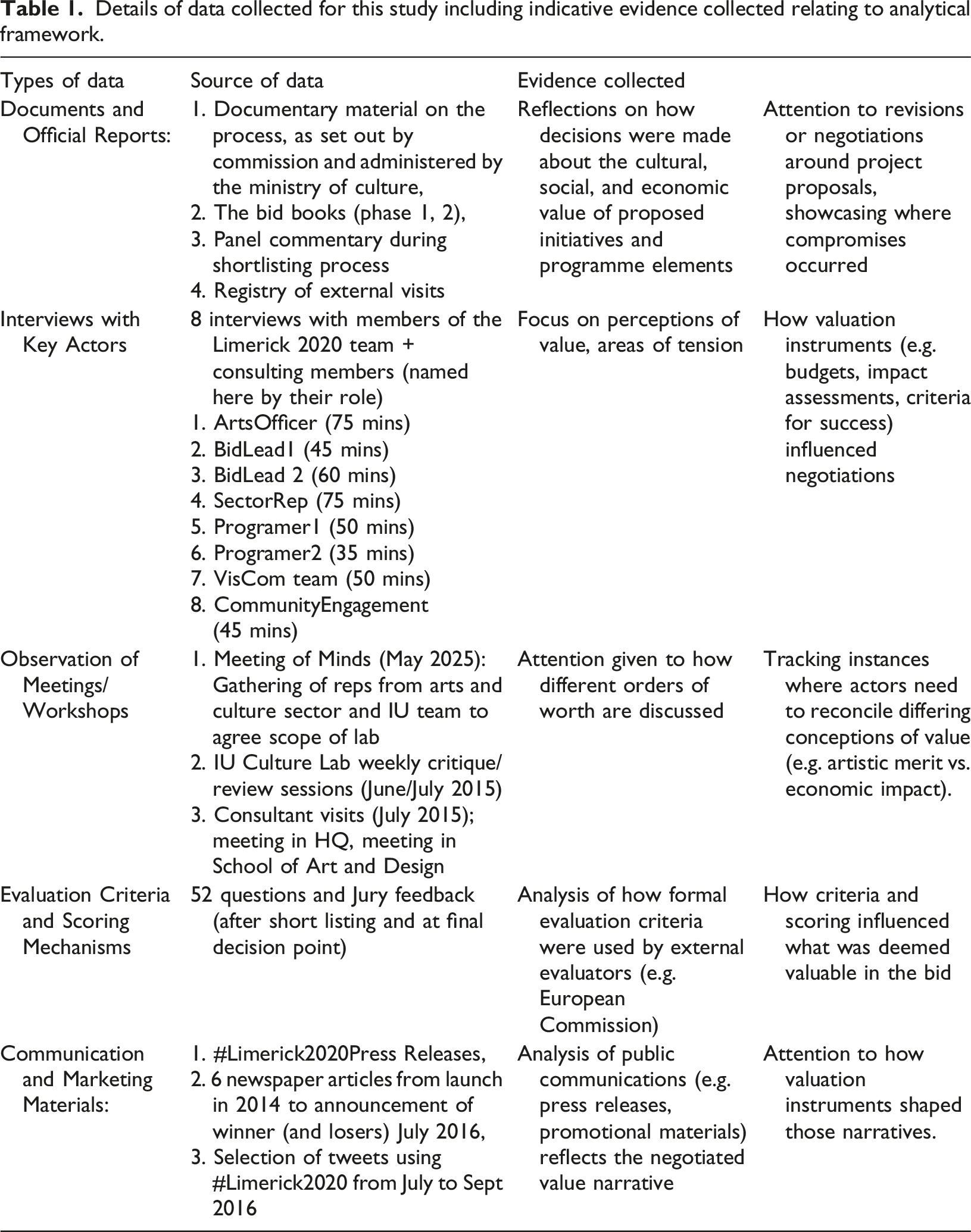
Details of data collected for this study including indicative evidence collected relating to analytical framework.
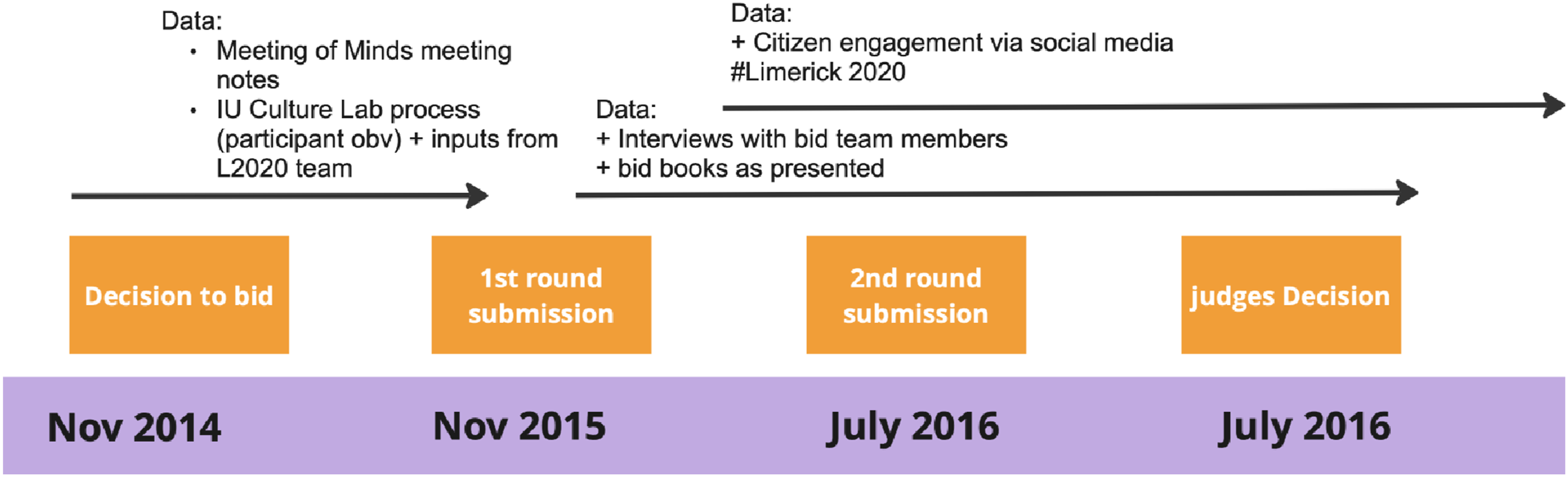
Overview of dates of data collection in relation to the bid process.
Eight in-depth interviews with bid participants were also conducted. Participants were selected via open call, capturing a range of roles. Interviews offered expert elicitation (Bracking, 2024) and cross-checked observations. Interviews (lasting between 35 and 75 mins) conducted in person or online, depending on availability, explored participants’ roles, use of valuation devices, and bid decision-making. These complemented other data sources and clarified missing details (Hede et al., 2023; Nenonen et al., 2019).
To contextualise our analysis, it is important to note that the city’s current brand, Limerick: Atlantic Edge, European Embrace, emerged directly from the ECoC bidding process. The brand was launched formally by Limerick City and County Council in 2020, drawing on elements and values that were developed during the bid, including the juxtaposition of boldness and openness. The brand has since been widely adopted across city communications, cultural initiatives, and commercial activity, including by local businesses and artists (see Exhibit 1). The brand’s public articulation emphasises a dual identity, that is, “edge” reflecting Limerick’s geographical and cultural boldness, and “embrace” symbolising its inclusivity and openness.
4
This duality traces directly back to the bid process, making the branding outcome inseparable from the valuation dynamics under investigation. As such, our analysis follows not only the bid process itself but how it laid the foundations for this now institutionalised brand identity (Limerick City and County Council, 2020; Place Brand Observer, 2021). Selection of #LimerickEdgeEmbrace campaign material.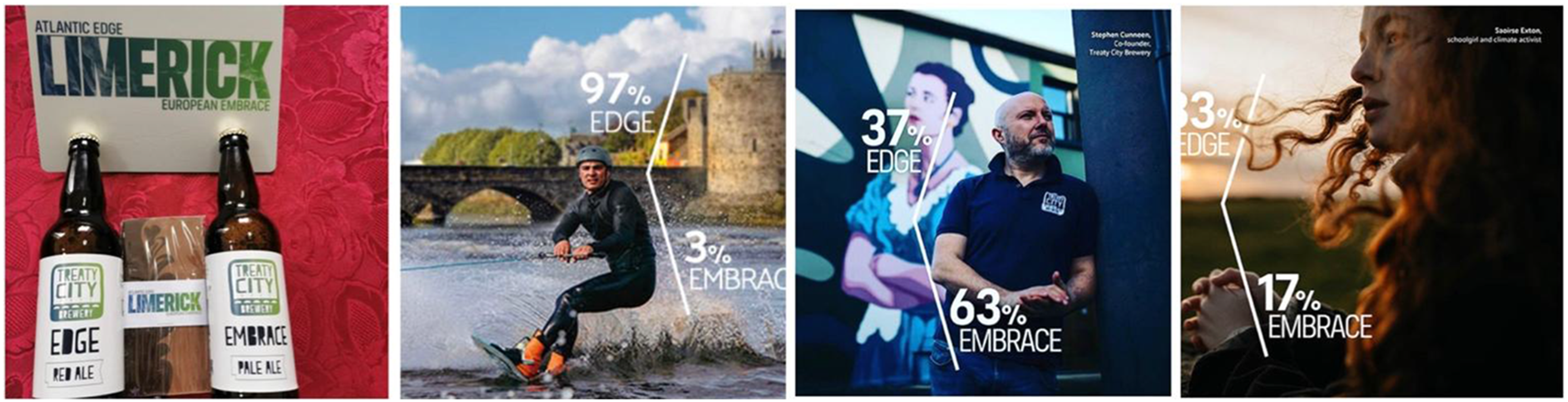
Data analysis
The dataset included transcribed interviews, observation notes, and documents. We used an abductive approach (Dubois and Gadde, 2017), iteratively linking data and theory to refine our understanding of valuation practices. This allowed us to identify emergent patterns and critical valuation moments. Following Law and Urry’s (2004) emphasis on partial and situated accounts, our focus was on temporally and spatially localised critical moments in the valuation process rather than attempting a comprehensive description of the entire bid.
The analysis proceeded across three levels: First, we coded for key practices and actors shaping valuation, including bid book revisions, jury feedback, and stakeholder engagement. Next, we developed three core themes: (1) valuation device assemblage, (2) stakeholder interactions, and (3) connections to the emerging place brand. Finally, we interpreted the themes through Callon and Muniesa’s (2005) valuation devices and Boltanski and Thévenot’s (2006) orders of worth, tracing how competing justifications were prioritised or reconciled. This stage identified the dynamic interplay between valuation devices and the justifications used to prioritise and reconcile cultural, civic, and market values. We examined valuation tensions, such as the bid’s thematic shift from “Multiplicity” to “Belonging,” to understand how actors navigated trade-offs and stabilised new priorities.
Analytical framework tracing dynamic intertwinement (Zuiderent-Jerak and van Egmond, 2015) of orders of worth and valuation devices.
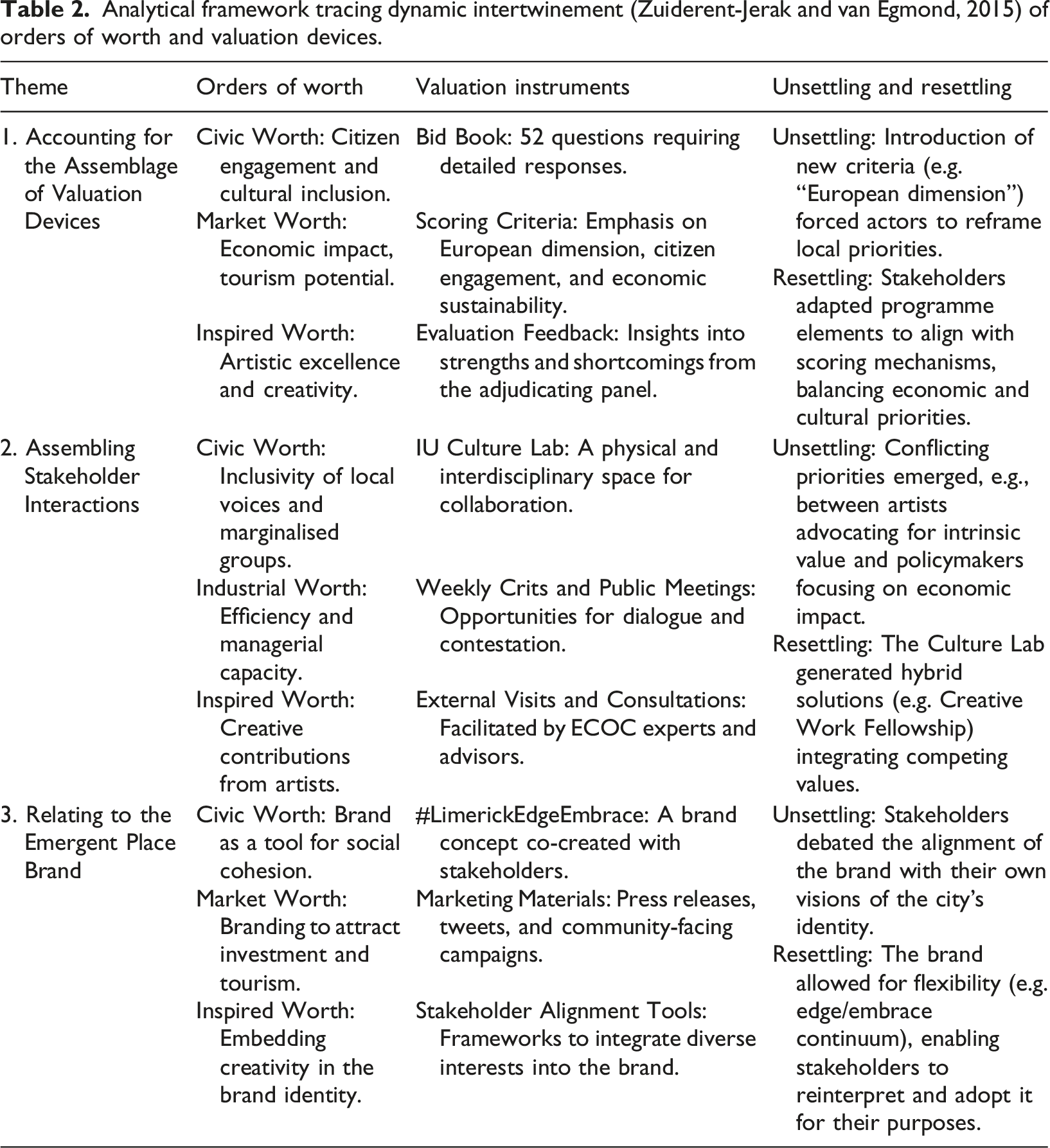
This multifaceted approach captured the distributed and negotiated nature of valuation practices, illustrating how valuation devices mediated the alignment and contestation of competing orders of worth, ultimately contributing to the dynamics of branding as a valuation process.
Findings
Valuation device assemblage
Overview of the many valuation devices evident in the competition.
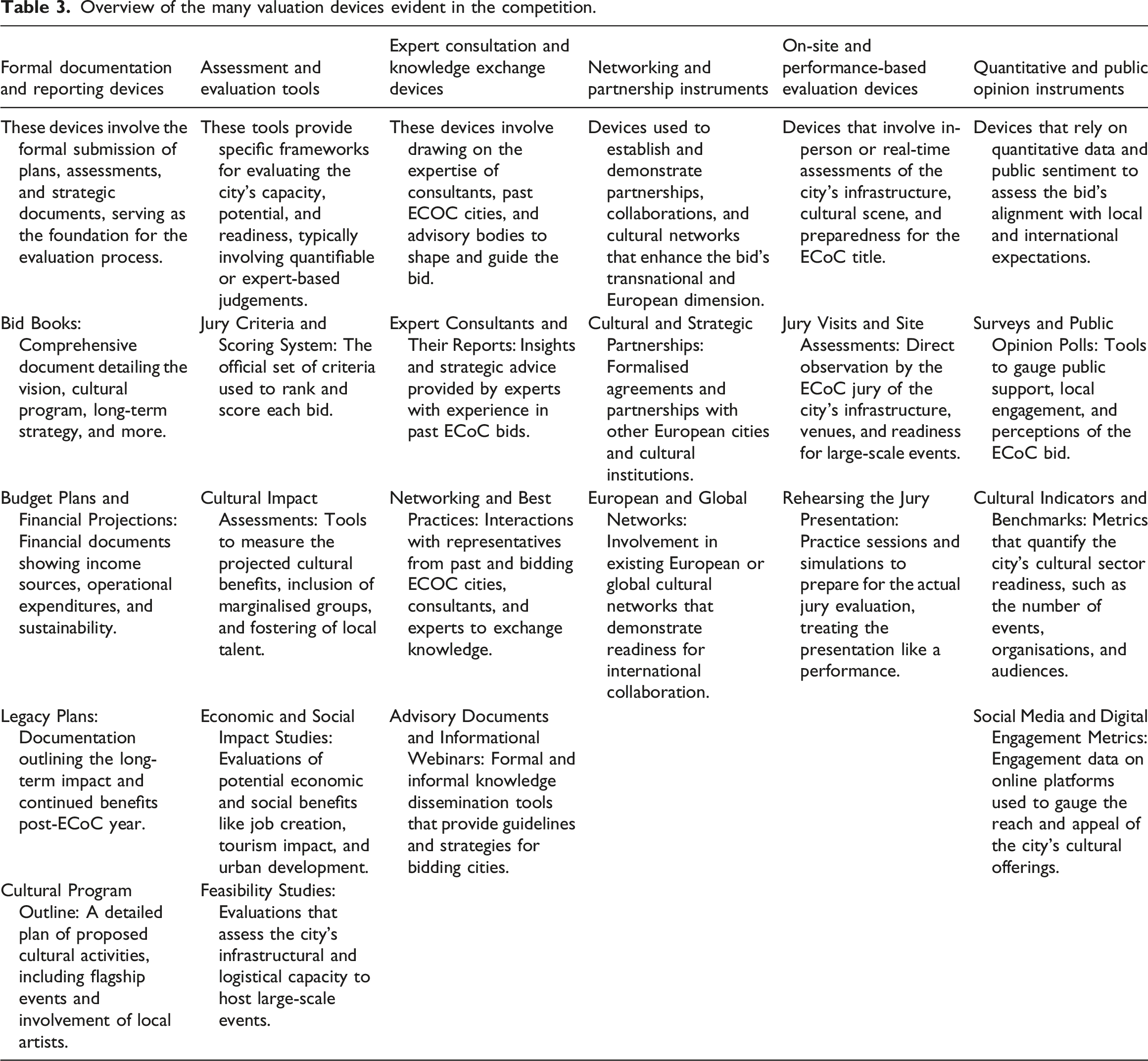
A key device in the process then is the “bid book,” which each competing city must create, first in the early stage of the shortlisting process and second a revised version for the final decision. The format of the bid book is prescribed, where cities must answer 52 questions as set out by the European Commission. This makes the bid book a tool that creates shared reference points, a common language for cities to use, even where they come from very different starting points. Each city is asked to present their bid around a key thematic, a detailed outline of their cultural strategy, a description of the European dimension of the bid, specific details on their artistic program, their capacity as a city to deliver on that program both from an infrastructural and a financial perspective, the efforts to engage with local citizens throughout the bidding process, as well as a detailed operating budget.
Throughout the bidding process, Limerick hosted a range of consultants and city representatives, as well as members of the bid team making visits to past, current, and future ECoC (and UK Cities of Culture) settings. These cities included Derry, Galway, Cork, Leeuwarden, Rijeka, Pula, Plymouth, Oslo, Glasgow, Liverpool, and Manchester, among others. At least 25 consultant interactions occurred over the 2 years, averaging one per month. These included visits to and from strategic advisors, former bid leaders, European Commission officials, and cultural policy consultants. These consultants played roles ranging from strategic bid development and peer feedback to impact measurement and cultural planning. The scope of their role varied from once off engagements and review of submission material, to more extensive role in authoring the city’s cultural strategy (an adjacent activity, but a requirement for the bid
5
) or to advise on specific aspects of the bid such as funding. Members of the bid team themselves, including the co-leads, curators, and others from Limerick City Council, travelled to observe or meet with officials and programme managers in these cities to learn from their approaches. Indeed, there was a secondary competition amongst bidding cities to secure the support of certain experts as lead consultants, with some consultants known to work across multiple bids and to shift allegiances based on perceived chances of success, as the following describes: “And MM [consultant] was here again from the 24th … then he met with some of the practitioners in Limerick. He was saying to us, “What are your urgencies? You need energy in between things.” So, we brought some people together, [named local artists etc.]…. [then referring to a further skype with MM] Yeah, he, was a, [we wanted him as] as a sounding board. Em, we wanted to work with him, he had gotten an offer from Dublin as well, but what you’re realising in hindsight is that he’s a professional in this area and he goes to where he thinks the winning city is and he really liked us, and he told us that, but he thought Dublin were going to win.” (BidLead1)
This consulting practice is internalised into the ECoC process and enabled by the Commission in order to share insights and best practices. Below a co-lead of the Limerick team recalls a series of events that she attended and a range of cities, and their stories, that were (re)presented: “I went to this [indicating an event in her diary] on the 20/7/2012, on European Capitals of Culture. This was the one that you had the head of Creative Europe at the time, you had FG [consultant] at that, this was about Essen, what they achieved, what they did. European glossary of key words in relation to capital or culture [was discussed]…[and then listing cases/presentations she attended] the guy from Bruges, the guy from Turku, the woman from Madeira…. And that’s where I met NP (UK consultant). And JF who ended up being on the jury. And [speaking about another expert] he was at Avignon you know, and then he, at this one he talked about Marseilles, and he was on the jury, he was on our jury.” (Bid Lead1)
Alongside these consultants moves a series of advisory documents and informational events and webinars to advise bidding cities on the process, what they should expect, and how to apply. These events can take place in the host country or bidding cities can attend events taking place anywhere in the EU. As there will be a range of competitions open at any one time, a bidding city will have many options for events and webinars to attend. Not only are these important information gathering events, but also important networking opportunities where bidding teams can identify possible partners to include in their cultural programme, which forms part of their bid: “Identifying …international partners there were people who contacted us, people who we contacted, people who were working in similar ways, on similar projects and sometimes the meetings were via Skype, sometimes you would, you would travel to meet them.” (Progammer2, Bid Team)
There was a range of modes of engagement with consultants, for example, utilising a consultant visit to mobilise local stakeholders to learn about “best practice” case studies. Other uses of consultant visits included networking, gaining programme ideas, preparation of the bid book, and more specifically rehearsing for the jury presentation. The following is an example of getting to hear “first hand” account of what the process of adjudication is like: [Discussing visit by rep of past ECoC city] You were looking for tangible things that you could say, “That’s actually the reality of what a jury visit sounds like. This is the reality.” It’s all well and good [to practice]… it’s like rehearsing a play. You rehearse it in a room with no audience, [and then] you go out onto the stage, and somebody claps and it could throw you. You need to know that that will happen… the actual physical, tangible, granular effect of having those people judging you, was really important to hear. (BidLead1)
This network of European cities and engagement with consultants and representatives during the ECoC bid process shapes the city’s perception of its value. The city’s interactions with consultants, the consultants’ mobility between cities, and the exchange of narratives among bidding or winning cities contribute to a complex web of valuation intermediaries. Additionally, Limerick’s participation in events, webinars, and advisory documents fosters a sense of belonging and partnership eligibility within the broader network, where the city’s practices are influenced and refined in conjunction with European peers. The city’s evolving engagement with consultants, diverse informational events, and the categorisation as an “eligible” partner exemplify how Limerick’s valuation practices are intricately woven into the dynamic and multi-layered landscape of the ECoC bid process.
The bid book, as a valuation device, played a crucial role in connecting a circuit of consultants and their valuation practices while also coordinating different orders of worth within the city and their expectations of what would be valuable. Although the cultural programme remained a central value in the competition, marketability became increasingly emphasised, including the attractiveness to tourism and the ability to draw visitors beyond those attending other cultural events (In bid book section d. Marketing and Communication). These priorities were evident in the changes made between the first and final rounds of the bid and the subsequent panel feedback.
Between the first and final selection, Limerick’s overarching theme shifted from Multiplicity to Belonging. This thematic evolution was framed in the final bid book as a progression: Multiplicity represented “where we are now,” while Belonging signified “where we want to be.” Belonging was linked to the European dimension, aligning with feedback from the jury during the pre-selection phase. The jury had noted, “The panel consider that the programme as outlined needs considerable development with a particular emphasis on the European Dimension criterion.” In response, the bid team sought to connect the concept of Belonging with making Limerick a welcoming place for new residents, including migrants and refugees. However, the jury’s final feedback highlighted further challenges, stating, “The panel did not see a clear attachment or relationship with Limerick itself.”
This feedback illustrates the complex navigation required to balance various orders of worth: crafting a compelling and coherent slogan, addressing the needs of Limerick’s growing population of new citizens, and anchoring these efforts in a clear connection to the city itself. The jury also remarked, “It is not evident in the bid book how a visitor would experience, through the programme, ‘Belonging’ in Limerick compared to any other city with a vibrant cultural festival.” This clash of priorities influenced the overarching theme of the proposal, creating uncertainty about how to balance the European dimension with local identity.
The challenge of articulating a clear, marketable theme is reflected in one of the 52 questions posed to candidate cities for their bid books: “Could your artistic programme be summed up by a slogan?” A bid leader shared the internal debate over this question: “There’s a question in there [the 52 questions] that says, Is there a slogan? Can you sum up your bid in one slogan? And she was worried that you can’t; what is multiplicity? … We don’t know whether that’s going to aggravate the jury, or will they feel that actually, within the process. We figured out that we were very excited by multiplicity, and we really, really love it. But would it transfer into a message (read in context of promotional message). And in one way, your message has to be clear… I fought to keep it as [multiplicity], as the feeling. And everybody, everybody else felt that it was, it described where we are, were, but like, how do you sell it?” (BidLead2)
This illustrates how valuation devices like the bid book orchestrate a fragile alignment between local meanings and external expectations. Overall, these dynamics demonstrate how valuation devices coordinate actors and ideas across networks, generating alignment and contestation that actively shape the evolving identity of the place brand.
Assembling stakeholder interactions
The ECoC bid process underscores the crucial role of stakeholder involvement as a key determinant of a city’s success. In the Limerick bid, one key mechanism for stakeholder engagement was an open 6-week Culture Lab commissioned by the bid team/local authority and led by a group of academics from the University of Limerick (IU Culture Lab). The lab aimed to generate insights into Limerick’s past and present to inform its future positioning in the bid book. Its role was to digest, make sense of, and importantly localise and situate the bid process alongside other parallel stakeholder involvement activities ongoing during this time. Weekly review sessions were open to the public, where insights from the lab were shared and discussed with stakeholders including members of the bid team, artists, representatives from industry, and citizens.
The lab was led by the university academics, and supported by students and researchers had four roles: to develop the bid them, act as a meeting space for stakeholders, showcase the bid publically, and as a cultural event in its own right. The final output, a large format art book was circulated amongst visiting bid experts and consultants as an account of Limerick’s cultural resources. As a meeting place, it was both a site for collaboration and of contestation between different orders of worth. For example, a field note captures a clash between “artists as instrumental contributors to the economy” (market) and “artists as valuable ‘in their own right’” (creativity): The [economist] was making a point about the role of artists in the economy and described them as multipliers. MC, [director of an artist led cultural venue], interrupted and said, in strident terms “NO, NO artists are not multipliers” She contested the framing of artists as amplifiers of economic activity and claimed their value should be seen “in their own right.” (Field notes from weekly IU crit 17.6.15)
Despite such tensions the lab enabled dialog between economists, artists, and policymakers, and supporting the introduction of new frameworks for evaluating artistic value. For example, following this exchange, the lab developed a Creative Work Fellowship (CWF), proposing a minimum wage for artists. This translated social welfare payments into a hybrid valuation logic acknowledging both artistic practice’s intrinsic worth and its social/policy value. What began as a stereotypical clash evolved into a novel valuation framework enabled by the lab’s interdisciplinary nature.
The lab also raised concerns about exclusion and elitism. While it supported broad interaction, some community members felt alienated by its perceived inaccessibility. “…people on the street found it very off-putting… they felt stupid… they didn’t like the fact that it was called the intelligence unit…” (CommunityEngagement Lead)
Such tensions reflect a clash between the fame and civic orders of worth. The bid’s openness further complicated things, as the team had to simultaneously balance presenting a transformative narrative with maintaining local stakeholder support (Exhibits 2–5). “Limerick presented the city on a journey from being perceived as Ireland’s “problem city” to being transformed and known as a cultural city.” (Quote from jury final selection report) Series of still shots from the 2020 launch video. Limerick 2020 sign walked through a deprived housing estate. Series of still shots from the 2020 launch video. Council staff posting Limerick 2020 poster in city graveyard. Series of still shots from the 2020 launch video. Drone shot of old part of city centre. Series of still shots from the 2020 launch video. Council staff member power washing street using Limerick 2020 sign.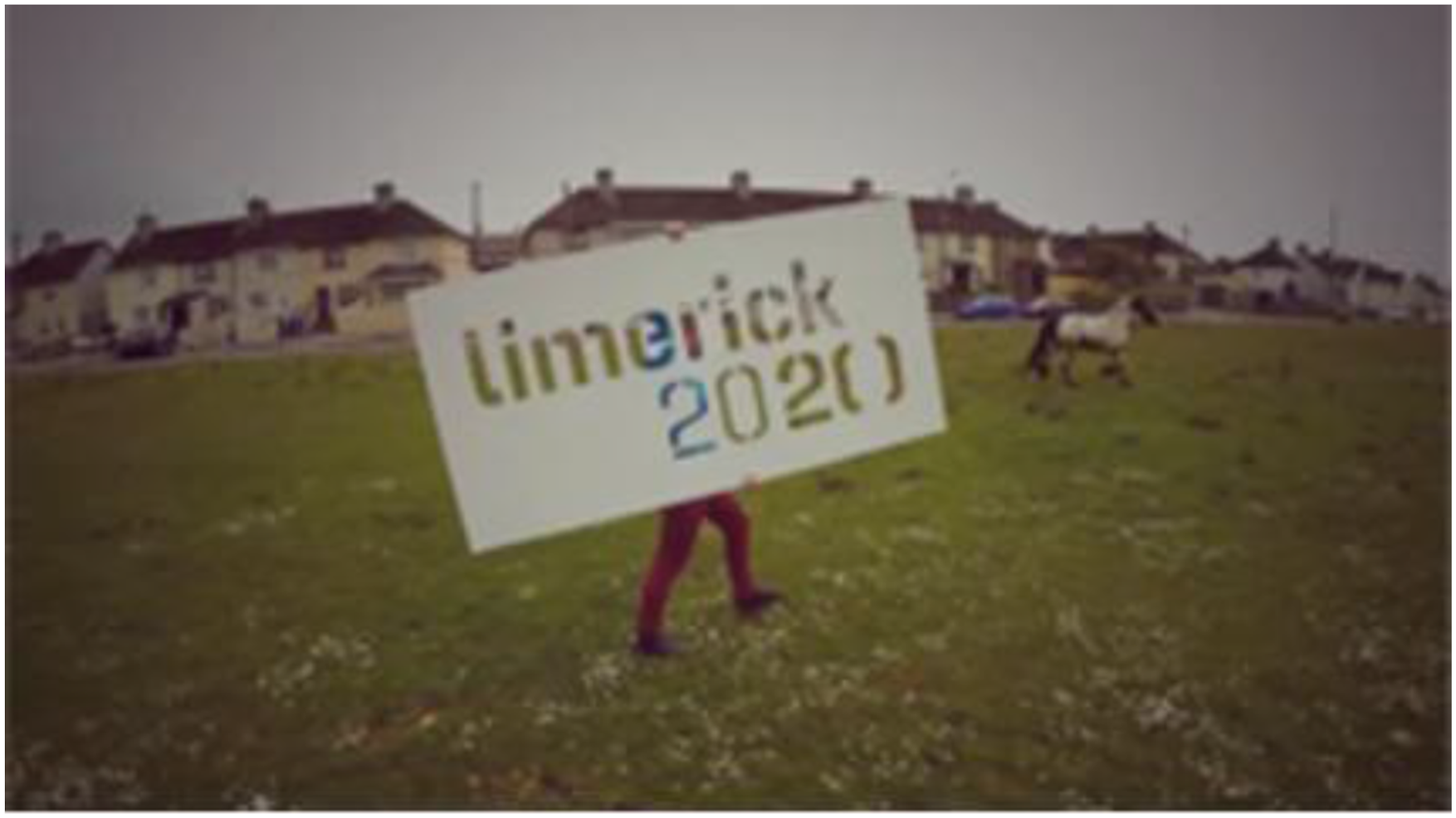

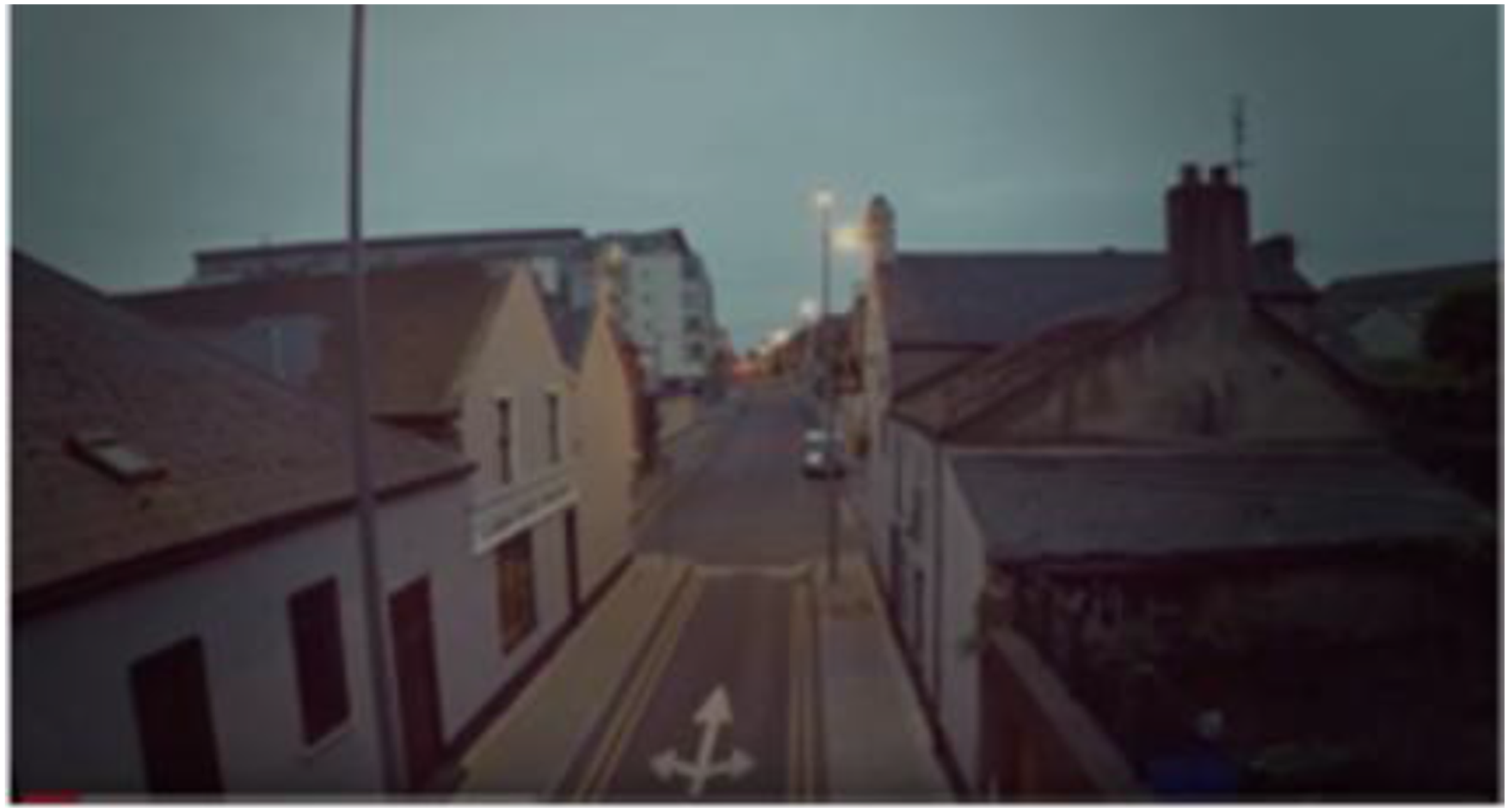
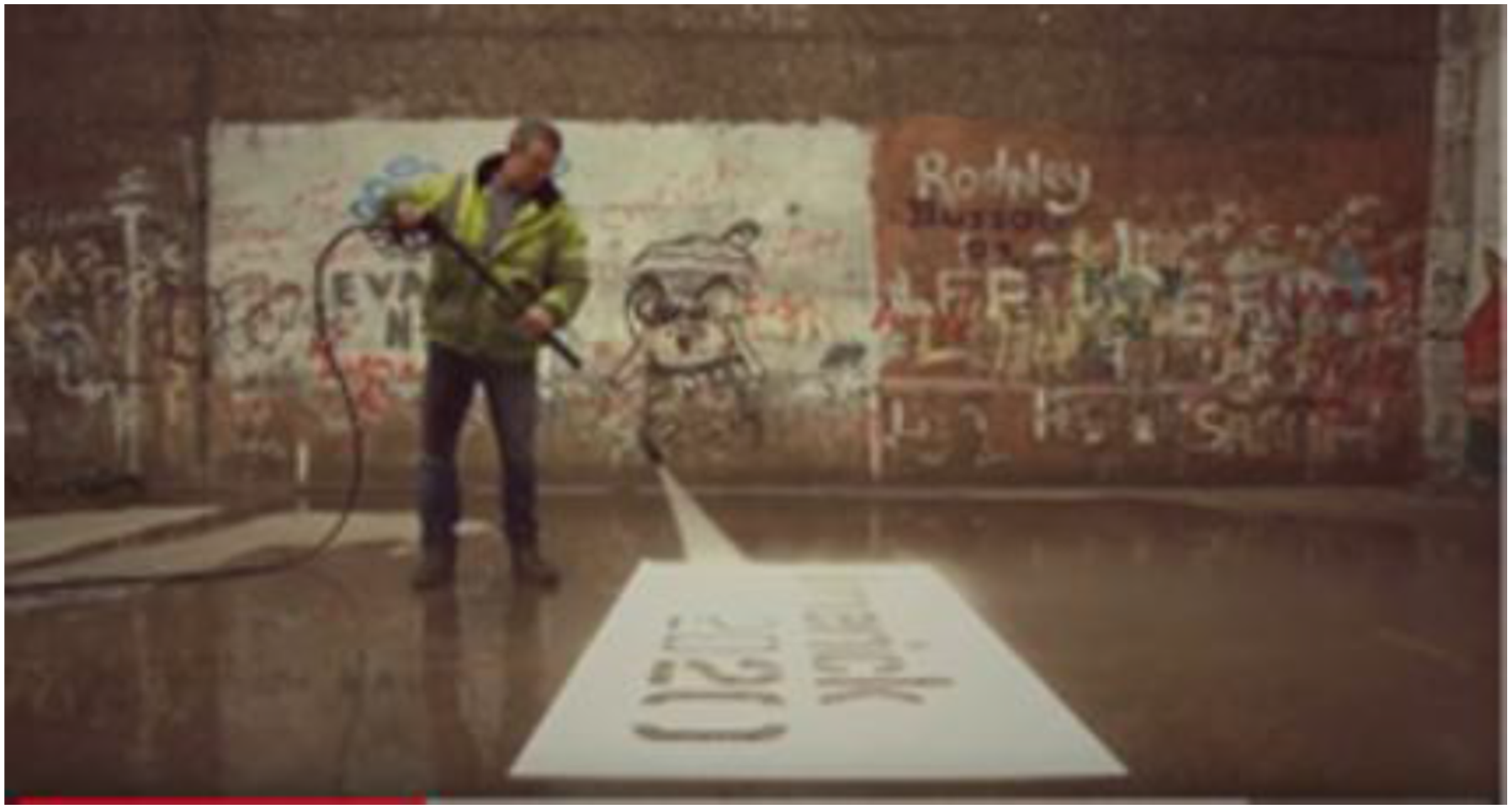
However, the narrative was contested. While “transformation” had resonated in previous winning cities, Limerick’s bid drew public criticism for referring to the city as a “non-place” in first page of the final bid book, a phrase picked up in the local press and on Twitter: “Bid Book defended by Council”: 21st Sept 2016, Limerick Life Newspaper reshared on Twitter….“Here’s the first page of #limerick2020 bid document. Important that we’re aware how the city was described.”
Connections to the emergent place brand
The findings of this study illustrate how the ECoC bid process served as a dynamic platform for the emergence of Limerick’s #LimerickEdgeEmbrace branding campaign in 2020. This valuation assemblage introduced new criteria, fostered contestation, and aligned stakeholders, shaping the eventual brand. These interactions reveal the performative and distributed nature of the competition, which extended beyond adjudication to influence the city’s identity and cultural narrative. The bid for ECoC 2020 followed Limerick’s designation as Ireland’s inaugural National City of Culture in 2014, a moment described by the city’s Marketing Director as pivotal: “It was really a big part of Limerick working out its identity because the city was becoming visible. It was drawing out and bringing to the fore its creative side, its creative resources were being more recognised and giving the city this edge.” Building on this momentum, the ECoC competition introduced structured valuation devices that required articulation of both local identity and European/global relevance.
The bid process exposed significant contestations, as stakeholders negotiated competing priorities, values, and strategies in shaping Limerick’s identity. The bid book, as a critical valuation device, provided a framework for structuring the city’s vision but also acted as a site of tension through which creative, civic, and market orders of worth converged and clashed. As one bid leader noted, “Are we meeting the criteria, which is that it’s a festive event, it’s a cultural event of high artistic excellence. It’s a transformative event. It’s an economic event. Like, there’s all the things that it is.”
This multiplicity generated tensions as stakeholders sought to reconcile competing priorities within a cohesive narrative. The competition’s performative nature was evident in efforts to differentiate Limerick’s bid while adhering to normative language. “I was watching the Galway one when I was like, Oh no, they have the vocabulary. They’re saying all the things that you’re supposed to say. And I’m thinking, how do we make that different in the room now? Like, how do we say it without saying the jargon? How do we say it without taking the meaning away from it? How do we say it to convince them what we are?” (BidLead 1)
This tension between conformity and authenticity exemplifies the dual role of valuation devices. They both imposed structured criteria and demanded innovation, often unsettling existing priorities. Another stakeholder articulated this balancing act: “We’re trying to be savvy, but at the same time authentic.” The challenge lay in presenting Limerick as both a sophisticated, future-facing city aligned with European cultural policy and a unique, authentic place rooted in local identity. These contestations shaped both the bid process and the emergent brand, with valuation devices mediating the dynamic interplay between local and global expectations.
This contested and negotiated process directly shaped the emergence of the #LimerickEdgeEmbrace brand. The competition’s valuation assemblage enabled the brand to embody multiple, sometimes conflicting, values. For example, the brand’s emphasis on openness and creativity resonated with the competition’s requirements for civic engagement and cultural innovation. At the same time, its framing of “edge” and “embrace” reflected Limerick’s local narrative of resilience and transformation.
A key moment in this process was the integration of the Limerick 2020 bid team into the branding effort. The Marketing Director involved bid team members in stakeholder networks to ensure alignment between the bid and the brand. The open and participatory design of #LimerickEdgeEmbrace allowed for significant stakeholder engagement. The brand team invited contributions from arts, culture, tourism, and industry representatives, encouraging them to interpret and use the brand in their contexts. For example, Treaty Brewery developed products inspired by the “edge/embrace” concept, demonstrating how the brand could inspire action and innovation across sectors. However, this openness also revealed contestations. Stakeholders grappled with reconciling local and European identities within the brand and ensuring its relevance to both civic and market orders of worth. This collaboration illustrates how competitive practices shaped long-term identity construction beyond the immediate bid. “Now this story of multiplicity….is actually one of the reasons that makes us edgy, and that makes us feel edgy is that we have this electricity here and that, and we all coexist. We coexist,” noted one bid leader, reflecting on the narrative that informed the brand’s framing.
Ultimately, the contestations enabled in the bid process enriched the brand, embedding it with the multiplicity and complexity of place. These findings underscore the performative nature of the ECoC competition in shaping the #LimerickEdgeEmbrace brand. While the European dimension and engagement mandates created the framework, it was the interplay of local contestations and global aspirations that gave the brand its distinctiveness. The competition did not merely assess Limerick; it transformed the city’s narrative and practices. The #LimerickEdgeEmbrace brand encapsulates the lessons and tensions of the bid process, celebrating the city’s diversity while striving to meet external expectations. Thus, the competition acted as a distributed actor-network that orchestrated and mediated valuation practices constitutive of the brand.
Discussion
Competitions as performative and distributed actor-networks
Competitions such as the ECoC bid process operate as distributed actor-networks in which agency emerges through interrelations between heterogeneous actors and devices (Callon, 1998). Central valuation devices, such as the bid book, do not operate in isolation but alongside scoring mechanisms, stakeholder workshops, and public consultations. Together, these configure and stabilise value claims, positioning the competition as a performative system through which the place brand is actively constituted. Valuation assemblages (Moor and Lury, 2011) position branding as a constitutive practice in which devices produce, circulate, and stabilise value claims. In the ECoC bid process, instruments such as bid templates, consultant feedback, and panel reviews impose coherence and comparability, operationalising civic, market, and creative orders of worth (Boltanski and Thévenot, 2006).
Competitions bring into being the objects they evaluate, creating arenas in which competing orders of worth are debated and reconciled (Kornberger and Carter, 2010). In this case, these processes extended beyond the bid itself shaping the emergent #LimerickEdgeEmbrace brand and mediating between local multiplicities and global evaluation frameworks. By foregrounding the distributed and dynamic nature of valuation assemblages (Moor and Lury, 2011; Pallesen, 2015), this study extends the co-creative approach (Kavaratzis and Hatch, 2013) by incorporating the role of valuation infrastructures and non-human actors that might otherwise remain peripheral. Valuation devices coordinate contestations, aligning actors through iterative negotiation and embedding valuation within the formation of the place brand.
Valuation assemblages: Unsettling and stabilising value orders
The ECoC valuation assemblages simultaneously unsettle and stabilise value orders. Devices such as bid books and jury evaluations introduce new evaluative criteria, for example, the emphasis on the European dimension, requiring cities to reconfigure their narratives. Limerick’s shift from “Multiplicity” to “Belonging” illustrates how valuation devices both disrupt existing priorities while stabilising new ones. However, such reconfigurations remain fragile, as competing orders of worth are only temporarily reconciled (Boltanski and Thévenot, 2006). Building on Pallesen’s (2015) concept of valuation assemblages, we show how heterogeneous entities, such as bid books, jury feedback, and local identities, are configured into contested yet temporarily stabilised arrangements, producing shifting associations between the bid and the emerging place brand.
Valuation devices mediate between competing orders of worth by shaping how actors articulate and justify what is valuable, and by influencing which claims come to count within the evaluation process. While orders of worth help explain how actors justify value, valuation devices shape how these justifications are taken up, reworked, and made actionable in practice. Their interaction reveals how values are selectively stabilised, contested, or transformed within the competition. This complementary perspective enables a richer understanding of how valuation processes not only reflect but also actively constitute the dynamics of contested spaces, such as those in the ECoC bidding process. Figure 2 visualises the dynamic intertwinement (Zuiderent-Jerak and Van Egmond, 2015) of orders of worth and valuation devices and their relation to the emergent place brand. Conceptualisation of the dynamic intertwinement (Zuiderent-Jerak and van Egmond, 2015) of orders of worth and valuation devices and their relation to the emergent place brand.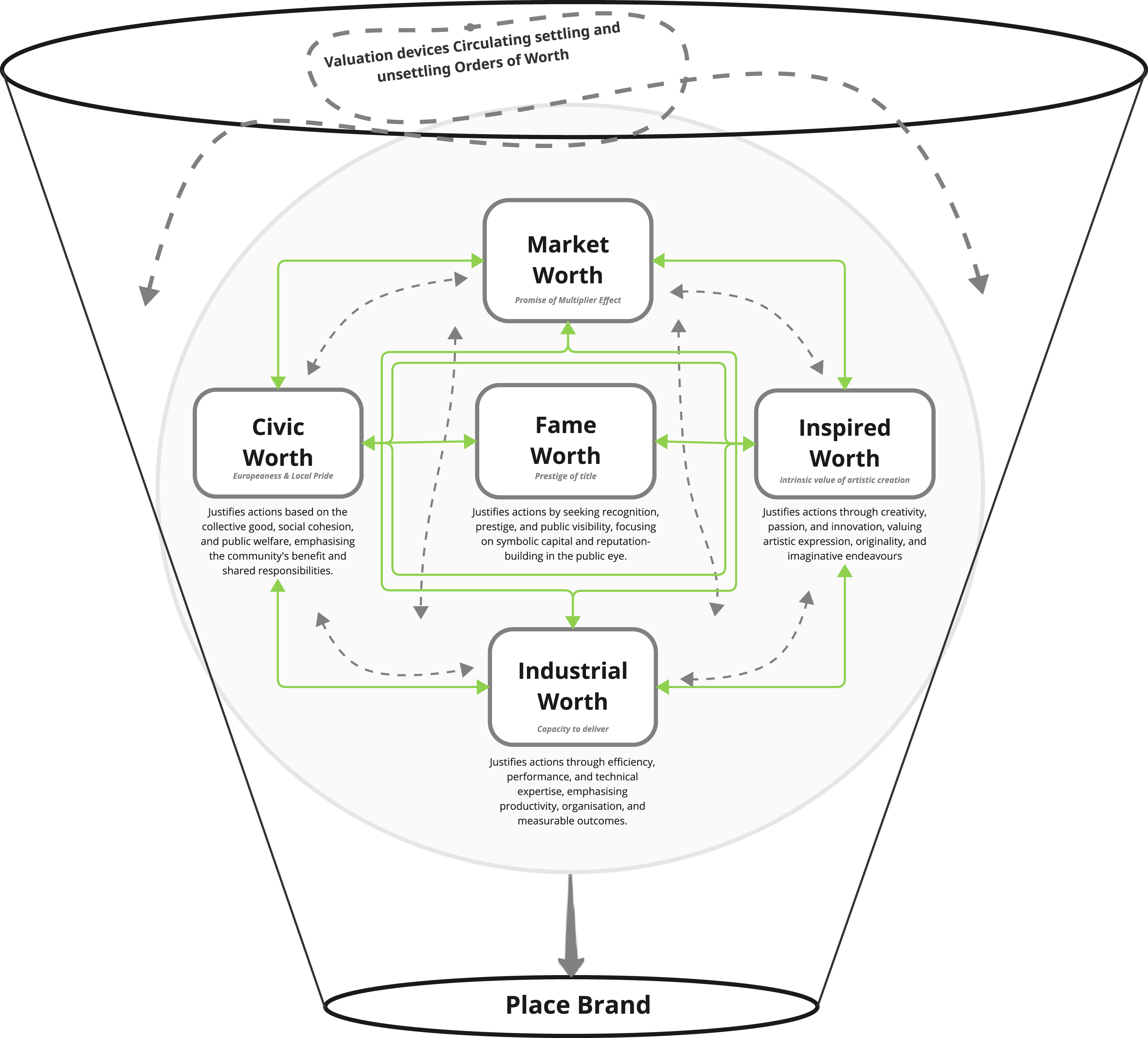
Figure 2 illustrates how a place brand emerges through the dynamic interplay between multiple orders of worth, (civic, market, industrial, fame, and inspired) and the valuation devices that circulate between them. Rather than fixed categories, these orders operate as competing justification frameworks; for example, market worth foregrounds economic impact and return on value, while civic worth emphasises social inclusion. At the centre, fame worth functions as a transversal amplifier, intensifying the visibility and stakes of all other orders in the high-profile context of the ECoC competition.
Valuation devices mediate these relations by translating, aligning, and contesting value claims. For instance, the bid book translated local cultural narratives into evaluative formats aligned with market and civic worth, foregrounding economic impact and social inclusion. Jury feedback privileging the “European dimension” unsettled locally grounded narratives and reoriented the bid toward industrial and civic worth. In contrast, the IU Culture Lab provided a space in which inspired and civic orders of worth could be articulated, resulting in initiatives such as the Creative Work Fellowship. These examples illustrate how valuation devices actively shape which orders of worth become dominant rather than simply representing them.
The dynamic is reflected in the shift from “Multiplicity” to “Belonging,” and its subsequent rejection, illustrating how devices selectively stabilise certain orders of worth while marginalising others. In Figure 2, solid arrows represent dominant and publically mobilised justifications, while dashed arrows indicate latent or background justifications that may be reactivated through contestation. The funnel structure captures how valuation devices circulate across value regimes, making certain orders actionable at particular moments. This circulation is performative: it shapes which values are amplified, muted, or reconfigured. The resulting place brand is a provisional and negotiated artefact of these interactions, rather than a fixed or top-down identity.
Not all concerns were equally translated into valuation devices. Actors gained influence not through formal authority but through their ability to inscribe concerns into devices such as bid books and strategic reports. For example, artists’ resistance to being framed as economic “multipliers” was partially translated into the Creative Work Fellowship, while “Belonging” was excluded following jury feedback. This illustrates how valuation practices selectively amplify some concerns while muting others, producing a situated politics of worth.
Valuation as constitutive of branding
This study positions valuation as constitutive of branding rather than external to it (Helgesson and Kjellberg 2013; Moor and Lury 2011). The #LimerickEdgeEmbrace brand emerged from the negotiations and that shaped the ECoC bidding process, embedding these valuation dynamics within the brand itself. Valuation devices imposed comparability and coherence, compelling cities to articulate their identity within structured criteria (“Could your artistic programme be summed up by a slogan?”) while allowing for selective creativity. As Czarniawska-Joerges (2002) notes, cities are complex sites of organising and valuation, where competitions provide structured yet evolving frameworks for these processes. Viewing competitions as valuation assemblages (Pallesen, 2015) highlights their role as infrastructures through which place brands are formed. These assemblages mediate between local and global identities, shaping how value is articulated, stabilised, and materialised in branding outcomes.
Conclusion
The study contributes to valuation and place branding research by conceptualising competitions as valuation assemblages, distributed actor-networks that enact, mediate, and transform value. By foregrounding the dynamic intertwinement of valuation devices and orders of worth, we show how place brands emerge through contested yet temporarily stabilised valuation processes, and competitions shape local identities while navigating the uncertainties of global frameworks. This highlights the need for more nuanced, inclusive, and politically attuned approaches to place branding.
In an era where cities are increasingly evaluated through rankings, metrics, and competitions, the ECoC bid process provides a setting in which valuation practices become visible. Our analysis shows how such competitions organise how cities articulate, negotiate, and stabilise what counts as valuable. Extending existing literature, we introduce branding as valuation to capture how place brands emerge through the operationalisation of valuation practices and devices. This shifts attention from branding as representation to branding as a process in which competing orders of worth are negotiated, translated, and stabilised. In doing so, we highlight the role of valuation assemblages comprising both human and non-human actors, in shaping how value is made actionable in place branding, which further extends the co-creative approach to place branding.
This study demonstrates that cities strategically manage and negotiate their identities in the competitive space of cultural recognition through a continuous process of coordination, valuation, and compromise. Cities, as Knox (2010) observes, are difficult to grasp due to their complexity (Latour, 2012). Bidding processes like ECoC offer a bounded setting in which this complexity becomes temporarily stabilised. They provide a window into how multiple orders of worth are coordinated under conditions of evaluation, revealing how urban identities are organised, negotiated, and contested.
Implications for practice
Branding as valuation highlights that place branding involves negotiating between diverse stakeholders with competing value claims. While this is recognised in co-creation approaches, our findings extend this by showing how valuation devices actively shape which values become visible and actionable. Drawing on orders of worth, practitioners can better recognise the justificatory logics underpinning stakeholder positions and to engage more reflexively with value pluralism. Importantly, devices such as bid books, scoring systems, and consultation frameworks do not merely reflect stakeholder values but perform them. This calls for a more reflexive approach in which valuation tools themselves are understood as shaping, rather than simply measuring, value.
Future research
This study demonstrates how valuation instruments not only reinforce existing orders of worth but can also unsettle and reconfigure them during moments of contestation. By foregrounding the performative role of valuation devices, we offer a dynamic view of how branding emerges through entangled processes of justification and valuation. Future research could extend this approach by examining how valuation unfolds across varied instruments including cultural strategies, development plans, or funding bids, each of which may carry distinct logics of value that intersect, support, or contradict one another. Tracing how actors move between these arenas can illuminate how values are stabilised, reshaped, or contested over time.
The dual theoretical framework proposed here, drawing on both orders of worth and valuation devices, offers a promising basis for further empirical and conceptual work. The notion of dynamic intertwinement (Zuiderent-Jerak and Van Egmond, 2015) between justifications and devices could be extended to other domains where public value is in question, such as urban development, cultural policy, or infrastructure planning. In each case, future work could explore how valuation devices not only stabilise value but also shape the conditions under which existing valuations are disrupted or reconfigured.
Further, while our analysis has traced how valuation practices unfold within the temporal and spatial boundaries of the ECoC bidding process, future research could expand the lens to consider how moments of valuation interconnect over time as valuation constellations (see Waibel et al., 2021). Applied to place branding, this approach could further illuminate how valuations generated during bidding processes circulate and reshape valuation practices in subsequent initiatives, including funding applications or cultural programming. By mapping these interconnected moments of valuation, research could trace how orders of worth are not only negotiated within bounded spaces and how they cohere, unravel, or transform as they travel across situations, revealing the broader temporal and spatial dynamics through which place brand value is assembled and reconfigured.
Footnotes
Acknowledgements
The authors would like to thank the colleagues who co-led the IU Culture Lab with the lead author, whose collaboration and commitment in the lab were central to the development of the work presented here. The authors are also grateful to the Limerick 2020 team for their generosity in sharing their time, insights, and experiences, and for their active engagement with the research.

Funding
The authors received no financial support for the research, authorship, and/or publication of this article.
Declaration of conflicting interests
The authors declared no potential conflicts of interest with respect to the research, authorship, and/or publication of this article.
Breakdown of work
Annmarie Ryan led the empirical components of the study, including data collection, collation, and analysis. Both Annmarie Ryan and Teea Palo contributed jointly to the conceptual development of the paper, engaging in the review of relevant literature and the development of the theoretical framing. The authors collaborated closely in shaping the core arguments and advancing the theorisation presented in the manuscript.