



Abstract
The purpose of our article is to propose that compromising is a constitutive characteristic of those marketing systems that entail matters of public interest or concern. In such markets, actors design compromises as they encounter criticisms of and contending justifications for the market’s products, as these refer to price, efficiency in production and use, regulatory compliance or ecological sustainability. Tests and justifications are vital in order to determine what is valuable and by which measure. As a theory framework, the economic sociology of conventions provides a basis for assessing these contests, compromises, and justifications over the issue of worth in a marketing context. Through an ethnographic study of the regulated activities of chemicals service companies supporting the upstream petroleum industry, we assess how actors evaluate and justify the market’s products and services in this environmentally sensitive setting by means of tests drawing from different orders of worth: the green, the industrial and the market order. Our contributions show that by artful and pragmatic compromising around exchanges, actors in marketing systems can balance several conflicting orders of worth over the question of worth without needing to converge on an overriding institutional logic.
Keywords
Introduction
Many marketing researchers now acknowledge the importance of ‘the context of context’ in which market actors operate (Askegaard and Linnet, 2011). Often, these investigations are framed in terms of marketing or market systems, understood as complex relational entities that include social, economic, cultural, material and institutional practices and that can be analysed at different levels of aggregation (Giesler, 2004; Layton, 2007). Recent research has made significant progress in furthering our understanding of how actors shape markets and marketing systems over time (e.g. Giesler, 2008, 2012; Humphreys, 2010; Scaraboto and Fischer, 2013). This research has mainly examined market systems in the consumer realm, with consumer entrepreneurs or social movements bringing about collective change in or adjacent to the market over time (Humphreys, 2010, 2014). The adoption of an institutional perspective has led some researchers to focus on the social, symbolic and normative dynamics of markets, while being less vocal about the specific exchange practices arising from these dynamics and how they intersect with a market’s material dimensions (exceptions include Giesler, 2008; Martin and Schouten, 2014). While providing valuable insights, an institutional focus may also come at the expense of attending to situations where individual actors are required to justify or coordinate their actions pragmatically in real time across competing logics, interests or values, especially when the institutional frames are not sufficient or sufficiently stable to guide them (Biggart and Beamish, 2003).
Our aim in this article is to ascertain how, collectively, actors address the question of ‘what is valuable’ in a marketing system if they cannot draw upon a single stable logic (Stark, 2009). Actors need to confront this question in order to coordinate the regulation, production, and exchange of products and services. To examine this issue, we trace the ongoing tests and compromises that actors make between several logics or orders of worth to include an industrial market located in an environmentally sensitive setting. We frame our understanding of these tests with reference to Boltanski and Thévenot’s (2006) examination of the kinds of justifications and compromises, which actors make in markets and other settings. We focus on the ways that actors cope when faced with criticisms or valuations external to the market – as, for instance, when bottled water is valued as an environmental and health concern rather than a commodity (Hawkins, 2011).
By focusing on coordination, valuation and compromise, we address the three conceptual gaps signalled above: First, while many extant marketing studies have considered consumer markets, we study a site where a marketing system overlaps and interacts with an ecosystem, which makes visible the externalities that markets create, and which raises vital questions over the common good and civic justice. Regulators articulate values and go about introducing these into markets – for instance, conservation or sustainability – and buyers and sellers become obliged to accommodate these. While Giesler (2008) and Chan (2009) assess commercialization as actors place products and services into markets and market logics, other dimensions remain outside of the market frame. By contrast, we assess the ways in which regulators attempt to develop versions of conservation and sustainability in terms of a market logic, which as a process can lead to intractable contests over the worth of products and services. Second, environmental sensitivity draws our attention beyond cultural, symbolic or social values to the materialities of the products and the exchanges made. As these materialities change, the market’s institutional equipment – regulations, contracts, price lists or norms of exchange – may prove insufficient to guide exchanges, requiring ongoing adjustments on the part of market actors. Where Patroitta et al. (2011) examine the maintenance of institutions and legitimacy, our focus is on actors facing a pragmatic and material requirement for the continuation of exchanges. Third, we address actors’ situated and pragmatic engagements in those critical moments of market activities where a capacity to compromise is necessary for making exchanges. Where, for example, Murray (2010) examines how actors draw on patents to maintain the integrity of the logics of market and science, we examine the recursive and divergent compromises made necessary by actors, who expect there to be a series of familiar exchanges into the medium term. Each of these three facets, we argue, brings to the fore questions of worth and requires actors to become artful in compromising as a constitutive, pragmatic and continuous activity in markets.
We develop our argument of the critical capacity of market actors to make compromises over what is valuable, good or worthy by investigating the supply of chemical services in support of the upstream petroleum industry in the North Atlantic. As a business-to-business marketing setting, the case is characterized by variable product/service hybrids exchanged through often complex once-off costing, pricing and service agreements. We follow our international cast of oil-producing buyers, chemical-producing sellers, service companies, non-governmental organizations (NGOs) and local and transnational regulators through a multi-year ethnographic study, as they regulate, design and exchange production chemistry.
Our contribution is to demonstrate that actors develop consistent, even systematic, ways of managing a number of general orders of worth, even where these orders allow others to make rival, unsettling and incompatible claims upon market exchanges. Boltanski and Thévenot (2006) present economics of convention as a means of representing and managing economic uncertainty. We show that actors coordinate their actions by making and remaking compromises across series of exchanges, because various tests can be made provisional if they indicate a promise of refinement and improvement for those expected future exchanges and tests.
Competing logics in marketing systems and ecosystems
Recent marketing research has shed light on markets that are characterized by competing interests or logics among actors. In institutional terms, logics can be understood as shared, durable and internally consistent sets of beliefs, rules, values and assumptions (Thornton and Ocasio 1999). Together with a market’s other institutional equipment, a logic can stabilize social interactions and behaviours. Institutional accounts have proven fruitful for researchers who investigate the processes by which consumers may act as groups in seeking ways to change markets characterized by a dominant logic – such as Scaraboto and Fischer (2013), who followed their frustrated fashionistas’ institutional work. Marketing researchers have also traced longitudinal shifts in markets’ legitimacy, framing these as institutional adaptations, for instance in the casino gambling industry (Humphreys, 2010). Importantly, studies have demonstrated that competing logics can coexist in markets for extended periods of time (Ertimur and Coskuner-Balli, 2015; Giesler, 2008, 2012). For instance, Giesler (2008) traces the conflicts and compromises in the evolution of the market for music downloads and highlights the moves and countermoves between the ‘sharing’ and ‘owning’ logics of illegal music downloaders and the music industry corporations, which cause ‘perpetual structural instability’ (p. 750). Thus, it is fair to agree that ‘plural logic markets do not constitute a new phenomenon’ (Ertimur and Coskuner-Balli, 2015: 40).
However, these broadly institutional and cultural accounts have arguably led to a neglect in examining situations where institutional equipment either breaks down or is insufficiently stable for actors to coordinate their activities during moments of exchange, especially when confronted with public justifications over the common good (Patriotta et al., 2011). This is regularly the case in ecologically or environmentally sensitive markets (Humphreys, 2014; Peñaloza and Mish, 2011; Scott et al., 2014). Marketing systems that include environmental matters of concern are often fraught with moral controversies over the appropriation of the common good into a market logic, as for instance in the ‘marketization’ of environmental assets or in the notion of ecosystem services (Corbera et al., 2007; Pröpper, 2015). Fisher et al. (2009) define ecosystem services as ‘aspects of ecosystems utilized actively or passively to produce human welfare’. This definition includes an understanding that ecosystems may offer services up to a certain level, beyond which their sustainability or reproducibility will become compromised. For example, a marine ecosystem’s services might range from the provision of food and recreation to carbon sinks and water treatments, which are seemingly free to users. Essentially, this means that (parts of) nature’s offers can be drawn into a marketing system. One reason put forward by policymakers when designing and implementing market frameworks in association with natural resources is that the market’s pricing mechanism allows them to regulate humans’ use of the ecosystem’s services.
Against this ‘ideal of concisely valued and well-accounted-for goods traded in markets by rational and moral actors’ (Pröpper, 2015: 247), ecosystem services have shown to be a ‘burdened concept’ (ibid). Researchers have studied marketization processes of ecosystems that have led to the commoditization of vulnerable natural resources (Hawkins, 2011) and irresolvable value struggles (Sullivan and Hannis, 2015). In most cases, these processes involved considerable translation efforts (ibid), were highly politicized (Blok, 2011) and placed human interests and values selectively centre stage (Fourcade, 2011). Even when these controversies are thought to be settled, new – often material or scientific – evidence may reignite them and put the market’s calculus into question (Gregson et al., 2013). Thus, research at the intersection of environmental issues and marketization has emphasized that ‘the ontological construction of economic goods goes hand in hand with normative considerations about what is desirable for the common good’ (Doganova and Laurent, 2016: 6). In other words, when actors design and exchange a product or service in markets associated with ecosystems, they have to confront the issue of worth as a matter of course. In these situations, actors’ mobilizing of different logics, justifications or legitimations becomes visible over the question of ‘what’s valuable’ and ‘for whom’ (Stark, 2009).
The economics of convention
In order to analyse such moments critiques when environmental and market values clash over questions of the common good, we turn to Boltanski and Thévenot’s (2006) framework of economic conventions. Boltanski and Thévenot provide a framework of durable orders of worth, which are not reducible to one another, but which allow actors to ‘organize uncertainty’ in situated arrangements (Boltanski and Thévenot, 2000; Stark, 2009; Thévenot, 2004). This framework is particularly useful for understanding activities in dynamic marketing systems where actors inhabit ‘a resistant, changing and transformed world’ (Thévenot 2001b: 67). However, despite Biggart and Beamish’s (2003) early encouragement that convention theory could be a valuable complement to network and institutional theories in explaining how market actors coordinate with each other, Boltanski and Thévenot’s writing has to date had little influence on marketing research.
Boltanski and Thévenot’s economics of convention has been described as ‘complex pragmatic situationalism’ (Diaz-Bone, 2014). Their focus lies on investigating if, when and how individuals access and mobilize different, socially and culturally shared, moral conventions in situations of dispute or uncertainty. According to Thévenot (2001a, 2004, 2007), the ideas behind the framework are as follow: (1) Coordination of action between individuals and groups of individuals can be problematic because of uncertainty, which cannot be assuaged through notions of the collective, routine, habitus or institutions. (2) Humans organize or ‘tame’ this uncertainty by giving public justifications of their actions if required to do so. Conventions give them frames on which they can base these justifications. (3) Shared knowledge or interpretations are only important in insofar as they allow actors to do things with others; in this sense, they are characterized as critical competences or ‘capacities’.
In ‘On Justification’, 1 Boltanski and Thévenot present six broad orders of worth, which represent ‘conventional forms of worth which sustain most legitimate criticisms and justifications in public’ (Thévenot, cited in Blokker and Brighenti, 2011: 36). These six orders include the market (in which ‘worthy’ objects are considered in terms of profit maximization and competition); the industrial (emphasizing science, productivity and instrumental relationships); the domestic (which values attachment, hierarchy and honesty); the civic (emphasizing civic solidarity, the collective and delegation); the inspired (emphasizing charisma, creation and uniqueness) and an order based on fame (reputation, public opinion and success). Of specific interest to Boltanski and Thévenot are problems and questions which actors can address by moving about different orders, deploying these flexibly and instrumentally to help them characterize, portray or ‘unveil’ cases of disputes or disagreements. For instance, Boltanski and Thévenot (2006: 332–333) argue that economic activity is a case of recurrent clashes of orders, of temporal and processual industrial activity and essentially atemporal market exchange activity, in which the business firm acts as a ‘compromising device’ (Thévenot, 2001a: 405).
To resolve disputes, actors may agree on ‘tests of worth’ emanating from one or several orders. If an agreement cannot be reached through one order, they may endeavour to find a ‘composite arrangement’, such as tests drawing from different orders or a compromise between such tests. Hence, ‘In a compromise, people agree to come to terms … to suspend a clash – a dispute involving more than one world – without settling it through recourse to a test in just one of the worlds’ (Boltanski and Thévenot, 2006: 277). At this point, it is important to emphasize that orders of worth are not only discursive devices. Thévenot’s work in particular considers material ‘investments in form’ or ‘equipments’ that help actors engage effectively with the world (Thévenot, 2001a). Through inscribing technologies of evaluation or calculation, orders and objects equip actors to carry out tests of worth.
Of focal relevance to this article, Lafaye and Thévenot (1993), Thévenot (1996, 2002) and Thévenot et al. (2000) discuss the role of the environment in the orders of worth framework. They ask whether in moral–political controversies involving the environment, actors resort to existing orders; for instance, the domestic (as concerned with proximity), the civic (equal rights) or indeed the market order as it offers a measure of equivalence through pricing or monetization. Thévenot and colleagues answer this question with yes and no. While nature’s worth may be approximated by these orders, for instance, as pollution tolls in the market world or by according animal rights based on the civic order, they cannot do full justice to nature’s concerns, which continually overflow the existing orders. Consequently, as Table 1 indicates, the possibility of a seventh, ‘green’ order of worth is raised, which emphasizes sustainability, the ecosystem and future generations. While this green order of worth may not yet be accessible to everyone as a ‘critical capacity’, it may in future act as a mode of evaluation alongside the other six (Thévenot et al., 2000). 2
Seven orders of worth.
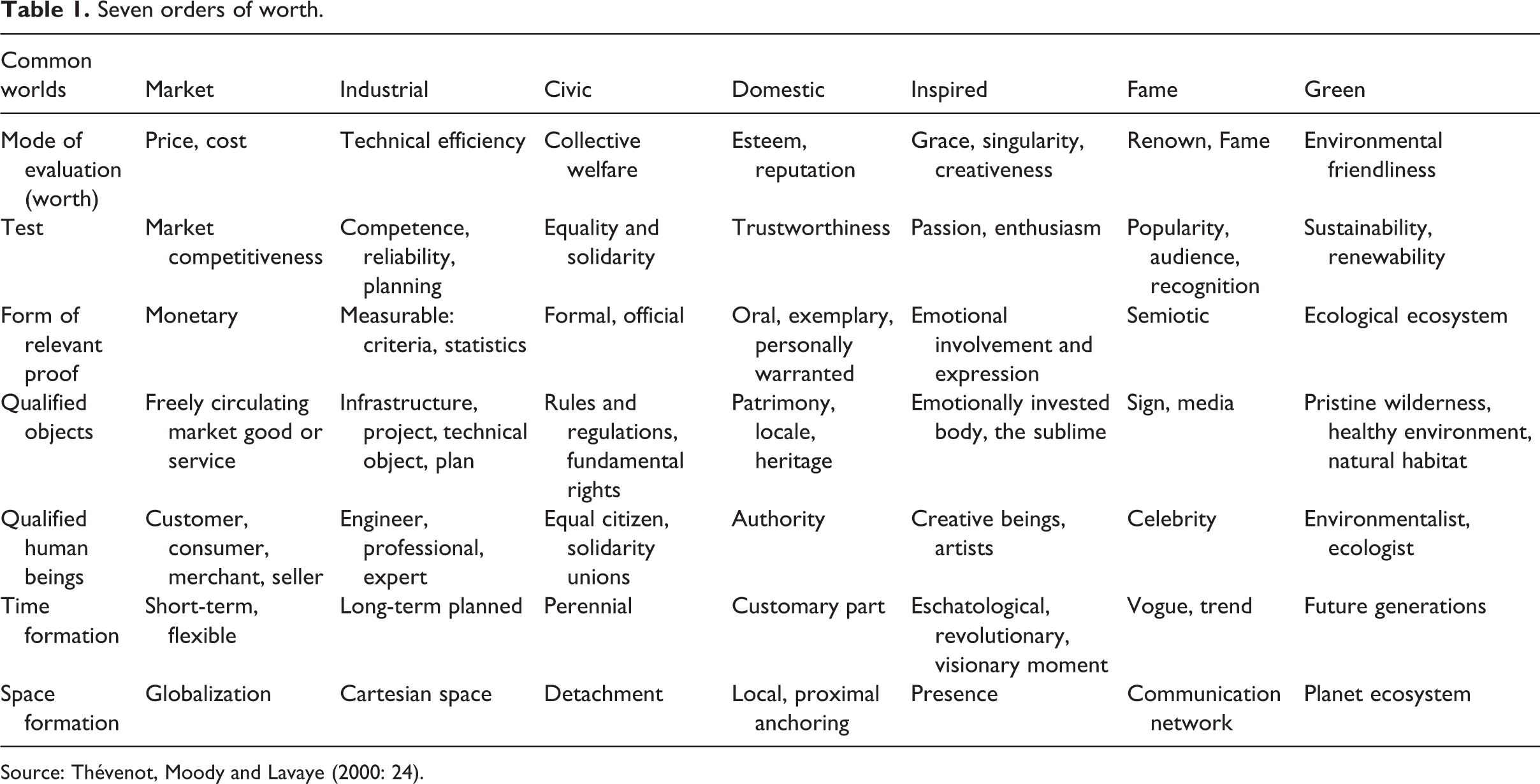
Source: Thévenot, Moody and Lavaye (2000: 24).
In organization and marketing research, a small number of studies have utilized Boltanski and Thévenot’s framework to analyse tensions by investigating discursive or institutional market contests (Corvellec and Hultman, 2014; McInerney, 2008; Patriotta et al., 2011). In these explorations, clashes among orders of worth occur when actors draw on different worlds in the difficult task of justifying, testing and compromising over questions of value. For instance, Patriotta et al. (2011) trace the ways in which stakeholders progressed in their justification accounts through evoking several orders of worth sequentially following a nuclear incident.
In summary, by following Boltanski and Thévenot, we discern a process by which public disputes are understood to ‘entail a process of justification that appeals to the common good against the backdrop of a spatially, temporally and socially situated reality’ (Holden et al., 2013: 6). We will now focus on actors’ ‘justification work’ (Jagd, 2011) in a B2B market where the valuation of objects is a matter of ongoing dispute among actors who draw their justifications across a number of orders of worth.
Research approach
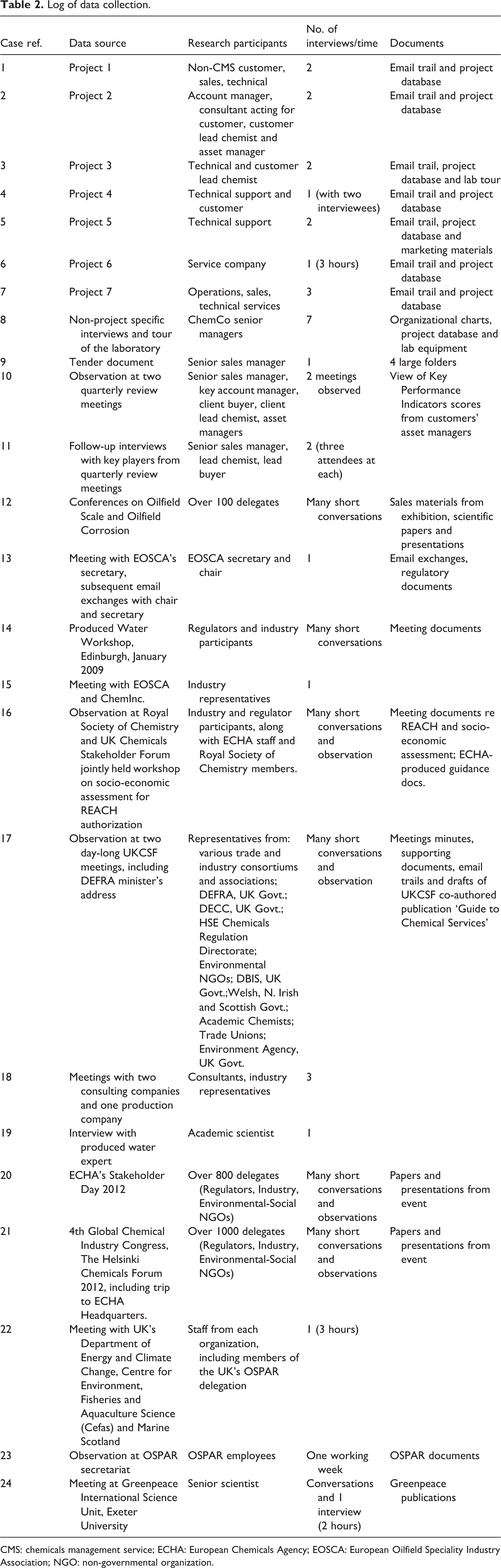
Our research approach was broadly ethnographic, undertaken over a period of six years, and focused on the processes of regulating, producing, exchanging and using production chemistry in the North-East Atlantic. When we negotiated access to a specialist production chemistry company (hereafter ChemCo) in early 2006, our interest was in the combination of science, technology, marketing and sales in the regulated market of the upstream petroleum industry. We began our research by undertaking a sampling exercise from ChemCo’s projects database, identifying seven projects each undertaken with a different oil company customer, that showed clear contrast across category of product and length of project (see Table 2 for an overview of these projects). Initial interviews with ChemCo’s senior managers relating to the sample of projects revealed the ‘greening’ of production chemistry and its regulatory impetus to be a common theme. Following this lead took our empirical investigation along two interrelated trails: the regulation of production chemistry and how regulation interacted with the design, marketing and use of green production chemistry. Accordingly, we expanded our fieldwork to become a case of a B2B marketing system with multiple sites, to include the laboratories of chemicals companies, the meeting rooms and labs of oil companies, pressure groups, universities, conferences, trade shows and the regulators’ offices.
Log of data collection.
CMS: chemicals management service; ECHA: European Chemicals Agency; EOSCA: European Oilfield Speciality Industry Association; NGO: non-governmental organization.
We traced the material and social dimensions of the development, marketing, sale and use of green chemistry across 24 instances of business exchanges and regulatory interactions (as summarized in Table 2, below). Each observation had a different bearing on the green credentials of production chemistry from mundane exchange episodes to the contested assessment of its evidence base for regulation decisions. Overall, we undertook 36 formal interviews, ranging from 50 minutes to three hours in length, and numerous informal interviews. All the formal interviews took place in respondents’ offices or labs and were recorded and transcribed in full. Interviews were open-ended and respondent-led but typically revolved around the following questions: How respondents defined and qualified green production chemistry; How they defined the market; How they perceived the historical and future development of production chemistry and of its market, industry and regulation; How they saw their own and their organization’s place in these activities; and How their work intersected with and was influenced by that of other market actors. Informal interviews happened at industry conferences, workshops and events and after meetings, and ample notes were taken on these by the researchers.
We also amassed a total of 160 hours of non-participant observation. In our case, participant observation was not an option, as the market actors were all highly qualified scientists and technologists. However, as academic researchers, we were often invited to public events and, after some negotiation, allowed to observe several ‘closed door’ meetings. One author spent a working week shadowing employees at the regulator OSPAR’s secretariat in London, and two others were given several tours of laboratory facilities at ChemCo and other organizations (see Table 2). Observations allowed us to see the market system in action and to witness controversies or clashes of perspectives that actors may not have readily talked about or even recalled in formal interviews.
In order to gain additional understanding of the market, its historical development and its regulation, we reviewed dozens of scientific papers, many policy documents and commentaries from stakeholders as well as minutes of meetings of the OSPAR Commission and the UK’s Chemical Stakeholders Forum. As in other regulated markets, many of these documents are open to public consultation through the internet. We also analysed a 500-page tender bid document from our focal chemistry supply organization. Utilizing interviews, non-participant observations and documentary analysis allowed us access to the phenomena of interest from three different angles: perspectives as expressed by interviewees reflectively in interviews, as emerging in social interaction with other market participants and as formulated in writing for public engagement, policy and marketing.
Data analysis
We organized our data for analysis in the software package QSR NVivo. At the start, our analytical activities were broadly inductive and independent across all authors. We were interested in how the marine ecosystem and the idea of ecosystem services in policy became connected with the market for production chemistry. First readings of the data aimed at tracing the different activities, actors, materials, technologies and texts involved in developing, regulating and exchanging production chemistry chronologically and thematically. We then took a steer from our theoretical background and interrogated our data in relation to the conceptual notions of compromises, justifications, orders of worth and their tests, categorizing field data against these concepts where applicable. For instance, pricing issues were categorized as part of the market order, while references to the importance of durable business-to-business relationships were categorized as part of the domestic order. 3 We compared and contrasted our initial inductive analysis to these theory-led categories in a series of joint research meetings and refined and adjusted our analysis where necessary. Finally, we presented our emerging results to our research participants and academic colleagues for further discussion and refinement on several occasions.
Findings
After introducing our case setting, we present our analysis below in three steps, which follow the activities of regulating, developing and exchanging green chemistry. First, by considering how regulation defines the ecosystem’s capacity to provide services, we trace how these services are organized in the green order of worth. Second, we assess the mechanisms through which regulators translate this green order into practical guidance and how actors work with this guidance to design green production chemicals as an industrial order. Third, we analyse market exchanges to assess how green chemistry is valued in the market world. Our results highlight that in each of these steps, actors jostle with multiple orders and evaluative principles, public contests and compromise.
Case setting
At the time of our fieldwork, a sustained effort was being made to produce oil and gas to unprecedented levels of exhaustion in the mature reservoirs of the North-East Atlantic. From the perspective of oil companies, there are a number of chemical processes such as corrosion in the production facilities or the presence of sulphates that without chemical treatment are a hindrance to the production process. Consequently, chemical services providers are required to respond to the oil and gas producers’ needs to maintain everyday chemical regimes that will keep a mature-era industry and its infrastructure functioning. They also have to minimize the levels and consequences of the so-called chemical ‘releases’ (routine and accidental). In total, chemistry companies add about 900,000 tons of oil production-related chemicals to the North-East Atlantic per year (www.ospar.org). The industry’s activities are regulated by the OSPAR Commission (OSPAR) and the European Chemicals Agency. 4 Together, these organizations oversee the use of chemicals in the North-East Atlantic and attempt to protect the marine ecosystem and their resources while balancing this with the interests of, and the demands of working within, the oil production marketing system. NGOs such as Greenpeace have observer status in OSPAR and regularly interact with and comment on the Commission’s regulatory moves.
Constituting and regulating ecosystem services through the green order
As the main regulatory body to govern the use of nature’s services in the North Sea, OSPAR applies the framing of ‘marine ecosystem’ to its jurisdiction: The OSPAR Commission’s activities … will be guided by the application of the Ecosystem Approach, which is the comprehensive integrated management of human activities based on the best available scientific knowledge about the ecosystem and its dynamics, in order to identify and take action on influences which are critical to the health of the marine ecosystems, thereby achieving sustainable use of ecosystem goods and services and maintenance of ecosystem integrity. (OSPAR Agreement 2010-3)
The fundamental principle guiding OSPAR’s activities is the precautionary principle. 5 As formulated through OSPAR, the precautionary principle indicates that the value of environmental services is apparent in some form to all users, including rival market activities such as recreation or fishing, and it demands preventative action from these actors even in the face of limited or uncertain evidence of environmental harm. It also implies that the North-East Atlantic is a relatively homogeneous entity into which all current users have to invest. By evoking the ‘needs of future generations’ (www.ospar.org) as a basis for tests or justifications, the precautionary principle explicitly draws upon the green order (Lafaye and Thévenot, 1993).
In the specific case of production chemistry, the ecosystem provides a service of dispersing leakages and spillages in the application of chemical solutions during oil production. For instance, chemists formulate their chemicals on the basis of simulations designed to test how quickly the ecosystem is able to break down chemical applications in the vicinity of oil rigs. OSPAR and Registration, Evaluation, Authorization and Restriction of Chemicals (REACH) regulations allow them to do so up to a ‘threshold point’ where the ecosystem (or rather, specific flora or fauna within it) cannot absorb any further chemical exposure. However, this guidance leaves open questions such as whether regulators are proposing that users of an ecosystem’s services also become investors in it to ensure a future supply, which would point to a market order of worth, or respectful citizens who rather than acquiring services are forgoing use of a commons, which may evoke a civic order. Are there, for instance, opportunity costs to be associated with using the ecosystem’s service of biodegradation? Which services exactly are we utilizing, and how are we to recompense nature for them?
OSPAR’s regulations do not address these specific questions, which leaves the regulatory guidance open to contestations from NGOs on the one hand and from industrial and market actors on the other, drawing on different orders of worth. During our fieldwork, OSPAR’s work became recognizable to us as patient, diplomatic and pragmatic. Discussions with the secretariat suggested that these were qualities adopted in an environment where challenge and contestation of statements were always to be expected, especially when they were drafting or updating regulation, as this informant explains: To get anything on the agenda in OSPAR it has to be supported by a contracting party, so a contracting party can raise an issue, put it on the agenda, and if it gains the support of all the others, it can go forward either as a work product or ultimately as a legally binding decision or a recommendation or another agreement. And the reason that’s important is that it’s a consensus organization. (case ref. 23)
Putting ecosystem services to work in the industrial order
The previous section has pointed to some of the difficulties in accommodating human activities in the context of the green order of worth, as OSPAR has done through the notions of ecosystem service and the precautionary principle. In this section, we will demonstrate that industry actors challenged OSPAR’s regulations on the two distinct grounds of: how the regulations should be translated into the design and deployment of production chemistry and how apt the notions of ecosystem service and precaution were in capturing the ‘real’ cost of oil production activities to the environment.
In translating the precautionary principle into a technical and scientific calculus for industrial use, OSPAR derives the twin measures of best available techniques (BAT) and best environmental practice (BEP) and provides cost calculations alongside lists of BAT and BEP techniques (OSPAR 2002). It also offers further technical guidance in its Chemical Hazard and Risk Management (CHARM) guidelines, which uses three proxy measures to calculate the reliance of a chemical on the ecosystem’s services: biodegradability, acceptable level of toxicity and bioaccumulation (Thatcher et al., 2005).
6
In response to OSPAR and REACH, scientists in chemistry and oil companies have developed what they call ‘green chemistry’ as a category of product that is approved by the industry regulator as complying with two out of the stated three dimensions of biodegradability, toxicity and bioaccumulation. Licenced chemistry products can lose their approval status if they receive a so-called substitution warning from the regulator, which are issued and updated at regular intervals and signal that a specific chemical needs to be phased out of use. Innovative opportunities emerge for chemistry companies as a direct consequence of translating these regulatory changes into ‘greener’ chemical products and product mixes: … it is almost like it is legislation that has to drive it. Until the operators are told ‘you’ve got three years to change a chemical out; otherwise we will shut you down’, there is no pressure. Before, it was asked for and people tried to do it but there was no pressure to get that sorted out. (Case ref. 5, project 5, technical services’ respondent) We’ve just got steady on what environmental requirements are on the biodegradation. All (of) it has to biodegrade, and they are not worried on where it biodegrades to. People are starting to look at what your reaction products are. So, if it breaks down, are your products which are formed, are they toxic or do they bioaccumulate? … When it breaks down, where does it go? (Case ref. 4, project 4, technical services’ respondent)
In addition to this scientific trial and error to ascertain whether a chemical is indeed green, the regulatory criteria often interfered with the standard industrial processes chemists address on behalf of their clients, as this respondent indicates: There is a number of problems with biocides [a chemical that kills bacteria]. In order for a biocide to work it has to be toxic. And because it is toxic then they’ve also got to be environmentally acceptable. So you are trying to weigh up something that is toxic and going to kill the bacteria but also be green enough to be used in the North Sea. (Case ref. 3, project 3, technical services’ respondent)
Analytically, the debates around risk and the precautionary principle as rival tests of worth for green chemistry draw our attention to the issue of time. OSPAR’s definition of the precautionary principle projects the ecosystem into something available to unspecified ‘future generations’. The concern with undefined future generations sets the precautionary principle in direct contrast with the industrial order, which deals with probabilistic futures, and with tests in the market order, which are anchored in the present – as evidenced, for instance, in net present value calculations (Thévenot, 1996). At the same time, OSPAR evokes ‘BAT’, linking the precautionary principle and its infinite future tense to contemporary actions. Thus, the precautionary principle accommodates tests of worth involving technical efficiency and scientific progress. In addition, as regulators mobilize the industrial order for incremental scientific proof, they also trace a conceivable trajectory from the industrial order’s forecasting horizons to the green order’s longue durée, especially as they are starting to consider risk as an alternative test ground for assessment of hazard and harm (case ref. 23).
Besides time, different conceptions of space in the green and industrial orders also motivated different tests and justifications. While risk is evaluated in a local context, precaution takes in a larger and possibly infinite space – which the industrial order is unable to embrace. In the industrial world of the laboratory, designing and testing green chemistry was a matter of working within a closed system – such as a bathtub containing tubes and synthesized seawater. In applying and scaling it in the North Atlantic, industrial chemists join in with the dynamic chemical processes that take place within open and ever-changing offshore environments. Our research revealed that interactions between those chemicals introduced into the sea and those occurring naturally could only ever be partially predicted and controlled. We heard of laboratory tests designed to emulate the chemical reactions in the North Sea go ‘sour’ in application, in our respondents’ vernacular (case ref. 7); we listened to stories of chemical mixes that did not ‘scale up’ (case ref. 1) or of one green chemical component causing a need for higher dosage of another, more toxic, chemical (case ref. 2). In a world where standardization and stabilization are signs of worth, material processes manifesting ‘weak control and the poor functioning of a disturbed system’ are highly problematic (Boltanski and Thévenot, 2006: 205). Thus, despite the guidance given by OSPAR and REACH in its regulatory documents, making a green production chemical in the industrial order seemed a constant work in progress, with the ever-present possibility of chemical ‘malfunctioning’ at a material and molecular level.
Marketing and exchanging green chemistry: The market order
In the market world or order, ‘worthy objects are salable goods’ (Boltanski and Thévenot, 2006: 196; original emphasis). The difficulties actors encountered in designing a green chemical with strong reference to the industrial world, as detailed in the last section, were mirrored in the market world when actors tried to exchange green chemistry as a product/service hybrid. Individual transactions of ‘freely circulating goods’ (ibid) are rare in this market. Instead, since the early 2000s and partly in response to increased regulatory pressures, oil companies have started to offer chemicals management service (CMS) contracts of three to five years to external chemicals companies. Governed by these contracts, chemists anticipate and solve their clients’ emerging problems and manage day-to-day compliance with regulation. Where regulators provide oil companies with updated schedules of chemicals that have received regulatory substitution warnings, the CMS holder develops a program for replacing these products with greener alternatives, planned and sequenced over the contract’s length: Rory [sales director] had come to me and said ‘you should start thinking about when we can organize some chemical changes here [on the oil platform]’ … Because that gives us more brownie points with Alpha, so that when it comes to tender time they should remember that we never stopped trying to improve the chemicals there both environmentally and performance-wise. (Case ref. 2, project 2, key account manager)
As actors try to price their activities in markets relative to the ecosystem services they draw upon, their market calculations intersect continuously with the green order of worth, as represented through regulation, and with the industrial world’s qualities of efficiency and performance. One of our interviewees at ChemCo mentioned that ‘The green chemistry can’t cost too much more than the normal chemistry because people don’t want to increase their budgets’. Despite the contractual arrangements, buyers typically reserve the right to purchase from ChemCo’s competitors if product performance is unsatisfactory or prices are too high, and they are not shy to dangle this stick in front of their CMS suppliers. In this competitive situation, ‘greenness’ is one performance criterion alongside cost and efficiency: The old rules apply of course: environmental performance has to be equal or better, and cost and efficiency has to be equal or better. (Case ref. 10, quarterly review meeting at customer beta)
Discussion
The three processes – regulating, developing and exchanging green production chemicals – convey a sense of the extent to which actors draw upon and contest within and between the market, green and industrial orders of worth in this market system when they try to justify what is valuable (see Table 3).
Orders of worth in green chemistry markets.
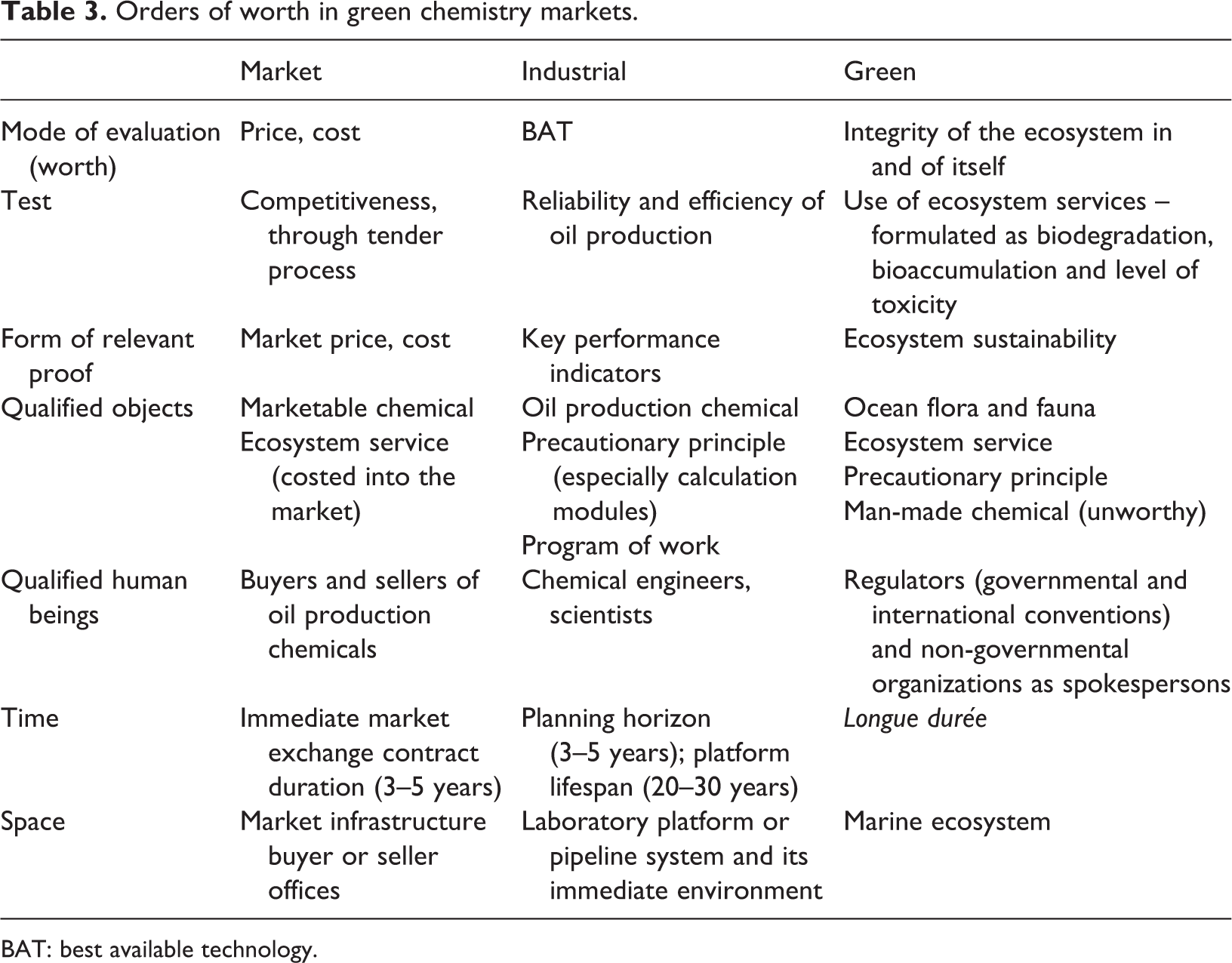
BAT: best available technology.
By grappling with different orders of worth in specific exchanges, actors encounter significant coordination problems. The controversies included (1) valuing the ecosystem and the services it renders to the commercial actor, (2) valuing the chemicals’ effects on the ecosystem and (3) establishing a chemical’s price in commercial exchange relative to alternatives assessed as posing greater hazards. These controversies overlap and were never fully resolved, partly due to the material dynamics in the ecosystem and partly due to regulation building its own reference points into the market and industrial worlds that are outside their time and scale: reference points to the vast space of the North Atlantic ecosystem and to environmentalism’s longue durée. As we illustrated, compromising over the worth of the objects in these market exchanges involved considerable, pragmatic and often costly coordination work in situ, undertaken by actors with a range of professional affiliations and expertise across multiple sites, in which material objects were prominent.
In contrast to processes of marketization in which the green order becomes absorbed over time by the market order (Nyberg and Wright, 2013), the ‘worthiness’ of nature is never fundamentally questioned in our case. Market and industrial actors were aware of their reliance upon a healthy, functioning ecosystem and regulators and pressure groups worked hard to keep the green order relevant. Yet, the issue of how to value ecosystem services in relation to the marketing system remained controversial during episodes of regulation, production and market exchange. Material proofs often served as a common ground where market actors could make a compromise in science: considerable justification work was undertaken through scientific papers, research alliances, incremental trial and error and simulations. Actors also had some overlapping or shared understandings of the ultimate arbiter of a production chemical’s green worth being the ecosystem itself; or rather, its material capacity to cope with the market’s activities.
To summarize, we find from our case analysis that whatever actors’ substantial differences in terms of discourse are, they coordinate their activities in situational arrangements by recognizing pragmatically that their collective task is to produce workable solutions. Furthermore, the solutions tend to be worthy across the green, industrial and market orders. More often than not, these solutions are explicitly provisional and configured until further notice. For instance, notice can be until future substitution warnings are issued on the part of the regulator, until further tests demonstrate levels of toxicity more conclusively or until BAT for cleaning up or avoiding chemical discharges improve. In other words, the only way to compromise over the issues of worth in this marketing system is by keeping these from settling, and by keeping institutional settings at arms’ length. In this market, investments in forms are investments in possibilities into the medium term, based on a trajectory of scientific progress upon which all actors can compromise.
Conceptual contributions
Our article has focused on actors’ situated work of justification, coordination and compromising, and we have argued that this pragmatic and often painstaking work allows them to retain a capacity to make market exchanges even when confronted with conflicting logics. In our introduction, we identified three conceptual gaps in extant marketing and organisational literature on conflicts and compromises: how a market copes with logics external and irreducible to its own; the role of materiality in tests of worth; and how actors justify and compromise across competing logics pragmatically in moments of exchange. By addressing these three gaps, we build on and extend existing research on competing logics in markets, which has focused mainly on cultural (Chan, 2009; Giesler, 2008, 2012), institutional (Ertimur and Coskuner-Balli, 2015; Murray, 2010) or discursive (Patriotta et al., 2011) processes. Ertimur and Coskuner-Balli (2015) focus on legitimacy and power struggles over the plural logics of spirituality, fitness and commerce in the US yoga market. By contrast, we contend that the green order of worth shifts actors’ perspectives to a logic of worth that will never be reducible to market concerns, but that nonetheless has to be taken into account in the market exchange. Likewise, juxtaposing the industrial, market and green orders of worth does not just create definitional or rhetorical struggles (Patriotta et al., 2011) – for instance over labelling as green a chemical product, which through testing and regulation has an ecotoxicological profile and which can leak into the sea. Rather, it shifts actors’ time and space horizons to dimensions that are just out of the reach of other orders of worth.
Further, where Chan (2009) and Giesler (2008) show how consumers and commercial players draw on cultural resources, respectively, to resist and drive market evolution in dialectic moves, we add that in many markets, materials shape these trajectories strongly. In Giesler’s case of music downloading, Digital Rights Management copyright protection mechanisms could be seen as a material compromise of sorts between the sharing and owning logics. In our case, cages of blue mussels in the vicinity of oil rigs provide at least a ‘good enough’ test to arbitrate between the green and the industrial worths. Despite uncertainties, these tests promise further development of a more rigorous or reliable compromise ‘next time’.
Finally, where Murray (2010) emphasizes the importance of institutional boundary work at the overlap of academic and commercial logics, we draw attention to how actors cope with divergent logics in specific moments of exchange. Whenever our industrial actors thought they had stabilized a chemical application, different orders of worth interfered to thwart the actors’ retreat into one specific institution or institutional logic and forced these same actors to work pragmatically toward yet another compromise. In analysing our case, we contribute to a broad impetus in research that questions neo-liberal understandings of a unified or singular market, with financial prices as the main – or perhaps the only – ‘metric of worth’, especially in environmental markets (Fourcade, 2011). We highlight the capacities of market actors to make exchanges and in so doing to make compromises in order to make those exchanges.
By assessing actors’ exchange practices and capacities to act, we extend research that traces shifts in discourses over who is ‘responsible’ for environmental sustainability, and what skills this responsibility requires (Giesler and Veresiu, 2014; Humphreys, 2014). Rather than institutional actors handing down guidelines to the market or formatting consumers, the activities of regulating, developing and exchanging green chemistry involved coordination across many actors trying to stabilize a market and its regulatory framework at the same time as relating market and regulation to a marine ecosystem. Actors’ capacities to work across three orders depended upon their pragmatic abilities to shift from one order of worth to another, as required by the specific situation at hand (Thévenot, 2001b). We highlight the need among market actors for cognitive flexibility, of thinking and acting ‘beyond’ a market logic and so of extending a marketing system, especially when they work in or with unstable or changing institutions.
Conclusions
Blok (2013: 500) suggests that ‘“sustainability” remains a fragile grammar, torn between the market, the industrial and the green orders’. In this article, we demonstrate empirically how actors interact across industrial, market and regulatory orders of worth to achieve workable compromises. Of itself, the existence of a green market signals a compromise, or to speak with Blok, ‘a world of inherent moral and cognitive tensions’ (p. 507). Combining our rich case study of a marketing system in an environmentally sensitive setting with Boltanski and Thévenot’s (2006) economics of conventions allowed us to highlight these tensions and uncertainties over the issue of value and to trace how these are worked out in good enough compromises during processes of exchange.
To conclude, we draw three implications for future research from our study. First, we demonstrate that moving beyond recognizing ‘sustainability as mega trend’ (e.g. Mittelstaedt et al., 2014) requires grappling with very practical issues of commensuration between calculative and valuation regimes that are all too often glossed over (Espeland and Stevens, 1998). Additional analyses of specific marketing and exchange practices in sustainable marketing systems will assist practitioners and researchers in understanding and coping better with these clashes of worth.
Second, our study suggests that marketing researchers have often missed the opportunity to describe the complicated attachments of things and people and to consider extensions of or extended marketing systems. We show that market actors should become adept at artful compromising as a constitutive characteristic of marketing activity (Giesler, 2008; Slater, 2002). This includes learning about different orders of worth as well as how to encounter and devise tests and valuation practices that constitute orders and perhaps suggest bridging and hybrids.
Third, we demonstrate that Boltanski and Thévenot’s theory of justification provides a convenient vocabulary to understand and articulate value in marketing systems, considered extensively. With marketization processes taking place across diverse areas of human existence, detailed insights into ‘matrices of worth’ in market systems will be needed more than ever (Lamont, 2012). While economic sociologists have started to investigate valuation practices across a range of markets (e.g. Kjellberg et al., 2013), marketing researchers have by and large not yet commenced to contribute to this line of inquiry. We hope that our article provides an impetus in this timely and important arena and will encourage marketing researchers to join fundamental debates as to ‘what counts’ in and around markets.
Footnotes
Acknowledgements
Earlier versions were presented at the workshop on Anthropology of Markets and Consumption, University of California Irvine (March 2013) and at the Strategic Management Society’s conference in Glasgow (June 2013). We are grateful to participants at those meetings, our colleagues Thomas Anker and Kalliopi Chatzipanagiotou, and Markus Giesler, Eileen Fischer and this journal’s referees for comments and criticisms as we developed this article. The usual disclaimer applies.
Declaration of Conflicting Interests
The author(s) declared no potential conflicts of interest with respect to the research, authorship, and/or publication of this article.
Funding
The author(s) disclosed receipt of the following financial support for the research, authorship, and/or publication of this article: The research upon which this article reports was funded by the Leverhulme Trust, grant F/00 273/N.