




Abstract
This commentary describes the evolution and prospects for further development of the marketing subarea within Constructivist Market Studies (CMS).
Introduction
This commentary offers a short biography of Constructive Market Studies (CMS), a research stream that has taken shape over roughly two decades. CMS investigates markets not as pre-given settings where autonomous buyers and sellers meet, but as socio-material accomplishments: webs of practice, devices, infrastructures, and relations that together make exchange possible. In telling this story, the account is necessarily selective. It privileges articles published in Marketing Theory and draws on the author’s proximity to the field as a participant-observer.
Although the label ‘Market Studies’ gained visibility in the early 2000s, the field’s genealogy is older and broader. Its intellectual ancestry runs through the new economic sociology, and its proximity to Science and Technology Studies (STS), particularly actor-network theory (ANT). Early CMS scholarship questioned abstract notions of ‘the market’ by investigating how calculative agencies come together; how goods are produced, stabilized, and valued; and how legal, material, and discursive devices represent and shape economic activity.
From the outset, CMS has been multidisciplinary. Its core constituency includes marketing scholars, but the field’s vitality owes much to collaborations spanning disciplines such as Management, Sociology, Geography, Anthropology, Design, and Information Systems. Rather than building a formal structure, the community has favoured informal exchanges: biennial workshops, special tracks within cognate conferences, and cross-disciplinary research networks. These venues have been instrumental in connecting subfields and fostering cross-pollination between conceptual innovation and empirical work. A recent edited volume consolidates these contributions and sets out future directions, showing a field that has grown in scope while staying critically reflexive about its methods to study markets (Geiger et al., 2024).
Within marketing scholarship, CMS has benefited from sustained editorial support across multiple outlets. Marketing Theory hosted early contributions and special issues, as well as offered room for conceptual and methodological experimentation. A cluster of edited collections in the 2010s, along with special journal issues, helped crystallize a shared agenda. The result is not a singular paradigm but a set of common sensibilities: a preference for theoretically informed empiricism; an interest in the mundane devices and backstage work that make markets function; and an emphasis on markets as multiple, contested, and historically as well as spatially situated.
The remainder of this commentary proceeds as follows. The next section surveys three thematic areas where CMS has made distinctive advances: (1) moving beyond ‘interface markets’; (2) reconceptualizing agency via the notion of agencing, and (3) developing marketer research alongside analyses of digitalization. I then sketch the distributed network of scholars that have shaped the field’s trajectory. A penultimate section outlines three emergent agendas – platforms, care, and multiple markets – followed by a brief reflection on what CMS has accomplished and where its challenges now lie.
Theoretical and empirical advances in CMS
(1) Beyond Interface Markets: from Exchange Dyads to Market Objects
Conventional marketing theory focuses on dyadic exchanges, depicting markets as arenas where buyers and sellers, treated as autonomous blocs, come together to trade pre-existing goods (Hunt, 1983). This interface model is superficially appealing, yet it obscures much of the work that enables exchange. CMS reframes the problem: goods, buyers, and sellers do not sit apart, poised for exchange. Rather, they are co-constituted through extended processes that span design, qualification, distribution, and use (Callon 2016, 2021).
A pivotal concept here is qualification: the situated work through which actors attribute, stabilize, and arrange the qualities of goods and their intended users (Callon et al., 2002). Qualification cuts across organizational boundaries (e.g. R&D, marketing, operations) and temporal phases (e.g. prototyping, market testing, roll-out). It also traverses material and symbolic dimensions (e.g. taste profiles for coffee or wine, nutritional claims for functional foods, sustainability credentials for apparel) and often involves contested metrological regimes (what counts, how it is measured, whose measures prevail). At stake is not merely how the qualities of goods are communicated, but what they are and who they are for.
Crucially, CMS shows that goods are enmeshed in socio-technical networks (e.g. standards, databases, property rights, logistics infrastructures) that afford and constrain their identities. To be exchangeable, goods must be temporarily disentangled from these networks so that ownership can be transferred. However, once exchanged, these goods are subsequently used or consumed – and, in the case of durable goods, they may be repaired, refurbished, upgraded, resold, dismantled, or disposed of (Spring and Araujo, 2017). In this light, an exchange is not an end point but an episode in the often-long career of goods (Callon, 2021).
Empirically, CMS scholars have pursued ‘difficult goods’ to reveal these dynamics: second-hand offshore oil fields whose valuation hinges on technical assessments, legal arrangements, and risk distribution (Finch and Acha, 2008); advertising space in mundane urban infrastructures (e.g. telephone kiosks) where trading depends on categories and measures that make otherwise fleeting audience attention into barterable units (Cluley and Nixon, 2019); artworks and their hybridization into forms that can circulate within publicly funded exhibition circuits (Borgblad and Hagberg, 2026); and digital objects, where ownership technologies mediate access, transfer, and control (Lianidis et al., 2025). These cases highlight how qualification and valuation are practical achievements, dependent on a range of devices and conventions.
A related and fruitful distinction is that between market and marketing objects (Finch and Geiger 2010, 2011). The former denotes goods stabilized enough to be exchangeable; the latter refers to goods still in the gaze of marketers, subject to re-positioning, requalification, and reinterpretation. The interplay between the two emphasizes that exchangeability is precarious: marketers continuously test and tinker with the qualities of goods, importing new associations or stripping away old ones to re-position goods and reconfigure markets. In short, the shift beyond interface markets widens the lens from the exchange dyad to the full set of practices and devices through which exchanges are made possible. (2) Agencing Markets: Distributed Action and the Making of Economic Agency
A second line of advance concerns the nature of agency in markets. If the interface model presumes individuals whose roles and competencies are pre-given, CMS instead proposes that agency is actively configured, not merely possessed. Drawing on ANT and adjacent literatures, CMS treats action as distributed across agencements – heterogeneous assemblages that combine humans (e.g. market professionals, users), non-humans (e.g. machines, algorithms, packaging), and normative elements (e.g. contracts, standards) (Caliskan and Callon, 2010; Callon, 2021).
Two implications follow. First, who or what acts in a market setting is an empirical question, not an axiom. An e-procurement system that auto-reorders inventory according to thresholds encoded by a category manager and governed by supplier agreements is neither purely human nor purely technological; it is an agencement whose capacities to act are emergent and subject to change (Andersson et al., 2008). Second, these capacities are plastic. As arrangements evolve (e.g. new devices are added, rules are modified) so do their capacities. This plasticity helps explain the variety of market practices across settings: even when contexts share the same actors, outcomes differ because agencements differ (Hagberg and Kjellberg, 2010).
The CMS literature illustrates these ideas across a diverse empirical terrain. In retail histories, shifts from counter service to self-service hinged on material re-agencements – aisle designs, shelf displays, shopping baskets – that redistributed tasks and reconfigured the shopper’s role (Cochoy, 2020). In consumer sustainability, smartphone apps and domestic devices agence ethical choice by making certain information available or salient and aligning it with everyday routines; conversely, breakdowns in these digital agencements can unravel the ‘smart consumer’, revealing the fragility of this agencement (Fuentes, 2019; Fuentes and Sörum 2016). In credit markets and platform ecosystems, algorithmic classifications compress complex socio-economic histories into scores and categories that travel through financial infrastructures, often with distributive consequences (Pellandini-Simányi, 2024; Wei and Geiger, 2024).
The move from agencement (noun) to agencing (verb) further emphasizes process (Cochoy, 2014; Cochoy et al., 2016). Markets are not merely populated by multiple and self-contained actors; they are continuously agenced, counter-agenced, and re-agenced as narratives, rules, and devices are added, contested, or withdrawn, as seen in the case of sustainable coffee farming practices in Uganda (Onyas and Ryan, 2015). This perspective draws attention to politics (e.g. embedded in standards, and protocols) and to temporality (Araujo and Kjellberg, 2016; Deville, 2016). Agency is thus a moving frontier, sustained through maintenance yet always prone to change. (3) Marketer Research and Digital Marketing Practices
A third contribution involves rebalancing marketing scholarship by redirecting analytical attention away from consumers and towards marketers and, more generally, market professionals – those tasked with ‘working on the market’ by building, organizing, and managing transactions (Cochoy and Dubuisson-Quellier, 2013). This marketer research stream also examines the performative effects of marketing practices: how tools, models, and discourses do not just describe markets but shape them (Cochoy, 2011; Mason et al., 2018).
In the last decade, the digitalization of marketing has provided a fertile ground to progress this agenda. Consider online advertising: a socio-technical infrastructure of cookies (and their successors), device identifiers (IDs), auctions, demand and supply side platforms (DSPs/SSPs), data brokers, and media planning tools (MacKenzie et al., 2023; Caliskan et al., 2025b; MacKenzie and Caliskan, 2026). Here, quality conventions multiply across a maze of metrics (viewability, brand safety, attention, incrementality) each supported by devices that enact what they measure (Cluley 2018, 2020, 2022).
As smartphones dissolve barriers between online and offline contexts, classic figures of the consumer – the audience, the cart, the card – converge into new, hybrid representations, frequently augmented by location and sensor data. Within agencies, the job of the media planner morphs into that of the audience planner, where segmentation and targeting are algorithmically mediated and constantly iterated (Beuscart and Mellet, 2013; Beauvisage et al., 2024; Beauvisage and Mellet, 2020).
Beyond advertising, CMS work has followed MarTech firms into the infrastructural trenches where customer data is collected, reconciled, enriched, and mobilized. The ambition of a unified customer view rests on fragile bridges that link data ecologies across CRM, commerce, service, and analytics, each with distinct schemas, quality issues, and governance regimes. This infrastructural view tones down narratives of a real-time panopticon, highlighting instead the frictions and compromises that characterize practice (Mellet, 2025).
Digitalization also reconfigures the skills and identities of marketers (Hafezieh et al., 2023; Akmeraner-Kökat and Pellandini-Simányi, 2025; Cluley, 2024). New roles emerge at the interface with IT and data science; ‘full-stack’ marketing machines combining platforms, dashboards, playbooks, and specialized staff, perform e-commerce in ways that blurs the boundary between strategy and operations (Fuentes and Stoopendahl, 2025).
These shifts provoke boundary work: negotiations over jurisdiction, standards, and performance metrics that seek to secure marketing’s autonomy and legitimacy even as it becomes more entangled with technical domains (Bourne, 2025; Ryan, 2025; Ryan et al., 2023). The broader social consequences of these infrastructures such as the monetization of engagement and the incentivization of disinformation underscore that market construction is not value-neutral (Diaz Ruiz, 2025). Studying marketers therefore requires viewing them not only as market professionals but also as actors whose instruments, practices, and decisions generate effects that extend across a wide range of publics.
Key scholars and the organization of the field
Key scholars to think with.
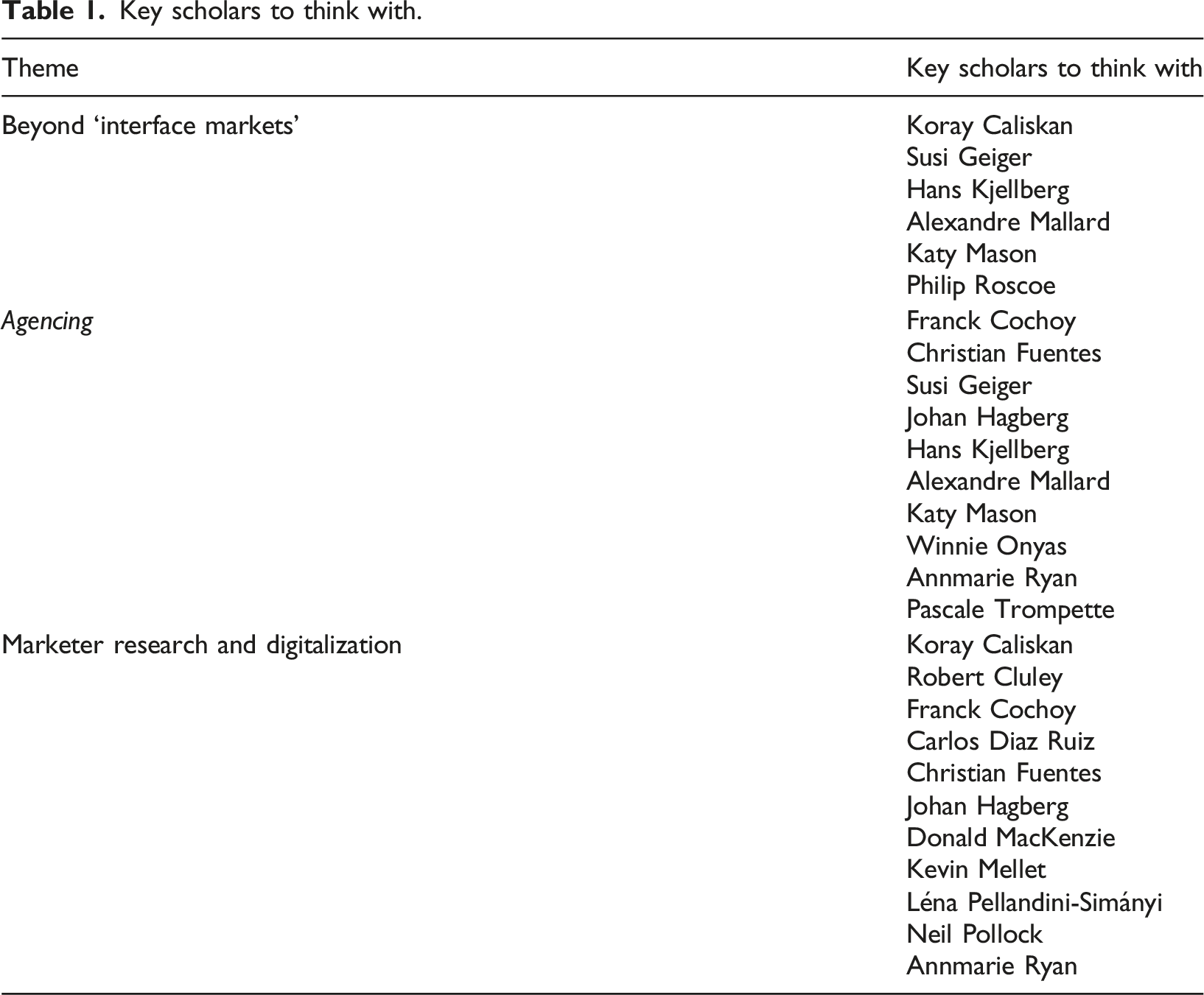
CMS nodes have fostered the circulation of PhD students, visiting scholars, and co-authorships effectively weaving a field together from previously loosely connected networks. Edited volumes and special issues functioned as catalysts: they convened disparate strands (e.g. concerned markets, attachments, performativity) into anthologies that consolidated conceptual frameworks and showcased empirical variety (e.g. Araujo et al., 2010; Cochoy et al., 2017; Geiger et al., 2014; Mason et al., 2018).
There are organizational advantages and vulnerabilities to this arrangement. On the one hand, the lack of a formal association preserves openness to new questions and collaborations, preventing the kinds of cognitive lock-ins that can solidify into orthodoxy. On the other hand, the diffuse structure risks intellectual homelessness for early-career researchers navigating job markets that cling to conventional disciplinary labels. Yet the trade-off has been arguably positive: CMS’s multi-disciplinarity extends academic horizons, seeding positions and projects across institutions, while its shared sensibilities provide enough coherence to sustain a collective identity.
Areas for further research
Platform studies: From two-sided markets to stacked economization
Platforms have moved from novel entrants to infrastructures of contemporary economic life. Interpretations that cast platforms as updated two-sided markets or as surveillance machines miss the specificity and diversity of digital platforms. CMS work advances a broader program under the rubric of stacked economization: platforms are layered systems where multiple modes of economizing (gift, barter, subscription, advertising, marketplace exchange) stack and interlock (Caliskan et al., 2025a). On a ride-hailing platform, for instance, dynamic pricing, driver incentives, data exchanges, and app store governance co-exist, each with distinct metrics, devices, and politics. The same holds for retail marketplaces where third-party sellers, fulfilment services, advertising slots, and recommender systems interrelate in ways that stage competition and shape profitability.
Moreover, platforms are not inert pipelines; they are exploratoria where users adapt, learn, and redefine needs (Callon, 2021; Caliskan et al., 2025a). This lens shifts attention to platforms as sites of experimentation where features, rules, and interfaces are continually trialled, monitored, and iterated. Importantly, some platforms are rapidly becoming general-purpose market infrastructures – gateways that host trading, payments, logistics, and marketing in integrated stacks. The implications are profound: curated choices and algorithmic management now mediate visibility and access across sectors, raising questions about competition, transparency, and the terms under which participation occurs (Chimenti et al., 2024, 2025)
CMS is well placed to contribute to these debates because of its attention to material politics. Studies of header bidding in AdTech, for example, show that milliseconds are not neutral: they are political micro-temporalities where rules and protocols redistribute advantage (MacKenzie et al., 2023). Similarly, MacKenzie and Caliskan (2026) examine the digital advertising industry by describing its underlying technological infrastructure as a set of large-scale, energy-intensive ‘megamachines’. They expose the way that design choices embedded in these systems create significant market power imbalances and contribute to growing environmental impacts.
Care: Ethics, maintenance, and alternative valuations
A second emergent agenda foregrounds care as a set of material practices, an ethical orientation, and a mode of maintenance. If markets emphasize exchange, care redirects attention to subsistence, stewardship, and value-in-maintenance. A care lens asks what happens when we take seriously that both human and non-human entities are vulnerable and require ongoing attention to endure (Geiger and Loza 2024).
In this view, economic activity can be recast as managing assets-actifs: dynamic beings and things whose value inheres in their continued viability and interdependence (Callon et al., 2025a). Accounting for care entails new valuemeters – devices and metrics that register restorative work, environmental externalities, and long-term resilience (Callon et al., 2025b). Take a clothing retailer that extends its responsibility beyond ethical buying, encouraging consumers to repair, repurpose, and better understand materials (Tölg, 2026). Or consider an underground transport signage system whose effectiveness depends on routine maintenance, showing how people and objects jointly sustain its operation (Denis and Pontille, 2025). Such cases highlight that care reorganizes temporality (from project to continuity), reorients expertise (from design to maintenance), and complicates valuation (from capital expenditure to lifecycle). They likewise raise broader questions about how we might move from a linear (take-make-dispose) to a circular (reduce-reuse-recycle) economic model (Mason and Araujo, 2024).
For CMS, bringing care into the frame has two payoffs. Analytically, it surfaces hidden labours (e.g. cleaning, calibration, repair, content moderation) that keep markets functioning. Normatively, it opens alternative political economies in which prosperity includes durability, repairability, and ecological fit. The challenge is methodological: how to devise empirical strategies and measurement tools that can grasp care’s distributed, low-visibility character without succumbing to moralism or nostalgia. Ethnographies of maintenance, studies of accounting tools, and design collaborations around repair ecologies are promising avenues.
Multiple markets: Plurality, overlaps, and ontological politics
The third theme asks us to retire the singular in ‘the market’ (Frankel, 2018). CMS has long observed that markets are not unitary but multiple: enacted differently by different actors with distinct practices, representations, and stakes. Rather than treating multiplicity as an aberration, the proposal is to make it an analytical baseline (Frankel and Vereta-Nahoum, 2024).
In coffee value chains, for instance, growers, intermediaries, tasters, and speciality buyers enact different value regimes – effort and relationships at the farm; margin and throughput for intermediaries; sensory protocols for tasters; narrative and distinction for speciality retail. These regimes intersect and sometimes clash, producing frictions that must be managed via framing, decoupling, or hybridization (Onyas, 2023; Franco De Alcântara and Perrut, 2025).
Multiplicity is not merely diversity; it is often a strategic resource. Entrepreneurs can mash up markets at the intersection of adjacent fields, creating novel hybrids (Kjellberg and Olson, 2017; Geiger and Kjellberg, 2021). Regulators, too, engage in ontological politics when they mobilize economic concepts (market failure, contestability) not only to diagnose but to reconfigure sectors, as seen in public transport reforms (Paulsson 2024). Vagueness and ambiguity can also be pragmatic assets: labels like ‘shared mobility’ function as capacious containers within which competing configurations can co-exist long enough to gather resources, build prototypes, and test alliances (Chimenti, 2024).
For CMS, the task is twofold. First, to map how multiple markets co-present in practice, often within the same site or device. Second, to trace how boundary operations – translation, commensuration, platform governance, legal definitions – stabilize or unsettle multiplicity. A more ambitious goal is to theorize market multiplicity over time: how certain versions become dominant or recede, and what socio-material investments make that possible.
Conclusion
This biography has recast CMS as a theoretically plural, empirically grounded effort to understand markets as constructed, maintained, and contested assemblages. Three moves capture the field’s distinctive contribution. (1) Markets are not just meeting points of buyers and sellers. Goods have trajectories before and after exchange; they are qualified, disentangled, and re-embedded across networks of production, regulation, distribution, and use. Seeing exchange as an episode within longer goods careers reveals the practical work that makes qualification, valuation and transfer possible. (2) Market action arises from agencements that bring together people, devices, rules, and spaces. Because these arrangements are mutable, so are the capacities they afford; agency is continuously produced and redistributed. This shift foregrounds devices and infrastructures (e.g. shopping bags and shelf layouts) as co-producers of economic action. (3) Marketing academia has often worried about the gap between theory and practice but has consistently neglected marketing work itself. By studying marketers, their tools, routines, and organizational positionings, CMS shows how market devices perform markets, with consequences that extend beyond firms to publics and politics. Digitalization intensifies these dynamics, further entangling marketing with data governance, platform rules, and algorithmic classifications.
Where does this leave the field? CMS has undermined idealized versions of markets by showing they are a precarious accomplishment that requires coordination, maintenance and repair. Yet because CMS excels at detailed studies of ‘real-world’ markets, it confronts a challenge: connecting different scales of activity. How can fine-grained ethnographic studies of devices and practices be articulated to the scale of say organizations or digital platforms, and to the broader level of policy, regulation, and political economy? The agendas outlined here (e.g. platforms as stacked economization) offer insights into how scalar articulations can be achieved.
Another challenge is pedagogical and professional. As digitalization reconfigures marketing work, the discipline should rethink curricular structures and professional identities. What constitutes marketing expertise when measurement, experimentation, and deployment are distributed across platform stacks and data teams? How should we educate students to engage with ethics, governance, and maintenance, not just with business strategy and economic growth? CMS cannot fully answer these questions, but it can enrich the discussion by providing conceptual tools and empirical insights.
Finally, the current organizational form of CMS’ community is a strength to be nurtured. Its networked, workshop-led ecology has kept the field’s boundaries flexible and open to innovation. But supporting early-career scholars requires imaginative academic initiatives that help overcome institutional inertia (e.g. cross-listed job positions, development of joint programs). Over the next decade, the field is likely to be shaped as much by institutional challenges as by theoretical or empirical progress.
While many disciplines remain anchored in models of stable agencies, singular markets, and a rigid theory–practice divide, CMS has advanced a different approach: markets are constructed, maintained, and multiple; agency is distributed and reconfigurable; and marketing work is constitutive of markets. If marketing academia is unsure of what contemporary marketing is, how it is conducted, by whom, and with what consequences (Cochoy et al., 2025), then CMS offers both a diagnosis of blind spots and a set of insights for seeing, and constructing, markets otherwise.
Footnotes
Acknowledgements
I am grateful to Katy Mason, Johan Hagberg, and Gianluca Chimenti for their helpful suggestions on an early draft of this commentary. I also extend my thanks to Andreas Chatzkidakis and two anonymous reviewers for their valuable contributions to improving an earlier version of this text.
