



Abstract
Marketing and consumer research predominantly conceptualize inclusion and exclusion as dichotomous or merely coexisting, leaving their relationship undertheorized. This paper explores their dialectical interplay in market interactions through the experiences of migrant consumers. Drawing on Relational Dialectics Theory, we employ a contrapuntal methodological approach that integrates a semantic network analysis of the interpretive marketing and consumer research literature with a hermeneutic analysis of interviews with Bangladeshi immigrants in Sweden. Our findings identify four competing discourses that structure four key relational dimensions, generating corresponding experiences of inclusion and exclusion. These tensions persist as self-sustaining dynamics in which moments of inclusion and exclusion are relationally co-produced through ongoing discursive struggle. We conceptualize “inclusionary labor” as the disproportionate work that ethnically marginalized consumers undertake to be included. The study theorizes marketplace inclusion and exclusion as dialectically co-constitutive and reframes migrant consumer vulnerability as a relational condition that is often outsourced by markets to marginalized consumers.
Keywords
Introduction
Market encounters can leave consumers feeling simultaneously included and excluded, welcomed by a smiling clerk yet subtly out of place. Firms and policymakers promise “inclusive” markets, but many consumers, especially migrants, report that access, recognition, and fairness are uneven and contingent (Wang and Tian, 2014). Such ambiguous experiences of feeling included and excluded at the same time are likely widespread but less frequently acknowledged, articulated, or theorized in marketing and consumer research. In relation to diversity, equality, and social justice, consumer experiences of inclusion or exclusion have drawn increasing scholarly interest over the last decade, yet the relationship between them remains conceptually ambiguous. Within marketing and consumer research, these concepts have been explored in relation to identity-based constructs (Audrezet and Parguel, 2023; Francis and Robertson, 2021; Gurrieri et al., 2013; Johnson et al., 2017; Thomas, 2013) and structural dimensions (Castilhos, 2019; Hutton, 2019; Kearney et al., 2019; Saatcioglu and Corus, 2016; Yang, 2025) to understand the sociocultural mechanisms at work when consumers feel welcome or unwelcome. The wide spectrum of contexts in which this phenomenon has been studied reflects its practical significance. Brands and policymakers struggle to create genuinely inclusive marketplaces amid growing global diversity, while marginalized consumers continue to face barriers to participation, with acute consequences for their well-being and access to essential resources.
While much of this work has explored inclusion (Arsel et al., 2022; Kipnis et al., 2021) and exclusion (Saren et al., 2019; Wang and Tian, 2014) separately, and some studies have examined them together (Miller and Stovall, 2019; Saatcioglu and Ozanne, 2013), we still know very little about their inherent relationship from a consumer perspective. Some have acknowledged that they coexist in the same environments (Arnould and Press, 2019; Olivotti, 2016) and that barriers to inclusion result in exclusion (Bhogal-Nair et al., 2024; Husemann et al., 2023), yet they are still viewed as binary, oppositional forces in which exclusion must be alleviated to enhance inclusion. The specific ways these experiential categories relate remain understudied, despite the value such understanding could create for firms, consumers, and society at large. Hence, we lack a consumer-centered theorization of how lived experiences of inclusion and exclusion relate to and recursively produce each other in market interactions.
We address this limitation by asking how migrant consumers navigate conflicting experiences of inclusion and exclusion and what this reveals theoretically about their entanglement. Drawing on Relational Dialectics Theory (Baxter, 2011; Baxter and Montgomery, 1996), we investigate how experiences of inclusion and exclusion (hereafter I&E) among marginalized consumers are dialectically related through the interplay of competing discourses. Methodologically, we adopt a contrapuntal approach by curating data from two sources—academic literature in marketing and consumer research and interviews with Bangladeshi migrants in Sweden—mapping discourses in the literature via semantic network analysis and then anchoring a hermeneutic analysis of interviews in those mapped discourses to examine discursive interplay. From four discourses on “inclusion” and “exclusion,” our findings reveal four relational dimensions that generate distinct I&E experiences and four corresponding forms of inclusionary labor—the disproportionate burden placed on vulnerable consumers—that migrants perform to navigate these tensions. We thus advance a dialectical framework that shows I&E as co-constitutive, extending the literature on marketplace I&E, particularly in relation to ethnically marginalized migrant consumers.
Relationship between inclusion and exclusion in the marketplace
Marketing and consumer research have predominantly conceptualized I&E as dichotomous forces (Arnould and Press, 2019; Arsel et al., 2022), treating them as “pairs of a binary distinction” at opposite ends of a spectrum (Cova et al., 2021: 485). Market exclusion occurs when individuals cannot participate in institutions and systems commonly accessed by the majority due to resource constraints, social isolation, or stigmatization, preventing them from being “normal” consumer-citizens (Arnould and Press, 2019; Saatcioglu and Corus, 2016; Saren et al., 2019). Rooted in discrimination across identity categories (gender, sex, race, class, disability), this deprivation produces “affective burdens, material struggles and disconnections” that exacerbate “structural economic injustices” (Bennett et al., 2016; Hutton, 2019: 528, 541; Saatcioglu and Ozanne, 2013). Market inclusion, by contrast, is framed as equitable access and fair treatment, often pursued through representational diversity (Arsel et al., 2022; Saatcioglu and Ozanne, 2013). The notion of equality parallels liberty, freedom, and social justice, often regarded as fundamental consumer rights (Johnson et al., 2017; Miller and Stovall, 2019). Amid rising migration and multiculturalism, calls for a “Western neoliberal idyll of market-based inclusion and diversity” intensify, heightening intergroup tensions (Demangeot et al., 2019; Veresiu and Giesler, 2018: 554). Diversity, equality, and inclusion (DEI) initiatives aim to address well-being, justice, and inequality but have become politically contested, particularly following counter-movements (Ng et al., 2025; Scott et al., 2025). For market actors, understanding consumer I&E remains important, as it carries not only social but also commercial value for attracting and retaining customers.
However, this dichotomy obscures layered marketplace complexities, especially for marginalized consumers. Although consumer culture promises inclusion—even a kind of “sovereignty”—for people with limited socioeconomic resources, the absence of “consumerist competence” yields exclusion beyond class position, since inclusion is defined against those radically excluded from consumer-citizenship (Miller and Stovall, 2019). Moreover, “the relative inexistence of total exclusion” (Cova et al., 2021: 483) implies inclusion is made possible precisely through the presence of exclusion, as social cohesion delineates its boundaries through groups that cannot be integrated. Sociohistorical markers facilitate inclusion in certain groups while enforcing exclusion in others—for example, Black people bearing legacies of oppression, disabled people deemed unproductive, women subjected to gender bias, impoverished people cast as lazy, or LGBTQ individuals stigmatized (Arsel et al., 2022; Bennett et al., 2016; Gurrieri et al., 2013). Thus, the prevailing binary structures who is “in” or “out” but does not illuminate how consumers encounter I&E’s interdependence in everyday market interactions.
Recent work recognizes the limitations of the binary model. Advertising studies on ethnic minority representations show that media simultaneously claim multicultural inclusion while promoting racial exclusion by reinforcing dominant market structures that privilege certain social groups and sustaining contradictory experiences within the same context (Olivotti, 2016; Ulver, 2021). Similarly, Arnould and Press (2019) describe East African producer-consumers navigating neocolonialist market systems that concurrently include and exclude, with interventions widening integration gaps and marginalizing small producers. Between neoliberal discourses and radical advocacy for the “right to consume” lies a reality that blurs I&E, where consumption technologies and retail spaces reshape consumer subjectivity from creative agency into positions constrained by capitalist institutions (Miller and Stovall, 2019). These studies indicate co-occurrence but leave the relational mechanisms of co-production unspecified.
Marketing theory still lacks a consumer-centered account of how I&E are mutually produced in the marketplace. To redress this, we theorize I&E as dialectically co-constitutive in consumer–market encounters and attend to the uneven consumer work this interplay demands of ethnically marginalized migrants, employing a relational, dialectical theoretical framework.
Theoretical framework
Because the unresolved problem we address is relational, specifically in how competing meanings co-produce I&E, we draw on Relational Dialectics Theory (Baxter, 2011; Baxter and Montgomery, 1996), hereafter RDT, which is rooted in Mikhail Bakhtin’s dialogism. RDT explores how meanings are constructed through the dynamic interplay of competing possibilities (Baxter et al., 2021). It challenges three widely accepted concepts by identifying the dialectical tensions in their contradictory relationships: connection–autonomy, openness–closedness, and certainty–uncertainty (Baxter, 2011; Scharp and Thomas, 2021). The first rendition of RDT used “contradictions” to describe the incessant interplay between oppositional and alternative meanings (Baxter and Montgomery, 1996). However, to improve conceptual clarity and better capture meaning-making complexity, Baxter (2004, 2011) proposed rearticulating these interactions as occurring between “discourses” or “competing meaning systems.” This discursive struggle moves beyond dichotomous problematization, opening up a “polyvocal possibility for meaning making” (Baxter et al., 2021: 7) and thereby making visible paradoxes that might otherwise remain inextricable.
The key changes introduced in the second iteration of RDT involve a shift from three dominant oppositional contradictions to systems of meaning that emerge from interactions among competing discourses, highlighting power asymmetries and utterance chains—intertextual links across past, present, and anticipated future—that shape meaning-making and thereby necessitate contrapuntal analysis (Baxter, 2011; Baxter et al., 2021; Scharp and Thomas, 2021). Inspired by Bakhtin’s (1975/1981) centripetal–centrifugal dynamic, RDT uses these terms metaphorically to describe forces pulling toward and pushing away from the center (Baxter et al., 2021). As discourses “enter into a semantic bond” (Bakhtin, 1929/1984: 189), an inherent discursive struggle reveals power dynamics in which dominant, legitimizing discourses (centripetal) are juxtaposed with marginalized, countervailing forces (centrifugal) in ongoing dialogic exchange (Baxter, 2011; Baxter and Montgomery, 1996). According to Baxter et al. (2021), RDT rests on four key principles. First, meanings are understood connotatively—encompassing various associations linked to a word or phrase—and are embedded in interconnected, multiplicative discourse systems. Second, meaning-making unfolds through interactions between competing discourses. Third, understandings form in chains of related utterances (textual segments) rather than isolated statements. Fourth, power asymmetries often exist among discourses, influencing meaning-making.
We use RDT to investigate how ethnically marginalized consumers’ experiences of I&E are co-produced through the interplay of competing discourses. RDT thus helps explain the dialectical relations and paradoxical tensions that structure I&E experiences.
Methods
To explore the relationship between I&E, we adopted an interpretivist, dialogic stance in which meanings emerge through the interplay of competing discourses. We followed RDT’s methodological practice, known as contrapuntal analysis, which involves a five-step process (Baxter, 2011; Scharp and Thomas, 2021). The study began by defining “inclusion” and “exclusion” as the semantic objects of investigation. Next, we selected texts that could illuminate discourses surrounding these objects, drawing on two empirical corpora: (1) academic texts in marketing and consumer research to provide a foundation of established discourses and (2) interviews with 18 Bangladeshi immigrants in Sweden to capture lived experiences of discursive negotiation. The third step involved recognizing and mapping discourses within the academic literature. Following the logic of thematic analysis to identify how utterances form themes and coalesce into broader meaning systems, we employed semantic network analysis for a structured, systematic examination of the literature corpus. In the fourth phase, we examined discursive interplay across both corpora. Using the identified discourses as an anchor, we analyzed how participants engaged with these meanings in everyday life, conducting a hermeneutic thematic reading of the interviews to assess how they reproduced centripetal (dominant, normalized) discourses or voiced centrifugal (marginalized, resistant) meanings that challenged them. Finally, we engaged in dialogic expansion, exploring how the combined findings challenged entrenched understandings of I&E and revealed the complex interplay of meanings embedded within these discourses (see Figure 1). Contrapuntal methodological approach.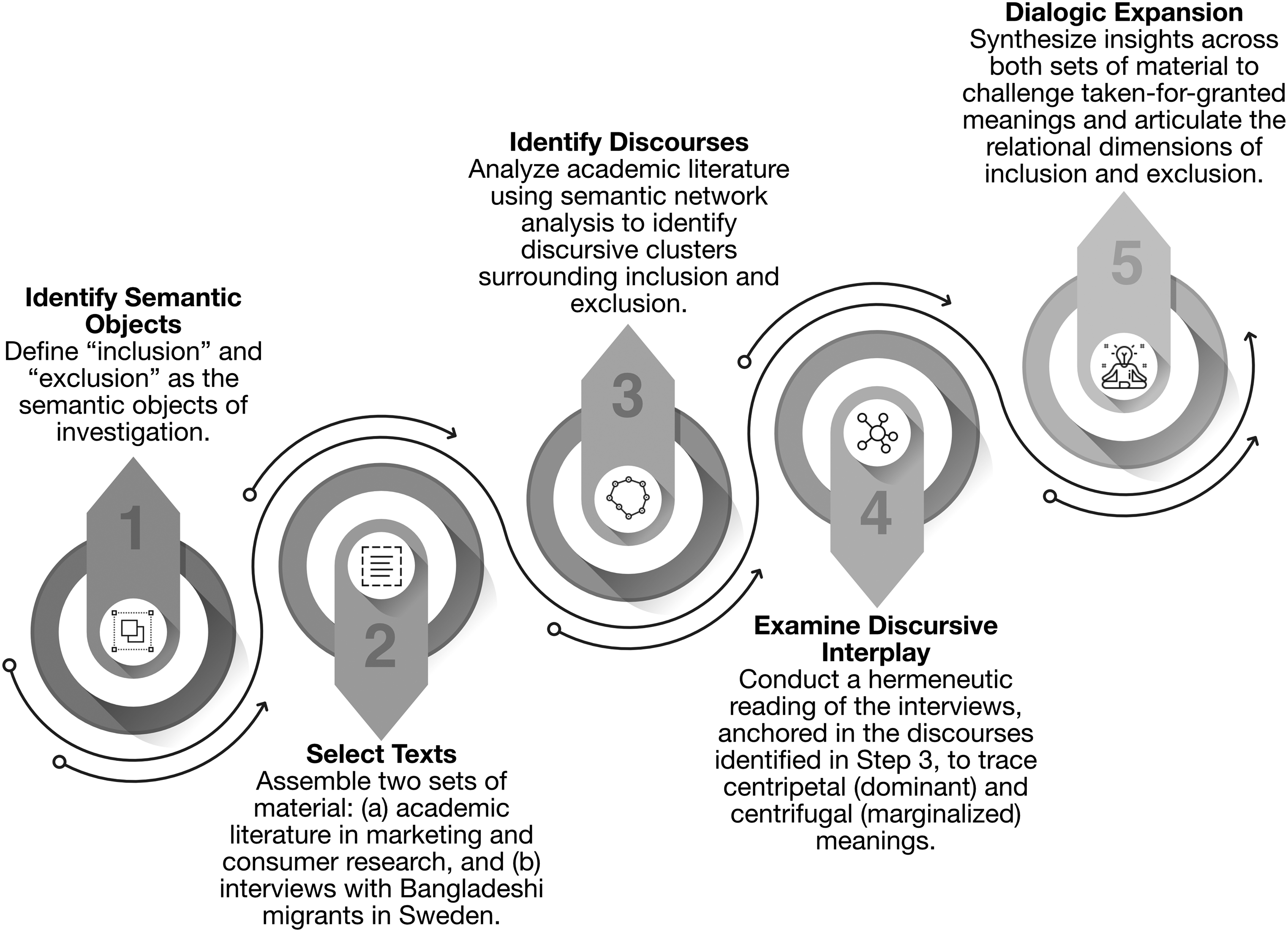
Data collection
To identify I&E discourses, we first searched academic repositories (Google Scholar, Scopus, Web of Science, and EBSCOhost). On March 7, 2025, we retrieved 342 texts on I&E in marketing and consumer research. After full-text screening, we selected 65 interpretive marketing and consumer research articles (Lucarelli et al., 2024). We recorded relevant metadata in a CSV file and treated the literature as a corpus for subsequent discourse mapping.
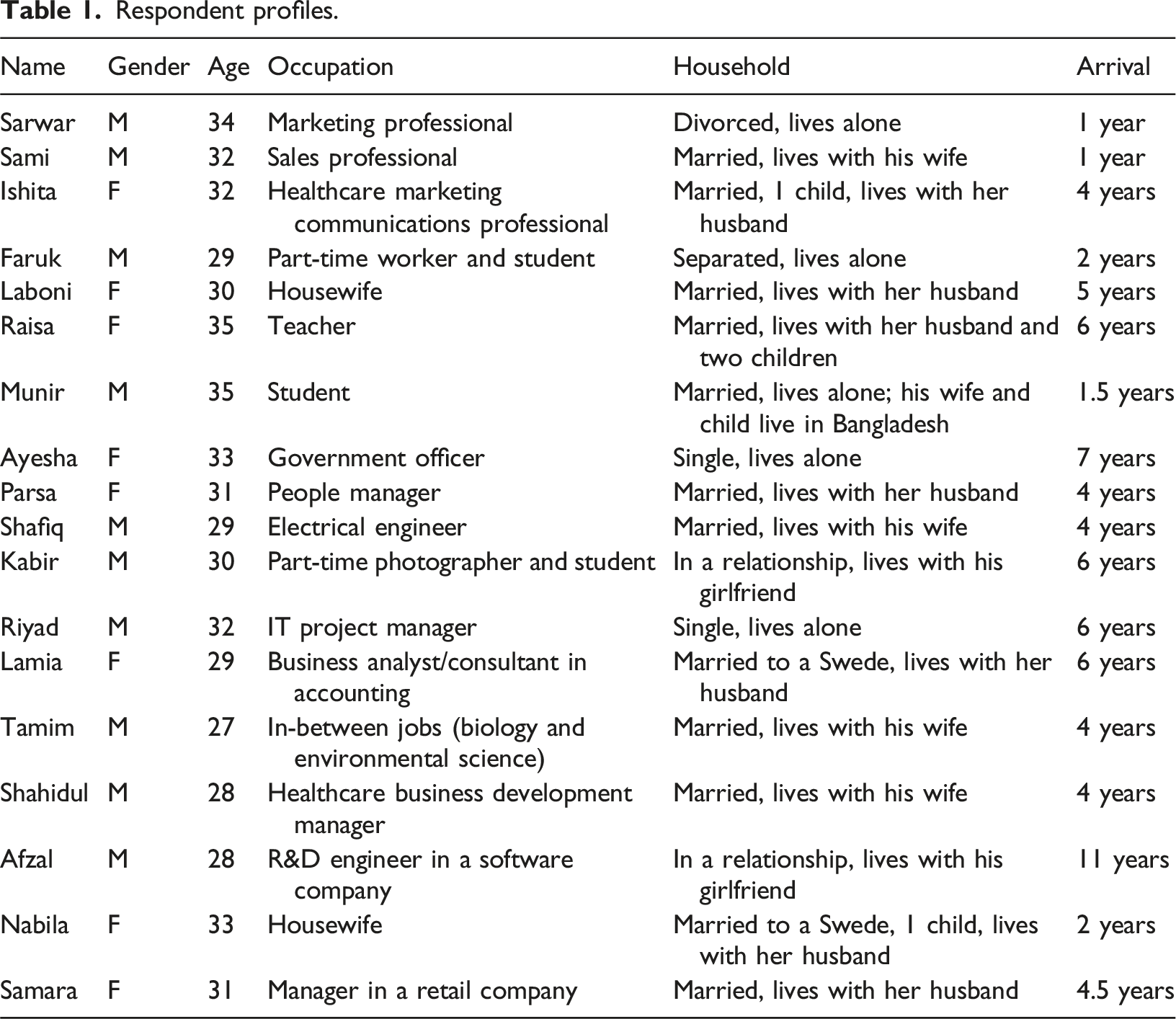
Second, we conducted semi-structured, long interviews (McCracken, 1988) with 18 Bangladeshi immigrants living in Sweden, a group that frequently encounters marketplace I&E due to their position as an ethnic minority situated between contrasting ideological contexts. Contemporary Bangladeshi culture is characterized by complex identity negotiations between a progressive, liberal heritage and potent religious influences (Hossain, 2020; Uddin, 2006). This tension is rooted in a multilingual, multi-faith past—where Persian, Urdu, Arabic, and Sanskrit traditions intersected with Bengali language politics—and in Islamic traditions shaped by syncretic Sufi, Hindu, and Buddhist elements (O’Connell, 2001; Rahman, 2020), layered over the legacies of the Mughal Empire, British colonialism, and postcolonial struggles in which Bengali-secular “Bangaliana” and political Islamic projects have alternately been mobilized (Hossain, 2012; Islam, 2018; Raju, 2011). While the 1905 Partition of Bengal—a British “divide-and-rule” policy separating Muslim-majority East from Hindu-majority West—set in motion religious–communal divides that were reinforced in 1947, when East Bengal was constituted as East Pakistan and governed from (West) Pakistan, thereby marginalizing Bengali-speaking Muslims, the axis of contention thereafter shifted to Bengali linguistic–cultural nationalism, marked by the 1952 Language Movement and culminating in the 1971 Liberation War (Rahman, 2020; Raju, 2011; Shamshad, 2017). Although independence constitutionally enshrined secularism, successive regimes leveraged Islamic sentiment for legitimacy, entrenching a liberal–ultra-religious divide (Mostofa, 2024). Economic neoliberalization in the 1980s, particularly the growth of the export-oriented garments sector, drew women into waged work, temporarily unsettling patriarchal norms (Hossain and Tisdell, 2005; Khan, 2005). More recently, an Islamic resurgence has reasserted religious justifications for gender inequality and modesty practices such as veiling, framed as ideological responses to perceived Western commodification of women’s bodies (Hussain, 2010; Islam, 2013). This history forges a complex mélange of conflicting ideological and religious imperatives.
Sweden represents a stark ideological counterpoint, characterized by progressive democratic values and gender equality (Castellanos and Ricalde Perez, 2023). A state-induced “double emancipation” ideology promotes equitable power relations, emancipating women from public constraints and men from domestic ones, across family and market contexts (Molander, 2021), although migrant women remain intersectionally vulnerable (Andersson Nystedt et al., 2025) and subject to subordination (Hudson et al., 2023). High immigration has spurred contentious debates about immigrant integration (Korver-Glenn et al., 2025), beneath which runs a divisive ethnic fault line (Hübinette and Räterlinck, 2014). A paradoxical relationship with racialized populations (Schclarek Mulinari, 2025) has intensified through reduced tolerance for Muslim immigrants and stricter policies (Krzyżanowski and Ekström, 2025), legitimizing “politics of exclusion” through the mainstreaming of anti-immigration rhetoric (Ekström et al., 2025). This tension between egalitarian ideals and growing exclusionary practices provides an ideal context for studying immigrant experiences.
Immigrants in Sweden navigate patterns of I&E that influence identity formation (Herz and Johansson, 2012), often encountering hostility (Henriksson et al., 2023) and marketplace discrimination (Rydgren, 2004). As non-white Muslims, Bangladeshi migrants balance tensions between intra-ethnic community support and mainstream societal exclusion (Salway, 2008), while negotiating multiple cultural identities (Lindridge et al., 2004), religious–secular contradictions (Eade and Garbin, 2006), and status challenges including (in)visibility (Mapril, 2011) and downgrading (Morad et al., 2021). These intersections of gender ideologies, religious beliefs, socioeconomic factors, and cultural contexts make them well suited for examining how ethnically marginalized consumers navigate marketplace I&E.
Respondent profiles.
Data analysis
We first mapped discourses in the literature corpus using semantic network analysis (SemNA), a systematic, theme-oriented approach that uncovers the “many discursive possibilities at play” and creates “semantic space” for contestation of “dominant discourses” (Baxter et al., 2021: 8, 10). SemNA involves “the visual mapping of semantic units through computational text analysis, revealing word/concept relationships, thematic clusters, and thereby facilitating the qualitative exploration of knowledge, information, concepts, and meanings in text-based data” (Schöps and Jaufenthaler, 2024: 501). A discourse represents a system of meanings revolving around central evaluative judgments, shaped by interconnected propositions that “co-occur and are interdependent with one another” (Baxter et al., 2021: 9; Scharp and Thomas, 2021). Using a custom Python script, we extracted author-defined keywords from the 65 articles based on their rhetorical claims (Lucarelli et al., 2024) and identified 818 keyword co-occurrences (Baxter et al., 2021; Schöps and Jaufenthaler, 2024). We then conducted SemNA using Gephi, an open-source network-visualization tool, to map these co-occurring keywords and visually represent the underlying themes. We computed the network’s average degree (6.007) and modularity (0.814) to identify the central nodes (268) and their relationships (810 edges) within the discourses, revealing 12 modularity classes (Figure 2). This visualization revealed how dominant discourses cluster relative to marginalized ones in constructing alternative I&E meanings. Semantic network of inclusion and exclusion discourses.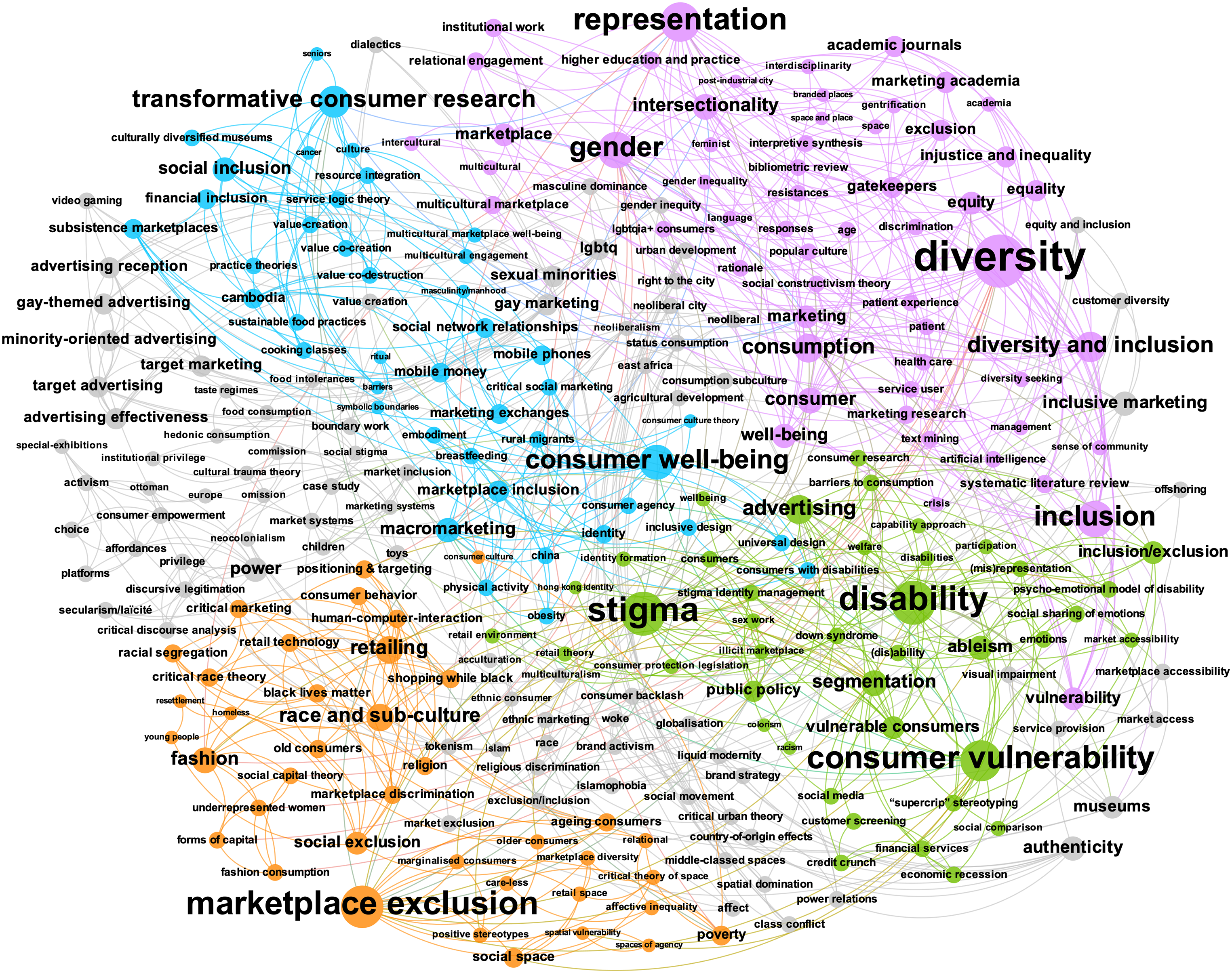
Second, anchoring our interview analysis in these mapped discourses, both researchers analyzed the interview data hermeneutically, identifying themes and patterns within and across participants (Thompson, 1997). This circular analytic process involved movement between the parts and the whole, producing progressively deeper understanding (Arnold and Fischer, 1994; Holbrook and O'Shaughnessy, 1988). Aligned with RDT, we treated interviews as contextually grounded “utterance-chains” and read participants’ talk against the SemNA-derived discourses, linking meanings to the centripetal and centrifugal discourses they drew upon (Baxter et al., 2021; Scharp and Thomas, 2021). This allowed us to identify how participants reproduced, negotiated, or resisted discursive positions in lived experience.
Finally, we integrated insights across corpora to challenge taken-for-granted assumptions, unsettle entrenched understandings of I&E, and reopen discursive possibilities. This dialogic expansion provided the basis for our relational dimensions and associated forms of I&E.
Findings: consumer-experienced relational dimensions of inclusion and exclusion
The SemNA of I&E discourses (Figure 2) revealed 12 thematic categories, with four dominant clusters comprising approximately 67% of the network. The top modularity cluster (21.11%, pink), focused on “DEI,” featured keywords—node degrees in parentheses—such as diversity (29), representation (20), inclusion (18), gender (18), diversity and inclusion (14), consumption (13), and equity (9). The second-largest cluster (15.93%, green), which we labeled “consumer vulnerability and accessibility,” included keywords such as disability (23), stigma (23), consumer vulnerability (21), advertising (13), ableism (9), vulnerable consumers (9), and market accessibility (4). The third cluster (15.93%, blue), which we termed “multicultural marketplaces and consumer well-being,” included prominent keywords such as consumer well-being (17), transformative consumer research (15), social inclusion (10), marketplace inclusion (8), identity (6), and multicultural marketplace well-being (4). The fourth cluster (14.45%, orange), “marketplace discrimination and social exclusion,” included marketplace exclusion (22), race and sub-culture (12), retailing (12), fashion (11), social exclusion (9), social space (7), marketplace discrimination (6), and religion (6). The remaining eight smaller clusters (gray) collectively represented 33% of the network and were not examined further.
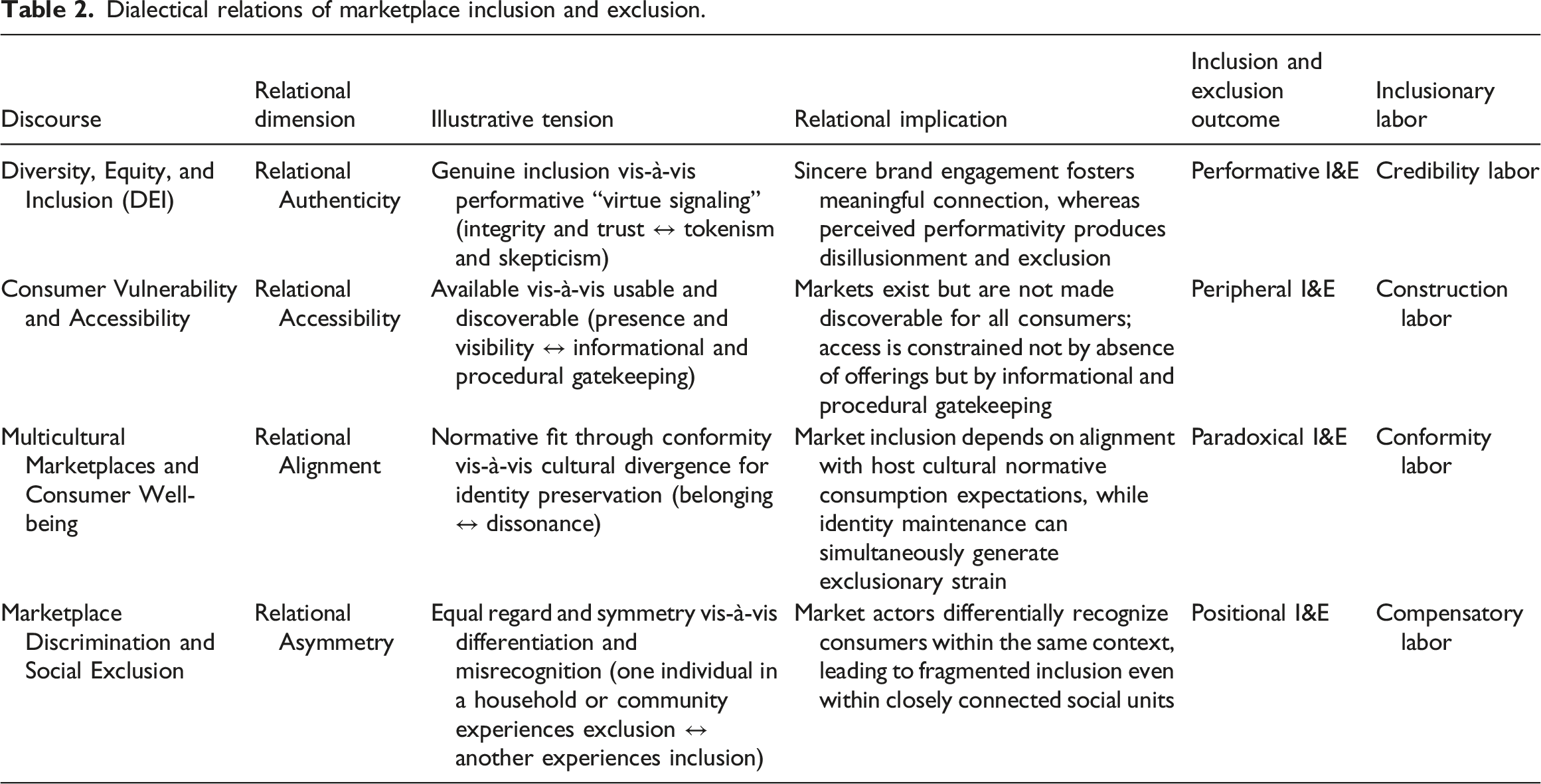
Dialectical relations of marketplace inclusion and exclusion.
Diversity, equity, and inclusion
Inclusion is often discussed alongside diversity and equity, collectively labeled DEI—where diversity refers to recognition of (actual or perceived) physical and sociocultural distinctions and equity concerns fair opportunity—with the aim of fostering belonging by actively integrating diverse groups into a culture and marketplace (Arsel et al., 2022). Within marketing, DEI encompasses communications that authentically reflect consumer diversity through equitable, bias-free representations that meaningfully include sociohistorically underrepresented and underserved consumers (van Esch et al., 2024). At a more foundational political level, while DEI efforts can be beneficial, they face critiques for being superficial and image-focused, failing to address systemic roots of exclusion and structural inequalities that prevent marginalized groups from fully participating in the marketplace (Kipnis et al., 2021). Despite its growing momentum, DEI faces increasing contestation, fueled by ideological backlash that polarizes inclusion efforts—a tension exploited commercially (Scott et al., 2025) and politically by counter-democratic movements (Ulver, 2022), as exemplified by the rollback of DEI programs in the U.S. (Ng et al., 2025). This has prompted many organizations to retreat from diversity commitments, influencing consumer trust, perceptions of brand authenticity, and corporate reputation (Sands and Ferraro, 2025).
Within DEI discourse, we identify a relational tension between genuine commitment to diversity and performative actions designed primarily for market advantage. Below, we use consumer accounts to show, first, how this tension manifests as relational authenticity and, second, how insufficient commitment to DEI produces performative patterns of I&E that require respondents to undertake credibility labor.
Relational authenticity
This dimension focuses on whether market actors demonstrate ethical coherence between stated values and marketer–consumer interactions, such that perceived integrity mediates I&E. This reflects the openness–closedness dialectic in RDT (Baxter and Montgomery, 1996), where market actors balance transparency about DEI commitments with strategic boundaries. The tension between genuine inclusion and performative virtue signaling appears in Laboni’s reflection on Åhléns’ “Break the Clothing Power Order” campaign: I’m not sure if Åhléns are doing it more to be trendy or because they really care about gender equality. [...] I don’t feel like it’s natural. [...] They’re not being genuine about it [...] they’re doing it just to follow the people. The colors [of people] are the ones that I don’t identify [with]. We are all the same. But I don’t really feel authentic [Laboni, 30].
Laboni’s skepticism reveals a struggle between competing discourses of woke-washing and authenticity. A dominant, market-driven discourse (centripetal) conflicts with marginalized perspectives on authentic representation (centrifugal), showing how inclusionary efforts can reproduce exclusionary dynamics when they are perceived as inauthentic. Her account illustrates how brand–consumer relationships strain when DEI appears driven by representation quotas rather than by sincere social concern that makes her feel valued.
Performative inclusion and exclusion
Breakdowns in relational authenticity lead to performative I&E—where DEI efforts appear to include diverse groups but lack genuine engagement, resulting in a superficial sense of belonging. Such efforts hinge on perfunctory gestures that prioritize optics, trends, or profit over commitment to social change. While there is formal inclusion via representation—often tokenistic—consumers can experience exclusion due to a lack of authentic engagement. Munir’s observation illustrates how performative I&E operates within multicultural market systems: They push these terms to spread their business and ideologies. [...] I think these ads are stunts of capitalism and results of colonialism. They promote these agendas to increase their sales and change people’s worldview, while taking money from small customers like me [Munir, 35].
Munir perceives DEI-infused marketing as co-opting social issues for growth, stripping them of genuine purpose rather than embracing diversity for transformative change and well-being. Here, performative I&E is characterized by superficial gestures that prioritize market-capitalist gain over meaningful engagement, commodifying differences without challenging exclusionary systems and creating an illusion of progress (Kipnis et al., 2021). This reflects power asymmetries (Baxter, 2011), where the dominant neoliberal market discourse undermines authentic DEI advocacy, positioning marginalized voices outside mainstream markets (Johnson et al., 2017; Wang and Tian, 2014) and, in effect, sustaining existing power structures. Echoing Henderson and Williams (2013), Munir’s concerns underscore the need for more substantial engagement with structural inequalities.
Credibility labor
The disconnect between organizational claims and marketplace experiences necessitates a form of work we call credibility labor—the emotional and cognitive effort required to distinguish genuine from performative inclusion. When Laboni questions whether Åhléns cares about gender equality or is “just following the people,” she performs this evaluative work. Similarly, Munir’s critique of advertising as “stunts of capitalism” demonstrates the interpretive labor needed to differentiate authentic commitment from market exploitation. This credibility labor constitutes a burden not typically required of majority consumers, who can engage with market offerings without interrogating intent. It represents additional, unacknowledged work that marginalized consumers perform to navigate performative inclusion, further stratifying market experiences even within ostensibly inclusive initiatives.
Consumer vulnerability and accessibility
Consumer vulnerability refers to individuals feeling powerless in marketplace interactions, often stemming from socioeconomic status, age, race, physical or mental disabilities, or language barriers (Edwards et al., 2018; Saatcioglu and Corus, 2016; Wang and Tian, 2014). Markets systematically marginalize vulnerable consumers, who frequently encounter symbolic exclusion, such as misrepresentation and invisibility, and physical exclusion, such as inaccessibility (Arsel et al., 2022; Bhogal-Nair et al., 2024; Kearney et al., 2019). Within this discourse, market access, accommodation, and disabling marketplace structures emerge as central concerns (Arnould and Press, 2019; Bennett et al., 2016; Higgins et al., 2024), highlighting the importance of inclusive retail and service design (Edwards et al., 2018). Many vulnerable consumers exist in a precarious state between complete deprivation and minimal inclusion, with limited access to the benefits of full marketplace participation (Miller and Stovall, 2019). Thus, individuals may access basic services without facing overt discrimination, but without intentional efforts to engage them, their inclusion remains incomplete.
The consumer vulnerability and accessibility discourse centers on how markets make themselves available to vulnerable consumers and how information and access constraints create marginality. Here, we identify a dimension of relational accessibility that generates peripheral I&E experiences and requires respondents to undertake construction labor.
Relational accessibility
This dimension captures how marginalized consumers navigate market visibility and access barriers. They often face a tension between seeking reliability (reliable access, consistent product availability) and managing unpredictability (limited information, fluctuating availability, discrimination)—the certainty–uncertainty dialectic in RDT (Baxter and Montgomery, 1996). A core tension is that markets exist but are not made discoverable for some consumers, as Parsa explains regarding ethnic food and religious clothing: I think one of the biggest changes was the kind of rice that we eat. Before, [in Umeå] I believe there were not many typical Asian food stores that we have [in Stockholm]. So, the rice we used to take was what we could get in ICA, like Basmati or maybe parboiled. [...] Now there are so many immigrants that you see, and not just immigrants, I mean there are a lot of Muslims that you see, and not just from Asia, from Africa as well. But I haven’t really seen any head-covering kind of clothes for them anywhere, I mean other than the shady areas that we call in Stockholm Rinkeby. Other than that, you don’t really see that, so I really don’t think that they are focusing on the bigger issues [or] looking for a revolution [Parsa, 31].
Parsa describes spatial variation in market accessibility. In Umeå, limited Asian food stores restricted culinary access for South Asian diasporic communities, while in Stockholm—despite greater diversity—cultural products like hijabs remain confined to marginalized neighborhoods. This spatial segregation of ethnically specific offerings hinders full engagement for consumers like her (Saatcioglu and Corus, 2016). Here, we observe an interplay between the centripetal force of mainstream market offerings and the centrifugal force of specialized ethnic markets. Parsa’s inclusion is constrained not by nonexistence but by informational gatekeeping, creating a fragmented marketplace relationship.
Peripheral inclusion and exclusion
Relational accessibility barriers lead to peripheral I&E, where individuals are ostensibly granted limited access and conditional acknowledgment—placed on the periphery, not quite in or out (Rennstam and Sullivan, 2018). Their presence is recognized, yet they are denied full marketplace participation (Edwards et al., 2018), making their exclusion subtle (Castilhos, 2019). Parsa’s account shows how peripheral I&E creates tension between inclusion in designated spaces and exclusion from mainstream markets. This conditionality acknowledges her cultural needs only in specific areas, relegating Asian or Muslim communities in Sweden to the fringes of mainstream society. In a related vein, Kabir’s evolving relationship with traditional cooking further illustrates this: When I came to Sweden, I didn’t miss the food from Bangladesh. So, I made whatever I thought was convenient, Thai or Italian, that needs little preparation. But then, as I found more spice shops, and I got better with cooking—I had absolutely no experience of cooking ever—my first experience learning to cook was when I landed in Sweden on my first day. So, from there to now, I would say it changed over time because Bangladeshi or traditional subcontinental food is more complex, it needs more ingredients. So, my consumption over time increased in that category because of my expertise, preparation of those foods, and my knowledge of where I can go and buy them [Kabir, 30].
For Kabir, Bangladeshi ingredients exist in Sweden, but access is not straightforward. His initial reliance on convenient, nontraditional meals, followed by a deliberate return to complex Bangladeshi cuisine as he acquired skills and resource knowledge, mirrors the dedicated pursuit of heritage food practices often observed among Bangladeshi migrants (Dey et al., 2023). This demonstrates how vulnerable individuals adopt strategies to mitigate exclusion while remaining included, albeit in less visible ways (Cova et al., 2021). The tension between mainstream participation and specialized cultural consumption reflects their precarious state (Miller and Stovall, 2019). Although service providers could facilitate accessibility, the onus of inclusion typically falls on vulnerable consumers (Husemann et al., 2023). While Kabir’s inclusion improves through personal and strategic efforts, as he discovers gateways, it remains conditional on his knowledge acquisition.
Construction labor
The constrained marketplace access of marginalized consumers necessitates construction labor—the work of building pathways to resources that are ostensibly available but not readily accessible. Parsa’s account of finding cultural products only in specific neighborhoods shows how consumers must develop knowledge of where ethnically specific offerings can be found. Kabir’s narrative highlights this labor, as he develops “expertise” and “knowledge” about where to buy ingredients for Bangladeshi cuisine. Thus, construction labor involves developing specialized knowledge and acquiring skills to overcome informational gatekeeping, which entails creating mental maps of where cultural resources exist, learning which stores carry specific products, and determining which neighborhoods offer cultural goods. Unlike many majority consumers, who can rely on mainstream retailers, marginalized consumers must invest significant effort to discover, access, and use resources that should be readily available, reinforcing their peripheral placement in the market.
Multicultural marketplaces and consumer well-being
Marketplaces have become increasingly diverse through migration and globalization, creating tensions between cultural groups that affect consumer well-being (Demangeot et al., 2019; Kipnis et al., 2021). Migrants experience dialectical marketplace dynamics as they navigate anticipated benefits and barriers, such that inclusion emerges as a “relational process” contingent on host-country policies, while exclusion manifests as migrants negotiate competing cultural norms between home and host societies, balancing cultural and religious maintenance with adaptation to new expectations (Crawford et al., 2023; Wang and Tian, 2014). Meaningful inclusion requires moving beyond tolerance and recognition toward actively leveraging cultural differences to enhance collective well-being (Demangeot et al., 2019). However, inclusionary initiatives often provoke resistance when they challenge hegemonic marketplace norms (Johnson et al., 2017) or when majority residents feel threatened by the inclusion of diverse ethnic groups (Saatcioglu and Corus, 2016). Inclusionary marketing aimed at minority groups, such as modest fashion for Muslim women, can become controversial and perpetuate exclusion by triggering backlash from majority consumers, who may perceive such initiatives as institutionalized discrimination (Audrezet and Parguel, 2023; Johnson et al., 2017). This challenges brands to be inclusive without alienating their broader consumer base.
The discourse of multicultural marketplaces and consumer well-being examines how sociocultural norms mediate consumer participation in markets. In what follows, we examine how respondents navigate tensions between home and host norms. We show that relational alignment yields paradoxical I&E patterns that require conformity labor.
Relational alignment
This dimension captures the tension between aligning with host market-mediated norms and maintaining cultural identity, where fitting what is coded as “normal” or “desirable” facilitates inclusion, while divergence risks exclusion. This embodies RDT’s connection–autonomy dialectic (Baxter and Montgomery, 1996), balancing belonging through marketplace conformity against cultural distinctiveness and individuality, with migrants oscillating between assimilation and cultural maintenance (Askegaard et al., 2005; Lindridge et al., 2004; Peñaloza, 1994). Samara’s narrative on consumption and cultural resonance echoes this calibration of social fit versus dissonance: I used to wear local clothing like salwar kameez or sarees. After coming to Sweden, I shifted to what’s acceptable here—pants, T-shirts, blouses, dresses. I also expose a bit more skin because I don’t feel judged as I felt back home. [...] I miss my own fashion sense, because it’s a lot of grays and blacks [but] I’m used to a lot of colors. I think initially I tried to sort of gel in but now it’s a lot more trying to create my own identity. During Eid I order these ornate, artisanal, vibrant kameez from these Facebook pages that bring them from India. […] There’s nostalgia, you start missing your own food, so I cook a lot from my culture, more than before, just to keep that connection with home, and because I’m the one cooking, while grocery shopping, I decide what needs to be in the household. [...] It’s liberating [here], in Bangladesh, I always felt I didn’t fit in because I had to comply with more norms than what I accepted. [...] It’s different values, and I quite like it, but then I’m also talking from quite an outsider perspective because I was not happy in my culture. I still don’t feel fully integrated. I think I live in my own, quite an outside, bubble [Samara, 31].
On the one hand, Samara aligns with Swedish market-mediated norms, embracing individualism, reduced moral surveillance, and emancipatory cultural expression by adapting her everyday wardrobe from modesty-normative to liberal-normative. On the other hand, she maintains connections to Bangladeshi “hyperculture” by consuming more Bangladeshi food than she did in Bangladesh, sourcing festive attire through alternative marketplaces, and reproducing home-culture gender roles in domestic provisioning through grocery shopping and cooking, thereby oscillating between alienation and attraction to both cultures (Askegaard et al., 2005; Lindridge et al., 2004). Rather than wholesale assimilation (Peñaloza, 1994), Samara pursues selective alignment, where market autonomy affords comfort while enduring attachments—and her self-described “outside bubble”—signal persistent dissonance.
Paradoxical inclusion and exclusion
Incongruence in relational alignment can lead to a state in which consumers experience inclusion through normative conformity yet exclusion through cultural disconnection. Arnould and Press (2019: 508) term this concurrent belonging and marginalization “paradoxical inclusion and exclusion.” This illustrates marketplaces as ambivalent sites of both empowerment and vulnerability (Saatcioglu and Corus, 2016), a paradox often perpetuated by structures that maintain boundaries and constrain genuine inclusion. Hegemonic taste regimes and their ritualized practices stabilize prevailing norms while marking nonadherence as deviant, producing stigma that, in turn, reinforces those regimes (Schneider-Kamp, 2021). Samara finds the Swedish context resonating with her values, offering emancipation from restrictive norms in Bangladesh, yet she experiences cultural disconnection that creates paradoxical I&E. As these countervailing pressures seep into everyday routines, their effects become tangible in mundane shopping. Sarwar’s account shows how the same retail system can both support and burden newcomers: Everything here closes early, especially on weekdays…back home some shops were open all night. […] The stores are super organized here. The main problem is language, because the billboards and labels in places like ICA or Willys are all in Swedish. I think they should add English as well. I mean, lots of foreign people live in Malmö, so it would be very convenient. […] Every time I go to the supermarket, I have to keep Google Translate open and it eats time—you scan, read, decide, and again…carrying your phone all the time is difficult. At the produce scale you weigh it yourself and enter the Swedish name. It’s awkward, especially with a long queue behind you… [although] everyone speaks English if you need help […] but [you] learn some Swedish words. […] Sweden is getting more cosmopolitan, but they don’t think about us. I mean, you see Christmas offers and decorations but not Eid. […] Every supermarket has rice now and there’s a lot of our food—maybe not Bangladeshi, mostly Indian and not a lot of variety—but still enough that I don’t need to go to [South Asian] stores every week, maybe once a month [Sarwar, 34].
Within the same market, Sarwar encounters a paradox in which infrastructural inclusion coexists with procedural and symbolic exclusion. Stores are orderly, mainstream chains carry staples like rice, and staff will assist in English when asked. Yet choices that ease shopping for the majority, such as standardized self-service routines, Swedish signage, and early closing, sort and strain migrant shoppers, turning into barriers. Seasonal merchandising spotlights Christmas while overlooking Eid, signaling limited recognition of Muslim consumers and their rituals. Despite being multicultural, such marketplaces, in Sarwar’s view, remain ambivalent toward cultural differences and the well-being of migrant consumers (Demangeot et al., 2019).
Conformity labor
The paradoxical nature of I&E necessitates conformity labor—a form of strategic adaptation to host-cultural, market-mediated norms while maintaining cultural identities, thereby revealing the emotional burdens of navigating acculturation demands. Sarwar illustrates how procedural and linguistic expectations reshape everyday shopping, including constant reliance on technology, learning key product and category terms, adjusting trip timing to earlier closing hours, and combining mainstream supermarkets with occasional visits to diasporic outlets. Samara’s use of alternative channels likewise reflects the psychological costs of this hidden labor. She demonstrates the continuous assessment required to navigate competing social cues and normative expectations when determining appropriate clothing in different contexts. Unlike majority consumers, migrants must continuously evaluate which consumption practices to adapt and which cultural expressions to maintain, creating an invisible burden essential to marketplace participation and highlighting the pressures migrant consumers face (Wang and Tian, 2014).
Marketplace discrimination and social exclusion
Marketplace discrimination manifests across multiple identity positions, including gender, age, race/ethnicity, social class, sexuality, body image, religion, and cultural identity (Arsel et al., 2022). Gender-based discrimination is perpetuated by idealized representations of women’s bodies that construct unrealistic beauty standards, engender fear and shame, and reinforce stigma, vulnerability, and structural inequality (Gurrieri et al., 2013; Saren et al., 2019). Exclusionary practices favor elites by erecting physical, symbolic, and social boundaries that alienate lower classes, restrict access to affordable essentials, and foster hostile retail environments (Castilhos, 2019; Saatcioglu and Ozanne, 2013). Urban, commercial, and quasi-public spaces have historically denied marginalized groups access to fundamental consumer-citizenship rights (Miller and Stovall, 2019; Saatcioglu and Corus, 2016). Spatialized marketplace exclusion deepens economic divides and reproduces broader inequalities related to immigrant rights and justice (Arnould and Press, 2019; Bennett et al., 2016). While racial profiling in retail is documented, marketplace colorism operates broadly, reproducing inequities and racialized segregation and thereby perpetuating spatial exclusion (Francis and Robertson, 2021; Saren et al., 2019). This ties into ethnicified religion, as young Muslims often navigate tensions between religious constraints and Western consumerism, sometimes leading to self-exclusion (Jafari and Goulding, 2008). Religiously sanctioned norms can also render routine market exchanges humiliating, producing “negative being” and extreme consumer vulnerability (Varman and Meshram, 2025).
The discourse of marketplace discrimination and social exclusion examines how market systems generate differential experiences within seemingly similar social groups. We explore how relational asymmetry creates divergent marketplace experiences, leading to positional I&E that require compensatory labor.
Relational asymmetry
This dimension addresses interpersonal differentiation, where visibly similar consumers receive differential treatment based on their position within a social category. Market dynamics selectively differentiate consumers, leading to fragmented inclusion even within closely knit social units, such as households, communities, or demographic groups. Such intrasystem disparities reveal how markets perpetuate relational asymmetry through power imbalances (Baxter, 2011). Lamia’s consumption and experience with her diaspora illustrate this dynamic: One thing that bothered me recently when we moved to a new apartment. There were some leaflets that we got from grocery stores and realtors. All the leaflets that we’ve got from Coop or ICA came in my name and the ones that came from realtors were in my husband’s name. I found it very irritating, and I didn’t think that it was okay. We both share our expenses equally. We make decisions together. So why would I get it, because I am a woman? […] I would say that systematic sexism still exists…the Swedish state says that they promote a feminist and gender-equal ideology, but in reality, it looks pretty different. [...] I’m not like other bhabis [wives]. I don’t feel comfortable with them…I don’t have that good reputation because I talk about things like women’s rights. I didn’t feel like myself in Bangladeshi communities. They didn’t want me…as I am with a Swedish guy. The men couldn’t find him because I was always with my husband. So, we found ourselves outside of the community…we don’t get invited to their barbecues or cultural festivals. But we eat dinner with our friends who are international [Lamia, 29].
Routine market segmentation and address list practices can encode gendered assumptions about who counts as the household decision-maker, even in ostensibly egalitarian settings (Molander, 2021). Real estate agents and retailers often employ covert discriminatory tactics that disadvantage ethnic minority consumers (Francis and Robertson, 2021). Lamia’s experience shows how ethnic migrant women in Sweden face persistent vulnerabilities (Andersson Nystedt et al., 2025) and structural barriers that hinder inclusion (Saatcioglu and Corus, 2016). In a context where equality rhetoric coexists with a public discourse of “caring racism” that constructs migrant women as subjects to be protected, paternalistic misrecognition at market touchpoints becomes normalized (Mulinari, 2021). Marketers’ targeting of immigrant women often aligns with “patriarchal bargains,” casting wives in household-manager roles and reinforcing origin-culture gender stereotypes and hierarchies (Lindridge et al., 2016). Lamia’s I&E is thus co-produced by the entanglement of gender and migration, as her mixed marriage places her at the edges of both marketer targeting and diaspora networks. Through RDT’s equality–inequality lens (Baxter and Montgomery, 1996), we see the pull of symmetrical recognition (centripetal) and lived differentiation (centrifugal).
Positional inclusion and exclusion
Relational asymmetry leads to positional I&E, where individuals experience different I&E patterns based on their social position relative to others in the same context. Exclusion is reproduced not only by explicit barriers but also by routine policies and everyday misrecognition that privilege incumbents, yielding inadvertent yet persistent disenfranchisement (Bennett et al., 2016; Johnson et al., 2017; Saren et al., 2019). Lamia encounters market actors making assumptions based on her gender position within her household. Afzal’s food and car consumption experiences likewise exemplify this dynamic: We love trying out new restaurants, and it’s interesting how differently they react. When she goes to a shop to buy cheese, they’re so welcoming, offering her samples, explaining the origins. But when I go to the same shop to buy the same things, it's different. They’re polite, but it’s…colder. […] In grocery, she can easily find ingredients for her food, but for simple green chilis, I have to go to a specialized “ethnic” store on the other side of town. […] When we went to buy a car, she really wanted a Volvo, the guy immediately started talking to her, explaining everything, like she was the primary decision-maker. I tried to ask a few questions. He answered but it felt like…you know how it’s in Sweden? The funny thing is, I saw this Volvo ad with immigrants, how they are “welcoming” and “diverse.” Like they want our money, but don’t really see me [Afzal, 28].
Afzal encounters position-based differentiation when, despite sharing the same context, the salesperson privileges his white European girlfriend, who is also an immigrant, as the primary decision-maker. This represents a failure to recognize or value out-group members, which can render them invisible through neglect and produce alienation and vulnerability (Bennett et al., 2016). Lamia experiences compounded positional exclusion: her gender leaves her marginalized in Swedish marketplace contexts, while her feminist views leave her outside some diasporic communal consumption contexts—overlapping disadvantages that show how intersecting identities shape I&E (Saatcioglu and Corus, 2016; Saren et al., 2019; Thomas, 2013).
Compensatory labor
The positional nature of I&E necessitates compensatory labor—efforts to counteract unequal, position-based differences and assert marketplace legitimacy within shared consumption contexts where others are automatically granted recognition. Afzal must actively work to insert himself into conversations where he has been sidelined and develop parallel strategies, such as visiting Bangladeshi stores for ingredients that his girlfriend can find in mainstream markets. Lamia navigates a dual burden, challenging assumptions about gendered roles for immigrant women in Sweden while encountering exclusion in Bangladeshi communal consumption contexts. Both develop strategies to gain recognition in mainstream markets, while Lamia additionally works to maintain access to culturally specific consumption contexts—labor that majority consumers seldom have to undertake.
Overall, given Bangladesh’s ideological–historical bifurcation between liberal–national and ultra-religious projects (Hossain, 2012; Mostofa, 2024), migrants enter Swedish marketplaces with different discursive anchors, weighting the four relational dimensions—authenticity, accessibility, alignment, and asymmetry—unevenly. Consequently, the mix of labor varies across Bangladeshi respondents, producing diverse I&E experiences within the same diaspora.
Discussion
Our findings reveal a dialectical framework of marketplace I&E in which four aggregate discourses—DEI, consumer vulnerability and accessibility, multicultural marketplaces and consumer well-being, and marketplace discrimination and social exclusion—continuously shape migrant consumer experiences. Drawing on RDT, we demonstrate how marketplace experiences emerge through the ongoing interplay between dominant narratives and marginalized counter-discourses. From this tension, we identify four relational dimensions—authenticity (negotiating trust and skepticism), accessibility (balancing visibility and gatekeeping), alignment (reconciling normative fit and cultural dissonance), and asymmetry (mediating equality and differentiation). These dialectical relations manifest as performative, peripheral, paradoxical, and positional I&E experiences that transcend binary conceptualizations. Our analysis further reveals that navigating these dimensions demands specific forms of labor from migrants: credibility labor to evaluate authenticity claims, construction labor to establish pathways to resources, conformity labor to balance cultural expectations with identity preservation, and compensatory labor to overcome differential treatment. Our framework (Figure 3) maps this dynamic interplay, illuminating the relational nature of marketplace experiences and the active work required of migrant consumers. Below, we articulate two key contributions. Relational dynamics of marketplace inclusion and exclusion.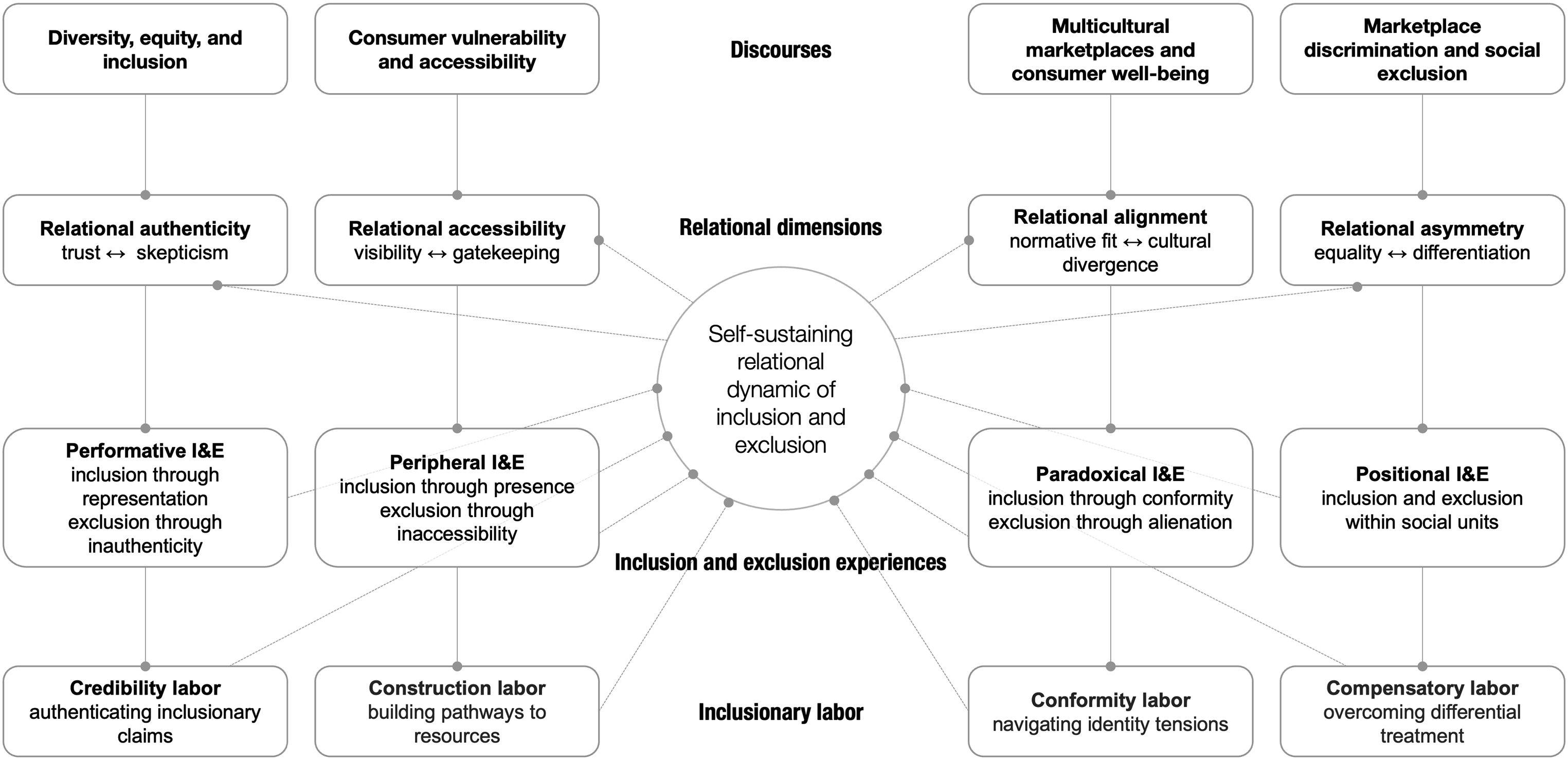
Inclusion and exclusion as relationally co-constituted
This research contributes to the literature on marketplace inclusion (Arsel et al., 2022; Thomas, 2013) and exclusion (Saren et al., 2019; Wang and Tian, 2014) in general and to their intersection in particular (Henderson and Williams, 2013; Saatcioglu and Ozanne, 2013). Prior work acknowledges the coexistence of I&E, documenting simultaneous participation and marginalization within markets (Arnould and Press, 2019) and showing how inclusion takes shape relative to exclusion (Cova et al., 2021; Miller and Stovall, 2019). Our findings extend this view by showing that I&E are in a dialectically co-constitutive relationship in which experiences of each actively produce, define, and give meaning to the other rather than merely coexisting.
Applying RDT to marketplace interactions illuminates four relational dimensions within which dominant discourses interact with marginalized alternatives, creating power asymmetries that shape consumer experiences. These tensions can generate a kind of Eigendynamik (Simmel, 1973)—self-sustaining dynamics that develop autonomous momentum beyond initial marketplace interactions and evolve through the interplay of competing forces (Rennstam et al., 2024; Sellerberg, 1994). Because each experience of inclusion can simultaneously generate new forms of exclusion, producing ceaseless interactions and cycles of adaptation, this self-propelling dynamic (Nedelmann, 1990; Simmel, 1978/2011) helps explain the persistence of marketplace I&E despite numerous intervention attempts. Building on this dialectical view, the tensions we identify materialize in four recurring patterns of experience, advancing understanding of marketplace I&E.
First, we extend two notions in the literature—paradoxical I&E in consumer research (Arnould and Press, 2019; Olivotti, 2016) and peripheral I&E in organization studies (Rennstam and Sullivan, 2018)—by specifying the relational mechanisms that sustain them. Paradoxical I&E captures how conformity-based inclusion can generate cultural alienation, as adoption of host norms provides certain freedoms while disconnecting consumers from cultural expression. Building on Arnould and Press (2019), we specify this mechanism as a tension between normative alignment and cultural identity preservation. These findings enrich discourse on paradoxical multicultural marketplaces (Olivotti, 2016) by offering an experiential framework for how marginalized consumers navigate competing normative systems. Peripheral I&E demonstrate how accessibility can produce simultaneous I&E when culturally specific products exist but remain geographically segregated. This enriches Saatcioglu and Ozanne’s (2013) account of inclusion as equitable access by highlighting how informational gatekeeping mediates that access, creating deliberately bounded participation. It also complements research on service provider accessibility strategies (Husemann et al., 2023) by identifying how informational barriers enact conditional market participation.
Second, we advance two novel forms of I&E: performative I&E and positional I&E. Performative I&E shows how ostensibly inclusive initiatives produce exclusion through inauthenticity. While Kearney et al. (2019) argue that representation can appear inclusive yet mask deeper exclusion, we add that within relational authenticity, performative inclusion can create exclusion through disillusionment. This also extends Bennett et al. (2016) by revealing how efforts that address “omission” can simultaneously reproduce exclusion through new forms of “commission,” helping explain why market-mediated multicultural DEI initiatives often fail to achieve intended outcomes while maintaining power imbalances. Positional I&E exposes how differential treatment within social units creates fragmented marketplace experiences. Whereas most studies examine intergroup dynamics (Johnson et al., 2017), we highlight intragroup differentiation driven by market systems, expanding work on marketplace discrimination (Francis and Robertson, 2021; Gurrieri et al., 2013) by revealing asymmetric experiences within seemingly homogeneous groups.
The burden of inclusionary labor
We conceptualize inclusionary labor as the disproportionate burden placed on marginalized consumers to facilitate their own marketplace inclusion. The concept emerges from our findings—credibility, construction, conformity, and compensatory labor—and builds on two research streams. First, we draw on the literature on I&E that reveals how inclusionary efforts often shift responsibility onto vulnerable consumers (Husemann et al., 2023), while exclusion imposes “affective burdens” disproportionately on them (Hutton, 2019). Second, we draw on the notions of affective labor (Kolehmainen and Mäkinen, 2021) and visibility labor (Abidin, 2016), which demonstrate how individuals perform additional work to be recognized within systems where visibility is unevenly distributed.
Inclusionary labor involves the invisible effort marginalized migrant consumers expend to navigate complex market systems in pursuit of fair access and treatment. This goes beyond adaptation as framed in consumer acculturation (Üstüner and Holt, 2007), requiring continual work to secure recognition as legitimate participants, echoing “visibility labor” performed for recognition in digital economies (Abidin, 2016) while managing the unpredictability and precarity (Duffy et al., 2021) of potentially exclusionary market systems. It also entails affective work (Kolehmainen and Mäkinen, 2021) that involves actively managing interactions and co-producing relational atmospheres to smooth potentially fraught encounters or ensure majority comfort. Like other under-recognized forms of labor, it is frequently unacknowledged and uncompensated, even as its value is captured by institutions that showcase “diversity” without redressing underlying power asymmetries.
Our research enriches discourse on the market’s inherent marginalization of vulnerable groups, who are treated unequally (Hutton, 2019), discriminated against (Higgins et al., 2024), overlooked (Henderson and Williams, 2013), and stigmatized (Gurrieri et al., 2013). Existing research highlights mechanisms that erect barriers to accessibility and how market actors can overcome them (Bhogal-Nair et al., 2024; Husemann et al., 2023). The concept of inclusionary labor shifts the focus to consumers’ active, often invisible work, moving beyond viewing them as passive recipients of I&E (Bennett et al., 2016; Saren et al., 2019) to highlight the cognitive, affective, and strategic efforts they expend to navigate these dynamics. The forms of labor we identify add to marketplace stigma-resistance strategies (Venkatraman et al., 2024) through which consumers combat exclusion and build competencies despite often hostile or asymmetrical environments.
Barriers to consumer rights manifest across cultural-cognitive, normative, and structural dimensions that collectively impede inclusionary efforts (Kipnis et al., 2021). Our study shows how these barriers, often experienced as mismatches with the marketplace environment (Lteif et al., 2025), necessitate different forms of inclusionary labor: cultural-cognitive barriers require construction labor (to build pathways), normative barriers demand conformity labor (to navigate expectations), and structural barriers necessitate both credibility labor (to evaluate institutional claims) and compensatory labor (to overcome differential treatment). By illuminating the hidden costs and the competencies consumers must actively develop and deploy to participate—or to mitigate harm—this concept reframes consumer vulnerability (Wang and Tian, 2014) not just as a state but as a relational condition that demands an unequal burden of labor within market systems that often merely claim inclusivity.
Additionally, this study expands understanding of consumer acculturation by illuminating the active work migrants perform to navigate marketplace I&E. While post-assimilationist research has focused on acculturation processes (Peñaloza, 1994) and multiplicative identity constructions (Lindridge et al., 2004), inclusionary labor reformulates acculturation from oscillating position-taking (Askegaard et al., 2005) to an ongoing labor process that requires continuous negotiation of dialectical tensions. Although Oswald (1999) identified the performative nature of “culture swapping,” our findings reveal the substantial work this performance entails. While our perspective resonates with recent acculturation studies examining macro-institutional forces, it goes further by articulating the specific forms of labor performed within structural constraints. Where Üstüner and Holt (2007) emphasize how ideological conflicts and limited capital constrain acculturation projects, our framework illustrates four distinct responses: credibility labor to authenticate inclusionary claims in “market-mediated multiculturation” (Veresiu and Giesler, 2018); construction labor to build knowledge pathways and overcome access barriers (Wang and Tian, 2014); conformity labor to negotiate conflicting ideologies (Jafari and Goulding, 2008); and compensatory labor to assert legitimacy from intersectionally subordinate positions (Chytkova and Kjeldgaard, 2023). While Luedicke (2015) reconceptualized acculturation as a relational process, we highlight the asymmetrical distribution of labor within these relations, shifting focus from how institutions shape ethnic consumer subjects (Veresiu and Giesler, 2018) to the often invisible work these consumers perform in response to marketplace structures that claim inclusivity while reproducing exclusion.
Conclusion, implications, and future research
Experiences of I&E are foremost a systemic problem rooted in the unequal distribution of resources. Our findings suggest that marketers have limited control over these experiences. The spectrum of possible meanings and experiences, shifting across contexts, is so vast that no retailer, brand manager, or marketer can fully control it, especially when it comes to “full” inclusion, which might be a capitalist fantasy. This is because the market economy’s logic spans from macro-level issues like poverty, sexism, and racism to micro-level outcomes like isolation and alienation (Saren et al., 2019), erecting structural barriers that deny individuals access to opportunities (Kipnis et al., 2021), resources (Arnould and Press, 2019), and representation (Kearney et al., 2019). If the market is the very bearer of inequality (Francis and Robertson, 2021), then one must problematize the mission to make the market more inclusive as a fetishizing form of “marketer responsibilization” rather than consumer responsibilization alone (Giesler and Veresiu, 2014). In capitalist-critical marketing studies (Zwick and Bradshaw, 2016), using the market to cure its own ill effects is oxymoronic. Yet one could contend that if what the market “does” actually matters, then its destructive reproduction of disadvantages could be reduced by eliminating discriminatory practices.
Our framework yields implications at four levels. Organizationally, authenticity prioritizes genuine inclusion over performative signaling and can guide marketers to lower credibility labor by simplifying routine touchpoints—using multilingual essentials and offering assisted alternatives to self-service—and by tracking experience parity, such as time to completion, help requests, and abandonment. At the market-system level, accessibility addresses the tension between availability and discoverability and calls for audits of signage, self-service flows, and documentation rules for unequal impact, with language and translation standards and assisted pathways that reduce consumers’ construction labor. At the societal level, alignment navigates the tension between normative fit and cultural preservation and requires public institutions and civil society to broaden symbolic recognition—for example, civic calendars and public spaces reflecting multiple traditions—and to co-design with communities so that the conformity labor migrants otherwise perform to fit singular norms is lowered. Interpersonally, asymmetry concerns equality versus misrecognition and can be mitigated by frontline practices that resist routine stereotyping, while migrants may also deploy compensatory strategies—such as credibility checks of inclusion claims, pre-translated lists, co-shopping, and shared store guides—to approach parity. Because these dimensions co-occur, single-issue inclusionary initiatives tend to shift rather than resolve exclusion. For instance, improving representation while leaving procedural barriers intact can reproduce paradoxical I&E.
We approached I&E through a relational lens, exploring how migrant consumers navigate dialectical tensions in market experiences through inclusionary labor. Our evidence comes from Bangladeshi migrants in Sweden, a pairing of a secular-egalitarian host with a home context marked by secular–religious oscillation. The framework is transferable, but the salience of the dimensions and the mix of inclusionary labor are likely to vary across different home–host configurations, potentially generating alternative combinations. We encourage researchers to study other marginalized groups ethnographically to understand inclusionary labor across contexts in a more culture-analytical way and to highlight historical–material dimensions. One promising avenue is tracing how inclusionary labor transforms from individual coping strategies to collective consumer resistance when marginalized consumers mobilize for market participation through digital enclaves (Brouard et al., 2023). Future research could benefit from examining well-meaning market actors’ own discourses, investigating how they envision excluded and/or included consumers, what struggles and barriers they encounter, and what strategies they employ. Another promising area concerns notions of overinclusion (McCarty et al., 2023) and exclusion by inclusion (McMillan Cottom, 2020)—the inability of the unprivileged to opt out of digital platforms’ unapologetic data harvesting—a rather problematic form of inclusion, albeit inverted. Finally, as restrictions on DEI initiatives in U.S. public institutions begin to diffuse internationally, it would be interesting to systematically follow how market actors respond to them.
Footnotes

Funding
The authors disclosed receipt of the following financial support for the research, authorship, and/or publication of this article: This paper is part of the research project “Exploring Retail Marketplaces as Spaces for Social Inclusion and Exclusion,” funded by Jan Wallanders och Tom Hedelius stiftelse samt Tore Browaldhs stiftelse (grant number P23-0282).
Declaration of conflicting interests
The authors declared no potential conflicts of interest with respect to the research, authorship, and/or publication of this article.