




Abstract
If it is well established that narrative can be a tool to think with, I propose doing the same, in parallel, with music. My argument follows the drift of the sonic turn, but inflects it by emphasising the processual features of sound as music, which constitute ongoingness as metamorphically repeating onflow rather than (narrative) transformation. I re-enact Lonergan, Patterson and Lichrou’s modulating reading technique to show how its power resides in getting readers to musicalise narrative data; then reproduce it as a research strategy using an embodied attunement technique to switch from an orientational narrative to an immersive musical world-view. By attending to the patterns of becoming that materialise when we listen to consumption in different styles, narrative-musical stylistic interplay is an epistemological strategy that translates the problem of where experiential consumption takes place (extraordinary vs everyday space-time) into the question of how consumption experiences go on (transformation vs onflow).
Keywords
Introduction
In music, repetition of a motif can lead to infinite metamorphoses. (Florent Briqué, France Musique, 4 May 2023)
1
Marketing studies take not only signs, speech and gestures, but also experiences, atmospheres and affects as objects worthy of study, yet in practice the discipline continues to suffer from a logocentric or representational bias. This paper mines the power of sonic epistemologies, in the belief that they ‘call forth a different relationship between the would-be-knower and what can be known than those that exist under logocentric epistemologies’ (Patterson and Larsen, 2019: 115). They can therefore complement (not replace) representational methods or styles, with the ambition of helping pluralise hegemonic knowledge systems (Kravets and Varman, 2022). Turning towards the sonic means asking ‘what does it mean to listen to consumption?’ (Patterson and Larsen, 2019: 106). By focussing on music, as one version of the sonic, I want to try to listen to a processuality that involves metamorphic repetition. A sonic epistemology is certainly a challenge to ocularcentrism (Patterson and Larsen, 2019: 108), but a musical epistemology can be employed to challenge the dominance of narrative frames (another representational thinking device) over our perception (of how things go on). That is important, since it alters how we might imagine and frame ongoingness, using music to explore the expectations of continuity and discontinuity, repetition and closure, which orient consumer behaviour and pattern consumption experiences.
In the wake of the experiential perspective and its subsequent critique (Carù and Cova, 2003), influenced by nonrepresentational 2 theory’s processual onto-epistemology, onflow has become a keyword in consumption research (Hill et al., 2014). Onflow is a processual type of ongoingness: things are in flux, or in a movement whose continuity is punctuated by countless inflections that we perceive as disturbances, not discontinuities. Onflow is a change that sets in, like the weather; a flow you can (responsively) go with 3 . Yet marketing campaigns are often about getting consumers to make punctual consumption decisions, driven by visions of transformation. Here the ‘process’ is an intervention to promote (or resist) a difference-making discontinuity between states, which we want to change, establish or perpetuate (Smith, 2025). This paper convokes these two versions of ongoingness using a narrative-musical interplay. Narrative – in the shape of goal-oriented or problem-solving programmes of action, which narrative semiotics (Greimas, 1983) provides the tools to model – is a way to grasp a transformative ongoingness. Music – in the shape of the proto-musical patterns that Schopenhauer heard in nature and Schaeffer taught us to listen for – is a way to grasp an onflowing ongoingness. Ongoingness is thus a bridging concept between configuring practices oriented to closure (closing a deal, solving a problem, reaching a goal) and configuring practices whose agents ‘apprehend the lived present [as] an open-ended generative process’, attentive to repetitions made metamorphic by ‘the disorder of the interval’ between them (Harrison, 2000: 499, 506).
Recent research in the experiential perspective has nuanced the sharp dichotomy originally drawn between everyday and extraordinary experiences (Holbrook and Hirschman, 1982). Nevertheless, their disjunction remains central to explanations of what motivates experiential consumption: immersion in extraordinary experiences is a way for consumers to escape from the tedium, mundanity or linear rationality of everyday life (Cova et al., 2018) and thereby ‘unleash the potential for self-transformation’ (Kozinets, 2002: 36). The nuances added by recent work mainly concern the articulation of everyday and extraordinary experiences, showing how they often coexist in tightly juxtaposed space-times (Chaney and Firat, 2020), that it takes ‘purifying practices’ to keep experience romantic, and hence apart from the everyday (Canniford and Shankar, 2013) and that escape comes in a variety of forms, not all of them ‘anti-structural’ in the Turnerian sense (Cova et al., 2018; Tumbat and Belk, 2011). Lonergan et al. (2022) propose a more radical correction which lets the site of immersion shift from the extraordinary to the everyday and questions the assumption that consumers are motivated by escape. I extend this critique by arguing that to grasp experience as escape is to harness a narrative world-view 4 – a representational style of thinking that orientates experiences towards goals and transformations and makes them narratable (Schmitt, 2000), even collectable (Keinan and Kivetz, 2011) episodes in a legible storyline – while the disposition to find a different kind of immersion in the onflow of unspectacular, quotidian encounters (Lonergan et al., 2022) draws its sense from orientation to a musical world-view in which we don’t read but listen responsively to experience. There is thus a correspondence between contrasting arrangements of ongoingness (onflow and transformation) and the contrasting experiential contexts (everyday and extraordinary) explored in the literature on consumer experiences and experiential marketing. Since this research increasingly emphasises tensions and disorientations, hybridity and syncretism, and fluid passages between experiential contexts, another way to approach the problem of how these contexts are articulated (Cova et al., 2018) is to explore how experiences, including one’s own, fluctuate between transformative and onflowing ongoingness.
Giving a musical inflection to the sonic turn is thus part of an endeavour to deploy narrative and musical world-views in parallel and in counterpoint to think about and especially with consumer experiences as they go on, exploring patterns of becoming. To do so, this paper develops a method to practise listening to consumption in different styles based on a repeat reading technique adapted from Lonergan et al. (2022) which facilitates modulation between a representational narrative style (listening-reading) and a nonrepresentational musical style (listening-responding). Part One grounds my musical world-view theoretically, beginning by defining two key terms, musicalisation and modulation. It then outlines a framework for grasping experiences of ongoingness dialectically – narratively and musically. In Part Two I describe my own reading of Lonergan et al.’s ‘narratives of onflow’ to show how the authors enlist readers to musicalise their stories via ‘orientation’, ‘attunement’ and ‘immersion’. I then analyse a Czech ad for the COVID-19 vaccination in the same style(s). At different points in the pandemic, ongoingness was arranged into being by public health messaging either as transformation (becoming extraordinary) or as onflow (becoming everyday), which makes this marketing campaign a good test case for the stylistic interplay I advocate. Part Three reviews the affordances of my methodological proposals.
Part One: Using music to think with
Musicalising and modulating
When we do something to music, it seems natural enough to say that we musicalise the activity, as Kerrigan et al. (2014) did in a paper about runners’ use of mobile technologies to listen to music while running. But if musicalisation implies turning something ‘non-musical’ into a musical object, then it does not feel entirely accurate to apply it to runners listening to pre-recorded tracks. Musicalisation is a term I reserve for processes in which a musical object is created: when something apparently non-musical is translated into music or reimagined as music. For example, the Canadian tennis player (and pianist) Gabriel Diallo described in an interview (Richard and Diallo, 2023) how it helps him play well if he can hear the sound of the ball bouncing on the court and the sound of his racket striking the ball as a rhythmic pattern: a good half-volley should sound like a rapid ‘tok-tok’, whereas a good baseline shot should sound more like ‘tok–clic’, with a difference in timbre and a longer interval between the two sounds. He doesn’t use recorded music as a performance aid but musicalises his tennis shots to help him find ‘flow’. He knows his timing is good if it sounds right.
I consider things like what Kerrigan et al.’s runners were doing not as musicalising but as modulating the musical objects they consume. Whenever we dance, run, cycle, work out or write to recorded music we adjust a stimulus to produce an ‘entrained’ 5 adjustment in response. Modulation can thus be defined as repetition disturbed by a modification (Miranda Medina, 2022): repetition of the ‘same’ activity disturbed by music, which is also a repetition of the ‘same’ musical object in a new context. Indeed if someone runs to the same music repeatedly (running different routes in different weather at different intensities), each repeat performance introduces new modifications. The music one runs to may act as a trigger to musicalise one’s breath or pounding feet in the way Diallo hears music-like patterns in his tennis shots, but its primary effect is to ‘disturb’ the activity and make it feel different (e.g. by evoking memories or distracting one’s thoughts from the pain).
Commonplace in an activity like sport, these two uses of music for sensemaking are also integral to the creative practice of marketing and advertising. Ad agencies, Eckhardt and Bradwell (2014) explain, employ trend spotters and trendsetters. Trend spotters select ‘cool’ music for branding campaigns: the resulting ad, by attaching a song to a marketing campaign, recontextualises it, and hence modulates the experience it is attached to, like the addition of music affects the feeling of running (or the atmosphere of a place) 6 . Trend spotters extend an older tradition of radio ads and jingles that parodied well-known melodies, reproducing, but recontextualising, listeners’ affection for the original song (Julien, 1989). Given music’s ability to influence people subconsciously, the recontextualisation of music to affect consumers’ attitude towards a brand arouses concerns about ‘manipulation’ (Bradshaw and Holbrook, 2008). This is a different sort of manipulation from the sense given to the term in narrative semiotics: a quasi-contractual motivational relationship using rhetorical tactics like flattery or challenge to position others as subjects wanting or having to do something. The parasitic ‘manipulation’ that trend spotters do depends on modulation. But in a dynamic system, there is an iterative feedback loop: ‘entrained’ responses recursively influence new stimuli, which is effectively what consumer culture theorists (Arnould and Thompson, 2005) and sociologists (DeNora, 2000) say when they argue that the use of popular music in branding is co-productive rather than simply coercive.
Co-production is also involved in the second, more recent occupational role which ad agencies, according to Eckhardt and Bradwell (2014), have introduced to make use of music. Trendsetters sponsor tours, commission songs or invite consumers to be part of the music-making process. They initiate musicalisation – creating musical objects that enable ideas (e.g. branding concepts) to be thought and felt musically. Sound designers do something similar when they translate concepts into distinctive sounds to evoke brand or place identities (Gustafsson, 2015). Although referred to as sonic ‘logos’, these musical or sound objects establish a relation not only through logos (information processing and symbolic meaning) but through pathos (induced affective states) and ethos (character and values) (Toppano and Toppano, 2014). Trendsetting and sound design exploit sound and music’s communicative capacity to not say things directly but instead make them sing and resonate.
Musicalisation involves a particular listening skill: an aptitude for listening to objects which were not designed to be musical (tennis shots, brands, places), but which can, intentionally, be heard, thought or felt musically (Schaeffer, 1966: 353). A related, if more spontaneous phenomenon is songfulness, a quality generated by the musicalisation of textual objects, converting ‘the absence of textual and melodic distinctness into a positive presence’ (Kramer, 2002: 54). Songfulness dilutes words’ semantic meaning. What permits David Bowie’s ‘Heroes’ to be (mis)heard as an anthem for everyday heroism – which would be unimaginable if one met the same words as a written text, given the dark verbal content of the lyrics (Feldner, 2022) – is the way a singing voice disregards what words were ‘designed to do’ and communicates on a nonverbal, corporeal level, ‘address[ing] itself in sensuous and vibratory fullness to the body of the listener’ (Kramer, 2002: 54).
The difference between musicalisation and modulation can thus be explained by analogy with the difference between speaking a phrase while music is playing and singing the phrase. Adding background music to the spoken word produces the perceptual effect I call modulation (compared with an unaccompanied version). Singing the phrase is musicalisation. Altering the words of a popular song mixes modulation and musicalisation: it mobilises the power of the original song to modulate an affective tie but also musicalises the new words, making them more songful than meaningful. According to Julien, the success of radio ads parodying well-known songs depends more on ‘the likeable dynamic of the orchestration’ than on the semantic organisation of the text, which is often ‘composed less to be heard than to be vaguely overheard’ (1989: 250).
Both modulation and musicalisation are perceptual operations that come naturally with the adoption of a musical world-view. If we let the world organise itself musically before our eyes and ears, we are liable to notice modulating patterns and use modulation as a way of going on with things, and we are liable to musicalise our experiences as a perceptual or motivational tool. There are several other dimensions to a musical world-view, which I will introduce shortly. In the background, like a sonata’s contrasting theme, lies a narrative world-view.
A musical world-view
The musical world-view I plead for is just one version of what music can be
7
. It draws on the Schopenhauerian perspective that makes music an audible expression of the world’s processuality – the animating, propulsive energy of nature which he calls ‘will’. Schopenhauer grounded music in ‘the patterns of becoming immanent to nature’, going so far as to claim that ‘we could just as well call the world embodied music’ (quoted in Cox, 2011: 150). It is also an extension of Pierre Schaeffer’s theory of listening to other objects of perception, an extension he encouraged in the Treatise on Musical Objects (1966: 113, 675). Schaeffer’s theory helps explain why a musical inflection of the sonic turn need not restore logocentrism by the back door, given that music comes with standard notation systems and cultural conventions that shape the kinds of sounds we appreciate, or even recognise as musical, and make music a language that can say and mean things. It is for this reason, after all, that Patterson and Larsen want to listen to consumption as sheer, brute sound instead of the ‘ordered sound’ of music, understood as a product of culture or the market (Attali, 1985). In this context, they cite Schaeffer on the difference between musical and sound objects (Patterson and Larsen, 2019: 111). Schaeffer, though, used the latter term to advocate not a non-musical but a proto-musical listening intention. His concept of ‘reduced’ listening (focusing on sound objects ‘subjectively’, ‘all at once’ and ‘for their own sake’) was not a rejection of music, but a refusal to let theory come to music’s rescue, to paraphrase Kodwo Eshun (1998: 4). It defers music as a language in order to discover it anew by listening to sound objects with a ‘disinterested’ but still musical attitude: Schaeffer did not view the turn to sound, even sound-qua-sound, as a desertion of the cause of music but rather as a necessary sacrifice towards a new kind of music. In other words, he understood the temporary forfeit of music to be a kind of penance, one that would allow, one day, for the return to a higher synthesis, and a system of musical communication wedded to the human ear (Bay, 2023: 118-119).
He therefore distinguished two kinds of ‘musical’ listening: traditional, acculturated musical listening is listening to the sound of ‘stereotyped’ musical objects, whereas musicianly listening is discovering the musicality of new sounds proposed as possible musical objects (1966: 353) – a curiosity-driven listening ‘constituted partly by a denial of habit’ (Östersjö, 2018: 38); an experimental attitude to take you towards reduced listening; an attempt, in fact, to expand the domain of music by ‘projecting a musical attitude beyond conditioned usages’ (Schaeffer, 1966: 345).
Musicianly listening is the aptitude referred to above for disregarding the practical, semantic or other face-value meaning of things. It substitutes a listening-responding attitude for a listening-reading one. Sonic materialists have re-cast listening as a ‘general responsiveness’ to sound (Cobussen, 2022) and the term listening-responding, or responsive listening, captures listening’s relationality, as a transmission of vibrations, and its processuality, as a dialogue extending across repetitions, unrehearsed or in rehearsal. Repetition was Schaeffer’s experimental technique for stimulating musicianly listening: found, sampled sounds were recorded and arranged in sillons fermés – locked grooves (on a record), or looped spools (of recording tape). Repetition erases both the ‘signified concrete object’ that we look for when performing ordinary eventful or causal listening (écouter) and the ‘signified abstract object’ that we look for when performing ordinary semantic listening (comprendre) (Schaeffer, 1966: 153, 478). Besides being the basis for modulation, repetition is thus one of the factors that can make things songful: the dilution of semantic meaning in David Bowie’s ‘Heroes’ is partly due to repetition of the line ‘we can be heroes’ nine times (Feldner, 2022).
Musical and narrative world-views.
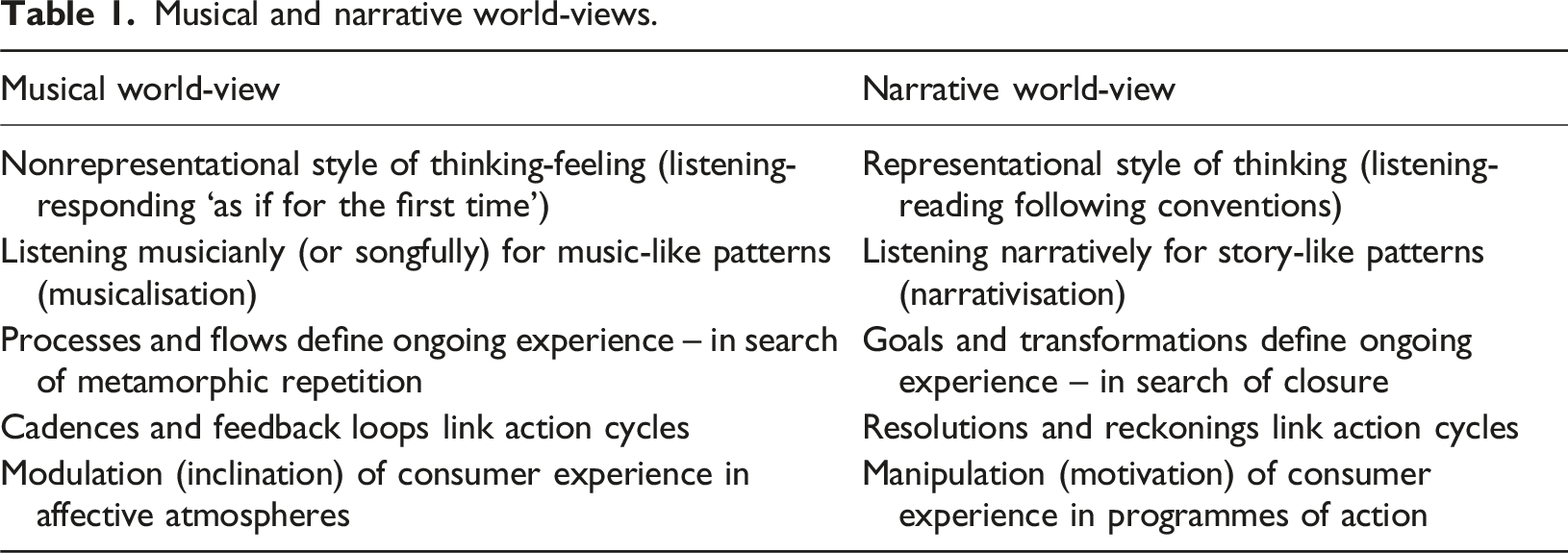
A musical world-view entails a nonrepresentational style of thinking-feeling once it meets Schaeffer’s condition that we listen to things ‘as if for the first time’, liberated from any a priori structures of perception – like hearing a new language and being unable to distinguish words from the mass of sound (Schaeffer, 1966: 284-7). This contrasts with the representational style of thinking which is integral to a narrative world-view: narrative provides conventional structures and generalisable templates which can be used as lenses through which to ‘read’ events and organise biographical experience (Frank, 2009).
Each style of thinking(-feeling) presupposes a different style of listening (to the ongoingness of experience), one of which, attentive to music-like patterns, I have dubbed musicianly (after Schaeffer) or songful (after Kramer); analogously we could speak of narratively listening if someone detects story-like, transformational patterns in ongoing events. Listening musicianly or songfully musicalises objects of perception; listening narratively narrativises them.
The plotlines of stories, however complicated they may be, are ultimately oriented towards goals and transformation (disorder into order, problems into solutions), in search of the quality of experience we often call closure. The musical world-view, on the other hand, grasps experience as an open-ended flow textured by metamorphic repetition – the ‘principle of differing’ that defines cyclical rhythms (Lefebvre, 2004). Emphasising process, it downplays the pauses, halts and cuts that ‘storytellers’ might call beginnings and ends.
Nonetheless, the temporal shape of musical things is still ‘punctuated’. Repetitions of a performance are joined in feedback loops. When someone is practising a piece of music in a class, for example, ‘the teacher’s perception expressed as oral feedback will modulate the student’s performance next time she plays the piece’ (Miranda Medina, 2022: 215). Repetitions within performances are punctuated by expectation-generating cadences, 8 signalling either tensing or relaxing movements. At the end of stories, by contrast, resolutions are expected, and in narrative semiotics they come with a reckoning – a ‘glorifying test’ or ‘sanction’, that is, an evaluation of how well things turned out, which shapes expectations about potential sequels and follow-up tasks.
Narrative subjects are motivated or manipulated – pushed into action by their engagement in programmes of action (plans, projects, missions) and their competentialisation for the goals they want or have to achieve. Modulation is the equivalent performative push that ‘keeps the world rolling over’ (Thrift, 2000: 216) in a musical world-view: experience is modulated when people are inclined to adopt certain dispositions by subtle changes in the affective atmospheres they are in (Jørgensen and Beyes, 2023; Marsh and Śliwa, 2022). My framework shows an equivalence but also a distinction between these two types of performative push. The performativity of manipulation depends on a ‘listening act’ (Srader, 2015) in which the response matches the proposition (recognising one’s place in a narrative schema and the thematic roles of others); modulation’s performativity involves listening acts where ‘the response is essential, more than the proposition’ (Schaeffer, 1966: 699).
If research thrives in a ‘high tension zone’ where traditional representational methods meet nonrepresentational experiments (Coffin and Hill, 2022: 1615), researchers working with a musical-narrative stylistic interplay are well placed to amplify homologous tensions within consumers’ practical understandings of how to go on.
Part Two: Amplifying onflow through modulation and musicalisation
Re-reading narratives of onflow
In the wake of the narrative turn, there is a tendency across social science, politics and the media to treat almost any text as a story. Like Kravets and Karababa (2022) I am uneasy about the general ubiquity of ‘narratives’ and the particular prevalence of storytelling in research presentation. Even among authors working with nonrepresentational and post-qualitative methods (e.g. Gherardi, 2019), indeed even among advocates of sonic epistemologies (e.g. Voegelin, 2024), there is frequently a simple alignment of the narrative with the embodied and the affective; an odd assumption that narrative knowledge frames can act as an antidote to logocentric methodologies and epistemologies. Yet narrative is a representational thinking device based on distance more than proximity and on structure more than complexity and multiplicity (Schönthaler, 2018). Running experiences through stories is unquestionably a powerful sensemaking and sensegiving tool, but there is a risk of overextending and misdirecting the explanatory power of narrative forms, methods and analytics. This danger is especially strong with regard to the affective dimensions of interaction.
Lonergan et al.’s (2022) ‘composite narratives of onflow’ is a good example on which to show both the limits of narrative analysis and its compatibility with a sonic methodology in a dialectical approach, for the reason their paper captures the onflow of experience so well lies less in the narratives themselves than in what a cooperative reader does with them. Rather than just using narratives to present research data, the authors effectively enlist readers to musicalise their stories, which become songful by means of ‘orientation’, ‘attunement’ and ‘immersion’.
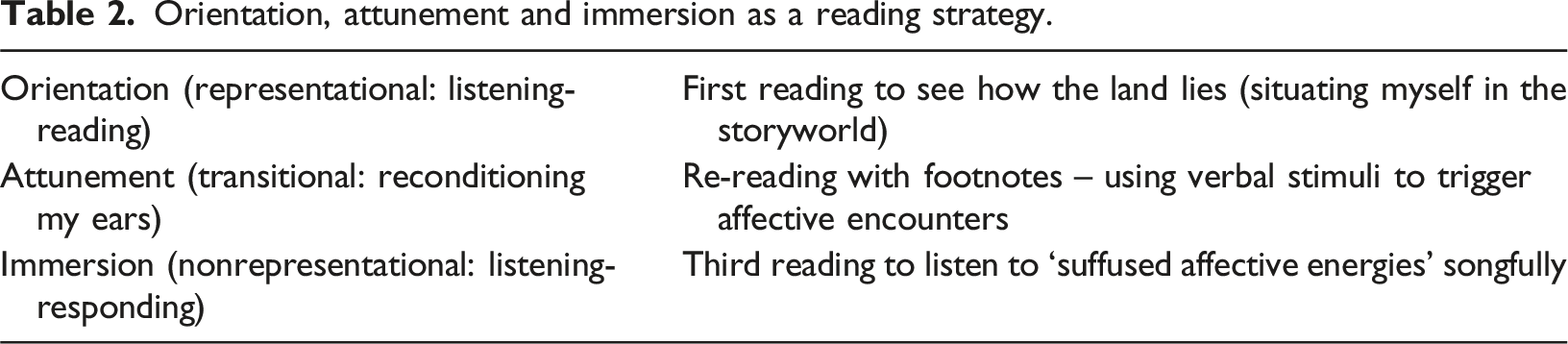
The instructions given to readers are as follows: [W]e recommend a first reading without recourse to the footnotes. This will help the reader to orient themselves to the experience in question. A second reading, in conjunction with the footnotes, will guide the reader and aid in the process of attuning the senses to the affective triggers, amplifiers, conduits, etc. within an otherwise ‘ordinary’ encounter. A final reading, once more without the footnotes should allow the reader to immerse themselves in the affective flow of the experience. (Lonergan et al., 2022: 633)
These are remarkable instructions, for they contravene the linear reading convention which holds that stories lose interest with repeat exposure (the spoiler effect). They are effectively saying: please read these narratives progressively less narratively, progressing from a reading to a sensing culture (Patterson and Larsen, 2019: 108) or from listening-reading to listening-responding. Only then do Lonergan et al.’s readers really open themselves to the flow of affect. The best way to demonstrate this is by describing my own experience as a reader of their paper.
The authors, in collaboration with 25 interviewees from the fashion community, had narrativised memories of encountering Kate Moss’s image for the first time. A cooperative reader engages with the narratives by reading them successively in three different ‘modes’: orientation (in the textworld), attunement (to affective triggers) and immersion (in an affective flow). The first time round I was not a cooperative reader: I only read the stories once and read the footnotes at the same time. When re-reading their paper (nine months later, when revising this text) I followed the authors’ instructions. What did I gain? There’s a line in the first story, just after a kind man has rescued the narrator, their mother and their sister from the crush at a Christmas Eve bus queue: ‘Finally, I could breathe’. When I read this for the third time, in ‘immersion’ mode, it had a physical effect on me: I let out a deep breath, surprised to realise how tense my body had become during the ’disgusting’, ‘nervous’, ‘uneasy’, ‘panicky’, ‘frenzied’, ‘bustling’, ‘smelly’, ‘horrific’, ‘screaming’, ‘purple, red and white’, ‘black and blue’ part of the narrative which that line mercifully (if not definitively) puts an end to. Since I felt this embodied tension only during the third reading, when I already knew how the story goes on, it clearly had nothing to do with narrative suspense. I think it had to do with a loss of semantic meaning produced by repeat reading, and a shift in my attention from the words as they signify action-related or conceptual meanings to the words (such as those adjectives listed above) as they reverberate and resonate. I was experiencing a musical tensing and relaxing as I listened responsively to the affective flow of someone’s experience becoming my experience in that present moment.
Orientation, attunement and immersion as a reading strategy.
Re-reading a COVID-19 vaccination ad
Orientation, attunement and immersion as a research strategy.
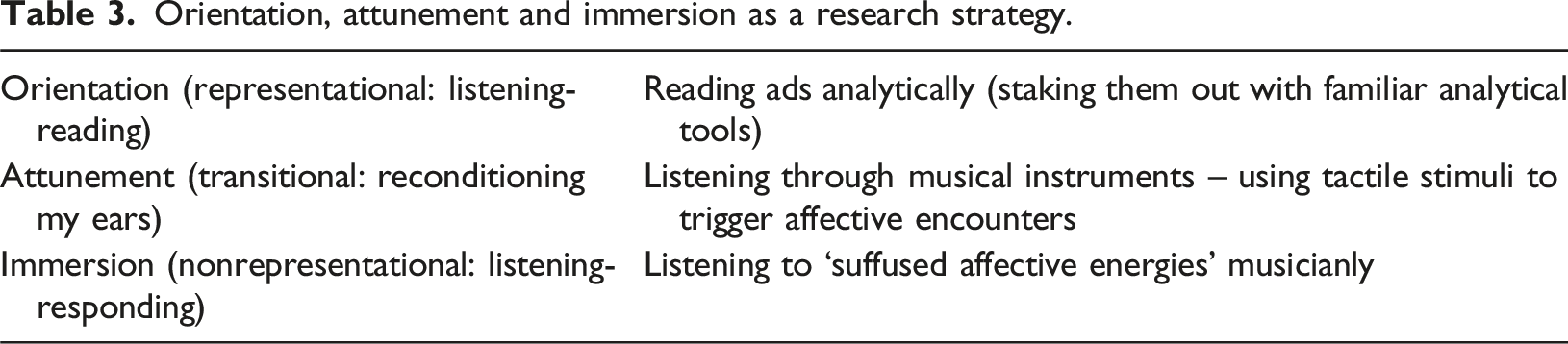
To demonstrate, I will focus on the third ad, made to persuade people to come for recall doses in October 2022, and show how the inherent polemicity of narrative 9 disappeared when I musicalised the text. Described in detail in Appendix 1, the ad begins with the recognition of a familiar threat (‘it’ is returning), followed by three small stories that remind us of the hard times when theatres were empty, schools closed and older people in grave danger. Then we meet a hotelier, who seems to be positioned as a key spokesperson since (until the final invitation to get vaccinated) she is the only actor to speak to camera, and about the future. She voices determination, on behalf of a collective ‘we’, to avoid what went wrong last time (‘we can avoid the most difficult’) before engaging her interlocutor with a resolute stare as she says ‘I never want to close again’. My orientational listening-reading, as a discourse analyst working with narrative semiotics 10 , gave her speech the following sense: first she attributes a skill to a collective actor (‘we can’), then she makes herself the subject of a desire (‘I never want’). She competentialises us and commits herself with respect to a programme of action. The shift from ‘we’ to ‘I’, however, and the attitude her gaze communicates, suggest she speaks not just for but to and perhaps even against a public. For the singular pronoun (which is used for stress in Czech) distances her from the ‘we’ she had just invoked and could be heard as a rebuke to groups whose actions or inactions (not getting vaccinated, not obeying restrictions) might have led to her having to close last time. There are actually three programmes of action in play: the vaccine’s (which ‘just works’), the hotelier’s (wanting not to close again) and a counter-programme imputed to an opponent whose behaviour, by not falling in line with the vaccine’s functional programme, could imperil the hotelier’s goal. The viewer is addressed as an agent whose action or inaction will make a difference to the outcome. As in all polemics, we are asked to choose sides, encouraged to side with people like her – the pandemic’s everyday heroes. This is a common trope in social and political marketing (Preece et al., 2023).
This narrative reading of the scene puts us at the heart of a high-stakes struggle for physical and economic survival. The accompanying music, however, takes the heat out of the struggle by projecting a calmness and evaporating the atmospheric tension with its relaxing cadence 11 . While puzzling over the contrast between narrative tension and musical relaxation, I attuned to the ad’s atmosphere by playing versions of the instrumental background music on a guitar and later recording them to listen back to. I listened back responsively, using an iPad multitrack studio app 12 where I could modulate the listening experience by adding and adjusting sound effects. Stripping words from encounters with objects of consumption and replacing them with tactile mediating devices enabled me to linger in the ad’s atmosphere by exploring what the background music does (to me). The value of the exercise was to suppress a narrative world-view and incline me to listen responsively. I suggest readers pause here to listen with me – to listen to me listening 13 .
The earlier Czech government ads, from December 2020 and April 2021, had dramatised an almost magical transformation ‘infused into the vaccine’. The second ad promised that vaccination would put a ‘full stop’ after coronavirus (Smith, 2026). The challenge for the agency commissioned to make an ad for recall doses, long after the virus should have been ‘full stopped’, was to communicate a meaningful and still motivational temporal shape into being without recourse to the discredited narrative frame used previously. The way the ad deflates this transformation myth parallels reactions against the overblown claims of experiential marketing about how extraordinary experiences can be ‘infused into a product’ (Carù and Cova, 2003: 273) 14 . In the words of its producer 15 , the ad sought ‘to motivate in a quiet moment’ and make time for contemplation. It communicates this re-rhythming of the ‘intensities that flow through and around consumption experiences’ (Lonergan et al., 2022: 624) partly by its soundscape: the cadence of the background music and the intermingled everyday sounds of the human and natural world, like the birdsong in the opening shot. Through multiple playbacks I amplified my affective response to all this by treating my guitar with warm, enveloping sound effects and adding the sound of the dawn chorus, recorded in my garden.
When viewing the final ad again, following this attunement exercise, I could more easily immerse myself in the ad’s suffused affective flows and let them work themselves out through me. In doing so I detected music-like patterns I had not initially appreciated. All the micro-dramas about cultural, educational, business and family life caught up in the pandemic sounded increasingly less dramatic and more like a celebration of low or medium intensity experiences (Bruckner, 2000). I sensed tensing and relaxing motions, perhaps evoking biological rhythms which – the ad implies – we can adjust to. Now that I was listening musicianly, the hotelier’s speech had a new effect on me. If my original narrative reading revealed her commitment (her determination and defiance with respect to those who might threaten the rescue/recovery narrative), I now responded to her as I might to a band-leader prompting the next rehearsal with a call that sounded like ‘one more time, with feeling!’ The sense of heroic performance – synonymous with the romantic roots of experiential consumption in which experience is ideally transformational (Holbrook, 1997) – was replaced by a mundane sense of learning from experience to adjust the next performance, like a rehearsing musician. Heard musically, the ad inscribes the present moment as a simple pause in the flow of events (Cassano, 2001) between repeat performances of ‘the same’.
Part Three: Towards a narrative-musical stylistic interplay
Lonergan et al.’s methodological claim is that narrative fiction allows the expression of affective experience when used ‘to re-presence rather than represent’ (2022: 632) encounters. Situating their work within the linguistic turn, but adopting a ‘more-than-representational’ framework, they explain that ‘writing is used not just to represent affect, but to permit “words into the affective encounter as another part of the event from which a new material experience arises” (Truman, 2016: 137)’ (Lonergan et al., 2022: 630). Then, citing Patterson and Larsen’s article, they claim: ‘Our narratives offer up everyday experience and resonant affective vibrations’ (Lonergan et al., 2022: 632). This tacit integration of the sonic turn within the linguistic and narrative turns is problematic, since it goes against the principle of opposition that underpins each ‘turn’ in the social sciences: the visual turn positioned itself against the linguistic turn (Patterson and Larsen, 2019: 108), and the sonic turn (I suggest) can be constructively opposed to the narrative turn. It is difficult to make narrative accounts, in and of themselves, more-than-representational, vulnerable as they are to the representational danger of reification – to “reproducing a priori discursive concepts” (Hill et al., 2014: 386). As Kravets and Karababa write (in their anti-storytelling zine-style paper) ‘it is hard to escape its structuring, which often sacrifices complexity, multiplicity, and dissonance for a narrative flow’ (2022: 1676). This is partly because the narrative subjectivities that are available to us (for composition or mental rehearsal) are always prefigured by the potentialities inherent in culturally inscribed transformational templates for narrative action (Greimas, 1987: 89). In a sense, the best we can hope to do through stories is to become what we always were, virtually (Landowski, 2004: 67). Like other discourses that work with representational categories, ‘solutions are partly pre-defined by the initial definition of the problem’ (Hill et al., 2014: 382). As a consequence, narrative discourse does not ‘offer up resonant affective vibrations’ without resistance from these categories and templates, since they are templates for resolution – for resolutely and intentionally transforming dissonance into consonance rather than adopting a resonating disposition, ready to be moved in unrehearsed ways; ready to improvise.
If Lonergan et al.’s paper nonetheless succeeds in doing more-than-representational things with words, much of the ‘re-presencing’ work falls to readers of narratives of onflow. The reader is invited to use orientation, attunement and immersion to ‘consider the multiplicity of “things” […] suffusing the atmosphere and constituting the consumption experience’ (2022: 625). Let me reflect on the things which this modulating reading technique enabled me to consider 16 , and specifically how it helped me experience different patterns of becoming by listening to consumption in different styles.
Orientation
The term orientation is used by Lonergan et al. more or less in Labov’s sense of ‘orient[ing] the listener in respect to person, place, time, and behavioral situation’ (Labov and Waletzky, 1997: 32). They wanted me to read the stories initially to stake out the storyworld. Orientation in my Czech data meant applying analytical tools (the ‘grammar’ of narrative semiotics; western tonal rules about musical cadences) which arranged the data according to familiar categories. In both cases, orientation is ‘referential’ – in Labov’s sense of gathering contextual clues, but also in Schaeffer’s sense of taking sounds or other percepts as signifiers referring to event repertoires and/or cultural codes. It is a representational style of processing textual data so that they hold together and divulge a landscape-mapping kind of sense, organised by shared ‘mapping’ conventions.
Attunement
Attunement is a transitional phase in which we recondition our ears to hear the same texts otherwise (Gherardi, 2019). With Lonergan et al., this means a re-reading accompanied by the words of a knowledgeable, attentive witness. Their footnotes read like the fieldnotes of an ethnographic observer annotating an empirical record, moving towards the abstract dimension of thinking and offering intertextual associations that might explain compositional choices by the authors. The footnotes told me what they, as readers of the ‘source’ narratives, were struck by. I used an introspective technique to recondition my ears to my multimodal Czech data by suppressing representational thinking, instead trying to feel the data through my body (to be struck by it), with the aid of instruments (guitar and mixing desk) which incarnate one dimension of my practical knowledgeability. In both cases, attunement uses a familiar device performatively, to devise a novel thinking technique (McCormack, 2015) which can initiate a transition from a representational to a nonrepresentational style of thinking-feeling. Footnotes and musical tools suggest new associations to unsettle the ‘natural’ representations produced by orientation. Leaving what? From a processual perspective, ‘there is always something to attune to’ (Stewart, 2011: 451) in present moments as they pass by, and it often comes down to a sense of something happening (or not), a sense we obtain from the pacing, rhythm or texture of experience rather than from any (narrative) meaning we might be able to read into events.
Immersion
Attunement enables a third, immersed reading. Experiential marketing research, to recall, makes immersion synonymous with escape: consumers immerse themselves in an extraordinary space-time to escape the everyday, like immersion in a good story. Yet Lonergan et al.’s narratives of onflow instigate the opposite of escape when they wrap ‘memorable’ moments in ‘inconsequential’ preambles and epilogues to ‘appreciate the body as one in a constant state of becoming’ (2022: 632); and the Covid vaccine ad, evoking the everyday as a source of ordinary pleasures, readies us for unspectacular repetition as we roll with the (inescapable) next wave of the pandemic. The site of immersion is the everyday, but grasped in its ‘changeability and aliveness’ (ibid.: 636) not its scheduled monotony. Everyday immersion is the passively responsive attitude that nonrepresentational approaches seek to induce so that an investigation can be ‘about how movement and thought think you: about how ideas have you; about how things work you out’ (McCormack, 2015: 102). In sound studies immersion has been defined as a relational practice of ‘listening with’, like listening to songs with birds instead of identifying the songs of birds (Voegelin, 2024: 9). In the same vein, Patterson and Larsen connect immersion with desemanticisation: quoting Cox, they write that it is because ‘sound is immersive and proximal, surrounding and passing through the body’ [Cox, 2011: 148] that the sonic turn ‘dispenses with the notion of sound as “text” [… and] requires a shift from “reading” culture to “sensing” culture’ (2019: 109). This is songful or musicianly listening: my third readings were immersed in the songfulness of a story and the music-like patterns of a multimodal text, gradually materialising as their narrative patterns faded with repetition. A cooperative reader/listener/consumer is not transported to another world but drawn into proximity, without expectations but with the hope of dialogue (Voegelin, 2024) and with the possibility of being affected, as I was when I read – but only when I re-read – Lonergan et al.’s composite narratives of onflow 17 .
The coupling of attunement with everyday immersion finds parallels in the work of organisational scholars and anthropologists interested in atmospheric and affective phenomena. Jørgensen and Beyes (2023), for instance, made it the main plank of their methodology for investigating ‘everyday organisational situations’, and Kathleen Stewart mobilised attunement and immersion to pay ‘analytic attention to the charged atmospheres of everyday life’ (2011: 445). Conscious of the inadequacy of traditional analytical methods to capture atmospheric and other experiential things, I am as reluctant as these nonrepresentational theorists to provide a ‘how to’ guide for my ‘method’. Like John Law, I wish to ‘move away from the idea that research method is a technical (or moralizing) set of procedures that need to be got right in a particular way’ (2004: 143). Nonrepresentational research is ‘never about just taking something off the shelf, about rehearsing something that has already been devised. It’s about making techniques anew, albeit partially, as part of the emergence of the problem’ (McCormack, 2015: 99). I think of the narrative and musical world-views, and the listening techniques I have described (in situ), as activities scoped and tested in the doing. I want to cultivate and communicate styles of research: characteristic ways of ‘going up to’ things (Shotter, 2011: 48).
One can nevertheless perform a retrospective audit by considering what the analysis would have missed out on if it had not ‘gone up’ to something narratively or musically. Lonergan et al. assert that without inviting their interviewees to tell stories they would have been unable to capture ‘the commitment of these people to this cultural icon’ (Lonergan et al., 2022: 629). Commitment, in the sense of quasi-contractual engagement or attachment, is a key currency in the economy of a narrative world-view (Greimas, 1983), so telling stories was an excellent way to bring it to the surface. But without repeat performance the affective vibrations would have been deadened at the point where the reader comes in. It is a narrative-musical relay – a conversion of storyful texts into songful ones via this modulating reading practice – that permits the flow of affect to spill over the boundary of the text. That, at least, was my experience.
If I did not narrativise my Czech data, I would overlook its polemicity, which certainly remains intact as one version of the patterning of experience. But if I did not listen musicianly, I would miss the ad’s tensing/relaxing rhythmic onflow which activates competences for modulation (like those a listener gains by ‘getting to know’ or ‘getting a feel for’ a musical object) to evoke dispositions for cohabitation (‘living with’ the virus). Neither perspective definitively displaces the other but they correct one another, like the background music in the ad corrects the words spoken.
In this paper I have shown how the rhythms and cadences of experiences are not essential properties so much as effects of the way we listen. This carries important insights for consumer culture theory and experiential marketing. When we narrativise experiences (by setting goals and orienting towards transformative projects), we make our experiences feel extraordinary; and when we musicalise experiences (by thinking with the world’s onflowing processuality and letting change happen through metamorphic repetition), we make them feel everyday. By modulating our research style – listening to consumption once, and then again, differently; suspending our ability to read the world the better to respond to it, and then (why not?) going back to re-read it – we can make better sense of how consumers’ sense of ongoingness also fluctuates: how fashion designers’ transformative first encounters with the image of Kate Moss could be mingled with mundane experiences like waiting for a bus; how a vaccine ad could simultaneously enrol me in a polemical struggle over life and death and give me a relaxing sense of confidence that the flow of everyday life goes on; or, indeed, how consumers who seek out extraordinarily painful experiences can do so to ‘suspend their ability to think’ (immersed in a state of flow) and yet re-cognise the experience as a transformative biographical episode (Cova, 2021: 66). An imbrication of transformative and onflowing ongoingness lends each of these consumption experiences a syncretic, polyrhythmic, sometimes disorienting richness, prefiguring marketplace tensions and creating marketing opportunities (which the Covid vaccine ad cleverly exploits with its incongruent words and music). But reflexive awareness of these fluctuations constitutes a powerful epistemological strategy since we can run our thoughts (and feelings) through them to amplify different patterns of becoming available in any experience.
Coda
Running thoughts through music is commonplace. Back (2023) interviewed 28 sociologists who admit doing it, mostly as amateur musicians like me. Yet, almost without exception, this activity leaves no trace in their writing, as if – in sharp contrast to narrative sensemaking –it was an illegitimate way of knowing the world, unscientific or simply unreportable 18 . Advertisers have no such qualms. They know that people run thoughts through music and have learned to combine stories and music in search of a wide range of sense effects. The case for adopting a musical world-view as a research style can therefore be made in the name of both accountability (acknowledging the existence and performativity of knowledge practices that many of us already do, but judge it prudent to keep quiet about) and commensurability (‘going where the thinking goes on’ and adjusting our methods to semiotic styles through which advertisers and consumers interact).
Patterson and Larsen proposed a sonic turn to encourage marketing researchers to find out how consumption sounds. It is an ontological shape-shift in which beings become ‘resonances and reverberations […] rather than hermetically sealed individuals’ (Patterson and Larsen, 2019: 112, 111) and an epistemological one in which ‘sound […] mak[es] evident the continuity and discontinuity of our subjectivity’ (ibid.: 113). The words used to capture how ‘sounds change us’ – reorientation, recalibration, attunement and resonance – evoke a process-orientation, but Patterson and Larsen did not make the particular kind of processuality associated with a musical world-view a distinctive feature of the sonic turn. To do so sets up a constructive opposition with the narrative turn, and their interplay affords a dialectical understanding of how contrasting arrangements of ongoingness are communicated into being in ‘the constant unfolding of consumer experiences’ (Lonergan et al., 2022: 624). This stylistic interplay is where things get more-than-representational in the both… and… sense ‘that nonrepresentational work should occur in conjunction with representational lines of research’ (Hill et al., 2014: 390) 19 . Affiliation to a new turn does not have to mean repudiation of a previous one: it is by alternating world-views that we hear things we might not otherwise hear and have to account for hearing them by consciously turning towards them.
Supplemental Material
Supplemental Material - Running thoughts through music. A musical inflection of the sonic turn in consumer research
Supplemental Material for Running thoughts through music. A musical inflection of the sonic turn in consumer research by Simon Smith in Marketing Theory
Footnotes
Acknowledgements
I would like to thank Boris Brummans and six anonymous reviewers for their constructive responses to one or more of the modulations this paper has taken form through.

Funding
The authors disclosed receipt of the following financial support for the research, authorship, and/or publication of this article: This work was supported by the NPO “Systemic Risk Institute”, Grant no. LX22NPO5101, under Programme EXCELES (Czech Ministry of Education, Youth and Sports), funded by the European Union — NextGenerationEU.
Declaration of conflicting interests
The authors declared no potential conflicts of interest with respect to the research, authorship, and/or publication of this article.
Supplemental Material
Supplemental material for this article is available online.
Notes
References
Supplementary Material
Please find the following supplemental material available below.
For Open Access articles published under a Creative Commons License, all supplemental material carries the same license as the article it is associated with.
For non-Open Access articles published, all supplemental material carries a non-exclusive license, and permission requests for re-use of supplemental material or any part of supplemental material shall be sent directly to the copyright owner as specified in the copyright notice associated with the article.
