



Abstract
The cultivation of pleasurable atmospheres is important for revitalising the UK’s high streets. However, existing literature cautions atmospheres are challenging to research, especially when adopting more ‘traditional’ or representational methods alone, since atmospheres are dynamic and intangible. Such difficulties are conceivably heightened within the complex environment of the high street. Surprisingly, however, there is a paucity of practical advice about how to address such challenges and effectively research place atmospheres. The paper draws on a scoping literature review, fieldwork, and two walking tours of a UK high street to trial six creative and sensory methods. We reveal the emotional, practical, and embodied dynamics involved in using such ‘alternative’ methods through three themes: Methodological (dis)comfort zones, Weathering methods, and Attuning in/out of place. Ultimately, the paper contributes to non-representational theory by demonstrating the value of combining non-representational and representational methods to research atmospheres on the high street and other places.
Keywords
Introduction
Academic interest in atmosphere – how a place feels – is intensifying (Steadman and Coffin, 2024); however, scholars have cautioned atmospheres can be challenging to empirically research (Anderson and Ash, 2015; Michels, 2015; Sumartojo, 2024). Atmospheres are unstable and amorphous, ebbing and flowing across times and spaces, fluctuating in affective intensity and tone, sometimes oozing and bleeding into one another (Steadman et al., 2021). Atmospheres are ‘never finished, static or at rest’ (Anderson, 2009: 79). They cannot be so easily seen or grasped as other more tangible phenomena, since ‘...an ambiance has no outline, no clearly defined shape, no exact limits’ (Thibaud, 2014: 50). Much like trying to capture flowing water in a sieve, therefore, atmospheres can be difficult to pin down.
More conventional methods have been used to study atmospheres, including experiments (Turley and Milliman, 2000), interviews (Hill et al., 2022; Steadman et al., 2021; Wilkinson and Wilkinson, 2024), and participant observation (ibid). Others, however, are beginning to deploy more creative and innovative techniques, such as poetry (Preece et al., 2022), drawing (Hawkins, 2015), onflow accounts (Lonergan et al., 2022), sensory (Steadman, 2024), and biosensing methods (Paiva et al., 2023). This reflects growing use of creative methods in consumer research more broadly (Coffin and Hill, 2022) as a means of accessing and communicating affective, embodied, and vulnerable experiences, and engaging diverse audiences as pathways to real-world impact (Pottinger et al., 2021). There is limited practical or accessible advice, however, about effective methods for researching atmospheres and existing accounts can be frustratingly opaque (e.g. McCormack, 2015; Stewart, 2011). As Pink et al. (2014: 362) thus contend, ‘there has been surprisingly little discussion about how the theoretical urge to put atmospheres at the centre… might be combined with research techniques’.
One context requiring further research into atmosphere are UK high streets (or main streets), which are facing competition from out-of-town retailing, online shopping, economic crises, and the aftershocks of COVID-19 (Ntounis et al., 2023). The experiential is important for revitalising struggling high streets (White et al., 2023), meaning those managing them require more guidance about interventions to enhance atmospheric experience, alongside how to measure their impacts (Howcroft et al., 2025). The methodological challenges raised above, however, are conceivably exacerbated on the high street, as consumers interact with a complex array of indoor and outdoor spaces: shops, markets, hospitality, healthcare, housing, workspaces, leisure and entertainment. Further advice is therefore needed about effective methods for researching atmospheres, particularly on the high street.
Subsequently, the authors and 10 participants trialled six creative and sensory methods on a UK high street to address the following research question: Which methods are most effective for researching high street atmospheres? In exploring this question, the paper contributes to non-representational theory – an approach associated with accessing the nebulous concept of atmosphere (Buser, 2014; Hill et al., 2014). Non-representational research enlivens ‘...the ephemeral, the fleeting, and the not-quite-graspable’ (Vannini, 2015a: 6) by animating rather than mimicking, rupturing rather than accounting, evoking rather than simply reporting (Vannini, 2015b: 318). However, there remain ‘many unanswered methodological questions’ (Vannini, 2015a: 2) about how to translate non-representational theory into research practice, since it is ‘difficult to actualise on the ground’ (Torrens, 2024: 265). By revealing the value in combining representational and non-representational methods, we thus offer more practical insights into researching (high street) atmospheres.
Non-representational approaches
Non-representational thinking is considered useful for researching atmosphere (Buser, 2014; Goulding, 2023; Hill et al., 2014), which has been described as a ‘strange class of non-representational thing’ (Anderson and Ash, 2015: 37). Non-representational theory emerged in the late-1990s to challenge representational styles of research (Thrift, 2007) which positioned persons as reflexive agents (Hill et al., 2014) and was thought to be overly static and concerned with revealing hidden meaning (Anderson and Harrison, 2011; Lorimer, 2005). Although deriving from the work of Nigel Thrift (2007) in human geography, discussions about non-representational theory have since spread to marketing theory (e.g. Coffin and Hill, 2022; Hill et al., 2014; Lonergan et al., 2022).
Whilst non-representational theory originated as a ‘mosaic of theoretical ideas’ (Vannini, 2015a: 3), it ‘reached for methods later’ (Torrens, 2024: 265) with a ‘quest for non-representational methodologies’ (Vannini, 2015a: 2) now underway. Despite challenges of ‘putting NRT ideas into empirical service’ (Torrens, 2024: 265), non-representational approaches seek to enliven the fleeting, embodied, sensory, affective, non-discursive, and pre-cognitive features of life (Hill et al., 2014; Vannini, 2015b), and some methods are arguably especially suitable for doing so. One way of achieving this is by attending to the ‘onflow of the everyday’ (Hill et al., 2014), as Lonergan et al. (2022) did to study consumers’ first encounters with model Kate Moss. They present three onflow accounts evoking the affective ‘...intensities that flow through and around consumption experiences’ (Lonergan et al., 2022: 624). This practically involved splicing narrative interviews into semi-fictive narratives of people’s first encounters with Moss, creatively combined with footnotes to attune readers to the affective forces and atmospheres surrounding these encounters (ibid).
Key findings from literature review.
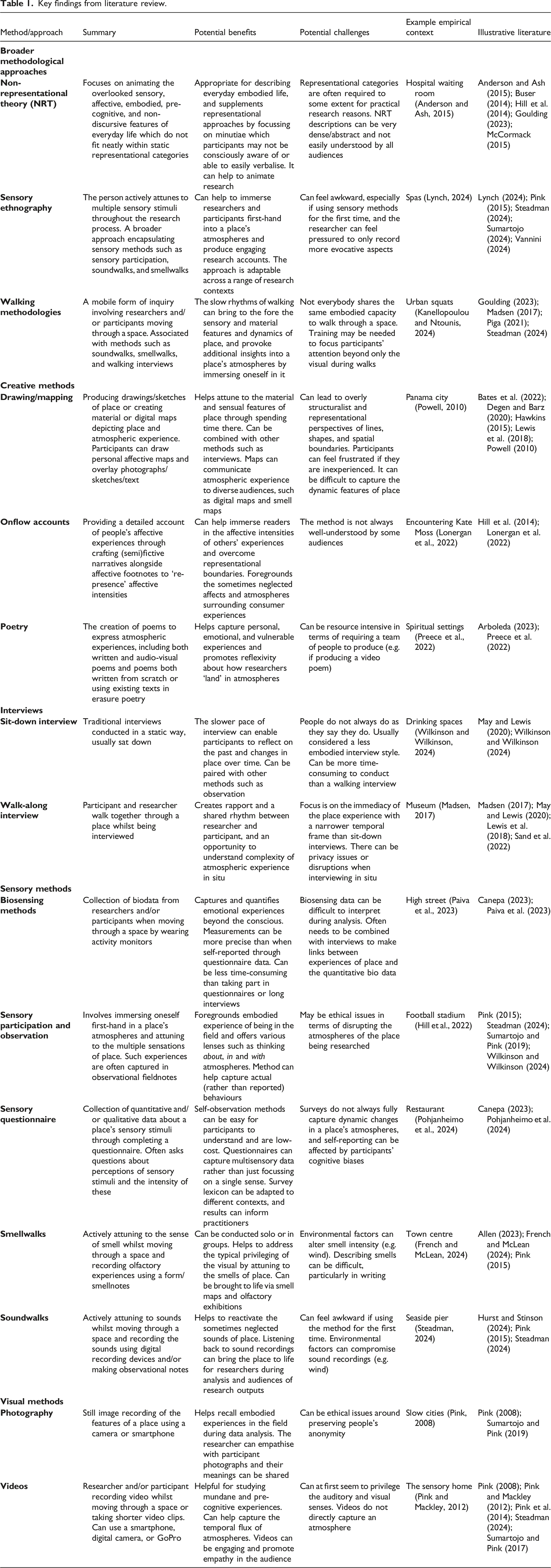
Collecting data about atmospheres
Sensory participation and observation
Sensory ethnography is considered effective for studying atmospheres, from spas (Lynch, 2024) to seaside piers (Steadman, 2024). This broader methodological approach ‘...involves the researcher self-consciously and reflexively attending to the senses throughout the research process’ (Pink, 2015: 7). Sensory ethnographers become ‘sensory apprentices’ (Pink, 2015) by attuning to multiple senses in knowledge production (Vannini, 2024). This approach is thus useful for first-hand immersion into a place’s sensuous atmospheres (Lynch, 2024; Steadman, 2024) and one route to this is through deploying observational methods.
Observational methods enable researchers to develop a ‘thick description of atmospheric experiences’ (Hill et al., 2022: 123) and observe people’s actual rather than reported behaviours (Wilkinson and Wilkinson, 2024). By researching in atmosphere (Sumartojo and Pink, 2019), participant observation attends to how atmospheres are constituted and experienced given ‘...atmosphere is something that we are in the flow of, rather than something that we are researching from the outside’ (Sumartojo and Pink, 2019: 36). Within sensory ethnography a multisensory orientation to doing observation is explicitly adopted, with this method termed ‘sensory participation’ in this context (Pink, 2015). It involves interacting with the environment using all the senses through direct immersion in place and typically recording data through sensuous fieldnotes. Subsequently, this technique has been deployed to investigate the atmospheres of football stadia (Hill et al., 2022; Steadman et al., 2021), drinking spaces (Wilkinson and Wilkinson, 2024), cities (Kanellopoulou and Ntounis, 2024; Lobo et al., 2020), and seaside piers (Steadman, 2024).
In practice, however, observational methods are often combined with other techniques. For instance, Hill et al. (2022) observed the atmospheres of Liverpool FC matches, alongside adopting interviews, netnography, photography, videos, and archival methods. Similarly, Wilkinson and Wilkinson (2024) combined observation with interviews to explore the human and non-human influences shaping drinking atmospheres, such as people’s embodied interactions with candlelight, smells, music, pool tables, and drink glasses. Sensory participation thus encourages us to ‘...make ourselves available to our surroundings’ (Thibaud, 2014: 52) and acknowledge the ways we both shape and are shaped by place through one’s ‘own emplacement in other people’s worlds’ (Pink, 2015: 97).
Soundwalks and smellwalks
Although not everyone shares the same embodied capacity to walk (Rose, 2020), and persons can focus too much attention on the visual when doing so (Piga, 2021), walking enables researchers and/or participants to understand atmospheres through direct sensory experience (Madsen, 2017; Steadman, 2024). Whether moving through drinking spaces (Wilkinson and Wilkinson, 2024), cities (Kanellopoulou and Ntounis, 2024), or football stadia (Steadman et al., 2021), walking methodologies are therefore considered fruitful for researching atmospheres (Goulding, 2023; Madsen, 2017; Piga, 2021).
Following broader attempts to shift emphasis away from the visual in qualitative inquiry by foregrounding neglected sensory modalities (Patterson and Larsen, 2019), soundwalks involve moving through an environment listening intently to the sounds and recording them through sound recordings, fieldnotes, and/or a soundwalk form (Steadman, 2024). To demonstrate, Steadman and Millington (2025) deployed soundwalks to attune to the atmospheres of a seaside pier, as well as taking shorter soundclips of anything delivering a particularly potent atmospheric charge (e.g. crashing waves). Moreover, Hurst and Stinson (2024) layered sound recordings with fieldnotes, poetry, and visuals to creatively communicate the atmosphere of Niagara Falls. Soundwalks are thus valuable for reactivating the sounds of place which can be neglected, whilst playing back sound recordings can bring the place to life (Hall et al., 2008).
Likewise, smellwalks involve moving through an environment attending to the ‘background’ (constant smells), ‘episodic’ (characteristic smells), and ‘short-lived’ (transient smells) odours of place. It involves ‘catching’ a smell and following it or using the other senses to ‘hunt’ down a particular smell and recording these smells using written or digital ‘smellnotes’ (Allen, 2023; French and McLean, 2024; Perkins and McLean, 2020). Smellwalks can be undertaken alone as a ‘smelfie’, as a group, or a buddy walk led by a local place expert (Perkins and McLean, 2020). Allen (2023), for instance, conducted ‘smelfies’ to sense the changing smells of a New Zealand town during COVID-19. Whilst it is difficult to communicate smells through text (Allen, 2023; Pink, 2015), olfactory exhibitions (French and McLean, 2024) or smell maps (French and McLean, 2024; Perkins and McLean, 2020) can be created. Smellwalks are therefore useful for foregrounding a fleeting sensory modality and refocussing ‘...attention onto our noses against our eyes’ (Perkins and McLean, 2020: 171).
Sit-down and walking interviews
Although people do not always do as they say (Wilkinson and Wilkinson, 2024), interviews can provoke a ‘sensory a-where-ness’ (Sand et al., 2022: 597) by accessing rich emic descriptions of atmospheric experience (Hill et al., 2014). Despite suggestions sit-down interviews can be overly static and disconnected from everyday experience, their slower pace can enable reflections of past embodied experiences and how places change over time (May and Lewis, 2020). Interview discussions about a place’s atmosphere can thus extend beyond the interview location to what may be recalled (ibid). For example, Wilkinson and Wilkinson (2024) conducted interviews with young people about the atmospheres of drinking spaces they had previously encountered. Yet some have turned away from the sit-down interview in favour of more mobile techniques such as ‘walk-alongs’, which access the immediacy of place experience (May and Lewis, 2020). Walk-along interviews help researchers to build familiarity with a place, experience shared rhythms with participants (Lewis et al., 2018; Madsen, 2017), and more fully appreciate a place’s sensory and emotional feel first-hand (Sand et al., 2022), with Madsen (2017) using walk-along interviews to understand the complexity of atmospheric experiences in a museum.
Sensory walk questionnaires
Although qualitative methods are more commonly used to research atmospheric experience, sensory questionnaires can be deployed to collect both quantitative and qualitative data about perceptions and intensities of a place’s atmospheric stimuli, including when walking through those spaces. Pohjanheimo et al. (2024), for example, used a sensory walk questionnaire to measure people’s sensory experiences of a restaurant, including the perceived intensity of different sensory stimuli and people’s hedonic perceptions. Benefits of questionnaires include their capacity to capture multisensory data rather than focussing on a single sense, and survey lexicon can be adapted to different audiences (ibid). Additionally, self-reporting methods can be low-cost and easy for participants to understand (Canepa, 2023). However, questionnaires ordinarily capture data at a single point in time, rather than fully reflecting changes in atmospheres (Pohjanheimo et al., 2024). Sensory questionnaires can thus be usefully paired with other methods, with Canepa (2023) combining an online questionnaire with neuroscientific data collected through finger electrodes to understand atmospheric experiences in a virtual reality corridor with fluctuating lighting levels.
Photographs and videos
Photographs and videos are valuable for accessing the ‘invisible’ within everyday life, such as atmosphere (Pink, 2008; Pink and Mackley, 2012; Pink et al., 2014; Sumartojo and Pink, 2017), and photographs are commonly taken during observational work (e.g. Hill et al., 2022; Steadman et al., 2021). Meanwhile, videos can access people’s pre-cognitive embodied encounters by recording the moment affect ‘impinges on the body’ (Hill et al., 2014: 389). To illustrate, Hill et al. (2022) undertook ‘audiencing interviews’ with Liverpool FC supporters, which involves playing video footage of a consumer experience during an interview to elicit embodied reminders of – and discussions about – the original encounter; in this case, atmospheres at Anfield Stadium. Others have walked with video to detect a space’s shifting atmospheres, whether using a smartphone along a seaside pier (Steadman, 2024) or wearing GoPros through commemorative events (Sumartojo and Pink, 2017). Whereas Pink and Mackley (2012) created video tours to understand how participants manipulated the sensory home to create an atmosphere that felt ‘right’. Rather than directly capturing an atmosphere, videos thus record the trace of a moving body through an atmosphere (Pink et al., 2014; Sumartojo and Pink, 2017). Subsequently, whilst photos and videos initially appear to privilege the audio-visual, they can stimulate embodied reminders of being in the field (Pink, 2008), enable persons to gain insights into their own sensing body from an alternative perspective, and encourage viewers to imagine others’ multisensory experiences (Pink and Mackley, 2012, Pink et al., 2014). Sumartojo (2024: 170) thus considers visual materials as ‘something that can go forward’.
Drawing and mapping
Drawing can be used as a standalone method or in conjunction with mapping techniques (e.g. Degen and Barz, 2020; Lewis et al., 2018), such as drawing personal maps and/or overlaying photographs, sketches, and text to depict atmospheric experiences of place. It can be undertaken alone, alongside an expert (Hawkins, 2015), or as part of a ‘sketchcrawl’ group (Heath and Chapman, 2020). Drawing can feel daunting for those who perceive they lack ‘artistic’ skills (Hawkins, 2015; Heath and Chapman, 2020) and might also lead to overly representational perspectives of space (Bates et al., 2022). However, the need to slow down and remain in the same place for extended periods attunes the drawer to the material and sensual features of place, and encourages them to take note of what might usually be overlooked when using more ‘traditional’ methods (Hawkins, 2015; Heath and Chapman, 2020; Lewis et al., 2018; Powell, 2010). For example, Hawkins (2015: 255) found the ‘still process of sensing’ when drawing in place engaged her body and senses which led to heightened ‘sensitivity towards experiences and affective atmospheres’. Maps are further useful for disseminating research about people’s atmospheric experiences, including through digital maps (Degen and Barz, 2020), static and dynamic smell maps (French and McLean, 2024; Perkins and McLean, 2020; see Sensory Maps, 2025).
Poetry
Poetry is becoming more widely used in marketing. Poems are performed at the Consumer Culture Theory Conference and the International Place Branding Association Conference art gallery. Poems regularly feature in the Journal of Customer Behaviour and there is a special issue of Consumption Markets & Culture titled ‘Poetics of Consumption’. Furthermore, there is work encouraging greater use of poetry in the field, such as Canniford (2012) who guides readers through processes of ‘poetic transcription’ (creation of poems from the creatively reconstructed words of participants), and ‘poetic translation’ (imaginatively expressing interactions between the human and non-human). Poetry enables persons to communicate emotional, affective, sensory, embodied, and vulnerable experiences (Canniford, 2012; Downey and Sherry, 2023; Preece et al., 2022) and has therefore been deemed useful for researching atmospheres and being reflexive about how researchers affect –and are affected by – atmospheres (Preece et al., 2022). Hence, Preece et al. (2022) provide written and audio(visual) poems to demonstrate how they ‘landed’ within the unfamiliar atmospheres of spiritual settings. Similarly, Arboleda (2023) co-created a videopoem to express the changing feel of tourist spaces in the low season (see videopoem here).
Analysing and representing atmospheres
Whilst there is a paucity of advice about analysing atmospheres, there has been some discussion about analysing sensory experience more broadly (Pink, 2015). Indeed, atmospheres themselves are intimately connected with sensory experience, given ‘atmosphere folds together affect, emotion and sensation in space’ (Edensor, 2015: 83). And, as previously noted, non-representational research is highly attuned to sensory experience, with such researchers often engaging in sensuous scholarship (Vannini, 2015b). Although analysis also occurs in the field, the analytical process of connecting experience to broader theoretical discussion typically involves sensorial (re)engagement with research materials (Pink, 2015). For instance, Steadman and Millington’s (2025) research into the atmospheres of a seaside pier involved revisiting fieldnotes, photographs, videos, and sound recordings during analysis to become re-immersed in the multisensory qualities of the pier’s atmospheres. Furthermore, the Western-centric sensorium of sight, sound, smell, taste, and touch can provide useful analytic categories (Pink, 2015), with Nowosielski and Nowosielska (2020) interpreting focus groups about the changing atmosphere of a Polish high street in relation to its ‘touchscape’, ‘seescape’, ‘soundscape’, and ‘smellscape’.
Following analysis, however, it can be difficult to represent atmospheres (Hill et al., 2014). Written text might seem overly representational by fixing down entities in flux and non-representational scholarship has thus been described as non- or more-than-textual (Lorimer, 2005). As Coffin and Hill (2022: 1614) reflect, words can seem like ‘wrought iron, too staid and structured in their black bar lines’. Yet the most common way of disseminating academic research remains through writing (Dewsbury, 2010) which helps connect experience and theory in dialogue (Pink, 2015). The task, therefore, is to ‘produce affect rather than simply describe it’ (Lonergan et al., 2022: 634) and make research ‘dance a little more’ (Vannini, 2015a: 14), whereby ‘writing differently may be enough’ (Coffin and Hill, 2022: 1622). Some have thus deployed sensuous description to ‘make people feel something’ (Vannini, 2024: 12), such as Edensor’s (2013: 455) atmospheric encounters with darkness in Galloway Forest Dark Sky Park, who describes how: ‘The night sky changes with the variable patterns of stars and the changing levels of light bestowed by the falling and rising sun… the infinite, dispassionate play of innumerable stars and galaxies’.
Sensuous writing has been further combined with photographs and audio-visual clips (e.g. Hurst and Stinson, 2024; Preece et al., 2022), whilst others have experimented with more-than-representational and non-textual modes of dissemination to ‘show’ rather than ‘tell’ audiences about an experience (Vannini, 2024). For example, French and McLean (2024) take readers through the creation of the Two Centuries of Stink exhibition to communicate the changing olfactory atmospheres of the town of Widnes, UK, which involved designing visual peg boards, smellboxes, dynamic smellmaps, and interactive visitor QR codes. Phillip and April Vannini have even created a four-part documentary series called Underwater Hotels streaming on Amazon Prime based on their sensory ethnography of these sensorially unfamiliar watery places (Prime Video, 2025). These creative and experimental modes of representation therefore ‘...evoke the corporeal and experiential feeling of being there’ (Pink, 2015: 164; original emphasis) in sensuous atmospheres.
Consequently, whilst existing literature identifies a series of methods which can be used to study atmospheres, discussion can be overly abstract with a paucity of accessible insights. Relatedly, the practical realities of combining representational and non-representational methods have been overlooked. It is also unclear which of the above methods are most effective for studying atmospheres on the high street. We address this through a study into researching high street atmospheres.
Research design
Scoping literature review
To answer our research question and inform fieldwork we conducted a scoping literature review, following past high streets research (Ntounis et al., 2023). Using Scopus and Google Scholar, we deployed a series of search terms such as ‘place atmospher*’ AND ‘method*’ and ‘affective atmospher*’ AND ‘method*’, reflexively tuning terms based on search results. This was supplemented by adding any relevant literature read for prior projects, alongside searching ‘atmosphere’ directly on qualitative journals (e.g. Qualitative Research). The last search was conducted in April 2024. Relevant articles were uploaded onto Covidence literature review software, initially generating 75 articles. First, both authors independently reviewed all article titles and abstracts and rated them as ‘yes/maybe/no’ in terms of their relevance to our research question, which led to 70 articles. Second, if any ambiguity existed over the article’s relevance from the abstract, both authors independently read through the main text to decide whether it should be included. Articles not methodological in focus or related enough to atmosphere were excluded. Third, the remaining 43 articles were split in half between the authors to read in full, with key findings recorded on a literature review template (Figure 1), which both authors read through to write this paper and make fieldwork decisions. Literature review template.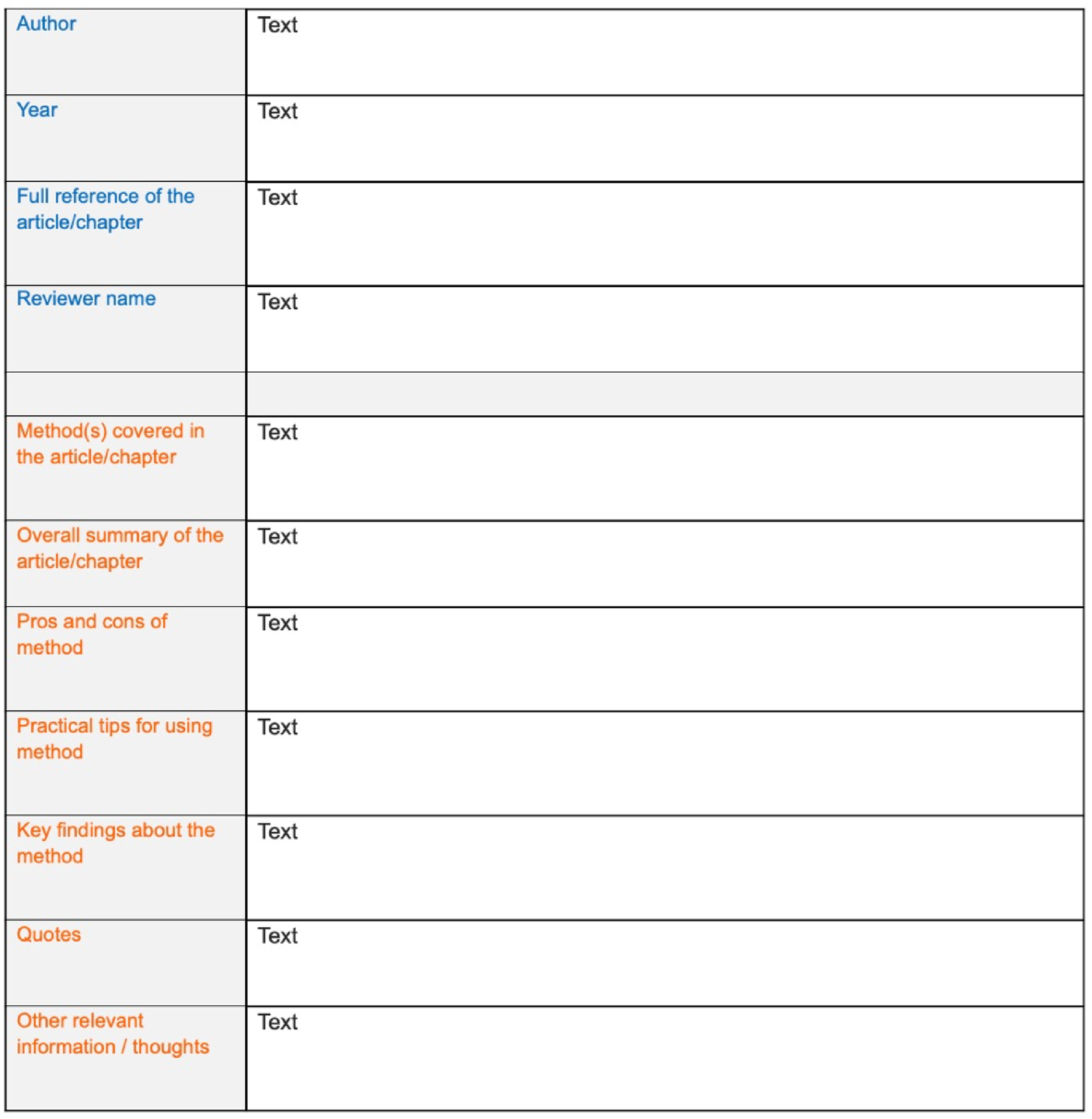
Fieldwork and methodological diaries
Based on learnings from the scoping review, six methods deemed particularly effective for researching atmospheres were selected for use whilst walking along Altrincham high street in Greater Manchester – accessible to both authors and a past winner of the Great British High Street Award having undergone significant regeneration. The chosen methods include: drawing/mapping, photography, poetry, sensory participation, smellwalk, and soundwalk. During summer 2024, both authors trialed each method once whilst walking through Altrincham high street, spanning different days, times, and weather conditions. We each visited the high street eight times including fieldwork and walking tours, with our walking route each time mirroring that taken by participants. Some modifications were made to methods based on our university’s ethical review process, such as using disposable cameras rather than smartphones, which we return to in the conclusions. Moreover, we both kept a research diary throughout the project reflecting on our methodological experiences.
Walking tours and group discussions
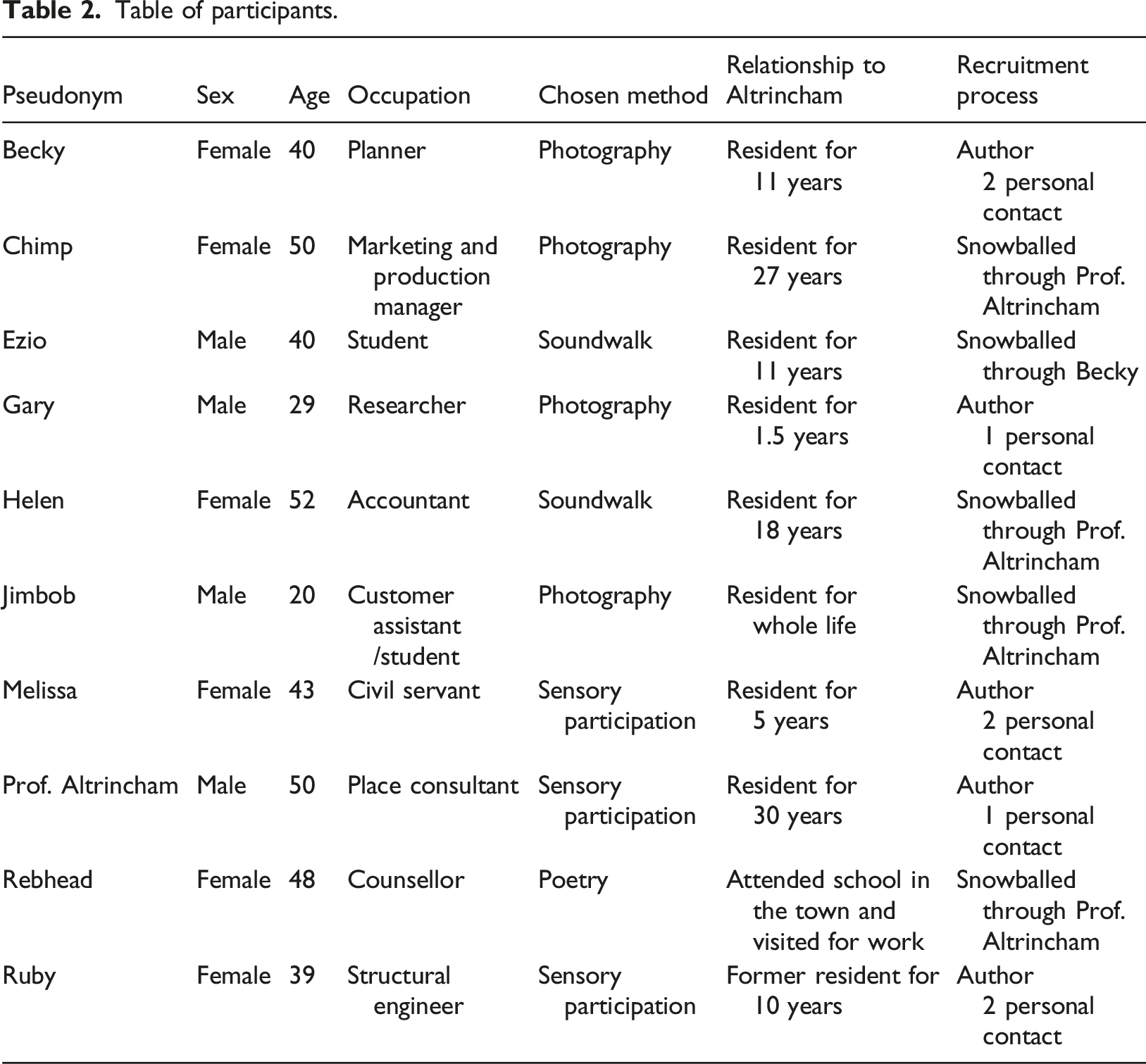
Table of participants.
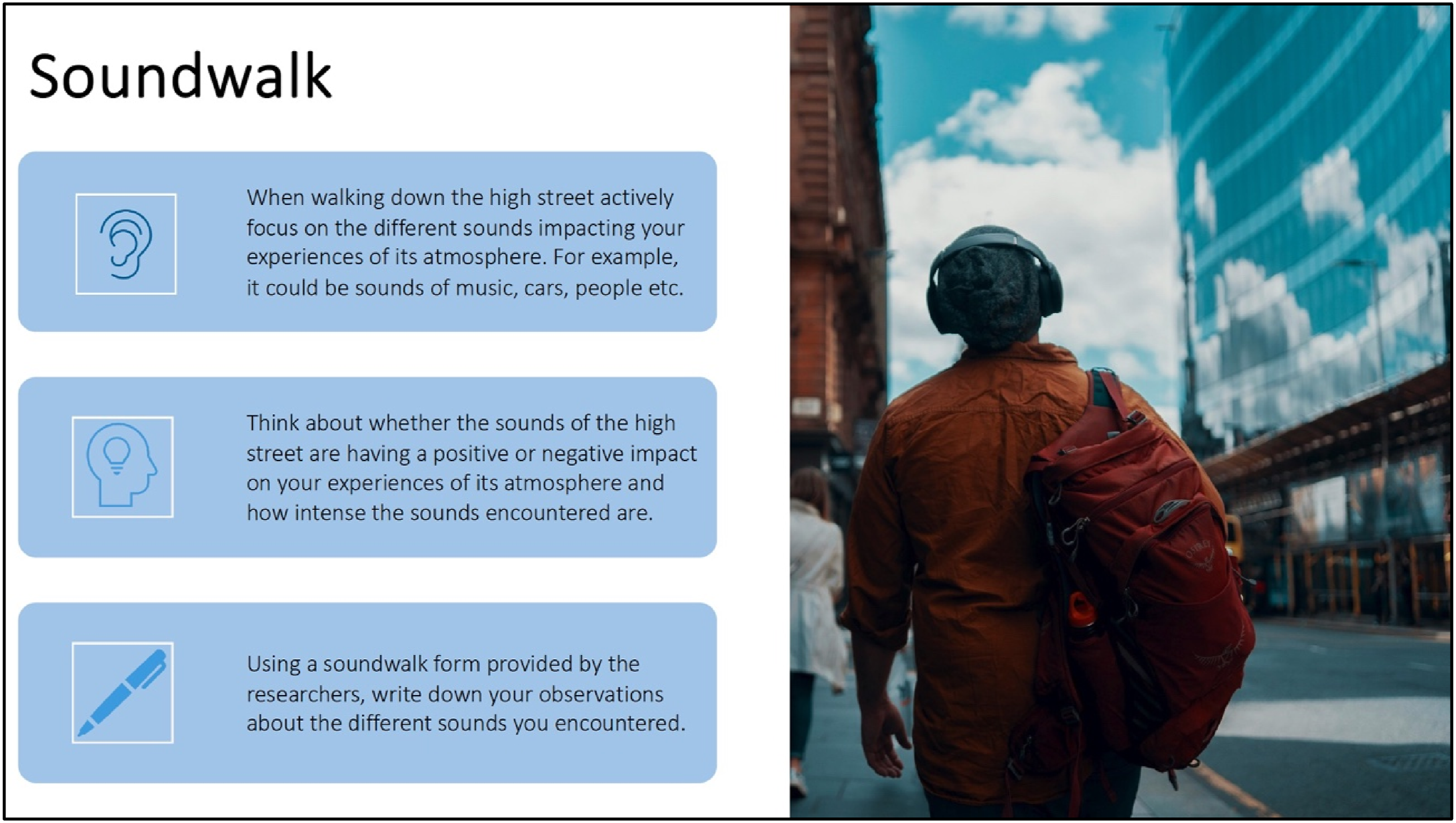
Page from Brochure of methods.
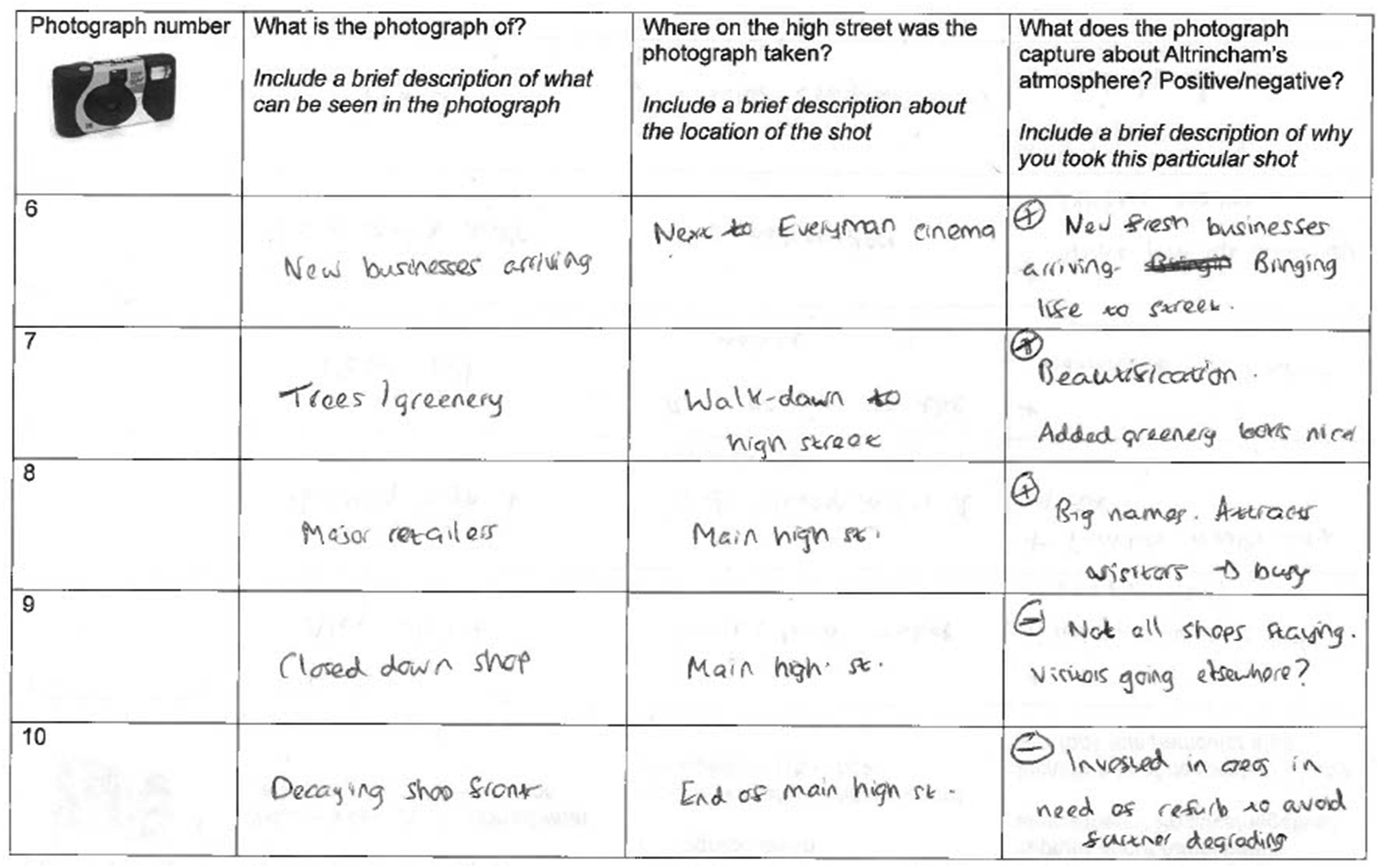
Jimbob’s photography form.
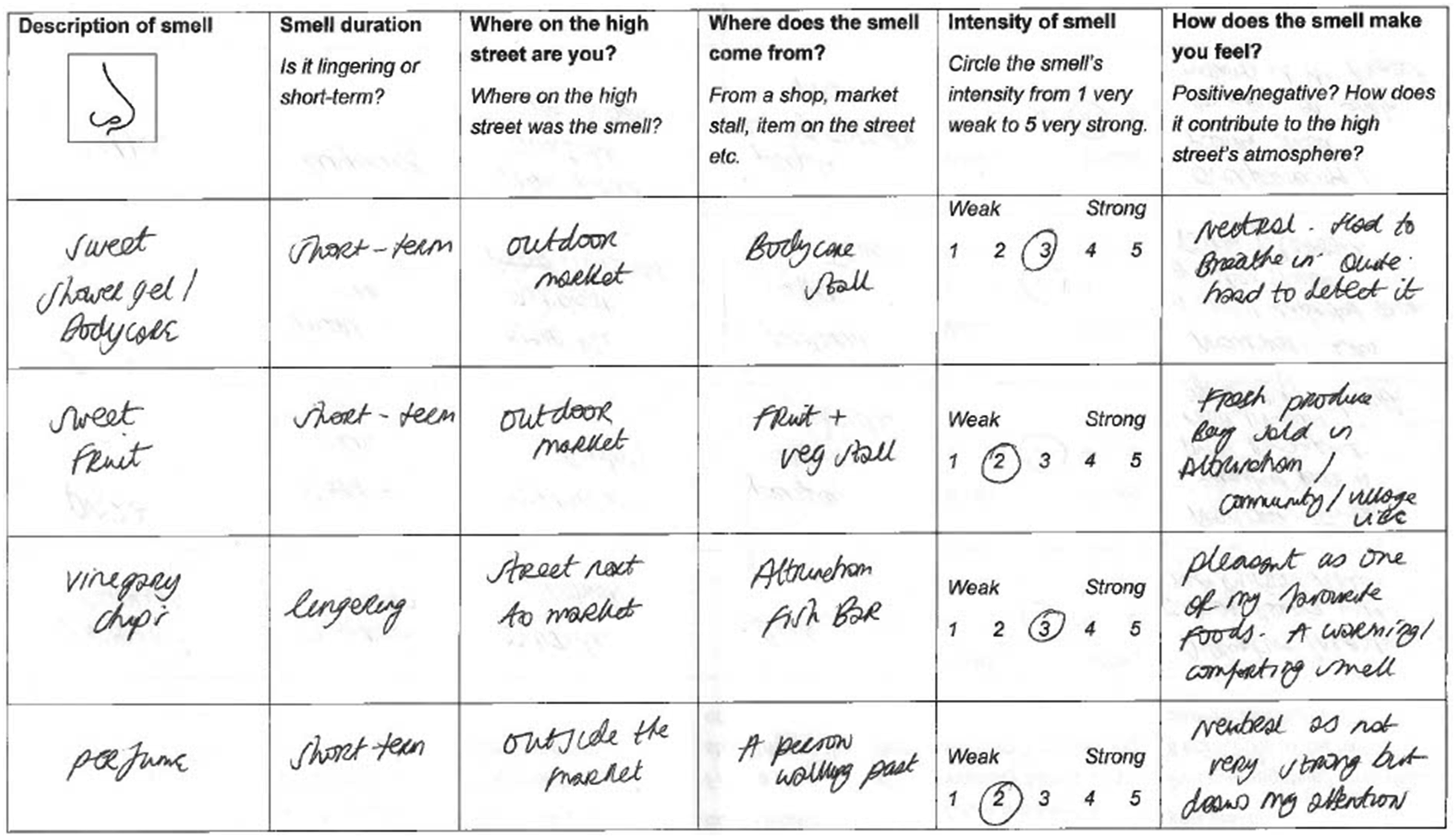
Author 1’s smellwalk form.
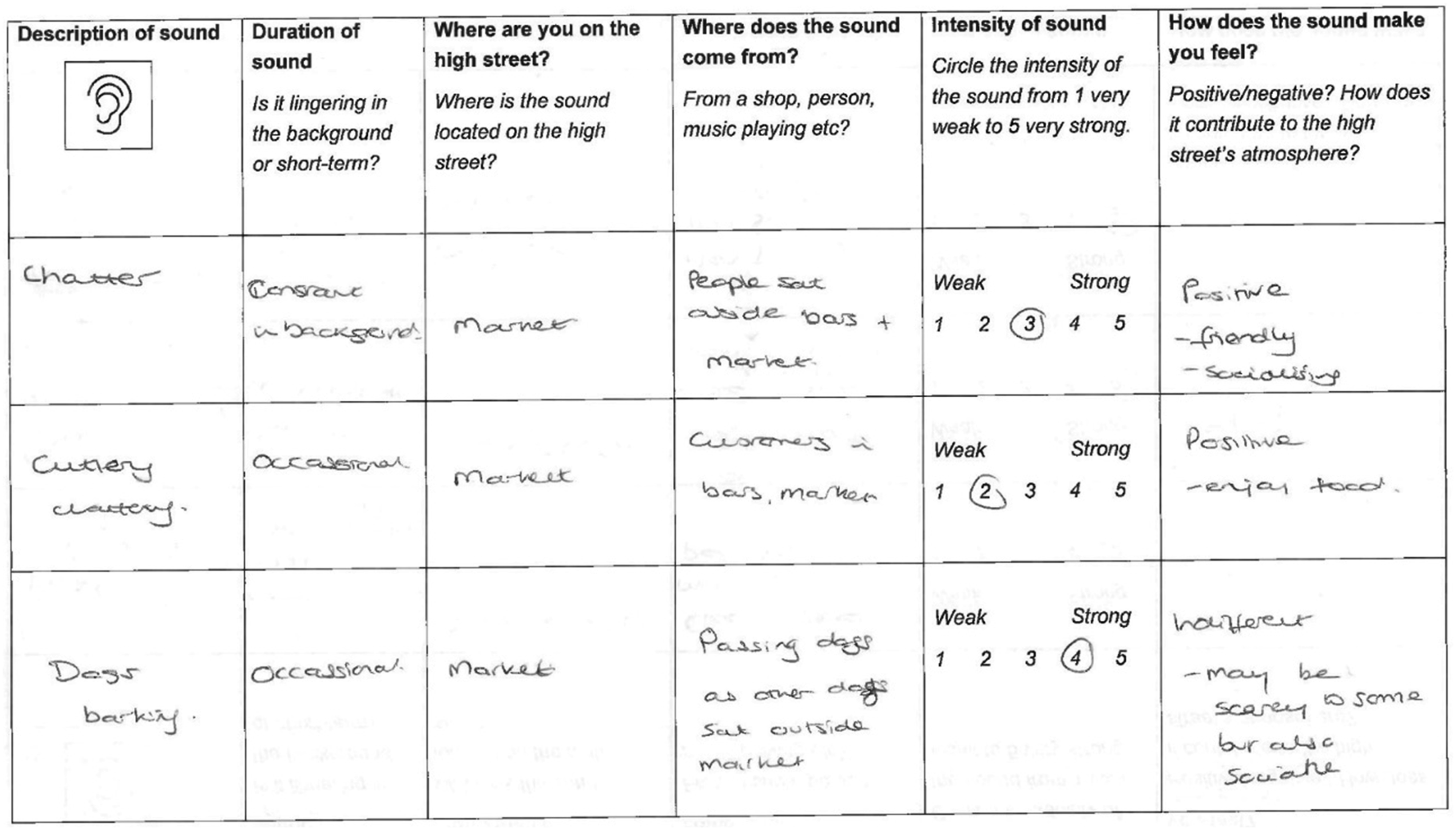
Helen’s soundwalk form.
By involving both academics and non-academics in trialing methods we could generate valuable insights from multiple perspectives. Indeed, creative and sensory methods often involve participants using methods themselves, as in the case of going on sensory walks (French and McLean, 2024; Paiva et al., 2023; Piga, 2021; Pink, 2008) or participant-led walking interviews (Madsen, 2017). Others have collaborated with filmmakers (Arboleda, 2023; Michels, 2015), artists (Hawkins, 2015), and digital artists (Degen and Barz, 2020) or involved students in trying out mapping (Powell, 2010), observational and sonic techniques (Lobo et al., 2020). We therefore follow calls for more collaborative approaches to researching atmospheres (Goulding, 2023; Paiva et al., 2023; Pink, 2015).
Data analysis and dissemination
Key findings from data collection.
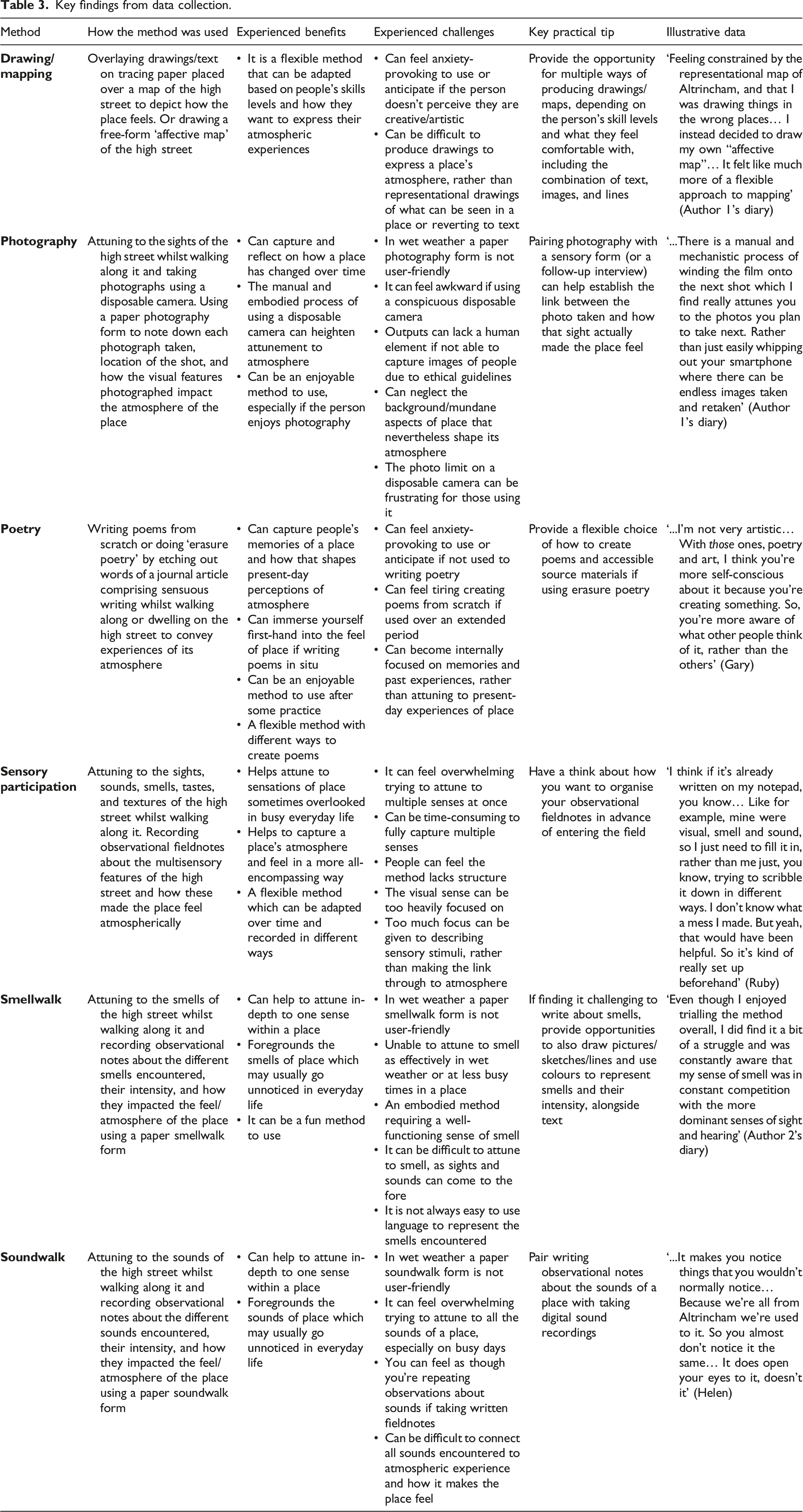
Findings
We now explore the three main themes identified, which together reveal the emotional, practical, and embodied dynamics of using atmospheric methods on the high street: Methodological (dis)comfort zones, Weathering methods, and Attuning in/out of place.
Methodological (dis)comfort zones
Our study reveals how some methods lie inside a person’s comfort zone, eliciting feelings of comfort, competence, and familiarity, whilst others can evoke uncomfortable feelings of anxiety, incompetence, and awkwardness. Reflecting the ocularcentrism of Western societies (Patterson and Larsen, 2019), photography was commonly viewed as lying inside participants’ comfort zones, with four of ten participants selecting this method (Table 2). As Gary notes, ‘I like photography. I think it’s something that I’m comfortable with… It seemed like a natural fit to me, rather than going outside my comfort zone… I went with my comfort zone’ (Gary). Chimp similarly reflected, ‘I like taking photographs. That’s how I like to capture things. I’m not poetic. I wouldn’t even begin to do that type of thing. So, it was the easy option (laughs)’ (Chimp). Whether a method falls within or outside an individual’s comfort zone depends on past experiences (or lack thereof), perceived skill levels, and simply what they enjoy doing. For example, Prof. Altrincham has a background in place consultancy work and therefore selected the more all-encompassing sensory participation method since ‘it’s just how I make sense of place, I suppose. And how I analyse things is very much through a sensory window…’ (Prof. Altrincham).
Conversely, other methods lingered outside an individual’s methodological comfort zone, especially poetry and drawing – arguably the most ‘creative’ methods – with notably no participants selecting drawing/mapping and only one selecting poetry. The typical positioning of these methods outside people’s comfort zones echoes how using non-representational approaches can feel inaccessible in practice (Vannini, 2015b). To illustrate, the first author anticipated she would feel uncomfortable using the poetry method prior to even trialling it, which elicited anxious embodied affects: A wave of anxiety rushes through my stomach as I imagine myself writing my poem. I imagine I will feel very uncomfortable doing this, as I haven’t really written poems before, and I am worried the output will be of an embarrassingly poor quality (Author 1’s diary).
Thus, feelings of (dis)comfort not only arise during data collection, but also in anticipation of using a method. As Billo and Hiemstra (2013: 324) observe, ‘the field… is not a static, self-contained place’; rather, emotions can also be aroused through anticipations of future data collection (Steadman, 2023). Author 1’s anxieties about poetry later flowed into the field, where she ‘...actually say[s] out loud under my breath “oh god, I can’t do this”’ (Author 1’s diary). Affects and emotions can jump between bodies and spaces (Hill et al., 2014), where the way researchers ‘land’ into places (Preece et al., 2022) can transform its atmospheric compositions (Sumartojo and Pink, 2019), perhaps reflected in the negative tone of Author 1’s erasure poem expressing the commercial feel of the main high street (Figure 6). Author 1’s erasure poem.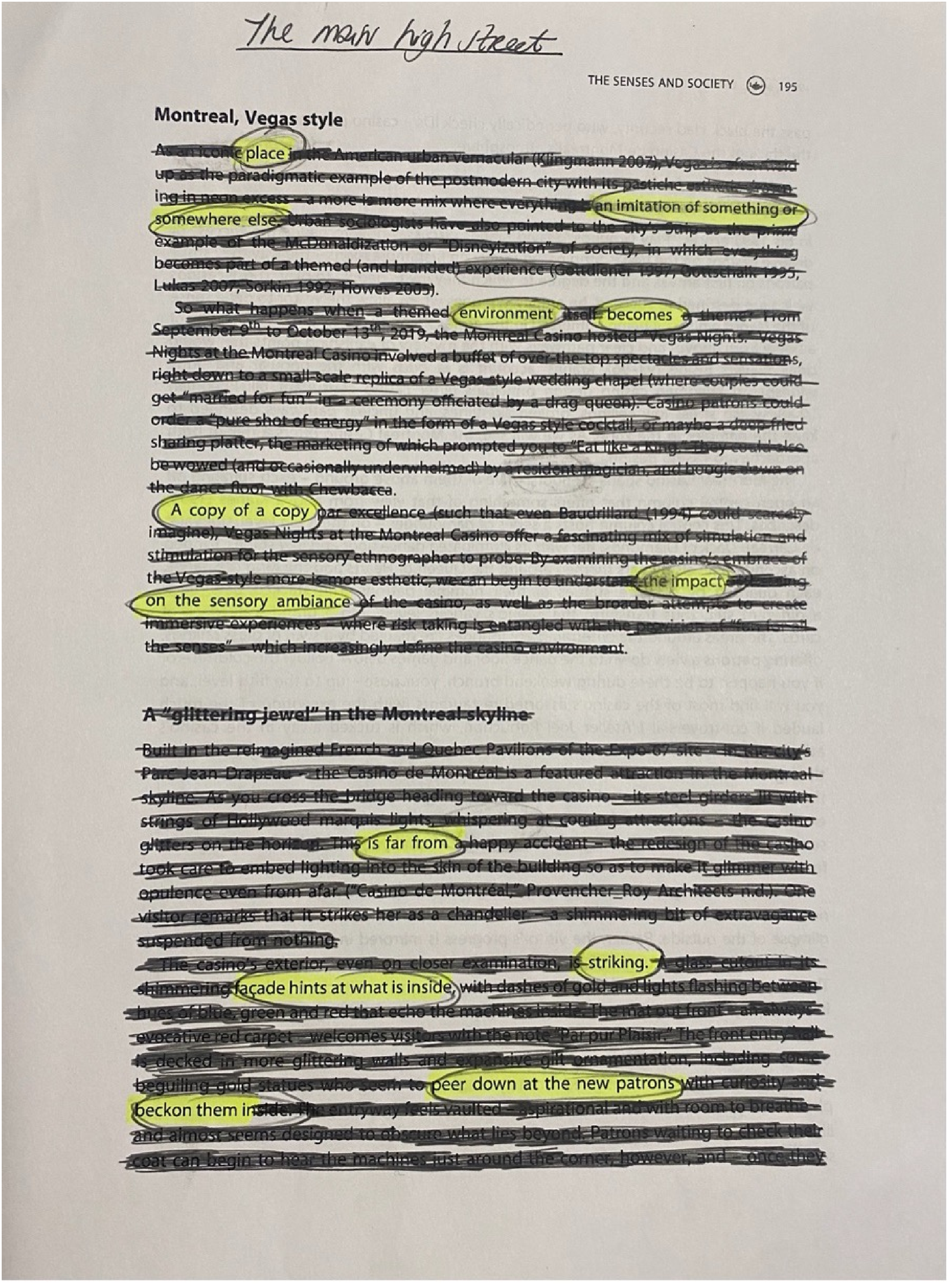
Anticipations can further impact individuals’ methodological choices, as ‘choosing a methodology is a personal and reflective process’ (Goulding, 1999: 870). Two participants sought to push themselves outside their comfort zone, with Ezio (chose soundwalk) observing ‘I used to do photography, so I thought that’s just going to be too comfortable for me. So, I chose away from it’ (Ezio); whilst Rebhead (chose poetry; Figure 7) remarked ‘I wanted to do something different’ (Rebhead). Most participants, however, elected to stay within their comfort zones by avoiding those methods lying furthest outside them. To illustrate, Helen (chose soundwalk) noted, ‘I can’t write poems or draw to save my life, so they were never even an option’ (Helen); whilst Becky (chose photography) echoed, ‘...the drawing I would have felt very self-conscious of and the poetry strikes fear into me’ (Becky). Rebhead’s high street poem.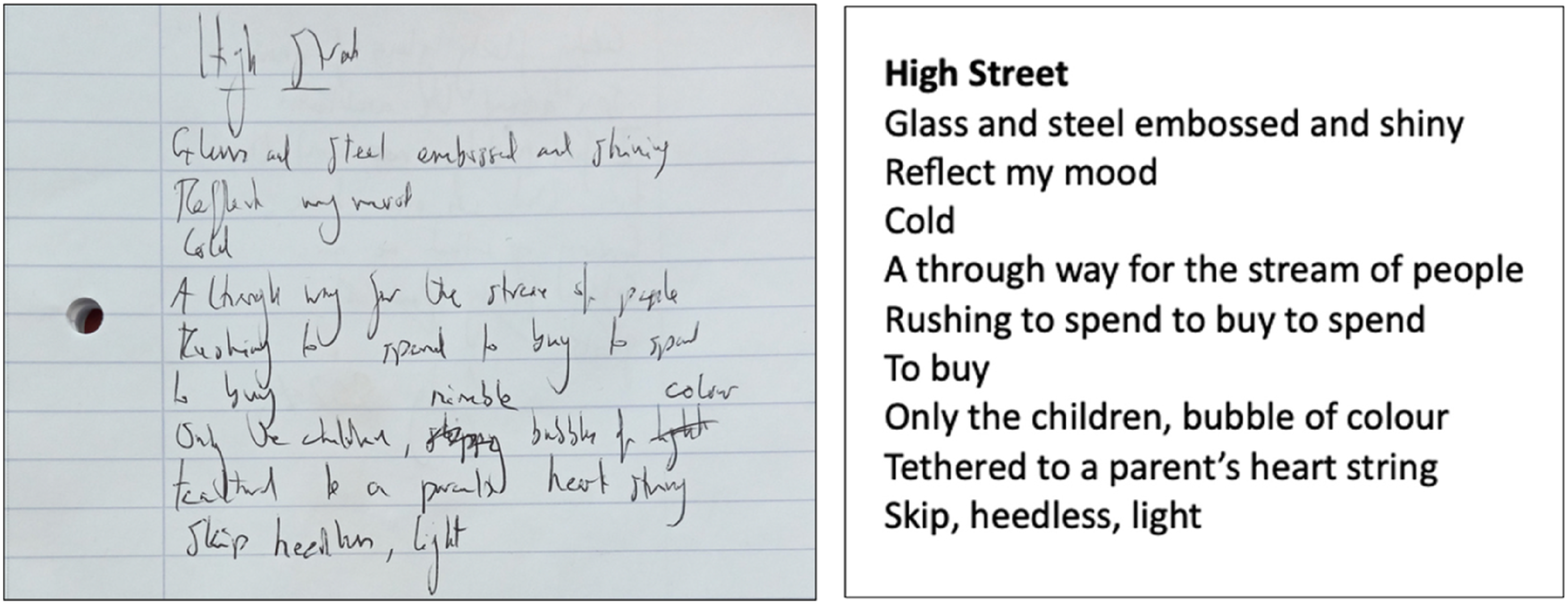
However, methodological comfort zones are not fixed; rather, their elasticated borders can either expand to let previously ejected methods inside through more experience, or methods are adapted to squeeze inside. To illustrate, the second author anxiously anticipated she would feel incompetent writing poetry; however, once she had spent some time using the method in the field, it began to feel more comfortable and even fun: I feel very apprehensive. I think this is going to be hard and my 'poems' will be awful... Soon enough, this becomes quite a fun and humorous exercise... It's been much more enjoyable than I expected... I actually found it improved my mood (Author 2’s diary).
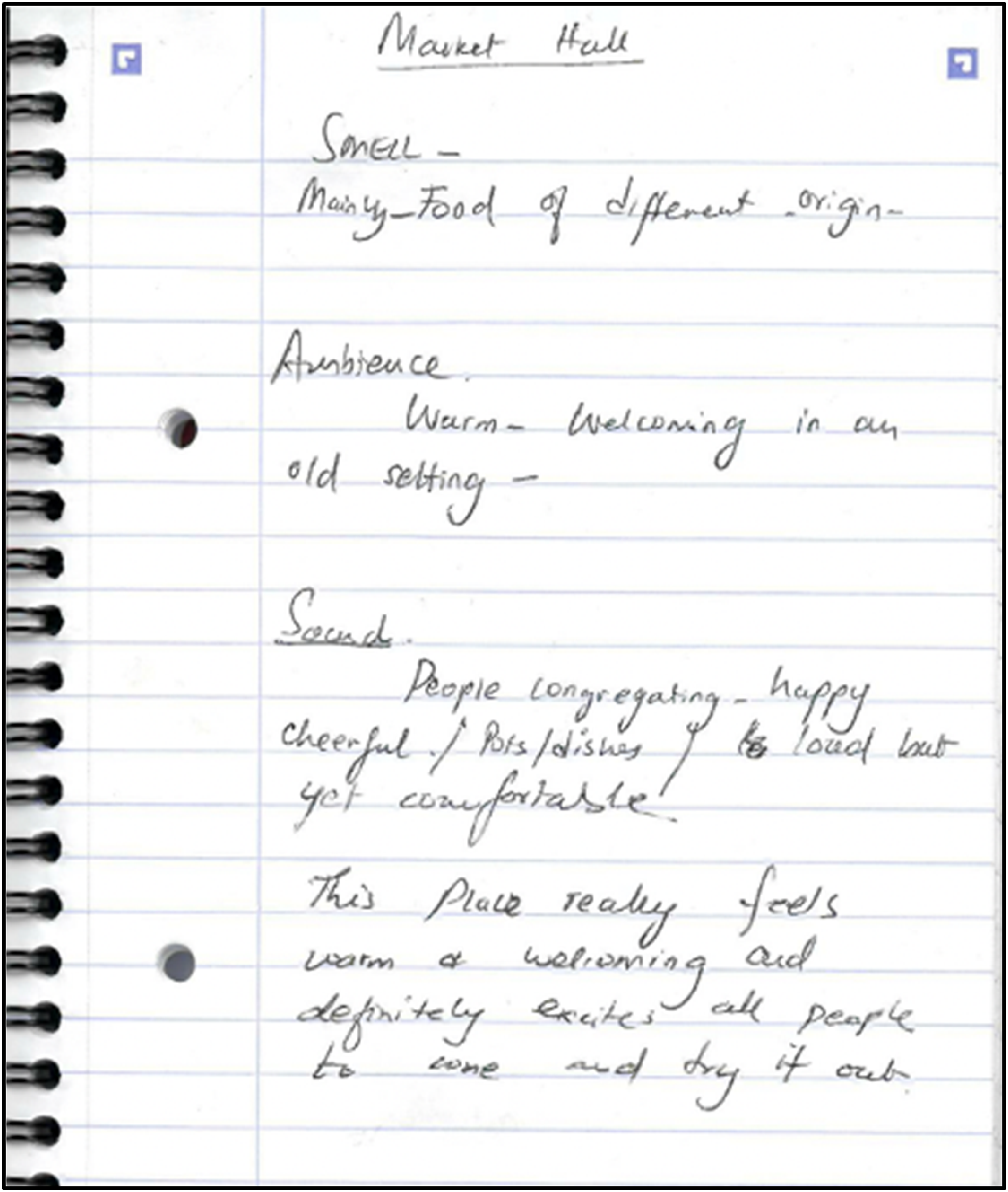
Awkward feelings can manifest as embodied discomfort at the ‘pinch point’ between how a person feels and the way they would like to feel (Schmidt et al., 2024), with some seeking to reduce this gap through adapting methods to change the intensity or quality of emotion. Following how people often cannot recognise bird’s-eye maps of places (Powell, 2010), Author 1 felt frustrated she was ‘drawing things in the wrong places’ when trying to draw onto a printed map of Altrincham. She therefore decided to draw her own ‘affective map’ of the high street (Figure 8), which ‘felt like a much more flexible approach to mapping’ (Author 1’s diary). Echoing how drawing can feel frustrating for the inexperienced (Hawkins, 2015), especially when ensnared in the ‘straight-jacket of realism’ (Heath and Chapman, 2020: 116), Author 1’s map instead ‘...became a mixture of drawings, colour, lines, and descriptive text’ which made her ‘feel more comfortable’ (Author 1’s diary). Reflecting the experimental thrust of non-representational scholarship (Hill et al., 2014; Vannini, 2015a), this mixing of the representational (e.g. text) and non-representational (e.g. drawings and coloured lines) reduced her discomfort and enabled greater immersion in place atmospheres, rather than reflexively focussing on the method itself. Meanwhile, both Prof. Altrincham and Ruby desired a more structured fieldnotes template for sensory participation to feel more competent and productive (Figure 9); as Ruby reflected, ‘I think if it’s already written on my notepad… so I just need to fill it in, rather than me just trying to scribble it down in different ways. I don’t know what a mess I made’ (Ruby). Author 1’s affective map of Altrincham. Ruby’s sensory participation fieldnotes.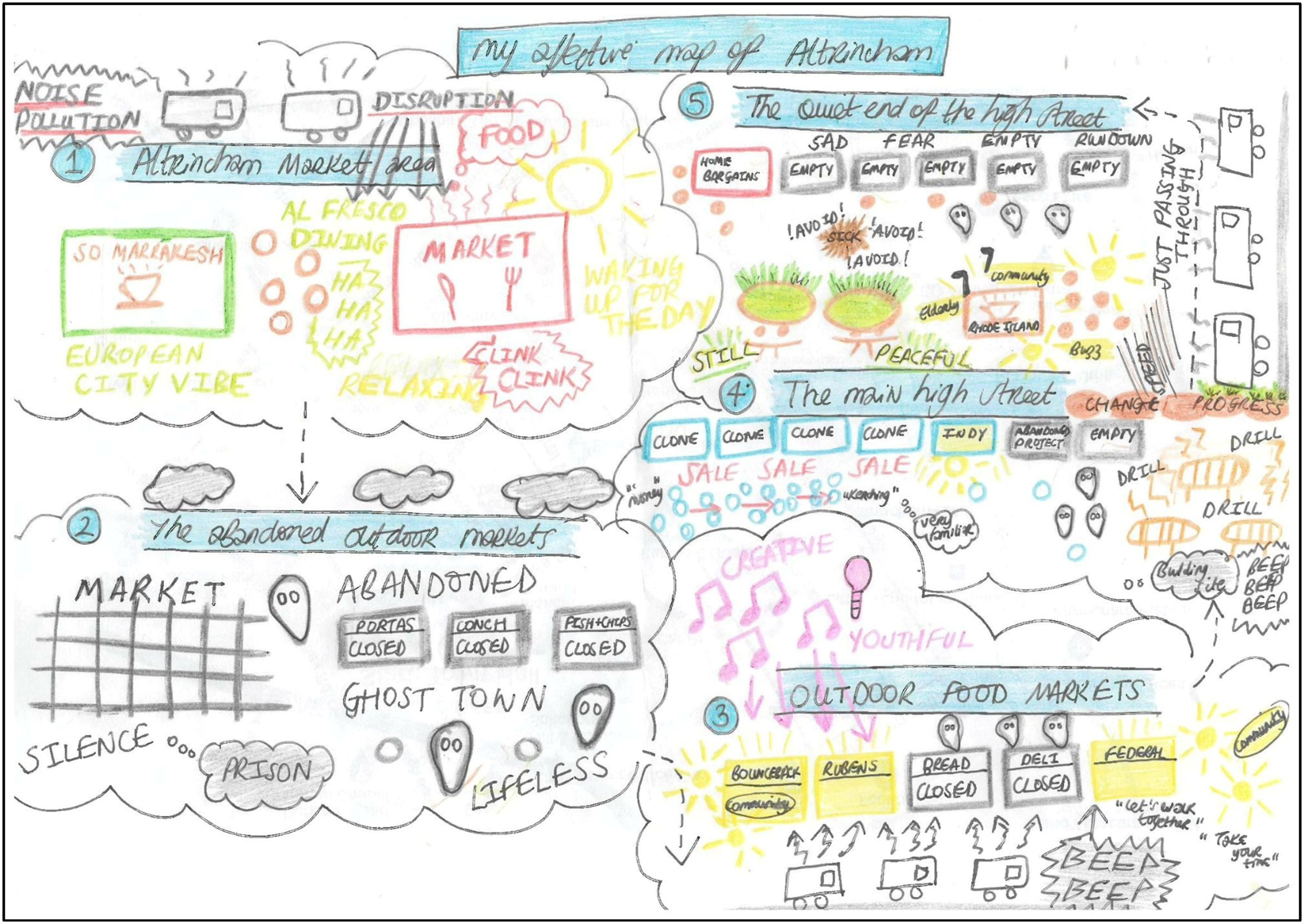
In summary, individuals possess differing – yet dynamic – methodological comfort zones, with some methods or combinations of representational and non-representational qualities feeling more comfortable than others. While feelings of (dis)comfort might arise when doing data collection, anticipations of methods also arouse emotional responses which can impact methodological choices. However, it is sometimes difficult to anticipate exactly how data collection will practically unfold, especially in outdoor consumption environments, which is the focus of the next theme.
Weathering methods
The metaphor ‘atmosphere’ derives from meteorology (French and McLean, 2024). Thus, as well as clouding the atmosphere of place itself through transforming the feel of material and embodied surfaces (Larsen, 2024), we found weather can pose some practical challenges to using atmospheric methods outdoors. As Vannini and Vannini (2021: 23) suggest, ‘all fieldwork done in the open is inevitably and deeply affected by weather’, as a pervasive element of the non-representational ‘background hum’ of life (Anderson and Harrison, 2011). Yet research on weather remains more common than the role the weather plays in research (Vannini and Vannini, 2021). To satisfy the ethical demands of our institution and owing to budgetary constraints, we used rather analogue and material versions of the methods trialled; opting for disposable cameras over smartphones and paper sensory forms and notebooks over digital devices. Whilst the ‘weatherworld’ (Vannini and Vannini, 2021) of fieldwork was typically warm and dry, our first walking tour was unseasonably rainy for July and we watched on as participants’ worksheets disintegrated in the rain, pens stopped working on soggy paper, and participants sometimes struggled to balance recording data whilst sheltering from the rain: Despite the recent spell of good weather, it started raining just as we took our group outside, and recording data became increasingly difficult... Paper forms got soggy and impossible to write on, raincoat hoods and umbrellas got in the way (Author 2’s diary).
Despite efforts to forecast the weather in advance of fieldwork to enable us to plan accordingly (e.g. bringing along plastic folders to shelter worksheets), reminiscent of surfers’ use of surf prediction websites to schedule optimal excursions (Canniford and Shankar, 2013), British weather is changeable and not always predictable. For example, even when forecast dry weather, sometimes it would unexpectedly start raining during fieldwork: As I headed towards the starting point of the walking route, I felt a bit disappointed as it had just started spitting with rain, and I felt concerned how the drawing method would work if my worksheet got too soggy. I decided to shelter on a table at the main market hall under cover to begin my drawing (Author 1’s diary).
Wind also played a role in disrupting our methodological experiences; indeed, wind impacts how smells intensify and disperse during smellwalks (Allen, 2023; French and McLean, 2024), as well as the quality of sound recordings (Steadman, 2024; Vannini and Vannini, 2021). To illustrate, the first author became frustrated with the wind blowing around paper and pencils, and making it more uncomfortable to draw on the high street: I also felt a bit frustrated with the weather today, as the wind kept blowing my paper and coloured pencils over (sometimes even onto the floor). I felt a bit chilly in the spitting rain and wind at times, which made it a bit more difficult and less enjoyable to dwell using the method outdoors (Author 1’s diary).
To cope with these practical challenges, individuals can make subtle methodological adaptations. Indeed, Vannini and Vannini (2021: 37) contend, ‘doing research entails weathering a place’, with methodological plans ‘an adjustable, evolving template...instead of a finished document’ (Billo and Hiemstra, 2013: 317). Given the pervasive use of digital technologies (Sumartojo, 2024), this weathering of methods often meant turning to the digital as a geographic-technological ‘purifying practice’ to reduce felt tensions (Canniford and Shankar, 2013). For example, we observed how Ezio began making digital smartphone notes mid-rainy walking tour; Chimp and Helen pondered about digitally recording the sounds of place; and Ezio and Melissa admitted they would have found it easier and quicker to make digital or verbal notes: I don't write with a pen and paper for somebody else to read very much these days... So, if you gave me an electronic gadget, I probably would have got more down for you, more accurately, quickly... In the rain, we were sort of sheltering and hunkering (Melissa).
In summary, although non-representational theory often lacks practical insight (Cresswell, 2012; Vannini, 2015a), we reveal adopting sensory and creative methods can raise some practical challenges when researching the atmospheres of spaces open to the elements, especially when using more analogue and material formats. Following how sensory methods are open to ‘finetuning’ over time (Steadman, 2024), participants often considered the value of digitalising methods to weatherproof them. We now further explore challenges involved in using alternative atmospheric methods in relation to embodied limits of attuning to place.
Attuning in/out of place
As Sumartojo (2024: 171) observes, ‘researching atmospherically demands that we attune’, and we found sensory and creative methods can help individuals tune into their high street from a new perspective by heightening focus on its atmospheric qualities. For instance, Prof. Altrincham noted ‘I think there’s a richness to actually pausing and stepping back and looking at place’ (Prof. Altrincham), whilst the following conversation unfolded: Helen: It makes you notice things that you wouldn’t normally notice Chimp: Yeah, you are just looking at everything and everywhere... Rebhead: It’s like a mindful walk isn’t it. Walking, sauntering and taking it all in.
Atmospheric attunement was enhanced by jolting participants from their habitual routines as the authors selected the walking time and route. As Hurst and Stinson (2024: 171; original emphasis) suggest, atmospheres ‘...are a part of us, and part of our being in place’, but their very ubiquity can render atmospheres difficult to always reflect back on during our busy daily lives. As Melissa observed, ‘...I’m not often in town at this time wandering around for an hour. So it’s, yeah, seeing your own hometown in a different light’ (Melissa). Becky echoed, ‘normally, I’m rushing around and I probably do kind of pick up a vibe of what I do and don’t like. But you don’t necessarily stop and think about it’ (Becky). The materiality of the methods used, alongside combinations of representational and non-representational qualities, also enhanced attunement. For example, the embodied process of lining up the shot and winding the film to take photographs using the disposable camera, paired with writing notes on the photography form, helped tune into the sights of place (Figure 10): ...There is a manual and mechanistic process of winding the film onto the next shot which I find really attunes you to the photos you plan to take next. Rather than just easily whipping out your smartphone where there can be endless images taken and retaken (Author 1’s diary). Participants’ photographs of the high street.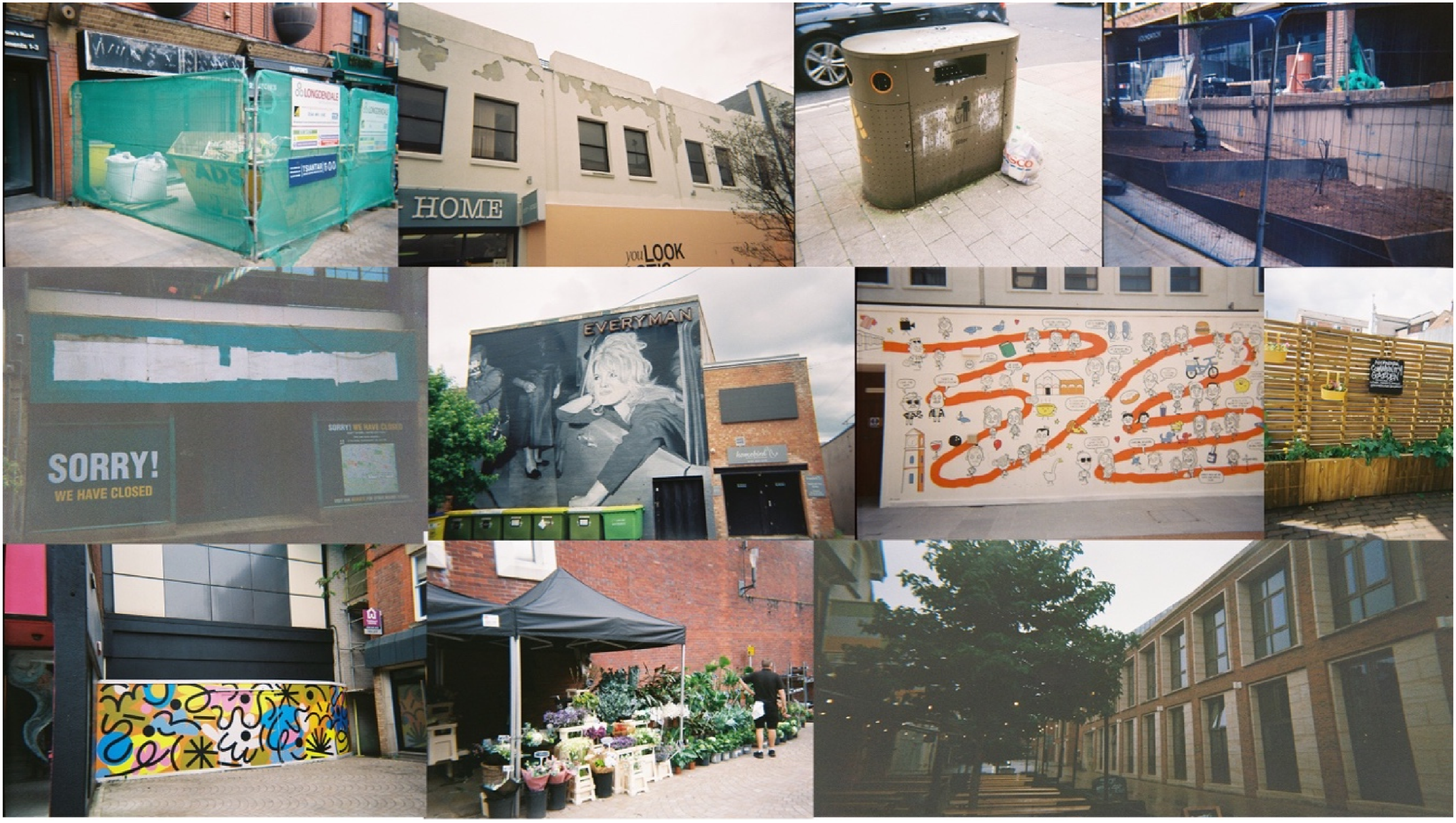
However, it was not always easy to attune to the competing sensations of the high street, owing to sensory overwhelm or distraction. Despite having past experiences with the method, both authors found it challenging to attune to multiple senses using sensory participation. This was driven by the wide variety of activity taking place on the high street, which produced an overwhelming array of sensory information to observe and capture: The sense of struggle I feel today might be due to the variation in activity around me... People taking a stroll or having a chat, walking the dog, working out, outdoor or indoor work, taking a work break, food and drink consumption, shopping activities... (Author 2’s diary).
To cope with sensory overwhelm, those using sensory participation can sometimes attend a disproportionate amount to sights (Piga, 2021), with Melissa observing ‘...I think visual is most people’s kind of immediate impressions of things, you know, so I started defaulting to that’ (Melissa). Those methods designed to tune into a single sense brought similar challenges. Given ‘bodies thrum with the sounds of the world around them’ (Patterson and Larsen, 2019: 112), the first author found the sheer volume of different sounds overwhelming to write about using her soundwalk form, even when standing in one place: Doing the soundwalk felt a bit overwhelming at times. There were so many sounds overlayered in just one place... Chatter, crying, sneezing, wheeling shopping trolleys and pushchairs, jangling keys, rustling shopping bags, cars, clattering cutlery, the fizz of cans being opened... (Author 1’s diary).
Chimp and Helen subsequently reflected on the value of recording sounds alongside writing about them. Similarly, Author 1 sometimes felt ‘puzzled and unable to detect the source of the smell or describe it in words’ and thus reflected on whether it would be more effective to combine writings about smells with drawings (Author 1’s diary), thereby revealing potential limits to using textual data recording approaches alone.
Both authors also experienced challenges attuning their body to smells of the multisensory high street. The second author, for instance, observed how ‘my sense of smell was in constant competition with the more dominant senses of sight and hearing’ (Author 2’s diary). We thus had to work our bodies hard to ‘recalibrate the senses’ (Patterson and Larsen, 2019: 113) through ‘often closing my eyes in an attempt to focus on smells’ (Author 2’s diary) and ‘breathing in through my nose more heavily, rapidly, and intentionally than I usually would’ (Author 1’s diary). As Stewart (2011: 450) suggests, ‘the body has to learn to play itself like a musical instrument in this world’s compositions’. Hence, the body works as an ‘instrument of research’ when exploring atmospheres using sensory (Sumartojo, 2024) and non-representational (Vannini, 2015a) approaches; but the instrument can malfunction, making it more difficult to attune. For example, the first author’s capacity to sense the diverse smells of the high street was compromised by recently applied sun lotion and a cold and the second author’s by chewing gum and hayfever. Meanwhile, both Rebhead and the first author became tired writing poetry, which reduced the number of poems they produced.
In summary, sensory and creative methods can help attune to the atmospheric qualities of place by foregrounding what can typically fade into the background of our everyday place experiences. However, sometimes an individual will encounter sensory overwhelm or competition between the senses when trying to attune to atmosphere, or record atmospheric experiences using more textual approaches alone, with the body playing an important role in making it easier or more difficult to tune into place.
Discussion
Having unravelled first-hand experiences of using ‘alternative’ methods to investigate high street atmospheres, we now discuss our study’s main theoretical contribution, which is to non-representational theory. Specifically, we demonstrate the value of combining non-representational and representational methods in practice. Whilst non-representational theory was initially proposed as ‘...a replacement rather than as a supplement’ (Cresswell, 2012: 99) to representational research, some have conceptually recognised how the two might work in combination, with Lorimer (2005) deploying the term ‘more-than-representational’ accordingly. Representational research has thus been posited as not ‘anti-representational’ (Anderson and Harrison, 2011; Hill et al., 2014), with the representational not ‘the enemy’ (Dewsbury, 2010: 4). Our empirical findings therefore enrich theoretical claims that research projects often comprise a hybrid of the two styles (Coffin and Hill, 2022; Hill et al., 2014), echoing how atmospheres have themselves been described as ontologically ‘in-between’ narrative and non-narrative, blurring representational and non-representational qualities (Anderson, 2009).
Subsequently, redolent of the experimental drive of non-representational scholarship (Hill et al., 2014), we experimented with different methods and combinations of non-representational and representational qualities. This included photographs paired with a written photography form, producing free-form poems or a non-linear etching of existing sensory texts, and combining drawings and lines with text on maps. Bolstering Coffin and Hill’s (2022) idea of a productive ‘high tension zone’ between the two styles, we found this hybrid approach can be valuable for attuning to atmospheres. As revealed in our first theme, methods lying outside a person’s comfort zone are often accompanied by uncomfortable affects and emotions. This embodied discomfort and reflexive attention to utilising the method itself can overpower the use of the sensing body as a knowledge instrument, as characteristic of non-representational theory (Vannini, 2015b). Yet adaptations to a method, such as adding text alongside drawings on personal affective maps, can move the method further inside a person’s comfort zone, thereby reducing uncomfortable sensations and enabling greater immersion in place atmospheres. Moreover, whilst sometimes representational approaches alone were ineffective for capturing atmospheres, such as writing about smells or sounds, a combination of the two was often more effective, such as pairing a disposable camera and visual data with a written photography form, which heightened atmospheric attunement, as seen in our third theme. Hence, whilst the non-representational is purported as useful for researching atmospheres (Goulding, 2023; Hill et al., 2014), we demonstrate the value of taking a more hybrid approach.
In doing so, our methodological experimentations enrich theorisations of atmosphere as a hybrid phenomenon sitting ‘in the middle’ (Buser, 2014) of the definite and indefinite, emotion and affect, inside and outside (Anderson, 2009; Edensor, 2012). By drawing attention to these hybrid qualities, our work thus builds on some emergent strands of atmospheric scholarship within marketing. For instance, it enables greater recognition of how, as ‘half-things’ (Jørgensen and Beyes, 2023) or the ‘in-between’ (De Molli et al., 2020), atmospheres can never wholly be designed into consumption spaces, as has been traditionally suggested in marketing (Steadman and Coffin, 2024). Rather, atmospheric design involves a careful balancing of controllable and uncontrollable – or definite and indefinite – elements (Jørgensen and Beyes, 2023; Steadman and Millington, 2025). Furthermore, this foregrounding of hybridity enhances understandings of the temporal and spatial ‘porosity’ of atmospheres (Steadman et al., 2021). Hence, how atmospheres are not only shaped affectively by present-day multisensory encounters in place, but also through past memories of the emotional feel of place (Preece et al., 2022). Nor are atmospheres singular entities neatly contained inside of places (Hill et al., 2022), especially ‘hybrid spaces’, like the high street, which comprise a mix of indoor and outdoor, public and private, spaces (De Molli et al., 2020), across which multiple atmospheres might flow, intermingle, or clash (Anderson and Ash, 2015). We hope the suite of methods presented in this paper go some way towards more fully accessing these complexities and ambiguities of atmosphere.
Finally, despite non-representational theory itself focussing on practical action (Vannini, 2015a), much existing discussion remains densely conceptual, with a paucity of advice about methodological applications (Cresswell, 2012; Vannini, 2015a). Non-representational accounts can be ‘notoriously difficult to follow’ (Hill et al., 2014: 389); but, to be useful, ‘...must not retreat into developing theory for theory’s sake’ (Vannini, 2015a: 12). Likewise, much literature surrounding atmospheric methods provides robust theoretical underpinnings (e.g. Hill et al., 2014; McCormack, 2015), whereas practical guidance is more limited. We contribute more practical insights into methods for researching atmospheres, whether combining (non)representational styles, the impact of weather, or embodied challenges of sensory distraction and overwhelm. This is not only of value to those researching atmospheres, but also those working to improve high streets. Policymakers are becoming more interested in measuring people’s emotional responses to place; yet they often lack effective methods for doing so, with quantitative and econometric approaches commonplace, but not always useful for accessing people’s affective place experiences (Howcroft et al., 2025). By advancing knowledge about a suite of alternative methods for researching atmospheric experience on the high street (see Steadman and Lipworth, 2025 for our practical guides), this paper responds to calls for ‘...more critical research on capturing, representing and measuring the felt experiences of place’ (Howcroft et al., 2025: 399).
Conclusions
To conclude, atmospheres can be tricky to research (Anderson and Ash, 2015) which is arguably compounded on the high street, where consumers interact with an array of indoor and outdoor spaces – from shops to public squares. To develop insights into effective methods for studying high street atmospheres, we trialled six ‘alternative’ methods on a UK high street and discussed the emotional, practical, and embodied dynamics involved through three themes: Methodological (dis)comfort zones, Weathering methods, and Attuning in/out of place. Returning to our research question, these themes revealed the value of deploying sensory and creative methods comprising a hybrid mixture of representational and non-representational features, to render them more comfortable to use, tackle the (im)practical realities of researching outdoors, and more effectively tune into the competing atmospheric and sensory qualities of place.
Future research could develop and test techniques for investigating the tastes of place which our study did not fully enable, despite sensory participation being multisensory. As Pink (2008) demonstrates, the sensory practice of eating can produce useful knowledge about how places are made and experienced. Moreover, whilst our focus was on data collection methods, more research is required on methods for analysing and representing atmospheres to extend Coffin and Hill’s (2022) insights into communicating research differently. Finally, future research could trial atmospheric methods with more diverse groups of consumers, potentially in terms of differently abled bodies or neurodivergence, as we found the body impacts atmospheric attunement.
On a final note, we encountered some ethical constraints to using creative and sensory methods, reflecting the ramping up of research ethics regulation (Alvesson and Stephens, 2025). Despite visual methods being valuable for researching atmospheres (Pink and Mackley, 2012), our ethics committee was cautious about such techniques and even questioned whether it would be possible to do the research without them. However, we did not want to disrupt communities by issuing filming privacy notices and it would also be impractical to do so for everyone passed by in public space (Rose, 2020). Further lacking budget to purchase encrypted video-recorders, as was also advised, coupled with tight funded project timelines, compromises had to be made. We thus used disposable cameras rather than smartphones, advised participants to avoid photographing people, and created a written soundwalk form rather than digitally recording sounds. Yet these formats were not always weatherproof, using disposable cameras felt quite conspicuous, and writing about sounds could be overwhelming. Participants also expressed frustrations with not being able to photograph people, with Jimbob remarking ‘I did feel a bit limited by not being able to take pictures of people… I think that people can capture a lot about a place’ (Jimbob).
There are indeed ethical considerations when researching atmospheres, such as minimising disruption to places (Rose, 2020), being empathetic to how researchers’ presence in a place can impact how it feels for others (Sumartojo and Pink, 2019), and using more participatory approaches to include communities in research (Pink, 2015). However, we call for the inclusion of people on ethics committees with broader disciplinary backgrounds and experience in using alternative methods, who could train others in the particularities of using them. Finally, we encourage universities to become more trusting of researchers’ abilities to make sensible ongoing negotiations of research ethics in the ever-unfolding field (Alvesson and Stephens, 2025). This would ensure ethical processes – whilst important – do not become an obstacle to using more innovative research techniques.
Footnotes
Acknowledgements
We would like to thank all our participants for taking part and pushing themselves outside their methodological comfort zones, the reviewers for providing constructive feedback about enhancing our manuscript, and Manchester Metropolitan University for funding the project.
Declaration of conflicting interests
The authors declared no potential conflicts of interest with respect to the research, authorship, and/or publication of this article.
Funding
The authors disclosed receipt of the following financial support for the research, authorship, and/or publication of this article: This research was supported by a Research Accelerator Grant from Manchester Metropolitan University.
