




Abstract
Embodied and emotional experiences are heightened in encounters with nature, especially in blue spaces. Thus, drawing on the works of Husserl and Merleau-Ponty, we analyse the role of the body in the production and experience of wild atmospheres through the practice of wild swimming in natural blue spaces. Using an interpretive approach involving interviews and ethnographic observations with forty-six wild swimmers, our analysis foregrounds embodiment and illuminates the central role of the body in the relational production and experience of atmospheres in nature. In so doing, we extend current understandings of embodiment by advancing a granular account of the emergence of ‘wild swimming atmospheres’ produced and experienced haptically and somatically through intimate and personal connections and entanglements between human bodies and natural surroundings. The paper concludes with suggestions for exploring embodied haptic and somatic experiences in other consumption contexts within natural settings.
Introduction
Several marketing studies have explored consumption in and of natural spaces and places (Arnould et al., 1998; Canniford and Shankar, 2013; Kunchamboo et al., 2017; Cheetham et al., 2018), but the co-creation and experience of atmospheres therein was implicit rather than explicit (Rodner et al., 2023). While the notion of atmosphere is traditionally grounded within meteorological contexts and described as a ‘tuned space, i.e. a space with a certain mood…always something spatial…[and]…always something emotional’ (Böhme, 2017: p. 2), nowhere are the embodied and emotional experiences more heightened than in our encounters with nature and in particular blue spaces 1 (Couper, 2018). Research around natural spaces predominantly focuses on greenspace (see Barrable et al., 2024), but the practice of wild swimming has experienced something of a renaissance with increasing numbers of people participating in it for exercise and physical health (Foley, 2017; Gould et al., 2021), mental health and wellbeing (Foley, 2015, 2017; Lund et al., 2022), social reasons 2 (Barrable et al., 2024; Bates and Moles, 2022) and to experience nature (Couper, 2018; Gould et al., 2021). Wild swimming refers to ‘full-body immersion in outdoor blue space’ (e.g. swimming or dipping in lakes, seas, canals, rivers or reservoirs), and when bodily movements synchronise with the movement of the water, this leads to a unique and deep connection with nature (Denton and Aranda, 2020; McDougall et al., 2022: p. 2).
Through the lens of embodiment, the practice of wild swimming provides our study with a novel context to advance our understanding of the production and experience of atmospheres in nature. Here, we are referring to the non-commercial context of swimming in the sea (off-season and all year round), off beaches and coves where no lifeguards are present, or swimming within inland waterways such as reservoirs where it is largely prohibited. These blue spaces which are neither designed or designated for swimming, are considered inhospitable by most, primarily due to associated health and safety concerns and the lack of market-based amenities/services to support the practice of swimming. Thus, wild swimming is often perceived as a transgressive, risky – even ‘dangerous’ – practice by observers and participants alike, and we suggest that these perceptions play an influential role in the production and experience of atmospheres invoked through the practice of wild swimming. While research has examined how atmospheres flow between bodies (see for example Steadman et al., 2021), further interrogation relating to the role of the body and foregrounding how embodiment works in practice is needed. This is especially the case in relation to how atmospheres are produced and experienced (Goulding, 2023; Rodner et al., 2023). More specifically, calls are made for further research on embodied and emotional experiences of blue space (Couper, 2018; Foley, 2017; Foley and Kistemann, 2015).
Responding to these calls, this study seeks to deepen our understanding of embodiment by shining a light on the interrelated haptic (felt by the body) and somatic (felt within the body) experiences produced through the practice of wild swimming in natural blue spaces. Our analysis is informed by Husserl’s (1989) conceptualisation, which places the body at the centre of experience both through the physical body – haptically (körper) – and the felt body or lived body – somatically (leib). Husserl’s representation accounts for both having a body (körper) and being a body and that which is directly experienced from within (leib). A key point of interest lies in Husserl’s incorporation or synthesises of the physical or material properties of the body and its lived or experiential somatic form. That is, embodiment should incorporate the body as lived from a physical point of view but also somatically from a first-hand perspective.
In so doing, we contribute to marketing theory by advancing a granular account of the emergence of wild swimming atmospheres relationally produced and experienced through intimate and personal connections and entanglements between human bodies and natural environments. Using an interpretive approach, our research moves beyond current understandings of embodiment in the context of atmospheres by offering a more comprehensive account of how atmospheres are relationally produced and experienced through the bodies, feelings, thoughts and movements of individuals through their engagement in the practice of wild swimming. The following section critically evaluates the marketing literature to date and argues why and how embodiment is central to the production and experience of atmospheres.
Atmospheres in marketing and consumer research
Böhme’s philosophical perspective on atmospheres suggests that they emerge somewhere in-between environmental qualities and human experience, filling these spaces with a ‘tone of feeling like a haze’ Böhme’s (1993, p. 114). By comparison, early studies on atmospheres within marketing were rather more prosaic, focussing primarily on the creation and manipulation of ‘environmental qualities’ within retail spaces (e.g. Healy et al., 2007; Kotler, 1974) to achieve marketing goals.
More recently, greater attention has been given to the role that atmospheres play in supporting marketers to stage memorable retail experiences for consumers (Stevens et al., 2019; Yakhlef, 2015), thereby outlining a relational process in which the embodied dispositions of individual consumers interact with the possibilities or ‘affordances’ of retail settings (Borghini et al., 2021; Yakhlef, 2015: p. 550). Here, a reciprocal relationship between the consumer and the retail setting is theorised through which multiple individual consumer experiences are brought into being. Consequently, atmospheres are conceptualised increasingly within marketing as being much less controlled and contained. This more dynamic view of atmospheres is taken up and extended in Steadman et al.’s (2021) analysis of place atmospheres, which challenges the assumption in much of the current retail and services marketing literature that presents atmospheres as bound by the here and now of place. Instead, attention is directed to how football atmospheres are shaped by supporters’ experiences over time, both inside and outside of the football stadium. This occurs through their shared memories of previous matches, match-day routines and practices, as well as through anticipations about future matches. Thus, a spatially and temporally porous conception emerges in which place atmospheres ‘flow through and across football stadia and fans in the build up to, during, and after a match’ (2021, p. 149).
Hill et al.’s (2022) study elaborates and illuminates the social facets of place atmospheres. Thus, social atmospheres are conceptualised as being relationally produced by crowds of individual consumers who come together through a series of interaction rituals in which they learn emotional scripts and coordinated behaviours such as singing, which subsequently ‘intensify in pleasurable outbursts of collective effervescence’ (p. 133). Echoing Steadman et al.’s (2021) analysis of place atmospheres, social atmospheres also have a mobile quality in that they are initiated, often in private social spaces, before an event, reach a climax during the event, and continue after the event as memories stored in symbolic objects. Social atmospheres are more likely to be produced and experienced at live sporting events and music festivals, particularly recurring as opposed to one-off events, rather than in the more typical retail settings studied in the services marketing literature. It may be instructive therefore, for marketers to examine the relational production and experience of atmospheres in a wider variety of consumption settings.
A growing body of recent research focuses on the concept of affective atmospheres, where embodied experience is foregrounded (e.g. Joy et al., 2023; Preece et al., 2022; Rokka et al., 2023). Much of this work references Anderson (2009), who conceptualised affective atmospheres as ‘spatially discharged affective qualities that are autonomous from the [human and non-human] bodies that they emerge from, enable and perish with’ (2009, p. 80). Joy et al.’s (2023) analysis of the retail context of winery tours illuminates how retail affective atmospheres are co-created through consumers’ embodied interactions with both retail staff and the material features of the retail context, impacted by the consumers’ level of expertise which influences their orientation towards the experience. Joy et al. (2023) suggest that retail affective atmospheres are akin to Hill et al.’s (2022) social atmospheres in terms of their association with human interactions and the use of symbolic objects. However, they differ in two ways. Firstly, they are associated with daily occurrences rather than extraordinary experiences; and secondly, the embodied interactions referred to are between consumers and retail staff rather than embodied consumer-to-consumer interactions. In a similar vein, Rokka et al. (2023) focus on embodied interactions between consumers and service employees, but in the context of tourism service encounters in Club Med resorts. Here, the authors specify a type of affective atmosphere – the convivial affective atmosphere – and emphasise the differentiated capacities of both consumers and service staff to affect and be affected. In so doing, their study highlights ‘the multiplicity of co-existing and co-isolated atmospheric bubbles’ (2023, p. 3) that can occur in given spaces.
Preece et al. (2022) is perhaps the only study to undertake detailed examination of the individual as the subject of the relational production and experience of affective atmospheres. The authors focus on the process of arriving or landing in affective atmospheres, arguing that the reason relational processes of arrival are heterogeneous is because affect is shaped, in part, by what consumers bring to affective atmospheres in terms of their lived experiences, and how this connects with the socio-political context. In short, ‘affect cannot be subjectless… Both bodily and cognitive elements help us sense and make sense of affective atmospheres’ (p. 362). Their analysis, however, tends to favour cognitive elements related to the orientations of consumers over their bodily experiences; a circumstance we suggest is contingent on the character of the relations between individual consumers and consumption settings. Although these studies are insightful, they nonetheless ‘fail to draw actual bodily movements, activities, and experiences into analytic focus’ (Oshima and Llewellyn, 2023: p. 3).
The role of embodiment in atmospheres
The body is central to any consideration of atmospheres since they are felt, lived and experienced through the body. Embodiment is, therefore, core to the relational production and experience of atmospheres (place, social and affective) as ‘experience is not the outcome of mental representations but rather related to the lifeworld linked to the body’ (Merleau-Ponty, 1962, cited in Yakhlef, 2015: p. 558). The traditional Western conceptualisation of the mind-body divide, subject-object dualism, and a prioritisation of the mind over the body, is advanced towards a more holistic understanding that prioritises the body as the locus of experience (see Kuuru and Närvänen, 2019; Scott et al., 2017; Stevens et al., 2019; Yakhlef, 2015). Based on the works of Merleau-Ponty and his predecessor Husserl, Oshima and Llewellyn (2023, p. 2) stress the importance of the body and embodied activities as key to understanding how ‘customers embody what is “on their mind”’.
Previous studies in marketing acknowledge the significance of embodied experiences in many extraordinary activities such as white-water rafting (Arnould and Price, 1993), skydiving (Celsi et al., 1993), surfing (Canniford, 2012; Canniford and Shankar, 2013), Tough Mudder (Scott et al., 2017), sport fishing (Valtonen et al., 2010) and fly fishing (Grant et al., 2024). Others concentrate on embodiment in the context of more mundane activities such as yoga (Kuuru, 2022; Kuuru, and Närvänen, 2019) and the body in bed (Valtonen and Närvänen, 2015).
Kuuru and Närvänen’s (2019) study on group yoga classes highlights embodied interaction between consumers where moving bodies ‘relate with other bodies in an emotionally charged way’ (p. 1250) and where social interaction ‘affects perceptions of the atmosphere’ (p. 1256). Here, ‘moving bodies are creators of a shared atmosphere, which transforms and affects the space’ (p. 1251). Their findings offer interpersonal and intrapsychic scripts as a means of interpreting embodied interactions leading to ‘forms of interaction’ (p. 1256). While Kuuru and Närvänen’s (2019) study highlights the nature of embodied interactions between self and other, Husserl’s (1989) conceptualisation presents a more holistic view of embodied experience wherein the body is the central focus of experience as felt by the body (haptically) and within the body (somatically). Therefore, it moves away from the body as a passive object or forms of interactions between bodies towards embodied experience, as actively felt by and with the body through both haptic and somatic experiences. Following Husserl (1989), our approach advances the work of Kuuru and Närvänen (2019) as it centralises the body as the unit of analysis beyond interactions alone.
Joy and Sherry’s (2003, p. 263) work elaborated the physical role of the body in movement and ability, that is, to do things (i.e. ‘I can’) based on perception and skill. Here, ‘the body simply takes over because of competence and experience’. The body thus provides the point of connection to and a vector of understanding the world, and we should think of experience, therefore, as being ‘co-determined by the environment and the body’ (Yakhlef, 2015: p. 559). Similarly, Kuuru (2022) identifies the importance of the ‘knowing body’ (situationally, socially, physically, affectively and transformative). Linking both external (haptic) and internal (somatic) bodily sensibilities together with spatial materialities (i.e. beaches and reservoirs), environmental materialities (e.g. weather, seasons, tides, temperatures, etc.) and other sentient non-humans (i.e. fish and birds), the embodied practice of wild swimming contributes to the relational production and experience of multiple atmospheres. Thus, the connections and entanglements between human bodies and bodies of water suggest that atmospheres are produced through a veritable combination of heterogeneous agencies (Cloke and Perkins, 2002).
Towards the concept of wild atmospheres in marketing
Whilst our perspective on atmospheres of wild swimming is consistent with the views outlined above vis-à-vis the production and experience of affective atmospheres being relational, embodied and dynamic, the consumption context of wild swimming is quite different in substantive ways. Firstly, it differs from retail and tourism contexts where affective atmospheres are relationally produced through embodied interactions between consumers and service providers in settings with various levels of socio-material design. In wild swimming, atmospheres are produced and experienced relationally between people and natural settings which are often not designed for swimming as such. This is not to claim that wild swimming exists outside of the market; Arnould (2007) provides extensive critique of the (im)possibility for this within contemporary consumer society. Rather, as Warde (2005) suggests, ‘consumption cannot be restricted to, nor defined by market exchange’ (p. 137) alone. Instead, we conceptualise consumption as a process in which people ‘engage in appropriation and appreciation, whether for utilitarian, expressive or contemplative purposes, of goods, services, performances, information or ambience whether purchased or not’ (Warde, 2005: p. 137). Following Warde (2005), we therefore acknowledge that consumption is a moment in the practice of wild swimming. Similar to the consumption practice of surfing, there is a relative ‘vow of silence with respect to consumption resources’ (Canniford and Shankar, 2013: p. 1065) associated with engaging in the practice of wild swimming. Nonetheless, we would not suggest that ‘anti-consumption attitudes dominate’ in wild swimming as they do in Chatzidakis et al.’s (2012) and Chatzidakis and Maclaran’s (2023, p. 6) studies on Exarcheia. However, we do see overlaps between our context and theirs regarding ‘emphasis on the free use of public space’ (2023, p. 6). Secondly, in the context of wild swimming, atmospheres do not derive necessarily from other people in the setting, although the experience may be shared through indirect interaction (Kuuru and Närvänen, 2019) with other swimmers. Instead, they are relationally produced and experienced through intimate bodily connections between people engaged in the practice of swimming and natural elements, that is, primarily cold water but also light, sounds, seasons and wildlife. In summary, “the non-human agency of nature is implicated in the performance” (Goulding, 2023: p. 8) and experience of these atmospheres.
With this in mind, we turn our attention to the concept of wild atmospheres (Vannini and Vannini, 2020). In their conceptualisation of wild atmospheres, Vannini and Vannini make a clear distinction between wilderness and wildness by suggesting that ‘wildness denotes a vitality, an ephemeral and relatively uncontainable energy, which may be sensed in different ways by different people’ (2020, p. 1). Here, wildness is a relational force that implies connection rather than separation between people and nature; indeed, they go as far as suggesting kinship. This relational view of wildness can be contrasted with the ideology of ‘untouched nature’ that underpins the concept of wilderness, highlighting the separation between people and nature. This view is consistent with Arnould et al. (1998, p. 99) who suggest that wilderness is less a geographical place, and more ‘an idea, a cultural invention…etched out in contrast to civilised life’.
For Vannini and Vannini (2020), a place ‘where wildness is felt becomes something alive – its wildness unfolding as a life-bearing force that is immanent within it as a capacity to affect its human and non-human inhabitants’ (p. 2). But wildness is more than a personal feeling; ‘it is the capacity to be affected by the ephemerally wild qualities of a place and the capacity of that place to affect…Understood this way, wildness is then a kind of atmosphere, an emergent and contingent affective event that is place-based and corporeally felt’ (p. 3). Wild atmospheres spill over discrete categories of affect, emotion and sensation, and although wildness is present in wildlife, for Vannini and Vannini, wild atmospheres are ‘less about what is, what can be explained, and more about what might be’ (p. 4-5). That is, they are felt by the body and can sometimes be difficult to articulate.
Wild atmospheres are different to the place, social and affective atmospheres described within the marketing literatures outlined above because they are ‘something that human co-presence alone cannot explain. Something that emotional contagion is insufficient at evoking…taking place more by way of absent presence than co-presence…through vitalist forces…forces that designers can’t manufacture’ (Vannini and Vannini, 2020: p. 5). Thus, wild atmospheres are produced and experienced when humans become sentient to the vitality of the natural world; this is not an acquired skill, it is more a possibility.
We bring the concept of wild atmospheres and the notion of sentience to the vitality of the natural world into the domain of marketing theory to help explore the relational production and experience of wild swimming atmospheres from the perspective of embodied consumers. Many wild swimmers discuss at length about how their experiences lead to an affective sense of connection with nature (Barrable et al., 2024; Denton and Aranda, 2020; Gould et al., 2021; McDougall et al., 2022). But the experience is not defined solely by the blue space itself, it is contingent on the individual’s ‘conscious expectations, unconscious moods, sensory and physical activity, general condition, social context, societal context and the experiences’ previously faced in other natural environments (Schilhab, 2021 cited in Barrable et al., 2024: p. 4; Vannini and Vannini, 2020).
Methodology
As our study focussed on bodily experiences of atmospheres in the context of wild swimming, an appropriate methodology was required to overcome the traditional ‘subject–object dichotomous thinking’ (Yakhlef, 2015: p. 559). To this end, we sought to capture the perspectives of swimmers’ bodily sensibilities, eliciting structural dimensions of their wild swimming experiences and uncover what those experiences meant to them (Denton and Aranda, 2020; Starks and Brown Trinidad, 2007). An interpretive, qualitative study was conducted with members of open water swimming groups through interviews conducted in-person or online. Since it is ‘difficult to approach atmospheres by taking them as given and researching them head on’ (Sumartojo, 2024: p. 159), we focused on the individual’s experiences associated with the practice of wild swimming. Discussions with participants therefore, sought to capture tacit unreflective dimensions (e.g. felt experiences and practices) (Polanyi, 1966). This approach was used to understand the role of the body in this specific context to reveal participants’ perceptions, feelings and experiences of affective atmospheres generated through the practice of wild swimming. Our approach is consistent with Sumartojo’s (2024) advice on the importance of ‘locating atmospheres in experience (instead, for example, in places)’ and thus to ‘put experience at the centre of research design rather than spatial context itself’ (p. 161-2).
Participant Profiles.
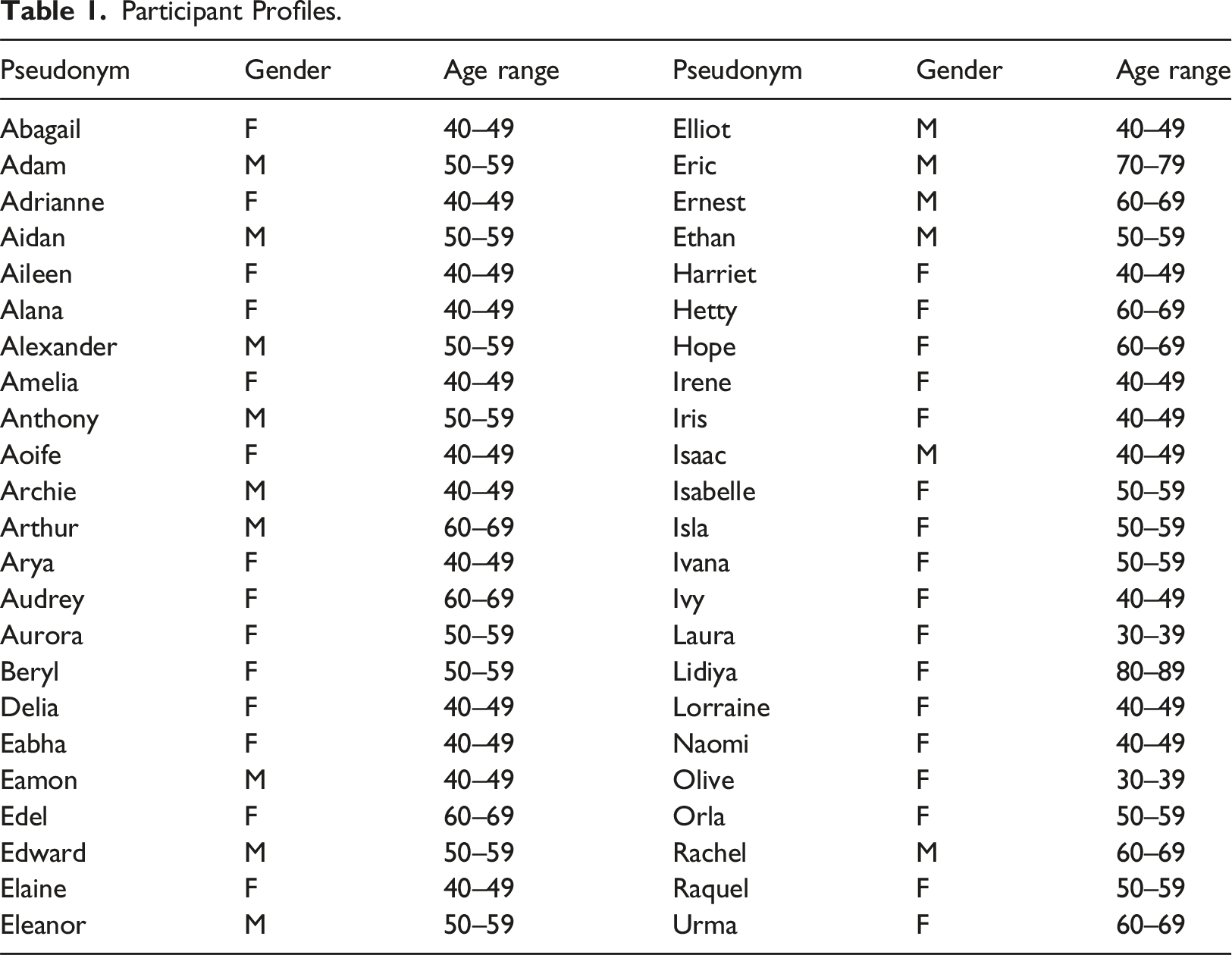
Interviews took place with participants in line with a ‘long-interview’ ethnographic interview approach (McCracken, 1988), being in-depth and unstructured in nature. Questions were intentionally broad in scope (e.g. ‘how was your swim?’ and ‘can you tell me about your swimming experience today?’) and were supported by a series of embodiment-specific prompts to elicit feelings around about their swimming experiences. Prompts were designed to motivate the conversation towards the relationship between the body and natural phenomena. Interviews typically lasted between 35 and 60 minutes and were primarily conducted in-person. Interviewers sometimes took part in the swim with the participant prior to the interview. This allowed for participant observation of the practice of wild swimming, where it was crucial that the interviewer did not interrupt the participant’s swim in any way and was therefore perceived as merely another swimmer in the group. Some post-swim interviews were short (i.e. 35 minutes), dependant on the participants’ recovery from the swim and need to regain body heat.
Coding Table.
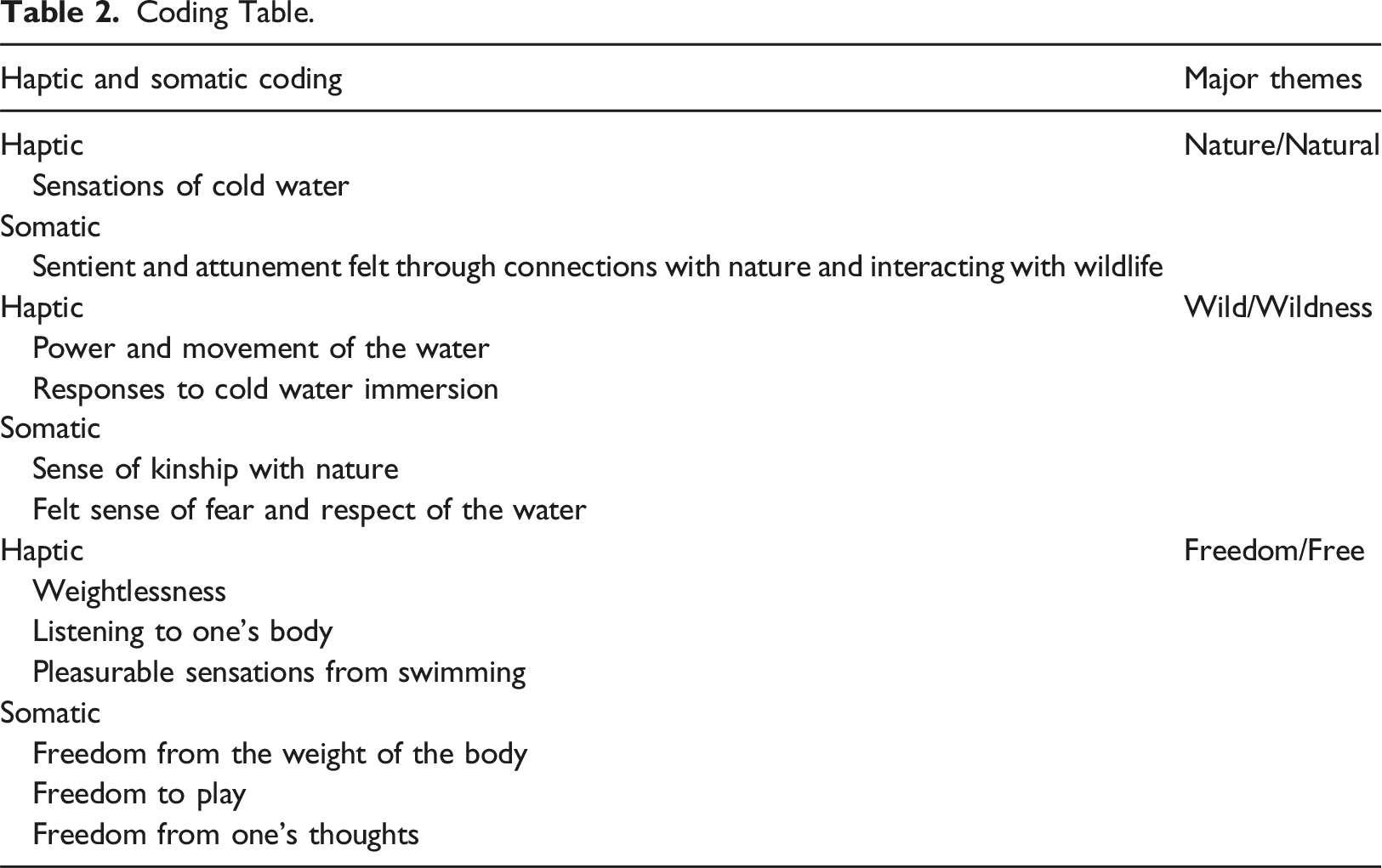
Nature/natural, wild/wildness, and freedom/free are the three most significant themes we identified through thematic analysis. Other themes relating to social and community aspects of wild swimming were also identified, but these were slightly less common and are the focus of a separate paper.
Some of our research participants enjoyed swimming alone as well as with others, while many only swim with friends or when other people are swimming in the vicinity. We now discuss our findings in the following section.
The production and experience of wild swimming atmospheres
All participants spoke affectively about the significance of their personal engagement with nature and the natural world, about wildness in different forms and about the freedom(s) they experience through the practice of wild swimming. We focus therefore on these three themes – taking each in turn but acknowledging at the outset that considerable overlap exists.
Nature/Natural
Immersion with nature and the natural world is something that all participants mention as being central to the multisensory experience of wild swimming. Unsurprisingly, sightings of wildlife such as fish, crabs, starfish, seals and the occasional dolphin are mentioned widely by those who swim in the sea and tend to look down through clearer water while swimming. For example, Orla excitedly recounts, ‘…and I looked down and I could see the dolphin swimming under me…if you were on holidays in Florida, you’d pay to see that, but this is in its natural habitat!’ By comparison, inland waters are cloudy, and therefore, birds including herons, kingfishers, curlews, ducks, rugged moorland and trees feature extensively in discussions with those swimmers as they are more inclined to look up. Here, Isabelle relates, ‘…and I am swimming [in the reservoir] with trees and kingfishers and there’s a heron and that crow’s just swooped across the water and there’s a duck over there. And it’s just like yeah…’ Participants also talk about water itself; its sounds and taste – particularly the saltiness of the sea, and the look (e.g. whether it is clear, cloudy/brown) and feel of water – its power and energy, and the level of cleanliness. The feel of water against the skin is a particularly important part of wild swimming and many participants have internal arguments about the need for neoprene gloves, socks and wetsuits to extend their time in the water during the winter months versus being able to feel the water against their skin. While these multisensory experiences with nature and the natural world are significant facets of wild swimming, it is the sensitivity to these experiences that contributes to the production and experience of wild swimming atmospheres, as we now outline.
Vannini and Vannini (2020) suggest that wild atmospheres are brought into being only when humans become sentient to the vitality of the natural world. They argue that such sensitivity can best be described as a process of ‘attunement’ which may or may not occur in a particular place. Attuning to atmospheres is also recognised by Sumartojo (2024) who reminds us, atmospheres can be intimate and personal; they are not necessarily always public and shared. A central and interrelated aspect of the practice of wild swimming pertinent to our swimmers attuning to the vitality of nature and the natural world is the twofold haptic experience of firstly, the total immersion in water and secondly, interacting with the natural world from a horizontal rather than our more usual, upright, position. In their research on sea swimming, Denton and Aranda (2020) conclude that ‘fully immersing oneself in water seems to assist with achieving different perspectives’ (p. 657). Similarly, Barrable et al. (2024, p. 13) comment on the significance of ‘physically changing one’s point of view’ through the practice of wild swimming for the development of our relationship with the natural world. The following excerpts are indicative of some of the developing relationships and entanglements between humans and nature through the practice of wild swimming: ‘I’m more aware of things… So today it was raining and just the way the raindrops hit the water, and you see the splash that you don’t see when you’re walking about and things like that and noticing things like that…little fish that will jump to get a bug on the surface that I wouldn’t notice if I was just walking by it. Things like that…’ (Laura)
Swimmers clearly pay attention to the minutiae of material nature; here we might describe Laura as becoming a ‘spectator’ of nature characterised by her ‘alterations to perceptual and attitudinal states, all enabled by the environment and the animal and plant species that live there’ (Grant et al., 2024: p. 8). Her haptic experience is based primarily on sight. As the next example reveals, Adrianne moves beyond being a mere spectator of nature since she is interacting with the natural environment through the kinaesthetic movement of her physical body in the water, which enhances the haptic sensations of cold water on her skin: ‘Even stopping, taking your body from being horizontal to vertical and feeling that difference in temperature. I mean I’m only short, but even five foot under it’s a lot colder than it is at a couple of inches under. All those sensations. It’s everything’.
Finally, Eamon moves between being a haptically informed spectator of nature towards ‘connecting with nature’ (Barrable et al., 2024), as he recounts the emergence of the affective somatic lived experience of interacting with wildlife while swimming in the sea: ‘…you’re looking down in the water, you’re seeing fish, you’re seeing crabs, and then all of a sudden, this bloody dolphin appears out of the middle of nowhere…I was terrified the first time I saw it, because I thought, “My God, that thing is huge”! What it did was, it swam around me three times, it circled around me three times. It basically did a swim with me – part of their morning swim with me – It was just SENSATIONAL’.
These examples serve to illustrate that immersion in bodies of water and the associated change of physical perspective from vertical to a horizontal positioning and movement, appears conducive to the process of attuning to nature. This process of attunement involves both haptic (felt by the body) and somatic (felt within the body) experiences with nature (see Husserl, 1989). This is not to say that wild swimmers are always able to attune to nature and the natural environment, as Vannini and Vannini (2020) forewarn. Instead, we argue that the practice of wild swimming allows swimmers to attune more easily to the vitality of the natural world in its material, sensory and affective forms. Ultimately, the process of attunement can lead to the deeply visceral somatic experience of feeling part of the natural world, and as the following quote demonstrates, this feeling is difficult to put into words: ‘…it’s part of me so it’s not just something I’m passing by and looking at, it’s part of me, it’s a lure, it’s a draw every day - I don’t know what it is. At some level, we’re all made up of water…I don’t know what it is - but there’s a connection, we’re not separate from that, we’re unified with it - it’s holistic, it’s appealing more to the spiritual, that emotional side, than just physical…’ (Irene).
We concur with Kuuru (2022, p. 247) who suggests ‘the lines are not drawn between cognitive, emotional, and embodied perceptions, but understood as intertwined, and the body as the locus of all our experiences’. In summary, we are arguing that wild swimming atmospheres are produced and experienced personally, through multiple connections and entanglements with nature and the natural environment. These connections and entanglements are felt simultaneously both haptically and somatically through a process of attunement with the natural world. Here, Husserl’s ‘double sensations’ is evident where embodied experiences simultaneously reflect feelings of the physical (körper) and lived body (leib) (Husserl, 1989).
Wild/wildness
The theme of wild/wildness was also a prominent discussion topic arising from our interviews. While wildness is most often associated with the power and energy of the sea, it is also used to describe experiences of swimming in inland bodies of water that are exposed to the harsh forces of weather, particularly the wind. Sometimes, the wildness of water is perceived as resonating with the characteristic wildness of the swimmers. Certain rural landscapes are described as being wild, and wildness is invoked when distinguishing between swimming in bodies of water in rural landscapes that are ‘free’ to enter and those where access is limited, and payment is required. Finally, wildness is associated with ceding control to the natural environment rather than being in control oneself.
Wildness captures the vitality, energy and force (Lund et al., 2022; Vannini and Vannini, 2020) of water as experienced by participants when they engage in the practice of wild swimming. In this regard, Laura describes swimming in a reservoir situated in moorland and exposed to the elements as follows: ‘there’s something just a bit wild about it…I’ve been up there a couple of times where the wind’s picked up and it’s been quite choppy, but there’s something quite fun about that and I like that it’s a bit exposed and things’. Laura compares this experience to that of swimming in the sea due to ‘the feeling of the waves and the movement that you get with that…just the feeling and the power of the waves and the movement…’ Here, wildness is a haptic experience felt by the body through the power and movement of the water surrounding the fully immersed physical human body. But haptic experiences of wildness are inextricably linked to somatic experiences of wildness – felt within the body – as the following quote from Delia illustrates: ‘…when the sea is wild - and it’s the wild, crazy part of my nature that it appeals to - I mean there’s definitely people that like it and there’s those that don’t…It’s awe inspiring when the sea is wild, when you see the waves, when there’s a storm…Christmas Day we were in the sea, and it was as bad as Storm Barra…we had to do it, and it was incredible, absolutely incredible’.
Here, Delia and other similarly self-proclaimed ‘wild’ wild swimmers somatically experience ‘a deep sense of kinship with nature’ (Barrable et al., 2024: p. 20; Vannini and Vannini, 2020) through immersion with powerful wild water. The affective intensity of this somatic experience surfaces primarily through personal reflection on the entanglement between the human body and wild water. Again, we witness Husserl’s (1989) double sensations, or as Kuuru and Närvänen (2019, p. 1254), call this ‘reflexive embodiment’ (i.e. ‘the ongoing reflection of sensations felt in the body-subject, as well as the individual’s own interpretation of the experience)’. Importantly, as Vannini and Vannini (2020, p. 2) suggest, ‘it is the capacity to be affected by the ephemerally wild qualities of a place’ that is central to the formation of wild atmospheres. This diverges significantly from the notions of ‘collective effervescence’ identified in Hill et al.’s (2022) study on social atmospheres. It also differs from the notion of ‘intercorporeal interaction’ through the ‘affecting body’ script outlined in Kuuru and Närvänen’s (2019) analysis of customer experience in group yoga classes. In contrast, wild swimming atmospheres do not require the physical presence of other swimmers to bring them into being, instead they are produced through the interrelated and intensely personal double sensations (Husserl, 1989) of haptic and somatic experiences generated through deep connections and entanglements between individual swimmers and the powerful energy – the wildness of bodies of water.
Several participants also use the term wild to describe the experience of swimming in rural locations where in addition to the wildness of the water, the surrounding landscape also contributes to the experience of wildness: ‘…where we are, the landscape’s quite rugged and quite wild’ (Adrianne). However, the connections and entanglements underpinning the relationship between natural environments and the experience of wildness is more complex than just the visual elements and haptic experience of the landscape alone (Vannini and Vannini, 2020). Here, Adrianne describes the experience of swimming in a man-made reservoir located high on the moors. She contrasts this experience to that of swimming in a natural lake, but where there is a water sports club requiring membership to be able to access the lake. Adrianne’s partner was trying to persuade her to join, and she refused, explaining: ‘For me that’s not wild, it’s potentially a business making money from the fact that people want [to enjoy] water’. Thus, given Adrianne’s emphasis on the ‘free’ use of space, market-based interventions in the form of humans trying to domesticate nature through paid membership and no doubt adherence to rules and regulations pertaining to safety, impacts Adrianne’s cognitive perception of the wildness of this natural lake. In the context of wild swimming, wildness is a multisensory haptic experience arising from the entanglement of human bodies with bodies of water, weather, the surrounding landscape and more. But wildness also interlinks with viscerally felt cognitive and emotional perceptions of the lack of human control over the swimming environment.
Indeed, the conception of the natural environment being in control is expressed by our participants in many ways, but more commonly by drawing comparisons between the experience of swimming outdoors in natural environments and that of swimming in a swimming pool, as Adam recounts: ‘…the bottom line is I like getting in water and experiencing that water, you know, however it kind of feels or whatever kind of dynamics it’s got, whatever temperature it’s got [whereas] if you’re in a pool you’re never far away from a lane rope or at the end of the pool there’s a lifeguard…So all of those kind of safety measures and fallbacks are not there…Being in the middle of a reservoir or a lake knowing there’s you know 30/40 feet, potentially, depth below you and it would take you a couple of minutes to swim to the side…it’s just that sense of adventurousness and that risk…being in extreme conditions, potentially very cold and wild…as individuals we want a little bit of that risk and adventure’.
Risk and adventure are not characteristics associated with the haptic experience of pool swimming where temperature, time and space are safely under human control. By comparison, in the context of embodied experiences such as white-water rafting (Arnould and Price, 1993), surfing (Canniford, 2012; Canniford and Shankar, 2013) and wild swimming, the sea and other bodies of water have been described as ‘utterly unknown’ (Foley, 2015: p. 221) and extremely risky. This unknown entity and the risk of ‘what might be…’ (Vannini and Vannini, 2020: p. 4-5) is a feature of wildness that is due partly to the changeable nature of bodies of water. But it is also because of the changeable nature of how the physical human body responds haptically to immersion in natural cold-water settings. Haptic experiences of wildness felt by the body immersed in wild water interlace with somatic experiences of wildness felt within the body in terms of swimmers’ ‘inbuilt sense of both fear and respect’ for the sea (Foley, 2015: p. 221) and inland bodies of water alike. Although our analysis concurs with previous research on wild swimming regarding swimmers relinquishing control to the ‘natural world’ (Denton and Aranda, 2020: p. 658; Gould et al., 2021), the additional point we are advancing here, is that this perception of the locus of control between humans and nature is fundamental to the production and experience of wild swimming atmospheres. In this regard, the locus of control tipping in favour of nature, contributes especially to the emotionally charged feelings of freedom experienced through the practice of wild swimming as the next section discusses.
Freedom/Free
Departing from Vannini and Vannini’s (2020) concept of wild atmospheres, feeling free and experiencing freedom are emotions associated with the practice of wild swimming that provides an additional and vital facet to our conception of wild swimming atmospheres. Similar to our theme of wild and wildness, a feeling of being free and a sense of freedom are expressed in several ways.
In comparison to commercial swimming pools, many sea swimmers’ comment on the fact that wild swimming in the sea is free of charge. Inland swimmers also argue for the right to be able to swim freely in reservoirs and for free in lakes, without fear of trespassing. This resonates with Chatzidakis et al.’s (2012) and Chatzidakis and Maclaran’s (2023) findings concerning the importance of the free use of public space in Exarcheia. Other comparisons with commercial swimming pools relate to freedom from the rules and regulations governing space and time, as Edward comments that ‘You’ve just got more freedoms than when you’re in a structured environment of a swimming pool’.
The first of two particularly significant aspects of the interrelated haptic and somatic experience of a sense of freedom through wild swimming takes us back to immersion of the human body in wild water. Reappearing in our discussions is talk about the power and movement of water: ‘…it’s something that’s like a gigantic, I don't know, force of energy! It’s just like passing through you, passing over you, that lifts you up and you feel so weightless, you feel kind of small and just kind of free or something, yeah’ (Abagail).
Here, the haptic experience of weightlessness is suggestive of relinquishing control to nature, in the sense that the water supports the human body rather than having to support oneself. This haptic experience of wild swimming enables the lived, somatic experience of freedom from the weight of the body. The way in which Abagail describes being physically tossed around by the waves in a joyful rather than a fearful tone is suggestive of playfulness. Thus, the haptic experience of wild swimming also facilitates the somatic experience of freedom to play, as opposed to the routine of swimming up and down in lanes in a commercial swimming pool.
An adjective that is used frequently to describe natural water is ‘freezing’ – with exaggerated effect. Nonetheless, the haptic experience of immersion in extremely cold water is significant in terms of highlighting the importance of and ‘ability to listen to one’s body’ (McDougall et al., 2022: p. 12). Interestingly, listening to one’s body responding haptically to cold water seems to lead to the somatic experience of stilling one’s mind as Eleanor explains: ‘…just very much switching off to everything except that moment…I find that difficult to do in the normal run of events. But it’s almost like you don’t have an option [but] to be thought free and, in your body, if that makes sense’?
These findings are consistent with Kuuru and Närvänen’s (2019, p. 1256) description of some aspects of individual experience within a group yoga class whereby ‘challenging one’s body provides individuals with the possibility to become aware of their corporeality and connect with their body’. As with other forms of exercise that challenge the physical body, in wild swimming the body becomes the centre of attention such that participants appear to experience ‘a temporary suspension of high-level self-awareness, by directing attention to bodily sensation’ (Scott et al., 2017: p. 36). Thus, the haptic experience of wild swimming in cold water enables (temporary) somatic freedom from our thoughts.
Another significant aspect of experiencing a sense of freedom through wild swimming is the freedom experienced through the haptic sensations of the body engaging physically in the practice of wild swimming. This is so pleasurably intense, that it overrides the somatic experience of the body as object of external gaze, as the following quote from Harriet outlines: ‘…there’s the whole range of body shapes and sizes, and it’s the least important thing about what we’re doing. And there’s something very, very freeing about that. And I just don’t think about it…it’s really liberating yeah… because pretty much all of my adult life I have worried about what I look like and whether it was acceptable to other people…’
Perhaps the most moving account of the interrelated haptic and somatic experiences of freedom achieved through the practice of wild swimming was provided by Audrey: ‘…when I became disabled with ME, it was a long time before I could do anything…and then I started swimming [outdoors] and discovered that swimming is the one time I tend to be if not pain free, relatively so…mine is Freedom. Freedom from expectations, other people’s expectations. Freedom from pain. Freedom to be myself. Freedom from my wheelchair. Freedom to do what I want!” It’s about the freedom for me. And for a lot of people who are disabled, I think it is because once you’re in the water…’
Audrey’s narrative highlights a significant aspect of wild swimming in that once immersed in wild water, little else matters outside of the personal embodied experience of freedom that emerges through wild swimming atmospheres.
The distinguishing features of wild swimming atmospheres
Drawing on the concepts of haptic and somatic experience, our analysis shines a light on Husserl’s (1989) distinction between körper – the physical body (of haptic experience) and leib – the lived body (of somatic experience) in the context of three interrelated themes underpinning the practice of wild swimming in natural blue spaces. Foregrounding embodiment through these three interrelated themes, illuminates the central role of the human body in intimate entangled relations with nature and through which, wild swimming atmospheres are brought into being.
Starting with entangled relations between human bodies and nature, the practice of wild swimming entails immersion with nature, and the immersion of the body in and its horizontal positioning and movement through natural, wild water. This shift in the physical perspective of the wild swimmer in relation to their natural surroundings (water, wildlife, weather, landscape, etc.) is conducive to achieving an increased sensitivity or attunement to the vitality of nature and the natural environment (Gould et al., 2021; Vannini and Vannini, 2020). It is this sensitivity to the vitality of the natural world through the double sensations (Husserl, 1989) of haptic and somatic experiences as described in our findings, that wild swimming atmospheres are relationally produced intimately and personally (Sumartojo, 2024). As a consequence, wild swimmers feel strong connections to nature. Indeed, some wild swimmers experience the feeling of being a part of nature, rather than feeling separated from it (Barrable et al., 2024). It is possible for this deeply personal embodied experience to be shared with other swimmers in the vicinity, albeit to a limited extent, through the ‘indirect experience’ of ‘utterances’ (Kuuru and Närvänen, 2019: p. 1256) such as yelps and laughter. Nonetheless, it is the deeply personal, intimate and embodied experiences of the vitality of nature and the natural world and not embodied interactions between people that serves to distinguish wild swimming atmospheres from place atmospheres (Steadman et al., 2021), social atmospheres (Hill et al., 2022) and convivial affective atmospheres (Rokka et al., 2023). The latter atmosphere types are all relationally produced through embodied interactions and shared experiences involving the presence of other people, whether crowds of football fans (Hill et al., 2022; Steadman et al., 2021) or combinations of fellow consumers and service providers (Rokka et al., 2023).
Experiencing the wildness – the energy, vitality and unpredictability – of water and of other aspects of material nature (weather, wildlife, surrounding landscape) is a second notable theme underpinning the practice of wild swimming. Central to the experience of wildness is the haptic bodily understanding that the locus of control, lies with wild water in the entangled relationships between human bodies and bodies of water. The interrelated somatic lived experience of this is expressed through descriptions of wild swimming being about risk and adventure, fear of and respect for wild water. The level of risk each participant is willing to endure is personal, and shifts depending upon how their body is feeling on a particular day, given that ‘bodily responses to the water are often contingent and unpredictable’ (Foley, 2015: p. 223). Human bodies are never fully prepared for arrival (Preece et al., 2022) in wild swimming atmospheres. Instead, wild swimming atmospheres are predicated on embodied experiences of relative danger, felt haptically and somatically by and within the body. This serves as a second distinguishing feature of wild swimming atmospheres from other types of atmospheres where moments of positive affect such as community, collective effervescence and conviviality are prominent (Hill et al., 2022; Rokka et al., 2023; Steadman et al., 2021). This is not to say that positive affect is absent; as we recall our participants describing their lived experiences of wild swimming as being ‘awe inspiring’, ‘incredible’ and ‘sensational’.
Feeling free and experiencing freedom is the final theme associated with the practice of wild swimming, and crucial to the production and experience of wild swimming atmospheres. This theme embraces oppositional experiences, which co-exist in the embodiment of wild swimming atmospheres. On the one hand, the haptic sensation of weightlessness with the body being supported by water, leads to the somatic sensation of freedom from the weight of the physical body. On the other hand, immersion of the physical body in ‘freezing’ wild water leads to an intense focus on the sensations felt initially at the surface of the human body, as first the outer layers of skin and then the inner body adjusts physically to the temperature of the water. This intense haptic focus on the physical body leads to the somatic sense of freedom from the mind, since such an intense focus on the physical body operates to cease all thoughts and worries (Gould et al., 2021; Scott et al., 2017). At the same time, while the physical body is at the centre of haptic and somatic experiences of wild swimming atmospheres, its perceived physicality as the object of society’s gaze, and judgement, diminishes into the background of swimmers’ lived experiences of wild swimming atmospheres. Thus, our analysis of wild swimming atmospheres builds upon and contributes to research which ‘foregrounds instead, a myriad of complex emotions that meld pleasure and pain’ in the production and experience of affective atmospheres (c.f. Preece et al., 2022: p. 376; Scott et al., 2017; Stevens et al., 2019).
Conclusions, limitations and avenues for future research
This study set out to examine the role of the body in the production and experience of atmospheres in nature guided by calls from Goulding (2023) and Rodner et al. (2023). Vannini and Vannini’s (2020) concept of wild atmospheres provided an appropriate framing for our focus on the production and experience of atmospheres in the context of the practice of wild swimming in natural blue spaces. Influenced by the works of Husserl (1989) and Merleau-Ponty (1962) on embodiment as well as research on embodied perspectives of consumer experience more generally (Kuuru, 2022; Kuuru and Närvänen, 2019; Oshima and Llewellyn, 2023; Scott et al., 2017), and affective atmospheres in particular (Preece et al., 2022; Rokka et al., 2023), we advance marketing theory by extending our current understanding of embodiment in the context of atmospheres in nature. We do so by advancing a granular account of the emergence of wild swimming atmospheres relationally produced through the double sensations of haptic and somatic experiences generated through intimate and personal connections and entanglements between human bodies and natural surroundings. We invite researchers to build on our work by adopting this perspective to examine the production and experience of wild atmospheres in other consumption contexts involving natural settings. It would be particularly interesting to examine market-based consumption practices that are nonetheless located in natural settings, for example, forest bathing, wild swimming retreats, white-water rafting and walking holidays. This would enable comparisons to be made between these more overtly commercial contexts and the practice of wild swimming with its insistence on the ‘free’ use of public (blue) space. In so doing it would be possible delve more deeply into the oxymoron of the marketisation of wild atmospheres.
Footnotes
Acknowledgements
We would like to thank our participants for their inspiring stories and time.
Declaration of conflicting interests
The author(s) declared no potential conflicts of interest with respect to the research, authorship, and/or publication of this article.
Funding
The author(s) received no financial support for the research, authorship, and/or publication of this article.
Notes
 ).
).